Articles | Volume 20, issue 1
https://doi.org/10.5194/tc-20-791-2026
© Author(s) 2026. This work is distributed under
the Creative Commons Attribution 4.0 License.

https://doi.org/10.5194/tc-20-791-2026
© Author(s) 2026. This work is distributed under
the Creative Commons Attribution 4.0 License.
Anatomy of Arctic and Antarctic sea ice lows in an ocean–sea ice model
Benjamin Richaud

CORRESPONDING AUTHOR
Earth and Climate Research Center, Earth and Life Institute, Université catholique de Louvain, Louvain-la-Neuve, Belgium
François Massonnet
Earth and Climate Research Center, Earth and Life Institute, Université catholique de Louvain, Louvain-la-Neuve, Belgium
Thierry Fichefet
Earth and Climate Research Center, Earth and Life Institute, Université catholique de Louvain, Louvain-la-Neuve, Belgium
Dániel Topál
Earth and Climate Research Center, Earth and Life Institute, Université catholique de Louvain, Louvain-la-Neuve, Belgium
Antoine Barthélemy
Earth and Climate Research Center, Earth and Life Institute, Université catholique de Louvain, Louvain-la-Neuve, Belgium
David Docquier
Dynamical Meteorology and Climatology Unit, Royal Meteorological Institute of Belgium, Brussels, Belgium
Related authors
Hugues Goosse, Stephy Libera, Alberto C. Naveira Garabato, Benjamin Richaud, Alessandro Silvano, and Martin Vancoppenolle
The Cryosphere, 19, 5763–5779, https://doi.org/10.5194/tc-19-5763-2025, https://doi.org/10.5194/tc-19-5763-2025, 2025
Short summary
Short summary
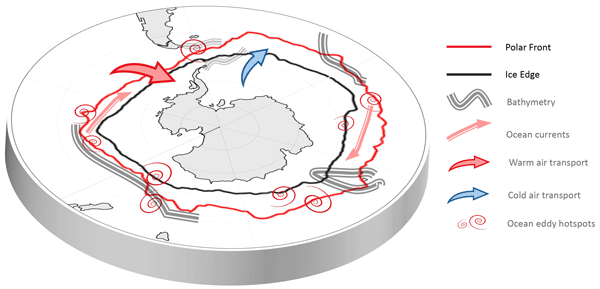
The position of the winter sea ice edge in the Southern Ocean is strongly linked to the one of the Antarctic Circumpolar Current and thus to ocean bathymetry. This is due to the influence of the Antarctic Circumpolar Current on the southward heat flux that limits sea ice expansion, directly through oceanic processes and indirectly through its influence on atmospheric heat transport.
Benjamin Richaud, Katja Fennel, Eric C. J. Oliver, Michael D. DeGrandpre, Timothée Bourgeois, Xianmin Hu, and Youyu Lu
The Cryosphere, 17, 2665–2680, https://doi.org/10.5194/tc-17-2665-2023, https://doi.org/10.5194/tc-17-2665-2023, 2023
Short summary
Short summary
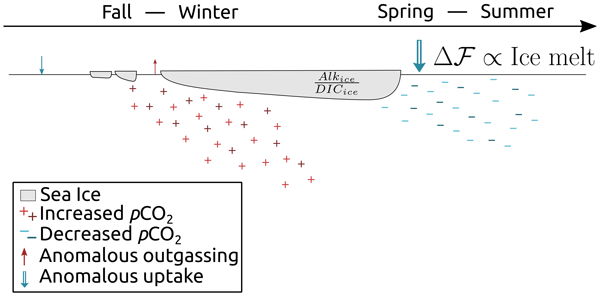
Sea ice is a dynamic carbon reservoir. Its seasonal growth and melt modify the carbonate chemistry in the upper ocean, with consequences for the Arctic Ocean carbon sink. Yet, the importance of this process is poorly quantified. Using two independent approaches, this study provides new methods to evaluate the error in air–sea carbon flux estimates due to the lack of biogeochemistry in ice in earth system models. Those errors range from 5 % to 30 %, depending on the model and climate projection.
Fareeha Siddique, Daniel Fiifi Tawia Hagan, Guojie Wang, David Docquier, and Stéphane Vannitsem
EGUsphere, https://doi.org/10.5194/egusphere-2026-267, https://doi.org/10.5194/egusphere-2026-267, 2026
This preprint is open for discussion and under review for Earth System Dynamics (ESD).
Short summary
Short summary
Understanding causality in Earth-system processes is challenging because multiple drivers act simultaneously and can distort causal estimates. We develop a diagnostic framework using controlled experiments and real land–atmosphere data to identify when external drivers affect how one variable influences another (via Liang–Kleeman Information Flow). This influence depends on system stress, guiding when multivariate conditioning is necessary.
Hugues Goosse, Stephy Libera, Alberto C. Naveira Garabato, Benjamin Richaud, Alessandro Silvano, and Martin Vancoppenolle
The Cryosphere, 19, 5763–5779, https://doi.org/10.5194/tc-19-5763-2025, https://doi.org/10.5194/tc-19-5763-2025, 2025
Short summary
Short summary
The position of the winter sea ice edge in the Southern Ocean is strongly linked to the one of the Antarctic Circumpolar Current and thus to ocean bathymetry. This is due to the influence of the Antarctic Circumpolar Current on the southward heat flux that limits sea ice expansion, directly through oceanic processes and indirectly through its influence on atmospheric heat transport.
Annelies Sticker, François Massonnet, Thierry Fichefet, Patricia DeRepentigny, Alexandra Jahn, David Docquier, Christopher Wyburn-Powell, Daphne Quint, Erica Shivers, and Makayla Ortiz
The Cryosphere, 19, 3259–3277, https://doi.org/10.5194/tc-19-3259-2025, https://doi.org/10.5194/tc-19-3259-2025, 2025
Short summary
Short summary
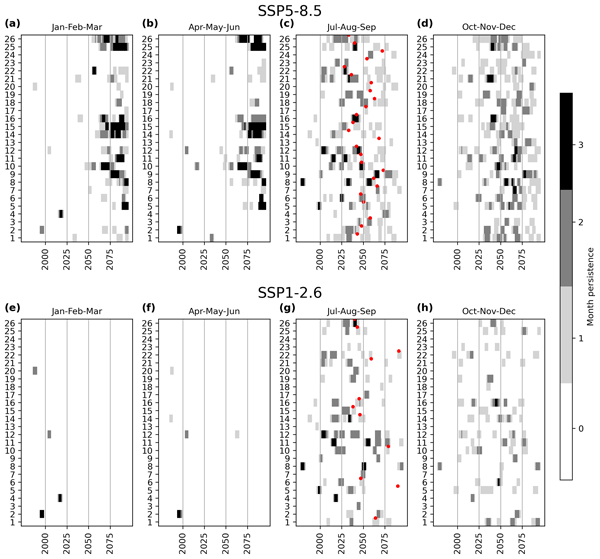
Our study analyzes rapid ice loss events (RILEs) in the Arctic, which are significant reductions in sea ice extent. RILEs are expected throughout the year, varying in frequency and duration with the seasons. Our research gives a year-round analysis of their characteristics in climate models and suggests that summer RILEs could begin before the middle of the century. Understanding these events is crucial as they can have profound impacts on the Arctic environment.
Cécile Osy, Sophie Opfergelt, Arsène Druel, and François Massonnet
EGUsphere, https://doi.org/10.5194/egusphere-2025-3680, https://doi.org/10.5194/egusphere-2025-3680, 2025
Preprint archived
Short summary
Short summary
The refreezing period of the active layer (the layer on top of the permafrost that freezes and thaws each year) is changing, with a delay of about five days over a large area in Siberia from 1950 to 2020 in the ERA5-Land reanalysis data. We investigate the drivers of this delay, and find that 2 m air temperature is the main driver of these changes at the large scale, which contrasts with field results in which snow cover is the main driver of changes in refreezing dynamics.
Florian Sauerland, Pierre-Vincent Huot, Sylvain Marchi, Thierry Fichefet, Hugues Goosse, Konstanze Haubner, François Klein, François Massonnet, Bianca Mezzina, Eduardo Moreno-Chamarro, Pablo Ortega, Frank Pattyn, Charles Pelletier, Deborah Verfaillie, Lars Zipf, and Nicole van Lipzig
EGUsphere, https://doi.org/10.5194/egusphere-2025-2889, https://doi.org/10.5194/egusphere-2025-2889, 2025
Short summary
Short summary
We simulated the Antarctic climate from 1985 to 2014. Our model is driven using the ERA-5 reanalysis for one simulation and the EC-Earth global climate model for three others. Most of the simulated trends, such as sea ice extent and precipitation over land, have opposite signs for the two drivers, but agree between the three EC-Earth driven simulations. We conclude that these opposing trends must be due to the different drivers, and that the climate over land is less predictable than over sea.
Baylor Fox-Kemper, Patricia DeRepentigny, Anne Marie Treguier, Christian Stepanek, Eleanor O’Rourke, Chloe Mackallah, Alberto Meucci, Yevgeny Aksenov, Paul J. Durack, Nicole Feldl, Vanessa Hernaman, Céline Heuzé, Doroteaciro Iovino, Gaurav Madan, André L. Marquez, François Massonnet, Jenny Mecking, Dhrubajyoti Samanta, Patrick C. Taylor, Wan-Ling Tseng, and Martin Vancoppenolle
EGUsphere, https://doi.org/10.5194/egusphere-2025-3083, https://doi.org/10.5194/egusphere-2025-3083, 2025
Short summary
Short summary
The earth system model variables needed for studies of the ocean and sea ice are prioritized and requested.
Jerome Sauer, François Massonnet, Giuseppe Zappa, and Francesco Ragone
Earth Syst. Dynam., 16, 683–702, https://doi.org/10.5194/esd-16-683-2025, https://doi.org/10.5194/esd-16-683-2025, 2025
Short summary
Short summary
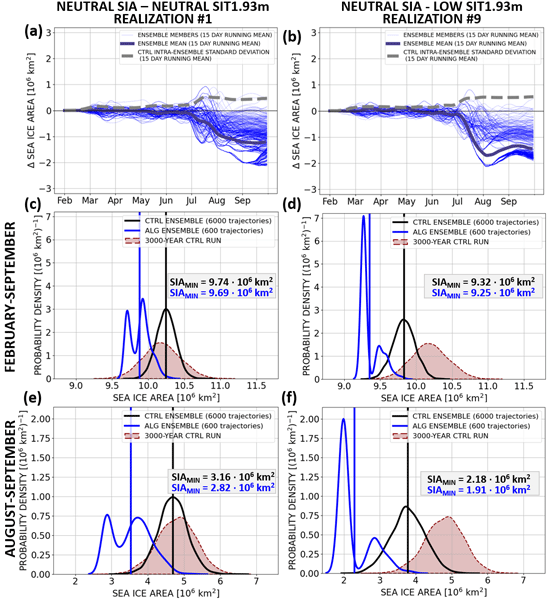
An obstacle in studying climate extremes is the lack of robust statistics. We use a rare event algorithm to gather robust statistics on extreme Arctic sea ice lows with probabilities below 0.1 % and to study drivers of events with amplitudes larger than observed in 2012. The work highlights that the most extreme sea ice reductions result from the combined effects of preconditioning and weather variability, emphasizing the need for thoughtful ensemble design when turning to real applications.
Sofia Allende, Anne Marie Treguier, Camille Lique, Clément de Boyer Montégut, François Massonnet, Thierry Fichefet, and Antoine Barthélemy
Geosci. Model Dev., 17, 7445–7466, https://doi.org/10.5194/gmd-17-7445-2024, https://doi.org/10.5194/gmd-17-7445-2024, 2024
Short summary
Short summary
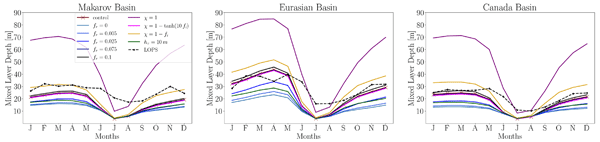
We study the parameters of the turbulent-kinetic-energy mixed-layer-penetration scheme in the NEMO model with regard to sea-ice-covered regions of the Arctic Ocean. This evaluation reveals the impact of these parameters on mixed-layer depth, sea surface temperature and salinity, and ocean stratification. Our findings demonstrate significant impacts on sea ice thickness and sea ice concentration, emphasizing the need for accurately representing ocean mixing to understand Arctic climate dynamics.
Bianca Mezzina, Hugues Goosse, François Klein, Antoine Barthélemy, and François Massonnet
The Cryosphere, 18, 3825–3839, https://doi.org/10.5194/tc-18-3825-2024, https://doi.org/10.5194/tc-18-3825-2024, 2024
Short summary
Short summary
We analyze years with extraordinarily low sea ice extent in Antarctica during summer, until the striking record in 2022. We highlight common aspects among these events, such as the fact that the exceptional melting usually occurs in two key regions and that it is related to winds with a similar direction. We also investigate whether the summer conditions are preceded by an unusual state of the sea ice during the previous winter, as well as the physical processes involved.
David Docquier, Giorgia Di Capua, Reik V. Donner, Carlos A. L. Pires, Amélie Simon, and Stéphane Vannitsem
Nonlin. Processes Geophys., 31, 115–136, https://doi.org/10.5194/npg-31-115-2024, https://doi.org/10.5194/npg-31-115-2024, 2024
Short summary
Short summary
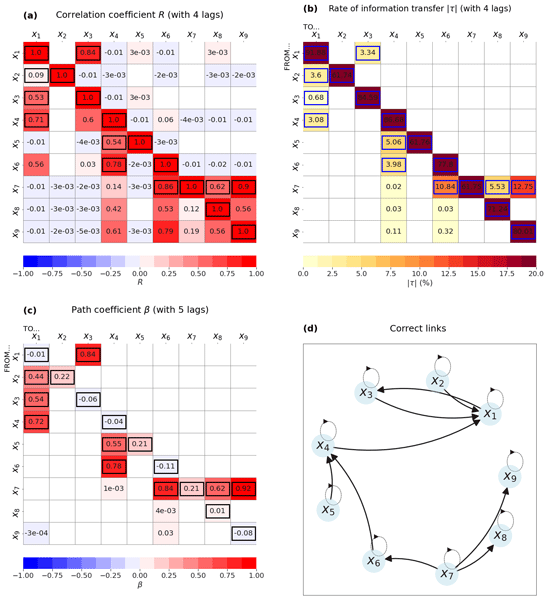
Identifying causes of specific processes is crucial in order to better understand our climate system. Traditionally, correlation analyses have been used to identify cause–effect relationships in climate studies. However, correlation does not imply causation, which justifies the need to use causal methods. We compare two independent causal methods and show that these are superior to classical correlation analyses. We also find some interesting differences between the two methods.
Nico Wunderling, Anna S. von der Heydt, Yevgeny Aksenov, Stephen Barker, Robbin Bastiaansen, Victor Brovkin, Maura Brunetti, Victor Couplet, Thomas Kleinen, Caroline H. Lear, Johannes Lohmann, Rosa Maria Roman-Cuesta, Sacha Sinet, Didier Swingedouw, Ricarda Winkelmann, Pallavi Anand, Jonathan Barichivich, Sebastian Bathiany, Mara Baudena, John T. Bruun, Cristiano M. Chiessi, Helen K. Coxall, David Docquier, Jonathan F. Donges, Swinda K. J. Falkena, Ann Kristin Klose, David Obura, Juan Rocha, Stefanie Rynders, Norman Julius Steinert, and Matteo Willeit
Earth Syst. Dynam., 15, 41–74, https://doi.org/10.5194/esd-15-41-2024, https://doi.org/10.5194/esd-15-41-2024, 2024
Short summary
Short summary
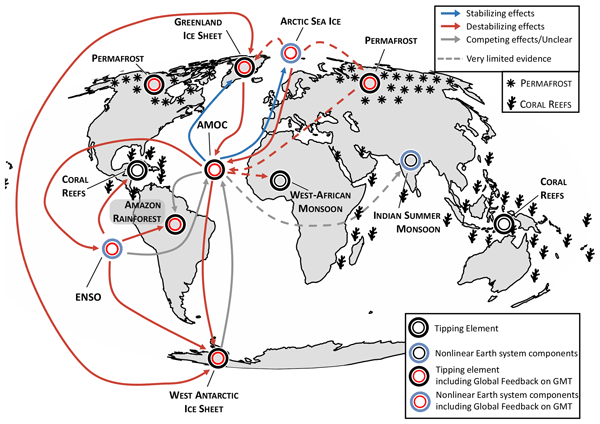
This paper maps out the state-of-the-art literature on interactions between tipping elements relevant for current global warming pathways. We find indications that many of the interactions between tipping elements are destabilizing. This means that tipping cascades cannot be ruled out on centennial to millennial timescales at global warming levels between 1.5 and 2.0 °C or on shorter timescales if global warming surpasses 2.0 °C.
Steve Delhaye, Rym Msadek, Thierry Fichefet, François Massonnet, and Laurent Terray
EGUsphere, https://doi.org/10.5194/egusphere-2023-1748, https://doi.org/10.5194/egusphere-2023-1748, 2023
Preprint archived
Short summary
Short summary
The climate impact of Arctic sea ice loss may depend on the region of sea ice loss and the methodology used to study this impact. This study uses two approaches across seven climate models to investigate the winter atmospheric circulation response to regional sea ice loss. Our findings indicate a consistent atmospheric circulation response to pan-Arctic sea ice loss in most models and across both approaches. In contrast, more uncertainty emerges in the responses linked to regional sea ice loss.
Mukesh Gupta, Leandro Ponsoni, Jean Sterlin, François Massonnet, and Thierry Fichefet
EGUsphere, https://doi.org/10.5194/egusphere-2023-1560, https://doi.org/10.5194/egusphere-2023-1560, 2023
Preprint archived
Short summary
Short summary
We explored the relationship of Arctic September minimum sea ice extent with mid-summer melt pond area fraction, under the present-day climate. We confirm through the advanced numerical modelling, with an explicit melt pond scheme in the global climate model, EC-EARTH3, that melt pond fraction in mid-summer (June–July, not May) shows a strong relationship with the Arctic September sea ice extent. Satellite-based inferences validated our findings of this association.
Benjamin Richaud, Katja Fennel, Eric C. J. Oliver, Michael D. DeGrandpre, Timothée Bourgeois, Xianmin Hu, and Youyu Lu
The Cryosphere, 17, 2665–2680, https://doi.org/10.5194/tc-17-2665-2023, https://doi.org/10.5194/tc-17-2665-2023, 2023
Short summary
Short summary
Sea ice is a dynamic carbon reservoir. Its seasonal growth and melt modify the carbonate chemistry in the upper ocean, with consequences for the Arctic Ocean carbon sink. Yet, the importance of this process is poorly quantified. Using two independent approaches, this study provides new methods to evaluate the error in air–sea carbon flux estimates due to the lack of biogeochemistry in ice in earth system models. Those errors range from 5 % to 30 %, depending on the model and climate projection.
Koffi Worou, Thierry Fichefet, and Hugues Goosse
Weather Clim. Dynam., 4, 511–530, https://doi.org/10.5194/wcd-4-511-2023, https://doi.org/10.5194/wcd-4-511-2023, 2023
Short summary
Short summary
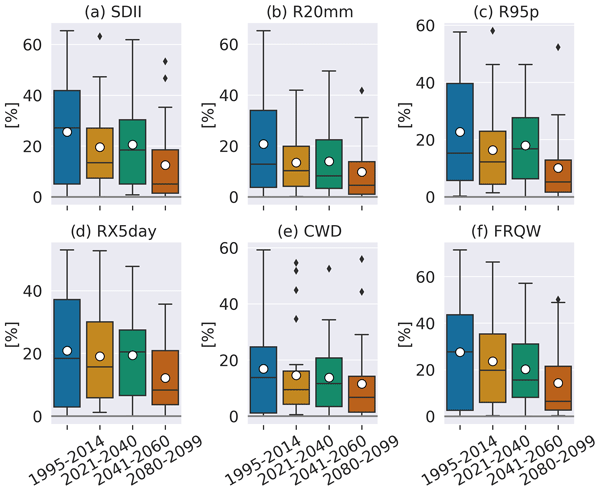
The Atlantic equatorial mode (AEM) of variability is partly responsible for the year-to-year rainfall variability over the Guinea coast. We used the current climate models to explore the present-day and future links between the AEM and the extreme rainfall indices over the Guinea coast. Under future global warming, the total variability of the extreme rainfall indices increases over the Guinea coast. However, the future impact of the AEM on extreme rainfall events decreases over the region.
David Docquier, Stéphane Vannitsem, and Alessio Bellucci
Earth Syst. Dynam., 14, 577–591, https://doi.org/10.5194/esd-14-577-2023, https://doi.org/10.5194/esd-14-577-2023, 2023
Short summary
Short summary
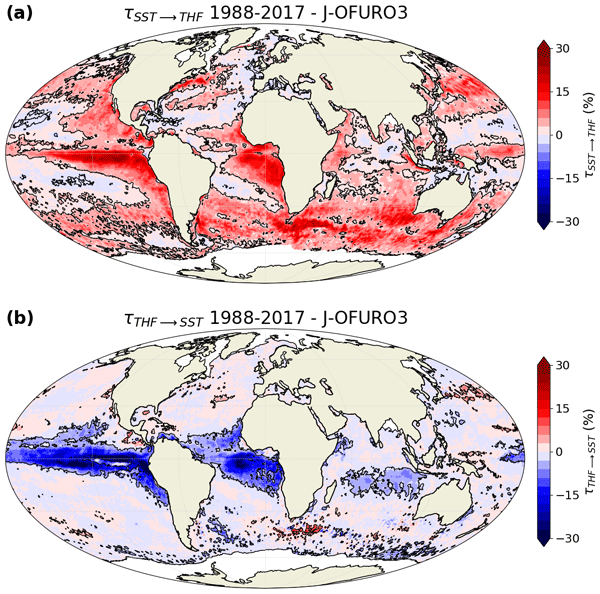
The climate system is strongly regulated by interactions between the ocean and atmosphere. However, many uncertainties remain in the understanding of these interactions. Our analysis uses a relatively novel approach to quantify causal links between the ocean surface and lower atmosphere based on satellite observations. We find that both the ocean and atmosphere influence each other but with varying intensity depending on the region, demonstrating the power of causal methods.
Xia Lin, François Massonnet, Thierry Fichefet, and Martin Vancoppenolle
The Cryosphere, 17, 1935–1965, https://doi.org/10.5194/tc-17-1935-2023, https://doi.org/10.5194/tc-17-1935-2023, 2023
Short summary
Short summary
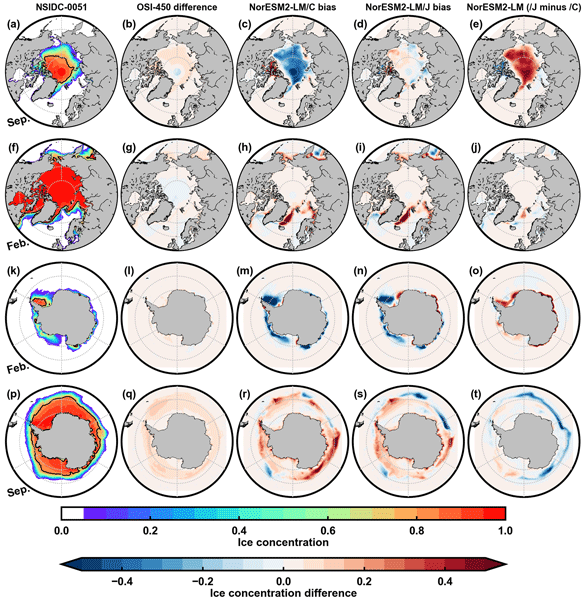
This study provides clues on how improved atmospheric reanalysis products influence sea ice simulations in ocean–sea ice models. The summer ice concentration simulation in both hemispheres can be improved with changed surface heat fluxes. The winter Antarctic ice concentration and the Arctic drift speed near the ice edge and the ice velocity direction simulations are improved with changed wind stress. The radiation fluxes and winds in atmospheric reanalyses are crucial for sea ice simulations.
Hugues Goosse, Sofia Allende Contador, Cecilia M. Bitz, Edward Blanchard-Wrigglesworth, Clare Eayrs, Thierry Fichefet, Kenza Himmich, Pierre-Vincent Huot, François Klein, Sylvain Marchi, François Massonnet, Bianca Mezzina, Charles Pelletier, Lettie Roach, Martin Vancoppenolle, and Nicole P. M. van Lipzig
The Cryosphere, 17, 407–425, https://doi.org/10.5194/tc-17-407-2023, https://doi.org/10.5194/tc-17-407-2023, 2023
Short summary
Short summary
Using idealized sensitivity experiments with a regional atmosphere–ocean–sea ice model, we show that sea ice advance is constrained by initial conditions in March and the retreat season is influenced by the magnitude of several physical processes, in particular by the ice–albedo feedback and ice transport. Atmospheric feedbacks amplify the response of the winter ice extent to perturbations, while some negative feedbacks related to heat conduction fluxes act on the ice volume.
Guillian Van Achter, Thierry Fichefet, Hugues Goosse, and Eduardo Moreno-Chamarro
The Cryosphere, 16, 4745–4761, https://doi.org/10.5194/tc-16-4745-2022, https://doi.org/10.5194/tc-16-4745-2022, 2022
Short summary
Short summary
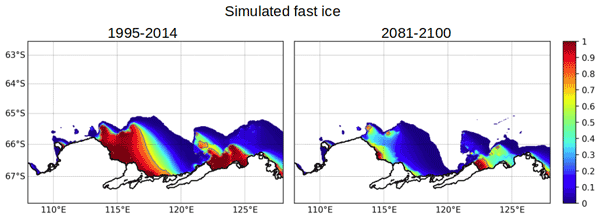
We investigate the changes in ocean–ice interactions in the Totten Glacier area between the last decades (1995–2014) and the end of the 21st century (2081–2100) under warmer climate conditions. By the end of the 21st century, the sea ice is strongly reduced, and the ocean circulation close to the coast is accelerated. Our research highlights the importance of including representations of fast ice to simulate realistic ice shelf melt rate increase in East Antarctica under warming conditions.
Steve Delhaye, Thierry Fichefet, François Massonnet, David Docquier, Rym Msadek, Svenya Chripko, Christopher Roberts, Sarah Keeley, and Retish Senan
Weather Clim. Dynam., 3, 555–573, https://doi.org/10.5194/wcd-3-555-2022, https://doi.org/10.5194/wcd-3-555-2022, 2022
Short summary
Short summary
It is unclear how the atmosphere will respond to a retreat of summer Arctic sea ice. Much attention has been paid so far to weather extremes at mid-latitude and in winter. Here we focus on the changes in extremes in surface air temperature and precipitation over the Arctic regions in summer during and following abrupt sea ice retreats. We find that Arctic sea ice loss clearly shifts the extremes in surface air temperature and precipitation over terrestrial regions surrounding the Arctic Ocean.
Ralf Döscher, Mario Acosta, Andrea Alessandri, Peter Anthoni, Thomas Arsouze, Tommi Bergman, Raffaele Bernardello, Souhail Boussetta, Louis-Philippe Caron, Glenn Carver, Miguel Castrillo, Franco Catalano, Ivana Cvijanovic, Paolo Davini, Evelien Dekker, Francisco J. Doblas-Reyes, David Docquier, Pablo Echevarria, Uwe Fladrich, Ramon Fuentes-Franco, Matthias Gröger, Jost v. Hardenberg, Jenny Hieronymus, M. Pasha Karami, Jukka-Pekka Keskinen, Torben Koenigk, Risto Makkonen, François Massonnet, Martin Ménégoz, Paul A. Miller, Eduardo Moreno-Chamarro, Lars Nieradzik, Twan van Noije, Paul Nolan, Declan O'Donnell, Pirkka Ollinaho, Gijs van den Oord, Pablo Ortega, Oriol Tintó Prims, Arthur Ramos, Thomas Reerink, Clement Rousset, Yohan Ruprich-Robert, Philippe Le Sager, Torben Schmith, Roland Schrödner, Federico Serva, Valentina Sicardi, Marianne Sloth Madsen, Benjamin Smith, Tian Tian, Etienne Tourigny, Petteri Uotila, Martin Vancoppenolle, Shiyu Wang, David Wårlind, Ulrika Willén, Klaus Wyser, Shuting Yang, Xavier Yepes-Arbós, and Qiong Zhang
Geosci. Model Dev., 15, 2973–3020, https://doi.org/10.5194/gmd-15-2973-2022, https://doi.org/10.5194/gmd-15-2973-2022, 2022
Short summary
Short summary
The Earth system model EC-Earth3 is documented here. Key performance metrics show physical behavior and biases well within the frame known from recent models. With improved physical and dynamic features, new ESM components, community tools, and largely improved physical performance compared to the CMIP5 version, EC-Earth3 represents a clear step forward for the only European community ESM. We demonstrate here that EC-Earth3 is suited for a range of tasks in CMIP6 and beyond.
Koffi Worou, Hugues Goosse, Thierry Fichefet, and Fred Kucharski
Earth Syst. Dynam., 13, 231–249, https://doi.org/10.5194/esd-13-231-2022, https://doi.org/10.5194/esd-13-231-2022, 2022
Short summary
Short summary
Over the Guinea Coast, the increased rainfall associated with warm phases of the Atlantic Niño is reasonably well simulated by 24 climate models out of 31, for the present-day conditions. In a warmer climate, general circulation models project a gradual decrease with time of the rainfall magnitude associated with the Atlantic Niño for the 2015–2039, 2040–2069 and 2070–2099 periods. There is a higher confidence in these changes over the equatorial Atlantic than over the Guinea Coast.
Charles Pelletier, Thierry Fichefet, Hugues Goosse, Konstanze Haubner, Samuel Helsen, Pierre-Vincent Huot, Christoph Kittel, François Klein, Sébastien Le clec'h, Nicole P. M. van Lipzig, Sylvain Marchi, François Massonnet, Pierre Mathiot, Ehsan Moravveji, Eduardo Moreno-Chamarro, Pablo Ortega, Frank Pattyn, Niels Souverijns, Guillian Van Achter, Sam Vanden Broucke, Alexander Vanhulle, Deborah Verfaillie, and Lars Zipf
Geosci. Model Dev., 15, 553–594, https://doi.org/10.5194/gmd-15-553-2022, https://doi.org/10.5194/gmd-15-553-2022, 2022
Short summary
Short summary
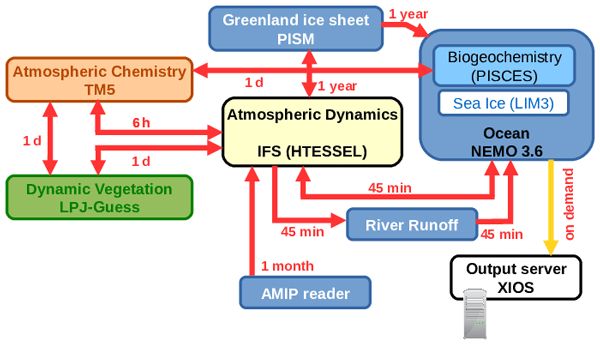
We present PARASO, a circumpolar model for simulating the Antarctic climate. PARASO features five distinct models, each covering different Earth system subcomponents (ice sheet, atmosphere, land, sea ice, ocean). In this technical article, we describe how this tool has been developed, with a focus on the
coupling interfacesrepresenting the feedbacks between the distinct models used for contribution. PARASO is stable and ready to use but is still characterized by significant biases.
Xia Lin, François Massonnet, Thierry Fichefet, and Martin Vancoppenolle
Geosci. Model Dev., 14, 6331–6354, https://doi.org/10.5194/gmd-14-6331-2021, https://doi.org/10.5194/gmd-14-6331-2021, 2021
Short summary
Short summary
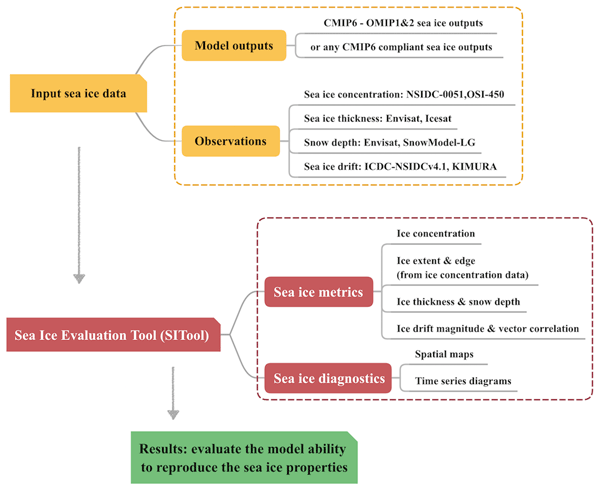
This study introduces a new Sea Ice Evaluation Tool (SITool) to evaluate the model skills on the bipolar sea ice simulations by providing performance metrics and diagnostics. SITool is applied to evaluate the CMIP6 OMIP simulations. By changing the atmospheric forcing from CORE-II to JRA55-do data, many aspects of sea ice simulations are improved. SITool will be useful for helping teams managing various versions of a sea ice model or tracking the time evolution of model performance.
Tian Tian, Shuting Yang, Mehdi Pasha Karami, François Massonnet, Tim Kruschke, and Torben Koenigk
Geosci. Model Dev., 14, 4283–4305, https://doi.org/10.5194/gmd-14-4283-2021, https://doi.org/10.5194/gmd-14-4283-2021, 2021
Short summary
Short summary
Three decadal prediction experiments with EC-Earth3 are performed to investigate the impact of ocean, sea ice concentration and thickness initialization, respectively. We find that the persistence of perennial thick ice in the central Arctic can affect the sea ice predictability in its adjacent waters via advection process or wind, despite those regions being seasonally ice free during two recent decades. This has implications for the coming decades as the thinning of Arctic sea ice continues.
Christoph Kittel, Charles Amory, Cécile Agosta, Nicolas C. Jourdain, Stefan Hofer, Alison Delhasse, Sébastien Doutreloup, Pierre-Vincent Huot, Charlotte Lang, Thierry Fichefet, and Xavier Fettweis
The Cryosphere, 15, 1215–1236, https://doi.org/10.5194/tc-15-1215-2021, https://doi.org/10.5194/tc-15-1215-2021, 2021
Short summary
Short summary
The future surface mass balance (SMB) of the Antarctic ice sheet (AIS) will influence the ice dynamics and the contribution of the ice sheet to the sea level rise. We investigate the AIS sensitivity to different warmings using physical and statistical downscaling of CMIP5 and CMIP6 models. Our results highlight a contrasting effect between the grounded ice sheet (where the SMB is projected to increase) and ice shelves (where the future SMB depends on the emission scenario).
Cited articles
Aylmer, J., Ferreira, D., and Feltham, D.: Different Mechanisms of Arctic and Antarctic Sea Ice Response to Ocean Heat Transport, Climate Dynamics, 59, 315–329, https://doi.org/10.1007/s00382-021-06131-x, 2022. a
Aylmer, J. R., Ferreira, D., and Feltham, D. L.: Impact of Ocean Heat Transport on Sea Ice Captured by a Simple Energy Balance Model, Communications Earth & Environment, 5, 1–17, https://doi.org/10.1038/s43247-024-01565-7, 2024. a
Batrak, Y. and Müller, M.: On the Warm Bias in Atmospheric Reanalyses Induced by the Missing Snow over Arctic Sea-Ice, Nature Communications, 10, 4170, https://doi.org/10.1038/s41467-019-11975-3, 2019. a
Baxter, I., Ding, Q., Schweiger, A., L'Heureux, M., Baxter, S., Wang, T., Zhang, Q., Harnos, K., Markle, B., Topal, D., and Lu, J.: How Tropical Pacific Surface Cooling Contributed to Accelerated Sea Ice Melt from 2007 to 2012 as Ice Is Thinned by Anthropogenic Forcing, Journal of Climate, 32, 8583–8602, https://doi.org/10.1175/JCLI-D-18-0783.1, 2019. a
Bitz, C. M. and Roe, G. H.: A Mechanism for the High Rate of Sea Ice Thinning in the Arctic Ocean, Journal of Climate, 17, 3623–3632, https://doi.org/10.1175/1520-0442(2004)017<3623:AMFTHR>2.0.CO;2, 2004. a
Carmack, E., Polyakov, I., Padman, L., Fer, I., Hunke, E., Hutchings, J., Jackson, J., Kelley, D., Kwok, R., Layton, C., Melling, H., Perovich, D., Persson, O., Ruddick, B., Timmermans, M.-L., Toole, J., Ross, T., Vavrus, S., and Winsor, P.: Toward Quantifying the Increasing Role of Oceanic Heat in Sea Ice Loss in the New Arctic, Bulletin of the American Meteorological Society, 96, 2079–2105, https://doi.org/10.1175/BAMS-D-13-00177.1, 2015. a
Cavalieri, D. J. and Parkinson, C. L.: Antarctic Sea Ice Variability and Trends, 1979–2006, Journal of Geophysical Research: Oceans, 113, https://doi.org/10.1029/2007JC004564, 2008. a
Chemke, R., Ming, Y., and Yuval, J.: The intensification of winter mid-latitude storm tracks in the Southern Hemisphere, Nature Climate Change, 12, 553–557, https://doi.org/10.1038/s41558-022-01368-8, 2022. a
Cohen, J., Zhang, X., Francis, J., Jung, T., Kwok, R., Overland, J., Ballinger, T. J., Bhatt, U. S., Chen, H. W., Coumou, D., Feldstein, S., Gu, H., Handorf, D., Henderson, G., Ionita, M., Kretschmer, M., Laliberte, F., Lee, S., Linderholm, H. W., Maslowski, W., Peings, Y., Pfeiffer, K., Rigor, I., Semmler, T., Stroeve, J., Taylor, P. C., Vavrus, S., Vihma, T., Wang, S., Wendisch, M., Wu, Y., and Yoon, J.: Divergent consensuses on Arctic amplification influence on midlatitude severe winter weather, Nature Climate Change, 10, 20–29, https://doi.org/10.1038/s41558-019-0662-y, 2020. a
Crawford, A. D. and Serreze, M. C.: Projected Changes in the Arctic Frontal Zone and Summer Arctic Cyclone Activity in the CESM Large Ensemble, Journal of Climate, 30, 9847–9869, https://doi.org/10.1175/JCLI-D-17-0296.1, 2017. a
Delhaye, S., Fichefet, T., Massonnet, F., Docquier, D., Msadek, R., Chripko, S., Roberts, C., Keeley, S., and Senan, R.: Summertime changes in climate extremes over the peripheral Arctic regions after a sudden sea ice retreat, Weather Clim. Dynam., 3, 555–573, https://doi.org/10.5194/wcd-3-555-2022, 2022. a
Docquier, D. and Koenigk, T.: A Review of Interactions between Ocean Heat Transport and Arctic Sea Ice, Environmental Research Letters, 16, 123002, https://doi.org/10.1088/1748-9326/ac30be, 2021. a
Docquier, D., Massonnet, F., Barthélemy, A., Tandon, N. F., Lecomte, O., and Fichefet, T.: Relationships between Arctic sea ice drift and strength modelled by NEMO-LIM3.6, The Cryosphere, 11, 2829–2846, https://doi.org/10.5194/tc-11-2829-2017, 2017. a
Docquier, D., Koenigk, T., Fuentes-Franco, R., Karami, M. P., and Ruprich-Robert, Y.: Impact of Ocean Heat Transport on the Arctic Sea-Ice Decline: A Model Study with EC-Earth3, Climate Dynamics, 56, 1407–1432, https://doi.org/10.1007/s00382-020-05540-8, 2021. a, b
Docquier, D., Massonnet, F., Ragone, F., Sticker, A., Fichefet, T., and Vannitsem, S.: Drivers of Summer Arctic Sea-Ice Extent at Interannual Time Scale in CMIP6 Large Ensembles Revealed by Information Flow, Scientific Reports, 14, 24236, https://doi.org/10.1038/s41598-024-76056-y, 2024. a, b, c
Docquier, D., Massonnet, F., Richaud, B., Fichefet, T., Goosse, H., Mezzina, B., Topál, D., and Vannitsem, S.: Drivers of summer Antarctic sea-ice extent at interannual time scale in CMIP6 large ensembles based on information flow, Climate Dynamics, 63, 374, https://doi.org/10.1007/s00382-025-07878-3, 2025. a
Eayrs, C., Li, X., Raphael, M. N., and Holland, D. M.: Rapid Decline in Antarctic Sea Ice in Recent Years Hints at Future Change, Nature Geoscience, 14, 460–464, https://doi.org/10.1038/s41561-021-00768-3, 2021. a
Francis, J. A. and Wu, B.: Why Has No New Record-Minimum Arctic Sea-Ice Extent Occurred since September 2012?, Environmental Research Letters, 15, 114034, https://doi.org/10.1088/1748-9326/abc047, 2020. a
Gani, S., Sirven, J., Sennéchael, N., and Provost, C.: Revisiting Winter Arctic Ice Mass Balance Observations With a 1-D Model: Sensitivity Studies, Snow Density Estimation, Flooding, and Snow Ice Formation, Journal of Geophysical Research: Oceans, 124, 9295–9316, https://doi.org/10.1029/2019JC015431, 2019. a
Garcia, H. E., Boyer, T. P., Baranova, O. K., Locarnini, R. A., Mishonov, A. V., Grodsky, A., Paver, C. R., Weathers, K. W., Smolyar, I. V., Reagan, J. R., Seidov, D., and Zweng, M. M.: World Ocean Atlas 2018: Product Documentation., Report, Ocean Climate Laboratory NCEI/NESDIS/NOAA, https://doi.org/10.25923/tzyw-rp36, 2019. a
Gilbert, E. and Holmes, C.: 2023's Antarctic Sea Ice Extent Is the Lowest on Record, Weather, 79, 46–51, https://doi.org/10.1002/wea.4518, 2024. a
Goosse, H. and Zunz, V.: Decadal trends in the Antarctic sea ice extent ultimately controlled by ice–ocean feedback, The Cryosphere, 8, 453–470, https://doi.org/10.5194/tc-8-453-2014, 2014. a
Goosse, H., Arzel, O., Bitz, C. M., de Montety, A., and Vancoppenolle, M.: Increased Variability of the Arctic Summer Ice Extent in a Warmer Climate, Geophysical Research Letters, 36, https://doi.org/10.1029/2009GL040546, 2009. a
Goosse, H., Kay, J. E., Armour, K. C., Bodas-Salcedo, A., Chepfer, H., Docquier, D., Jonko, A., Kushner, P. J., Lecomte, O., Massonnet, F., Park, H.-S., Pithan, F., Svensson, G., and Vancoppenolle, M.: Quantifying Climate Feedbacks in Polar Regions, Nature Communications, 9, 1919, https://doi.org/10.1038/s41467-018-04173-0, 2018. a
Guemas, V., Doblas-Reyes, F. J., Germe, A., Chevallier, M., and Salas y Mélia, D.: September 2012 Arctic Sea Ice Minimum: Discriminating between Sea Ice Memory, the August 2012 Extreme Storm and Prevailing Warm Conditions, Bulletin of the American Meteorological Society, S20–S22, https://doi.org/10.1175/BAMS-D-13-00085.1, 2013. a, b, c
Hersbach, H., Bell, B., Berrisford, P., Hirahara, S., Horányi, A., Muñoz-Sabater, J., Nicolas, J., Peubey, C., Radu, R., Schepers, D., Simmons, A., Soci, C., Abdalla, S., Abellan, X., Balsamo, G., Bechtold, P., Biavati, G., Bidlot, J., Bonavita, M., De Chiara, G., Dahlgren, P., Dee, D., Diamantakis, M., Dragani, R., Flemming, J., Forbes, R., Fuentes, M., Geer, A., Haimberger, L., Healy, S., Hogan, R. J., Hólm, E., Janisková, M., Keeley, S., Laloyaux, P., Lopez, P., Lupu, C., Radnoti, G., de Rosnay, P., Rozum, I., Vamborg, F., Villaume, S., and Thépaut, J.-N.: The ERA5 Global Reanalysis, Quarterly Journal of the Royal Meteorological Society, 146, 1999–2049, https://doi.org/10.1002/qj.3803, 2020. a
Hobbs, W., Spence, P., Meyer, A., Schroeter, S., Fraser, A. D., Reid, P., Tian, T. R., Wang, Z., Liniger, G., Doddridge, E. W., and Boyd, P. W.: Observational Evidence for a Regime Shift in Summer Antarctic Sea Ice, Journal of Climate, 37, 2263–2275, https://doi.org/10.1175/JCLI-D-23-0479.1, 2024. a
Hobbs, W. R., Massom, R., Stammerjohn, S., Reid, P., Williams, G., and Meier, W.: A Review of Recent Changes in Southern Ocean Sea Ice, Their Drivers and Forcings, Global and Planetary Change, 143, 228–250, https://doi.org/10.1016/j.gloplacha.2016.06.008, 2016. a
Holland, M. M., Bailey, D. A., and Vavrus, S.: Inherent Sea Ice Predictability in the Rapidly Changing Arctic Environment of the Community Climate System Model, Version 3, Climate Dynamics, 36, 1239–1253, https://doi.org/10.1007/s00382-010-0792-4, 2011. a
Holland, M. M., Bitz, C. M., Tremblay, L.-B., and Bailey, D. A.: The Role of Natural Versus Forced Change in Future Rapid Summer Arctic Ice Loss, in: Geophysical Monograph Series, edited by DeWeaver, E. T., Bitz, C. M., and Tremblay, L.-B., American Geophysical Union, Washington, D.C., 133–150, ISBN 978-1-118-66647-0 978-0-87590-445-0, https://doi.org/10.1029/180GM10, 2013. a
Huang, B., Wang, Z., Yin, X., Arguez, A., Graham, G., Liu, C., Smith, T., and Zhang, H.-M.: Prolonged Marine Heatwaves in the Arctic: 1982–2020, Geophysical Research Letters, 48, e2021GL095590, https://doi.org/10.1029/2021GL095590, 2021. a
Hunke, E. C., Hebert, D. A., and Lecomte, O.: Level-ice melt ponds in the Los Alamos sea ice model, CICE, Ocean Modelling, 71, 26–42, https://doi.org/10.1016/j.ocemod.2012.11.008, 2013. a
Ionita, M.: Large-Scale Drivers of the Exceptionally Low Winter Antarctic Sea Ice Extent in 2023, Frontiers in Earth Science, 12, https://doi.org/10.3389/feart.2024.1333706, 2024. a, b, c
Jackson, K., Wilkinson, J., Maksym, T., Meldrum, D., Beckers, J., Haas, C., and Mackenzie, D.: A Novel and Low-Cost Sea Ice Mass Balance Buoy, Journal of Atmospheric and Oceanic Technology, 30, 2676–2688, https://doi.org/10.1175/JTECH-D-13-00058.1, 2013. a
Kauker, F., Kaminski, T., Karcher, M., Giering, R., Gerdes, R., and Voßbeck, M.: Adjoint Analysis of the 2007 All Time Arctic Sea-Ice Minimum, Geophysical Research Letters, 36, https://doi.org/10.1029/2008GL036323, 2009. a, b, c
Keen, A. and Blockley, E.: Investigating future changes in the volume budget of the Arctic sea ice in a coupled climate model, The Cryosphere, 12, 2855–2868, https://doi.org/10.5194/tc-12-2855-2018, 2018. a
Keen, A., Blockley, E., Bailey, D. A., Boldingh Debernard, J., Bushuk, M., Delhaye, S., Docquier, D., Feltham, D., Massonnet, F., O'Farrell, S., Ponsoni, L., Rodriguez, J. M., Schroeder, D., Swart, N., Toyoda, T., Tsujino, H., Vancoppenolle, M., and Wyser, K.: An inter-comparison of the mass budget of the Arctic sea ice in CMIP6 models, The Cryosphere, 15, 951–982, https://doi.org/10.5194/tc-15-951-2021, 2021. a, b, c, d
Koenigk, T., Caian, M., Nikulin, G., and Schimanke, S.: Regional Arctic Sea Ice Variations as Predictor for Winter Climate Conditions, Climate Dynamics, 46, 317–337, https://doi.org/10.1007/s00382-015-2586-1, 2016. a
Kwok, R.: Arctic Sea Ice Thickness, Volume, and Multiyear Ice Coverage: Losses and Coupled Variability (1958–2018), Environmental Research Letters, 13, 105005, https://doi.org/10.1088/1748-9326/aae3ec, 2018. a, b, c
Landy, J. C., Dawson, G. J., Tsamados, M., Bushuk, M., Stroeve, J. C., Howell, S. E. L., Krumpen, T., Babb, D. G., Komarov, A. S., Heorton, H. D. B. S., Belter, H. J., and Aksenov, Y.: A Year-Round Satellite Sea-Ice Thickness Record from CryoSat-2, Nature, 609, 517–522, https://doi.org/10.1038/s41586-022-05058-5, 2022. a
Li, S., Huang, G., Li, X., Liu, J., and Fan, G.: An Assessment of the Antarctic Sea Ice Mass Budget Simulation in CMIP6 Historical Experiment, Frontiers in Earth Science, 9, https://doi.org/10.3389/feart.2021.649743, 2021. a, b
Liang, X., Li, X., Bi, H., Losch, M., Gao, Y., Zhao, F., Tian, Z., and Liu, C.: A Comparison of Factors That Led to the Extreme Sea Ice Minima in the Twenty-First Century in the Arctic Ocean, Journal of Climate, 35, 1249–1265, https://doi.org/10.1175/JCLI-D-21-0199.1, 2022. a
Liao, S., Luo, H., Wang, J., Shi, Q., Zhang, J., and Yang, Q.: An evaluation of Antarctic sea-ice thickness from the Global Ice-Ocean Modeling and Assimilation System based on in situ and satellite observations, The Cryosphere, 16, 1807–1819, https://doi.org/10.5194/tc-16-1807-2022, 2022. a
Lindsay, R. and Schweiger, A.: Arctic sea ice thickness loss determined using subsurface, aircraft, and satellite observations, The Cryosphere, 9, 269–283, https://doi.org/10.5194/tc-9-269-2015, 2015. a
Locarnini, M., Mishonov, A., Baranova, O., Boyer, T., Zweng, M., Garcia, H., Reagan, J., Seidov, D., Weathers, K., Paver, C., Smolyar, I., Baranova, O., Boyer, T., Zweng, M., Garcia, H., Reagan, J., Seidov, D., Weathers, K., Paver, C., and Smolyar, I.: World Ocean Atlas 2018, Volume 1: Temperature, NOAA Atlas NESDIS 81, https://doi.org/10.25923/e5rn-9711, 2018. a
Lukovich, J. V., Stroeve, J. C., Crawford, A., Hamilton, L., Tsamados, M., Heorton, H., and Massonnet, F.: Summer Extreme Cyclone Impacts on Arctic Sea Ice, Journal of Climate, 34, 4817–4834, https://doi.org/10.1175/JCLI-D-19-0925.1, 2021. a
Lüpkes, C., Gryanik, V. M., Hartmann, J., and Andreas, E. L.: A parametrization, based on sea ice morphology, of the neutral atmospheric drag coefficients for weather prediction and climate models, Journal of Geophysical Research: Atmospheres, 117, https://doi.org/10.1029/2012JD017630, 2012. a
Madec, G., Bell, M., Blaker, A., Bricaud, C., Bruciaferri, D., Castrillo, M., Calvert, D., Chanut, J., Clementi, E., Coward, A., Epicoco, I., Éthé, C., Ganderton, J., Harle, J., Hutchinson, K., Iovino, D., Lea, D., Lovato, T., Martin, M., Martin, N., Mele, F., Martins, D., Masson, S., Mathiot, P., Mele, F., Mocavero, S., Müller, S., Nurser, A. J. G., Paronuzzi, S., Peltier, M., Person, R., Rousset, C., Rynders, S., Samson, G., Téchené, S., Vancoppenolle, M., and Wilson, C.: NEMO Ocean Engine Reference Manual, Zenodo, https://doi.org/10.5281/zenodo.8167700, 2023. a
Maksym, T.: Arctic and Antarctic Sea Ice Change: Contrasts, Commonalities, and Causes, Annual Review of Marine Science, 11, 187–213, https://doi.org/10.1146/annurev-marine-010816-060610, 2019. a, b
Massonnet, F., Mathiot, P., Fichefet, T., Goosse, H., König Beatty, C., Vancoppenolle, M., and Lavergne, T.: A Model Reconstruction of the Antarctic Sea Ice Thickness and Volume Changes over 1980–2008 Using Data Assimilation, Ocean Modelling, 64, 67–75, https://doi.org/10.1016/j.ocemod.2013.01.003, 2013. a
Massonnet, F., Barthélemy, A., Worou, K., Fichefet, T., Vancoppenolle, M., Rousset, C., and Moreno-Chamarro, E.: On the discretization of the ice thickness distribution in the NEMO3.6-LIM3 global ocean–sea ice model, Geosci. Model Dev., 12, 3745–3758, https://doi.org/10.5194/gmd-12-3745-2019, 2019. a, b, c
Maykut, G. A. and Untersteiner, N.: Some Results from a Time-Dependent Thermodynamic Model of Sea Ice, Journal of Geophysical Research, 76, 1550–1575, https://doi.org/10.1029/JC076i006p01550, 1971. a
Meier, W. and Stroeve, J.: An Updated Assessment of the Changing Arctic Sea Ice Cover, Oceanography, 35, https://doi.org/10.5670/oceanog.2022.114, 2022. a
Meier, W., Fetterer, F., Windnagel, A., and Stewart, J.: NOAA/NSIDC Climate Data Record of Passive Microwave Sea Ice Concentration, Version 4, Colorado USA. National Snow and Ice Data Center [data set], https://doi.org/10.7265/efmz-2t65, 2021. a
Mezzina, B., Goosse, H., Klein, F., Barthélemy, A., and Massonnet, F.: The role of atmospheric conditions in the Antarctic sea ice extent summer minima, The Cryosphere, 18, 3825–3839, https://doi.org/10.5194/tc-18-3825-2024, 2024. a, b, c
O'Brien, J. K., Krishfield, R. A., Timmermans, M.-L., and Toole, J. M.: The Tethered Ocean Profiler, TOP, in: OCEANS 2023 – Limerick, IEEE, Limerick, Ireland, 1–10, ISBN 9798350332261, https://doi.org/10.1109/OCEANSLimerick52467.2023.10244491, 2023. a
Olason, E. and Notz, D.: Drivers of variability in Arctic sea-ice drift speed, Journal of Geophysical Research: Oceans, 119, 5755–5775, https://doi.org/10.1002/2014JC009897, 2014. a
Olonscheck, D., Mauritsen, T., and Notz, D.: Arctic Sea-Ice Variability Is Primarily Driven by Atmospheric Temperature Fluctuations, Nature Geoscience, 12, 430–434, https://doi.org/10.1038/s41561-019-0363-1, 2019. a
Parkinson, C. L. and Comiso, J. C.: On the 2012 Record Low Arctic Sea Ice Cover: Combined Impact of Preconditioning and an August Storm, Geophysical Research Letters, 40, 1356–1361, https://doi.org/10.1002/grl.50349, 2013. a, b
Perovich, D. K. and Richter-Menge, J. A.: Loss of Sea Ice in the Arctic, Annual Review of Marine Science, 1, 417–441, https://doi.org/10.1146/annurev.marine.010908.163805, 2009. a, b
Perovich, D. K., Richter-Menge, J. A., Jones, K. F., and Light, B.: Sunlight, Water, and Ice: Extreme Arctic Sea Ice Melt during the Summer of 2007, Geophysical Research Letters, 35, https://doi.org/10.1029/2008GL034007, 2008. a, b, c, d
Planck, C. J., Whitlock, J., Polashenski, C., and Perovich, D.: The Evolution of the Seasonal Ice Mass Balance Buoy, Cold Regions Science and Technology, 165, 102792, https://doi.org/10.1016/j.coldregions.2019.102792, 2019. a
Purich, A. and Doddridge, E. W.: Record Low Antarctic Sea Ice Coverage Indicates a New Sea Ice State, Communications Earth & Environment, 4, 1–9, https://doi.org/10.1038/s43247-023-00961-9, 2023. a, b, c, d
Rantanen, M., Karpechko, A. Y., Lipponen, A., Nordling, K., Hyvärinen, O., Ruosteenoja, K., Vihma, T., and Laaksonen, A.: The Arctic Has Warmed Nearly Four Times Faster than the Globe since 1979, Communications Earth & Environment, 3, 1–10, https://doi.org/10.1038/s43247-022-00498-3, 2022. a
Raphael, M. N. and Handcock, M. S.: A New Record Minimum for Antarctic Sea Ice, Nature Reviews Earth & Environment, 3, 215–216, https://doi.org/10.1038/s43017-022-00281-0, 2022. a, b
Raphael, M. N. and Hobbs, W.: The Influence of the Large-Scale Atmospheric Circulation on Antarctic Sea Ice during Ice Advance and Retreat Seasons, Geophysical Research Letters, 41, 5037–5045, https://doi.org/10.1002/2014GL060365, 2014. a
Richaud, B., Massonnet, F., Fichefet, T., Topal, D., Barthélemy, A., and Docquier, D.: Ice mass fluxes for Anatomy of Arctic and Antarctic sea ice lows in an ocean–sea ice model, Zenodo [data set], https://doi.org/10.5281/zenodo.18347836, 2026. a
Rousset, C., Vancoppenolle, M., Madec, G., Fichefet, T., Flavoni, S., Barthélemy, A., Benshila, R., Chanut, J., Levy, C., Masson, S., and Vivier, F.: The Louvain-La-Neuve sea ice model LIM3.6: global and regional capabilities, Geosci. Model Dev., 8, 2991–3005, https://doi.org/10.5194/gmd-8-2991-2015, 2015. a
Schweiger, A., Lindsay, R., Zhang, J., Steele, M., Stern, H., and Kwok, R.: Uncertainty in modeled Arctic sea ice volume, Journal of Geophysical Research: Oceans, 116, https://doi.org/10.1029/2011JC007084, 2011. a
Schweiger, A. J., Zhang, J., Lindsay, R. W., and Steele, M.: Did Unusually Sunny Skies Help Drive the Record Sea Ice Minimum of 2007?, Geophysical Research Letters, 35, https://doi.org/10.1029/2008GL033463, 2008. a, b
Serreze, M. C. and Francis, J. A.: The Arctic Amplification Debate, Climatic Change, 76, 241–264, https://doi.org/10.1007/s10584-005-9017-y, 2006. a
Serreze, M. C. and Meier, W. N.: The Arctic's Sea Ice Cover: Trends, Variability, Predictability, and Comparisons to the Antarctic, Annals of the New York Academy of Sciences, 1436, 36–53, https://doi.org/10.1111/nyas.13856, 2019. a
Serreze, M. C. and Stroeve, J.: Arctic Sea Ice Trends, Variability and Implications for Seasonal Ice Forecasting, Philosophical Transactions of the Royal Society A: Mathematical, Physical and Engineering Sciences, 373, 20140159, https://doi.org/10.1098/rsta.2014.0159, 2015. a
Shimada, K., Kamoshida, T., Itoh, M., Nishino, S., Carmack, E., McLaughlin, F., Zimmermann, S., and Proshutinsky, A.: Pacific Ocean Inflow: Influence on Catastrophic Reduction of Sea Ice Cover in the Arctic Ocean, Geophysical Research Letters, 33, 2005GL025624, https://doi.org/10.1029/2005GL025624, 2006. a
Simmonds, I. and Rudeva, I.: The Great Arctic Cyclone of August 2012, Geophysical Research Letters, 39, https://doi.org/10.1029/2012GL054259, 2012. a
Soriot, C., Vancoppenolle, M., Prigent, C., Jimenez, C., and Frappart, F.: Winter Arctic Sea Ice Volume Decline: Uncertainties Reduced Using Passive Microwave-Based Sea Ice Thickness, Scientific Reports, 14, 21000, https://doi.org/10.1038/s41598-024-70136-9, 2024. a
Stuecker, M. F., Bitz, C. M., and Armour, K. C.: Conditions Leading to the Unprecedented Low Antarctic Sea Ice Extent during the 2016 Austral Spring Season, Geophysical Research Letters, 44, 9008–9019, https://doi.org/10.1002/2017GL074691, 2017. a
Swart, N. C., Fyfe, J. C., Hawkins, E., Kay, J. E., and Jahn, A.: Influence of Internal Variability on Arctic Sea-Ice Trends, Nature Climate Change, 5, 86–89, https://doi.org/10.1038/nclimate2483, 2015. a
Timmermans, M.-L.: The Impact of Stored Solar Heat on Arctic Sea Ice Growth, Geophysical Research Letters, 42, 6399–6406, https://doi.org/10.1002/2015GL064541, 2015. a, b, c, d
Timmermans, M.-L., Toole, J., and Krishfield, R.: Warming of the Interior Arctic Ocean Linked to Sea Ice Losses at the Basin Margins, Science Advances, 4, eaat6773, https://doi.org/10.1126/sciadv.aat6773, 2018. a, b
Toole, J., Krishfield, R., Timmermans, M.-L., and Proshutinsky, A.: The Ice-Tethered Profiler: Argo of the Arctic, Oceanography, 24, 126–135, https://doi.org/10.5670/oceanog.2011.64, 2011. a
Turner, J., Hosking, J. S., Bracegirdle, T. J., Marshall, G. J., and Phillips, T.: Recent Changes in Antarctic Sea Ice, Philosophical Transactions of the Royal Society A: Mathematical, Physical and Engineering Sciences, 373, 20140163, https://doi.org/10.1098/rsta.2014.0163, 2015. a
Turner, J., Phillips, T., Marshall, G. J., Hosking, J. S., Pope, J. O., Bracegirdle, T. J., and Deb, P.: Unprecedented Springtime Retreat of Antarctic Sea Ice in 2016, Geophysical Research Letters, 44, 6868–6875, https://doi.org/10.1002/2017GL073656, 2017. a, b
Turner, J., Guarino, M. V., Arnatt, J., Jena, B., Marshall, G. J., Phillips, T., Bajish, C. C., Clem, K., Wang, Z., Andersson, T., Murphy, E. J., and Cavanagh, R.: Recent Decrease of Summer Sea Ice in the Weddell Sea, Antarctica, Geophysical Research Letters, 47, e2020GL087127, https://doi.org/10.1029/2020GL087127, 2020. a
Turner, J., Holmes, C., Caton Harrison, T., Phillips, T., Jena, B., Reeves-Francois, T., Fogt, R., Thomas, E. R., and Bajish, C. C.: Record Low Antarctic Sea Ice Cover in February 2022, Geophysical Research Letters, 49, e2022GL098904, https://doi.org/10.1029/2022GL098904, 2022. a, b
Vancoppenolle, M., Rousset, C., Blockley, E., Aksenov, Y., Feltham, D., Fichefet, T., Garric, G., Guémas, V., Iovino, D., Keeley, S., Madec, G., Massonnet, F., Ridley, J., Schroeder, D., and Tietsche, S.: SI3, the NEMO Sea Ice Engine, Zenodo, https://doi.org/10.5281/zenodo.7534900, 2023. a
Wang, J., Luo, H., Yang, Q., Liu, J., Yu, L., Shi, Q., and Han, B.: An Unprecedented Record Low Antarctic Sea-ice Extent during Austral Summer 2022, Advances in Atmospheric Sciences, 39, 1591–1597, https://doi.org/10.1007/s00376-022-2087-1, 2022. a, b, c
WMO, W. M. O.: WMO Guidelines on the Calculation of Climate Normals, Technical, WMO, Geneva, https://library.wmo.int/idurl/4/55797 (last access: 23 January 2026), 2017. a
Woodgate, R. A., Weingartner, T., and Lindsay, R.: The 2007 Bering Strait Oceanic Heat Flux and Anomalous Arctic Sea-Ice Retreat, Geophysical Research Letters, 37, https://doi.org/10.1029/2009GL041621, 2010. a, b, c, d
Yadav, J., Kumar, A., and Mohan, R.: Atmospheric Precursors to the Antarctic Sea Ice Record Low in February 2022, Environmental Research Communications, 4, 121005, https://doi.org/10.1088/2515-7620/aca5f2, 2022. a, b
Zampieri, L., Arduini, G., Holland, M., Keeley, S. P. E., Mogensen, K., Shupe, M. D., and Tietsche, S.: A Machine Learning Correction Model of the Winter Clear-Sky Temperature Bias over the Arctic Sea Ice in Atmospheric Reanalyses, Monthly Weather Review, 151, 1443–1458, https://doi.org/10.1175/MWR-D-22-0130.1, 2023. a
Zhang, J. and Rothrock, D. A.: Modeling Global Sea Ice with a Thickness and Enthalpy Distribution Model in Generalized Curvilinear Coordinates, Monthly Weather Review, 131, 845–861, https://doi.org/10.1175/1520-0493(2003)131<0845:MGSIWA>2.0.CO;2, 2003. a
Zhang, J., Lindsay, R., Steele, M., and Schweiger, A.: What Drove the Dramatic Retreat of Arctic Sea Ice during Summer 2007?, Geophysical Research Letters, 35, https://doi.org/10.1029/2008GL034005, 2008. a
Zhang, J., Lindsay, R., Schweiger, A., and Steele, M.: The Impact of an Intense Summer Cyclone on 2012 Arctic Sea Ice Retreat, Geophysical Research Letters, 40, 720–726, https://doi.org/10.1002/grl.50190, 2013. a, b, c
Zhang, L., Delworth, T. L., Yang, X., Zeng, F., Lu, F., Morioka, Y., and Bushuk, M.: The Relative Role of the Subsurface Southern Ocean in Driving Negative Antarctic Sea Ice Extent Anomalies in 2016–2021, Communications Earth & Environment, 3, 1–9, https://doi.org/10.1038/s43247-022-00624-1, 2022. a, b
Zhang, X., Tang, H., Zhang, J., Walsh, J. E., Roesler, E. L., Hillman, B., Ballinger, T. J., and Weijer, W.: Arctic cyclones have become more intense and longer-lived over the past seven decades, Communications Earth & Environment, 4, 348, https://doi.org/10.1038/s43247-023-01003-0, 2023. a
Zweng, M., Reagan, J., Seidov, D., Boyer, T., Locarnini, M., Garcia, H., Mishonov, A., Baranova, O., Weathers, K., Paver, C., Smolyar, I., Seidov, D., Boyer, T., Locarnini, M., Garcia, H., Mishonov, A., Baranova, O., Weathers, K., Paver, C., and Smolyar, I.: World Ocean Atlas 2018, Volume 2: Salinity, https://doi.org/10.25923/9pgv-1224, 2019. a
Short summary
Sea ice covers in the Arctic and Antarctic experienced intense reduction during specific recent years. Using an ocean-sea ice model, we found similarities between hemispheres and years to explain the ice reduction, such as ice melt (or lack of growth) at the ice-ocean interface. Differences between years and regions are also evident, such as increased ice transport or snow precipitation. Our analysis highlights the importance of the ice-ocean interface to understand the sea ice mass budget.
Sea ice covers in the Arctic and Antarctic experienced intense reduction during specific recent...