
Articles | Volume 20, issue 1
https://doi.org/10.5194/tc-20-723-2026
© Author(s) 2026. This work is distributed under
the Creative Commons Attribution 4.0 License.
the Creative Commons Attribution 4.0 License.
https://doi.org/10.5194/tc-20-723-2026
© Author(s) 2026. This work is distributed under
the Creative Commons Attribution 4.0 License.
the Creative Commons Attribution 4.0 License.
Brief communication
| 
28 Jan 2026
Brief communication |
| 28 Jan 2026
| 28 Jan 2026
Brief communication: Intercomparison study reveals pathways for improving the representation of sea-ice biogeochemistry in models
Letizia Tedesco
CORRESPONDING AUTHOR

Marine and Freshwater Solutions, Finnish Environment Institute, Helsinki, Finland
Giulia Castellani
University of Bremen, Institute of Environmental Physics (IUP), Bremen, Germany
Deutsches Zentrum für Luft- und Raumfahrt (DLR), Institut für Physik der Atmosphäre, Oberpfaffenhofen, Germany
Pedro Duarte
Norwegian Polar Institute, Tromsø, Norway
Meibing Jin
University of Alaska Fairbanks, AK, Fairbanks, USA
Sebastien Moreau
Norwegian Polar Institute, Tromsø, Norway
Eric Mortenson
University of Miami, Cooperative Institute for Marine and Atmospheric Studies (CIMAS), Miami, USA
Benjamin Tobey Saenz
Biota.Earth, Berkeley, CA, USA
Nadja Steiner
Institute of Ocean Sciences, Fisheries and Oceans Canada, Sidney, BC, Canada
Canadian Center for Climate Modelling and Analysis, Environment and Climate Change Canada, Victoria, BC, Canada
School of Earth and Ocean Sciences, University of Victoria, Victoria, BC, Canada
Martin Vancoppenolle
Laboratoire d'Océanographie et du Climat, CNRS/IRD/MNHN, Sorbonne Université, Paris, France
Related authors
Letizia Tedesco, Delphine Lannuzel, Julie Janssen, and Lars H. Smedsrud
EGUsphere, https://doi.org/10.5194/egusphere-2025-6509, https://doi.org/10.5194/egusphere-2025-6509, 2026
Short summary
Short summary
Sea ice around Antarctica contains much more iron than the surrounding ocean, but how this iron becomes trapped in ice has been unclear. We used a computer model to show that tiny ice crystals forming in turbulent winter waters can collect iron from seawater and concentrate it in newly formed ice. When this ice melts, it can release a short but intense pulse of iron that helps fuel ocean life and supports the Southern Ocean’s role in regulating climate.
Augustin Lambotte, Thierry Fichefet, François Massonnet, Pierre Rampal, Laurent Brodeau, Jean-François Lemieux, Frédéric Dupont, Martin Vancoppenolle, Antoine Barthélemy, and Pierre-Yves Barriat
EGUsphere, https://doi.org/10.5194/egusphere-2026-3861, https://doi.org/10.5194/egusphere-2026-3861, 2026
This preprint is open for discussion and under review for The Cryosphere (TC).
Short summary
Short summary
Arctic fast ice influences the ocean and is important for Arctic communities and animals. Using the ocean and sea ice model NEMO-SI3, we study the interactions between sea ice mechanical formulation and grounding scheme. While the grounding scheme is the most important mechanism, its effect varies with the mechanical formulation. Our results highlight the importance of accurately simulating fast ice thickness and point to future developments for sea ice mechanical frameworks in numerical models.
Giulia Castellani, Karley Campbell, Sebastien Moreau, and Pedro Duarte
Geosci. Model Dev., 19, 7939–7959, https://doi.org/10.5194/gmd-19-7939-2026, https://doi.org/10.5194/gmd-19-7939-2026, 2026
Short summary
Short summary
Nutrient exchange at the ocean-ice interface is a key process to supply nutrients and support sea-ice algal growth in polar regions. Such fluxes depend on the characteristics of the flow under the ice, whether of smooth or turbulent nature. We developed and implemented a parameterization that accounts for flow regime in two sea-ice biogeochemical models. By enhancing nutrient fluxes, turbulence supports higher primary production, resulting in more than double the biomass accumulation.
Léna Champiot-Bayard, Lester Kwiatkowski, and Martin Vancoppenolle
Biogeosciences, 23, 4735–4758, https://doi.org/10.5194/bg-23-4735-2026, https://doi.org/10.5194/bg-23-4735-2026, 2026
Short summary
Short summary
To investigate the future of primary production, we analyzed outputs from several climate models. Changes vary greatly from one region to another: some areas show large increases, while others experience little change or even declines. These differences reflect the balance between water temperature, light availability, and nutrient supply. We also found that the newer generation of climate models projects a much stronger increase than previous models, but with greater uncertainty.
Baylor Fox-Kemper, Patricia DeRepentigny, Anne Marie Treguier, Christian Stepanek, Eleanor O'Rourke, Chloe Mackallah, Alberto Meucci, Yevgeny Aksenov, Paul J. Durack, Nicole Feldl, Oluwayemi Garuba, Vanessa Hernaman, Céline Heuzé, Doroteaciro Iovino, Gaurav Madan, André L. Marquez, François Massonnet, Jenny Mecking, Dhrubajyoti Samanta, Patrick C. Taylor, Wan-Ling Tseng, and Martin Vancoppenolle
Geosci. Model Dev., 19, 6043–6078, https://doi.org/10.5194/gmd-19-6043-2026, https://doi.org/10.5194/gmd-19-6043-2026, 2026
Short summary
Short summary
The ocean and sea ice are central to Earth's climate system, influencing global heat and carbon cycles, weather patterns, and sea level rise. Here the earth system model variables needed for studies of the ocean and sea ice are prioritized and requested. These requested variables were developed through an international, community-based process.
Hugues Goosse, Cecile Davrinche, Benjamin Richaud, Dániel Topál, Stephy Libera, Alberto C. Naveira Garabato, Alessandro Silvano, Martin Vancoppenolle, and Pablo Ortega
EGUsphere, https://doi.org/10.5194/egusphere-2026-1823, https://doi.org/10.5194/egusphere-2026-1823, 2026
Short summary
Short summary
The variability of the winter sea ice edge is much higher in regions close to the main topographic features of the Southern Ocean than over the smoother abyssal plain. The oceanic bathymetry influences mesoscale eddy activity and the Antarctic Circumpolar Current jets, affecting both oceanic heat transport and sea ice velocity and subsequently sea ice variability.
Hui Gao, Zelun Wu, Zhentao Sun, Diana Cai, Meibing Jin, and Wei-Jun Cai
Earth Syst. Sci. Data, 18, 2443–2467, https://doi.org/10.5194/essd-18-2443-2026, https://doi.org/10.5194/essd-18-2443-2026, 2026
Short summary
Short summary
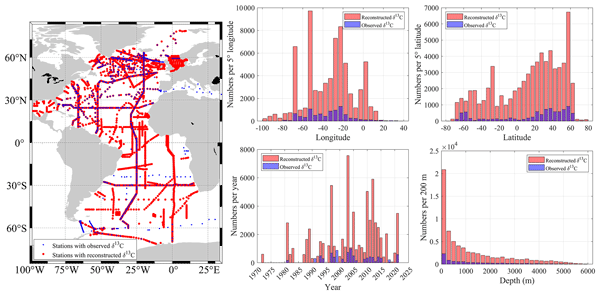
Observations of stable carbon isotopes in dissolved inorganic carbon are sparse, limiting their potential in carbon cycle studies. We compiled 51 cruises and used a machine learning method trained on 37 cruises that passed secondary quality control to reconstruct isotope values in the Atlantic. The reconstruction expands usable samples from 8,941 to 68,435, reducing noise, filling gaps, preserving decadal trend, and strengthening studies of carbon variability and model validation.
Letizia Tedesco, Delphine Lannuzel, Julie Janssen, and Lars H. Smedsrud
EGUsphere, https://doi.org/10.5194/egusphere-2025-6509, https://doi.org/10.5194/egusphere-2025-6509, 2026
Short summary
Short summary
Sea ice around Antarctica contains much more iron than the surrounding ocean, but how this iron becomes trapped in ice has been unclear. We used a computer model to show that tiny ice crystals forming in turbulent winter waters can collect iron from seawater and concentrate it in newly formed ice. When this ice melts, it can release a short but intense pulse of iron that helps fuel ocean life and supports the Southern Ocean’s role in regulating climate.
Guillaume Liniger, Delphine Lannuzel, Sébastien Moreau, Michael S. Dinniman, and Peter G. Strutton
Biogeosciences, 23, 665–682, https://doi.org/10.5194/bg-23-665-2026, https://doi.org/10.5194/bg-23-665-2026, 2026
Short summary
Short summary
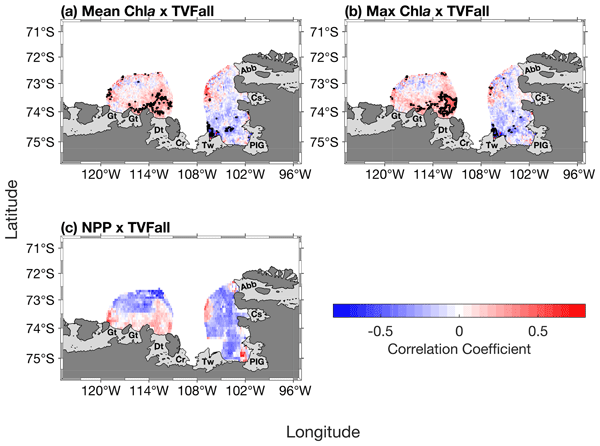
We investigate the phytoplankton bloom variability and its drivers in the Amundsen polynyas (areas of open water within sea ice). Between 1998 and 2017, we find that changes in melting ice shelves may have different impacts on biological productivity between the Amundsen Sea (ASP) and Pine Island (PIP) polynyas. While ice shelves melting seems to play an important role for phytoplankton growth variability in the ASP, light and warmer waters appear to be more important in the PIP.

Hiroshi Sumata, Mats A. Granskog, and Pedro Duarte
Geosci. Model Dev., 19, 647–659, https://doi.org/10.5194/gmd-19-647-2026, https://doi.org/10.5194/gmd-19-647-2026, 2026
Short summary
Short summary
A major shift in Arctic sea ice occurred in 2007, transitioning from thicker, deformed ice to thinner, more uniform ice with reduced surface roughness. This abrupt change likely altered the dynamic and thermodynamic interactions between sea ice and ocean. We present a suite of regional coupled ocean-sea ice simulations designed to assess the potential impact of the regime shift on sea ice-ocean interactions, with a regional focus on the Atlantic sector of the Arctic Ocean.
Hugues Goosse, Stephy Libera, Alberto C. Naveira Garabato, Benjamin Richaud, Alessandro Silvano, and Martin Vancoppenolle
The Cryosphere, 19, 5763–5779, https://doi.org/10.5194/tc-19-5763-2025, https://doi.org/10.5194/tc-19-5763-2025, 2025
Short summary
Short summary
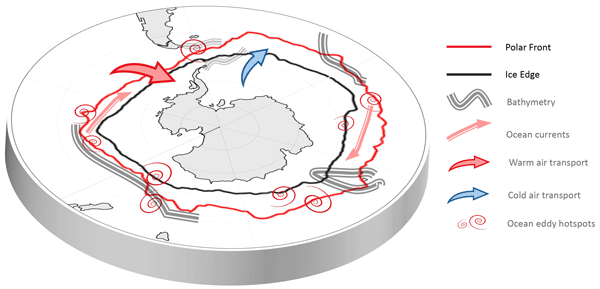
The position of the winter sea ice edge in the Southern Ocean is strongly linked to the one of the Antarctic Circumpolar Current and thus to ocean bathymetry. This is due to the influence of the Antarctic Circumpolar Current on the southward heat flux that limits sea ice expansion, directly through oceanic processes and indirectly through its influence on atmospheric heat transport.
Théo Brivoal, Virginie Guemas, Martin Vancoppenolle, Clément Rousset, and Bertrand Decharme
Geosci. Model Dev., 18, 6885–6902, https://doi.org/10.5194/gmd-18-6885-2025, https://doi.org/10.5194/gmd-18-6885-2025, 2025
Short summary
Short summary
Snow in polar regions is key to sea ice formation and the Earth's climate, but current climate models simplify snow cover on sea ice. This study integrates an intermediate-complexity snow-physics scheme into a sea ice model designed for climate applications. We show that modeling the temporal changes in properties such as the density and thermal conductivity of the snow layers leads to a more accurate representation of heat transfer between the underlying sea ice and the atmosphere.

Ed Blockley, Emma Fiedler, Jeff Ridley, Luke Roberts, Alex West, Dan Copsey, Daniel Feltham, Tim Graham, David Livings, Clement Rousset, David Schroeder, and Martin Vancoppenolle
Geosci. Model Dev., 17, 6799–6817, https://doi.org/10.5194/gmd-17-6799-2024, https://doi.org/10.5194/gmd-17-6799-2024, 2024
Short summary
Short summary
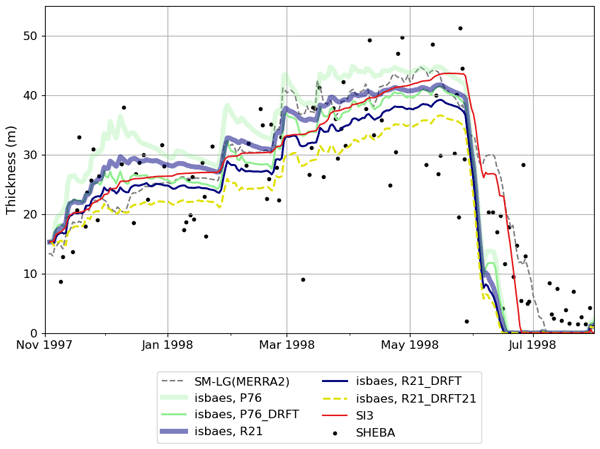
This paper documents the sea ice model component of the latest Met Office coupled model configuration, which will be used as the physical basis for UK contributions to CMIP7. Documentation of science options used in the configuration are given along with a brief model evaluation. This is the first UK configuration to use NEMO’s new SI3 sea ice model. We provide details on how SI3 was adapted to work with Met Office coupling methodology and documentation of coupling processes in the model.
Max Thomas, Briana Cate, Jack Garnett, Inga J. Smith, Martin Vancoppenolle, and Crispin Halsall
The Cryosphere, 17, 3193–3201, https://doi.org/10.5194/tc-17-3193-2023, https://doi.org/10.5194/tc-17-3193-2023, 2023
Short summary
Short summary
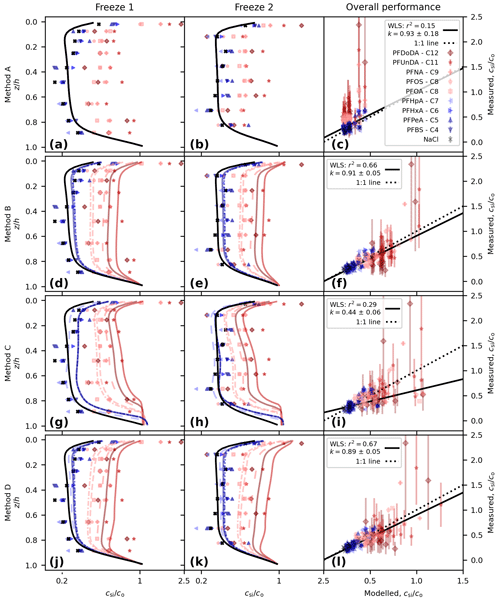
A recent study showed that pollutants can be enriched in growing sea ice beyond what we would expect from a perfectly dissolved chemical. We hypothesise that this effect is caused by the specific properties of the pollutants working in combination with fluid moving through the sea ice. To test our hypothesis, we replicate this behaviour in a sea-ice model and show that this type of modelling can be applied to predicting the transport of chemicals with complex behaviour in sea ice.
Asmita Singh, Susanne Fietz, Sandy J. Thomalla, Nicolas Sanchez, Murat V. Ardelan, Sébastien Moreau, Hanna M. Kauko, Agneta Fransson, Melissa Chierici, Saumik Samanta, Thato N. Mtshali, Alakendra N. Roychoudhury, and Thomas J. Ryan-Keogh
Biogeosciences, 20, 3073–3091, https://doi.org/10.5194/bg-20-3073-2023, https://doi.org/10.5194/bg-20-3073-2023, 2023
Short summary
Short summary
Despite the scarcity of iron in the Southern Ocean, seasonal blooms occur due to changes in nutrient and light availability. Surprisingly, during an autumn bloom in the Antarctic sea-ice zone, the results from incubation experiments showed no significant photophysiological response of phytoplankton to iron addition. This suggests that ambient iron concentrations were sufficient, challenging the notion of iron deficiency in the Southern Ocean through extended iron-replete post-bloom conditions.
Katherine Hutchinson, Julie Deshayes, Christian Éthé, Clément Rousset, Casimir de Lavergne, Martin Vancoppenolle, Nicolas C. Jourdain, and Pierre Mathiot
Geosci. Model Dev., 16, 3629–3650, https://doi.org/10.5194/gmd-16-3629-2023, https://doi.org/10.5194/gmd-16-3629-2023, 2023
Short summary
Short summary
Bottom Water constitutes the lower half of the ocean’s overturning system and is primarily formed in the Weddell and Ross Sea in the Antarctic due to interactions between the atmosphere, ocean, sea ice and ice shelves. Here we use a global ocean 1° resolution model with explicit representation of the three large ice shelves important for the formation of the parent waters of Bottom Water. We find doing so reduces salt biases, improves water mass realism and gives realistic ice shelf melt rates.
Xia Lin, François Massonnet, Thierry Fichefet, and Martin Vancoppenolle
The Cryosphere, 17, 1935–1965, https://doi.org/10.5194/tc-17-1935-2023, https://doi.org/10.5194/tc-17-1935-2023, 2023
Short summary
Short summary
This study provides clues on how improved atmospheric reanalysis products influence sea ice simulations in ocean–sea ice models. The summer ice concentration simulation in both hemispheres can be improved with changed surface heat fluxes. The winter Antarctic ice concentration and the Arctic drift speed near the ice edge and the ice velocity direction simulations are improved with changed wind stress. The radiation fluxes and winds in atmospheric reanalyses are crucial for sea ice simulations.
Yafei Nie, Chengkun Li, Martin Vancoppenolle, Bin Cheng, Fabio Boeira Dias, Xianqing Lv, and Petteri Uotila
Geosci. Model Dev., 16, 1395–1425, https://doi.org/10.5194/gmd-16-1395-2023, https://doi.org/10.5194/gmd-16-1395-2023, 2023
Short summary
Short summary
State-of-the-art Earth system models simulate the observed sea ice extent relatively well, but this is often due to errors in the dynamic and other processes in the simulated sea ice changes cancelling each other out. We assessed the sensitivity of these processes simulated by the coupled ocean–sea ice model NEMO4.0-SI3 to 18 parameters. The performance of the model in simulating sea ice change processes was ultimately improved by adjusting the three identified key parameters.
Hugues Goosse, Sofia Allende Contador, Cecilia M. Bitz, Edward Blanchard-Wrigglesworth, Clare Eayrs, Thierry Fichefet, Kenza Himmich, Pierre-Vincent Huot, François Klein, Sylvain Marchi, François Massonnet, Bianca Mezzina, Charles Pelletier, Lettie Roach, Martin Vancoppenolle, and Nicole P. M. van Lipzig
The Cryosphere, 17, 407–425, https://doi.org/10.5194/tc-17-407-2023, https://doi.org/10.5194/tc-17-407-2023, 2023
Short summary
Short summary
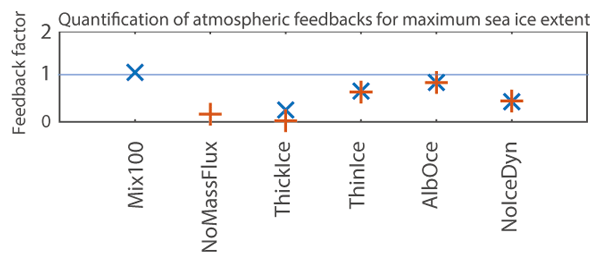
Using idealized sensitivity experiments with a regional atmosphere–ocean–sea ice model, we show that sea ice advance is constrained by initial conditions in March and the retreat season is influenced by the magnitude of several physical processes, in particular by the ice–albedo feedback and ice transport. Atmospheric feedbacks amplify the response of the winter ice extent to perturbations, while some negative feedbacks related to heat conduction fluxes act on the ice volume.
Hanna M. Kauko, Philipp Assmy, Ilka Peeken, Magdalena Różańska-Pluta, Józef M. Wiktor, Gunnar Bratbak, Asmita Singh, Thomas J. Ryan-Keogh, and Sebastien Moreau
Biogeosciences, 19, 5449–5482, https://doi.org/10.5194/bg-19-5449-2022, https://doi.org/10.5194/bg-19-5449-2022, 2022
Short summary
Short summary
This article studies phytoplankton (microscopic
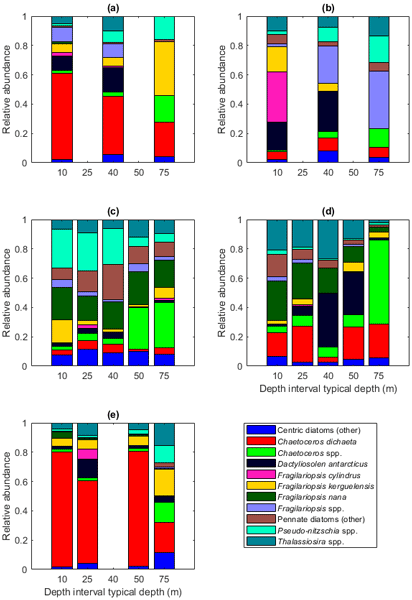
plantsin the ocean capable of photosynthesis) in Kong Håkon VII Hav in the Southern Ocean. Different species play different roles in the ecosystem, and it is therefore important to assess the species composition. We observed that phytoplankton blooms in this area are formed by large diatoms with strong silica armors, which can lead to high silica (and sometimes carbon) export to depth and be important prey for krill.
Julian Gutt, Stefanie Arndt, David Keith Alan Barnes, Horst Bornemann, Thomas Brey, Olaf Eisen, Hauke Flores, Huw Griffiths, Christian Haas, Stefan Hain, Tore Hattermann, Christoph Held, Mario Hoppema, Enrique Isla, Markus Janout, Céline Le Bohec, Heike Link, Felix Christopher Mark, Sebastien Moreau, Scarlett Trimborn, Ilse van Opzeeland, Hans-Otto Pörtner, Fokje Schaafsma, Katharina Teschke, Sandra Tippenhauer, Anton Van de Putte, Mia Wege, Daniel Zitterbart, and Dieter Piepenburg
Biogeosciences, 19, 5313–5342, https://doi.org/10.5194/bg-19-5313-2022, https://doi.org/10.5194/bg-19-5313-2022, 2022
Short summary
Short summary
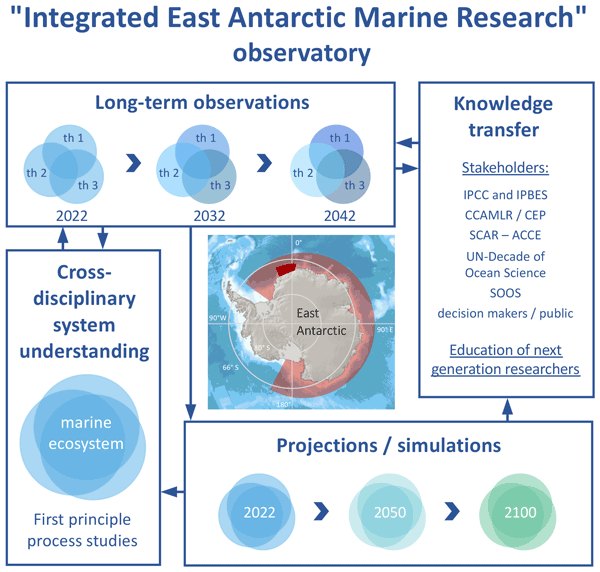
Long-term ecological observations are key to assess, understand and predict impacts of environmental change on biotas. We present a multidisciplinary framework for such largely lacking investigations in the East Antarctic Southern Ocean, combined with case studies, experimental and modelling work. As climate change is still minor here but is projected to start soon, the timely implementation of this framework provides the unique opportunity to document its ecological impacts from the very onset.
Pedro Duarte, Jostein Brændshøi, Dmitry Shcherbin, Pauline Barras, Jon Albretsen, Yvonne Gusdal, Nicholas Szapiro, Andreas Martinsen, Annette Samuelsen, Keguang Wang, and Jens Boldingh Debernard
Geosci. Model Dev., 15, 4373–4392, https://doi.org/10.5194/gmd-15-4373-2022, https://doi.org/10.5194/gmd-15-4373-2022, 2022
Short summary
Short summary
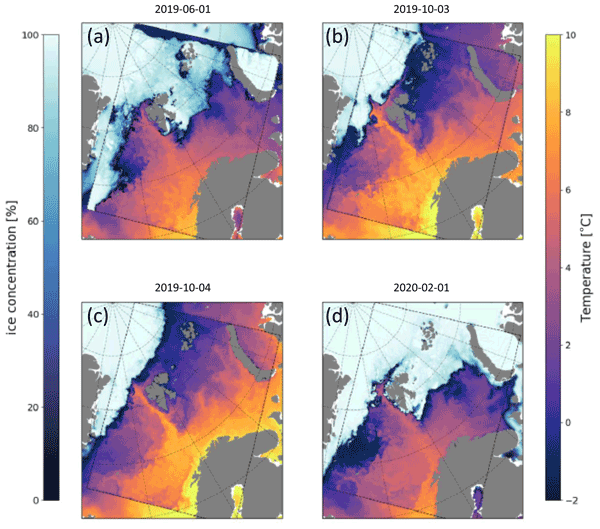
Sea ice models are often implemented for very large domains beyond the regions of sea ice formation, such as the whole Arctic or all of Antarctica. In this study, we implement changes in the Los Alamos Sea Ice Model, allowing it to be implemented for relatively small regions within the Arctic or Antarctica and yet considering the presence and influence of sea ice outside the represented areas. Such regional implementations are important when spatially detailed results are required.
Ralf Döscher, Mario Acosta, Andrea Alessandri, Peter Anthoni, Thomas Arsouze, Tommi Bergman, Raffaele Bernardello, Souhail Boussetta, Louis-Philippe Caron, Glenn Carver, Miguel Castrillo, Franco Catalano, Ivana Cvijanovic, Paolo Davini, Evelien Dekker, Francisco J. Doblas-Reyes, David Docquier, Pablo Echevarria, Uwe Fladrich, Ramon Fuentes-Franco, Matthias Gröger, Jost v. Hardenberg, Jenny Hieronymus, M. Pasha Karami, Jukka-Pekka Keskinen, Torben Koenigk, Risto Makkonen, François Massonnet, Martin Ménégoz, Paul A. Miller, Eduardo Moreno-Chamarro, Lars Nieradzik, Twan van Noije, Paul Nolan, Declan O'Donnell, Pirkka Ollinaho, Gijs van den Oord, Pablo Ortega, Oriol Tintó Prims, Arthur Ramos, Thomas Reerink, Clement Rousset, Yohan Ruprich-Robert, Philippe Le Sager, Torben Schmith, Roland Schrödner, Federico Serva, Valentina Sicardi, Marianne Sloth Madsen, Benjamin Smith, Tian Tian, Etienne Tourigny, Petteri Uotila, Martin Vancoppenolle, Shiyu Wang, David Wårlind, Ulrika Willén, Klaus Wyser, Shuting Yang, Xavier Yepes-Arbós, and Qiong Zhang
Geosci. Model Dev., 15, 2973–3020, https://doi.org/10.5194/gmd-15-2973-2022, https://doi.org/10.5194/gmd-15-2973-2022, 2022
Short summary
Short summary
The Earth system model EC-Earth3 is documented here. Key performance metrics show physical behavior and biases well within the frame known from recent models. With improved physical and dynamic features, new ESM components, community tools, and largely improved physical performance compared to the CMIP5 version, EC-Earth3 represents a clear step forward for the only European community ESM. We demonstrate here that EC-Earth3 is suited for a range of tasks in CMIP6 and beyond.
Pedro Duarte, Philipp Assmy, Karley Campbell, and Arild Sundfjord
Geosci. Model Dev., 15, 841–857, https://doi.org/10.5194/gmd-15-841-2022, https://doi.org/10.5194/gmd-15-841-2022, 2022
Short summary
Short summary
Sea ice modeling is an important part of Earth system models (ESMs). The results of ESMs are used by the Intergovernmental Panel on Climate Change in their reports. In this study we present an improvement to calculate the exchange of nutrients between the ocean and the sea ice. This nutrient exchange is an essential process to keep the ice-associated ecosystem functioning. We found out that previous calculation methods may underestimate the primary production of the ice-associated ecosystem.
Xia Lin, François Massonnet, Thierry Fichefet, and Martin Vancoppenolle
Geosci. Model Dev., 14, 6331–6354, https://doi.org/10.5194/gmd-14-6331-2021, https://doi.org/10.5194/gmd-14-6331-2021, 2021
Short summary
Short summary
This study introduces a new Sea Ice Evaluation Tool (SITool) to evaluate the model skills on the bipolar sea ice simulations by providing performance metrics and diagnostics. SITool is applied to evaluate the CMIP6 OMIP simulations. By changing the atmospheric forcing from CORE-II to JRA55-do data, many aspects of sea ice simulations are improved. SITool will be useful for helping teams managing various versions of a sea ice model or tracking the time evolution of model performance.
Cited articles
Abraham, C., Steiner, N., Monahan, A., and Michel, C.: Effects of subgrid-scale snow thickness variability on radiative transfer in sea ice, J. Geophys. Res. Oceans, 120, 5597–5614, https://doi.org/10.1002/2015JC010741, 2015.
Assmy, P., Duarte, P., Dujardin, J., Fernández-Méndez, M., Fransson, A., Hodgson, R., Kauko, H., Kristiansen, S., Mundy, C., Olsen, L. M., Peeken, I., Sandbu, M., Wallenschus, J., and Wold, A.: N-ICE2015 water column biogeochemistry, Norwegian Polar Institute [data set], https://doi.org/10.21334/NPOLAR.2016.3EBB7F64, 2016.
Arrigo, K. R.: Sea ice as a habitat for primary producers, in Sea Ice, edited by: Thomas, D. N., 3rd ed., 352–369, Wiley-Blackwell, https://doi.org/10.1002/9781118778371.ch14, 2017.
Boetius, A., Albrecht, S., Bakker, K., Bienhold, C., Felden, J., Fernández-Méndez, M., Hendricks, S., Katlein, C., Lalande, C., Krumpen, T., Nicolaus, M., Peeken, I., Rabe, B., Rogacheva, A., Rybakova, E., Somavilla, R., and Wenzhöfer, F.: Export of algal biomass from the melting Arctic sea ice, Science, 339, 1430–1432, https://doi.org/10.1126/science.1231346, 2013.
Castellani, G.: SIMBA – 1D Model intercomparison. Zenodo [ocde], https://doi.org/10.5281/zenodo.17979962, 2025.
Castellani, G., Losch, M., Lange, B. A., and Flores, H.: Modeling Arctic sea-ice algae: Physical drivers of spatial distribution and algae phenology, J. Geophys. Res. Oceans, 122, 7466–7487, https://doi.org/10.1002/2017JC012828, 2017.
Castellani, G., Veyssière, G., Karcher, M., Stroeve, J., Banas, S. N., Bouman, A. H., Brierley, S. A., Connan, S., Cottier, F., Große, Hobbs, L., Katlein, C., Light, B., McKee, D., Orkney, A., Proud, R., and Schourup-Kristensen, V.: Shine a light: Under-ice light and its ecological implications in a changing Arctic Ocean, Ambio, 51, 307–317, https://doi.org/10.1007/s13280-021-01662-3, 2022.
Castellani, G., Tedesco, L., Steiner, N., and Vancoppenolle, M.: Numerical model of sea-ice biogeochemistry, in: Sea Ice, edited by: Thomas, D. N., 4th ed., Wiley-Blackwell, https://doi.org/10.1002/9781394213764.ch20, 2025.
Cohen, L., Hudson, S. R., Walden, V. P., Graham, R. M., and Granskog, M. A.: Meteorological conditions in a thinner Arctic sea ice regime from winter to summer during the Norwegian Young Sea Ice expedition (N-ICE2015), J. Geophys. Res.-Atmos., 122, 7235–7259, https://doi.org/10.1002/2016JD026034, 2017.
Dalman, L. A., Meiners, K. M., Thomas, D. N., Deman, F., Bestley, S., Moreau, S., Arrigo, K. R., Campbell, K., Corkill, M., Cozzi, S., Delille, B., Fransson, A., Fraser, A. D., Henley, S. F., Janssens, J., Lannuzel, D., Munro, D. R., Nomura, D., Norman, L., Papadimitriou, S., Schallenberg, C., Tison, J.-L., Vancoppenolle, M., van der Merwe, P., and Fripiat, F.: Observation-based estimate of net community production in Antarctic sea ice, Geophysical Research Letters, 52, e2024GL113717, https://doi.org/10.1029/2024GL113717, 2025.
Duarte, P.: CICE-Consortium/CICE: CICE with bottom drag, heat and nutrient turbulent diffusion (1.1), Zenodo [code], https://doi.org/10.5281/zenodo.4675097, 2021a.
Duarte, P.: CICE-Consortium/Icepack: Icepack with bottom drag, heat and nutrient turbulent diffusion (1.1), Zenodo [code], https://doi.org/10.5281/zenodo.4675021, 2021b.
Duarte, P., Assmy, P., Campbell, K., and Sundfjord, A.: The importance of turbulent ocean–sea ice nutrient exchanges for simulation of ice algal biomass and production with CICE6.1 and Icepack 1.2, Geosci. Model Dev., 15, 841–857, https://doi.org/10.5194/gmd-15-841-2022, 2022.
Duarte, P., Meyer, A., Olsen, L. M., Kauko, H. M., Assmy, P., Rosel, A., Itkin, P., Hudson, S. R., Granskog, M. A., Gerland, S., Sundfjord, A., Steen, H., Hop, H., Cohen, L., Peterson, A. K., Jeffery, N., Elliott, S. M., Hunke, E. C., and Turner, A. K.: Sea ice thermohaline dynamics and biogeochemistry in the Arctic Ocean: Empirical and model results, J. Geophys. Res.-Biogeo., 122, 1632–1654, https://doi.org/10.1002/2016JG003660, 2017.
Duarte, P., Meyer, A., and Moreau, S.: Nutrients in water masses in the Atlantic sector of the Arctic Ocean: Temporal trends, mixing and links with primary production, Journal of Geophysical Research: Oceans, 126, e2021JC017413, https://doi.org/10.1029/2021JC017413, 2021.
Eyring, V., Bony, S., Meehl, G. A., Senior, C. A., Stevens, B., Stouffer, R. J., and Taylor, K. E.: Overview of the Coupled Model Intercomparison Project Phase 6 (CMIP6) experimental design and organization, Geosci. Model Dev., 9, 1937–1958, https://doi.org/10.5194/gmd-9-1937-2016, 2016.
Geoffroy, M., Bouchard, C., Flores, H., Robert, D., Gjøsæter, H., Hoover, C., Hop, H., Hussey, N. E., Nahrgang, J., Steiner, N., Bender, M., Berge, J., Castellani, G., Chernova, N., Copeman, L., David, C. L., Deary, A., Divoky, G., Dolgov, A. V., Duffy-Anderson, J., Dupont, N., Durant, J. M., Elliott, K., Gauthier, S., Goldstein, E. D., Gradinger, R., Hedges, K., Herbig, J., Laurel, B., Loseto, L., Maes, S., Mark, F. C., Mosbech, A., Pedro, S., Pettitt-Wade, H., Prokopchuk, I., Renaud, P. E., Schembri, S., Vestfals, C., and Walkusz, W.: The circumpolar impacts of climate change and anthropogenic stressors on Arctic cod (Boreogadus saida) and its ecosystem, Elementa: Science of the Anthropocene, 11, 00097, https://doi.org/10.1525/elementa.2022.00097, 2023.
Gerland, S.,Granskog, M. A., King, J., and Rösel, A.: N-ICE2015 ICE core physics: Temperature, salinity and density, Norwegian Polar Institute [data set], https://doi.org/10.21334/npolar.2017.c3db82e3, 2017.
Graham, R. M., Itkin, P., Meyer, A., Sundfjord, A., Spreen, G., Smedsrud, L. H., Liston, G. E., Cheng, B., Cohen, L., Divine, D., and Fer, I.: Winter storms accelerate the demise of sea ice in the Atlantic sector of the Arctic Ocean, Sci. Rep., 9, 9222, https://doi.org/10.1038/s41598-019-45574-5, 2019.
Granskog, M. A., Fer, I., Rinke, A., and Steen, H.: Atmosphere-Ice-Ocean-Ecosystem Processes in a Thinner Arctic Sea Ice Regime: The Norwegian Young Sea ICE (N-ICE2015) Expedition, J. Geophys. Res.-Oceans, 123, 1586–1594, https://doi.org/10.1002/2017jc013328, 2018.
Hayashida, H., Steiner, N., Monahan, A., Galindo, V., Lizotte, M., and Levasseur, M.: Implications of sea-ice biogeochemistry for oceanic production and emissions of dimethyl sulfide in the Arctic, Biogeosciences, 14, 3129–3155, https://doi.org/10.5194/bg-14-3129-2017, 2017a.
Hayashida, H., Mortenson, E., Steiner, N., and Monahan, A.: GOTM-FABM-based 1D coupled sea ice-ocean physical-biogeochemical model and its test case for Resolute, Zenodo [code], https://doi.org/10.5281/zenodo.825274, 2017b.
Hayashida, H., Jin, M., Steiner, N. S., Swart, N. C., Watanabe, E., Fiedler, R., Hogg, A. McC., Kiss, A. E., Matear, R. J., and Strutton, P. G.: Ice Algae Model Intercomparison Project phase 2 (IAMIP2), Geosci. Model Dev., 14, 6847–6861, https://doi.org/10.5194/gmd-14-6847-2021, 2021.
Hudson, S. R., Cohen, L., and Walden, V. P.: N-ICE2015 surface meteorology, Norwegian Polar Institute [data set], https://doi.org/10.21334/npolar.2015.056a61d1, 2015.
Hudson, S. R., Cohen, L., and Walden, V. P.: N-ICE2015 surface broadband radiation data, Norwegian Polar Institute [data set], https://doi.org/10.21334/npolar.2016.a89cb766, 2016.
Hunke, E. C. and Lipscomb, W. H.: CICE: The Los Alamos Sea Ice Model: Documentation and software user's manual, version 4.0, Tech. Rep. LA-CC-06-012, Los Alamos Natl. Lab., Los Alamos, N. M., 2008.
Hunke, E. C., Lipscomb, W. H., Turner, A. K., Jeffery, N., and Elliot, S.: CICE: The Los Alamos sea ice model documentation and user's manual version 5.1. Tech. Rep., LA-CC-06-012, Los Alamos National Laboratory, Los Alamos, N. M, 2015.
Janssens, J., Meiners, K. M., Townsend, A. T., and Lannuzel, D.: Organic matter controls of iron incorporation in growing sea ice, Frontiers in Earth Science, 6, 22, https://doi.org/10.3389/feart.2018.00022, 2018.
Jeffery, N., Elliott, S., Hunke, E. C., Lipscomb, W. H., and Turner, A. K.: Biogeochemistry of CICE: The Los Alamos Sea Ice Model, Documentation and User's Manual, Zbgc_colpkg modifications to Version 5, Los Alamos National Laboratory, Los Alamos, N. M., 2016.
Kauko, H. M., Taskjelle, T., Assmy, P., Pavlov, A. K., Mundy, C. J., Duarte, P., Fernández-Méndez, M., Olsen, L. M., Hudson, S. R., Johnsen, G., Elliot, A., Wang, F., and Granskog, M. A.: Windows in Arctic sea ice: light transmission and ice algae in a refrozen lead, J. Geophys. Res.-Biogeo., 122, https://doi.org/10.1002/2016JG003626, 2017.
Koch, C. W., Brown, T. A., Amiraux, R., Ruiz-Gonzalez, C., MacCorquodale, M., Yunda-Guarin, G. A., Kohlbach, D., Loseto, L. L., Rosenberg, B., and Hussey, N. E.: Year-round utilization of sea ice-associated carbon in Arctic ecosystems, Nat. Commun., 14, 1964, https://doi.org/10.1038/s41467-023-37612-8, 2023.
Kohlbach, D., Lange, B. A., Schaafsma, F. L., David, C., Vortkamp, M., Graeve, M., van Franeker, J. A., Krumpen, T., and Flores, H.: Ice Algae-Produced Carbon Is Critical for Overwintering of Antarctic Krill Euphausia superba, Front. Mar. Sci., 4, 310, https://doi.org/10.3389/fmars.2017.00310, 2017.
Lannuzel, D, Tedesco, L., van Leeuwe, M., Campbell, K., Flores, H., Delille, B., Miller, L., Stefels, J., Assmy, P., Bowman, J., Brown, K., Castellani, G., Chierici, M., Crabeck, O., Damm, E., Else, B., Fransson, A., Fripiat, F., Geilfus, N.-X., Jacques, C., Jones, E., Kaartokallio, K., Kotovitch, M., Meiners, K., Moreau, S., Nomura, D., Peeken, I., Rintala, J.-M., Steiner, N., Tison, J.-L., Vancoppenolle, M., der Linden, F. V., Vichi, M., and Wongpan, P.: The future of Arctic sea-ice biogeochemistry and ice-associated ecosystems, Nature Climate Change, https://doi.org/10.1038/s41558-020-00940-4, 2020.
Lavoie, D., Macdonald, R. W., and Denman, K. L.: Primary productivity and export fluxes on the Canadian shelf of the Beaufort Sea, Primary productivity and export fluxes on the Canadian shelf of the Beaufort Sea: A modelling study, Journal of Marine Systems, 75, 17–32, https://doi.org/10.1016/j.jmarsys.2008.07.007, 2009.
Losch, M., Menemenlis, D., Campin, J. M., Heimbach, P., and Hill, C.: On the formulation of sea-ice models: Part 1: Effects of different solver implementations and parameterizations, Ocean Modell., 33, 129–144, https://doi.org/10.1016/j.ocemod.2009.12.008, 2010.
Marshall, J., Adcroft, A. J., Hill, C. N., Perelman, L., and Heisey, C.: A finite-volume, incompressible Navier Stokes model for studies of the ocean on parallel computers, J. Geophys. Res., 102, 5753–5766, https://doi.org/10.1029/96JC02775, 1997.
Mortenson, E., Hayashida, H., Steiner, N., Monahan, A., Blais, M., Gale, M. A., Galindo, V., Gosselin, M., Hu, X., Lavoie, D., and Mundy, C. J.: A model-based analysis of physical and biological controls on ice algal and pelagic primary production in Resolute Passage, Elementa: Science of the Anthropocene Sci. Anth., 5, 39, https://doi.org/10.1525/elementa.229, 2017.
Mortenson, E., Steiner, N., Monahan, A. H., Miller, L. A., Geilfus, N.-X., and Brown, K.: A model-based analysis of physical and biogeochemical controls on carbon exchange in the upper water column, sea ice, and atmosphere in a seasonally ice-covered Arctic strait, Journal of Geophysical Research: Oceans, 123, 7529–7549, https://doi.org/10.1029/2018JC014376, 2018.
Olsen, L. M., Laney, S. R., Duarte, P., Kauko, H. M., Fernández-Méndez, M., Mundy, C. J., Rösel, A., Meyer, A., Itkin, P., Cohen, L., Peeken, I., Tatarek, A., Róźańska, M., Wiktor, J., Taskjelle, T., Pavlov, A. K., Hudson, S. R., Granskog, M. A., Hop, H., and Assmy, P.: The seeding of ice-algal blooms in Arctic pack ice: the multiyear ice seed repository hypothesis, Journal of Geophysical Research: Biogeosciences, https://doi.org/10.1002/2016jg003668, 2017.
Peterson, A. K., Fer, I., Randelhoff, A., Meyer, A., Håvik, L., Smedsrud, L. H., Onarheim, L., Muilwijk, M., Sundfjord, A., and McPhee, M. H.: N-ICE2015 ocean turbulent fluxes from under-ICE turbulence cluster (TIC), Norwegian Polar Institute [data set], https://doi.org/10.21334/npolar.2016.ab29f1e2, 2016.
Peterson, A. K., Fer, I., McPhee, M. G., and Randelhoff, A.: Turbulent heat and momentum fluxes in the upper ocean under Arctic sea ice, Journal of Geophysical Research: Oceans, 122, 1439–1456, https://doi.org/10.1002/2016JC012283, 2017.
Post, E., Bhatt, U. S., Bitz, C. M., Brodie, J. F., Fulton, T. L., Hebblewhite, M., Kerby, J., Kutz, S. J., Stirling, I., and Walker, D. A.: Ecological consequences of sea-ice decline, Science, 341, 519–524, https://doi.org/10.1126/science.1235225, 2013.
Poulin, M., Daugbjerg, N., Gradinger, R., Ilyash, L. V., Ratkova, T. N., and von Quillfeldt, C.: The pan-Arctic biodiversity of marine pelagic and sea-ice unicellular eukaryotes: a first-attempt assessment, Mar. Biodiv., 41, 13–28, https://doi.org/10.1007/s12526-010-0058-8, 2011.
Saenz, B. T.: blsaenz/SIESTA: SIESTA – model intercomparison (v0.9.0), Zenodo [code], https://doi.org/10.5281/zenodo.18330005, 2026.
Saenz, B. T. and Arrigo, K. R.: Simulation of a sea ice ecosystem using a hybrid model for slush layer desalination, J. Geophys. Res., 117, C05007, https://doi.org/10.1029/2011JC007544, 2012.
Saenz, B. T. and Arrigo, K. R.: Annual primary production in Antarctic sea ice during 2005–2006 from a sea ice state estimate, J. Geophys. Res. Oceans, 119, 3645–3678, https://doi.org/10.1002/2013JC009677, 2014.
Saenz, B. T., McKee, D. C., Doney, S. C., Martinson, D. G., and Stammerjohn, S. E: Influence of seasonally varying sea-ice concentration and subsurface ocean heat on sea-ice thickness and sea-ice seasonality for a “warm-shelf” region in Antarctica, Journal of Glaciology, 69, 1466-1482, https://doi.org/10.1017/jog.2023.36, 2023.
Schaafsma, F. L., Kohlbach, D., David, C., Lange, B. A., Graeve, M., Flores, H., and van Franeker, J. A.: Spatio-temporal variability in the winter diet of larval and juvenile Antarctic krill, Euphausia superba, in ice-covered waters, Marine Ecology Progress Series, 580, 101–115, https://doi.org/10.3354/meps12309, 2017.
Semtner, A. J.: A model for the thermodynamic growth of sea ice in numerical investigation of climate, J. Phys. Oceanogr., 6, 379–389, https://doi.org/10.1175/1520-0485(1976)006<0379:AMFTTG>2.0.CO;2, 1976.
Schartau, M., Wallhead, P., Hemmings, J., Löptien, U., Kriest, I., Krishna, S., Ward, B. A., Slawig, T., and Oschlies, A.: Reviews and syntheses: parameter identification in marine planktonic ecosystem modelling, Biogeosciences, 14, 1647–1701, https://doi.org/10.5194/bg-14-1647-2017, 2017.
Steiner, N., Denman, K., McFarlane, N., and Solheim, L.: Simulating the coupling between atmosphere-ocean processes and the planktonic ecosystem during SERIES, Deep Sea Research Part II: Topical Studies in Oceanography, 53, 20–22, 2434–2454, https://doi.org/10.1016/j.dsr2.2006.05.030, 2006.
Steiner, N., Bowman, J., Campbell, K., Chierici, M., Eronen-Rasimus, Falardeau, E. M., Flores, H., Fransson, A., Herr , H., Insley, S. J., Kauko, H., Lannuzel, D., Loseto, L., Lynnes, A., Majewski, A., Meiners, K., Miller, L. A., Michel, L., Moreau, S., Nacke, M., Nomura, D., Tedesco, L., van Franeker, J. A., van Leeuwe, M. A., and Wongpan, P.: Climate change impacts on sea-ice ecosystems and associated ecosystem services, Elem. Sci. Anth., 9, 00007, https://doi.org/10.1525/elementa.2021.00007, 2021.
Taskjelle, T., Hudson, S. R., Pavlov, A., and Granskog, M. A.: N-ICE2015 surface and under-ICE spectral shortwave radiation data, Norwegian Polar Institute [data set], https://doi.org/10.21334/npolar.2016.9089792e, 2016.
Tedesco, L.: BFM-SI and ESIM model codes for sea-ice physics and biogeochemistry simulations of N-ICE2015, Zenodo [code], https://doi.org/10.5281/zenodo.18050331, 2025.
Tedesco, L. and Vichi, M.: Sea ice biogeochemistry: a guide for modellers, PLOS ONE, https://doi.org/10.1371/journal.pone.0089217, 2014.
Tedesco, L., Vichi, M., Haapala, J., and Stipa, T.: An enhanced sea-ice thermodynamic model applied to the Baltic Sea, Boreal Environmental Research, 14, 68–80, 2009.
Tedesco, L., Vichi, M., Haapala, J., and Stipa, T.: A dynamic Biologically-Active Layer for numerical studies of the sea ice ecosystem, Ocean Modelling, 35, 89–104, https://doi.org/10.1016/j.ocemod.2010.06.008, 2010.
Tedesco, L., Vichi, M., and Thomas, D.: Process studies on the ecological coupling between sea ice algae and phytoplankton, Ecological Modelling, 226, 120–138, https://doi.org/10.1016/j.ecolmodel.2011.11.011, 2012.
Tedesco, L., Miettunen E., An, B. W., Kaartokallio, H., and Haapala, J.: Long-term mesoscale variability of modelled sea-ice primary production in the northern Baltic Sea, Elem. Sci. Anth., 5, 29, https://doi.org/10.1525/elementa.223, 2017.
Tedesco, L., Vichi, M., and Scoccimarro, E.: Sea-ice algal phenology in a warmer Arctic, Science Advances, 5, eaav4830, https://doi.org/10.1126/sciadv.aav4830, 2019.
Tedesco, L., Castellani, G., Duarte, P., Jin, M., Moreau, S., Mortenson, E., Saenz, B., Steiner, N., and Vancoppenolle, M.: N-ICE2015 sea-ice biogeochemistry model simulations: input data, boundary conditions, and outputs, Zenodo [data set], https://doi.org/10.5281/zenodo.18053496, 2025.
Vichi M., Lovato T., Butenschön M., Tedesco L., Lazzari P., Cossarini G., Masina S., Pinardi N., Solidoro C., and Zavatarelli M.: The Biogeochemical Flux Model (BFM): Equation Description and User Manual. BFM version 5.3. BFM Report series N. 1, Release 1.3, February 2023, Bologna, Italy, 104 pp., http://bfm-community.eu (last access: 20 January 2026), 2023.
Watanabe, E., Jin, M., Hayashida, H., Zhang, J., and Steiner, N.: Multi-Model Intercomparison of the Pan-Arctic Ice-Algal Productivity on Seasonal, Interannual, and Decadal Timescales, Journal of Geophysical Research: Oceans, 124, 9053–9084, https://doi.org/10.1029/2019JC015100, 2019.
Short summary
Sea ice hosts tiny algae that support polar marine life, yet their growth remains challenging to simulate. We tested six computer models using data from a 2015 Arctic drifting ice expedition to see how well they reproduced spring algae blooms and nutrient changes. While tuning helped models better match algae growth, nutrients remained difficult to capture. Our results highlight key challenges in representing fragile sea‑ice habitats that are expected to become more common as the Arctic warms.
Sea ice hosts tiny algae that support polar marine life, yet their growth remains challenging to...


