
Articles | Volume 20, issue 11
https://doi.org/10.5194/tc-20-6283-2026
© Author(s) 2026. This work is distributed under
the Creative Commons Attribution 4.0 License.
the Creative Commons Attribution 4.0 License.
https://doi.org/10.5194/tc-20-6283-2026
© Author(s) 2026. This work is distributed under
the Creative Commons Attribution 4.0 License.
the Creative Commons Attribution 4.0 License.
Research article
| 
04 Nov 2026
Research article |
| 04 Nov 2026
| 04 Nov 2026
SeidarT: an open-source full-waveform seismic and electromagnetic wave propagation modeling toolbox demonstrated in snow and ice
Steven Bernsen
CORRESPONDING AUTHOR

School of Earth and Climate Sciences, University of Maine, 5790 Bryand Global Sciences Center, Orono, Maine 04469, USA
Christopher Gerbi
School of Earth and Climate Sciences, University of Maine, 5790 Bryand Global Sciences Center, Orono, Maine 04469, USA
Senthil Vel
Department of Mechanical Engineering, University of Maine, Ferland Engineering Education and Design Center, Orono, Maine 04469, USA
Knut Christianson
Earth and Space Sciences, University of Washington, 1707 NE Grant Lane, Seattle, Washington 98195, USA
Seth Campbell
School of Earth and Climate Sciences, University of Maine, 5790 Bryand Global Sciences Center, Orono, Maine 04469, USA
Related authors
No articles found.
Ingalise Kindstedt, Andrew Johnson, Kristin M. Schild, Luke Copland, Christine Dow, Alison Criscitiello, Dominic Winski, Karl Kreutz, and Seth Campbell
The Cryosphere, 20, 5941–5971, https://doi.org/10.5194/tc-20-5941-2026, https://doi.org/10.5194/tc-20-5941-2026, 2026
Short summary
Short summary
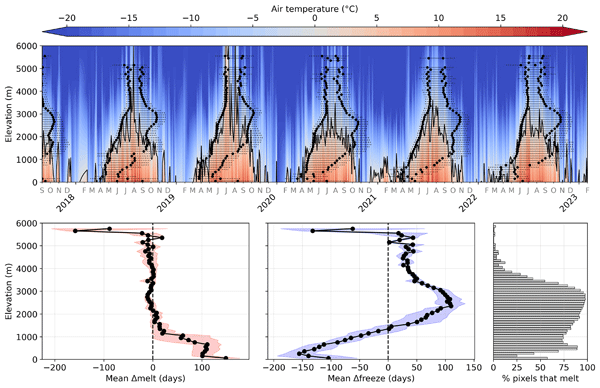
Mountain snow at high elevations is changing as warming causes more melting and water to linger within it. We use satellite radar images from 2015 to 2024 to track when melting starts and when snow refreezes across the Wrangell and St. Elias Mountains on the border of Alaska and Yukon. We find that melting now reaches nearly all elevations, and water often remains trapped well into fall. Only the highest areas stay fully dry, showing widespread impacts of warming on mountain snowpacks.
Annika N. Horlings, Juliana Ruef, C. Max Stevens, Mikaila Mannello, Keegan Bellamy, Tahi Wiggins, Bradley Markle, and Seth Campbell
The Cryosphere, 20, 5401–5433, https://doi.org/10.5194/tc-20-5401-2026, https://doi.org/10.5194/tc-20-5401-2026, 2026
Short summary
Short summary
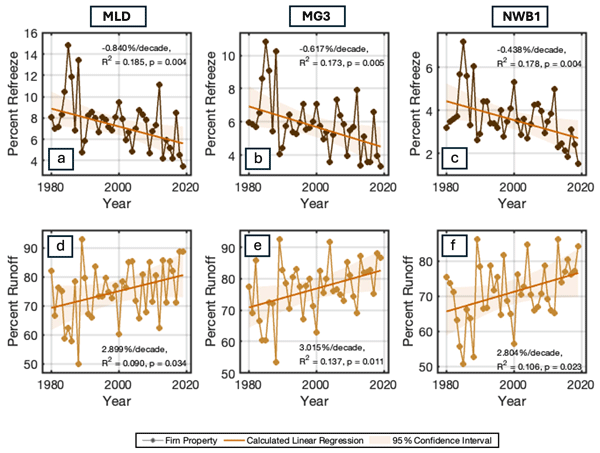
Firn, the permeable and porous material through which snow compacts into glacier ice, plays an important role in glacier hydrology, mass balance, and dynamics. We investigated seasonal to decadal evolution of firn on the Juneau Icefield using field measurements and firn modeling, and found that the firn is thinning and warming. Our study offers insights into consequent changes in firn hydrology, including declining refreezing capacity and inter-seasonal shifts in liquid-water retention.
Andrew O. Hoffman, Paul T. Summers, Jenny Suckale, Knut Christianson, Ginny Catania, and Howard Conway
The Cryosphere, 20, 3977–4003, https://doi.org/10.5194/tc-20-3977-2026, https://doi.org/10.5194/tc-20-3977-2026, 2026
Short summary
Short summary
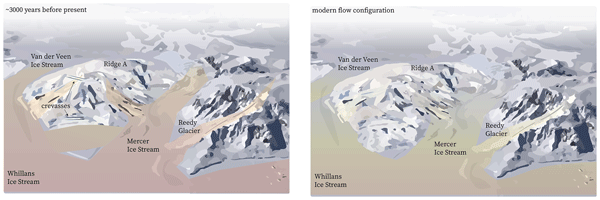
In Antarctica, fast-flowing ice streams drive most ice loss. Radar data from Conway Ice Ridge reveal that the van der Veen and Mercer Ice Streams were wider ~3000 years ago and narrowed progressively. Numerical modeling demonstrates that small thickness changes can rapidly alter shear-margin locations. These findings offer crucial insights into Late Holocene Ice Sheet readvance.
Andrew O. Hoffman, Knut Christianson, Ching-Yao Lai, Ian Joughin, Nicholas Holschuh, Elizabeth Case, Jonathan Kingslake, and the GHOST science team
The Cryosphere, 19, 1353–1372, https://doi.org/10.5194/tc-19-1353-2025, https://doi.org/10.5194/tc-19-1353-2025, 2025
Short summary
Short summary
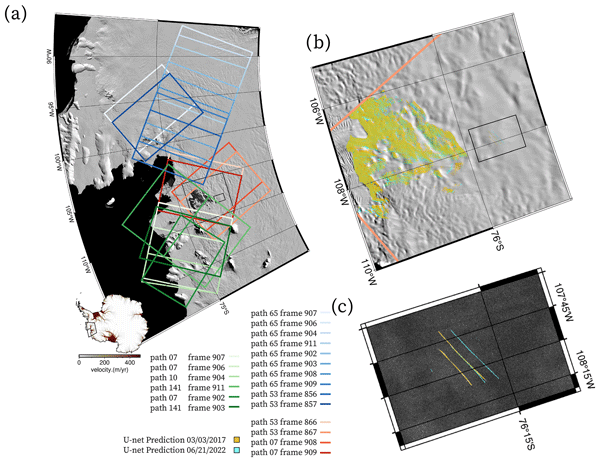
We use satellite and ice-penetrating radar technology to segment crevasses in the Amundsen Sea Embayment. Inspection of satellite time series reveals inland expansion of crevasses where surface stresses have increased. We develop a simple model for the strength of densifying snow and show that these crevasses are likely restricted to the near surface. This result bridges discrepancies between satellite and lab experiments and reveals the importance of porosity on surface crevasse formation.

Andrew O. Hoffman, Michelle L. Maclennan, Jan Lenaerts, Kristine M. Larson, and Knut Christianson
The Cryosphere, 19, 713–730, https://doi.org/10.5194/tc-19-713-2025, https://doi.org/10.5194/tc-19-713-2025, 2025
Short summary
Short summary
Traditionally, glaciologists use global navigation satellite systems (GNSSs) to measure the surface elevation and velocity of glaciers to understand processes associated with ice flow. Using the interference of GNSS signals that bounce off of the ice sheet surface, we measure the surface height change near GNSS receivers in the Amundsen Sea Embayment (ASE). From surface height change, we infer daily accumulation rates that we use to understand the drivers of extreme precipitation in the ASE.
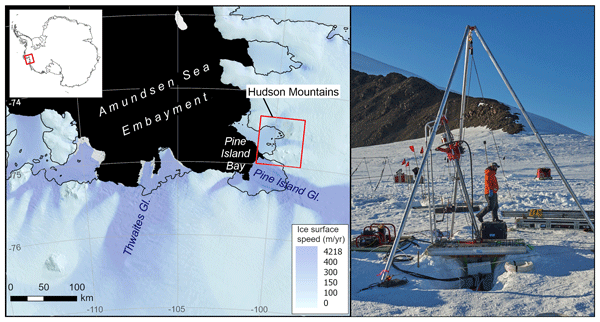
Joanne S. Johnson, John Woodward, Ian Nesbitt, Kate Winter, Seth Campbell, Keir A. Nichols, Ryan A. Venturelli, Scott Braddock, Brent M. Goehring, Brenda Hall, Dylan H. Rood, and Greg Balco
The Cryosphere, 19, 303–324, https://doi.org/10.5194/tc-19-303-2025, https://doi.org/10.5194/tc-19-303-2025, 2025
Short summary
Short summary
Determining where and when the Antarctic ice sheet was smaller than present requires recovery and exposure dating of subglacial bedrock. Here we use ice sheet model outputs and field data (geological and glaciological observations, bedrock samples, and ground-penetrating radar) to assess the suitability for subglacial drilling of sites in the Hudson Mountains, West Antarctica. We find that no sites are perfect, but two are feasible, with the most suitable being Winkie Nunatak (74.86°S, 99.77°W).
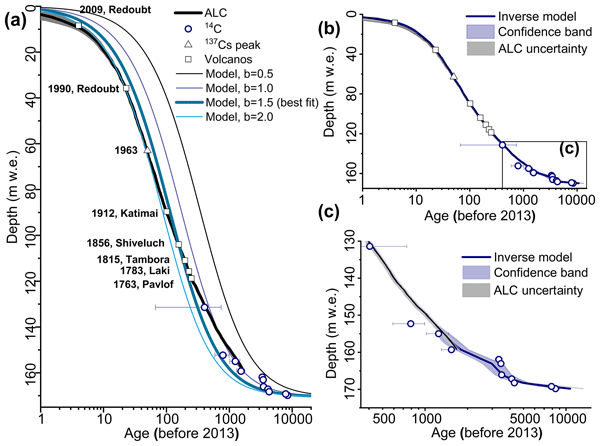
Ling Fang, Theo M. Jenk, Dominic Winski, Karl Kreutz, Hanna L. Brooks, Emma Erwin, Erich Osterberg, Seth Campbell, Cameron Wake, and Margit Schwikowski
The Cryosphere, 17, 4007–4020, https://doi.org/10.5194/tc-17-4007-2023, https://doi.org/10.5194/tc-17-4007-2023, 2023
Short summary
Short summary
Understanding the behavior of ocean–atmosphere teleconnections in the North Pacific during warm intervals can aid in predicting future warming scenarios. However, majority ice core records from Alaska–Yukon region only provide data for the last few centuries. This study introduces a continuous chronology for Denali ice core from Begguya, Alaska, using multiple dating methods. The early-Holocene-origin Denali ice core will facilitate future investigations of hydroclimate in the North Pacific.
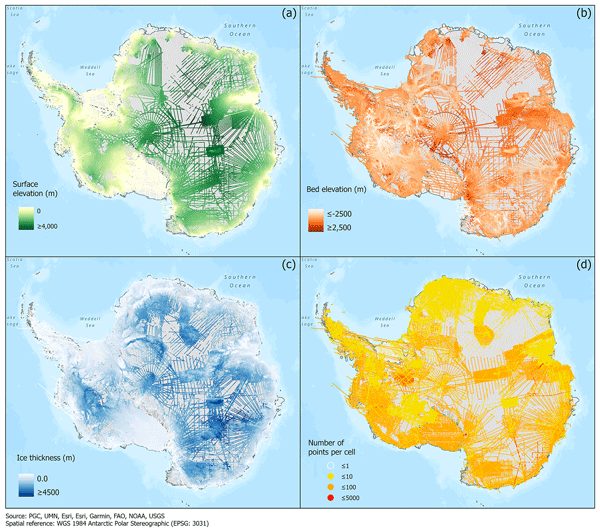
Alice C. Frémand, Peter Fretwell, Julien A. Bodart, Hamish D. Pritchard, Alan Aitken, Jonathan L. Bamber, Robin Bell, Cesidio Bianchi, Robert G. Bingham, Donald D. Blankenship, Gino Casassa, Ginny Catania, Knut Christianson, Howard Conway, Hugh F. J. Corr, Xiangbin Cui, Detlef Damaske, Volkmar Damm, Reinhard Drews, Graeme Eagles, Olaf Eisen, Hannes Eisermann, Fausto Ferraccioli, Elena Field, René Forsberg, Steven Franke, Shuji Fujita, Yonggyu Gim, Vikram Goel, Siva Prasad Gogineni, Jamin Greenbaum, Benjamin Hills, Richard C. A. Hindmarsh, Andrew O. Hoffman, Per Holmlund, Nicholas Holschuh, John W. Holt, Annika N. Horlings, Angelika Humbert, Robert W. Jacobel, Daniela Jansen, Adrian Jenkins, Wilfried Jokat, Tom Jordan, Edward King, Jack Kohler, William Krabill, Mette Kusk Gillespie, Kirsty Langley, Joohan Lee, German Leitchenkov, Carlton Leuschen, Bruce Luyendyk, Joseph MacGregor, Emma MacKie, Kenichi Matsuoka, Mathieu Morlighem, Jérémie Mouginot, Frank O. Nitsche, Yoshifumi Nogi, Ole A. Nost, John Paden, Frank Pattyn, Sergey V. Popov, Eric Rignot, David M. Rippin, Andrés Rivera, Jason Roberts, Neil Ross, Anotonia Ruppel, Dustin M. Schroeder, Martin J. Siegert, Andrew M. Smith, Daniel Steinhage, Michael Studinger, Bo Sun, Ignazio Tabacco, Kirsty Tinto, Stefano Urbini, David Vaughan, Brian C. Welch, Douglas S. Wilson, Duncan A. Young, and Achille Zirizzotti
Earth Syst. Sci. Data, 15, 2695–2710, https://doi.org/10.5194/essd-15-2695-2023, https://doi.org/10.5194/essd-15-2695-2023, 2023
Short summary
Short summary
This paper presents the release of over 60 years of ice thickness, bed elevation, and surface elevation data acquired over Antarctica by the international community. These data are a crucial component of the Antarctic Bedmap initiative which aims to produce a new map and datasets of Antarctic ice thickness and bed topography for the international glaciology and geophysical community.
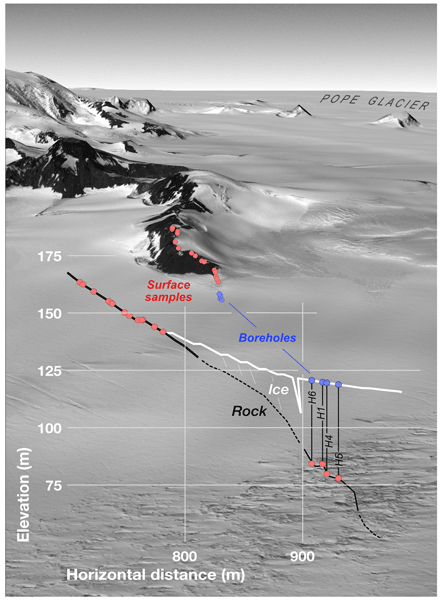
Greg Balco, Nathan Brown, Keir Nichols, Ryan A. Venturelli, Jonathan Adams, Scott Braddock, Seth Campbell, Brent Goehring, Joanne S. Johnson, Dylan H. Rood, Klaus Wilcken, Brenda Hall, and John Woodward
The Cryosphere, 17, 1787–1801, https://doi.org/10.5194/tc-17-1787-2023, https://doi.org/10.5194/tc-17-1787-2023, 2023
Short summary
Short summary
Samples of bedrock recovered from below the West Antarctic Ice Sheet show that part of the ice sheet was thinner several thousand years ago than it is now and subsequently thickened. This is important because of concern that present ice thinning in this region may lead to rapid, irreversible sea level rise. The past episode of thinning at this site that took place in a similar, although not identical, climate was not irreversible; however, reversal required at least 3000 years to complete.
Ingalise Kindstedt, Kristin M. Schild, Dominic Winski, Karl Kreutz, Luke Copland, Seth Campbell, and Erin McConnell
The Cryosphere, 16, 3051–3070, https://doi.org/10.5194/tc-16-3051-2022, https://doi.org/10.5194/tc-16-3051-2022, 2022
Short summary
Short summary
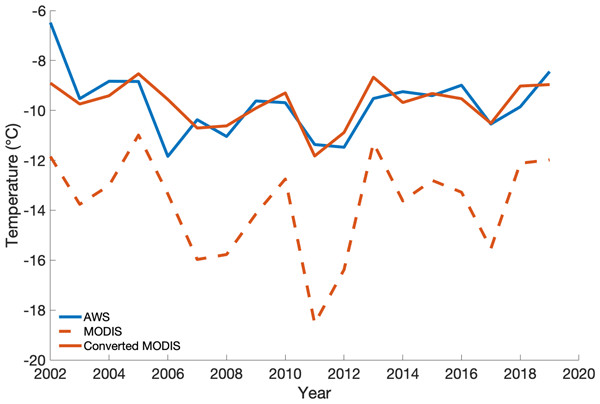
We show that neither the large spatial footprint of the MODIS sensor nor poorly constrained snow emissivity values explain the observed cold offset in MODIS land surface temperatures (LSTs) in the St. Elias. Instead, the offset is most prominent under conditions associated with near-surface temperature inversions. This work represents an advance in the application of MODIS LSTs to glaciated alpine regions, where we often depend solely on remote sensing products for temperature information.

Joanne S. Johnson, Ryan A. Venturelli, Greg Balco, Claire S. Allen, Scott Braddock, Seth Campbell, Brent M. Goehring, Brenda L. Hall, Peter D. Neff, Keir A. Nichols, Dylan H. Rood, Elizabeth R. Thomas, and John Woodward
The Cryosphere, 16, 1543–1562, https://doi.org/10.5194/tc-16-1543-2022, https://doi.org/10.5194/tc-16-1543-2022, 2022
Short summary
Short summary
Recent studies have suggested that some portions of the Antarctic Ice Sheet were less extensive than present in the last few thousand years. We discuss how past ice loss and regrowth during this time would leave its mark on geological and glaciological records and suggest ways in which future studies could detect such changes. Determining timing of ice loss and gain around Antarctica and conditions under which they occurred is critical for preparing for future climate-warming-induced changes.
Cited articles
A2 Photonics Sensors: Wise Snow Liquid Water Content Sensor User Manual, A2 Photonics Sensors, Grenoble, France, 2019. a
Agnew, R. S., Clark, R. A., Booth, A. D., Brisbourne, A. M., and Smith, A. M.: Measuring seismic attenuation in polar firn: method and application to Korff Ice Rise, West Antarctica, J. Glaciol., 69, 2075–2086, https://doi.org/10.1017/jog.2023.82, 2023. a
Akaike, H.: A new look at the statistical model identification, IEEE T. Automat. Contr., 19, 716–723, 2003. a
Aki, K. and Richards, P.: Quantitative seismology, MIT Press, ISBN 978-1891389634, 2002. a
Ali, T., Eldin, M. N., and Haider, W.: The effect of soil-structure interaction on the seismic response of structures using machine learning, finite element modeling and ASCE 7-16 methods, Sensors, 23, 2047, https://doi.org/10.3390/s23042047, 2023. a
Alley, R. B.: Fabrics in polar ice sheets: development and prediction, Science, 240, 493, https://doi.org/10.1126/science.240.4851.493, 1988. a
Bælum, K. and Benn, D. I.: Thermal structure and drainage system of a small valley glacier (Tellbreen, Svalbard), investigated by ground penetrating radar, The Cryosphere, 5, 139–149, https://doi.org/10.5194/tc-5-139-2011, 2011. a
Bai, C.-Y., Huang, G.-J., Li, X.-L., Zhou, B., and Greenhalgh, S.: Ray tracing of multiple transmitted/reflected/converted waves in 2-D/3-D layered anisotropic TTI media and application to crosswell traveltime tomography, Geophys. J. Int., 195, 1068–1087, https://doi.org/10.1093/gji/ggt267, 2013. a
Bernsen, S. P.: UMainedynamics/SeidarT-Backend: v3.0.21, Zenodo [code], https://doi.org/10.5281/zenodo.18956126, 2026a. a, b
Bernsen, S. P.: UMainedynamics/SeidarT-Recipes: v1.0.0, Zenodo [code], https://doi.org/10.5281/zenodo.18956061, 2026b. a
Bernsen, S. P. and ChristopherGerbi: UMainedynamics/SeidarT: v3, Zenodo [code], https://doi.org/10.5281/zenodo.21982065, 2026. a
Berryman, J. G.: Long-wavelength propagation in composite elastic media I. Spherical inclusions, J. Acoust. Soc. Am., 68, 1809–1819, 1980. a
Bond, W. L.: The mathematics of the physical properties of crystals, Bell Syst. Tech. J., 22, 1–72, 1943. a
Bozdağ, E., Ruan, Y., Metthez, N., Khan, A., Leng, K., Van Driel, M., Wieczorek, M., Rivoldini, A., Larmat, C. S., Giardini, D., Tromp, J., Lognonne, P., and Banerdt, B. W.: Simulations of seismic wave propagation on Mars, Space Sci. Rev., 211, 571–594, 2017. a
Bradford, J. H., Harper, J. T., and Brown, J.: Complex dielectric permittivity measurements from ground‐penetrating radar data to estimate snow liquid water content in the pendular regime, Water Resour. Res., 45, https://doi.org/10.1029/2008WR007341, 2009. a
Bray, T.: The JavaScript Object Notation (JSON) Data Interchange Format, RFC 8259, https://doi.org/10.17487/RFC8259, 2017. a
Calonne, N., Flin, F., Morin, S., Lesaffre, B., du Roscoat, S. R., and Geindreau, C.: Numerical and experimental investigations of the effective thermal conductivity of snow, Geophys. Res. Lett., 38, https://doi.org/10.1029/2011GL049234, 2011. a
Cangellaris, A. C. and Wright, D. B.: Analysis of the numerical error caused by the stair-stepped approximation of a conducting boundary in FDTD simulations of electromagnetic phenomena, IEEE T. Antenn. Propag., 39, 1518–1525, 1991. a
Chew, W. C.: Waves and fields in inhomogenous media, John Wiley & Sons, ISBN 0-7803-4749-8, 1999. a
Collet, Y. and Kucherawy, M.: Zstandard Compression and the application/zstd Media Type, RFC 8878, RFC Editor, ISSN 2070-1721, https://doi.org/10.17487/RFC8878, 2021. a
Collino, F. and Tsogka, C.: Application of the PML Absorbing Layer Model to the Linear Elastodynamic Problem in Anisotropic Hetereogeneous Media, Geophysics, 66, 294–307, https://doi.org/10.1190/1.1444908, 1998. a
deWit, R.: Elastic constants and thermal expansion averages of a nontextured polycrystal, J. Mech. Mater. Struct., 3, 195–212, 2008. a
Dridi, K., Hesthaven, J. S., and Ditkowski, A.: Staircase-free finite-difference time-domain formulation for general materials in complex geometries, IEEE T. Antenn. Propag., 49, 749–756, 2001. a
Eshelby, J. D. and Peierls, R. E.: The determination of the elastic field of an ellipsoidal inclusion, and related problems, P. Roy. Soc. Lond. Ser. A, 241, 376–396, https://doi.org/10.1098/rspa.1957.0133, 1957. a
Festa, G. and Vilotte, J.-P.: The Newmark scheme as velocity-stress time-staggering: An efficient implementation for spectral element simulations of elastodynamics, Geophys. J. Int., 161, 789–812, https://doi.org/10.1111/j.1365-246X.2005.02601.x, 2005. a, b
Fujita, S., Matsuoka, T., Morishima, S., and Mae, S.: The measurement on the dielectric properties of ice at HF, VHF and microwave frequencies, in: Geoscience and Remote Sensing Symposium, 1993, IGARSS'93, Better Understanding of Earth Environment, International, IEEE, 1258–1260, https://doi.org/10.1109/IGARSS.1993.32267, 1993. a, b, c
Fujita, S., Matsuoka, T., Ishida, T., Matsuoka, K., and Mae, S.: A summary of the complex dielectric permittivity of ice in the megahertz range and its applications for radar sounding of polar ice sheets, in: Physics of ice core records, Hokkaido University Press, 185–212, hdl:2115/32469, 2000. a, b
Gagnon, R., Kiefte, H., Clouter, M., and Whalley, E.: Elastic constants of ice Ih, up to 2.8 kbar, by Brillouin spectroscopy, Le Journal de Physique Colloques, 48, C1–23, 1987. a
Gassmann, F.: On elasticity of porous media, 2007. a
Gerbi, C., Mills, S., Clavette, R., Campbell, S., Bernsen, S., Clemens-Sewall, D., Lee, I., Hawley, R., Kreutz, K., and Hruby, K.: Microstructures in a shear margin: Jarvis Glacier, Alaska, J. Glaciol., 67, 1163–1176, https://doi.org/10.1017/jog.2021.62, 2021. a
Graves, R. W. and Day, S. M.: Stability and accuracy analysis of coarse-grain viscoelastic simulations, Bull. Seismol. Soc. Am., 93, 283–300, 2003. a
Gueting, N., Vienken, T., Klotzsche, A., van der Kruk, J., Vanderborght, J., Caers, J., Vereecken, H., and Englert, A.: High resolution aquifer characterization using crosshole GPR full-waveform tomography: Comparison with direct-push and tracer test data, Water Resour. Res., 53, 49–72, 2017. a
Gusmeroli, A., Clark, R. A., Murray, T., Booth, A. D., Kulessa, B., and Barrett, B. E.: Seismic wave attenuation in the uppermost glacier ice of Storglaciären, Sweden, J. Glaciol., 56, 249–256, 2010a. a
Hagenmuller, P.: Snow mechanics: from snow microstructure to avalanche formation, Ph.D. thesis, Université Grenoble Alpes, hal_id: tel-04143903, 2022. a
Häggblad, J. and Runborg, O.: Accuracy of staircase approximations in finite-difference methods for wave propagation, Numer. Math., 128, 741–771, 2014. a
Hellmann, S., Grab, M., Kerch, J., Löwe, H., Bauder, A., Weikusat, I., and Maurer, H.: Acoustic velocity measurements for detecting the crystal orientation fabrics of a temperate ice core, The Cryosphere, 15, 3507–3521, https://doi.org/10.5194/tc-15-3507-2021, 2021. a
Hill, R.: The elastic behaviour of a crystalline aggregate, Proc. Phys. Soc. A, 65, 349, https://doi.org/10.1088/0370-1298/65/5/307, 1952. a, b
Hill, R.: A self-consistent mechanics of composite materials, J. Mech. Phys. Solids, 13, 213–222, https://doi.org/10.1016/0022-5096(65)90010-4, 1965. a
Hu, Z., Yang, J., Han, L., Huang, J., Qin, S., Sun, J., and Yu, Y.: Modeling seismic wave propagation in the Loess Plateau using a viscoacoustic wave equation with explicitly expressed quality factor, Front. Earth Sci., 10, https://doi.org/10.3389/feart.2022.1069166, 2023. a
Hugenschmidt, J. and Mastrangelo, R.: GPR inspection of concrete bridges, Cement and Concrete Composites, 28, 384–392, 2006. a
Inman, M. J., Elsherbeni, A. Z., Maloney, J. G., and Baker, B. N.: GPU based FDTD solver with CPML boundaries, in: 2007 IEEE Antennas and Propagation Society International Symposium, IEEE, 5255–5258, https://doi.org/10.1109/APS.2007.4396732, 2007. a
Jiang, Z., Ringel, L. M., Bayer, P., and Xu, T.: Fracture network characterization in reservoirs by joint inversion of microseismicity and thermal breakthrough data: Method development and verification, Water Resour. Res., 59, e2022WR034339, https://doi.org/10.1029/2022WR034339, 2023. a
Jiracek, G. R.: Radio sounding of Antarctic ice, https://api.semanticscholar.org/CorpusID:222386279 (last access: 16 October 2026), 1967. a
Jones, S. B. and Or, D.: Thermal and geometrical effects on bulk permittivity of porous mixtures containing bound water, in: Electromagnetic Aquametry: Electromagnetic Wave Interaction with Water and Moist Substances, Springer, 71–92, https://api.semanticscholar.org/CorpusID:222386279 (last access: 20 October 2026), 2005. a
Julian, B. R. and Gubbins, D.: Three-dimensional seismic ray tracing, J. Geophys., 43, 95–113, 1977. a
Jurkevics, A.: Polarization analysis of three-component array data, Bull. Seismol. Soc. Am., 78, 1725–1743, 1988. a
Kell, G. S.: Density, thermal expansivity, and compressibility of liquid water from 0. deg. to 150. deg.. Correlations and tables for atmospheric pressure and saturation reviewed and expressed on 1968 temperature scale, J. Chem. Eng. Data, 20, 97–105, 1975. a
Klin, P., Priolo, E., and Seriani, G.: Numerical simulation of seismic wave propagation in realistic 3-D geo-models with a Fourier pseudo-spectral method, Geophys. J. Int., 183, 905–922, 2010. a
Komatitsch, D. and Martin, R.: An unsplit convolutional Perfectly Matched Layer improved at grazing incidence for the seismic wave equation, Geophysics, 72, SM155–SM167, https://doi.org/10.1190/1.2757586, 2007. a, b, c
Komatitsch, D. and Tromp, J.: Introduction to the spectral element method for three-dimensional seismic wave propagation, Geophys. J. Int., 139, 806–822, 1999. a
Komatitsch, D. and Vilotte, J.-P.: The spectral element method: an efficient tool to simulate the seismic response of 2D and 3D geological structures, Bull. Seismol. Soc. Am., 88, 368–392, 1998. a
Kovacs, A., Gow, A. J., and Morey, R. M.: Dielectric Properties of Saline Ice at Microwave Frequencies, Tech. Rep. CRREL Report 95-18, Cold Regions Research and Engineering Laboratory (CRREL), Hanover, NH, USA, DTIC Accession Number: ADA301222, 1995. a
Lai, W. M., Rubin, D., and Krempl, E.: Introduction to continuum mechanics, Butterworth-Heinemann, ISBN 978-0-7506-8560-3, https://doi.org/10.1016/B978-0-7506-8560-3.X0001-1, 2009. a
Levander, A. R.: Fourth-order finite-difference P-SV seismograms, Geophysics, 53, 1425–1436, 1988. a
Liebe, H. J., Hufford, G. A., and Manabe, T.: A model for the complex permittivity of water at frequencies below 1 THz, Int. J. Infrared Milli., 12, 659–675, 1991. a
Luu, K.: disba: Numba-accelerated computation of surface wave dispersion, Zenodo [code], https://doi.org/10.5281/zenodo.14534395, 2021. a
Lyu, C., Romanowicz, B., Zhao, L., and Masson, Y.: Efficient hybrid numerical modeling of the seismic wavefield in the presence of solid-fluid boundaries, Nat. Commun., 16, 1722, https://doi.org/10.1038/s41467-025-56530-5, 2025. a
Mahmoudian, F. and Margrave, G. F.: A review of the finite-element method in seismic wave modelling, Technical report, CREWES Research Report, https://crewes.org (last access: 20 October 2026), 2003. a
Man, C.-S. and Huang, M.: A simple explicit formula for the Voigt-Reuss-Hill average of elastic polycrystals with arbitrary crystal and texture symmetries, J. Elasticity, 105, 29–48, 2011. a
Martin, R. and Komatitsch, D.: An unsplit convolutional perfectly matched layer technique improved at grazing incidence for the viscoelastic wave equation, Geophys. J. Int., 179, 333–344, https://doi.org/10.1111/j.1365-246X.2009.04278.x, 2009. a, b
Martin, R., Komatitsch, D., and Ezziani, A.: An unsplit convolutional perfectly matched layer improved at grazing incidence for seismic wave equation in poroelastic media, Geophysics, 73, T51–T61, https://doi.org/10.1190/1.2939484, 2008a. a
Martin, R., Komatitsch, D., and Gedney, S. D.: A variational formulation of a stabilized unsplit convolutional perfectly matched layer for the isotropic or anisotropic seismic wave equation, CMES-Comp. Model. Eng., 37, 274–304, 2008b. a
Matsuoka, K., Power, D., Fujita, S., and Raymond, C. F.: Rapid development of anisotropic ice-crystal-alignment fabrics inferred from englacial radar polarimetry, central West Antarctica, J. Geophys. Res.-Earth, 117, https://doi.org/10.1029/2012JF002440, 2012. a
McMechan, G. A. and Yedlin, M. J.: Analysis of dispersive waves by wave field transformation, Geophysics, 46, 869–874, 1981. a
Miller, J. F., Kelley, A. R., Kelley, J. T., Belknap, D. F., and Spiess, A. E.: Ground-penetrating radar as a cultural resource management tool for assessment of eroding shell middens, Conserv. Manage. Archa., 20, 199–214, 2018. a
Montagnat, M., Löwe, H., Calonne, N., Schneebeli, M., Matzl, M., and Jaggi, M.: On the birth of structural and crystallographic fabric signals in polar snow: A case study from the EastGRIP snowpack, Front. Earth Sci., 8, 365, https://doi.org/10.3389/feart.2020.00365, 2020. a
Monz, M. E., Hudleston, P. J., Prior, D. J., Michels, Z., Fan, S., Negrini, M., Langhorne, P. J., and Qi, C.: Full crystallographic orientation (c and a axes) of warm, coarse-grained ice in a shear-dominated setting: a case study, Storglaciären, Sweden, The Cryosphere, 15, 303–324, https://doi.org/10.5194/tc-15-303-2021, 2021. a
Park, C. B., Miller, R. D., and Xia, J.: Multichannel analysis of surface waves, Geophysics, 64, 800–808, 1999. a
Petrenko, V. F. and Whitworth, R. W.: Physics of ice, OUP Oxford, ISBN 0-19-851895-1, 1999. a
Schneebeli, M. and Sokratov, S.: Tomography of temperature gradient metamorphism of snow and associated changes in heat conductivity, Hydrol. Process., 18, 3655–3665, https://doi.org/10.1002/hyp.5800, 2004. a
Takanami, T. and Kitagawa, G.: A new efficient procedure for the estimation of onset times of seismic waves, J. Phys. Earth, 36, 267–290, 1988. a
Tiuri, M., Sihvola, A., Nyfors, E., and Hallikaiken, M.: The complex dielectric constant of snow at microwave frequencies, IEEE J. Ocean. Eng., 9, 377–382, https://doi.org/10.1109/JOE.1984.1145645, 1984. a
Trefethen, L. N. and Bau, D.: Numerical linear algebra, Society for Industrial and Applied Mathematics (SIAM), ISBN 978-1-61197-715-8, https://doi.org/10.1137/1.9781611977165, 2022. a
Um, J. and Thurber, C.: A fast algorithm for two-point seismic ray tracing, Bull. Seismol. Soc. Am., 77, 972–986, 1987. a
Valovcan, J., Moczo, P., Kristek, J., Galis, M., and Kristekova, M.: How Accurate Numerical Simulation of Seismic Waves in a Heterogeneous Medium Can Be?, Bull. Seismol. Soc. Am., 114, 2287–2309, https://doi.org/10.1785/0120240049, 2024. a
Witsil, A., Fee, D., Dickey, J., Peña, R., Waxler, R., and Blom, P.: Detecting large explosions with machine learning models trained on synthetic infrasound data, Geophys. Res. Lett., 49, e2022GL097785, https://doi.org/10.1029/2022GL097785, 2022. a
Wu, X., Liang, L., Shi, Y., and Fomel, S.: FaultSeg3D: Using synthetic data sets to train an end-to-end convolutional neural network for 3D seismic fault segmentation, Geophysics, 84, IM35–IM45, 2019. a
Xu, Z., Yu, M., Cai, J., Yang, Q., and Wei, T.: A Finite-Difference Time-Domain (FDTD) solver with linearly scalable performance in an FPGA cluster, in: 2023 IEEE International Conference on Cluster Computing (CLUSTER), 307–317, https://doi.org/10.1109/CLUSTER52292.2023.00033, 2023. a
Zienkiewicz, O. C., Taylor, R. L., Nithiarasu, P., and Zhu, J.: The finite element method, vol. 3, Elsevier, ISBN 978-0-443-16044-8, https://doi.org/10.1016/C2022-0-01494-X, 1977. a
Short summary
We developed open-source software that simulates how elastic and electromagnetic waves travel through snow and ice with the aim to advance and make accessible ice and snow imaging methods. This helps researchers test survey designs and interpret field measurements without expensive or risky expeditions. Parameters influencing the mechanics of snow and ice are easily input from JSON files, and geometries can be generated using an image editor allowing for time effective production of models.
We developed open-source software that simulates how elastic and electromagnetic waves travel...


Altmetrics
Final-revised paper
Preprint