
Articles | Volume 20, issue 9
https://doi.org/10.5194/tc-20-5303-2026
© Author(s) 2026. This work is distributed under
the Creative Commons Attribution 4.0 License.
the Creative Commons Attribution 4.0 License.
https://doi.org/10.5194/tc-20-5303-2026
© Author(s) 2026. This work is distributed under
the Creative Commons Attribution 4.0 License.
the Creative Commons Attribution 4.0 License.
Research article
| 
21 Sep 2026
Research article |
| 21 Sep 2026
| 21 Sep 2026
The history of ground ice formation and intra-permafrost fluid flow as documented by Ra and Th isotopes
Dotan Rotem
CORRESPONDING AUTHOR

Department of Environment, Planning and Sustainability, Bar-Ilan University, Ramat-Gan, 529002, Israel
Yishai Weinstein
Department of Environment, Planning and Sustainability, Bar-Ilan University, Ramat-Gan, 529002, Israel
Yehudit Harlavan
Geological Survey of Israel, 32 Yesha'yahu Leibowitz, Jerusalem, 9692100, Israel
Adi Torfstein
Institute of Earth Sciences, Hebrew University of Jerusalem, Jerusalem, 9190400, Israel
The Interuniversity Institute for Marine Sciences, Eilat, 8810302, Israel
Hanne Hvidtfeldt Christiansen
Department of Environmental Science, Aarhus University, Aarhus, Denmark
Related authors
Dotan Rotem, Vladimir Lyakhovsky, Hanne Hvidtfeldt Christiansen, Yehudit Harlavan, and Yishai Weinstein
The Cryosphere, 17, 3363–3381, https://doi.org/10.5194/tc-17-3363-2023, https://doi.org/10.5194/tc-17-3363-2023, 2023
Short summary
Short summary
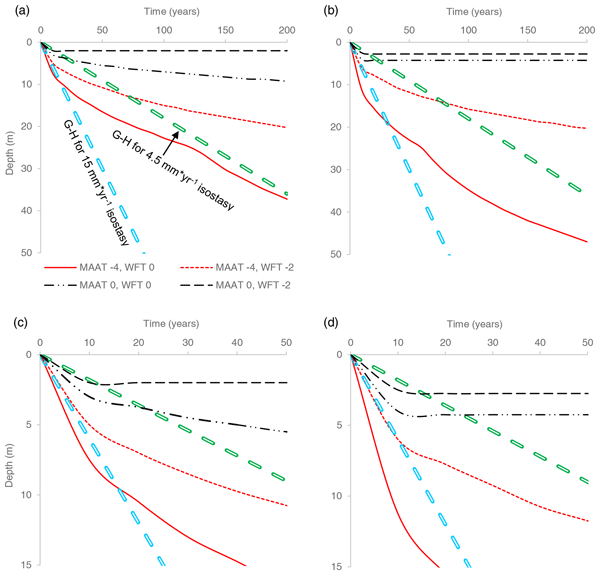
Frozen saline pore water, left over from post-glacial marine ingression, was found in shallow permafrost in a Svalbard fjord valley. This suggests that freezing occurred immediately after marine regression due to isostatic rebound. We conducted top-down freezing simulations, which confirmed that with Early to mid-Holocene temperatures (e.g. −4 °C), freezing could progress down to 20–40 m within 200 years. This, in turn, could inhibit flow through the sediment, therefore preserving saline fluids.
Lin Hoober, Barak Herut, Nadya Teutsch, Sarit Ashckenazi-Polivoda, Adi Torfstein, and Sigal Abramovich
Biogeosciences, 23, 5685–5696, https://doi.org/10.5194/bg-23-5685-2026, https://doi.org/10.5194/bg-23-5685-2026, 2026
Short summary
Short summary
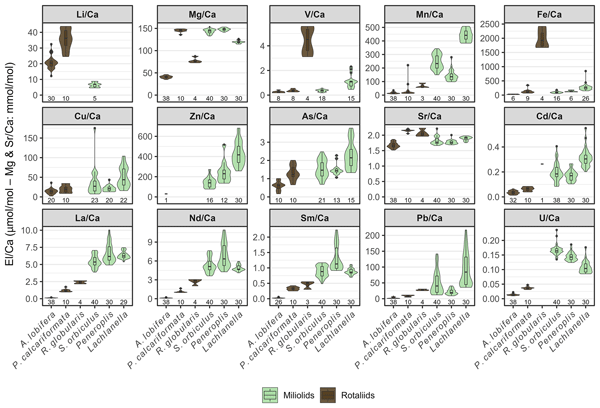
Foraminifera are tiny marine organisms that build shells and have evolved different ways of doing so over millions of years. By comparing two major groups living side by side in the Mediterranean Sea, this study shows that their shells record clear, systematic chemical differences. These contrasts reveal fundamentally different shell-building strategies shaped by evolution, not just by the surrounding environment.

Lotte Wendt, Line Rouyet, Hanne H. Christiansen, Tom Rune Lauknes, and Sebastian Westermann
The Cryosphere, 20, 1179–1197, https://doi.org/10.5194/tc-20-1179-2026, https://doi.org/10.5194/tc-20-1179-2026, 2026
Short summary
Short summary
In permafrost environments, the ground surface moves due to the formation and melt of ice in the ground. This study compares ground surface displacements measured from satellite images against field data of ground ice contents. We find good agreement between the detected seasonal subsidence and observed ground ice melt. Our results show the potential of satellite remote sensing for mapping ground ice variability, but also indicate that ice in excess of the pore space must be considered.
Efraim Bril, Adi Torfstein, Roy Yaniv, and Assaf Hochman
Clim. Past, 22, 339–355, https://doi.org/10.5194/cp-22-339-2026, https://doi.org/10.5194/cp-22-339-2026, 2026
Short summary
Short summary
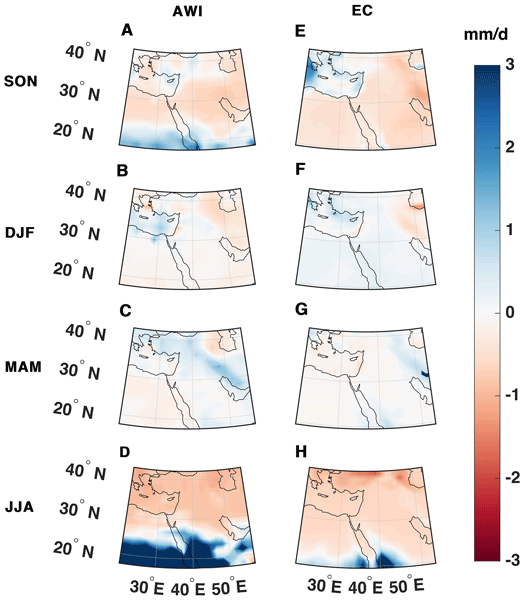
During a past warm period, we found that the eastern Mediterranean region experienced stronger but shorter rain events, especially in the south. The warming made the air wetter, which helped produce more intense rainfall. Using climate models and recent data, we show how this improves our understanding of future changes in dry regions.
Noy Levy, Adi Torfstein, Ralf Schiebel, Natalie Chernihovsky, Klaus Peter Jochum, Ulrike Weis, Brigitte Stoll, and Gerald H. Haug
Biogeosciences, 23, 1065–1088, https://doi.org/10.5194/bg-23-1065-2026, https://doi.org/10.5194/bg-23-1065-2026, 2026
Short summary
Short summary
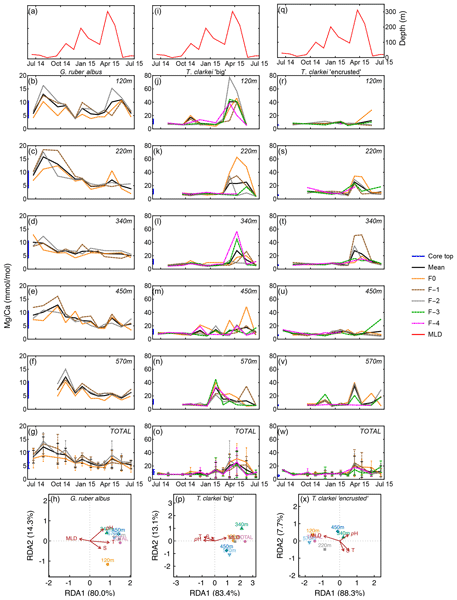
We investigated the shell chemistry of planktic organisms called foraminifera to understand how conditions in the Gulf of Aqaba (north of Red Sea), a relative warm and saline sea, are recorded. We analyzed shell parts, called chambers, and we found that shell chemistry varies significantly between both chambers and foraminifera species. These findings help better understand how deposited shells can be used to reconstruct past ocean temperatures and other conditions.
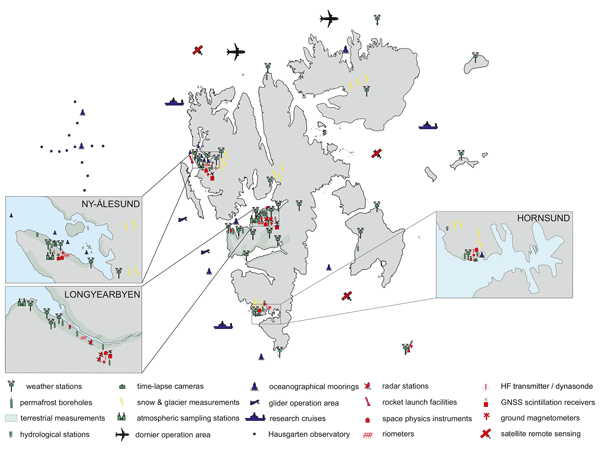
Hanne H. Christiansen, Ilkka S. O. Matero, Lisa Baddeley, Kim Holmén, Clara J. M. Hoppe, Maarten J. J. E. Loonen, Rune Storvold, Vito Vitale, Agata Zaborska, and Heikki Lihavainen
Earth Syst. Dynam., 15, 933–946, https://doi.org/10.5194/esd-15-933-2024, https://doi.org/10.5194/esd-15-933-2024, 2024
Short summary
Short summary
We provide an overview of the state and future of Earth system science in Svalbard as a synthesis of the recommendations made by the scientific community active in the archipelago. This work helped identify foci for developments of the observing system and a path forward to reach the full interdisciplinarity needed to operate at Earth system science scale. Better understanding of the processes in Svalbard will benefit both process-level understanding and Earth system models.
Dotan Rotem, Vladimir Lyakhovsky, Hanne Hvidtfeldt Christiansen, Yehudit Harlavan, and Yishai Weinstein
The Cryosphere, 17, 3363–3381, https://doi.org/10.5194/tc-17-3363-2023, https://doi.org/10.5194/tc-17-3363-2023, 2023
Short summary
Short summary
Frozen saline pore water, left over from post-glacial marine ingression, was found in shallow permafrost in a Svalbard fjord valley. This suggests that freezing occurred immediately after marine regression due to isostatic rebound. We conducted top-down freezing simulations, which confirmed that with Early to mid-Holocene temperatures (e.g. −4 °C), freezing could progress down to 20–40 m within 200 years. This, in turn, could inhibit flow through the sediment, therefore preserving saline fluids.
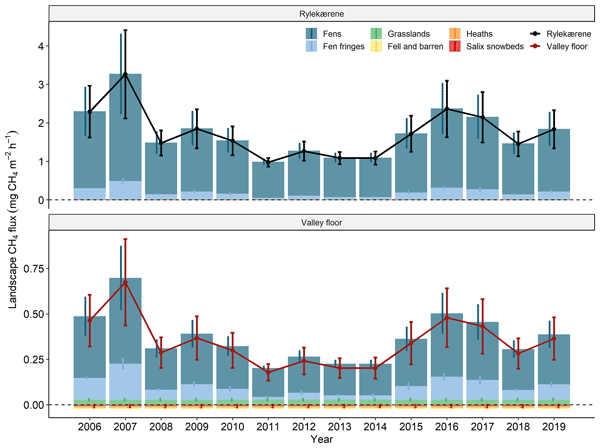
Johan H. Scheller, Mikhail Mastepanov, Hanne H. Christiansen, and Torben R. Christensen
Biogeosciences, 18, 6093–6114, https://doi.org/10.5194/bg-18-6093-2021, https://doi.org/10.5194/bg-18-6093-2021, 2021
Short summary
Short summary
Our study presents a time series of methane emissions in a high-Arctic-tundra landscape over 14 summers, which shows large variations between years. The methane emissions from the valley are expected to more than double in the late 21st century. This warming increases permafrost thaw, which could increase surface erosion in the valley. Increased erosion could offset some of the rise in methane fluxes from the valley, but this would require large-scale impacts on vegetated surfaces.
Cited articles
Abramov, A., Vishnivetskaya, T., and Rivkina, E.: Are permafrost microorganisms as old as permafrost?, FEMS Microbiol. Ecol, 97, https://doi.org/10.1093/femsec/fiaa260, 2021.
Ahonen, L.: Permafrost: occurrence and physiochemical processes (POSIVA–01-05), POSIVA OY, Finland, 2001.
Åkerman, H. J., and Malmström, B.: Permafrost Mounds in the Abisko Area, Northern Sweden, Geogr. Ann. A, 68, 155–165, https://doi.org/10.1080/04353676.1986.11880169, 1986.
Alekseyev, V. R.: Cryogenesis and geodynamics of icing valleys, Geodyn. Tectonophys., 6, 171–224, https://doi.org/10.5800/GT-2015-6-2-0177, 2015.
Anisimov, O. A. and Nelson, F. E.: Permafrost zonation and climate change in the northern hemisphere: results from transient general circulation models, Clim. Change, 35, 241–258, https://doi.org/10.1023/A:1005315409698, 1986.
Banin, A. and Anderson, D. M.: Effects of Salt Concentration Changes During Freezing on the Unfrozen Water Content of Porous Materials, Water Resour. Res., 10, 124–128, https://doi.org/10.1029/WR010i001p00124, 1974.
Bear, J.: Dynamics of Fluids in Porous Media, New York, American Elsevier Publishing Company, ISBN-10 0-468-65675-6, 1972.
Boike, J., Roth, K., and Overduin, P. P.: Thermal and hydrologic dynamics of the active layer at a continuous permafrost site (Taymyr Peninsula, Siberia), Water Resour. Res., 34, 355–363, https://doi.org/10.1029/97WR03498, 1998.
Braathen, A., Bælum, K., Christiansen, H. H., Dahl, T., Eiken, O., Elvebakk, H., Hansen, F., Hanssen, T. H., Jochmann, M., Johansen, T. A., Johnsen, H., Larsen, L., Lie, T., Mertes, J., Mørk, A., Mørk, M. B., Nemec, W., Olaussen, S., Oye, V., Rød, K., Titlestad, G. O., Tveranger, J., and Vagle, K.: The Longyearbyen CO2 Lab of Svalbard, Norway – initial assessment of the geological conditions for CO2 sequestration, Norw. J. Geol., 92, 353–376, 2012.
Brady, J. B. and Cherniak, D. J.: Diffusion in Minerals: An Overview of Published Experimental Diffusion Data, Rev. Mineral. Geochem., 72, 899–920, https://doi.org/10.2138/rmg.2010.72.20, 2010.
Brigham-Grette, J. and Hopkins, D. M.: Emergent Marine Record and Paleoclimate of the Last Interglaciation along the Northwest Alaskan Coast, Quaternary Res., 43, 159–173, 1995.
Brouchkov, A.: Nature and distribution of frozen saline sediments on the Russian Arctic coast, Permafr. Perigl., 13, 83–90, https://doi.org/10.1006/qres.1995.1017, 2002.
Brown, J., Ferrians, O., Heginbottom, J. A., and Melnikov, E.: Circum-Arctic Map of Permafrost and Ground-Ice Conditions. (GGD318, Version 2), Boulder, Colorado USA, National Snow and Ice Data Center [data set], https://doi.org/10.7265/skbg-kf16 (last access: 9 February 2026), 2002.
Bullock, E. J., Kipp, L., Moore, W., Brown, K., Mann, P. J., Vonk, J. E., Zimov, N., and Charette, M. A.: Radium Inputs Into the Arctic Ocean From Rivers: A Basin-Wide Estimate, J. Geophys. Res.-Ocean., 127, e2022JC018964, https://doi.org/10.1029/2022JC01896, 2022.
Burn, C. R. and Michel, F. A.: Evidence for recent temperature-induced water migration into permafrost from the tritium content of ground ice near Mayo, Yukon Territory, Canada, Can. J. Earth Sci., 25, 909–915, https://doi.org/10.1139/e88-087, 1988.
Cable, S., Elberling, B., and Kroon, A.: Holocene permafrost history and cryostratigraphy in the High‐Arctic Adventdalen Valley, central Svalbard, Boreas, 47, 423–442, https://doi.org/10.1111/bor.12286, 2018.
Cherniak, D. J.: Cation Diffusion in Feldspars, Rev. Mineral. Geochem., 72, 691–733, https://doi.org/10.2138/rmg.2010.72.15, 2010.
Charkin, A. N., Pipko, I. I., Yu. Pavlova, G., Dudarev, O. V., Leusov, A. E., Barabanshchikov, Y. A., Shcherbakova, K. P., Yaroshchuk, E. I., Pugach, S. P., Gulenko, T. A., Goriachev, V. A., Semiletov, I. P., and Zarubina, N. V.: Hydrochemistry and isotopic signatures of sub-permafrost groundwater discharge along the eastern slope of the Lena River Delta in the Laptev Sea, J. Hydrol., 590, 125515, https://doi.org/10.1016/j.jhydrol.2020.125515, 2020.
Christiansen, H. H., French, H. M., and Humlum, O.: Permafrost in the Gruve-7 mine, Adventdalen, Svalbard. Norw. J. Geog., 59, 109–115, https://doi.org/10.1080/00291950510020592, 2005.
Crank, J.: The Mathematics of Diffusion, 2nd edn., Oxford, UK, Clarendon Press, ISBN-13 978-0198533443, 1975.
Colangelo-Lillis, J., Eicken, H., Carpenter, S. D., and Deming, J. W.: Evidence for marine origin and microbial-viral habitability of sub-zero hypersaline aqueous inclusions within permafrost near Barrow, Alaska, FEMS Microbiol. Ecol., 92, https://doi.org/10.1093/femsec/fiw053, 2016.
Dabrowski, J. S.: Radium isotopes and radon-222 as tracers of sediment-water interaction in Arctic coastal and, lacustrine environments, Doctoral dissertation, Massachusetts Institute of Technology, https://hdl.handle.net/1721.1/128993 (last access: 5 January 2021), 2020.
Dafflon, B., Hubbard, S., Ulrich, C., Peterson, J., Wu, Y., Wainwright, H., and Kneafsey, T. J.: Geophysical estimation of shallow permafrost distribution and properties in an ice-wedge polygon-dominated Arctic tundra region, Geophysics, 81, https://doi.org/10.1190/geo2015-0175.1, 2016.
Dash, J. G., Rempel, A. W., and Wettlaufer, J. S.: The physics of premelted ice and its geophysical consequences, Rev. Modern Phys., 78, 695–741, 2006.
Davidson, M. R. and Dickson, B. L.: A porous flow model for steady state transport of radium in groundwater, Water Resour. Res., 22, 34–44, 1986.
de Baar, H. J. W., van Heuven, S. M. A. C., and Middag, R.: Ocean Salinity, Major Elements, and Thermohaline Circulation, in: Encyclopedia of Geochemistry, edited by: White, W., Encyclopedia of Earth Sciences Series, Springer, Cham, https://doi.org/10.1007/978-3-319-39193-9_120-1, 2017.
Demidov, N., Wetterich, S., Verkulich, S., Ekaykin, A., Meyer, H., Anisimov, M., Schirrmeister, L., Demidov, V., and Hodson, A. J.: Geochemical signatures of pingo ice and its origin in Grøndalen, west Spitsbergen, The Cryosphere, 13, 3155–316, https://doi.org/10.5194/tc-13-3155-2019, 2019.
Demidov, V., Wetterich, S., Demidov, N., Schirrmeister, L., Verkulich, S., Koshurnikov, A., Gagarin, V., Ekaykin, A., Terekchov, A., Veres, A., and Kozachek, A.: Pingo drilling reveals sodium–chloride-dominated massive ice in Grøndalen, Spitsbergen, Permafr. Perigl., 32, 572–586, https://doi.org/10.1002/ppp.2124, 2021.
Dickinson, W. W. and Rosen, M. R.: Antarctic permafrost: An analogue for water and diagenetic minerals on Mars, Geology, 31, 199–202, https://doi.org/10.1130/0091-7613(2003)031<0199:APAAFW>2.0.CO;2, 2003.
Dobinski, W.: Permafrost. Earth Sci. Rev., 108, 158–169, https://doi.org/10.1016/j.earscirev.2011.06.007, 2011.
Diego-Feliu, M., Rodellas, V., Saaltink, M., Alorda-Kleinglass, A., Goyetche, T., Martínez-Pérez, L., Folch, A., and Garcia-Orellana, J.: New perspectives on the use of 224Ra/228Ra and 222Rn/226Ra activity ratios in groundwater studies, J. Hydrol., 596, 126043, https://doi.org/10.1016/j.jhydrol.2021.126043, 2021.
Dimova, N. T., Paytan, A., Kessler, J. D., Sparrow, K. J., Garcia-Tigreros Kodovska, F., Lecher, A. L., Murray, J., and Tulaczyk, S. M.: Current Magnitude and Mechanisms of Groundwater Discharge in the Arctic: Case Study from Alaska, Environ. Sci. Technol., 49, 12036–12043, https://doi.org/10.1021/acs.est.5b02215, 2015.
Elverhøi, A., Svendsen, J. I., Solheim, A., Andersen, E. S., Milliman, J., Mangerud, J., and Hooke, R. L.: Late Quaternary Sediment Yield from the High Arctic Svalbard Area, J. Geol., 103, https://doi.org/10.1086/629718, 1994.
Ewing, S. A., Paces, J. B., O'Donnell, J. A., Jorgenson, M. T., Kanevskiy, M. Z., Aiken, G. R., Shur, Y., Harden, J. W., and Striegl, R.: Uranium isotopes and dissolved organic carbon in loess permafrost: modeling the age of ancient ice, Geochim. Cosmochim. Ac., 152, 143–165, https://doi.org/10.1016/j.gca.2014.11.008, 2015.
Fisher, D. A., Lacelle, D., and Pollard, W.: A model of unfrozen water content and its transport in icy permafrost soils: Effects on ground ice content and permafrost stability, Permafr. Perigl., 31, 184–199, https://doi.org/10.1002/ppp.2031, 2019.
Fleischer, R. L. and Raabe, O.: Recoiling alpha-emitting nuclei, Mechanisms for uranium-series disequilibrium, Geoch. Cosm. Act., 42, 973–978, https://doi.org/10.1016/0016-7037(78)90286-7, 1978.
Forman, S. L., Lubinski, D. J., Ingólfsson, Ó., Zeeberg, J. J., Snyder, J. A., Siegert, M. J., and Matishov, G. G.: A review of postglacial emergence on Svalbard, Franz Josef Land and Novaya Zemlya, northern Eurasia, Quaternary Sci. Rev., 23, 1391–1434, https://doi.org/10.1016/j.quascirev.2003.12.007, 2004.
French, H.: The Periglacial Environment, Copyright © 2007 by John Wiley & Sons, Ltd., ISBN 9781119132790, 2007.
French, H.: Recent contributions to the study of past permafrost, Permafr. Perigl., 19, 179–194, https://doi.org/10.1002/ppp.614, 2008.
Fu, Z., Wu, Q., Zhang, W., He, H., and Wang, L.: Water Migration and Segregated Ice Formation in Frozen Ground: Current Advances and Future Perspectives, Front. Earth Sci., 10, 826961, https://doi.org/10.3389/feart.2022.826961, 2022.
Gao, Z., Lin, Z., Niu, F., Luo, J., Liu, M., and Yin, G.: Hydrochemistry and controlling mechanism of lakes in permafrost regions along the Qinghai-Tibet Engineering Corridor, China, Geomorphology, 297, 159–169, https://doi.org/10.1016/j.geomorph.2017.09.020, 2017.
Garcia-Solsona, E., Garcia-Orellana, J., Masqué, P., and Dulaiova, H.: Uncertainties associated with 223Ra and 224Ra measurements in water via a Delayed Coincidence Counter (RaDeCC), Mar. Chem., 109, 198–219, https://doi.org/10.1016/j.marchem.2007.11.006, 2008.
Garcia-Orellana, J., Rodellas, V., Tamborski, J., Diego-Feliu, M., Van Beek, P., Weinstein, Y., Charette, M., Alorda-Kleinglass, A., Michael, H., Stieglitz, T., and Scholten, J.: Radium isotopes as submarine groundwater discharge (SGD) tracers: Review and recommendations, Earth Sci. Rev., 220, 103681, https://doi.org/10.1016/j.earscirev.2021.103681, 2021.
Gilbert, G. L., O'Neill, H. B., Nemec, W., Thiel, C., Christiansen, H. H., and Buylaert, J. P.: Late Quaternary sedimentation and permafrost development in a Svalbard fjord‐valley, Norwegian high Arctic, Sedimentology, 65, 2531–2558, https://doi.org/10.1111/sed.12476, 2018.
Gilbert, G. L., Instanes, A., Sinitsyn, A., and Aalberg, A.: Characterization of two sites for geotechnical testing in permafrost: Longyearbyen, Svalbard, AIMS Geosci., 5, 868–885, 2019.
Gilichinsky, D. and Wagener, S.: Microbial life in permafrost: A historical review, Permafr. Perigl., 6, 243–250, https://doi.org/10.1002/ppp.3430060305, 1995.
Gilichinsky, D., Rivkina, E., Shcherbakova, V., Laurinavichuis, K., and Tiedje, J.: Supercooled Water Brines Within Permafrost – An Unknown Ecological Niche for Microorganisms: A Model for Astrobiology, Astrobiology, 3, 331–341, 2003.
Gonneea, M. E., Morris, P. J., Dulaiova, H., and Charette, M. A.: New perspectives on radium behavior within a subterranean estuary, Mar. Chem., 109, 250–267, https://doi.org/10.1016/j.marchem.2007.12.002, 2008.
Grant, K. M., Rohling, E. J., Ayalon, A., Ramsey, C. B., Satow, C., and Roberts, A. P.: Rapid coupling between ice volume and polar temperature over the past 150,000 years, Nature, 491, 744–747, https://doi.org/10.1038/nature11593, 2012.
Grundvåg, S. A., Jelby, M. E., Sliwinska, K. K., Nøhr-Hansen, H., Aadland, T., Sandvik, S. E., Tennvassås, I., Engen, T., and Olaussen, S.: Sedimentology and palynology of the Lower Cretaceous succession of central Spitsbergen: integration of subsurface and outcrop data, Nor. J. Geol., 99, 253–284, https://doi.org/10.17850/njg006, 2019.
Harry, D. G. and Gozdzik, J. S.: Ice wedges: growth, thaw transformation, and palaeoenvironmental significance, J. Quat. Sci., 3, 39–55, https://doi.org/10.1002/jqs.3390030107, 1988.
Henkemans, E.: Geochemical Characterization of Groundwaters, Surface Waters and Water-Rock Interaction in an Area of Continuous Permafrost Adjacent to the Greenland Ice Sheet, Kangerlussuaq, Southwest Greenland, A thesis presented to the University of Waterloo, Waterloo, Ontario, Canada, http://hdl.handle.net/10012/10193 (last access: 21 January 2016), 2016.
Herut, B., Starinsky, A., Katz, A., and Bein, A.: The role of seawater freezing in the formation of subsurface brines, Geochim. Cosmochim. Ac., 54, 13–21, https://doi.org/10.1016/0016-7037(90)90190-V, 1990.
Hivon, E. G. and Sego, D. C.: Distribution of saline permafrost in the Northwest Territories, Canada, Can. Geotech. J., 30, 506–514, https://doi.org/10.1139/t93-043, 1993.
Hodson, A. J., Nowak, A., Hornum, M. T., Senger, K., Redeker, K., Christiansen, H. H., Jessen, S., Betlem, P., Thornton, S. F., Turchyn, A. V., Olaussen, S., and Marca, A.: Sub-permafrost methane seepage from open-system pingos in Svalbard, The Cryosphere, 14, 3829–3842, https://doi.org/10.5194/tc-14-3829-2020, 2020.
Hornum, M. T., Hodson, A. J., Jessen, S., Bense, V., and Senger, K.: Numerical modelling of permafrost spring discharge and open-system pingo formation induced by basal permafrost aggradation, The Cryosphere, 14, 4627–4651, https://doi.org/10.5194/tc-14-4627-2020, 2020.
Hsieh, T., Geibert, W., Stahl, H., Aleynik, D., and Henderson, G. M.: Using the radium quartet (228Ra, 226Ra, 224Ra, and 223Ra) to estimate water mixing and radium inputs in Loch Etive, Scotland, Limnol. Oceanogr., 58, 1089–1102, https://doi.org/10.4319/lo.2013.58.3.1089, 2013.
Humlum, O., Instanes, A., and Sollid, J. L.: Permafrost in Svalbard: a review of research history, climatic background and engineering challenges, Polar Res., 22, 191–215, https://doi.org/10.1111/j.1751-8369.2003.tb00107.x, 2003.
Isaksen, K., Holmlund, P., Sollid, J. L., and Harris, C.: Three deep Alpine-permafrost boreholes in Svalbard and Scandinavia, Permafr. Perigl., 12, 13–25, https://doi.org/10.1002/ppp.380, 2001.
Iwahana, G., Cooper, Z. S., Carpenter, S. D., Deming, J. W., and Eicken, H.: Intra-ice and intra-sediment cryopeg brine occurrence in permafrost near Utqiaġvik (Barrow), Permafr. Perigl., 32, 427–446, https://doi.org/10.1002/ppp.2101, 2021.
James, M., Lewkowicz, A. G., Smith, S. L., and Miceli, C. M.: Multi-decadal degradation and persistence of permafrost in the Alaska Highway corridor, northwest Canada, Environ. Res. Lett., 8, 045013, https://doi.org/10.1088/1748-9326/8/4/045013, 2013.
Jellinek, H. H. G. and Chatterjee, A. K.: Diffusion of radioactive sodium in polycrystalline ice, Phys. Status Solidi A, 4, 173–179, https://doi.org/10.1002/pssa.2210040118, 1971.
Jin, H. J., Chang, X. L., and Wang, S. L.: Evolution of permafrost on the Qinghai-Xizang (Tibet) Plateau since the end of the late Pleistocene, J. Geophys., 112, https://doi.org/10.1029/2006JF000521, 2007.
Jones, B. M., Kanevskiy, M. Z., Parsekian, A. D., Bergstedt, H., Ward Jones, M. K., Rangel, R. C., Hinkel, K. M., and Shur, Y.: Rapid Saline Permafrost Thaw Below a Shallow Thermokarst Lake in Arctic Alaska, Geophys. Res. Lett., 50, e2023GL105552, https://doi.org/10.1029/2023GL105552, 2023.
Keating, K., Binley, A., Bense, V., Van Dam, R. L., and Christiansen, H. H.: Combined geophysical measurements provide evidence for unfrozen water in permafrost in the Adventdalen valley in Svalbard, Geophys. Res. Lett., 45, 7606–7614, https://doi.org/10.1029/2017GL076508, 2018.
Kipp, L., Charette, M., Robbins, A., Pnyushkov, A., Polyakov, I., and Whitmore, L.: Radium Isotopes as Tracers of Shelf-Basin Exchange Processes in the Eastern Arctic Ocean, J. Geophys. Re.-Ocean., 128, e2023JC020303, https://doi.org/10.1029/2023JC020303, 2023.
Kipp, L., Chaillou, G., Kienast, M., Tamborski, J., and Whalen, D.: Radon and radium isotope signatures on a massive ice- and permafrost-rich coastline. Geochim. Cosmochim. Ac., 403, 166–181, https://doi.org/10.1016/j.gca.2025.06.014, 2025.
Kipp, L. E., Kadko, D. C., Pickart, R. S., Henderson, P. B., Moore, W. S., and Charette, M. A.: Shelf-Basin Interactions and Water Mass Residence Times in the Western Arctic Ocean: Insights Provided by Radium Isotopes, J. Geophys. Re.-Ocean., 124, 3279–3297, https://doi.org/10.1029/2019JC014988, 2019.
Kiro, Y., Yechieli, Y., Voss, C.I., Starinsky, A., and Weinstein, Y.: Modeling radium distribution in coastal aquifers during sea level changes: the Dead Sea case, Geochim. Cosmochim. Ac., 88, 237–254, https://doi.org/10.1016/j.gca.2012.03.022, 2012.
Kiro, Y., Weinstein, Y., Starinsky, A., and Yechieli, Y.: Groundwater ages and reaction rates during seawater circulation in the Dead Sea aquifer, Geochim. Cosmochim. Ac., 122, 17–35, https://doi.org/10.1016/j.gca.2013.08.005, 2013.
Kiro, Y., Weinstein, Y., Starinsky, A., and Yechieli, Y.: Application of radon and radium isotopes to groundwater flow dynamics: An example from the Dead Sea, Chem. Geol., 411, 155–171, https://doi.org/10.1016/j.chemgeo.2015.06.014, 2015.
Kraemer, T. F. and Reid, D. F.: The occurrence and behavior of radium in saline formation water of the U.S. Gulf coast region, Isotope Geosci., 2, 153–174, https://doi.org/10.1016/0009-2541(84)90186-4, 1984.
Krishnaswami, S., Graustein, W. C., Turekian, K. K., and Dowd, J. F.: Radium, thorium and radioactive lead isotopes in groundwaters: Application to the in-situ determination of adsorption-desorption rate constants and retardation factors, Water Resour. Res., 18, 1663–1675, https://doi.org/10.1029/WR018i006p01663, 1982.
Kumar, A., Rout, S., Pulhani, V., and Kumar, A. V.: A review on distribution coefficient (Kd) of some selected radionuclides in soil/sediment over the last three decades, J. Radioanal. Nucl. Chem., 323, 13–26, https://doi.org/10.1007/s10967-019-06930-x, 2020.
Kwong, Y. T. J. and Gan, T. Y.: Northward migration of permafrost along the Mackenzie highway and climatic warming, Clim. Change, 26, 399–419, https://doi.org/10.1007/BF01094404, 1994.
Lacelle, D., Fisher, D. A., Verret, M., and Pollard, W.: Improved prediction of the vertical distribution of ground ice in Arctic-Antarctic permafrost sediments, Commun. Earth Environ. 3, 1–12, https://doi.org/10.1038/s43247-022-00367-z, 2022.
Li, G., Zhang, M., Pei, W., Melnikov, A., Khristoforov, I., Li, R., and Yu, F.: Changes in permafrost extent and active layer thickness in the Northern Hemisphere from 1969 to 2018, Sci. Total Environ., 804, 150182, https://doi.org/10.1016/j.scitotenv.2021.150182, 2022.
Lønne, I. and Nemec, W.: High-arctic fan delta recording deglaciation and environment disequilibrium, Sedimentology, 51, 553–589, https://doi.org/10.1111/j.1365-3091.2004.00636.x, 2004.
Mackay J. R.: Downward water movement into frozen ground, western arctic coast, Canada, Can. J. Earth Sci., 20, 120–134, https://doi.org/10.1139/e83-012, 1983.
Mackay, J. R.: Ice-Wedge Cracks, Western Arctic Coast, Can. Geogr., 33, 365–368, https://doi.org/10.1111/j.1541-0064.1989.tb00923.x, 1989.
Mackay, J. R. and Dallimore, S. R.: Massive ice of the Tuktoyaktuk area, western Arctic coast, Canada, Can. J. Earth Sci., 29, 1235–1249, https://doi.org/10.1139/e92-099, 1992.
Marion, G. M.: Freeze-thaw processes and soil chemistry, Special Report 95-12, U.S. Army Cold Regions Research and Engineering Laboratory (CRREL), Hanover, NH, USA, 102 pp., https://hdl.handle.net/11681/12110 (last access: 10 July 2025), 1995.
Marsh, P. and Woo, M. K.: Infiltration of meltwater into frozen soils in a continuous permafrost environment, in: Proceedings of the sixth international conference on permafrost, South China University of Technology Press, Beijing, vol. 1, 443–448, 1993.
Mathieu, G. G., Biscaye, P. E., Lupton, R. A., and Hammond, D. E.: System for measurement of 222Rn at low levels in natural waters, Health Phys., 55, 989–992, 1988.
Moore, W. S.: Large groundwater inputs to coastal waters revealed by 226Ra enrichments, Nature, 380, 612–614, https://doi.org/10.1038/380612a0, 1996.
Moore, W. S.: Sources and fluxes of submarine groundwater discharge delineated by radium isotopes, Biogeochemistry, 66, 75–93, https://doi.org/10.1023/B:BIOG.0000006065.77764.a0, 2003.
Moore, W. S. and Arnold, R.: Measurement of 223Ra and 224Ra in coastal waters using a delayed coincidence counter, J. Geophys. Res.-Ocean., 101, 1321–1329, https://doi.org/10.1029/95JC03139, 1996.
Mulrooney, M. J., Larsen, L., Van Stappen, J., Rismyhr, B., Senger, K., Braathen, A., Olaussen, S., Mørk, M. B. E., Ogata, K., and Cnudde, V.: Fluid flow properties of the Wilhelmøya Subgroup, a potential unconventional CO2 storage unit in central Spitsbergen, Nor. J. Geol., 85–116, https://doi.org/10.17850/njg002, 2018.
Obu, J., Westermann, S., Bartsch, A., Berdnikov, N., Christiansen, H. H., Dashtseren, A., Delaloye, R., Elberling, B., Etzelmüller, B., Kholodov, A., Khomutov, A., Kääb, A., Leibman, M. O., Lewkowicz, A. G., Panda, S. K., Romanovsky, V., Way, R. G., Westergaard-Nielsen, A., Wu, T., Yamkhin, J., and Zou, D.: Northern Hemisphere permafrost map based on TTOP modelling for 2000–2016 at 1 km2 scale, Earth-Sci. Rev., 193, 299–316, https://doi.org/10.1016/j.earscirev.2019.04.023, 2019.
Ogata, K., Senger, K., Braathen, A., Tveranger, J., and Olaussen, S.: The importance of natural fractures in a tight reservoir for potential CO2 storage: a case study of the upper Triassic–middle Jurassic Kapp Toscana Group (Spitsbergen, Arctic Norway), Geol. Soc. Lond. Spec. Publ., 374, 395–415, https://doi.org/10.1144/SP374.9, 2014.
Opel, T., Meyer, H., Wetterich, S., Laepple, T., Dereviagin, A., and Murton, J.: Ice wedges as archives of winter paleoclimate: A review, Permafr. Perigl., 29, 199–209, https://doi.org/10.1002/ppp.1980, 2018.
Osterkamp, T. E. and Romanovsky, V. E.: Evidence for warming and thawing of discontinuous permafrost in Alaska, Permafr. Perigl., 10, 17–37, https://doi.org/10.1002/(SICI)1099-1530(199901/03)10:1<17::AID-PPP303>3.0.CO;2-4, 1998.
Rama and Moore, W.: Mechanism of transport of U-Th series radioisotopes from solids into ground water, Geochim. Cosmochim. Ac., https://doi.org/10.1016/0016-7037(84)90261-8, 1984.
Rotem, D.: Tables for article The history of ground ice formation and intra-permafrost fluid flow as documented by Ra and Th isotopes, figshare [data set], https://doi.org/10.6084/m9.figshare.30959015.v3, 2025.
Rotem, D., Lyakhovsky, V., Christiansen, H. H., Harlavan, Y., and Weinstein, Y.: Permafrost saline water and Early to mid-Holocene permafrost aggradation in Svalbard, The Cryosphere, 17, 3363–3381, https://doi.org/10.5194/tc-17-3363-2023, 2023.
Rotem, D., Weinstein, Y., Christiansen, H. H., Sültenfuß, J., and Hodson, A.: Ra isotope perspective on the hydrology and continuity of permafrost in the high Arctic, Sci. Total Environ., 950, 175412, https://doi.org/10.1016/j.scitotenv.2024.175412, 2024.
Rutgers Van Der Loeff, M. M., Key, R. M., Scholten, J., Bauch, D., and Michel, A.: 228Ra as a tracer for shelf water in the Arctic Ocean, Deep-Sea Res. Pt. II, 42, 1533–1553, https://doi.org/10.1016/0967-0645(95)00053-4, 1994.
Rutgers van der Loeff, M., Kühne, S., Wahsner, M., Höltzen, H., Frank, M., Ekwurzel, B., Mensch, M., and Rachold, V.: 228Ra and 226Ra in the Kara and Laptev seas, Cont. Shelf Res., 23, 113–124, https://doi.org/10.1016/S0278-4343(02)00169-3, 2002.
Sheshukov, A. Y. and Nieber, J. L.: One‐dimensional freezing of non-heaving unsaturated soils: Model formulation and similarity solution, Water Resour. Res., 47, https://doi.org/10.1029/2011WR010512, 2011.
Solomatin, V. I. and Xu, X.: Water migration and ice segregation in the transition zone between thawed and frozen soil, Permafr. Perigl., 5, 185–190, https://doi.org/10.1002/ppp.3430050307, 1994.
Stephani, E., Drage, J., Miller, D., Jones, B. M., and Kanevskiy, M.: Taliks, cryopegs, and permafrost dynamics related to channel migration, Colville River Delta, Alaska, Permafr. Perigl., 31, 239–254, https://doi.org/10.1002/ppp.2046, 2020.
Suksi, J. and Rasilainen, K.: On the Role of α-Recoil in Uranium Migration – Some Findings from the Palmottu natural Analogue Site, SW Finland, adiochim. Acta, 74, 297–302, https://doi.org/10.1524/ract.1996.74.special-issue.297, 1996.
Sumner, M. E. and Miller, W. P.: Cation exchange capacity and exchange coefficients, in:Methods of Soil Analysis, Part 3: Chemical Methods, edited by: Sparks, D. L. et al., 1201–1229, Soil Science Society of America, Madison, WI, https://doi.org/10.2136/sssabookser5.3.c40, 1996.
Vany'sek, P.: Ionic conductivity and diffusion at infinite dilution, in: CRC Handbook Of Chemistry and Physics, edited by: Haynes, W. M., CRC Press, Taylor & Francis Group, 6000 Broken Sound Parkway NW, Suite 300, Boca Raton, FL 33487-2742, ISBN 978-1-4822-0867-2, 2017.
Vinson, D. S., Tagma, T., Bouchaou, L., Dwyer, G. S., Warner, N. R., and Vengosh, A.: Occurrence and mobilization of radium in fresh to saline coastal groundwater inferred from geochemical and isotopic tracers (Sr, S, O, H, Ra, Rn), Appl. Geochem., 38, 161–175, https://doi.org/10.1016/j.apgeochem.2013.09.004, 2013.
Wang, S., Wang, Q., Xu, J., and Ding, J.: Effect of freeze-thaw on freezing point and thermal conductivity of loess, Arab. J. Geosci., 13, 206, https://doi.org/10.1007/s12517-020-5186-2, 2020.
Wang, C., Li, S., Lai, Y., Chen, Q., He, X., Zhang, H., and Liu, X.: Predicting the Soil Freezing Characteristic From the Particle Size Distribution Based on Micro-Pore Space Geometry, Water Resour. Res., 58, e2021WR030782, https://doi.org/10.1029/2021WR030782, 2021.
Weinstein, Y., Rotem, D., Kooi, H., Yechieli, Y., Sültenfuß, J., Kiro, Y., Harlavan, Y., Feldman, M., and Christiansen, H. H.: Radium isotope fingerprinting of permafrost‐applications to thawing and intra‐permafrost processes, Permafr. Perigl., 30, 104–112, https://doi.org/10.1002/ppp.1999, 2019.
Weinstein, Y., Friedheim, O., Odintsov, L., Harlavan, Y., Nuriel, P., Lazar, B., and Burg, A.: Using radium isotopes to constrain the age of saline groundwater, implications to seawater intrusion in aquifers, J. Hydrol., 598, 126412, https://doi.org/10.1016/j.jhydrol.2021.126412, 2021.
Wojtasik, B., Świrydowicz, S., Burska, D., and Nowiński, K.: Radionuclide activities in sediments on the northern coast of Spitsbergen, Polish Polar Res., 291–312, https://doi.org/10.1515/popore-2017-0019, 2017.
Yamaguchi, A., Nagata, K., Kobayashi, K., Tanaka, K., Kobayashi, T., Tanida, H., Shimojo, K., Sekiguchi, T., Kaneta, Y., Matsuda, S., Yokoyama, K., Yaita, T., Yoshimura, T., Okumura, M., and Takahashi, Y.: Extended X-ray absorption fine structure spectroscopy measurements and ab initio molecular dynamics simulations reveal the hydration structure of the radium(II) ion, iScience, 25, 104763, https://doi.org/10.1016/j.isci.2022.104763, 2022.
Yershov, E. D.: General Geocryology, Cambridge University Press, Cambridge, UK, 580 pp., https://doi.org/10.1017/CBO9780511564505, 1998.
Zhang, M., Zhang, X., Lu, J., Pei, W., and Wang, C.: Analysis of volumetric unfrozen water contents in freezing soils, Exp. Heat Transf., 32, 426–438, https://doi.org/10.1080/08916152.2018.1535528, 2019.
Short summary
We investigated the residence time of ground ice in the Svalbard permafrost. Marked variations in salinity and the chemical composition were found in three proximal cores. Radioactive Ra and Th isotopes suggest that while some ice has a residence time of several thousands years, the more saline samples show lower long-to-short-lived Ra ratios, implying a residence time under 100 years. This indicates active within-permafrost flow, which highlights the system's resilience to global warming.
We investigated the residence time of ground ice in the Svalbard permafrost. Marked variations...


