
Articles | Volume 20, issue 9
https://doi.org/10.5194/tc-20-5041-2026
© Author(s) 2026. This work is distributed under
the Creative Commons Attribution 4.0 License.
the Creative Commons Attribution 4.0 License.
https://doi.org/10.5194/tc-20-5041-2026
© Author(s) 2026. This work is distributed under
the Creative Commons Attribution 4.0 License.
the Creative Commons Attribution 4.0 License.
Research article
| 
08 Sep 2026
Research article |
| 08 Sep 2026
| 08 Sep 2026
Enabling ice sheet models to capture centennial-scale solid Earth feedback with relative ease and sufficient accuracy
Surendra Adhikari
CORRESPONDING AUTHOR

Jet Propulsion Laboratory, California Institute of Technology, Pasadena, CA 91011, USA
Lambert Caron
Jet Propulsion Laboratory, California Institute of Technology, Pasadena, CA 91011, USA
Erik R. Ivins
Jet Propulsion Laboratory, California Institute of Technology, Pasadena, CA 91011, USA
Holly K. Han
Jet Propulsion Laboratory, California Institute of Technology, Pasadena, CA 91011, USA
Luc Houriez
Jet Propulsion Laboratory, California Institute of Technology, Pasadena, CA 91011, USA
Department of Mechanical Engineering, Stanford University, Stanford, CA 94305, USA
Eric Larour
Jet Propulsion Laboratory, California Institute of Technology, Pasadena, CA 91011, USA
Related authors
Daniel Cheng, Ian Fenty, Eric Larour, and Surendra Adhikari
EGUsphere, https://doi.org/10.5194/egusphere-2026-5874, https://doi.org/10.5194/egusphere-2026-5874, 2026
This preprint is open for discussion and under review for The Cryosphere (TC).
Short summary
Short summary
Understanding how Antarctic ice shelves evolve over time is critical for predicting future sea level rise, yet direct measurements of ice and below it are sparse. We combine satellite observations of ice velocity and height change with a physics model to reconstruct 26 years of melting and sub-surface changes beneath Antarctica's Ronne Ice Shelf. Our estimates better match available measurements than existing approaches, and independently agree with gravity-based mass change data.
Lambert Caron, Erik Ivins, Eric Larour, Surendra Adhikari, and Laurent Métivier
Geosci. Model Dev., 19, 4031–4054, https://doi.org/10.5194/gmd-19-4031-2026, https://doi.org/10.5194/gmd-19-4031-2026, 2026
Short summary
Short summary
Presented here is a new model of the solid-Earth response to tides and mass changes in ice sheets, oceans, and groundwater, in of terms of gravity change and bedrock motion. The model is capable simulating mantle deformation including elasticity, transient and steady-state viscous flow. We detail our approach to numerical optimization, and report the accuracy of results with respect to community benchmarks. The resulting coupled system features kilometer-scale resolution and fast computation.
Luc Houriez, Eric Larour, Lambert Caron, Nicole-Jeanne Schlegel, Surendra Adhikari, Erik Ivins, Tyler Pelle, Hélène Seroussi, Eric Darve, and Martin Fischer
The Cryosphere, 19, 4355–4372, https://doi.org/10.5194/tc-19-4355-2025, https://doi.org/10.5194/tc-19-4355-2025, 2025
Short summary
Short summary
This work examines how interactions between the ice sheet and the Earth’s evolving surface affect the future of Thwaites Glacier in Antarctica. We find that small features in the bedrock play a major role in these interactions which can delay the glacier’s retreat by decades or even centuries. This can significantly reduce sea-level rise projections. Our study highlights resolution requirements for similar ice–earth models and the importance of bedrock mapping efforts in Antarctica.

Flavien Beaud, Saif Aati, Ian Delaney, Surendra Adhikari, and Jean-Philippe Avouac
The Cryosphere, 16, 3123–3148, https://doi.org/10.5194/tc-16-3123-2022, https://doi.org/10.5194/tc-16-3123-2022, 2022
Short summary
Short summary
Understanding sliding at the bed of glaciers is essential to understand the future of sea-level rise and glacier-related hazards. Yet there is currently no universal law to describe this mechanism. We propose a universal glacier sliding law and a method to qualitatively constrain it. We use satellite remote sensing to create velocity maps over 6 years at Shisper Glacier, Pakistan, including its recent surge, and show that the observations corroborate the generalized theory.
Daniel Cheng, Ian Fenty, Eric Larour, and Surendra Adhikari
EGUsphere, https://doi.org/10.5194/egusphere-2026-5874, https://doi.org/10.5194/egusphere-2026-5874, 2026
This preprint is open for discussion and under review for The Cryosphere (TC).
Short summary
Short summary
Understanding how Antarctic ice shelves evolve over time is critical for predicting future sea level rise, yet direct measurements of ice and below it are sparse. We combine satellite observations of ice velocity and height change with a physics model to reconstruct 26 years of melting and sub-surface changes beneath Antarctica's Ronne Ice Shelf. Our estimates better match available measurements than existing approaches, and independently agree with gravity-based mass change data.
Courtney Shafer, Matthew Hoffman, Kristin Poinar, Xylar Asay-Davis, Carolyn Begeman, Darin Comeau, Alexander Hager, Holly Han, Trevor Hillebrand, and Irena Vankova
EGUsphere, https://doi.org/10.5194/egusphere-2026-4556, https://doi.org/10.5194/egusphere-2026-4556, 2026
Short summary
Short summary
Many Earth-system models (ESMs) omit ocean circulation within Antarctic ice-shelf cavities. We compare 2000–2100 Antarctic sea-level contributions that use thermal forcing from a cavity-resolving ocean model vs. an open-ocean-only model within an ESM. Including cavities lowers the contribution by ~4 mm (~13 %), within acceptable uncertainty for most policy applications. Beyond 2100, warmer climates likely worsen this bias, so cavity-resolving models are needed for post-2100 projections.
Trevor R. Hillebrand, Matthew J. Hoffman, Holly K. Han, Mauro Perego, Alexander O. Hager, Andrew Nolan, Xylar Asay-Davis, Stephen F. Price, Jerry Watkins, and Max Carlson
The Cryosphere, 20, 4061–4098, https://doi.org/10.5194/tc-20-4061-2026, https://doi.org/10.5194/tc-20-4061-2026, 2026
Short summary
Short summary
We present new simulations that complement our contribution to the ISMIP6-Antarctica-2300 ensemble. We find significant mass loss after 2300 under both low-emissions and present-day forcing. Thermal evolution is extremely important, with fixed temperature yielding up to almost twice as much mass loss as simulations with evolving temperature. External forcing uncertainty, rather than parameter uncertainty, dominates the ensemble spread after 2050.
Lambert Caron, Erik Ivins, Eric Larour, Surendra Adhikari, and Laurent Métivier
Geosci. Model Dev., 19, 4031–4054, https://doi.org/10.5194/gmd-19-4031-2026, https://doi.org/10.5194/gmd-19-4031-2026, 2026
Short summary
Short summary
Presented here is a new model of the solid-Earth response to tides and mass changes in ice sheets, oceans, and groundwater, in of terms of gravity change and bedrock motion. The model is capable simulating mantle deformation including elasticity, transient and steady-state viscous flow. We detail our approach to numerical optimization, and report the accuracy of results with respect to community benchmarks. The resulting coupled system features kilometer-scale resolution and fast computation.
Mirko Scheinert, Weisen Shen, Richard C. Aster, Lambert Caron, Michael D. Hartinger, Matt A. King, Andrew Lloyd, Anya M. Reading, J. Paul Winberry, Terry Wilson, Lucilla Alfonsi, Michael J. Bentley, Eric Buchta, Thomas Y. Chen, Peter J. Clarke, Jörg Ebbing, Olaf Eisen, Natalya Gomez, Esra Günaydın, Samantha Hansen, Erik R. Ivins, Achraf Koulali, Grace A. Nield, Frederick Richards, Mahmut O. Selbesoglu, Stephanie Sherman, Pippa L. Whitehouse, and Matthias Willen
EGUsphere, https://doi.org/10.5194/egusphere-2025-6370, https://doi.org/10.5194/egusphere-2025-6370, 2026
Short summary
Short summary
With an ongoing mass loss the Antarctic Ice Sheet contributes to global-mean sea level rise at a rate of 0.4 mm/a. Thus, it plays a key role in global climate and provides a natural laboratory to study processes that interlink cryosphere, solid Earth, atmosphere and ocean. We discuss how GNSS and seismic networks in Antarctica were used to significantly advance our understanding of these processes, and how they should be maintained and extended to answer key science questions in the future.
Johanna Beckmann, Ronja Reese, Felicity S. McCormack, Sue Cook, Lawrence Bird, Dawid Gwyther, Daniel Richards, Matthias Scheiter, Yu Wang, Hélène Seroussi, Ayako Abe‐Ouchi, Torsten Albrecht, Jorge Alvarez‐Solas, Xylar S. Asay‐Davis, Jean‐Baptiste Barre, Constantijn J. Berends, Jorge Bernales, Javier Blasco, Justine Caillet, David M. Chandler, Violaine Coulon, Richard Cullather, Christophe Dumas, Benjamin K. Galton‐Fenzi, Julius Garbe, Fabien Gillet‐Chaulet, Rupert Gladstone, Heiko Goelzer, Nicholas R. Golledge, Ralf Greve, G. Hilmar Gudmundsson, Holly Kyeore Han, Trevor R. Hillebrand, Matthew J. Hoffman, Philippe Huybrechts, Nicolas C. Jourdain, Ann Kristin Klose, Petra M. Langebroek, Gunter R. Leguy, William H. Lipscomb, Daniel P. Lowry, Pierre Mathiot, Marisa Montoya, Mathieu Morlighem, Sophie Nowicki, Frank Pattyn, Antony J. Payne, Tyler Pelle, Aurélien Quiquet, Alexander Robinson, Leopekka Saraste, Erika G. Simon, Sainan Sun, Jake P. Twarog, Luke D. Trusel, Benoit Urruty, Jonas Van Breedam, Roderik S. W. van de Wal, Chen Zhao, and Thomas Zwinger
EGUsphere, https://doi.org/10.5194/egusphere-2025-4069, https://doi.org/10.5194/egusphere-2025-4069, 2025
Short summary
Short summary
Antarctica holds enough ice to raise sea levels by many meters, but its future is uncertain. Warm ocean water melts ice shelves from below, letting inland ice flow faster into the sea. By 2300, Antarctica could add 0.6–4.4 m to sea levels. Our study identifies two key factors—how strongly shelves melt and how the ice responds. These explain much of the range, and refining them in models may improve future predictions.
Luc Houriez, Eric Larour, Lambert Caron, Nicole-Jeanne Schlegel, Surendra Adhikari, Erik Ivins, Tyler Pelle, Hélène Seroussi, Eric Darve, and Martin Fischer
The Cryosphere, 19, 4355–4372, https://doi.org/10.5194/tc-19-4355-2025, https://doi.org/10.5194/tc-19-4355-2025, 2025
Short summary
Short summary
This work examines how interactions between the ice sheet and the Earth’s evolving surface affect the future of Thwaites Glacier in Antarctica. We find that small features in the bedrock play a major role in these interactions which can delay the glacier’s retreat by decades or even centuries. This can significantly reduce sea-level rise projections. Our study highlights resolution requirements for similar ice–earth models and the importance of bedrock mapping efforts in Antarctica.
Hélène Seroussi, Vincent Verjans, Sophie Nowicki, Antony J. Payne, Heiko Goelzer, William H. Lipscomb, Ayako Abe-Ouchi, Cécile Agosta, Torsten Albrecht, Xylar Asay-Davis, Alice Barthel, Reinhard Calov, Richard Cullather, Christophe Dumas, Benjamin K. Galton-Fenzi, Rupert Gladstone, Nicholas R. Golledge, Jonathan M. Gregory, Ralf Greve, Tore Hattermann, Matthew J. Hoffman, Angelika Humbert, Philippe Huybrechts, Nicolas C. Jourdain, Thomas Kleiner, Eric Larour, Gunter R. Leguy, Daniel P. Lowry, Chistopher M. Little, Mathieu Morlighem, Frank Pattyn, Tyler Pelle, Stephen F. Price, Aurélien Quiquet, Ronja Reese, Nicole-Jeanne Schlegel, Andrew Shepherd, Erika Simon, Robin S. Smith, Fiammetta Straneo, Sainan Sun, Luke D. Trusel, Jonas Van Breedam, Peter Van Katwyk, Roderik S. W. van de Wal, Ricarda Winkelmann, Chen Zhao, Tong Zhang, and Thomas Zwinger
The Cryosphere, 17, 5197–5217, https://doi.org/10.5194/tc-17-5197-2023, https://doi.org/10.5194/tc-17-5197-2023, 2023
Short summary
Short summary
Mass loss from Antarctica is a key contributor to sea level rise over the 21st century, and the associated uncertainty dominates sea level projections. We highlight here the Antarctic glaciers showing the largest changes and quantify the main sources of uncertainty in their future evolution using an ensemble of ice flow models. We show that on top of Pine Island and Thwaites glaciers, Totten and Moscow University glaciers show rapid changes and a strong sensitivity to warmer ocean conditions.
Mattia Poinelli, Michael Schodlok, Eric Larour, Miren Vizcaino, and Riccardo Riva
The Cryosphere, 17, 2261–2283, https://doi.org/10.5194/tc-17-2261-2023, https://doi.org/10.5194/tc-17-2261-2023, 2023
Short summary
Short summary
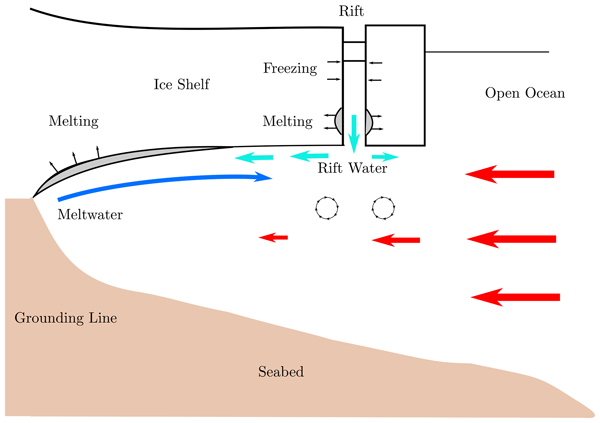
Rifts are fractures on ice shelves that connect the ice on top to the ocean below. The impact of rifts on ocean circulation below Antarctic ice shelves has been largely unexplored as ocean models are commonly run at resolutions that are too coarse to resolve the presence of rifts. Our model simulations show that a kilometer-wide rift near the ice-shelf front modulates heat intrusion beneath the ice and inhibits basal melt. These processes are therefore worthy of further investigation.
Alex S. Gardner, Nicole-Jeanne Schlegel, and Eric Larour
Geosci. Model Dev., 16, 2277–2302, https://doi.org/10.5194/gmd-16-2277-2023, https://doi.org/10.5194/gmd-16-2277-2023, 2023
Short summary
Short summary
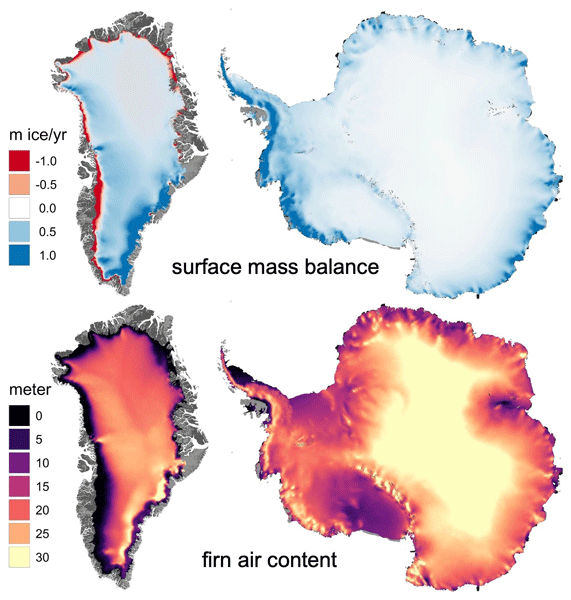
This is the first description of the open-source Glacier Energy and Mass Balance (GEMB) model. GEMB models the ice sheet and glacier surface–atmospheric energy and mass exchange, as well as the firn state. The model is evaluated against the current state of the art and in situ observations and is shown to perform well.
Flavien Beaud, Saif Aati, Ian Delaney, Surendra Adhikari, and Jean-Philippe Avouac
The Cryosphere, 16, 3123–3148, https://doi.org/10.5194/tc-16-3123-2022, https://doi.org/10.5194/tc-16-3123-2022, 2022
Short summary
Short summary
Understanding sliding at the bed of glaciers is essential to understand the future of sea-level rise and glacier-related hazards. Yet there is currently no universal law to describe this mechanism. We propose a universal glacier sliding law and a method to qualitatively constrain it. We use satellite remote sensing to create velocity maps over 6 years at Shisper Glacier, Pakistan, including its recent surge, and show that the observations corroborate the generalized theory.
Blake A. Castleman, Nicole-Jeanne Schlegel, Lambert Caron, Eric Larour, and Ala Khazendar
The Cryosphere, 16, 761–778, https://doi.org/10.5194/tc-16-761-2022, https://doi.org/10.5194/tc-16-761-2022, 2022
Short summary
Short summary
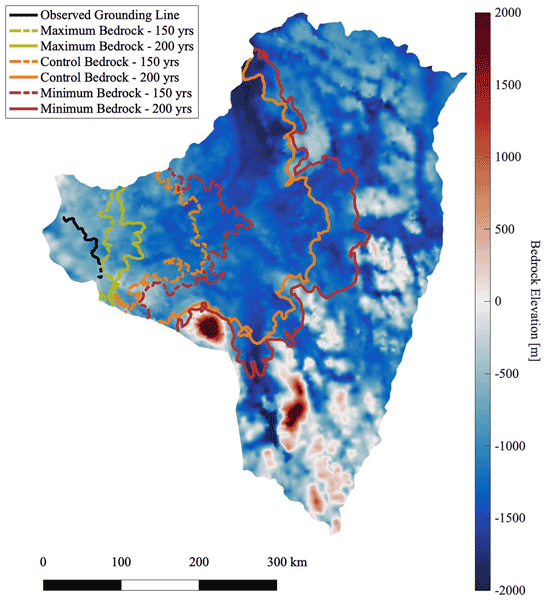
In the described study, we derive an uncertainty range for global mean sea level rise (SLR) contribution from Thwaites Glacier in a 200-year period under an extreme ocean warming scenario. We derive the spatial and vertical resolutions needed for bedrock data acquisition missions in order to limit global mean SLR contribution from Thwaites Glacier to ±2 cm in a 200-year period. We conduct sensitivity experiments in order to present the locations of critical regions in need of accurate mapping.
Kevin Bulthuis and Eric Larour
Geosci. Model Dev., 15, 1195–1217, https://doi.org/10.5194/gmd-15-1195-2022, https://doi.org/10.5194/gmd-15-1195-2022, 2022
Short summary
Short summary
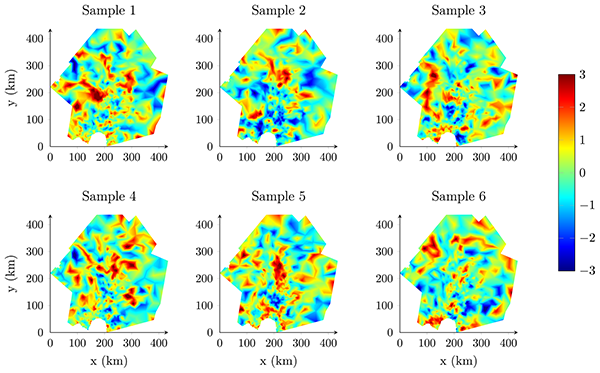
We present and implement a stochastic solver to sample spatially and temporal varying uncertain input parameters in the Ice-sheet and Sea-level System Model, such as ice thickness or surface mass balance. We represent these sources of uncertainty using Gaussian random fields with Matérn covariance function. We generate random samples of this random field using an efficient computational approach based on solving a stochastic partial differential equation.
Cited articles
Adhikari, S., Ivins, E. R., Larour, E., Seroussi, H., Morlighem, M., and Nowicki, S.: Future Antarctic bed topography and its implications for ice sheet dynamics, Solid Earth, 5, 569–584, https://doi.org/10.5194/se-5-569-2014, 2014. a, b
Adhikari, S., Ivins, E. R., and Larour, E.: ISSM-SESAW v1.0: mesh-based computation of gravitationally consistent sea-level and geodetic signatures caused by cryosphere and climate driven mass change, Geosci. Model Dev., 9, 1087–1109, https://doi.org/10.5194/gmd-9-1087-2016, 2016. a
Adhikari, S., Milne, G. A., Caron, L., Khan, S. A., Kjeldsen, K. K., Nilsson, J., Larour, E., and Ivins, E. R.: Decadal to Centennial Timescale Mantle Viscosity Inferred From Modern Crustal Uplift Rates in Greenland, Geophys. Res. Lett., 48, e2021GL094040, https://doi.org/10.1029/2021GL094040, 2021. a, b, c
Ajourlou, P., Darbyshire, F., Audet, P., and Milne, G. A.: Structure of the crust and upper mantle in Greenland and northeastern Canada: insights from anisotropic Rayleigh-wave tomography, Geophys. J. Int., 239, 329–350, https://doi.org/10.1093/gji/ggae269, 2024. a
Ajourlou, P., Milne, G. A., Love, R., Afonso, J. C., Salajegheh, F., Latychev, K., Kjeldsen, K. K., Lepipas, A., Martos, Y. M., and Woodroffe, S. A.: Upper mantle temperatures illuminate the Iceland hotspot track and understanding of ice – Earth interactions in Greenland, P. Natl. Acad. Sci. USA, 122, e2504752122, https://doi.org/10.1073/pnas.2504752122, 2025. a, b, c, d
Albrecht, T., Bagge, M., and Klemann, V.: Feedback mechanisms controlling Antarctic glacial-cycle dynamics simulated with a coupled ice sheet–solid Earth model, The Cryosphere, 18, 4233–4255, https://doi.org/10.5194/tc-18-4233-2024, 2024. a, b, c
Alterman, Z., Jarosch, H., Pekeris, C. L., and Jeffreys, H.: Oscillations of the earth, P. Roy. Soc. Lond. A Mat., 252, 80–95, https://doi.org/10.1098/rspa.1959.0138, 1959. a
Amalvict, M., Willis, P., Wöppelmann, G., Ivins, E. R., Bouin, M.-N., Testut, L., and Hinderer, J.: Isostatic stability of the East Antarctic station Dumont d’Urville from long-term geodetic observations and geophysical models, Polar Res., 28, 193–202, https://doi.org/10.3402/polar.v28i2.6112, 2009. a, b
An, M., Wiens, D. A., Zhao, Y., Feng, M., Nyblade, A., Kanao, M., Li, Y., Maggi, A., and Lévêque, J.-J.: Temperature, lithosphere-asthenosphere boundary, and heat flux beneath the Antarctic Plate inferred from seismic velocities, J. Geophys. Res.-Sol. Ea., 120, 8720–8742, https://doi.org/10.1002/2015JB011917, 2015. a
Barletta, V. R., Bevis, M., Smith, B. E., Wilson, T., Brown, A., Bordoni, A., Willis, M., Khan, S. A., Rovira-Navarro, M., Dalziel, I., Smalley, R., Kendrick, E., Konfal, S., Caccamise, D. J., Aster, R. C., Nyblade, A., and Wiens, D. A.: Observed rapid bedrock uplift in Amundsen Sea Embayment promotes ice-sheet stability, Science, 360, 1335–1339, https://doi.org/10.1126/science.aao1447, 2018. a, b, c, d, e
Berg, D., Barletta, V. R., Hassan, J., Lippert, E. Y. H., Colgan, W., Bevis, M., Steffen, R., and Khan, S. A.: Vertical Land Motion Due To Present-Day Ice Loss From Greenland's and Canada's Peripheral Glaciers, Geophys. Res. Lett., 51, e2023GL104851, https://doi.org/10.1029/2023GL104851, 2024. a
Bradley, S. L., Hindmarsh, R. C. A., Whitehouse, P. L., Bentley, M. J., and King, M. A.: Low post-glacial rebound rates in the Weddell Sea due to late Holocene ice-sheet readvance, Earth Planet. Sc. Lett., 413, 79–89, https://doi.org/10.1016/j.epsl.2014.12.039, 2015. a, b
Brown, S. E. and Fischer, K. M.: Investigating the Antarctic Lithosphere Through Sp Receiver Function Analysis, Geochem. Geophy. Geosy., 26, e2025GC012268, https://doi.org/10.1029/2025GC012268, 2025. a
Caron, L., Ivins, E., Larour, E., Adhikari, S., and Métivier, L.: Love number computation within the Ice-sheet and Sea-level System Model (ISSM v4.24), Geosci. Model Dev., 19, 4031–4054, https://doi.org/10.5194/gmd-19-4031-2026, 2026. a, b, c
Chaput, J., Aster, R. C., Huerta, A., Sun, X., Lloyd, A., Wiens, D., Nyblade, A., Anandakrishnan, S., Winberry, J. P., and Wilson, T.: The crustal thickness of West Antarctica, J. Geophys. Res.-Sol. Ea., 119, 378–395, https://doi.org/10.1002/2013JB010642, 2014. a
Chua, E. L. and Lebedev, S.: Waveform tomography of the Antarctic Plate, Geophys. J. Int., 241, 219–240, https://doi.org/10.1093/gji/ggaf041, 2025. a
Coonin, A. N., Parazin, B., Lau, H. C. P., and Gomez, N.: West Antarctic Ice Retreat Temporarily Halted with Transient Rheology in Future Climate Projections, EGUsphere [preprint], https://doi.org/10.5194/egusphere-2026-2172, 2026. a
Coulon, V., Bulthuis, K., Whitehouse, P. L., Sun, S., Haubner, K., Zipf, L., and Pattyn, F.: Contrasting Response of West and East Antarctic Ice Sheets to Glacial Isostatic Adjustment, J. Geophys. Res.-Earth, 126, e2020JF006003, https://doi.org/10.1029/2020JF006003, 2021. a, b
Danabasoglu, G., Lamarque, J.-F., Bacmeister, J., Bailey, D. A., DuVivier, A. K., Edwards, J., Emmons, L. K., Fasullo, J., Garcia, R., Gettelman, A., Hannay, C., Holland, M. M., Large, W. G., Lauritzen, P. H., Lawrence, D. M., Lenaerts, J. T. M., Lindsay, K., Lipscomb, W. H., Mills, M. J., Neale, R., Oleson, K. W., Otto-Bliesner, B., Phillips, A. S., Sacks, W., Tilmes, S., van Kampenhout, L., Vertenstein, M., Bertini, A., Dennis, J., Deser, C., Fischer, C., Fox-Kemper, B., Kay, J. E., Kinnison, D., Kushner, P. J., Larson, V. E., Long, M. C., Mickelson, S., Moore, J. K., Nienhouse, E., Polvani, L., Rasch, P. J., and Strand, W. G.: The Community Earth System Model Version 2 (CESM2), J. Adv. Model. Earth Sy., 12, e2019MS001916, https://doi.org/10.1029/2019MS001916, 2020. a
Dziewonski, A. M. and Anderson, D. L.: Preliminary reference Earth model, Physi. Earth Planet. In., 25, 297–356, https://doi.org/10.1016/0031-9201(81)90046-7, 1981. a, b
Farrell, W. E.: Deformation of the Earth by surface loads, Rev. Geophys., 10, 761–797, https://doi.org/10.1029/RG010i003p00761, 1972. a, b
Farrell, W. E. and Clark, J. A.: On Postglacial Sea Level, Geophys. J. Int., 46, 647–667, https://doi.org/10.1111/j.1365-246X.1976.tb01252.x, 1976. a, b, c, d
Faul, U. and Jackson, I.: Transient Creep and Strain Energy Dissipation: An Experimental Perspective, Annu. Rev. Earth Pl. Sc., 43, 541–569, https://doi.org/10.1146/annurev-earth-060313-054732, 2015. a
Gomez, N., Pollard, D., Mitrovica, J. X., Huybers, P., and Clark, P. U.: Evolution of a coupled marine ice sheet–sea level model, J. Geophys. Res.-Earth, 117, https://doi.org/10.1029/2011JF002128, 2012. a, b
Gomez, N., Weber, M. E., Clark, P. U., Mitrovica, J. X., and K., H.: Antarctic ice dynamics amplified by Northern Hemisphere sea-level forcing, Nature, 587, https://doi.org/10.1038/s41586-020-2916-2, 2020. a, b
Gomez, N., Yousefi, M., Pollard, D., DeConto, R. M., Sadai, S., Lloyd, A., Nyblade, A., Wiens, D. A., Aster, R. C., and Wilson, T.: The influence of realistic 3D mantle viscosity on Antarctica’s contribution to future global sea levels, Science Advances, 10, eadn1470, https://doi.org/10.1126/sciadv.adn1470, 2024. a, b, c
Gowan, E. J.: Paleo sea-level indicators and proxies from Greenland in the GAPSLIP database and comparison with modelled sea level from the PaleoMIST ice-sheet reconstruction, GEUS Bulletin, 53, https://doi.org/10.34194/geusb.v53.8355, 2023. a
Gregory, J. M., Griffies, S. M., Hughes, C. W., Lowe, J. A., Church, J. A., Fukutomi, Y., Gomez, N., Kopp, R. E., Landerer, F. W., Le Cozannet, G., Ponte, R. M., Stammer, D., Tamisiea, M. E., Thompson, P. R., von Schuckmann, K., and Widmann, M.: Concepts and Terminology for Sea Level: Mean, Variability and Change, Both Local and Global, Surv. Geophys., 40, 1251–1289, https://doi.org/10.1007/s10712-019-09525-z, 2019. a, b
Han, H. K., Gomez, N., and Wan, J. X. W.: Capturing the interactions between ice sheets, sea level and the solid Earth on a range of timescales: a new “time window” algorithm, Geosci. Model Dev., 15, 1355–1373, https://doi.org/10.5194/gmd-15-1355-2022, 2022. a, b
Han, H. K., Hoffman, M., Asay-Davis, X., Hillebrand, T. R., and Perego, M.: Improving Projections of Antarctic Ice Sheet Contribution to Sea-Level Change Through 2300 by Capturing Gravitational, Rotational, and Deformational Effects, J. Geophys. Res.-Earth, 130, e2025JF008388, https://doi.org/10.1029/2025JF008388, 2025. a, b, c
Hansen, S. E. and Emry, E. L.: East Antarctic tectonic basin structure and its implications for ice-sheet modeling and sea-level projections, Communications Earth & Environment, 6, 138, https://doi.org/10.1038/s43247-025-02140-4, 2025. a, b
Hazzard, J. A. N., Richards, F. D., Goes, S. D. B., and Roberts, G. G.: Probabilistic Assessment of Antarctic Thermomechanical Structure: Impacts on Ice Sheet Stability, J. Geophys. Res.-Sol. Ea., 128, e2023JB026653, https://doi.org/10.1029/2023JB026653, 2023. a
Houriez, L., Larour, E., Caron, L., Schlegel, N.-J., Adhikari, S., Ivins, E., Pelle, T., Seroussi, H., Darve, E., and Fischer, M.: Reinforced ridges in Thwaites Glacier yield insights into resolution requirements for coupled ice sheet and solid Earth models, The Cryosphere, 19, 4355–4372, https://doi.org/10.5194/tc-19-4355-2025, 2025. a, b, c, d, e, f, g, h, i
Ivins, E. R. and James, T. S.: Simple models for late Holocene and present-day Patagonian glacier fluctuations and predictions of a geodetically detectable isostatic response, Geophys. J. Int., 138, 601–624, https://doi.org/10.1046/j.1365-246x.1999.00899.x, 1999. a
Ivins, E. R., Watkins, M. M., Yuan, D.-N., Dietrich, R., Casassa, G., and Rülke, A.: On-land ice loss and Glacial Isostatic Adjustment at the Drake Passage: 2003–2009, J. Geophys. Res.-Sol. Ea., 116, https://doi.org/10.1029/2010JB007607, 2011. a
Ivins, E., Caron, L., and Adhikari, S.: Anthropocene isostatic adjustment on an anelastic mantle, J. Geodesy, 97, 1043–1049, https://doi.org/10.1007/s00190-023-01781-7, 2023a. a
Ivins, E. R., van der Wal, W., Wiens, D. A., Lloyd, A. J., and Caron, L.: Antarctic upper mantle rheology, Geological Society, London, Memoirs, 56, 267–294, https://doi.org/10.1144/M56-2020-19, 2023b. a, b
Kendall, R. A., Mitrovica, J. X., and Milne, G. A.: On post-glacial sea level – II. Numerical formulation and comparative results on spherically symmetric models, Geophys. J. Int., 161, 679–706, https://doi.org/10.1111/j.1365-246X.2005.02553.x, 2005. a, b
Kodama, S. T., Pico, T., Robel, A. A., Christian, J. E., Gomez, N., Vigilia, C., Powell, E., Gagliardi, J., Tulaczyk, S., and Blackburn, T.: Impact of glacial isostatic adjustment on zones of potential grounding line persistence in the Ross Sea Embayment (Antarctica) since the Last Glacial Maximum, The Cryosphere, 19, 2935–2948, https://doi.org/10.5194/tc-19-2935-2025, 2025. a
Konrad, H., Sasgen, I., Pollard, D., and Klemann, V.: Potential of the solid-Earth response for limiting long-term West Antarctic Ice Sheet retreat in a warming climate, Earth Planet. Sc. Lett., 432, 254–264, https://doi.org/10.1016/j.epsl.2015.10.008, 2015. a
Konrad, H., Sasgen, I., Klemann, V., Thoma, M., Grosfeld, K., and Martinec, Z.: Sensitivity of Grounding-Line Dynamics to Viscoelastic Deformation of the Solid-Earth in an Idealized Scenario, Polarforschung, 85, 89–99, https://doi.org/10.2312/polfor.2016.005, 2016. a
Kreuzer, M., Albrecht, T., Nicola, L., Reese, R., and Winkelmann, R.: Bathymetry-constrained impact of relative sea-level change on basal melting in Antarctica, The Cryosphere, 19, 1181–1203, https://doi.org/10.5194/tc-19-1181-2025, 2025. a
Lecavalier, B. S., Milne, G. A., Simpson, M. J., Wake, L., Huybrechts, P., Tarasov, L., Kjeldsen, K. K., Funder, S., Long, A. J., Woodroffe, S., Dyke, A. S., and Larsen, N. K.: A model of Greenland ice sheet deglaciation constrained by observations of relative sea level and ice extent, Quaternary Sci. Rev., 102, 54–84, https://doi.org/10.1016/j.quascirev.2014.07.018, 2014. a, b
Lewright, L., Austermann, J., Piecuch, C. G., Adhikari, S., Davis, J. L., Milne, G. A., and Paxman, G. J. G.: Projections of 21st-century sea-level fall along coastal Greenland, Nat. Commun., 17, 353, https://doi.org/10.1038/s41467-025-68182-6, 2026. a, b
Lin, Y., Whitehouse, P. L., Valentine, A. P., and Woodroffe, S. A.: GEORGIA: A Graph Neural Network Based EmulatOR for Glacial Isostatic Adjustment, Geophysical Res. Lett., 50, e2023GL103672, https://doi.org/10.1029/2023GL103672, 2023. a
Lingle, C. S. and Clark, J. A.: A numerical model of interactions between a marine ice sheet and the solid earth: Application to a West Antarctic ice stream, J. Geophys. Res.-Oceans, 90, 1100–1114, https://doi.org/10.1029/JC090iC01p01100, 1985. a
Lloyd, A. J., Wiens, D. A., Zhu, H., Tromp, J., Nyblade, A. A., Aster, R. C., Hansen, S. E., Dalziel, I. W. D., Wilson, T., Ivins, E. R., and O’Donnell, J. P.: Seismic Structure of the Antarctic Upper Mantle Imaged with Adjoint Tomography, J. Geophys. Res.-Sol. Ea., 125, https://doi.org/10.1029/2019JB017823, 2020. a
Longman, I. M.: A Green's function for determining the deformation of the Earth under surface mass loads: 1. Theory, J. Geophys. Res., 67, 845–850, https://doi.org/10.1029/JZ067i002p00845, 1962. a, b
Love, A. E. H.: The yielding of the earth to disturbing forces, P. R. Soc. Lond. A-Conta., 82, 73–88, https://doi.org/10.1098/rspa.1909.0008, 1909. a
Love, R., Milne, G. A., Ajourlou, P., Parang, S., Tarasov, L., and Latychev, K.: A fast surrogate model for 3D Earth glacial isostatic adjustment using Tensorflow (v2.8.0) artificial neural networks, Geosci. Model Dev., 17, 8535–8551, https://doi.org/10.5194/gmd-17-8535-2024, 2024. a
Lucas, E. M., Nyblade, A. A., Lloyd, A. J., Aster, R. C., Wiens, D. A., O'Donnell, J. P., Stuart, G. W., Wilson, T. J., Dalziel, I. W. D., Winberry, J. P., and Huerta, A. D.: Seismicity and Pn Velocity Structure of Central West Antarctica, Geochem. Geophy. Geosy., 22, e2020GC009471, https://doi.org/10.1029/2020GC009471, 2021. a
Lucas, E. M., Gomez, N., and Wilson, T.: The impact of regional-scale upper-mantle heterogeneity on glacial isostatic adjustment in West Antarctica, The Cryosphere, 19, 2387–2405, https://doi.org/10.5194/tc-19-2387-2025, 2025. a
Meur, E. L. and Huybrechts, P.: A comparison of different ways of dealing with isostasy: examples from modeling the Antarctic ice sheet during the last glacial cycle, Ann. Glaciol., 23, 309–317, 1996. a
Milne, G. A. and Mitrovica, J. X.: Postglacial sea-level change on a rotating Earth, Geophys. J. Int., 133, 1–19, https://doi.org/10.1046/j.1365-246X.1998.1331455.x, 1998. a, b, c, d
Milne, G. A., Latychev, K., Schaeffer, A., Crowley, J. W., Lecavalier, B. S., and Audette, A.: The influence of lateral Earth structure on glacial isostatic adjustment in Greenland, Geophys. J. Int., 214, 1252–1266, https://doi.org/10.1093/gji/ggy189, 2018. a, b
Mouginot, J. and Rignot, E.: Glacier catchments/basins for the Greenland Ice Sheet, Dryad [data set], https://doi.org/10.7280/D1WT11, 2019. a
Näränen, J., Mäkinen, J., Nordman, M., and Raja-Halli, A.: Three Decades of Repeated Absolute Gravity Measurements at the Finnish Antarctic Research Station Aboa, Pure Appl. Geophys., 183, 137–157, https://doi.org/10.1007/s00024-025-03868-y. a
Nield, G. A., Barletta, V. R., Bordoni, A., King, M. A., Whitehouse, P. L., Clarke, P. J., Domack, E., Scambos, T. A., and Berthier, E.: Rapid bedrock uplift in the Antarctic Peninsula explained by viscoelastic response to recent ice unloading, Earth Planet. Sc. Lett., 397, 32–41, https://doi.org/10.1016/j.epsl.2014.04.019, 2014. a, b, c, d, e
Nield, G. A., Whitehouse, P. L., King, M. A., and Clarke, P. J.: Glacial isostatic adjustment in response to changing late Holocene behaviour of ice streams on the Siple Coast, West Antarctica, Geophys. J. Int., 205, 1–21, https://doi.org/10.1093/gji/ggv532, 2016. a, b
Okuno, J., Hattori, A., Doi, K., et al.: Mid Holocene rapid thinning and rethickening of the East Antarctic ice sheet suggested by glacial isostatic adjustment, Scientific Reports, 15, 40207, https://doi.org/10.1038/s41598-025-24176-4, 2025. a, b
Pan, L., Mitrovica, J. X., Milne, G. A., Hoggard, M. J., and Woodroffe, S. A.: Timescales of glacial isostatic adjustment in Greenland: is transient rheology required?, Geophys. J. Int., 237, 989–995, https://doi.org/10.1093/gji/ggae095, 2024. a, b
Paxman, G. J. G., Lau, H. C., Austermann, J., Holtzman, B. K., and Havlin, C.: Inference of the timescale-dependent apparent viscosity structure in the upper mantle beneath Greenland, AGU Advances, 4, e2022AV000751, https://doi.org/10.1029/2022AV000751, 2023. a
Pelle, T., Morlighem, M., and Bondzio, J. H.: Brief communication: PICOP, a new ocean melt parameterization under ice shelves combining PICO and a plume model, The Cryosphere, 13, 1043–1049, https://doi.org/10.5194/tc-13-1043-2019, 2019. a
Peltier, W. R.: The impulse response of a Maxwell Earth, Rev. Geophys., 12, 649–669, https://doi.org/10.1029/RG012i004p00649, 1974. a, b
Powell, E., Gomez, N., Hay, C., Latychev, K., and Mitrovica, J. X.: Viscous effects in the solid earth response to modern Antarctic ice mass flux: Implications for geodetic studies of WAIS stability in a warming world, J. Climate, 33, 443–459, https://doi.org/10.1175/JCLI-D-19-0479.1, 2020. a, b
Reese, R., Albrecht, T., Mengel, M., Asay-Davis, X., and Winkelmann, R.: Antarctic sub-shelf melt rates via PICO, The Cryosphere, 12, 1969–1985, https://doi.org/10.5194/tc-12-1969-2018, 2018. a
Rignot, E., Jacobs, S., Mouginot, J., and Scheuchl, B.: Ice Shelf Melting Around Antarctica, Science, 341, 266–270, https://doi.org/10.1126/science.1235798, 2013. a
Rignot, E., Mouginot, J., Morlighem, M., Seroussi, H., and Scheuchl, B.: Widespread, rapid grounding line retreat of Pine Island, Thwaites, Smith, and Kohler glaciers, West Antarctica, from 1992 to 2011, Geophys. Res. Lett., 41, 3502–3509, https://doi.org/10.1002/2014GL060140, 2014. a
Samrat, N. H., King, M. A., Watson, C. S., Hooper, A., Chen, X., Barletta, V. R., and Bordoni, A.: Reduced ice mass loss and three-dimensional viscoelastic deformation in northern Antarctic Peninsula inferred from GPS, Geophys. J. Int., 222, 1013–1022, https://doi.org/10.1093/gji/ggaa229, 2020. a, b, c
Scheinert, M., Ivins, E. R., Dietrich, R., and Rülke, A.: Vertical Crustal Deformation in Dronning Maud Land, Antarctica: Observation versus Model Prediction, in: Antarctica, edited by: Fütterer, D. K., Damaske, D., Kleinschmidt, G., Miller, H., and Tessensohn, F., Springer, Berlin, Heidelberg, https://doi.org/10.1007/3-540-32934-X_44, 2006. a, b
Scheinert, M., Shen, W., Aster, R. C., Caron, L., Hartinger, M. D., King, M. A., Lloyd, A., Reading, A. M., Winberry, J. P., Wilson, T., Alfonsi, L., Bentley, M. J., Buchta, E., Chen, T. Y., Clarke, P. J., Ebbing, J., Eisen, O., Gomez, N., Günaydın, E., Hansen, S., Ivins, E. R., Koulali, A., Nield, G. A., Richards, F., Selbesoglu, M. O., Sherman, S., Whitehouse, P. L., and Willen, M.: Geophysics in Antarctica: Achievements, Current Capabilities, and Future Directions, EGUsphere [preprint], https://doi.org/10.5194/egusphere-2025-6370, 2026. a
Seroussi, H., Pelle, T., Lipscomb, W. H., Abe-Ouchi, A., Albrecht, T., Alvarez-Solas, J., Asay-Davis, X., Barre, J.-B., Berends, C. J., Bernales, J., Blasco, J., Caillet, J., Chandler, D. M., Coulon, V., Cullather, R., Dumas, C., Galton-Fenzi, B. K., Garbe, J., Gillet-Chaulet, F., Gladstone, R., Goelzer, H., Golledge, N., Greve, R., Gudmundsson, G. H., Han, H. K., Hillebrand, T. R., Hoffman, M. J., Huybrechts, P., Jourdain, N. C., Klose, A. K., Langebroek, P. M., Leguy, G. R., Lowry, D. P., Mathiot, P., Montoya, M., Morlighem, M., Nowicki, S., Pattyn, F., Payne, A. J., Quiquet, A., Reese, R., Robinson, A., Saraste, L., Simon, E. G., Sun, S., Twarog, J. P., Trusel, L. D., Urruty, B., Van Breedam, J., van de Wal, R. S. W., Wang, Y., Zhao, C., and Zwinger, T.: Evolution of the Antarctic Ice Sheet Over the Next Three Centuries From an ISMIP6 Model Ensemble, Earth's Future, 12, e2024EF004561, https://doi.org/10.1029/2024EF004561, 2024. a, b, c, d
Shida, T.: On the Elasticity of the Earth and the Earth’s Crust, Memoirs of the College of Science and Engineering, Kyoto Imperial University, 4, 1–286, https://books.google.com/books?id=9Ko_AQAAMAAJ (last access: 3 September 2026), 1912. a
Simms, A. R., Ivins, E. R., DeWitt, R., Kouremenos, P., and Simkins, L. M.: Timing of the most recent Neoglacial advance and retreat in the South Shetland Islands, Antarctic Peninsula: insights from raised beaches and Holocene uplift rates, Quaternary Sci. Rev., 47, 41–55, https://doi.org/10.1016/j.quascirev.2012.05.013, 2012. a
Spada, G. and Boschi, L.: Using the Post–Widder formula to compute the Earth's viscoelastic Love numbers, Geophys. J. Int., 166, 309–321, https://doi.org/10.1111/j.1365-246X.2006.02995.x, 2006. a
Spada, G. and Melini, D.: SELEN4 (SELEN version 4.0): a Fortran program for solving the gravitationally and topographically self-consistent sea-level equation in glacial isostatic adjustment modeling, Geosci. Model Dev., 12, 5055–5075, https://doi.org/10.5194/gmd-12-5055-2019, 2019. a, b
Spada, G., Antonioli, A., Boschi, L., Boschi, L., Brandi, V., Cianetti, S., Galvani, G., Giunchi, C., Perniola, B., Agostinetti, N. P., Piersanti, A., and Stocchi, P.: Modeling Earth's post-glacial rebound, Eos T. Am. Geophys. Un., 85, 62–64, https://doi.org/10.1029/2004EO060007, 2004. a
Spada, G., Barletta, V. R., Klemann, V., Riva, R. E. M., Martinec, Z., Gasperini, P., Lund, B., Wolf, D., Vermeersen, L. L. A., and King, M. A.: A benchmark study for glacial isostatic adjustment codes, Geophys. J. Int., 185, 106–132, https://doi.org/10.1111/j.1365-246X.2011.04952.x, 2011. a
Swierczek-Jereczek, J., Montoya, M., Latychev, K., Robinson, A., Alvarez-Solas, J., and Mitrovica, J.: FastIsostasy v1.0 – a regional, accelerated 2D glacial isostatic adjustment (GIA) model accounting for the lateral variability of the solid Earth, Geosci. Model Dev., 17, 5263–5290, https://doi.org/10.5194/gmd-17-5263-2024, 2024. a, b
van Calcar, C. J., Whitehouse, P. L., van de Wal, R. S. W., and van der Wal, W.: Approximating 3D bedrock deformation in an Antarctic ice-sheet model for projections, The Cryosphere, 20, 757–775, https://doi.org/10.5194/tc-20-757-2026, 2026. a, b
Wan, J. X. W., Gomez, N., Latychev, K., and Han, H. K.: Resolving glacial isostatic adjustment (GIA) in response to modern and future ice loss at marine grounding lines in West Antarctica, The Cryosphere, 16, 2203–2223, https://doi.org/10.5194/tc-16-2203-2022, 2022. a
Weerdesteijn, M. F. M. and Conrad, C. P.: Recent ice melt above a mantle plume track is accelerating the uplift of Southeast Greenland, Communications Earth & Environment, 5, 791, https://doi.org/10.1038/s43247-024-01968-6, 2024. a, b, c
Whitehouse, P., Bentley, M. J., Milne, G. A., King, M. A., and Thomas, I. D.: A new glacial isostatic adjustment model for Antarctica: calibrated and tested using observations of relative sea-level change and present-day uplift rates, Geophys. J. Int., 190, 1464–1482, 2012. a
Whitehouse, P. L.: Glacial isostatic adjustment modelling: historical perspectives, recent advances, and future directions, Earth Surf. Dynam., 6, 401–429, https://doi.org/10.5194/esurf-6-401-2018, 2018. a, b
Wiens, D. A., Shen, W., and Lloyd, A. J.: The seismic structure of the Antarctic upper mantle, Geological Society, London, Memoirs, 56, 195–212, https://doi.org/10.1144/M56-2020-18, 2023. a
Wolstencroft, M., King, M. A., Whitehouse, P. L., Bentley, M. J., Nield, G. A., King, E. C., McMillan, M., Shepherd, A., Barletta, V. R., Bordoni, A., Riva, R. E. M., Didova, O., and Gunter, B. C.: Uplift rates from a new high-density GPS network in Palmer Land indicate significant late Holocene ice loss in the southwestern Weddell Sea, Geophys. J. Int., 203, 737–754, https://doi.org/10.1093/gji/ggv327, 2015. a, b, c
Zhao, C., King, M. A., Watson, C. S., Barletta, V. R., Bordoni, A., Dell, M., and Whitehouse, P. L.: Rapid ice unloading in the Fleming Glacier region, southern Antarctic Peninsula, and its effect on bedrock uplift rates, Earth Planet. Sc. Lett., 473, 164–176, https://doi.org/10.1016/j.epsl.2017.06.002, 2017. a, b
Short summary
We present an efficient approach for coupling ice sheet and solid Earth models, bringing realistic gravitational and deformational processes into mainstream ice sheet modeling. Earth responses are encoded in precomputed Green’s functions and applied to modeled ice mass change through matrix multiplication. By removing a major computational and technical barrier, the approach could accelerate adoption within the Ice Sheet Model Intercomparison Project (ISMIP) to improve sea level projections.
We present an efficient approach for coupling ice sheet and solid Earth models, bringing...


