
Articles | Volume 20, issue 8
https://doi.org/10.5194/tc-20-4491-2026
© Author(s) 2026. This work is distributed under
the Creative Commons Attribution 4.0 License.
the Creative Commons Attribution 4.0 License.
https://doi.org/10.5194/tc-20-4491-2026
© Author(s) 2026. This work is distributed under
the Creative Commons Attribution 4.0 License.
the Creative Commons Attribution 4.0 License.
Research article
| 
18 Aug 2026
Research article |
| 18 Aug 2026
| 18 Aug 2026
Modeling the Subglacial Sediment System of the Finnish Lake District Ice Lobe During Deglaciation

School of Earth and Oceans, The University of Western Australia, Perth, Western Australia
The Australian Centre for Excellence in Antarctic Science, The University of Western Australia, Perth, Western Australia
Adam J. Hepburn
Department of Geography and Earth Sciences, Aberystwyth University, Aberystwyth, Wales, United Kingdom
Antti E. K. Ojala
Department of Geography and Geology, University of Turku, Turku, Finland
Geological Survey of Finland, Espoo, Finland
Related authors
Mareen Lösing, Alan Aitken, Michael Field, Emma MacKie, and Lu Li
The Cryosphere, 20, 5629–5652, https://doi.org/10.5194/tc-20-5629-2026, https://doi.org/10.5194/tc-20-5629-2026, 2026
Short summary
Short summary
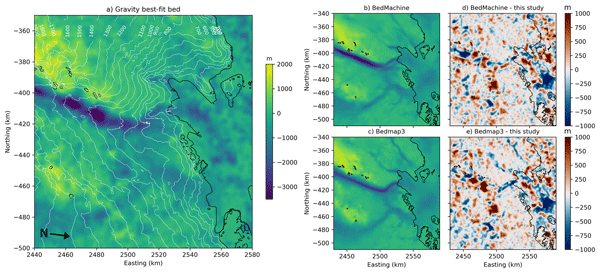
Subglacial topography controls how Antarctic ice flows towards the ocean and responds to climate change. In the Denman–Shackleton region, deep valleys connect the ice-sheet interior to the coast. Denman Glacier occupies one of the deepest and could contribute significantly to sea-level rise. Combining new ground-based gravity measurements with airborne data and statistical modelling reveals a more complex landscape than existing maps and a potential vulnerability to unstable retreat.
Alan Robert Alexander Aitken, Ian Delaney, Guillaume Pirot, and Mauro A. Werder
The Cryosphere, 18, 4111–4136, https://doi.org/10.5194/tc-18-4111-2024, https://doi.org/10.5194/tc-18-4111-2024, 2024
Short summary
Short summary
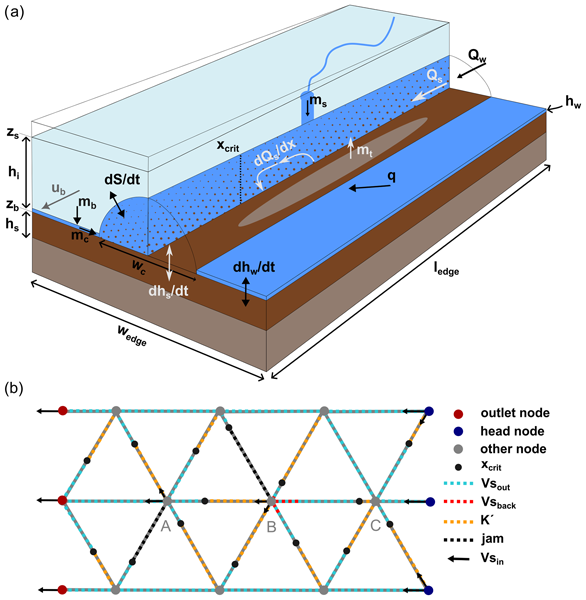
Understanding how glaciers generate sediment and transport it to the ocean is important for understanding ocean ecosystems and developing knowledge of the past cryosphere from marine sediments. This paper presents a new way to simulate sediment transport in rivers below ice sheets and glaciers and quantify volumes and characteristics of sediment that can be used to reveal the hidden record of the subglacial environment for both past and present glacial conditions.
Felicity S. McCormack, Jason L. Roberts, Bernd Kulessa, Alan Aitken, Christine F. Dow, Lawrence Bird, Benjamin K. Galton-Fenzi, Katharina Hochmuth, Richard S. Jones, Andrew N. Mackintosh, and Koi McArthur
The Cryosphere, 17, 4549–4569, https://doi.org/10.5194/tc-17-4549-2023, https://doi.org/10.5194/tc-17-4549-2023, 2023
Short summary
Short summary
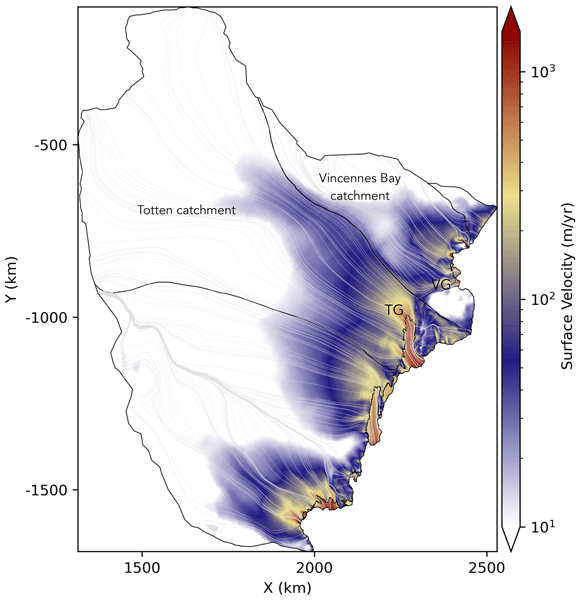
Changes in Antarctic surface elevation can cause changes in ice and basal water flow, impacting how much ice enters the ocean. We find that ice and basal water flow could divert from the Totten to the Vanderford Glacier, East Antarctica, under only small changes in the surface elevation, with implications for estimates of ice loss from this region. Further studies are needed to determine when this could occur and if similar diversions could occur elsewhere in Antarctica due to climate change.
Alice C. Frémand, Peter Fretwell, Julien A. Bodart, Hamish D. Pritchard, Alan Aitken, Jonathan L. Bamber, Robin Bell, Cesidio Bianchi, Robert G. Bingham, Donald D. Blankenship, Gino Casassa, Ginny Catania, Knut Christianson, Howard Conway, Hugh F. J. Corr, Xiangbin Cui, Detlef Damaske, Volkmar Damm, Reinhard Drews, Graeme Eagles, Olaf Eisen, Hannes Eisermann, Fausto Ferraccioli, Elena Field, René Forsberg, Steven Franke, Shuji Fujita, Yonggyu Gim, Vikram Goel, Siva Prasad Gogineni, Jamin Greenbaum, Benjamin Hills, Richard C. A. Hindmarsh, Andrew O. Hoffman, Per Holmlund, Nicholas Holschuh, John W. Holt, Annika N. Horlings, Angelika Humbert, Robert W. Jacobel, Daniela Jansen, Adrian Jenkins, Wilfried Jokat, Tom Jordan, Edward King, Jack Kohler, William Krabill, Mette Kusk Gillespie, Kirsty Langley, Joohan Lee, German Leitchenkov, Carlton Leuschen, Bruce Luyendyk, Joseph MacGregor, Emma MacKie, Kenichi Matsuoka, Mathieu Morlighem, Jérémie Mouginot, Frank O. Nitsche, Yoshifumi Nogi, Ole A. Nost, John Paden, Frank Pattyn, Sergey V. Popov, Eric Rignot, David M. Rippin, Andrés Rivera, Jason Roberts, Neil Ross, Anotonia Ruppel, Dustin M. Schroeder, Martin J. Siegert, Andrew M. Smith, Daniel Steinhage, Michael Studinger, Bo Sun, Ignazio Tabacco, Kirsty Tinto, Stefano Urbini, David Vaughan, Brian C. Welch, Douglas S. Wilson, Duncan A. Young, and Achille Zirizzotti
Earth Syst. Sci. Data, 15, 2695–2710, https://doi.org/10.5194/essd-15-2695-2023, https://doi.org/10.5194/essd-15-2695-2023, 2023
Short summary
Short summary
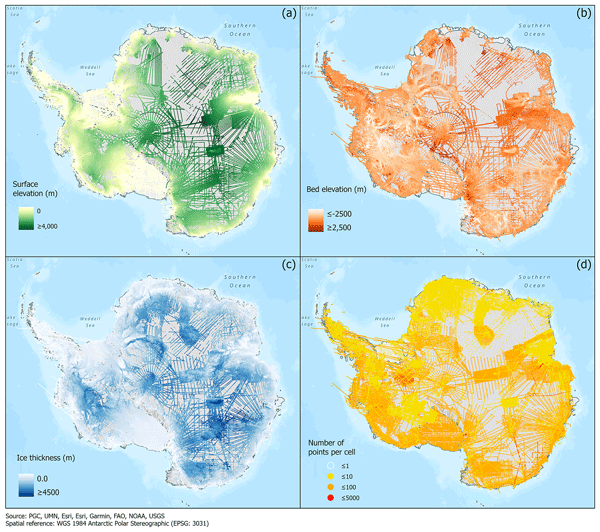
This paper presents the release of over 60 years of ice thickness, bed elevation, and surface elevation data acquired over Antarctica by the international community. These data are a crucial component of the Antarctic Bedmap initiative which aims to produce a new map and datasets of Antarctic ice thickness and bed topography for the international glaciology and geophysical community.
Adam J. Hepburn, Sammie Buzzard, Andrew J. Sole, Stephen J. Livingstone, Felix Ng, Mathieu Morlighem, Elizabeth A. Bagshaw, Caroline Clason, Lisa Craw, Christine F. Dow, Samuel Doyle, Jonathan Hawkins, Matthew Peacey, and Robert Storrar
The Cryosphere, 20, 5675–5696, https://doi.org/10.5194/tc-20-5675-2026, https://doi.org/10.5194/tc-20-5675-2026, 2026
Short summary
Short summary
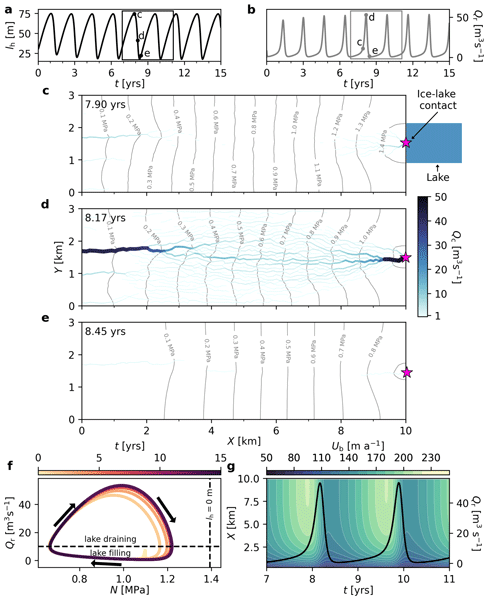
Lakes at glacier margins can drain beneath the ice in devastating, floods called jökulhlaups. We present the first 2D model of jökulhlaup propagation, first applying it to a synthetic glacier, before then assessing its ability to reproduce an observed record of lake fill-drain cycles in Greenland. Our results match a 17-year record of flood timing but underpredicts peak discharge likely because we are missing certain physical processes. Our results hold promise for simulating jökulhlaups.
Mareen Lösing, Alan Aitken, Michael Field, Emma MacKie, and Lu Li
The Cryosphere, 20, 5629–5652, https://doi.org/10.5194/tc-20-5629-2026, https://doi.org/10.5194/tc-20-5629-2026, 2026
Short summary
Short summary
Subglacial topography controls how Antarctic ice flows towards the ocean and responds to climate change. In the Denman–Shackleton region, deep valleys connect the ice-sheet interior to the coast. Denman Glacier occupies one of the deepest and could contribute significantly to sea-level rise. Combining new ground-based gravity measurements with airborne data and statistical modelling reveals a more complex landscape than existing maps and a potential vulnerability to unstable retreat.
Ashley M. Abrook, Gordon N. Inglis, Peter G. Langdon, McKenzie R. Bentley, Achim Brauer, Ian Bull, Daisy Fallows, Paul Lincoln, Antti E. K. Ojala, Helen L. Whelton, and Celia Martin-Puertas
Biogeosciences, 23, 1809–1832, https://doi.org/10.5194/bg-23-1809-2026, https://doi.org/10.5194/bg-23-1809-2026, 2026
Short summary
Short summary
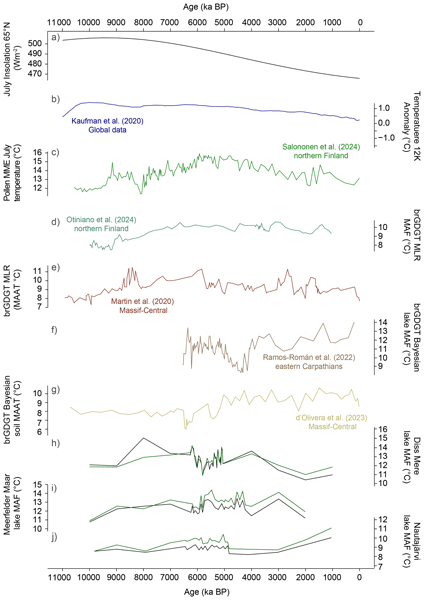
We present lipid-based environmental and temperature reconstructions spanning the Holocene from three European varved lakes. At each site archaea are impacted by methane which influence lake water temperature reconstructions, and bacteria appear to respond to oxygen conditions and specific lake and environmental processes. Nonetheless, bacterial temperature reconstructions are comparable to regional climate data, showing the potential of varve archives for high resolution reconstructions.
Laura Boyall, Andrew C. Parnell, Paul Lincoln, Antti Ojala, Armand Hernández, and Celia Martin-Puertas
Clim. Past, 21, 1465–1480, https://doi.org/10.5194/cp-21-1465-2025, https://doi.org/10.5194/cp-21-1465-2025, 2025
Short summary
Short summary
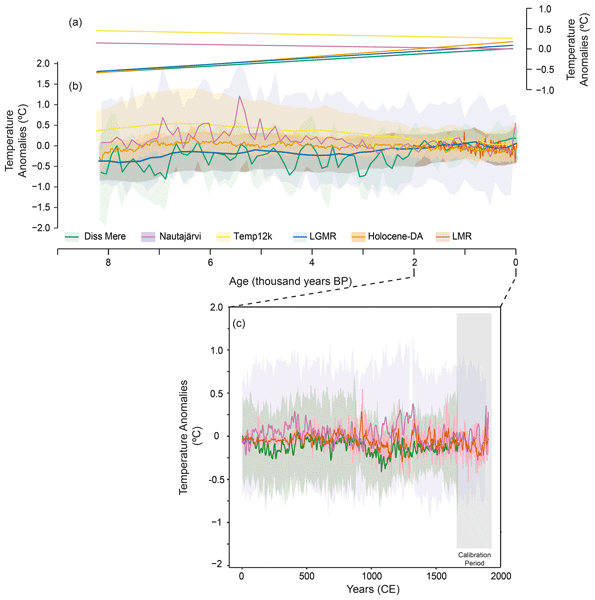
We present a new approach to reconstructing annual mean temperature using geochemical data from lake sediments. This paper uses Bayesian inference, a type of statistical approach, and creates a model called Simulating Climate Using Bayesian Inference with proxy Data Observations (SCUBIDO), which takes the high-resolution geochemical data and transforms them into quantitative climate information at an annual resolution. We show the results from two lakes in England and Finland to produce temperature reconstructions for the past 8000 years with data every year.
Adam J. Hepburn, Christine F. Dow, Antti Ojala, Joni Mäkinen, Elina Ahokangas, Jussi Hovikoski, Jukka-Pekka Palmu, and Kari Kajuutti
The Cryosphere, 18, 4873–4916, https://doi.org/10.5194/tc-18-4873-2024, https://doi.org/10.5194/tc-18-4873-2024, 2024
Short summary
Short summary
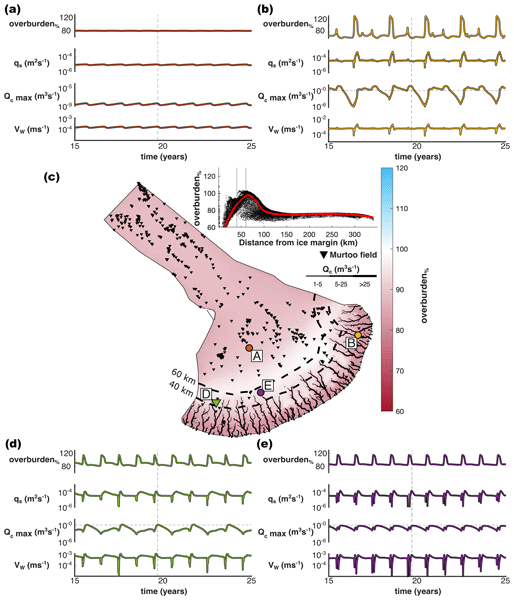
Terrain formerly occupied by ice sheets in the last ice age allows us to parameterize models of basal water flow using terrain and data unavailable beneath current ice sheets. Using GlaDS, a 2D basal hydrology model, we explore the origin of murtoos, a specific landform found throughout Finland that is thought to mark the upper limit of channels beneath the ice. Our results validate many of the predictions of murtoo origins and demonstrate that such models can be used to explore past ice sheets.
Alan Robert Alexander Aitken, Ian Delaney, Guillaume Pirot, and Mauro A. Werder
The Cryosphere, 18, 4111–4136, https://doi.org/10.5194/tc-18-4111-2024, https://doi.org/10.5194/tc-18-4111-2024, 2024
Short summary
Short summary
Understanding how glaciers generate sediment and transport it to the ocean is important for understanding ocean ecosystems and developing knowledge of the past cryosphere from marine sediments. This paper presents a new way to simulate sediment transport in rivers below ice sheets and glaciers and quantify volumes and characteristics of sediment that can be used to reveal the hidden record of the subglacial environment for both past and present glacial conditions.
Felicity S. McCormack, Jason L. Roberts, Bernd Kulessa, Alan Aitken, Christine F. Dow, Lawrence Bird, Benjamin K. Galton-Fenzi, Katharina Hochmuth, Richard S. Jones, Andrew N. Mackintosh, and Koi McArthur
The Cryosphere, 17, 4549–4569, https://doi.org/10.5194/tc-17-4549-2023, https://doi.org/10.5194/tc-17-4549-2023, 2023
Short summary
Short summary
Changes in Antarctic surface elevation can cause changes in ice and basal water flow, impacting how much ice enters the ocean. We find that ice and basal water flow could divert from the Totten to the Vanderford Glacier, East Antarctica, under only small changes in the surface elevation, with implications for estimates of ice loss from this region. Further studies are needed to determine when this could occur and if similar diversions could occur elsewhere in Antarctica due to climate change.
Alice C. Frémand, Peter Fretwell, Julien A. Bodart, Hamish D. Pritchard, Alan Aitken, Jonathan L. Bamber, Robin Bell, Cesidio Bianchi, Robert G. Bingham, Donald D. Blankenship, Gino Casassa, Ginny Catania, Knut Christianson, Howard Conway, Hugh F. J. Corr, Xiangbin Cui, Detlef Damaske, Volkmar Damm, Reinhard Drews, Graeme Eagles, Olaf Eisen, Hannes Eisermann, Fausto Ferraccioli, Elena Field, René Forsberg, Steven Franke, Shuji Fujita, Yonggyu Gim, Vikram Goel, Siva Prasad Gogineni, Jamin Greenbaum, Benjamin Hills, Richard C. A. Hindmarsh, Andrew O. Hoffman, Per Holmlund, Nicholas Holschuh, John W. Holt, Annika N. Horlings, Angelika Humbert, Robert W. Jacobel, Daniela Jansen, Adrian Jenkins, Wilfried Jokat, Tom Jordan, Edward King, Jack Kohler, William Krabill, Mette Kusk Gillespie, Kirsty Langley, Joohan Lee, German Leitchenkov, Carlton Leuschen, Bruce Luyendyk, Joseph MacGregor, Emma MacKie, Kenichi Matsuoka, Mathieu Morlighem, Jérémie Mouginot, Frank O. Nitsche, Yoshifumi Nogi, Ole A. Nost, John Paden, Frank Pattyn, Sergey V. Popov, Eric Rignot, David M. Rippin, Andrés Rivera, Jason Roberts, Neil Ross, Anotonia Ruppel, Dustin M. Schroeder, Martin J. Siegert, Andrew M. Smith, Daniel Steinhage, Michael Studinger, Bo Sun, Ignazio Tabacco, Kirsty Tinto, Stefano Urbini, David Vaughan, Brian C. Welch, Douglas S. Wilson, Duncan A. Young, and Achille Zirizzotti
Earth Syst. Sci. Data, 15, 2695–2710, https://doi.org/10.5194/essd-15-2695-2023, https://doi.org/10.5194/essd-15-2695-2023, 2023
Short summary
Short summary
This paper presents the release of over 60 years of ice thickness, bed elevation, and surface elevation data acquired over Antarctica by the international community. These data are a crucial component of the Antarctic Bedmap initiative which aims to produce a new map and datasets of Antarctic ice thickness and bed topography for the international glaciology and geophysical community.
Cited articles
Ahokangas, E., Ojala, A. E. K., Tuunainen, A., Valkama, M., Palmu, J.-P., Kajuutti, K., and Mäkinen, J.: The distribution of glacial meltwater routes and associated murtoo fields in Finland, Geomorphology, 389, 107854, https://doi.org/10.1016/j.geomorph.2021.107854, 2021. a
Aitken, A.: GraphSSeT – SHMIP repository, Zenodo [code], https://doi.org/10.5281/zenodo.12570097, 2024. a, b, c
Aitken, A. and Hepburn, A.: GraphSSeT models for Finnish Lake District Ice Lobe, Zenodo [data set], https://doi.org/10.5281/zenodo.17204682, 2025. a
Aitken, A. R. A. and Urosevic, L.: A probabilistic and model-based approach to the assessment of glacial detritus from ice sheet change, Palaeogeogr. Palaeocl., 561, 110053, https://doi.org/10.1016/j.palaeo.2020.110053, 2021. a
Alley, R. B., Marotzke, J., Nordhaus, W. D., Overpeck, J. T., Peteet, D. M., Pielke, R. A., Pierrehumbert, R. T., Rhines, P. B., Stocker, T. F., Talley, L. D., and Wallace, J. M.: Abrupt Climate Change, Science, 299, 2005–2010, https://doi.org/10.1126/science.1081056, 2003. a
Andresen, C. S., Karlsson, N. B., Straneo, F., Schmidt, S., Andersen, T. J., Eidam, E. F., Bjørk, A. A., Dartiguemalle, N., Dyke, L. M., Vermassen, F., and Gundel, I. E.: Sediment discharge from Greenland's marine-terminating glaciers is linked with surface melt, Nat. Commun., 15, 1332, https://doi.org/10.1038/s41467-024-45694-1, 2024. a
Boulton, G. S., Dongelmans, P., Punkari, M., and Broadgate, M.: Palaeoglaciology of an ice sheet through a glacial cycle:: the European ice sheet through the Weichselian, Quat. Sci. Rev., 20, 591–625, https://doi.org/10.1016/S0277-3791(00)00160-8, 2001. a
Boulton, G. S., Lunn, R., Vidstrand, P., and Zatsepin, S.: Subglacial drainage by groundwater-channel coupling, and the origin of esker systems: part II–theory and simulation of a modern system, Quat. Sci. Rev., 26, 1091–1105, https://doi.org/10.1016/j.quascirev.2007.01.006, 2007. a, b
Cape, M. R., Straneo, F., Beaird, N., Bundy, R. M., and Charette, M. A.: Nutrient release to oceans from buoyancy-driven upwelling at Greenland tidewater glaciers, Nature Geosc., 12, 34–39, https://doi.org/10.1038/s41561-018-0268-4, 2019. a
Chu, V. W., Smith, L. C., Rennermalm, A. K., Forster, R. R., Box, J. E., and Reeh, N.: Sediment plume response to surface melting and supraglacial lake drainages on the Greenland ice sheet, J. Glaciol., 55, 1072–1082, https://doi.org/10.3189/002214309790794904, 2009. a
Danielson, J. and Gesch, D.: Global multi-resolution terrain elevation data 2010 (GMTED2010), USGS Numbered Series 2011–1073, United States Geological Survey, Earth Resources Observation and Science (EROS) Center, https://doi.org/10.3133/ofr20111073, 2011. a
Delaney, I. and Adhikari, S.: Increased Subglacial Sediment Discharge in a Warming Climate: Consideration of Ice Dynamics, Glacial Erosion, and Fluvial Sediment Transport, Geophys. Res. Lett., 47, https://doi.org/10.1029/2019GL085672, 2020. a
Delaney, I., Werder, M. A., and Farinotti, D.: A Numerical Model for Fluvial Transport of Subglacial Sediment, J. Geophys. Res.-Earth Surf., 124, 2197–2223, https://doi.org/10.1029/2019JF005004, 2019. a, b
Delaney, I., Anderson, L., and Herman, F.: Modeling the spatially distributed nature of subglacial sediment transport and erosion, Earth Surf. Dynam., 11, 663–680, https://doi.org/10.5194/esurf-11-663-2023, 2023. a
Delaney, I., Margirier, A., Gevers, M., Jenkin, M., Leger, T., Vergara, I., Seguinot, J., Jouvet, G., Alexander Aitken, A. R., Lane, S., Herman, F., and King, G. E.: Increased Glacier Melt Across Millennia to Hours Enhances Erosion and Sediment Export Processes, J. Geophys. Res.-Earth Surf., 131, https://doi.org/10.1029/2025JF008614, 2026. a
Dewald, N., Livingstone, S. J., and Clark, C. D.: Subglacial meltwater routes of the Fennoscandian Ice Sheet, J. Maps, 18, 382–396, 2022. a
Dow, C. F., Ross, N., Jeofry, H., Siu, K., and Siegert, M. J.: Antarctic basal environment shaped by high-pressure flow through a subglacial river system, Nat. Geosci., 15, 892–898, https://doi.org/10.1038/s41561-022-01059-1, 2022. a
Ehrenfeucht, S., Morlighem, M., Rignot, E., Dow, C. F., and Mouginot, J.: Seasonal Acceleration of Petermann Glacier, Greenland, From Changes in Subglacial Hydrology, Geophys. Res. Lett., 50, https://doi.org/10.1029/2022GL098009, 2023. a, b
Flowers, G. E.: Modelling water flow under glaciers and ice sheets, P. R. Soc. A., 471, 20140907, https://doi.org/10.1098/rspa.2014.0907, 2015. a
GTK Finland: Bedrock of Finland 1 : 1 000 000 – Spatial data products, https://hakku.gtk.fi/en/locations?id=170 (last access: 12 February 2025), 2025b. a
Hepburn, A., Dow, C. F., Ojala, A., Mäkinen, J., Ahokangas, E., Hovikoski, J., Palmu, J.-P., and Kajuutti, K.: Supplementary material for “Reorganisation of subglacial drainage processes during rapid melting of the Fennoscandian Ice Sheet”, Zenodo [data set], https://doi.org/10.5281/zenodo.8344208, 2023. a
Hepburn, A. J., Dow, C. F., Ojala, A., Mäkinen, J., Ahokangas, E., Hovikoski, J., Palmu, J.-P., and Kajuutti, K.: The organization of subglacial drainage during the demise of the Finnish Lake District Ice Lobe, The Cryosphere, 18, 4873–4916, https://doi.org/10.5194/tc-18-4873-2024, 2024. a, b, c, d, e, f, g, h, i, j, k, l, m, n, o
Herman, F., De Doncker, F., Delaney, I., Prasicek, G., and Koppes, M.: The impact of glaciers on mountain erosion, Nat. Rev. Earth Environ., 2, 422–435, https://doi.org/10.1038/s43017-021-00165-9, 2021. a
Hewitt, I. J.: Modelling distributed and channelized subglacial drainage: the spacing of channels, J. Glaciol., 57, 302–314, https://doi.org/10.3189/002214311796405951, 2011. a
Hewitt, I. J. and Creyts, T. T.: A Model for the Formation of Eskers, Geophys. Res. Lett., 46, 6673–6680, https://doi.org/10.1029/2019GL082304, 2019. a
Hovikoski, J., Mäkinen, J., Winsemann, J., Soini, S., Kajuutti, K., Hepburn, A., and Ojala, A. E. K.: Upper-flow regime bedforms in a subglacial triangular-shaped landform (murtoo), Late Pleistocene, SW Finland: Implications for flow dynamics and sediment transport in (semi-)distributed subglacial meltwater drainage systems, Sediment. Geol., 454, 106448, https://doi.org/10.1016/j.sedgeo.2023.106448, 2023. a, b, c, d
Hovikoski, J., Palmu, J.-P., Väänänen, T., Valkama, M., Ojala, A. E. K., Putkinen, S., and Pitkäranta, R.: Revised classification of glaciofluvial landforms in the Finnish sector of the Fennoscandian Ice Sheet, Boreas, 55, https://doi.org/10.1111/bor.70060, 2026. a
Hughes, A. L. C., Greenwood, S. L., and Winsborrow, M. C. M.: Chapter 45 – The glacial legacy of the EISC during the Younger Dryas Stadial, in: European Glacial Landscapes, edited by: Palacios, D., Hughes, P. D., García-Ruiz, J. M., and Andrés, N., 425–435, Elsevier, ISBN 9780323918992, https://doi.org/10.1016/B978-0-323-91899-2.00046-2, 2023. a, b
Joakim Donner: The Younger Dryas age of the Salpausselkä moraines in Finland, Bull. Geol. Soc. Finl., 82, 69–80, 2010. a
Johnson, M. D., Öhrling, C., Bergström, A., Dreyer Isaksson, O., and Pizarro Rajala, E.: Geomorphology and sedimentology of features formed at the outlet during the final drainage of the Baltic Ice Lake, Boreas, 51, 20–40, https://doi.org/10.1111/bor.12547, 2022. a
Kirkham, J. D., Hogan, K. A., Larter, R. D., Arnold, N. S., Ely, J. C., Clark, C. D., Self, E., Games, K., Huuse, M., Stewart, M. A., Ottesen, D., and Dowdeswell, J. A.: Tunnel valley formation beneath deglaciating mid-latitude ice sheets: Observations and modelling, Quat. Sci. Rev., 323, 107680, https://doi.org/10.1016/j.quascirev.2022.107680, 2024. a
Kleman, J., Hättestrand, C., Borgström, I., and Stroeven, A.: Fennoscandian palaeoglaciology reconstructed using a glacial geological inversion model, J. Glaciol., 43, 283–299, https://doi.org/10.3189/S0022143000003233, 1997. a
Larour, E., Seroussi, H., Morlighem, M., and Rignot, E.: Continental scale, high order, high spatial resolution, ice sheet modeling using the Ice Sheet System Model (ISSM), J. Geophys. Res.-Earth Surf., 117, https://doi.org/10.1029/2011JF002140, 2012. a, b
Licht, K. J. and Hemming, S. R.: Analysis of Antarctic glacigenic sediment provenance through geochemical and petrologic applications, Quat. Sci. Rev., 164, 1–24, https://doi.org/10.1016/j.quascirev.2017.03.009, 2017. a, b, c
Lie, Ø. and Paasche, Ø.: How extreme was northern hemisphere seasonality during the Younger Dryas?, Quat. Sci. Rev., 25, 404–407, https://doi.org/10.1016/j.quascirev.2005.11.003, 2006. a
Mäkinen, J., Kajuutti, K., Ojala, A. E. K., Ahokangas, E., Tuunainen, A., Valkama, M., and Palmu, J.-P.: Genesis of subglacial triangular-shaped landforms (murtoos) formed by the Fennoscandian Ice Sheet, Earth Surf. Process. Landf., 48, 2171–2196, https://doi.org/10.1002/esp.5606, 2023. a, b
Mangerud, J., Hughes, A. L., Johnson, M. D., and Lunkka, J. P.: The Fennoscandian ice sheet during the Younger Dryas stadial, in: European Glacial Landscapes, 437–452, Elsevier, https://doi.org/10.1016/B978-0-323-91899-2.00060-7, 2023. a
Meire, L., Mortensen, J., Meire, P., Juul-Pedersen, T., Sejr, M. K., Rysgaard, S., Nygaard, R., Huybrechts, P., and Meysman, F. J. R.: Marine-terminating glaciers sustain high productivity in Greenland fjords, Glob. Change Biol., 23, 5344–5357, https://doi.org/10.1111/gcb.13801, 2017. a
Naughton, F., Sánchez-Goñi, M. F., Landais, A., Rodrigues, T., Riveiros, N. V., and Toucanne, S.: Chapter 7 – The Younger Dryas Stadial, in: European Glacial Landscapes, edited by: Palacios, D., Hughes, P. D., García-Ruiz, J. M., and Andrés, N., 51–57, Elsevier, ISBN 9780323918992, https://doi.org/10.1016/B978-0-323-91899-2.00024-3, 2023. a
Núñez Ferreira, F. A., Zoet, L. K., Rawling III, J. E., Haseloff, M., Rehwald, M., and Ullman, D. J.: Subglacial hydrology insights from eskers developed atop soft beds of the Laurentide ice sheet, Earth Surf. Process. Landf., 50, https://doi.org/10.1002/esp.6037, 2025. a
Ojala, A. E. K., Peterson, G., Mäkinen, J., Johnson, M. D., Kajuutti, K., Palmu, J.-P., Ahokangas, E., and Öhrling, C.: Ice-sheet scale distribution and morphometry of triangular-shaped hummocks (murtoos): a subglacial landform produced during rapid retreat of the Scandinavian Ice Sheet, Ann. Glaciol., 60, 115–126, https://doi.org/10.1017/aog.2019.34, 2019. a, b, c, d
Ojala, A. E. K., Mäkinen, J., Ahokangas, E., Kajuutti, K., Valkama, M., Tuunainen, A., and Palmu, J.-P.: Diversity of murtoos and murtoo-related subglacial landforms in the Finnish area of the Fennoscandian Ice Sheet, Boreas, 50, 1095–1115, https://doi.org/10.1111/bor.12526, 2021. a, b
Overeem, I., Hudson, B. D., Syvitski, J. P. M., Mikkelsen, A. B., Hasholt, B., van den Broeke, M. R., Noël, B. P. Y., and Morlighem, M.: Substantial export of suspended sediment to the global oceans from glacial erosion in Greenland, Nat. Geosci., 10, 859–863, https://doi.org/10.1038/ngeo3046, 2017. a
Regnéll, C., Greenwood, S. L., Gyllencreutz, R., Peterson, G., Regnéll, J., Öhrling, C., Hardeng, J., Johnson, E., Bakke, J., and Cederstrøm, J. M.: Anchoring the Swedish Time Scale to the radiocarbon time scale – An absolute age for De Geer's zero varve, Geology, 53, 601–606, https://doi.org/10.1130/G53280.1, 2025. a
Röthlisberger, H.: Water Pressure in Intra- and Subglacial Channels, J. Glaciol., 11, 177–203, https://doi.org/10.3189/S0022143000022188, 1972. a, b
Saarnisto, M. and Saarinen, T.: Deglaciation chronology of the Scandinavian Ice Sheet from the Lake Onega Basin to the Salpausselkä End Moraines, Glob. Planet. Change, 31, 387–405, https://doi.org/10.1016/S0921-8181(01)00131-X, 2001. a, b, c, d
Schenk, F., Väliranta, M., Muschitiello, F., Tarasov, L., Heikkilä, M., Björck, S., Brandefelt, J., Johansson, A. V., Näslund, J.-O., and Wohlfarth, B.: Warm summers during the Younger Dryas cold reversal, Nat. Commun., 9, 1634, https://doi.org/10.1038/s41467-018-04071-5, 2018. a
Shreve, R. L.: Movement of Water in Glaciers, J. Glaciol., 11, 205–214, https://doi.org/10.3189/S002214300002219X, 1972. a
Sommers, A., Meyer, C., Morlighem, M., Rajaram, H., Poinar, K., Chu, W., and Mejia, J.: Subglacial hydrology modeling predicts high winter water pressure and spatially variable transmissivity at Helheim Glacier, Greenland, J. Glaciol., 69, 1556–1568, https://doi.org/10.1017/jog.2023.39, 2023. a
Svendsen, J. I., Alexanderson, H., Astakhov, V. I., Demidov, I., Dowdeswell, J. A., Funder, S., Gataullin, V., Henriksen, M., Hjort, C., Houmark-Nielsen, M., Hubberten, H. W., Ingólfsson, Ó., Jakobsson, M., Kjær, K. H., Larsen, E., Lokrantz, H., Lunkka, J. P., Lyså, A., Mangerud, J., Matiouchkov, A., Murray, A., Möller, P., Niessen, F., Nikolskaya, O., Polyak, L., Saarnisto, M., Siegert, C., Siegert, M. J., Spielhagen, R. F., and Stein, R.: Late Quaternary ice sheet history of northern Eurasia, Quat. Sci. Rev., 23, 1229–1271, https://doi.org/10.1016/j.quascirev.2003.12.008, 2004. a
Swift, D. A., Tallentire, G. D., Farinotti, D., Cook, S. J., Higson, W. J., and Bryant, R. G.: The hydrology of glacier-bed overdeepenings: Sediment transport mechanics, drainage system morphology, and geomorphological implications, Earth Surf. Process. Landf., 46, 2264–2278, https://doi.org/10.1002/esp.5173, 2021. a
van den Broeke, M., Bus, C., Ettema, J., and Smeets, P.: Temperature thresholds for degree-day modelling of Greenland ice sheet melt rates, Geophys. Res. Lett., 37, https://doi.org/10.1029/2010GL044123, 2010. a
Vorren, T. O.: Grain-size distribution and grain-size parameters of different till types on Hardangervidda, south Norway, Boreas, 6, 219–227, https://doi.org/10.1111/j.1502-3885.1977.tb00351.x, 1977. a, b, c
Wake, L. M. and Marshall, S. J.: Assessment of current methods of positive degree-day calculation using in situ observations from glaciated regions, J. Glaciol., 61, 329–344, https://doi.org/10.3189/2015JoG14J116, 2015. a
Walder, J. S. and Fowler, A.: Channelized subglacial drainage over a deformable bed, J. Glaciol., 40, 3–15, https://doi.org/10.3189/S0022143000003750, 1994. a, b
Zolitschka, B., Francus, P., Ojala, A. E. K., and Schimmelmann, A.: Varves in lake sediments – a review, Quat. Sci. Rev., 117, 1–41, https://doi.org/10.1016/j.quascirev.2015.03.019, 2015. a
Short summary
Understanding past ice sheet behaviours is key to predicting future ice sheets in a warming climate, but meshing geological observations with ice sheet models is challenging. This manuscript models the sedimentary system of the Finnish Lake District Ice Lobe during its retreat about 12 000 years ago, when extensive water flow developed under the ice, and connects models with observations. The approach opens a path to improve knowledge of previously glaciated regions and systems under ice today.
Understanding past ice sheet behaviours is key to predicting future ice sheets in a warming...


