
Articles | Volume 20, issue 7
https://doi.org/10.5194/tc-20-3977-2026
© Author(s) 2026. This work is distributed under
the Creative Commons Attribution 4.0 License.
the Creative Commons Attribution 4.0 License.
https://doi.org/10.5194/tc-20-3977-2026
© Author(s) 2026. This work is distributed under
the Creative Commons Attribution 4.0 License.
the Creative Commons Attribution 4.0 License.
Research article
| 
20 Jul 2026
Research article |
| 20 Jul 2026
| 20 Jul 2026
Late Holocene stabilization of Conway Ice Ridge
Andrew O. Hoffman
CORRESPONDING AUTHOR

Department of Earth, Environmental and Planetary Sciences, Rice University, Houston, TX, USA
Lamont-Doherty Earth Observatory, Columbia University, Palisades, NY, USA
Paul T. Summers
Department of Geophysics, Stanford University, Stanford, CA, USA
Department of Earth and Atmospheric Science, Georgia Institute of Technology, Atlanta, GA, USA
Department of Marine and Coastal Sciences, Rutgers University, New Brunswick, NJ, USA
Jenny Suckale
Department of Geophysics, Stanford University, Stanford, CA, USA
Institute for Computational and Mathematical Engineering, Stanford University, Stanford, CA, USA
Department of Civil and Environmental Engineering, Stanford University, Stanford, CA, USA
Knut Christianson
Department of Earth and Space Sciences, University of Washington, Seattle, WA, USA
Ginny Catania
Institute of Geophysics, The University of Texas, Austin, TX, USA
Department of Geological Sciences, The University of Texas, Austin, TX, USA
Howard Conway
Department of Earth and Space Sciences, University of Washington, Seattle, WA, USA
Related authors
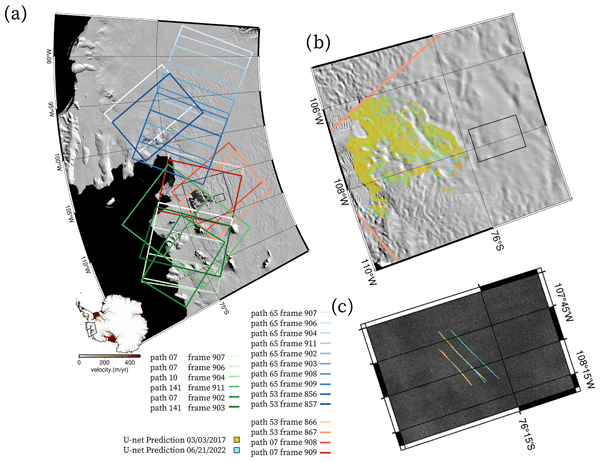
Andrew O. Hoffman, Knut Christianson, Ching-Yao Lai, Ian Joughin, Nicholas Holschuh, Elizabeth Case, Jonathan Kingslake, and the GHOST science team
The Cryosphere, 19, 1353–1372, https://doi.org/10.5194/tc-19-1353-2025, https://doi.org/10.5194/tc-19-1353-2025, 2025
Short summary
Short summary
We use satellite and ice-penetrating radar technology to segment crevasses in the Amundsen Sea Embayment. Inspection of satellite time series reveals inland expansion of crevasses where surface stresses have increased. We develop a simple model for the strength of densifying snow and show that these crevasses are likely restricted to the near surface. This result bridges discrepancies between satellite and lab experiments and reveals the importance of porosity on surface crevasse formation.

Andrew O. Hoffman, Michelle L. Maclennan, Jan Lenaerts, Kristine M. Larson, and Knut Christianson
The Cryosphere, 19, 713–730, https://doi.org/10.5194/tc-19-713-2025, https://doi.org/10.5194/tc-19-713-2025, 2025
Short summary
Short summary
Traditionally, glaciologists use global navigation satellite systems (GNSSs) to measure the surface elevation and velocity of glaciers to understand processes associated with ice flow. Using the interference of GNSS signals that bounce off of the ice sheet surface, we measure the surface height change near GNSS receivers in the Amundsen Sea Embayment (ASE). From surface height change, we infer daily accumulation rates that we use to understand the drivers of extreme precipitation in the ASE.
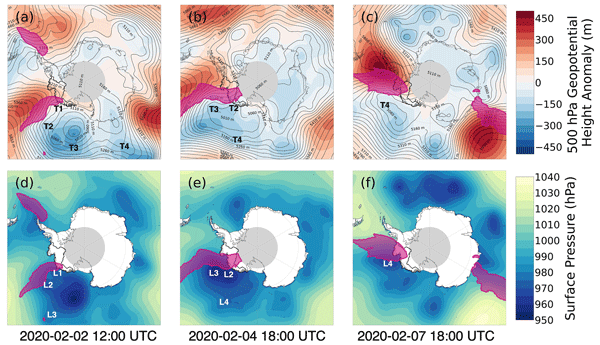
Michelle L. Maclennan, Jan T. M. Lenaerts, Christine A. Shields, Andrew O. Hoffman, Nander Wever, Megan Thompson-Munson, Andrew C. Winters, Erin C. Pettit, Theodore A. Scambos, and Jonathan D. Wille
The Cryosphere, 17, 865–881, https://doi.org/10.5194/tc-17-865-2023, https://doi.org/10.5194/tc-17-865-2023, 2023
Short summary
Short summary
Atmospheric rivers are air masses that transport large amounts of moisture and heat towards the poles. Here, we use a combination of weather observations and models to quantify the amount of snowfall caused by atmospheric rivers in West Antarctica which is about 10 % of the total snowfall each year. We then examine a unique event that occurred in early February 2020, when three atmospheric rivers made landfall over West Antarctica in rapid succession, leading to heavy snowfall and surface melt.

Enze Zhang, Ginny Catania, Ben Smith, Denis Felikson, Beata Csatho, and Daniel T. Trugman
The Cryosphere, 20, 3875–3891, https://doi.org/10.5194/tc-20-3875-2026, https://doi.org/10.5194/tc-20-3875-2026, 2026
Short summary
Short summary
Understanding seasonal changes in Greenland glaciers is vital for studying long-term trends. We use a simple model and high-resolution observation to reveal how multiple processes influence seasonal glacier velocity either alternately or simultaneously each year. Additional tests suggest a steepening glacier surface increases sensitivity of the surface velocity to terminus changes. Our approach can be applied to other glaciers decompose seasonal changes of glacier velocity.
Steven Bernsen, Christopher Gerbi, Senthil Vel, Knut Christianson, and Seth Campbell
EGUsphere, https://doi.org/10.5194/egusphere-2026-1357, https://doi.org/10.5194/egusphere-2026-1357, 2026
Short summary
Short summary
We developed open-source software that simulates how elastic and electromagnetic waves travel through snow and ice with the aim to advance and make accessible ice and snow imaging methods. This helps researchers test survey designs and interpret field measurements without expensive or risky expeditions. Parameters influencing the mechanics of snow and ice are easily input from JSON files, and geometries can be generated using an image editor allowing for time effective production of models.
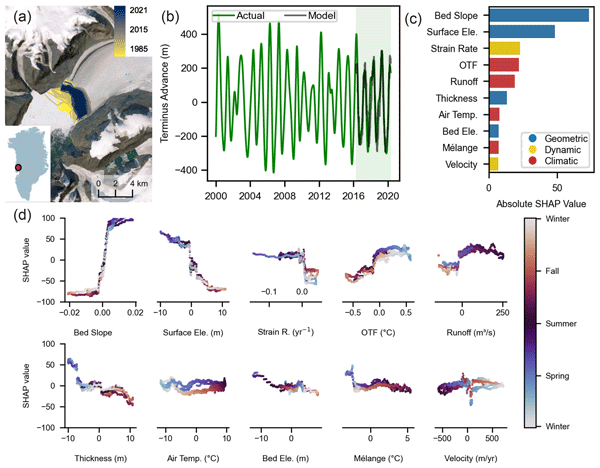
Kevin Shionalyn, Ginny Catania, Daniel T. Trugman, Michael G. Shahin, Leigh A. Stearns, and Denis Felikson
The Cryosphere, 20, 1725–1744, https://doi.org/10.5194/tc-20-1725-2026, https://doi.org/10.5194/tc-20-1725-2026, 2026
Short summary
Short summary
The ocean-facing front of a glacier changes with the seasons. We know this cycle is controlled by the shape and speed of the glacier as well as by the climate, but we do not have a full understanding of these processes. Our study uses 20 years of data and a machine learning model to predict this pattern and identifies which factors matter most. We find that while several factors influence the seasonal cycle, the shape of the glacier plays a key role in how much a glacier changes annually.
Jenny Suckale and Cooper W. Elsworth
EGUsphere, https://doi.org/10.5194/egusphere-2026-67, https://doi.org/10.5194/egusphere-2026-67, 2026
Short summary
Short summary
The widths of glaciers and ice streams can change over time, which strongly affects how much ice is lost to the ocean. Many existing models of sea-level rise neglect these width changes, but they are commonly observed and important. This paper presents a new, simple model that helps identify which physical factors govern width changes at different field sites. The model is explained step by step and tested using an Antarctic ice stream as an example.
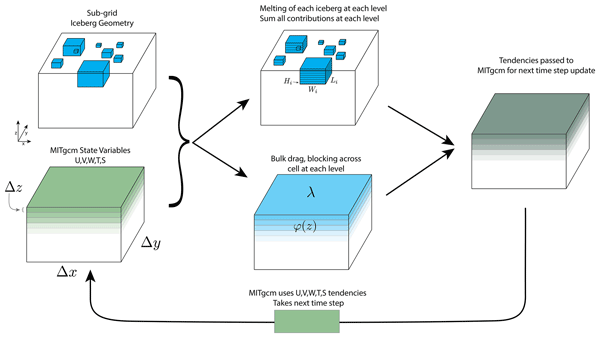
Paul T. Summers, Rebecca H. Jackson, and Alexander A. Robel
The Cryosphere, 19, 5135–5156, https://doi.org/10.5194/tc-19-5135-2025, https://doi.org/10.5194/tc-19-5135-2025, 2025
Short summary
Short summary
We develop a method that allows numerical ocean models to include drag from icebergs, even for icebergs smaller than the model grid scale. This builds upon previous models that have either neglected iceberg drag or required higher resolution to model individual icebergs. We test our model against higher-resolution models, as well as models without iceberg drag, and show that including drag from icebergs is important for capturing realistic ocean circulation, temperature, and ice melt rates.
Andrew O. Hoffman, Knut Christianson, Ching-Yao Lai, Ian Joughin, Nicholas Holschuh, Elizabeth Case, Jonathan Kingslake, and the GHOST science team
The Cryosphere, 19, 1353–1372, https://doi.org/10.5194/tc-19-1353-2025, https://doi.org/10.5194/tc-19-1353-2025, 2025
Short summary
Short summary
We use satellite and ice-penetrating radar technology to segment crevasses in the Amundsen Sea Embayment. Inspection of satellite time series reveals inland expansion of crevasses where surface stresses have increased. We develop a simple model for the strength of densifying snow and show that these crevasses are likely restricted to the near surface. This result bridges discrepancies between satellite and lab experiments and reveals the importance of porosity on surface crevasse formation.
Andrew O. Hoffman, Michelle L. Maclennan, Jan Lenaerts, Kristine M. Larson, and Knut Christianson
The Cryosphere, 19, 713–730, https://doi.org/10.5194/tc-19-713-2025, https://doi.org/10.5194/tc-19-713-2025, 2025
Short summary
Short summary
Traditionally, glaciologists use global navigation satellite systems (GNSSs) to measure the surface elevation and velocity of glaciers to understand processes associated with ice flow. Using the interference of GNSS signals that bounce off of the ice sheet surface, we measure the surface height change near GNSS receivers in the Amundsen Sea Embayment (ASE). From surface height change, we infer daily accumulation rates that we use to understand the drivers of extreme precipitation in the ASE.

Nicole Abib, David A. Sutherland, Rachel Peterson, Ginny Catania, Jonathan D. Nash, Emily L. Shroyer, Leigh A. Stearns, and Timothy C. Bartholomaus
The Cryosphere, 18, 4817–4829, https://doi.org/10.5194/tc-18-4817-2024, https://doi.org/10.5194/tc-18-4817-2024, 2024
Short summary
Short summary
The melting of ice mélange, or dense packs of icebergs and sea ice in glacial fjords, can influence the water column by releasing cold fresh water deep under the ocean surface. However, direct observations of this process have remained elusive. We use measurements of ocean temperature, salinity, and velocity bookending an episodic ice mélange event to show that this meltwater input changes the density profile of a glacial fjord and has implications for understanding tidewater glacier change.
Enze Zhang, Ginny Catania, and Daniel T. Trugman
The Cryosphere, 17, 3485–3503, https://doi.org/10.5194/tc-17-3485-2023, https://doi.org/10.5194/tc-17-3485-2023, 2023
Short summary
Short summary
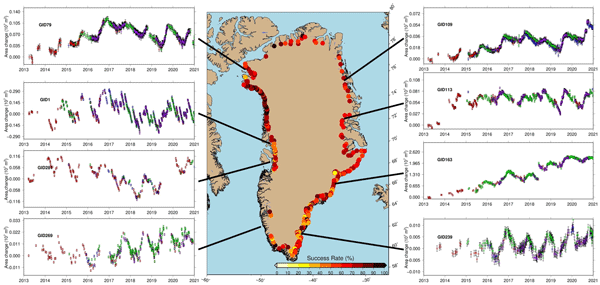
Glacier termini are essential for studying why glaciers retreat, but they need to be mapped automatically due to the volume of satellite images. Existing automated mapping methods have been limited due to limited automation, lack of quality control, and inadequacy in highly diverse terminus environments. We design a fully automated, deep-learning-based method to produce termini with quality control. We produced 278 239 termini in Greenland and provided a way to deliver new termini regularly.
Alice C. Frémand, Peter Fretwell, Julien A. Bodart, Hamish D. Pritchard, Alan Aitken, Jonathan L. Bamber, Robin Bell, Cesidio Bianchi, Robert G. Bingham, Donald D. Blankenship, Gino Casassa, Ginny Catania, Knut Christianson, Howard Conway, Hugh F. J. Corr, Xiangbin Cui, Detlef Damaske, Volkmar Damm, Reinhard Drews, Graeme Eagles, Olaf Eisen, Hannes Eisermann, Fausto Ferraccioli, Elena Field, René Forsberg, Steven Franke, Shuji Fujita, Yonggyu Gim, Vikram Goel, Siva Prasad Gogineni, Jamin Greenbaum, Benjamin Hills, Richard C. A. Hindmarsh, Andrew O. Hoffman, Per Holmlund, Nicholas Holschuh, John W. Holt, Annika N. Horlings, Angelika Humbert, Robert W. Jacobel, Daniela Jansen, Adrian Jenkins, Wilfried Jokat, Tom Jordan, Edward King, Jack Kohler, William Krabill, Mette Kusk Gillespie, Kirsty Langley, Joohan Lee, German Leitchenkov, Carlton Leuschen, Bruce Luyendyk, Joseph MacGregor, Emma MacKie, Kenichi Matsuoka, Mathieu Morlighem, Jérémie Mouginot, Frank O. Nitsche, Yoshifumi Nogi, Ole A. Nost, John Paden, Frank Pattyn, Sergey V. Popov, Eric Rignot, David M. Rippin, Andrés Rivera, Jason Roberts, Neil Ross, Anotonia Ruppel, Dustin M. Schroeder, Martin J. Siegert, Andrew M. Smith, Daniel Steinhage, Michael Studinger, Bo Sun, Ignazio Tabacco, Kirsty Tinto, Stefano Urbini, David Vaughan, Brian C. Welch, Douglas S. Wilson, Duncan A. Young, and Achille Zirizzotti
Earth Syst. Sci. Data, 15, 2695–2710, https://doi.org/10.5194/essd-15-2695-2023, https://doi.org/10.5194/essd-15-2695-2023, 2023
Short summary
Short summary
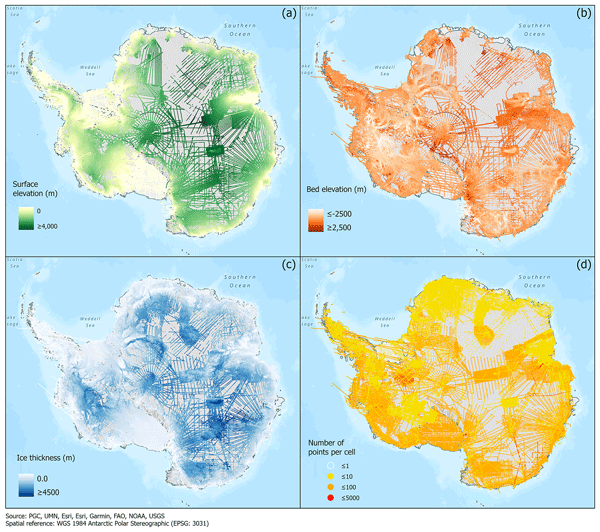
This paper presents the release of over 60 years of ice thickness, bed elevation, and surface elevation data acquired over Antarctica by the international community. These data are a crucial component of the Antarctic Bedmap initiative which aims to produce a new map and datasets of Antarctic ice thickness and bed topography for the international glaciology and geophysical community.
Ian Madden, Simone Marras, and Jenny Suckale
Geosci. Model Dev., 16, 3479–3500, https://doi.org/10.5194/gmd-16-3479-2023, https://doi.org/10.5194/gmd-16-3479-2023, 2023
Short summary
Short summary
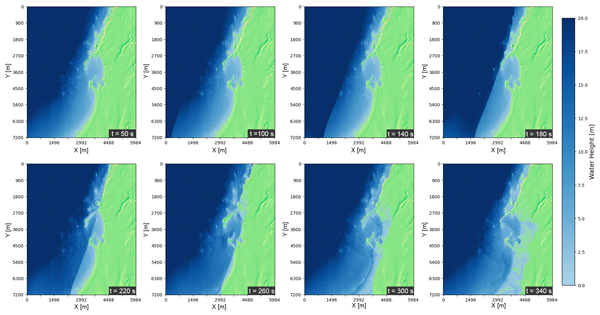
To aid risk managers who may wish to rapidly assess tsunami risk but may lack high-performance computing infrastructure, we provide an accessible software package able to rapidly model tsunami inundation over real topography by leveraging Google's Tensor Processing Unit, a high-performance hardware. Minimally trained users can take advantage of the rapid modeling abilities provided by this package via a web browser thanks to the ease of use of Google Cloud Platform.
Michelle L. Maclennan, Jan T. M. Lenaerts, Christine A. Shields, Andrew O. Hoffman, Nander Wever, Megan Thompson-Munson, Andrew C. Winters, Erin C. Pettit, Theodore A. Scambos, and Jonathan D. Wille
The Cryosphere, 17, 865–881, https://doi.org/10.5194/tc-17-865-2023, https://doi.org/10.5194/tc-17-865-2023, 2023
Short summary
Short summary
Atmospheric rivers are air masses that transport large amounts of moisture and heat towards the poles. Here, we use a combination of weather observations and models to quantify the amount of snowfall caused by atmospheric rivers in West Antarctica which is about 10 % of the total snowfall each year. We then examine a unique event that occurred in early February 2020, when three atmospheric rivers made landfall over West Antarctica in rapid succession, leading to heavy snowfall and surface melt.
Evan Carnahan, Ginny Catania, and Timothy C. Bartholomaus
The Cryosphere, 16, 4305–4317, https://doi.org/10.5194/tc-16-4305-2022, https://doi.org/10.5194/tc-16-4305-2022, 2022
Short summary
Short summary
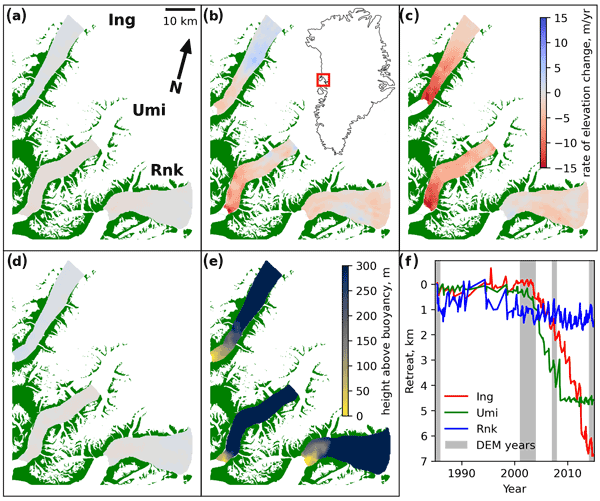
The Greenland Ice Sheet primarily loses mass through increased ice discharge. We find changes in discharge from outlet glaciers are initiated by ocean warming, which causes a change in the balance of forces resisting gravity and leads to acceleration. Vulnerable conditions for sustained retreat and acceleration are predetermined by the glacier-fjord geometry and exist around Greenland, suggesting increases in ice discharge may be sustained into the future despite a pause in ocean warming.
Sophie Goliber, Taryn Black, Ginny Catania, James M. Lea, Helene Olsen, Daniel Cheng, Suzanne Bevan, Anders Bjørk, Charlie Bunce, Stephen Brough, J. Rachel Carr, Tom Cowton, Alex Gardner, Dominik Fahrner, Emily Hill, Ian Joughin, Niels J. Korsgaard, Adrian Luckman, Twila Moon, Tavi Murray, Andrew Sole, Michael Wood, and Enze Zhang
The Cryosphere, 16, 3215–3233, https://doi.org/10.5194/tc-16-3215-2022, https://doi.org/10.5194/tc-16-3215-2022, 2022
Short summary
Short summary
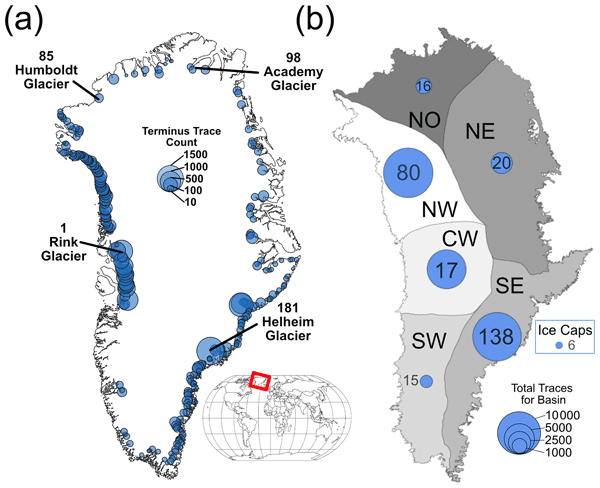
Terminus traces have been used to understand how Greenland's glaciers have changed over time; however, manual digitization is time-intensive, and a lack of coordination leads to duplication of efforts. We have compiled a dataset of over 39 000 terminus traces for 278 glaciers for scientific and machine learning applications. We also provide an overview of an updated version of the Google Earth Engine Digitization Tool (GEEDiT), which has been developed specifically for the Greenland Ice Sheet.
John Erich Christian, Alexander A. Robel, and Ginny Catania
The Cryosphere, 16, 2725–2743, https://doi.org/10.5194/tc-16-2725-2022, https://doi.org/10.5194/tc-16-2725-2022, 2022
Short summary
Short summary
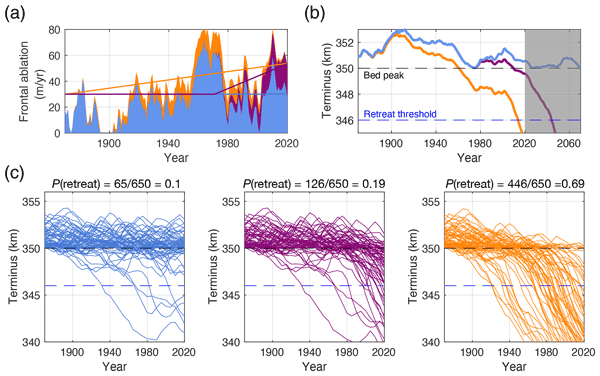
Marine-terminating glaciers have recently retreated dramatically, but the role of anthropogenic forcing remains uncertain. We use idealized model simulations to develop a framework for assessing the probability of rapid retreat in the context of natural climate variability. Our analyses show that century-scale anthropogenic trends can substantially increase the probability of retreats. This provides a roadmap for future work to formally assess the role of human activity in recent glacier change.
Cited articles
Alley, K. E., Scambos, T. A., Anderson, R. S., Rajaram, H., Pope, A., and Haran, T. M.: Continent-wide estimates of Antarctic strain rates from Landsat 8-derived velocity grids, J. Glaciol., 64, 321–332, https://doi.org/10.1017/jog.2018.23, 2018. a
Alley, R. B. and Whillans, I. M.: Changes in the West Antarctic Ice Sheet, Science, 254, 959–963, https://doi.org/10.1126/science.254.5034.959, 1991. a
Anandakrishnan, S. and Alley, R. B.: Stagnation of Ice Stream C, West Antarctica by water piracy, Geophys. Res. Lett., 24, 265–268, https://doi.org/10.1029/96gl04016, 1997. a
Bindschadler, R.: Siple Coast Project research of Crary Ice Rise and the mouths of Ice Streams B and C, West Antarctica: review and new perspectives, J. Glaciol., 39, 538–552, https://doi.org/10.3189/S0022143000016439, 1993. a
Bindschadler, R., Vornberger, P., Blankenship, D., Scambos, T., and Jacobel, R.: Surface velocity and mass balance of Ice Streams D and E, West Antarctica, J. Glaciol., 42, 461–475, https://doi.org/10.3189/s0022143000003452, 1996. a
Bindschadler, R. A., Roberts, E. P., and Iken, A.: Age of Crary Ice Rise, Antarctica, Determined from Temperature-Depth Profiles, Ann. Glaciol., 14, 13–16, https://doi.org/10.3189/s0260305500008168, 1990. a
Bindschadler, R. A., King, M. A., Alley, R. B., Anandakrishnan, S., and Padman, L.: Tidally controlled stick-slip discharge of a West Antarctic ice stream, Science, 301, 1087–1089, https://doi.org/10.1126/science.1087231, 2003. a
Bingham, R. G. and Siegert, M. J.: Radar‐derived bed roughness characterization of Institute and Möller ice streams, West Antarctica, and comparison with Siple Coast ice streams, Geophys. Res. Lett., 34, https://doi.org/10.1029/2007gl031483, 2007. a, b
Bogorodsky, V. V., Bentley, C. R., and Gudmandsen, P. E.: Radioglaciology, Springer Dordrecht, Dordrecht, Holland, 1985. a
Booth, A. M., Roering, J. J., and Perron, J. T.: Automated landslide mapping using spectral analysis and high-resolution topographic data: Puget Sound lowlands, Washington, and Portland Hills, Oregon, Geomorphology, 109, 132–147, https://doi.org/10.1016/j.geomorph.2009.02.027, 2009. a
Catania, G., Conway, H., Raymond, C., and Scambos, T.: Surface morphology and internal layer stratigraphy in the downstream end of Kamb Ice Stream, West Antarctica, J. Glaciol., 51, 423–431, https://doi.org/10.3189/172756505781829142, 2005. a, b
Catania, G., Hulbe, C., and Conway, H.: Grounding-line basal melt rates determined using radar-derived internal stratigraphy, J. Glaciol., 56, 545–554, https://doi.org/10.3189/002214310792447842, 2010. a, b
Catania, G. A., Scambos, T. A., Conway, H., and Raymond, C. F.: Sequential stagnation of Kamb Ice Stream, West Antarctica, Geophys. Res. Lett., 33, https://doi.org/10.1029/2006gl026430, 2006. a, b, c, d
Christianson, K., Jacobel, R. W., Horgan, H. J., Alley, R. B., Anandakrishnan, S., Holland, D. M., and DallaSanta, K. J.: Basal conditions at the grounding zone of Whillans Ice Stream, West Antarctica, from ice‐penetrating radar, J. Geophys. Res.-Earth Surf., 121, 1954–1983, https://doi.org/10.1002/2015jf003806, 2016. a, b
Clarke, T. S., Liu, C., Lord, N. E., and Bentley, C. R.: Evidence for a recently abandoned shear margin adjacent to ice stream B2, Antarctica, from ice‐penetrating radar measurements, J. Geophys. Res.-Sol. Ea., 105, 13409–13422, https://doi.org/10.1029/2000jb900037, 2000. a
Clough, J. W. and Hansen, B. L.: The Ross Ice Shelf Project, Science, 203, 433–434, https://doi.org/10.1126/science.203.4379.433, 1979. a
Colgan, W., Rajaram, H., Abdalati, W., McCutchan, C., Mottram, R., Moussavi, M. S., and Grigsby, S.: Glacier crevasses: Observations, models, and mass balance implications, Rev. Geophys., 54, 119–161, https://doi.org/10.1002/2015rg000504, 2016. a
Conway, H., Catania, G., Raymond, C. F., Gades, A. M., Scambos, T. A., and Engelhardt, H.: Switch of flow direction in an Antarctic ice stream, Nature, 419, 465–467, https://doi.org/10.1038/nature01081, 2002. a, b, c, d
Crary, A. P.: Glaciological regime at Little America Station, Antarctica, J. Geophys. Res., 66, 871–878, https://doi.org/10.1029/JZ066i003p00871, 1961. a
Crary, A. P., Robinson, E. S., Bennett, H. F., and Boyd Jr., W. W.: Glaciological regime of the Ross Ice Shelf, J. Geophys. Res., 67, 2791–2807, https://doi.org/10.1029/JZ067i007p02791, 1962. a
Creel, R. C., Austermann, J., Kopp, R. E., Khan, N. S., Albrecht, T., and Kingslake, J.: Global mean sea level likely higher than present during the Holocene, Nat. Commun., 15, 10731, https://doi.org/10.1038/s41467-024-54535-0, 2024. a
Dansgaard, W. and Johnsen, S. J.: A Flow Model and a Time Scale for the Ice Core from Camp Century, Greenland, J. Glaciol., 8, 215–223, https://doi.org/10.3189/S0022143000031208, 1969. a, b
Elsworth, C. W. and Suckale, J.: Rapid ice flow rearrangement induced by subglacial drainage in West Antarctica, Geophys. Res. Lett., 43, 11697–11707, https://doi.org/10.1002/2016gl070430, 2016. a
Fahnestock, M. A., Joughin, I., Scambos, T. A., Kwok, R., Krabill, W. B., and Gogineni, S.: Ice-stream-related patterns of ice flow in the interior of northeast Greenland, J. Geophys. Res.-Atmos., 106, 34035–34045, https://doi.org/10.1029/2001JD900194, 2001. a
Fujita, S., Maeno, H., and Matsuoka, K.: Radio-wave depolarization and scattering within ice sheets: a matrix-based model to link radar and ice-core measurements and its application, J. Glaciol., 52, 407–424, https://doi.org/10.3189/172756506781828548, 2006. a
Gades, A. M., Raymond, C. F., Conway, H., and Jacobel, R. W.: Bed properties of Siple Dome and adjacent ice streams, West Antarctica, inferred from radio-echo sounding measurements, J. Glaciol., 46, 88–94, https://doi.org/10.3189/172756500781833467, 2000. a
Grant, M. and Boyd, S.: CVX: Matlab Software for Disciplined Convex Programming, version 2.1, http://cvxr.com/cvx (last access: 3 April 2026), 2014. a
Greenwood, S. L., Simkins, L. M., Halberstadt, A. R. W., Prothro, L. O., and Anderson, J. B.: Holocene reconfiguration and readvance of the East Antarctic Ice Sheet, Nat. Commun., 9, 3176, https://doi.org/10.1038/s41467-018-05625-3, 2018. a
Grinsted, A., Rathmann, N. M., Mottram, R., Solgaard, A. M., Mathiesen, J., and Hvidberg, C. S.: Failure strength of glacier ice inferred from Greenland crevasses, The Cryosphere, 18, 1947–1957, https://doi.org/10.5194/tc-18-1947-2024, 2024. a, b
Gustafson, C. D., Key, K., Siegfried, M. R., Winberry, J. P., Fricker, H. A., Venturelli, R. A., and Michaud, A. B.: A dynamic saline groundwater system mapped beneath an Antarctic ice stream, Science, 376, 640–644, https://doi.org/10.1126/science.abm3301, 2022. a
Haefeli, R.: A numerical and experimental method for determining ice motion in central parts of ice sheets, General Assembly of Berkeley, Commission of Snow and Ice (Proceedings of the General Assembly of Berkeley), 61, 253– 260, 1963. a
Hall, B., Bromley, G., Stone, J., and Conway, H.: Holocene ice recession at Polygon Spur, Reedy Glacier, Antarctica, Holocene, 27, 122–129, https://doi.org/10.1177/0959683616652708, 2016. a
Hall, B. L., Denton, G. H., Stone, J. O., and Conway, H.: History of the grounded ice sheet in the Ross Sea sector of Antarctica during the Last Glacial Maximum and the last termination, Geological Society, London, Special Publications, 381, 167–181, https://doi.org/10.1144/SP381.5, 2013. a
Hillebrand, T. R., Conway, H., Koutnik, M., Martín, C., Paden, J., and Winberry, J. P.: Radio-echo sounding and waveform modeling reveal abundant marine ice in former rifts and basal crevasses within Crary Ice Rise, Antarctica, J. Glaciol., 67, 641–652, https://doi.org/10.1017/jog.2021.17, 2021. a
Hoffman, A. O., Christianson, K., Shapero, D., Smith, B. E., and Joughin, I.: Brief communication: Heterogenous thinning and subglacial lake activity on Thwaites Glacier, West Antarctica, The Cryosphere, 14, 4603–4609, https://doi.org/10.5194/tc-14-4603-2020, 2020. a
Hoffman, A., Christianson, K., and Conway, H.: Impulse HF radar data from Conway Ridge, U.S. Antarctic Program (USAP) Data Center [data set], https://doi.org/10.15784/601810, 2024. a
Hoffman, A. O., Christianson, K., Lai, C.-Y., Joughin, I., Holschuh, N., Case, E., Kingslake, J., and the GHOST science team: Inland migration of near-surface crevasses in the Amundsen Sea Sector, West Antarctica, The Cryosphere, 19, 1353–1372, https://doi.org/10.5194/tc-19-1353-2025, 2025. a, b, c
Holschuh, N., Christianson, K., Conway, H., Jacobel, R. W., and Welch, B. C.: Persistent tracers of historic ice flow in glacial stratigraphy near Kamb Ice Stream, West Antarctica, The Cryosphere, 12, 2821–2829, https://doi.org/10.5194/tc-12-2821-2018, 2018. a
Howat, I. M., Porter, C., Smith, B. E., Noh, M.-J., and Morin, P.: The Reference Elevation Model of Antarctica, The Cryosphere, 13, 665–674, https://doi.org/10.5194/tc-13-665-2019, 2019. a
Hulbe, C. and Fahnestock, M.: Century‐scale discharge stagnation and reactivation of the Ross ice streams, West Antarctica, J. Geophys. Res.-Earth Surf., 112, https://doi.org/10.1029/2006jf000603, 2007. a
Jacobel, R. W., Scambos, T. A., Nereson, N. A., and Raymond, C. F.: Changes in the margin of Ice Stream C, Antarctica, J. Glaciol., 46, 102–110, https://doi.org/10.3189/172756500781833485, 2000. a, b
Jacobel, R. W., Welch, B. C., Osterhouse, D., Pettersson, R., and MacGregor, J. A.: Spatial variation of radar-derived basal conditions on Kamb Ice Stream, West Antarctica, Ann. Glaciol., 50, 10–16, https://doi.org/10.3189/172756409789097504, 2009. a
Jezek, K. C.: Glaciological properties of the Antarctic ice sheet from RADARSAT-1 synthetic aperture radar imagery, Ann. Glaciol., 29, 286–290, https://doi.org/10.3189/172756499781820969, 1999. a, b, c, d
Jezek, K. C., Curlander, J. C., Carsey, F., Wales, C., and Barry, R. G.: RAMP AMM-1 SAR Image Mosaic of Antarctica, Version 2, Boulder, Colorado USA, NASA National Snow and Ice Data Center Distributed Active Archive Center [data set], https://doi.org/10.5067/8AF4ZRPULS4H, 2013. a, b
Jones, R. S., Johnson, J. S., Lin, Y., Mackintosh, A. N., Sefton, J. P., Smith, J. A., Thomas, E. R., and Whitehouse, P. L.: Stability of the Antarctic Ice Sheet during the pre-industrial Holocene, Nat. Rev. Earth Environ., 3, 500–515, https://doi.org/10.1038/s43017-022-00309-5, 2022. a
King, M.: Rigorous GPS data-processing strategies for glaciological applications, J. Glaciol., 50, 601–607, https://doi.org/10.3189/172756504781829747, 2004. a
Kingslake, J., Scherer, R. P., Albrecht, T., Coenen, J., Powell, R. D., Reese, R., Stansell, N. D., Tulaczyk, S., Wearing, M. G., and Whitehouse, P. L.: Extensive retreat and re-advance of the West Antarctic Ice Sheet during the Holocene, Nature, 558, 430–434, https://doi.org/10.1038/s41586-018-0208-x, 2018. a, b, c
Le Brocq, A. M., Payne, A. J., and Vieli, A.: Antarctic dataset in NetCDF format, PANGAEA [data set], https://doi.org/10.1594/PANGAEA.734145, 2010. a
Lowry, D. P., Han, H. K., Golledge, N. R., Gomez, N., Johnson, K. M., and McKay, R. M.: Ocean cavity regime shift reversed West Antarctic grounding line retreat in the late Holocene, Nat. Commun., 15, 3176, https://doi.org/10.1038/s41467-024-47369-3, 2024. a
MacAyeal, D. R.: Large-scale ice flow over a viscous basal sediment: Theory and application to ice stream B, Antarctica, J. Geophys. Res.-Sol. Ea., 94, 4071–4087, https://doi.org/10.1029/JB094iB04p04071, 1989. a
MacAyeal, D. R. and Thomas, R. H.: Ross Ice Shelf temperatures support a history of ice-shelf thickening, Nature, 282, 703–705, https://doi.org/10.1038/282703a0, 1979. a
MacGregor, J. A., Li, J., Paden, J. D., Catania, G. A., Clow, G. D., Fahnestock, M. A., Gogineni, S. P., Grimm, R. E., Morlighem, M., Nandi, S., Seroussi, H., and Stillman, D. E.: Radar attenuation and temperature within the Greenland Ice Sheet, J. Geophys. Res.-Earth Surf., 120, 983–1008, https://doi.org/10.1002/2014jf003418, 2015. a
MacGregor, J. A., Fahnestock, M. A., Catania, G. A., Aschwanden, A., Clow, G. D., Colgan, W. T., Gogineni, S. P., Morlighem, M., Nowicki, S. M. J., Paden, J. D., Price, S. F., and Seroussi, H.: A synthesis of the basal thermal state of the Greenland Ice Sheet, J. Geophys. Res.-Earth Surf., 121, 1328–1350, https://doi.org/10.1002/2015JF003803, 2016. a, b, c
Matsuoka, K., Wilen, L., Hurley, S. P., and Raymond, C. F.: Effects of Birefringence Within Ice Sheets on Obliquely Propagating Radio Waves, IEEE T. Geosci. Remote, 47, 1429–1443, https://doi.org/10.1109/tgrs.2008.2005201, 2009. a
Matsuoka, K., Morse, D., and Raymond, C. F.: Estimating englacial radar attenuation using depth profiles of the returned power, central West Antarctica, J. Geophys. Res.-Earth Surf., 115, https://doi.org/10.1029/2009jf001496, 2010. a, b
Matsuoka, K., MacGregor, J. A., and Pattyn, F.: Predicting radar attenuation within the Antarctic ice sheet, Earth Planet. Sc. Lett., 359, 173–183, https://doi.org/10.1016/j.epsl.2012.10.018, 2012. a
Matsuoka, K., Hindmarsh, R. C., Moholdt, G., Bentley, M. J., Pritchard, H. D., Brown, J., Conway, H., Drews, R., Durand, G., Goldberg, D., Hattermann, T., Kingslake, J., Lenaerts, J. T., Martín, C., Mulvaney, R., Nicholls, K. W., Pattyn, F., Ross, N., Scambos, T., and Whitehouse, P. L.: Antarctic ice rises and rumples: Their properties and significance for ice-sheet dynamics and evolution, Earth-Sci. Rev., 150, 724–745, https://doi.org/10.1016/j.earscirev.2015.09.004, 2015. a, b, c
Meyer, C. R. and Minchew, B. M.: Temperate ice in the shear margins of the Antarctic Ice Sheet: Controlling processes and preliminary locations, Earth Planet. Sc. Lett., 498, 17–26, https://doi.org/10.1016/j.epsl.2018.06.028, 2018. a
Morlighem, M., Rignot, E., Binder, T., Blankenship, D., Drews, R., Eagles, G., Eisen, O., Ferraccioli, F., Forsberg, R., Fretwell, P., Goel, V., Greenbaum, J. S., Gudmundsson, H., Guo, J., Helm, V., Hofstede, C., Howat, I., Humbert, A., Jokat, W., Karlsson, N. B., Lee, W. S., Matsuoka, K., Millan, R., Mouginot, J., Paden, J., Pattyn, F., Roberts, J., Rosier, S., Ruppel, A., Seroussi, H., Smith, E. C., Steinhage, D., Sun, B., Broeke, M. R. v. d., Ommen, T. D. v., Wessem, M. v., and Young, D. A.: Deep glacial troughs and stabilizing ridges unveiled beneath the margins of the Antarctic ice sheet, Nat. Geosci., 13, 132–137, https://doi.org/10.1038/s41561-019-0510-8, 2020. a, b, c
Nereson, N. and Raymond, C.: The elevation history of ice streams and the spatial accumulation pattern along the Siple Coast of West Antarctica inferred from ground-based radar data from three inter-ice-stream ridges, J. Glaciol., 47, 303–313, https://doi.org/10.3189/172756501781832197, 2001. a
Neuhaus, S. U., Tulaczyk, S. M., Stansell, N. D., Coenen, J. J., Scherer, R. P., Mikucki, J. A., and Powell, R. D.: Did Holocene climate changes drive West Antarctic grounding line retreat and readvance?, The Cryosphere, 15, 4655–4673, https://doi.org/10.5194/tc-15-4655-2021, 2021. a, b, c, d
Nilsson, J., Gardner, A. S., and Paolo, F. S.: Elevation change of the Antarctic Ice Sheet: 1985 to 2020, Earth Syst. Sci. Data, 14, 3573–3598, https://doi.org/10.5194/essd-14-3573-2022, 2022. a
Nye, J. F.: A Method of Determining the Strain-Rate Tensor at the Surface of a Glacier, J. Glaciol., 3, 409–419, https://doi.org/10.3189/s0022143000017093, 1959. a, b
Nye, J. F.: Correction Factor for Accumulation Measured by the Thickness of the Annual Layers in an Ice Sheet, J. Glaciol., 4, 785–788, https://doi.org/10.3189/S0022143000028367, 1963. a
Ólafur, I. and Christian, H.: The Antarctic contribution to Holocene global sea level rise, Polar Res., 18, 323–330, https://doi.org/10.3402/polar.v18i2.6591, 1999. a
Persson, P.-O. and Strang, G.: A Simple Mesh Generator in MATLAB, SIAM Rev., 46, 329–345, 2004. a
Priscu, J. C., Kalin, J., Winans, J., Campbell, T., Siegfried, M. R., Skidmore, M., Dore, J. E., Leventer, A., Harwood, D. M., Duling, D., Zook, R., Burnett, J., Gibson, D., Krula, E., Mironov, A., McManis, J., Roberts, G., Rosenheim, B. E., Christner, B. C., Kasic, K., Fricker, H. A., Lyons, W. B., Barker, J., Bowling, M., Collins, B., Davis, C., Gagnon, A., Gardner, C., Gustafson, C., Kim, O.-S., Li, W., Michaud, A., Patterson, M. O., Tranter, M., Venturelli, R., Vick-Majors, T., Elsworth, C., and The SALSA Science Team: Scientific access into Mercer Subglacial Lake: scientific objectives, drilling operations and initial observations, Ann. Glaciol., 62, 340–352, https://doi.org/10.1017/aog.2021.10, 2021. a
Scheuchl, B., Mouginot, J., and Rignot, E.: Ice velocity changes in the Ross and Ronne sectors observed using satellite radar data from 1997 and 2009, The Cryosphere, 6, 1019–1030, https://doi.org/10.5194/tc-6-1019-2012, 2012a. a
Scheuchl, B., Mouginot, J., and Rignot, E.: MEaSUREs InSAR-Based Ice Velocity Maps of Central Antarctica: 1997 and 2009, Version 1, Boulder, Colorado USA, NASA National Snow and Ice Data Center Distributed Active Archive Center [data set], https://doi.org/10.5067/MEASURES/CRYOSPHERE/nsidc-0525.001, 2012b. a
Schoof, C.: A variational approach to ice stream flow, J. Fluid Mech., 556, 227–251, https://doi.org/10.1017/S0022112006009591, 2006. a
Seroussi, H., Nowicki, S., Simon, E., Abe-Ouchi, A., Albrecht, T., Brondex, J., Cornford, S., Dumas, C., Gillet-Chaulet, F., Goelzer, H., Golledge, N. R., Gregory, J. M., Greve, R., Hoffman, M. J., Humbert, A., Huybrechts, P., Kleiner, T., Larour, E., Leguy, G., Lipscomb, W. H., Lowry, D., Mengel, M., Morlighem, M., Pattyn, F., Payne, A. J., Pollard, D., Price, S. F., Quiquet, A., Reerink, T. J., Reese, R., Rodehacke, C. B., Schlegel, N.-J., Shepherd, A., Sun, S., Sutter, J., Van Breedam, J., van de Wal, R. S. W., Winkelmann, R., and Zhang, T.: initMIP-Antarctica: an ice sheet model initialization experiment of ISMIP6, The Cryosphere, 13, 1441–1471, https://doi.org/10.5194/tc-13-1441-2019, 2019. a
Shabtaie, S., Whillans, I. M., and Bentley, C. R.: The morphology of ice streams A, B, and C, west Antarctica, and their environs, J. Geophys. Res.-Sol. Ea., 92, 8865–8883, https://doi.org/10.1029/jb092ib09p08865, 1987. a
Siegert, M. J., Taylor, J., Payne, A. J., and Hubbard, B.: Macro‐scale bed roughness of the siple coast ice streams in West Antarctica, Earth Surf. Proc. Land., 29, 1591–1596, https://doi.org/10.1002/esp.1100, 2004a. a
Siegert, M. J., Welch, B., Morse, D., Vieli, A., Blankenship, D. D., Joughin, I., King, E. C., Vieli, G. J.-M. C. L., Payne, A. J., and Jacobel, R.: Ice Flow Direction Change in Interior West Antarctica, Science, 305, 1948–1951, https://doi.org/10.1126/science.1101072, 2004b. a
Siegfried, M., Venturelli, R., Patterson, M., Arnuk, W., Campbell, T., Gustafson, C., Michaud, A., Galton-Fenzi, B., Hausner, M., Holzschuh, S., Huber, B., Mankoff, K., Schroeder, D., Summers, P., Tyler, S., Carter, S., Fricker, H., Harwood, D., Leventer, A., Rosenheim, B., Skidmore, M., Priscu, J., and the SALSA Science Team: The life and death of a subglacial lake in West Antarctica, Geology, 51, 434–438, https://doi.org/10.1130/G50995.1, 2023. a, b
Smith, B., Fricker, H. A., Holschuh, N., Gardner, A. S., Adusumilli, S., Brunt, K. M., Csatho, B., Harbeck, K., Huth, A., Neumann, T., Nilsson, J., and Siegfried, M. R.: Land ice height-retrieval algorithm for NASA's ICESat-2 photon-counting laser altimeter, Remote Sens. Environ., 233, 111352, https://doi.org/10.1016/j.rse.2019.111352, 2019. a
Smith, B., Fricker, H. A., Gardner, A. S., Medley, B., Nilsson, J., Paolo, F. S., Holschuh, N., Adusumilli, S., Brunt, K., Csatho, B., Harbeck, K., Markus, T., Neumann, T., Siegfried, M. R., and Zwally, H. J.: Pervasive ice sheet mass loss reflects competing ocean and atmosphere processes, Science, 368, 1239–1242, https://doi.org/10.1126/science.aaz5845, 2020. a, b
Smith, B. E., Lord, N. E., and Bentley, C. R.: Crevasse ages on the northern margin of Ice Stream C, West Antarctica, Ann. Glaciol., 34, 209–216, https://doi.org/10.3189/172756402781817932, 2002. a
Smith, B. E., Fricker, H. A., Joughin, I. R., and Tulaczyk, S.: An inventory of active subglacial lakes in Antarctica detected by ICESat (2003–2008), J. Glaciol., 55, 573–595, https://doi.org/10.3189/002214309789470879, 2009. a
Spector, P., Stone, J., Cowdery, S. G., Hall, B., Conway, H., and Bromley, G.: Rapid early‐Holocene deglaciation in the Ross Sea, Antarctica, Geophys. Res. Lett., 44, 7817–7825, https://doi.org/10.1002/2017gl074216, 2017. a, b
Summers, P.: somonesummers/IceStreamA: Code for Manuscript and associate model data, Zenodo [code, data set], https://doi.org/10.5281/zenodo.19354457, 2026. a
Taylor, J., Siegert, M. J., Payne, A. J., and Hubbard, B.: Regional-scale bed roughness beneath ice masses: measurement and analysis, Comput. Geosci., 30, 899–908, https://doi.org/10.1016/j.cageo.2004.06.007, 2004. a, b
Todd, C., Stone, J., Conway, H., Hall, B., and Bromley, G.: Late Quaternary evolution of Reedy Glacier, Antarctica, Quaternary Sci. Rev., 29, 1328–1341, https://doi.org/10.1016/j.quascirev.2010.02.001, 2010. a
Tulaczyk, S., Kamb, W. B., and Engelhardt, H. F.: Basal mechanics of Ice Stream B, west Antarctica: 2. Undrained plastic bed model, J. Geophys. Res.-Sol. Ea., 105, 483–494, https://doi.org/10.1029/1999JB900328, 2000. a, b
Tulaczyk, S., Mikucki, J. A., Siegfried, M. R., Priscu, J. C., Barcheck, C. G., Beem, L. H., Behar, A., Burnett, J., Christner, B. C., Fisher, A. T., Fricker, H. A., Mankoff, K. D., Powell, R. D., Rack, F., Sampson, D., Scherer, R. P., Schwartz, S. Y., and The WISSARD Science Team: WISSARD at Subglacial Lake Whillans, West Antarctica: scientific operations and initial observations, Ann. Glaciol., 55, 51–58, https://doi.org/10.3189/2014AoG65A009, 2014. a
Vaughan, D. G.: Relating the occurrence of crevasses to surface strain rates, J. Glaciol., 39, 255–266, https://doi.org/10.3189/s0022143000015926, 1993. a, b, c, d
Venturelli, R. A., Siegfried, M. R., Roush, K. A., Li, W., Burnett, J., Zook, R., Fricker, H. A., Priscu, J. C., Leventer, A., and Rosenheim, B. E.: Mid‐Holocene Grounding Line Retreat and Readvance at Whillans Ice Stream, West Antarctica, Geophys. Res. Lett., 47, https://doi.org/10.1029/2020gl088476, 2020. a, b, c, d, e, f
Venturelli, R. A., Boehman, B., Davis, C., Hawkings, J. R., Johnston, S. E., Gustafson, C. D., Michaud, A. B., Mosbeux, C., Siegfried, M. R., Vick-Majors, T. J., Galy, V., Spencer, R. G. M., Warny, S., Christner, B. C., Fricker, H. A., Harwood, D. M., Leventer, A., Priscu, J. C., Rosenheim, B. E., and Team, S. S.: Constraints on the Timing and Extent of Deglacial Grounding Line Retreat in West Antarctica, AGU Adv., 4, e2022AV000846, https://doi.org/10.1029/2022AV000846, 2023. a, b, c, d, e
Winberry, J. P., Anandakrishnan, S., Alley, R. B., Bindschadler, R. A., and King, M. A.: Basal mechanics of ice streams: Insights from the stick‐slip motion of Whillans Ice Stream, West Antarctica, J. Geophys. Res.-Earth Surf., 114, https://doi.org/10.1029/2008jf001035, 2009. a
Winberry, J. P., Anandakrishnan, S., Wiens, D. A., Alley, R. B., and Christianson, K.: Dynamics of stick–slip motion, Whillans Ice Stream, Antarctica, Earth Planet. Sc. Lett., 305, 283–289, https://doi.org/10.1016/j.epsl.2011.02.052, 2011. a
Winberry, J. P., Anandakrishnan, S., Alley, R. B., Wiens, D. A., and Pratt, M. J.: Tidal pacing, skipped slips and the slowdown of Whillans Ice Stream, Antarctica, J. Glaciol., 60, 795–807, https://doi.org/10.3189/2014jog14j038, 2014. a
Winebrenner, D. P., Smith, B. E., Catania, G. A., Conway, H. B., and Raymond, C. F.: Radio-frequency attenuation beneath Siple Dome,West Antarctica, from wide-angle and profiling radar observations, Ann. Glaciol., 37, 226–232, https://doi.org/10.3189/172756403781815483, 2003. a, b
Zoet, L. K. and Iverson, N. R.: A slip law for glaciers on deformable beds, Science, 368, 76–78, https://doi.org/10.1126/science.aaz1183, 2020. a
Short summary
In Antarctica, fast-flowing ice streams drive most ice loss. Radar data from Conway Ice Ridge reveal that the van der Veen and Mercer Ice Streams were wider ~3000 years ago and narrowed progressively. Numerical modeling demonstrates that small thickness changes can rapidly alter shear-margin locations. These findings offer crucial insights into Late Holocene Ice Sheet readvance.
In Antarctica, fast-flowing ice streams drive most ice loss. Radar data from Conway Ice Ridge...


