
Articles | Volume 20, issue 7
https://doi.org/10.5194/tc-20-3795-2026
© Author(s) 2026. This work is distributed under
the Creative Commons Attribution 4.0 License.
the Creative Commons Attribution 4.0 License.
https://doi.org/10.5194/tc-20-3795-2026
© Author(s) 2026. This work is distributed under
the Creative Commons Attribution 4.0 License.
the Creative Commons Attribution 4.0 License.
Research article
| 
08 Jul 2026
Research article |
| 08 Jul 2026
| 08 Jul 2026
Enhanced prediction skill of Antarctic sea ice through sea ice thickness assimilation
Nicholas Williams
CORRESPONDING AUTHOR

Nansen Environmental and Remote Sensing Center and Bjerknes Centre for Climate Research, Bergen, Norway
School of Atmospheric Sciences, Sun Yat-sen University, and Southern Marine Science and Engineering Guangdong Laboratory (Zhuhai), Zhuhai, China
Yiguo Wang
Nansen Environmental and Remote Sensing Center and Bjerknes Centre for Climate Research, Bergen, Norway
François Counillon
Nansen Environmental and Remote Sensing Center and Bjerknes Centre for Climate Research, Bergen, Norway
Related authors
Nicholas Williams, Nicholas Byrne, Daniel Feltham, Peter Jan Van Leeuwen, Ross Bannister, David Schroeder, Isobel Lawrence, Lars Nerger, Jack Landy, and Geoffrey Dawson
EGUsphere, https://doi.org/10.5194/egusphere-2026-742, https://doi.org/10.5194/egusphere-2026-742, 2026
Short summary
Short summary
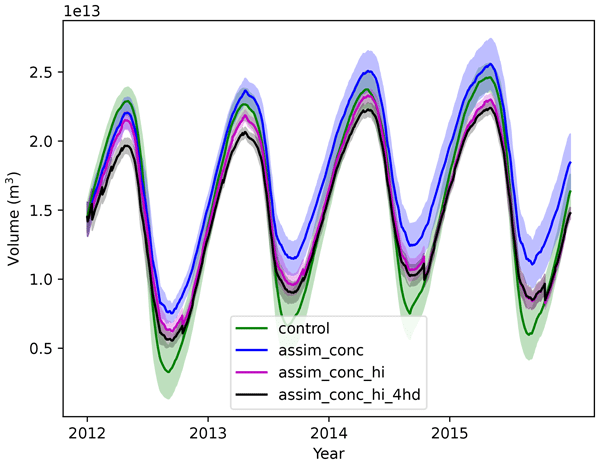
In this study we present three satellite era Arctic sea ice reanalyses, each assimilating different combinations of sea ice concentration and thickness observations. Results show that using year-round thickness observations substantially improves reanalysis compared to winter-only data. The best-performing reanalysis reveals a seasonally compensating bias cycle, suggesting errors in ice growth, leads, refreezing, marginal ice zone dynamics, redistribution, and melt timing mask model errors.
Nicholas Williams, Yiguo Wang, and François Counillon
The Cryosphere, 20, 853–873, https://doi.org/10.5194/tc-20-853-2026, https://doi.org/10.5194/tc-20-853-2026, 2026
Short summary
Short summary
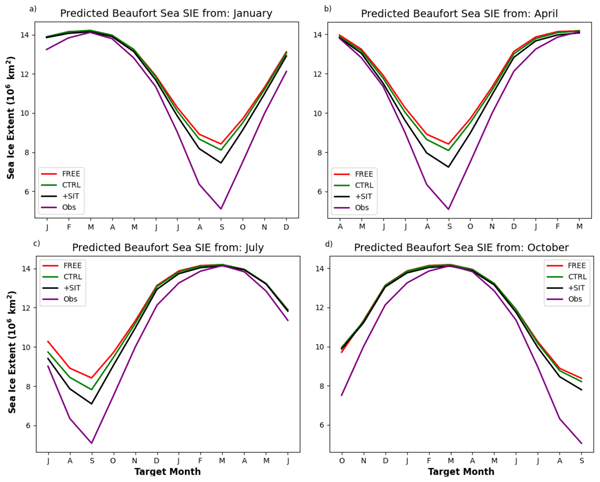
We assimilate satellite observations of Arctic sea ice thickness to create a skillful initial sea ice state, assimilating ENVISAT-derived sea ice thickness for the first time. We produce a reanalysis and seasonal hindcasts showing that sea ice thickness and volume estimates are significantly improved in both reanalysis and prediction. Predictions of summer sea ice extent in our model are also substantially improved by reducing the high sea ice thickness bias.
Nicholas Williams, Nicholas Byrne, Daniel Feltham, Peter Jan Van Leeuwen, Ross Bannister, David Schroeder, Andrew Ridout, and Lars Nerger
The Cryosphere, 17, 2509–2532, https://doi.org/10.5194/tc-17-2509-2023, https://doi.org/10.5194/tc-17-2509-2023, 2023
Short summary
Short summary
Observations show that the Arctic sea ice cover has reduced over the last 40 years. This study uses ensemble-based data assimilation in a stand-alone sea ice model to investigate the impacts of assimilating three different kinds of sea ice observation, including the novel assimilation of sea ice thickness distribution. We show that assimilating ice thickness distribution has a positive impact on thickness and volume estimates within the ice pack, especially for very thick ice.
Quentin Dalaiden, François Counillon, Lea Svendsen, Ingo Bethke, and Noel Keenlyside
Earth Syst. Sci. Data Discuss., https://doi.org/10.5194/essd-2026-433, https://doi.org/10.5194/essd-2026-433, 2026
Preprint under review for ESSD
Short summary
Short summary
Instrumental observations only cover a small part of Earth’s climate history, making it difficult to understand long-term climate changes. We combined information from natural climate archives, such as tree rings, corals, and ice cores, with a climate model to reconstruct climate variability over the last 500 years. Our reconstruction displays a good performance when compared with observations, provide a physically consistent picture of how the atmosphere and ocean evolved together through time.
Julien Brajard, Anton Korosov, Fabio Mangini, Richard Davy, and Yiguo Wang
EGUsphere, https://doi.org/10.5194/egusphere-2026-2318, https://doi.org/10.5194/egusphere-2026-2318, 2026
Short summary
Short summary
Small details in Arctic sea ice thickness, such as ridges, cracks and leads, are difficult to observe with satellites and are rarely represented in climate models, even though they strongly influence sea ice motion and its interaction with the climate system. In this study, we introduce an artificial intelligence method that reconstructs realistic small‑scale ice thickness features from coarse observations. The results show more accurate estimates and physically realistic sea ice patterns.
Nicholas Williams, Nicholas Byrne, Daniel Feltham, Peter Jan Van Leeuwen, Ross Bannister, David Schroeder, Isobel Lawrence, Lars Nerger, Jack Landy, and Geoffrey Dawson
EGUsphere, https://doi.org/10.5194/egusphere-2026-742, https://doi.org/10.5194/egusphere-2026-742, 2026
Short summary
Short summary
In this study we present three satellite era Arctic sea ice reanalyses, each assimilating different combinations of sea ice concentration and thickness observations. Results show that using year-round thickness observations substantially improves reanalysis compared to winter-only data. The best-performing reanalysis reveals a seasonally compensating bias cycle, suggesting errors in ice growth, leads, refreezing, marginal ice zone dynamics, redistribution, and melt timing mask model errors.
Nicholas Williams, Yiguo Wang, and François Counillon
The Cryosphere, 20, 853–873, https://doi.org/10.5194/tc-20-853-2026, https://doi.org/10.5194/tc-20-853-2026, 2026
Short summary
Short summary
We assimilate satellite observations of Arctic sea ice thickness to create a skillful initial sea ice state, assimilating ENVISAT-derived sea ice thickness for the first time. We produce a reanalysis and seasonal hindcasts showing that sea ice thickness and volume estimates are significantly improved in both reanalysis and prediction. Predictions of summer sea ice extent in our model are also substantially improved by reducing the high sea ice thickness bias.
Lilian Garcia-Oliva, Alberto Carrassi, and François Counillon
Nonlin. Processes Geophys., 32, 439–456, https://doi.org/10.5194/npg-32-439-2025, https://doi.org/10.5194/npg-32-439-2025, 2025
Short summary
Short summary
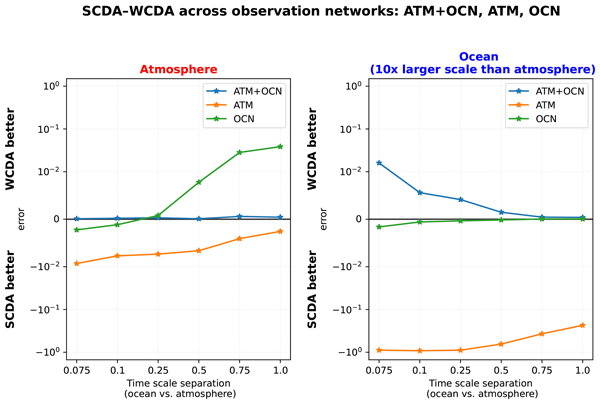
We used a simple coupled model and a data assimilation method to find the correct initialisation for climate predictions. We aim to clarify when weakly or strongly coupled data assimilation (WCDA or SCDA) is best, depending on the system's dynamical characteristics (spatio-temporal) and data coverage. We found that WCDA is better in full data coverage. When we have a partially observed system, SCDA is better. This result depends on the temporal and spatial scale of the observed quantity.
Zikang He, Julien Brajard, Yiguo Wang, Xidong Wang, and Zheqi Shen
Nonlin. Processes Geophys., 32, 397–409, https://doi.org/10.5194/npg-32-397-2025, https://doi.org/10.5194/npg-32-397-2025, 2025
Short summary
Short summary
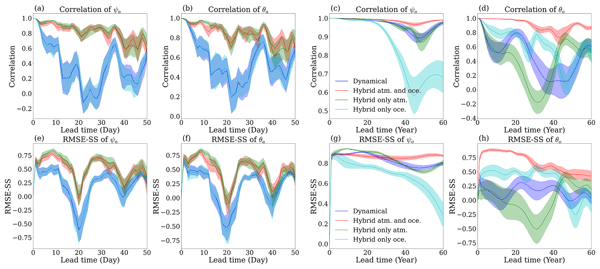
Climate prediction is challenging due to systematic errors in traditional climate models. We addressed this by training a machine learning model to correct these errors and then integrating it with the traditional climate model to form an AI-physics hybrid model. Our study demonstrates that the hybrid model outperforms the original climate model on both short-term and long-term predictions of the atmosphere and ocean.
Yiguo Wang, François Counillon, Lea Svendsen, Ping-Gin Chiu, Noel Keenlyside, Patrick Laloyaux, Mariko Koseki, and Eric de Boisseson
Earth Syst. Sci. Data, 17, 4185–4211, https://doi.org/10.5194/essd-17-4185-2025, https://doi.org/10.5194/essd-17-4185-2025, 2025
Short summary
Short summary
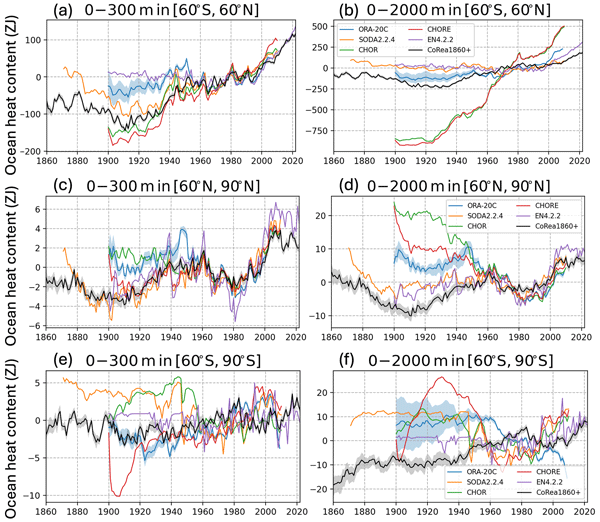
CoRea1860+ is a new climate dataset that reconstructs past climate conditions from 1860 to today. By using advanced modelling techniques and incorporating sea surface temperature observations, it provides a consistent picture of long-term climate variability. The dataset captures key ocean, sea ice, and atmosphere changes, helping scientists understand past climate changes and variability.
Zikang He, Yiguo Wang, Julien Brajard, Xidong Wang, and Zheqi Shen
The Cryosphere, 19, 3279–3293, https://doi.org/10.5194/tc-19-3279-2025, https://doi.org/10.5194/tc-19-3279-2025, 2025
Short summary
Short summary
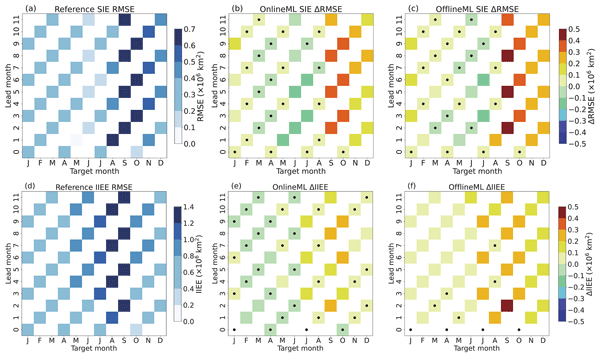
Declining Arctic sea ice presents both risks and opportunities for ecosystems, communities, and economic activities. To address prediction errors in dynamical models, we apply machine learning for error correction during prediction (online) or post-processing (offline). Our results show that both methods enhance sea ice predictions, particularly from September to January, with offline corrections outperforming online corrections.
Nil Irvalı, Ulysses S. Ninnemann, Are Olsen, Neil L. Rose, David J. R. Thornalley, Tor L. Mjell, and François Counillon
Geochronology, 6, 449–463, https://doi.org/10.5194/gchron-6-449-2024, https://doi.org/10.5194/gchron-6-449-2024, 2024
Short summary
Short summary
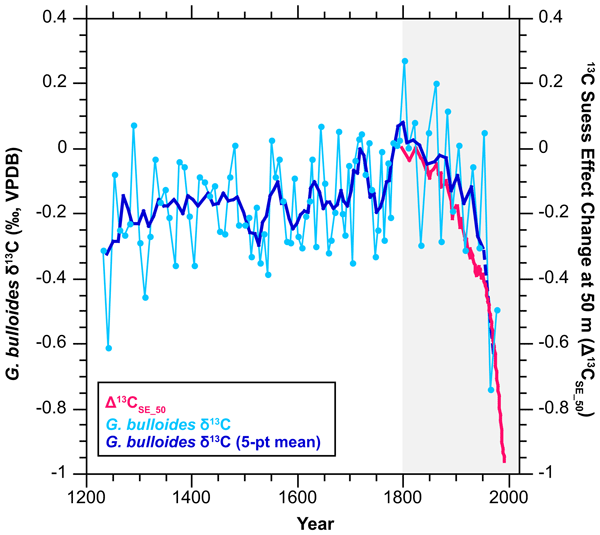
Marine sediments are excellent archives for reconstructing past changes in climate and ocean circulation. Yet, dating uncertainties, particularly during the 20th century, pose major challenges. Here we propose a novel chronostratigraphic approach that uses anthropogenic signals, such as the oceanic 13C Suess effect and spheroidal carbonaceous fly-ash particles, to reduce age model uncertainties in high-resolution marine archives over the 20th century.
Akhilesh Sivaraman Nair, François Counillon, and Noel Keenlyside
Geosci. Model Dev. Discuss., https://doi.org/10.5194/gmd-2023-217, https://doi.org/10.5194/gmd-2023-217, 2024
Publication in GMD not foreseen
Short summary
Short summary
This study demonstrates the importance of soil moisture (SM) in subseasonal-to-seasonal predictions. To addess this, we introduce the Norwegian Climate Prediction Model Land (NorCPM-Land), a land data assimilation system developed for the NorCPM. NorCPM-Land reduces error in SM by 10.5 % by assimilating satellite SM products. Enhanced land initialisation improves predictions up to a 3.5-month lead time for SM and a 1.5-month lead time for temperature and precipitation.
Nicholas Williams, Nicholas Byrne, Daniel Feltham, Peter Jan Van Leeuwen, Ross Bannister, David Schroeder, Andrew Ridout, and Lars Nerger
The Cryosphere, 17, 2509–2532, https://doi.org/10.5194/tc-17-2509-2023, https://doi.org/10.5194/tc-17-2509-2023, 2023
Short summary
Short summary
Observations show that the Arctic sea ice cover has reduced over the last 40 years. This study uses ensemble-based data assimilation in a stand-alone sea ice model to investigate the impacts of assimilating three different kinds of sea ice observation, including the novel assimilation of sea ice thickness distribution. We show that assimilating ice thickness distribution has a positive impact on thickness and volume estimates within the ice pack, especially for very thick ice.
Ingo Bethke, Yiguo Wang, François Counillon, Noel Keenlyside, Madlen Kimmritz, Filippa Fransner, Annette Samuelsen, Helene Langehaug, Lea Svendsen, Ping-Gin Chiu, Leilane Passos, Mats Bentsen, Chuncheng Guo, Alok Gupta, Jerry Tjiputra, Alf Kirkevåg, Dirk Olivié, Øyvind Seland, Julie Solsvik Vågane, Yuanchao Fan, and Tor Eldevik
Geosci. Model Dev., 14, 7073–7116, https://doi.org/10.5194/gmd-14-7073-2021, https://doi.org/10.5194/gmd-14-7073-2021, 2021
Short summary
Short summary
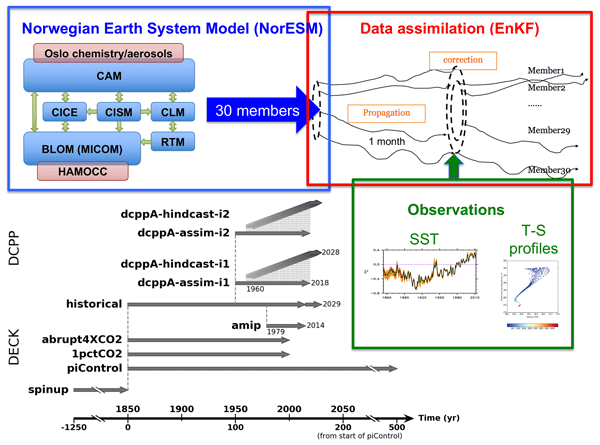
The Norwegian Climate Prediction Model version 1 (NorCPM1) is a new research tool for performing climate reanalyses and seasonal-to-decadal climate predictions. It adds data assimilation capability to the Norwegian Earth System Model version 1 (NorESM1) and has contributed output to the Decadal Climate Prediction Project (DCPP) as part of the sixth Coupled Model Intercomparison Project (CMIP6). We describe the system and evaluate its baseline, reanalysis and prediction performance.
Cited articles
Bentsen, M., Bethke, I., Debernard, J. B., Iversen, T., Kirkevåg, A., Seland, Ø., Drange, H., Roelandt, C., Seierstad, I. A., Hoose, C., and Kristjánsson, J. E.: The Norwegian Earth System Model, NorESM1-M – Part 1: Description and basic evaluation of the physical climate, Geosci. Model Dev., 6, 687–720, https://doi.org/10.5194/gmd-6-687-2013, 2013. a, b
Bethke, I., Wang, Y., Counillon, F., Keenlyside, N., Kimmritz, M., Fransner, F., Samuelsen, A., Langehaug, H., Svendsen, L., Chiu, P.-G., Passos, L., Bentsen, M., Guo, C., Gupta, A., Tjiputra, J., Kirkevåg, A., Olivié, D., Seland, Ø., Solsvik Vågane, J., Fan, Y., and Eldevik, T.: NorCPM1 and its contribution to CMIP6 DCPP, Geosci. Model Dev., 14, 7073–7116, https://doi.org/10.5194/gmd-14-7073-2021, 2021. a, b, c, d, e, f, g, h
Bitz, C. M. and Lipscomb, W. H.: An energy-conserving thermodynamic model of sea ice, J. Geophys. Res. Oceans, 104, 15669–15677, https://doi.org/10.1029/1999JC900100, 1999. a
Bitz, C. M., Holland, M. M., Weaver, A. J., and Eby, M.: Simulating the ice-thickness distribution in a coupled climate model, J. Geophys. Res. Oceans, 106, 2441–2463, https://doi.org/10.1029/1999JC000113, 2001. a
Bocquet, M., Fleury, S., Piras, F., Rinne, E., Sallila, H., Garnier, F., and Rémy, F.: Arctic sea ice radar freeboard retrieval from the European Remote-Sensing Satellite (ERS-2) using altimetry: toward sea ice thickness observation from 1995 to 2021, The Cryosphere, 17, 3013–3039, https://doi.org/10.5194/tc-17-3013-2023, 2023. a, b, c
Bocquet, M., Fleury, S., Rémy, F., and Piras, F.: Arctic and Antarctic Sea Ice Thickness and Volume Changes From Observations Between 1994 and 2023, J. Geophys. Res. Oceans, 129, e2023JC020 848, https://doi.org/10.1029/2023JC020848, 2024. a, b, c, d
Briegleb, B. and Light, B.: A Delta-Eddington multiple scattering parameterization for solar radiation in the sea ice component of the Community Climate System Model, NCAR technical note, pp. 1–108, https://doi.org/10.5065/D6B27S71, 2007. a
Bushuk, M., Msadek, R., Winton, M., Vecchi, G. A., Gudgel, R., Rosati, A., and Yang, X.: Skillful regional prediction of Arctic sea ice on seasonal timescales, Geophys. Res. Lett., 44, 4953–4964, https://doi.org/10.1002/2017GL073155, 2017. a
Bushuk, M., Winton, M., Bonan, D. B., Blanchard-Wrigglesworth, E., and Delworth, T. L.: A Mechanism for the Arctic Sea Ice Spring Predictability Barrier, Geophys. Res. Lett., 47, e2020GL088335, https://doi.org/10.1029/2020GL088335, 2020. a
Bushuk, M., Winton, M., Haumann, F. A., Delworth, T., Lu, F., Zhang, Y., Jia, L., Zhang, L., Cooke, W., Harrison, M., Hurlin, B., Johnson, N. C., Kapnick, S. B., McHugh, C., Murakami, H., Rosati, A., Tseng, K.-C., Wittenberg, A. T., Yang, X., and Zeng, F.: Seasonal Prediction and Predictability of Regional Antarctic Sea Ice, J. Clim., 34, 6207–6233, 10.1175/JCLI-D-20-0965.1, 2021. a, b, c, d, e, f, g, h
Carrassi, A., Weber, R. J. T., Guemas, V., Doblas-Reyes, F. J., Asif, M., and Volpi, D.: Full-field and anomaly initialization using a low-order climate model: a comparison and proposals for advanced formulations, Nonlin. Processes Geophys., 21, 521–537, https://doi.org/10.5194/npg-21-521-2014, 2014. a
Cavalieri, D. J. and Parkinson, C. L.: Antarctic sea ice variability and trends, 1979–2006, J. Geophys. Res. Oceans, 113, https://doi.org/10.1029/2007JC004564, 2008. a
Cavalieri, D. J. and Parkinson, C. L.: Arctic sea ice variability and trends, 1979–2010, The Cryosphere, 6, 881–889, https://doi.org/10.5194/tc-6-881-2012, 2012. a
Chenal, A., Garric, G., Testut, C.-E., Hamon, M., Ruggiero, G., Garnier, F., and Le Traon, P.-Y.: Assimilation of radar freeboard and snow altimetry observations in the Arctic and Antarctic with a coupled ocean/sea ice modelling system, The Cryosphere, 20, 369–395, https://doi.org/10.5194/tc-20-369-2026, 2026. a, b
Comiso, J.: Bootstrap Sea Ice Concentrations from Nimbus-7 SMMR and DMSP SSM/I-SSMIS, Version 3, Boulder, Colorado, USA, NASA National Snow and Ice Data Center Distributed Active Archive Center [data set], https://doi.org/10.5067/X5LG68MH013O, 2017. a
Comiso, J. C., Kwok, R., Martin, S., and Gordon, A. L.: Variability and trends in sea ice extent and ice production in the Ross Sea, J. Geophys. Res. Oceans, 116, https://doi.org/10.1029/2010JC006391, 2011. a
Corsolini, S. and Ademollo, N.: POPs in Antarctic ecosystems: is climate change affecting their temporal trends?, Environ. Sci.: Processes Impacts, 24, 1631–1642, https://doi.org/10.1039/D2EM00273F, 2022. a
Counillon, F., Bethke, I., Keenlyside, N., Bentsen, M., Bertino, L., and Zheng, F.: Seasonal-to-decadal predictions with the ensemble Kalman filter and the Norwegian Earth System Model: a twin experiment, Tell. A: Dyn. Meteorol. Oceanogr., 66, 21074, https://doi.org/10.3402/tellusa.v66.21074, 2014. a, b
Counillon, F., Keenlyside, N., Bethke, I., Wang, Y., Billeau, S., Shen, M. L., and Bentsen, M.: Flow-dependent assimilation of sea surface temperature in isopycnal coordinates with the Norwegian Climate Prediction Model, Tell. A: Dyn. Meteorol. Oceanogr., 68, 32437, https://doi.org/10.3402/tellusa.v68.32437, 2016. a, b, c, d, e
Craig, A. P., Vertenstein, M., and Jacob, R.: A new flexible coupler for earth system modeling developed for CCSM4 and CESM1, is Int. J. High Perform. Comput. Appl., 26, 31–42, https://doi.org/10.1177/1094342011428141, 2012. a
Donlon, C. J., Martin, M., Stark, J., Roberts-Jones, J., Fiedler, E., and Wimmer, W.: The Operational Sea Surface Temperature and Sea Ice Analysis (OSTIA) system, Remote Sens. Environ., 116, 140–158, https://doi.org/10.1016/j.rse.2010.10.017, 2012. a
Eayrs, C., Li, X., Raphael, M. N., and Holland, D. M.: Rapid decline in Antarctic sea ice in recent years hints at future change, Nat. Geosci., 14, 460–464, https://doi.org/10.1038/s41561-021-00768-3, 2021. a
Embury, O., Merchant, C. J., Good, S. A., Rayner, N. A., Høyer, J. L., Atkinson, C., Block, T., Alerskans, E., Pearson, K. J., Worsfold, M., McCarroll, N., and Donlon, C.: Satellite-based time-series of sea-surface temperature since 1980 for climate applications, Sci. Data, 11, 326, https://doi.org/10.1038/s41597-024-03147-w, 2024. a
England, M. R., Shaw, T. A., and Polvani, L. M.: Troposphere-stratosphere dynamical coupling in the southern high latitudes and its linkage to the Amundsen Sea, J. Geophys. Res. Atmos., 121, 3776–3789, https://doi.org/10.1002/2015JD024254, 2016. a
Evensen, G.: Sequential data assimilation with a nonlinear quasi-geostrophic model using Monte Carlo methods to forecast error statistics, J. Geophys. Res. Oceans, 99, 10143–10162, https://doi.org/10.1029/94JC00572, 1994. a, b, c
Falco, P., Aulicino, G., Castagno, P., Capozzi, V., de Ruggiero, P., Garzia, A., Ferola, A. I., Cotroneo, Y., Colella, A., Fusco, G., Pierini, S., Budillon, G., Zambianchi, E., and Spezie, G.: Ocean-atmosphere-ice processes in the Ross Sea: A review, Deep-Sea Res. Pt. II, 218, 105429, https://doi.org/10.1016/j.dsr2.2024.105429, 2024. a
Ferrari, R., Jansen, M. F., Adkins, J. F., Burke, A., Stewart, A. L., and Thompson, A. F.: Antarctic sea ice control on ocean circulation in present and glacial climates, Proc. Natl. Acad. Sci. USA, 111, 8753–8758, https://doi.org/10.1073/pnas.1323922111, 2014. a
Gaspari, G. and Cohn, S. E.: Construction of correlation functions in two and three dimensions, Q. J. R. Meteorol. Soc., 125, 723–757, https://doi.org/10.1002/qj.49712555417, 1999. a
Goessling, H. F., Tietsche, S., Day, J. J., Hawkins, E., and Jung, T.: Predictability of the Arctic sea ice edge, Geophys. Res. Lett., 43, 1642–1650, https://doi.org/10.1002/2015GL067232, 2016. a, b
Good, S. A., Martin, M. J., and Rayner, N. A.: EN4: Quality controlled ocean temperature and salinity profiles and monthly objective analyses with uncertainty estimates, J. Geophys. Res. Oceans, 118, 6704–6716, https://doi.org/10.1002/2013JC009067, 2013. a
Gouretski, V. and Cheng, L.: Correction for systematic errors in the global dataset of temperature profiles from mechanical bathythermographs, J. Atmos. Ocean. Technol., 37, 841–855, https://doi.org/10.1175/JTECH-D-19-0205.1, 2020. a
Guemas, V., Chevallier, M., Déqué, M., Bellprat, O., and Doblas-Reyes, F.: Impact of sea ice initialization on sea ice and atmosphere prediction skill on seasonal timescales, Geophys. Res. Lett., 43, 3889–3896, https://doi.org/10.1002/2015GL066626, 2016. a, b, c, d
Holland, M. M., Bailey, D. A., Briegleb, B. P., Light, B., and Hunke, E.: Improved sea ice shortwave radiation physics in CCSM4: The impact of melt ponds and aerosols on Arctic sea ice, J. Clim., 25, 1413–1430, https://doi.org/10.1175/JCLI-D-11-00078.1, 2012. a
Holland, M. M., Blanchard-Wrigglesworth, E., Kay, J., and Vavrus, S.: Initial-value predictability of Antarctic sea ice in the Community Climate System Model 3, Geophys. Res. Lett., 40, 2121–2124, https://doi.org/10.1002/grl.50410, 2013. a, b
Hou, Y., Min, C., Lin, Y., Luo, H., Shu, Q., Liu, J., and Yang, Q.: Future Antarctic marine accessibility in a warming world, Environ. Res. Lett., 20, 094016, 10.1088/1748-9326/adf3ce, 2025. a
Hunke, E. C. and Dukowicz, J. K.: An elastic–viscous–plastic model for sea ice dynamics, J. Phys. Oceanogr., 27, 1849–1867, https://doi.org/10.1175/1520-0485(1997)027<1849:AEVPMF>2.0.CO;2, 1997. a
Hunke, E. C., Hebert, D. A., and Lecomte, O.: Level-ice melt ponds in the Los Alamos sea ice model, CICE, Ocean Modell., 71, 26–42, https://doi.org/10.1016/j.ocemod.2012.11.008, arctic Ocean, 2013. a
Hunke, E., Lipscomb, W., Turner, A., Jeffery, N., and Elliott, S.: CICE: The Los Alamos sea ice model documentation and software user's manual 1568 version 5.1, Tech. rep., Los Alamos National Laboratory, 2015. a
Hurrell, J. W., Holland, M. M., Gent, P. R., Ghan, S., Kay, J. E., Kushner, P. J., Lamarque, J.-F., Large, W. G., Lawrence, D., Lindsay, K., Lipscomb, W., Long, M., Mahowald, D., Marsh, D., Neale, R., Rasch, S., Vavrus, S., Vertenstein, D., Collins, W., Hack, J., Kiehl, J., and Marshall, S.: The community earth system model: a framework for collaborative research, Bull. Am. Meteorol. Soc., 94, 1339–1360, https://doi.org/10.1175/BAMS-D-12-00121.1, 2013. a
Istomina, L., Heygster, G., Enomoto, H., Ushio, S., Tamura, T., and Haas, C.: Remote Sensing Observations of Melt Ponds on Top of Antarctic Sea Ice Using Sentinel-3 Data, in: IGARSS 2022-2022 IEEE International Geoscience and Remote Sensing Symposium, 3884–3887, IEEE, https://doi.org/10.1109/IGARSS46834.2022.9884159, 2022. a
Ivanova, N., Pedersen, L. T., Tonboe, R. T., Kern, S., Heygster, G., Lavergne, T., Sørensen, A., Saldo, R., Dybkjær, G., Brucker, L., and Shokr, M.: Inter-comparison and evaluation of sea ice algorithms: towards further identification of challenges and optimal approach using passive microwave observations, The Cryosphere, 9, 1797–1817, https://doi.org/10.5194/tc-9-1797-2015, 2015. a
Kimmritz, M., Counillon, F., Bitz, C., Massonnet, F., Bethke, I., and Gao, Y.: Optimising assimilation of sea ice concentration in an Earth system model with a multicategory sea ice model, Tellus A: Dyn. Meteorol. Oceanogr., 70, 1–23, https://doi.org/10.1080/16000870.2018.1435945, 2018. a, b, c
Kirkevåg, A., Iversen, T., Seland, Ø., Hoose, C., Kristjánsson, J. E., Struthers, H., Ekman, A. M. L., Ghan, S., Griesfeller, J., Nilsson, E. D., and Schulz, M.: Aerosol–climate interactions in the Norwegian Earth System Model – NorESM1-M, Geosci. Model Dev., 6, 207–244, https://doi.org/10.5194/gmd-6-207-2013, 2013. a
Landy, J., Dawson, G., Tsamados, M., Bushuk, M., Stroeve, J., Howell, S., Krumpen, T., Babb, D., Komarov, A., Heorton, H., H.J, B., and Aksenov, Y.: A year-round satellite sea-ice thickness record from CryoSat-2, Nature, https://doi.org/10.1038/s41586-022-05058-5, 2022. a
Lavergne, T., Sørensen, A. M., Kern, S., Tonboe, R., Notz, D., Aaboe, S., Bell, L., Dybkjær, G., Eastwood, S., Gabarro, C., Heygster, G., Killie, M. A., Brandt Kreiner, M., Lavelle, J., Saldo, R., Sandven, S., and Pedersen, L. T.: Version 2 of the EUMETSAT OSI SAF and ESA CCI sea-ice concentration climate data records, The Cryosphere, 13, 49–78, https://doi.org/10.5194/tc-13-49-2019, 2019. a
Lawrence, D. M., Oleson, K. W., Flanner, M. G., Thornton, P. E., Swenson, S. C., Lawrence, P. J., Zeng, X., Yang, Z.-L., Levis, S., Sakaguchi, K., Bonan, G. B., and Slater, A. G.: Parameterization improvements and functional and structural advances in Version 4 of the Community Land Model, J. Adv. Model. Earth Syst., 3, https://doi.org/10.1029/2011MS00045, 2011. a
Laxon, S. W., Giles, K. A., Ridout, A. L., Wingham, D. J., Willatt, R., Cullen, R., Kwok, R., Schweiger, A., Zhang, J., Haas, C., Hendricks, S., Krishfield, R., Kurtz, N., Farrell, S., and Davidson, M.: CryoSat-2 estimates of Arctic sea ice thickness and volume, Geophys. Res. Lett., 40, 732–737, https://doi.org/10.1002/grl.50193, 2013. a
Libera, S., Hobbs, W., Klocker, A., Meyer, A., and Matear, R.: Ocean-Sea Ice Processes and Their Role in Multi-Month Predictability of Antarctic Sea Ice, Geophys. Res. Lett., 49, e2021GL097047, https://doi.org/10.1029/2021GL097047, 2022. a
Lipscomb, W. H.: Remapping the thickness distribution in sea ice models, J. Geophys. Res. Oceans, 106, 13989–14000, https://doi.org/10.1029/2000JC000518, 2001. a
Lipscomb, W. H. and Hunke, E. C.: Modeling Sea Ice Transport Using Incremental Remapping, Mon. Weather Rev., 132, 1341–1354, https://doi.org/10.1175/1520-0493(2004)132<1341:MSITUI>2.0.CO;2, 2004. a
Liu, J., Zhu, Z., and Chen, D.: Lowest Antarctic sea ice record broken for the second year in a row, Ocean-Land-Atmos. Res., 2, 0007, https://doi.org/10.34133/olar.0007, 2023. a
Luo, H., Yang, Q., Mu, L., Tian-Kunze, X., Nerger, L., Mazloff, M., Kaleschke, L., and Chen, D.: DASSO: a data assimilation system for the Southern Ocean that utilizes both sea-ice concentration and thickness observations, J. Glaciol., 67, 1235–1240, https://doi.org/10.1017/jog.2021.57, 2021. a, b
Luo, H., Yang, Q., Mazloff, M., Nerger, L., and Chen, D.: The Impacts of Optimizing Model-Dependent Parameters on the Antarctic Sea Ice Data Assimilation, Geophys. Res. Lett., 50, e2023GL105690, https://doi.org/10.1029/2023GL105690, 2023. a, b
Ma, Z., Yang, Q., Xu, Y., Shi, W., Dong, X., Shi, Q., Luo, H., Liu, J., Uotila, P., and Nie, Y.: Reconstruction of Antarctic sea ice thickness from sparse satellite laser altimetry data via deep learning – ICESat Sea Ice Thickness Dataset, figshare [data set], https://doi.org/10.6084/m9.figshare.28899965, 2025. a
Ma, Z., Yang, Q., Xu, Y., Shi, W., Dong, X., Shi, Q., Luo, H., Liu, J., Uotila, P., and Nie, Y.: Reconstruction of Antarctic sea ice thickness from sparse satellite laser altimetry data via deep learning, Scientific Data, https://doi.org/10.1038/s41597-025-06390-x, 2026. a, b, c
Marchi, S., Fichefet, T., Goosse, H., Zunz, V., Tietsche, S., Day, J. J., and Hawkins, E.: Reemergence of Antarctic sea ice predictability and its link to deep ocean mixing in global climate models, Clim. Dynam., 52, 2775–2797, https://doi.org/10.1007/s00382-018-4292-2, 2019. a, b, c
Massonnet, F., Barthélemy, A., Worou, K., Fichefet, T., Vancoppenolle, M., Rousset, C., and Moreno-Chamarro, E.: On the discretization of the ice thickness distribution in the NEMO3.6-LIM3 global ocean–sea ice model, Geosci. Model Dev., 12, 3745–3758, https://doi.org/10.5194/gmd-12-3745-2019, 2019. a
Massonnet, F., Barreira, S., Barthélemy, A., Bilbao, R., Blanchard-Wrigglesworth, E., Blockley, E., Bromwich, D. H., Bushuk, M., Dong, X., Goessling, H. F., Hobbs, W., Iovino, D., Lee, W.-S., Li, C., Meier, W. N., Merryfield, W. J., Moreno-Chamarro, E., Morioka, Y., Li, X., Niraula, B., Petty, A., Sanna, A., Scilingo, M., Shu, Q., Sigmond, M., Sun, N., Tietsche, S., Wu, X., Yang, Q., and Yuan, X.: SIPN South: six years of coordinated seasonal Antarctic sea ice predictions, Front. Mar. Sci., 10, https://doi.org/10.3389/fmars.2023.1148899, 2023. a
Morioka, Y., Doi, T., Iovino, D., Masina, S., and Behera, S. K.: Role of sea-ice initialization in climate predictability over the Weddell Sea, Sci. Rep., 9, 2457, https://doi.org/10.1038/s41598-019-39421-w, 2019. a, b
Morioka, Y., Iovino, D., Cipollone, A., Masina, S., and Behera, S. K.: Summertime sea-ice prediction in the Weddell Sea improved by sea-ice thickness initialization, Sci. Rep., 11, 11475, https://doi.org/10.1038/s41598-021-91042-4, 2021. a, b, c, d
Moss, R. H., Edmonds, J. A., Hibbard, K. A., Manning, M. R., Rose, S. K., Van Vuuren, D. P., Carter, T. R., Emori, S., Kainuma, M., Kram, T., Meehl, G., Mitchell, J., Nakicenovic, N., Riahi, K., Smith, S., Stouffer, R., Thomson, A., Weyant, J., and Wilbanks, T. J.: The next generation of scenarios for climate change research and assessment, Nature, 463, 747–756, https://doi.org/10.1038/nature08823, 2010. a
Neale, R. B., Chen, C.-C., Gettelman, A., Lauritzen, P. H., Park, S., Williamson, D. L., Conley, A. J., Garcia, R., Kinnison, D., Lamarque, J.-F., Mills, M., Smith, A., Tilmes, S., Vitt, F., Morrison, H., Cameron-Smith, P., Collins, W., Iacono, M., Easter, R., Ghan, S., Liu, X., Rasch, P., and Taylor, M.: Description of the NCAR community atmosphere model (CAM 5.0), NCAR Tech. Note NCAR/TN-486+ STR, Citeseer, 12 pp., https://doi.org/10.1007/s00382-009-0614-8, 2010. a
Parkinson, C. L. and Cavalieri, D. J.: Antarctic sea ice variability and trends, 1979–2010, The Cryosphere, 6, 871–880, https://doi.org/10.5194/tc-6-871-2012, 2012. a
Petty, A. A., Kurtz, N. T., Kwok, R., Markus, T., and Neumann, T. A.: Winter Arctic Sea Ice Thickness From ICESat-2 Freeboards, J. Geophys Res. Oceans, 125, e2019JC015764, https://doi.org/10.1029/2019JC015764, 2020. a
Raphael, M. N., Holland, M. M., Landrum, L., and Hobbs, W. R.: Links between the Amundsen Sea Low and sea ice in the Ross Sea: seasonal and interannual relationships, Clim. Dynam., 52, 2333–2349, https://doi.org/10.1007/s00382-018-4258-4, 2019. a
Rea, D., Elsbury, D., Butler, A. H., Sun, L., Peings, Y., and Magnusdottir, G.: Interannual Influence of Antarctic Sea Ice on Southern Hemisphere Stratosphere-Troposphere Coupling, Geophys. Res. Lett., 51, e2023GL107478, https://doi.org/10.1029/2023GL107478, 2024. a
Ricker, R., Hendricks, S., Kaleschke, L., Tian-Kunze, X., King, J., and Haas, C.: A weekly Arctic sea-ice thickness data record from merged CryoSat-2 and SMOS satellite data, The Cryosphere, 11, 1607–1623, https://doi.org/10.5194/tc-11-1607-2017, 2017. a
Sakov, P. and Oke, P. R.: A deterministic formulation of the ensemble Kalman filter: an alternative to ensemble square root filters, Tellus A: Dyn. Meteorol. Oceanogr., 60, 361–371, https://doi.org/10.1111/j.1600-0870.2007.00299.x, 2008. a, b
Sakov, P., Counillon, F., Bertino, L., Lisæter, K. A., Oke, P. R., and Korablev, A.: TOPAZ4: an ocean-sea ice data assimilation system for the North Atlantic and Arctic, Ocean Sci., 8, 633–656, https://doi.org/10.5194/os-8-633-2012, 2012. a, b
Sallila, H., Farrell, S. L., McCurry, J., and Rinne, E.: Assessment of contemporary satellite sea ice thickness products for Arctic sea ice, The Cryosphere, 13, 1187–1213, https://doi.org/10.5194/tc-13-1187-2019, 2019. a
Shadwick, E. H., De Meo, O. A., Schroeter, S., Arroyo, M. C., Martinson, D. G., and Ducklow, H.: Sea Ice Suppression of CO2 Outgassing in the West Antarctic Peninsula: Implications For The Evolving Southern Ocean Carbon Sink, Geophys. Res. Lett., 48, e2020GL091835, https://doi.org/10.1029/2020GL091835, 2021. a
Søren, R., Bendtsen, J., Delille, B., Dieckmann, G. S., Glud, R. N., Kennedy, H., Mortensen, J., Papadimitriou, S., Thomas, D. N., and Tison, J.-L.: Sea ice contribution to the air–sea CO2 exchange in the Arctic and Southern Oceans, Tellus B: Chem. Phys. Meteorol., 63, 823–830, https://doi.org/10.1111/j.1600-0889.2011.00571.x, 2011. a
Stroeve, J., Holland, M. M., Meier, W., Scambos, T., and Serreze, M.: Arctic sea ice decline: Faster than forecast, Geophys. Res. Lett., 34, https://doi.org/10.1029/2007GL029703, 2007. a
Stroeve, J. C., Markus, T., Boisvert, L., Miller, J., and Barrett, A.: Changes in Arctic melt season and implications for sea ice loss, Geophys. Res. Lett., 41, 1216–1225, https://doi.org/10.1002/2013GL058951, 2014. a
Taylor, K. E., Stouffer, R. J., and Meehl, G. A.: An Overview of CMIP5 and the Experiment Design, Bull. Am. Meteorol. Soc., 93, 485–498, https://doi.org/10.1175/BAMS-D-11-00094.1, 2012. a
Titchner, H. A. and Rayner, N. A.: The Met Office Hadley Centre sea ice and sea surface temperature data set, version 2: 1, Sea ice concentrations, J. Geophys. Res. Atmos., 119, 2864–2889, https://doi.org/10.1002/2013JD020316, 2014. a
Trevena, J., Sijp, W. P., and England, M. H.: Stability of Antarctic Bottom Water Formation to Freshwater Fluxes and Implications for Global Climate, J. Clim., 21, 3310–3326, https://doi.org/10.1175/2007JCLI2212.1, 2008. a
Von Storch, H. and Zwiers, F. W.: Statistical analysis in climate research, Cambridge University Press, https://doi.org/10.1017/CBO9780511612336, 2002. a
Wang, S., Liu, J., Cheng, X., Kerzenmacher, T., Hu, Y., Hui, F., and Braesicke, P.: How Do Weakening of the Stratospheric Polar Vortex in the Southern Hemisphere Affect Regional Antarctic Sea Ice Extent?, Geophys. Res. Lett., 48, e2021GL092582, https://doi.org/10.1029/2021GL092582, 2021. a
Wang, Y., Counillon, F., Keenlyside, N., Bethke, I., Wang, Y., Billeau, S., Shen, M.-L., and Bentsen, M.: Optimising assimilation of hydrographic profiles into isopycnal ocean models with ensemble data assimilation, Ocean Modell., 114, 33–44, https://doi.org/10.1016/j.ocemod.2017.04.007, 2017. a, b, c
Wang, Y., Counillon, F., Keenlyside, N., Svendsen, L., Gleixner, S., Kimmritz, M., Dai, P., and Gao, Y.: Seasonal predictions initialised by assimilating sea surface temperature observations with the EnKF, Clim. Dynam., 53, 5777–5797, https://doi.org/10.1007/s00382-019-04897-9, 2019. a
Wang, Y., Counillon, F., Svendsen, L., Chiu, P.-G., Keenlyside, N., Laloyaux, P., Koseki, M., and de Boisseson, E.: An ensemble-based coupled reanalysis of the climate from 1860 to the present (CoRea1860+), Earth Syst. Sci. Data, 17, 4185–4211, https://doi.org/10.5194/essd-17-4185-2025, 2025. a, b
Warren, S. G., Rigor, I. G., Untersteiner, N., Radionov, V. F., Bryazgin, N. N., Aleksandrov, Y. I., and Colony, R.: Snow Depth on Arctic Sea Ice, J. Clim., 12, 1814–1829, https://doi.org/10.1175/1520-0442(1999)012<1814:SDOASI>2.0.CO;2, 1999. a
Williams, N., Byrne, N., Feltham, D., Van Leeuwen, P. J., Bannister, R., Schroeder, D., Ridout, A., and Nerger, L.: The effects of assimilating a sub-grid-scale sea ice thickness distribution in a new Arctic sea ice data assimilation system, The Cryosphere, 17, 2509–2532, https://doi.org/10.5194/tc-17-2509-2023, 2023. a
Williams, N., Wang, Y., and Counillon, F.: Enhancing sea ice knowledge through assimilation of sea ice thickness from ENVISAT and CS2SMOS, The Cryosphere, 20, 853–873, https://doi.org/10.5194/tc-20-853-2026, 2026. a, b, c, d
Wingham, D., Francis, C., Baker, S., Bouzinac, C., Brockley, D., Cullen, R., de Chateau-Thierry, P., Laxon, S., Mallow, U., Mavrocordatos, C., Phalippou, L., Ratier, G., Rey, L., Rostan, F., Viau, P., and Wallis, D.: CryoSat: A mission to determine the fluctuations in Earth’s land and marine ice fields, Adv. Space Res., 37, 841–871, https://doi.org/10.1016/j.asr.2005.07.027, 2006. a
Worsfold, M., Good, S., Atkinson, C., and Embury, O.: Presenting a Long-Term, Reprocessed Dataset of Global Sea Surface Temperature Produced Using the OSTIA System, Remote Sens., 16, https://doi.org/10.3390/rs16183358, 2024. a
Zhu, Z. and Song, M.: Impacts of Observed Extreme Antarctic Sea Ice Conditions on the Southern Hemisphere Atmosphere, Atmosphere, 14, https://doi.org/10.3390/atmos14010036, 2023. a
Znój, A., Chwedorzewska, K. J., Androsiuk, P., Cuba-Diaz, M., Giełwanowska, I., Koc, J., Korczak-Abshire, M., Grzesiak, J., and Zmarz, A.: Rapid environmental changes in the Western Antarctic Peninsula region due to climate change and human activity, Appl. Ecol. Environ. Res., 15, 525–539, https://doi.org/10.1039/D2EM00273F, 2017. a
Short summary
This study investigates whether assimilating sea ice thickness observations into a global climate model can improve reanalysis and seasonal prediction skill of the Antarctic sea ice. We found that assimilation of sea ice thickness improves the representation of sea ice variability, especially in western Antarctica. We also show that initialisation of predictions with sea ice thickness data assimilation can improve forecasts of sea ice concentration, extent and thickness in summer and autumn.
This study investigates whether assimilating sea ice thickness observations into a global...


