
Articles | Volume 20, issue 6
https://doi.org/10.5194/tc-20-3257-2026
© Author(s) 2026. This work is distributed under
the Creative Commons Attribution 4.0 License.
the Creative Commons Attribution 4.0 License.
https://doi.org/10.5194/tc-20-3257-2026
© Author(s) 2026. This work is distributed under
the Creative Commons Attribution 4.0 License.
the Creative Commons Attribution 4.0 License.
Research article
| 
02 Jun 2026
Research article |
| 02 Jun 2026
| 02 Jun 2026
Seasonal glacier motion variations and underlying hydro-mechanical processes at Glacier d'Argentière, French Alps

IGE, Univ. Grenoble Alpes, CNRS, INRAE, IRD, Grenoble INP, 38000 Grenoble, France
ISTerre, Univ. Grenoble Alpes, CNRS, IRD, UGE, 38000 Grenoble, France
Adrien Gilbert
IGE, Univ. Grenoble Alpes, CNRS, INRAE, IRD, Grenoble INP, 38000 Grenoble, France
Florent Gimbert
IGE, Univ. Grenoble Alpes, CNRS, INRAE, IRD, Grenoble INP, 38000 Grenoble, France
Andrea Walpersdorf
ISTerre, Univ. Grenoble Alpes, CNRS, IRD, UGE, 38000 Grenoble, France
Related authors
Laurane Charrier, Nathan Lioret, Fanny Brun, Amaury Dehecq, Romain Millan, Anuar Togaibekov, Andrea Walpersdorf, Diego Cusicanqui, and Antoine Rabatel
EGUsphere, https://doi.org/10.5194/egusphere-2026-946, https://doi.org/10.5194/egusphere-2026-946, 2026
Short summary
Short summary
Sub-annual glacier surface velocity derived from remote sensing images are receiving increasing attention. In the meantime, systematic seasonal errors (i.e. biases) have been reported in time series derived from optical images on various landforms, such as landslides or dunes. The extent to which such biases affect glacier velocity maps remains poorly investigated. Here, we propose characterizing the amplitude and spatial distribution of these seasonal biases.
Juan-Pedro Roldán-Blasco, Adrien Gilbert, Luc Piard, Florent Gimbert, Christian Vincent, Olivier Gagliardini, Anuar Togaibekov, Andrea Walpersdorf, and Nathan Maier
The Cryosphere, 19, 267–282, https://doi.org/10.5194/tc-19-267-2025, https://doi.org/10.5194/tc-19-267-2025, 2025
Short summary
Short summary
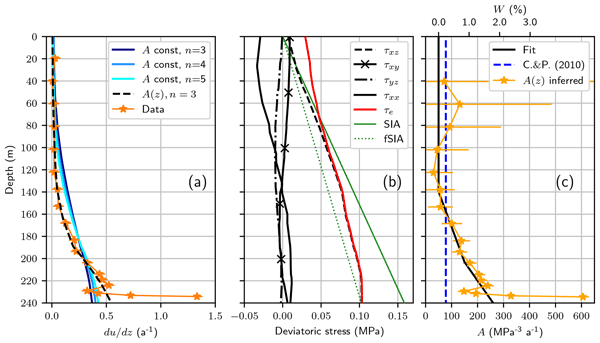
The flow of glaciers and ice sheets results from ice deformation and basal sliding driven by gravitational forces. Quantifying the rate at which ice deforms under its own weight is critical for assessing glacier evolution. This study uses borehole instrumentation in an Alpine glacier to quantify ice deformation and constrain ice viscosity in a natural setting. Our results show that the viscosity of ice at 0 °C is largely influenced by interstitial liquid water, which enhances ice deformation.
R. Akhmetov, G. Makhmetova, E. Orynbassarova, A. Baltiyeva, A. Togaibekov, K. Roberts, and A. Yerzhankyzy
Int. Arch. Photogramm. Remote Sens. Spatial Inf. Sci., XLVI-5-W1-2022, 7–14, https://doi.org/10.5194/isprs-archives-XLVI-5-W1-2022-7-2022, https://doi.org/10.5194/isprs-archives-XLVI-5-W1-2022-7-2022, 2022
Cyrille Mosbeux, Peter Råback, Adrien Gilbert, Julien Brondex, Fabien Gillet-Chaulet, Nicolas C. Jourdain, Mondher Chekki, Olivier Gagliardini, and Gaël Durand
Geosci. Model Dev., 19, 8269–8288, https://doi.org/10.5194/gmd-19-8269-2026, https://doi.org/10.5194/gmd-19-8269-2026, 2026
Short summary
Short summary
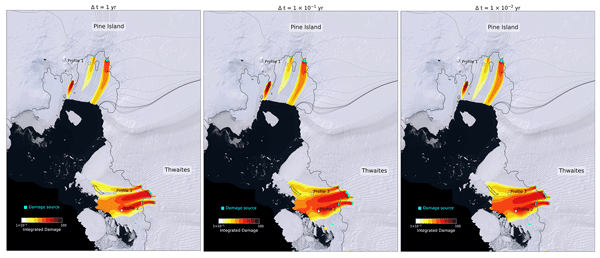
Transport processes like rocks carried by ice flow and damage evolution – a proxy for crevasses – are key in ice sheet modeling and should occur without diffusion. Yet, standard numerical methods often blur these features. We explore a particle-based Semi-Lagrangian approach, comparing it to a Discontinuous Galerkin method, and show it can accurately simulate such transport when run at high enough resolution.
Adrien Gilbert, Fabrizio Troilo, Olivier Gagliardini, Christian Vincent, Paolo Perret, Luca Mondardini, Luc Piard, Olivier Laarman, and Emmanuel Le Meur
EGUsphere, https://doi.org/10.5194/egusphere-2026-4058, https://doi.org/10.5194/egusphere-2026-4058, 2026
This preprint is open for discussion and under review for The Cryosphere (TC).
Short summary
Short summary
This study reports on long-term temperature changes observed on the Whymper hanging glacier in Italy from 1997 to 2021, which are interpreted using a numerical modeling approach. Our results show that recent surface warming, driven by increased melting, has raised the glacier's basal temperature significantly, which could reach its melting point by 2050. However, this warming is partially offset by cooling from the mountain's cold north face, which may keep the glacier frozen and stable.
Nicolás Acuña Reyes, Léo Martin, Adrien Gilbert, Vincent Jomelli, Antoine Rabatel, Simon Filhol, Deborah Verfaillie, Pierre-Henri Blard, and Jérôme Lavé
EGUsphere, https://doi.org/10.5194/egusphere-2026-2638, https://doi.org/10.5194/egusphere-2026-2638, 2026
Short summary
Short summary
Glacier landforms are often used to reconstruct past climate, but the same glacier shape can result from different combinations of temperature and snowfall. Using computer simulations of glaciers in the Bolivian Andes, we show that climate reconstructions based on a single glacier can lead to large uncertainties. By combining several neighboring glaciers, we estimate temperatures about 0.8°C cooler during the Little Ice Age and 1.3°C cooler during the Early Holocene (~10,000 years ago).
Julien Brondex, Olivier Gagliardini, Adrien Gilbert, and Emmanuel Thibert
The Cryosphere, 20, 1655–1677, https://doi.org/10.5194/tc-20-1655-2026, https://doi.org/10.5194/tc-20-1655-2026, 2026
Short summary
Short summary
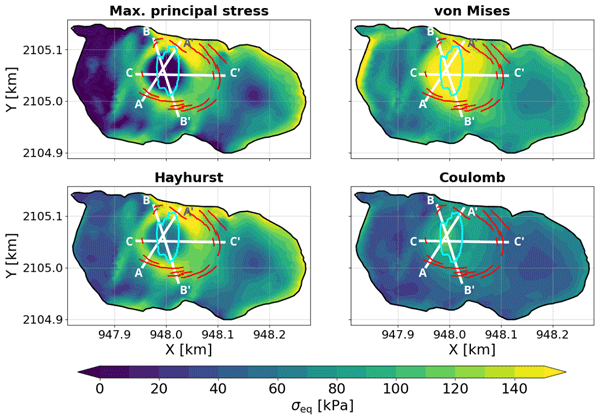
We investigate crevasse initiation by analyzing the artificial drainage of a water-filled cavity at Tête Rousse Glacier (Mont Blanc, France). Using a numerical model, we compute stress fields in response to water level variations in the cavity and compare them to observed crevasse patterns. Results show that a non-linear viscous rheology and a maximum principal stress criterion (with a stress threshold of 100–130 kPa) best predict crevasse occurrence.
Andrew Nolan, Gwenn E. Flowers, Andy Aschwanden, and Adrien Gilbert
EGUsphere, https://doi.org/10.5194/egusphere-2026-913, https://doi.org/10.5194/egusphere-2026-913, 2026
Short summary
Short summary
We used a computer model to study the effects of glacier "surges", or unusual fast-flow events, on the distribution of ice temperature in a glacier. The purpose of the study was to examine feedbacks that might influence the form and flow of these glaciers in a stable climate. We found surging glaciers to be smaller and colder than their ordinary counterparts, while strong regular surges induced an oscillation in glacier temperature and flow speed much longer than the interval between surges.
Laurane Charrier, Nathan Lioret, Fanny Brun, Amaury Dehecq, Romain Millan, Anuar Togaibekov, Andrea Walpersdorf, Diego Cusicanqui, and Antoine Rabatel
EGUsphere, https://doi.org/10.5194/egusphere-2026-946, https://doi.org/10.5194/egusphere-2026-946, 2026
Short summary
Short summary
Sub-annual glacier surface velocity derived from remote sensing images are receiving increasing attention. In the meantime, systematic seasonal errors (i.e. biases) have been reported in time series derived from optical images on various landforms, such as landslides or dunes. The extent to which such biases affect glacier velocity maps remains poorly investigated. Here, we propose characterizing the amplitude and spatial distribution of these seasonal biases.
Tifenn Le Bris, Guilhem Barruol, Florent Gimbert, Emmanuel Le Meur, Dimitri Zigone, Maxime Bès de Berc, and Armelle Bernard
EGUsphere, https://doi.org/10.5194/egusphere-2026-76, https://doi.org/10.5194/egusphere-2026-76, 2026
Short summary
Short summary
When Antarctic glaciers meet the ocean, they shift from resting on the bedrock to floating, at a boundary called the grounding line. Using a dense array of seismic sensors deployed on the Astrolabe Glacier, East Antarctica, we investigate daily spatial and temporal variations of seismicity at this critical boundary. We show that ice deformation at the surface and the base of the glacier serves as an efficient proxy to track the grounding line position and its daily motion under tidal forcing.
Victoria Mowbray, Christian Sue, Stéphane Baize, Céline Beauval, Marguerite Mathey, Anne Lemoine, Andrea Walpersdorf, and Eloïse Granier
Earth Syst. Sci. Data Discuss., https://doi.org/10.5194/essd-2025-601, https://doi.org/10.5194/essd-2025-601, 2025
Manuscript not accepted for further review
Short summary
Short summary
We present a fault-related data compilation, named South-East France Potentially Active Faults (SEFPAF). It integrates structural components and presents a fault classification by importance, amount of documentation and seismogenic potential. This last parameter is assessed by analysing the amount of observed seismicity near the faults, amount of surface deformation estimated from GNSS velocities, and the age of the last known rupture on the fault.
Thomas Chauve, Florent Gimbert, Adrien Gilbert, Olivier Gagliardini, Luc Piard, Arnaud Reboud, Olivier Laarman, Paolo Perret, William Boffelli, Pietro Di Sopra, Luca Mondardini, and Fabrizio Troilo
EGUsphere, https://doi.org/10.5194/egusphere-2025-5714, https://doi.org/10.5194/egusphere-2025-5714, 2025
Short summary
Short summary
A field campaign on the Planpincieux Glacier investigated how hidden heterogeneities inside the ice affect its deformation. A borehole logged with optical and acoustic tools and equipped with tilt sensors revealed that these heterogeneities cause strong deformation localization. Such weak zones significantly influence glacier motion, showing that internal structure is key to understanding how glaciers flow.
Juan-Pedro Roldán-Blasco, Adrien Gilbert, Luc Piard, Florent Gimbert, Christian Vincent, Olivier Gagliardini, Anuar Togaibekov, Andrea Walpersdorf, and Nathan Maier
The Cryosphere, 19, 267–282, https://doi.org/10.5194/tc-19-267-2025, https://doi.org/10.5194/tc-19-267-2025, 2025
Short summary
Short summary
The flow of glaciers and ice sheets results from ice deformation and basal sliding driven by gravitational forces. Quantifying the rate at which ice deforms under its own weight is critical for assessing glacier evolution. This study uses borehole instrumentation in an Alpine glacier to quantify ice deformation and constrain ice viscosity in a natural setting. Our results show that the viscosity of ice at 0 °C is largely influenced by interstitial liquid water, which enhances ice deformation.
Marin Kneib, Amaury Dehecq, Adrien Gilbert, Auguste Basset, Evan S. Miles, Guillaume Jouvet, Bruno Jourdain, Etienne Ducasse, Luc Beraud, Antoine Rabatel, Jérémie Mouginot, Guillem Carcanade, Olivier Laarman, Fanny Brun, and Delphine Six
The Cryosphere, 18, 5965–5983, https://doi.org/10.5194/tc-18-5965-2024, https://doi.org/10.5194/tc-18-5965-2024, 2024
Short summary
Short summary
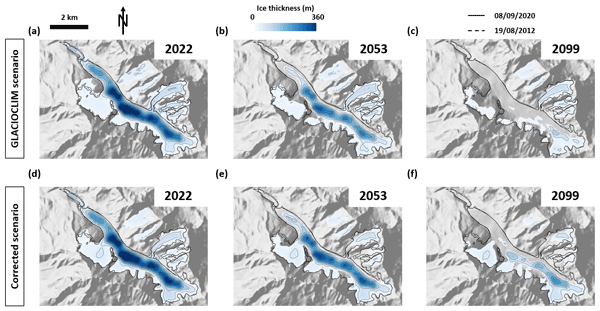
Avalanches contribute to increasing the accumulation on mountain glaciers by redistributing snow from surrounding mountains slopes. Here we quantified the contribution of avalanches to the mass balance of Argentière Glacier in the French Alps, by combining satellite and field observations to model the glacier dynamics. We show that the contribution of avalanches locally increases the accumulation by 60–70 % and that accounting for this effect results in less ice loss by the end of the century.
Susanne Preunkert, Pascal Bohleber, Michel Legrand, Adrien Gilbert, Tobias Erhardt, Roland Purtschert, Lars Zipf, Astrid Waldner, Joseph R. McConnell, and Hubertus Fischer
The Cryosphere, 18, 2177–2194, https://doi.org/10.5194/tc-18-2177-2024, https://doi.org/10.5194/tc-18-2177-2024, 2024
Short summary
Short summary
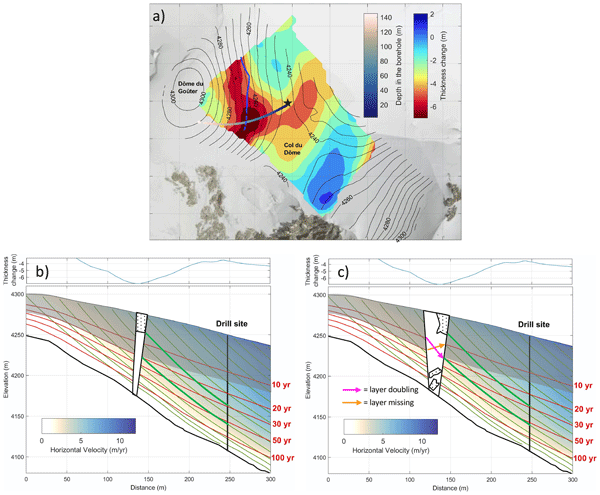
Ice cores from high-elevation Alpine glaciers are an important tool to reconstruct the past atmosphere. However, since crevasses are common at these glacier sites, rigorous investigations of glaciological conditions upstream of drill sites are needed before interpreting such ice cores. On the basis of three ice cores extracted at Col du Dôme (4250 m a.s.l; French Alps), an overall picture of a dynamic crevasse formation is drawn, which disturbs the depth–age relation of two of the three cores.
Małgorzata Chmiel, Maxime Godano, Marco Piantini, Pierre Brigode, Florent Gimbert, Maarten Bakker, Françoise Courboulex, Jean-Paul Ampuero, Diane Rivet, Anthony Sladen, David Ambrois, and Margot Chapuis
Nat. Hazards Earth Syst. Sci., 22, 1541–1558, https://doi.org/10.5194/nhess-22-1541-2022, https://doi.org/10.5194/nhess-22-1541-2022, 2022
Short summary
Short summary
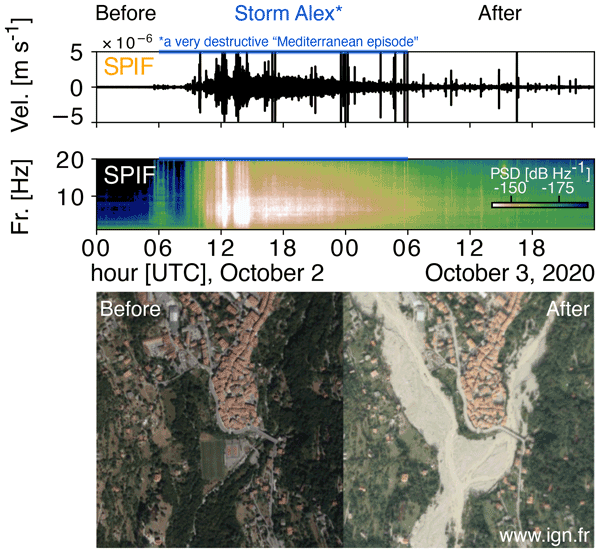
On 2 October 2020, the French Maritime Alps were struck by an extreme rainfall event caused by Storm Alex. Here, we show that seismic data provide the timing and velocity of the propagation of flash-flood waves along the Vésubie River. We also detect 114 small local earthquakes triggered by the rainwater weight and/or its infiltration into the ground. This study paves the way for future works that can reveal further details of the impact of Storm Alex on the Earth’s surface and subsurface.
R. Akhmetov, G. Makhmetova, E. Orynbassarova, A. Baltiyeva, A. Togaibekov, K. Roberts, and A. Yerzhankyzy
Int. Arch. Photogramm. Remote Sens. Spatial Inf. Sci., XLVI-5-W1-2022, 7–14, https://doi.org/10.5194/isprs-archives-XLVI-5-W1-2022-7-2022, https://doi.org/10.5194/isprs-archives-XLVI-5-W1-2022-7-2022, 2022
Marco Piantini, Florent Gimbert, Hervé Bellot, and Alain Recking
Earth Surf. Dynam., 9, 1423–1439, https://doi.org/10.5194/esurf-9-1423-2021, https://doi.org/10.5194/esurf-9-1423-2021, 2021
Short summary
Short summary
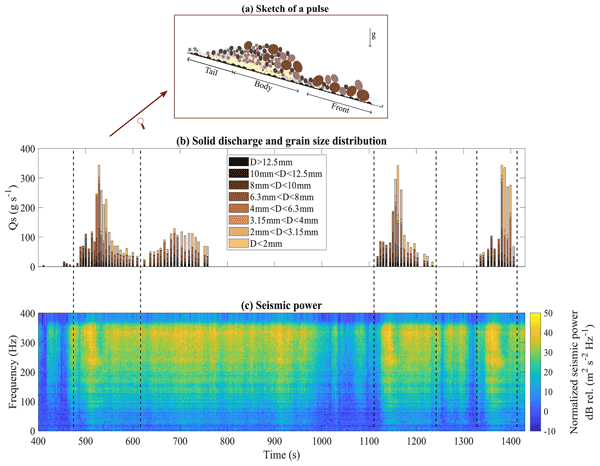
We carry out laboratory experiments to investigate the formation and propagation dynamics of exogenous sediment pulses in mountain rivers. We show that the ability of a self-formed deposit to destabilize and generate sediment pulses depends on the sand content of the mixture, while each pulse turns out to be formed by a front, a body, and a tail. Seismic measurements reveal a complex and non-unique dependency between seismic power and sediment pulse transport characteristics.
Cited articles
Anderson, R. S., Anderson, S. P., MacGregor, K. R., Waddington, E. D., O'Neel, S., Riihimaki, C. A., and Loso, M. G.: Strong feedbacks between hydrology and sliding of a small alpine glacier, J. Geophys. Res.-Earth Surf., 109, https://doi.org/10.1029/2004JF000120, 2004. a
Bingham, R. G., Hubbard, A. L., Nienow, P. W., and Sharp, M. J.: An investigation into the mechanisms controlling seasonal speedup events at a High Arctic glacier, J. Geophys. Res.-Earth Surf., 113, https://doi.org/10.1029/2007JF000832, 2008. a
Bock, Y., Gourevitch, S. A., Counselman III, C. C., King, R. W., and Abbot, R. I.: Interferometric analysis of GPS phase observations, Manuscr. Geodaet., 11, 282–288, 1986. a
Davison, B. J., Sole, A. J., Livingstone, S. J., Cowton, T. R., and Nienow, P. W.: The Influence of Hydrology on the Dynamics of Land-Terminating Sectors of the Greenland Ice Sheet, Front. Earth Sci., 7, https://doi.org/10.3389/feart.2019.00010, 2019. a, b
Downs, J. Z., Johnson, J. V., Harper, J. T., Meierbachtol, T., and Werder, M. A.: Dynamic hydraulic conductivity reconciles mismatch between modeled and observed winter subglacial water pressure, J. Geophys. Res.-Earth Surf., 123, 818–836, https://doi.org/10.1002/2017JF004522, 2018. a
Flowers, G. E.: Modelling water flow under glaciers and ice sheets, P. R. Soc. A, 471, 20140907, https://doi.org/10.1098/rspa.2014.0907, 2015. a
Fowler, A. C.: Sliding with Cavity Formation, J. Glaciol., 33, 255–267, https://doi.org/10.3189/S0022143000008820, 1987. a
Fudge, T. J., Humphrey, N. F., Harper, J. T., and Pfeffer, W. T.: Diurnal fluctuations in borehole water levels: configuration of the drainage system beneath Bench Glacier, Alaska, USA, J. Glaciol., 54, 297–306, https://doi.org/10.3189/002214308784886072, 2008. a, b
Gagliardini, O., Cohen, D., Råback, P., and Zwinger, T.: Finite-element modeling of subglacial cavities and related friction law, J. Geophys. Res.-Earth Surf., 112, https://doi.org/10.1029/2006JF000576, 2007. a, b
Gilbert, A., Gimbert, F., Gagliardini, O., and Vincent, C.: Inferring the Basal Friction Law From Long Term Changes of Glacier Length, Thickness and Velocity on an Alpine Glacier, Geophys. Res. Lett., 50, e2023GL104503, https://doi.org/10.1029/2023GL104503, 2023. a
Gimbert, F., Nanni, U., Roux, P., Helmstetter, A., Garambois, S., Lecointre, A., Walpersdorf, A., Jourdain, B., Langlais, M., Laarman, O., Lindner, F., Sergeant, A., Vincent, C., and Walter, F.: A Multi‐Physics Experiment with a Temporary Dense Seismic Array on the Argentière Glacier, French Alps: The RESOLVE Project, Seismol. Res. Lett., 92, 1185–1201, https://doi.org/10.1785/0220200280, 2021b. a
Hantz, D. and Lliboutry, L.: Waterways, Ice Permeability at Depth, and Water Pressures at Glacier D’Argentière, French Alps, J. Glaciol., 29, 227–239, https://doi.org/10.3189/S0022143000008285, 1983. a
Harper, J., Meierbachtol, T., Humphrey, N., Saito, J., and Stansberry, A.: Generation and fate of basal meltwater during winter, western Greenland Ice Sheet, The Cryosphere, 15, 5409–5421, https://doi.org/10.5194/tc-15-5409-2021, 2021. a
Harper, J. T., Humphrey, N. F., Pfeffer, W. T., Fudge, T., and O’Neel, S.: Evolution of subglacial water pressure along a glacier’s length, Ann. Glaciol., 40, 31–36, https://doi.org/10.3189/172756405781813573, 2005. a
Herring, T. A., King, R. W., Floyd, M. A., and McClusky, S. C.: Introduction to GAMIT/GLOBK, Massachusetts Institute of Technology, Cambridge, MA, USA, http://geoweb.mit.edu/gg/docs/Intro_GG.pdf (last access: 1 June 2026), 2018. a
Hodge, S. M.: Variations in the Sliding of a Temperate Glacier, J. Glaciol., 13, 349–369, https://doi.org/10.3189/S0022143000023157, 1974. a
Hoffman, M. J., Andrews, L. C., Price, S. F., Catania, G. A., Neumann, T. A., Lüthi, M. P., Gulley, J., Ryser, C., Hawley, R. L., and Morriss, B.: Greenland subglacial drainage evolution regulated by weakly connected regions of the bed, Nat. Commun., 7, 13903, https://doi.org/10.1038/ncomms13903, 2016. a, b, c
Iken, A.: The Effect of the Subglacial Water Pressure on the Sliding Velocity of a Glacier in an Idealized Numerical Model, J. Glaciol., 27, 407–421, https://doi.org/10.3189/S0022143000011448, 1981. a
Iken, A. and Bindschadler, R. A.: Combined measurements of Subglacial Water Pressure and Surface Velocity of Findelengletscher, Switzerland: Conclusions about Drainage System and Sliding Mechanism, J. Glaciol., 32, 101–119, https://doi.org/10.3189/S0022143000006936, 1986. a, b, c, d
King, M.: Rigorous GPS data-processing strategies for glaciological applications, J. Glaciol., 50, 601–607, https://doi.org/10.3189/172756504781829747, 2004. a
Lefeuvre, P.-M., Jackson, M., Lappegard, G., and Hagen, J. O.: Interannual variability of glacier basal pressure from a 20 year record, Ann. Glaciol., 56, 33–44, 2015. a
Lliboutry, L.: Contribution a la theorie du frottement du glacier sur son lit, Comptes Rendus Hebdomadaires des Seances de l’Academie des Sciences, 247, 318–320, 1958. a
Lliboutry, L.: General Theory of Subglacial Cavitation and Sliding of Temperate Glaciers, J. Glaciol., 7, 21–58, https://doi.org/10.3189/S0022143000020396, 1968. a
Maier, N., Gimbert, F., and Gillet-Chaulet, F.: Threshold response to melt drives large-scale bed weakening in Greenland, Nature, 607, 714–720, https://doi.org/10.1038/s41586-022-04927-3, 2022. a
Mair, D., Nienow, P., Willis, I., and Sharp, M.: Spatial patterns of glacier motion during a high-velocity event: Haut Glacier d’Arolla, Switzerland, J. Glaciol., 47, 9–20, https://doi.org/10.3189/172756501781832412, 2001. a
Mair, D., Willis, I., Fischer, U. H., Hubbard, B., Nienow, P., and Hubbard, A.: Hydrological controls on patterns of surface, internal and basal motion during three “spring events”: Haut Glacier d’Arolla, Switzerland, J. Glaciol., 49, 555–567, https://doi.org/10.3189/172756503781830467, 2003. a
Mejia, J. Z., Gulley, J. D., Trunz, C., Covington, M. D., Bartholomaus, T. C., Xie, S., and Dixon, T. H.: Isolated Cavities Dominate Greenland Ice Sheet Dynamic Response to Lake Drainage, Geophys. Res. Lett., 48, e2021GL094762, https://doi.org/10.1029/2021GL094762, 2021. a, b
Nanni, U., Gimbert, F., Vincent, C., Gräff, D., Walter, F., Piard, L., and Moreau, L.: Quantification of seasonal and diurnal dynamics of subglacial channels using seismic observations on an Alpine glacier, The Cryosphere, 14, 1475–1496, https://doi.org/10.5194/tc-14-1475-2020, 2020. a
Nanni, U., Gimbert, F., Roux, P., and Lecointre, A.: Observing the subglacial hydrology network and its dynamics with a dense seismic array, P. Natl. Acad. Sci. USA, 118, e2023757118, https://doi.org/10.1073/pnas.2023757118, 2021. a
Nienow, P., Sharp, M., and Willis, I.: Seasonal changes in the morphology of the subglacial drainage system, Haut Glacier d'Arolla, Switzerland, Earth Surf. Process. Land., 23, 825–843, https://doi.org/10.1002/(SICI)1096-9837(199809)23:9<825::AID-ESP893>3.0.CO;2-2, 1998. a
Nye, J. F.: Water Flow in Glaciers: Jökulhlaups, Tunnels and Veins, J. Glaciol., 17, 181–207, https://doi.org/10.3189/S002214300001354X, 1976. a
Roldán-Blasco, J.-P., Gilbert, A., Piard, L., Gimbert, F., Vincent, C., Gagliardini, O., Togaibekov, A., Walpersdorf, A., and Maier, N.: Creep enhancement and sliding in a temperate, hard-bedded alpine glacier, The Cryosphere, 19, 267–282, https://doi.org/10.5194/tc-19-267-2025, 2025. a, b
Röthlisberger, H.: Water Pressure in Intra- and Subglacial Channels, J. Glaciol., 11, 177–203, https://doi.org/10.3189/S0022143000022188, 1972. a
Ryser, C., Lüthi, M. P., Andrews, L. C., Hoffman, M. J., Catania, G. A., Hawley, R. L., Neumann, T. A., and Kristensen, S. S.: Sustained high basal motion of the Greenland ice sheet revealed by borehole deformation, J. Glaciol., 60, 647–660, https://doi.org/10.3189/2014JoG13J196, 2014. a, b
Sole, A., Nienow, P., Bartholomew, I., Mair, D., Cowton, T., Tedstone, A., and King, M. A.: Winter motion mediates dynamic response of the Greenland Ice Sheet to warmer summers, Geophys. Res. Lett., 40, 3940–3944, https://doi.org/10.1002/grl.50764, 2013. a, b
Solgaard, A., Rapp, D., Noël, B., and Hvidberg, C.: Seasonal patterns of Greenland ice velocity from Sentinel-1 SAR data linked to runoff, Geophys. Res. Lett., 49, e2022GL100343, https://doi.org/10.1029/2022GL100343, 2022. a, b
Sommers, A., Meyer, C., Morlighem, M., Rajaram, H., Poinar, K., Chu, W., and Mejia, J.: Subglacial hydrology modeling predicts high winter water pressure and spatially variable transmissivity at Helheim Glacier, Greenland, J. Glaciol., 69, 1556–1568, https://doi.org/10.1017/jog.2023.39, 2023. a, b
Spring, U. and Hutter, K.: Conduit flow of a fluid through its solid phase and its application to intraglacial channel flow, Int. J. Eng. Sci., 20, 327–363, https://doi.org/10.1016/0020-7225(82)90029-5, 1982. a
Sugiyama, S. and Gudmundsson, G. H.: Short-term variations in glacier flow controlled by subglacial water pressure at Lauteraargletscher, Bernese Alps, Switzerland, J. Glaciol., 50, 353–362, https://doi.org/10.3189/172756504781829846, 2004. a, b
Tedstone, A. J., Nienow, P. W., Gourmelen, N., Dehecq, A., Goldberg, D., and Hanna, E.: Decadal slowdown of a land-terminating sector of the Greenland Ice Sheet despite warming, Nature, 526, 692–695, https://doi.org/10.1038/nature15722, 2015. a
Togaibekov, A.: SmartStake SMB, air temperature, snow depth measurements at Argentière Glacier between 2019 and 2021, Zenodo [data set], https://doi.org/10.5281/zenodo.15023211, 2025. a
Togaibekov, A., Gimbert, F., Gilbert, A., and Walpersdorf, A.: Sliding velocity, water discharge, water pressure, and rainfall time series at Argentière Glacier between 2019 and 2021, Zenodo [data set], https://doi.org/10.5281/zenodo.10419097, 2023. a
Togaibekov, A., Gimbert, F., Rabatel, A., and Walpersdorf, A.: Surface mass balance monitoring of an alpine glacier using GNSS Interferometric Reflectometry, J. Glaciol., 71, e111, https://doi.org/10.1017/jog.2025.10086, 2025. a
Vernay, M., Lafaysse, M., Monteiro, D., Hagenmuller, P., Nheili, R., Samacoïts, R., Verfaillie, D., and Morin, S.: The S2M meteorological and snow cover reanalysis over the French mountainous areas: description and evaluation (1958–2021), Earth Syst. Sci. Data, 14, 1707–1733, https://doi.org/10.5194/essd-14-1707-2022, 2022. a
Vijay, S., Khan, S. A., Kusk, A., Solgaard, A. M., Moon, T., and Bjørk, A. A.: Resolving seasonal ice velocity of 45 Greenlandic glaciers with very high temporal details, Geophys. Res. Lett., 46, 1485–1495, https://doi.org/10.1029/2018GL081503, 2019. a, b
Vincent, C.: Ice flow velocities and uplift, Zenodo [data set], https://doi.org/10.5281/zenodo.5536953, 2021. a
Vincent, C., Soruco, A., Six, D., and Meur, E. L.: Glacier thickening and decay analysis from 50 years of glaciological observations performed on Glacier d’Argentière, Mont Blanc area, France, Ann. Glaciol., 50, 73–79, https://doi.org/10.3189/172756409787769500, 2009. a, b
Vincent, C., Gilbert, A., Walpersdorf, A., Gimbert, F., Gagliardini, O., Jourdain, B., Roldan Blasco, J. P., Laarman, O., Piard, L., Six, D., Moreau, L., Cusicanqui, D., and Thibert, E.: Evidence of Seasonal Uplift in the Argentière Glacier (Mont Blanc Area, France), J. Geophys. Res.-Earth Surf., 127, e2021JF006454, https://doi.org/10.1029/2021JF006454, 2022. a, b, c, d, e, f, g, h, i, j
Vivian, R. and Bocquet, G.: Subglacial Cavitation Phenomena Under the Glacier D’Argentière, Mont Blanc, France, J. Glaciol., 12, 439–451, https://doi.org/10.3189/S0022143000031853, 1973. a, b
Walpersdorf, A., Ott, L., Helmstetter, A., Sue, C., Bouvier, J.-N., Champon, M., Moreau, L., Togaibekov, A., Gimbert, F., Six, D., Vincent, C., Garambois, S., Mercier, S., Laarman, O., Piard, L., Nanni, U., Mathey, M., Urruty, B., Romeyer, O., and Radiguet, M.: Epos-France – GPSMob data – Mission no. 19-050 – Argentiere (2019) – 2019-04-02 / 2020-01-01 – 7 points, OSU OREME [data set], https://doi.org/10.15148/744BE716-3207-4A26-BF7B-60B5FD304FFD, 2023a. a
Walpersdorf, A., Ott, L., Helmstetter, A., Sue, C., Bouvier, J.-N., Champon, M., Moreau, L., Togaibekov, A., Gimbert, F., Six, D., Vincent, C., Garambois, S., Mercier, S., Laarman, O., Piard, L., Nanni, U., Mathey, M., Urruty, B., Romeyer, O., and Radiguet, M.: Epos-France – GPSMob data – Mission no. 20-021 – Argentiere (2020) – 2020-01-02 / 2021-01-01 – 13 points, OSU OREME [data set], https://doi.org/10.15148/3FD58616-E0C4-4A7F-B2A9-7CF3DB4933BA, 2023b. a
Walpersdorf, A., Ott, L., Helmstetter, A., Sue, C., Bouvier, J.-N., Champon, M., Moreau, L., Togaibekov, A., Gimbert, F., Six, D., Vincent, C., Garambois, S., Mercier, S., Laarman, O., Piard, L., Nanni, U., Mathey, M., Urruty, B., Romeyer, O., and Radiguet, M.: Epos-France – GPSMob data – Mission no. 21-028 – Argentiere (2021) – 2021-01-02 / 2021-12-31 – 13 points, OSU OREME [data set], https://doi.org/10.15148/FF97D3BB-0DB2-4D21-8ABE-999A7C2565CD, 2023c. a
Werder, M. A., Hewitt, I. J., Schoof, C. G., and Flowers, G. E.: Modeling channelized and distributed subglacial drainage in two dimensions, J. Geophys. Res.-Earth Surf., 118, 2140–2158, https://doi.org/10.1002/jgrf.20146, 2013. a, b, c
Wessel, P., Luis, J. F., Uieda, L., Scharroo, R., Wobbe, F., Smith, W. H. F., and Tian, D.: The Generic Mapping Tools Version 6, Geochem. Geophys. Geosyst., 20, 5556–5564, https://doi.org/10.1029/2019GC008515, 2019. a, b
Short summary
Changes in water reaching the base of glaciers strongly affect their sliding speed by altering water pressure beneath the ice. High water pressure is often thought to develop during summer melt, enlarging cavities at the glacier base and increasing sliding speed. Our observations show instead that the cavities mainly grow during winter, when water pressure builds up in isolated cavities. As the cavities become connected during the melt season, water pressure decreases and the glacier slows down.
Changes in water reaching the base of glaciers strongly affect their sliding speed by altering...


