
the Creative Commons Attribution 4.0 License.
the Creative Commons Attribution 4.0 License.
 | 08 May 2026
Ensemble numerical simulation of permafrost thermal regimes over the Tibetan Plateau using the Flexible Permafrost Model: 1950–2023
Wen Sun
Permafrost is a subsurface phenomenon that is difficult to be measured directly, and understanding its dynamics as well as influences under a warming climate depends critically on numerical simulations. However, this task presents significant challenges as the state-of-the-art land surface models are weak in their ability to represent permafrost processes. In this study, we introduce a new land surface scheme specifically designed for permafrost applications, the Flexible Permafrost Model (FPM). This model serves as an adaptable framework for implementing innovative parameterizations of permafrost-related physics. The FPM accounts for heat flow at and below the soil surface, while simultaneously resolving the land-atmosphere energy exchanges through comprehensive treatment of radiative balance and turbulent flux dynamics. We simulate the ground thermal regime and test the model with a network of permafrost measurements across the Tibetan Plateau.
Our result yields root mean square error values of 1.0 m for active layer thickness and 1.0 °C for the mean annual ground temperature at 15 m depth of permafrost. We estimate that the current extent of permafrost (2010–2023) on the Tibetan Plateau is approximately km2. Long-term simulations indicate that the permafrost temperature increased at a rate of 0.11 °C per decade since 1980 with a decreased area of 14.6×10⁴ km2 (∼12.4 %). These ensemble simulations provide valuable information on the dynamics of permafrost over the Tibetan Plateau. Furthermore, our findings suggest that current land surface models, which utilize shallow soil columns (typically ∼3 m), are insufficient for permafrost simulations over the Tibetan Plateau due to the typically deep active layer (that is, 2.68±0.82 m by mean) and may not be suitable for future projections.
- Article
(7265 KB) - Full-text XML
-
Supplement
(287 KB) - BibTeX
- EndNote


Permafrost regions occupy more than one-fifth of the exposed land area in the Northern Hemisphere (Gruber, 2012). Long-term records revealed steady warming of permafrost over the past several decades at a global scale (Biskaborn et al., 2019). This has led to significant degradation of the permafrost, such as a deepening active layer (Cao et al., 2018; Biskaborn et al., 2019), decreased permafrost area (Chadburn et al., 2017; Sun et al., 2022; Langer et al., 2024), expanded thermokarst (Wellman et al., 2013; Chen et al., 2021), and potential carbon decomposition (Schuur et al., 2015). Permafrost degradation has considerable influences on ecosystems, hydrological systems, and the integrity of the infrastructure (Hjort et al., 2018; Walvoord et al., 2019; Schuur and Mack, 2018). Therefore, detailed investigations of changes in permafrost in response to a warming climate are crucial for sustainable management and adaptation strategies.
Despite permafrost's importance, direct permafrost measurements, such as borehole temperature, are rare due to harsh environments and high costs (Biskaborn et al., 2015). This is especially true on the Tibetan Plateau (TP), where complex terrain and high altitudes impose further constraints on permafrost research (Cao et al., 2017b, 2019b). For these reasons, there is often a lack of essential in situ information to develop suitable statistical models (Zhao et al., 2021; Cao et al., 2021). Therefore, process-based simulation is an increasingly important tool for transient assessment of permafrost conditions and dynamics.
The TP, also known as the Third Pole, has the largest extent of permafrost in the low-middle latitudes (Cao et al., 2019b). Significant efforts have been made to understand the permafrost changes over the TP based on simulations. A large portion of these contributions comes from the hydrological community, employing models originally designed to simulate hydrological processes in permafrost-affected regions. Many of the models implemented detailed representations of hydrological processes (e.g. water mass balance) while simplifying the surface energy balance and soil thermal processes. For instance, the DHTC model parameterized ground heat conduction as a linear function of net radiation (Guo et al., 2024), and the FLEXTopo-FS model uses the empirical method (i.e. Stefan equation) for freeze/thaw processes (Gao et al., 2022). In addition to such hydrological models, the process-based models used for recent transient permafrost simulation over the TP can be generally divided into geothermal numerical models (i.e. GIPL model) and the common land surface models (i.e. CLM and Noah-MP). The geothermal numerical models typically have rich permafrost-specific processes, such as suitable numerical solver in heat transfer with soil phase changes (Nicolsky et al., 2007; Tubini et al., 2021), deep soil column (tens to hundreds of meters), and well-defined lower boundary, but lack representation of land-atmosphere interactions (i.e. Qin et al., 2017a; Sun et al., 2023). On the other hand, the land surface models benefits from the consideration of land-atmosphere processes, and therefore outperform in describing the responses of permafrost to climate warming (i.e. Guo et al., 2018; Wu et al., 2018; Zhang et al., 2021; Cao et al., 2022).
Recently, several permafrost-specific land surface schemes have been proposed to integrate the strengths of both model types. The stand-alone models yield promising potential for application to cross-scale permafrost processes (Fiddes et al., 2015; Westermann et al., 2016). However, dedicated stand-alone permafrost models remain scarce for the TP. Most existing simulations rely on distributed hydrological models, such as GBEHM and WEB-DHM, that have been enhanced with permafrost process representations (e.g. Qin et al., 2017b; Gao et al., 2018; Song et al., 2020). Although these models generally offer more realistic and detailed simulations of permafrost-influenced hydrological processes, they are typically confined to site or regional scales and short time periods due to their demand for extensive spatial data and high computational cost (i.e. Pan et al., 2016; Zhang et al., 2017; Zheng et al., 2020).
In this study, we introduce a new land surface scheme specifically designed for permafrost applications, the Flexible Permafrost Model (FPM). This model serves as a flexible platform for a variety of permafrost processes. The suitability of the new model was carefully evaluated, we then employed it in analyzing the long-term (1950–2023) permafrost thermal regime over the TP based on the ensemble simulation. Specifically, this study
- 1.
gives a detailed description of the model conceptualization, structure, and key parameterizations;
- 2.
evaluates the model performance in reproducing permafrost characteristics based on the ensemble approach, such as active layer thickness (ALT), and the thermal state;
- 3.
interprets current conditions and historical changes of permafrost in response to climate change from the stand-alone simulations;
- 4.
proposes insights for future model developments.
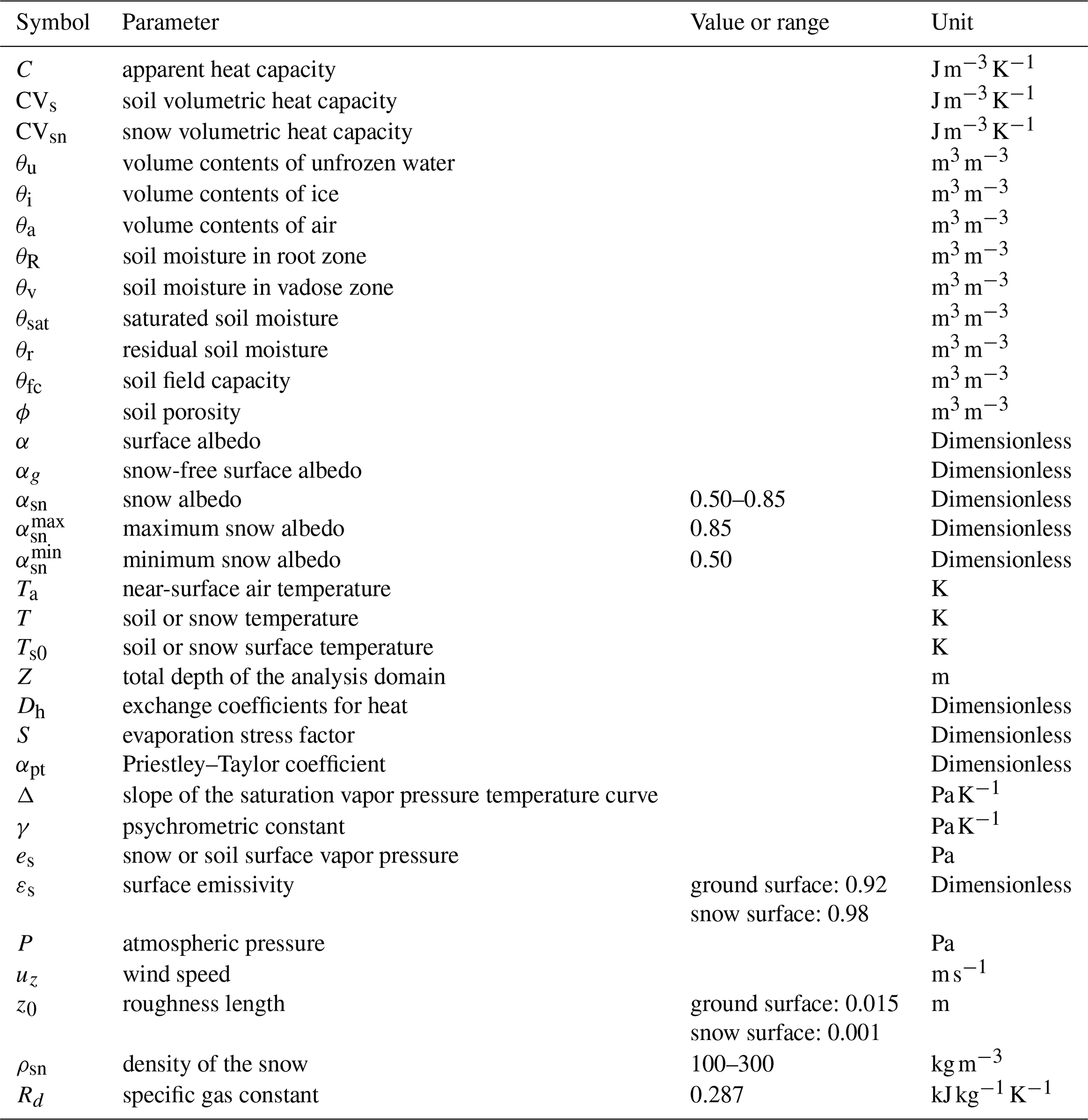
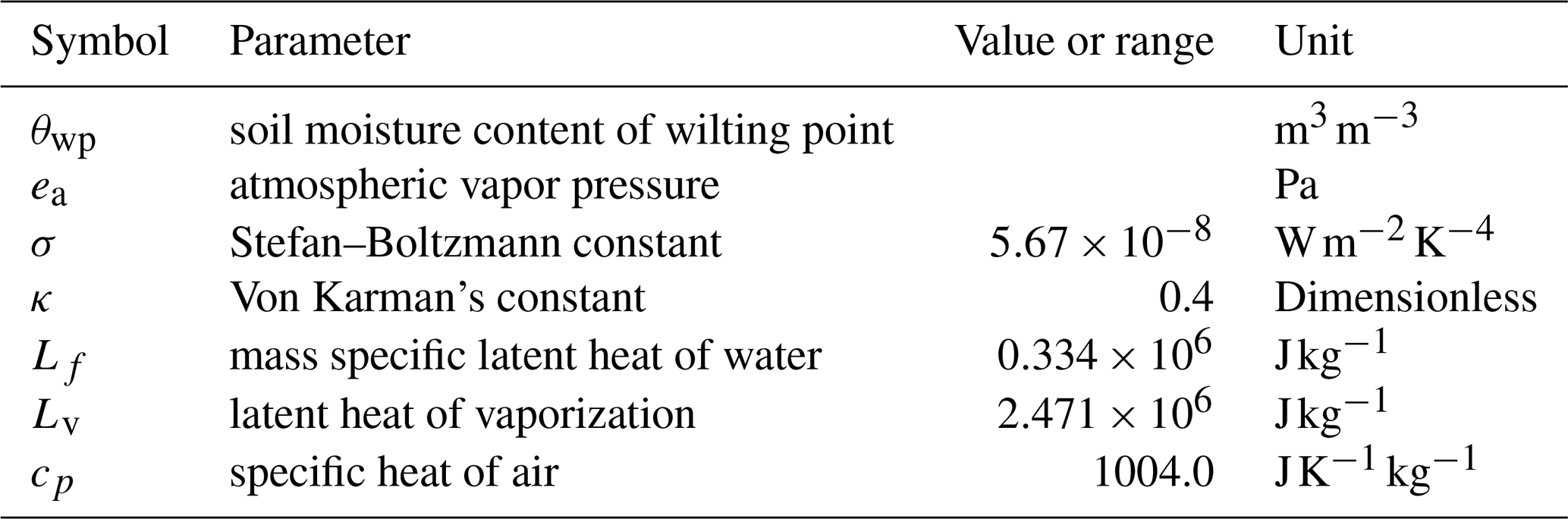
FPM accounts for heat flow with phase change at and below the soil surface, while also describing the energy exchange with the atmosphere by considering radiative and turbulent fluxes. In this study, we give the detailed introduction and evaluation of FPM and employ it in analyzing large-scale permafrost studies. The nomenclature of key model parameters are given in Table 1, and constants are in Table B1.
Table 1Nomenclature and input parameters in Flexible Permafrost Model (FPM).
2.1 Surface energy balance
The soil or snow surface temperature (TS0, K) was treated as upper boundary of the soil column. To derive TS0, a physically-based surface energy balance scheme for different land surface cover types was coupled to FPM, and was formulated as:
where Qsi is the incoming shortwave radiation, Qli is the incoming longwave radiation, Qle is the emitted longwave radiation, Qh is the turbulent exchange of sensible heat, Qe is the turbulent exchange of latent heat, and Qc is the energy transport due to conduction. All the above energy terms have units of W m−2. The α (–) is the surface albedo, obtained as a fraction-weighted average of albedo from snow-free (αg) and snow-covered (αsn) areas.
where SCF (–) is the snow cover fraction (see Sect. 2.2), and αg is from MODIS products whenever snow is not present (Table 2).
Muñoz-Sabater et al. (2021)Moesinger et al. (2020)Myneni et al. (2021)Su et al. (2019)Jia et al. (2022)H SAF (2020)Parinussa et al. (2015)Dorigo et al. (2017)Fernandez-Moran et al. (2017)O'Neill et al. (2021)Dai et al. (2019)Shangguan et al. (2017)Fan et al. (2013)Davies (2013)Table 2Climate forcing and input datasets used in Flexible Permafrost Model (FPM).
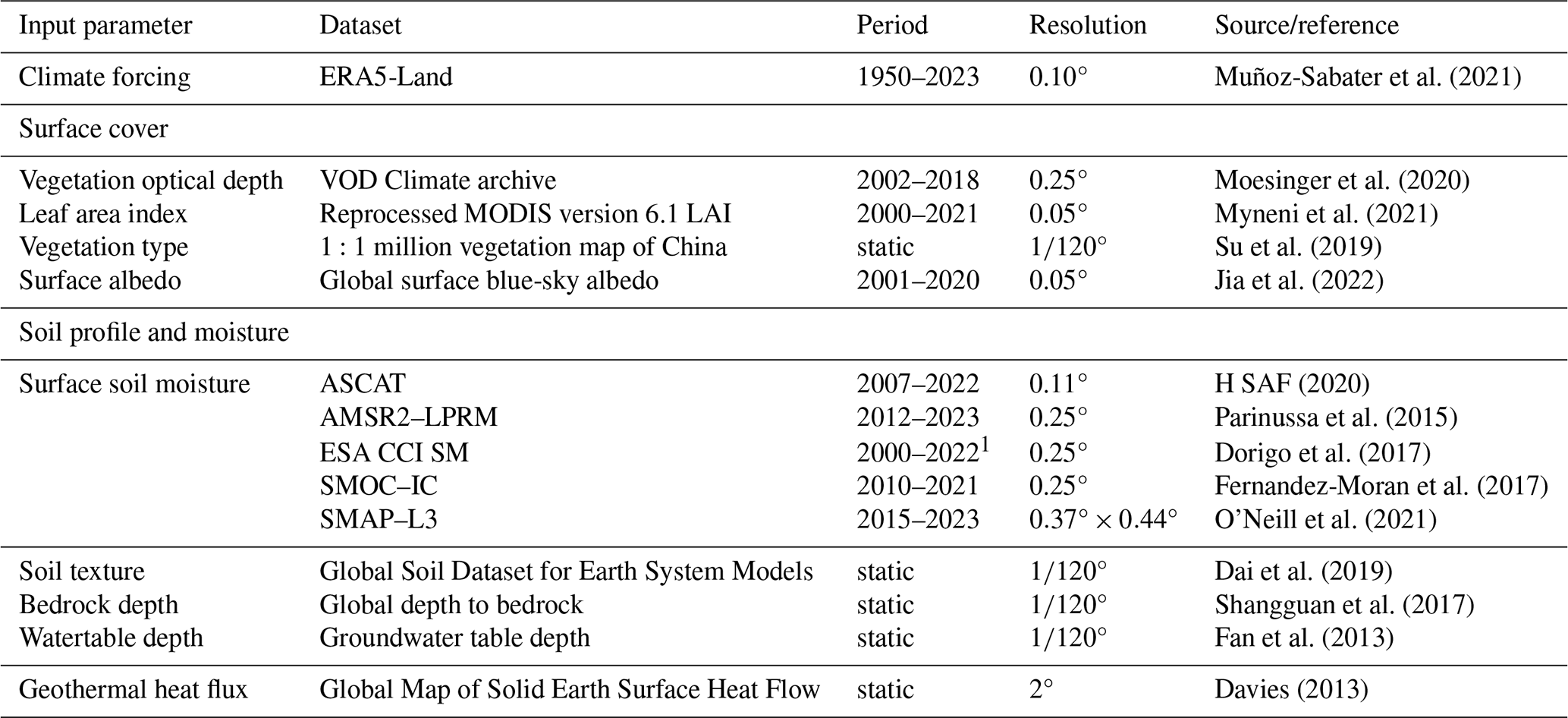
1 To be consistent with the other soil moisture products, only the period of 2000–2022 are used here, although ESA CCI provides a longer period.
The Qsi and Qli are either from observations or from a reanalysis dataset (Table 2). The Qle is computed under the assumption that ground (snow) emits as a gray body:
where εs (–) is the surface emissivity, and σ is the Stefan–Boltzmann constant of . The εs was set to 0.92 for soil surface, and 0.98 for snow surface (Fleagle and Businger, 1980).
The turbulent exchange of sensible heat Qh is given by Price and Dunne (1976):
where ρa is the air density (kg m−3), cp=1004 is the specific heat of air, P (Pa) is atmospheric pressure, Ta (K) is near-surface air temperature, and Rd=0.287 is specific gas constant. The exchange coefficients for heat Dh (–) can be estimated as:
where κ=0.4 is the Von Karman's constant, uz (m) is the wind speed at the instrument height z (m), and z0 (m) is the roughness length as 0.015 m for soil surface and 0.001 m for snow surface following Ling and Zhang (2004).
The latent heat flux was calculated via the Priestley–Taylor method (Priestley and Taylor, 1972).
where S (–) is the evaporation stress factor, αpt (–) is the Priestley–Taylor coefficient, Qn (W m−2) is the net radiation, Δ (Pa K−1) is the slope of the saturation vapor pressure-temperature curve, and γ (Pa K−1) is psychrometric constant. Δ is determined following Dingman (2015):
where Tfrz=273.15 K is the freezing point temperature, and es (Pa) is saturation vapor pressure derived following Dingman (2015):
the γ is calculated using the formula proposed by Brunt (2011):
where J kg−1 is the latent heat of vaporization, and ε is a constant of 0.622 (Dingman, 2015). For each grid, the latent heat flux is treated separately for the bare ground surface, vegetation, and snow. The detailed parameterizations are in Appendix E. In current FPM, Monin–Obukhov similarity theory (for Qh) and Priestley–Taylor method (for Qe) were combined to improve simulation efficiency as some previous studies (Agam et al., 2010; Song et al., 2016). We acknowledge that using two different theories may introduce additional uncertainties.
Heat conduction through the snow layer or/and ground surface (Qc) was given as Liston and Hall (1995):
where Ts (K) is the temperature at 0.1 m depth, and is either from snow (if snd≥0.1 m) or from soil. The ks and ksn () are the thermal conductivity of the soil and snow at the depth of zs and zsn, respectively.
The surface energy balance and heat conduction constitute a coupled non-linear equation system, and was solved iteratively for the surface temperature Ts0, using the Newton–Raphson method.
2.2 Snow scheme
The significant influences of snow cover on soil thermal regime have been well documented (Zhang, 2005). Over the TP, snow cover is minor, with a mean annual snow depth of about 0.002 m (and about 0.01 m in winter) according to the ground observations from the China Meteorological Administration network (Orsolini et al., 2019; Cao et al., 2019b). Consequently, the snow effects are relatively minor in this region. The required degree of model complexity depending on the intended applications. For this reason, a simple snow scheme was incorporated into the initial version of FPM to represent the influences of seasonal snow on soil thermal regime. We acknowledge that the application of the FPM is not recommended in regions with prevalent snow due to its limited capability in simulating snow processes. The snow layer was discretized into multiple layers with a vertical resolution of 0.01 m snow depth (snd) for heat transfer simulations. The snow densification algorithm from Verseghy (1991) was introduced here.
where kg m−3 is the maximum snow density, and Δt is the simulation time step in day. The fresh snow density was set as 100 kg m−3.
The snow albedo is treated separately for non-melting and melting conditions following Douville et al. (1995). For non-melting conditions, a linear decrease is assumed for αsn, while an exponential decrease is assumed for melting snow due to the presence of liquid water.
where denotes the maximum snow albedo or the fresh snow albedo, while is the minimum snow albedo for old snow, and Δsnd (m) refers to the change in snow depth per time step. If there is a significant snowfall, i.e. Δsnd≥0.01 m, snow albedo was reset to the maximum by assuming the snow surface is completely overlaid by the fresh snow.
The snow cover fraction was given as
where sndcr=0.1 m is the minimum snow depth that ensures complete coverage of the grid cell.
The snow volumetric heat capacity (CVsn, ) and thermal conductivity are treated as functions of snow density (ρsn, kg m−3) following Douville et al. (1995):
where is volumetric heat capacity for ice, ki=2.22 is the thermal conductivity of ice, ρi=920 kg m−3 is ice density, and ρw=1000 kg m−3 is water density. Snow ablation was heavily simplified by directly using the snow water equivalent from reanalysis. Snowfall temperature equals the near-surface air temperature, capped at 273.15 K. During snowmelt, any simulated snow temperature exceeding 273.15 K is reset to this threshold.
2.3 Ground heat conduction and phase change
The ground temperature T (K) changes over time (t) and depth (z, m), and is numerically solved by the heat conduction for energy transfer and phase change determined by Fourier's law:
The latent heat during phase change is taken into account through an apparent volumetric heat capacity:
where C and CVs are the apparent volumetric heat capacity and volumetric heat capacity of soil (), respectively, J kg−1 is mass specific latent heat of water, θu (m3 m−3) is the volumetric unfrozen water content or super-cooled water, and T is from the previous step. The unfrozen water was parameterized following Niu and Yang (2006):
where g=9.80665 m s−2 is the acceleration due to gravity. The θsat (m3 m−3), ψsat (mm), and b is the saturated soil moisture, saturated matric potential, and Clapp–Hornberger parameter, respectively. They are all derived based on the soil material properties (Appendix A). FPM implements the nonlinear heat-transfer equations in Cartesian coordinates.
Thermal properties of the soil are assumed to be a weighted combination of different components of the soil column. The CVs is calculated from the volumetric fractions of the constituents as follows Westermann et al. (2016):
where subscripts n=m, o, w, i, a, and g refer to soil constituents of mineral, organic, water, ice, air, and gravel. In this context, fn (m3 m−3) and Cn () represent the volumetric content and volumetric heat capacity for each component (Table B1, Appendix B). Similarly, the thermal conductivity of the soil ks () is calculated following Cosenza et al. (2003):
where kn is the thermal conductivity () for each soil component.
For temporal discretization, the model employs a first-order backward Euler scheme with a daily time step. We selected this unconditionally stable implicit method to overcome the strict step-size limitations typically associated with explicit schemes. By preventing numerical divergence even with a relatively coarse temporal resolution, this approach allows for a computationally economical implementation that maintains sufficient fidelity for capturing long-term thermal dynamics. The spatial derivatives are discretized using the control volume method, yielding a tridiagonal system of algebraic equations at each time step that is efficiently solved via the Thomas algorithm.
3.1 Soil profile
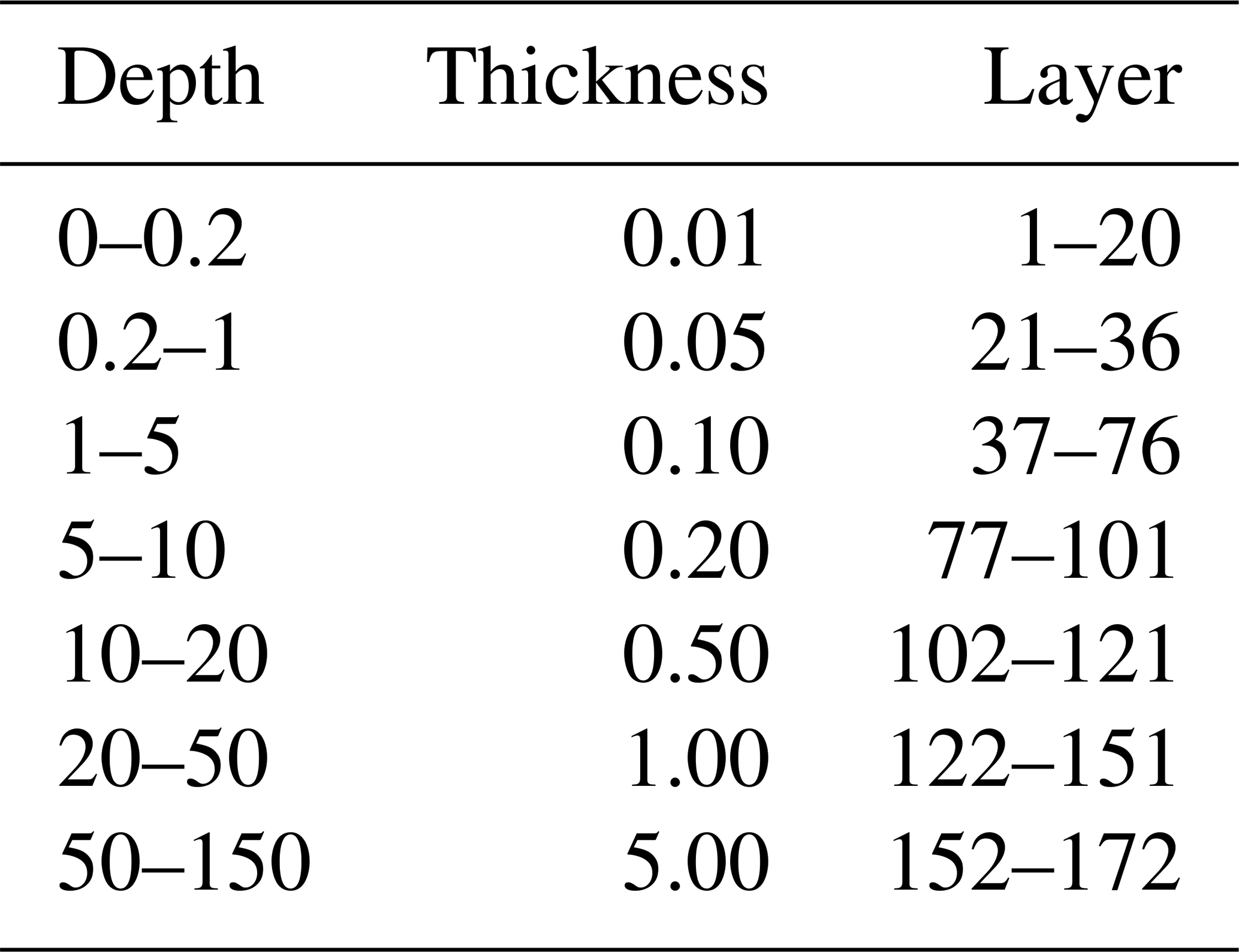
To maintain numerical stability and reduce computational cost, the soil vertical grid size increased from 0.01 m for subsurface to 5.0 m for deep soil (Table E1), similar to the other models (Zheng et al., 2020). The soil column with a total depth of 150 m is discretized to 172 layers. We use the soil texture of the Global Soil Dataset for Earth System Models (GSDE) as it additionally provides the soil gravel content, which is prevalent over the TP (Dai et al., 2019). GSDE has 8 soil layers with a total depth of 3.8 m. The information of the last layer was extended to deeper soil, but was refined based on the bedrock depth from Shangguan et al. (2017). Note that, we assume soil organic matter is absent for soil below 3 m as is normally done in Earth system models (e.g. Chadburn et al., 2015).
3.2 Soil water content
Soil moisture can significantly affect the dynamics of the soil thermal regime through evapotranspiration and by altering soil thermal properties (Göckede et al., 2017; Zwieback et al., 2019). However, in the permafrost regions of the TP, soil moisture exhibits marked heterogeneity and is difficult to accurately represent in models. This challenge stems from uncertainties in soil datasets and climate forcing, as well as the inherent complexities of the rugged terrain. For the current version, the static soil moisture is used. To specify the vertical water distribution within the soil column, we used sub-grid parameterizations from SURFEX and CryoGridLite (Decharme et al., 2006; Masson et al., 2013; Langer et al., 2024). Here, we distinguished four hydrological layers in the subsurface, from the uppermost surface to deep layer, including the: (1) root zone; (2) vadose layer, extending from the root layer downward to the lower boundary or saturated table/bedrock (if present); (3) saturated layer, which lies between the depth of groundwater table and bedrock; and (4) bedrock layer, extends down to the lower boundary. Note that the presence and depth of the saturated layer is estimated based on the groundwater table information from Fan et al. (2013). The root depth is set between 0.05 m for bare soil and 0.5 m for high vegetation, and the typical depth for different vegetation cover is from GEOtop (Endrizzi et al., 2014).
In the root layer, the water content θR (m3 m−3) is estimated as the ensemble mean of five remote sensing-based products (Table 2, details see Sect. 3.3). The water content for the vadose layer θv (m3 m−3) is determined based on field capacity θfc (m3 m−3) and soil porosity ϕ (m3 m−3), and an ensemble range is used (see Sect.3.3). Please see Appendix A for the parameterizations of soil properties. In the saturated layer, the water content (θsat) is equal to ϕ. The water content of 0.05 m3 m−3 was used for the bedrock (Gubler et al., 2013).
3.3 Ensemble simulations for soil hydrology
Although the use of static soil moisture models is common practice for investigating long-term permafrost changes among permafrost researchers (e.g. Jafarov et al., 2012; Qin et al., 2017a; Langer et al., 2024), and four vertical water distribution schemes were implemented in FPM, this estimate is subject to large uncertainty. To allow the propagation of this uncertainty into model results, we introduced both wet and dry variants of the default parameters (see Sect. 3.3). The ensemble simulations – allowing degrees of parameter uncertainties – are widely used for Earth system studies as they generally outperform individual simulations (Cao et al., 2019a; Langer et al., 2024). In this study, the ensemble simulation is produced using reasonable ranges of parameters (Table 3). Both the ensemble range of soil moisture in root layer and vadose zone are assumed here to allow possible uncertainties. The θR is derived as an ensemble mean of five state-of-the-art products (Table 2), and the ensemble was produced by (wet/dry soil) standard deviation of all these products. The baseline of θv was determined as the mean of θfc and θsat in previous studies (e.g. Langer et al., 2024). We followed this algorithm, but introduced a dry and wet variants of the θv parameter used (Table 3). We emphasize that the ensemble was chosen after considerable tests and comparisons but ultimately remains a subjective choice at this time. The range of the above selected parameters are used for the 45-member ensemble simulation to represent a wide range of permafrost conditions. This approach prevents the simulation from capturing seasonal and long term evolution linked to changes in the soil water content which can be an important driver of permafrost dynamics.
Table 3Soil moisture (m3 m−3) parameters selected for ensemble simulations. The dry and wet variants indicate the parameter ensemble range, and default indicates the standard choice used in model simulation.
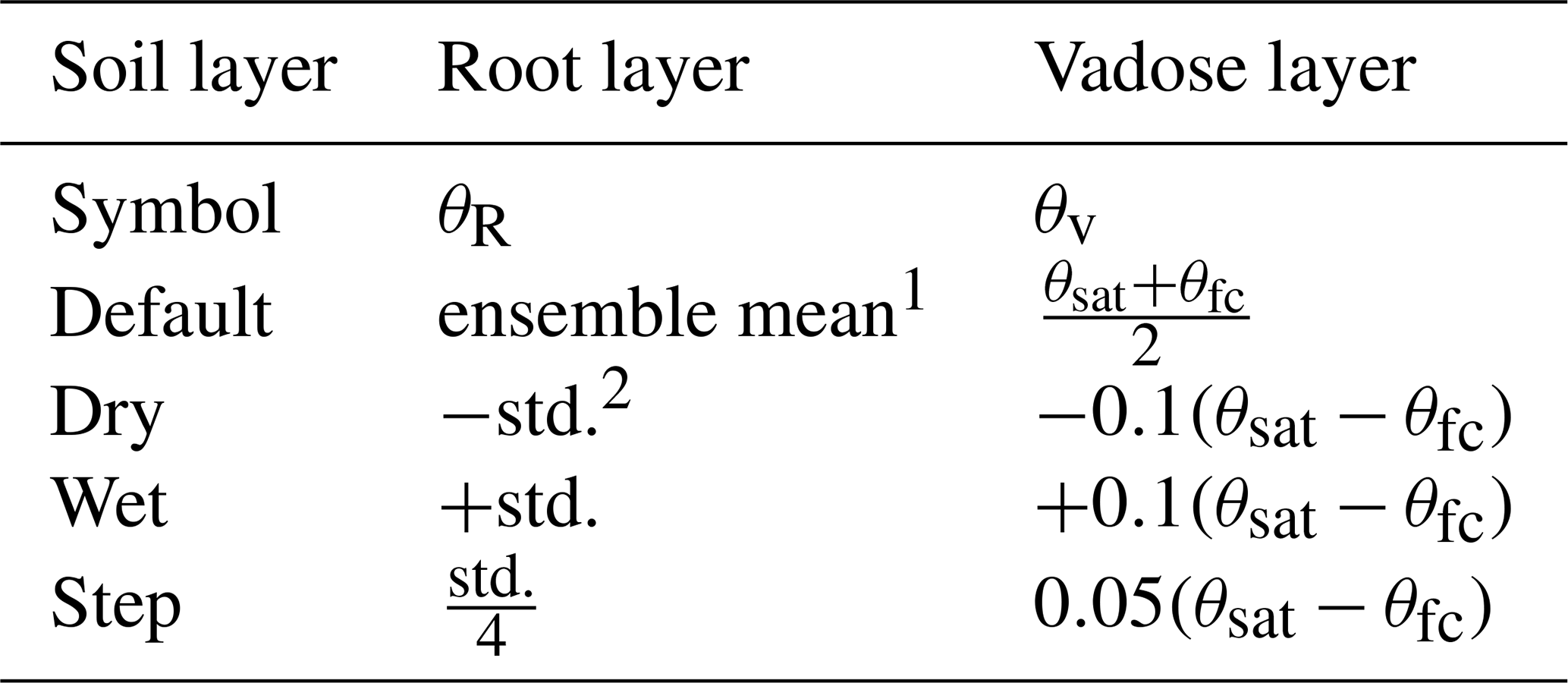
The footnote of 1 and 2 mean the ensemble mean and standard deviation (std.) of five remote-sensing-based soil moisture in Table 2.
3.4 Model settings
The simulation was conducted at a time step of 1 d. A lower boundary condition of geothermal heat flux from Davies (2013) is used (Table 2). To ensure the convergence of soil temperature profile, the model was initialized through a 1000 year spin-up process. This was achieved by cyclically applying the climate forcing data from the first decade (July 1950 to June 1960) one hundred times. Simulation performance was measured by the mean bias (BIAS) as well as root mean square error (RMSE), and more details can be found in Appendix C.
3.5 Diagnosis and analyses of permafrost characteristics
Permafrost is diagnosed following its definition, i.e. the daily soil temperature of a simulation pixel remains at or below 0 °C for two or more years at any simulated depth. Instead of directly using presence/absence of permafrost for individual ensemble member, the permafrost zonation index (PZI), as a fraction (0–1) corresponds to the 45 simulation members identified the probability of permafrost presence for each grid, is introduced to represent permafrost extent here. In such, the PZI can be used to quantitatively explore permafrost changes for each grid. More details of permafrost probability estimate could be found from Obu et al. (2019) and Burke et al. (2020). In this study, we especially focus on the thermal state of permafrost at a depth of 3 m as the near-surface permafrost treated in most land surface models (Burke et al., 2020), and 15 m as the permafrost mean annual ground temperature (MAGT). The permafrost extent for above 100 m is additionally used as reference. The glaciers and lakes from ERA5-Land are masked before permafrost extent analyses. The ALT is estimated from linear interpolation of daily soil temperature. In this study, the period of 2010–2023 is used as the current condition for permafrost.
4.1 Climate forcing
FPM is driven by climate forcing from reanalysis, including: near-surface air temperature, wind speed, incoming shortwave radiation, incoming longwave radiation, atmospheric pressure, and snow water equivalent. In this study, the historical climate is taken from the ERA5-Land datasets, produced by the European Centre for Medium-Range Weather Forecasts (ECMWF, Table 2). ERA5-Land is an enhanced land component of ERA5 with a spatial resolution of 0.1° and a coverage from 1950 to the present (Muñoz-Sabater et al., 2021). The reanalyses were evaluated against the in situ observations (Appendix D). Note that the snowfall from ERA5-Land was reported to be over biased due to the significant drawback of precipitation represented in models (Orsolini et al., 2019). For this reason, the simulated snow influences on soil thermal regime were very likely artificially amplified.
4.2 Surface cover
FPM considers the influences of vegetation on permafrost via the latent heat and soil moisture etc. (Appendix E). In FPM, static vegetation is assumed and the vegetation optical depth (VOD), leaf area index (LAI), and vegetation type are required (Table 2). For snow-free periods, the ground albedo is from Jia et al. (2022).
The remote-sensing datasets vary in their temporal coverage, so we used the climatology to represent the long-term conditions. For the VOD and snow-free ground albedo, the daily measurements over the entire recording period were aggregated into a day-of-year climatology using the median, so as to reduce sensitivity to extreme values. The monthly LAI from Myneni et al. (2021) was aggregated to monthly medians. Daily θR values were first aggregated into monthly averages for each dataset. These monthly values from the thawing season (June to August) were then used to compute the annual mean. For each soil moisture dataset, the average over the entire recording period was derived, and an ensemble mean across the five datasets was calculated and employed as model inputs. Note that only the measurements from the thawing season were used to derive VOD.
4.3 Datasets used for model evaluation
4.3.1 Synthesis datasets
In this study, 10 synthesis sites with both meteorological and soil temperature measurements were used to conduct the detailed evaluations (Table 4, Fig. 1). The soil information, i.e. soil texture and moisture are also available at the sites. Note that the missing atmospheric observations are filled with downscaled reanalyses following the algorithm presented by Fiddes and Gruber (2014), Cao et al. (2017a).
Zhao et al. (2021)Cao et al. (2018)Table 4Metadata for the synthesis sites with both permafrost and atmospheric forcing measurements, including latitude (Lat, ° N), longitude (Lon, ° E), elevation (Ele, m), vegetation type, mean annual air temperature (MAAT, °C), mean soil moisture (SM, m3 m−3) in growth season, mean annual ground temperature (MAGT, °C), active layer thickness (ALT, m), and measurement period.
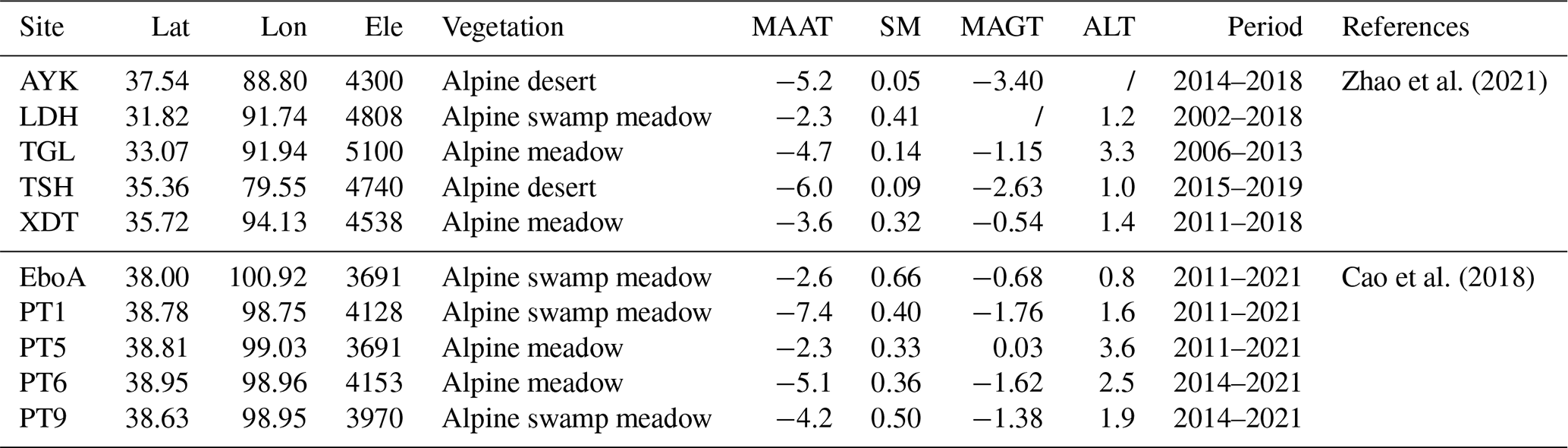
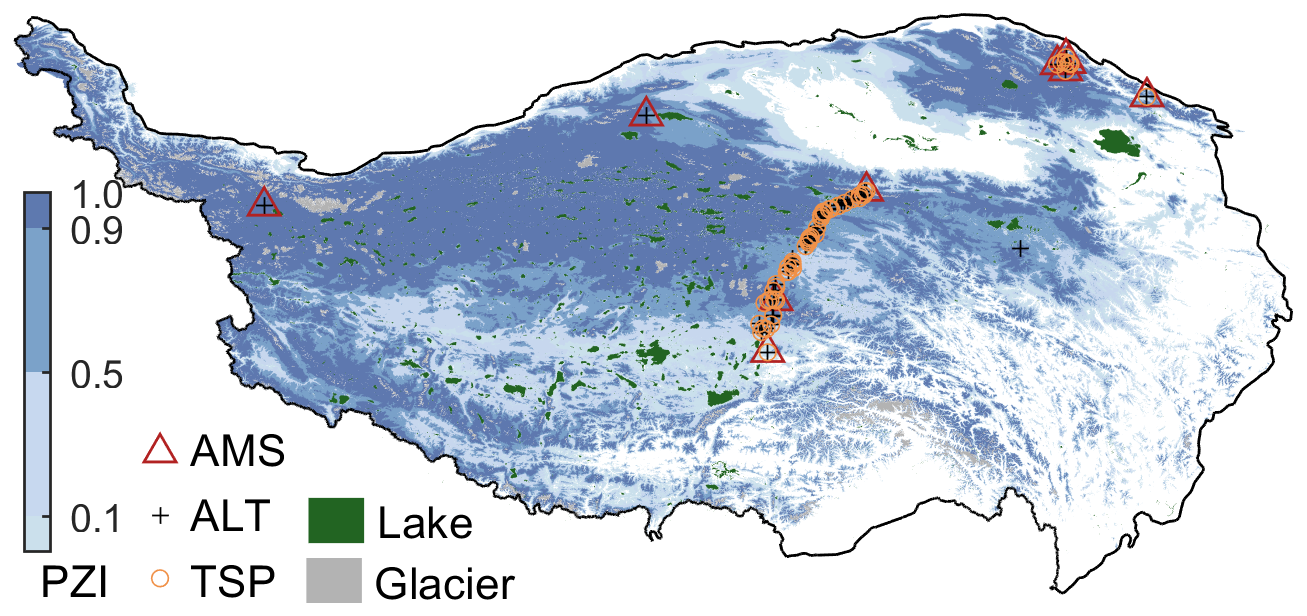
Figure 1In situ observations used for model evaluation, including comprehensive observation sites with both the active layer soil temperature and atmospheric observations from the automatic meteorological system (AMS), active layer thickness (ALT) from soil temperature profile, and the permafrost thermal state (TSP) from boreholes. The permafrost zonation index (PZI) is from Cao et al. (2019b).
4.3.2 Active layer thickness and borehole temperature measurements
Active layer thickness and borehole temperature measurements from the Global Terrestrial Network for Permafrost (GTN-P, Biskaborn et al., 2019) and literature (see Supplement for details) are used here to evaluate model performance. This yielded 247 ALT measurements from 128 sites (Fig. 1). The measured mean ALT was about 2.3±0.8 m with a range of 0.7–4.9 m. ALTs are derived from different land covers, including Alpine desert, alpine steppe, alpine meadow, and alpine swamp meadow, indicating that the evaluation presented here is representative.
The MAGT measurements between the depths of 7.5 and 40 m are treated as the thermal state of permafrost, and this leads to 71 boreholes with 364 MAGT measurements that were used for model evaluation. The measured mean MAGT was about °C with a range from −4.2 to 2.2 °C. Among the measurements, 19 borehole sites with a long times-series (≥1 decade) were further used to evaluate the modeled TSP changes.
4.3.3 Referenced permafrost maps and process-based simulations
We use five permafrost maps as reference datasets to evaluate the modeled permafrost area. These are (1) the new map of permafrost distribution on the TP via the temperature at the top of permafrost (TTOP) model (Zou et al., 2017); (2) the permafrost zonation index map compiled based on the statistical relationship between topoclimatic predictors (e.g. air temperature, snow, and vegetation) and permafrost zonation (Cao et al., 2019b); (3) the global permafrost zonation index with the normal and cold variant (Gruber, 2012); (4) the Northern Hemisphere permafrost map derived via the TTOP model (Obu et al., 2019), and (5) the outputs from LSM of Noah (Wu et al., 2018).
Process-based permafrost simulations across the TP remain relatively scarce, and the direct evaluation of such simulations against observations is currently unavailable. Consequently, this study utilizes permafrost conditions and dynamics derived from the Noah (Wu et al., 2018), CLM (Guo and Wang, 2013), GIPL2 (Qin et al., 2017a), and GBEHM (Zheng et al., 2020) models as a basis for comparing the permafrost thermal regime. The referenced permafrost extent and thermal regime is estimated for different time periods, using different modeling paradigms and forcing, and are not perfect or a “source of truth”. We treat them as the “best available” reference.
5.1 Model evaluations
Our evaluation results showed the overall RMSE of daily soil temperature in the active layer was 1.8 °C with a BIAS of 0.4 °C (Fig. 2). FPM showed relatively worse performance in areas with alpine swamp meadow (RMSE=2.7 °C), with warm bias in summer and cold bias in winter. This is attributed to poorly prescribed soil information, i.e. peat layer and soil moisture. At the sites with alpine desert, the overestimated soil moisture (by about 25 %) at 0.5 m depth leads to a colder simulated soil temperature in summer (Fig. 2a). To demonstrate the hypothesis, we conducted the additional simulations using observed atmospheric forcing and soil profile from borehole measurements. The simulated soil temperature was significantly improved by 1.9 °C, indicating the simulations could be improved with more reliable climate forcing and soil profile (Fig. 2).
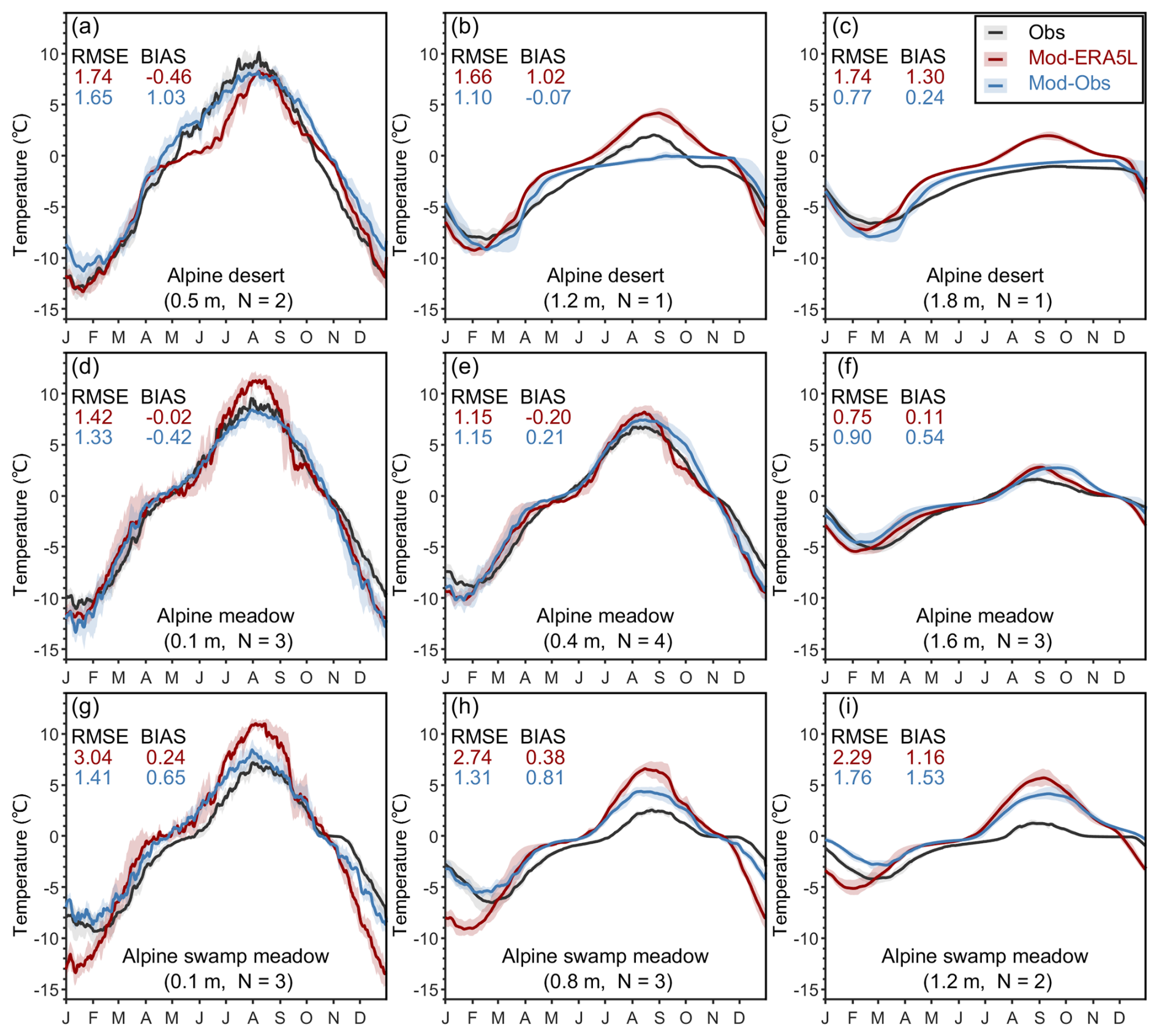
Figure 2Comparison of simulated and observed day-of-year soil temperature in the active layer across the synthesis sites. The daily soil temperature present is averaged for each vegetation type and soil depth based on all available sites and years. The soil depth and numbers of sites (N) are given in parentheses. The sites used for each vegetation type and depth differ based on data availability. Observations are in black (Obs), red lines show the simulation forced by reanalyses (MOD-ERA5L), and the blue lines represent that forced by observed atmospheric forcing and in situ soil information (if available, MOD-Obs). The shaded areas depict the ensemble range from the 25th to 75th. The ensemble of observation forced simulation are produced using results from different sites and additional ranges of soil moisture (see Table 3).
FPM generally has good agreement with observed ALTs with the overall RMSE of 1.0 m, and slightly underestimated ALT ( m) due to the cold-biased summer air temperature (Figs. 3 and D1). Following the relatively worse soil temperature, ALT was over-biased in areas with alpine swamp meadow. The additional simulation with observed forcing and soil information, again, showed more promising results (RMSE=0.7 m). The ALT bias was within ±1 m at most (64 %) evaluated cells (Fig. 3).
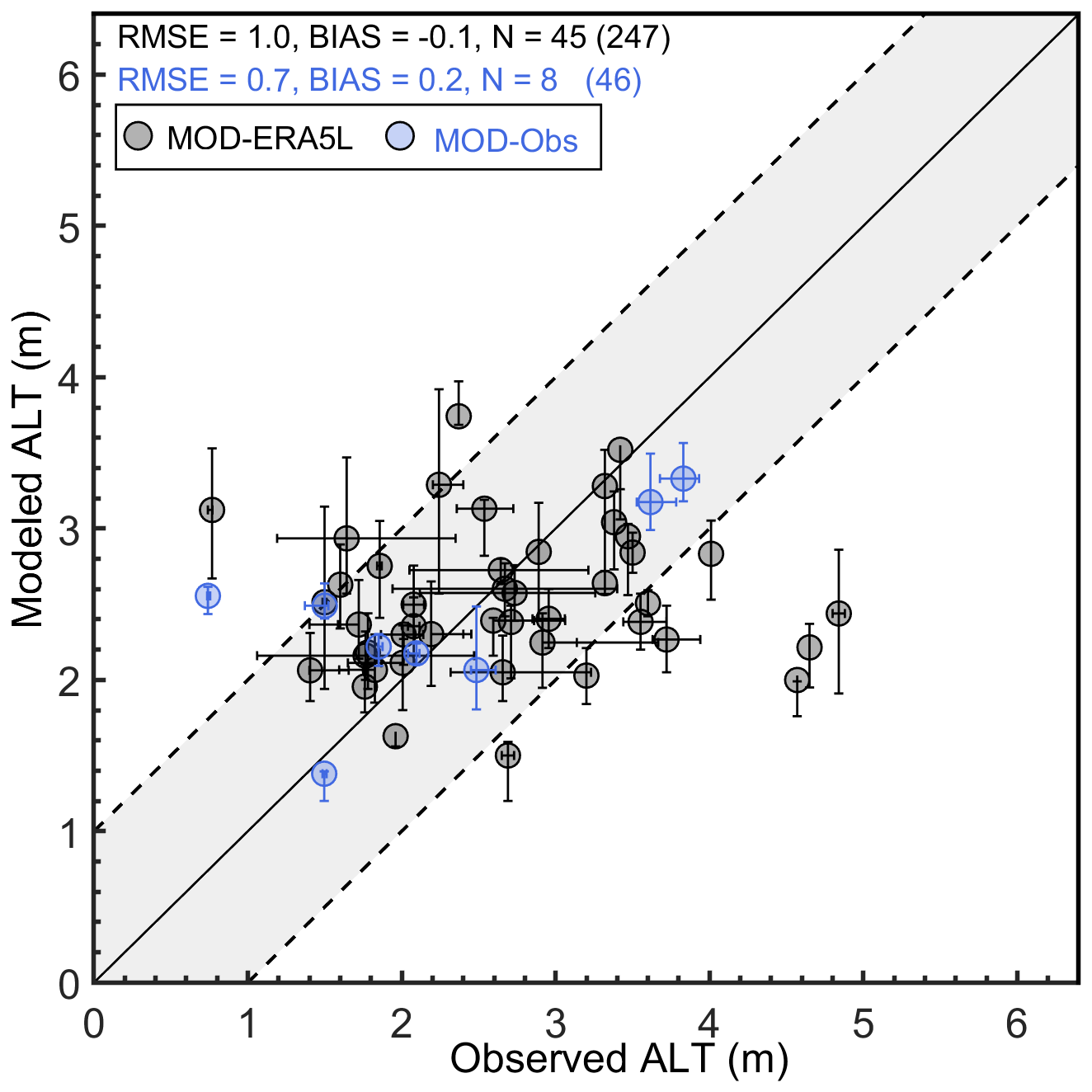
Figure 3Evaluation of modeled active layer thickness (ALT). The ensemble mean from FPM simulations (MOD-ERA5L) are given in black dot, with the whiskers representing the range between the 25th and 75th percentiles. The observed mean was aggregated from multiple measurements at a single site or from multiple sites within the same grid. N indicates the number of grids used for evaluation after aggregating sites within the same grid, and the number of measurements was given in parentheses. The additional simulation driven by observed meteorological forcing (MOD-Obs) are given in blue. Dashed lines indicate ±1 m.
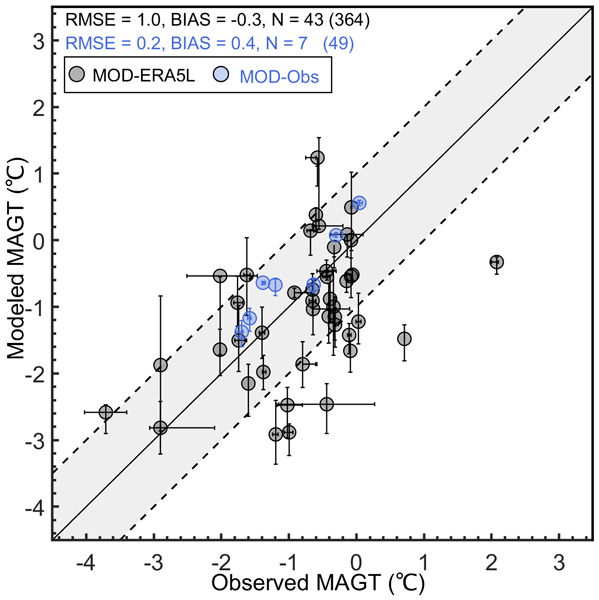
FPM is found to underestimate the MAGT with an overall mean BIAS of −0.3 °C, which is aligned with the cold-biased air temperature (Fig. D1a). The overall MAGT RMSE was 1.0 °C (Fig. 4), and about 65(93) % sites have a bias within ±1(2) °C. Although the MAGT change trend is well addressed by FPM with an RMSE of 0.22 °C per decade, it is found even greater than the observed mean MAGT trend of 0.12±0.09 °C per decade (Fig. 5). This indicates that the simulated MAGT trend may not be reliable. In fact, the permafrost warming at the measured sites was relatively gentle (with a range from −0.07 to 0.3 °C per decade) compared to that in high latitudes (Intergovernmental Panel On Climate Change, 2022). This is because the permafrost temperature over the TP is very “warm”, and the heat from atmosphere was consumed by phase change rather than temperature increase (also see Fig. 7). The significant latent heat introduce additional challenge for reproducing MAGT trend.
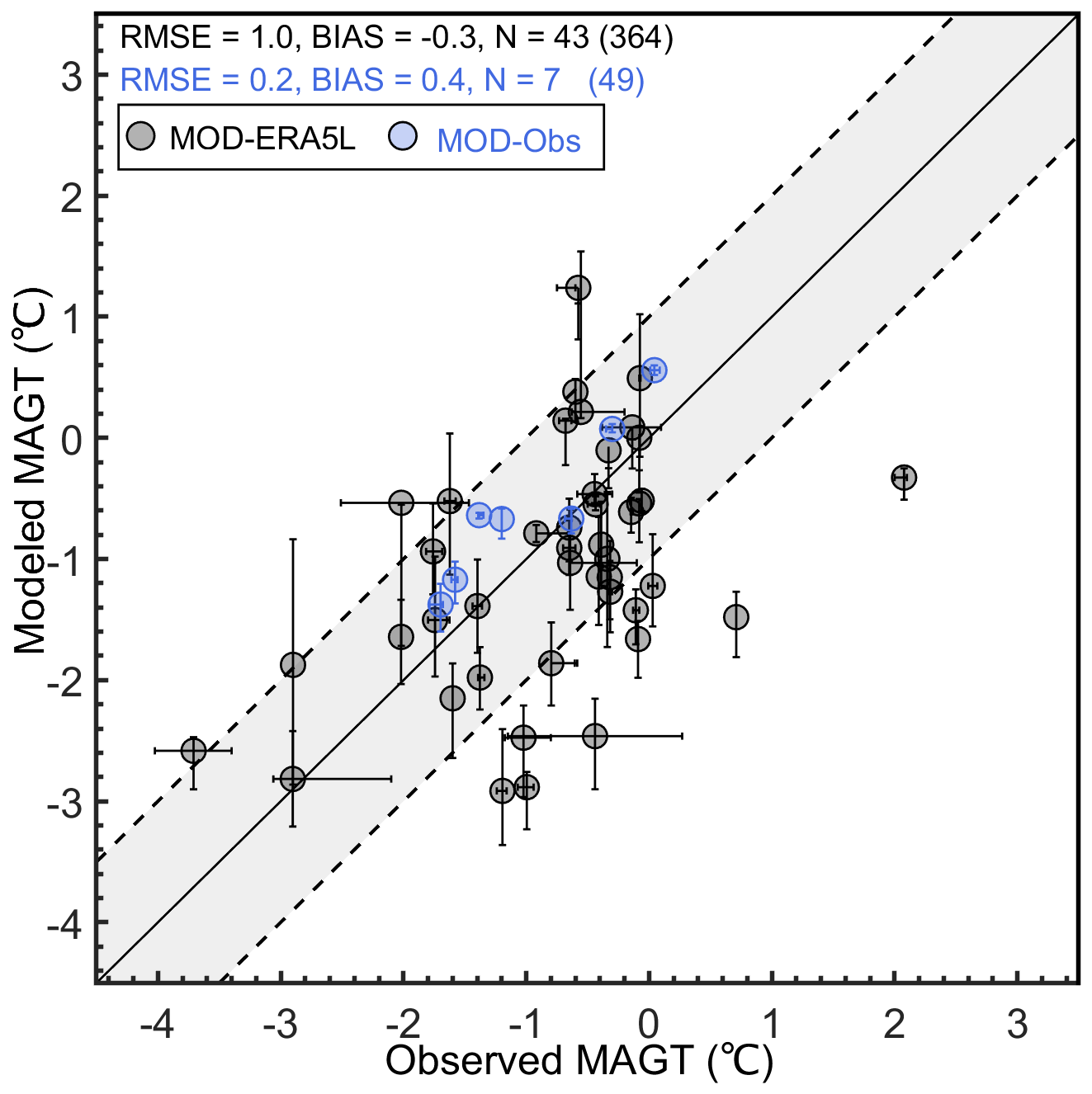
Figure 4Same as Fig. 3, but for the mean annual ground temperature (MAGT) at 15 m depth. Dashed lines indicate ±1 °C.
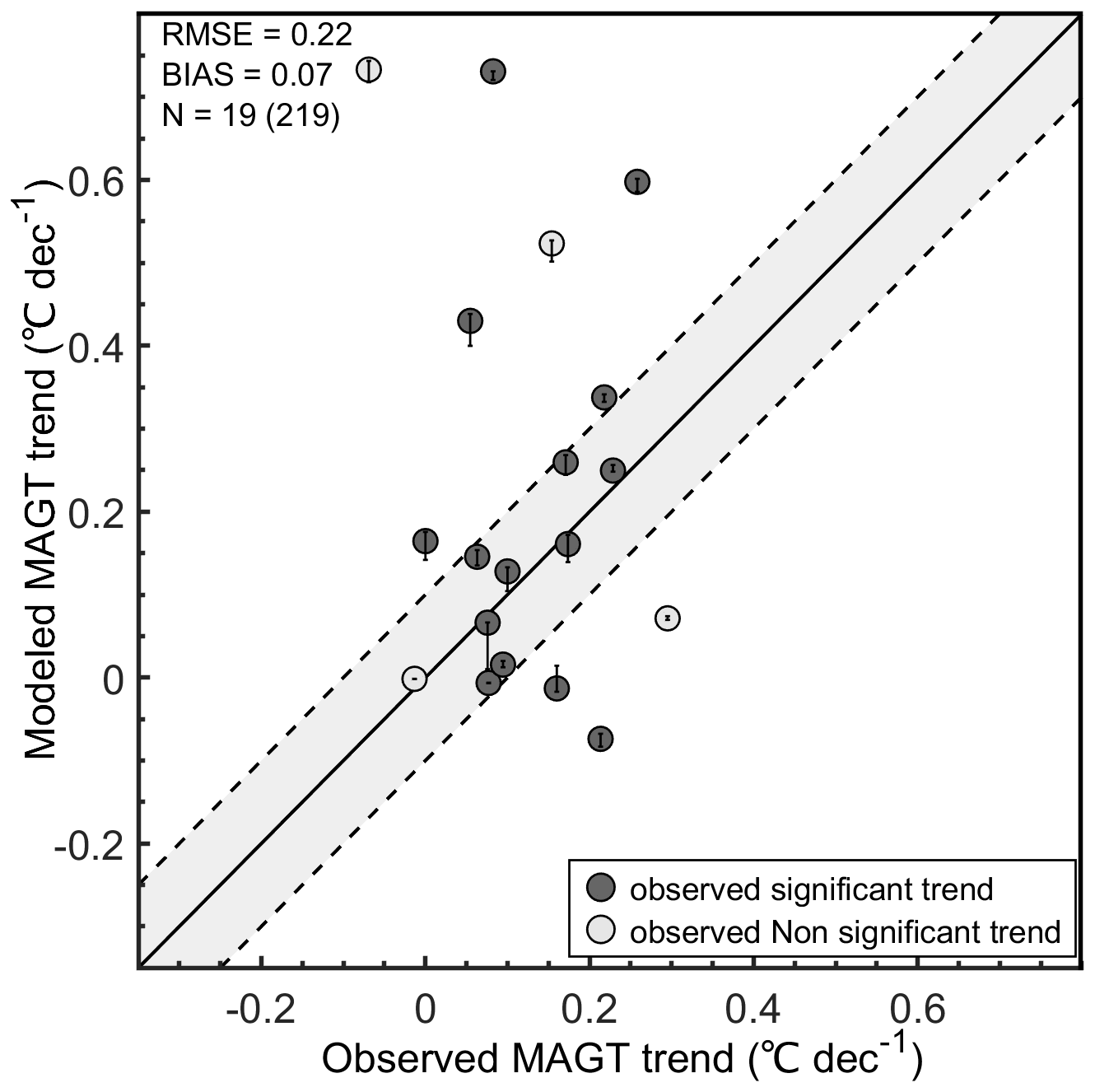
Figure 5Same as Fig. 3, but for the changes of mean annual ground temperature (MAGT) at 15 m depth. Only the sites with long-term observations (≥1 decade) are used here. The filled dots are sites with observed significant trends. Dashed lines indicate ±0.1 °C per decade.
Excluding glaciers and lakes, the estimated current (2010–2023) permafrost area was about km2 (Fig. 8) based on the ensemble simulations from FPM. This is found reasonable compared to the referenced ensemble mean of km2 (Fig. 9).
5.2 Changes in active layer thickness
The ensemble simulations from FPM showed the current (2010–2023) overall mean ALT was about 2.68±0.82 m over the TP. The results are found align with the previous simulations, for example, 2.1–2.4 m (1981–2013) from GIPL2 (Qin et al., 2017a) and 2.01 m (1981–2000) from CLM (Guo and Wang, 2013). Our results indicated that about 33.0 % of permafrost regions have an ALT greater than 3 m, highlighting that the widely used land surface models and reanalyses with shallow soil column may not be sufficient for permafrost studies over the TP.
The long-term simulation showed that ALT had a inter-annual trends with a decreasing trend between 1950–1980 (−0.14 m per decade), followed by a continuous increasing trend (0.13 m per decade). Consequently, the ALT over TP increased by 0.41 m since 1980 (Fig. 6b). While the simulated ALT increase rate was similar to that of Guo and Wang (2013), it was lower than those reported by Zheng et al. (2020), Qin et al. (2017a), both of which indicated a rate of ∼0.3 m per decade. Notably, long-term observations showed that the ALT increased at a rate of 0.19 m per decade, suggesting that our results are likely underestimates (Zhao et al., 2020).
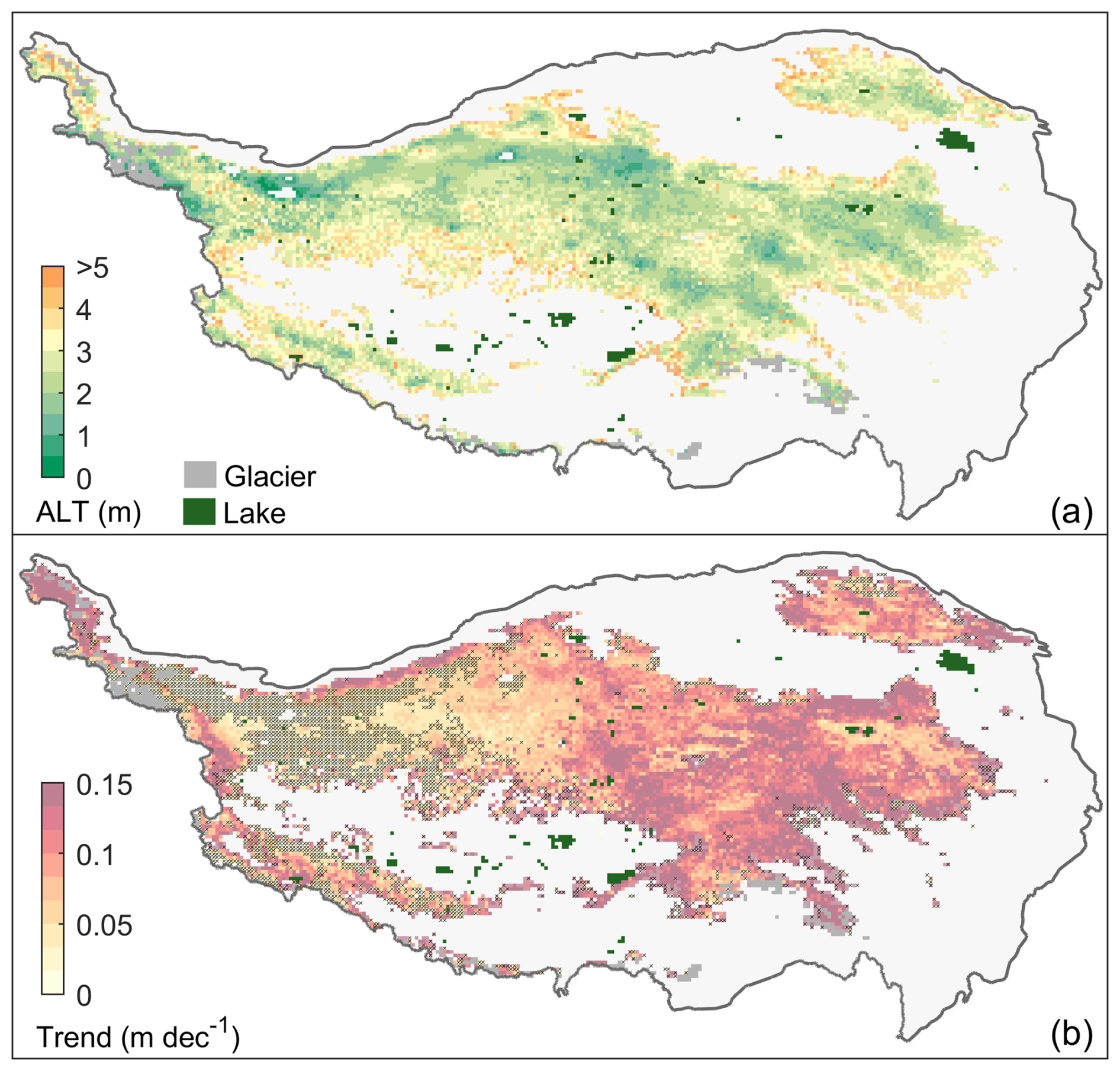
Figure 6(a) The modeled current (2010–2023) mean active layer thickness (ALT), and (b) its change rate from 1980 to 2023. The areas without significant trends are marked by ×. Glaciers and lakes are from ERA5-Land.
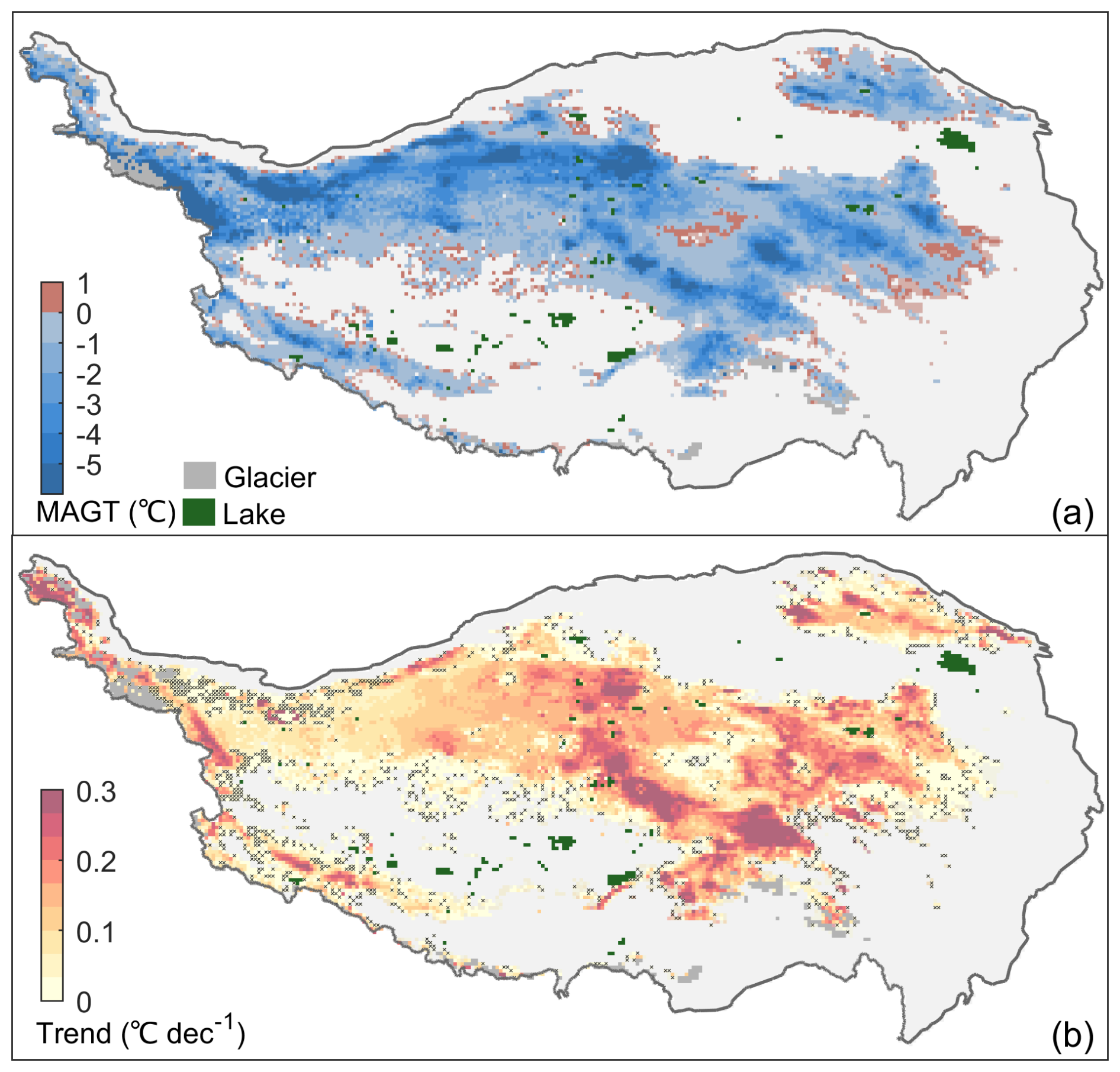
Figure 7(a) The modeled current (2010–2023) mean annual ground temperatures at the depth of 15 m, and (b) its change rate from 1980 to 2023. The areas without significant trends are marked by ×.
5.3 Changes in permafrost temperature
The mean annual ground temperature at the depth of 15 m (MAGT15) is used to represent the thermal state of permafrost. The modeled overall mean MAGT15 (2010–2023) was about °C for the permafrost regions over the TP and shows a wide range from −19.2 to 3.4 °C (Fig. 7a). The permafrost thermal regime is found similar to the outputs from Noah LSM, i.e. −1.6 °C (Wu et al., 2018). Our simulations revealed that the overall MAGT15 increased by approximately 0.22 °C since 1950, with a more dramatic warming of 0.11 °C per decade since 1980. Similar to the ALT, MAGT shows a clear cooling trend (−0.02 °C per decade) between 1950–1980 corresponding to the changes in near surface air temperature.
The permafrost warming trend was found to be MAGT-dependent, with a slower rate for warmer permafrost. For example, the permafrost warming rate was about 0.05±0.06 °C per decade for areas with MAGT15 between −1–0 °C, and 0.17±0.09 °C per decade for permafrost regions colder than −2 °C. This is consistent with observations (Biskaborn et al., 2019; Zhao et al., 2020), as heat is consumed as latent heat during the ice phase change for permafrost that is close to thawing.
5.4 Changes in permafrost extent
The permafrost area decreased by approximately 9.5×10⁴ km2 during 1950–2023, but increased by 4.3 % from 1950 to 1980 following cooling of the near-surface air temperature (Fig. 9a). Permafrost area decreased at a rate of 3.3×10⁴ km2 per decade, or a total area of 12.4 %, since 1980. Our results showed that the model with shallow soil column would significantly underestimate permafrost area but overestimated permafrost degradation. Take the top 3 m as an example, which has been widely used in the land surface model. The estimated near-surface (top 3 m) permafrost area (7.9×10⁴ km2) was about 26.0 % smaller compared to the ground “truth”, or 31.4 % smaller than the simulations with sufficient soil column (e.g. 100 m, Fig. 9b). Furthermore, by omitting permafrost below a depth of 3 m, the shallow soil model incorrectly classified areas with deep permafrost as permafrost-free. Therefore, the permafrost degradation rate was overestimated by about 42 % (3.3×10⁴ vs. 4.7×10⁴ km2 per decade) (Fig. 9). This highlights that the current land surface models with shallow soil column can lead to significant uncertainties in permafrost simulations.
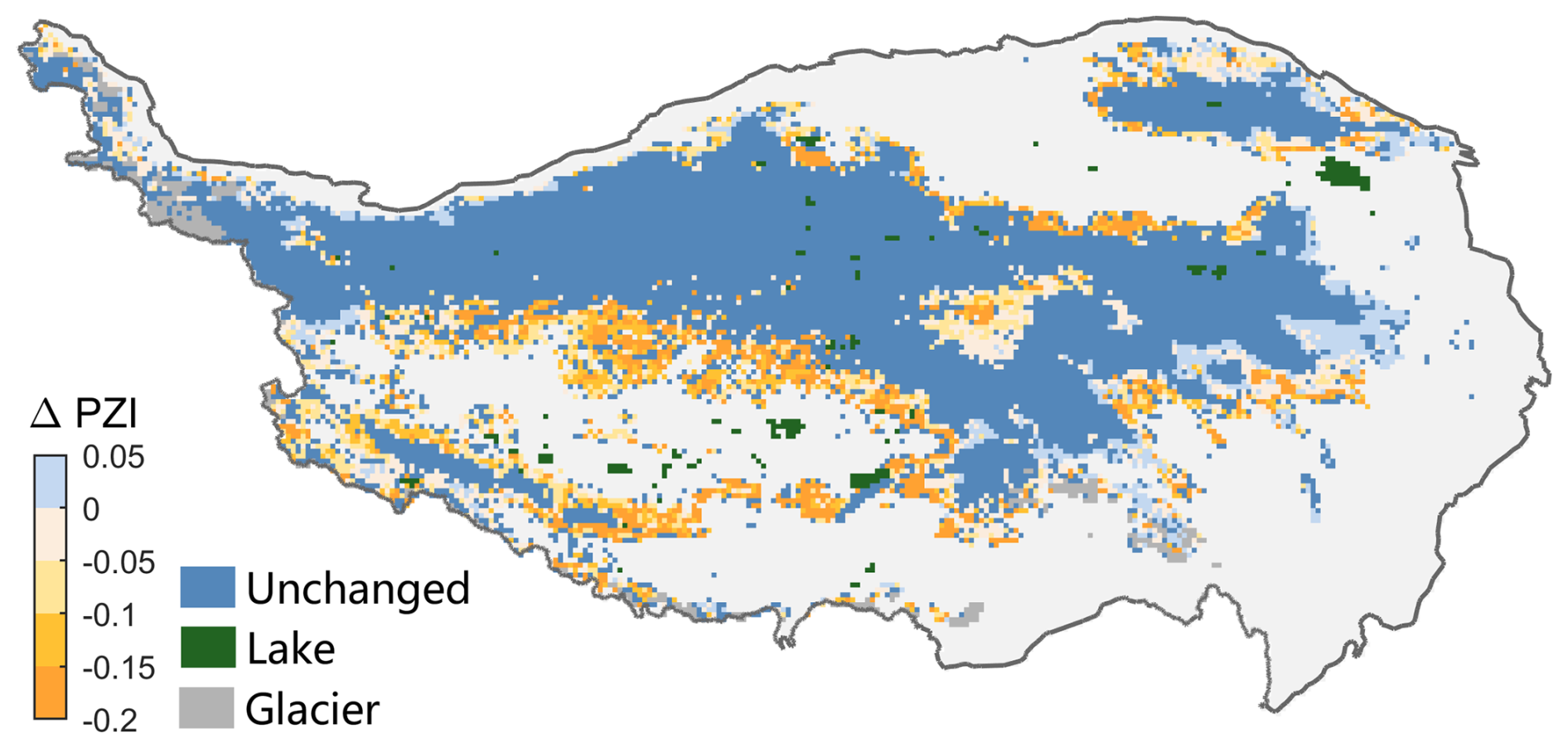
Figure 8Changes of permafrost extent, as permafrost zonation index (PZI), between 2010–2023 and 1981–1990. The PZI is 45-member ensemble probability of permafrost where permafrost is defined by the daily temperature at 15 m depth, and negative values indicate a loss in permafrost extent.
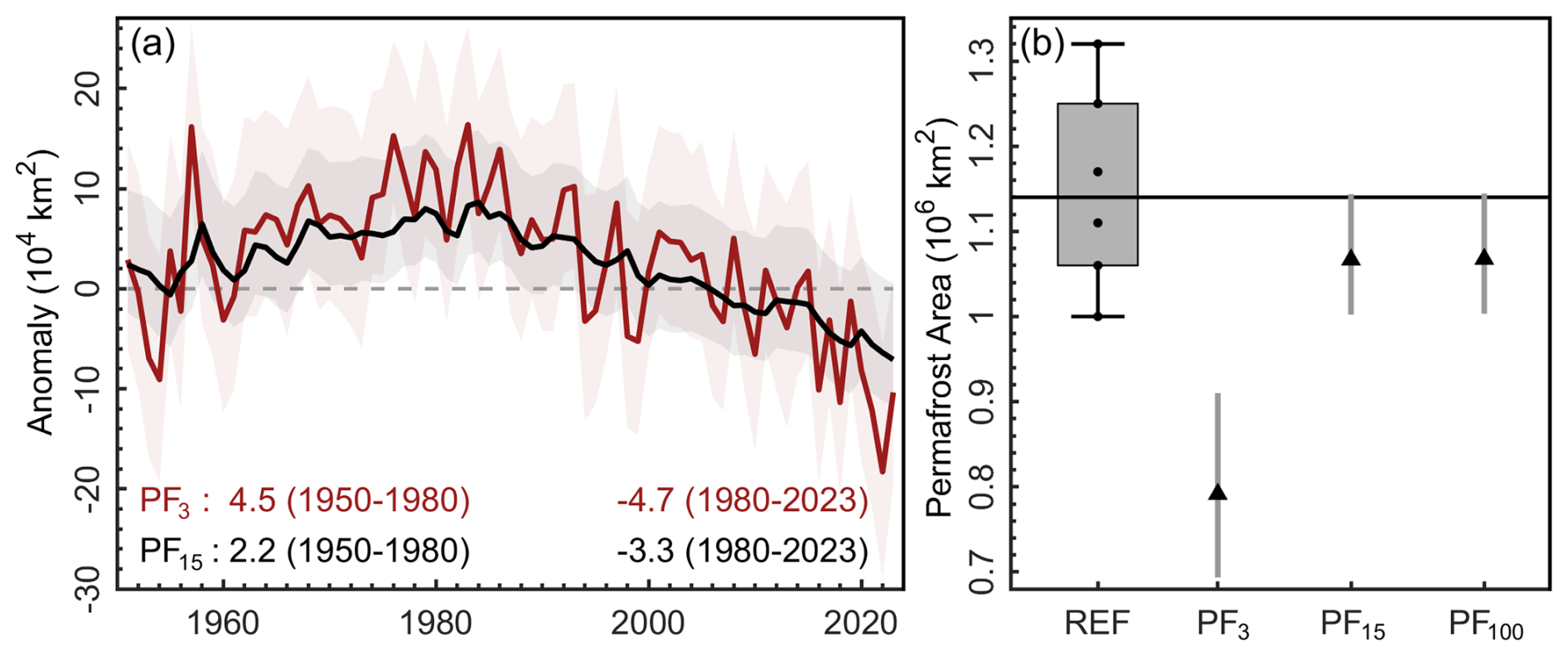
Figure 9(a) Anomaly of permafrost area since 1950, and (b) comparison of estimated current (2010–2023) permafrost area from FPM simulations with referenced estimations (Sect. 4.3.3). The subscript means the depth above which permafrost is diagnosed. The permafrost area trend (104 km2 per decade) is estimated for the periods before and after 1980, separately, and curves are 25th and 75th.
5.5 Simulation spread
The ensemble simulation revealed that the variation in soil moisture translated into considerable influences on simulated permafrost characteristics (Fig. 10), with the overall mean standard deviation was about 0.26 m in ALT and about 0.31 °C in MAGT. Notably, the input soil moisture datasets themselves exhibited substantial variability, with mean standard deviation of 0.11 m3 m−3 in root zone and 0.14 m3 m−3 in vadose zone (Fig. E1). The propagation of input uncertainties into significant permafrost simulation bias thus highlights the essential role of obtaining more reliable soil moisture datasets for advancing our capacity to simulate permafrost changes.
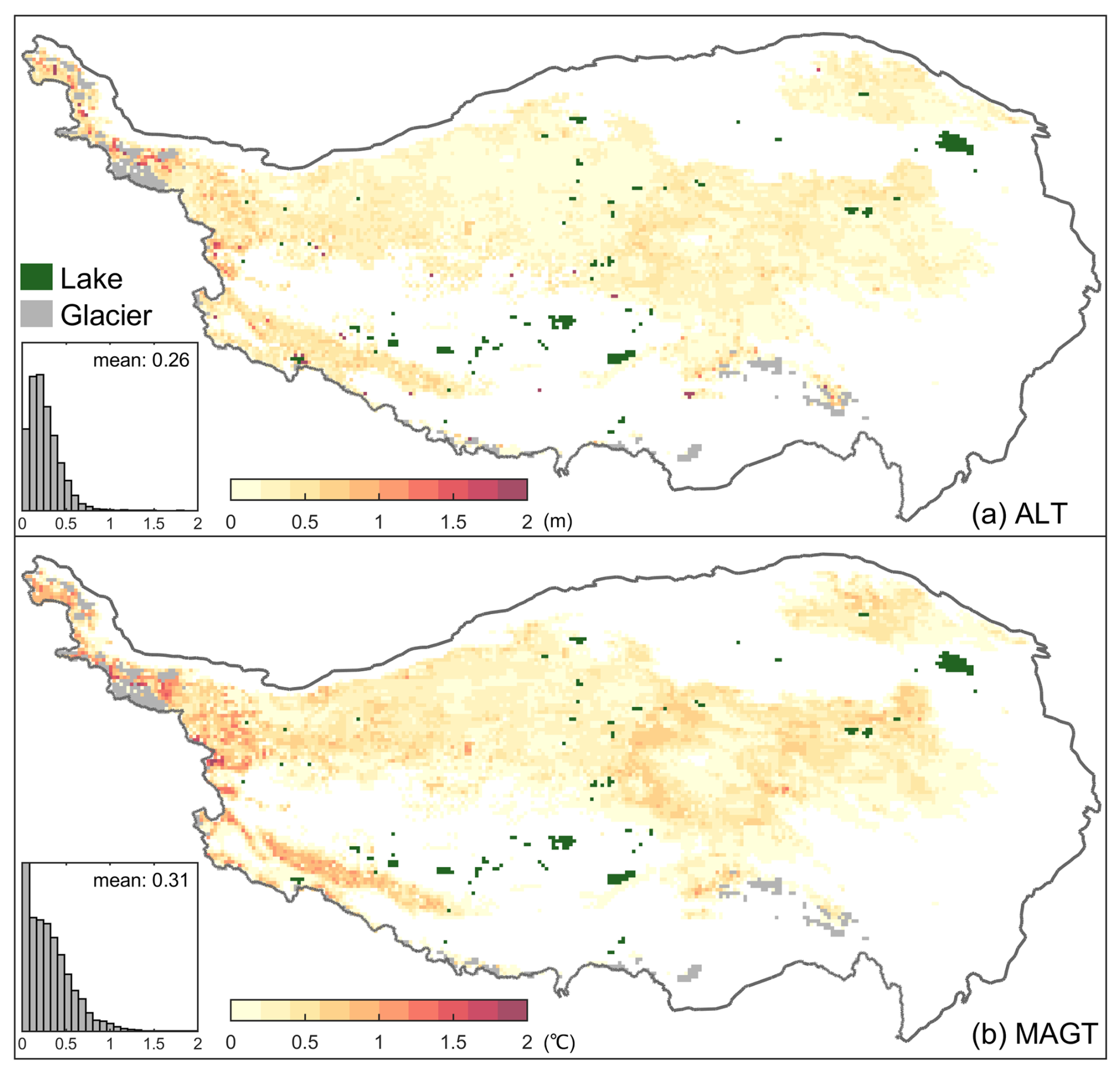
Figure 10The standard deviation of (a) simulated active layer thickness (ALT) and (b) mean annual ground temperature (MAGT) based on the 45-member ensemble simulations which accounted the possible soil moisture spread in root and vadose zones.
6.1 Uncertainties from climate forcing and input datasets
We used the ERA5-Land reanalyses as model forcing. However, the ERA5-Land is found cold biased in near-surface air temperature (Appendix D, Fig. D1), leading to underestimated ALT as well as MAGT (Figs. 6 and 7). In fact, permafrost simulations are hampered by reduced reanalyses quality in cold regions primarily due to inherent challenges in representing nonlinear processes involving ice, or its phase change near 0 °C (Cao and Gruber, 2025). The poorly described soil column, especially the soil organic matter, put additional uncertainty for permafrost simulations.
6.2 Model limitations
In this study, we introduced and demonstrated the suitability of FPM for large-scale permafrost simulation. For the initial version of FPM, there are four main limitations. First, the snow scheme is simplistic, although significant influences of snow cover on soil thermal regime have been well documented (Zhang, 2005). FPM currently does not consider the snow mass balance, and, therefore, additionally requires snow water equivalent as input. Further, the snow cover fraction used here was developed for high latitudes and does not consider the influences of complex terrain, which may redistribute the snow cover and lead to strong heterogeneity for the soil thermal regime. While the simple snow scheme seems adequate for the TP with little snow, considerable efforts are required to improve snow processes if FPM would applied to snow-prevalent areas, i.e. the high latitudes.
Second, FPM does not consider the water balance, and the static surface conditions, including vegetation and albedo (varies with season but remains unchanged among years), were assumed via using the remote-sensing-based climatology. This means the influences of surface and sub-surface changes are not accounted for and limited the model ability in predicting long-term permafrost changes.
Third, the fine-scale influences (i.e. debris and peat layer) are either not or simply represented here due to the simulation scale (∼10 km). This may overestimate permafrost degradation, especially for the areas near the permafrost lower limit, where the relict permafrost was found (Fig. 8, Cao et al., 2021).
Fourth, FPM does not consider the thermokarst processes or the so-called “abrupt thaw” raised by excess ice loss. The thermokarst was thought as local-scale tipping element that would remarkably accelerate permafrost degradation (Devoie et al., 2019).
6.3 Comparison with other permafrost models
Our results are found comparable to previous simulations derived from the geothermal numerical models (e.g. Qin et al., 2017a; Chen et al., 2025) as well as land surface models (e.g. Guo and Wang, 2013; Wu et al., 2018; Zheng et al., 2020). FPM, as the stand-alone permafrost model, benefits from the consideration of land-atmosphere processes (i.e. the surface energy balance and vegetation effects) typically not included in geothermal numerical models, while maintaining the deep soil column and suitable numerical solver for soil phase change. In addition, the land-surface-scheme designed structure and streamlined processes (i.e. its efficient simulation of latent heat) make it suitable for large-scale ensemble simulations. Different from the other land surface scheme models with rich processes beyonds permafrost, such as SUTRA (McKenzie et al., 2007), Advanced Terrestrial Simulator (Jan et al., 2020), and CryoGrid 3 (Westermann et al., 2023), which are applied to fine scales, the initial FPM aim to provide a flexible yet simple platform for large-scale permafrost simulation studies.
6.4 Future developments
Previous studies reported that the permafrost processes of the Earth system model in CMIP6 is limited improved compared to the previous generation of CMIP5 (e.g. Burke et al., 2020), and current Earth system models generally have weak ability in representing permafrost (Schädel et al., 2024). This highlights the urgent need to develop the stand-alone permafrost model. Since the required inputs are derived from global datasets, this opens the opportunity for global permafrost simulation with the FPM platform. The incorporation of a state-of-the-art snow scheme – particularly critical for high-latitude permafrost processes – will further enhance this capability. We hope with improved permafrost ground ice maps and a rigorously validated solution (addressing both physical processes and numerical solver aspects), we can implement excess ice loss processes within FPM to represent permafrost “abrupt thaw”. We hope FPM could be further improved via incorporating lateral heat transfer, as described by Sun et al. (2023), making FPM a cross-scale platform for understanding diverse permafrost landscapes.
In this study, we introduce a new land surface scheme specifically designed for permafrost applications, the Flexible Permafrost Model (FPM). This model serves as a flexible platform to explore novel parameterizations for a variety of permafrost processes. To demonstrate the utility of FPM for supporting permafrost studies, we apply the model to permafrost studies over the Tibetan Plateau. Our simulation results are compared to in situ observations and published permafrost extent. We summarize the main contributions and insights of this work as the following:
- 1.
FPM shows suitability in reproducing permafrost characteristics, such as active layer thickness, and the thermal state. With more reliable inputs, especially soil profile, FPM-based simulations can be further improved;
- 2.
Simulations indicated that the current (2010–2023) mean active layer thickness was about 2.68±0.82 m, permafrost temperature at a depth of 15 m was about °C, and permafrost extent was about km2 over the Tibetan Plateau, and is comparable with previous model outputs;
- 3.
The process-based historical simulation revealed steady permafrost degradation over the Tibetan Plateau since 1980. The active layer thickness increased by 0.41 m, permafrost temperature at 15 m depth increased at a rate of 0.11±0.01 °C per decade, and permafrost extent degraded by about 12.4 %. Evaluations against observations and comparisons with reference studies indicate that the rate of increase in active layer thickness is likely underestimated;
- 4.
Our simulations indicate that current land surface models employing shallow soil columns are inadequate for permafrost research on the Tibetan Plateau, since they have generally underestimated permafrost extent while overestimating degradation rates. Such inadequacy may also pose challenges in other regions characterized by deep active layers (i.e. >3 m);
- 5.
This study highlights the ongoing efforts in stand-alone process-based permafrost model development. We hope that in the future, with more available stand-alone land-scheme-designed permafrost models, the permafrost community will provide a simulation benchmark for the Earth system model developments as well as the climate change assessment at a global scale.
FPM considers the impacts of organic matter on soil hydraulic properties following CoLM (Dai et al., 2003) and SURFEX (Masson et al., 2013):
where fo (m3 m−3), fm (m3 m−3), and fg (m3 m−3) are the fractions of organic matter, mineral and gravel, respectively. The τ refers to the soil hydraulic properties, including: slope of the retention curve b (–), soil matric potential ψ (–), soil porosity ϕ (m3 m−3), field capacity θfc (m3 m−3), and wilting point θwp (m3 m−3). For gravel, ϕ is set as 0.05 m3 m−3, and others are set to 0, assuming the soil hydraulic properties are not directly affected by gravel.
The soil organic matter properties τo were implicitly accounted for in the FPM:
where zi (m) is the soil depth for soil grid of i, and zsap=0.5 m is the depth that organic matter takes on the characteristics of sapric peat.
The mineral soil hydraulic properties were approximated as:
where fclay (m3 m−3) and fsand (m3 m−3) are the volumetric content of clay and sand to the total mineral soil, respectively.
In this study, Q (W m−2) refers to surface energy balance terms, subscripts identify the term (si: incoming shortwave radiation; li: incoming longwave radiation; le: emitted longwave radiation; h: turbulent exchange of sensible heat; e: turbulent exchange of latent heat; c: energy transport due to conduction; n: net radiation; and m: the energy flux available for melt). We use k (), CV (), and ρ (kg m−3) to represent thermal conductivity, volumetric heat capacity, and density, respectively. The subscript identifies each source (s: soil; sn: snow; m: mineral; o: organic; w: water; i: ice; a: air; and g: gravel). The volumetric contents for each soil component is represented by f (m3 m−3).
Table B1Nomenclature and input parameters for Flexible Permafrost Model (FPM).
The evaluation metrics of bias (BIAS) and root-mean-square-error (RMSE) were used here to evaluate model performance.
where OBS and MOD represent the variables of interest (i.e. mean annual ground temperature and active layer thickness) from in situ observations and the simulations.
The climate forcing was evaluated against in situ daily observations from the synthesis sites (Table 4). Our evaluation results indicate that there is generally a cold bias of the near-surface air temperature (−1.9 °C) for the ERA5-Land, and the RMSE was about 3.5 °C (Fig. D1). While ERA5-Land slightly overestimated the incoming short-wave radiation (bias=10.3 W m−2), the incoming long-wave radiation was underestimated by about −24.1 W m−2. Overall, the evaluation results indicate that the meteorological variables in the reanalysis dataset are generally consistent with the observations and can be used as suitable forcing/inputs for the numerical simulation.
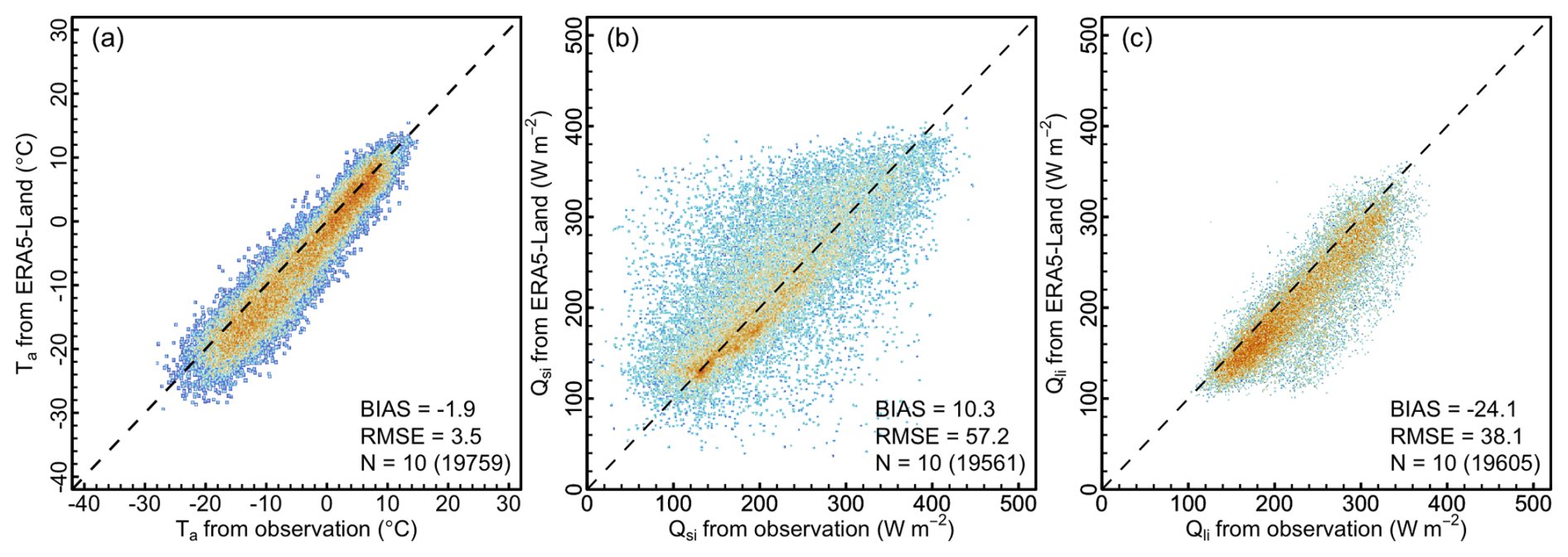
Figure D1Evaluation of the daily (a) near-surface air temperature (Ta), (b) incoming short-wave radiation (Qsi), and (c) incoming long-wave radiation (Qli) from ERA5-Land. The number of meteorological stations (measurements) used for the evaluation are given as N.
The latent heat flux (Qe) is treated differently depending on the snow cover, and the FPM uses the Priestley–Taylor method by generally following Martens et al. (2017). If snow is absent, Qe is the sum of latent heat for bare soil (W m−2) and covered vegetation (W m−2).
where and are given as
where and are the net radiation partitioned for bare soil and vegetation, and derived following Fisher et al. (2008).
where Qn (W m−2) is the total net radiation, fs (–) is fractional net radiation reached to the bare soil, and is treated as
where kRn = 0.6 is extinction coefficient from Impens and Lemeur (1969), and LAI (–) is Leaf Area Index from MODIS (Table 2).
While αpt is normally set to 1.26 for snow-free areas following the original study (Priestley and Taylor, 1972), many studies reported that it is site-specific, depending on the surface conditions (e.g. Constantin et al., 2015; Martens et al., 2017). In FPM, the parameterization scheme that solves the influences of vegetation and soil moisture on latent heat was used. This is achieved via introducing the evaporation stress factor S (–). The S for bare soil (Ss) and vegetation (Sv) are defined as:
where θc (m3 m−3) is the critical soil moisture, θR (m3 m−3) is the soil moisture in the root zone layer, θr (m3 m−3) is the residual soil moisture, θwp (m3 m−3) is soil moisture content of wilting point, VOD (–) is vegetation optical depth, and VODmax is the maximum VOD for a given simulation cell. The θc is variable depending on the soil texture, and we used the parameters from Zhu et al. (2019). The θwp is given in Appendix A, and θr is constant of 0.05 m3 m−3 following Fisher et al. (2008). The VOD is from Moesinger et al. (2020).
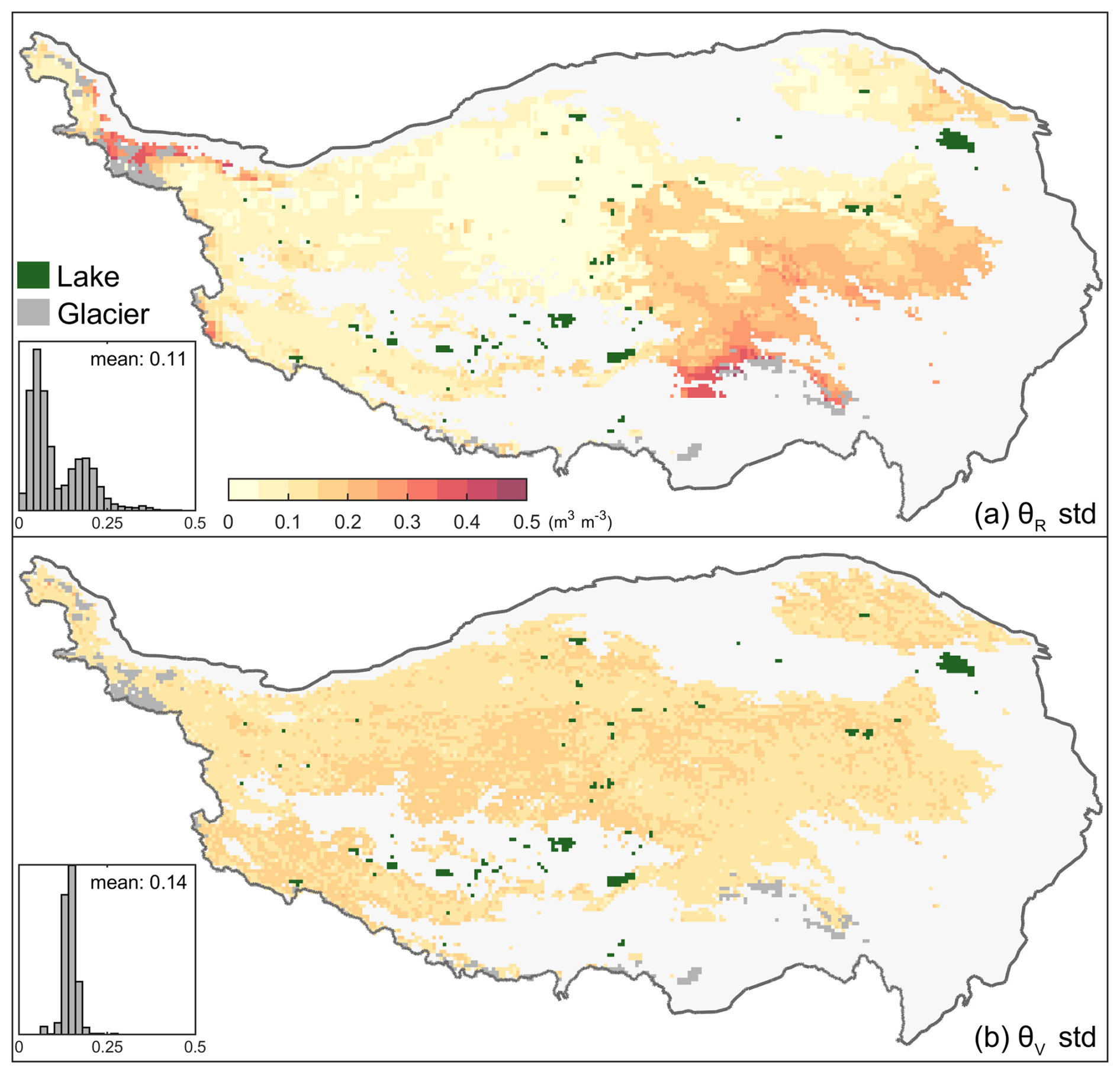
Figure E1The standard deviation (std.) of the soil moisture spread in (a) root (θR) and (b) vadose (θv) zones.
Table E1Ground layer depths (m) and thicknesses (m) for the FPM ground layers configuration.
If snow is present, the Qe for a given cell is derived as the weighted mean of the snow and soil cover fractions (SCF), assuming no latent heat via vegetation:
where is the latent heat from snow-covered area, and is given as
where Ssn and αpt are set to 1 and 0.95, respectively.
The Flexible Permafrost Model (FPM) source code is available on request from Bin Cao (bin.cao@itpcas.ac.cn).
The active layer thickness, mean annual ground temperature at 15 m depth, and the permafrost extent – as the 45-member ensemble mean – are publicly available via Zenodo (https://doi.org/10.5281/zenodo.15229474; Sun and Cao, 2025).
The supplement related to this article is available online at https://doi.org/10.5194/tc-20-2681-2026-supplement.
WS carried out this study by developing model, analyzing data, performing the simulations, and writing the paper and was responsible for the compilation and quality control of the observations. BC conceived and guided the project, proposed the initial idea designed model structure as well as parameterizations, developed and tested the model, and contributed to organizing as well as writing the paper.
The contact author has declared that neither of the authors has any competing interests.
Publisher's note: Copernicus Publications remains neutral with regard to jurisdictional claims made in the text, published maps, institutional affiliations, or any other geographical representation in this paper. The authors bear the ultimate responsibility for providing appropriate place names. Views expressed in the text are those of the authors and do not necessarily reflect the views of the publisher.
The authors thank Kun Zhang for his helpful suggestions in model development and Shengdi Wang for developing and testing the early version of model. ERA5-Land reanalysis data and the ESA CCI LC map are provided by the ECMWF.
This research has been supported by the National Natural Science Foundation of China (grant no. 42422608), the Youth Innovation Promotion Association of the Chinese Academy of Sciences (grant no. 2023075), and the China Postdoctoral Science Foundation (grant no. 2023M733604).
This paper was edited by Jeannette Noetzli and reviewed by Rui Chen and two anonymous referees.
Agam, N., Kustas, W. P., Anderson, M. C., Norman, J. M., Colaizzi, P. D., Howell, T. A., Prueger, J. H., Meyers, T. P., and Wilson, T. B.: Application of the Priestley–Taylor approach in a two-source surface energy balance model, J. Hydrometeorol., 11, 185–198, https://doi.org/10.1175/2009JHM1124.1, 2010. a
Biskaborn, B. K., Lanckman, J.-P., Lantuit, H., Elger, K., Streletskiy, D. A., Cable, W. L., and Romanovsky, V. E.: The new database of the Global Terrestrial Network for Permafrost (GTN-P), Earth Syst. Sci. Data, 7, 245–259, https://doi.org/10.5194/essd-7-245-2015, 2015. a
Biskaborn, B. K., Smith, S. L., Noetzli, J., Matthes, H., Vieira, G., Streletskiy, D. A., Schoeneich, P., Romanovsky, V. E., Lewkowicz, A. G., and Abramov, A.: Permafrost is warming at a global scale, Nat. Commun., 10, 1–11, https://doi.org/10.1038/s41467-018-08240-4, 2019. a, b, c, d
Brunt, D.: Physical and Dynamical Meteorology, Cambridge University Press, ISBN-10 1107601436, 2011. a
Burke, E. J., Zhang, Y., and Krinner, G.: Evaluating permafrost physics in the Coupled Model Intercomparison Project 6 (CMIP6) models and their sensitivity to climate change, The Cryosphere, 14, 3155–3174, https://doi.org/10.5194/tc-14-3155-2020, 2020. a, b, c
Cao, B. and Gruber, S.: Brief communication: Reanalyses underperform in cold regions, raising concerns for climate services and research, The Cryosphere, 19, 4525–4532, https://doi.org/10.5194/tc-19-4525-2025, 2025. a
Cao, B., Gruber, S., and Zhang, T.: REDCAPP (v1.0): parameterizing valley inversions in air temperature data downscaled from reanalyses, Geosci. Model Dev., 10, 2905–2923, https://doi.org/10.5194/gmd-10-2905-2017, 2017a. a
Cao, B., Gruber, S., Zhang, T., Li, L., Peng, X., Wang, K., Zheng, L., Shao, W., and Guo, H.: Spatial variability of active layer thickness detected by ground penetrating radar in the Qilian Mountains, Western China, J. Geophys. Res.-Earth, 122, 574–591, https://doi.org/10.1002/2016JF004018, 2017b. a
Cao, B., Zhang, T., Peng, X., Mu, C., Wang, Q., Zheng, L., Wang, K., and Zhong, X.: Thermal characteristics and recent changes of permafrost in the upper reaches of the heihe river basin, Western China, J. Geophys. Res.-Atmos., 123, 7935–7949, https://doi.org/10.1029/2018JD028442, 2018. a, b
Cao, B., Quan, X., Brown, N., Stewart-Jones, E., and Gruber, S.: GlobSim (v1.0): deriving meteorological time series for point locations from multiple global reanalyses, Geosci. Model Dev., 12, 4661–4679, https://doi.org/10.5194/gmd-12-4661-2019, 2019a. a
Cao, B., Zhang, T., Wu, Q., Sheng, Y., Zhao, L., and Zou, D.: Permafrost zonation index map and statistics over the Qinghai–Tibet Plateau based on field evidence, Permafrost. Periglac., 30, 178–194, https://doi.org/10.1002/ppp.2006, 2019b. a, b, c, d, e
Cao, B., Li, X., Feng, M., and Zheng, D.: Quantifying overestimated permafrost extent driven by rock glacier inventory, Geophys. Res. Lett., 48, e2021GL092476, https://doi.org/10.1029/2021GL092476, 2021. a, b
Cao, B., Arduini, G., and Zsoter, E.: Brief communication: Improving ERA5-Land soil temperature in permafrost regions using an optimized multi-layer snow scheme, The Cryosphere, 16, 2701–2708, https://doi.org/10.5194/tc-16-2701-2022, 2022. a
Chadburn, S. E., Burke, E. J., Essery, R. L. H., Boike, J., Langer, M., Heikenfeld, M., Cox, P. M., and Friedlingstein, P.: Impact of model developments on present and future simulations of permafrost in a global land-surface model, The Cryosphere, 9, 1505–1521, https://doi.org/10.5194/tc-9-1505-2015, 2015. a
Chadburn, S., Burke, E., Cox, P., Friedlingstein, P., Hugelius, G., and Westermann, S.: An observation-based constraint on permafrost loss as a function of global warming, Nat. Clim. Change, 7, 340–344, https://doi.org/10.1038/nclimate3262, 2017. a
Chen, R., Nitzbon, J., von Deimling, T. S., Stuenzi, S. M., Chan, N.-H., Boike, J., and Langer, M.: Potential vegetation greenness changes in the permafrost areas over the Tibetan Plateau under future climate warming, Global Planet. Change, 104833, https://doi.org/10.1016/j.gloplacha.2025.104833, 2025. a
Chen, Y., Lara, M. J., Jones, B. M., Frost, G. V., and Hu, F. S.: Thermokarst acceleration in Arctic tundra driven by climate change and fire disturbance, One Earth, 4, 1718–1729, https://doi.org/10.1016/j.oneear.2021.11.011, 2021. a
Constantin, J., Willaume, M., Murgue, C., Lacroix, B., and Therond, O.: The soil-crop models STICS and AqYield predict yield and soil water content for irrigated crops equally well with limited data, Agr. Forest Meteorol., 206, 55–68, https://doi.org/10.1016/j.agrformet.2015.02.011, 2015. a
Cosenza, P., Guérin, R., and Tabbagh, A.: Relationship between thermal conductivity and water content of soils using numerical modelling, Eur. J. Soil Sci., 54, 581–588, https://doi.org/10.1046/j.1365-2389.2003.00539.x, 2003. a
Dai, Y., Zeng, X., Dickinson, R. E., Baker, I., Bonan, G. B., Bosilovich, M. G., Denning, A. S., Dirmeyer, P. A., Houser, P. R., Niu, G., Oleson, K. W., Schlosser, C. A., and Yang, Z.-L.: The common land model, B. Am. Meteorol. Soc., 84, 1013–1024, https://doi.org/10.1175/BAMS-84-8-1013, 2003. a
Dai, Y., Xin, Q., Wei, N., Zhang, Y., Shangguan, W., Yuan, H., Zhang, S., Liu, S., and Lu, X.: A global high-resolution data set of soil hydraulic and thermal properties for land surface modeling, J. Adv. Model. Earth Sy., 11, 2996–3023, https://doi.org/10.1029/2019MS001784, 2019. a, b
Davies, J. H.: Global map of solid Earth surface heat flow, Geochem. Geophy. Geosy., 14, 4608–4622, https://doi.org/10.1002/ggge.20271, 2013. a, b
Decharme, B., Douville, H., Boone, A., Habets, F., and Noilhan, J.: Impact of an exponential profile of saturated hydraulic conductivity within the ISBA LSM: simulations over the Rhône basin, J. Hydrometeorol., 7, 61–80, https://doi.org/10.1175/JHM469.1, 2006. a
Devoie, É. G., Craig, J. R., Connon, R. F., and Quinton, W. L.: Taliks: a tipping point in discontinuous permafrost degradation in peatlands, Water Resour. Res., 55, 9838–9857, https://doi.org/10.1029/2018WR024488, 2019. a
Dingman, S. L.: Physical Hydrology, Waveland Press, ISBN 10 1-4786-1118-9, ISBN 13 978-1-4786-1118-9, 2015. a, b, c
Dorigo, W., Wagner, W., Albergel, C., Albrecht, F., Balsamo, G., Brocca, L., Chung, D., Ertl, M., Forkel, M., Gruber, A., Haas, E., Hamer, P. D., Hirschi, M., Ikonen, J., De Jeu, R., Kidd, R., Lahoz, W., Liu, Y. Y., Miralles, D., Mistelbauer, T., Nicolai-Shaw, N., Parinussa, R., Pratola, C., Reimer, C., Van Der Schalie, R., Seneviratne, S. I., Smolander, T., and Lecomte, P.: ESA CCI soil moisture for improved Earth system understanding: state-of-the art and future directions, Remote Sens. Environ., 203, 185–215, https://doi.org/10.1016/j.rse.2017.07.001, 2017. a
Douville, H., Royer, J. F., and Mahfouf, J. F.: A new snow parameterization for the Météo-France climate model: Part I: validation in stand-alone experiments, Clim. Dynam., 12, 21–35, https://doi.org/10.1007/BF00208760, 1995. a, b
Endrizzi, S., Gruber, S., Dall'Amico, M., and Rigon, R.: GEOtop 2.0: simulating the combined energy and water balance at and below the land surface accounting for soil freezing, snow cover and terrain effects, Geosci. Model Dev., 7, 2831–2857, https://doi.org/10.5194/gmd-7-2831-2014, 2014. a
Fan, Y., Li, H., and Miguez-Macho, G.: Global patterns of groundwater table depth, Science, 339, 940–943, https://doi.org/10.1126/science.1229881, 2013. a, b
Fernandez-Moran, R., Al-Yaari, A., Mialon, A., Mahmoodi, A., Al Bitar, A., De Lannoy, G., Rodriguez-Fernandez, N., Lopez-Baeza, E., Kerr, Y., and Wigneron, J.-P.: SMOS-IC: an alternative SMOS soil moisture and vegetation optical depth product, Remote Sens.-Basel, 9, 457, https://doi.org/10.3390/rs9050457, 2017. a
Fiddes, J. and Gruber, S.: TopoSCALE v.1.0: downscaling gridded climate data in complex terrain, Geosci. Model Dev., 7, 387–405, https://doi.org/10.5194/gmd-7-387-2014, 2014. a
Fiddes, J., Endrizzi, S., and Gruber, S.: Large-area land surface simulations in heterogeneous terrain driven by global data sets: application to mountain permafrost, The Cryosphere, 9, 411–426, https://doi.org/10.5194/tc-9-411-2015, 2015. a
Fisher, J. B., Tu, K. P., and Baldocchi, D. D.: Global estimates of the land–atmosphere water flux based on monthly AVHRR and ISLSCP-II data, validated at 16 FLUXNET sites, Remote Sens. Environ., 112, 901–919, https://doi.org/10.1016/j.rse.2007.06.025, 2008. a, b
Fleagle, R. G. and Businger, J. A.: An Introduction to Atmospheric Physics, in: International Geophysics Series, 2nd edn., Academic Press, New York, ISBN 978-0-12-260355-6, 1980. a
Gao, B., Yang, D., Qin, Y., Wang, Y., Li, H., Zhang, Y., and Zhang, T.: Change in frozen soils and its effect on regional hydrology, upper Heihe basin, northeastern Qinghai–Tibetan Plateau, The Cryosphere, 12, 657–673, https://doi.org/10.5194/tc-12-657-2018, 2018. a
Gao, H., Han, C., Chen, R., Feng, Z., Wang, K., Fenicia, F., and Savenije, H.: Frozen soil hydrological modeling for a mountainous catchment northeast of the Qinghai–Tibet Plateau, Hydrol. Earth Syst. Sci., 26, 4187–4208, https://doi.org/10.5194/hess-26-4187-2022, 2022. a
Göckede, M., Kittler, F., Kwon, M. J., Burjack, I., Heimann, M., Kolle, O., Zimov, N., and Zimov, S.: Shifted energy fluxes, increased Bowen ratios, and reduced thaw depths linked with drainage-induced changes in permafrost ecosystem structure, The Cryosphere, 11, 2975–2996, https://doi.org/10.5194/tc-11-2975-2017, 2017. a
Gruber, S.: Derivation and analysis of a high-resolution estimate of global permafrost zonation, The Cryosphere, 6, 221–233, https://doi.org/10.5194/tc-6-221-2012, 2012. a, b
Gubler, S., Endrizzi, S., Gruber, S., and Purves, R. S.: Sensitivities and uncertainties of modeled ground temperatures in mountain environments, Geosci. Model Dev., 6, 1319–1336, https://doi.org/10.5194/gmd-6-1319-2013, 2013. a
Guo, D. and Wang, H.: Simulation of permafrost and seasonally frozen ground conditions on the Tibetan Plateau, 1981–2010, J. Geophys. Res.-Atmos., 118, 5216–5230, https://doi.org/10.1002/jgrd.50457, 2013. a, b, c, d
Guo, D., Wang, A., Li, D., and Hua, W.: Simulation of changes in the near surface soil freeze/thaw cycle using clm4. 5 with four atmospheric forcing data sets, J. Geophys. Res.-Atmos., 123, 2509–2523, https://doi.org/10.1002/2017JD028097, 2018. a
Guo, L., Genxu, W., Chunlin, S., Shouqin, S., Kai, L., Jinlong, L., Yang, L., Biying, Z., Jiapei, M., and Peng, H.: Development of a modular distributed hydro-thermal coupled hydrological model for cold regions, J. Hydrol., 644, 132099, https://doi.org/10.1016/j.jhydrol.2024.132099, 2024. a
Hjort, J., Karjalainen, O., Aalto, J., Westermann, S., Romanovsky, V. E., Nelson, F. E., Etzelmüller, B., and Luoto, M.: Degrading permafrost puts Arctic infrastructure at risk by mid-century, Nat. Commun., 9, 1–9, https://doi.org/10.1038/s41467-018-07557-4, 2018. a
H SAF: ASCAT Surface Soil Moisture Climate Data Record v5 12.5 km sampling–Metop, EUMETSAT SAF on Support to Operational Hydrology and Water Management, [data set], https://doi.org/10.15770/EUM_SAF_H_0009, 2020. a
Impens, I. and Lemeur, R.: Extinction of net radiation in different crop canopies, Arch. Meteor. Geophy. B, 17, 403–412, https://doi.org/10.1007/BF02243377, 1969. a
Intergovernmental Panel On Climate Change: The Ocean and Cryosphere in a Changing Climate: Special Report of the Intergovernmental Panel on Climate Change, Cambridge University Press, https://doi.org/10.1017/9781009157964, 2022. a
Jafarov, E. E., Marchenko, S. S., and Romanovsky, V. E.: Numerical modeling of permafrost dynamics in Alaska using a high spatial resolution dataset, The Cryosphere, 6, 613–624, https://doi.org/10.5194/tc-6-613-2012, 2012. a
Jan, A., Coon, E. T., and Painter, S. L.: Evaluating integrated surface/subsurface permafrost thermal hydrology models in ATS (v0.88) against observations from a polygonal tundra site, Geosci. Model Dev., 13, 2259–2276, https://doi.org/10.5194/gmd-13-2259-2020, 2020. a
Jia, A., Wang, D., Liang, S., Peng, J., and Yu, Y.: Global daily actual and snow-free blue-sky land surface albedo climatology from 20-year MODIS products, J. Geophys. Res.-Atmos., 127, e2021JD035987, https://doi.org/10.1029/2021JD035987, 2022. a, b
Langer, M., Nitzbon, J., Groenke, B., Assmann, L.-M., Schneider von Deimling, T., Stuenzi, S. M., and Westermann, S.: The evolution of Arctic permafrost over the last 3 centuries from ensemble simulations with the CryoGridLite permafrost model, The Cryosphere, 18, 363–385, https://doi.org/10.5194/tc-18-363-2024, 2024. a, b, c, d, e
Ling, F. and Zhang, T.: A numerical model for surface energy balance and thermal regime of the active layer and permafrost containing unfrozen water, Cold Reg. Sci. Technol., 38, 1–15, https://doi.org/10.1016/S0165-232X(03)00057-0, 2004. a
Liston, G. E. and Hall, D. K.: An energy-balance model of lake-ice evolution, J. Glaciol., 41, 373–382, https://doi.org/10.3189/S0022143000016245, 1995. a
Martens, B., Miralles, D. G., Lievens, H., van der Schalie, R., de Jeu, R. A. M., Fernández-Prieto, D., Beck, H. E., Dorigo, W. A., and Verhoest, N. E. C.: GLEAM v3: satellite-based land evaporation and root-zone soil moisture, Geosci. Model Dev., 10, 1903–1925, https://doi.org/10.5194/gmd-10-1903-2017, 2017. a, b
Masson, V., Le Moigne, P., Martin, E., Faroux, S., Alias, A., Alkama, R., Belamari, S., Barbu, A., Boone, A., Bouyssel, F., Brousseau, P., Brun, E., Calvet, J.-C., Carrer, D., Decharme, B., Delire, C., Donier, S., Essaouini, K., Gibelin, A.-L., Giordani, H., Habets, F., Jidane, M., Kerdraon, G., Kourzeneva, E., Lafaysse, M., Lafont, S., Lebeaupin Brossier, C., Lemonsu, A., Mahfouf, J.-F., Marguinaud, P., Mokhtari, M., Morin, S., Pigeon, G., Salgado, R., Seity, Y., Taillefer, F., Tanguy, G., Tulet, P., Vincendon, B., Vionnet, V., and Voldoire, A.: The SURFEXv7.2 land and ocean surface platform for coupled or offline simulation of earth surface variables and fluxes, Geosci. Model Dev., 6, 929–960, https://doi.org/10.5194/gmd-6-929-2013, 2013. a, b
McKenzie, J. M., Voss, C. I., and Siegel, D. I.: Groundwater flow with energy transport and water–ice phase change: numerical simulations, benchmarks, and application to freezing in peat bogs, Adv. Water Resour., 30, 966–983, https://doi.org/10.1016/j.advwatres.2006.08.008, 2007. a
Moesinger, L., Dorigo, W., de Jeu, R., van der Schalie, R., Scanlon, T., Teubner, I., and Forkel, M.: The global long-term microwave Vegetation Optical Depth Climate Archive (VODCA), Earth Syst. Sci. Data, 12, 177–196, https://doi.org/10.5194/essd-12-177-2020, 2020. a, b
Muñoz-Sabater, J., Dutra, E., Agustí-Panareda, A., Albergel, C., Arduini, G., Balsamo, G., Boussetta, S., Choulga, M., Harrigan, S., Hersbach, H., Martens, B., Miralles, D. G., Piles, M., Rodríguez-Fernández, N. J., Zsoter, E., Buontempo, C., and Thépaut, J.-N.: ERA5-Land: a state-of-the-art global reanalysis dataset for land applications, Earth Syst. Sci. Data, 13, 4349–4383, https://doi.org/10.5194/essd-13-4349-2021, 2021. a, b
Myneni, R., Knyazikhin, Y., and Park, T.: MODIS/Terra Leaf Area Index/FPAR 8-Day L4 Global 500m SIN Grid V061, NASA EOSDIS Land Processes Distributed Active Archive Center [data set], https://doi.org/10.5067/MODIS/MOD15A2H.061, 2021. a, b
Nicolsky, D., Romanovsky, V., Alexeev, V., and Lawrence, D.: Improved modeling of permafrost dynamics in a GCM land surface scheme, Geophys. Res. Lett., 34, https://doi.org/10.1029/2007GL029525, 2007. a
Niu, G.-Y. and Yang, Z.-L.: Effects of frozen soil on snowmelt runoff and soil water storage at a continental scale, J. Hydrometeorol., 7, 937–952, https://doi.org/10.1175/JHM538.1, 2006. a
Obu, J., Westermann, S., Bartsch, A., Berdnikov, N., Christiansen, H. H., Dashtseren, A., Delaloye, R., Elberling, B., Etzelmüller, B., and Kholodov, A.: Northern Hemisphere permafrost map based on TTOP modelling for 2000–2016 at 1 km2 scale, Earth-Sci. Rev., 193, 299–316, https://doi.org/10.1016/j.earscirev.2019.04.023, 2019. a, b
Orsolini, Y., Wegmann, M., Dutra, E., Liu, B., Balsamo, G., Yang, K., de Rosnay, P., Zhu, C., Wang, W., Senan, R., and Arduini, G.: Evaluation of snow depth and snow cover over the Tibetan Plateau in global reanalyses using in situ and satellite remote sensing observations, The Cryosphere, 13, 2221–2239, https://doi.org/10.5194/tc-13-2221-2019, 2019. a, b
O'Neill, P., Chan, S., Njoku, E., Jackson, T., Bindlish, R., and Chaubell, J.: L3 Radiometer Global Daily 36 km EASE-Grid Soil Moisture, Boulder, Colorado USA, NASA National Snow and Ice Data Center Distributed Active Archive Center [data set], https://doi.org/10.5067/4XXOGX0OOW1S, 2021. a
Pan, X., Li, Y., Yu, Q., Shi, X., Yang, D., and Roth, K.: Effects of stratified active layers on high-altitude permafrost warming: a case study on the Qinghai–Tibet Plateau, The Cryosphere, 10, 1591–1603, https://doi.org/10.5194/tc-10-1591-2016, 2016. a
Parinussa, R. M., Holmes, T. R., Wanders, N., Dorigo, W. A., and de Jeu, R. A.: A preliminary study toward consistent soil moisture from AMSR2, J. Hydrometeorol., 16, 932–947, https://doi.org/10.1175/JHM-D-13-0200.1, 2015. a
Price, A. and Dunne, T.: Energy balance computations of snowmelt in a subarctic area, Water Resour. Res., 12, 686–694, https://doi.org/10.1029/WR012i004p00686, 1976. a
Priestley, C. H. B. and Taylor, R. J.: On the assessment of surface heat flux and evaporation using large-scale parameters, Mon. Weather Rev., 100, 81–92, https://doi.org/10.1175/1520-0493(1972)100<0081:OTAOSH>2.3.CO;2, 1972. a, b
Qin, Y., Wu, T., Zhao, L., Wu, X., Li, R., Xie, C., Pang, Q., Hu, G., Qiao, Y., Zhao, G., Liu, G., Zhu, X., and Hao, J.: Numerical modeling of the active layer thickness and permafrost thermal state across Qinghai-Tibetan Plateau, J. Geophys. Res.-Atmos., 122, 11–604, https://doi.org/10.1002/2017JD026858, 2017a. a, b, c, d, e, f
Qin, Y., Yang, D., Gao, B., Wang, T., Chen, J., Chen, Y., Wang, Y., and Zheng, G.: Impacts of climate warming on the frozen ground and eco-hydrology in the Yellow River source region, China, Sci. Total Environ., 605–606, 830–841, https://doi.org/10.1016/j.scitotenv.2017.06.188, 2017b. a
Schuur, E. A. and Mack, M. C.: Ecological response to permafrost thaw and consequences for local and global ecosystem services, Annu. Rev. Ecol. Evol. S., 49, 279–301, https://doi.org/10.1146/annurev-ecolsys-121415-032349, 2018. a
Schuur, E. A., McGuire, A. D., Schädel, C., Grosse, G., Harden, J., Hayes, D. J., Hugelius, G., Koven, C. D., Kuhry, P., and Lawrence, D. M.: Climate change and the permafrost carbon feedback, Nature, 520, 171–179, https://doi.org/10.1038/nature14338, 2015. a
Schädel, C., Rogers, B. M., Lawrence, D. M., Koven, C. D., Brovkin, V., Burke, E. J., Genet, H., Huntzinger, D. N., Jafarov, E., McGuire, A. D., Riley, W. J., and Natali, S. M.: Earth system models must include permafrost carbon processes, Nat. Clim. Change, 14, 114–116, https://doi.org/10.1038/s41558-023-01909-9, 2024. a
Shangguan, W., Hengl, T., Mendes de Jesus, J., Yuan, H., and Dai, Y.: Mapping the global depth to bedrock for land surface modeling, J. Adv. Model. Earth Sy., 9, 65–88, https://doi.org/10.1002/2016ms000686, 2017. a, b
Song, L., Kustas, W. P., Liu, S., Colaizzi, P. D., Nieto, H., Xu, Z., Ma, Y., Li, M., Xu, T., Agam, N., Tolk, J. A., and Evett, S. R.: Applications of a thermal-based two-source energy balance model using Priestley-Taylor approach for surface temperature partitioning under advective conditions, J. Hydrol., 540, 574–587, https://doi.org/10.1016/j.jhydrol.2016.06.034, 2016. a
Song, L., Wang, L., Li, X., Zhou, J., Luo, D., Jin, H., Qi, J., Zeng, T., and Yin, Y.: Improving permafrost physics in a distributed cryosphere-hydrology model and its evaluations at the upper Yellow River basin, J. Geophys. Res.-Atmos., 125, e2020JD032916, https://doi.org/10.1029/2020JD032916, 2020. a
Su, Y., Guo, Q., Hu, T., Guan, H., Jin, S., An, S., Chen, X., Guo, K., Hao, Z., Hu, Y., Huang, Y., Jiang, M., Li, J., Li, Z., Li, X., Li, X., Liang, C., Liu, R., Liu, Q., Ni, H., Peng, S., Shen, Z., Tang, Z., Tian, X., Wang, X., Wang, R., Xie, Z., Xie, Y., Xu, X., Yang, X., Yang, Y., Yu, L., Yue, M., Zhang, F., and Ma, K.: An updated Vegetation Map of China (1:1 000 000), Sci. Bull., 65, 1125–1136, https://doi.org/10.1016/j.scib.2020.04.004, 2019. a
Sun, W. and Cao, B.: Ensemble numerical simulation of permafrost over the Tibetan Plateau from Flexible Permafrost Model: 1950–2023, Zenodo [data set], https://doi.org/10.5281/zenodo.15229474, 2025. a
Sun, W., Zhang, T., Clow, G. D., Sun, Y., Zhao, W., Liang, B., Fan, C., Peng, X., and Cao, B.: Observed permafrost thawing and disappearance near the altitudinal limit of permafrost in the Qilian Mountains, Advances in Climate Change Research, https://doi.org/10.1016/j.accre.2022.08.004, 2022. a
Sun, W., Cao, B., Hao, J., Wang, S., Clow, G. D., Sun, Y., Fan, C., Zhao, W., Peng, X., Yao, Y., and Zhang, T.: Two-dimensional simulation of island permafrost degradation in Northeastern Tibetan Plateau, Geoderma, 430, 116330, https://doi.org/10.1016/j.geoderma.2023.116330, 2023. a, b
Tubini, N., Gruber, S., and Rigon, R.: A method for solving heat transfer with phase change in ice or soil that allows for large time steps while guaranteeing energy conservation, The Cryosphere, 15, 2541–2568, https://doi.org/10.5194/tc-15-2541-2021, 2021. a
Verseghy, D. L.: Class–A Canadian land surface scheme for GCMS. I. Soil model, Int. J. Climatol., 11, 111–133, https://doi.org/10.1002/joc.3370110202, 1991. a
Walvoord, M. A., Voss, C. I., Ebel, B. A., and Minsley, B. J.: Development of perennial thaw zones in boreal hillslopes enhances potential mobilization of permafrost carbon, Environ. Res. Lett., 14, 015003, https://doi.org/10.1088/1748-9326/aaf0cc, 2019. a
Wellman, T. P., Voss, C. I., and Walvoord, M. A.: Impacts of climate, lake size, and supra- and sub-permafrost groundwater flow on lake-talik evolution, Yukon Flats, Alaska (USA), Hydrogeol. J., 21, 281–298, https://doi.org/10.1007/s10040-012-0941-4, 2013. a
Westermann, S., Langer, M., Boike, J., Heikenfeld, M., Peter, M., Etzelmüller, B., and Krinner, G.: Simulating the thermal regime and thaw processes of ice-rich permafrost ground with the land-surface model CryoGrid 3, Geosci. Model Dev., 9, 523–546, https://doi.org/10.5194/gmd-9-523-2016, 2016. a, b
Westermann, S., Ingeman-Nielsen, T., Scheer, J., Aalstad, K., Aga, J., Chaudhary, N., Etzelmüller, B., Filhol, S., Kæb, A., Renette, C., Schmidt, L. S., Schuler, T. V., Zweigel, R. B., Martin, L., Morard, S., Ben-Asher, M., Angelopoulos, M., Boike, J., Groenke, B., Miesner, F., Nitzbon, J., Overduin, P., Stuenzi, S. M., and Langer, M.: The CryoGrid community model (version 1.0) – a multi-physics toolbox for climate-driven simulations in the terrestrial cryosphere, Geosci. Model Dev., 16, 2607–2647, https://doi.org/10.5194/gmd-16-2607-2023, 2023. a
Wu, X., Nan, Z., Zhao, S., Zhao, L., and Cheng, G.: Spatial modeling of permafrost distribution and properties on the Qinghai Tibet Plateau, Permafrost. Periglac., 29, 86–99, https://doi.org/10.1002/ppp.1971, 2018. a, b, c, d, e
Zhang, G., Nan, Z., Yin, Z., and Zhao, L.: Isolating the contributions of seasonal climate warming to permafrost thermal responses over the Qinghai-Tibet Plateau, JGR Atmospheres, 126, e2021JD035218, https://doi.org/10.1029/2021JD035218, 2021. a
Zhang, T.: Influence of the seasonal snow cover on the ground thermal regime: an overview, Rev. Geophys., 43, https://doi.org/10.1029/2004RG000157, 2005. a, b
Zhang, Y., Cheng, G., Li, X., Jin, H., Yang, D., Flerchinger, G. N., Chang, X., Bense, V. F., Han, X., and Liang, J.: Influences of frozen ground and climate change on hydrological processes in an alpine watershed: a case study in the upstream area of the Hei'he River, Northwest China: influences of frozen soil dynamics on hydrological processes, Permafrost. Periglac., 28, 420–432, https://doi.org/10.1002/ppp.1928, 2017. a
Zhao, L., Zou, D., Hu, G., Du, E., Pang, Q., Xiao, Y., Li, R., Sheng, Y., Wu, X., Sun, Z., Wang, L., Wang, C., Ma, L., Zhou, H., and Liu, S.: Changing climate and the permafrost environment on the Qinghai–Tibet (Xizang) plateau, Permafrost. Periglac., 31, 396–405, https://doi.org/10.1002/ppp.2056, 2020. a, b
Zhao, L., Zou, D., Hu, G., Wu, T., Du, E., Liu, G., Xiao, Y., Li, R., Pang, Q., Qiao, Y., Wu, X., Sun, Z., Xing, Z., Sheng, Y., Zhao, Y., Shi, J., Xie, C., Wang, L., Wang, C., and Cheng, G.: A synthesis dataset of permafrost thermal state for the Qinghai–Tibet (Xizang) Plateau, China, Earth Syst. Sci. Data, 13, 4207–4218, https://doi.org/10.5194/essd-13-4207-2021, 2021. a, b
Zheng, G., Yang, Y., Yang, D., Dafflon, B., Yi, Y., Zhang, S., Chen, D., Gao, B., Wang, T., Shi, R., and Wu, Q.: Remote sensing spatiotemporal patterns of frozen soil and the environmental controls over the Tibetan Plateau during 2002–2016, Remote Sens. Environ., 247, 111927, https://doi.org/10.1016/j.rse.2020.111927, 2020. a, b, c, d, e
Zhu, G., Zhang, K., Chen, H., Wang, Y., Su, Y., Zhang, Y., and Ma, J.: Development and evaluation of a simple hydrologically based model for terrestrial evapotranspiration simulations, J. Hydrol., 577, 123928, https://doi.org/10.1016/j.jhydrol.2019.123928, 2019. a
Zou, D., Zhao, L., Sheng, Y., Chen, J., Hu, G., Wu, T., Wu, J., Xie, C., Wu, X., Pang, Q., Wang, W., Du, E., Li, W., Liu, G., Li, J., Qin, Y., Qiao, Y., Wang, Z., Shi, J., and Cheng, G.: A new map of permafrost distribution on the Tibetan Plateau, The Cryosphere, 11, 2527–2542, https://doi.org/10.5194/tc-11-2527-2017, 2017. a
Zwieback, S., Westermann, S., Langer, M., Boike, J., Marsh, P., and Berg, A.: Improving Permafrost Modeling by Assimilating Remotely Sensed Soil Moisture, Water Resour. Res., 55, 1814–1832, https://doi.org/10.1029/2018wr023247, 2019. a
1
- Abstract
- Introduction
- Flexible Permafrost Model (FPM)
- Model setting up and ensemble simulation
- Data
- Results
- Discussions
- Conclusions
- Appendix A: Soil organic matter properties
- Appendix B: Nomenclature
- Appendix C: Evaluation metrics
- Appendix D: Evaluation of model forcing
- Appendix E: Latent heat from Priestley–Taylor method
- Code availability
- Data availability
- Author contributions
- Competing interests
- Disclaimer
- Acknowledgements
- Financial support
- Review statement
- References
- Supplement
- Abstract
- Introduction
- Flexible Permafrost Model (FPM)
- Model setting up and ensemble simulation
- Data
- Results
- Discussions
- Conclusions
- Appendix A: Soil organic matter properties
- Appendix B: Nomenclature
- Appendix C: Evaluation metrics
- Appendix D: Evaluation of model forcing
- Appendix E: Latent heat from Priestley–Taylor method
- Code availability
- Data availability
- Author contributions
- Competing interests
- Disclaimer
- Acknowledgements
- Financial support
- Review statement
- References
- Supplement