
Articles | Volume 20, issue 3
https://doi.org/10.5194/tc-20-1699-2026
© Author(s) 2026. This work is distributed under
the Creative Commons Attribution 4.0 License.
the Creative Commons Attribution 4.0 License.
https://doi.org/10.5194/tc-20-1699-2026
© Author(s) 2026. This work is distributed under
the Creative Commons Attribution 4.0 License.
the Creative Commons Attribution 4.0 License.
Research article
| 
23 Mar 2026
Research article |
| 23 Mar 2026
| 23 Mar 2026
Active subglacial lakes in the Canadian Arctic identified by multi-annual ice elevation changes

Center for Space and Remote Sensing Research, National Central University, Taoyuan City 320317, Taiwan
Taiwan Polar Institute, National Central University, Taoyuan City 320317, Taiwan
Wesley Van Wychen
Department of Geography and Environmental Management, University of Waterloo, Waterloo N2L 3G1, Ontario, Canada
Bristol Glaciology Centre, University of Bristol, Bristol BS8 1SS, United Kingdom
Tsutomu Yamanokuchi
Remote Sensing Technology Center of Japan, Tokyo 105-0001, Japan
Related authors
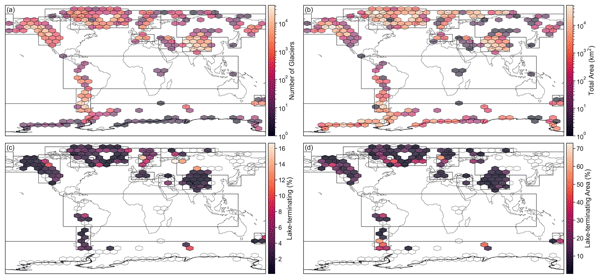
Jakob Steiner, William Armstrong, Will Kochtitzky, Robert McNabb, Rodrigo Aguayo, Tobias Bolch, Fabien Maussion, Vibhor Agarwal, Iestyn Barr, Nathaniel R. Baurley, Mike Cloutier, Katelyn DeWater, Frank Donachie, Yoann Drocourt, Siddhi Garg, Gunjan Joshi, Byron Guzman, Stanislav Kutuzov, Thomas Loriaux, Caleb Mathias, Brian Menounos, Evan Miles, Aleksandra Osika, Kaleigh Potter, Adina Racoviteanu, Brianna Rick, Miles Sterner, Guy D. Tallentire, Levan Tielidze, Rebecca White, Kunpeng Wu, and Whyjay Zheng
Earth Syst. Sci. Data, 18, 1665–1681, https://doi.org/10.5194/essd-18-1665-2026, https://doi.org/10.5194/essd-18-1665-2026, 2026
Short summary
Short summary
Many mountain glaciers around the world flow into lakes – exactly how many however, has never been mapped. Across a large team of experts we have now identified all glaciers that end in lakes. Only about 1% do so, but they are generally larger than those which end on land. This is important to understand, as lakes can influence the behaviour of glacier ice, including how fast it disappears. This new dataset allows us to better model glaciers at a global scale, accounting for the effect of lakes.
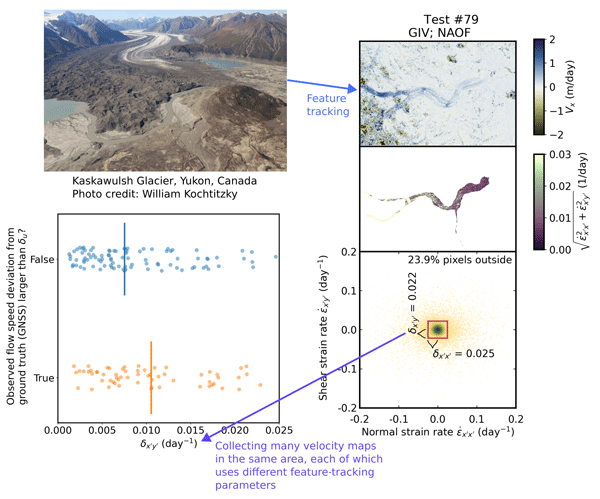
Whyjay Zheng, Shashank Bhushan, Maximillian Van Wyk De Vries, William Kochtitzky, David Shean, Luke Copland, Christine Dow, Renette Jones-Ivey, and Fernando Pérez
The Cryosphere, 17, 4063–4078, https://doi.org/10.5194/tc-17-4063-2023, https://doi.org/10.5194/tc-17-4063-2023, 2023
Short summary
Short summary
We design and propose a method that can evaluate the quality of glacier velocity maps. The method includes two numbers that we can calculate for each velocity map. Based on statistics and ice flow physics, velocity maps with numbers close to the recommended values are considered to have good quality. We test the method using the data from Kaskawulsh Glacier, Canada, and release an open-sourced software tool called GLAcier Feature Tracking testkit (GLAFT) to help users assess their velocity maps.
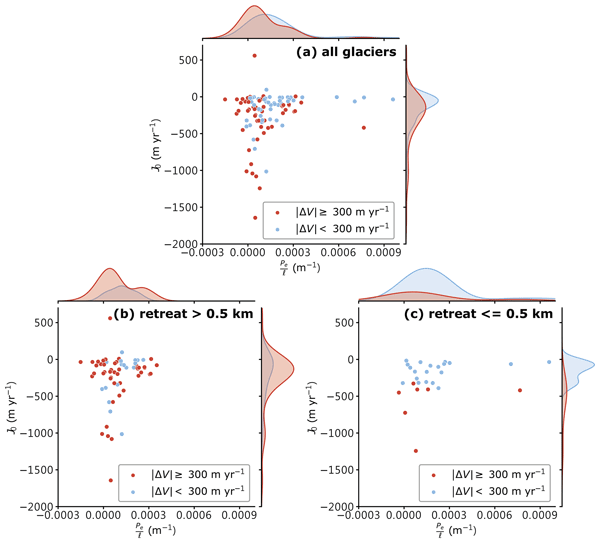
Whyjay Zheng
The Cryosphere, 16, 1431–1445, https://doi.org/10.5194/tc-16-1431-2022, https://doi.org/10.5194/tc-16-1431-2022, 2022
Short summary
Short summary
A glacier can speed up when surface water reaches the glacier's bottom via crevasses and reduces sliding friction. This paper builds up a physical model and finds that thick and fast-flowing glaciers are sensitive to this friction disruption. The data from Greenland and Austfonna (Svalbard) glaciers over 20 years support the model prediction. To estimate the projected sea-level rise better, these sensitive glaciers should be frequently monitored for potential future instabilities.
Leyue Tang, Jonathan L. Bamber, Tian Li, and Gang Qiao
Earth Syst. Sci. Data Discuss., https://doi.org/10.5194/essd-2026-414, https://doi.org/10.5194/essd-2026-414, 2026
Revised manuscript under review for ESSD
Short summary
Short summary
Many Antarctic ice shelves are thinning and retreating, threatening future sea-level rise. Surface damage indicates structural weakening, but long-term records are scarce. We created a multi-decadal surface damage record for nine representative Antarctic ice shelves using satellite imagery and deep learning. The dataset shows that Pine Island, Thwaites and Larsen B have experienced the most significant damage changes since 1999, providing valuable insights into ice shelf stability.
Ruitang Yang, Lizz Ultee, Kristoffer Aalstad, Matvey V. Debolskiy, Regine Hock, Patrick Schmitt, David Rounce, and Tian Li
EGUsphere, https://doi.org/10.5194/egusphere-2026-1081, https://doi.org/10.5194/egusphere-2026-1081, 2026
Short summary
Short summary
We present a new framework to model frontal ablation of marine-terminating glaciers by linking two global glacier models with a simple physics-based calving scheme and Bayesian calibration. Applied to 71 Svalbard glaciers (2000–2019) and projected to 2100, it reproduces seasonal front changes but overestimates ablation due to uncertain geometry and velocity. This efficient approach can improve regional to global simulations.
Jakob Steiner, William Armstrong, Will Kochtitzky, Robert McNabb, Rodrigo Aguayo, Tobias Bolch, Fabien Maussion, Vibhor Agarwal, Iestyn Barr, Nathaniel R. Baurley, Mike Cloutier, Katelyn DeWater, Frank Donachie, Yoann Drocourt, Siddhi Garg, Gunjan Joshi, Byron Guzman, Stanislav Kutuzov, Thomas Loriaux, Caleb Mathias, Brian Menounos, Evan Miles, Aleksandra Osika, Kaleigh Potter, Adina Racoviteanu, Brianna Rick, Miles Sterner, Guy D. Tallentire, Levan Tielidze, Rebecca White, Kunpeng Wu, and Whyjay Zheng
Earth Syst. Sci. Data, 18, 1665–1681, https://doi.org/10.5194/essd-18-1665-2026, https://doi.org/10.5194/essd-18-1665-2026, 2026
Short summary
Short summary
Many mountain glaciers around the world flow into lakes – exactly how many however, has never been mapped. Across a large team of experts we have now identified all glaciers that end in lakes. Only about 1% do so, but they are generally larger than those which end on land. This is important to understand, as lakes can influence the behaviour of glacier ice, including how fast it disappears. This new dataset allows us to better model glaciers at a global scale, accounting for the effect of lakes.
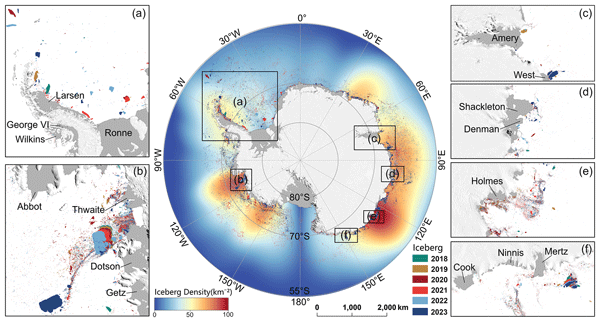
Zilong Chen, Xuying Liu, Zhenfu Guan, Teng Li, Xiao Cheng, Tian Li, Yan Liu, Qi Liang, Lei Zheng, and Jiping Liu
Earth Syst. Sci. Data, 18, 147–166, https://doi.org/10.5194/essd-18-147-2026, https://doi.org/10.5194/essd-18-147-2026, 2026
Short summary
Short summary
Our study uses Google Earth Engine to create a dataset of Antarctic icebergs in the Southern Ocean (south of 55° S) from October 2018 to 2023. The dataset includes icebergs larger than 0.04 km², with details on their locations, sizes, and shapes. It shows significant changes in iceberg number and area, mainly driven by major ice shelf calving events – especially in the Weddell Sea. This resource fills key gaps in understanding iceberg impacts on the ocean and climate.
Bertie W. J. Miles, Tian Li, and Robert G. Bingham
The Cryosphere, 19, 4027–4043, https://doi.org/10.5194/tc-19-4027-2025, https://doi.org/10.5194/tc-19-4027-2025, 2025
Short summary
Short summary
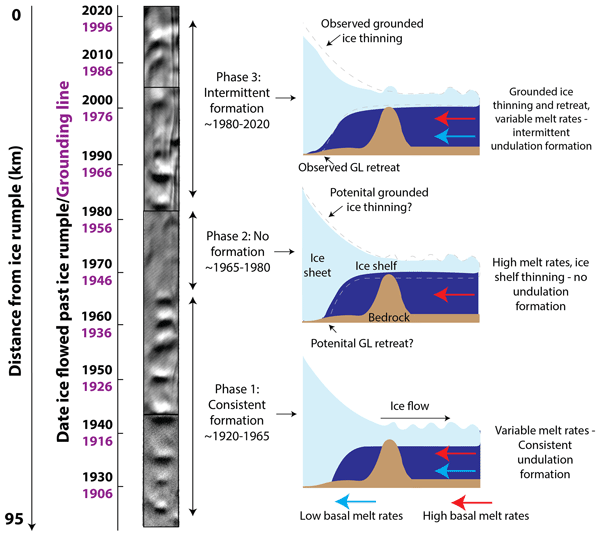
Totten Glacier, East Antarctica's largest mass-loss source, has thinned since at least the 1990s. No sustained acceleration has occurred since 1973, but earlier grounding-line retreat suggests prior loss. A ~20-year gap in surface undulations implies a mid-20th-century warm period that may have triggered ongoing loss. Collapse of a nearby ice shelf supports this. Current ~30-year satellite records are too short to capture full decadal melt-rate variability.
Tian Li, Konrad Heidler, Lichao Mou, Ádám Ignéczi, Xiao Xiang Zhu, and Jonathan L. Bamber
Earth Syst. Sci. Data, 16, 919–939, https://doi.org/10.5194/essd-16-919-2024, https://doi.org/10.5194/essd-16-919-2024, 2024
Short summary
Short summary
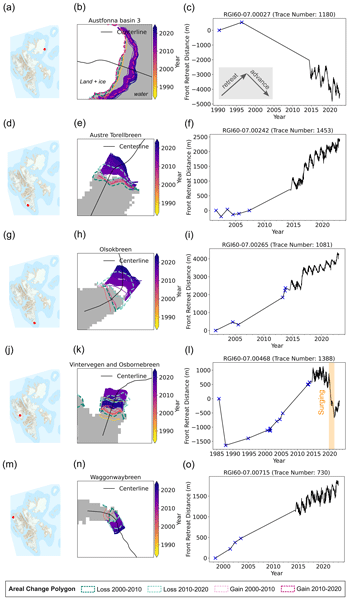
Our study uses deep learning to produce a new high-resolution calving front dataset for 149 marine-terminating glaciers in Svalbard from 1985 to 2023, containing 124 919 terminus traces. This dataset offers insights into understanding calving mechanisms and can help improve glacier frontal ablation estimates as a component of the integrated mass balance assessment.
Whyjay Zheng, Shashank Bhushan, Maximillian Van Wyk De Vries, William Kochtitzky, David Shean, Luke Copland, Christine Dow, Renette Jones-Ivey, and Fernando Pérez
The Cryosphere, 17, 4063–4078, https://doi.org/10.5194/tc-17-4063-2023, https://doi.org/10.5194/tc-17-4063-2023, 2023
Short summary
Short summary
We design and propose a method that can evaluate the quality of glacier velocity maps. The method includes two numbers that we can calculate for each velocity map. Based on statistics and ice flow physics, velocity maps with numbers close to the recommended values are considered to have good quality. We test the method using the data from Kaskawulsh Glacier, Canada, and release an open-sourced software tool called GLAcier Feature Tracking testkit (GLAFT) to help users assess their velocity maps.
Tian Li, Geoffrey J. Dawson, Stephen J. Chuter, and Jonathan L. Bamber
The Cryosphere, 17, 1003–1022, https://doi.org/10.5194/tc-17-1003-2023, https://doi.org/10.5194/tc-17-1003-2023, 2023
Short summary
Short summary
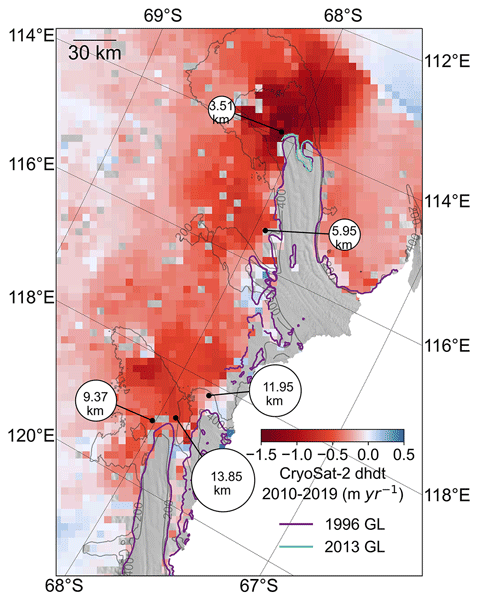
The Totten and Moscow University glaciers in East Antarctica have the potential to make a significant contribution to future sea-level rise. We used a combination of different satellite measurements to show that the grounding lines have been retreating along the fast-flowing ice streams across these two glaciers. We also found two tide-modulated ocean channels that might open new pathways for the warm ocean water to enter the ice shelf cavity.
Whyjay Zheng
The Cryosphere, 16, 1431–1445, https://doi.org/10.5194/tc-16-1431-2022, https://doi.org/10.5194/tc-16-1431-2022, 2022
Short summary
Short summary
A glacier can speed up when surface water reaches the glacier's bottom via crevasses and reduces sliding friction. This paper builds up a physical model and finds that thick and fast-flowing glaciers are sensitive to this friction disruption. The data from Greenland and Austfonna (Svalbard) glaciers over 20 years support the model prediction. To estimate the projected sea-level rise better, these sensitive glaciers should be frequently monitored for potential future instabilities.
Tian Li, Geoffrey J. Dawson, Stephen J. Chuter, and Jonathan L. Bamber
Earth Syst. Sci. Data, 14, 535–557, https://doi.org/10.5194/essd-14-535-2022, https://doi.org/10.5194/essd-14-535-2022, 2022
Short summary
Short summary
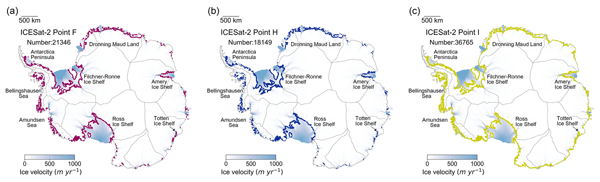
Accurate knowledge of the Antarctic grounding zone is important for mass balance calculation, ice sheet stability assessment, and ice sheet model projections. Here we present the first ICESat-2-derived high-resolution grounding zone product of the Antarctic Ice Sheet, including three important boundaries. This new data product will provide more comprehensive insights into ice sheet instability, which is valuable for both the cryosphere and sea level science communities.
Cited articles
Arthur, J. F., Shackleton, C., Moholdt, G., Matsuoka, K., and van Oostveen, J.: Evidence of active subglacial lakes under a slowly moving coastal region of the Antarctic Ice Sheet, The Cryosphere, 19, 375–392, https://doi.org/10.5194/tc-19-375-2025, 2025. a
Bell, R. E.: The role of subglacial water in ice-sheet mass balance, Nat. Geosci., 1, 297–304, https://doi.org/10.1038/ngeo186, 2008. a, b
Beyer, R. A., Alexandrov, O., and McMichael, S.: The Ames Stereo Pipeline: NASA's Open Source Software for Deriving and Processing Terrain Data, Earth Space Sci., 5, 537–548, https://doi.org/10.1029/2018EA000409, 2018. a
Björnsson, H.: Subglacial lakes and jökulhlaups in Iceland, Global Planet. Change, 35, 255–271, https://doi.org/10.1016/S0921-8181(02)00130-3, 2003. a, b, c
Björnsson, H., Rott, H., Gudmundsson, S., Fischer, A., Siegel, A., and Gudmundsson, M. T.: Glacier–volcano interactions deduced by SAR interferometry, J. Glaciol., 47, 58–70, https://doi.org/10.3189/172756501781832520, 2001. a, b
Bowling, J. S., Livingstone, S. J., Sole, A. J., and Chu, W.: Distribution and dynamics of Greenland subglacial lakes, Nat. Commun., 10, 2810, https://doi.org/10.1038/s41467-019-10821-w, 2019. a, b
Burgess, D. O. and Danielson, B. D.: Meighen Ice Cap: changes in geometry, mass, and climatic response since 1959, Can. J. Earth Sci., 59, 884–896, https://doi.org/10.1139/cjes-2021-0126, 2022. a
Capps, D. M., Rabus, B., Clague, J. J., and Shugar, D. H.: Identification and characterization of alpine subglacial lakes using interferometric synthetic aperture radar (InSAR): Brady Glacier, Alaska, USA, J. Glaciol., 56, 861–870, https://doi.org/10.3189/002214310794457254, 2010. a, b
Ehrenfeucht, S., Dow, C., McArthur, K., Morlighem, M., and McCormack, F. S.: Antarctic Wide Subglacial Hydrology Modeling, Geophys. Res. Lett., 52, e2024GL111386, https://doi.org/10.1029/2024GL111386, 2025. a
Ester, M., Kriegel, H.-P., Sander, J., and Xu, X.: A density-based algorithm for discovering clusters in large spatial databases with noise, in: Proceedings of the Second International Conference on Knowledge Discovery and Data Mining (KDD-96), edited by Simoudis, E., Han, J., and Fayyad, U. M., 226–231, AAAI Press, https://dl.acm.org/doi/10.5555/3001460.3001507 (Last access: 18 March 2026.), 1996. a
Flament, T., Berthier, E., and Rémy, F.: Cascading water underneath Wilkes Land, East Antarctic ice sheet, observed using altimetry and digital elevation models, The Cryosphere, 8, 673–687, https://doi.org/10.5194/tc-8-673-2014, 2014. a, b
Fricker, H. A. and Scambos, T.: Connected subglacial lake activity on lower Mercer and Whillans Ice Streams, West Antarctica, 2003–2008, J. Glaciol., 55, 303–315, https://doi.org/10.3189/002214309788608813, 2009. a, b
Fricker, H. A., Carter, S. P., Bell, R. E., and Scambos, T.: Active lakes of recovery ice stream, East Antarctica: A bedrock-controlled subglacial hydrological system, J. Glaciol., 60, 1015–1030, https://doi.org/10.3189/2014JoG14J063, 2014. a, b
Gardner, A. S., Moholdt, G., Wouters, B., Wolken, G. J., Burgess, D. O., Sharp, M. J., Cogley, J. G., Braun, C., and Labine, C.: Sharply increased mass loss from glaciers and ice caps in the Canadian Arctic Archipelago, Nature, 473, 357–360, https://doi.org/10.1038/nature10089, 2011. a
Gardner, A. S., Moholdt, G., Scambos, T., Fahnstock, M., Ligtenberg, S., van den Broeke, M., and Nilsson, J.: Increased West Antarctic and unchanged East Antarctic ice discharge over the last 7 years, The Cryosphere, 12, 521–547, https://doi.org/10.5194/tc-12-521-2018, 2018. a, b
Gardner, A. S., Fahnestock, M. A., and Scambos, T. A.: ITS_LIVE Regional Glacier and Ice Sheet Surface Velocities, National Snow and Ice Data Center [data set], https://doi.org/10.5067/6II6VW8LLWJ7, 2019. a, b
Gray, L., Burgess, D., Copland, L., Demuth, M. N., Dunse, T., Langley, K., and Schuler, T. V.: CryoSat-2 delivers monthly and inter-annual surface elevation change for Arctic ice caps, The Cryosphere, 9, 1895–1913, https://doi.org/10.5194/tc-9-1895-2015, 2015. a
Gray, L., Burgess, D., Copland, L., Dow, C., Fettweis, X., Fisher, D., Kochtitzky, W., van Wychen, W., and Zheng, J.: Repeated subglacial jökulhlaups in northeastern Greenland revealed by CryoSat, J. Glaciol., 1–11, https://doi.org/10.1017/jog.2024.32, 2024a. a, b, c
Gray, L., Lauzon, B., Copland, L., Van Wychen, W., Dow, C., Kochtitzky, W., and Alley, K. E.: Tracking the Filling, Outburst Flood and Resulting Subglacial Water Channel From a Large Canadian Arctic Subglacial Lake, Geophys. Res. Lett., 51, https://doi.org/10.1029/2024GL110456, 2024b. a, b, c, d, e, f, g, h
Hodgson, D. A., Jordan, T. A., Ross, N., Riley, T. R., and Fretwell, P. T.: Drainage and refill of an Antarctic Peninsula subglacial lake reveal an active subglacial hydrological network, The Cryosphere, 16, 4797–4809, https://doi.org/10.5194/tc-16-4797-2022, 2022. a
Hugonnet, R., McNabb, R., Berthier, E., Menounos, B., Nuth, C., Girod, L., Farinotti, D., Huss, M., Dussaillant, I., Brun, F., and Kääb, A.: Accelerated global glacier mass loss in the early twenty-first century, Nature, 592, 726–731, https://doi.org/10.1038/s41586-021-03436-z, 2021. a, b, c, d
Jakob, L. and Gourmelen, N.: Glacier Mass Loss Between 2010 and 2020 Dominated by Atmospheric Forcing, Geophys. Res. Lett., 50, 1–10, https://doi.org/10.1029/2023GL102954, 2023. a
Khalsa, S. J. S., Borsa, A., Nandigam, V., Phan, M., Lin, K., Crosby, C., Fricker, H., Baru, C., and Lopez, L.: OpenAltimetry – rapid analysis and visualization of Spaceborne altimeter data, Earth Sci. Inform., 15, 1471–1480, https://doi.org/10.1007/s12145-020-00520-2, 2022. a
Killingbeck, S. F., Rutishauser, A., Unsworth, M. J., Dubnick, A., Criscitiello, A. S., Killingbeck, J., Dow, C. F., Hill, T., Booth, A. D., Main, B., and Brossier, E.: Misidentified subglacial lake beneath the Devon Ice Cap, Canadian Arctic: a new interpretation from seismic and electromagnetic data, The Cryosphere, 18, 3699–3722, https://doi.org/10.5194/tc-18-3699-2024, 2024. a, b
Killingbeck, S. F., Unsworth, M. J., Young, D. A., Rutishauser, A., Yan, S., Beem, L. H., Richter, T. G., Blankenship, D. D., Dubnick, A., Criscitiello, A. S., Vestrum, Z., Greenbaum, J., and Dow, C. F.: Integrating Gravity, Magnetic, and Magnetotelluric Data Over Devon Ice Cap, Canadian Arctic, to Investigate the Subglacial Geology, J. Geophys. Res.-Sol. Ea., 130, https://doi.org/10.1029/2024JB028929, 2025. a
Lenaerts, J. T. M., van Angelen, J. H., van den Broeke, M. R., Gardner, A. S., Wouters, B., and van Meijgaard, E.: Irreversible mass loss of Canadian Arctic Archipelago glaciers, Geophys. Res. Lett., 40, 870–874, https://doi.org/10.1002/grl.50214, 2013. a, b, c
Livingstone, S. J., Clark, C. D., Woodward, J., and Kingslake, J.: Potential subglacial lake locations and meltwater drainage pathways beneath the Antarctic and Greenland ice sheets, The Cryosphere, 7, 1721–1740, https://doi.org/10.5194/tc-7-1721-2013, 2013. a, b
Livingstone, S. J., Li, Y., Rutishauser, A., Sanderson, R. J., Winter, K., Mikucki, J. A., Björnsson, H., Bowling, J. S., Chu, W., Dow, C. F., Fricker, H. A., McMillan, M., Ng, F. S. L., Ross, N., Siegert, M. J., Siegfried, M., and Sole, A. J.: Subglacial lakes and their changing role in a warming climate, Nature Reviews Earth & Environment, 3, 106–124, https://doi.org/10.1038/s43017-021-00246-9, 2022. a, b, c, d, e, f, g, h, i
MacKie, E. J., Schroeder, D. M., Caers, J., Siegfried, M. R., and Scheidt, C.: Antarctic Topographic Realizations and Geostatistical Modeling Used to Map Subglacial Lakes, J. Geophys. Res.-Earth, 125, https://doi.org/10.1029/2019JF005420, 2020. a
Magnússon, E., Rott, H., Björnsson, H., and Pálsson, F.: The impact of jökulhlaups on basal sliding observed by SAR interferometry on Vatnajökull, Iceland, J. Glaciol., 53, 232–240, https://doi.org/10.3189/172756507782202810, 2007. a
Noël, B., van de Berg, W. J., Lhermitte, S., Wouters, B., Schaffer, N., and van den Broeke, M. R.: Six Decades of Glacial Mass Loss in the Canadian Arctic Archipelago, J. Geophys. Res.-Earth, 123, 1430–1449, https://doi.org/10.1029/2017JF004304, 2018. a, b, c
Pedregosa, F., Varoquaux, G., Gramfort, A., Michel, V., Thirion, B., Grisel, O., Blondel, M., Prettenhofer, P., Weiss, R., Dubourg, V., Vanderplas, J., Passos, A., Cournapeau, D., Brucher, M., Perrot, M., and Duchesnay, E.: Scikit-learn: Machine Learning in Python, J. Mach. Learn. Res., 12, 2825–2830, 2011. a, b
Porter, C., Howat, I., Noh, M.-J., Husby, E., Khuvis, S., Danish, E., Tomko, K., Gardiner, J., Negrete, A., Yadav, B., Klassen, J., Kelleher, C., Cloutier, M., Bakker, J., Enos, J., Arnold, G., Bauer, G., and Morin, P.: ArcticDEM – Strips, Version 4.1, Harvard Dataverse [data set], https://doi.org/10.7910/DVN/C98DVS, 2022. a, b, c, d, e
Porter, C., Howat, I., Noh, M.-J., Husby, E., Khuvis, S., Danish, E., Tomko, K., Gardiner, J., Negrete, A., Yadav, B., Klassen, J., Kelleher, C., Cloutier, M., Bakker, J., Enos, J., Arnold, G., Bauer, G., and Morin, P.: ArcticDEM – Mosaics, Version 4.1, Harvard Dataverse [data set], https://doi.org/10.7910/DVN/3VDC4W, 2023. a
Rasmussen, C. E. and Williams, C. K. I.: Gaussian Processes for Machine Learning, The MIT Press, ISBN 026218253X, https://doi.org/10.7551/mitpress/3206.001.0001, 2005. a
Rutishauser, A., Blankenship, D. D., Sharp, M., Skidmore, M. L., Greenbaum, J. S., Grima, C., Schroeder, D. M., Dowdeswell, J. A., and Young, D. A.: Discovery of a hypersaline subglacial lake complex beneath Devon Ice Cap, Canadian Arctic, Science Advances, 4, 2–7, https://doi.org/10.1126/sciadv.aar4353, 2018. a, b
Sandberg Sørensen, L., Bahbah, R., Simonsen, S. B., Havelund Andersen, N., Bowling, J., Gourmelen, N., Horton, A., Karlsson, N. B., Leeson, A., Maddalena, J., McMillan, M., Solgaard, A., and Wessel, B.: Improved monitoring of subglacial lake activity in Greenland, The Cryosphere, 18, 505–523, https://doi.org/10.5194/tc-18-505-2024, 2024. a
Sharp, M., Burgess, D. O., Cogley, J. G., Ecclestone, M., Labine, C., and Wolken, G. J.: Extreme melt on Canada's Arctic ice caps in the 21st century, Geophys. Res. Lett., 38, L11501, https://doi.org/10.1029/2011GL047381, 2011. a, b
Siegfried, M., Venturelli, R., Patterson, M., Arnuk, W., Campbell, T., Gustafson, C., Michaud, A., Galton-Fenzi, B., Hausner, M., Holzschuh, S., Huber, B., Mankoff, K., Schroeder, D., Summers, P., Tyler, S., Carter, S., Fricker, H., Harwood, D., Leventer, A., Rosenheim, B., Skidmore, M., and Priscu, J.: The life and death of a subglacial lake in West Antarctica, Geology, 51, 434–438, https://doi.org/10.1130/G50995.1, 2023. a
Siegfried, M. R. and Fricker, H. A.: Thirteen years of subglacial lake activity in Antarctica from multi-mission satellite altimetry, Ann. Glaciol., 59, 42–55, https://doi.org/10.1017/aog.2017.36, 2018. a
Siegfried, M. R. and Fricker, H. A.: Illuminating Active Subglacial Lake Processes With ICESat‐2 Laser Altimetry, Geophys. Res. Lett., 48, https://doi.org/10.1029/2020GL091089, 2021. a
Siegfried, M. R., Fricker, H. A., Carter, S. P., and Tulaczyk, S.: Episodic ice velocity fluctuations triggered by a subglacial flood in West Antarctica, Geophys. Res. Lett., 43, 2640–2648, https://doi.org/10.1002/2016GL067758, 2016. a, b, c
Smith, B., Adusumilli, S., Csatho, B. M., Felikson, D., Helen, A. F., Gardner, A., Holschuh, N., Lee, J., Paolo, F. S., Siegfried, M. R., Sutterley, T., and ICESat-2 Science Team: ATLAS/ICESat-2 L3A Land Ice Height, Version 6, National Snow and Ice Data Center [data set], https://doi.org/10.5067/ATLAS/ATL06.006, 2023. a, b
Smith, B. E., Fricker, H. A., Joughin, I. R., and Tulaczyk, S.: An inventory of active subglacial lakes in Antarctica detected by ICESat (2003–2008), J. Glaciol., 55, 573–595, https://doi.org/10.3189/002214309789470879, 2009. a
Smith, B. E., Gourmelen, N., Huth, A., and Joughin, I.: Connected subglacial lake drainage beneath Thwaites Glacier, West Antarctica, The Cryosphere, 11, 451–467, https://doi.org/10.5194/tc-11-451-2017, 2017. a
Stubblefield, A. G., Meyer, C. R., Siegfried, M. R., Sauthoff, W., and Spiegelman, M.: Reconstructing subglacial lake activity with an altimetry-based inverse method, J. Glaciol., 1–15, https://doi.org/10.1017/jog.2023.90, 2023. a
Willis, M. J., Herried, B. G., Bevis, M. G., and Bell, R. E.: Recharge of a subglacial lake by surface meltwater in northeast Greenland, Nature, 518, 223–227, https://doi.org/10.1038/nature14116, 2015. a, b, c
Wingham, D. J., Siegert, M. J., Shepherd, A., and Muir, A. S.: Rapid discharge connects Antarctic subglacial lakes, Nature, 440, 1033–1036, https://doi.org/10.1038/nature04660, 2006. a, b, c
Wright, A. and Siegert, M.: A fourth inventory of Antarctic subglacial lakes, Antarctic Sci., 24, 659–664, https://doi.org/10.1017/S095410201200048X, 2012. a
Zemp, M., Jakob, L., Dussaillant, I., Nussbaumer, S. U., Gourmelen, N., Dubber, S., A, G., Abdullahi, S., Andreassen, L. M., Berthier, E., Bhattacharya, A., Blazquez, A., Boehm Vock, L. F., Bolch, T., Box, J., Braun, M. H., Brun, F., Cicero, E., Colgan, W., Eckert, N., Farinotti, D., Florentine, C., Floricioiu, D., Gardner, A., Harig, C., Hassan, J., Hugonnet, R., Huss, M., Jóhannesson, T., Liang, C.-C. A., Ke, C.-Q., Khan, S. A., King, O., Kneib, M., Krieger, L., Maussion, F., Mattea, E., McNabb, R., Menounos, B., Miles, E., Moholdt, G., Nilsson, J., Pálsson, F., Pfeffer, J., Piermattei, L., Plummer, S., Richter, A., Sasgen, I., Schuster, L., Seehaus, T., Shen, X., Sommer, C., Sutterley, T., Treichler, D., Velicogna, I., Wouters, B., Zekollari, H., and Zheng, W.: Community estimate of global glacier mass changes from 2000 to 2023, Nature, https://doi.org/10.1038/s41586-024-08545-z, 2025. a, b, c, d, e, f, g, h
Zhang, G., Bolch, T., Yao, T., Rounce, D. R., Chen, W., Veh, G., King, O., Allen, S. K., Wang, M., and Wang, W.: Underestimated mass loss from lake-terminating glaciers in the greater Himalaya, Nat. Geosci., 16, 333–338, https://doi.org/10.1038/s41561-023-01150-1, 2023. a
Zheng, W., Pritchard, M. E., Willis, M. J., Tepes, P., Gourmelen, N., Benham, T. J., and Dowdeswell, J. A.: Accelerating glacier mass loss on Franz Josef Land, Russian Arctic, Remote Sens. Environ., 211, 357–375, https://doi.org/10.1016/j.rse.2018.04.004, 2018. a, b, c
Zheng, W., Durkin, W. J., Melkonian, A. K., and Pritchard, M. E.: Cryosphere And Remote Sensing Toolkit (CARST) v2.0.0a1, Zenodo [code], https://doi.org/10.5281/zenodo.4592619, 2021. a, b
Zheng, W., Willis, M. J., Pritchard, M. E., and Howat, I.: 15-m ArcticDEM-derived Elevation Change Rate of Glaciers in The Arctic, Taiwan Polar Institute Data Repository [data set], https://doi.org/10.30238/TPIDR.DB_ECRG/Dataset, 2024. a, b
Zheng, W.: whyjz/ac-subglacial-lakes: v1.0, Zenodo [code], https://doi.org/10.5281/zenodo.19097467, 2026. a
Short summary
We identify lakes beneath the glaciers in the Canadian Arctic using satellite measurements over a decade, increasing the number of known subglacial lakes in this area from 2 to 37. These lakes are recharged by billions of cubic meters of water, and the draining of these lakes can lower the ice elevation by more than 100 m. We find three types of subglacial lakes, two of which are primarily located in the Canadian Arctic. When glaciers lose their ice quickly, these lakes become active.
We identify lakes beneath the glaciers in the Canadian Arctic using satellite measurements over...


