
Articles | Volume 18, issue 4
https://doi.org/10.5194/tc-18-2061-2024
© Author(s) 2024. This work is distributed under
the Creative Commons Attribution 4.0 License.
the Creative Commons Attribution 4.0 License.
https://doi.org/10.5194/tc-18-2061-2024
© Author(s) 2024. This work is distributed under
the Creative Commons Attribution 4.0 License.
the Creative Commons Attribution 4.0 License.
Research article
| 
30 Apr 2024
Research article |
| 30 Apr 2024
| 30 Apr 2024
Towards the systematic reconnaissance of seismic signals from glaciers and ice sheets – Part 1: Event detection for cryoseismology
Rebecca B. Latto
CORRESPONDING AUTHOR

School of Natural Sciences (Physics), University of Tasmania, Private Bag 37, Hobart, TAS 7001, Australia
Ross J. Turner
School of Natural Sciences (Physics), University of Tasmania, Private Bag 37, Hobart, TAS 7001, Australia
Anya M. Reading
School of Natural Sciences (Physics), University of Tasmania, Private Bag 37, Hobart, TAS 7001, Australia
J. Paul Winberry
Department of Geological Sciences, Central Washington University, Ellensburg, WA, USA
Related authors
Rebecca B. Latto, Ross J. Turner, Anya M. Reading, Sue Cook, Bernd Kulessa, and J. Paul Winberry
The Cryosphere, 18, 2081–2101, https://doi.org/10.5194/tc-18-2081-2024, https://doi.org/10.5194/tc-18-2081-2024, 2024
Short summary
Short summary
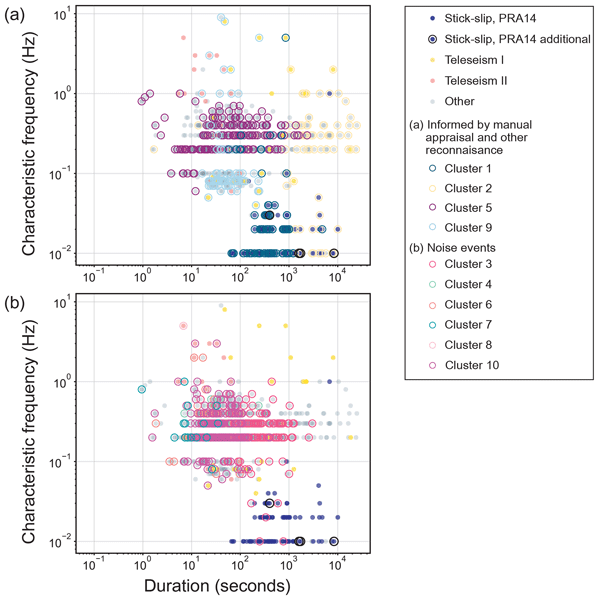
Seismic catalogues are potentially rich sources of information on glacier processes. In a companion study, we constructed an event catalogue for seismic data from the Whillans Ice Stream. Here, we provide a semi-automated workflow for consistent catalogue analysis using an unsupervised cluster analysis. We discuss the defining characteristics of identified signal types found in this catalogue and possible mechanisms for the underlying glacier processes and noise sources.
Mirko Scheinert, Weisen Shen, Richard C. Aster, Lambert Caron, Michael D. Hartinger, Matt A. King, Andrew Lloyd, Anya M. Reading, J. Paul Winberry, Terry Wilson, Lucilla Alfonsi, Michael J. Bentley, Eric Buchta, Thomas Y. Chen, Peter J. Clarke, Jörg Ebbing, Olaf Eisen, Natalya Gomez, Esra Günaydın, Samantha Hansen, Erik R. Ivins, Achraf Koulali, Grace A. Nield, Frederick Richards, Mahmut O. Selbesoglu, Stephanie Sherman, Pippa L. Whitehouse, and Matthias Willen
EGUsphere, https://doi.org/10.5194/egusphere-2025-6370, https://doi.org/10.5194/egusphere-2025-6370, 2026
Short summary
Short summary
With an ongoing mass loss the Antarctic Ice Sheet contributes to global-mean sea level rise at a rate of 0.4 mm/a. Thus, it plays a key role in global climate and provides a natural laboratory to study processes that interlink cryosphere, solid Earth, atmosphere and ocean. We discuss how GNSS and seismic networks in Antarctica were used to significantly advance our understanding of these processes, and how they should be maintained and extended to answer key science questions in the future.
Rebecca B. Latto, Ross J. Turner, Anya M. Reading, Sue Cook, Bernd Kulessa, and J. Paul Winberry
The Cryosphere, 18, 2081–2101, https://doi.org/10.5194/tc-18-2081-2024, https://doi.org/10.5194/tc-18-2081-2024, 2024
Short summary
Short summary
Seismic catalogues are potentially rich sources of information on glacier processes. In a companion study, we constructed an event catalogue for seismic data from the Whillans Ice Stream. Here, we provide a semi-automated workflow for consistent catalogue analysis using an unsupervised cluster analysis. We discuss the defining characteristics of identified signal types found in this catalogue and possible mechanisms for the underlying glacier processes and noise sources.
Molly O. Patterson, Richard H. Levy, Denise K. Kulhanek, Tina van de Flierdt, Huw Horgan, Gavin B. Dunbar, Timothy R. Naish, Jeanine Ash, Alex Pyne, Darcy Mandeno, Paul Winberry, David M. Harwood, Fabio Florindo, Francisco J. Jimenez-Espejo, Andreas Läufer, Kyu-Cheul Yoo, Osamu Seki, Paolo Stocchi, Johann P. Klages, Jae Il Lee, Florence Colleoni, Yusuke Suganuma, Edward Gasson, Christian Ohneiser, José-Abel Flores, David Try, Rachel Kirkman, Daleen Koch, and the SWAIS 2C Science Team
Sci. Dril., 30, 101–112, https://doi.org/10.5194/sd-30-101-2022, https://doi.org/10.5194/sd-30-101-2022, 2022
Short summary
Short summary
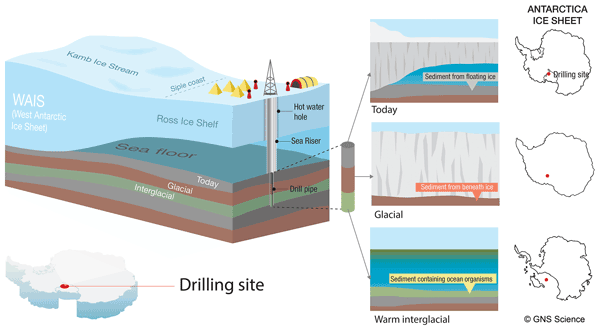
How much of the West Antarctic Ice Sheet will melt and how quickly it will happen when average global temperatures exceed 2 °C is currently unknown. Given the far-reaching and international consequences of Antarctica’s future contribution to global sea level rise, the SWAIS 2C Project was developed in order to better forecast the size and timing of future changes.
Cited articles
Allen, R.: Automatic phase pickers: Their present use and future prospects, B. Seismol. Soc. Am., 72, S225–S242, 1982. a
Allstadt, K. and Malone, S. D.: Swarms of repeating stick-slip icequakes triggered by snow loading at Mount Rainier volcano, J. Geophys. Res.-Earth, 119, 1180–1203, https://doi.org/10.1002/2014JF003086, 2014. a
Anderson, K. R., Beaudoin, B. C., Butler, R., Clinton, J. F., Dahl-Jensen, T., Ekstrom, G., Giardini, D., Govoni, A., Hanka, W., Kanao, M., Larsen, T., Lasocki, S., McCormack, D. A., Mykkeltveit, S., Nettles, M., Agostinetti, N. P., Stutzmann, E., Tsuboi, S., and Vos, P.: The Greenland Ice Sheet Monitoring Network (GLISN), AGUFM, 2010, C43A–0525, 2010. a
Anstey, N. A.: The Sectional auto-correlogram and the section retro-correlogram ∗ Part I: The sectional auto-correlogram, Geophys. Prospect., 14, 389–426, 1966. a
Anthony, R. E., Aster, R. C., Wiens, D., Nyblade, A., Anandakrishnan, S., Huerta, A., Winberry, J. P., Wilson, T., and Rowe, C.: The seismic noise environment of Antarctica, Seismol. Res. Lett., 86, 89–100, 2015. a
Aster, R. and Winberry, J.: Glacial seismology, Rep. Prog. Phys., 80, 126801, https://doi.org/10.1088/1361-6633/aa8473, 2017. a
Baker, M. G., Aster, R. C., Wiens, D. A., Nyblade, A., Bromirski, P. D., Gerstoft, P., and Stephen, R. A.: Teleseismic earthquake wavefields observed on the Ross Ice Shelf, J. Glaciol., 67, 58–74, 2021. a
Bassis, J. N., Fricker, H. A., Coleman, R., Bock, Y., Behrens, J., Darnell, D., Okal, M., and Minster, J.-B.: Seismicity and deformation associated with ice-shelf rift propagation, J. Glaciol., 53, 523–536, 2007. a
Beem, L., Tulaczyk, S., King, M., Bougamont, M., Fricker, H., and Christoffersen, P.: Variable deceleration of Whillans Ice Stream, West Antarctica, J. Geophys. Res.-Earth, 119, 212–224, 2014. a
Bergen, K. J. and Beroza, G. C.: Earthquake fingerprints: Extracting waveform features for similarity-based earthquake detection, Pure Appl. Geophys., 176, 1037–1059, 2019. a
Bergen, K. J., Chen, T., and Li, Z.: Preface to the focus section on machine learning in seismology, Seismol. Res. Lett., 90, 477–480, 2019. a
Burton-Johnson, A., Black, M., Fretwell, P. T., and Kaluza-Gilbert, J.: An automated methodology for differentiating rock from snow, clouds and sea in Antarctica from Landsat 8 imagery: a new rock outcrop map and area estimation for the entire Antarctic continent, The Cryosphere, 10, 1665–1677, https://doi.org/10.5194/tc-10-1665-2016, 2016. a
Cathles IV, L., Okal, E. A., and MacAyeal, D. R.: Seismic observations of sea swell on the floating Ross Ice Shelf, Antarctica, J. Geophys. Res.-Earth, 114, F02015, https://doi.org/10.1029/2007JF000934, 2009. a
Chaput, J., Aster, R. C., McGrath, D., Baker, M., Anthony, R. E., Gerstoft, P., Bromirski, P., Nyblade, A., Stephen, R. A., Wiens, D. A., Das, S. B., and Stevens, L. A.: Near-Surface Environmentally Forced Changes in the Ross Ice Shelf Observed With Ambient Seismic Noise, Geophys. Res. Lett., 45, 11–187, 2018. a
Cichowicz, A.: An automatic S-phase picker, B. Seismol. Soc. Am., 83, 180–189, 1993. a
Comiso, J. C.: Variability and trends in Antarctic surface temperatures from in situ and satellite infrared measurements, J. Climate, 13, 1674–1696, 2000. a
DeConto, R. M. and Pollard, D.: Contribution of Antarctica to past and future sea-level rise, Nature, 531, 591–597, 2016. a
Feuerverger, A. and Mureika, R. A.: The empirical characteristic function and its applications, Ann. Stat., 5, 88–97, 1977. a
Gal, M. and Reading, A. M.: Beamforming and polarization analysis, in: Seismic Ambient Noise, edited by: Nakata, N., Gualtieri, L., and Fichtner, A., Cambridge University Press, p. 30, Online ISBN 9781108264808, https://doi.org/10.1017/9781108264808, 2019. a
Gal, M., Reading, A., Ellingsen, S., Koper, K., Burlacu, R., and Gibbons, S.: Deconvolution enhanced direction of arrival estimation using one-and three-component seismic arrays applied to ocean induced microseisms, Geophys. J. Int., 206, 345–359, 2016. a
Grigoli, F., Cesca, S., Krieger, L., Kriegerowski, M., Gammaldi, S., Horalek, J., Priolo, E., and Dahm, T.: Automated microseismic event location using master-event waveform stacking, Sci. Rep.-UK, 6, 25744, https://doi.org/10.1038/srep25744, 2016. a
Hammer, C., Ohrnberger, M., and Schlindwein, V.: Pattern of cryospheric seismic events observed at Ekström Ice Shelf, Antarctica, Geophys. Res. Lett., 42, 3936–3943, https://doi.org/10.1002/2015GL064029, 2015. a
Howard, S. L., Erofeeva, S., and Padman, L.: CATS2008: Circum-Antarctic Tidal Simulation version 2008, U.S. Antarctic Program (USAP) Data Center, https://doi.org/10.15784/601235, 2019. a, b
Hudson, T. S., Smith, J., Brisbourne, A. M., and White, R. S.: Automated detection of basal icequakes and discrimination from surface crevassing, Ann. Glaciol., 60, 167–181, https://doi.org/10.1017/aog.2019.18, 2019. a
Hudson, T. S., Brisbourne, A. M., Kufner, S.-K., Kendall, J.-M., and Smith, A. M.: Array processing in cryoseismology: a comparison to network-based approaches at an Antarctic ice stream, The Cryosphere, 17, 4979–4993, https://doi.org/10.5194/tc-17-4979-2023, 2023. a, b
Jenkins, W. F., Gerstoft, P., Bianco, M. J., and Bromirski, P. D.: Unsupervised deep clustering of seismic data: Monitoring the Ross Ice Shelf, Antarctica, J. Geophys. Res.-Sol. Ea., 126, e2021JB021716, https://doi.org/10.1029/2021JB021716, 2021. a
Key, J., Wang, X., Liu, Y., Dworak, R., and Letterly, A.: The AVHRR polar pathfinder climate data records, Remote Sens.-Basel, 8, 167, https://doi.org/10.3390/rs8030167, 2016. a
Key, J., Liu, Y., and Wang, X.: Program: NOAA Climate Data Record (CDR) of AVHRR Polar Pathfinder (APP) Cryosphere, Version 2.0., NOAA National Centers for Environnemental Information (NCEI), Boulder, CO, https://doi.org/10.25921/X2X1-JR34, 2019. a
Köhler, A., Ohrnberger, M., Riggelsen, C., and Scherbaum, F.: Unsupervised feature selection for pattern search in seismic time series, in: J. Mach. Learn. Res., Workshop and Conference Proceedings: New challenges for feature selection in data mining and knowledge discovery, 15 September 2008, Antwerp, Belgium, vol. 4, pp. 106–121, 2008. a
Köhler, A., Nuth, C., Schweitzer, J., Weidle, C., and Gibbons, S. J.: Regional passive seismic monitoring reveals dynamic glacier activity on Spitsbergen, Svalbard, Polar Res., 34, 26178, https://doi.org/10.3402/polar.v34.26178, 2015. a
Krischer, L., Megies, T., Barsch, R., Beyreuther, M., Lecocq, T., Caudron, C., and Wassermann, J.: ObsPy: A bridge for seismology into the scientific Python ecosystem, Computational Science & Discovery, 8, 014003, https://doi.org/10.1088/1749-4699/8/1/014003, 2015. a
Latto, R. B., Turner, R. J., Reading, A. M., Cook, S., Kulessa, B., and Winberry, J. P.: Towards the systematic reconnaissance of seismic signals from glaciers and ice sheets – Part 2: Unsupervised learning for source process characterization, The Cryosphere, 18, 2081–2101, https://doi.org/10.5194/tc-18-2081-2024, 2024. a, b, c, d, e, f, g
Latto, B.: beccalatto/multi_sta_lta: Towards the systematic reconnaissance of seismic signals from glaciers and ice sheets – Part 1: Event detection for cryoseismology (v1.0.0), Zenodo [code], https://doi.org/10.5281/zenodo.11062070, 2024. a
Lipovsky, B. P. and Dunham, E. M.: Tremor during ice-stream stick slip, The Cryosphere, 10, 385–399, https://doi.org/10.5194/tc-10-385-2016, 2016. a
Lois, A., Sokos, E., Martakis, N., Paraskevopoulos, P., and Tselentis, G.-A.: A new automatic S-onset detection technique: Application in local earthquake data, Geophysics, 78, KS1–KS11, 2013. a
Lombardi, D., Gorodetskaya, I., Barruol, G., and Camelbeeck, T.: Thermally induced icequakes detected on blue ice areas of the East Antarctic ice sheet, Ann. Glaciol., 60, 45–56, 2019. a
Lough, A. C., Barcheck, C. G., Wiens, D. A., Nyblade, A., and Anandakrishnan, S.: A previously unreported type of seismic source in the firn layer of the East Antarctic Ice Sheet, J. Geophys. Res.-Earth, 120, 2237–2252, 2015. a
MacAyeal, D., Okal, E., Aster, R., and Bassis, J.: Seismic and hydroacoustic tremor generated by colliding icebergs, J. Geophys. Res.-Earth, 113, F3, https://doi.org/10.1029/2008JF001005, 2008. a
MacAyeal, D. R., Banwell, A. F., Okal, E. A., Lin, J., Willis, I. C., Goodsell, B., and MacDonald, G. J.: Diurnal seismicity cycle linked to subsurface melting on an ice shelf, Ann. Glaciol., 60, 137–157, 2019. a
Makinson, K., King, M. A., Nicholls, K. W., and Hilmar Gudmundsson, G.: Diurnal and semidiurnal tide-induced lateral movement of Ronne Ice Shelf, Antarctica, Geophys. Res. Lett., 39, L10501, https://doi.org/10.1029/2012GL051636, 2012. a
McBrearty, I. W., Zoet, L. K., and Anandakrishnan, S.: Basal seismicity of the Northeast Greenland Ice Stream, J. Glaciol., 66, 430–446, https://doi.org/10.1017/jog.2020.17, 2020. a
Megies, T., Beyreuther, M., Barsch, R., Krischer, L., and Wassermann, J.: ObsPy–What can it do for data centers and observatories?, Ann. Geophys., 54, 47–58, 2011. a
Mikesell, T., van Wijk, K., Haney, M. M., Bradford, J. H., Marshall, H.-P., and Harper, J. T.: Monitoring glacier surface seismicity in time and space using Rayleigh waves, J. Geophys. Res.-Earth, 117, https://doi.org/10.1029/2011JF002259, 2012. a
Minowa, M., Podolskiy, E. A., and Sugiyama, S.: Tide-modulated ice motion and seismicity of a floating glacier tongue in East Antarctica, Ann. Glaciol., 60, 57–67, https://doi.org/10.1017/aog.2019.25, 2019. a
Nanni, U., Roux, P., Gimbert, F., and Lecointre, A.: Dynamic Imaging of Glacier Structures at High-Resolution Using Source Localization With a Dense Seismic Array, Geophys. Res. Lett., 49, e2021GL095996, https://doi.org/10.1029/2021GL095996, 2022. a, b
Perol, T., Gharbi, M., and Denolle, M.: Convolutional neural network for earthquake detection and location, Sci. Adv., 4, e1700578, https://doi.org/10.1126/sciadv.1700578, 2018. a
Podolskiy, E. A. and Walter, F.: Cryoseismology, Rev. Geophys., 54, 708–758, https://doi.org/10.1002/2016RG000526, 2016. a, b, c
Pomeroy, J., Brisbourne, A., Evans, J., and Graham, D.: The search for seismic signatures of movement at the glacier bed in a polythermal valley glacier, Ann. Glaciol., 54, 149–156, 2013. a
Rignot, E., Mouginot, J., and Scheuchl, B.: Ice Flow of the Antarctic Ice Sheet, Science, 333, 1427–1430, https://doi.org/10.1126/science.1208336, 2011. a
Roux, P.-F., Marsan, D., Metaxian, J.-P., O'Brien, G., and Moreau, L.: Microseismic activity within a serac zone in an alpine glacier (Glacier d'Argentiere, Mont Blanc, France), J. Glaciol., 54, 157–168, 2008. a
Rydelek, P. A. and Sacks, I. S.: Testing the completeness of earthquake catalogues and the hypothesis of self-similarity, Nature, 337, 251–253, 1989. a
Smith, J. D., White, R. S., Avouac, J.-P., and Bourne, S.: Probabilistic earthquake locations of induced seismicity in the Groningen region, the Netherlands, Geophys. J. Int., 222, 507–516, 2020. a
Stål, T. and Reading, A. M.: A grid for multidimensional and multivariate spatial representation and data processing, Journal of Open Research Software, 8, 1–10, https://doi.org/10.5334/JORS.287, 2020. a, b
Tulaczyk, S., Kamb, W. B., and Engelhardt, H. F.: Basal mechanics of ice stream B, West Antarctica: 1. Till mechanics, J. Geophys. Res.-Sol. Ea., 105, 463–481, 2000. a
Turner, R. J., Latto, R. B., and Reading, A. M.: An ObsPy library for event detection and seismic attribute calculation: preparing waveforms for automated analysis (v1.0.3.post1), Zenodo [code], https://doi.org/10.5281/zenodo.5499909, 2021b.
Umlauft, J., Johnson, C. W., Roux, P., Trugman, D. T., Lecointre, A., Walpersdorf, A., Nanni, U., Gimbert, F., Rouet-Leduc, B., Hulbert, C., Lüdtke, S., Marton, S., and Johnson, P. A.: Mapping glacier basal sliding applying machine learning, J. Geophys. Res.-Earth, 128, e2023JF007280, https://doi.org/10.1029/2023JF007280, 2023. a
U.S. Geological Survey: Earthquake Hazards Program, Advanced National Seismic System (ANSS) Comprehensive Catalog of Earthquake Events and Products, https://doi.org/10.5066/F7MS3QZH, 2022. a
Vaezi, Y. and Van der Baan, M.: Comparison of the STA/LTA and power spectral density methods for microseismic event detection, Mon. Not. R. Astron. Soc., Geophysical Supplements, 203, 1896–1908, 2015. a
Valentine, A. P. and Trampert, J.: Data space reduction, quality assessment and searching of seismograms: autoencoder networks for waveform data, Geophys. J. Int., 189, 1183–1202, 2012. a
Walter, F., Deichmann, N., and Funk, M.: Basal icequakes during changing subglacial water pressures beneath Gornergletscher, Switzerland, J. Glaciol., 54, 511–521, 2008. a
Wang, J. and Teng, T.-L.: Artificial neural network-based seismic detector, B. Seismol. Soc. Am., 85, 308–319, 1995. a
Wang, J. and Teng, T.-l.: Identification and picking of S phase using an artificial neural network, B. Seismol. Soc. Am., 87, 1140–1149, 1997. a
Weiss, J.: The role of attenuation on acoustic emission amplitude distributions and b-values, B. Seismol. Soc. Am., 87, 1362–1367, 1997. a
Wiens, D., Pratt, M., Aster, R., Nyblade, A., Bromirski, P., Stephen, R., and Gerstoft, P.: Longitudinal seismic waves in the Ross Ice Shelf excited by Whillans Ice Stream stick-slip events, Geoscience, 7, 677–681, 2016. a
Wilson, T., Aster, R., Bevis, M., Dalziel, I., Nyblade, A., Raymond, C., Smalley, R., and Wiens, D.: IPY POLENET-Antarctica: Investigating links between geodynamics and ice sheets, International Federation of Digital Seismograph Networks [data set], https://doi.org/10.7914/SN/YT_2007, 2006. a
Winberry, J. P., Anandakrishnan, S., and Alley, R. B.: Seismic observations of transient subglacial water-flow beneath MacAyeal Ice Stream, West Antarctica, Geophys. Res. Lett., 36, L11502, https://doi.org/10.1029/2009GL037730, 2009. a, b
Winberry, J. P., Anandakrishnan, S., and Wiens, D.: Geophysical Study of Ice Stream Stick-slip dynamics, International Federation of Digital Seismograph Networks, https://doi.org/10.7914/SN/2C_2010, 2010. a, b, c
Winberry, J. P., Anandakrishnan, S., Wiens, D. A., and Alley, R. B.: Nucleation and seismic tremor associated with the glacial earthquakes of Whillans Ice Stream, Antarctica, Geophys. Res. Lett., 40, 312–315, https://doi.org/10.1002/grl.50130, 2013. a
Yoon, C. E., O'Reilly, O., Bergen, K. J., and Beroza, G. C.: Earthquake detection through computationally efficient similarity search, Sci. Adv., 1, e1501057, https://doi.org/10.1126/sciadv.1501057, 2015. a
Short summary
The study of icequakes allows for investigation of many glacier processes that are unseen by typical reconnaissance methods. However, detection of such seismic signals is challenging due to low signal-to-noise levels and diverse source mechanisms. Here we present a novel algorithm that is optimized to detect signals from a glacier environment. We apply the algorithm to seismic data recorded in the 2010–2011 austral summer from the Whillans Ice Stream and evaluate the resulting event catalogue.
The study of icequakes allows for investigation of many glacier processes that are unseen by...


