
the Creative Commons Attribution 4.0 License.
the Creative Commons Attribution 4.0 License.
 | 07 Jan 2026
Simple analytical–statistical models (ASMs) for mean annual permafrost table temperature and active-layer thickness estimates

Filip Hrbáček
Michaela Kňažková
A number of models have been developed for estimating the mean annual permafrost table temperature (MAPT) and active-layer thickness (ALT). These tools typically require at least a few ground physical properties as their input parameters in addition to air or ground temperatures. However, ground physical properties are frequently unavailable or unrepresentative and therefore need to be estimated, which introduces uncertainties into model outputs. Hence, we devised two simple analytical–statistical models (ASMs) for MAPT and ALT, which are driven solely by thawing and freezing indices from two depth levels within the active layer, while no ground physical properties are required. ASMs reproduced MAPT and ALT in the Earth's major permafrost regions with the total mean errors of less than 0.05 °C and 9 %, respectively. This is similar or better than other analytical or statistical models, which suggests that ASMs can be useful tools for estimating MAPT and ALT under a wide range of environmental conditions.
- Article
(2678 KB) - Full-text XML
- BibTeX
- EndNote


Of ∼ 11 % of the Earth's exposed land surface underlain by permafrost (Obu, 2021), most seasonally thaws from the ground surface to a depth of up to several meters and then completely refreezes, which is mainly controlled by climate conditions and ground physical properties (Bonnaventure and Lamoureux, 2013). This superficial active layer greatly influences the energy and mass transfer between the underlying permafrost, ground surface and the atmosphere, and is therefore critical for the dynamics of hydrological, geomorphic, pedogenic, biological and/or biogeochemical processes including greenhouse gas fluxes, as well as for human infrastructure in permafrost regions (e.g., Grosse et al., 2016; Walvoord and Kurylyk, 2016; Hjort et al., 2022). As climate is a first-order control on ground temperatures and thaw depth (Wang et al., 2019; Smith et al., 2022), the thermal state of permafrost and the thickness of the active layer have attracted a huge interest over recent decades because they are important indicators of how the climate system is evolving (Li et al., 2022; Hrbáček et al., 2023b). Climate change has provoked permafrost warming and active-layer thickening at a global scale (Noetzli et al., 2024; Smith et al., 2024), which can have severe consequences on landscape and ecosystem stability as well as infrastructure integrity. Carbon release due to permafrost degradation is likely to trigger feedback mechanisms with impacts on the Earth's climate system (Lawrence et al., 2015; Schuur et al., 2022). The permafrost and active-layer monitoring is therefore of utmost scientific and societal importance (Brown et al., 2000; Biskaborn et al., 2015).
The thermal state of permafrost and the thickness of the active layer have been investigated by semi-continuous temperature measurements using data loggers with temperature sensors distributed in vertical arrays across the active layer and near-surface permafrost (e.g., Biskaborn et al., 2015; Noetzli et al., 2021), by periodic or semi-continuous geophysical measurements using electric, electromagnetic or seismic methods (e.g., Hauck, 2002; Farzamian et al., 2020), or by periodic thaw-depth measurements using physical probing with rigid rods or thaw-tube readings (e.g., Burn, 1998; Bonnaventure and Lamoureux, 2013). Of these methods, temperature measurements using data loggers are the most convenient in terms of accuracy, temporal resolution and/or logistics, which is well suitable for remote and poorly accessible permafrost regions that have limited or no technical infrastructure (Biskaborn et al., 2015; Streletskiy et al., 2022). However, ground temperatures are frequently measured only in the active layer, and therefore the permafrost temperatures and the active-layer thickness need to be estimated in these situations. This has been done using either statistical methods or numerical and analytical models of various complexity (e.g., Riseborough, 2008; Riseborough et al., 2008; Bonnaventure and Lamoureux, 2013; Aalto et al., 2018).
Of these solutions, analytical models in particular have become popular for estimating the mean annual temperature at the top of permafrost (hereafter referred to as the mean annual permafrost table temperature, MAPT) (Garagulya, 1990; Romanovsky and Osterkamp, 1995; Smith and Riseborough, 1996) and the active-layer thickness (ALT) (Neumann, 1860; Stefan, 1891; Kudryavtsev et al., 1977) because of their simplicity, small number of input parameters, computational efficiency and yet sufficient accuracy, which is advantageous for diverse permafrost regions and environmental settings (e.g., Anisimov et al., 1997; Nelson et al., 1997; Zhao et al., 2017; Obu et al., 2019, 2020). These tools typically require at least a few ground physical properties, such as thermal conductivity, heat capacity, water content or bulk density, as their input parameters in addition to air or ground temperatures. However, ground physical properties are frequently unavailable or unrepresentative and therefore need to be estimated, which introduces uncertainties into model outputs. But even in situ observations of ground physical properties may not guarantee accurate model outputs either, as these properties are usually measured annually or less frequently and are then treated as constants in models, regardless of their temporal variability, which can be considerable (e.g., Gao et al., 2020; Hrbáček et al., 2023a; Li et al., 2023; Kňažková and Hrbáček, 2024; Wenhao et al., 2024).
Here, we devise two novel analytical–statistical models (ASMs) for MAPT and ALT, which are driven solely by thawing and freezing indices from two depth levels within the active layer. ASMs are primarily intended to be used for MAPT or ALT estimates where ground temperature measurements are too shallow and MAPT or ALT therefore cannot be determined directly, while no information on ground physical properties exists. We evaluate ASMs against in situ ground temperature measurements from the Earth's major permafrost regions, and we discuss their performance, advantages and limitations.
2.1 Mean annual permafrost table temperature
MAPT [°C] can be calculated using the TTOP model (Romanovsky and Osterkamp, 1995; Smith and Riseborough, 1996), which assumes that the ratio of thawed and frozen thermal conductivity and the effects of latent heat produce the difference between MAPT and the mean annual ground surface temperature (thermal offset). The TTOP formula for permafrost conditions (MAPT ≤ 0 °C) is as follows (Romanovsky and Osterkamp, 1995; Smith and Riseborough, 1996)
where kt [W m−1 K−1] and kf [W m−1 K−1] is the thawed and frozen thermal conductivity, respectively, that defines the thermal conductivity ratio, Its [°C d] and Ifs [°C d] is the ground surface thawing and freezing index, respectively (both assumed in absolute values), and P [365 d] is the length of one year.
However, Eq. (1) can work with thawing and freezing index observed at any depth within the active layer (Riseborough, 2004). This is highly convenient because ground surface temperatures are difficult to measure due to radiative and convective energy fluxes and problematic fixing of temperature sensors exactly at the ground surface (Riseborough, 2003). Using ground temperatures observed at two depth levels within the active layer z1 and z2 ( ALT), MAPT can therefore be expressed as
where [°C d] and [°C d] is the thawing and freezing index at the depth z1, and [°C d] and [°C d] is the thawing and freezing index at the depth z2. This implies that Eqs. (2) and (3) are equivalent:
Solving Eq. (4) for the thermal conductivity ratio yields
Equation (5) can be substituted for the thermal conductivity ratio in Eqs. (2) and (3) as follows
Simplifying Eqs. (6) and (7) then produces the same formula for MAPT:
Substantially, Eq. (8) implies that MAPT can be simply estimated using thawing and freezing indices from two depth levels within the active layer alone, that is, without knowing the thermal conductivity ratio.
Since Eq. (8) was derived from Eq. (1), it has a physical basis (cf. Romanovsky and Osterkamp, 1995). However, it can be shown that it is in principle a linear extrapolation of the freezing index to the depth, where the thawing index becomes zero, and dividing it by the length of one year. Using the same notation as before, this can be expressed as
where [°C d] and [°C d] represents the thawing and freezing index at the base of the active layer. Note that the slope of the relationship is determined by the thermal conductivity ratio. Solving Eqs. (9) and (10) for gives
Since the thawing index at the base of the active layer is zero, Eqs. (11) and (12) become equivalent to Eqs. (6) and (7), respectively, when divided by the length of one year, and both simplify to Eq. (8). This documents that Eq. (8) can be derived in two alternative manners consisting of analytical and statistical procedures.
2.2 Active-layer thickness
ALT [m] can be calculated using the Stefan (1891) model, which builds on the premise that the conductive heat flux above the thaw front equals to the rate at which latent heat is absorbed as the thaw front propagates downwards. Its simplest form is as follows (Lunardini, 1981)
where L [3.34 × 10⁸ J m−3] is the volumetric latent heat of fusion of water and ϕ [–] is the volumetric water content. Note that the thawing index must be multiplied by the scaling factor of 86 400 s d−1. As stated previously (Sect. 2.1), ground surface temperatures are difficult to measure (Riseborough, 2003), and therefore the Stefan model has commonly been forced by ground temperatures collected at some depth within the active layer. However, this has rarely been accounted for, although it has been shown to substantially affect the model outputs (Hrbáček and Uxa, 2020; Kaplan Pastíriková et al., 2023). Yet, it can be easily implemented as follows (Riseborough, 2003; Hayashi et al., 2007)
where z [m] is the depth at which the thawing index Itz [°C d] is observed. Using ground temperatures observed at two depth levels within the active layer z1 and z2 ( ALT), ALT can therefore be expressed as
This implies that Eqs. (15) and (16) are equivalent:
The vertical distance between z2 and z1 can be expressed as
which simplifies to
Subsequently rearranging Eq. (19) gives
where the right-hand side corresponds to the so-called edaphic term (Nelson and Outcalt, 1987), which has been used to combine the thawed thermal conductivity and volumetric water content into a single variable in the modified Stefan model:
where E [m °C−0.5 d−0.5] denotes the edaphic term given by
Although Eq. (21) is equivalent to Eq. (13), it has frequently been preferred for estimating ALT because the edaphic term can be calibrated based on the relationship between ALT and thawing index, that is, without knowing the thawed thermal conductivity and volumetric water content (Nelson and Outcalt, 1987; Hinkel and Nicholas, 1995; Nelson et al., 1997; Anisimov et al., 2002; Shiklomanov and Nelson, 2002; Smith et al., 2009; Shiklomanov et al., 2010; Peng et al., 2023). The edaphic term can be implemented in Eqs. (15) and (16) as follows
Substituting the left-hand side of Eq. (20) for the edaphic term in Eqs. (23) and (24) yields
Simplifying Eqs. (25) and (26) then produces the same formula for ALT:
Substantially, Eq. (27) implies that ALT can be simply estimated using thawing indices from two depth levels within the active layer alone, that is, without knowing the thawed thermal conductivity and volumetric water content or the edaphic term.
Since Eq. (27) was derived from Eq. (13), it has a physical basis (cf. Lunardini, 1981). However, it can also be shown that it is in principle a linear extrapolation of the depth where the square root of the thawing index becomes zero (cf. Riseborough, 2003). This can be expressed as
Note that the slope of the relationship is determined by the edaphic term. Solving Eqs. (28) and (29) for ALT gives
Since the thawing index at the base of the active layer is zero, Eqs. (30) and (31) are equivalent to Eqs. (25) and (26), respectively, and both simplify to Eq. (27). As with Eq. (8), this documents that Eq. (27) can also be derived in two alternative manners consisting of analytical and statistical procedures.
ASMs for estimating MAPT and ALT were evaluated using in situ ground temperature measurements from the Earth's major permafrost regions that differ in climate, permafrost zone, ground surface cover and/or ground physical properties and their distribution within the active layer to enhance the robustness of the model evaluation. Unlike manual thaw-depth measurements, such as those from the Circumpolar Active Layer Monitoring (CALM) network (Brown et al., 2000), ground temperature measurements with sensors distributed in vertical arrays across the active layer and near-surface permafrost provide high temporal and depth resolutions, which enable consistent determination of MAPT and ALT using a uniform procedure at all sites and ensure the homogeneity of the validation dataset. Since the accuracy of these MAPT and ALT values depends on the spacing of the ground temperature sensors (Riseborough, 2003, 2008), we attempted to keep their maximum distances at 25 and 50 cm for ALT of <1 and >1 m, respectively. While this requirement excluded numerous sites, it ensured that the benchmark values for MAPT and ALT could be established as accurately as possible.
We collected ground temperature data for a total of 55 sites from monitoring networks and public databases of the Polar-Geo-Lab of the Masaryk University (MU) (e.g., Hrbáček et al., 2017a, b; Hrbáček and Uxa, 2020; Hrbáček et al., 2025), Global Terrestrial Network for Permafrost (GTN-P; http://gtnpdatabase.org, last access: 20 November 2024), Natural Resources Conservation Service of the United States Department of Agriculture (USDA; https://www.nrcs.usda.gov/resources/data-and-reports/soil-climate-research-stations, last access: 19 September 2024), Geophysical Institute Permafrost Laboratory of the University of Alaska Fairbanks (GI-UAF, https://permafrost.gi.alaska.edu, last access: 25 July 2025), Yukon Permafrost Database (YPD, https://service.yukon.ca/permafrost/, last access: 25 July 2025), Nordicana D of the Centre for Northern Studies (ND, https://nordicana.cen.ulaval.ca/en/, last access: 15 July 2025), and National Tibetan Plateau/Third Pole Environment Data Center (NTP/TPEDC; https://data.tpdc.ac.cn/en/disallow/789e838e-16ac-4539-bb7e-906217305a1d, last access: 21 November 2024) (Zhao et al., 2021). The dataset comprised five different ground surface covers and four permafrost zones, spanned variable time periods during 1997–2023, and exhibited a wide range of MAPT and ALT from to ∼ 0 °C and ∼ 40 to ∼ 310 cm, respectively (Table C1).
Ground temperature data were first checked for quality and then daily means were calculated for all available depths before further processing. Thawing and freezing indices were calculated as annual sums of positive and negative mean daily ground temperatures, respectively, which were expressed in absolute values for convenience. Following standard procedures and monitoring guidelines (Streletskiy et al., 2022), ALT was determined as the maximum annual depth of the 0 °C isotherm that was tracked by linear interpolation of mean daily ground temperatures within the measured profile. MAPT was calculated as the mean annual ground temperature, which was linearly interpolated to the depth that corresponds to ALT (e.g., Hrbáček et al., 2020, 2021; Kňažková and Hrbáček, 2024). It is important to note that there is no universal method for interpolating between ground temperature sensors that works best, and therefore we used the linear interpolation, which is generally accepted (e.g., Streletskiy et al., 2022). Hereafter, these values are referred to as the observed MAPT and ALT. They were considered suitable for the model evaluation because ∼ 65 % of the observed MAPT differed by less than 0.1 °C from the temperature of the closest temperature sensor used for the interpolation and ∼ 80 % of the observed ALT were less than 10 cm from the closest temperature sensor, which sets their maximum possible deviations from the actual MAPT and ALT values (Fig. 1).
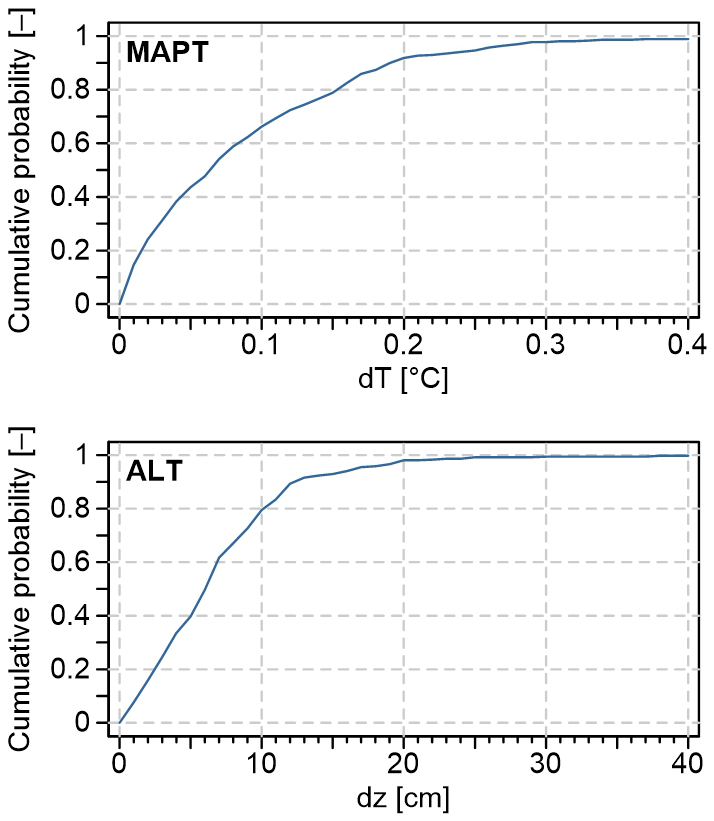
Figure 1Cumulative distributions of the temperature and depth differences between the observed MAPT and ALT and the closest temperature sensor used for the linear interpolation, which sets their maximum possible deviations from the actual MAPT and ALT values.
Subsequently, MAPT and ALT were also modelled using ASMs given by Eqs. (8) and (27) forced by the observed thawing and freezing indices from the depth intervals of 0–10, 25–35 and 45–55 cm, which were combined into three pairs of , and cm so that they were comparable across the validation sites. This provided us with three sets of MAPT and ALT estimates that allowed to determine which depth combinations worked best. The three depth pairs were situated within the active layer in all instances, and therefore differed from the temperature sensors used to determine the observed MAPT and ALT, so this did not invalidate the evaluation.
We compared the modelled MAPT and ALT directly with the observed MAPT and ALT, and evaluated the model accuracy for each site using common error metrics, such as mean error (ME), mean percentage error (MPE), mean absolute error (MAE), mean absolute percentage error (MAPE), and root-mean-square error (RMSE). The evaluation statistics were grouped by depth pairs and surface cover, as the latter also broadly captures the common characteristics of the validation sites in terms of climate and composition of the active layer.
4.1 Mean annual permafrost table temperature
The MAPT modelled using ASM given by Eq. (8) based on the observed thawing and freezing indices for the depth pairs of , and cm showed the total site-weighted ME from 0.01 °C to 0.05 °C compared to the observed MAPT (Table 1). Since the errors were scattered around zero (Fig. 2), the total site-weighted MAE was somewhat larger and ranged from 0.11 to 0.16 °C, while the total site-weighted RMSE was 0.12 to 0.19 °C (Table 1). The majority of errors were well within ±0.2 °C (Fig. 2).
Table 1Evaluation statistics of MAPT modelled using ASM given by Eq. (8) based on the observed thawing and freezing indices for the depth pairs of , and cm and diverse surface covers.
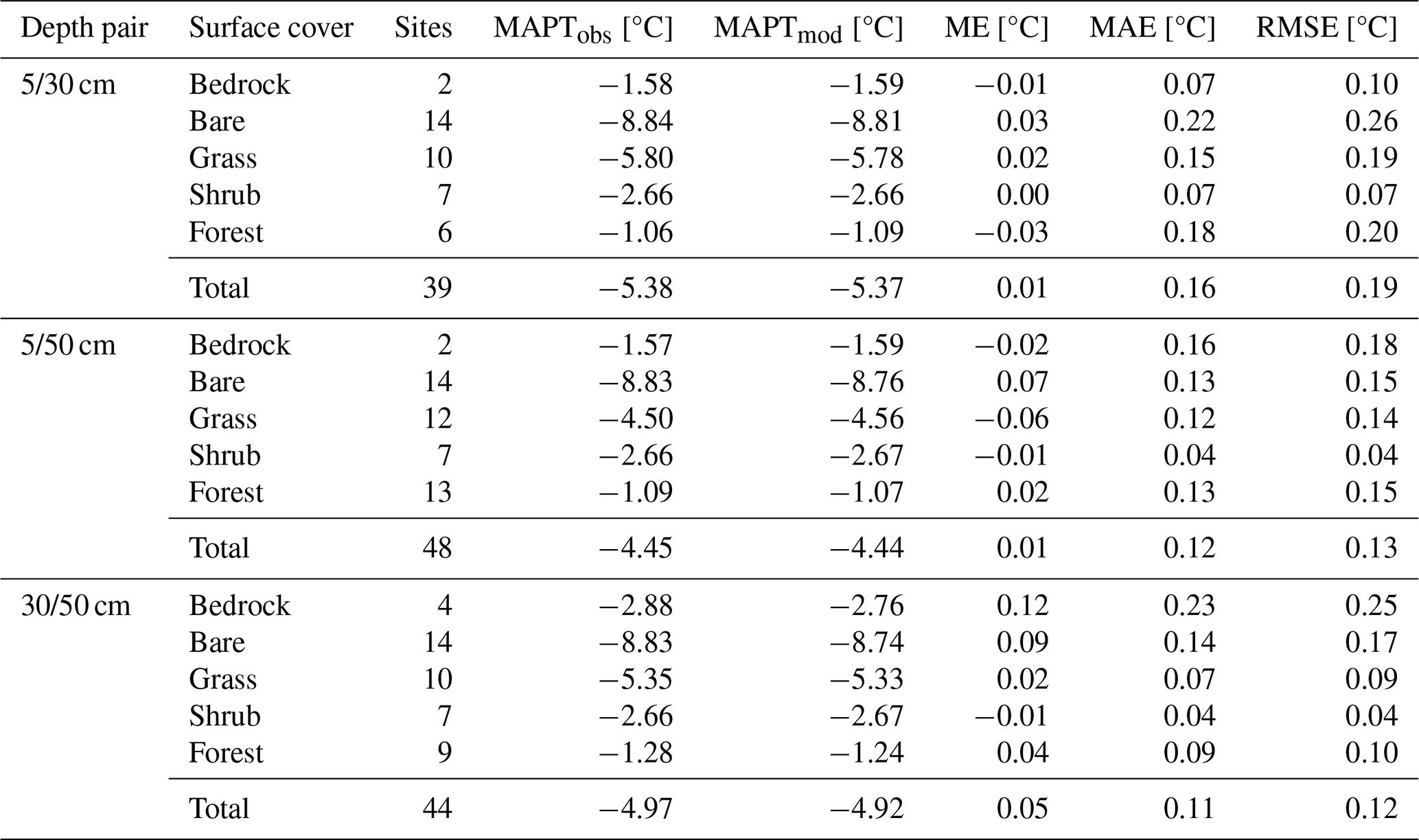
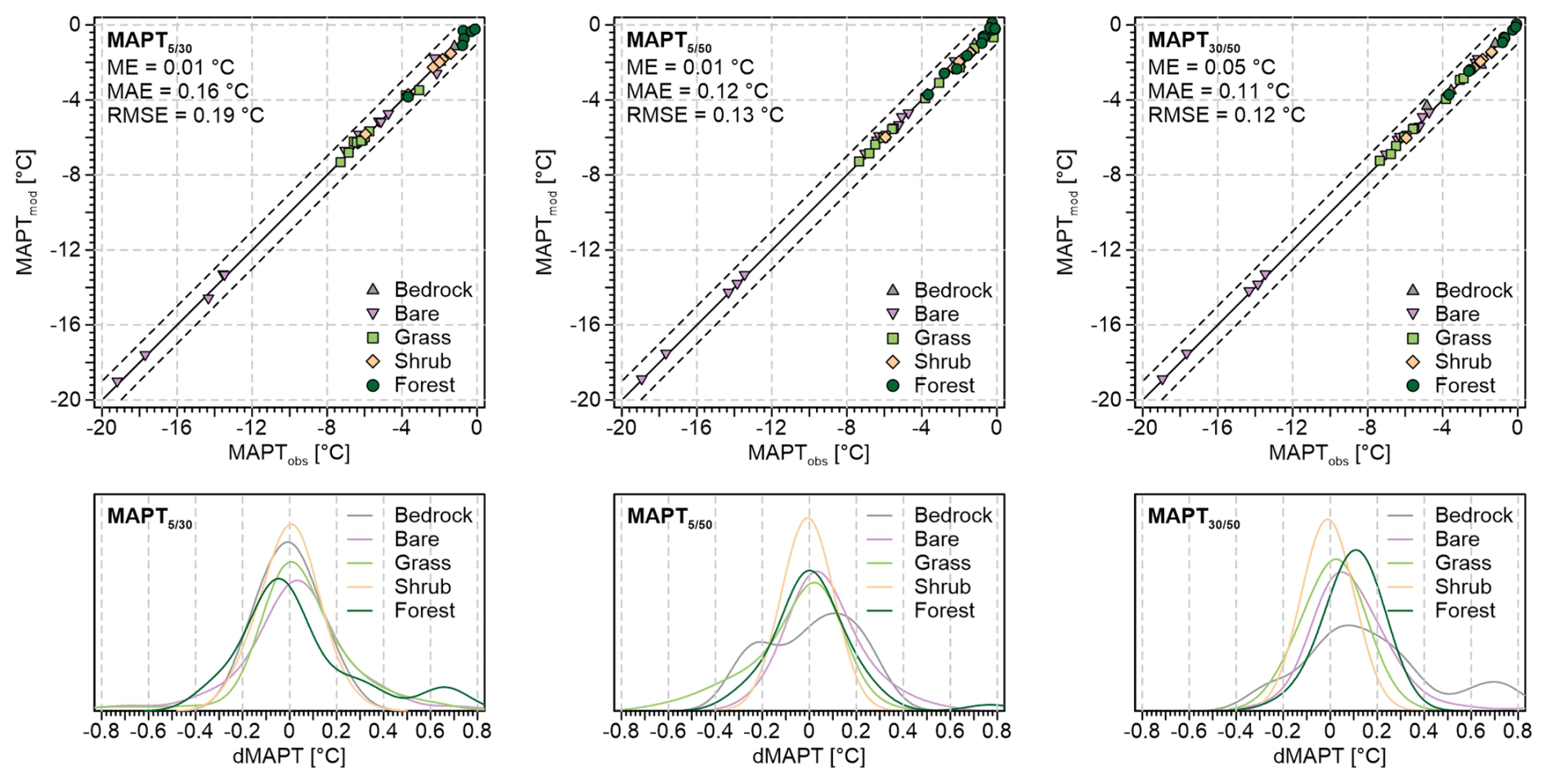
Figure 2Comparison of the observed MAPT and MAPT modelled using ASM given by Eq. (8) based on the observed thawing and freezing indices for the depth pairs of , and cm and diverse surface covers. The black solid and dashed lines in the upper plots represent the line of identity and the deviation of ±1 °C, respectively.
The accuracy of the modelled MAPT was similar for the three depth pairs, although and cm performed slightly better than 5/30 cm (Table 1). Similarly, there were rather small differences between individual surface covers (Fig. 2) that exhibited the site-weighted ME from −0.06 to 0.12 °C (Table 1). However, the MAPT estimates were somewhat better at the vegetated sites, as the site-weighted MAE and RMSE there were mostly less than ∼ 0.15 °C, while the bedrock and bare-ground sites mostly showed the site-weighted MAE and RMSE greater than ∼ 0.15 °C (Table 1). The site-weighted errors also tended to be somewhat larger at higher MAPT for all three depth pairs.
4.2 Active-layer thickness
The ALT modelled using ASM given by Eq. (27) based on the observed thawing indices for the depth pairs of , and cm exhibited the total site-weighted ME from −11.5 cm (−9.3 %) to −1.6 cm (−1.2 %) compared to the observed ALT (Table 2). The total site-weighted MAE was larger (Fig. 3) and reached 13.1 cm (10.2 %) to 17.1 cm (19.8 %), while the total site-weighted RMSE was 14.2 cm to 18.2 cm (Table 2).
Table 2Evaluation statistics of ALT modelled using ASM given by Eq. (27) based on the observed thawing and freezing indices for the depth pairs of , and cm and diverse surface covers.
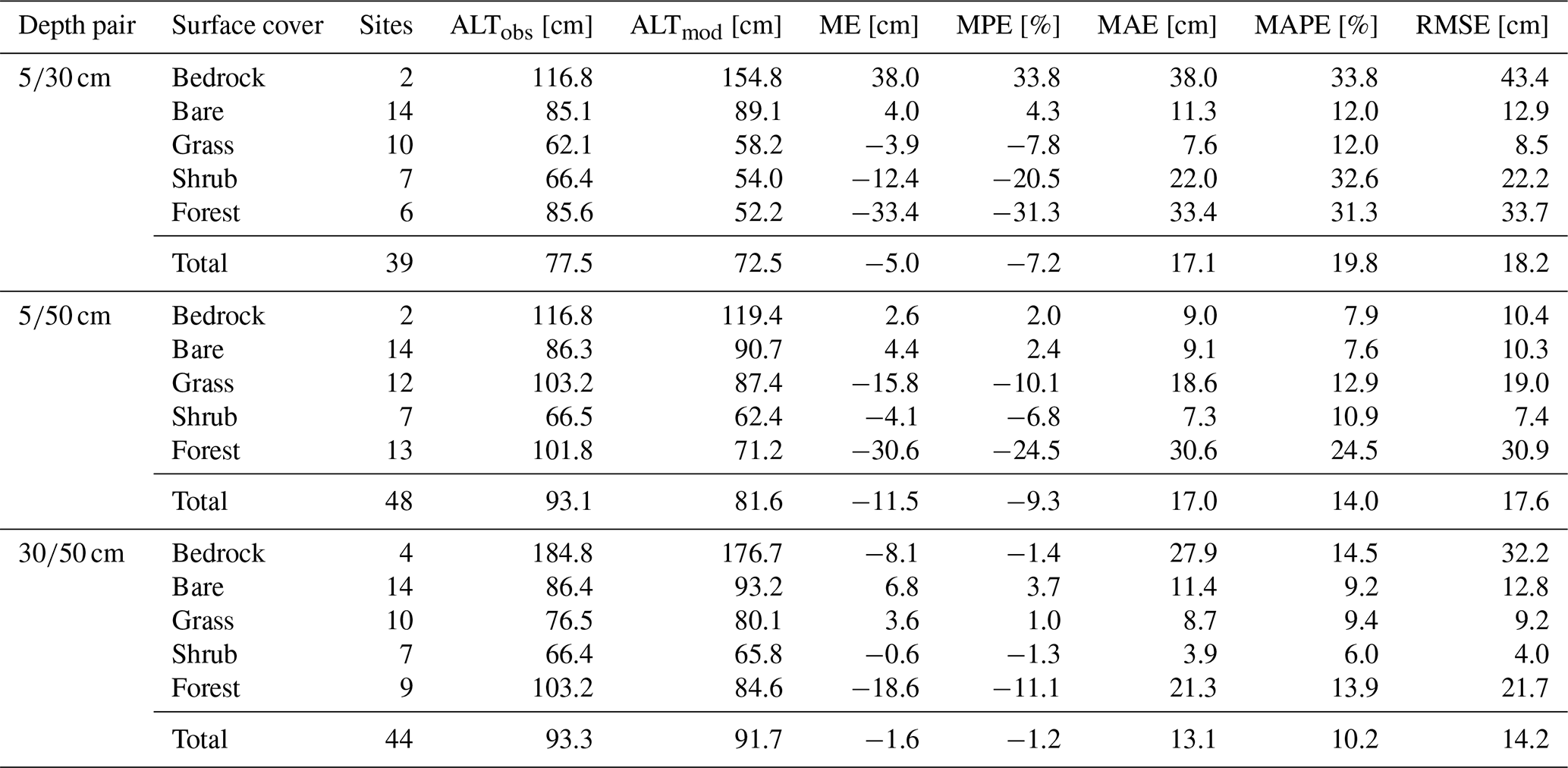
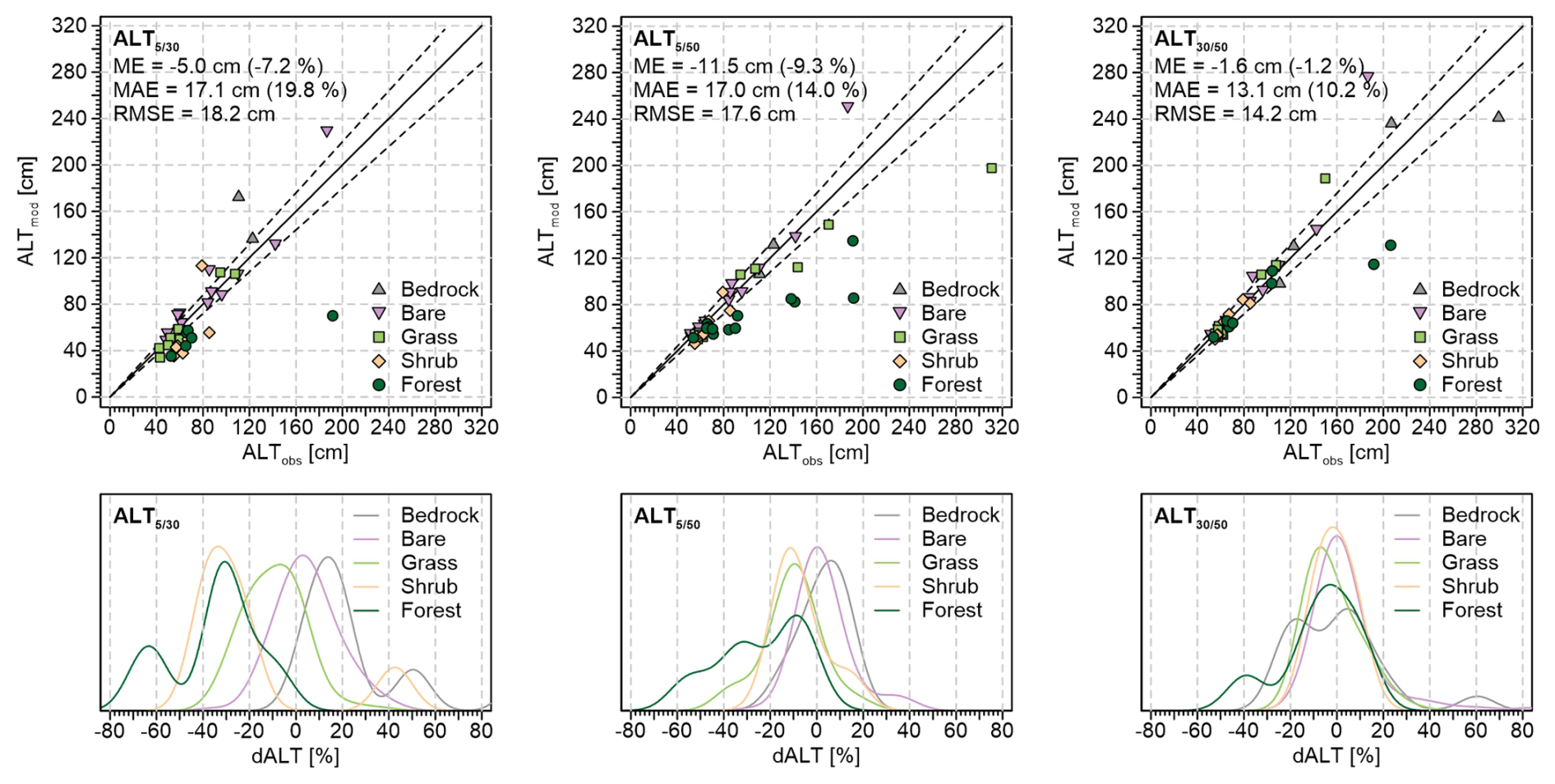
Figure 3Comparison of the observed ALT and ALT modelled using ASM given by Eq. (27) based on the observed thawing and freezing indices for the depth pairs of , and cm and diverse surface covers. The black solid and dashed lines in the upper plots represent the line of identity and the deviation of ±10 %, respectively.
The accuracy of the modelled ALT was higher for the depth pairs of and cm compared to cm, especially at the bedrock, shrub and forest sites (Table 2). Additionally, there were rather large differences between individual surface covers (Fig. 3), among which the site-weighted ME ranged from −33.4 cm (−31.3 %) to 38.0 cm (33.8 %) (Table 2). The most accurate ALT estimates were at the bare-ground sites and those with grass and shrub cover, as their site-weighted MAE ranged from 3.9 cm (6.0 %) to 22.0 cm (32.6 %), and the site-weighted RMSE was from 4.0 cm to 22.2 cm (Table 2). Somewhat worse was the model performance at the bedrock and forest sites, with the site-weighted MAE from 9.0 cm (7.9 %) to 38.0 cm (33.8 %) and the site-weighted RMSE from 10.4 cm to 43.4 cm (Table 2). The site-weighted errors were also larger at thicker ALT for all three depth pairs.
5.1 Mean annual permafrost table temperature
The modelled MAPT showed a relatively high accuracy for all three depth pairs and surface covers (Fig. 2), with the mean errors close to zero and the majority of them within ±0.2 °C (Table 1), which is similar or better than in most previous studies that used other analytical or statistical models for MAPT (e.g., Romanovsky and Osterkamp, 1995; Sazonova and Romanovsky, 2003; Ferreira et al., 2017; Way and Lewkowicz, 2018; Wang et al., 2020; Kaplan Pastíriková et al., 2023).
Somewhat larger errors in the modelled MAPT arose especially under warmer conditions and within a thicker active layer where MAPT needs to be extrapolated to greater depth. Warmer climates are also dominated by vegetated sites (Table C1) with well-developed soils and therefore a more heterogeneous active layer where MAPT estimates are more difficult. In addition, it may also be associated with increased complexity of the system at permafrost temperatures approaching 0 °C when simple models tend to fail to a greater extent (Riseborough, 2007). The worst MAPT estimates at the bedrock sites were also likely because active layer is thick there (Table 1). Moreover, the boreholes were drilled into vertical rockwalls, and therefore it is possible that lateral flows of heat and moisture occur in the fractured bedrock, which further complicates MAPT estimates.
So far, models for estimating MAPT have typically assumed that the ratio of thawed and frozen thermal conductivity is less than or equal to 1, and that the thermal offset is therefore negative (e.g., Gisnås et al., 2013; Obu et al., 2019, 2020), which would result in invalid MAPT estimates if the actual conditions were reversed. However, although nearly half of the bedrock and bare-ground sites exhibited a positive thermal offset with a thermal conductivity ratio above 1, the MAPT was modelled with similar accuracy at these locations as elsewhere (Table 1, Fig. 2). This is because ASM utilizes thawing and freezing indices within the active layer and can therefore easily capture this behaviour. This is also demonstrated by the thermal conductivity ratios modelled using Eq. (5) for the three depth pairs that are close to those determined for the whole active layer (Fig. 4) based on the relationship between MAPT and thawing and freezing indices (Riseborough, 2004; Way and Lewkowicz, 2018). This is likely because the relationship between the thawing and freezing indices within the active layer is linear (see Sect. 2.1) and its slope varies rather slightly with vertical changes in ground physical properties.
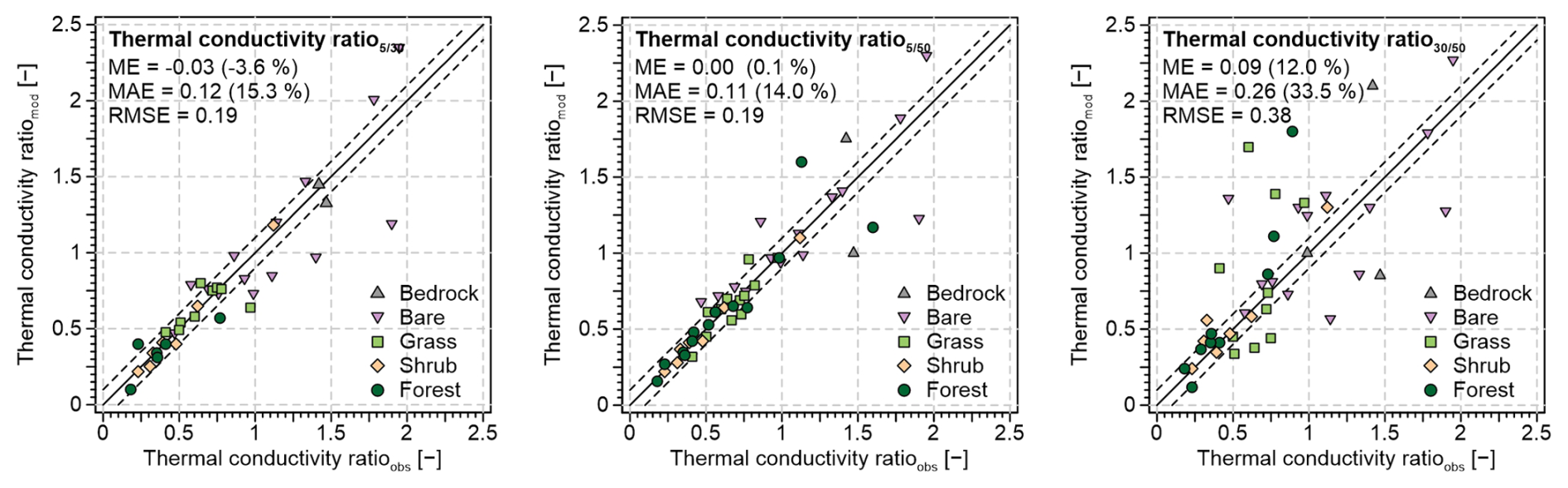
Figure 4Comparison of the thermal conductivity ratio for the whole active layer determined using the rearranged Eq. (2) based on the observed MAPT and the observed thawing and freezing indices for the uppermost available sensors (Riseborough, 2004; Way and Lewkowicz, 2018) and the thermal conductivity ratio estimated using Eq. (5) based on the observed thawing and freezing indices for the depth pairs of , and cm and diverse surface covers. The black solid and dashed lines represent the line of identity and the deviation of ±0.1.
5.2 Active-layer thickness
Unlike MAPT, the modelled ALT showed variable performance for individual depth pairs and surface covers (Fig. 3, Table 2). However, the errors were mostly well within ±20 %, which is also similar or better than in most previous studies that used other analytical or statistical models for ALT (Anisimov et al., 1997; Nelson et al., 1997; Romanovsky and Osterkamp, 1997; Anisimov et al., 2002; Shiklomanov and Nelson, 2002; Sazonova and Romanovsky, 2003; Streletskiy et al., 2012; Yin et al., 2016; Zorigt et al., 2016; Hrbáček and Uxa, 2020; Kaplan Pastíriková et al., 2023).
Notably, the modelled ALT showed variable accuracy for the depth pair of cm (Table 2). This is because the active layer is typically more heterogeneous at the vegetated sites and may often comprise a surface organic layer there, the physical properties of which strongly differ from the ground underneath. This alters the temperature gradient within the active layer and results in worse ALT estimates, which can be observed especially at the shrub and forest sites (Fig. 3). By contrast, the ALT estimates showed substantially lower errors for the depth pairs of and cm (Fig. 3), which largely to completely eliminated the influence of the surface layer. This also explains the consistently high accuracy of the modelled ALT at the bare-ground sites for all three depth pairs (Table 2), as the active layer there is relatively homogeneous in terms of its stratigraphy and physical properties. The ALT estimates were also relatively accurate at the bedrock sites (Table 2), but the same concern exists for them as for MAPT (see Sect. 5.1). Similarly to MAPT, the modelled ALT tended to be less accurate under warmer conditions dominated by vegetated sites with a more heterogeneous and thick active layer (Table C1) where ALT needs to be extrapolated to greater depth.
Previous studies have estimated the edaphic term based on the relationship between ALT and thawing index (Nelson and Outcalt, 1987; Hinkel and Nicholas, 1995; Nelson et al., 1997; Anisimov et al., 2002; Shiklomanov and Nelson, 2002; Smith et al., 2009; Shiklomanov et al., 2010; Strand et al., 2021; Xu and Wu, 2021; Peng et al., 2023), which is restrictive because it requires ALT. However, the edaphic term modelled using Eq. (20) for the three depth levels was close to the edaphic term determined for the whole active layer (Fig. 5) based on the relationship between ALT and thawing index (Nelson and Outcalt, 1987; Hinkel and Nicholas, 1995). As with MAPT, this is because the square root of the thawing index within the active layer is linear (see Sect. 2.2) and its slope varies rather slightly with vertical changes in ground physical properties (Riseborough, 2003).
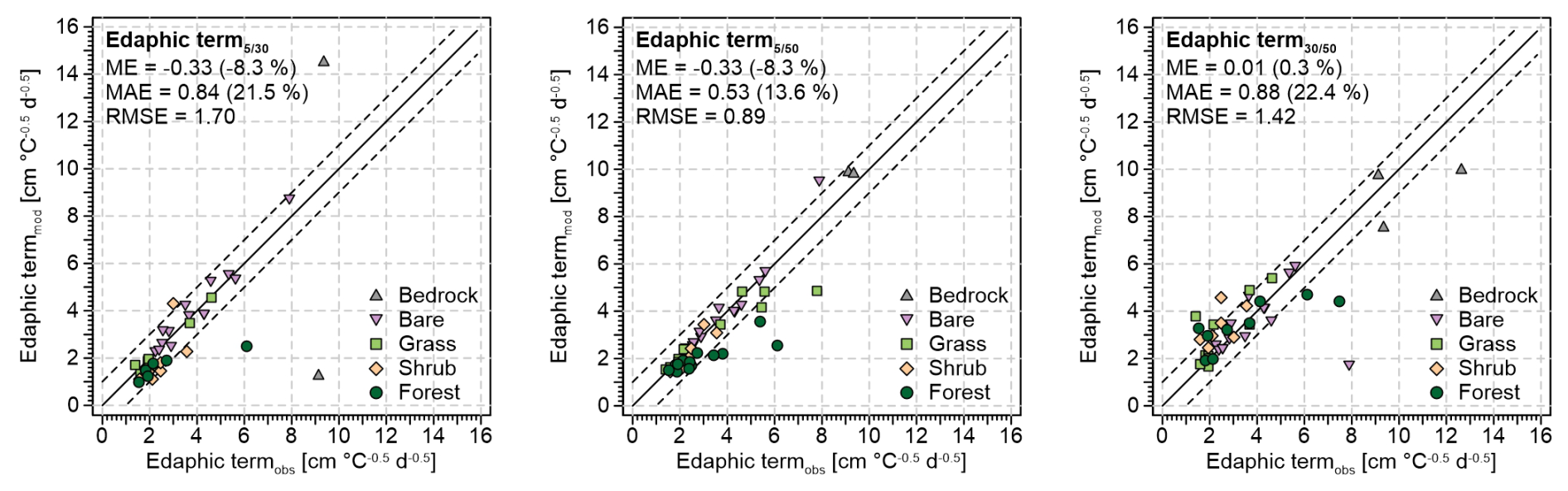
Figure 5Comparison of the observed edaphic term for the whole active layer determined using the rearranged Eq. (23) based on the observed ALT and the observed thawing index for the uppermost available sensor (Nelson and Outcalt, 1987; Hinkel and Nicholas, 1995) and the edaphic term estimated using Eq. (20) based on the observed thawing indices for the depth pairs of , and cm and diverse surface covers. The black solid and dashed lines represent the line of identity and the deviation of ± 1 cm °C−0.5 d−0.5.
5.3 Model advantages
Unlike other analytical or statistical models for MAPT (e.g., Garagulya, 1990; Romanovsky and Osterkamp, 1995; Smith and Riseborough, 1996) and ALT (e.g., Neumann, 1860; Stefan, 1891; Kudryavtsev et al., 1977), ASMs given by Eqs. (8) and (27) can work in any grounds where conductive heat transfer prevails without knowing their physical properties.
Although ASMs utilize only thawing and freezing indices from two depth levels within the active layer as inputs, they inherently account for the natural variability of ground physical properties in the intermediate layer between these two depths that is expressed in terms of annual and seasonal means of the thermal conductivity ratio and the edaphic term, respectively. Similarly, ASMs consider latent and sensible heat or other factors that influence the thermal regime between the two depth levels, although these effects are not explicitly accounted for. This is because the relative values of the thawing and freezing indices at the two depth levels reflect the rate of heat transfer in the intermediate layer between them (see Eqs. 5 and 20) that is influenced by seasonal changes in ground physical properties. So in principle it is analogous to, for instance, the calculations of apparent thermal diffusivity, which are based on damping of temperature amplitude or phase lag between two depth levels (Horton et al., 1983).
This is highly convenient because ground physical properties, such as thermal conductivity, heat capacity, water content or bulk density, are frequently unavailable or unrepresentative. Ground physical properties in other models for MAPT and ALT have therefore been estimated empirically or based on published values with unknown validity (e.g., Hinkel and Nicholas, 1995; Nelson et al., 1997; Anisimov et al., 2002; Shiklomanov and Nelson, 2002; Gisnås et al., 2013; Obu et al., 2019, 2020; Garibaldi et al., 2021). Ground physical properties also show more or less variability on seasonal and annual time scales (e.g., Gao et al., 2020; Hrbáček et al., 2023a; Li et al., 2023; Kňažková and Hrbáček, 2024; Wenhao et al., 2024), which most other models cannot handle because they typically treat ground physical properties as constants for whole modelling periods. Of course, ASMs also treat them as constants, but their values are annual or seasonal means that reflect the variations in ground physical properties over time mainly due to changes in water content and as such they are representative for individual years or thawing seasons. This is a major improvement over other analytical or statistical models for MAPT (e.g., Garagulya, 1990; Romanovsky and Osterkamp, 1995; Smith and Riseborough, 1996) and ALT (e.g., Neumann, 1860; Stefan, 1891; Kudryavtsev et al., 1977), which can increase the spatial and/or temporal validity of modelled MAPT and ALT.
Moreover, we believe that, in addition to MAPT and ALT estimates, ASMs can also be useful for investigating the spatial and temporal variations in the thermal conductivity ratio (Fig. 4) and the edaphic term (Fig. 5) regardless of MAPT and ALT (cf. Nelson and Outcalt, 1987; Hinkel and Nicholas, 1995; Riseborough, 2004; Way and Lewkowicz, 2018). This could be done using networks of miniature temperature loggers collecting data only in shallow parts of the active layer because another advantage of ASMs is that their inputs can be any depth combinations from within the active layer. For most accurate outputs, however, we suggest using thawing and freezing indices from depth levels as close as possible to the permafrost table. For instance, this could improve ALT estimates at the bedrock sites where active layer is thick.
In addition to in situ ground temperature measurements, we suppose that ASMs could also be forced by diverse climate reanalyses or Earth system models, if these at least partially account for the physics of ground thawing and freezing. While these products have been widely used for permafrost applications (e.g., Cao et al., 2020; Kaplan Pastíriková et al., 2025; Liu et al., 2025), they typically provide only ground surface and shallow active-layer temperatures with ground physical properties largely unknown, which is frequently insufficient to determine MAPT and ALT directly or using conventional models. If the active layer is thick, MAPT and ALT have therefore usually been confined to the deepest ground temperature level available in these products, which can obviously be misleading (e.g., Cao et al., 2020). However, ASMs are designed so that they should be able to provide MAPT and ALT estimates even under these conditions.
Lastly, ASMs can also be easily reformulated to be used for estimating the mean annual temperature at the base of seasonally frozen ground and frost depth (see Appendices A and B).
5.4 Model limitations
Since ASMs assume that active layer is vertically homogeneous, they can be biased if there are strong vertical changes in ground physical properties and/or higher ground-ice content near the base of the active layer (Riseborough, 2003). For instance, if temperature measurements are used from the topmost layer, whose physical properties differ from the rest of the active layer, ASMs may be inaccurate. Similarly, the modelled MAPT and ALT may be unreliable if only shallow temperature measurements in a thick active layer are used. This is because the estimates would be based on physical properties of a small portion of the active layer, which may be different in its deeper parts. Nevertheless, the natural variability of ground physical properties without sharp changes in their vertical distribution is unlikely to have a major influence on the MAPT and ALT estimates (see Figs. 2 and 3, Tables 1 and 2).
Other downside of ASMs is that they require temperature measurements from two depth levels within the active layer, which may not be available at many sites.
We devised two novel analytical–statistical models (ASMs) for estimating MAPT and ALT given by Eqs. (8) and (27), respectively, which are driven solely by thawing and freezing indices from two depth levels within the active layer, while no ground physical properties are required. ASMs reproduced MAPT and ALT in the Earth's major permafrost regions with the total mean errors of less than 0.05 °C and 9 %, respectively, which is very promising because it is similar or better than other analytical or statistical models. ASMs worked best in a homogeneous active layer with small vertical changes in ground physical properties and when permafrost table was close below the temperature sensors considered for MAPT and ALT estimates. By contrast, they performed worst in a heterogeneous and thick active layer when the topmost organic layer influenced the estimates.
We believe that ASMs can find useful applications under a wide range of climates, ground surface covers and ground physical conditions wherever at least two temperature measurements within the active layer are available. They are primarily intended to be used for MAPT or ALT estimates where ground temperature measurements are too shallow and MAPT or ALT therefore cannot be determined directly, but they can also be used to establish typical values of the thermal conductivity ratio and the edaphic term for MAPT and ALT estimates in the past and in the future or for modelling their spatial variations. In addition to in situ measurements, they could utilize diverse climate reanalyses or Earth system models. Lastly, they can be easily reformulated for estimating the mean annual temperature at the base of seasonally frozen ground and frost depth.
Similarly to Eq. (1), the mean annual temperature at the base of seasonally frozen ground (MASFT > 0 °C) is calculated as follows (Romanovsky and Osterkamp, 1995)
MASFT based on temperatures observed at two distinct depths in the seasonally freezing layer z1 and z2 ( FD) can therefore be expressed as follows
This implies that Eqs. (A2) and (A3) are equivalent:
Solving Eq. (A4) for the inverse of the thermal conductivity ratio yields
Equation (A5) can be then substituted for the thermal conductivity ratio in Eqs. (A2) and (A3) as follows
Subsequently, Eqs. (A6) and (A7) both simplify to the same formula for MASFT:
which only slightly differs from Eq. (8).
Similarly to Eq. (13), the frost depth (FD) can be calculated using the Stefan (1891) model as follows
As with Eq. (13), note that the freezing index must be multiplied by the scaling factor of 86 400 s d−1. FD estimated using freezing indices observed at two distinct depths z1 and z2 ( FD) can be expressed as follows
This implies that Eqs. (B2) and (B3) are equivalent:
The vertical distance between z2 and z1 can be expressed as
which simplifies to
Subsequently rearranging Eq. (B6) gives
where the right-hand side corresponds to the edaphic term, which combines the ground physical properties in the Stefan model into a single variable. The edaphic term can be implemented in Eqs. (B2) and (B3) as
Substituting the left-hand side of Eq. (B7) for the edaphic term in Eqs. (B8) and (B9) yields
Simplifying Eqs. (B10) and (B11) then produces the same formula for FD:
which is the same as Eq. (27), but with the freezing indices instead of the thawing ones.
Table C1List of sites used for model evaluation.
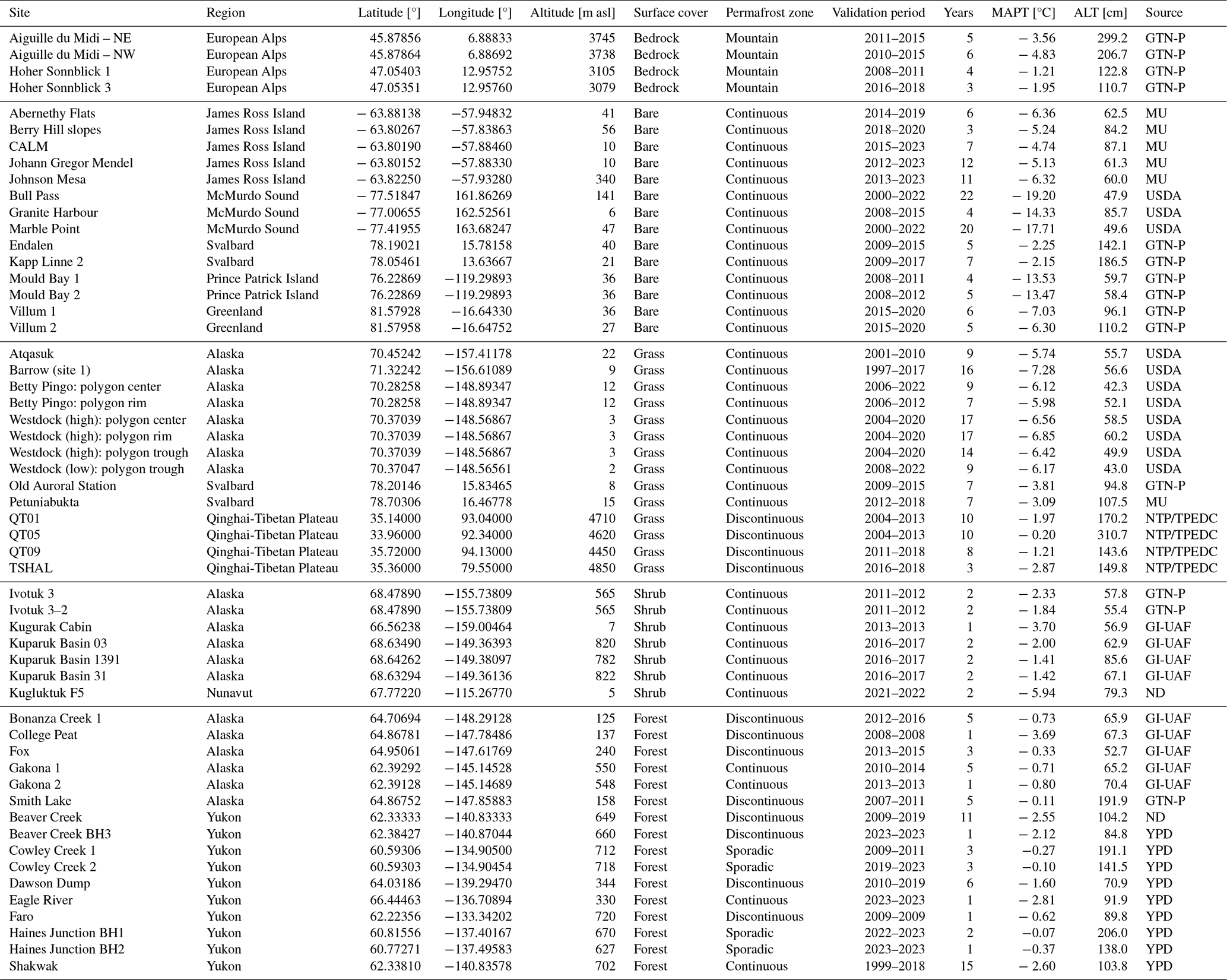
GTN-P = Global Terrestrial Network for Permafrost, MU = Polar-Geo-Lab of the Masaryk University, USDA = Natural Resources Conservation Service of the United States Department of Agriculture, NTP/TPEDC = National Tibetan Plateau/Third Pole Environment Data Center, GI-UAF = Geophysical Institute Permafrost Laboratory of the University of Alaska Fairbanks, ND = Nordicana D of the Centre for Northern Studies, YPD = Yukon Permafrost Database.
The validation data from James Ross Island and Petuniabukta are available upon request from Filip Hrbáček (hrbacekfilip@gmail.com) and Kamil Láska (laska@sci.muni.cz), respectively, while the other data are available from Global Terrestrial Network for Permafrost (http://gtnpdatabase.org, last access: 20 November 2024), Natural Resources Conservation Service of the United States Department of Agriculture (https://www.nrcs.usda.gov/resources/data-and-reports/soil-climate-research-stations, last access: 19 September 2023), Geophysical Institute Permafrost Laboratory of the University of Alaska Fairbanks (https://permafrost.gi.alaska.edu, last access: 25 July 2025), Yukon Permafrost Database (https://service.yukon.ca/permafrost/, last access: 25 July 2025), Nordicana D of the Centre for Northern Studies (https://nordicana.cen.ulaval.ca/en/, last access: 15 July 2025), and National Tibetan Plateau/Third Pole Environment Data Center (https://data.tpdc.ac.cn/en/disallow/789e838e-16ac-4539-bb7e-906217305a1d, last access: 21 November 2024).
TU: conceptualization, methodology, software, validation, formal analysis, resources, investigation, writing – original draft, visualization, funding acquisition. FH: conceptualization, resources, writing – review & editing, supervision, funding acquisition. MK: formal analysis, resources, writing – review & editing.
The contact author has declared that none of the authors has any competing interests.
Publisher’s note: Copernicus Publications remains neutral with regard to jurisdictional claims made in the text, published maps, institutional affiliations, or any other geographical representation in this paper. While Copernicus Publications makes every effort to include appropriate place names, the final responsibility lies with the authors. Views expressed in the text are those of the authors and do not necessarily reflect the views of the publisher.
We thank Kamil Láska and acknowledge the Global Terrestrial Network for Permafrost, Natural Resources Conservation Service of the United States Department of Agriculture, Geophysical Institute Permafrost Laboratory of the University of Alaska Fairbanks, Yukon Permafrost Database, Centre for Northern Studies, and National Tibetan Plateau/Third Pole Environment Data Center for collecting long-term ground temperature data and disseminating them personally and/or publicly.
The research was funded by the Czech Science Foundation (project numbers GM22-28659M and GA25-18272S) and by the Ministry of Education, Youth and Sports (project number LL2505).
This paper was edited by Johannes J. Fürst and reviewed by three anonymous referees.
Aalto, J., Karjalainen, O., Hjort, J., and Luoto, M.: Statistical forecasting of current and future Circum-Arctic ground temperatures and active layer thickness, Geophys. Res. Lett., 45, 4889–4898, 2018. a
Anisimov, O. A., Shiklomanov, N. I., and Nelson, F. E.: Global warming and active-layer thickness: results from transient general circulation models, Glob. Planet. Change, 15, 61–77, https://doi.org/10.1016/S0921-8181(97)00009-X, 1997. a, b
Anisimov, O. A., Shiklomanov, N. I., and Nelson, F. E.: Variability of seasonal thaw depth in permafrost regions: a stochastic modeling approach, Ecol. Model., 153, 217–227, https://doi.org/10.1016/S0304-3800(02)00016-9, 2002. a, b, c, d
Biskaborn, B. K., Lanckman, J.-P., Lantuit, H., Elger, K., Streletskiy, D. A., Cable, W. L., and Romanovsky, V. E.: The new database of the Global Terrestrial Network for Permafrost (GTN-P), Earth Syst. Sci. Data, 7, 245–259, https://doi.org/10.5194/essd-7-245-2015, 2015. a, b, c
Bonnaventure, P. P. and Lamoureux, S. F.: The active layer: A conceptual review of monitoring, modelling techniques and changes in a warming climate, Prog. Phys. Geog., 37, 352–376, https://doi.org/10.1177/0309133313478314, 2013. a, b, c
Brown, J., Hinkel, K. M., and Nelson, F. E.: The Circumpolar Active Layer Monitoring (CALM) Program: Research Designs and Initial Results, Polar Geogr., 24, 166–258, https://doi.org/10.1080/10889370009377698, 2000. a, b
Burn, C. R.: The Active Layer: Two Contrasting Definitions, Permafrost Periglac., 9, 411–416, https://doi.org/10.1002/(SICI)1099-1530(199810/12)9:4<411::AID-PPP292>3.0.CO;2-6, 1998. a
Cao, B., Gruber, S., Zheng, D., and Li, X.: The ERA5-Land soil temperature bias in permafrost regions, The Cryosphere, 14, 2581–2595, https://doi.org/10.5194/tc-14-2581-2020, 2020. a, b
Farzamian, M., Vieira, G., Monteiro Santos, F. A., Yaghoobi Tabar, B., Hauck, C., Paz, M. C., Bernardo, I., Ramos, M., and de Pablo, M. A.: Detailed detection of active layer freeze–thaw dynamics using quasi-continuous electrical resistivity tomography (Deception Island, Antarctica), The Cryosphere, 14, 1105–1120, https://doi.org/10.5194/tc-14-1105-2020, 2020. a
Ferreira, A., Vieira, G., Ramos, M., and Nieuwendam, A.: Ground temperature and permafrost distribution in Hurd Peninsula (Livingston Island, Maritime Antarctic): An assessment using freezing indexes and TTOP modelling, Catena, 149, 560–571, https://doi.org/10.1016/j.catena.2016.08.027, 2017. a
Gao, Z., Lin, Z., Niu, F., and Luo, J.: Soil water dynamics in the active layers under different land-cover types in the permafrost regions of the Qinghai–Tibet Plateau, China. Geoderma, 364, 114176, https://doi.org/10.1016/j.geoderma.2020.114176, 2020. a, b
Garagulya, L. S.: Application of Mathematical Methods and Computers in Investigations of Geocryological Processes, Moscow University Press, Moscow, Russia, 124 pp., ISBN 5-1756190, 1990. a, b, c
Garibaldi, M. C., Bonnaventure, P. P., and Lamoureux, S. F.: Utilizing the TTOP model to understand spatial permafrost temperature variability in a High Arctic landscape, Cape Bounty, Nunavut, Canada, Permafrost Periglac., 32, 19–34, https://doi.org/10.1002/ppp.2086, 2021. a
Gisnås, K., Etzelmüller, B., Farbrot, H., Schuler, T. V., and Westermann, S.: CryoGRID 1.0: Permafrost Distribution in Norway estimated by a Spatial Numerical Model, Permafrost Periglac., 24, 2–19, https://doi.org/10.1002/ppp.1765, 2013. a, b
Grosse, G., Goetz, S., McGuire, A. D., Romanovsky, V. E., and Schuur, E. A. G.: Changing permafrost in a warming world and feedbacks to the Earth system, Environ. Res. Lett., 11, 040201, https://doi.org/10.1088/1748-9326/11/4/040201, 2016. a
Hauck, C.: Frozen ground monitoring using DC resistivity tomography, Geophys. Res. Lett., 29, 2016, https://doi.org/10.1029/2002GL014995, 2002. a
Hayashi, M., Goeller, N., Quinton, W. L., and Wright, N.: A simple heat-conduction method for simulating the frost-table depth in hydrological models, Hydrol. Process., 21, 2610–2622, https://doi.org/10.1002/hyp.6792, 2007. a
Hinkel, K. M., Nicholas, J. R. J.: Active Layer Thaw Rate at a Boreal Forest Site in Central Alaska, U.S.A., Arct. Alp. Res., 27, 72–80, https://doi.org/10.2307/1552069, 1995. a, b, c, d, e, f
Hjort, J., Streletskiy, D., Doré, G., Wu, Q., Bjella, K., and Luoto, M.: Impacts of permafrost degradation on infrastructure, Nat. Rev. Earth Environ., 3, 24–38, https://doi.org/10.1038/s43017-021-00247-8, 2022. a
Hrbáček, F. and Uxa, T.: The evolution of a near-surface ground thermal regime and modeled active‐layer thickness on James Ross Island, Eastern Antarctic Peninsula, in 2006–2016, Permafrost Periglac., 31, 141–155, https://doi.org/10.1002/ppp.2018, 2020. a, b, c
Hrbáček, F., Kňažková, M., Nývlt, D., Láska, K., Mueller, C. W., and Ondruch, J.: Active layer monitoring at CALM-S site near J. G. Mendel Station, James Ross Island, eastern Antarctic Peninsula, Sci. Total Environ., 601–602, 987–997, https://doi.org/10.1016/j.scitotenv.2017.05.266, 2017a. a
Hrbáček, F., Nývlt, D., and Láska, K.: Active layer thermal dynamics at two lithologically different sites on James Ross Island, Eastern Antarctic Peninsula, Catena, 149, 592–602, https://doi.org/10.1016/j.catena.2016.06.020, 2017b. a
Hrbáček, F., Cannone, N., Kňažková, M., Malfasi, F., Convey, P., and Guglielmin, M.: Effect of climate and moss vegetation on ground surface temperature and the active layer among different biogeographical regions in Antarctica, Catena, 190, 104562, https://doi.org/10.1016/j.catena.2020.104562, 2020. a
Hrbáček, F., Engel, Z., Kňažková, M., and Smolíková, J.: Effect of summer snow cover on the active layer thermal regime and thickness on CALM-S JGM site, James Ross Island, eastern Antarctic Peninsula, Catena, 207, 105608, https://doi.org/10.1016/j.catena.2021.105608, 2021. a
Hrbáček, F., Kňažková, M., Farzamian, M., and Baptista, J.: Variability of soil moisture on three sites in the Northern Antarctic Peninsula in 2022/23, Czech Polar Rep., 13, 10–23, https://doi.org/10.5817/CPR2023-1-2, 2023a. a, b
Hrbáček, F., Oliva, M., Hansen, C., Balks, M., O'Neill, T. A., de Pablo, M. A., Ponti, S., Ramos, M., Vieira, G., Abramov, A., Kaplan Pastíriková, L., Guglielmin, M., Goyanes, G., Rocha Francelino, M., Schaefer, C., and Lacelle, D.: Active layer and permafrost thermal regimes in the ice-free areas of Antarctica, Earth-Sci. Rev., 242, 104458, https://doi.org/10.1016/j.earscirev.2023.104458, 2023b. a
Hrbáček, F., Kňažková, M., Láska, K., and Kaplan Pastíriková, L.: Active Layer Warming and Thickening on CALM‐S JGM, James Ross Island, in the Period 2013/14–2022/23, Permafrost Periglac., 36, 378–389, https://doi.org/10.1002/ppp.2274, 2025. a
Horton, R., Wierenga, P. J., and Nielsen, D. R.: Evaluation of Methods for Determining the Apparent Thermal Diffusivity of Soil Near the Surface, Soil. Sci. Soc. Am. J., 47, 25–32, https://doi.org/10.2136/sssaj1983.03615995004700010005x, 1983. a
Kaplan Pastíriková, L., Hrbáček, F., Uxa, T., and Láska, K.: Permafrost table temperature and active layer thickness variability on James Ross Island, Antarctic Peninsula, in 2004–2021, Sci. Total Environ., 869, 161690, https://doi.org/10.1016/j.scitotenv.2023.161690, 2023. a, b, c
Kaplan Pastíriková, L., Hrbáček, F., and Matějka, M.: Validation of ERA5-Land-based reconstructed air temperature and near-surface ground temperature on James Ross Island. Polar Geogr., 48, 95–115, https://doi.org/10.1080/1088937X.2024.2434744, 2025. a
Kňažková, M. and Hrbáček, F.: Interannual variability of soil thermal conductivity and moisture on the Abernethy Flats (James Ross Island) during thawing seasons 2015–2023, Catena, 234, 107640, https://doi.org/10.1016/j.catena.2023.107640, 2024. a, b, c
Kudryavtsev, V. A., Garagulia, L., Kondratyeva, K. A., and Melamed, V. G.: Fundamentals of Frost Forecasting in Geological Engineering Investigations, Draft Translation 606, U.S. Army Cold Regions Research And Engineering Lab, Hanover, NH, 489 pp., accession no. ADA 039677, 1977. a, b, c
Lawrence, D. M., Koven, C. D., Swenson, S. C., Riley, W. J., and Slater, A. G.: Permafrost thaw and resulting soil moisture changes regulate projected high-latitude CO2 and CH4 emissions, Environ. Res. Lett., 10, 094011, https://doi.org/10.1088/1748-9326/10/9/094011, 2015. a
Li, G., Zhang, M., Pei, W., Melnikov, A., Khristoforov, I., Li, R., and Yu, F.: Changes in permafrost extent and active layer thickness in the Northern Hemisphere from 1969 to 2018, Sci. Total Environ., 804, 150182, https://doi.org/10.1016/j.scitotenv.2021.150182, 2022. a
Li, W., Weng, B., Yan, D., Lai, Y., Li, M., and Wang, H.: Underestimated permafrost degradation: Improving the TTOP model based on soil thermal conductivity, Sci. Total Environ., 854, 158564, https://doi.org/10.1016/j.scitotenv.2022.158564, 2023. a, b
Liu, Z., Guo, D., Hua, W., and Chen, Y.: Near-surface permafrost extent and active layer thickness characterized by reanalysis/assimilation data. Atmos. Sci. Lett., 26, e1289. https://doi.org/10.1002/asl.1289, 2025. a
Lunardini, V. J.: Heat Transfer in Cold Climates, Van Nostrand Reinhold Co., New York, NY, 731 pp., ISBN 9780442262501, 1981. a, b
Nelson, F. E. and Outcalt, S. I.: A Computational Method for Prediction and Regionalization of Permafrost, Arctic Alpine Res., 19, 279–288, https://doi.org/10.2307/1551363, 1987. a, b, c, d, e, f
Nelson, F. E., Shiklomanov, N. I., Mueller, G., Hinkel, K. M., Walker, D. A., and Bockheim, J. G.: Estimating Active-Layer Thickness over a Large Region: Kuparuk River Basin, Alaska, U.S.A., Arct. Alp. Res., 29, 367–378, https://doi.org/10.2307/1551985, 1997. a, b, c, d, e
Neumann, F.: Lectures given in the 1860’s, cf. Riemann-Weber, Die Partiellen Differentialgleichungen der Mathematischen, Physik, 2, 117–121, 1860. a, b, c
Noetzli, J., Arenson, L. U., Bast, A., Beutel, J., Delaloye, R., Farinotti, D., Gruber, S., Gubler, H., Haeberli, W., Hasler, A., Hauck, C., Hiller, M., Hoelzle, M., Lambiel, C., Pellet, C., Springman, S. M., Vonder Muehll, D., and Phillips, M.: Best Practice for Measuring Permafrost Temperature in Boreholes Based on the Experience in the Swiss Alps, Front. Earth Sci., 9, 607875, https://doi.org/10.3389/feart.2021.607875, 2021. a
Noetzli, J., Christiansen, H. H., Guglielmin, M., Hrbáček, F., Hu, G., Isaksen, K., Magnin, F., Pogliotti, P., Smith, S. L., Zhao, L., and Streletskiy, D. A.: Permafrost temperature and active-layer thickness, in: State of the Climate in 2023, Bull. Amer. Meteor. Soc., 105, S43–S44. https://doi.org/10.1175/2024BAMSStateoftheClimate.1, 2024. a
Obu, J.: How Much of the Earth's Surface is Underlain by Permafrost?, J. Geophys. Res.-Earth, 126, e2021JF006123, https://doi.org/10.1029/2021JF006123, 2021. a
Obu, J., Westermann, S., Bartsch, A., Berdnikov, N., Christiansen, H. H., Dashtseren, A., Delaloye, R., Elberling, B., Etzelmüller, B., Kholodov, A., Khomutov, A., Kääb, A., Leibman, M. O., Lewkowicz, A. G., Panda, S. K., Romanovsky, V., Way, R. G., Westergaard-Nielsen, A., Wu, T., Yamkhin, J., and Zou, D.: Northern Hemisphere permafrost map based on TTOP modelling for 2000–2016 at 1 km2 scale, Earth Sci. Rev., 193, 299–316, https://doi.org/10.1016/j.earscirev.2019.04.023, 2019. a, b, c
Obu, J., Westermann, S., Vieira, G., Abramov, A., Balks, M. R., Bartsch, A., Hrbáček, F., Kääb, A., and Ramos, M.: Pan-Antarctic map of near-surface permafrost temperatures at 1 km2 scale, The Cryosphere, 14, 497–519, https://doi.org/10.5194/tc-14-497-2020, 2020. a, b, c
Peng, X., Zhang, T., Frauenfeld, O. W., Mu, C., Wang, K., Wu, X., Guo, D., Luo, J., Hjort, J., Aalto, J., Karjalainen, O., and Luoto, M.: Active Layer Thickness and Permafrost Area Projections for the 21st Century, Earth's Future, 11, e2023EF003573, https://doi.org/10.1029/2023EF003573, 2023. a, b
Riseborough, D.: Thawing and freezing indices in the active layer, in: Proceedings of the 8th International Conference on Permafrost, Zurich, Switzerland, 21–25 July 2003, 953–958, ISBN 90-5809-582-7, 2003. a, b, c, d, e, f, g
Riseborough, D. W.: Exploring the parameters of a simple model of the permafrost-climate relationship, Ph.D. thesis, Carleton University, Ottawa, 328 pp., https://doi.org/10.22215/etd/2004-05938 (last access: 11 December 2025), 2004. a, b, c, d
Riseborough, D.: The effect of transient conditions on an equilibrium permafrost-climate model. Permafrost Periglac., 18, 21–32, https://doi.org/10.1002/ppp.579, 2007. a
Riseborough, D. W.: Estimating active layer and talik thickness from temperature data: implications from modeling results, in: Proceedings of the 9th International Conference on Permafrost, Fairbanks, Alaska, 29 June–3 July 2008, 1487–1492, ISBN 978-0-9800179-3-9, 2008. a, b
Riseborough, D., Shiklomanov, N., Etzelmüller, B., Gruber, S., and Marchenko, S.: Recent advances in permafrost modelling, Permafrost Periglac., 19, 137–156, https://doi.org/10.1002/ppp.615, 2008. a
Romanovsky, V. E. and Osterkamp, T. E.: Interannual Variations of the Thermal Regime of the Active Layer and Near-Surface Permafrost in Northern Alaska, Permafrost Periglac., 6, 313–335, https://doi.org/10.1002/ppp.3430060404, 1995. a, b, c, d, e, f, g, h
Romanovsky, V. E. and Osterkamp, T. E.: Thawing of the Active Layer on the Coastal Plain of the Alaskan Arctic, Permafrost Periglac., 8, 1–22, https://doi.org/10.1002/(SICI)1099-1530(199701)8:1<1::AID-PPP243>3.0.CO;2-U, 1997. a
Sazonova, T. S. and Romanovsky, V. E.: A model for regional-scale estimation of temporal and spatial variability of active layer thickness and mean annual ground temperaturesPermafrost Periglac., 14, 125–139, https://doi.org/10.1002/ppp.449, 2003. a, b
Schuur, E. A., Abbott, B. W., Commane, R., Ernakovich, J., Euskirchen, E., Hugelius, G., Grosse, G., Jones, M., Koven, C., Leshyk, V., Lawrence, D., Loranty, M. M., Mauritz, M., Olefeldt, D., Natali, S., Rodenhizer, H., Salmon, V., Schädel, C., Strauss, J., Treat, C., and Turetsky, M.: Permafrost and Climate Change: Carbon Cycle Feedbacks From the Warming Arctic, Annu. Rev. Env. Resour., 47, 343–371, https://doi.org/10.1146/annurev-environ-012220-011847, 2022. a
Shiklomanov, N. I. and Nelson, F. E.: Active-Layer Mapping at Regional Scales: A 13-Year Spatial Time Series for the Kuparuk Region, North-Central Alaska, Permafrost Periglac., 13, 219–230, https://doi.org/10.1002/ppp.425, 2002. a, b, c, d
Shiklomanov, N. I., Streletskiy, D. A., Nelson, F. E., Hollister, R. D., Romanovsky, V. E., Tweedie, C. E., Bockheim, J. G., and Brown, J.: Decadal variations of active‐layer thickness in moisture‐controlled landscapes, Barrow, Alaska, J. Geophys. Res.-Biogeo., 115, G00I04, https://doi.org/10.1029/2009JG001248, 2010. a, b
Smith, M. W. and Riseborough, D. W.: Permafrost monitoring and detection of climate change, Permafrost Periglac., 7, 301–309, https://doi.org/10.1002/(SICI)1099-1530(199610)7:4<301::AID-PPP231>3.0.CO;2-R, 1996. a, b, c, d, e
Smith, S. L., Wolfe, S. A., Riseborough, D. W., and Nixon, F. M.: Active-layer characteristics and summer climatic indices, Mackenzie Valley, Northwest Territories, Canada, Permafrost Periglac., 20, 201–220, https://doi.org/10.1002/ppp.651, 2009. a, b
Smith, S. L., O'Neill, H. B., Isaksen, K., Noetzli, J., and Romanovsky, V. E.: The changing thermal state of permafrost, Nat. Rev. Earth Environ., 3, 10–23, https://doi.org/10.1038/s43017-021-00240-1, 2022. a
Smith, S. L., Romanovsky, V. E., Isaksen, K., Nyland, K., Shiklomanov, N. I., Streletskiy, D. A., and Christiansen, H. H.: Permafrost (Arctic), in: State of the Climate in 2023, Bull. Amer. Meteor. Soc., 105, S314–S317, https://doi.org/10.1175/BAMS-D-24-0101.1, 2024 a
Stefan, J.: Über die Theorie der Eisbildung, insbesondere über die Eisbildung im Polarmeere, Ann. Phys., 278, 269–286, https://doi.org/10.1002/andp.18912780206, 1891. a, b, c, d, e
Strand, S. M., Christiansen, H. H., Johansson, M., Åkerman, J., and Humlum, O.: Active layer thickening and controls on interannual variability in the Nordic Arctic compared to the circum-Arctic, Permafrost Periglac., 32, 47–58, https://doi.org/10.1002/ppp.2088, 2021. a
Streletskiy, D. A., Shiklomanov, N. I., and Nelson, F. E.: Spatial variability of permafrost active-layer thickness under contemporary and projected climate in northern Alaska, Polar Geogr., 35, 95–116, https://doi.org/10.1080/1088937X.2012.680204, 2012. a
Streletskiy, D., Noetzli, J., Smith, S. L., Vieira, G., Schoeneich, P., Hrbacek, F., and Irrgang, A. M.: Measurement Recommendations and Guidelines for the Global Terrestrial Network for Permafrost (GTN-P), Zenodo, https://doi.org/10.5281/zenodo.5973079, 2022. a, b, c
Xu, X. and Wu, Q.: Active Layer Thickness Variation on the Qinghai-Tibetan Plateau: Historical and Projected Trends, J. Geophys. Res.-Atmos., 126, e2021JD034841, https://doi.org/10.1029/2021JD034841, 2021. a
Walvoord, M. A. and Kurylyk, B. L.: Hydrologic Impacts of Thawing Permafrost – A Review, Vadose Zone J., 15, vzj2016-01, https://doi.org/10.2136/vzj2016.01.0010, 2016. a
Wang, C., Wang, Z., Kong, Y., Zhang, F., Yang, K., and Zhang, T.: Most of the Northern Hemisphere Permafrost Remains under Climate Change, Sci. Rep., 9, 3295, https://doi.org/10.1038/s41598-019-39942-4, 2019. a
Wang, K., Jafarov, E., and Overeem, I.: Sensitivity evaluation of the Kudryavtsev permafrost model, Sci. Total Environ., 720, 137538, https://doi.org/10.1016/j.scitotenv.2020.137538, 2020. a
Way, R. G. and Lewkowicz, A. G.: Environmental controls on ground temperature and permafrost in Labrador, northeast Canada, Permafrost Periglac., 29, 73–85, https://doi.org/10.1002/ppp.1972, 2018. a, b, c, d
Wenhao, L., Ren, L., Tonghua, W., Xiaoqian, S., Xiaodong, W., Guojie, H., Lin, Z., Jimin, Y., Dong, W., Yao, X., Jianzong, S., Junjie, M., Shenning, W., and Yongping, Q.: Spatio-temporal variation in soil thermal conductivity during the freeze-thaw period in the permafrost of the Qinghai–Tibet Plateau in 1980–2020, Sci. Total Environ., 913, 169654, https://doi.org/10.1016/j.scitotenv.2023.169654, 2024. a, b
Yin, G., Niu, F., Lin, Z., Luo, J., and Liu, M.: Performance comparison of permafrost models in Wudaoliang Basin, Qinghai-Tibet plateau, China, J. Mt. Sci., 13, 1162–1173, https://doi.org/10.1007/s11629-015-3745-x, 2016. a
Zhao, S. P., Nan, Z. T., Huang, Y. B., and Zhao, L.: The Application and Evaluation of Simple Permafrost Distribution Models on the Qinghai–Tibet Plateau, Permafrost Periglac., 28, 391–404, https://doi.org/10.1002/ppp.1939, 2017. a
Zhao, L., Zou, D., Hu, G., Wu, T., Du, E., Liu, G., Xiao, Y., Li, R., Pang, Q., Qiao, Y., Wu, X., Sun, Z., Xing, Z., Sheng, Y., Zhao, Y., Shi, J., Xie, C., Wang, L., Wang, C., and Cheng, G.: A synthesis dataset of permafrost thermal state for the Qinghai–Tibet (Xizang) Plateau, China, Earth Syst. Sci. Data, 13, 4207–4218, https://doi.org/10.5194/essd-13-4207-2021, 2021. a
Zorigt, M., Kwadijk, J., Van Beek, E., and Kenner, S.: Estimating thawing depths and mean annual ground temperatures in the Khuvsgul region of Mongolia, Environ. Earth Sci., 75, 897, https://doi.org/10.1007/s12665-016-5687-1, 2016. a
- Abstract
- Introduction
- Model derivation
- Model evaluation
- Results
- Discussion
- Conclusions
- Appendix A: Derivation of ASM for mean annual temperature at the base of seasonally frozen ground
- Appendix B: Derivation of ASM for frost depth
- Appendix C
- Data availability
- Author contributions
- Competing interests
- Disclaimer
- Acknowledgements
- Financial support
- Review statement
- References
- Abstract
- Introduction
- Model derivation
- Model evaluation
- Results
- Discussion
- Conclusions
- Appendix A: Derivation of ASM for mean annual temperature at the base of seasonally frozen ground
- Appendix B: Derivation of ASM for frost depth
- Appendix C
- Data availability
- Author contributions
- Competing interests
- Disclaimer
- Acknowledgements
- Financial support
- Review statement
- References