
Articles | Volume 20, issue 1
https://doi.org/10.5194/tc-20-757-2026
© Author(s) 2026. This work is distributed under
the Creative Commons Attribution 4.0 License.
the Creative Commons Attribution 4.0 License.
https://doi.org/10.5194/tc-20-757-2026
© Author(s) 2026. This work is distributed under
the Creative Commons Attribution 4.0 License.
the Creative Commons Attribution 4.0 License.
Research article
| 
29 Jan 2026
Research article |
| 29 Jan 2026
| 29 Jan 2026
Approximating 3D bedrock deformation in an Antarctic ice-sheet model for projections
Caroline J. van Calcar
CORRESPONDING AUTHOR

Institute for Marine and Atmospheric research Utrecht, Utrecht University, Utrecht, 3508 TA, the Netherlands
Faculty of Aerospace Engineering, Delft University of Technology, Delft, 2629 HS, the Netherlands
Pippa L. Whitehouse
Department of Geography, Durham University, Durham, UK
Roderik S. W. van de Wal
Institute for Marine and Atmospheric research Utrecht, Utrecht University, Utrecht, 3508 TA, the Netherlands
Department of Physical Geography, Utrecht University, Utrecht, 3584 CB, the Netherlands
Royal Netherlands Meteorological Institute (KNMI), De Bilt, the Netherlands
Wouter van der Wal
Faculty of Aerospace Engineering, Delft University of Technology, Delft, 2629 HS, the Netherlands
Related authors
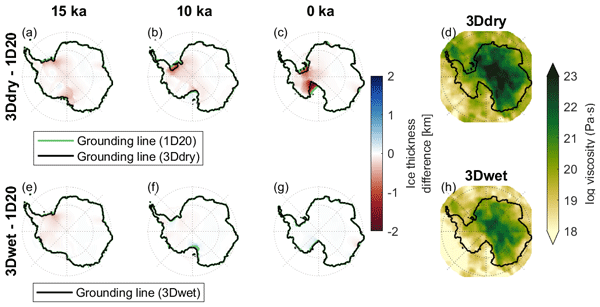
Caroline J. van Calcar, Roderik S. W. van de Wal, Bas Blank, Bas de Boer, and Wouter van der Wal
Geosci. Model Dev., 16, 5473–5492, https://doi.org/10.5194/gmd-16-5473-2023, https://doi.org/10.5194/gmd-16-5473-2023, 2023
Short summary
Short summary
The waxing and waning of the Antarctic ice sheet caused the Earth’s surface to deform, which is stabilizing the ice sheet and mainly determined by the spatially variable viscosity of the mantle. Including this feedback in model simulations led to significant differences in ice sheet extent and ice thickness over the last glacial cycle. The results underline and quantify the importance of including this local feedback effect in ice sheet models when simulating the Antarctic ice sheet evolution.
Franka Jesse, Erwin Lambert, Constantijn J. Berends, and Roderik S. W. van de Wal
EGUsphere, https://doi.org/10.5194/egusphere-2026-4237, https://doi.org/10.5194/egusphere-2026-4237, 2026
This preprint is open for discussion and under review for The Cryosphere (TC).
Short summary
Short summary
Strong ocean-driven melting can create gaps in floating ice shelves. Because the pathways of meltwater beneath these gaps are poorly understood, we tested two contrasting scenarios: one in which meltwater loses heat and momentum within the gaps, and another in which it continues to flow across them. These different representations substantially alter projected ice mass loss, highlighting meltwater treatment across ice-shelf gaps as a key source of uncertainty.
Constantijn J. Berends, Jorge A. Bernales, Erwin Lambert, and Roderik S. W. van de Wal
EGUsphere, https://doi.org/10.5194/egusphere-2026-4041, https://doi.org/10.5194/egusphere-2026-4041, 2026
Short summary
Short summary
Computer models of the Antarctic ice sheet can project how much it will melt in response to climate change. That depends on the properties of the rock and the water beneath the ice, about which we know very little. That means the amount of sea-level in the future is very uncertain. Techniques to reduce that uncertainty do not always work as well as expected. We must get actual measurements of the bottom of the ice to improve our understanding of the ice sheet, and our knowledge of its future.
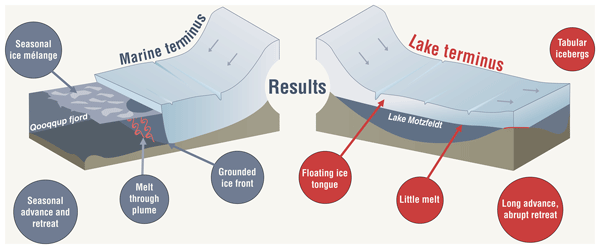
Florian Vacek, Faezeh M. Nick, Douglas Benn, Maarten P. A. Zwarts, Walter Immerzeel, and Roderik S. W. van de Wal
The Cryosphere, 20, 3827–3845, https://doi.org/10.5194/tc-20-3827-2026, https://doi.org/10.5194/tc-20-3827-2026, 2026
Short summary
Short summary
We studied a unique glacier in South Greenland that ends in both a lake and the ocean. Using satellite data and field work, we found that the two glacier fronts behave very differently even under the same climate. At the lake glacier we identify a floating ice tongue and we infer little melt below water. The lake glacier experienced a sudden large breakup. Our work suggests that lake and marine glacier fronts must be treated differently in model simulations.
James R. Jordan, Frank Pattyn, Daniel Abele, Torsten Albrecht, Jorge Alvarez-Solas, Jowan M. Barnes, Tijn Berends, Jorge A. Bernales, Javier Blasco, Gong Cheng, Youngmin Choi, Stephen L. Cornford, Cruz Garcia-Molina, Fabien Gillet-Chaulet, G. Hilmar Gudmundsson, Angelika Humbert, Gunter R. Leguy, William H. Lipscomb, Marisa Montoya, Daniel Moreno-Parada, Mathieu Morlighem, Tyler Pelle, Alexander Robinson, Martin Rückamp, Hélène Seroussi, Yanmei Tian, Luisa Wagner, Roderick S. W. van de Wal, Liyun Zhao, and Thomas Zwinger
EGUsphere, https://doi.org/10.5194/egusphere-2026-1962, https://doi.org/10.5194/egusphere-2026-1962, 2026
Short summary
Short summary
Ice calving is a recent inclusion in ice sheet models and there has not been a systematic test of how well it has been implemented. We show that models can accurately represent a given rate of ice calving, properties at the ice front evolve smoothly during calving, and that there are no consistent differences in ice behaviour between various approaches to representing calving in numerical ice models. This gives us confidence in their ability for use in sea level rise prediction simulations.
Daniel Gunning, Kerim H. Nisancioglu, Emilie Capron, and Roderik S. W. van de Wal
EGUsphere, https://doi.org/10.5194/egusphere-2026-1151, https://doi.org/10.5194/egusphere-2026-1151, 2026
Short summary
Short summary
During the Early Pleistocene, glacial cycles closely follow Earth’s obliquity, even though summer insolation is strongly modulated by precession. Sensitivity experiments with a zonally averaged energy balance model show a pronounced obliquity cycle in polar temperatures. This arises from obliquity control on winter sea ice, which regulates ocean heat release, while precession has a weaker effect on sea ice and temperature.
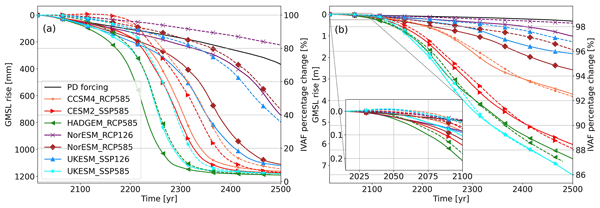
Tim van den Akker, William H. Lipscomb, Gunter R. Leguy, Willem Jan van de Berg, and Roderik S. W. van de Wal
The Cryosphere, 20, 1405–1425, https://doi.org/10.5194/tc-20-1405-2026, https://doi.org/10.5194/tc-20-1405-2026, 2026
Short summary
Short summary
The Antarctic Ice Sheet is currently thinning, especially at major outlet glaciers. Including present-day ice thinning rates in models is a modeller's choice and can affect future projections. This study quantifies the impact of current imbalance on forced future projections, revealing strong regional and short-term (up to 2100) effects when these mass change rates are included.
Mirko Scheinert, Weisen Shen, Richard C. Aster, Lambert Caron, Michael D. Hartinger, Matt A. King, Andrew Lloyd, Anya M. Reading, J. Paul Winberry, Terry Wilson, Lucilla Alfonsi, Michael J. Bentley, Eric Buchta, Thomas Y. Chen, Peter J. Clarke, Jörg Ebbing, Olaf Eisen, Natalya Gomez, Esra Günaydın, Samantha Hansen, Erik R. Ivins, Achraf Koulali, Grace A. Nield, Frederick Richards, Mahmut O. Selbesoglu, Stephanie Sherman, Pippa L. Whitehouse, and Matthias Willen
EGUsphere, https://doi.org/10.5194/egusphere-2025-6370, https://doi.org/10.5194/egusphere-2025-6370, 2026
Short summary
Short summary
With an ongoing mass loss the Antarctic Ice Sheet contributes to global-mean sea level rise at a rate of 0.4 mm/a. Thus, it plays a key role in global climate and provides a natural laboratory to study processes that interlink cryosphere, solid Earth, atmosphere and ocean. We discuss how GNSS and seismic networks in Antarctica were used to significantly advance our understanding of these processes, and how they should be maintained and extended to answer key science questions in the future.

Tim van den Akker, William H. Lipscomb, Gunter R. Leguy, Willem Jan van de Berg, and Roderik S. W. van de Wal
The Cryosphere, 20, 1217–1235, https://doi.org/10.5194/tc-20-1217-2026, https://doi.org/10.5194/tc-20-1217-2026, 2026
Short summary
Short summary
Ice sheet models to simulate future sea level rise require parameterizations, like for the friction at the bedrock. Studies have quantified the effect of using different parameterizations, and some have concluded that projections are sensitive to the choice of the specific parameterization. In this study, we show that you can make an ice sheet model sensitive to the basal friction parameterization, and that for different modellers choices you can also make the model insensitive to this.

Heiko Goelzer, Constantijn J. Berends, Fredrik Boberg, Gael Durand, Tamsin L. Edwards, Xavier Fettweis, Fabien Gillet-Chaulet, Quentin Glaude, Philippe Huybrechts, Sébastien Le clec'h, Ruth Mottram, Brice Noël, Martin Olesen, Charlotte Rahlves, Jeremy Rohmer, Michiel van den Broeke, and Roderik S. W. van de Wal
The Cryosphere, 19, 6887–6906, https://doi.org/10.5194/tc-19-6887-2025, https://doi.org/10.5194/tc-19-6887-2025, 2025
Short summary
Short summary
We present an ensemble of ice sheet model projections for the Greenland ice sheet. The focus is on providing projections that improve our understanding of the range future sea-level rise and the inherent uncertainties over the next 100 to 300 years. Compared to earlier work we more fully account for some of the uncertainties in sea-level projections. We include a wider range of climate model output, more climate change scenarios and we extend projections schematically up to year 2300.
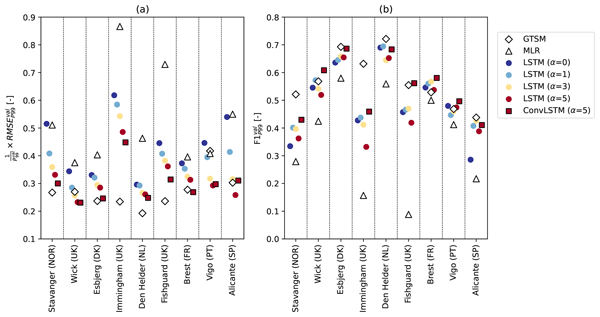
Tim H. J. Hermans, Chiheb Ben Hammouda, Simon Treu, Timothy Tiggeloven, Anaïs Couasnon, Julius J. M. Busecke, and Roderik S. W. van de Wal
Nat. Hazards Earth Syst. Sci., 25, 4593–4612, https://doi.org/10.5194/nhess-25-4593-2025, https://doi.org/10.5194/nhess-25-4593-2025, 2025
Short summary
Short summary
We studied the performance of different types of neural networks at predicting extreme storm surges. We found that that performance improves when during model training, storm surges that are rarer are given a higher weight than moderate storm surges. Additionally, we found that the performance of some of the neural networks approaches that of a state-of-the-art hydrodynamic model. This is promising for the future application of neural networks to climate model simulations.
Johanna Beckmann, Ronja Reese, Felicity S. McCormack, Sue Cook, Lawrence Bird, Dawid Gwyther, Daniel Richards, Matthias Scheiter, Yu Wang, Hélène Seroussi, Ayako Abe‐Ouchi, Torsten Albrecht, Jorge Alvarez‐Solas, Xylar S. Asay‐Davis, Jean‐Baptiste Barre, Constantijn J. Berends, Jorge Bernales, Javier Blasco, Justine Caillet, David M. Chandler, Violaine Coulon, Richard Cullather, Christophe Dumas, Benjamin K. Galton‐Fenzi, Julius Garbe, Fabien Gillet‐Chaulet, Rupert Gladstone, Heiko Goelzer, Nicholas R. Golledge, Ralf Greve, G. Hilmar Gudmundsson, Holly Kyeore Han, Trevor R. Hillebrand, Matthew J. Hoffman, Philippe Huybrechts, Nicolas C. Jourdain, Ann Kristin Klose, Petra M. Langebroek, Gunter R. Leguy, William H. Lipscomb, Daniel P. Lowry, Pierre Mathiot, Marisa Montoya, Mathieu Morlighem, Sophie Nowicki, Frank Pattyn, Antony J. Payne, Tyler Pelle, Aurélien Quiquet, Alexander Robinson, Leopekka Saraste, Erika G. Simon, Sainan Sun, Jake P. Twarog, Luke D. Trusel, Benoit Urruty, Jonas Van Breedam, Roderik S. W. van de Wal, Chen Zhao, and Thomas Zwinger
EGUsphere, https://doi.org/10.5194/egusphere-2025-4069, https://doi.org/10.5194/egusphere-2025-4069, 2025
Short summary
Short summary
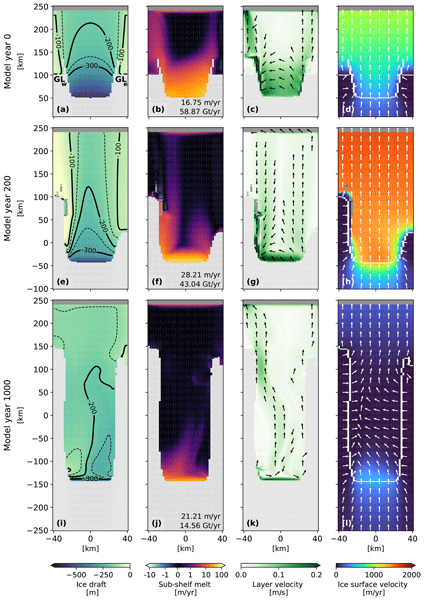
Antarctica holds enough ice to raise sea levels by many meters, but its future is uncertain. Warm ocean water melts ice shelves from below, letting inland ice flow faster into the sea. By 2300, Antarctica could add 0.6–4.4 m to sea levels. Our study identifies two key factors—how strongly shelves melt and how the ice responds. These explain much of the range, and refining them in models may improve future predictions.
Franka Jesse, Erwin Lambert, and Roderik S. W. van de Wal
The Cryosphere, 19, 3849–3872, https://doi.org/10.5194/tc-19-3849-2025, https://doi.org/10.5194/tc-19-3849-2025, 2025
Short summary
Short summary
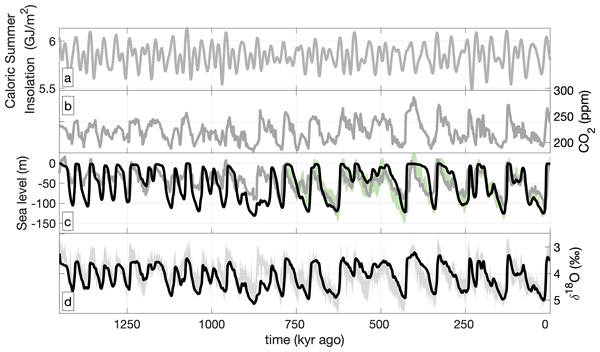
We introduce the coupling of a sub-shelf melt model with an ice sheet model to explore how horizontal meltwater flow below ice shelves affects ice sheet mass loss over time. We show that accurately modelling the meltwater flow direction leads to distinct feedbacks and transient volume loss not captured by melt parameterisations that simplify flow direction. Our results highlight the importance of refining the meltwater flow representation in ice sheet models to improve sea level projections.
Meike D. W. Scherrenberg, Constantijn J. Berends, and Roderik S. W. van de Wal
Clim. Past, 21, 1061–1077, https://doi.org/10.5194/cp-21-1061-2025, https://doi.org/10.5194/cp-21-1061-2025, 2025
Short summary
Short summary
Glacial cycle duration changed from 41 000 to 100 000 years during the Mid-Pleistocene Transition (MPT), but the cause is still under debate. We simulate the MPT with an ice sheet model forced by prescribed CO2 and insolation and simple ice–climate interactions. Before the MPT, glacial cycles follow insolation. After the MPT, low CO2 levels may compensate for warming at insolation maxima, increasing the length of glacial cycles until the North American ice sheet becomes large and thereby unstable.

Constantijn J. Berends, Victor Azizi, Jorge A. Bernales, and Roderik S. W. van de Wal
Geosci. Model Dev., 18, 3635–3659, https://doi.org/10.5194/gmd-18-3635-2025, https://doi.org/10.5194/gmd-18-3635-2025, 2025
Short summary
Short summary
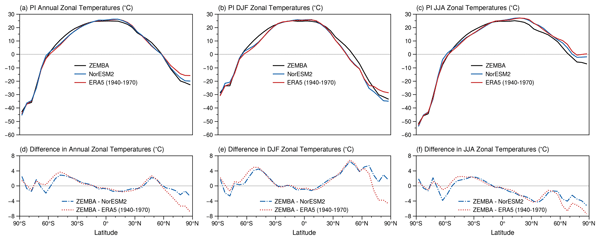
Ice-sheet models are computer programs that can simulate how the Greenland and Antarctic ice sheets will evolve in the future. The accuracy of these models depends on their resolution: how small the details are that the model can resolve. We have created a model with a variable resolution that can resolve a lot of detail in areas where lots of changes happen in the ice and less detail in areas where the ice does not move so much. This makes the model both accurate and fast.
Daniel F. J. Gunning, Kerim H. Nisancioglu, Emilie Capron, and Roderik S. W. van de Wal
Geosci. Model Dev., 18, 2479–2508, https://doi.org/10.5194/gmd-18-2479-2025, https://doi.org/10.5194/gmd-18-2479-2025, 2025
Short summary
Short summary
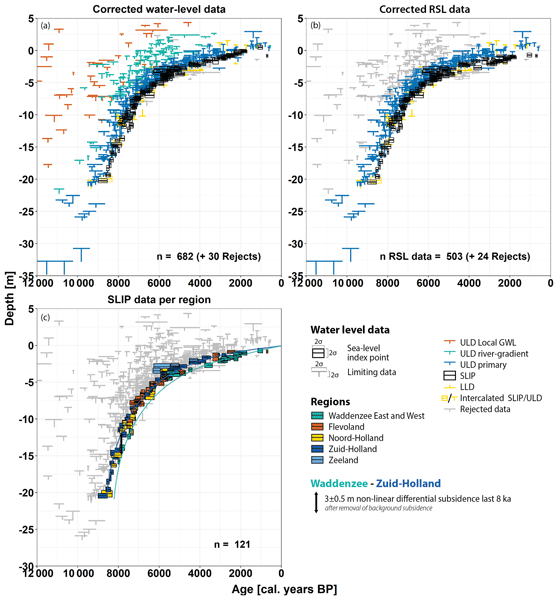
This work documents the first results from ZEMBA: an energy balance model of the climate system. The model is a computationally efficient tool designed to study the response of climate to changes in the Earth's orbit. We demonstrate that ZEMBA reproduces many features of the Earth's climate for both the pre-industrial period and the Earth's most recent cold extreme – the Last Glacial Maximum. We intend to develop ZEMBA further and investigate the glacial cycles of the last 2.5 million years.
Kim de Wit, Kim M. Cohen, and Roderik S. W. van de Wal
Earth Syst. Sci. Data, 17, 545–577, https://doi.org/10.5194/essd-17-545-2025, https://doi.org/10.5194/essd-17-545-2025, 2025
Short summary
Short summary
In the Holocene, deltas and coastal plains developed due to relative sea level rise (RSLR). Past coastal and inland water levels are preserved in geological indicators, like basal peats. We present a dataset of 712 Holocene water level indicators from the Dutch coastal plain, relevant for studying RSLR and regional subsidence, compiled in HOLSEA workbook format. Our new, internally consistent, expanded documentation encourages multiple data uses and to report RSLR uncertainties transparently.
Tim van den Akker, William H. Lipscomb, Gunter R. Leguy, Jorjo Bernales, Constantijn J. Berends, Willem Jan van de Berg, and Roderik S. W. van de Wal
The Cryosphere, 19, 283–301, https://doi.org/10.5194/tc-19-283-2025, https://doi.org/10.5194/tc-19-283-2025, 2025
Short summary
Short summary
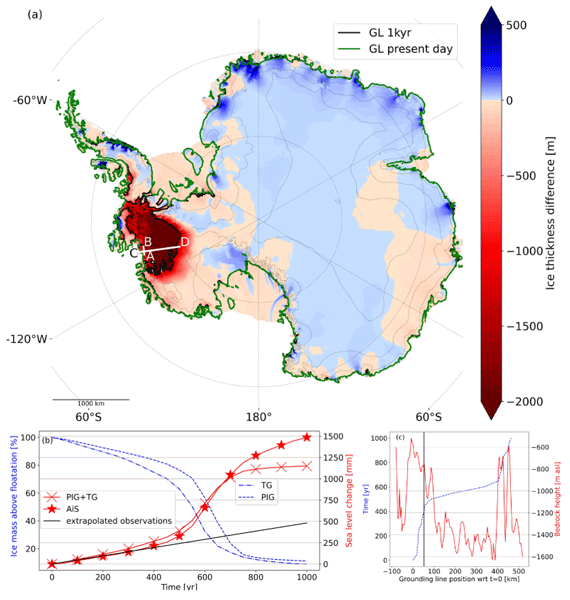
In this study, we present an improved way of representing ice thickness change rates in an ice sheet model. We apply this method using two ice sheet models of the Antarctic Ice Sheet. We found that the two largest outlet glaciers on the Antarctic Ice Sheet, Thwaites Glacier and Pine Island Glacier, will collapse without further warming on a timescale of centuries. This would cause a sea level rise of about 1.2 m globally.
Bart van den Hurk, Nadia Pinardi, Alexander Bisaro, Giulia Galluccio, José A. Jiménez, Kate Larkin, Angélique Melet, Lavinia Giulia Pomarico, Kristin Richter, Kanika Singh, Roderik van de Wal, and Gundula Winter
State Planet, 3-slre1, 1, https://doi.org/10.5194/sp-3-slre1-1-2024, https://doi.org/10.5194/sp-3-slre1-1-2024, 2024
Short summary
Short summary
The Summary for Policymakers compiles findings from “Sea Level Rise in Europe: 1st Assessment Report of the Knowledge Hub on Sea Level Rise”. It covers knowledge gaps, observations, projections, impacts, adaptation measures, decision-making principles, and governance challenges. It provides information for each European basin (Mediterranean, Black Sea, North Sea, Baltic Sea, Atlantic, and Arctic) and aims to assist policymakers in enhancing the preparedness of European coasts for sea level rise.
Roderik van de Wal, Angélique Melet, Debora Bellafiore, Paula Camus, Christian Ferrarin, Gualbert Oude Essink, Ivan D. Haigh, Piero Lionello, Arjen Luijendijk, Alexandra Toimil, Joanna Staneva, and Michalis Vousdoukas
State Planet, 3-slre1, 5, https://doi.org/10.5194/sp-3-slre1-5-2024, https://doi.org/10.5194/sp-3-slre1-5-2024, 2024
Short summary
Short summary
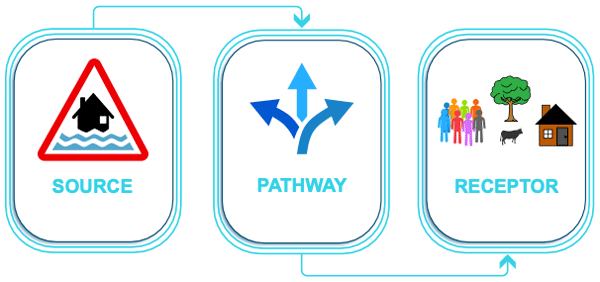
Sea level rise has major impacts in Europe, which vary from place to place and in time, depending on the source of the impacts. Flooding, erosion, and saltwater intrusion lead, via different pathways, to various consequences for coastal regions across Europe. This causes damage to assets, the environment, and people for all three categories of impacts discussed in this paper. The paper provides an overview of the various impacts in Europe.
Angélique Melet, Roderik van de Wal, Angel Amores, Arne Arns, Alisée A. Chaigneau, Irina Dinu, Ivan D. Haigh, Tim H. J. Hermans, Piero Lionello, Marta Marcos, H. E. Markus Meier, Benoit Meyssignac, Matthew D. Palmer, Ronja Reese, Matthew J. R. Simpson, and Aimée B. A. Slangen
State Planet, 3-slre1, 4, https://doi.org/10.5194/sp-3-slre1-4-2024, https://doi.org/10.5194/sp-3-slre1-4-2024, 2024
Short summary
Short summary
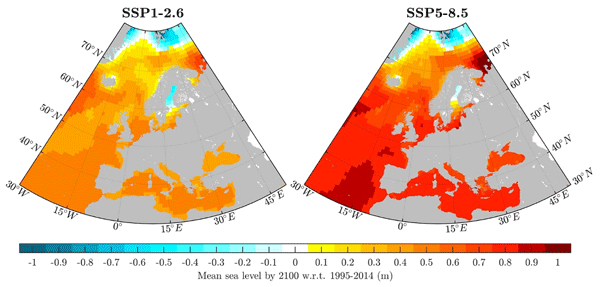
The EU Knowledge Hub on Sea Level Rise’s Assessment Report strives to synthesize the current scientific knowledge on sea level rise and its impacts across local, national, and EU scales to support evidence-based policy and decision-making, primarily targeting coastal areas. This paper complements IPCC reports by documenting the state of knowledge of observed and 21st century projected changes in mean and extreme sea levels with more regional information for EU seas as scoped with stakeholders.
Meike D. W. Scherrenberg, Constantijn J. Berends, and Roderik S. W. van de Wal
Clim. Past, 20, 1761–1784, https://doi.org/10.5194/cp-20-1761-2024, https://doi.org/10.5194/cp-20-1761-2024, 2024
Short summary
Short summary
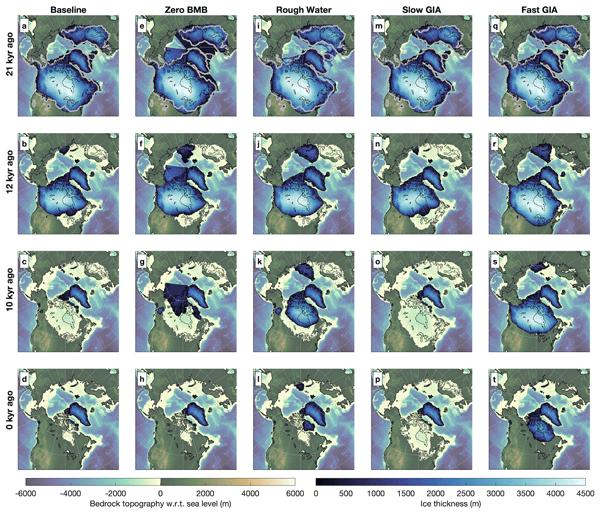
During Late Pleistocene glacial cycles, the Eurasian and North American ice sheets grew and melted, resulting in over 100 m of sea-level change. Studying the melting of past ice sheets can improve our understanding of how ice sheets might respond in the future. In this study, we find that melting increases due to proglacial lakes forming at the margins of the ice sheets, primarily due to the reduced basal friction of floating ice. Furthermore, bedrock uplift rates can strongly influence melting.
Lennert B. Stap, Constantijn J. Berends, and Roderik S. W. van de Wal
Clim. Past, 20, 257–266, https://doi.org/10.5194/cp-20-257-2024, https://doi.org/10.5194/cp-20-257-2024, 2024
Short summary
Short summary
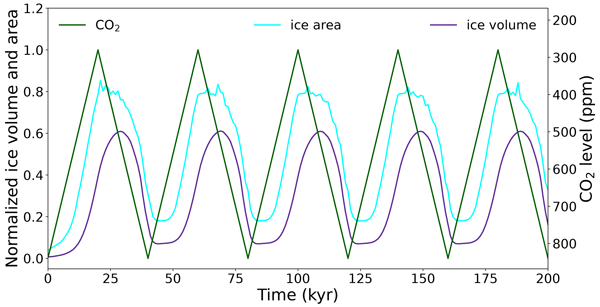
Analysing simulations of Antarctic Ice Sheet variability during the early and mid-Miocene (23 to 14 Myr ago), we find that the ice sheet area adapts faster and more strongly than volume to climate change on quasi-orbital timescales. Considering the recent discovery that ice area, rather than volume, influences deep-ocean temperatures, this implies that the Miocene Antarctic Ice Sheet affects deep-ocean temperatures more than its volume suggests.
Hélène Seroussi, Vincent Verjans, Sophie Nowicki, Antony J. Payne, Heiko Goelzer, William H. Lipscomb, Ayako Abe-Ouchi, Cécile Agosta, Torsten Albrecht, Xylar Asay-Davis, Alice Barthel, Reinhard Calov, Richard Cullather, Christophe Dumas, Benjamin K. Galton-Fenzi, Rupert Gladstone, Nicholas R. Golledge, Jonathan M. Gregory, Ralf Greve, Tore Hattermann, Matthew J. Hoffman, Angelika Humbert, Philippe Huybrechts, Nicolas C. Jourdain, Thomas Kleiner, Eric Larour, Gunter R. Leguy, Daniel P. Lowry, Chistopher M. Little, Mathieu Morlighem, Frank Pattyn, Tyler Pelle, Stephen F. Price, Aurélien Quiquet, Ronja Reese, Nicole-Jeanne Schlegel, Andrew Shepherd, Erika Simon, Robin S. Smith, Fiammetta Straneo, Sainan Sun, Luke D. Trusel, Jonas Van Breedam, Peter Van Katwyk, Roderik S. W. van de Wal, Ricarda Winkelmann, Chen Zhao, Tong Zhang, and Thomas Zwinger
The Cryosphere, 17, 5197–5217, https://doi.org/10.5194/tc-17-5197-2023, https://doi.org/10.5194/tc-17-5197-2023, 2023
Short summary
Short summary
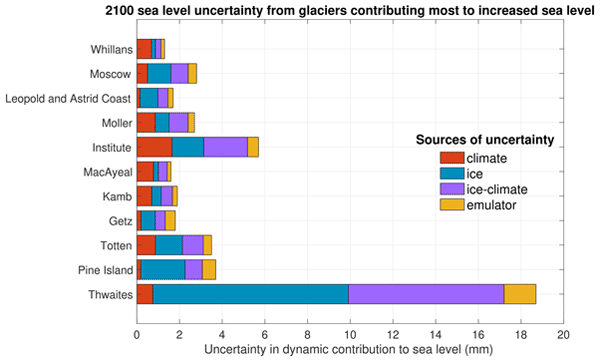
Mass loss from Antarctica is a key contributor to sea level rise over the 21st century, and the associated uncertainty dominates sea level projections. We highlight here the Antarctic glaciers showing the largest changes and quantify the main sources of uncertainty in their future evolution using an ensemble of ice flow models. We show that on top of Pine Island and Thwaites glaciers, Totten and Moscow University glaciers show rapid changes and a strong sensitivity to warmer ocean conditions.
Caroline J. van Calcar, Roderik S. W. van de Wal, Bas Blank, Bas de Boer, and Wouter van der Wal
Geosci. Model Dev., 16, 5473–5492, https://doi.org/10.5194/gmd-16-5473-2023, https://doi.org/10.5194/gmd-16-5473-2023, 2023
Short summary
Short summary
The waxing and waning of the Antarctic ice sheet caused the Earth’s surface to deform, which is stabilizing the ice sheet and mainly determined by the spatially variable viscosity of the mantle. Including this feedback in model simulations led to significant differences in ice sheet extent and ice thickness over the last glacial cycle. The results underline and quantify the importance of including this local feedback effect in ice sheet models when simulating the Antarctic ice sheet evolution.
Erwin Lambert, André Jüling, Roderik S. W. van de Wal, and Paul R. Holland
The Cryosphere, 17, 3203–3228, https://doi.org/10.5194/tc-17-3203-2023, https://doi.org/10.5194/tc-17-3203-2023, 2023
Short summary
Short summary
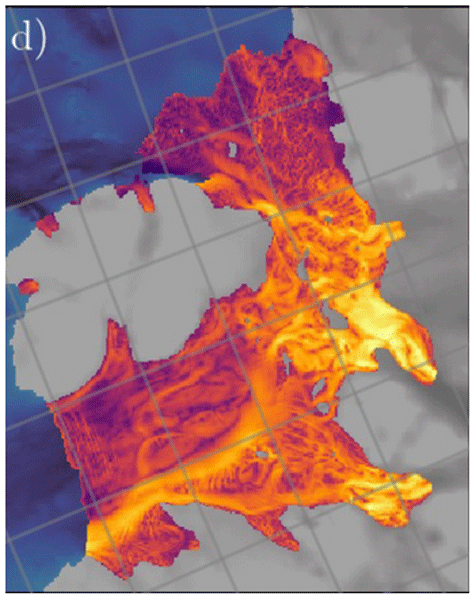
A major uncertainty in the study of sea level rise is the melting of the Antarctic ice sheet by the ocean. Here, we have developed a new model, named LADDIE, that simulates this ocean-driven melting of the floating parts of the Antarctic ice sheet. This model simulates fine-scale patterns of melting and freezing and requires significantly fewer computational resources than state-of-the-art ocean models. LADDIE can be used as a new tool to force high-resolution ice sheet models.
Iris Keizer, Dewi Le Bars, Cees de Valk, André Jüling, Roderik van de Wal, and Sybren Drijfhout
Ocean Sci., 19, 991–1007, https://doi.org/10.5194/os-19-991-2023, https://doi.org/10.5194/os-19-991-2023, 2023
Short summary
Short summary
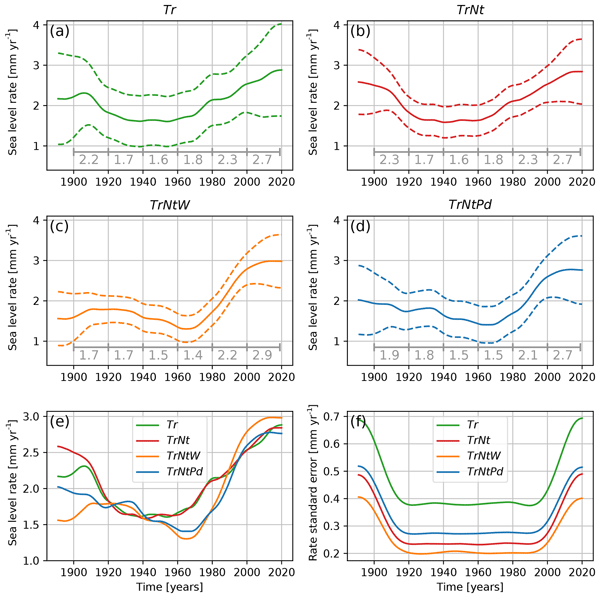
Using tide gauge observations, we show that the acceleration of sea-level rise (SLR) along the coast of the Netherlands started in the 1960s but was masked by wind field and nodal-tide variations. This finding aligns with global SLR observations and expectations based on a physical understanding of SLR related to global warming.
Inès N. Otosaka, Andrew Shepherd, Erik R. Ivins, Nicole-Jeanne Schlegel, Charles Amory, Michiel R. van den Broeke, Martin Horwath, Ian Joughin, Michalea D. King, Gerhard Krinner, Sophie Nowicki, Anthony J. Payne, Eric Rignot, Ted Scambos, Karen M. Simon, Benjamin E. Smith, Louise S. Sørensen, Isabella Velicogna, Pippa L. Whitehouse, Geruo A, Cécile Agosta, Andreas P. Ahlstrøm, Alejandro Blazquez, William Colgan, Marcus E. Engdahl, Xavier Fettweis, Rene Forsberg, Hubert Gallée, Alex Gardner, Lin Gilbert, Noel Gourmelen, Andreas Groh, Brian C. Gunter, Christopher Harig, Veit Helm, Shfaqat Abbas Khan, Christoph Kittel, Hannes Konrad, Peter L. Langen, Benoit S. Lecavalier, Chia-Chun Liang, Bryant D. Loomis, Malcolm McMillan, Daniele Melini, Sebastian H. Mernild, Ruth Mottram, Jeremie Mouginot, Johan Nilsson, Brice Noël, Mark E. Pattle, William R. Peltier, Nadege Pie, Mònica Roca, Ingo Sasgen, Himanshu V. Save, Ki-Weon Seo, Bernd Scheuchl, Ernst J. O. Schrama, Ludwig Schröder, Sebastian B. Simonsen, Thomas Slater, Giorgio Spada, Tyler C. Sutterley, Bramha Dutt Vishwakarma, Jan Melchior van Wessem, David Wiese, Wouter van der Wal, and Bert Wouters
Earth Syst. Sci. Data, 15, 1597–1616, https://doi.org/10.5194/essd-15-1597-2023, https://doi.org/10.5194/essd-15-1597-2023, 2023
Short summary
Short summary
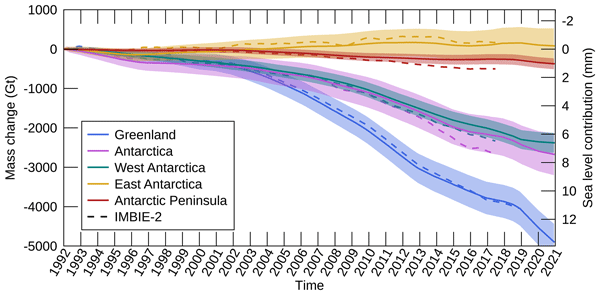
By measuring changes in the volume, gravitational attraction, and ice flow of Greenland and Antarctica from space, we can monitor their mass gain and loss over time. Here, we present a new record of the Earth’s polar ice sheet mass balance produced by aggregating 50 satellite-based estimates of ice sheet mass change. This new assessment shows that the ice sheets have lost (7.5 x 10¹²) t of ice between 1992 and 2020, contributing 21 mm to sea level rise.
Constantijn J. Berends, Roderik S. W. van de Wal, Tim van den Akker, and William H. Lipscomb
The Cryosphere, 17, 1585–1600, https://doi.org/10.5194/tc-17-1585-2023, https://doi.org/10.5194/tc-17-1585-2023, 2023
Short summary
Short summary
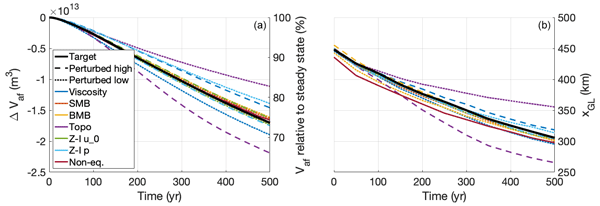
The rate at which the Antarctic ice sheet will melt because of anthropogenic climate change is uncertain. Part of this uncertainty stems from processes occurring beneath the ice, such as the way the ice slides over the underlying bedrock.
Inversion methodsattempt to use observations of the ice-sheet surface to calculate how these sliding processes work. We show that such methods cannot fully solve this problem, so a substantial uncertainty still remains in projections of sea-level rise.
Meike D. W. Scherrenberg, Constantijn J. Berends, Lennert B. Stap, and Roderik S. W. van de Wal
Clim. Past, 19, 399–418, https://doi.org/10.5194/cp-19-399-2023, https://doi.org/10.5194/cp-19-399-2023, 2023
Short summary
Short summary
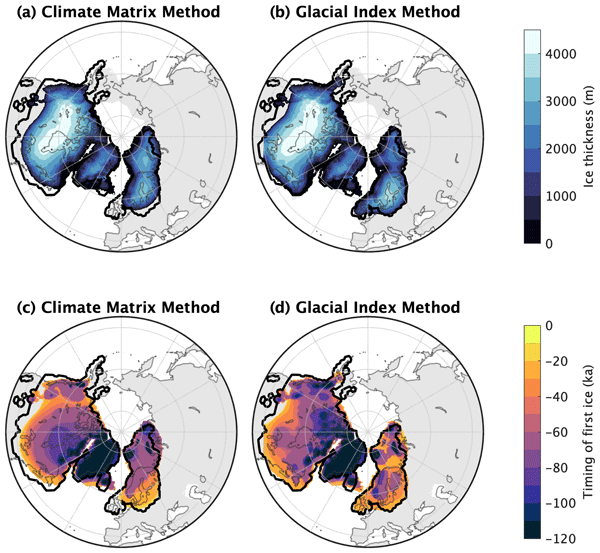
Ice sheets have a large effect on climate and vice versa. Here we use an ice sheet computer model to simulate the last glacial cycle and compare two methods, one that implicitly includes these feedbacks and one that does not. We found that when including simple climate feedbacks, the North American ice sheet develops from two domes instead of many small domes. Each ice sheet melts slower when including feedbacks. We attribute this difference mostly to air temperature–ice sheet interactions.
Constantijn J. Berends, Heiko Goelzer, Thomas J. Reerink, Lennert B. Stap, and Roderik S. W. van de Wal
Geosci. Model Dev., 15, 5667–5688, https://doi.org/10.5194/gmd-15-5667-2022, https://doi.org/10.5194/gmd-15-5667-2022, 2022
Short summary
Short summary
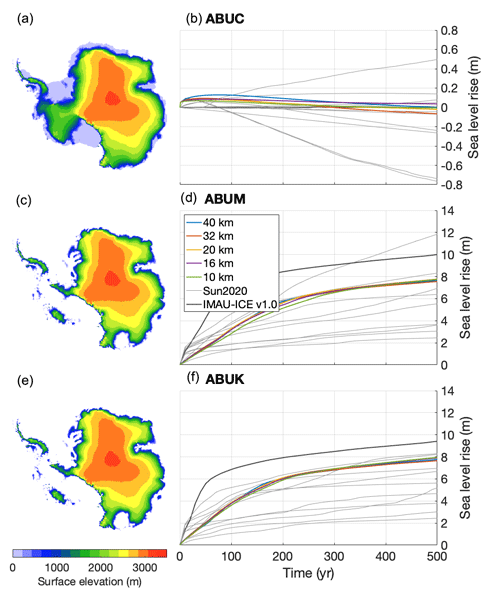
The rate at which marine ice sheets such as the West Antarctic ice sheet will retreat in a warming climate and ocean is still uncertain. Numerical ice-sheet models, which solve the physical equations that describe the way glaciers and ice sheets deform and flow, have been substantially improved in recent years. Here we present the results of several years of work on IMAU-ICE, an ice-sheet model of intermediate complexity, which can be used to study ice sheets of both the past and the future.
Lennert B. Stap, Constantijn J. Berends, Meike D. W. Scherrenberg, Roderik S. W. van de Wal, and Edward G. W. Gasson
The Cryosphere, 16, 1315–1332, https://doi.org/10.5194/tc-16-1315-2022, https://doi.org/10.5194/tc-16-1315-2022, 2022
Short summary
Short summary
To gain understanding of how the Antarctic ice sheet responded to CO2 changes during past warm climate conditions, we simulate its variability during the Miocene. We include feedbacks between the ice sheet and atmosphere in our model and force the model using time-varying climate conditions. We find that these feedbacks reduce the amplitude of ice volume variations. Erosion-induced changes in the bedrock below the ice sheet that manifested during the Miocene also have a damping effect.
Cited articles
An, M., Wiens, D. A., Zhao, Y., Feng, M., Nyblade, A., Kanao, M., Li, Y., Maggi, A., and Lévêque, J.-J.: Temperature, lithosphere-asthenosphere boundary, and heat flux beneath the Antarctic Plate inferred from seismic velocities, J. Geophys. Res. Solid Earth, 120, 8720–8742, https://doi.org/10.1002/2015JB011917, 2015.
Bagge, M., Klemann, V., Steinberger, B., Latinović, M., and Thomas, M.: Glacial-isostatic adjustment models using geodynamically constrained 3D Earth structures, Geochem. Geophys. Geosyst., 22, e2021GC009853, https://doi.org/10.1029/2021GC009853, 2021.
Barletta, V. R., Bevis, M., Smith, B., Wilson, T., Brown, A., Bordoni, A., Willis, M., Khan, S. A., Rovira-Navarro, M., Dalziel, I. W. D., Smalley, R., Kendrick, E., Konfal, S., Caccamise, D. J., Aster, R. C., Nyblade, A., and Wiens, D. A.: Observed rapid bedrock uplift in Amundsen Sea Embayment promotes ice-sheet stability, Science, 360, 1335–1339, https://doi.org/10.1126/science.aao1447, 2018.
Becker, T. W. and Boschi, L.: A comparison of tomographic and geodynamic mantle models, Geochem. Geophys. Geosyst., 3, https://doi.org/10.1029/2001GC000168, 2002.
Berends, C. J., Goelzer, H., Reerink, T. J., Stap, L. B., and van de Wal, R. S. W.: Benchmarking the vertically integrated ice-sheet model IMAU-ICE (version 2.0), Geosci. Model Dev., 15, 5667–5688, https://doi.org/10.5194/gmd-15-5667-2022, 2022.
Blank, B., Barletta, V., Hu, H., Pappa, F., and van der Wal, W.: Effect of lateral and stress-dependent viscosity variations on GIA induced uplift rates in the Amundsen Sea Embayment, Geochemistry, Geophysics, Geosystems, 22, https://doi.org/10.1029/2021GC009807, 2021.
Book, C., Hoffman, M. J., Kachuck, S. B., Kachuck, S. B., Hillebrand, T. R., Price, S. F., Perego, M., and Bassis, J. N.: Stabilizing effect of bedrock uplift on retreat of Thwaites Glacier, Antarctica, at centennial timescales, Earth Planet. Sci. Lett., 597, 117798, https://doi.org/10.1016/j.epsl.2022.117798, 2022.
Bueler, E. and Brown, J.: Shallow shelf approximation as a “sliding law” in a thermomechanically coupled ice-sheet model, J. Geophys. Res.-Earth, 114, F03008, https://doi.org/10.1029/2008JF001179, 2009.
Bulthuis, K., Arnst, M., Sun, S., and Pattyn, F.: Uncertainty quantification of the multi-centennial response of the Antarctic ice sheet to climate change, The Cryosphere, 13, 1349–1380, https://doi.org/10.5194/tc-13-1349-2019, 2019.
Coulon, V., Bulthuis, K., Whitehouse, P. L., Sun, S., Haubner, K., Zipf, L., and Pattyn, F.: Contrasting response of West and East Antarctic Ice Sheets to glacial isostatic adjustment, J. Geophys. Res.-Earth Surf., 126, e2020JF006003, https://doi.org/10.1029/2020JF006003, 2021.
Coulon, V., Klose, A. K., Kittel, C., Edwards, T., Turner, F., Winkelmann, R., and Pattyn, F.: Disentangling the drivers of future Antarctic ice loss with a historically calibrated ice-sheet model, The Cryosphere, 18, 653–681, https://doi.org/10.5194/tc-18-653-2024, 2024.
Christensen, U.: Convection with pressure- and temperature-dependent non-Newtonian rheology, Geophys. J. Int., 77, 343–384, https://doi.org/10.1111/j.1365-246X.1984.tb01939.x, 1984.
Danabasoglu, G., Lamarque, J.-F., Bacmeister, J., Bailey, D. A., DuVivier, A. K., Edwards, J., Emmons, L. K., Fasullo, J., Garcia, R., Gettelman, A., Hannay, C., Holland, M. M., Large, W. G., Lauritzen, P. H., Lawrence, D. M., Lenaerts, J. T. M., Lindsay, K., Lipscomb, W. H., Mills, M. J., Neale, R., Oleson, K. W., Otto-Bliesner, B., Phillips, A. S., Sacks, W., Tilmes, S., van Kampenhout, L., Vertenstein, M., Bertini, A., Dennis, J., Deser, C., Fischer, C., Fox-Kemper, B., Kay, J. E., Kinnison, D., Kushner, P. J., Larson, V. E., Long, M. C., Mickelson, S., Moore, J. K., Nienhouse, E., Polvani, L., Rasch, P. J., and Strand, W. G.: The Community Earth System Model Version 2 (CESM2), Journal of Advances in Modeling Earth Systems, 12, https://doi.org/10.1029/2019MS001916, 2020.
DeConto, R. M., Pollard, D., Alley, R. B., Velicogna, I., Gasson, E., Gomez, N., Sadai, S., Condron, A., Gilford, D. M., Ashe, E. L., Kopp, R. E., Li, D., and Dutton, A.: The Paris Climate Agreement and future sea-level rise from Antarctica, Nature, 593, 83–89, https://doi.org/10.1038/s41586-021-03427-0, 2021.
Eyring, V., Bony, S., Meehl, G. A., Senior, C. A., Stevens, B., Stouffer, R. J., and Taylor, K. E.: Overview of the Coupled Model Intercomparison Project Phase 6 (CMIP6) experimental design and organization, Geosci. Model Dev., 9, 1937–1958, https://doi.org/10.5194/gmd-9-1937-2016, 2016.
Farrell, W. E. and Clark, J. A.: On Postglacial Sea Level, Geophys. J. R. Astron. Soc., 46, 647–667, https://doi.org/10.1111/j.1365-246X.1976.tb01252.x, 1976.
Favier, L., Jourdain, N. C., Jenkins, A., Merino, N., Durand, G., Gagliardini, O., Gillet-Chaulet, F., and Mathiot, P.: Assessment of sub-shelf melting parameterisations using the ocean–ice-sheet coupled model NEMO(v3.6)–Elmer/Ice(v8.3) , Geosci. Model Dev., 12, 2255–2283, https://doi.org/10.5194/gmd-12-2255-2019, 2019.
Fox-Kemper, B., Hewitt, H. T., and Xiao, C.: Ocean, Cryosphere and Sea Level Change, in: Climate Change 2021: The Physical Science Basis. Contribution of Working Group I to the Sixth Assessment Report of the Intergovernmental Panel on Climate Change, Cambridge University Press, 1211–1362, https://doi.org/10.1017/9781009157896.011, 2021.
Golledge, N., Kowalewski, D., Naish, T., Levy, R. H., Fogwill, C. J., and Gasson, E. G. W.: The multi-millennial Antarctic commitment to future sea-level rise, Nature, 526, 421–425, https://doi.org/10.1038/nature15706, 2015.
Gomez, N., Pollard, D., and Holland, D.: Sea-level feedback lowers projections of future Antarctic Ice-Sheet mass loss, Nat. Commun., 6, 8798, https://doi.org/10.1038/ncomms9798, 2015.
Gomez, N., Yousefi, M., Pollard, D., DeConto, R. M., Sadai, S., Lloyd, A., Nyblade, A., Wiens, D. A., Aster, R. C., and Wilson, T.: The influence of realistic 3D mantle viscosity on Antarctica's contribution to future global sea levels, Sci. Adv., 10, eadn1470, https://doi.org/10.1126/sciadv.adn1470, 2024.
Heeszel, D. S., Wiens, D. A., Anandakrishnan, S., Aster, R. C., Dalziel, I. W. D., Hierta, A. D., Nyblade, A. A., Wilson, T. J., and Winberry, J. P.: Upper Mantle Structure of Central and West Antarctica from Array Analysis of Rayleigh Wave Phase Velocities, J. Geophys. Res.-Sol. Ea., 121, 1758–1775, https://doi.org/10.1002/2015JB012616, 2016.
Hirth, G. and Kohlstedt, D. L.: Rheology of the Upper Mantle and the Mantle Wedge: A View from the Experimentalists, in: Inside the Subduction Factory, edited by: Eiler, J., American Geophysical Union, Washington, D. C., USA, 83–105, https://doi.org/10.1029/138GM06, 2003.
Ivins, E. R., van der Wal, W., Wiens, D. A., Lloyd, A. J., and Caron, L.: Antarctic upper mantle rheology, in: The Geochemistry and Geophysics of the Antarctic Mantle, edited by: Martin, A. P. and van der Wal, W., https://doi-org.utrechtuniversity.idm.oclc.org/10.1144/M56-2020-19, 2023.
Kachuck, S. B., Martin, D. F., Bassis, J. N., and Price, S. F.: Rapid viscoelastic deformation slows marine ice sheet instability at Pine Island Glacier, Geophys. Res. Lett., 47, e2019GL086446, https://doi.org/10.1029/2019GL086446, 2020.
Karato, S. I.: Deformation of earth materials. An introduction to the rheology of Solid Earth, Cambridge University Press, 463, ISBN 9780511389269, 2008.
Kaufmann, G., Wu, P., and Ivins, E. R.: Lateral viscosity variations beneath Antarctica and their implications on regional rebound motions and seismotectonics, J. Geodyn., 39, 165–181, https://doi.org/10.1016/j.jog.2004.08.009, 2005.
Kearey, P., Klepeis, K. A., and Vine, F. J.: Global tectonics, 3rd edn., Wiley–Blackwell, EAN 9780865429246, 2009.
Klose, A. K., Coulon, V., Pattyn, F., and Winkelmann, R.: The long-term sea-level commitment from Antarctica, The Cryosphere, 18, 4463–4492, https://doi.org/10.5194/tc-18-4463-2024, 2024.
Konrad, H., Sasgen, I., Pollard, D., and Klemann, V.: Potential of the solid-Earth response for limiting long-term West Antarctic Ice Sheet retreat in a warming climate, Earth Planet. Sci. Lett., 432, 254–264, https://doi.org/10.1016/j.epsl.2015.10.008, 2015.
Le Meur, E. and Huybrechts, P.: A comparison of different ways of dealing with isostasy: examples from modelling the Antarctic Ice Sheet during the last glacial cycle, Ann. Glaciol., 23, 309–317, https://doi.org/10.3189/S0260305500013586, 1996.
Levermann, A., Winkelmann, R., Albrecht, T., Goelzer, H., Golledge, N. R., Greve, R., Huybrechts, P., Jordan, J., Leguy, G., Martin, D., Morlighem, M., Pattyn, F., Pollard, D., Quiquet, A., Rodehacke, C., Seroussi, H., Sutter, J., Zhang, T., Van Breedam, J., Calov, R., DeConto, R., Dumas, C., Garbe, J., Gudmundsson, G. H., Hoffman, M. J., Humbert, A., Kleiner, T., Lipscomb, W. H., Meinshausen, M., Ng, E., Nowicki, S. M. J., Perego, M., Price, S. F., Saito, F., Schlegel, N.-J., Sun, S., and van de Wal, R. S. W.: Projecting Antarctica's contribution to future sea level rise from basal ice shelf melt using linear response functions of 16 ice sheet models (LARMIP-2), Earth Syst. Dynam., 11, 35–76, https://doi.org/10.5194/esd-11-35-2020, 2020.
Lloyd, A. J., Wiens, D. A., Zhu, H., Tromp, J., Nyblade, A. A., Aster, R. C., Hansen, S. E., Dalziel, I., Wilson, T., Ivins, E. R., and O'Donnell, J. P.: Seismic structure of the Antarctic upper mantle imaged with adjoint tomography, J. Geophys. Res.-Sol. Ea., 124, 1115–1130, https://doi.org/10.1029/2019JB017823, 2019.
Lurton, T., Balkanski, Y., Bastrikov, V., Bekki, S., Bopp, L., Braconnot, P., Brockmann, P., Cadule, P., Contoux, C., Cozic, A., Cugnet, D., Dufresne, J.-L., Éthé, C., Foujols, M.-A., Ghattas, J., Hauglustaine, D., Hu, R.-M., Kageyama, M., Khodri, M., Lebas, N., Levavasseur, G., Marchand, M., Ottlé, C., Peylin, P., Sima, A., Szopa, S., Thiéblemont, R., Vuichard, N., and Boucher, O.: Implementation of the CMIP6 forcing data in the IPSL-CM6A-LR model, Journal of Advances in Modeling Earth Systems, 12, https://doi.org/10.1029/2019MS001940, 2020.
McConnell, R. K.: Viscosity of the mantle from relaxation time spectra of isostatic adjustment, J. Geophys. Res., 70, 5171–5188, https://doi.org/10.1029/JZ070i020p05171, 1965.
Morland, L. W.: Unconfined ice-shelf flow, in: Dynamics of the West Antarctic Ice Sheet, edited by: Van der Veen, C. J., Oerlemans, J., D. Reidel Publishing Company, Dordrecht, the Netherlands, 99–116, https://doi.org/10.1007/978-94-009-3745-1, 1985.
Morlighem, M., Rignot, E., Binder, T., Blankenship, D., Drews, R., Eagles, G., Eisen, O., Ferraccioli, F., Forsberg, R., Fretwell, P., Goel, V., Greenbaum, J. S., Gudmundsson, H., Guo, J., Helm, V., Hofstede, C., Howat, I., Humbert, A., Jokat, W., Karlsson, N. B., Lee, W. S., Matsuoka, K., Millan, R., Mouginot, J., Paden, J., Pattyn, F., Roberts, J., Rosier, S., Ruppel, A., Seroussi, H., Smith, E. C., Steinhage, D., Sun, B., van den Broeke, M. R., van Ommen, T. D., van Wessem, M., and Young, D. A.: Deep glacial troughs and stabilizing ridges unveiled beneath the margins of the Antarctic Ice Sheet, Nat. Geosci., 13, 132–137, https://doi.org/10.1038/s41561-019-0510-8, 2020.
Milne, G. A., Mitrovica, J. X., and Davis, J. L.: Near-field hydro-isostasy: the implementation of a revised sea-level equation, Geophysical Journal International, 139, 464–482, https://doi.org/10.1046/j.1365-246x.1999.00971.x, 1999.
Mitrovica, J. X., Gomez, N., Morrow, E., Hay, C., Latychev, K., and Tamisiea, M. E.: On the robustness of predictions of sea level fingerprints, Geophysical Journal International, 187, 729–742, https://doi.org/10.1111/j.1365-246X.2011.05090.x, 2011.
Nield, G. A., Whitehouse, P. L., van der Wal, W., Blank, B., O'Donnell, J. P., and Stuart, G. W.: The impact of lateral variations in lithospheric thickness on glacial isostatic adjustment in West Antarctica. Geophysical Journal International, 214, 811–824, https://doi.org/10.1093/gji/ggy158, 2018.
Oude Egbrink, D. F.: Modelling the Last Glacial Ice Sheet on Antarctica with Laterally Varying Relaxation Time, MSc Thesis, Delft University of Technology, Delft, the Netherlands, https://resolver.tudelft.nl/uuid:372721e2-2891-48f2-8c1f-5c8dd036c3a3 (last access: 27 January 2026), 2018.
Pappa, F., Ebbing, J., Ferraccioli, F., and van der Wal, W.: Modeling satellite gravity gradient data to derive density, temperature, and viscosity structure of the Antarctic lithosphere. Journal of Geophysical Research: Solid Earth, 124, 12053–12076, https://doi.org/10.1029/2019JB017997, 2019.
Paulson, A., Zhong, S., and Wahr, J.: Modelling post-glacial rebound with lateral viscosity variations, Geophys. J. Int., 163, 357–371, https://doi.org/10.1111/j.1365-246X.2005.02645.x, 2005.
Peltier, W. R.: The impulse response of a Maxwell Earth, Reviews of Geophysics, 12, 649–669, https://doi.org/10.1029/RG012i004p00649, 1974.
Peltier, W. R.: Glacial-Isostatic Adjustment – II. The Inverse Problem, Geophys. J. Int., 46, 669–705, https://doi.org/10.1111/j.1365-246X.1976.tb01253.x, 1976.
Pollard, D., Gomez, N., and DeConto, R. M.: Variations of the Antarctic Ice Sheet in a coupled ice sheet-Earth-sea level model: Sensitivity to viscoelastic Earth properties, J. Geophys. Res.-Earth Surf., 122, 2124–2138, https://doi.org/10.1002/2017JF004371, 2017.
Rodehacke, C. B., Pfeiffer, M., Semmler, T., Gurses, Ö., and Kleiner, T.: Future sea level contribution from Antarctica inferred from CMIP5 model forcing and its dependence on precipitation ansatz, Earth Syst. Dynam., 11, 1153–1194, https://doi.org/10.5194/esd-11-1153-2020, 2020.
Schaeffer, A. J. and Lebedev, S.: Global shear speed structure of the upper mantle and transition zone, Geophys. J. Int., 194, 417–449, https://doi.org/10.1093/gji/ggt095, 2013.
Seroussi, H., Nowicki, S., Payne, A. J., Goelzer, H., Lipscomb, W. H., Abe-Ouchi, A., Agosta, C., Albrecht, T., Asay-Davis, X., Barthel, A., Calov, R., Cullather, R., Dumas, C., Galton-Fenzi, B. K., Gladstone, R., Golledge, N. R., Gregory, J. M., Greve, R., Hattermann, T., Hoffman, M. J., Humbert, A., Huybrechts, P., Jourdain, N. C., Kleiner, T., Larour, E., Leguy, G. R., Lowry, D. P., Little, C. M., Morlighem, M., Pattyn, F., Pelle, T., Price, S. F., Quiquet, A., Reese, R., Schlegel, N.-J., Shepherd, A., Simon, E., Smith, R. S., Straneo, F., Sun, S., Trusel, L. D., Van Breedam, J., van de Wal, R. S. W., Winkelmann, R., Zhao, C., Zhang, T., and Zwinger, T.: ISMIP6 Antarctica: a multi-model ensemble of the Antarctic ice sheet evolution over the 21st century, The Cryosphere, 14, 3033–3070, https://doi.org/10.5194/tc-14-3033-2020, 2020.
Seroussi, H., Pelle, T., Lipscomb, W. H., Abe-Ouchi, A., Albrecht, T., Alvarez-Solas, J., Asay-Davis, X., Barre, J.-B., Berends, C. J., Bernales, J., Blasco, J., Caillet, J., Chandler, D. M., Coulon, V., Cullather, R., Dumas, C., Galton-Fenzi, B. K., Garbe, J., Gillet-Chaulet, F., Gladstone, R., Goelzer, H., Golledge, N., Greve, R., Gudmundsson, G. H., Han, H. K., Hillebrand, T. R., Hoffman, M. J., Huybrechts, P., Jourdain, N. C., Klose, A. K., Langebroek, P. M., Leguy, G. R., Lowry, D. P., Mathiot, P., Montoya, M., Morlighem, M., Nowicki, S., Pattyn, F., Payne, A. J., Quiquet, A., Reese, R., Robinson, A., Saraste, L., Simon, E. G., Sun, S., Twarog, J. P., Trusel, L. D., Urruty, B., Van Breedam, J., van de Wal, R. S. W., Wang, Y., Zhao, C., and Zwinger, T.: Evolution of the Antarctic Ice Sheet over the next three centuries from an ISMIP6 model ensemble, Earth's Future, 12, https://doi.org/10.1029/2024EF004561, 2024.
Swierczek-Jereczek, J., Montoya, M., Latychev, K., Robinson, A., Alvarez-Solas, J., and Mitrovica, J.: FastIsostasy v1.0 – a regional, accelerated 2D glacial isostatic adjustment (GIA) model accounting for the lateral variability of the solid Earth, Geosci. Model Dev., 17, 5263–5290, https://doi.org/10.5194/gmd-17-5263-2024, 2024.
Turcotte, D. L. and Schubert, G.: Geodynamics, 2nd edn., Cambridge University Press, Cambridge, United Kingdom, ISBN 0521661862, 2002.
van Calcar, C.: Supplemental materials of the publication: Approximating ice sheet – bedrock interaction in Antarctic ice sheet projections. Version 1, 4TU.ResearchData [data set], https://doi.org/10.4121/a7215d4c-767f-49f1-a8bb-da40d0d2b01d.v1, 2024a.
van Calcar, C.: Data underlying the publication: Approximating ice sheet – bedrock interaction in Antarctic ice sheet projections. Version 1, 4TU.ResearchData [data set], https://doi.org/10.4121/b5548aaa-4c05-45f7-b0ce-775b83f13e5d.v1, 2024b.
van Calcar, C. J., van de Wal, R. S. W., Blank, B., de Boer, B., and van der Wal, W.: Simulation of a fully coupled 3D glacial isostatic adjustment – ice sheet model for the Antarctic ice sheet over a glacial cycle, Geosci. Model Dev., 16, 5473–5492, https://doi.org/10.5194/gmd-16-5473-2023, 2023a.
van Calcar, C. J., Blank, B., and de Boer, B.: Model underlying the publication: Simulation of a fully coupled 3D GIA – Ice Dynamical model for the Antarctic Ice Sheet over a glacial cycle. Version 2, 4TU.ResearchData [software], https://doi.org/10.4121/19765816.v2, 2023b.
van Calcar, C. J., Bernales, J., Berends, C. J., van de Wal, R. S. W., and van der Wal, W.: Bedrock uplift reduces Antarctic sea-level contribution over next centuries, Nature Communications, 16, 10512, https://doi.org/10.1038/s41467-025-66435-y, 2025.
van der Wal, W., Barnhoorn, A., Stocchi, P., Gradmann, S., Wu, P., Drury, M., and Vermeersen, B.: Glacial isostatic adjustment model with composite 3-D Earth rheology for Fennoscandia, Geophysical Journal International, 194, 61–77, https://doi.org/10.1093/gji/ggt099, 2013.
van der Wal, W., Whitehouse, P. L., and Schrama, E. J. O.: Effect of GIA models with 3D composite mantle viscosity on GRACE mass balance estimates for Antarctica, Earth Planet. Sci. Lett., 414, 134–143, https://doi.org/10.1016/j.epsl.2015.01.001, 2015.
Wan, J. X. W., Gomez, N., Latychev, K., and Han, H. K.: Resolving glacial isostatic adjustment (GIA) in response to modern and future ice loss at marine grounding lines in West Antarctica, The Cryosphere, 16, 2203–2223, https://doi.org/10.5194/tc-16-2203-2022, 2022.
Wang, H. and Wu, P.: Effects of lateral variations in lithospheric thickness and mantle viscosity on glacially induced relative sea levels and long wavelength gravity field in a spherical, self-gravitating Maxwell Earth, Earth Planet. Sci. Lett., 249, 368–383, https://doi.org/10.1016/j.epsl.2006.07.011, 2006.
Weerdesteijn, M. F., Naliboff, J. B., Conrad, C. P., Reusen, J. M., Steffen, R., Heister, T., and Zhang, J.: Modeling viscoelastic solid earth deformation due to ice age and contemporary glacial mass changes in ASPECT, Geochemistry, Geophysics, Geosystems, 24, e2022GC010813, https://doi.org/10.1029/2022GC010813, 2023.
Whitehouse, P., Gomez, N., King, M. A., and Wiens, D. A.: Solid Earth change and the evolution of the Antarctic Ice Sheet, Nat. Commun., 10, 503, https://doi.org/10.1038/s41467-018-08068-y, 2019.
Whitehouse, P. L., Latychev, K., Milne, G. A., Mitrovica, J. X., and Kendall, R.: Impact of 3-D Earth structure on Fennoscandian glacial isostatic adjustment: Implications for space-geodetic estimates of present-day crustal deformations, Geophys. Res. Lett., 33, L13502, https://doi.org/10.1029/2006GL026568, 2006.
Wu, P.: Sensitivity of relative sea levels and crustal velocities in Laurentide to radial and lateral viscosity variations in the mantle, Geophys. J. Int., 165, 401–413, https://doi.org/10.1111/j.1365-246X.2006.02960.x, 2006.
Wu, P. and Johnston, P.: Validity of Using Flat-Earth Finite Element Models in the Study of Postglacial Rebound, in: Dynamics of the Ice Age Earth, edited by: Wu, P., Trans Tech Publications Ltd, Switzerland, 191–202, https://www.researchgate.net/profile/Patrick-Wu-5/publication/245332573_Validity_of_using_Flat-Earth_Finite_Element_Models_in_the_study_of_Postglacial (last access: 27 January 2026), 1998.
Wu, P. and Peltier, W. R.: Viscous gravitational relaxation, Geophys. J. Int., 70, 435–485, https://doi.org/10.1111/j.1365-246X.1982.tb04976.x, 1982.
Wu, P. and van der Wal, W.: Postglacial sealevels on a spherical, self-gravitating viscoelastic earth: effects of lateral viscosity variations in the upper mantle on the inference of viscosity contrasts in the lower mantle, Earth Planet. Sci. Lett., 211, 57–68, https://doi.org/10.1016/S0012-821X(03)00199-7, 2003.
Wu, P. and van der Wal, W.: Postglacial sealevels on a spherical, self-gravitating viscoelastic earth: Effects of lateral viscosity variations in the upper mantle on the inference of viscosity contrasts in the lower mantle, Geophys. J. Int., 192, 7–17, https://doi.org/10.1016/S0012-821X(03)00199-7, 2013.
Zhao, C., King, M. A., Watson, C. S., Barletta, V. R., Bordoni, A., Dell, M., and Whitehouse, P. L.: Rapid ice unloading in the Fleming Glacier region, southern Antarctic Peninsula, and its effect on bedrock uplift rates, Earth Planet. Sci. Lett., 473, 164–176, https://doi.org/10.1016/j.epsl.2017.06.002, 2017.
Zoet, L. K. and Iverson, N. R.: A slip law for glaciers on deformable beds, Science, 368, 76–78, https://doi.org/10.1126/science.aaz1183, 2020.
Short summary
The bedrock deformation in response to a melting ice sheet provides significant negative feedback on Antarctic ice mass loss in the next 500 years. Current ice sheet models often use computationally fast but simplified Earth models. Our results show that projections of the Antarctic Ice Sheet contribution to sea-level rise using an ice sheet - 3D GIA (glacial isostatic adjustment) model can be approximated using a laterally varying ELRA (elastic lithosphere, relaxed asthenosphere) model or a 1D GIA model when the recommended parameters are used.
The bedrock deformation in response to a melting ice sheet provides significant negative...


