
Articles | Volume 20, issue 11
https://doi.org/10.5194/tc-20-6401-2026
© Author(s) 2026. This work is distributed under
the Creative Commons Attribution 4.0 License.
the Creative Commons Attribution 4.0 License.
https://doi.org/10.5194/tc-20-6401-2026
© Author(s) 2026. This work is distributed under
the Creative Commons Attribution 4.0 License.
the Creative Commons Attribution 4.0 License.
Research article
| 
11 Nov 2026
Research article |
| 11 Nov 2026
| 11 Nov 2026
Observational data and neural network-accelerated modelling provide valuable insights for glacier thickness reconstruction in High Mountain Asia

School of Mathematics and Maxwell Institute for Mathematical Sciences, The University of Edinburgh, Edinburgh, UK
Daniel N. Goldberg
School of GeoSciences, The University of Edinburgh, Edinburgh, UK
Guillaume Jouvet
Institute of Earth Surface Dynamics, University of Lausanne, Lausanne, Switzerland
James R. Maddison
School of Mathematics and Maxwell Institute for Mathematical Sciences, The University of Edinburgh, Edinburgh, UK
Hamish D. Pritchard
British Antarctic Survey, Cambridge, UK
Related authors
No articles found.
Andreas Henz, Sarah Kamleitner, Samuel U. Nussbaumer, Tancrède P. M. Leger, Guillaume Jouvet, and Andreas Vieli
EGUsphere, https://doi.org/10.5194/egusphere-2026-5635, https://doi.org/10.5194/egusphere-2026-5635, 2026
This preprint is open for discussion and under review for Geoscientific Model Development (GMD).
Short summary
Short summary
We developed a tool to compare computer glacier simulations of ancient glaciers with real-world evidence, helping scientists refine models and better understand past climate. By matching simulated glacier behaviour to geological data, we improve accuracy in reconstructing glacier history and predicting future changes. This work bridges gaps between models and observations, offering clearer insights into glacier and climate dynamics.
Jaime Otero, Daniel Goldberg, Peter Nienow, and Yefan Wang
The Cryosphere, 20, 6221–6239, https://doi.org/10.5194/tc-20-6221-2026, https://doi.org/10.5194/tc-20-6221-2026, 2026
Short summary
Short summary
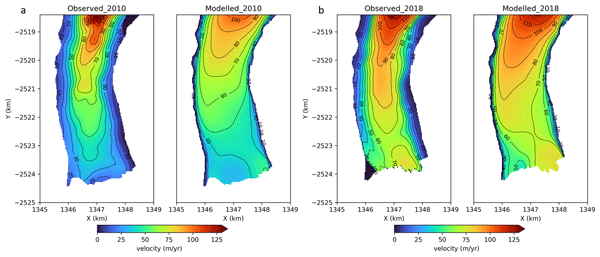
As climate change creates new lakes at the front of retreating glaciers, these ice bodies often accelerate and lose mass more quickly. We used a computer model to study this process at an Icelandic glacier. Our results show that thinning ice is the main driver for recent acceleration, with 37 % of the total ice loss resulting from the presence of the lake. These findings imply that as lakes grow globally, glaciers could vanish more rapidly than predicted, enhancing the rate of sea level rise.
Sebastian H. R. Rosier, Thomas Gregov, Guillaume Jouvet, and Andreas Vieli
EGUsphere, https://doi.org/10.5194/egusphere-2026-5523, https://doi.org/10.5194/egusphere-2026-5523, 2026
Short summary
Short summary
Mountain glacier projections usually rely on flowline models or simplified ice flow, because higher order models are too slow to run many times or at high resolution. We built a training set of 350,000 flow solutions across tens of thousands of synthetic glaciers, far larger than anything before, and trained a neural network on both these solutions and the flow physics itself. It matches the original solver on glaciers it has never seen, and is cheap enough to make large ensembles affordable.
Daniel N. Goldberg, Paul R. Holland, and Kaitlin A. Naughten
EGUsphere, https://doi.org/10.5194/egusphere-2026-3779, https://doi.org/10.5194/egusphere-2026-3779, 2026
Short summary
Short summary
Antarctica’s Amundsen Sea glaciers are major contributors to sea-level rise. Using multi-century, high-resolution coupled ice–ocean simulations of the region, we show that 21st century predictions depend strongly on how ice-sheet models are initialized, especially for Thwaites Glacier. By the 22nd century, however, ocean warming becomes the dominant driver, leading to much faster ice loss under high-emissions scenarios, highlighting the importance of improving coupled climate–ice models.
Laure Moinat, Florian Franziskakis, Christian Vérard, Daniel Nathan Goldberg, and Maura Brunetti
Geosci. Model Dev., 19, 4357–4384, https://doi.org/10.5194/gmd-19-4357-2026, https://doi.org/10.5194/gmd-19-4357-2026, 2026
Short summary
Short summary
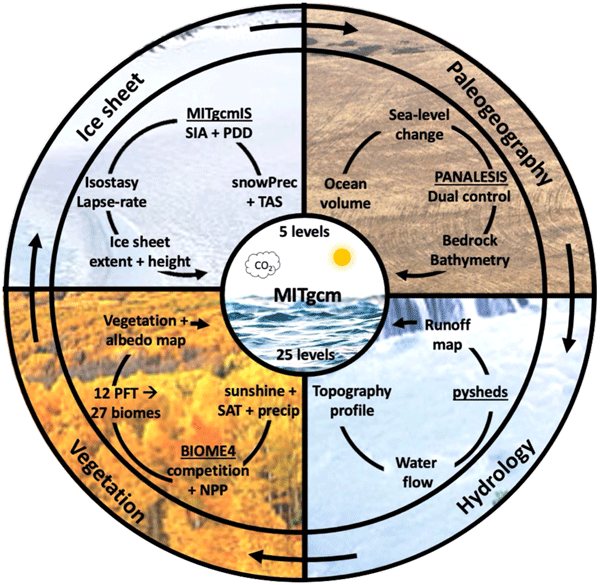
We describe a new tool, BIG-MITgcm, that consistently reproduces the global-scale dynamics of the ocean, atmosphere, vegetation and ice on multimillennial timescales at a low computational cost. Evaluated against observations and state-of-the-art Earth system models, it includes asynchronous coupling to models of vegetation, hydrology and a newly developed global-scale ice sheet. Using arbitrary continental configurations, it enables studies of past and present climates on Earth or exoplanets.
Léa Rodari, Audrey Margirier, Ann V. Rowan, Christoph Schmidt, Remy Veness, Charlotte S. Curry, Alex C. Scoffield, Christiaan R. Diemont, Faye Perchanok, Guillaume Jouvet, Vivi Pedersen, Derek Fabel, and Georgina E. King
EGUsphere, https://doi.org/10.5194/egusphere-2026-1536, https://doi.org/10.5194/egusphere-2026-1536, 2026
Short summary
Short summary
By combining innovative dating techniques and glacier modelling, we studied how sediment is produced, transported, and stored within the Mer de Glace catchment in the French Alps. We show that whilst sediment is transported through the glacier in less than a millennium, some sediment can be stored for many thousands of years before being re-entrained into glacial transport. This long-term storage affects how landscapes evolve and how climate signals are preserved during deglaciation.
Tancrède P. M. Leger, Guillaume Jouvet, Sarah Kamleitner, Brandon D. Finley, Maxime Bernard, Balthazar Allegri, Frédéric Herman, Andreas Vieli, Andreas Henz, and Samuel U. Nussbaumer
Earth Surf. Dynam., 14, 361–389, https://doi.org/10.5194/esurf-14-361-2026, https://doi.org/10.5194/esurf-14-361-2026, 2026
Short summary
Short summary
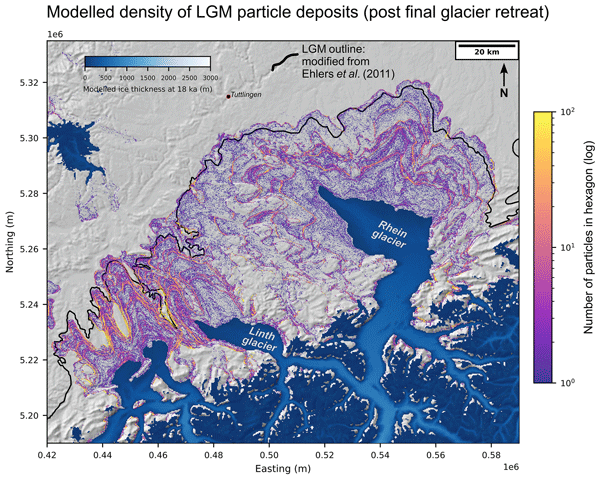
This study reconstructs for the first time the transport-pathways of sediments by glaciers during the last glaciation of the European Alps, 24000 years ago. This helps us understand how the European Alps were shaped by past glaciations and helps us better constrain the mechanisms of iceflow, glacier erosion and the movement of large sediment masses by ice. This breakthrough is achieved by coupling a smart particle-tracking algorithm to a machine-learning-enhanced glacier evolution model.
Helen Werner, Dirk Scherler, Tancrède P. M. Leger, Guillaume Jouvet, and Ricarda Winkelmann
The Cryosphere, 20, 2469–2484, https://doi.org/10.5194/tc-20-2469-2026, https://doi.org/10.5194/tc-20-2469-2026, 2026
Short summary
Short summary
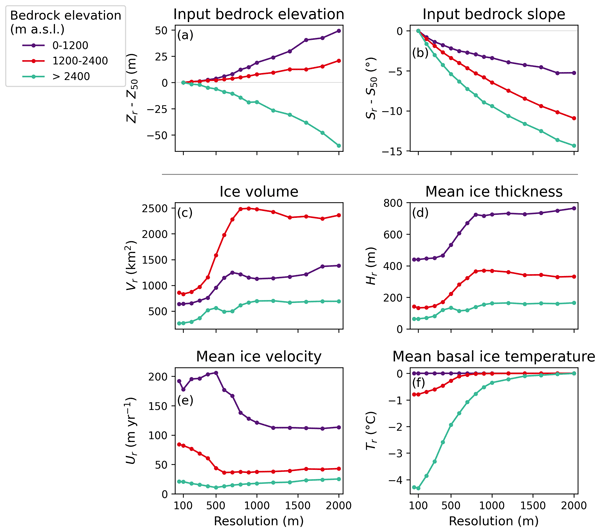
Coarse spatial resolutions reduce computational costs but poorly resolve complex topographies. Our simulations of an alpine ice field at 50 m to 2 km resolution show similar ice areas, yet much higher volumes at coarser resolutions. Resolutions of 300 m and finer accurately capture topographically constrained flow, while coarse resolutions flatten mountain slopes and peaks, affecting ice velocities, thickness, and thermal regimes which emphasizes the need for sufficiently high-resolution models.
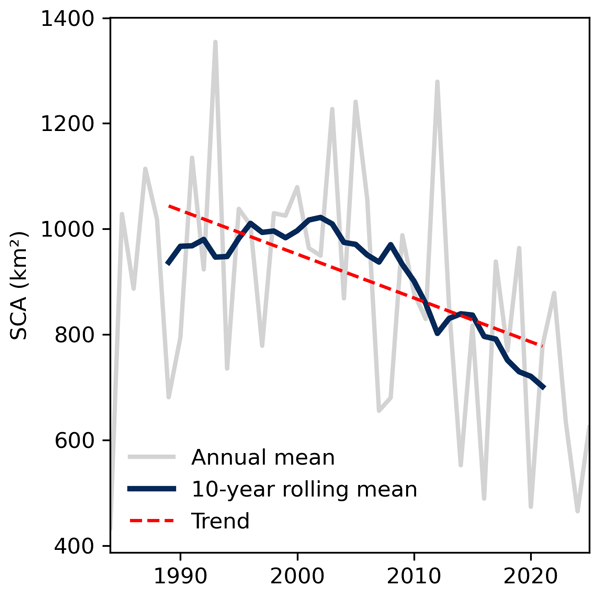
Konstantis Alexopoulos, Ian C. Willis, Hamish D. Pritchard, Giorgos Kyros, Vassiliki Kotroni, and Konstantinos Lagouvardos
The Cryosphere, 20, 2209–2236, https://doi.org/10.5194/tc-20-2209-2026, https://doi.org/10.5194/tc-20-2209-2026, 2026
Short summary
Short summary
Our research shows that Greece's highest mountains have lost half of their winter snow over the past four decades. Using a new model that reconstructs daily snow cover from satellite and climate data, we found a rapid and widespread decline driven mainly by rising temperatures. These changes fall outside the natural variability of the climate and highlight growing risks for water resources in Mediterranean mountain regions, due to snow droughts.
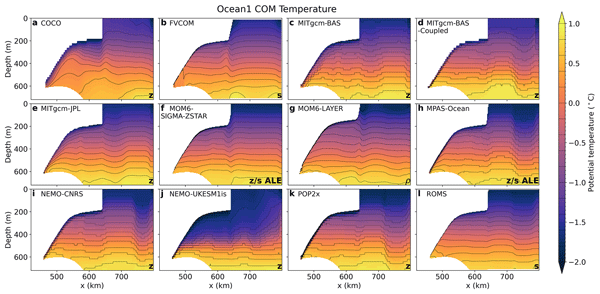
Claire K. Yung, Xylar S. Asay-Davis, Alistair Adcroft, Christopher Y. S. Bull, Jan De Rydt, Michael S. Dinniman, Benjamin K. Galton-Fenzi, Daniel Goldberg, David E. Gwyther, Robert Hallberg, Matthew Harrison, Tore Hattermann, David M. Holland, Denise Holland, Paul R. Holland, James R. Jordan, Nicolas C. Jourdain, Kazuya Kusahara, Gustavo Marques, Pierre Mathiot, Dimitris Menemenlis, Adele K. Morrison, Yoshihiro Nakayama, Olga Sergienko, Robin S. Smith, Alon Stern, Ralph Timmermann, and Qin Zhou
The Cryosphere, 20, 2053–2088, https://doi.org/10.5194/tc-20-2053-2026, https://doi.org/10.5194/tc-20-2053-2026, 2026
Short summary
Short summary
The second Ice Shelf-Ocean Model Intercomparison Project, ISOMIP+, compares 12 ice shelf-ocean models with a common, idealised, static configuration, aiming to assess inter-model variability. Models show similar basal melt rate patterns, ocean profiles and circulation but differ in ice-ocean boundary layer properties. Ice-ocean boundary layer representation is a key area for future work, as are realistic-domain ice sheet-ocean model intercomparisons.
Brad Reed, Jan De Rydt, Kaitlin A. Naughten, and Daniel N. Goldberg
EGUsphere, https://doi.org/10.5194/egusphere-2026-931, https://doi.org/10.5194/egusphere-2026-931, 2026
Short summary
Short summary
Melting beneath Antarctic ice shelves drives ice loss and raises sea levels, but the computer models we use to predict this are poorly constrained. We improved how these models are set up by using multiple real-world observations of ice thinning and glacier speed, rather than melt rates alone. This better captures how the ice and ocean interact. Our projections show this approach adds 14 mm of extra sea-level rise by 2100, which is more than switching to a warmer climate scenario alone.
Veena Prasad, Oskar Herrmann, Ilaria Tabone, Mamta K C, Alexander R. Groos, Guillaume Jouvet, James R. Jordan, and Johannes J. Fürst
EGUsphere, https://doi.org/10.5194/egusphere-2026-508, https://doi.org/10.5194/egusphere-2026-508, 2026
Short summary
Short summary
We present the testing and implementation of a calving framework for simulating the evolution of glacier fronts in grounded glacier tongues. The approach is coupled with a level set method to track changes in the glacier front over time and with an eigen-calving law that allows calving to respond to ice flow and stress conditions. The framework is evaluated using a synthetic glacier domain and, when applied to marine-terminating glaciers in Svalbard, reproduces observed calving front patterns.
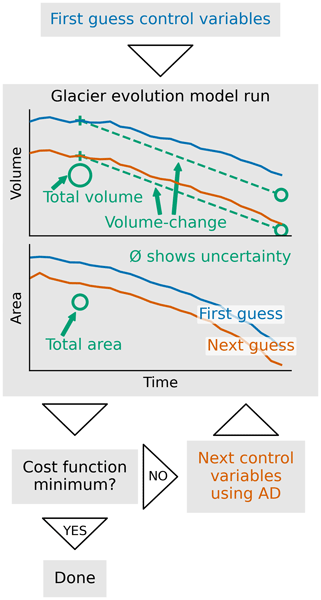
Patrick Schmitt, Fabien Maussion, Daniel N. Goldberg, and Philipp Gregor
Geosci. Model Dev., 19, 1301–1319, https://doi.org/10.5194/gmd-19-1301-2026, https://doi.org/10.5194/gmd-19-1301-2026, 2026
Short summary
Short summary
To improve large-scale understanding of glaciers, we developed a new data assimilation method that integrates available observations in a dynamically consistent way, while taking their timestamps into account. It is designed to flexibly include new glacier data as it becomes available. We tested the method with idealized experiments and found promising results in terms of accuracy and efficiency, showing strong potential for real-world applications.
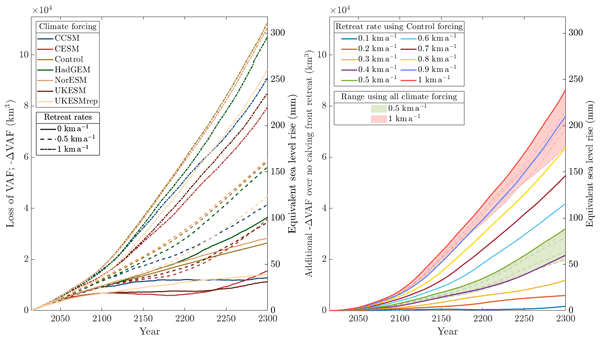
Jowan M. Barnes, G. Hilmar Gudmundsson, Daniel N. Goldberg, and Sainan Sun
The Cryosphere, 20, 777–790, https://doi.org/10.5194/tc-20-777-2026, https://doi.org/10.5194/tc-20-777-2026, 2026
Short summary
Short summary
Calving is where ice breaks off the front of glaciers. It has not been included widely in modelling as it is difficult to represent. We use our ice flow model to investigate the effects of calving floating ice shelves in West Antarctica. More calving leads to more ice loss and greater sea level rise, with local differences due to the shape of the bedrock. We find that ocean forcing and calving should be considered equally when trying to improve how models represent the real world.
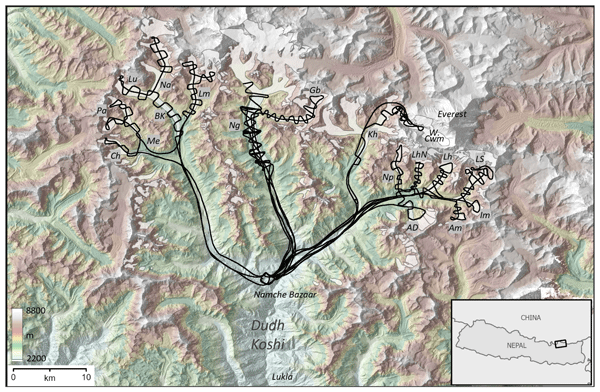
Hamish D. Pritchard, Edward C. King, David J. Goodger, Douglas Boyle, Daniel N. Goldberg, Beatriz Recinos, Andrew Orr, and Dhananjay Regmi
Earth Syst. Sci. Data, 18, 199–217, https://doi.org/10.5194/essd-18-199-2026, https://doi.org/10.5194/essd-18-199-2026, 2026
Short summary
Short summary
We present a new and uniquely extensive dataset of glacier thickness from the Khumbu Himal around Mount Everest that stretches for 119 km, doubling the extent of thickness measurements in High Mountain Asia. Such measurements are key inputs for models that estimate how much ice is stored on the whole mountain range scale and for models that predict how this ice reserve will change in future, and what impact this will have on water supply for the large populations living downstream.
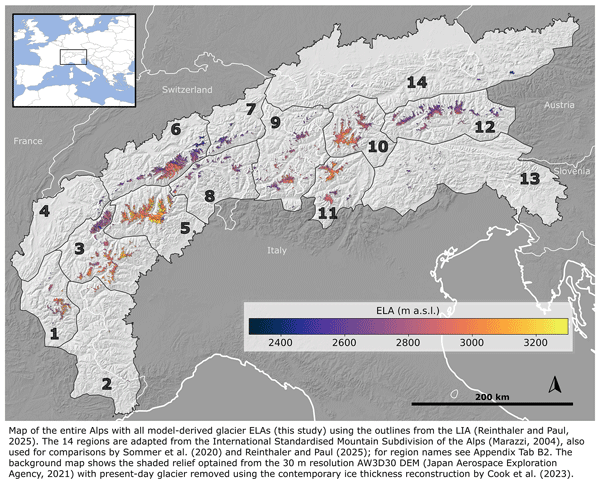
Andreas Henz, Johannes Reinthaler, Samuel U. Nussbaumer, Tancrède P. M. Leger, Sarah Kamleitner, Guillaume Jouvet, and Andreas Vieli
The Cryosphere, 19, 5913–5937, https://doi.org/10.5194/tc-19-5913-2025, https://doi.org/10.5194/tc-19-5913-2025, 2025
Short summary
Short summary
Glaciers are key to understanding climate change, reflecting historical variability. Using glacier models on the computer, we reconstructed European Alps glaciers during the Little Ice Age, with a total ice volume of 283 ± 42 cubic kilometres. Also, the study determines equilibrium line altitudes (ELAs) for over 4000 glaciers, showing patterns influenced by temperature, precipitation, and solar radiation. After all, we introduce a new ELA correction approach based on solar incidence.
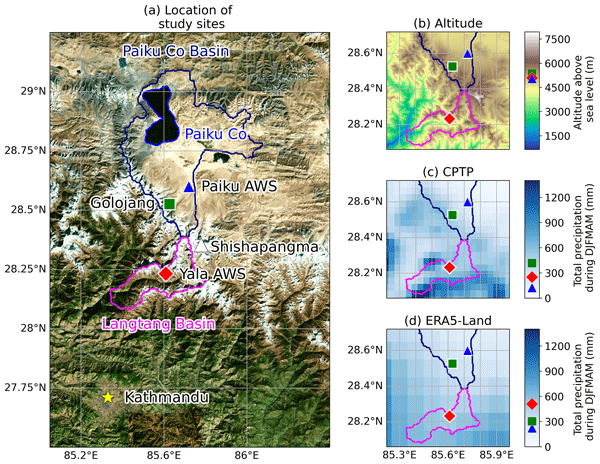
Titouan Biget, Fanny Brun, Walter Immerzeel, Léo Martin, Hamish Pritchard, Emily Collier, Yanbin Lei, and Tandong Yao
The Cryosphere, 19, 5863–5870, https://doi.org/10.5194/tc-19-5863-2025, https://doi.org/10.5194/tc-19-5863-2025, 2025
Short summary
Short summary
This study explore the precipitation in the southern Tibetan plateau using the water pressure of an high altitude lake and meteorological models and shows that snowfall could be much stronger on the Plateau than what is predicted by the models.
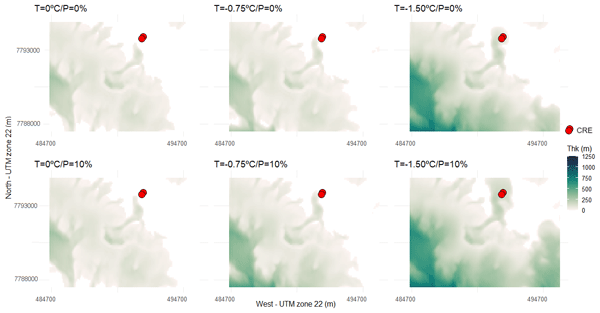
Josep Bonsoms, Marc Oliva, Juan Ignacio López-Moreno, and Guillaume Jouvet
The Cryosphere, 19, 1973–1993, https://doi.org/10.5194/tc-19-1973-2025, https://doi.org/10.5194/tc-19-1973-2025, 2025
Short summary
Short summary
The extent to which Greenland's peripheral glaciers and ice caps current and future ice loss rates are unprecedented within the Holocene is poorly understood. This study connects the maximum ice extent of the Late Holocene with present and future glacier evolution in the Nuussuaq Peninsula (central western Greenland). By > 2050 glacier mass loss may have doubled in rate compared to the Late Holocene to the present, highlighting significant impacts of anthropogenic climate change.
Shin Sugiyama, Shun Tsutaki, Daiki Sakakibara, Izumi Asaji, Ken Kondo, Yefan Wang, Evgeny Podolskiy, Guillaume Jouvet, and Martin Funk
The Cryosphere, 19, 525–540, https://doi.org/10.5194/tc-19-525-2025, https://doi.org/10.5194/tc-19-525-2025, 2025
Short summary
Short summary
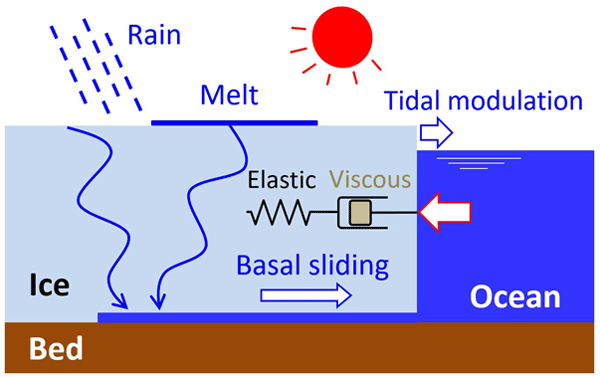
We report flow speed variations near the front of a tidewater glacier in Greenland. Ice flow near the glacier front is crucial for the mass loss of the Greenland ice sheet, but in situ data are hard to obtain. Our unique in situ GPS data revealed fine details of short-term speed variations associated with melting, ocean tides, and rain. The results are important for understanding the response of tidewater glaciers to changing environments, such as warming, more frequent rain, and ice thinning.
Marin Kneib, Amaury Dehecq, Adrien Gilbert, Auguste Basset, Evan S. Miles, Guillaume Jouvet, Bruno Jourdain, Etienne Ducasse, Luc Beraud, Antoine Rabatel, Jérémie Mouginot, Guillem Carcanade, Olivier Laarman, Fanny Brun, and Delphine Six
The Cryosphere, 18, 5965–5983, https://doi.org/10.5194/tc-18-5965-2024, https://doi.org/10.5194/tc-18-5965-2024, 2024
Short summary
Short summary
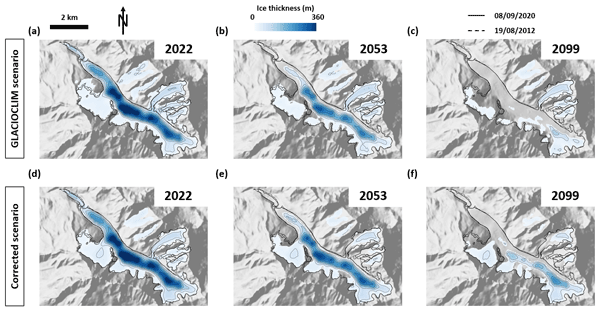
Avalanches contribute to increasing the accumulation on mountain glaciers by redistributing snow from surrounding mountains slopes. Here we quantified the contribution of avalanches to the mass balance of Argentière Glacier in the French Alps, by combining satellite and field observations to model the glacier dynamics. We show that the contribution of avalanches locally increases the accumulation by 60–70 % and that accounting for this effect results in less ice loss by the end of the century.
David T. Bett, Alexander T. Bradley, C. Rosie Williams, Paul R. Holland, Robert J. Arthern, and Daniel N. Goldberg
The Cryosphere, 18, 2653–2675, https://doi.org/10.5194/tc-18-2653-2024, https://doi.org/10.5194/tc-18-2653-2024, 2024
Short summary
Short summary
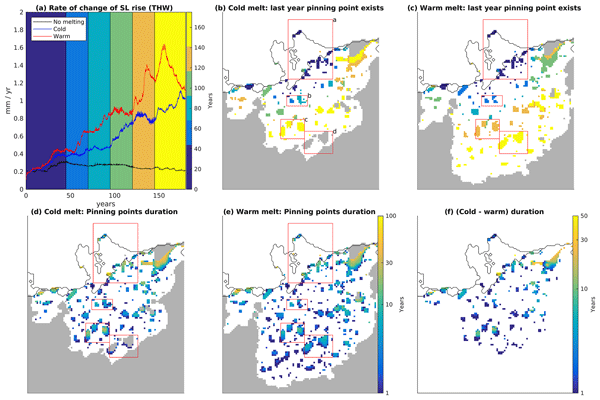
A new ice–ocean model simulates future ice sheet evolution in the Amundsen Sea sector of Antarctica. Substantial ice retreat is simulated in all scenarios, with some retreat still occurring even with no future ocean melting. The future of small "pinning points" (islands of ice that contact the seabed) is an important control on this retreat. Ocean melting is crucial in causing these features to go afloat, providing the link by which climate change may affect this sector's sea level contribution.
Emmanuele Russo, Jonathan Buzan, Sebastian Lienert, Guillaume Jouvet, Patricio Velasquez Alvarez, Basil Davis, Patrick Ludwig, Fortunat Joos, and Christoph C. Raible
Clim. Past, 20, 449–465, https://doi.org/10.5194/cp-20-449-2024, https://doi.org/10.5194/cp-20-449-2024, 2024
Short summary
Short summary
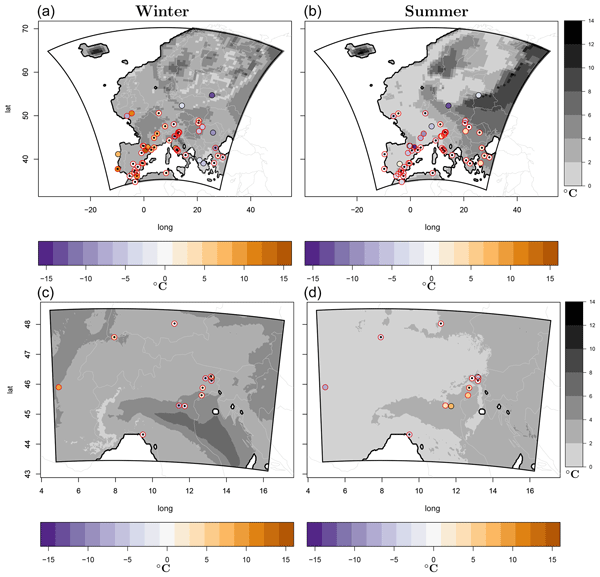
We present a series of experiments conducted for the Last Glacial Maximum (~21 ka) over Europe using the regional climate Weather Research and Forecasting model (WRF) at convection-permitting resolutions. The model, with new developments better suited to paleo-studies, agrees well with pollen-based climate reconstructions. This agreement is improved when considering different sources of uncertainty. The effect of convection-permitting resolutions is also assessed.
Beatriz Recinos, Daniel Goldberg, James R. Maddison, and Joe Todd
The Cryosphere, 17, 4241–4266, https://doi.org/10.5194/tc-17-4241-2023, https://doi.org/10.5194/tc-17-4241-2023, 2023
Short summary
Short summary
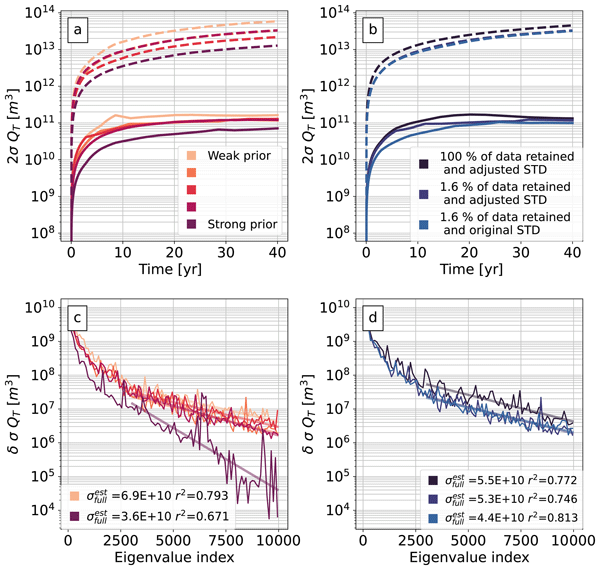
Ice sheet models generate forecasts of ice sheet mass loss, a significant contributor to sea level rise; thus, capturing the complete range of possible projections of mass loss is of critical societal importance. Here we add to data assimilation techniques commonly used in ice sheet modelling (a Bayesian inference approach) and fully characterize calibration uncertainty. We successfully propagate this type of error onto sea level rise projections of three ice streams in West Antarctica.
Denis Cohen, Guillaume Jouvet, Thomas Zwinger, Angela Landgraf, and Urs H. Fischer
E&G Quaternary Sci. J., 72, 189–201, https://doi.org/10.5194/egqsj-72-189-2023, https://doi.org/10.5194/egqsj-72-189-2023, 2023
Short summary
Short summary
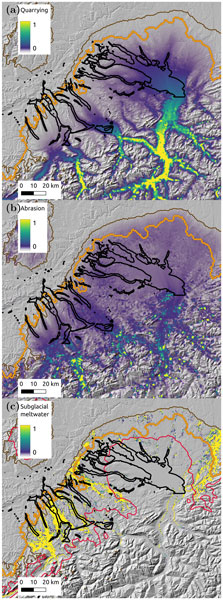
During glacial times in Switzerland, glaciers of the Alps excavated valleys in low-lying regions that were later filled with sediment or water. How glaciers eroded these valleys is not well understood because erosion occurred near ice margins where ice moved slowly and was present for short times. Erosion is linked to the speed of ice and to water flowing under it. Here we present a model that estimates the location of water channels beneath the ice and links these locations to zones of erosion.
Alice C. Frémand, Peter Fretwell, Julien A. Bodart, Hamish D. Pritchard, Alan Aitken, Jonathan L. Bamber, Robin Bell, Cesidio Bianchi, Robert G. Bingham, Donald D. Blankenship, Gino Casassa, Ginny Catania, Knut Christianson, Howard Conway, Hugh F. J. Corr, Xiangbin Cui, Detlef Damaske, Volkmar Damm, Reinhard Drews, Graeme Eagles, Olaf Eisen, Hannes Eisermann, Fausto Ferraccioli, Elena Field, René Forsberg, Steven Franke, Shuji Fujita, Yonggyu Gim, Vikram Goel, Siva Prasad Gogineni, Jamin Greenbaum, Benjamin Hills, Richard C. A. Hindmarsh, Andrew O. Hoffman, Per Holmlund, Nicholas Holschuh, John W. Holt, Annika N. Horlings, Angelika Humbert, Robert W. Jacobel, Daniela Jansen, Adrian Jenkins, Wilfried Jokat, Tom Jordan, Edward King, Jack Kohler, William Krabill, Mette Kusk Gillespie, Kirsty Langley, Joohan Lee, German Leitchenkov, Carlton Leuschen, Bruce Luyendyk, Joseph MacGregor, Emma MacKie, Kenichi Matsuoka, Mathieu Morlighem, Jérémie Mouginot, Frank O. Nitsche, Yoshifumi Nogi, Ole A. Nost, John Paden, Frank Pattyn, Sergey V. Popov, Eric Rignot, David M. Rippin, Andrés Rivera, Jason Roberts, Neil Ross, Anotonia Ruppel, Dustin M. Schroeder, Martin J. Siegert, Andrew M. Smith, Daniel Steinhage, Michael Studinger, Bo Sun, Ignazio Tabacco, Kirsty Tinto, Stefano Urbini, David Vaughan, Brian C. Welch, Douglas S. Wilson, Duncan A. Young, and Achille Zirizzotti
Earth Syst. Sci. Data, 15, 2695–2710, https://doi.org/10.5194/essd-15-2695-2023, https://doi.org/10.5194/essd-15-2695-2023, 2023
Short summary
Short summary
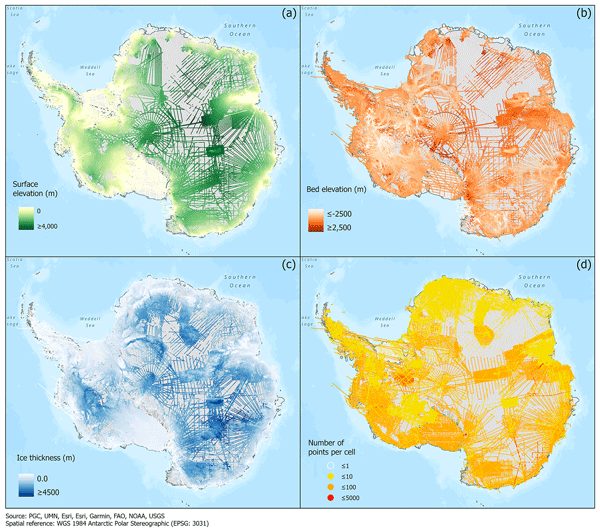
This paper presents the release of over 60 years of ice thickness, bed elevation, and surface elevation data acquired over Antarctica by the international community. These data are a crucial component of the Antarctic Bedmap initiative which aims to produce a new map and datasets of Antarctic ice thickness and bed topography for the international glaciology and geophysical community.
Shuhong Wang, Jintao Liu, Hamish D. Pritchard, Linghong Ke, Xiao Qiao, Jie Zhang, Weihua Xiao, and Yuyan Zhou
Hydrol. Earth Syst. Sci., 27, 933–952, https://doi.org/10.5194/hess-27-933-2023, https://doi.org/10.5194/hess-27-933-2023, 2023
Short summary
Short summary
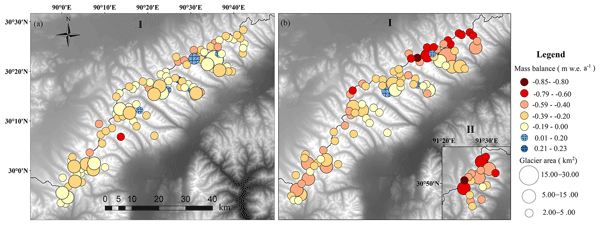
We assessed and compared the glacier areal retreat rate and surface thinning rate and the effects of topography, debris cover and proglacial lakes in the west Nyainqentanglha Range (WNT) during 1976–2000 and 2000–2020. Our study will help us to better understand the glacier change characteristics in the WNT on a long timescale and will serve as a reference for glacier changes in other regions on the Tibetan Plateau.
Helen Ockenden, Robert G. Bingham, Andrew Curtis, and Daniel Goldberg
The Cryosphere, 16, 3867–3887, https://doi.org/10.5194/tc-16-3867-2022, https://doi.org/10.5194/tc-16-3867-2022, 2022
Short summary
Short summary
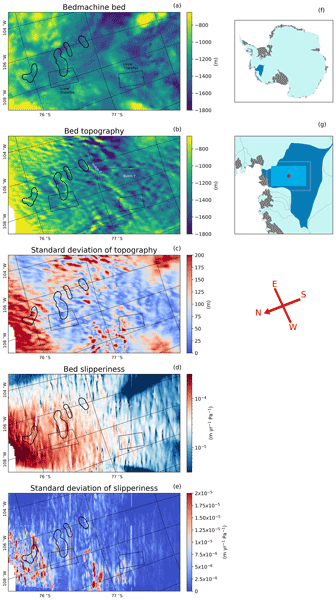
Hills and valleys hidden under the ice of Thwaites Glacier have an impact on ice flow and future ice loss, but there are not many three-dimensional observations of their location or size. We apply a mathematical theory to new high-resolution observations of the ice surface to predict the bed topography beneath the ice. There is a good correlation with ice-penetrating radar observations. The method may be useful in areas with few direct observations or as a further constraint for other methods.
Alexander Robinson, Daniel Goldberg, and William H. Lipscomb
The Cryosphere, 16, 689–709, https://doi.org/10.5194/tc-16-689-2022, https://doi.org/10.5194/tc-16-689-2022, 2022
Short summary
Short summary
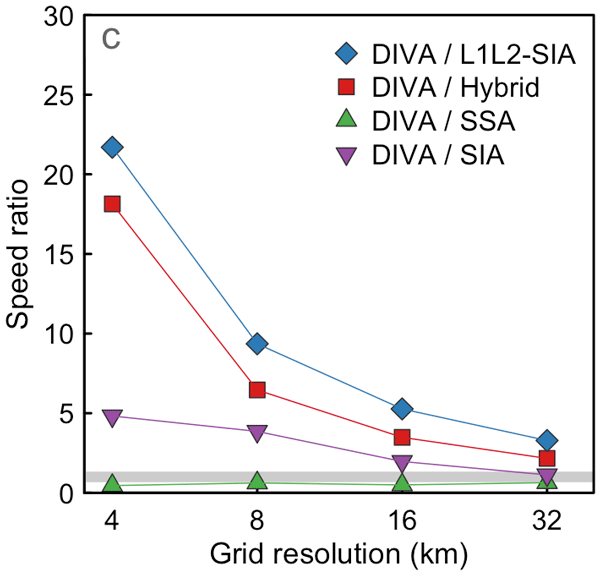
Here we investigate the numerical stability of several commonly used methods in order to determine which of them are capable of resolving the complex physics of the ice flow and are also computationally efficient. We find that the so-called DIVA solver outperforms the others. Its representation of the physics is consistent with more complex methods, while it remains computationally efficient at high resolution.
Adrien Wehrlé, Martin P. Lüthi, Andrea Walter, Guillaume Jouvet, and Andreas Vieli
The Cryosphere, 15, 5659–5674, https://doi.org/10.5194/tc-15-5659-2021, https://doi.org/10.5194/tc-15-5659-2021, 2021
Short summary
Short summary
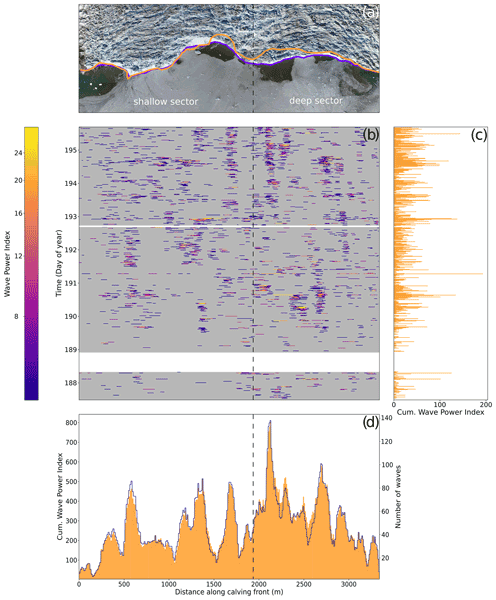
We developed a novel automated method for the detection and the quantification of ocean waves generated by glacier calving. This method was applied to data recorded with a terrestrial radar interferometer at Eqip Sermia, Greenland. Results show a high calving activity at the glacier front sector ending in deep water linked with more frequent meltwater plumes. This suggests that rising subglacial meltwater plumes strongly affect glacier calving in deep water, but weakly in shallow water.
Cited articles
Abadi, M., Agarwal, A., Barham, P., Brevdo, E., Chen, Z., Citro, C., Corrado, G. S., Davis, A., Dean, J., Devin, M., Ghemawat, S., Goodfellow, I., Harp, A., Irving, G., Isard, M., Jia, Y., Jozefowicz, R., Kaiser, L., Kudlur, M., Levenberg, J., Mané, D., Monga, R., Moore, S., Murray, D., Olah, C., Schuster, M., Shlens, J., Steiner, B., Sutskever, I., Talwar, K., Tucker, P., Vanhoucke, V., Vasudevan, V., Viégas, F., Vinyals, O., Warden, P., Wattenberg, M., Wicke, M., Yu, Y., and Zheng, X.: TensorFlow: Large-scale machine learning on heterogeneous systems, https://www.tensorflow.org/ (last access: 9 February 2026), 2015. a, b
Bosson, J. B., Huss, M., Cauvy-Fraunié, S., Clément, J. C., Costes, G., Fischer, M., Poulenard, J., and Arthaud, F.: Future emergence of new ecosystems caused by glacial retreat, Nature, 620, 562–569, https://doi.org/10.1038/s41586-023-06302-2, 2023. a
Cook, S. J., Jouvet, G., Millan, R., Rabatel, A., Zekollari, H., and Dussaillant, I.: Committed ice loss in the European Alps until 2050 using a deep-learning-aided 3D ice-flow model with data assimilation, Geophys. Res. Lett., 50, https://doi.org/10.1029/2023GL105029, 2023. a
Copernicus: Copernicus DEM GLO-90, Copernicus [data set], https://doi.org/10.5270/ESA-c5d3d65, 2019. a
Dehecq, A., Gourmelen, N., Gardner, A. S., Brun, F., Goldberg, D., Nienow, P. W., Berthier, E., Vincent, C., Wagnon, P., and Trouvé, E.: Twenty-first century glacier slowdown driven by mass loss in High Mountain Asia, Nat. Geosci., 12, 22–27, https://doi.org/10.1038/s41561-018-0271-9, 2019. a
Farinotti, D., Huss, M., Bauder, A., Funk, M., and Truffer, M.: A method to estimate the ice volume and ice-thickness distribution of alpine glaciers, J. Glaciol., 55, 422–430, https://doi.org/10.3189/002214309788816759, 2009. a
Farinotti, D., Brinkerhoff, D. J., Clarke, G. K. C., Fürst, J. J., Frey, H., Gantayat, P., Gillet-Chaulet, F., Girard, C., Huss, M., Leclercq, P. W., Linsbauer, A., Machguth, H., Martin, C., Maussion, F., Morlighem, M., Mosbeux, C., Pandit, A., Portmann, A., Rabatel, A., Ramsankaran, R., Reerink, T. J., Sanchez, O., Stentoft, P. A., Singh Kumari, S., van Pelt, W. J. J., Anderson, B., Benham, T., Binder, D., Dowdeswell, J. A., Fischer, A., Helfricht, K., Kutuzov, S., Lavrentiev, I., McNabb, R., Gudmundsson, G. H., Li, H., and Andreassen, L. M.: How accurate are estimates of glacier ice thickness? Results from ITMIX, the Ice Thickness Models Intercomparison eXperiment, The Cryosphere, 11, 949–970, https://doi.org/10.5194/tc-11-949-2017, 2017. a, b, c, d, e
Farinotti, D., Brinkerhoff, D. J., Fürst, J. J., Gantayat, P., Gillet-Chaulet, F., Huss, M., Leclercq, P. W., Maurer, H., Morlighem, M., Pandit, A., Rabatel, A., Ramsankaran, R., Reerink, T. J., Robo, E., Rouges, E., Tamre, E., van Pelt, W. J. J., Werder, M. A., Azam, M. F., Li, H., and Andreassen, L. M.: Results from the Ice Thickness Models Intercomparison eXperiment Phase 2 (ITMIX2), Front. Earth Sci., 8, https://doi.org/10.3389/feart.2020.571923, 2021. a, b, c, d, e, f
Frank, T. and van Pelt, W. J. J.: Ice volume and thickness of all Scandinavian glaciers and ice caps, J. Glaciol., 70, 1–14, https://doi.org/10.1017/jog.2024.25, 2024. a
Gardner, A. S., Greene, C. A., Kennedy, J. H., Fahnestock, M. A., Liukis, M., López, L. A., Lei, Y., Scambos, T. A., and Dehecq, A.: ITS_LIVE global glacier velocity data in near-real time, The Cryosphere, 19, 3517–3533, https://doi.org/10.5194/tc-19-3517-2025, 2025. a
Glen, J. W.: Rate of flow of polycrystalline ice, Nature, 172, 721–722, https://doi.org/10.1038/172721a0, 1953. a, b
Goldberg, D. N. and Heimbach, P.: Parameter and state estimation with a time-dependent adjoint marine ice sheet model, The Cryosphere, 7, 1659–1678, https://doi.org/10.5194/tc-7-1659-2013, 2013. a
Hansen, P. C. and O'Leary, D. P.: The use of the L-curve in the regularization of discrete ill-posed problems, SIAM J. Sci. Comput., 14, 1487–1503, https://doi.org/10.1137/0914086, 1993. a, b
Hugonnet, R., McNabb, R., Berthier, E., Menounos, B., Nuth, C., Girod, L., Farinotti, D., Huss, M., Dussaillant, I., Brun, F., and Kæb, A.: Accelerated global glacier mass loss in the early twenty-first century, Nature, 592, 726–731, https://doi.org/10.1038/s41586-021-03436-z, 2021. a, b, c, d
Huss, M. and Farinotti, D.: Distributed ice thickness and volume of all glaciers around the globe, J. Geophys. Res.-Earth, 117, https://doi.org/10.1029/2012JF002523, 2012. a
Immerzeel, W. W., Lutz, A. F., Andrade, M., Bahl, A., Biemans, H., Bolch, T., Hyde, S., Brumby, S., Davies, B. J., Elmore, A. C., Emmer, A., Feng, M., Fernández, A., Haritashya, U., Kargel, J. S., Koppes, M., Kraaijenbrink, P. D. A., Kulkarni, A. V., Mayewski, P. A., Nepal, S., Pacheco, P., Painter, T. H., Pellicciotti, F., Rajaram, H., Rupper, S., Sinisalo, A., Shrestha, A. B., Viviroli, D., Wada, Y., Xiao, C., Yao, T., and Baillie, J. E. M.: Importance and vulnerability of the world's water towers, Nature, 577, 364–369, https://doi.org/10.1038/s41586-019-1822-y, 2020. a
Jakob, L. and Gourmelen, N.: Glacier mass loss between 2010 and 2020 dominated by atmospheric forcing, Geophys. Res. Lett., 50, e2023GL102954, https://doi.org/10.1029/2023GL102954, 2023. a
Jouvet, G.: Mechanical error estimators for shallow ice flow models, J. Fluid Mech., 807, 40–61, https://doi.org/10.1017/jfm.2016.593, 2016. a
Jouvet, G., Cordonnier, G., Kim, B., Lüthi, M., Vieli, A., and Aschwanden, A.: Deep learning speeds up ice flow modelling by several orders of magnitude, J. Glaciol., 68, 651–664, https://doi.org/10.1017/jog.2021.120, 2022. a, b
Jouvet, G., Finley, B., Gregov, T., Rosier, S. H. R., Herrmann, O., Henz, A., Sirdey, M., Smith, G., Barndon, S., Maussion, F., Schmitt, P., Mey, J., Fischer, A., Jarosch, A., and Leger, T.: IGM v2.2.3 (extended), Zenodo [software], https://doi.org/10.5281/zenodo.18484149, 2026. a
Khanal, S., Lutz, A., Kraaijenbrink, P. D. A., van den Hurk, B., Yao, T., and Immerzeel, W. W.: Variable 21st century climate change response for rivers in High Mountain Asia at seasonal to decadal time scales, Water Resour. Res., 57, e2020WR029266, https://doi.org/10.1029/2020WR029266, 2021. a
Kharazmi, E., Zhang, Z., and Karniadakis, G. E.: Variational Physics-Informed Neural Networks For Solving Partial Differential Equations, arXiv [preprint], https://doi.org/10.48550/arXiv.1912.00873, 2019. a
Kingma, D. P. and Ba, J.: Adam: A Method for Stochastic Optimization, arXiv [preprint], https://doi.org/10.48550/arXiv.1412.6980, 2017. a, b
Kneib, M., Dehecq, A., Gilbert, A., Basset, A., Miles, E. S., Jouvet, G., Jourdain, B., Ducasse, E., Beraud, L., Rabatel, A., Mouginot, J., Carcanade, G., Laarman, O., Brun, F., and Six, D.: Distributed surface mass balance of an avalanche-fed glacier, The Cryosphere, 18, 5965–5983, https://doi.org/10.5194/tc-18-5965-2024, 2024. a
MacAyeal, D. R.: The basal stress distribution of Ice Stream E, Antarctica, inferred by control methods, J. Geophys. Res.-Sol. Ea., 97, 595–603, https://doi.org/10.1029/91JB02454, 1992. a
Maffezzoli, N., Rignot, E., Barbante, C., Petersen, T., and Vascon, S.: A gradient-boosted tree framework to model the ice thickness of the world's glaciers (IceBoost v1.1), Geosci. Model Dev., 18, 2545–2568, https://doi.org/10.5194/gmd-18-2545-2025, 2025. a
Maussion, F., Butenko, A., Champollion, N., Dusch, M., Eis, J., Fourteau, K., Gregor, P., Jarosch, A. H., Landmann, J., Oesterle, F., Recinos, B., Rothenpieler, T., Vlug, A., Wild, C. T., and Marzeion, B.: The Open Global Glacier Model (OGGM) v1.1, Geosci. Model Dev., 12, 909–931, https://doi.org/10.5194/gmd-12-909-2019, 2019. a
Miles, K. E., Hubbard, B., Quincey, D. J., Miles, E. S., Sherpa, T. C., Rowan, A. V., and Doyle, S. H.: Polythermal structure of a Himalayan debris-covered glacier revealed by borehole thermometry, Sci. Rep.-UK, 8, 16825, https://doi.org/10.1038/s41598-018-34327-5, 2018. a
Morlighem, M., Rignot, E., Seroussi, H., Larour, E., Ben Dhia, H., and Aubry, D.: A mass conservation approach for mapping glacier ice thickness, Geophys. Res. Lett., 38, https://doi.org/10.1029/2011GL048659, 2011. a
Morlighem, M., Rignot, E., Mouginot, J., Wu, X., Seroussi, H., Larour, E., and Paden, J.: High-resolution bed topography mapping of Russell Glacier, Greenland, inferred from Operation IceBridge data, J. Glaciol., 59, 1015–1023, https://doi.org/10.3189/2013JoG12J235, 2013. a
Morlighem, M., Williams, C. N., Rignot, E., An, L., Arndt, J. E., Bamber, J. L., Catania, G., Chauché, N., Dowdeswell, J. A., Dorschel, B., Fenty, I., Hogan, K., Howat, I., Hubbard, A., Jakobsson, M., Jordan, T. M., Kjeldsen, K. K., Millan, R., Mayer, L., Mouginot, J., Noël, B. P. Y., O'Cofaigh, C., Palmer, S., Rysgaard, S., Seroussi, H., Siegert, M. J., Slabon, P., Straneo, F., van den Broeke, M. R., Weinrebe, W., Wood, M., and Zinglersen, K. B.: BedMachine v3: complete bed topography and ocean bathymetry mapping of Greenland from multibeam echo sounding combined with mass conservation, Geophys. Res. Lett., 44, 11,051–11,061, https://doi.org/10.1002/2017GL074954, 2017. a
Nie, Y., Pritchard, H. D., Liu, Q., Hennig, T., Wang, W., Wang, X., Liu, S., Nepal, S., Samyn, D., Hewitt, K., and Chen, X.: Glacial change and hydrological implications in the Himalaya and Karakoram, Nature Reviews Earth and Environment, 2, 91–106, https://doi.org/10.1038/s43017-020-00124-w, 2021. a, b
Nixon-Hill, R. W., Shapero, D., Cotter, C. J., and Ham, D. A.: Consistent point data assimilation in Firedrake and Icepack, Geosci. Model Dev., 17, 5369–5386, https://doi.org/10.5194/gmd-17-5369-2024, 2024. a
Nocedal, J. and Wright, S. J.: Numerical Optimization, Springer Series in Operations Research and Financial Engineering, Springer New York, https://doi.org/10.1007/978-0-387-40065-5, 2006. a
Pattyn, F.: A new three-dimensional higher-order thermomechanical ice sheet model: basic sensitivity, ice stream development, and ice flow across subglacial lakes, J. Geophys. Res.-Sol. Ea., 108, https://doi.org/10.1029/2002JB002329, 2003. a, b, c
Picard, R. R. and Cook, R. D.: Cross-validation of regression models, J. Am. Stat. Assoc., 79, 575–583, https://doi.org/10.2307/2288403, 1984. a
Pritchard, H. D.: Asia's shrinking glaciers protect large populations from drought stress, Nature, 569, 649–654, https://doi.org/10.1038/s41586-019-1240-1, 2019. a, b
Pritchard, H. D., Fretwell, P. T., Fremand, A. C., Bodart, J. A., Kirkham, J. D., Aitken, A., Bamber, J., Bell, R., Bianchi, C., Bingham, R. G., Blankenship, D. D., Casassa, G., Christianson, K., Conway, H., Corr, H. F. J., Cui, X., Damaske, D., Damm, V., Dorschel, B., Drews, R., Eagles, G., Eisen, O., Eisermann, H., Ferraccioli, F., Field, E., Forsberg, R., Franke, S., Goel, V., Gogineni, S. P., Greenbaum, J., Hills, B., Hindmarsh, R. C. A., Hoffman, A. O., Holschuh, N., Holt, J. W., Humbert, A., Jacobel, R. W., Jansen, D., Jenkins, A., Jokat, W., Jong, L., Jordan, T. A., King, E. C., Kohler, J., Krabill, W., Maton, J., Gillespie, M. K., Langley, K., Lee, J., Leitchenkov, G., Leuschen, C., Luyendyk, B., MacGregor, J. A., MacKie, E., Moholdt, G., Matsuoka, K., Morlighem, M., Mouginot, J., Nitsche, F. O., Nost, O. A., Paden, J., Pattyn, F., Popov, S., Rignot, E., Rippin, D. M., Rivera, A., Roberts, J. L., Ross, N., Ruppel, A., Schroeder, D. M., Siegert, M. J., Smith, A. M., Steinhage, D., Studinger, M., Sun, B., Tabacco, I., Tinto, K. J., Urbini, S., Vaughan, D. G., Wilson, D. S., Young, D. A., and Zirizzotti, A.: Bedmap3 updated ice bed, surface and thickness gridded datasets for Antarctica, Sci. Data, 12, 414, https://doi.org/10.1038/s41597-025-04672-y, 2025. a
Pritchard, H. D., King, E. C., Goodger, D. J., Boyle, D., Goldberg, D. N., Recinos, B., Orr, A., and Regmi, D.: Towards Bedmap Himalayas: a new airborne glacier thickness survey in Khumbu Himal, Nepal, Earth Syst. Sci. Data, 18, 199–217, https://doi.org/10.5194/essd-18-199-2026, 2026. a, b, c, d, e, f, g, h, i, j, k
Raissi, M., Perdikaris, P., and Karniadakis, G. E.: Physics-informed neural networks: A deep learning framework for solving forward and inverse problems involving nonlinear partial differential equations, J. Comput. Phys., 378, 686–707, https://doi.org/10.1016/j.jcp.2018.10.045, 2019. a
RGI Consortium: Randolph Glacier Inventory – A Dataset of Global Glacier Outlines (NSIDC-0070, Version 6), National Snow and Ice Data Center [data set], https://doi.org/10.7265/4m1f-gd79, 2017. a, b
Robinson, A., Goldberg, D., and Lipscomb, W. H.: A comparison of the stability and performance of depth-integrated ice-dynamics solvers, The Cryosphere, 16, 689–709, https://doi.org/10.5194/tc-16-689-2022, 2022. a
Rounce, D. R., Hock, R., and Shean, D. E.: Glacier mass change in High Mountain Asia through 2100 using the open-source Python Glacier Evolution Model (PyGEM), Front. Earth Sci., 7, https://doi.org/10.3389/feart.2019.00331, 2020. a
Rounce, D. R., Hock, R., Maussion, F., Hugonnet, R., Kochtitzky, W., Huss, M., Berthier, E., Brinkerhoff, D., Compagno, L., Copland, L., Farinotti, D., Menounos, B., and McNabb, R. W.: Global glacier change in the 21st century: every increase in temperature matters, Science, 379, 78–83, https://doi.org/10.1126/science.abo1324, 2023. a
Schmitt, P., Maussion, F., Goldberg, D. N., and Gregor, P.: AGILE v0.1: The Open Global Glacier Data Assimilation Framework, Geosci. Model Dev., 19, 1301–1319, https://doi.org/10.5194/gmd-19-1301-2026, 2026. a, b
Schoof, C.: Variational methods for glacier flow over plastic till, J. Fluid Mech., 555, 299–320, https://doi.org/10.1017/S0022112006009104, 2006. a
Schoof, C. and Hewitt, I.: Ice-sheet dynamics, Annu. Rev. Fluid Mech., 45, 217–239, https://doi.org/10.1146/annurev-fluid-011212-140632, 2013. a
Smith, G.: Observational data and neural network-accelerated modelling provide valuable insights for glacier thickness reconstruction in High Mountain Asia: experiment files, Zenodo [software], https://doi.org/10.5281/zenodo.18495260, 2026. a
Sommer, C., Malz, P., Seehaus, T. C., Lippl, S., Zemp, M., and Braun, M. H.: Rapid glacier retreat and downwasting throughout the European Alps in the early 21st century, Nat. Commun., 11, 3209, https://doi.org/10.1038/s41467-020-16818-0, 2020. a
Steidl, V., Bamber, J. L., and Zhu, X. X.: Physics-aware machine learning for glacier ice thickness estimation: a case study for Svalbard, The Cryosphere, 19, 645–661, https://doi.org/10.5194/tc-19-645-2025, 2025. a
van Pelt, W. and Frank, T.: New glacier thickness and bed topography maps for Svalbard, The Cryosphere, 19, 1–17, https://doi.org/10.5194/tc-19-1-2025, 2025. a
Welty, E., Zemp, M., Navarro, F., Huss, M., Fürst, J. J., Gärtner-Roer, I., Landmann, J., Machguth, H., Naegeli, K., Andreassen, L. M., Farinotti, D., Li, H., and GlaThiDa Contributors: Worldwide version-controlled database of glacier thickness observations, Earth Syst. Sci. Data, 12, 3039–3055, https://doi.org/10.5194/essd-12-3039-2020, 2020. a, b
Wouters, B., Gardner, A. S., and Moholdt, G.: Global glacier mass loss during the GRACE satellite mission (2002–2016), Front. Earth Sci., 7, https://doi.org/10.3389/feart.2019.00096, 2019. a
Zekollari, H., Huss, M., Schuster, L., Maussion, F., Rounce, D. R., Aguayo, R., Champollion, N., Compagno, L., Hugonnet, R., Marzeion, B., Mojtabavi, S., and Farinotti, D.: Twenty-first century global glacier evolution under CMIP6 scenarios and the role of glacier-specific observations, The Cryosphere, 18, 5045–5066, https://doi.org/10.5194/tc-18-5045-2024, 2024. a
Zheng, G., Allen, S. K., Bao, A., Ballesteros-Cánovas, J. A., Huss, M., Zhang, G., Li, J., Yuan, Y., Jiang, L., Yu, T., Chen, W., and Stoffel, M.: Increasing risk of glacial lake outburst floods from future Third Pole deglaciation, Nat. Clim. Change, 11, 411–417, https://doi.org/10.1038/s41558-021-01028-3, 2021. a
Short summary
We estimate the thickness of a glacier in the Himalaya, using recently available thickness measurements and a computational model which uses higher-order physics to match thickness with satellite-observed velocity. Our velocity-constrained estimate achieves similar accuracy to leading estimates, while estimates additionally constrained by thickness show increased accuracy, but limited interpolative power. We make recommendations for future measurement locations and for choosing model parameters.
We estimate the thickness of a glacier in the Himalaya, using recently available thickness...


Altmetrics
Final-revised paper
Preprint