
Articles | Volume 20, issue 10
https://doi.org/10.5194/tc-20-5697-2026
© Author(s) 2026. This work is distributed under
the Creative Commons Attribution 4.0 License.
the Creative Commons Attribution 4.0 License.
https://doi.org/10.5194/tc-20-5697-2026
© Author(s) 2026. This work is distributed under
the Creative Commons Attribution 4.0 License.
the Creative Commons Attribution 4.0 License.
Research article
| 
06 Oct 2026
Research article |
| 06 Oct 2026
| 06 Oct 2026
A 2020 permafrost distribution map of the Qinghai-Tibet Plateau
Yuhong Chen
Hangzhou International Innovation Institute, Beihang University, Hangzhou, 311115, China

Yangtze River Delta Urban Wetland Ecosystem National Field Scientific Observation and Research Station, School of Environment and Geographic Sciences, Shanghai Normal University, Shanghai, 200234, China
State Key Laboratory of Climate System Prediction and Risk Management, Nanjing Normal University, Nanjing, 210023, China
Wenbiao Tian
State Key Laboratory of Climate System Prediction and Risk Management, Nanjing Normal University, Nanjing, 210023, China
Yi Zhao
Key Laboratory of Water and Sediment Sciences, Ministry of Education, College of Environmental Sciences and Engineering, Peking University, Beijing, 100871, China
Shuping Zhao
Yangtze River Delta Urban Wetland Ecosystem National Field Scientific Observation and Research Station, School of Environment and Geographic Sciences, Shanghai Normal University, Shanghai, 200234, China
State Key Laboratory of Climate System Prediction and Risk Management, Nanjing Normal University, Nanjing, 210023, China
Dongkai Yang
Hangzhou International Innovation Institute, Beihang University, Hangzhou, 311115, China
Guifei Jing
Hangzhou International Innovation Institute, Beihang University, Hangzhou, 311115, China
Fujun Niu
Yangtze River Delta Urban Wetland Ecosystem National Field Scientific Observation and Research Station, School of Environment and Geographic Sciences, Shanghai Normal University, Shanghai, 200234, China
Related authors
Zetao Cao, Zhuotong Nan, Jianan Hu, Yuhong Chen, and Yaonan Zhang
Earth Syst. Sci. Data, 15, 3905–3930, https://doi.org/10.5194/essd-15-3905-2023, https://doi.org/10.5194/essd-15-3905-2023, 2023
Short summary
Short summary
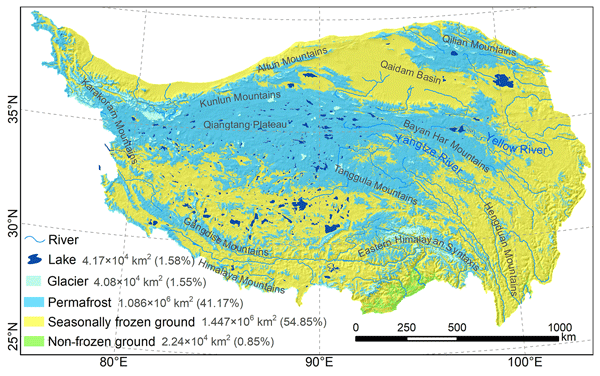
This study provides a new 2010 permafrost distribution map of the Qinghai–Tibet Plateau (QTP), using an effective mapping approach based entirely on satellite temperature data, well constrained by survey-based subregion maps, and considering the effects of local factors. The map shows that permafrost underlies about 41 % of the total QTP. We evaluated it with borehole observations and other maps, and all evidence indicates that this map has excellent accuracy.
Pengfei Li, Zhuotong Nan, Jiwei Xu, and Fujun Niu
EGUsphere, https://doi.org/10.5194/egusphere-2026-5035, https://doi.org/10.5194/egusphere-2026-5035, 2026
This preprint is open for discussion and under review for The Cryosphere (TC).
Short summary
Short summary
Most susceptibility models reduce multi-year inventories to binary occurrence labels and make little use of when failures occurred. We use the temporal ordering of pre-initiation states as weak supervision for susceptibility. Using annual retrogressive thaw slump inventories, the framework captured 89.45 % of 2021–2022 initiations within the top 10 % susceptibility area. The principle may apply to landslides and other mass-movement processes with multi-temporal initiation inventories.
Guoan Yin, Zhanju Lin, Fujun Niu, Jing Luo, Huini Wang, Hongye Yan, Zeyong Gao, Xin Ju, and Wenbin Yuan
EGUsphere, https://doi.org/10.5194/egusphere-2026-3345, https://doi.org/10.5194/egusphere-2026-3345, 2026
This preprint is open for discussion and under review for Geoscientific Model Development (GMD).
Short summary
Short summary
Climate change is thawing permanently frozen ground, causing the land to sink and damaging critical roads and buildings. To predict this hazard, we developed a fast computer simulation that mimics how different types of underground ice melt and compress. Our study shows that traditional models overestimate how quickly the ground warms but severely underestimate how deeply it collapses. This new tool helps engineers foresee sudden land collapse, protecting vital infrastructure in warming regions.
Lihua Chen, Xingyu Ding, Shuping Zhao, Fujun Niu, Keting Feng, and Zhuotong Nan
Earth Syst. Sci. Data, 18, 3779–3801, https://doi.org/10.5194/essd-18-3779-2026, https://doi.org/10.5194/essd-18-3779-2026, 2026
Short summary
Short summary
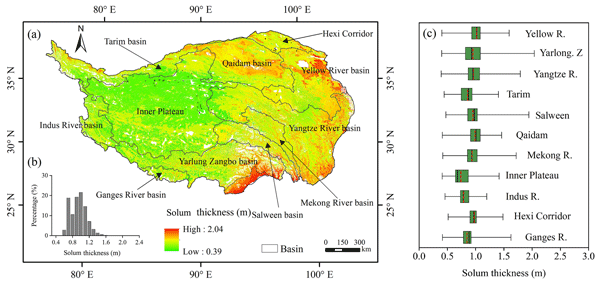
This study presents a high-resolution (1 km) physically-based solum thickness dataset for the Qinghai–Tibet Plateau. Grounded in a mechanistic mass-balance model that couples climate weathering with multi-process erosion, the data resolve geomorphological patterns and offer superior accuracy over conventional statistical products. This dataset provides essential model parameter for hydrological, ecological, and cryosphere models, facilitating more reliable assessments under a changing climate.
Jiwei Xu, Shuping Zhao, Zhuotong Nan, Fujun Niu, and Yaonan Zhang
Geosci. Model Dev., 19, 2919–2943, https://doi.org/10.5194/gmd-19-2919-2026, https://doi.org/10.5194/gmd-19-2919-2026, 2026
Short summary
Short summary
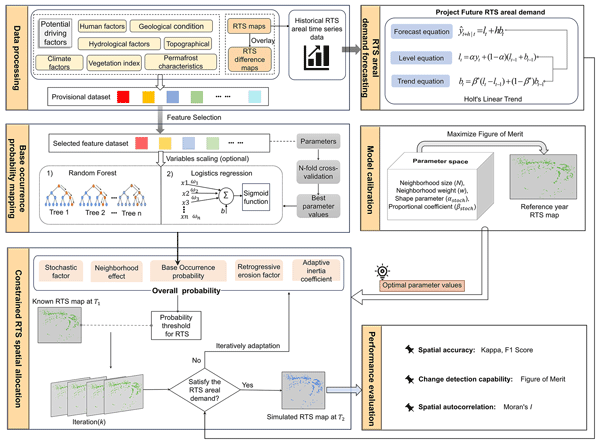
Permafrost is warming, causing more ground collapses known as retrogressive thaw slumps that damage ecosystems and infrastructure. We created a new computer model to predict how these slumps grow and spread over time. By combining satellite data, statistics, and rules that mimic natural erosion, the model can reproduce changes with high accuracy. This helps scientists and planners better forecast future permafrost hazards.
Wenbiao Tian, Hu Yu, Shuping Zhao, Yuhe Cao, Wenjun Yi, Jiwei Xu, and Zhuotong Nan
Geosci. Model Dev., 19, 57–72, https://doi.org/10.5194/gmd-19-57-2026, https://doi.org/10.5194/gmd-19-57-2026, 2026
Short summary
Short summary
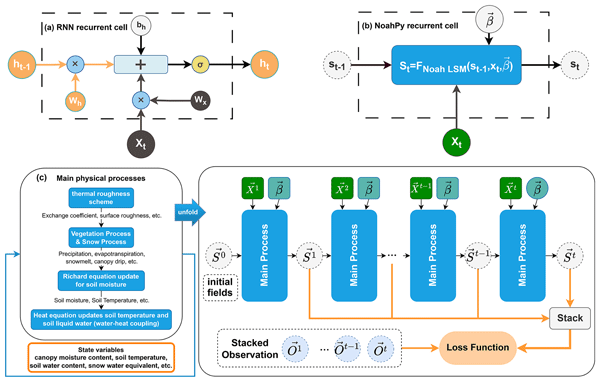
Accurately predicting how permafrost will thaw with land surface models is a grand challenge in Earth science. We created a new computer model by rebuilding a traditional physics model to work with artificial intelligence. Our results show this new approach is much faster and more reliable for tuning model parameters with data. This provides a better tool to build the next generation of climate models and improve predictions of permafrost's future.
Zetao Cao, Zhuotong Nan, Jianan Hu, Yuhong Chen, and Yaonan Zhang
Earth Syst. Sci. Data, 15, 3905–3930, https://doi.org/10.5194/essd-15-3905-2023, https://doi.org/10.5194/essd-15-3905-2023, 2023
Short summary
Short summary
This study provides a new 2010 permafrost distribution map of the Qinghai–Tibet Plateau (QTP), using an effective mapping approach based entirely on satellite temperature data, well constrained by survey-based subregion maps, and considering the effects of local factors. The map shows that permafrost underlies about 41 % of the total QTP. We evaluated it with borehole observations and other maps, and all evidence indicates that this map has excellent accuracy.
J. Li, C. Xiu, and D. Yang
ISPRS Ann. Photogramm. Remote Sens. Spatial Inf. Sci., X-3-W1-2022, 85–91, https://doi.org/10.5194/isprs-annals-X-3-W1-2022-85-2022, https://doi.org/10.5194/isprs-annals-X-3-W1-2022-85-2022, 2022
Yi Zhao, Zhuotong Nan, Hailong Ji, and Lin Zhao
The Cryosphere, 16, 825–849, https://doi.org/10.5194/tc-16-825-2022, https://doi.org/10.5194/tc-16-825-2022, 2022
Short summary
Short summary
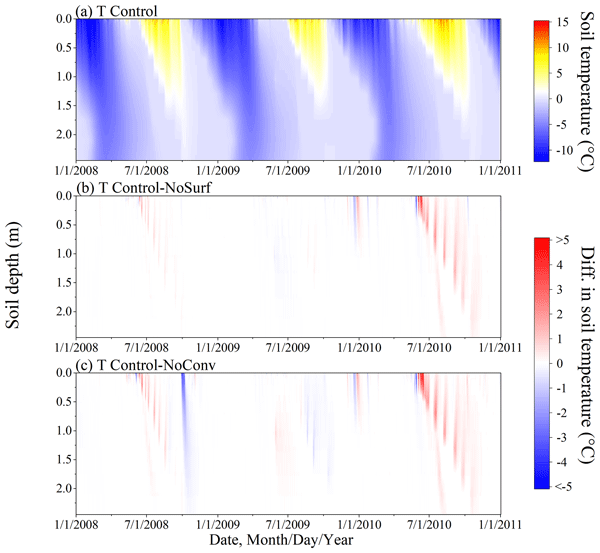
Convective heat transfer (CHT) is important in affecting thermal regimes in permafrost regions. We quantified its thermal impacts by contrasting the simulation results from three scenarios in which the Simultaneous Heat and Water model includes full, partial, and no consideration of CHT. The results show the CHT commonly happens in shallow and middle soil depths during thawing periods and has greater impacts in spring than summer. The CHT has both heating and cooling effects on the active layer.
Cited articles
Brus, D. J., de Gruijter, J. J., and van Groenigen, J. W.: Designing spatial coverage samples using the k-means clustering algorithm, Chap. 14, in: Developments in Soil Science, edited by: Lagacherie, P., McBratney, A. B., and Voltz, M., Elsevier, Amsterdam, the Netherlands, 183–192, https://doi.org/10.1016/S0166-2481(06)31014-8, 2006.
Burke, E. J., Zhang, Y., and Krinner, G.: Evaluating permafrost physics in the Coupled Model Intercomparison Project 6 (CMIP6) models and their sensitivity to climate change, The Cryosphere, 14, 3155–3174, https://doi.org/10.5194/tc-14-3155-2020, 2020.
Cao, Z., Nan, Z., Hu, J., Chen, Y., and Zhang, Y.: A new 2010 permafrost distribution map over the Qinghai–Tibet Plateau based on subregion survey maps: a benchmark for regional permafrost modeling, Earth Syst. Sci. Data, 15, 3905–3930, https://doi.org/10.5194/essd-15-3905-2023, 2023.
Carré, F., Mcbratney, A. B., and Minasny, B.: Estimation and potential improvement of the quality of legacy soil samples for digital soil mapping, Geoderma, 141, 1–14, https://doi.org/10.1016/j.geoderma.2007.01.018, 2007.
Chadburn, S. E., Burke, E. J., Cox, P. M., Friedlingstein, P., Hugelius, G., and Westermann, S.: An observation-based constraint on permafrost loss as a function of global warming, Nat. Clim. Change, 7, 340–344, https://doi.org/10.1038/nclimate3262, 2017.
Chen, X., Mu, C., Jia, L., Li, Z., Fan, C., Mu, M., Peng, X., and Wu, X.: High-resolution dataset of thermokarst lakes on the Qinghai-Tibetan Plateau, Earth Syst. Sci. Data Discuss. [preprint], https://doi.org/10.5194/essd-2020-378, 2021.
Chen, Y. and Nan, Z.: A 2020 permafrost distribution map of the Qinghai-Tibet Plateau, National Cryosphere Desert Data Center [data set], https://doi.org/10.12072/ncdc.permalab.db7813.2026, 2026.
Chen, Y., Nan, Z., Cao, Z., Ou, M., and Feng, K.: A stepwise framework for interpolating land surface temperature under cloudy conditions based on the solar-cloud-satellite geometry, ISPRS – J. Photogramm. Remote Sens., 197, 292–308, https://doi.org/10.1016/j.isprsjprs.2023.02.004, 2023.
Chen, Y., Nan, Z., Tian, W., Zhao, Y., Zhao, S., Yang, D., Jing, G., and Niu, F.: A 2020 permafrost distribution map over the Qinghai-Tibet Plateau, Figshare [data set], https://doi.org/10.6084/m9.figshare.30997375, 2026.
Cheng, G., Li, S., and Nan, Z.: Map of permafrost on the Qinghai-Tibet Plateau (1:3 000 000) (1983–1996), National Tibetan Plateau Data Center [data set], https://doi.org/10.11888/Geocry.tpdc.270014, 1996.
Deng, H., Zhang, Z., and Wu, Y.: Accelerated permafrost degradation in thermokarst landforms in Qilian Mountains from 2007 to 2020 observed by SBAS-InSAR, Ecol. Indic., 159, 111724, https://doi.org/10.1016/j.ecolind.2024.111724, 2024.
Fu, Y., Horton, R., and Heitman, J.: Neural network estimation of thermal conductivity across full saturation for various soil types, Comput. Electron. Agric., 235, 110321, https://doi.org/10.1016/j.compag.2025.110321, 2025.
Gay, B. A., Pastick, N. J., Züfle, A. E., Armstrong, A. H., Miner, K. R., and Qu, J. J.: Investigating permafrost carbon dynamics in Alaska with artificial intelligence, Environ. Res. Lett., 18, 125001, https://doi.org/10.1088/1748-9326/ad0607, 2023.
Guo, D. and Wang, H.: Simulation of permafrost and seasonally frozen ground conditions on the Tibetan Plateau, 1981–2010, J. Geophys. Res.-Atmos., 118, 5216–5230, https://doi.org/10.1002/jgrd.50457, 2013.
Hachem, S., Allard, M., and Duguay, C.: Using the MODIS land surface temperature product for mapping permafrost: an application to northern Québec and Labrador, Canada, Permafrost Perigl., 20, 407–416, https://doi.org/10.1002/ppp.672, 2009.
Hartigan, J.: Clustering algorithms, Wiley, New York, USA, 364 pp., ISBN 0-471-35645-X, 1975.
Hengl, T., Rossiter, D. G., and Stein, A. G.: Soil sampling strategies for spatial prediction by correlation with auxiliary maps, Austr. J. Soil Res., 41, 1403–1422, https://doi.org/10.1071/SR03005, 2003.
Hjort, J., Streletskiy, D., Doré, G., Wu, Q., Bjella, K., and Luoto, M.: Impacts of permafrost degradation on infrastructure, Nat. Rev. Earth Environ., 3, 24–38, https://doi.org/10.1038/s43017-021-00247-8, 2022.
Hu, G., Zhao, L., Sun, Z., Zou, D., Xiao, Y., Liu, G., Du, E., Wang, C., Wang, Y., Wu, X., Wang, L., and Zhao, Y.: Spatiotemporal characteristics and variability in the thermal state of permafrost on the Qinghai-Tibet Plateau, Permafrost Perigl., 35, 143–156, https://doi.org/10.1002/ppp.2219, 2024.
Hu, G., Zhao, L., Wu, X., Li, R., Wu, T., Su, Y., and Hao, J.: Evaluation of reanalysis air temperature products in permafrost regions on the Qinghai-Tibetan Plateau, Theor. Appl. Climatol., 138, 1457–1470, https://doi.org/10.1007/s00704-019-02888-8, 2019.
Hu, J., Zhao, S., Nan, Z., Wu, X., Sun, X., and Cheng, G.: An effective approach for mapping permafrost in a large area using subregion maps and satellite data, Permafrost Perigl., 31, 548–560, https://doi.org/10.1002/ppp.2068, 2020.
Huang, X., Tang, G., Zhu, T., Ding, H., and Na, J.: Space-for-time substitution in geomorphology: A critical review and conceptual framework, J. Geogr. Sci., 29, 1670–1680, https://doi.org/10.1007/s11442-019-1684-0, 2019.
Jia, Y., Chen, S., Wu, M., Gu, Y., Wei, P., Wu, T., Shang, Z., Wang, S., and Yu, H.: Improved permafrost stability by revegetation in extremely degraded grassland of the Qinghai-Tibetan Plateau, Geoderma, 430, 116350, https://doi.org/10.1016/j.geoderma.2023.116350, 2023.
Karjalainen, O., Luoto, M., Aalto, J., and Hjort, J.: New insights into the environmental factors controlling the ground thermal regime across the Northern Hemisphere: a comparison between permafrost and non-permafrost areas, The Cryosphere, 13, 693–707, https://doi.org/10.5194/tc-13-693-2019, 2019.
Kim, K. Y., Haagenson, R., Kansara, P., Rajaram, H., and Lakshmi, V.: Augmenting daily MODIS LST with AIRS surface temperature retrievals to estimate ground temperature and permafrost extent in High Mountain Asia, Remote Sens. Environ., 305, 114075, https://doi.org/10.1016/j.rse.2024.114075, 2024.
Kukulies, J., Chen, D., and Wang, M.: Temporal and spatial variations of convection, clouds and precipitation over the Tibetan Plateau from recent satellite observations. Part II: Precipitation climatology derived from global precipitation measurement mission, Int. J. Climatol., 40, 4858–4875, https://doi.org/10.1002/joc.6493, 2020.
Lei, W., Luo, D., Chen, F., Liu, J., Peng, Y., Li, S., and Shen, Q.: Changes in the thermal regime of permafrost in the Headwater Area of the Yellow River in 1979–2018 based on the HYDRUS model, Adv. Earth Sci., 39, 1–13, https://doi.org/10.11867/j.issn.1001-8166.2024.084, 2024 (in Chinese).
Lewkowicz, A. G., O'Neill, H. B., Wolfe, S. A., Roy-Léveillée, P., Roujanski, V. E., Hoever, E., Gruber, S., Brooks, H., Rudy, A. C., Koenig, C. E. M., Brown, N., and Bonnaventure, P. P. (Eds.): Glossary of Permafrost Science and Engineering, Canadian Permafrost Association, Toronto, Canada, 188 pp., https://doi.org/10.3138/cpa-gpse, 2025.
Li, G.: Survey data of major frozen soil engineering diseases in South Asia channel and Himalayas (2020–2021), Third Pole Environment Data Center, https://doi.org/10.11888/Cryos.tpdc.271880, 2021.
Li, X. and Cheng, G.: A GIS-aided response model of high-altitude permafrost to global change, Sci. China Ser. D, 42, 72–79, https://doi.org/10.1007/BF02878500, 1999.
Li, X., Cheng, G., Jin, H., Kang, E., Che, T., Jin, R., Wu, L., Nan, Z., Wang, J., and Shen, Y.: Cryospheric change in China, Glob. Planet. Change, 62, 210–218, https://doi.org/10.1016/j.gloplacha.2008.02.001, 2008.
Li, Z., Zhao, L., Liu, G., Zou, D., Wang, L., Yang, B., Du, E., Hu, G., Zhou, H., and Wang, C.: Analysis of soil moisture content in the active layer in the permafrost region of the Tuotuo River source in frozen season, J. Glaciol. Geocryol., 44, 56–68, https://doi.org/10.7522/j.issn.1000-0240.2022.0001, 2022.
Mao, J., Shi, X., Ma, L., Kaiser, D. P., Li, Q., and Thornton, P. E.: Assessment of reanalysis daily extreme temperatures with China's homogenized historical dataset during 1979–2001 using probability density functions, J. Clim., 23, 6605–6623, https://doi.org/10.1175/2010JCLI3581.1, 2010.
Mi, D.: Map of snow, ice and frozen ground in China, J. Glaciol. Geocryol., 12, 175–181, https://doi.org/10.7522/j.issn.1000-0240.1990.0054, 1990.
Mu, C., Abbott, B. W., Norris, A. J., Mu, M., Fan, C., Chen, X., Jia, L., Yang, R., Zhang, T., Wang, K., Peng, X., Wu, Q., Guggenberger, G., and Wu, X.: The status and stability of permafrost carbon on the Tibetan Plateau, Earth-Sci. Rev., 211, 103433, https://doi.org/10.1016/j.earscirev.2020.103433, 2020.
Mu, C., Peng, X., Du, R., Liu, H., Jin, H., Liang, B., Mu, M., Sun, W., Fan, C., Wu, X., Frauenfeld, O. W., and Zhang, T.: A Comprehensive Dataset for Earth System Models in a Permafrost Region: Meteorological, Permafrost, and Carbon Observations (2011–2020) in Northeastern Qinghai-Tibet Plateau, Earth Syst. Sci. Data Discuss. [preprint], https://doi.org/10.5194/essd-2022-347, 2022.
Nan, Z., Huang, P., and Zhao, L.: Permafrost distribution modeling and depth estimation in the Western Qinghai-Tibet Plateau, Acta Geographica Sinica, 68, 318–327, https://doi.org/10.11821/xb201303003, 2013 (in Chinese).
Nan, Z., Li, S., and Liu, Y.: Mean annual ground temperature distribution on the Tibetan Plateau: permafrost distribution mapping and further application, J. Glaciol. Geocryol., 24, 142–148, https://doi.org/10.7522/j.issn.1000-0240.2002.0024, 2002.
Ni, J., Du, Y., Wu, T., Mo, Q., Zhang, X., and Su, Y.: Hydrothermal variations of active layer in permafrost regions and the influence of vegetation in the Qinghai-Tibetan Plateau, Theor. Appl. Climatol., 156, 12, https://doi.org/10.1007/s00704-024-05286-x, 2025.
Ni, J., Wu, T., Zhu, X., Hu, G., Zou, D., Wu, X., Li, R., Xie, C., Qiao, Y., Pang, Q., Hao, J., and Yang, C.: Simulation of the present and future projection of permafrost on the Qinghai-Tibet Plateau with statistical and machine learning models, J. Geophys. Res.-Atmos., 126, e2020JD033402, https://doi.org/10.1029/2020JD033402, 2021.
Obu, J., Westermann, S., Bartsch, A., Berdnikov, N., Christiansen, H. H., Dashtseren, A., Delaloye, R., Elberling, B., Etzelmüller, B., Kholodov, A., Khomutov, A., Kääb, A., Leibman, M. O., Lewkowicz, A. G., Panda, S. K., Romanovsky, V., Way, R. G., Westergaard-Nielsen, A., Wu, T., Yamkhin, J., and Zou, D.: Northern Hemisphere permafrost map based on TTOP modelling for 2000–2016 at 1 km2 scale, Earth-Sci. Rev., 193, 299–316, https://doi.org/10.1016/j.earscirev.2019.04.023, 2019.
Pan, F., Jiang, L., Wang, G., Pan, J., Huang, J., Zhang, C., Cui, H., Yang, J., Zheng, Z., Wu, S., and Shi, J.: MODIS daily cloud-gap-filled fractional snow cover dataset of the Asian Water Tower region (2000–2022), Earth Syst. Sci. Data, 16, 2501–2523, https://doi.org/10.5194/essd-16-2501-2024, 2024.
Pan, Y., Li, X., and Li, S.: Effects of different soil thermal conductivity schemes on the simulation of permafrost on the Tibetan Plateau, Geoderma, 442, 116789, https://doi.org/10.1016/j.geoderma.2024.116789, 2024.
Park, Y. S. and Lek, S.: Artificial neural networks: Multilayer perceptron for ecological modeling, Chap. 7, in: Developments in Environmental Modelling, edited by: Jørgensen, S. E., Elsevier, Amsterdam, the Netherlands, 123–140, https://doi.org/10.1016/B978-0-444-63623-2.00007-4, 2016.
Peng, S., Ding, Y., Liu, W., and Li, Z.: 1 km monthly temperature and precipitation dataset for China from 1901 to 2017, Earth Syst. Sci. Data, 11, 1931–1946, https://doi.org/10.5194/essd-11-1931-2019, 2019.
Pickett, S. T.: Space-for-time substitution as an alternative to long-term studies, in: Long-Term Studies in Ecology, edited by: Likens, G. E., Springer, New York, USA, 110–135, https://doi.org/10.1007/978-1-4615-7358-6_5, 1989.
Qiu, J.: China: The third pole, Nature, 454, 393–396, https://doi.org/10.1038/454393a, 2008.
Ran, Y., Li, X., Cheng, G., Che, J., Aalto, J., Karjalainen, O., Hjort, J., Luoto, M., Jin, H., Obu, J., Hori, M., Yu, Q., and Chang, X.: New high-resolution estimates of the permafrost thermal state and hydrothermal conditions over the Northern Hemisphere, Earth Syst. Sci. Data, 14, 865–884, https://doi.org/10.5194/essd-14-865-2022, 2022.
Ran, Y., Li, X., Cheng, G., Nan, Z., Che, J., Sheng, Y., Wu, Q., Jin, H., Luo, D., and Tang, Z.: Mapping the permafrost stability on the Tibetan Plateau for 2005–2015, Sci. China Earth Sci., 64, 62–79, https://doi.org/10.1007/s11430-020-9685-3, 2021.
Ran, Y., Li, X., Cheng, G., Zhang, T., Wu, Q., Jin, H., and Jin, R.: Distribution of permafrost in China: an overview of existing permafrost maps, Permafrost Perigl., 23, 322–333, https://doi.org/10.1002/ppp.1756, 2012.
Reuter, H. I., Nelson, A., and Jarvis, A.: An evaluation of void-filling interpolation methods for SRTM data, Geogr. Inf. Syst., 21, 983–1008, https://doi.org/10.1080/13658810601169899, 2007.
Shan, W., Zhang, C., Guo, Y., and Qiu, L.: Mapping the thermal state of permafrost in Northeast China based on the surface frost number model, Remote Sens., 14, 3185, https://doi.org/10.3390/rs14133185, 2022.
Shangguan, W., Dai, Y., Liu, B., Zhu, A., Duan, Q., Wu, L., Ji, D., Ye, A., Yuan, H., Zhang, Q., Chen, D., Chen, M., Chu, J., Dou, Y., Guo, J., Li, H., Li, J., Liang, L., Liang, X., Liu, H., Liu, S., Miao, C., and Zhang, Y.: A China data set of soil properties for land surface modeling, J. Adv. Model. Earth Syst., 5, 212–224, https://doi.org/10.1002/jame.20026, 2013.
Shi, S., Wang, P., Zhan, X., Han, J., Guo, M., and Wang, F.: Warming and increasing precipitation induced greening on the northern Qinghai-Tibet Plateau, Catena, 233, 107483, https://doi.org/10.1016/j.catena.2023.107483, 2023.
Siewert, M. B.: High-resolution digital mapping of soil organic carbon in permafrost terrain using machine learning: a case study in a sub-Arctic peatland environment, Biogeosciences, 15, 1663–1682, https://doi.org/10.5194/bg-15-1663-2018, 2018.
Smith, M. W. and Riseborough, D. W.: Permafrost monitoring and detection of climate change, Permafrost Perigl., 7, 301–309, https://doi.org/10.1002/(SICI)1099-1530(199610)7:4<301::AID-PPP231>3.0.CO;2-R, 1996.
Smith, S. L., O'Neill, H. B., Isaksen, K., Noetzli, J., Romanovsky, V. E., and anonymous: The changing thermal state of permafrost, Nat. Rev. Earth Environ., 3, 10–23, https://doi.org/10.1038/s43017-021-00240-1, 2022.
Tananaev, N. and Lotsari, E.: Defrosting northern catchments: Fluvial effects of permafrost degradation, Earth-Sci. Rev., 228, 103996, https://doi.org/10.1016/j.earscirev.2022.103996, 2022.
van Der Westhuizen, S., Heuvelink, G. B., and Hofmeyr, D. P.: Multivariate random forest for digital soil mapping, Geoderma, 431, 116365, https://doi.org/10.1016/j.geoderma.2023.116365, 2023.
van Doninck, J., Peters, J., De Baets, B., De Clercq, E. M., Ducheyne, E., and Verhoest, N. E. C.: The potential of multitemporal Aqua and Terra MODIS apparent thermal inertia as a soil moisture indicator, Int. J. Appl. Earth Obs. Geoinf., 13, 934–941, https://doi.org/10.1016/j.jag.2011.07.003, 2011.
Wadoux, A. M. C., Brus, D. J., and Heuvelink, G. B.: Sampling design optimization for soil mapping with random forest, Geoderma, 355, 113913, https://doi.org/10.1016/j.geoderma.2019.113913, 2019.
Wang, G., Liu, G., Li, C., and Yang, Y.: The variability of soil thermal and hydrological dynamics with vegetation cover in a permafrost region, Agr. Forest Meteorol., 162/163, 44–57, https://doi.org/10.1016/j.agrformet.2012.04.006, 2012.
Wang, Y., Lv, W., Xue, K., Wang, S., Zhang, L., Hu, R., Zeng, H., Xu, X., Li, Y., and Jiang, L.: Grassland changes and adaptive management on the Qinghai–Tibetan Plateau, Nat. Rev. Earth Environ., 3, 668–683, https://doi.org/10.1038/s43017-022-00330-8, 2022.
Wu, Q. and Zhang, T.: Recent permafrost warming on the Qinghai-Tibetan Plateau, J. Geophys. Res.-Atmos., 113, https://doi.org/10.1029/2007JD009539, 2008.
Yan, D., Zheng, X., Feng, M., Liang, S., Hu, Z., Kuang, X., and Feng, Y.: Frozen ground change data set in the Tibetan Plateau (1961–2020), National Tibetan Plateau/Third Pole Environment Data Center [data set], https://doi.org/10.11888/Cryos.tpdc.300955, 2023.
Yang, M., Nelson, F. E., Shiklomanov, N. I., Guo, D., and Wan, G.: Permafrost degradation and its environmental effects on the Tibetan Plateau: A review of recent research, Earth-Sci. Rev., 103, 31–44, https://doi.org/10.1016/j.earscirev.2010.07.002, 2010.
Yang, M., Wang, X., Pang, G., Wan, G., and Liu, Z.: The Tibetan Plateau cryosphere: Observations and model simulations for current status and recent changes, Earth-Sci. Rev., 190, 353–369, https://doi.org/10.1016/j.earscirev.2018.12.018, 2019.
Yao, T., Bolch, T., Chen, D., Gao, J., Immerzeel, W., Piao, S., Su, F., Thompson, L., Wada, Y., and Wang, L.: The imbalance of the Asian water tower, Nat. Rev. Earth Environ., 3, 618–632, https://doi.org/10.1038/s43017-022-00299-4, 2022.
Yao, T., Thompson, L., Yang, W., Yu, W., Gao, Y., Guo, X., Yang, X., Duan, K., Zhao, H., Xu, B., Pu, J., Lu, A., Xiang, Y., Kattel, D. B., and Joswiak, D.: Different glacier status with atmospheric circulations in Tibetan Plateau and surroundings, Nat. Clim. Change, 2, 663–667, https://doi.org/10.1038/nclimate1580, 2012.
Ye, Q., Zong, J., Tian, L., Cogley, J. G., Song, C., and Guo, W.: Glacier changes on the Tibetan Plateau derived from Landsat imagery: mid-1970s – 2000–2013, J. Glaciol., 63, 273–287, https://doi.org/10.1017/jog.2016.137, 2017.
Yu, W., Nan, Z., Wang, Z., Chen, H., Wu, T., and Zhao, L.: An effective interpolation method for MODIS land surface temperature on the Qinghai-Tibet Plateau, IEEE J. Sel. Top. Appl. Earth Observ. Remote Sens., 8, 4539–4550, https://doi.org/10.1109/JSTARS.2015.2464094, 2015.
Zhang, G., Nan, Z., Hu, N., Yin, Z., Zhao, L., Cheng, G., and Mu, C.: Qinghai-Tibet Plateau permafrost at risk in the late 21st century, Earth Future, 10, https://doi.org/10.1029/2022EF002652, 2022.
Zhang, G., Nan, Z., Wu, X., Ji, H., and Zhao, S.: The Role of Winter Warming in Permafrost Change Over the Qinghai-Tibet Plateau, Geophys. Res. Lett., 46, 11261–11269, https://doi.org/10.1029/2019GL084292, 2019.
Zhang, G., Nan, Z., Zhao, L., Liang, Y., and Cheng, G.: Qinghai-Tibet Plateau wetting reduces permafrost thermal responses to climate warming, Earth Planet. Sc. Lett., 562, 116858, https://doi.org/10.1016/j.epsl.2021.116858, 2021.
Zhang, G., Ran, Y., Wan, W., Luo, W., Chen, W., Xu, F., and Li, X.: 100 years of lake evolution over the Qinghai–Tibet Plateau, Earth Syst. Sci. Data, 13, 3951–3966, https://doi.org/10.5194/essd-13-3951-2021, 2021.
Zhang, G., Yao, T., Xie, H., Yang, K., Zhu, L., Shum, C. K., Bolch, T., Yi, S., Allen, S., Jiang, L., Chen, W., and Ke, C.: Response of Tibetan Plateau lakes to climate change: Trends, patterns, and mechanisms, Earth-Sci. Rev., 208, 103269, https://doi.org/10.1016/j.earscirev.2020.103269, 2020.
Zhang, T., Barry, R. G., Knowles, K., Heginbottom, J. A., and Brown, J.: Statistics and characteristics of permafrost and ground-ice distribution in the Northern Hemisphere, Polar Geogr., 23, 132–154, https://doi.org/10.1080/10889379909377670, 1999.
Zhao, J., Zhao, L., Sun, Z., Hu, G., Zou, D., Xiao, M., Liu, G., Pang, Q., Du, E., Li, Z., Wu, X., Xiao, Y., Wang, L., and Zhang, W.: The thermal state of permafrost under climate change on the Qinghai-Tibet Plateau (1980–2022): a case study of the West Kunlun, The Cryosphere, 19, 4211–4236, https://doi.org/10.5194/tc-19-4211-2025, 2025.
Zhao, J., Zhao, L., Sun, Z., Niu, F., Hu, G., Zou, D., Liu, G., Du, E., Wang, C., Wang, L., Qiao, Y., Shi, J., Zhang, Y., Gao, J., Wang, Y., Li, Y., Yu, W., Zhou, H., Xing, Z., Xiao, M., Yin, L., and Wang, S.: Simulating the current and future northern limit of permafrost on the Qinghai–Tibet Plateau, The Cryosphere, 16, 4823–4846, https://doi.org/10.5194/tc-16-4823-2022, 2022.
Zhao, L., Ping, C., Yang, D., Cheng, G., Ding, Y., and Liu, S.: Changes of climate and seasonally frozen ground over the past 30 years in Qinghai–Xizang (Tibetan) Plateau, China, Glob. Planet. Change, 43, 19–31, https://doi.org/10.1016/j.gloplacha.2004.02.003, 2004.
Zhao, L., Zou, D., Hu, G., Du, E., Pang, Q., Xiao, Y., Li, R., Sheng, Y., Wu, X., and Sun, Z.: Changing climate and the permafrost environment on the Qinghai–Tibet (Xizang) plateau, Permafrost Perigl., 31, 396–405, https://doi.org/10.1002/ppp.2056, 2020.
Zhao, L., Zou, D., Hu, G., Wu, T., Du, E., Liu, G., Xiao, Y., Li, R., Pang, Q., Qiao, Y., Wu, X., Sun, Z., Xing, Z., Sheng, Y., Zhao, Y., Shi, J., Xie, C., Wang, L., Wang, C., and Cheng, G.: A synthesis dataset of permafrost thermal state for the Qinghai–Tibet (Xizang) Plateau, China, Earth Syst. Sci. Data, 13, 4207–4218, https://doi.org/10.5194/essd-13-4207-2021, 2021.
Zhao, S. P., Nan, Z. T., Huang, Y. B., and Zhao, L.: The application and evaluation of simple permafrost distribution models on the Qinghai–Tibet Plateau, Permafrost Perigl., 28, 391–404, https://doi.org/10.1002/ppp.1939, 2017.
Zhao, Y., Liao, J., Zhang, Q., Chen, J., Gong, X., Shi, Y., Shi, M., Yang, D., Fan, S., Zhou, X., Cao, L., and Hu, K.: Development of China Ground Climate Normal Value Dataset from 1991 to 2020, Chin. J. Atmos. Sci., 48, 555–571, https://doi.org/10.3878/j.issn.1006-9895.2204.22010, 2024 (in Chinese).
Zhong, L., Lei, H., and Yang, J.: Development of a distributed physics-informed deep learning hydrological model for data-scarce regions, Water Resour. Res., 60, e2023WR036333, https://doi.org/10.1029/2023WR036333, 2024.
Zhou, G., Ren, H., Zhang, L., Lv, X., and Zhou, M.: Annual vegetation maps in the Qinghai–Tibet Plateau (QTP) from 2000 to 2022 based on MODIS series satellite imagery, Earth Syst. Sci. Data, 17, 773–797, https://doi.org/10.5194/essd-17-773-2025, 2025.
Zhu, Y., Sang, Y., Chen, D., Sivakumar, B., and Li, D.: Effects of the South Asian summer monsoon anomaly on interannual variations in precipitation over the South-Central Tibetan Plateau, Environ. Res. Lett., 15, 124067, https://doi.org/10.1088/1748-9326/abc71b, 2020.
Zou, D., Zhao, L., Hu, G., Du, E., Liu, G., Wang, C., and Li, W.: Permafrost temperature baseline at 15 m depth on the Qinghai–Tibetan Plateau (2010–2019), Earth Syst. Sci. Data, 17, 1731–1742, https://doi.org/10.5194/essd-17-1731-2025, 2025.
Zou, D., Zhao, L., Sheng, Y., Chen, J., Hu, G., Wu, T., Wu, J., Xie, C., Wu, X., Pang, Q., Wang, W., Du, E., Li, W., Liu, G., Li, J., Qin, Y., Qiao, Y., Wang, Z., Shi, J., and Cheng, G.: A new map of permafrost distribution on the Tibetan Plateau, The Cryosphere, 11, 2527–2542, https://doi.org/10.5194/tc-11-2527-2017, 2017.
Short summary
This study presents a 1-km permafrost map of the Qinghai-Tibet Plateau for 2020, generated via a frost number model and space-for-time substitution. Permafrost covers 1.038×10⁶ km² (39.35 %), a 1.82 % decline since 2010, while seasonally frozen ground covers 1.466×10⁶ km² (55.57 %). Validated against boreholes, the map achieves 0.84 accuracy (Kappa= 0.58). This map offers a critical, up-to-date baseline for cryospheric research.
This study presents a 1-km permafrost map of the Qinghai-Tibet Plateau for 2020, generated via a...


