Articles | Volume 20, issue 9
https://doi.org/10.5194/tc-20-5365-2026
© Author(s) 2026. This work is distributed under
the Creative Commons Attribution 4.0 License.
https://doi.org/10.5194/tc-20-5365-2026
© Author(s) 2026. This work is distributed under
the Creative Commons Attribution 4.0 License.
Feedbacks and timescales in the modelled transient response of debris-covered glaciers

Florian Hardmeier
CORRESPONDING AUTHOR
Department of Geography, University of Zurich, Zurich, Switzerland
James C. Ferguson
Department of Geography, University of Zurich, Zurich, Switzerland
Institute of Science and Technology Austria, Klosterneuburg, Austria
Andreas Vieli
Department of Geography, University of Zurich, Zurich, Switzerland
Related authors
No articles found.
Giulio Saibene, Isabelle Gärtner-Roer, Jan Beutel, and Andreas Vieli
The Cryosphere, 20, 3511–3532, https://doi.org/10.5194/tc-20-3511-2026, https://doi.org/10.5194/tc-20-3511-2026, 2026
Short summary
Short summary
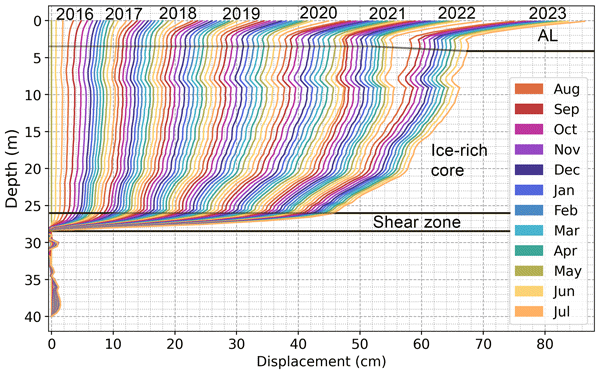
Rock glaciers are bodies of frozen ground found in mountain regions. They move downslope and are mainly studied at the surface. Here, we analyze deformation data from a borehole, providing continuous data for almost eight years. The data shows that the acceleration in the summer movement happens in the uppermost layer, while long-term movement is mostly occurring in a deeper layer. This is important for the interpretation of surface movements, which are used as climate indicators.
Ilaria Santin, Huw J. Horgan, Raphael Moser, Nanna Bjørnholt Karlsson, Faezeh M. Nick, Andreas Vieli, Anja Rutishauser, Hansruedi Maurer, and Daniel Farinotti
The Cryosphere, 20, 3435–3441, https://doi.org/10.5194/tc-20-3435-2026, https://doi.org/10.5194/tc-20-3435-2026, 2026
Short summary
Short summary
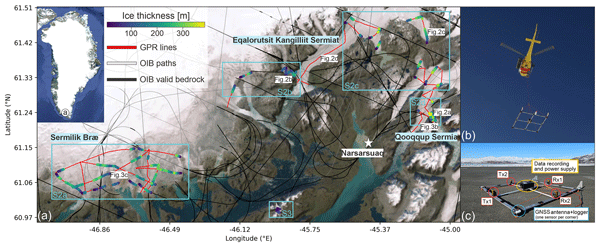
Ice thickness near Greenland’s coast is still poorly measured, yet it is vital for predicting sea level rise. We flew a helicopter ice-penetrating radar over three outlet glaciers in southern Greenland and mapped the glacier bed where basal reflections were clear. We measured ice up to about 340 meters thick, with reliable penetration typically to about 300 meters, providing new constraints that can improve regional bed maps.
Tancrède P. M. Leger, Guillaume Jouvet, Sarah Kamleitner, Brandon D. Finley, Maxime Bernard, Balthazar Allegri, Frédéric Herman, Andreas Vieli, Andreas Henz, and Samuel U. Nussbaumer
Earth Surf. Dynam., 14, 361–389, https://doi.org/10.5194/esurf-14-361-2026, https://doi.org/10.5194/esurf-14-361-2026, 2026
Short summary
Short summary
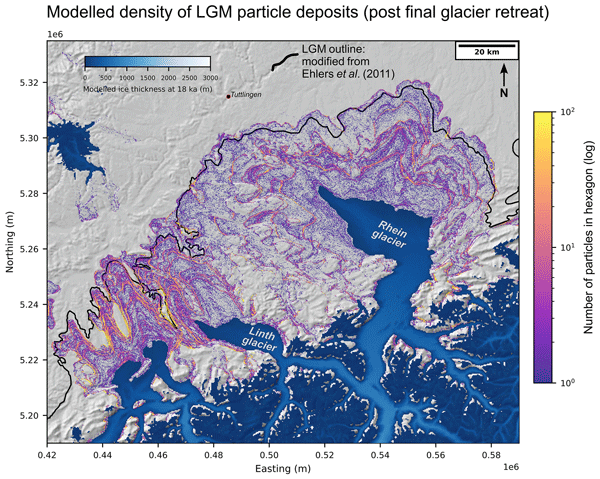
This study reconstructs for the first time the transport-pathways of sediments by glaciers during the last glaciation of the European Alps, 24000 years ago. This helps us understand how the European Alps were shaped by past glaciations and helps us better constrain the mechanisms of iceflow, glacier erosion and the movement of large sediment masses by ice. This breakthrough is achieved by coupling a smart particle-tracking algorithm to a machine-learning-enhanced glacier evolution model.
Armin Dachauer, Andrea Kneib-Walter, Dominik Gräff, and Andreas Vieli
The Cryosphere, 20, 2099–2125, https://doi.org/10.5194/tc-20-2099-2026, https://doi.org/10.5194/tc-20-2099-2026, 2026
Short summary
Short summary
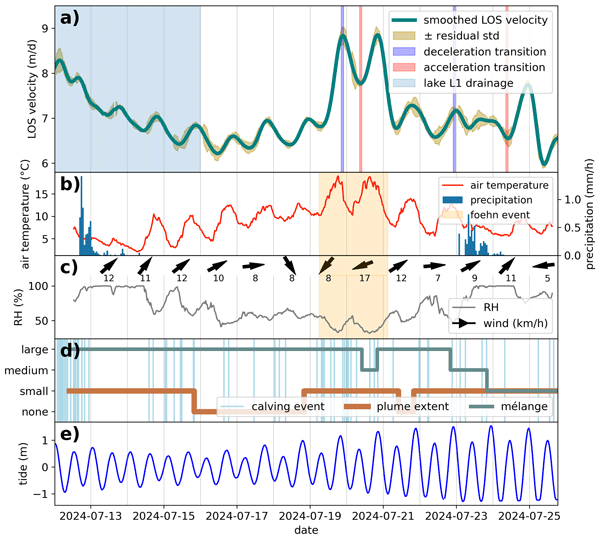
Terrestrial radar observations were used to investigate flow speed changes at Eqalorutsit Kangilliit Sermiat, a marine-terminating glacier in Greenland. The velocity varied on both daily and multi-day timescales, showing that the glacier speeds up markedly when meltwater or lake drainage increases basal water pressure. Usually speed changes move downstream with time towards the glacier front, but during multi-day speed-up events they start at the front and travel upstream.
Samuel Weber, Andreas Vieli, Marcia Phillips, and Alessandro Cicoira
The Cryosphere, 19, 6727–6748, https://doi.org/10.5194/tc-19-6727-2025, https://doi.org/10.5194/tc-19-6727-2025, 2025
Short summary
Short summary
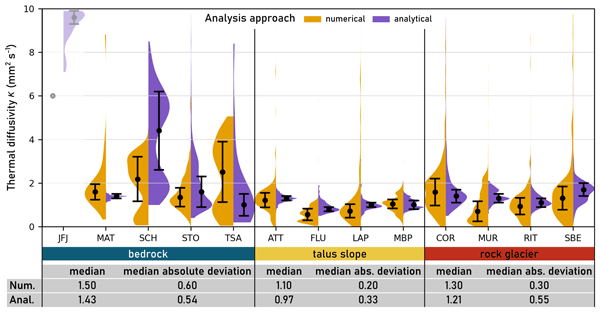
The properties of the permafrost ground depend on its temperature and composition. We used temperature data from 29 boreholes in Switzerland to study how heat moves through different types of mountain permafrost landforms, supporting a physically meaningful interpretation of thermal properties in terms of ice content, water saturation, and porosity. Understanding changes is important because they can affect how stable mountain slopes are and how easy it is to build things in mountain areas.
Andreas Henz, Johannes Reinthaler, Samuel U. Nussbaumer, Tancrède P. M. Leger, Sarah Kamleitner, Guillaume Jouvet, and Andreas Vieli
The Cryosphere, 19, 5913–5937, https://doi.org/10.5194/tc-19-5913-2025, https://doi.org/10.5194/tc-19-5913-2025, 2025
Short summary
Short summary
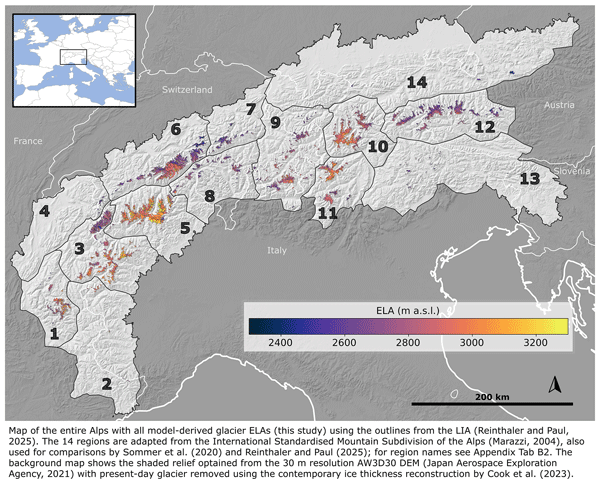
Glaciers are key to understanding climate change, reflecting historical variability. Using glacier models on the computer, we reconstructed European Alps glaciers during the Little Ice Age, with a total ice volume of 283 ± 42 cubic kilometres. Also, the study determines equilibrium line altitudes (ELAs) for over 4000 glaciers, showing patterns influenced by temperature, precipitation, and solar radiation. After all, we introduce a new ELA correction approach based on solar incidence.
Adrien Wehrlé, Martin P. Lüthi, and Andreas Vieli
The Cryosphere, 17, 309–326, https://doi.org/10.5194/tc-17-309-2023, https://doi.org/10.5194/tc-17-309-2023, 2023
Short summary
Short summary
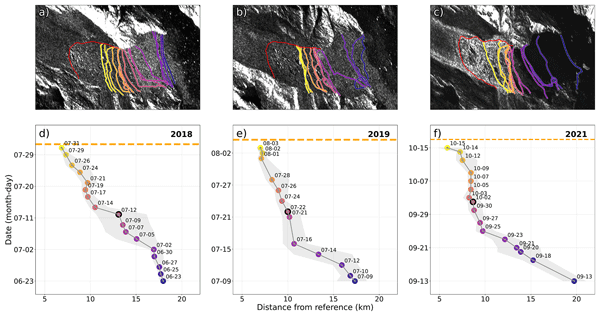
We characterized short-lived episodes of ice mélange weakening (IMW) at the front of three major Greenland outlet glaciers. Through a continuous detection at the front of Kangerdlugssuaq Glacier during the June-to-September period from 2018 to 2021, we found that 87 % of the IMW episodes occurred prior to a large-scale calving event. Using a simple model for ice mélange motion, we further characterized the IMW process as self-sustained through the existence of an IMW–calving feedback.
Alessandro Cicoira, Samuel Weber, Andreas Biri, Ben Buchli, Reynald Delaloye, Reto Da Forno, Isabelle Gärtner-Roer, Stephan Gruber, Tonio Gsell, Andreas Hasler, Roman Lim, Philippe Limpach, Raphael Mayoraz, Matthias Meyer, Jeannette Noetzli, Marcia Phillips, Eric Pointner, Hugo Raetzo, Cristian Scapozza, Tazio Strozzi, Lothar Thiele, Andreas Vieli, Daniel Vonder Mühll, Vanessa Wirz, and Jan Beutel
Earth Syst. Sci. Data, 14, 5061–5091, https://doi.org/10.5194/essd-14-5061-2022, https://doi.org/10.5194/essd-14-5061-2022, 2022
Short summary
Short summary
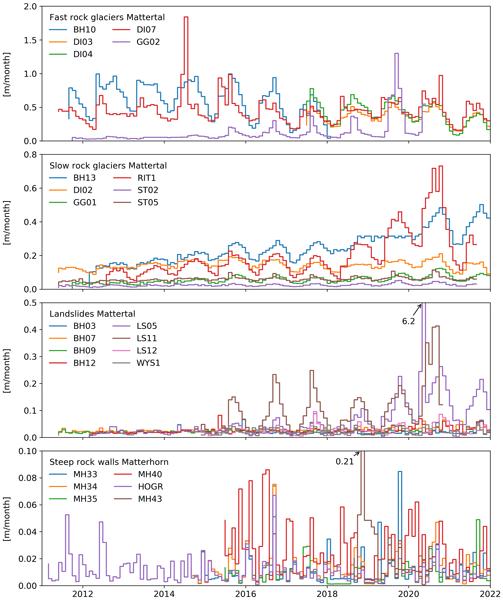
This paper documents a monitoring network of 54 positions, located on different periglacial landforms in the Swiss Alps: rock glaciers, landslides, and steep rock walls. The data serve basic research but also decision-making and mitigation of natural hazards. It is the largest dataset of its kind, comprising over 209 000 daily positions and additional weather data.
Adrien Wehrlé, Martin P. Lüthi, Andrea Walter, Guillaume Jouvet, and Andreas Vieli
The Cryosphere, 15, 5659–5674, https://doi.org/10.5194/tc-15-5659-2021, https://doi.org/10.5194/tc-15-5659-2021, 2021
Short summary
Short summary
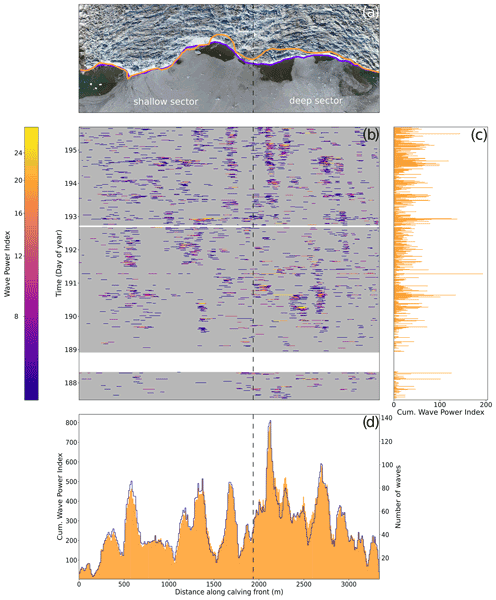
We developed a novel automated method for the detection and the quantification of ocean waves generated by glacier calving. This method was applied to data recorded with a terrestrial radar interferometer at Eqip Sermia, Greenland. Results show a high calving activity at the glacier front sector ending in deep water linked with more frequent meltwater plumes. This suggests that rising subglacial meltwater plumes strongly affect glacier calving in deep water, but weakly in shallow water.
Cited articles
Anderson, L. S. and Anderson, R. S.: Debris thickness patterns on debris-covered glaciers, Geomorphology, 311, 1–12, https://doi.org/10.1016/J.GEOMORPH.2018.03.014, 2018. a, b
Anderson, L. S., Armstrong, W. H., Anderson, R. S., Scherler, D., and Petersen, E.: The Causes of Debris-Covered Glacier Thinning: Evidence for the Importance of Ice Dynamics From Kennicott Glacier, Alaska, Front. Earth Sci., 9, 680995, https://doi.org/10.3389/FEART.2021.680995, 2021. a
Anderson, R. S.: A model of ablation-dominated medial moraines and the generation of debris-mantled glacier snouts, J. Glaciol., 46, 459–469, https://doi.org/10.3189/172756500781833025, 2000. a
Anderson, R. S., Anderson, L. S., Armstrong, W. H., Rossi, M. W., and Crump, S. E.: Glaciation of alpine valleys: The glacier – debris-covered glacier – rock glacier continuum, Geomorphology, 311, 127–142, https://doi.org/10.1016/J.GEOMORPH.2018.03.015, 2018. a
Bahr, D. B., Pfeffer, W. T., Sassolas, C., and Meier, M. F.: Response time of glaciers as a function of size and mass balance: 1. Theory, J. Geophys. Res.-Sol. Ea., 103, 9777–9782, https://doi.org/10.1029/98JB00507, 1998. a, b
Banerjee, A. and Shankar, R.: On the response of Himalayan glaciers to climate change, J. Glaciol., 59, 480–490, https://doi.org/10.3189/2013JOG12J130, 2013. a, b, c
Banerjee, A. and Wani, B. A.: Exponentially decreasing erosion rates protect the high-elevation crests of the Himalaya, Earth Planet. Sc. Lett., 497, 22–28, https://doi.org/10.1016/J.EPSL.2018.06.001, 2018. a, b
Bartlett, O. T., Ng, F. S., and Rowan, A. V.: Morphology and evolution of supraglacial hummocks on debris-covered Himalayan glaciers, Earth Surf. Proc. Land., 46, 525–539, https://doi.org/10.1002/ESP.5043, 2021. a
Benn, D. I. and Lehmkuhl, F.: Mass balance and equilibrium-line altitudes of glaciers in high-mountain environments, Quatern. Int., 65–66, 15–29, https://doi.org/10.1016/S1040-6182(99)00034-8, 2000. a
Benn, D. I., Bolch, T., Hands, K., Gulley, J., Luckman, A., Nicholson, L. I., Quincey, D., Thompson, S., Toumi, R., and Wiseman, S.: Response of debris-covered glaciers in the Mount Everest region to recent warming, and implications for outburst flood hazards, Earth-Sci. Rev., 114, 156–174, https://doi.org/10.1016/J.EARSCIREV.2012.03.008, 2012. a, b
Carturan, L., Filippi, R., Seppi, R., Gabrielli, P., Notarnicola, C., Bertoldi, L., Paul, F., Rastner, P., Cazorzi, F., Dinale, R., and Dalla Fontana, G.: Area and volume loss of the glaciers in the Ortles-Cevedale group (Eastern Italian Alps): controls and imbalance of the remaining glaciers, The Cryosphere, 7, 1339–1359, https://doi.org/10.5194/tc-7-1339-2013, 2013. a
Compagno, L., Huss, M., Miles, E. S., McCarthy, M. J., Zekollari, H., Dehecq, A., Pellicciotti, F., and Farinotti, D.: Modelling supraglacial debris-cover evolution from the single-glacier to the regional scale: an application to High Mountain Asia, The Cryosphere, 16, 1697–1718, https://doi.org/10.5194/tc-16-1697-2022, 2022. a, b, c
Courant, R., Friedrichs, K., and Lewy, H.: Über die partiellen Differenzengleichungen der mathematischen Physik, Math. Ann., 100, 32–74, https://doi.org/10.1007/BF01448839, 1928. a
Egholm, D. L., Knudsen, M. F., Clark, C. D., and Lesemann, J. E.: Modeling the flow of glaciers in steep terrains: The integrated second-order shallow ice approximation (iSOSIA), J. Geophys. Res.-Earth, 116, https://doi.org/10.1029/2010JF001900, 2011. a
Fowler, A. C. and Larson, D. A.: On the flow of polythermal glaciers – I. Model and preliminary analysis, P. Roy. Soc. Lond. A. Mat., 363, 217–242, https://doi.org/10.1098/RSPA.1978.0165, 1978. a
Goosse, H., Barriat, P.-Y., Dalaiden, Q., Klein, F., Marzeion, B., Maussion, F., Pelucchi, P., and Vlug, A.: Testing the consistency between changes in simulated climate and Alpine glacier length over the past millennium, Clim. Past, 14, 1119–1133, https://doi.org/10.5194/cp-14-1119-2018, 2018. a
Hardmeier, F., Ferguson, J. C., and Vieli, A.: Model code and video supplement for 'Feedbacks and timescales in the modelled transient response of debris-covered glaciers', Version 1.0.0, Zenodo [code/video], https://doi.org/10.5281/zenodo.22687411, 2026. a, b
Hartmeyer, I., Delleske, R., Keuschnig, M., Krautblatter, M., Lang, A., Schrott, L., and Otto, J.-C.: Current glacier recession causes significant rockfall increase: the immediate paraglacial response of deglaciating cirque walls, Earth Surf. Dynam., 8, 729–751, https://doi.org/10.5194/esurf-8-729-2020, 2020. a, b
Heimsath, A. M. and McGlynn, R.: Quantifying periglacial erosion in the Nepal high Himalaya, Geomorphology, 97, 5–23, https://doi.org/10.1016/J.GEOMORPH.2007.02.046, 2008. a
Herreid, S. and Pellicciotti, F.: The state of rock debris covering Earth’s glaciers, Nat. Geosci., 13, 621–627, https://doi.org/10.1038/s41561-020-0615-0, 2020. a
Johannesson, T., Raymond, C., and Waddington, E.: Time–Scale for Adjustment of Glaciers to Changes in Mass Balance, J. Glaciol., 35, 355–369, https://doi.org/10.3189/S002214300000928X, 1989. a, b
Kirkbride, M. P. and Deline, P.: The formation of supraglacial debris covers by primary dispersal from transverse englacial debris bands, Earth Surf. Proc. Land., 38, 1779–1792, https://doi.org/10.1002/ESP.3416, 2013. a, b, c
Konrad, S. K. and Humphrey, N. F.: Steady-state flow model of debris-covered glaciers (rock glaciers), in: Debris-Covered Glaciers: Proceedings of an International Workshop Held at the University of Washington in Seattle, Washington, USA, 13–15 September, 2000 (IAHS), Iahs Publication, Seattle, Washington, USA, 264, 255–266, ISBN: 1-901502-31-7, 2000. a
Laha, S., Winter-Billington, A., Banerjee, A., Shankar, R., Nainwal, H. C., and Koppes, M.: Estimation of ice ablation on a debris-covered glacier from vertical debris-temperature profiles, J. Glaciol., 69, 1–12, https://doi.org/10.1017/JOG.2022.35, 2023. a
Langhammer, L., Rabenstein, L., Schmid, L., Bauder, A., Grab, M., Schaer, P., and Maurer, H.: Glacier bed surveying with helicopter-borne dual-polarization ground-penetrating radar, J. Glaciol., 65, 123–135, https://doi.org/10.1017/JOG.2018.99, 2019. a
Margirier, A., Brondex, J., Rowan, A. V., Schmidt, C., Pedersen, V. K., Lehmann, B., Anderson, L. S., Veness, R., Watson, C. S., Swift, D., and King, G. E.: Tracking Sediment Transport Through Miage Glacier, Italy, Using a Lagrangian Approach With Luminescence Rock Surface Burial Dating of Englacial Clasts, J. Geophys. Res.-Earth, 130, e2024JF007773, https://doi.org/10.1029/2024JF007773, 2025. a, b
Masson-Delmotte, V., Zhai, P., Chen, Y., Goldfarb, L., Gomis, M. I., Matthews, J. B. R., Berger, S., Huang, M., Yelekçi, O., Yu, R., Zhou, B., Lonnoy, E., Maycock, T. K., Waterfield, T., Leitzell, K., and Caud, N.: IPCC, 2021: Summary for Policymakers, Climate Change 2021: The e Physical Science Basis. Contribution of Working Group I to the Sixth Assessment Report of the Intergovernmental Panel on Climate Change, https://doi.org/10.1017/9781009157896.001, 2021. a, b, c, d, e, f, g
Mattson, L. E., Gardner, J. S., and Young, G. J.: Ablation on Debris Covered Glaciers: an Example from the Rakhiot Glacier, Punjab, Himalaya, Proceedings of the Kathmandu Symposium, November 1992, IAHS-AISH P., 289–296, 1993. a
Mayer, C. and Licciulli, C.: The Concept of Steady State, Cyclicity and Debris Unloading of Debris-Covered Glaciers, Front. Earth Sci., 9, 710276, https://doi.org/10.3389/FEART.2021.710276, 2021. a, b, c, d
McCarthy, M., Miles, E., Kneib, M., Buri, P., Fugger, S., and Pellicciotti, F.: Supraglacial debris thickness and supply rate in High-Mountain Asia, Communications Earth & Environment, 3, 1–11, https://doi.org/10.1038/s43247-022-00588-2, 2022. a, b
Miles, E. S., Steiner, J. F., Buri, P., Immerzeel, W. W., and Pellicciotti, F.: Controls on the relative melt rates of debris-covered glacier surfaces, Environ. Res. Lett., 17, 064004, https://doi.org/10.1088/1748-9326/AC6966, 2022. a
Miles, K. E., Hubbard, B., Quincey, D. J., Miles, E. S., Sherpa, T. C., Rowan, A. V., and Doyle, S. H.: Polythermal structure of a Himalayan debris-covered glacier revealed by borehole thermometry, Sci. Rep., 8, 1–9, https://doi.org/10.1038/s41598-018-34327-5, 2018. a
Mölg, N., Bolch, T., Walter, A., and Vieli, A.: Unravelling the evolution of Zmuttgletscher and its debris cover since the end of the Little Ice Age, The Cryosphere, 13, 1889–1909, https://doi.org/10.5194/tc-13-1889-2019, 2019. a, b
Mölg, N., Ferguson, J., Bolch, T., and Vieli, A.: On the influence of debris cover on glacier morphology: How high-relief structures evolve from smooth surfaces, Geomorphology, 357, 107092, https://doi.org/10.1016/J.GEOMORPH.2020.107092, 2020. a
Moore, P. L.: Stability of supraglacial debris, Earth Surf. Proc. Land., 43, 285–297, https://doi.org/10.1002/ESP.4244, 2018. a, b
Nainwal, H., Banerjee, A., Shankar, R., Semwal, P., and Sharma, T.: Shrinkage of Satopanth and Bhagirath Kharak Glaciers, India, from 1936 to 2013, Ann. Glaciol., 57, 131–139, https://doi.org/10.3189/2016AOG71A015, 2016. a
Nakawo, M., Yabuki, H., and Sakai, A.: Characteristics of Khumbu Glacier, Nepal Himalaya: recent change in the debris-covered area, Ann. Glaciol., 28, 118–122, https://doi.org/10.3189/172756499781821788, 1999. a
Nicholson, L. and Benn, D. I.: Calculating ice melt beneath a debris layer using meteorological data, J. Glaciol., 52, 463–470, https://doi.org/10.3189/172756506781828584, 2006. a
Nicholson, L., Wirbel, A., Mayer, C., and Lambrecht, A.: The Challenge of Non-Stationary Feedbacks in Modeling the Response of Debris-Covered Glaciers to Climate Forcing, Front. Earth Sci., 9, 662695, https://doi.org/10.3389/feart.2021.662695, 2021. a, b
Oerlemans, J.: Estimating response times of Vadret da Morteratsch, Vadret da Palü, Briksdalsbreen and Nigardsbreen from their length records, J. Glaciol., 53, 357–362, https://doi.org/10.3189/002214307783258387, 2007. a
Østrem, G.: Ice Melting under a Thin Layer of Moraine, and the Existence of Ice Cores in Moraine Ridges, Geogr. Ann., 41, 228–230, https://doi.org/10.1080/20014422.1959.11907953, 1959. a
Pellicciotti, F., Stephan, C., Miles, E., Herreid, S., Immerzeel, W. W., and Bolch, T.: Mass-balance changes of the debris-covered glaciers in the Langtang Himal, Nepal, from 1974 to 1999, J. Glaciol., 61, 373–386, https://doi.org/10.3189/2015JOG13J237, 2015. a, b
Pellicciotti, F., Fontrodona-Bach, A., Rounce, D. R., Fyffe, C. L., Anderson, L. S., Ayala, Á., Brock, B. W., Buri, P., Fugger, S., Fujita, K., Gantayat, P., Groos, A. R., Immerzeel, W., Kneib, M., Mayer, C., MacDonell, S., McCarthy, M., McPhee, J., Miles, E., Purdie, H., Rets, E., Sakai, A., Shaw, T. E., Steiner, J., Wagnon, P., and Winter-Billington, A.: DCG-MIP: the Debris-Covered Glacier melt Model Intercomparison exPeriment, The Cryosphere, 20, 1895–1928, https://doi.org/10.5194/tc-20-1895-2026, 2026. a
Ragettli, S., Bolch, T., and Pellicciotti, F.: Heterogeneous glacier thinning patterns over the last 40 years in Langtang Himal, Nepal, The Cryosphere, 10, 2075–2097, https://doi.org/10.5194/tc-10-2075-2016, 2016. a
Rippin, D. M., Sharp, M., Van Wychen, W., and Zubot, D.: `Detachment' of icefield outlet glaciers: catastrophic thinning and retreat of the Columbia Glacier (Canada), Earth Surf. Proc. Land., 45, 459–472, https://doi.org/10.1002/ESP.4746, 2020. a, b
Rounce, D. R., King, O., McCarthy, M., Shean, D. E., and Salerno, F.: Quantifying Debris Thickness of Debris-Covered Glaciers in the Everest Region of Nepal Through Inversion of a Subdebris Melt Model, J. Geophys. Res.-Earth, 123, 1094–1115, https://doi.org/10.1029/2017JF004395, 2018. a
Rowan, A. V., Egholm, D. L., Quincey, D. J., and Glasser, N. F.: Modelling the feedbacks between mass balance, ice flow and debris transport to predict the response to climate change of debris-covered glaciers in the Himalaya, Earth Planet. Sc. Lett., 430, 427–438, https://doi.org/10.1016/J.EPSL.2015.09.004, 2015. a, b, c, d, e, f
Rowan, A. V., Egholm, D. L., Quincey, D. J., Hubbard, B., King, O., Miles, E. S., Miles, K. E., and Hornsey, J.: The Role of Differential Ablation and Dynamic Detachment in Driving Accelerating Mass Loss From a Debris-Covered Himalayan Glacier, J. Geophys. Res.-Earth, 126, e2020JF005761, https://doi.org/10.1029/2020JF005761, 2021. a, b, c
Scherler, D. and Egholm, D. L.: Production and Transport of Supraglacial Debris: Insights From Cosmogenic 10Be and Numerical Modeling, Chhota Shigri Glacier, Indian Himalaya, J. Geophys. Res.-Earth, 125, e2020JF005586, https://doi.org/10.1029/2020JF005586, 2020. a, b, c, d
Smolarkiewicz, P. K.: A Simple Positive Definite Advection Scheme with Small Implicit Diffusion, Mon. Weather Rev., 111, 479–486, 1983. a
Stewart, R., Westoby, M., Dunning, S., Rowan, A. V., and Woodward, J.: Exploring short-term rockfall inventories in deglaciating catchments: From evidencing glacial history to modelling rockfall runout, Earth Surf. Proc. Land., 50, e70217, https://doi.org/10.1002/ESP.70217, 2025. a
Suter, S., Laternser, M., Haeberli, W., Frauenfelder, R., and Hoelzle, M.: Cold firn and ice of high-altitude glaciers in the Alps: measurements and distribution modelling, J. Glaciol., 47, 85–96, https://doi.org/10.3189/172756501781832566, 2001. a
Thompson, S., Benn, D. I., Mertes, J., and Luckman, A.: Stagnation and mass loss on a Himalayan debris-covered glacier: processes, patterns and rates, J. Glaciol., 62, 467–485, https://doi.org/10.1017/JOG.2016.37, 2016. a, b
Vacco, D. A., Alley, R. B., and Pollard, D.: Glacial advance and stagnation caused by rock avalanches, Earth Planet. Sc. Lett., 294, 123–130, https://doi.org/10.1016/J.EPSL.2010.03.019, 2010. a, b
van Woerkom, T., Steiner, J. F., Kraaijenbrink, P. D. A., Miles, E. S., and Immerzeel, W. W.: Sediment supply from lateral moraines to a debris-covered glacier in the Himalaya, Earth Surf. Dynam., 7, 411–427, https://doi.org/10.5194/esurf-7-411-2019, 2019. a
Verhaegen, Y. and Huybrechts, P.: Coupling Debris Transport to 3D Higher-Order Ice Flow Dynamics to Model the Behavior and Climate Change Response of Debris-Covered Glaciers, J. Geophys. Res.-Earth, 131, e2025JF008748, https://doi.org/10.1029/2025JF008748, 2026. a, b, c, d
Verhaegen, Y., Huybrechts, P., Rybak, O., and Popovnin, V. V.: Modelling the evolution of Djankuat Glacier, North Caucasus, from 1752 until 2100 CE, The Cryosphere, 14, 4039–4061, https://doi.org/10.5194/tc-14-4039-2020, 2020. a, b
Westoby, M. J., Rounce, D. R., Shaw, T. E., Fyffe, C. L., Moore, P. L., Stewart, R. L., and Brock, B. W.: Geomorphological evolution of a debris-covered glacier surface, Earth Surf. Proc. Land., 45, 3431–3448, https://doi.org/10.1002/ESP.4973, 2020. a
Wirbel, A., Jarosch, A. H., and Nicholson, L.: Modelling debris transport within glaciers by advection in a full-Stokes ice flow model, The Cryosphere, 12, 189–204, https://doi.org/10.5194/tc-12-189-2018, 2018. a
Zekollari, H. and Huybrechts, P.: On the climate–geometry imbalance, response time and volume–area scaling of an alpine glacier: insights from a 3-D flow model applied to Vadret da Morteratsch, Switzerland, Ann. Glaciol., 56, 51–62, https://doi.org/10.3189/2015AOG70A921, 2015. a
Short summary
As mountain glaciers are retreating, they are becoming increasingly debris-covered. We want to better understand how these glaciers respond to a changing climate. Here, we present an improved model that simulates transport of debris within and on the glacier. We find that short-term changes have a low impact due to long response times. However, long-term warming can lead to fast collapse of the glacier tongue after a phase of thinning, where debris cover expands and thickens.
As mountain glaciers are retreating, they are becoming increasingly debris-covered. We want to...