Articles | Volume 20, issue 9
https://doi.org/10.5194/tc-20-4911-2026
© Author(s) 2026. This work is distributed under
the Creative Commons Attribution 4.0 License.
https://doi.org/10.5194/tc-20-4911-2026
© Author(s) 2026. This work is distributed under
the Creative Commons Attribution 4.0 License.
Predictability of summertime diurnal winds over ungauged mountain glaciers
Jayan Krishnanand
Earth and Climate Science, Indian Institute of Science Education and Research Pune, Maharashtra, India
Argha Banerjee
CORRESPONDING AUTHOR
Earth and Climate Science, Indian Institute of Science Education and Research Pune, Maharashtra, India
Ramachandran Shankar
The Institute of Mathematical Sciences, Chennai, Tamil Nadu, India
Himanshu Kaushik
Department of Civil Engineering, Indian Institute of Technology Indore, Madhya Pradesh, India
Mohd. Farooq Azam
Department of Civil Engineering, Indian Institute of Technology Indore, Madhya Pradesh, India
Chandan Sarangi
Department of Civil Engineering, Indian Institute of Technology Madras, Tamil Nadu, India
Related authors
No articles found.
Oscar Paul, N. Nithila Devi, Rakesh Teja Konduru, Soumendra Nath Kuiry, Kundan Lal Shrestha, and Chandan Sarangi
Nat. Hazards Earth Syst. Sci., 26, 3749–3759, https://doi.org/10.5194/nhess-26-3749-2026, https://doi.org/10.5194/nhess-26-3749-2026, 2026
Short summary
Short summary
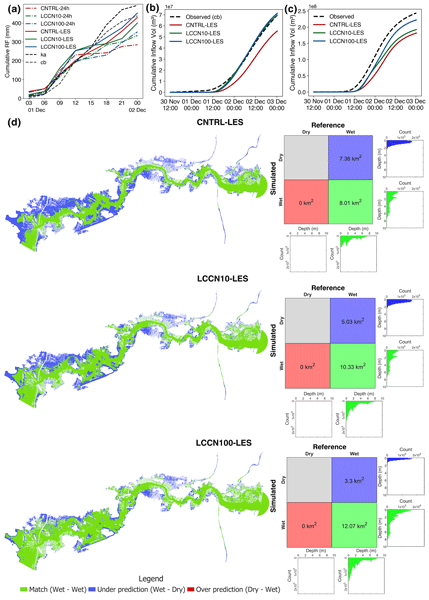
Despite computationally intensive high-resolution weather models, accurate spatio-temporal rainfall simulation at complex urban scales remains challenging. Using the December 2015 Chennai 1-in-100-year flood as a case study, we show that explicit aerosol representation significantly influences rainfall simulations, improving flood extent mapping by up to 50 %. Our approach resolves urban-scale aerosol microphysics and can be systematically extended to other extreme events across regions.
Amit Singh Chandel, Chandan Sarangi, Nurun Nahar, Saqib Ahmad Zargar, Poul Cherian, Xena Mansoura, Vijay P. Kanawade, Bhishma Tyagi, Antti-Pekka Hyvärinen, Aki Virkkula, Harendra S. Negi, Swarup China, and Rakesh K. Hooda
EGUsphere, https://doi.org/10.5194/egusphere-2026-424, https://doi.org/10.5194/egusphere-2026-424, 2026
Short summary
Short summary
Dust storms reaching the western Himalayas often mix with pollution during transport. Using high-altitude measurements from May 2023, we show that this polluted dust has altered intrinsic optical properties, scattering and absorbing more sunlight than clean dust, with important implications for atmospheric heating and regional climate.
Ashim Sattar, Shashi Kant Rai, Abhinav Alangadan, Adam Emmer, Sunil Dhar, Umesh Haritashya, and Mohd. Farooq Azam
EGUsphere, https://doi.org/10.5194/egusphere-2025-6281, https://doi.org/10.5194/egusphere-2025-6281, 2026
Short summary
Short summary
The Warwan basin in the western Himalaya is a remote region that harbours many glacial lakes. Many past events including avalanches and sudden glacial lake floods went unnoticed in the region. This study shows that past avalanches triggered a sudden burst of a glacial lake. The GLOF exposure in the valley remains high owing to the existing infrastructure in the valley. Early warnings can give sufficient lead time in case of potential GLOF in the valley.
Sougat Kumar Sarangi, Chandan Sarangi, Niravkumar Patel, Bomidi Lakshmi Madhavan, Shantikumar Singh Ningombam, Belur Ravindra, and Madineni Venkat Ratnam
Atmos. Meas. Tech., 18, 5637–5648, https://doi.org/10.5194/amt-18-5637-2025, https://doi.org/10.5194/amt-18-5637-2025, 2025
Short summary
Short summary
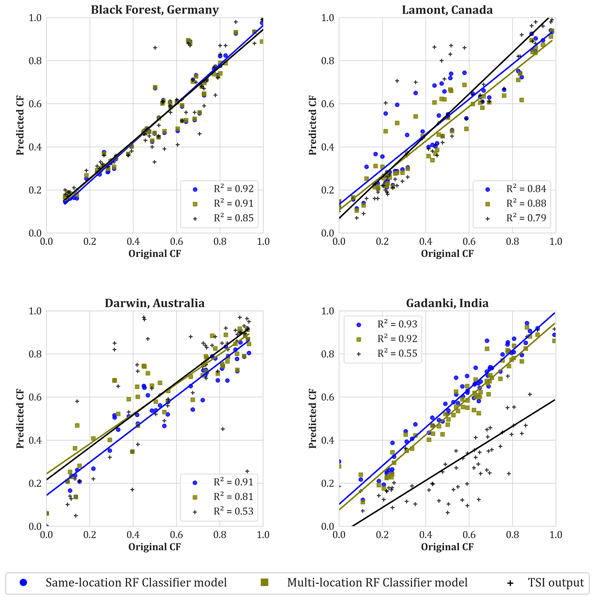
This study introduces a new approach to measure cloud cover from image data taken by ground-based sky observations. Our method used diverse sky images taken from various locations across the globe to train our machine learning model. We achieved a very high accuracy in detecting cloud cover, even in polluted areas. Our model surpasses traditional methods by running efficiently with minimal computational needs.
Saleem Ali, Chandan Sarangi, and Sanjay Kumar Mehta
Atmos. Chem. Phys., 25, 8769–8783, https://doi.org/10.5194/acp-25-8769-2025, https://doi.org/10.5194/acp-25-8769-2025, 2025
Short summary
Short summary
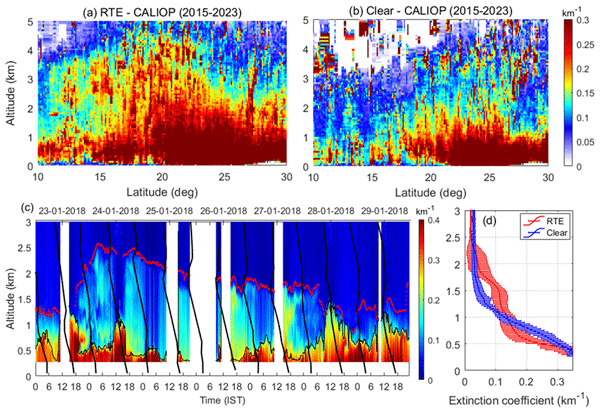
The pollutants over northern India are transported towards southern India under the influence of the prevalent wind system, especially during the winter season. This long-range transport induces widespread haziness over southern India, lasting for days. We evaluated the occurrence of such transport episodes over southern India using observational methods and found that it suppresses the boundary layer height by approximately 40 % compared to clear days, while exacerbating the surface pollution by approximately 50 %–60 %.
Mohd Farooq Azam, Christian Vincent, Smriti Srivastava, Etienne Berthier, Patrick Wagnon, Himanshu Kaushik, Md. Arif Hussain, Manoj Kumar Munda, Arindan Mandal, and Alagappan Ramanathan
The Cryosphere, 18, 5653–5672, https://doi.org/10.5194/tc-18-5653-2024, https://doi.org/10.5194/tc-18-5653-2024, 2024
Short summary
Short summary
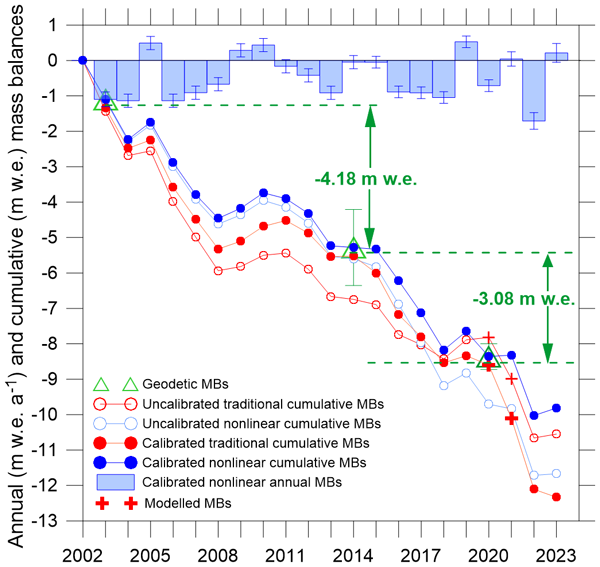
Mass balance series on Chhota Shigri Glacier has been reanalysed by combining the traditional mass balance reanalysis framework and a nonlinear model. The nonlinear model is preferred over traditional glaciological methods to compute the mass balances, as the former can capture the spatiotemporal variability in point mass balances from a heterogeneous in situ point mass balance network. The nonlinear model outperforms the traditional method and agrees better with the geodetic estimates.
Imtiyaz Ahmad Bhat, Irfan Rashid, RAAJ Ramsankaran, Argha Banerjee, and Saurabh Vijay
Earth Syst. Sci. Data Discuss., https://doi.org/10.5194/essd-2023-522, https://doi.org/10.5194/essd-2023-522, 2024
Preprint withdrawn
Short summary
Short summary
A comprehensive rock glacier inventory (n = 5492) has been generated through manual delineation in a GIS environment for the western Himalayan region. The inventory has characterized each rock glacier with 22 attributes following the standard protocols. This inventory shall serve as a baseline for the future research related to rock glacier dynamics, their hydrological contribution and response to climate change.
Chandan Sarangi, Yun Qian, L. Ruby Leung, Yang Zhang, Yufei Zou, and Yuhang Wang
Atmos. Chem. Phys., 23, 1769–1783, https://doi.org/10.5194/acp-23-1769-2023, https://doi.org/10.5194/acp-23-1769-2023, 2023
Short summary
Short summary
We show that for air quality, the densely populated eastern US may see even larger impacts of wildfires due to long-distance smoke transport and associated positive climatic impacts, partially compensating the improvements from regulations on anthropogenic emissions. This study highlights the tension between natural and anthropogenic contributions and the non-local nature of air pollution that complicate regulatory strategies for improving future regional air quality for human health.
Sourav Laha, Argha Banerjee, Ajit Singh, Parmanand Sharma, and Meloth Thamban
Hydrol. Earth Syst. Sci., 27, 627–645, https://doi.org/10.5194/hess-27-627-2023, https://doi.org/10.5194/hess-27-627-2023, 2023
Short summary
Short summary
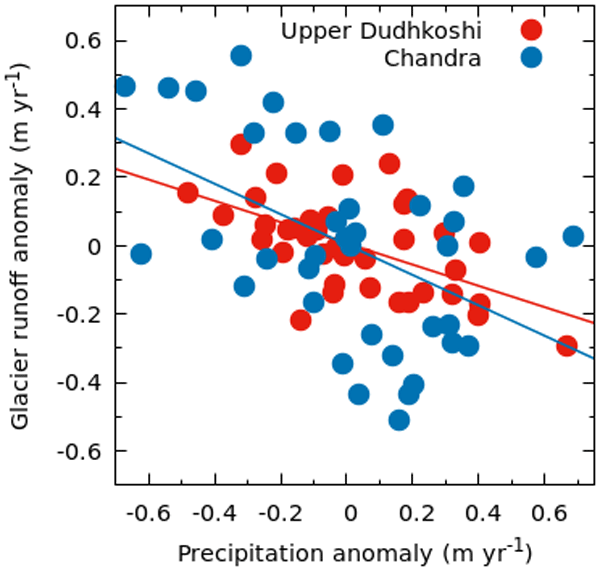
A model study of two Himalayan catchments reveals that the summer runoff from the glacierized parts of the catchments responds strongly to temperature forcing and is insensitive to precipitation forcing. The runoff from the non-glacierized parts has the exact opposite behaviour. The interannual variability and decadal changes of runoff under a warming climate is determined by the response of glaciers to temperature forcing and that of off-glacier areas to precipitation perturbations.
Jonathan P. Conway, Jakob Abermann, Liss M. Andreassen, Mohd Farooq Azam, Nicolas J. Cullen, Noel Fitzpatrick, Rianne H. Giesen, Kirsty Langley, Shelley MacDonell, Thomas Mölg, Valentina Radić, Carleen H. Reijmer, and Jean-Emmanuel Sicart
The Cryosphere, 16, 3331–3356, https://doi.org/10.5194/tc-16-3331-2022, https://doi.org/10.5194/tc-16-3331-2022, 2022
Short summary
Short summary
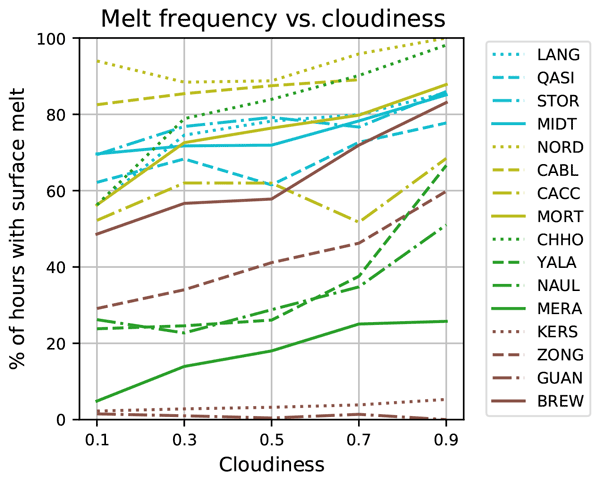
We used data from automatic weather stations on 16 glaciers to show how clouds influence glacier melt in different climates around the world. We found surface melt was always more frequent when it was cloudy but was not universally faster or slower than under clear-sky conditions. Also, air temperature was related to clouds in opposite ways in different climates – warmer with clouds in cold climates and vice versa. These results will help us improve how we model past and future glacier melt.
Chandan Sarangi, TC Chakraborty, Sachchidanand Tripathi, Mithun Krishnan, Ross Morrison, Jonathan Evans, and Lina M. Mercado
Atmos. Chem. Phys., 22, 3615–3629, https://doi.org/10.5194/acp-22-3615-2022, https://doi.org/10.5194/acp-22-3615-2022, 2022
Short summary
Short summary
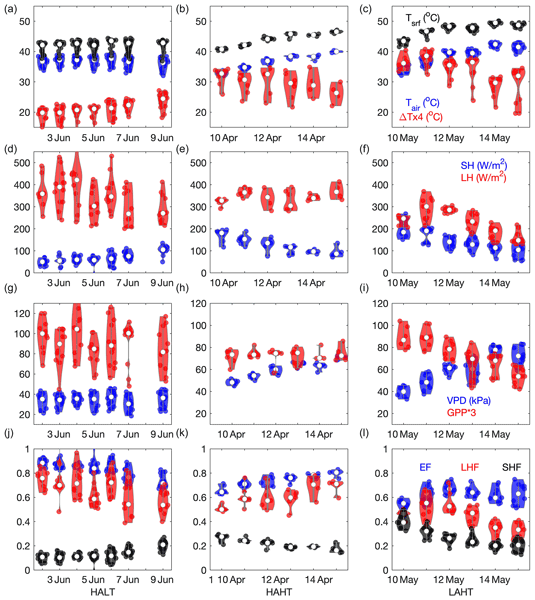
Transpiration fluxes by vegetation are reduced under heat stress to conserve water. However, in situ observations over northern India show that the strength of the inverse association between transpiration and atmospheric vapor pressure deficit is weakening in the presence of heavy aerosol loading. This finding not only implicates the significant role of aerosols in modifying the evaporative fraction (EF) but also warrants an in-depth analysis of the aerosol–plant–temperature–EF continuum.
Sourav Laha, Argha Banerjee, Ajit Singh, Parmanand Sharma, and Meloth Thamban
Hydrol. Earth Syst. Sci. Discuss., https://doi.org/10.5194/hess-2021-499, https://doi.org/10.5194/hess-2021-499, 2021
Revised manuscript not accepted
Short summary
Short summary
A study of two glacierised Himalayan catchments reveals that the summer runoff from the glacierised parts of the catchments responds strongly to temperature forcing and is stable to precipitation forcing, while that of the non-glacierised parts has an exactly opposite behaviour. The pattern of changes in mean runoff and its variability under a warming climate is determined by the response of glaciers to temperature forcing, and that of off-glacier areas to precipitation perturbations.
Cited articles
Arndt, A., Scherer, D., and Schneider, C.: Atmosphere Driven Mass-Balance Sensitivity of Halji Glacier, Himalayas, Atmosphere, 12, https://doi.org/10.3390/atmos12040426, 2021. a
Ayala, A., Pellicciotti, F., and Shea, J. M.: Modeling 2-m air temperatures over mountain glaciers: Exploring the influence of katabatic cooling and external warming, J. Geophys. Res.-Atmos., 120, 3139–3157, https://doi.org/10.1002/2015JD023137, 2015. a
Azam, M. F., Wagnon, P., Vincent, C., Ramanathan, AL., Favier, V., Mandal, A., and Pottakkal, J. G.: Processes governing the mass balance of Chhota Shigri Glacier (western Himalaya, India) assessed by point-scale surface energy balance measurements, The Cryosphere, 8, 2195–2217, https://doi.org/10.5194/tc-8-2195-2014, 2014. a
Björnsson, H., Gudmundsson, S., and Pálsson, F.: Glacier winds on Vatnajökull ice cap, Iceland, and their relation to temperatures of its lowland environs, Ann. Glaciol., 42, 291–296, https://doi.org/10.3189/172756405781812493, 2005. a, b
Bolton, D.: The Computation of Equivalent Potential Temperature, Mon. Weather Rev., 108, 1046–1053, https://doi.org/10.1175/1520-0493(1980)108<1046:TCOEPT>2.0.CO;2, 1980. a
Boyce, W. E., DiPrima, R. C., and Meade, D. B.: Elementary differential equations, John Wiley & Sons, ISBN 978-1-119-77773-1, 2017. a
Broeke, V. D.: Momentum, Heat, and Moisture Budgets of the Katabatic Wind Layer over a Midlatitude Glacier in Summer, J. Appl. Meteorol., 36, 763–774, https://doi.org/10.1175/1520-0450(1997)036<0763:MHAMBO>2.0.CO;2, 1997a. a
Broeke, V. D.: Structure and diurnal variation of the atmospheric boundary layer over a mid-latitude glacier in summer, Bound.-Lay. Meteorol., 83, 183–205, 1997b. a
Burlando, M., Carassale, L., Georgieva, E., Ratto, C. F., and Solari, G.: A simple and efficient procedure for the numerical simulation of wind fields in complex terrain, Bound.-Lay. Meteorol., 125, 417–439, 2007. a
Cai, X., Song, Y., Zhu, T., Lin, W., and Kang, L.: Glacier winds in the Rongbuk Valley, north of Mount Everest: 2. Their role in vertical exchange processes, J. Geophys. Res.-Atmos., 112, https://doi.org/10.1029/2006JD007868, 2007. a, b
Claremar, B., Obleitner, F., Reijmer, C., Pohjola, V., Waxegård, A., Karner, F., and Rutgersson, A.: Applying a Mesoscale Atmospheric Model to Svalbard Glaciers, Adv. Meteorol., 2012, 321649, https://doi.org/10.1155/2012/321649, 2012. a
Collier, E., Maussion, F., Nicholson, L. I., Mölg, T., Immerzeel, W. W., and Bush, A. B. G.: Impact of debris cover on glacier ablation and atmosphere–glacier feedbacks in the Karakoram, The Cryosphere, 9, 1617–1632, https://doi.org/10.5194/tc-9-1617-2015, 2015. a
Denby, B. and Greuell, W.: The use of bulk and profile methods for determining surface heat fluxes in the presence of glacier winds, J. Glaciol., 46, 445–452, https://doi.org/10.3189/172756500781833124, 2000. a
Draeger, C., Radić, V., White, R. H., and Tessema, M. A.: Evaluation of reanalysis data and dynamical downscaling for surface energy balance modeling at mountain glaciers in western Canada, The Cryosphere, 18, 17–42, https://doi.org/10.5194/tc-18-17-2024, 2024. a, b
Dujardin, J. and Lehning, M.: Wind-Topo: Downscaling near-surface wind fields to high-resolution topography in highly complex terrain with deep learning, Q. J. Roy. Meteor. Soc., 148, 1368–1388, https://doi.org/10.1002/qj.4265, 2022. a
Farina, S. and Zardi, D.: Understanding thermally driven slope winds: recent advances and open questions, Bound.-Lay. Meteorol., 189, 5–52, 2023. a
Goger, B., Stiperski, I., Nicholson, L., and Sauter, T.: Large-eddy simulations of the atmospheric boundary layer over an Alpine glacier: Impact of synoptic flow direction and governing processes, Q. J. Roy. Meteor. Soc., 148, 1319–1343, https://doi.org/10.1002/qj.4263, 2022. a
Greuell, W. and Böhm, R.: 2 m temperatures along melting mid-latitude glaciers, and implications for the sensitivity of the mass balance to variations in temperature, J. Glaciol., 44, 9–20, https://doi.org/10.3189/S0022143000002306, 1998. a
Greuell, W., Knap, W. H., and Smeets, P. C.: Elevational changes in meteorological variables along a midlatitude glacier during summer, J. Geophys. Res.-Atmos., 102, 25941–25954, https://doi.org/10.1029/97JD02083, 1997. a
Hastie, T., Tibshirani, R., Friedman, J. H., and Friedman, J. H.: The elements of statistical learning: data mining, inference, and prediction, vol. 2, Springer, https://doi.org/10.1007/978-0-387-84858-7, 2009. a
Hersbach, H., Bell, B., Berrisford, P., Hirahara, S., Horányi, A., Muñoz-Sabater, J., Nicolas, J., Peubey, C., Radu, R., Schepers, D., Simmons, A., Soci, C., Abdalla, S., Abellan, X., Balsamo, G., Bechtold, P., Biavati, G., Bidlot, J., Bonavita, M., De Chiara, G., Dahlgren, P., Dee, D., Diamantakis, M., Dragani, R., Flemming, J., Forbes, R., Fuentes, M., Geer, A., Haimberger, L., Healy, S., Hogan, R. J., Hólm, E., Janisková, M., Keeley, S., Laloyaux, P., Lopez, P., Lupu, C., Radnoti, G., de Rosnay, P., Rozum, I., Vamborg, F., Villaume, S., and Thépaut, J.-N.: The ERA5 global reanalysis, Q. J. Roy. Meteor. Soc., 146, 1999–2049, https://doi.org/10.1002/qj.3803, 2020. a
Hock, R.: A distributed temperature-index ice- and snowmelt model including potential direct solar radiation, J. Glaciol., 45, 101–111, https://doi.org/10.3189/S0022143000003087, 1999. a
Hu, W., Scholz, Y., Yeligeti, M., Bremen, L. v., and Deng, Y.: Downscaling ERA5 wind speed data: a machine learning approach considering topographic influences, Environ. Res. Lett., 18, 094007, https://doi.org/10.1088/1748-9326/aceb0a, 2023. a
Klok, E., Nolan, M., and Van den Broeke, M.: Analysis of meteorological data and the surface energy balance of McCall Glacier, Alaska, USA, J. Glaciol., 51, 451–461, 2005. a
Krishnanand, J.: krrishj2000/Mountain_glacier_winds_parameterisation: Mountain_glacier_winds_parameterisation (Version Glacier_winds), Zenodo [code and data set], https://doi.org/10.5281/zenodo.21756089, 2026. a
Kronenberg, M., van Pelt, W., Machguth, H., Fiddes, J., Hoelzle, M., and Pertziger, F.: Long-term firn and mass balance modelling for Abramov Glacier in the data-scarce Pamir Alay, The Cryosphere, 16, 5001–5022, https://doi.org/10.5194/tc-16-5001-2022, 2022. a
Lin, C., Yang, K., Chen, D., Guyennon, N., Balestrini, R., Yang, X., Acharya, S., Ou, T., Yao, T., Tartari, G., and Salerno, F.: Summer afternoon precipitation associated with wind convergence near the Himalayan glacier fronts, Atmos. Res., 259, 105658, https://doi.org/10.1016/j.atmosres.2021.105658, 2021. a
Litt, M., Sicart, J.-E., Helgason, W. D., and Wagnon, P.: Turbulence characteristics in the atmospheric surface layer for different wind regimes over the tropical Zongo glacier (Bolivia, 16° S), Bound.-Lay. Meteorol., 154, 471–495, 2015. a
Mandal, A., Angchuk, T., Azam, M. F., Ramanathan, A., Wagnon, P., Soheb, M., and Singh, C.: An 11-year record of wintertime snow-surface energy balance and sublimation at 4863 m a.s.l. on the Chhota Shigri Glacier moraine (western Himalaya, India), The Cryosphere, 16, 3775–3799, https://doi.org/10.5194/tc-16-3775-2022, 2022. a
Miller, S., Keim, B., Talbot, R., and Mao, H.: Sea breeze: Structure, forecasting, and impacts, Rev. Geophys., 41, https://doi.org/10.1029/2003RG000124, 2003. a
Obleitner, F.: Climatological features of glacier and valley winds at the Hintereisferner (Ötztal Alps, Austria), Theor. Appl. Climatol., 49, 225–239, 1994. a
Oerlemans, J.: Glaciers and climate change, CRC Press, https://doi.org/10.1201/9781003760672, 2001. a
Oerlemans, J.: Extracting a Climate Signal from 169 Glacier Records, Science, 308, 675–677, https://doi.org/10.1126/science.1107046, 2005. a
Oerlemans, J. and Grisogono, B.: Glacier winds and parameterisation of the related surface heat fluxes, Tellus A, 54, 440–452, https://doi.org/10.3402/tellusa.v54i5.12164, 2002. a
Prandtl, L.: Essentials of Fluid Dynamics: With Applications to Hydraulics, Aeronautics, Meteorology and Other Subjects, Hafner Publishing Company, ISBN 9780028503301, 1952. a
Radić, V., Menounos, B., Shea, J., Fitzpatrick, N., Tessema, M. A., and Déry, S. J.: Evaluation of different methods to model near-surface turbulent fluxes for a mountain glacier in the Cariboo Mountains, BC, Canada, The Cryosphere, 11, 2897–2918, https://doi.org/10.5194/tc-11-2897-2017, 2017. a
RGI7.0-Consortium: Randolph Glacier Inventory – A Dataset of Global Glacier Outlines, Version 7.0, Boulder, Colorado USA, NASA National Snow and Ice Data Center Distributed Active Archive Center [data set], https://doi.org/10.5067/f6jmovy5navz, 2023. a
Rupper, S. and Roe, G.: Glacier Changes and Regional Climate: A Mass and Energy Balance Approach, J. Climate, 21, 5384 – 5401, https://doi.org/10.1175/2008JCLI2219.1, 2008. a
Rye, C. J., Arnold, N. S., Willis, I. C., and Kohler, J.: Modeling the surface mass balance of a high Arctic glacier using the ERA-40 reanalysis, J. Geophys. Res.-Earth Surf., 115, https://doi.org/10.1029/2009JF001364, 2010. a
Sauter, T., Brock, B. W., Collier, E., Goger, B., Groos, A. R., Haualand, K. F., Mott, R., Nicholson, L., Prinz, R., Shaw, T. E., Stiperski, I., Georgi, A., Haugeneder, M., Mandal, A., Reynolds, D., Saigger, M., Sicart, J. E., and Voordendag, A.: Glacier-Atmosphere Interactions and Feedbacks in High-Mountain Regions – A Review, Rev. Geophys., 64, e2024RG000869, https://doi.org/10.1029/2024RG000869, 2026. a
Shea, J. M. and Moore, R. D.: Prediction of spatially distributed regional-scale fields of air temperature and vapor pressure over mountain glaciers, J. Geophys. Res.-Atmos., 115, https://doi.org/10.1029/2010JD014351, 2010. a
Steiner, J. F., Litt, M., Stigter, E. E., Shea, J., Bierkens, M. F., and Immerzeel, W. W.: The importance of turbulent fluxes in the surface energy balance of a debris-covered glacier in the Himalayas, Front. Earth Sci., 6, 144, https://doi.org/10.3389/feart.2018.00144, 2018. a
Stigter, E. E., Litt, M., Steiner, J. F., Bonekamp, P. N. J., Shea, J. M., Bierkens, M. F. P., and Immerzeel, W. W.: The Importance of Snow Sublimation on a Himalayan Glacier, Front. Earth Sci., 6, https://doi.org/10.3389/feart.2018.00108, 2018. a, b
Strasser, U., Corripio, J., Pellicciotti, F., Burlando, P., Brock, B., and Funk, M.: Spatial and temporal variability of meteorological variables at Haut Glacier d'Arolla (Switzerland) during the ablation season 2001: Measurements and simulations, J. Geophys. Res.-Atmos., 109, https://doi.org/10.1029/2003JD003973, 2004. a
Tadono, T., Ishida, H., Oda, F., Naito, S., Minakawa, K., and Iwamoto, H.: Precise Global DEM Generation by ALOS PRISM, ISPRS Annals of the Photogrammetry, Remote Sensing and Spatial Information Sciences, II-4, 71–76, https://doi.org/10.5194/isprsannals-II-4-71-2014, 2014. a
Tiwari, U. and Bush, A. B. G.: Understanding the Atmospheric Dynamics over High-Altitude Glaciated Regions in the Central Himalayas Using High-Resolution Numerical Simulations, J. Hydrometeorol., 26, 239–257, https://doi.org/10.1175/JHM-D-24-0084.1, 2025. a
Vergeiner, I. and Dreiseitl, E.: Valley winds and slope winds – Observations and elementary thoughts, Meteorol. Atmos. Phys., 36, 264–286, https://doi.org/10.1007/BF01045154, 1987. a, b
Yáñez San Francisco, E., MacDonell, S., and Casassa, G.: The Importance of a Glacier Complex for Downstream Runoff in the Semiarid Chilean Andes During Dry Years, Hydrol. Process., 39, e70064, https://doi.org/10.1002/hyp.70064, 2025. a
Zou, H., Zhou, L., Ma, S., Li, P., Wang, W., Li, A., Jia, J., and Gao, D.: Local wind system in the Rongbuk Valley on the northern slope of Mt. Everest, Geophys. Res. Lett., 35, https://doi.org/10.1029/2008GL033466, 2008. a

Short summary
Glacierised valleys create unique local-scale winds. Most glaciers in the world are ungauged, making it hard to estimate the melt contribution of heat exchanged by these winds. We developed a model that predicts wind speed on any glacier without requiring any in-situ data, enabling wind predictions on ungauged glaciers. Our predictions are about three times more accurate than a standard climate product, helping improve estimates of glacier melt and runoff in a warming climate.
Glacierised valleys create unique local-scale winds. Most glaciers in the world are ungauged,...