
Articles | Volume 20, issue 9
https://doi.org/10.5194/tc-20-4787-2026
© Author(s) 2026. This work is distributed under
the Creative Commons Attribution 4.0 License.
the Creative Commons Attribution 4.0 License.
https://doi.org/10.5194/tc-20-4787-2026
© Author(s) 2026. This work is distributed under
the Creative Commons Attribution 4.0 License.
the Creative Commons Attribution 4.0 License.
Research article
| 
31 Aug 2026
Research article |
| 31 Aug 2026
| 31 Aug 2026
Field-validated imaging of decadal and seasonal changes in permafrost bedrock using quantitative electrical resistivity tomography (Zugspitze, Germany/Austria)
Riccardo Scandroglio
CORRESPONDING AUTHOR

Technical University of Munich, Chair of Landslide Research, Munich, Germany
Samuel Weber
Climate Change, Extremes and Natural Hazards in Alpine Regions Research Center CERC, Davos, Switzerland
WSL Institute for Snow and Avalanche Research SLF, Davos, Switzerland
Jonas K. Limbrock
University of Bonn, Institute of Geosciences, Geophysics Section, Bonn, Germany
Michael Krautblatter
Technical University of Munich, Chair of Landslide Research, Munich, Germany
Related authors
Riccardo Scandroglio, Samuel Weber, Till Rehm, and Michael Krautblatter
Earth Surf. Dynam., 13, 295–314, https://doi.org/10.5194/esurf-13-295-2025, https://doi.org/10.5194/esurf-13-295-2025, 2025
Short summary
Short summary
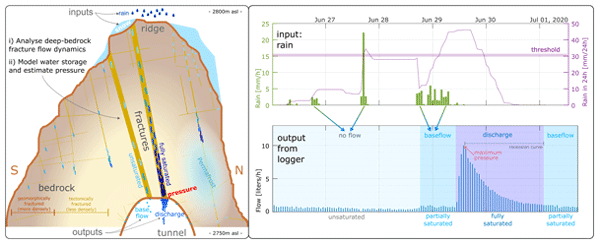
Despite the critical role of water in alpine regions, its presence in bedrock is frequently neglected. This research examines the dynamics of water in fractures using 1 decade of measurements from a tunnel 50 m underground. We provide new insights into alpine groundwater dynamics, revealing that up to 800 L d-1 can flow in one fracture during extreme events. These quantities can saturate the fractures, enhance hydraulic conductivity, and generate pressures that destabilize slopes.
Johannes Leinauer, Michael Dietze, Sibylle Knapp, Riccardo Scandroglio, Maximilian Jokel, and Michael Krautblatter
Earth Surf. Dynam., 12, 1027–1048, https://doi.org/10.5194/esurf-12-1027-2024, https://doi.org/10.5194/esurf-12-1027-2024, 2024
Short summary
Short summary
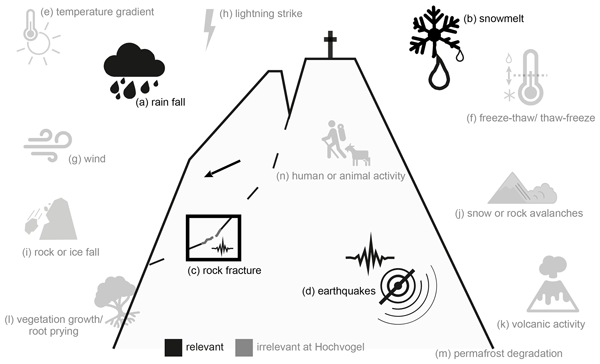
Massive rock slope failures are a significant alpine hazard and change the Earth's surface. Therefore, we must understand what controls the preparation of such events. By correlating 4 years of slope displacements with meteorological and seismic data, we found that water from rain and snowmelt is the most important driver. Our approach is applicable to similar sites and indicates where future climatic changes, e.g. in rain intensity and frequency, may alter the preparation of slope failure.
Maike Offer, Ingo Hartmeyer, Samuel Weber, Markus Keuschnig, and Michael Krautblatter
Earth Surf. Dynam., 14, 661–683, https://doi.org/10.5194/esurf-14-661-2026, https://doi.org/10.5194/esurf-14-661-2026, 2026
Short summary
Short summary
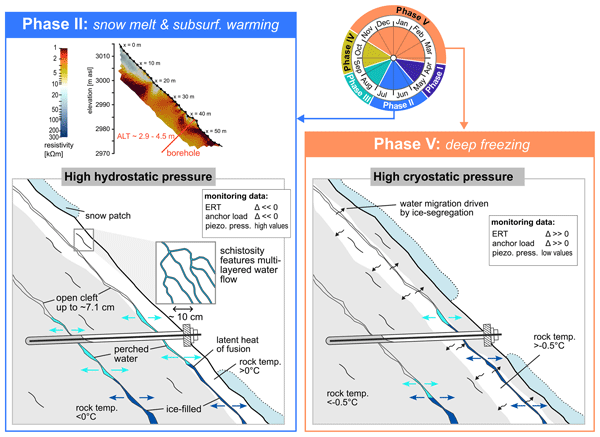
This study presents a year-round automated electrical resistivity tomography monitoring of a steep permafrost rockwall combined with borehole temperature, anchor load and piezometer observations. The joint analysis revealed seasonal phases with enhanced mechanical forcing of rockwalls related to high hydrostatic and cryostatic pressures, which are of particular interest for understanding preconditioning of rock instabilities.
Felix Pfluger, Samuel Weber, Natalie Barbosa, Florentin Hofmeister, Johannes Leinauer, Peter Wegmann, and Michael Krautblatter
Earth Surf. Dynam., 14, 601–634, https://doi.org/10.5194/esurf-14-601-2026, https://doi.org/10.5194/esurf-14-601-2026, 2026
Short summary
Short summary
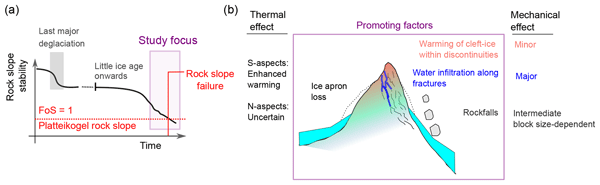
The 2024 Platteikogel rock slope failure (Tyrol, Austria) highlights how cryospheric changes promote slope failure. We demonstrate how the system feedback of ice apron loss, permafrost warming, increase in rockfall activity, and changes in groundwater conditions accelerate mechanical destabilization, and as a consequence likely peaked in the observed failure. Today, rapidly vanishing ice aprons potentially mark source zones for future rock slides.
Philipp Daniel Gewalt, Thomas C. Wagner, and Michael Krautblatter
EGUsphere, https://doi.org/10.5194/egusphere-2026-1699, https://doi.org/10.5194/egusphere-2026-1699, 2026
Short summary
Short summary
Sediments move through mountain landscapes during heavy rainfall. Climate change will alter the occurrence of heavy rainfall, potentially changing sediment transport. To understand how, we investigate how mountain sediment transport responded to past climate changes. We show that sediments in small, steep catchments are moved by less extreme precipitation compared to larger, gentler catchments. This means that catchment form and area control future sediment transport in a changing climate.
Katharina Wetterauer, Sebastian Müller, Michael Krautblatter, Shiva P. Pudasaini, and Ivo Baselt
EGUsphere, https://doi.org/10.5194/egusphere-2026-1235, https://doi.org/10.5194/egusphere-2026-1235, 2026
Short summary
Short summary
Contrasting mobility responses of erosive debris flows are poorly understood. Here, the role of bed inertia in debris-flow evolution and runout is experimentally assessed using distinct bed-density contrasts. Erosion is higher and runout longer over low-density beds, whereas equal- and high-density beds congruently show shallower erosion and shorter runout. The results indicate that solid density alone cannot explain mobility changes and that particle shape and internal friction also contribute.
Benjamin Jacobs, Mohamed Ismael, Mostafa Ezzy, Markus Keuschnig, Alexander Mendler, Johanna Kieser, Michael Krautblatter, Christian U. Grosse, and Hany Helal
Earth Surf. Dynam., 14, 55–74, https://doi.org/10.5194/esurf-14-55-2026, https://doi.org/10.5194/esurf-14-55-2026, 2026
Short summary
Short summary
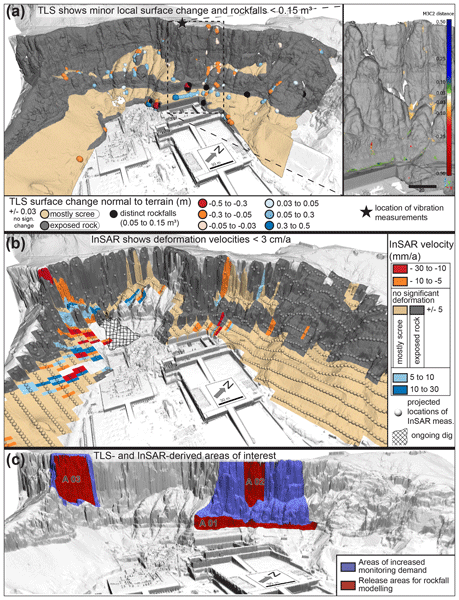
The Mortuary Temple of Hatshepsut is one of Egypt's key heritage sites but is potentially threatened by rockfalls from a 100 m high limestone cliff. We transferred established monitoring techniques from alpine environments to this UNESCO World Heritage Site and evaluated their performance in a historically sensitive desert environment. Our study presents the first evidence-based event and impact analysis of rockfalls at the Temple of Hatshepsut, providing vital data for future risk assessment.
Samuel Weber, Andreas Vieli, Marcia Phillips, and Alessandro Cicoira
The Cryosphere, 19, 6727–6748, https://doi.org/10.5194/tc-19-6727-2025, https://doi.org/10.5194/tc-19-6727-2025, 2025
Short summary
Short summary
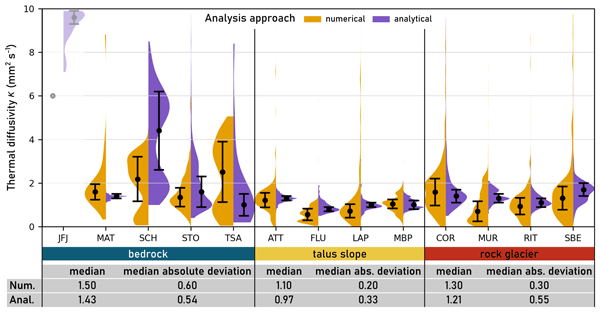
The properties of the permafrost ground depend on its temperature and composition. We used temperature data from 29 boreholes in Switzerland to study how heat moves through different types of mountain permafrost landforms, supporting a physically meaningful interpretation of thermal properties in terms of ice content, water saturation, and porosity. Understanding changes is important because they can affect how stable mountain slopes are and how easy it is to build things in mountain areas.
Samuel Weber, Jan Beutel, Michael Dietze, Alexander Bast, Robert Kenner, Marcia Phillips, Johannes Leinauer, Simon Mühlbauer, Felix Pfluger, and Michael Krautblatter
Earth Surf. Dynam., 13, 1157–1179, https://doi.org/10.5194/esurf-13-1157-2025, https://doi.org/10.5194/esurf-13-1157-2025, 2025
Short summary
Short summary
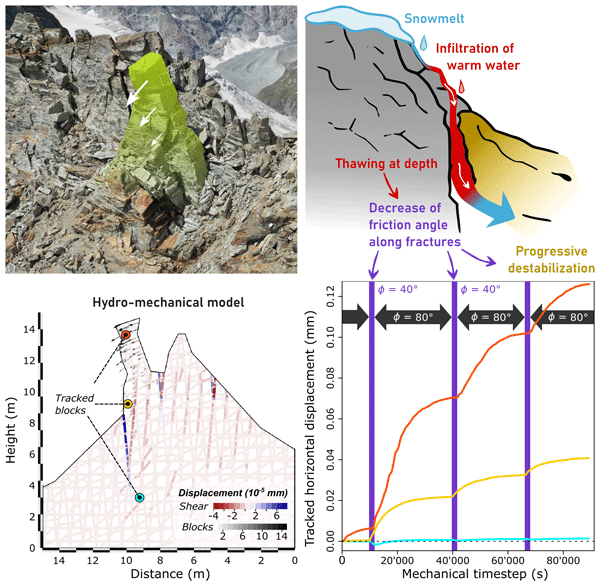
On 13 June 2023, a freestanding rock pillar on the Matterhorn collapsed after years of weakening. Our study examines this progressive destabilization by analyzing field data and integrating lab experiments into a hydro-mechanical model. We highlight the critical role of water infiltration into frozen rock, intensified by climate warming, as a widespread driver of the rising frequency of rockfalls in high mountain permafrost regions.
Riccardo Scandroglio, Samuel Weber, Till Rehm, and Michael Krautblatter
Earth Surf. Dynam., 13, 295–314, https://doi.org/10.5194/esurf-13-295-2025, https://doi.org/10.5194/esurf-13-295-2025, 2025
Short summary
Short summary
Despite the critical role of water in alpine regions, its presence in bedrock is frequently neglected. This research examines the dynamics of water in fractures using 1 decade of measurements from a tunnel 50 m underground. We provide new insights into alpine groundwater dynamics, revealing that up to 800 L d-1 can flow in one fracture during extreme events. These quantities can saturate the fractures, enhance hydraulic conductivity, and generate pressures that destabilize slopes.
Maike Offer, Samuel Weber, Michael Krautblatter, Ingo Hartmeyer, and Markus Keuschnig
The Cryosphere, 19, 485–506, https://doi.org/10.5194/tc-19-485-2025, https://doi.org/10.5194/tc-19-485-2025, 2025
Short summary
Short summary
We present a unique long-term dataset of measurements of borehole temperature, repeated electrical resistivity tomography, and piezometric pressure to investigate the complex seasonal water flow in permafrost rockwalls. Our joint analysis shows that permafrost rocks are subjected to enhanced pressurised water flow during the thaw period, resulting in push-like warming events and long-lasting rock temperature regime changes.
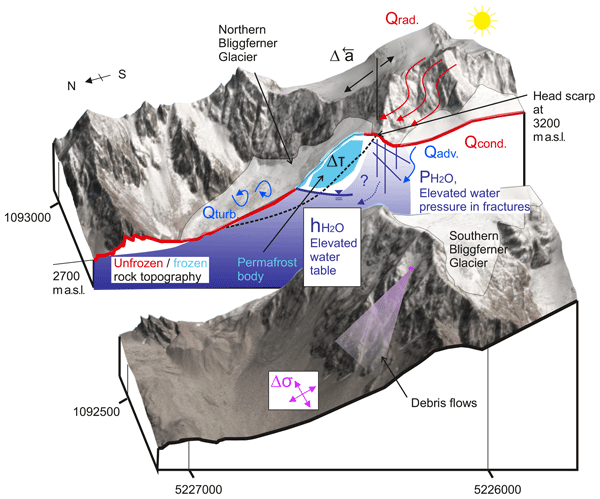
Felix Pfluger, Samuel Weber, Joseph Steinhauser, Christian Zangerl, Christine Fey, Johannes Fürst, and Michael Krautblatter
Earth Surf. Dynam., 13, 41–70, https://doi.org/10.5194/esurf-13-41-2025, https://doi.org/10.5194/esurf-13-41-2025, 2025
Short summary
Short summary
Our study explores permafrost–glacier interactions with a focus on their implications for preparing or triggering high-volume rock slope failures. Using the Bliggspitze rock slide as a case study, we demonstrate a new type of rock slope failure mechanism triggered by the uplift of the cold–warm dividing line in polythermal alpine glaciers, a widespread and currently under-explored phenomenon in alpine environments worldwide.
Johannes Leinauer, Michael Dietze, Sibylle Knapp, Riccardo Scandroglio, Maximilian Jokel, and Michael Krautblatter
Earth Surf. Dynam., 12, 1027–1048, https://doi.org/10.5194/esurf-12-1027-2024, https://doi.org/10.5194/esurf-12-1027-2024, 2024
Short summary
Short summary
Massive rock slope failures are a significant alpine hazard and change the Earth's surface. Therefore, we must understand what controls the preparation of such events. By correlating 4 years of slope displacements with meteorological and seismic data, we found that water from rain and snowmelt is the most important driver. Our approach is applicable to similar sites and indicates where future climatic changes, e.g. in rain intensity and frequency, may alter the preparation of slope failure.
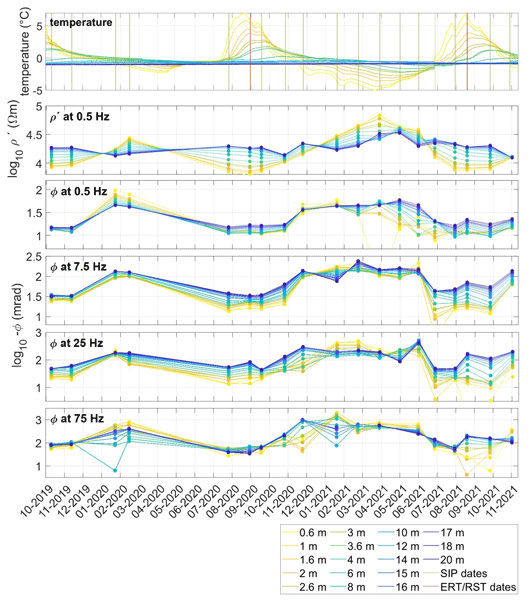
Theresa Maierhofer, Adrian Flores Orozco, Nathalie Roser, Jonas K. Limbrock, Christin Hilbich, Clemens Moser, Andreas Kemna, Elisabetta Drigo, Umberto Morra di Cella, and Christian Hauck
The Cryosphere, 18, 3383–3414, https://doi.org/10.5194/tc-18-3383-2024, https://doi.org/10.5194/tc-18-3383-2024, 2024
Short summary
Short summary
In this study, we apply an electrical method in a high-mountain permafrost terrain in the Italian Alps, where long-term borehole temperature data are available for validation. In particular, we investigate the frequency dependence of the electrical properties for seasonal and annual variations along a 3-year monitoring period. We demonstrate that our method is capable of resolving temporal changes in the thermal state and the ice / water ratio associated with seasonal freeze–thaw processes.
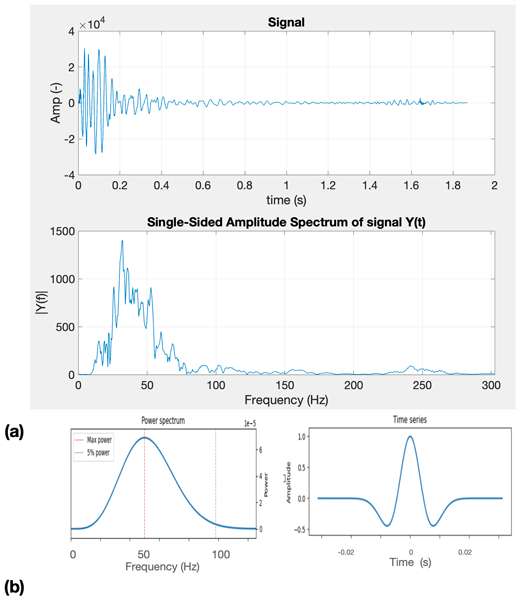
Jacopo Boaga, Mirko Pavoni, Alexander Bast, and Samuel Weber
The Cryosphere, 18, 3231–3236, https://doi.org/10.5194/tc-18-3231-2024, https://doi.org/10.5194/tc-18-3231-2024, 2024
Short summary
Short summary
Reversal polarity is observed in rock glacier seismic refraction tomography. We collected several datasets observing this phenomenon in Switzerland and Italy. This phase change may be linked to interferences due to the presence of a thin low-velocity layer. Our results are confirmed by the modelling and analysis of synthetic seismograms to demonstrate that the presence of a low-velocity layer produces a polarity reversal on the seismic gather.
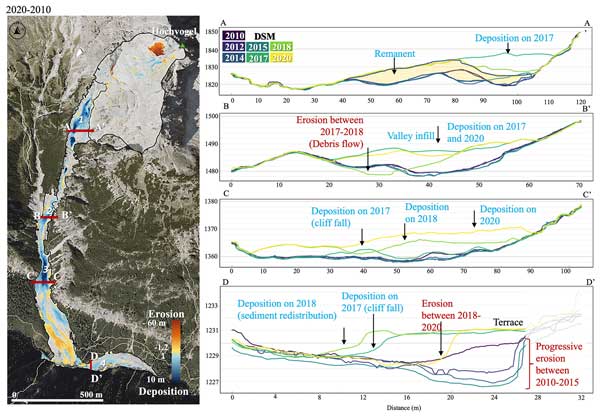
Natalie Barbosa, Johannes Leinauer, Juilson Jubanski, Michael Dietze, Ulrich Münzer, Florian Siegert, and Michael Krautblatter
Earth Surf. Dynam., 12, 249–269, https://doi.org/10.5194/esurf-12-249-2024, https://doi.org/10.5194/esurf-12-249-2024, 2024
Short summary
Short summary
Massive sediment pulses in catchments are a key alpine multi-risk component. Combining high-resolution aerial imagery and seismic information, we decipher a multi-stage >130.000 m³ rockfall and subsequent sediment pulses over 4 years, reflecting sediment deposition up to 10 m, redistribution in the basin, and finally debouchure to the outlet. This study provides generic information on spatial and temporal patterns of massive sediment pulses in highly charged alpine catchments.
Marcia Phillips, Chasper Buchli, Samuel Weber, Jacopo Boaga, Mirko Pavoni, and Alexander Bast
The Cryosphere, 17, 753–760, https://doi.org/10.5194/tc-17-753-2023, https://doi.org/10.5194/tc-17-753-2023, 2023
Short summary
Short summary
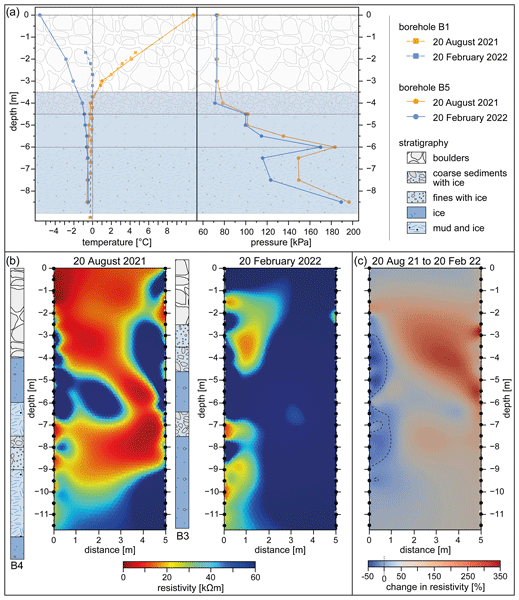
A new combination of temperature, water pressure and cross-borehole electrical resistivity data is used to investigate ice/water contents in an ice-rich rock glacier. The landform is close to 0°C and has locally heterogeneous characteristics, ice/water contents and temperatures. The techniques presented continuously monitor temporal and spatial phase changes to a depth of 12 m and provide the basis for a better understanding of accelerating rock glacier movements and future water availability.
Sibylle Knapp, Michael Schwenk, and Michael Krautblatter
Earth Surf. Dynam., 10, 1185–1193, https://doi.org/10.5194/esurf-10-1185-2022, https://doi.org/10.5194/esurf-10-1185-2022, 2022
Short summary
Short summary
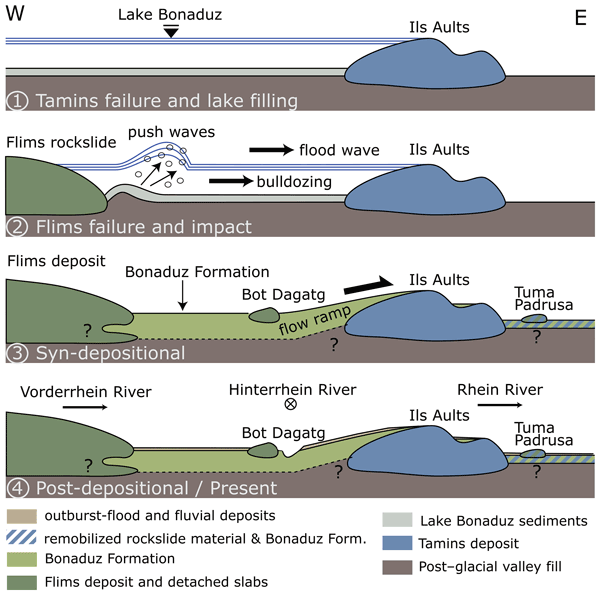
The Flims area in the Swiss Alps has fascinated the researchers with its complex geological history ever since. Especially the order of events related to the Tamins and Flims rockslides has long been debated. This paper presents novel results based on up to 160 m deep geophysical profiles, which show onlaps of the Bonaduz Formation onto the Tamins deposits (Ils Aults) and thus indicate that the Tamins rockslide occurred first. The consecutive evolution of this landscape is shown in four phases.
Alessandro Cicoira, Samuel Weber, Andreas Biri, Ben Buchli, Reynald Delaloye, Reto Da Forno, Isabelle Gärtner-Roer, Stephan Gruber, Tonio Gsell, Andreas Hasler, Roman Lim, Philippe Limpach, Raphael Mayoraz, Matthias Meyer, Jeannette Noetzli, Marcia Phillips, Eric Pointner, Hugo Raetzo, Cristian Scapozza, Tazio Strozzi, Lothar Thiele, Andreas Vieli, Daniel Vonder Mühll, Vanessa Wirz, and Jan Beutel
Earth Syst. Sci. Data, 14, 5061–5091, https://doi.org/10.5194/essd-14-5061-2022, https://doi.org/10.5194/essd-14-5061-2022, 2022
Short summary
Short summary
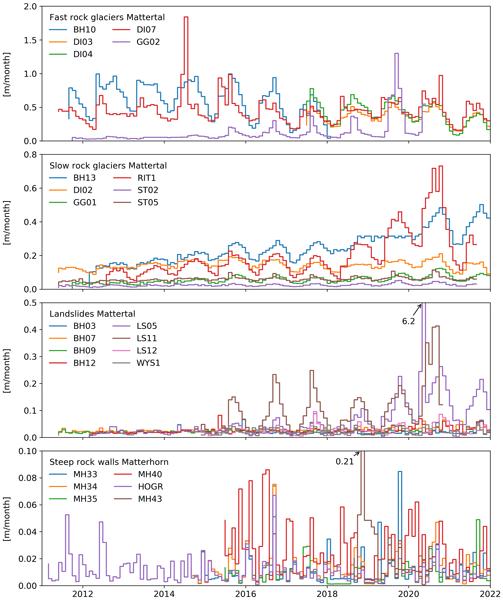
This paper documents a monitoring network of 54 positions, located on different periglacial landforms in the Swiss Alps: rock glaciers, landslides, and steep rock walls. The data serve basic research but also decision-making and mitigation of natural hazards. It is the largest dataset of its kind, comprising over 209 000 daily positions and additional weather data.
Shiva P. Pudasaini and Michael Krautblatter
Earth Surf. Dynam., 10, 165–189, https://doi.org/10.5194/esurf-10-165-2022, https://doi.org/10.5194/esurf-10-165-2022, 2022
Short summary
Short summary
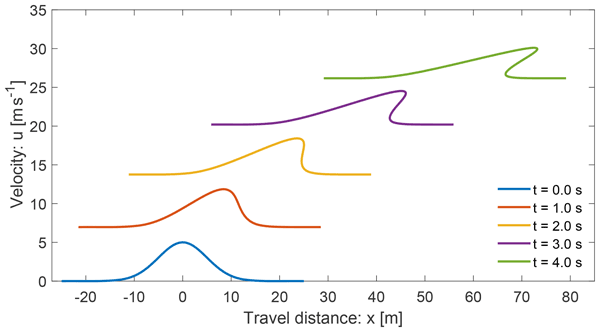
We present the first physics-based general landslide velocity model incorporating internal deformation and external forces. Voellmy–inviscid Burgers' equations are specifications of the novel advective–dissipative system. Unified analytical solutions constitute a new foundation of landslide velocity, providing key information to instantly estimate impact forces and describe breaking waves and folding, revealing that landslide dynamics are architectured by advection and reigned by forcing.
Bernd Etzelmüller, Justyna Czekirda, Florence Magnin, Pierre-Allain Duvillard, Ludovic Ravanel, Emanuelle Malet, Andreas Aspaas, Lene Kristensen, Ingrid Skrede, Gudrun D. Majala, Benjamin Jacobs, Johannes Leinauer, Christian Hauck, Christin Hilbich, Martina Böhme, Reginald Hermanns, Harald Ø. Eriksen, Tom Rune Lauknes, Michael Krautblatter, and Sebastian Westermann
Earth Surf. Dynam., 10, 97–129, https://doi.org/10.5194/esurf-10-97-2022, https://doi.org/10.5194/esurf-10-97-2022, 2022
Short summary
Short summary
This paper is a multi-authored study documenting the possible existence of permafrost in permanently monitored rockslides in Norway for the first time by combining a multitude of field data, including geophysical surveys in rock walls. The paper discusses the possible role of thermal regime and rockslide movement, and it evaluates the possible impact of atmospheric warming on rockslide dynamics in Norwegian mountains.
Carolin Kiefer, Patrick Oswald, Jasper Moernaut, Stefano Claudio Fabbri, Christoph Mayr, Michael Strasser, and Michael Krautblatter
Earth Surf. Dynam., 9, 1481–1503, https://doi.org/10.5194/esurf-9-1481-2021, https://doi.org/10.5194/esurf-9-1481-2021, 2021
Short summary
Short summary
This study provides amphibious investigations of debris flow fans (DFFs). We characterize active DFFs, combining laser scan and sonar surveys at Plansee. We discover a 4000-year debris flow record in sediment cores, providing evidence for a 7-fold debris flow frequency increase in the 20th and 21st centuries, coincident with 2-fold enhanced rainstorm activity in the northern European Alps. Our results indicate climate change as being the main factor controlling debris flow activity.
Cited articles
Aalto, J., Karjalainen, O., Hjort, J., and Luoto, M.: Statistical Forecasting of Current and Future Circum-Arctic Ground Temperatures and Active Layer Thickness, Geophys. Res. Lett., 45, 4889–4898, https://doi.org/10.1029/2018GL078007, 2018. a
Abdulsamad, F., Bock, J., Magnin, F., Malet, E., Revil, A., Ben-Asher, M., Richard, J., Duvillard, P.-A., Karaoulis, M., Condom, T., Ravanel, L., and Deline, P.: Rockwall permafrost dynamics evidenced by repeated and Automated Electrical Resistivity Tomography at Aiguille du Midi (3842 m a.s.l., French Alps), The Cryosphere, 20, 2181–2207, https://doi.org/10.5194/tc-20-2181-2026, 2026. a
AEG: Die Bayerische Zugspitzbahn, Tech. rep., Berlin, 1931. a
Bast, A., Kenner, R., and Phillips, M.: Short-term cooling, drying, and deceleration of an ice-rich rock glacier, The Cryosphere, 18, 3141–3158, https://doi.org/10.5194/tc-18-3141-2024, 2024. a
Binley, A., Ramirez, A., and Daily, W.: Regularized image reconstruction of noisy electrical resistance tomography data, in: Proceedings of the 4h Workshop of the European Concerted Action on Process Tomography, edited by: Beck, M., 401–401, https://www.researchgate.net/publication/284669008_Regularised_image_reconstruction_of_noisy_electrical_resistance_tomography_data/citations (last access: 9 August 2026), 1995. a
Biskaborn, B. K., Smith, S. L., Noetzli, J., Matthes, H., Vieira, G., Streletskiy, D. A., Schoeneich, P., Romanovsky, V. E., Lewkowicz, A. G., Abramov, A., Allard, M., Boike, J., Cable, W. L., Christiansen, H. H., Delaloye, R., Diekmann, B., Drozdov, D., Etzelmüller, B., Grosse, G., Guglielmin, M., Ingeman-Nielsen, T., Isaksen, K., Ishikawa, M., Johansson, M., Johannsson, H., Joo, A., Kaverin, D., Kholodov, A., Konstantinov, P., Kröger, T., Lambiel, C., Lanckman, J.-P., Luo, D., Malkova, G., Meiklejohn, I., Moskalenko, N., Oliva, M., Phillips, M., Ramos, M., Sannel, A. B. K., Sergeev, D., Seybold, C., Skryabin, P., Vasiliev, A., Wu, Q., Yoshikawa, K., Zheleznyak, M., and Lantuit, H.: Permafrost is warming at a global scale, Nat. Commun., 10, 264, https://doi.org/10.1038/s41467-018-08240-4, 2019. a
Bommer, C., Phillips, M., Keusen, H.-R., Teysseire, P., Forschungsanstalt für Wald, E., and Wsl, L.: Bauen im Permafrost Ein Leitfaden für die Praxis, ISBN 978-3-905621-46-4, 2009. a
Buckel, J., Mudler, J., Gardeweg, R., Hauck, C., Hilbich, C., Frauenfelder, R., Kneisel, C., Buchelt, S., Blöthe, J. H., Hördt, A., and Bücker, M.: Identifying mountain permafrost degradation by repeating historical electrical resistivity tomography (ERT) measurements, The Cryosphere, 17, 2919–2940, https://doi.org/10.5194/tc-17-2919-2023, 2023. a
Cathala, M., Bock, J., Magnin, F., Ravanel, L., Ben Asher, M., Astrade, L., Bodin, X., Chambon, G., Deline, P., Faug, T., Genuite, K., Jaillet, S., Josnin, J.-Y., Revil, A., and Richard, J.: Predisposing, triggering and runout processes at a permafrost‐affected rock avalanche site in the French Alps (Étache, June 2020), Earth Surf. Proc. Land., 49, https://doi.org/10.1002/esp.5881, 2024. a, b
Cimpoiasu, M. O., Kuras, O., Harrison, H., Wilkinson, P. B., Meldrum, P., Chambers, J. E., Liljestrand, D., Oroza, C., Schmidt, S. K., Sommers, P., Irons, T. P., and Bradley, J. A.: Characterization of a Deglaciated Sediment Chronosequence in the High Arctic Using Near-Surface Geoelectrical Monitoring Methods, Permafrost Periglac., 35, 157–171, https://doi.org/10.1002/ppp.2220, 2024. a
Cimpoiasu, M. O., Kuras, O., Harrison, H., Wilkinson, P. B., Meldrum, P., Chambers, J. E., Liljestrand, D., Oroza, C., Schmidt, S. K., Sommers, P., Vimercati, L., Irons, T. P., Lyu, Z., Solon, A., and Bradley, J. A.: High-resolution 4D electrical resistivity tomography and below-ground point sensor monitoring of High Arctic deglaciated sediments capture zero-curtain effects, freeze–thaw transitions, and mid-winter thawing, The Cryosphere, 19, 401–421, https://doi.org/10.5194/tc-19-401-2025, 2025. a, b
Delforge, D., Watlet, A., Kaufmann, O., Camp, M. V., and Vanclooster, M.: Time-series clustering approaches for subsurface zonation and hydrofacies detection using a real time-lapse electrical resistivity dataset, J. Appl. Geophys., 184, 104203, https://doi.org/10.1016/J.JAPPGEO.2020.104203, 2021. a, b
Deline, P., Gruber, S., Amann, F., Bodin, X., Delaloye, R., Failletaz, J., Fischer, L., Geertsema, M., Giardino, M., Hasler, A., Kirkbride, M., Krautblatter, M., Magnin, F., McColl, S., Ravanel, L., Schoeneich, P., and Weber, S.: Ice loss from glaciers and permafrost and related slope instability in high-mountain regions, Snow and Ice-Related Hazards, Risks, and Disasters, Elsevier, 501–540, https://doi.org/10.1016/B978-0-12-817129-5.00015-9, 2021. a, b, c
Doetsch, J., Ingeman-Nielsen, T., Christiansen, A., Fiandaca, G., Auken, E., and Elberling, B.: Direct current (DC) resistivity and induced polarization (IP) monitoring of active layer dynamics at high temporal resolution, Cold Reg. Sci. Technol., 119, 16–28, https://doi.org/10.1016/j.coldregions.2015.07.002, 2015. a, b
Duvillard, P. A., Revil, A., Qi, Y., Soueid Ahmed, A., Coperey, A., and Ravanel, L.: Three-Dimensional Electrical Conductivity and Induced Polarization Tomography of a Rock Glacier, J. Geophys. Res.-Sol. Ea., 123, 9528–9554, https://doi.org/10.1029/2018JB015965, 2018. a
Duvillard, P. A., Magnin, F., Revil, A., Legay, A., Ravanel, L., Abdulsamad, F., and Coperey, A.: Temperature distribution in a permafrost-affected rock ridge from conductivity and induced polarization tomography, Geophys. J. Int., 225, 1207–1221, https://doi.org/10.1093/gji/ggaa597, 2021. a
Etzelmüller, B., Guglielmin, M., Hauck, C., Hilbich, C., Hoelzle, M., Isaksen, K., Noetzli, J., Oliva, M., and Ramos, M.: Twenty years of European mountain permafrost dynamics-the PACE legacy, Environ. Res. Lett., 15, https://doi.org/10.1088/1748-9326/ABAE9D, 2020. a
Etzelmüller, B., Czekirda, J., Magnin, F., Duvillard, P.-A., Ravanel, L., Malet, E., Aspaas, A., Kristensen, L., Skrede, I., Majala, G. D., Jacobs, B., Leinauer, J., Hauck, C., Hilbich, C., Böhme, M., Hermanns, R., Eriksen, H. Ø., Lauknes, T. R., Krautblatter, M., and Westermann, S.: Permafrost in monitored unstable rock slopes in Norway – new insights from temperature and surface velocity measurements, geophysical surveying, and ground temperature modelling, Earth Surf. Dynam., 10, 97–129, https://doi.org/10.5194/esurf-10-97-2022, 2022. a, b, c
Etzelmüller, B., Isaksen, K., Czekirda, J., Westermann, S., Hilbich, C., and Hauck, C.: Rapid warming and degradation of mountain permafrost in Norway and Iceland, The Cryosphere, 17, 5477–5497, https://doi.org/10.5194/tc-17-5477-2023, 2023. a
Farzamian, M., Vieira, G., Monteiro Santos, F. A., Yaghoobi Tabar, B., Hauck, C., Paz, M. C., Bernardo, I., Ramos, M., and de Pablo, M. A.: Detailed detection of active layer freeze–thaw dynamics using quasi-continuous electrical resistivity tomography (Deception Island, Antarctica), The Cryosphere, 14, 1105–1120, https://doi.org/10.5194/tc-14-1105-2020, 2020. a
Gallemann, T., Wagner, B., Foltyn, M., Mahr, M., and Jerz, H.: Permafrost und Böden im Bereich der Zugspitze, in: Geologica Bavarica 120, https://www.bestellen.bayern.de/91120 (last access: 9 August 2026), 2021. a
Gruber, S., Fleiner, R., Guegan, E., Panday, P., Schmid, M.-O., Stumm, D., Wester, P., Zhang, Y., and Zhao, L.: Review article: Inferring permafrost and permafrost thaw in the mountains of the Hindu Kush Himalaya region, The Cryosphere, 11, 81–99, https://doi.org/10.5194/tc-11-81-2017, 2017. a
Haberkorn, A., Kenner, R., Noetzli, J., and Phillips, M.: Changes in Ground Temperature and Dynamics in Mountain Permafrost in the Swiss Alps, Frontiers in Earth Science, 9, 1–21, https://doi.org/10.3389/feart.2021.626686, 2021. a
Hauck, C.: Geophysical methods for detecting permafrost in high mountains, PhD thesis, Technischen Hochschule Zurich, https://doi.org//10.3929/ETHZ-A-004172478, 2001. a, b
Hauck, C. and Vonder Muehll, D.: Inversion and interpretation of two-dimensional geoelectrical measurements for detecting permafrost in mountainous regions, Permafrost Periglac., 14, 305–318, https://doi.org/10.1002/ppp.462, 2003. a
Herring, T., Lewkowicz, A., Hauck, C., Hilbich, C., Mollaret, C., Oldenborger, G., Uhlemann, S., Farzamian, M., Calmels, F., and Scandroglio, R.: Best practices for using electrical resistivity tomography to investigate permafrost, Permafrost Periglac., 34, 494–512, https://doi.org/10.1002/ppp.2207, 2023. a, b, c, d, e
Hilbich, C., Hauck, C., Hoelzle, M., Scherler, M., Schudel, L., Völksch, I., Vonder Muehll, D., and Mäusbacher, R.: Monitoring mountain permafrost evolution using electrical resistivity tomography: A 7-year study of seasonal, annual, and long-term variations at Schilthorn, Swiss Alps, J. Geophys. Res., 113, F01S90, https://doi.org/10.1029/2007JF000799, 2008. a, b
Hilbich, C., Fuss, C., and Hauck, C.: Automated Time‐lapse ERT for Improved Process Analysis and Monitoring of Frozen Ground, Permafrost Periglac., 22, 306–319, https://doi.org/10.1002/ppp.732, 2011. a
Hornung, T. and Haas, U.: Erläuterungen zu den Blättern 8531/8631 Zugspitze & 8531/8632 Garmisch-Partenkirchen, Tech. rep., Bayrisches Landesamt für Umwelt, Augsburg, https://www.bestellen.bayern.de/13120 (last access: 9 August 2026), 2017. a
Huggel, C., Clague, J. J., and Korup, O.: Is climate change responsible for changing landslide activity in high mountains?, Earth Surf. Proc. and Land., 37, 77–91, https://doi.org/10.1002/ESP.2223, 2012. a
Kellerer-Pirklbauer, A. and Eulenstein, J.: The summer heatwave in 2022 and its role in changing permafrost and periglacial conditions at a historic mountain pass in the Eastern Alps (Hochtor, Hohe Tauern Range, Austria), Permafrost Periglac., 34, 547–565, https://doi.org/10.1002/PPP.2205, 2023. a
Kemna, A., Binley, A., Ramirez, A., and Daily, W.: Complex resistivity tomography for environmental applications, Chem. Eng. J., 77, 11–18, https://doi.org/10.1016/S1385-8947(99)00135-7, 2000. a, b
Keuschnig, M., Hartmeyer, I., Höfer-Öllinger, G., Schober, A., Krautblatter, M., and Schrott, L.: Permafrost-Related mass Movements: Implications from a Rock Slide at the Kitzsteinhorn, Austria, Engineering Geology for Society and Territory – Volume 1: Climate Change and Engineering Geology, 255–259, https://doi.org/10.1007/978-3-319-09300-0_48, 2015. a
Keuschnig, M., Krautblatter, M., Hartmeyer, I., Fuss, C., and Schrott, L.: Automated Electrical Resistivity Tomography Testing for Early Warning in Unstable Permafrost Rock Walls Around Alpine Infrastructure, Permafrost Periglac., 28, 158–171, https://doi.org/10.1002/ppp.1916, 2017. a, b
Kneisel, C.: New insights into mountain permafrost occurrence and characteristics in glacier forefields at high altitude through the application of 2D resistivity imaging, Permafrost Periglac., 15, 221–227, https://doi.org/10.1002/PPP.495, 2004. a
Körner, H. and Ulrich, R.: Geologische und felsmechanische Untersuchungen für die Gipfelstation der Seilbahn Eibsee ‐ Zugspitze, Geologica Bavarica, 55, 404–421, 1965. a
Krautblatter, M.: Detection and quantification of permafrost change in alpine rock walls and implications for rock instability, Ph.D. thesis, Universität Bonn, https://d-nb.info/1000299147 (last access: 9 August 2026), 2009. a
Krautblatter, M. and Hauck, C.: Electrical resistivity tomography monitoring of permafrost in solid rock walls, J. Geophys. Res.-Earth, 112, 1–14, https://doi.org/10.1029/2006JF000546, 2007. a
Krautblatter, M., Verleysdonk, S., Flores-Orozco, A., and Kemna, A.: Temperature-calibrated imaging of seasonal changes in permafrost rock walls by quantitative electrical resistivity tomography (Zugspitze, German/Austrian Alps), J. Geophys. Res.-Earth, 115, 1–15, https://doi.org/10.1029/2008JF001209, 2010. a, b, c, d, e, f, g, h, i, j, k, l, m, n, o, p, q, r, s, t, u, v
Krautblatter, M., Funk, D., and Günzel, F. K.: Why permafrost rocks become unstable: a rock-ice-mechanical model in time and space, Earth Surf. Proc. Land., 38, 876–887, https://doi.org/10.1002/esp.3374, 2013. a, b
LaBrecque, D. J., Miletto, M., Daily, W., Ramirez, A., and Owen, E.: The effects of noise on Occam's inversion of resistivity tomography data, Geophysics, 61, 538–548, https://doi.org/10.1190/1.1443980, 1996. a, b
Lewkowicz, A. G., Etzelmüller, B., and Smith, S. L.: Characteristics of Discontinuous Permafrost based on Ground Temperature Measurements and Electrical Resistivity Tomography, Southern Yukon, Canada, Permafrost Periglac., 22, 320–342, https://doi.org/10.1002/PPP.703, 2011. a
Limbrock, J. K., Weigand, M., and Kemna, A.: Temperature Dependence of the Low-Frequency Electrical Properties of Partially Frozen Rocks, J. Geophys. Res.-Sol. Ea., 130, e2024JB030870, https://doi.org/10.1029/2024JB030870, 2025. a, b, c
Lin, C., Kjellström, E., Wilcke, R. A. I., and Chen, D.: Present and future European heat wave magnitudes: climatologies, trends, and their associated uncertainties in GCM-RCM model chains, Earth Syst. Dynam., 13, 1197–1214, https://doi.org/10.5194/esd-13-1197-2022, 2022. a
Lindner, F., Wassermann, J., and Igel, H.: Seasonal Freeze‐Thaw Cycles and Permafrost Degradation on Mt. Zugspitze (German/Austrian Alps) Revealed by Single‐Station Seismic Monitoring, Geophys. Res. Lett., 48, 1–11, https://doi.org/10.1029/2021GL094659, 2021. a
Luo, H., Jougnot, D., Jost, A., Limbrock, J. K., Wang, S., Thanh, L. D., and Kemna, A.: Bayesian inference of hysteretic behavior of unfrozen water content and electrical conductivity in saturated frozen rocks, J. Hydrol., 645, 132146, https://doi.org/10.1016/J.JHYDROL.2024.132146, 2024. a
Magnin, F., Deline, P., Ravanel, L., Noetzli, J., and Pogliotti, P.: Thermal characteristics of permafrost in the steep alpine rock walls of the Aiguille du Midi (Mont Blanc Massif, 3842 m a.s.l), The Cryosphere, 9, 109–121, https://doi.org/10.5194/tc-9-109-2015, 2015. a, b, c, d
Magnin, F., Westermann, S., Pogliotti, P., Ravanel, L., Deline, P., and Malet, E.: Snow control on active layer thickness in steep alpine rock walls (Aiguille du Midi, 3842 m a.s.l., Mont Blanc massif), CATENA, 149, 648–662, https://doi.org/10.1016/J.CATENA.2016.06.006, 2017. a
Magnin, F., Ravanel, L., Bodin, X., Deline, P., Malet, E., Krysiecki, J. M., and Schoeneich, P.: Main results of permafrost monitoring in the French Alps through the PermaFrance network over the period 2010–2022, Permafrost Periglac., https://doi.org/10.1002/PPP.2209, 2023. a
Maierhofer, T., Flores Orozco, A., Roser, N., Limbrock, J. K., Hilbich, C., Moser, C., Kemna, A., Drigo, E., Morra di Cella, U., and Hauck, C.: Spectral induced polarization imaging to monitor seasonal and annual dynamics of frozen ground at a mountain permafrost site in the Italian Alps, The Cryosphere, 18, 3383–3414, https://doi.org/10.5194/tc-18-3383-2024, 2024. a
Mamot, P., Weber, S., Schröder, T., and Krautblatter, M.: A temperature- and stress-controlled failure criterion for ice-filled permafrost rock joints, The Cryosphere, 12, 3333–3353, https://doi.org/10.5194/tc-12-3333-2018, 2018. a
Mamot, P., Weber, S., Eppinger, S., and Krautblatter, M.: A temperature-dependent mechanical model to assess the stability of degrading permafrost rock slopes, Earth Surf. Dynam., 9, 1125–1151, https://doi.org/10.5194/esurf-9-1125-2021, 2021. a, b
Marescot, L., Loke, M. H., Chapellier, D., Delaloye, R., Lambiel, C., and Reynard, E.: Assessing reliability of 2D resistivity imaging in mountain permafrost studies using the depth of investigation index method, Near Surf. Geophys., 1, 57–67, https://doi.org/10.3997/1873-0604.2002007, 2003. a
Masiokas, M. H., Rabatel, A., Rivera, A., Ruiz, L., Pitte, P., Ceballos, J. L., Barcaza, G., Soruco, A., Bown, F., Berthier, E., Dussaillant, I., and MacDonell, S.: A Review of the Current State and Recent Changes of the Andean Cryosphere, Frontiers in Earth Science, 8, 503838, https://doi.org/10.3389/feart.2020.00099, 2020. a
Mayer, C., Weber, M., Wendt, A., and Hagg, W.: Die bayerischen Gletscher, die verbliebenen Eisreserven Deutschlands, Polarforschung, 89, 1–7, https://doi.org/10.5194/polf-89-1-2021, 2021. a
Miller, H.: Zur Geologie des westlichen Wetterstein- und Mieminger Gebirges., Phdthesis, LMU München, https://www2.uibk.ac.at/downloads/c715/gpm_12/12_317-340.pdf (last access: 9 August 2026), 1962. a
Morard, S., Hilbich, C., Mollaret, C., Pellet, C., and Hauck, C.: 20-year permafrost evolution documented through petrophysical joint inversion, thermal and soil moisture data, Environ. Res. Lett., 19, https://doi.org/10.1088/1748-9326/AD5571, 2024. a
Muller, S. W.: Permafrost, or permanently frozen ground and related engineering problems, https://catalog.hathitrust.org/Record/001514161 (last access: 9 August 2026), 1947. a
Noetzli, J. and Pellet, C. E.: PERMOS Swiss Permafrost Bulletin 2023, Tech. Rep., https://doi.org/10.13093/permos-bull-2024, 2024. a
Noetzli, J., Gruber, S., and Haeberli, W.: 3D-Modellierung der thermischen Bedingungen im Bereich des Gipfelgrates der Zugspitze, Tech. rep., Bavarian State Ministry of the Environment. Glaciology and Geomorphodynamics Group, Department of Geography, University of Zurich, 2006. a
Noetzli, J., Isaksen, K., Barnett, J., Christiansen, H. H., Delaloye, R., Etzelmüller, B., Farinotti, D., Gallemann, T., Guglielmin, M., Hauck, C., Hilbich, C., Hoelzle, M., Lambiel, C., Magnin, F., Oliva, M., Paro, L., Pogliotti, P., Riedl, C., Schoeneich, P., Valt, M., Vieli, A., and Phillips, M.: Enhanced warming of European mountain permafrost in the early 21st century, Nat. Commun., 15, 1–15, https://doi.org/10.1038/s41467-024-54831-9, 2024. a
Offer, M., Weber, S., Krautblatter, M., Hartmeyer, I., and Keuschnig, M.: Pressurised water flow in fractured permafrost rocks revealed by borehole temperature, electrical resistivity tomography, and piezometric pressure, The Cryosphere, 19, 485–506, https://doi.org/10.5194/tc-19-485-2025, 2025. a, b
Offer, M., Hartmeyer, I., Weber, S., Keuschnig, M., and Krautblatter, M.: Seasonal thermo-hydro-mechanical dynamics of permafrost rockwalls revealed by automated electrical resistivity monitoring, EGUsphere [preprint], https://doi.org/10.5194/egusphere-2025-6091, 2026. a, b, c
Parkhomenko, E. I.: Electrical Properties of Rocks, Springer US, Boston, MA, ISBN 978-1-4615-8611-1, https://doi.org/10.1007/978-1-4615-8609-8, 1967. a
Pavoni, M., Boaga, J., Wagner, F. M., Bast, A., and Phillips, M.: Characterization of rock glaciers environments combining structurally-coupled and petrophysically-coupled joint inversions of electrical resistivity and seismic refraction datasets, J. Appl. Geophys., 215, 105097, https://doi.org/10.1016/J.JAPPGEO.2023.105097, 2023. a
Phillips, M., Wolter, A., Lüthi, R., Amann, F., Kenner, R., and Bühler, Y.: Rock slope failure in a recently deglaciated permafrost rock wall at Piz Kesch (Eastern Swiss Alps), February 2014, Earth Surf. Proc. Land., 42, 426–438, https://doi.org/10.1002/esp.3992, 2017. a
Phillips, M., Buchli, C., Weber, S., Boaga, J., Pavoni, M., and Bast, A.: Brief communication: Combining borehole temperature, borehole piezometer and cross-borehole electrical resistivity tomography measurements to investigate seasonal changes in ice-rich mountain permafrost, The Cryosphere, 17, 753–760, https://doi.org/10.5194/tc-17-753-2023, 2023. a
Pogliotti, P., Guglielmin, M., Cremonese, E., Morra di Cella, U., Filippa, G., Pellet, C., and Hauck, C.: Warming permafrost and active layer variability at Cime Bianche, Western European Alps, The Cryosphere, 9, 647–661, https://doi.org/10.5194/tc-9-647-2015, 2015. a
Rödder, T. and Kneisel, C.: Permafrost mapping using quasi-3D resistivity imaging, Murtèl, Swiss Alps, Near Surf. Geophys., 10, 117–127, https://doi.org/10.3997/1873-0604.2011029, 2012. a
Sass, O.: Rock moisture measurements: Techniques, results, and implications for weathering, Earth Surf. Proc. Land., 30, 359–374, https://doi.org/10.1002/esp.1214, 2005. a
Scandroglio, R.: ERT data collected in the Kammstollen tunnel (Zugspitze, Germany) from 2007 to 2023. Raw and inverted values with relative scripts, Zenodo [data set], https://doi.org/10.5281/zenodo.13839155, 2024. a
Scandroglio, R., Draebing, D., Offer, M., and Krautblatter, M.: 4D quantification of alpine permafrost degradation in steep rock walls using a laboratory‐calibrated electrical resistivity tomography approach, Near Surf. Geophys., 19, 241–260, https://doi.org/10.1002/nsg.12149, 2021. a, b, c, d, e, f, g
Scandroglio, R., Weber, S., Rehm, T., and Krautblatter, M.: Decadal in situ hydrological observations and empirical modeling of pressure head in a high-alpine, fractured calcareous rock slope, Earth Surf. Dynam., 13, 295–314, https://doi.org/10.5194/esurf-13-295-2025, 2025. a, b, c, d
Smith, S. L., O'Neill, H. B., Isaksen, K., Noetzli, J., and Romanovsky, V. E.: The changing thermal state of permafrost, Nature Reviews Earth & Environment 2022, 3, 10–23, https://doi.org/10.1038/s43017-021-00240-1, 2022. a, b
Supper, R., Ottowitz, D., Jochum, B., Römer, A., Pfeiler, S., Kauer, S., Keuschnig, M., and Ita, A.: Geoelectrical monitoring of frozen ground and permafrost in alpine areas: Field studies and considerations towards an improved measuring technology, Near Surf. Geophys., 12, 93–115, https://doi.org/10.3997/1873-0604.2013057, 2014. a
Tomaškovičová, S. and Ingeman-Nielsen, T.: Quantification of freeze–thaw hysteresis of unfrozen water content and electrical resistivity from time lapse measurements in the active layer and permafrost, Permafrost Periglac., 35, 79–97, https://doi.org/10.1002/ppp.2201, 2024. a
Tso, C. H. M., Kuras, O., Wilkinson, P. B., Uhlemann, S., Chambers, J. E., Meldrum, P. I., Graham, J., Sherlock, E. F., and Binley, A.: Improved characterisation and modelling of measurement errors in electrical resistivity tomography (ERT) surveys, J. Appl. Geophys., 146, 103–119, https://doi.org/10.1016/J.JAPPGEO.2017.09.009, 2017. a, b, c
Tsytovlch, N. A. and Sumgin, M. I.: Principles of Mechanics of Frozen Ground – Osnovaniia mekhaniki merzlykh gruntov, vol. 13, Translated from the Russian by E. A. Golomshtok, Moscow-Leningrad, izdatepatv edn., 1937. a
Ulrich, R. and King, L.: Influence of mountain permafrost on construction in the Zugspitze mountains, Bavarian alps, Germany, in: International conference; 6th, Permafrost; 1993; Beijing, 625–630, South China University of Technology Press, https://www.tib.eu/en/search/id/BLCP:CN015187124/Influence-of-Mountain-Permafrost-on-Construction/ (last access: 9 August 2026), 1993. a, b
Voigt, C., Schulz, K., Koch, F., Wetzel, K.-F., Timmen, L., Rehm, T., Pflug, H., Stolarczuk, N., Förste, C., and Flechtner, F.: Technical note: Introduction of a superconducting gravimeter as novel hydrological sensor for the Alpine research catchment Zugspitze, Hydrol. Earth Syst. Sci., 25, 5047–5064, https://doi.org/10.5194/hess-25-5047-2021, 2021. a
Vonder Muehll, D., Hauck, C., and Lehmann, F.: Verification of geophysical models in Alpine permafrost using borehole information, Ann. Glaciol., 31, 300–306, https://doi.org/10.3189/172756400781820057, 2000. a, b
Vonder Muehll, D., Hauck, C., Gubler, H., McDonald, R., and Russill, N.: New geophysical methods of investigating the nature and distribution of mountain permafrost with special reference to radiometry techniques, Permafrost Periglac., 12, 27–38, https://doi.org/10.1002/PPP.382, 2001. a
Wagner, B., Gallemann, T., Foltyn, M., Joneck, M., and Mahr, M.: Permafrost Analysis for the Alpine Monitoring Station at Zugspitze (Bavaria, Germany): Measurements, Modeling and Climate Impacts, Research Square [preprint], https://doi.org/10.21203/RS.3.RS-3142479/V1, 2023. a
Walter, F., Amann, F., Kos, A., Kenner, R., Phillips, M., de Preux, A., Huss, M., Tognacca, C., Clinton, J., Diehl, T., and Bonanomi, Y.: Direct observations of a three million cubic meter rock-slope collapse with almost immediate initiation of ensuing debris flows, Geomorphology, 351, 106933, https://doi.org/10.1016/j.geomorph.2019.106933, 2020. a
Watlet, A., Thirugnanam, H., Singh, B., Kumar M., N., Brahmanandan, D., Inauen, C., Swift, R., Meldrum, P., Uhlemann, S., Wilkinson, P., Chambers, J., and Ramesh, M. V.: 4D electrical resistivity to monitor unstable slopes in mountainous tropical regions: an example from Munnar, India, Landslides, 20, 1–14, https://doi.org/10.1007/S10346-023-02029-3, 2023. a, b
Wetzel, K.: On the hydrology of the Partnach area in the Wetterstein mountains (Bavarian Alps), Erdkunde, 58, 172–186, 2004. a
Wrobel, J.: Bericht über den Markierungsversuch auf dem Zugspitzplatt im Sommer 1980, Tech. rep., Bayerisches Geologisches Landesamt, Munich, 1980. a
Short summary
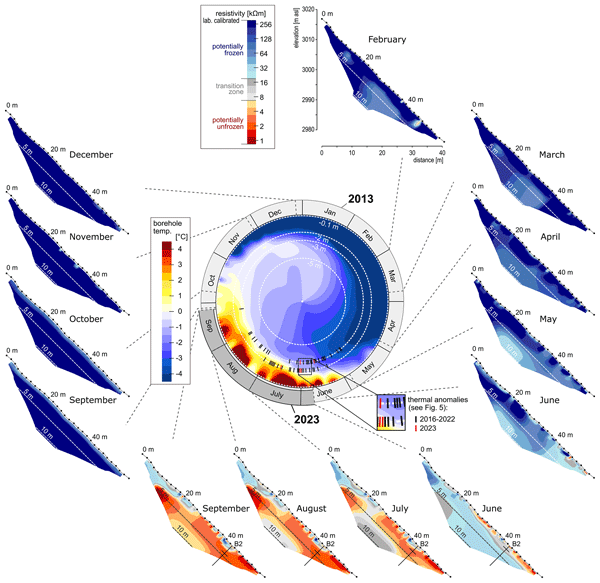
This study monitors changes in frozen rock on Mount Zugspitze over 17 years using monthly electrical resistivity measurements. By linking this data to rock temperature and applying advanced analysis, it reveals a 40 % loss of permafrost in the past decade. Thawing accelerates during summer, highlighting increasing risks of rock instability as temperatures rise.
This study monitors changes in frozen rock on Mount Zugspitze over 17 years using monthly...


