
Articles | Volume 20, issue 8
https://doi.org/10.5194/tc-20-4655-2026
© Author(s) 2026. This work is distributed under
the Creative Commons Attribution 4.0 License.
the Creative Commons Attribution 4.0 License.
https://doi.org/10.5194/tc-20-4655-2026
© Author(s) 2026. This work is distributed under
the Creative Commons Attribution 4.0 License.
the Creative Commons Attribution 4.0 License.
Research article
| 
24 Aug 2026
Research article |
| 24 Aug 2026
| 24 Aug 2026
Arctic sea ice predictability on daily-to-weekly timescales: sensitivity to initial positional errors under different rheology formulations
DATLAS, Grenoble, France
Univ. Grenoble Alpes, CNRS, INRAE, IRD, Grenoble INP, IGE, 38000 Grenoble, France
Stephanie Leroux
DATLAS, Grenoble, France
Pierre Rampal
Univ. Grenoble Alpes, CNRS, INRAE, IRD, Grenoble INP, IGE, 38000 Grenoble, France
Jean-Michel Brankart
Univ. Grenoble Alpes, CNRS, INRAE, IRD, Grenoble INP, IGE, 38000 Grenoble, France
Related authors
No articles found.
Jean-Michel Brankart, Damien Héron, Lisa Weiss, Thierry Penduff, and Pierre Brasseur
Ocean Sci., 22, 3207–3224, https://doi.org/10.5194/os-22-3207-2026, https://doi.org/10.5194/os-22-3207-2026, 2026
Short summary
Short summary
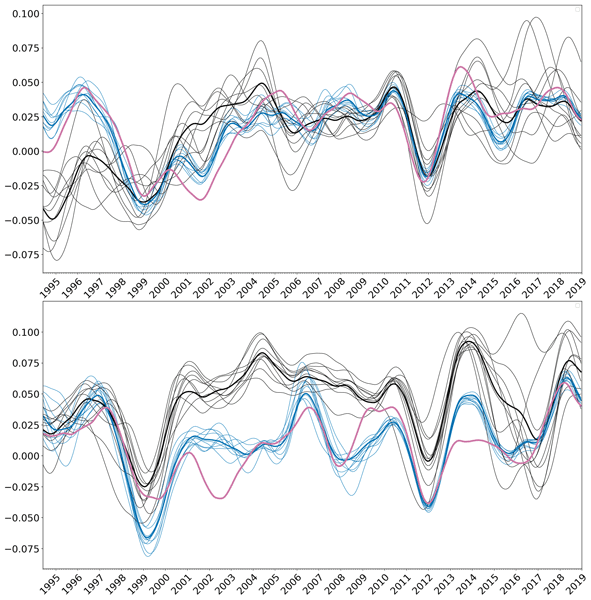
In this paper, an ensemble method is proposed to estimate directly the low-frequency component of the ocean variability from native observations using statistics from a prior long-term ensemble simulation. The approach is illustrated by the reconstruction of the low-frequency variability of the Mediterranean sea level from along-track altimetric observations over 26 years. The resulting ensemble estimate is assessed against independent observations, showing good reliability.
Augustin Lambotte, Thierry Fichefet, François Massonnet, Pierre Rampal, Laurent Brodeau, Jean-François Lemieux, Frédéric Dupont, Martin Vancoppenolle, Antoine Barthélemy, and Pierre-Yves Barriat
EGUsphere, https://doi.org/10.5194/egusphere-2026-3861, https://doi.org/10.5194/egusphere-2026-3861, 2026
This preprint is open for discussion and under review for The Cryosphere (TC).
Short summary
Short summary
Arctic fast ice influences the ocean and is important for Arctic communities and animals. Using the ocean and sea ice model NEMO-SI3, we study the interactions between sea ice mechanical formulation and grounding scheme. While the grounding scheme is the most important mechanism, its effect varies with the mechanical formulation. Our results highlight the importance of accurately simulating fast ice thickness and point to future developments for sea ice mechanical frameworks in numerical models.
Loïc Macé, Luc Vandenbulcke, Jean-Michel Brankart, Jean-François Grailet, Pierre Brasseur, and Marilaure Grégoire
Geosci. Model Dev., 19, 9077–9102, https://doi.org/10.5194/gmd-19-9077-2026, https://doi.org/10.5194/gmd-19-9077-2026, 2026
Short summary
Short summary
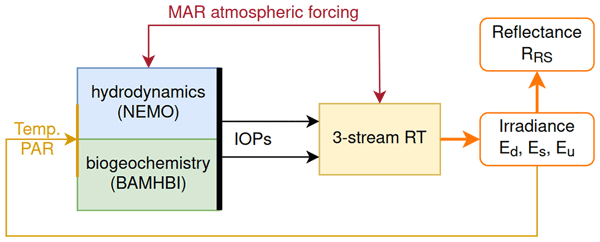
We present a three-stream radiative transfer model within the NEMO (Nucleus for European Modelling of the Ocean) framework and a use case for the Black Sea. The model is able to simulate in-water irradiance and sea surface reflectance in a wide spectral range. When coupled with an ecosystem model, the simulated irradiances are used to compute water temperature and primary production. A stochastic version of this model is also proposed to inform on uncertainties in the optical properties of seawater.
Yutong Zhang, Pierre Brasseur, Melika Baklouti, and Jean-Michel Brankart
EGUsphere, https://doi.org/10.5194/egusphere-2026-5134, https://doi.org/10.5194/egusphere-2026-5134, 2026
This preprint is open for discussion and under review for Ocean Science (OS).
Short summary
Short summary
This study examines how parameter-induced uncertainty affects marine biogeochemical model outputs and whether simplified model versions preserve these uncertainty distributions. Parameter-induced uncertainty is concentrated during the spring bloom and near the nutricline and deep chlorophyll maximum. Simplification affects oxygen, plankton, and carbon export differently, while using annual or depth-integrated ecosystem indicators may mask changes occurring at specific times or depths.
Alejandro Blazquez, Benoit Meyssignac, Robin Fraudeau, Michael Ablain, Jonathan Bamber, Antonio Bonaduce, Marie Bouih, Anny Cazenave, Thorben Döhne, Ines Dussaillant, Ramiro Ferrari, Martin Horwath, Nicolas Kolodziejczyk, Hugo Lecomte, Stephanie Leroux, William Llovel, Daniele Melini, Erwan Oulhen, Thierry Penduff, Roshin P. Raj, Giorgio Spada, Marius Schlaak, Papasarafianou Stamatia, Andrea Storto, Chunxue Yang, and Sarah Connors
Earth Syst. Sci. Data Discuss., https://doi.org/10.5194/essd-2026-627, https://doi.org/10.5194/essd-2026-627, 2026
Preprint under review for ESSD
Short summary
Short summary
Closing the sea‑level budget on annual and longer time scales is a cornerstone of physical oceanography because sea‑level rise is one of the best indicators of climate change, and a closed budget shows we have identified and quantified all major drivers. We examined it from 1993 to 2022, finding an accelerated rise that matched ice melt and warm water until 2015. Afterwards an unexplained gap appears. Better deep‑ocean observations and refined gravity processing are needed to close the budget.
Einar Ólason, Guillaume Boutin, Timothy Williams, Anton Korosov, Heather Regan, Jonathan Rheinlænder, Pierre Rampal, Daniela Flocco, Abdoulaye Samaké, Richard Davy, Timothy Spain, and Sean Chua
Geosci. Model Dev., 19, 6467–6496, https://doi.org/10.5194/gmd-19-6467-2026, https://doi.org/10.5194/gmd-19-6467-2026, 2026
Short summary
Short summary
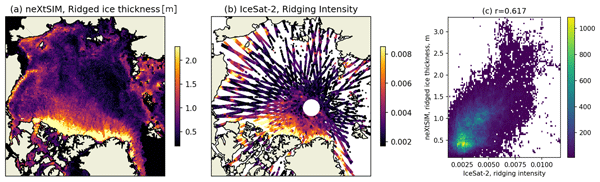
This paper introduces a new version of the neXtSIM sea-ice model. NeXtSIM is unique among sea-ice models in how it represents sea-ice dynamics, focusing on features such as cracks and ridges and how these impact interactions between the atmosphere and ocean where sea ice is present. The new version introduces some physical parameterisations and model options detailed and explained in the paper. Following the paper's publication, the neXtSIM code will be released publicly for the first time.
Fabien Salmon, Pierre Rampal, Stéphanie Leroux, Timothy Williams, Einar Ólason, and Nicolas Barral
EGUsphere, https://doi.org/10.5194/egusphere-2026-1869, https://doi.org/10.5194/egusphere-2026-1869, 2026
Short summary
Short summary
Accurate modeling of sea ice dynamics is a major challenge for forecasting its future evolution and assessing its impact on climate change. This paper presents the parallelisation of state-of-the art sea-ice dynamics model NeXtSIM. The code was interfaced with a new parallel version of the remeshing library MMG. Validation and performance of the code are discussed. Simulations with a uniform 1km spatial resolution are run, which is unprecedented with this kind of lagrangian sea-ice models.

Damien Héron, Thierry Penduff, Jean-Michel Brankart, Pierre Brasseur, Samuel Somot, Robin Waldman, and Romain Pennel
Ocean Sci., 22, 531–547, https://doi.org/10.5194/os-22-531-2026, https://doi.org/10.5194/os-22-531-2026, 2026
Short summary
Short summary
Our study used realistic ocean simulations to determine how much of the Mediterranean’s circulation is due to natural randomness rather than atmospheric forcing. We found that spontaneous ocean variability is strong in several regions and can persist for years or even decades. This randomness influences how well models and observations can capture the Mediterranean’s response to climate change.

Loïc Macé, Luc Vandenbulcke, Jean-Michel Brankart, Pierre Brasseur, and Marilaure Grégoire
Biogeosciences, 22, 3747–3768, https://doi.org/10.5194/bg-22-3747-2025, https://doi.org/10.5194/bg-22-3747-2025, 2025
Short summary
Short summary
The representation of light propagation in seawater is critical for modelling marine biogeochemistry. We analyse results from a radiative transfer model that accounts for the absorption and scattering of light in the ocean with their respective uncertainties. We compare these results with in situ and remote-sensed data. Our analysis highlights the benefits of accounting for model uncertainties while using advanced representations of light in modelling frameworks.
Rémy Lapere, Louis Marelle, Pierre Rampal, Laurent Brodeau, Christian Melsheimer, Gunnar Spreen, and Jennie L. Thomas
Atmos. Chem. Phys., 24, 12107–12132, https://doi.org/10.5194/acp-24-12107-2024, https://doi.org/10.5194/acp-24-12107-2024, 2024
Short summary
Short summary
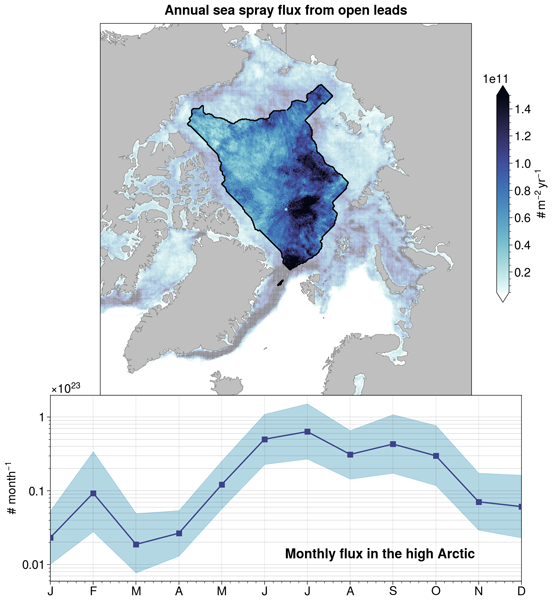
Elongated open-water areas in sea ice, called leads, can release marine aerosols into the atmosphere. In the Arctic, this source of atmospheric particles could play an important role for climate. However, the amount, seasonality and spatial distribution of such emissions are all mostly unknown. Here, we propose a first parameterization for sea spray aerosols emitted through leads in sea ice and quantify their impact on aerosol populations in the high Arctic.
Olivier Narinc, Thierry Penduff, Guillaume Maze, Stéphanie Leroux, and Jean-Marc Molines
Ocean Sci., 20, 1351–1365, https://doi.org/10.5194/os-20-1351-2024, https://doi.org/10.5194/os-20-1351-2024, 2024
Short summary
Short summary
This study examines how the ocean's chaotic variability and atmospheric fluctuations affect yearly changes in North Atlantic Subtropical Mode Water (STMW) properties, using an ensemble of realistic ocean simulations. Results show that while yearly changes in STMW properties are mostly paced by the atmosphere, a notable part of these changes are random in phase. This study also illustrates the value of ensemble simulations over single runs in understanding oceanic fluctuations and their causes.
Laurent Brodeau, Pierre Rampal, Einar Ólason, and Véronique Dansereau
Geosci. Model Dev., 17, 6051–6082, https://doi.org/10.5194/gmd-17-6051-2024, https://doi.org/10.5194/gmd-17-6051-2024, 2024
Short summary
Short summary
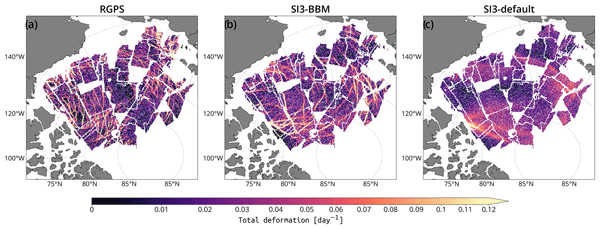
A new brittle sea ice rheology, BBM, has been implemented into the sea ice component of NEMO. We describe how a new spatial discretization framework was introduced to achieve this. A set of idealized and realistic ocean and sea ice simulations of the Arctic have been performed using BBM and the standard viscous–plastic rheology of NEMO. When compared to satellite data, our simulations show that our implementation of BBM leads to a fairly good representation of sea ice deformations.
Yumeng Chen, Polly Smith, Alberto Carrassi, Ivo Pasmans, Laurent Bertino, Marc Bocquet, Tobias Sebastian Finn, Pierre Rampal, and Véronique Dansereau
The Cryosphere, 18, 2381–2406, https://doi.org/10.5194/tc-18-2381-2024, https://doi.org/10.5194/tc-18-2381-2024, 2024
Short summary
Short summary
We explore multivariate state and parameter estimation using a data assimilation approach through idealised simulations in a dynamics-only sea-ice model based on novel rheology. We identify various potential issues that can arise in complex operational sea-ice models when model parameters are estimated. Even though further investigation will be needed for such complex sea-ice models, we show possibilities of improving the observed and the unobserved model state forecast and parameter accuracy.
Mikhail Popov, Jean-Michel Brankart, Arthur Capet, Emmanuel Cosme, and Pierre Brasseur
Ocean Sci., 20, 155–180, https://doi.org/10.5194/os-20-155-2024, https://doi.org/10.5194/os-20-155-2024, 2024
Short summary
Short summary
This study contributes to the development of methods to estimate targeted ocean ecosystem indicators, including their uncertainty, in the framework of the Copernicus Marine Service. A simplified approach is introduced to perform a 4D ensemble analysis and forecast, directly targeting selected biogeochemical variables and indicators (phenology, trophic efficiency, downward flux of organic matter). Care is taken to present the methods and discuss the reliability of the solution proposed.
Anton Korosov, Pierre Rampal, Yue Ying, Einar Ólason, and Timothy Williams
The Cryosphere, 17, 4223–4240, https://doi.org/10.5194/tc-17-4223-2023, https://doi.org/10.5194/tc-17-4223-2023, 2023
Short summary
Short summary
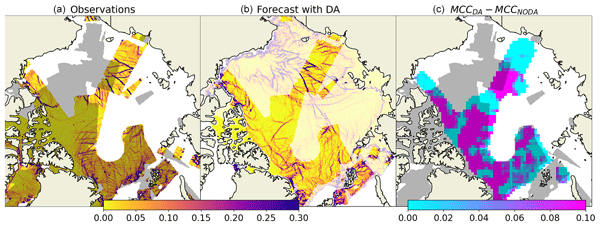
It is possible to compute sea ice motion from satellite observations and detect areas where ice converges (moves together), forms ice ridges or diverges (moves apart) and opens leads. However, it is difficult to predict the exact motion of sea ice and position of ice ridges or leads using numerical models. We propose a new method to initialise a numerical model from satellite observations to improve the accuracy of the forecasted position of leads and ridges for safer navigation.
Heather Regan, Pierre Rampal, Einar Ólason, Guillaume Boutin, and Anton Korosov
The Cryosphere, 17, 1873–1893, https://doi.org/10.5194/tc-17-1873-2023, https://doi.org/10.5194/tc-17-1873-2023, 2023
Short summary
Short summary
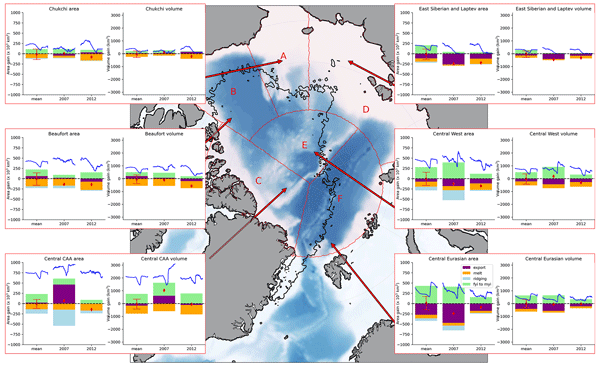
Multiyear ice (MYI), sea ice that survives the summer, is more resistant to changes than younger ice in the Arctic, so it is a good indicator of sea ice resilience. We use a model with a new way of tracking MYI to assess the contribution of different processes affecting MYI. We find two important years for MYI decline: 2007, when dynamics are important, and 2012, when melt is important. These affect MYI volume and area in different ways, which is important for the interpretation of observations.
Sukun Cheng, Yumeng Chen, Ali Aydoğdu, Laurent Bertino, Alberto Carrassi, Pierre Rampal, and Christopher K. R. T. Jones
The Cryosphere, 17, 1735–1754, https://doi.org/10.5194/tc-17-1735-2023, https://doi.org/10.5194/tc-17-1735-2023, 2023
Short summary
Short summary
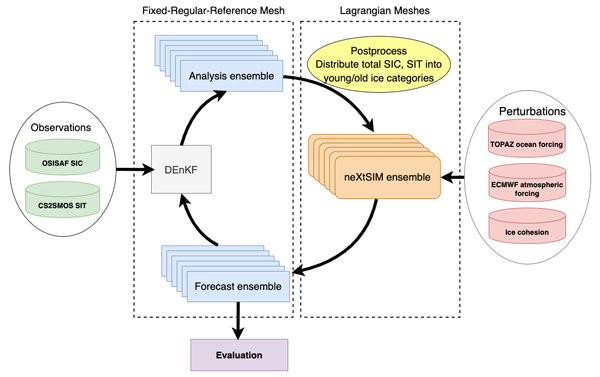
This work studies a novel application of combining a Lagrangian sea ice model, neXtSIM, and data assimilation. It uses a deterministic ensemble Kalman filter to incorporate satellite-observed ice concentration and thickness in simulations. The neXtSIM Lagrangian nature is handled using a remapping strategy on a common homogeneous mesh. The ensemble is formed by perturbing air–ocean boundary conditions and ice cohesion. Thanks to data assimilation, winter Arctic sea ice forecasting is enhanced.
Guillaume Boutin, Einar Ólason, Pierre Rampal, Heather Regan, Camille Lique, Claude Talandier, Laurent Brodeau, and Robert Ricker
The Cryosphere, 17, 617–638, https://doi.org/10.5194/tc-17-617-2023, https://doi.org/10.5194/tc-17-617-2023, 2023
Short summary
Short summary
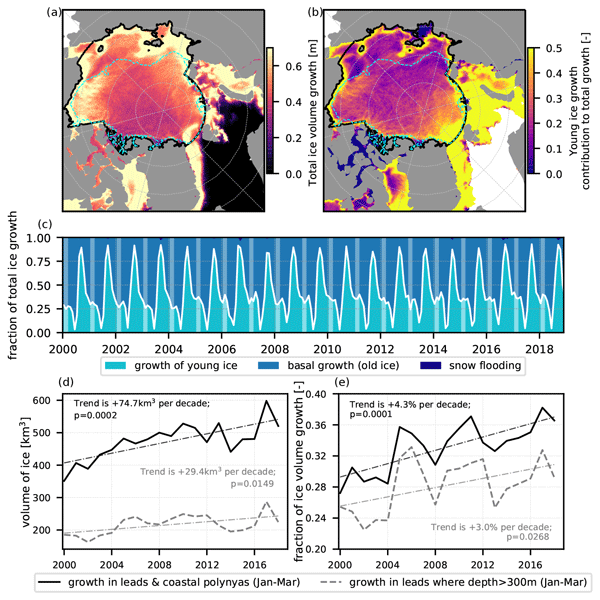
Sea ice cover in the Arctic is full of cracks, which we call leads. We suspect that these leads play a role for atmosphere–ocean interactions in polar regions, but their importance remains challenging to estimate. We use a new ocean–sea ice model with an original way of representing sea ice dynamics to estimate their impact on winter sea ice production. This model successfully represents sea ice evolution from 2000 to 2018, and we find that about 30 % of ice production takes place in leads.

Stephanie Leroux, Jean-Michel Brankart, Aurélie Albert, Laurent Brodeau, Jean-Marc Molines, Quentin Jamet, Julien Le Sommer, Thierry Penduff, and Pierre Brasseur
Ocean Sci., 18, 1619–1644, https://doi.org/10.5194/os-18-1619-2022, https://doi.org/10.5194/os-18-1619-2022, 2022
Short summary
Short summary
The goal of the study is to evaluate the predictability of the ocean circulation
at a kilometric scale, in order to anticipate the requirements of the future operational forecasting systems. For that purpose, ensemble experiments have been performed with a regional model for the Western Mediterranean (at 1/60° horizontal resolution). From these ensemble experiments, we show that it is possible to compute targeted predictability scores, which depend on initial and model uncertainties.
Cited articles
Bertino, L., Heimbach, P., Blockley, E., and Ólason, E.: Numerical models for monitoring and forecasting sea ice: a short description of present status, in: Ocean prediction: present status and state of the art (OPSR), edited by: Álvarez Fanjul, E., Ciliberti, S. A., Pearlman, J., Wilmer-Becker, K., and Behera, S., Copernicus Publications, State Planet, 5-opsr, 14, https://doi.org/10.5194/sp-5-opsr-14-2025, 2025. a, b
Bouchat, A., Hutter, N., Chanut, J., Dupont, F., Dukhovskoy, D., Garric, G., Lee, Y., Lemieux, J.-F., Lique, C., Losch, M., Maslowski, W., Myers, P. G., Ólason, E., Rampal, P., Rasmussen, T., Talandier, C., Tremblay, B., and Wang, Q.: Sea Ice Rheology Experiment (SIREx): 1. Scaling and statistical properties of sea-ice deformation fields, J. Geophys. Res.-Oceans, 127, e2021JC017666, https://doi.org/10.1029/2021JC017666, 2022. a
Brankart, J.-M. and Leroux, S.: lu-simulator (v1.0), Zenodo [code], https://doi.org/10.5281/zenodo.17896830, 2025. a, b
Brodeau, L., Rampal, P., Ólason, E., and Dansereau, V.: Implementation of a brittle sea ice rheology in an Eulerian, finite-difference, C-grid modeling framework: impact on the simulated deformation of sea ice in the Arctic, Geosci. Model Dev., 17, 6051–6082, https://doi.org/10.5194/gmd-17-6051-2024, 2024. a, b, c, d, e, f
Candille, G., Brankart, J.-M., and Brasseur, P.: Assessment of an ensemble system that assimilates Jason-1/Envisat altimeter data in a probabilistic model of the North Atlantic ocean circulation, Ocean Sci., 11, 425–438, https://doi.org/10.5194/os-11-425-2015, 2015. a
Cruz-García, R., Guemas, V., Chevallier, M., and Massonnet, F.: An assessment of regional sea ice predictability in the Arctic ocean, Clim. Dynam., 53, 427–440, https://doi.org/10.1007/s00382-018-4592-6, 2019. a
Dansereau, V., Weiss, J., Saramito, P., Lattes, P., and Coche, E.: Ice bridges and ridges in the Maxwell-EB sea ice rheology, The Cryosphere, 11, 2033–2058, https://doi.org/10.5194/tc-11-2033-2017, 2017. a
Day, J. J., Tietsche, S., and Hawkins, E.: Pan-Arctic and regional sea ice predictability: Initialization month dependence, J. Climate, 27, 4371–4390, https://doi.org/10.1175/JCLI-D-13-00614.1, 2014. a
Durán Moro, M., Sperrevik, A. K., Lavergne, T., Bertino, L., Gusdal, Y., Iversen, S. C., and Rusin, J.: Assimilation of satellite swaths versus daily means of sea ice concentration in a regional coupled ocean–sea ice model, The Cryosphere, 18, 1597–1619, https://doi.org/10.5194/tc-18-1597-2024, 2024. a, b
Fiol, L.: Notebooks of the figures of Fiol et al. 2026 (v1.0), Zenodo [code], https://doi.org/10.5281/zenodo.17896832, 2025. a
Fiol, L., Leroux, S., and Rampal, P.: Lagrangian trajectory dataset used in Fiol et al. 2026 (v1.0), Zenodo [data set], https://doi.org/10.5281/zenodo.17897059, 2025. a
Girard, L., Bouillon, S., Weiss, J., Amitrano, D., Fichefet, T., and Legat, V.: A new modeling framework for sea-ice mechanics based on elasto-brittle rheology, Ann. Glaciol., 52, 123–132, https://doi.org/10.3189/172756411795931499, 2011. a
Goessling, H. F. and Jung, T.: A probabilistic verification score for contours: Methodology and application to Arctic ice-edge forecasts, Q. J. Roy. Meteor. Soc., 144, 735–743, https://doi.org/10.1002/qj.3242, 2018. a, b, c, d
Goessling, H. F., Tietsche, S., Day, J. J., Hawkins, E., and Jung, T.: Predictability of the Arctic sea ice edge, Geophys. Res. Lett., 43, 1642–1650, https://doi.org/10.1002/2015GL067232, 2016. a, b, c, d
Hersbach, H.: Decomposition of the Continuous Ranked Probability Score for Ensemble Prediction Systems, Weather Forecast., 15, 559–570, https://doi.org/10.1175/1520-0434(2000)015<0559:DOTCRP>2.0.CO;2, 2000. a, b
Hersbach, H., Bell, B., Berrisford, P., Hirahara, S., Horányi, A., Muñoz-Sabater, J., Nicolas, J., Peubey, C., Radu, R., Schepers, D., Simmons, A., Soci, C., Abdalla, S., Abellan, X., Balsamo, G., Bechtold, P., Biavati, G., Bidlot, J., Bonavita, M., De Chiara, G., Dahlgren, P., Dee, D., Diamantakis, M., Dragani, R., Flemming, J., Forbes, R., Fuentes, M., Geer, A., Haimberger, L., Healy, S., Hogan, R. J., Hólm, E., Janisková, M., Keeley, S., Laloyaux, P., Lopez, P., Lupu, C., Radnoti, G., de Rosnay, P., Rozum, I., Vamborg, F., Villaume, S., and Thépaut, J.: The ERA5 global reanalysis, Q. J. Roy. Meteor. Soc., 146, 1999–2049, https://doi.org/10.1002/qj.3803, 2020. a
Hibler, W. D.: A dynamic thermodynamic sea ice model, J. Phys. Oceanogr., 9, 815–846, https://doi.org/10.1175/1520-0485(1979)009<0815:ADTSIM>2.0.CO;2, 1979. a
Hunke, E. C. and Dukowicz, J. K.: An elastic–viscous–plastic model for sea ice dynamics, J. Phys. Oceanogr., 27, 1849–1867, https://doi.org/10.1175/1520-0485(1997)027<1849:AEVPMF>2.0.CO;2, 1997. a
International Arctic Buoy Programme (IABP): In Situ Observations from the International Arctic Buoy Programme (IABP), Level 1, https://doi.org/10.18739/A2R785R0C, 2023. a
Kimmritz, M., Danilov, S., and Losch, M.: The adaptive EVP method for solving the sea ice momentum equation, Ocean Model., 101, 59–67, https://doi.org/10.1016/j.ocemod.2016.03.004, 2016. a, b, c, d
Kwok, R.: Deformation of the Arctic Ocean Sea Ice Cover between November 1996 and April 1997: A Qualitative Survey, in: IUTAM Symposium on Scaling Laws in Ice Mechanics and Ice Dynamics, edited by: Dempsey, J. P. and Shen, H. H., Springer Netherlands, Dordrecht, 315–322, ISBN 978-94-015-9735-7, https://doi.org/10.1007/978-94-015-9735-7_26, 2001. a, b
Kwok, R., Schweiger, A., Rothrock, D. A., Pang, S., and Kottmeier, C.: Sea ice motion from satellite passive microwave imagery assessed with ERS SAR and buoy motions, J. Geophys. Res.-Oceans, 103, 8191–8214, https://doi.org/10.1029/97JC03334, 1998. a, b
Lang, S., Alexe, M., Clare, M. C. A., Roberts, C., Adewoyin, R., Ben Bouallègue, Z., Chantry, M., Dramsch, J., Dueben, P. D., Hahner, S., Maciel, P., Prieto-Nemesio, A., O'Brien, C., Pinault, F., Polster, J., Raoult, B., Tietsche, S., and Leutbecher, M.: AIFS-CRPS: Ensemble forecasting using a model trained with a loss function based on the Continuous Ranked Probability Score, arXiv [preprint], https://doi.org/10.48550/arXiv.2412.15832, 2024. a
Lavergne, T. and Down, E.: A climate data record of year-round global sea-ice drift from the EUMETSAT Ocean and Sea Ice Satellite Application Facility (OSI SAF), Earth Syst. Sci. Data, 15, 5807–5834, https://doi.org/10.5194/essd-15-5807-2023, 2023. a
Lellouche, J.-M., Greiner, E., Bourdallé-Badie, R., Garric, G., Melet, A., Drévillon, M., Bricaud, C., Hamon, M., Le Galloudec, O., Regnier, C., Candela, T., Testut, C.-E., Gasparin, F., Ruggiero, G., Benkiran, M., Drillet, Y., and Le Traon, P.-Y.: The Copernicus Global
Leppäranta, M.: The Drift of Sea Ice, Springer, Berlin, Heidelberg, 2nd edn., ISBN 978-3-642-04682-7, e-ISBN 978-3-642- 4683-4, https://doi.org/10.1007/978-3-642-4683-4, 2011. a
Leroux, S., Brankart, J.-M., Albert, A., Brodeau, L., Molines, J.-M., Jamet, Q., Le Sommer, J., Penduff, T., and Brasseur, P.: Ensemble quantification of short-term predictability of the ocean dynamics at a kilometric-scale resolution: a Western Mediterranean test case, Ocean Sci., 18, 1619–1644, https://doi.org/10.5194/os-18-1619-2022, 2022. a
Lorenz, E. N.: The predictability of a flow which possesses many scales of motion, Tellus, 21, 289–307, https://doi.org/10.1111/j.2153-3490.1969.tb00444.x, 1969. a, b
Lorenz, E. N.: Climatic Predictability, in: The Physical Bases of Climate and Climate Modelling, no. 16 in GARP Publications Series, World Meteorological Organization, 132–136, https://wind.mit.edu/~emanuel/Lorenz/EdLorenz/Lorenz_GARP_1975.pdf (last access: on 22 July 2026), 1975. a
Ludwig, V., Ribere, C., Fleury, S., Haas, C., Tsamados, M., El Hajj, M., Bouffard, J., Scagliola, M., Bocquet, M., de Boisseson, E., Boulenger, V., Boutin, G., Connor, L., Edel, L., Hendricks, S., Hernández Macià, F., Huntemann, M., Kaleschke, L., Kauker, F., Landy, J., Megain, T., Petty, A., Soya Rasmussen, T., Hvid Ribergaard, M., Ricker, R., Schweiger, A., Shi, H., Tian-Kunze, X., Yi, D., and Di Bella, A.: Biases, Uncertainties, and Trends in Arctic Sea-Ice Thickness: A Cross-Product Analysis from 1995 to 2023, EGUsphere [preprint], https://doi.org/10.5194/egusphere-2025-6201, 2026. a
Madec, G. and the NEMO-System-Team: NEMO Ocean Engine Reference Manual, NEMO consortium, https://doi.org/10.5281/zenodo.1464816, 2024. a
Ólason, E. and Notz, D.: Drivers of variability in Arctic sea-ice drift speed, J. Geophys. Res.-Oceans, 119, 5755–5775, https://doi.org/10.1002/2014JC009897, 2014. a, b
PAME: Arctic Shipping Status Report 1, Technical report, Protection of the Arctic Marine Environment (PAME), https://pame.is/images/03_Projects/ASSR/ASSR_1_-_2024_update.pdf (last access: September 2025), 2024. a
Rabatel, M., Rampal, P., Carrassi, A., Bertino, L., and Jones, C. K. R. T.: Impact of rheology on probabilistic forecasts of sea ice trajectories: application for search and rescue operations in the Arctic, The Cryosphere, 12, 935–953, https://doi.org/10.5194/tc-12-935-2018, 2018. a, b, c, d, e, f, g, h
Rabe, B., Cox, C. J., Fang, Y.-C., Goessling, H., Granskog, M. A., Hoppmann, M., Hutchings, J. K., Krumpen, T., Kuznetsov, I., Lei, R., Li, T.,Maslowski, W., Nicolaus, M., Perovich, D., Persson, O., Regnery, J., Rigor, I., Shupe, M. D., Sokolov, V., Spreen, G., Stanton, T., Watkins, D. M., Blockley, E., Buenger, H. J., Cole, S., Fong, A., Haapala, J., Heuzé, C., Hoppe, C. J. M., Janout, M., Jutila, A., Katlein, C., Krishfield, R., Lin, L., Ludwig, V., Morgenstern, A., O’Brien, J., Quintanilla Zurita, A., Rackow, T., Riemann-Campe, K., Rohde, J., Shaw, W., Smolyanitsky, V., Solomon, A., Sperling, A., Tao, R., Toole, J., Tsamados, M., Zhu, J., and Zuo, G.: The MOSAiC Distributed Network: Observing the coupled Arctic system with multidisciplinary, coordinated platforms, Elementa: Science of the Anthropocene, 12, https://doi.org/10.1525/elementa.2023.00103, 2024. a
Rampal, P.: Etude de la dérive et de la déformation de la banquise Arctique par l’analyse de trajectoires lagrangiennes, PhD thesis, Université Joseph Fourier – Grenoble 1, français. tel-00352799, https://theses.hal.science/tel-00352799v1 (last access: 22 July 2026), 2008. a
Rampal, P., Weiss, J., Marsan, D., Lindsay, R., and Stern, H.: Scaling properties of sea ice deformation from buoy dispersion analysis, J. Geophys. Res.-Oceans, 113, C03002, https://doi.org/10.1029/2007jc004143, 2008. a
Rampal, P., Bouillon, S., Ólason, E., and Morlighem, M.: neXtSIM: a new Lagrangian sea ice model, The Cryosphere, 10, 1055–1073, https://doi.org/10.5194/tc-10-1055-2016, 2016. a
Rampal, P., Dansereau, V., Olason, E., Bouillon, S., Williams, T., Korosov, A., and Samaké, A.: On the multi-fractal scaling properties of sea ice deformation, The Cryosphere, 13, 2457–2474, https://doi.org/10.5194/tc-13-2457-2019, 2019. a, b, c
Reifenberg, S. F. and Goessling, H. F.: Predictability of Arctic sea ice drift in coupled climate models, The Cryosphere, 16, 2927–2946, https://doi.org/10.5194/tc-16-2927-2022, 2022. a, b, c
Sakov, P., Counillon, F., Bertino, L., Lisæter, K. A., Oke, P. R., and Korablev, A.: TOPAZ4: an ocean-sea ice data assimilation system for the North Atlantic and Arctic, Ocean Sci., 8, 633–656, https://doi.org/10.5194/os-8-633-2012, 2012. a
Sumata, H., de Steur, L., Divine, D. V., Granskog, M. A., and Gerland, S.: Regime shift in Arctic Ocean sea ice thickness, Nature, 615, 443–449, https://doi.org/10.1038/s41586-022-05686-x, 2023. a
Thorndike, A. S. and Colony, R.: Sea ice motion in response to geostrophic winds, J. Geophys. Res., 87, 5845–5852, https://doi.org/10.1029/JC087iC08p05845, 1982. a
Tietsche, S., Day, J. J., Collins, M., and Hawkins, E.: Predictability of the Arctic sea ice edge, Geophys. Res. Lett., 41, 2414–2420, https://doi.org/10.1002/2014GL059393, 2014. a, b
Tietsche, S., Mueller, M., Bertino, L., Garric, G., Goessling, H., Pedersen, L. T., Wagner, P., and Lavergne, T.: Recommendations for more user-relevant sea-ice forecasts, Public technical report, deliverable d4.3, EU-KEPLER project, https://kepler-polar.eu/deliverables/index.html (last access: September 2025), 2020. a, b
Vancoppenolle, M., Rousset, C., Blockley, E., and the NEMO Sea Ice Working Group: SI3 – Sea Ice modelling Integrated Initiative – The NEMO Sea Ice Engine, Zenodo, https://doi.org/10.5281/zenodo.7534900, 2023. a
Williams, T., Korosov, A., Rampal, P., and Ólason, E.: Presentation and evaluation of the Arctic sea ice forecasting system neXtSIM-F, The Cryosphere, 15, 3207–3227, https://doi.org/10.5194/tc-15-3207-2021, 2021. a, b, c, d
Short summary
We examine how uncertainty in the initial position of sea ice features (leads, ridges), affects daily-to-weekly winter sea-ice forecasts. Using ensemble simulations with a sea ice–ocean model, we compare two formulations of sea ice mechanics. We show that pack-ice dynamics are highly sensitive to this choice: one formulation strongly amplifies small initial errors, while the other damps them. Our results highlight the need for ensemble forecasts to capture uncertainty and risks in the Arctic.
We examine how uncertainty in the initial position of sea ice features (leads, ridges), affects...


