
Articles | Volume 20, issue 8
https://doi.org/10.5194/tc-20-4563-2026
© Author(s) 2026. This work is distributed under
the Creative Commons Attribution 4.0 License.
the Creative Commons Attribution 4.0 License.
https://doi.org/10.5194/tc-20-4563-2026
© Author(s) 2026. This work is distributed under
the Creative Commons Attribution 4.0 License.
the Creative Commons Attribution 4.0 License.
Research article
| 
20 Aug 2026
Research article |
| 20 Aug 2026
| 20 Aug 2026
The multilayer ocean circulation melting the 79N Glacier ice tongue

Leibniz Institute for Baltic Sea Research Warnemünde (IOW), Seestr. 15, 18119 Rostock, Germany
Federal Waterways Engineering and Research Institute (BAW), Wedeler Landstr. 157, 22559 Hamburg, Germany
Claudia Wekerle
Alfred Wegener Institute Helmholtz Centre for Polar and Marine Research (AWI), Am Handelshafen 12, 27570 Bremerhaven, Germany
Knut Klingbeil
Leibniz Institute for Baltic Sea Research Warnemünde (IOW), Seestr. 15, 18119 Rostock, Germany
Marvin Lorenz
Leibniz Institute for Baltic Sea Research Warnemünde (IOW), Seestr. 15, 18119 Rostock, Germany
Federal Waterways Engineering and Research Institute (BAW), Wedeler Landstr. 157, 22559 Hamburg, Germany
Hans Burchard
Leibniz Institute for Baltic Sea Research Warnemünde (IOW), Seestr. 15, 18119 Rostock, Germany
Related authors
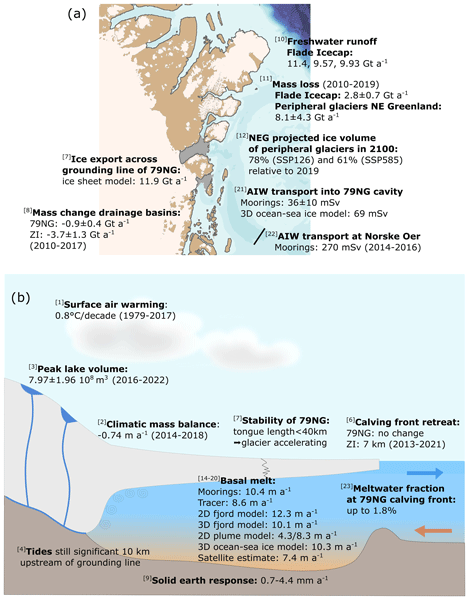
Torsten Kanzow, Angelika Humbert, Thomas Mölg, Mirko Scheinert, Matthias Braun, Hans Burchard, Francesca Doglioni, Philipp Hochreuther, Martin Horwath, Oliver Huhn, Maria Kappelsberger, Jürgen Kusche, Erik Loebel, Katrina Lutz, Ben Marzeion, Rebecca McPherson, Mahdi Mohammadi-Aragh, Marco Möller, Carolyne Pickler, Markus Reinert, Monika Rhein, Martin Rückamp, Janin Schaffer, Muhammad Shafeeque, Sophie Stolzenberger, Ralph Timmermann, Jenny Turton, Claudia Wekerle, and Ole Zeising
The Cryosphere, 19, 1789–1824, https://doi.org/10.5194/tc-19-1789-2025, https://doi.org/10.5194/tc-19-1789-2025, 2025
Short summary
Short summary
The Greenland Ice Sheet represents the second-largest contributor to global sea-level rise. We quantify atmosphere, ice and ocean processes related to the mass balance of glaciers in northeast Greenland, focusing on Greenland’s largest floating ice tongue, the 79° N Glacier. We find that together, the different in situ and remote sensing observations and model simulations reveal a consistent picture of a coupled atmosphere–ice sheet–ocean system that has entered a phase of major change.
Torsten Kanzow, Rebecca A. McPherson, Claudia Wekerle, Wilken-Jon von Appen, Oliver Huhn, Donald A. Slater, and Andreas Münchow
EGUsphere, https://doi.org/10.5194/egusphere-2026-5184, https://doi.org/10.5194/egusphere-2026-5184, 2026
This preprint is open for discussion and under review for Ocean Science (OS).
Short summary
Short summary
Atlantic Water (AW) delivers heat to glaciers in Greenland, thereby causing melt. We reveal a cooling of the AW entering the world's largest fjord system, Kangertittivaq (East Greenland), after 2018. The cooling is present on the entire Northeast Greenland shelf, driven by cooling in the Nordic Seas. In the fjord, summertime glacier meltwater drives the flow of AW towards the prominent Daugaard Jensen Glacier. The cooling is as strong as the warming of AW at the fjord over the past half century.
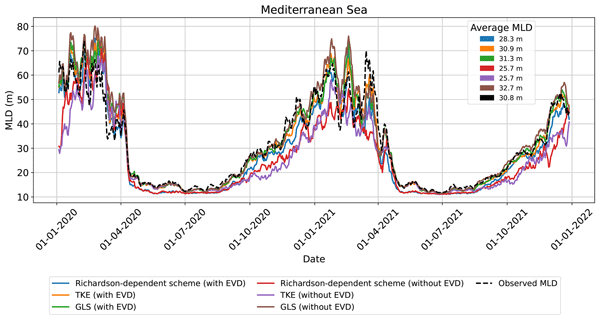
Lucia Gualtieri, Hans Burchard, Federica Borile, Aimie Moulin, Pietro Miraglio, Francesco Maicu, Emanuela Clementi, and Paolo Oddo
Geosci. Model Dev., 19, 7041–7068, https://doi.org/10.5194/gmd-19-7041-2026, https://doi.org/10.5194/gmd-19-7041-2026, 2026
Short summary
Short summary
This study addresses a gap in understanding how turbulent mixing closure schemes and convective adjustments interplay in the Mediterranean Sea. Coupled ocean-wave simulations were performed with different mixing parameterizations and model results were compared against Argo float observations across different space and time scales. Results show that the Generalised Length Scale closure scheme best reproduces observed mixed layer properties and variability, without needing convective adjustment.
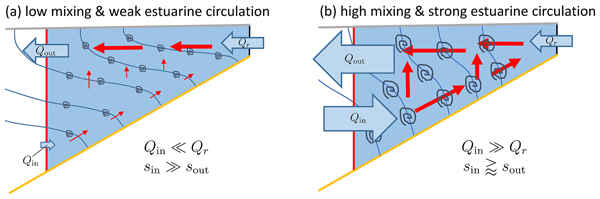
Hans Burchard, Knut Klingbeil, Xiangyu Li, Lloyd Reese, and W. Rockwell Geyer
Ocean Sci., 22, 1875–1918, https://doi.org/10.5194/os-22-1875-2026, https://doi.org/10.5194/os-22-1875-2026, 2026
Short summary
Short summary
This review presents major aspects of estuarine mixing. Due to the large amounts of brackish water in estuaries produced by mixing of fresh river discharge and salty ocean water, mixing is one major characteristic of what is an estuary. Mixing is quantified locally as well as on estuary-wide scales. Diagnostics of integrated mixing are given for estuarine volumes bounded by transects as well as surfaces of constant salinity moving with the flow. Examples for real-world estuaries are given.
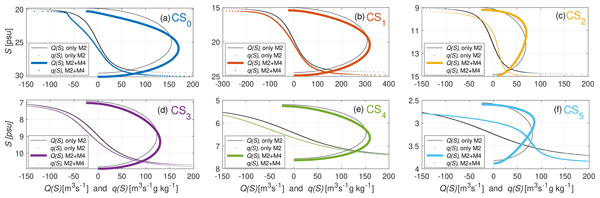
Manuel Díez-Minguito and Hans Burchard
Ocean Sci., 22, 1861–1874, https://doi.org/10.5194/os-22-1861-2026, https://doi.org/10.5194/os-22-1861-2026, 2026
Short summary
Short summary
Combining field observations with an analytical tidal scenario, we estimated in the Guadalquivir estuary its Total Exchange Flow (TEF), which has implications for water quality and residence times. The influence of tidal asymmetry on TEF is also explored. Results reveal a spatial variability in TEF and that salinity–current covariance exerts greater control on TEF than tidal asymmetry. The approach is suitable for regional studies evaluating sensitivity to changes in runoff, salinity and tides.
Evridiki Chrysagi, Lars Umlauf, Ulf Gräwe, Hans Burchard, and Alberto C. Naveira Garabato
EGUsphere, https://doi.org/10.5194/egusphere-2026-2878, https://doi.org/10.5194/egusphere-2026-2878, 2026
Short summary
Short summary
High-resolution numerical simulations of the Baltic Sea reveal that fine-scale motions known as submesoscales are widespread in the deeper layers of the basin, especially near its boundaries. These features are linked to strong mixing and, in this wind-driven system, are found to intensify during storms, with wind reversals shifting the location of mixing hotspots. Our results suggest that storm-modulated submesoscales may be important in other wind-driven coastal seas and lakes.

Alejandra Quintanilla-Zurita, Benjamin Rabe, Claudia Wekerle, Torsten Kanzow, Ivan Kuznetsov, Sinhue Torres-Valdes, Enric Pallàs-Sanz, and Ying-Chih Fang
Ocean Sci., 22, 305–328, https://doi.org/10.5194/os-22-305-2026, https://doi.org/10.5194/os-22-305-2026, 2026
Short summary
Short summary
During a year-long Arctic expedition, we discovered nine underwater eddies beneath the sea ice in the central Arctic Ocean. These hidden structures form within a layered part of the ocean just below the surface and may reshape water layers and transport heat, freshwater, and nutrients. Using drifting ice platforms, we measured their size, depth, and motion to understand how they form.
Torsten Kanzow, Angelika Humbert, Thomas Mölg, Mirko Scheinert, Matthias Braun, Hans Burchard, Francesca Doglioni, Philipp Hochreuther, Martin Horwath, Oliver Huhn, Maria Kappelsberger, Jürgen Kusche, Erik Loebel, Katrina Lutz, Ben Marzeion, Rebecca McPherson, Mahdi Mohammadi-Aragh, Marco Möller, Carolyne Pickler, Markus Reinert, Monika Rhein, Martin Rückamp, Janin Schaffer, Muhammad Shafeeque, Sophie Stolzenberger, Ralph Timmermann, Jenny Turton, Claudia Wekerle, and Ole Zeising
The Cryosphere, 19, 1789–1824, https://doi.org/10.5194/tc-19-1789-2025, https://doi.org/10.5194/tc-19-1789-2025, 2025
Short summary
Short summary
The Greenland Ice Sheet represents the second-largest contributor to global sea-level rise. We quantify atmosphere, ice and ocean processes related to the mass balance of glaciers in northeast Greenland, focusing on Greenland’s largest floating ice tongue, the 79° N Glacier. We find that together, the different in situ and remote sensing observations and model simulations reveal a consistent picture of a coupled atmosphere–ice sheet–ocean system that has entered a phase of major change.
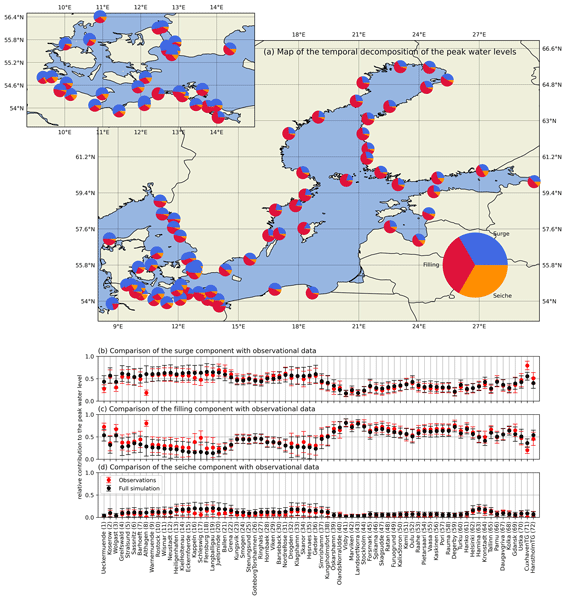
Marvin Lorenz, Katri Viigand, and Ulf Gräwe
Nat. Hazards Earth Syst. Sci., 25, 1439–1458, https://doi.org/10.5194/nhess-25-1439-2025, https://doi.org/10.5194/nhess-25-1439-2025, 2025
Short summary
Short summary
This study divides the sea level components that contribute to extreme sea levels in the Baltic Sea into three parts: the filling state of the Baltic Sea, seiches, and storm surges. In the western part of the Baltic Sea, storm surges are the main factor, while in the central and northern parts, the filling state plays a larger role. Using a numerical model, we show that wind and air pressure are the main drivers of these events, with Atlantic sea level also playing a small role.
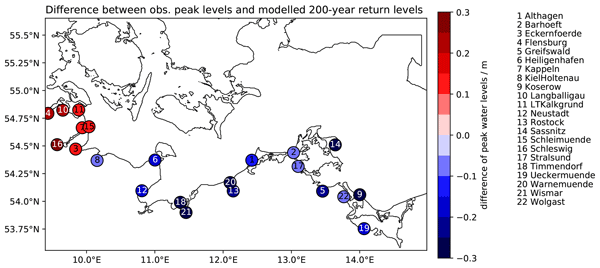
Joshua Kiesel, Claudia Wolff, and Marvin Lorenz
Nat. Hazards Earth Syst. Sci., 24, 3841–3849, https://doi.org/10.5194/nhess-24-3841-2024, https://doi.org/10.5194/nhess-24-3841-2024, 2024
Short summary
Short summary
In October 2023, one of the strongest storm surges on record hit the southwestern Baltic Sea coast, causing severe impacts in the German federal state of Schleswig-Holstein, including dike failures. Recent studies on coastal flooding from the same region align well with the October 2023 surge, with differences in peak water levels of less than 30 cm. This rare coincidence is used to assess current capabilities and limitations of coastal flood modelling and derive key areas for future research.
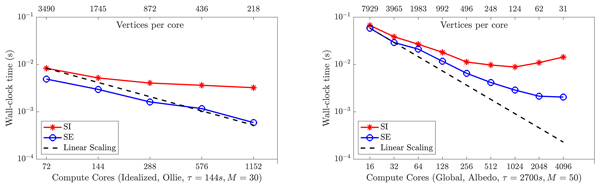
Tridib Banerjee, Patrick Scholz, Sergey Danilov, Knut Klingbeil, and Dmitry Sidorenko
Geosci. Model Dev., 17, 7051–7065, https://doi.org/10.5194/gmd-17-7051-2024, https://doi.org/10.5194/gmd-17-7051-2024, 2024
Short summary
Short summary
In this paper we propose a new alternative to one of the functionalities of the sea ice model FESOM2. The alternative we propose allows the model to capture and simulate fast changes in quantities like sea surface elevation more accurately. We also demonstrate that the new alternative is faster and more adept at taking advantages of highly parallelized computing infrastructure. We therefore show that this new alternative is a great addition to the sea ice model FESOM2.
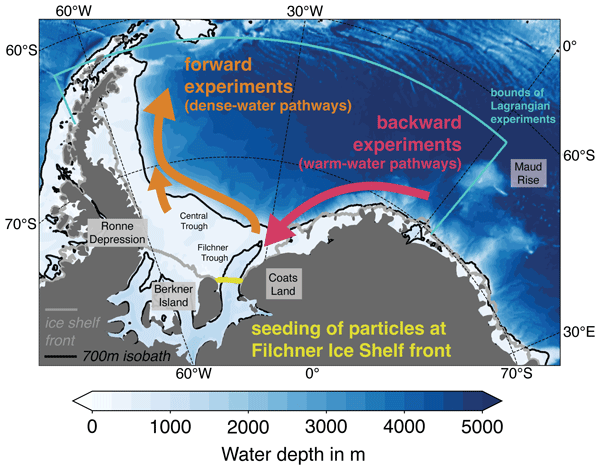
Cara Nissen, Ralph Timmermann, Mathias van Caspel, and Claudia Wekerle
Ocean Sci., 20, 85–101, https://doi.org/10.5194/os-20-85-2024, https://doi.org/10.5194/os-20-85-2024, 2024
Short summary
Short summary
The southeastern Weddell Sea is important for global ocean circulation due to the cross-shelf-break exchange of Dense Shelf Water and Warm Deep Water, but their exact circulation pathways remain elusive. Using Lagrangian model experiments in an eddy-permitting ocean model, we show how present circulation pathways and transit times of these water masses on the continental shelf are altered by 21st-century climate change, which has implications for local ice-shelf basal melt rates and ecosystems.
Marvin Lorenz and Ulf Gräwe
Ocean Sci., 19, 1753–1771, https://doi.org/10.5194/os-19-1753-2023, https://doi.org/10.5194/os-19-1753-2023, 2023
Short summary
Short summary
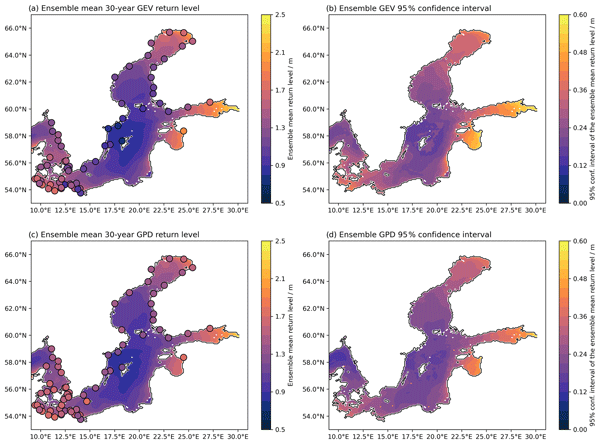
We study the variability of extreme sea levels in a 13 member hindcast ensemble for the Baltic Sea. The ensemble mean shows good agreement with observations regarding return levels and trends. However, we find great variability and uncertainty within the ensemble. We argue that the variability of storms in the atmospheric data directly translates into the variability of the return levels. These results highlight the need for large regional ensembles to minimise uncertainties.
Joshua Kiesel, Marvin Lorenz, Marcel König, Ulf Gräwe, and Athanasios T. Vafeidis
Nat. Hazards Earth Syst. Sci., 23, 2961–2985, https://doi.org/10.5194/nhess-23-2961-2023, https://doi.org/10.5194/nhess-23-2961-2023, 2023
Short summary
Short summary
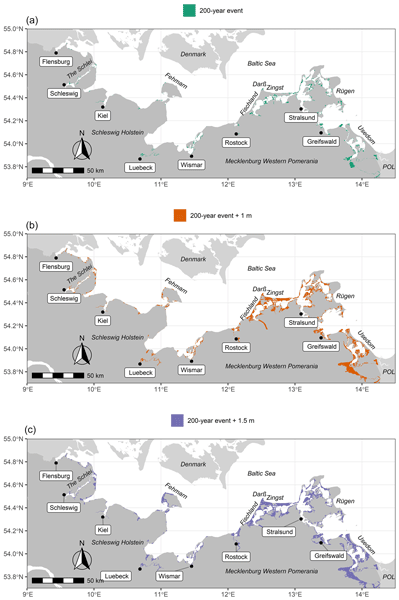
Among the Baltic Sea littoral states, Germany is anticipated to experience considerable damage as a result of increased coastal flooding due to sea-level rise (SLR). Here we apply a new modelling framework to simulate how flooding along the German Baltic Sea coast may change until 2100 if dikes are not upgraded. We find that the study region is highly exposed to flooding, and we emphasise the importance of current plans to update coastal protection in the future.
Pia Kolb, Anna Zorndt, Hans Burchard, Ulf Gräwe, and Frank Kösters
Ocean Sci., 18, 1725–1739, https://doi.org/10.5194/os-18-1725-2022, https://doi.org/10.5194/os-18-1725-2022, 2022
Short summary
Short summary
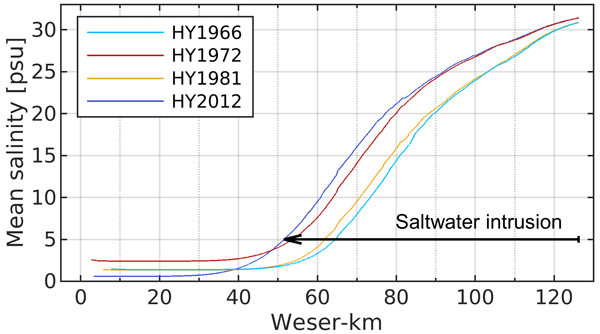
River engineering measures greatly changed tidal dynamics in the Weser estuary. We studied the effect on saltwater intrusion with numerical models. Our analysis shows that a deepening of the navigation channel causes saltwater to intrude further into the Weser estuary. This effect is mostly masked by the natural variability of river discharge. In our study, it proved essential to recalibrate individual hindcast models due to differences in sediments, bed forms, and underlying bathymetric data.
Vera Fofonova, Tuomas Kärnä, Knut Klingbeil, Alexey Androsov, Ivan Kuznetsov, Dmitry Sidorenko, Sergey Danilov, Hans Burchard, and Karen Helen Wiltshire
Geosci. Model Dev., 14, 6945–6975, https://doi.org/10.5194/gmd-14-6945-2021, https://doi.org/10.5194/gmd-14-6945-2021, 2021
Short summary
Short summary
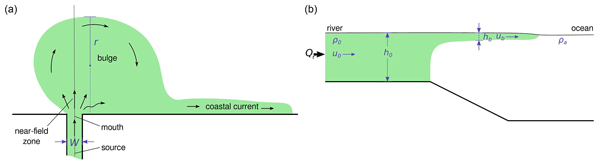
We present a test case of river plume spreading to evaluate coastal ocean models. Our test case reveals the level of numerical mixing (due to parameterizations used and numerical treatment of processes in the model) and the ability of models to reproduce complex dynamics. The major result of our comparative study is that accuracy in reproducing the analytical solution depends less on the type of applied model architecture or numerical grid than it does on the type of advection scheme.
Qiang Wang, Sergey Danilov, Longjiang Mu, Dmitry Sidorenko, and Claudia Wekerle
The Cryosphere, 15, 4703–4725, https://doi.org/10.5194/tc-15-4703-2021, https://doi.org/10.5194/tc-15-4703-2021, 2021
Short summary
Short summary
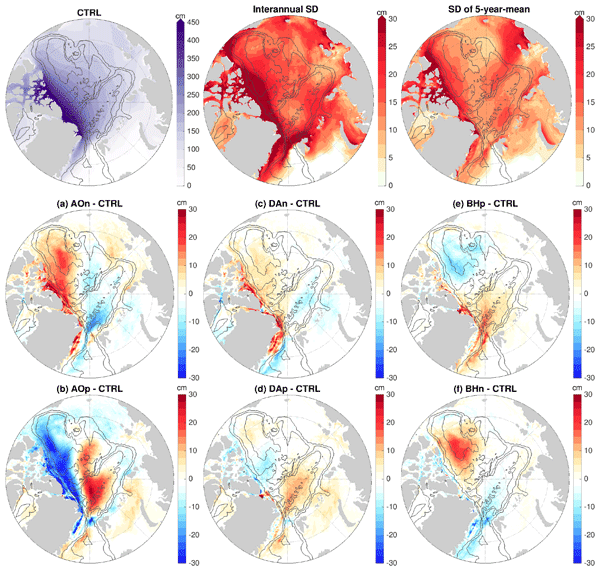
Using simulations, we found that changes in ocean freshwater content induced by wind perturbations can significantly affect the Arctic sea ice drift, thickness, concentration and deformation rates years after the wind perturbations. The impact is through changes in sea surface height and surface geostrophic currents and the most pronounced in warm seasons. Such a lasting impact might become stronger in a warming climate and implies the importance of ocean initialization in sea ice prediction.
Cited articles
Alley, K. E., Scambos, T. A., Siegfried, M. R., and Fricker, H. A.: Impacts of Warm Water on Antarctic Ice Shelf Stability through Basal Channel Formation, Nat. Geosci., 9, https://doi.org/10.1038/ngeo2675, 2016. a, b
Arneborg, L., Fiekas, V., Umlauf, L., and Burchard, H.: Gravity Current Dynamics and Entrainment – A Process Study Based on Observations in the Arkona Basin, J. Phys. Oceanogr., 37, https://doi.org/10.1175/JPO3110.1, 2007. a
Böning, C. W., Behrens, E., Biastoch, A., Getzlaff, K., and Bamber, J. L.: Emerging impact of Greenland meltwater on deepwater formation in the North Atlantic Ocean, Nat. Geosci., 9, 523–527, 2016. a
Brown, K. A., Holding, J. M., and Carmack, E. C.: Understanding Regional and Seasonal Variability Is Key to Gaining a Pan-Arctic Perspective on Arctic Ocean Freshening, Front. Mar. Sci., 7, https://doi.org/10.3389/fmars.2020.00606, 2020. a
Burchard, H. and Beckers, J.-M.: Non-Uniform Adaptive Vertical Grids in One-Dimensional Numerical Ocean Models, Ocean Model., 6, https://doi.org/10.1016/S1463-5003(02)00060-4, 2004. a, b, c
Burchard, H. and Bolding, K.: GETM – A General Estuarine Transport Model, Tech. Rep. EUR 20253 EN, European Commission, https://publications.jrc.ec.europa.eu/repository/handle/JRC23237 (last access: 14 August 2026), 2002. a
Burchard, H., Bolding, K., and Villarreal, M. R.: GOTM, a General Ocean Turbulence Model: Theory, Implementation and Test Cases, Space Applications Institute, Tech. Rep. EUR 18745 EN, https://op.europa.eu/publication-detail/-/publication/5b512e12-367d-11ea-ba6e-01aa75ed71a1 (last access: 14 August 2026), 1999. a, b
Burchard, H., Lange, X., Klingbeil, K., and MacCready, P.: Mixing Estimates for Estuaries, J. Phys. Oceanogr., 49, https://doi.org/10.1175/JPO-D-18-0147.1, 2019. a
Burchard, H., Klingbeil, K., Lange, X., Li, X., Lorenz, M., MacCready, P., and Reese, L.: The Relation between Exchange Flow and Diahaline Mixing in Estuaries, J. Phys. Oceanogr., 55, https://doi.org/10.1175/JPO-D-24-0105.1, 2025. a, b
Carroll, D., Sutherland, D. A., Shroyer, E. L., Nash, J. D., Catania, G. A., and Stearns, L. A.: Subglacial Discharge-Driven Renewal of Tidewater Glacier Fjords, J. Geophys. Res.-Ocean., 122, https://doi.org/10.1002/2017JC012962, 2017. a
Chartrand, A. M., Howat, I. M., Joughin, I. R., and Smith, B. E.: Thwaites Glacier Thins and Retreats Fastest Where Ice-Shelf Channels Intersect Its Grounding Zone, The Cryosphere, 18, https://doi.org/10.5194/tc-18-4971-2024, 2024. a
Christmann, J., Helm, V., Khan, S. A., Kleiner, T., Müller, R., Morlighem, M., Neckel, N., Rückamp, M., Steinhage, D., Zeising, O., and Humbert, A.: Elastic Deformation Plays a Non-Negligible Role in Greenland's Outlet Glacier Flow, Commun. Earth Environ., 2, https://doi.org/10.1038/s43247-021-00296-3, 2021. a
Dinniman, M. S., Klinck, J. M., and Smith Jr., W. O.: Influence of Sea Ice Cover and Icebergs on Circulation and Water Mass Formation in a Numerical Circulation Model of the Ross Sea, Antarctica, J. Geophys. Res.-Ocean., 112, https://doi.org/10.1029/2006JC004036, 2007. a
Döös, K., Nilsson, J., Nycander, J., Brodeau, L., and Ballarotta, M.: The World Ocean Thermohaline Circulation, J. Phys. Oceanogr., 42, 1445–1460, https://doi.org/10.1175/JPO-D-11-0163.1, 2012. a, b
Ferrari, R. and Polzin, K. L.: Finescale Structure of the T–S Relation in the Eastern North Atlantic, J. Phys. Oceanogr., 35, https://doi.org/10.1175/JPO2763.1, 2005. a
Gade, H. G.: Melting of Ice in Sea Water: A Primitive Model with Application to the Antarctic Ice Shelf and Icebergs, J. Phys. Oceanogr., 9, https://doi.org/10.1175/1520-0485(1979)009<0189:MOIISW>2.0.CO;2, 1979. a
Groeskamp, S., Griffies, S. M., Iudicone, D., Marsh, R., Nurser, A. G., and Zika, J. D.: The water mass transformation framework for ocean physics and biogeochemistry, Ann. Rev. Mar. Sci., 11, 271–305, https://doi.org/10.1146/annurev-marine-010318-095421, 2019. a
Grosfeld, K., Gerdes, R., and Determann, J.: Thermohaline Circulation and Interaction between Ice Shelf Cavities and the Adjacent Open Ocean, J. Geophys. Res.-Ocean., 102, https://doi.org/10.1029/97JC00891, 1997. a
Gwyther, D. E., Kusahara, K., Asay-Davis, X. S., Dinniman, M. S., and Galton-Fenzi, B. K.: Vertical Processes and Resolution Impact Ice Shelf Basal Melting: A Multi-Model Study, Ocean Model., 147, https://doi.org/10.1016/j.ocemod.2020.101569, 2020. a
Hellmer, H. H. and Olbers, D. J.: A Two-Dimensional Model for the Thermohaline Circulation under an Ice Shelf, Antarct. Sci., 1, https://doi.org/10.1017/S0954102089000490, 1989. a
Henell, E., Burchard, H., Gräwe, U., and Klingbeil, K.: Spatial Composition of the Diahaline Overturning Circulation in a Fjord–Type, Non–Tidal Estuarine System, J. Geophys. Res.-Ocean., 128, https://doi.org/10.1029/2023JC019862, 2023. a
Hieronymus, M., Nilsson, J., and Nycander, J.: Water mass transformation in salinity–temperature space, J. Phys. Oceanogr., 44, 2547–2568, https://doi.org/10.1175/JPO-D-13-0257.1, 2014. a
Hofmeister, R., Burchard, H., and Beckers, J.-M.: Non-Uniform Adaptive Vertical Grids for 3D Numerical Ocean Models, Ocean Model., 33, https://doi.org/10.1016/j.ocemod.2009.12.003, 2010. a, b, c, d
Holland, D. M. and Jenkins, A.: Modeling Thermodynamic Ice–Ocean Interactions at the Base of an Ice Shelf, J. Phys. Oceanogr., 29, https://doi.org/10.1175/1520-0485(1999)029<1787:MTIOIA>2.0.CO;2, 1999. a
Huang, R. X.: Real Freshwater Flux as a Natural Boundary Condition for the Salinity Balance and Thermohaline Circulation Forced by Evaporation and Precipitation, J. Phys. Oceanogr., 23, https://doi.org/10.1175/1520-0485(1993)023<2428:RFFAAN>2.0.CO;2, 1993. a
Jenkins, A.: The Impact of Melting Ice on Ocean Waters, J. Phys. Oceanogr., 29, https://doi.org/10.1175/1520-0485(1999)029<2370:TIOMIO>2.0.CO;2, 1999. a
Kanzow, T., Humbert, A., Mölg, T., Scheinert, M., Braun, M., Burchard, H., Doglioni, F., Hochreuther, P., Horwath, M., Huhn, O., Kappelsberger, M., Kusche, J., Loebel, E., Lutz, K., Marzeion, B., McPherson, R., Mohammadi-Aragh, M., Möller, M., Pickler, C., Reinert, M., Rhein, M., Rückamp, M., Schaffer, J., Shafeeque, M., Stolzenberger, S., Timmermann, R., Turton, J., Wekerle, C., and Zeising, O.: The system of atmosphere, land, ice and ocean in the region near the 79N Glacier in northeast Greenland: synthesis and key findings from the Greenland Ice Sheet–Ocean Interaction (GROCE) experiment, The Cryosphere, 19, 1789–1824, https://doi.org/10.5194/tc-19-1789-2025, 2025. a, b, c, d, e
Khan, S. A., Choi, Y., Morlighem, M., Rignot, E., Helm, V., Humbert, A., Mouginot, J., Millan, R., Kjær, K. H., and Bjørk, A. A.: Extensive inland thinning and speed-up of Northeast Greenland Ice Stream, Nature, 611, 727–732, https://doi.org/10.1038/s41586-022-05301-z, 2022. a
Klingbeil, K.: Source code for the coastal ocean model GETM (glacial_ice branch), Zenodo [software], https://doi.org/10.5281/zenodo.17201289, 2024. a
Klingbeil, K. and Burchard, H.: Implementation of a Direct Nonhydrostatic Pressure Gradient Discretisation into a Layered Ocean Model, Ocean Model., 65, https://doi.org/10.1016/j.ocemod.2013.02.002, 2013. a
Knudsen, M.: Ein hydrographischer Lehrsatz, Annalen der Hydrographie und Maritimen Meteorologie, 28, 316–320, 1900. a
Larter, R. D.: Basal Melting, Roughness and Structural Integrity of Ice Shelves, Geophys. Res. Lett., 49, https://doi.org/10.1029/2021GL097421, 2022. a
Li, X., Chrysagi, E., Klingbeil, K., and Burchard, H.: Impact of Islands on Tidally Dominated River Plumes: A High-Resolution Modeling Study, J. Geophys. Res.-Ocean., 129, https://doi.org/10.1029/2023JC020272, 2024. a
Lindeman, M. R., Straneo, F., Wilson, N. J., Toole, J. M., Krishfield, R. A., Beaird, N. L., Kanzow, T., and Schaffer, J.: Ocean Circulation and Variability Beneath Nioghalvfjerdsbræ (79 North Glacier) Ice Tongue, J. Geophys. Res.-Ocean., 125, https://doi.org/10.1029/2020JC016091, 2020. a, b
Lorenz, M., Klingbeil, K., MacCready, P., and Burchard, H.: Numerical issues of the Total Exchange Flow (TEF) analysis framework for quantifying estuarine circulation, Ocean Sci., 15, 601–614, https://doi.org/10.5194/os-15-601-2019, 2019. a, b, c, d
Lorenz, M., Klingbeil, K., and Burchard, H.: Numerical Study of the Exchange Flow of the Persian Gulf Using an Extended Total Exchange Flow Analysis Framework, J. Geophys. Res.-Ocean., 125, https://doi.org/10.1029/2019JC015527, 2020. a, b, c
Lorenz, M., Klingbeil, K., and Burchard, H.: Diahaline Overturning and Mixing in a Semi-Enclosed Marginal Sea With Excess Evaporation, Geophys. Res. Lett., 52, https://doi.org/10.1029/2025GL116434, 2025. a
Losch, M.: Modeling Ice Shelf Cavities in a z Coordinate Ocean General Circulation Model, J. Geophys. Res.-Ocean., 113, https://doi.org/10.1029/2007JC004368, 2008. a
MacCready, P.: Calculating Estuarine Exchange Flow Using Isohaline Coordinates, J. Phys. Oceanogr., 41, https://doi.org/10.1175/2011JPO4517.1, 2011. a
MacCready, P., Geyer, W. R., and Burchard, H.: Estuarine Exchange Flow Is Related to Mixing through the Salinity Variance Budget, J. Phys. Oceanogr., 48, https://doi.org/10.1175/JPO-D-17-0266.1, 2018. a
Malyarenko, A., Robinson, N. J., Williams, M. J. M., and Langhorne, P. J.: A Wedge Mechanism for Summer Surface Water Inflow Into the Ross Ice Shelf Cavity, J. Geophys. Res.-Ocean., 124, https://doi.org/10.1029/2018JC014594, 2019. a
Mankoff, K. D., Noël, B., Fettweis, X., Ahlstrøm, A. P., Colgan, W., Kondo, K., Langley, K., Sugiyama, S., van As, D., and Fausto, R. S.: Greenland liquid water discharge from 1958 through 2019, Earth Syst. Sci. Data, 12, 2811–2841, https://doi.org/10.5194/essd-12-2811-2020, 2020a. a, b
Mankoff, K. D., Solgaard, A., Colgan, W., Ahlstrøm, A. P., Khan, S. A., and Fausto, R. S.: Greenland Ice Sheet solid ice discharge from 1986 through March 2020, Earth Syst. Sci. Data, 12, 1367–1383, https://doi.org/10.5194/essd-12-1367-2020, 2020b. a
Mayer, C., Reeh, N., Jung-Rothenhäusler, F., Huybrechts, P., and Oerter, H.: The Subglacial Cavity and Implied Dynamics under Nioghalvfjerdsfjorden Glacier, NE-Greenland, Geophys. Res. Lett., 27, https://doi.org/10.1029/2000GL011514, 2000. a, b
Mayer, C., Schaffer, J., Hattermann, T., Floricioiu, D., Krieger, L., Dodd, P. A., Kanzow, T., Licciulli, C., and Schannwell, C.: Large Ice Loss Variability at Nioghalvfjerdsfjorden Glacier, Northeast-Greenland, Nat. Commun, 9., https://doi.org/10.1038/s41467-018-05180-x, 2018. a
Millan, R., Jager, E., Mouginot, J., Wood, M., Larsen, S., Mathiot, P., Jourdain, N., and Bjørk, A.: Dataset supporting “Rapid Disintegration and Weakening of Ice Shelves in North Greenland”, Zenodo, https://doi.org/10.5281/zenodo.8354794, dataset, 2023a. a
Mohammadi-Aragh, M., Zeising, O., Reinert, M., Klingbeil, K., Humbert, A., McPherson, R., Morlighem, M., Timmermann, R., Wekerle, C., and Burchard, H.: Impact of Ice Topography, Basal Channels and Subglacial Discharge on Basal Melting Under the Floating Ice Tongue of 79N Glacier, Northeast Greenland, J. Adv. Model. Earth Sy., 17, https://doi.org/10.1029/2024MS004735, 2025. a, b, c, d, e, f, g, h, i, j, k
Morlighem, M., Williams, C. N., Rignot, E., An, L., Arndt, J. E., Bamber, J. L., Catania, G., Chauché, N., Dowdeswell, J. A., Dorschel, B., Fenty, I., Hogan, K., Howat, I., Hubbard, A., Jakobsson, M., Jordan, T. M., Kjeldsen, K. K., Millan, R., Mayer, L., Mouginot, J., Noël, B. P. Y., O'Cofaigh, C., Palmer, S., Rysgaard, S., Seroussi, H., Siegert, M. J., Slabon, P., Straneo, F., van den Broeke, M. R., Weinrebe, W., Wood, M., and Zinglersen, K. B.: BedMachine v3: Complete Bed Topography and Ocean Bathymetry Mapping of Greenland From Multibeam Echo Sounding Combined With Mass Conservation, Geophys. Res. Lett., 44, https://doi.org/10.1002/2017GL074954, 2017. a, b
Morlighem, M., Williams, C., Rignot, E., An, L., Arndt, J. E., Bamber, J., Catania, G., Chauché, N., Dowdeswell, J. A., Dorschel, B., Fenty, I., Hogan, K., Howat, I., Hubbard, A., Jakobsson, M., Jordan, T. M., Kjeldsen, K. K., Millan, R., Mayer, L., Mouginot, J., Noël, B., O'Cofaigh, C., Palmer, S. J., Rysgaard, S., Seroussi, H., Siegert, M. J., Slabon, P., Straneo, F., van den Broeke, M. R., Weinrebe, W., Wood, M., and Zinglersen, K.: IceBridge BedMachine Greenland, Version 5, NASA National Snow and Ice Data Center Distributed Active Archive Center, Boulder, Colorado, USA, https://doi.org/10.5067/gmevbwflwa7x, 2022. a
Mouginot, J., Rignot, E., Scheuchl, B., Fenty, I., Khazendar, A., Morlighem, M., Buzzi, A., and Paden, J.: Fast Retreat of Zachariæ Isstrøm, Northeast Greenland, Science, 350, https://doi.org/10.1126/science.aac7111, 2015. a, b
Mouginot, J., Rignot, E., Bjørk, A. A., van den Broeke, M., Millan, R., Morlighem, M., Noël, B., Scheuchl, B., and Wood, M.: Forty-six years of Greenland Ice Sheet mass balance from 1972 to 2018, P. Natl. Acad. Sci. USA, 116, 9239–9244, https://doi.org/10.1073/pnas.1904242116, 2019. a
Münchow, A., Schaffer, J., and Kanzow, T.: Ocean Circulation Connecting Fram Strait to Glaciers off Northeast Greenland: Mean Flows, Topographic Rossby Waves, and Their Forcing, J. Phys. Oceanogr., 50, https://doi.org/10.1175/JPO-D-19-0085.1, 2020. a
Narkevic, A., Csatho, B., and Schenk, T.: Rapid Basal Channel Growth Beneath Greenland's Longest Floating Ice Shelf, Geophys. Res. Lett., 50, https://doi.org/10.1029/2023GL103226, 2023. a, b, c
Nilsson, J., van Dongen, E., Jakobsson, M., O'Regan, M., and Stranne, C.: Hydraulic suppression of basal glacier melt in sill fjords, The Cryosphere, 17, 2455–2476, https://doi.org/10.5194/tc-17-2455-2023, 2023. a, b, c
Reinert, M.: Output Files of the 3D Model of the 79NG Fjord, Zenodo [data set], https://doi.org/10.5281/zenodo.21107642, 2026a. a
Reinert, M.: 79NG Fjord Model in GETM, Zenodo [software], https://doi.org/10.5281/zenodo.21207449, 2026b. a
Reinert, M., Lorenz, M., Klingbeil, K., Büchmann, B., and Burchard, H.: High-Resolution Simulations of the Plume Dynamics in an Idealized 79° N Glacier Cavity Using Adaptive Vertical Coordinates, J. Adv. Model. Earth Sy., 15, https://doi.org/10.1029/2023MS003721, 2023. a, b, c, d, e, f, g, h, i, j, k, l, m, n, o, p, q, r, s, t
Richter, O., Gwyther, D. E., King, M. A., and Galton-Fenzi, B. K.: The impact of tides on Antarctic ice shelf melting, The Cryosphere, 16, 1409–1429, https://doi.org/10.5194/tc-16-1409-2022, 2022. a
Rignot, E. and Steffen, K.: Channelized Bottom Melting and Stability of Floating Ice Shelves, Geophys. Res. Lett., 35, https://doi.org/10.1029/2007GL031765, 2008. a, b
Schaffer, J., Timmermann, R., Arndt, J. E., Rosier, S. H. R., Anker, P. G. D., Callard, S. L., Davis, P. E. D., Dorschel, B., Grob, H., Hattermann, T., Hofstede, C. M., Kanzow, T., Kappelsberger, M., Lloyd, J. M., Ó'Cofaigh, C., and Roberts, D. H.: An Update to Greenland and Antarctic Ice Sheet Topography, Cavity Geometry, and Global Bathymetry (RTopo-2.0.4), Supplement to: Schaffer, J., Kanzow, T., von Appen, W.-J., von Albedyll, L., Arndt, J. E., Roberts, D. H., Bathymetry constrains ocean heat supply to Greenland's largest glacier tongue, Nat. Geosci., 13, 227–231, https://doi.org/10.1038/s41561-019-0529-x, 2019. a, b
Schaffer, J., Kanzow, T., von Appen, W.-J., von Albedyll, L., Arndt, J. E., and Roberts, D. H.: Bathymetry Constrains Ocean Heat Supply to Greenland's Largest Glacier Tongue, Nat. Geosci., 13, https://doi.org/10.1038/s41561-019-0529-x, 2020. a, b, c, d, e, f, g, h, i, j, k, l, m, n, o, p, q, r, s, t, u, v, w
Sergienko, O. V.: Basal Channels on Ice Shelves, J. Geophys. Res.-Ea. Surf., 118, https://doi.org/10.1002/jgrf.20105, 2013. a, b, c
Sneed, W. A. and Hamilton, G. S.: Recent Changes in the Norske Øer Ice Barrier, Coastal Northeast Greenland, Ann. Glaciol., 57, https://doi.org/10.1017/aog.2016.21, 2016. a, b, c
Straneo, F. and Cenedese, C.: The Dynamics of Greenland's Glacial Fjords and Their Role in Climate, Annu. Rev. Mar. Sci., 7, https://doi.org/10.1146/annurev-marine-010213-135133, 2015. a, b, c
Straneo, F. and Heimbach, P.: North Atlantic Warming and the Retreat of Greenland's Outlet Glaciers, Nature, 504, https://doi.org/10.1038/nature12854, 2013. a
Timmermann, R., Wang, Q., and Hellmer, H. H.: Ice-Shelf Basal Melting in a Global Finite-Element Sea-Ice/Ice-Shelf/Ocean Model, Ann. Glaciol., 53, https://doi.org/10.3189/2012AoG60A156, 2012. a
Turton, J. V., Mölg, T., and As, D. V.: Atmospheric Processes and Climatological Characteristics of the 79N Glacier (Northeast Greenland), Mon. Weather Rev., 147, https://doi.org/10.1175/MWR-D-18-0366.1, 2019. a
Umlauf, L. and Burchard, H.: Second-Order Turbulence Closure Models for Geophysical Boundary Layers. A Review of Recent Work, Cont. Shelf Res., 25, https://doi.org/10.1016/j.csr.2004.08.004, 2005. a, b
von Albedyll, L., Schaffer, J., and Kanzow, T.: Ocean Variability at Greenland's Largest Glacier Tongue Linked to Continental Shelf Circulation, J. Geophys. Res.-Ocean., 126, https://doi.org/10.1029/2020JC017080, 2021. a, b, c, d
Wåhlin, A. K., Steiger, N., Darelius, E., Assmann, K. M., Glessmer, M. S., Ha, H. K., Herraiz-Borreguero, L., Heuzé, C., Jenkins, A., Kim, T. W., Mazur, A. K., Sommeria, J., and Viboud, S.: Ice Front Blocking of Ocean Heat Transport to an Antarctic Ice Shelf, Nature, 578, https://doi.org/10.1038/s41586-020-2014-5, 2020. a
Walin, G.: A theoretical framework for the description of estuaries, Tellus, 29, 128–136, https://doi.org/10.1111/j.2153-3490.1977.tb00716.x, 1977. a
Walin, G.: On the relation between sea-surface heat flow and thermal circulation in the ocean, Tellus, 34, 187–195, https://doi.org/10.1111/j.2153-3490.1982.tb01806.x, 1982. a
Wang, G., Ke, C.-Q., Fan, Y., Shen, X., Nourani, V., Sankaran, A., Mehr, A. D., and Popov, S. V.: Accelerated Basal Melt Rates of Ice Shelves in North Greenland From 2013 to 2022 Estimated With the High-Resolution ArcticDEM, J. Geophys. Res.-Ocean., 129, https://doi.org/10.1029/2024JC021509, 2024. a, b, c
Wekerle, C., Wang, Q., von Appen, W.-J., Danilov, S., Schourup-Kristensen, V., and Jung, T.: Eddy-Resolving Simulation of the Atlantic Water Circulation in the Fram Strait With Focus on the Seasonal Cycle, J. Geophys. Res.-Ocean., 122, https://doi.org/10.1002/2017JC012974, 2017. a
Wekerle, C., McPherson, R., von Appen, W.-J., Wang, Q., Timmermann, R., Scholz, P., Danilov, S., Shu, Q., and Kanzow, T.: Atlantic Water Warming Increases Melt below Northeast Greenland's Last Floating Ice Tongue, Nat. Commun., 15, https://doi.org/10.1038/s41467-024-45650-z, 2024. a, b, c, d, e, f, g, h, i, j, k, l, m
Wiskandt, J., Koszalka, I. M., Nelsone, L., and Nilsson, J.: Marine Melt in Three Dimensional Greenlandic Sill Fjord Simulations, J. Glaciol., 71, https://doi.org/10.1017/jog.2025.10073, 2025a. a, b
Wiskandt, J., Nilsson, J., and Koszalka, I. M.: Hydraulic Control of Submarine Glacial Melt in Greenlandic Fjords, J. Geophys. Res.-Ocean., 130, https://doi.org/10.1029/2024JC021257, 2025b. a, b, c, d
Zeising, O., Neckel, N., Dörr, N., Helm, V., Steinhage, D., Timmermann, R., and Humbert, A.: Extreme melting at Greenland's largest floating ice tongue, The Cryosphere, 18, 1333–1357, https://doi.org/10.5194/tc-18-1333-2024, 2024. a, b, c, d
Zika, J. D., England, M. H., and Sijp, W. P.: The Ocean Circulation in Thermohaline Coordinates, J. Phys. Oceanogr., 42, 708–724, https://doi.org/10.1175/JPO-D-11-0139.1, 2012. a, b
Short summary
The Greenland Ice Sheet is an important contributor to global sea level rise. In northern Greenland, floating glacier tongues are primarily melted by ocean currents. These processes are difficult to observe, so we developed a realistic numerical model to study ocean-driven melting at Greenland's largest floating ice tongue, the 79° North Glacier. Our simulation reveals the details of the oceanic currents bringing warm water toward the ice base, melting and shaping the glacier tongue from below.
The Greenland Ice Sheet is an important contributor to global sea level rise. In northern...


