
Articles | Volume 20, issue 5
https://doi.org/10.5194/tc-20-3151-2026
© Author(s) 2026. This work is distributed under
the Creative Commons Attribution 4.0 License.
the Creative Commons Attribution 4.0 License.
https://doi.org/10.5194/tc-20-3151-2026
© Author(s) 2026. This work is distributed under
the Creative Commons Attribution 4.0 License.
the Creative Commons Attribution 4.0 License.
Research article
| 
29 May 2026
Research article |
| 29 May 2026
| 29 May 2026
Increasing precipitation due to climate change could partially offset the impact of warming on glacier loss in the monsoon-influenced Himalaya until 2100 CE
Anya M. Schlich-Davies
Priestley International Centre for Climate, School of Earth and Environment, University of Leeds, Leeds, UK

Department of Earth Science, University of Bergen and Bjerknes Centre for Climate Research, Bergen, Norway
Andrew N. Ross
Priestley International Centre for Climate, School of Earth and Environment, University of Leeds, Leeds, UK
Duncan J. Quincey
School of Geography, University of Leeds, Leeds, UK
Vivi K. Pedersen
Department of Geoscience, Aarhus University, Aarhus C, Denmark
Related authors
No articles found.
Léa Rodari, Audrey Margirier, Ann V. Rowan, Christoph Schmidt, Remy Veness, Charlotte S. Curry, Alex C. Scoffield, Christiaan R. Diemont, Faye Perchanok, Guillaume Jouvet, Vivi Pedersen, Derek Fabel, and Georgina E. King
EGUsphere, https://doi.org/10.5194/egusphere-2026-1536, https://doi.org/10.5194/egusphere-2026-1536, 2026
Short summary
Short summary
By combining innovative dating techniques and glacier modelling, we studied how sediment is produced, transported, and stored within the Mer de Glace catchment in the French Alps. We show that whilst sediment is transported through the glacier in less than a millennium, some sediment can be stored for many thousands of years before being re-entrained into glacial transport. This long-term storage affects how landscapes evolve and how climate signals are preserved during deglaciation.
William J. Dow, Amanda C. Maycock, Andrew N. Ross, Ryan S. Williams, and Thomas J. Bracegirdle
EGUsphere, https://doi.org/10.5194/egusphere-2026-1179, https://doi.org/10.5194/egusphere-2026-1179, 2026
Short summary
Short summary
This study aims to advance understanding of the atmospheric drivers of extreme warm days across the Antarctic Peninsula during summer. We find that these days are linked to a range of large-scale atmospheric circulation patterns. Using a statistical method, we grouped similar events and compared their wind, temperature and pressure features, showing clear differences spatially and temporally. Understanding these dynamics improves understanding of the processes that drive these extreme events.

Sunil N. Oulkar, Matthew W. Peacey, Michael Mitrev, Duncan J. Quincey, Bryn Hubbard, Tom Matthews, Ankita S. Oulkar, Katie E. Miles, and Ann V. Rowan
Geosci. Instrum. Method. Data Syst., 15, 75–88, https://doi.org/10.5194/gi-15-75-2026, https://doi.org/10.5194/gi-15-75-2026, 2026
Short summary
Short summary
We designed and tested a system that can record and send data in near real time from extreme and remote locations, such as Mount Everest. Using solar power and satellite communication, the system worked reliably at high altitude, showing it can be applied in other remote regions. This approach will help scientists collect vital information on how the environment is changing in areas that are normally very difficult to study.
Gustav Jungdal-Olesen, Jane Lund Andersen, Andreas Born, and Vivi Kathrine Pedersen
The Cryosphere, 18, 1517–1532, https://doi.org/10.5194/tc-18-1517-2024, https://doi.org/10.5194/tc-18-1517-2024, 2024
Short summary
Short summary
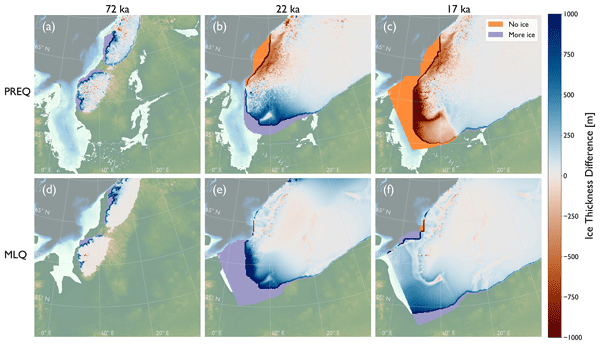
We explore how the shape of the land and underwater features in Scandinavia affected the former Scandinavian ice sheet over time. Using a computer model, we simulate how the ice sheet evolved during different stages of landscape development. We discovered that early glaciations were limited in size by underwater landforms, but as these changed, the ice sheet expanded more rapidly. Our findings highlight the importance of considering landscape changes when studying ice-sheet history.
Anna Wendleder, Jasmin Bramboeck, Jamie Izzard, Thilo Erbertseder, Pablo d'Angelo, Andreas Schmitt, Duncan J. Quincey, Christoph Mayer, and Matthias H. Braun
The Cryosphere, 18, 1085–1103, https://doi.org/10.5194/tc-18-1085-2024, https://doi.org/10.5194/tc-18-1085-2024, 2024
Short summary
Short summary
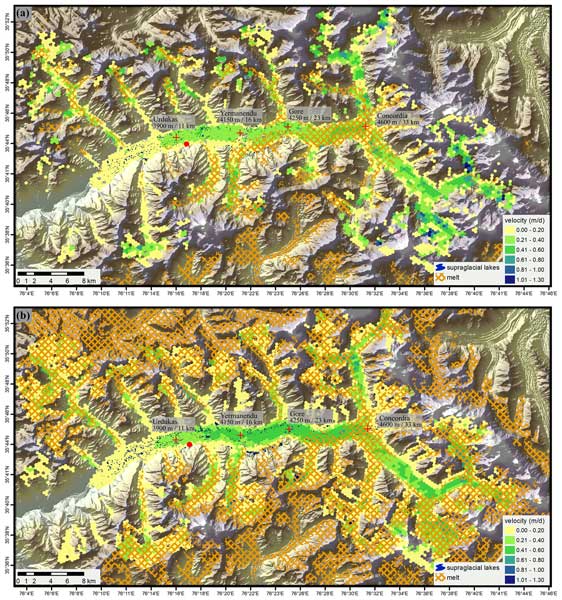
This study analyses the basal sliding and the hydrological drainage of Baltoro Glacier, Pakistan. The surface velocity was characterized by a spring speed-up, summer peak, and autumn speed-up. Snow melt has the largest impact on the spring speed-up, summer velocity peak, and the transition from inefficient to efficient drainage. Drainage from supraglacial lakes contributed to the fall speed-up. Increased summer temperatures will intensify the magnitude of meltwater and thus surface velocities.
Guanyu Li, Mingyang Lv, Duncan J. Quincey, Liam S. Taylor, Xinwu Li, Shiyong Yan, Yidan Sun, and Huadong Guo
The Cryosphere, 17, 2891–2907, https://doi.org/10.5194/tc-17-2891-2023, https://doi.org/10.5194/tc-17-2891-2023, 2023
Short summary
Short summary
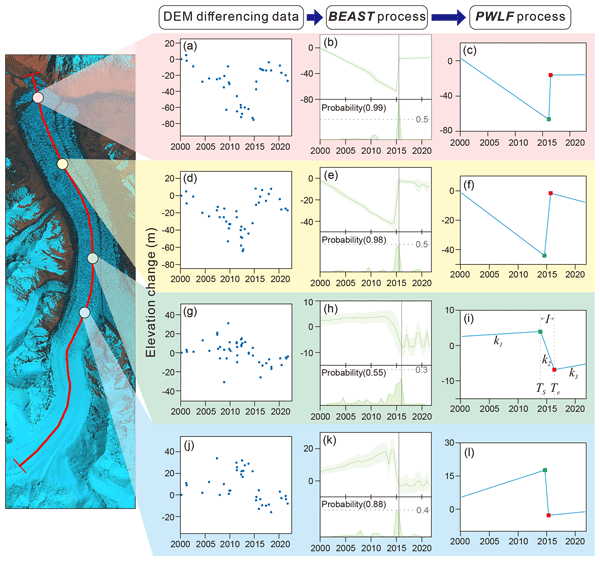
Kyagar Glacier in the Karakoram is well known for its surge history and its frequent blocking of the downstream valley, leading to a series of high-magnitude glacial lake outburst floods. Using it as a test bed, we develop a new approach for quantifying surge behaviour using successive digital elevation models. This method could be applied to other surge studies. Combined with the results from optical satellite images, we also reconstruct the surge process in unprecedented detail.
William Stanley Torgerson, Juliane Schwendike, Andrew Ross, and Chris Short
EGUsphere, https://doi.org/10.5194/egusphere-2023-1272, https://doi.org/10.5194/egusphere-2023-1272, 2023
Preprint archived
Short summary
Short summary
Two types of fluctuations were studied in Hurricane Irma (2017) using model simulations. The first type of fluctuation, the eyewall replacement cycle, has a Hurricane’s eyewall replaced by a second outer eyewall that develops further out. The other type of fluctuation has no replacement of the eyewall but a disruption to its structure instead.

William Torgerson, Juliane Schwendike, Andrew Ross, and Chris J. Short
Weather Clim. Dynam., 4, 331–359, https://doi.org/10.5194/wcd-4-331-2023, https://doi.org/10.5194/wcd-4-331-2023, 2023
Short summary
Short summary
We investigated intensity fluctuations that occurred during the rapid intensification of Hurricane Irma (2017) to understand their effects on the storm structure. Using high-resolution model simulations, we found that the fluctuations were caused by local regions of strong ascent just outside the eyewall that disrupted the storm, leading to a larger and more symmetrical storm eye. This alters the location and intensity of the strongest winds in the storm and hence the storm's impact.
Liam S. Taylor, Duncan J. Quincey, and Mark W. Smith
Nat. Hazards Earth Syst. Sci., 23, 329–341, https://doi.org/10.5194/nhess-23-329-2023, https://doi.org/10.5194/nhess-23-329-2023, 2023
Short summary
Short summary
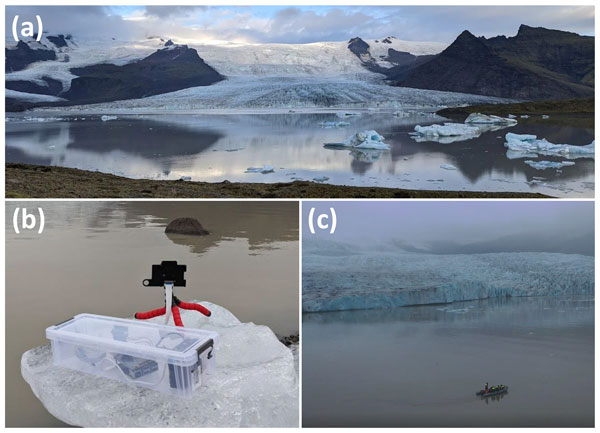
Hazards from glaciers are becoming more likely as the climate warms, which poses a threat to communities living beneath them. We have developed a new camera system which can capture regular, high-quality 3D models to monitor small changes in glaciers which could be indicative of a future hazard. This system is far cheaper than more typical camera sensors yet produces very similar quality data. We suggest that deploying these cameras near glaciers could assist in warning communities of hazards.
Christopher D. Stringer, Jonathan L. Carrivick, Duncan J. Quincey, and Daniel Nývlt
Earth Syst. Sci. Data Discuss., https://doi.org/10.5194/essd-2022-250, https://doi.org/10.5194/essd-2022-250, 2022
Revised manuscript not accepted
Short summary
Short summary
Glaciers in Antarctica have been decreasing in size at a fast rate, leading to the expansion of proglacial areas, with wide-ranging ecological implications. Several global land-cover maps exist, but they do not include Antarctica. We map land cover types across West Antarctica and the McMurdo Dry Valleys to a high degree of accuracy (77.0 %). We highlight the spatial variation in land cover and emphasise the need for more field data.
Gregoire Guillet, Owen King, Mingyang Lv, Sajid Ghuffar, Douglas Benn, Duncan Quincey, and Tobias Bolch
The Cryosphere, 16, 603–623, https://doi.org/10.5194/tc-16-603-2022, https://doi.org/10.5194/tc-16-603-2022, 2022
Short summary
Short summary
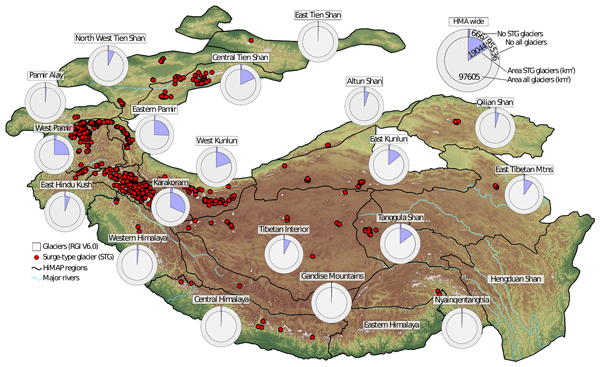
Surging glaciers show cyclical changes in flow behavior – between slow and fast flow – and can have drastic impacts on settlements in their vicinity.
One of the clusters of surging glaciers worldwide is High Mountain Asia (HMA).
We present an inventory of surging glaciers in HMA, identified from satellite imagery. We show that the number of surging glaciers was underestimated and that they represent 20 % of the area covered by glaciers in HMA, before discussing new physics for glacier surges.
Cited articles
Ageta, Y.: Characteristics of precipitation during monsoon season in Khumbu Himalaya, Seppyo, 38, 84–88, https://doi.org/10.5331/seppyo.38.Special_84 (last access: 18 May 2026), 1976.
Altena, B. and Kääb, A.: Ensemble matching of repeat satellite images applied to measure fast-changing ice flow, verified with mountain climber trajectories on Khumbu icefall, Mount Everest, J. Glaciol., 66, 905–915, https://doi.org/10.1017/jog.2020.66, 2020.
Anderson, L. S. and Anderson, R. S.: Modeling debris-covered glaciers: response to steady debris deposition, The Cryosphere, 10, 1105–1124, https://doi.org/10.5194/tc-10-1105-2016, 2016.
Arndt, A., Sauter, T., and Saß, B.: cryotools/cosipy: COSIPY v1.3 – An open-source coupled snowpack and ice surface energy and mass balance model (v1.3), Zenodo [code], https://doi.org/10.5281/zenodo.3902191, 2020.
Bartlett, O. T., Ng, F. S. L., and Rowan, A. V.: Morphology and evolution of supraglacial hummocks on debris-covered Himalayan glaciers, Earth Surf. Process. Landforms, 46, 525–539, https://doi.org/10.1002/esp.5043, 2021.
Benn, D. I. and Lehmkuhl, F.: Mass balance and equilibrium-line altitudes of glaciers in high-mountain environments, Quatern. Int., 65–66, 15–29, https://doi.org/10.1016/S1040-6182(99)00034-8, 2000.
Benn, D. I. and Owen, L. A.: The role of the Indian summer monsoon and the mid-latitude westerlies in Himalayan glaciation: review and speculative discussion, Journal of the Geological Society, 155, 353–363, https://doi.org/10.1144/gsjgs.155.2.0353, 1998.
Biemans, L. H., Speelman, F., Ludwig, E. J., Moors, A. J., Wiltshire, P., Kumar, D., Gerten, P., and Kabat, P.: Future water resources for food production in five South Asian river basins and potential for adaptation – A modeling study, Sci. Total Environ., https://doi.org/10.1016/j.scitotenv.2013.05.092, 2013.
Bollasina, M., Bertolani, L., and Tartari, G.: Meteorological observations at high altitude in the Khumbu Valley, Nepal Himalayas, 1994–1999, Bull. Glaciol. Res., 19, 1–11, https://www.seppyo.org/publication/bgr/archive/bgr_19_2002/attachment/bgr19p1/ (last access: 18 May 2026), 2002.
Bonekamp, P. N. J., Wanders, N., Wiel, K., Lutz, A. F., and Immerzeel, W. W.: Using large ensemble modelling to derive future changes in mountain specific climate indicators in a 2 and 3 °C warmer world in High Mountain Asia, Int. J. Climatol., 41, https://doi.org/10.1002/joc.6742, 2021.
Bookhagen, B. and Burbank, D. W.: Topography, relief, and TRMM-derived rainfall variations along the Himalaya, Geophys. Res. Lett., 33, L08405, https://doi.org/10.1029/2006GL026037, 2006.
Brock, B. W., Willis, I. C., and Sharp, M. J.: Measurement and parameterization of aerodynamic roughness length variations at Haut Glacier d'Arolla, Switzerland, J. Glaciol., 52, 281–297, https://doi.org/10.3189/172756506781828746, 2006.
Brun, F., King, O., Réveillet, M., Amory, C., Planchot, A., Berthier, E., Dehecq, A., Bolch, T., Fourteau, K., Brondex, J., Dumont, M., Mayer, C., Leinss, S., Hugonnet, R., and Wagnon, P.: Everest South Col Glacier did not thin during the period 1984–2017, The Cryosphere, 17, 3251–3268, https://doi.org/10.5194/tc-17-3251-2023, 2023.
Collins, M., Knutti, R., and Arblaster, J.: Long-term Climate Change: Projections, Commitments and Irreversibility, in: Climate Change 2013: The Physical Science Basis. Contribution of Working Group I to the Fifth Assessment Report of the Intergovernmental Panel on Climate Change, edited by: Stocker, T. F., Qin, D., Plattner, G.-K., Tignor, M., Allen, S. K., Boschung, J., Nauels, A., Xia, Y., Bex V., and Midgley, P. M., Cambridge University Press, Cambridge, United Kingdom and New York, NY, USA, 1–108, https://www.ipcc.ch/site/assets/uploads/2018/02/WG1AR5_Chapter12_FINAL.pdf (last access: 18 May 2026), 2013.
Compagno, L., Huss, M., Miles, E. S., McCarthy, M. J., Zekollari, H., Dehecq, A., Pellicciotti, F., and Farinotti, D.: Modelling supraglacial debris-cover evolution from the single-glacier to the regional scale: an application to High Mountain Asia, The Cryosphere, 16, 1697–1718, https://doi.org/10.5194/tc-16-1697-2022, 2022.
Cuffey, K. M. and Paterson, W. S. B.: The physics of glaciers, 4th edn., Academic Press, 704 pp., ISBN-10: 0-123694-61-2, ISBN-13: 978-0-123-69461-4, 2010.
Dehecq, A., Gourmelen, N., Gardner, A. S., Brun, F., Goldberg, D., Nienow, P. W., Berthier, E., Vincent, C., Wagnon, P., and Trouvé, E.: Twenty-first century glacier slowdown driven by mass loss in High Mountain Asia, Nat. Geosci., 12, 22–27, https://doi.org/10.1038/s41561-018-0271-9, 2019.
Egholm, D. L., Knudsen, M. F., Clark, C. D., and Lesemann, J. E.: Modeling the flow of glaciers in steep terrains: The integrated second-order shallow ice approximation (iSOSIA), J. Geophys. Res., 116, https://doi.org/10.1029/2010JF001900, 2011.
Farinotti, D., Huss, M., Fürst, J. J., Landmann, J., Machguth, H., Maussion, F., and Pandit, A.: A consensus estimate for the ice thickness distribution of all glaciers on Earth, Nat. Geosci., 12, 168–173, https://doi.org/10.1038/s41561-019-0300-3, 2019.
Farr, T. G., Rosen, P. A., Caro, E., Crippen, R., Duren, R., Hensley, S., Kobrick, M., Paller, M., Rodriguez, E., Roth, L., Seal, D., Shaffer, S., Shimada, J., Umland, J., Werner, M., Oskin, M., Burbank, D., and Alsdorf, D.: The Shuttle Radar Topography Mission, Rev. Geophys., 45, 2005RG000183, https://doi.org/10.1029/2005RG000183, 2007.
Ferguson, J. C. and Vieli, A.: Modelling steady states and the transient response of debris-covered glaciers, The Cryosphere, 15, 3377–3399, https://doi.org/10.5194/tc-15-3377-2021, 2021.
Förster, K., Hanzer, F., Winter, B., Marke, T., and Strasser, U.: An open-source MEteoroLOgical observation time series DISaggregation Tool (MELODIST v0.1.1), Geosci. Model Dev., 9, 2315–2333, https://doi.org/10.5194/gmd-9-2315-2016, 2016.
Gades, A., Conway, H., Nereson, N., Naito, N., and Kadota, T.: Radio echo-sounding through supraglacial debris on Lirung and Khumbu Glaciers, Nepal Himalayas, Debris-Covered Glaciers (Proceedings of a workshop held at Seattle, Washington, USA, September 2000), IAHS, 264, 13–22, ISBN-10: 1901502317, ISBN-13: 978-1901502312., 2000.
Gao, Y., Chen, F., Lettenmaier, D. P., Xu, J., Xiao, L., and Li, X.: Does elevation-dependent warming hold true above 5000 m elevation? Lessons from the Tibetan Plateau, npj Clim. Atmos. Sci., 1, 19, https://doi.org/10.1038/s41612-018-0030-z, 2018.
Gromke, C., Manes, C., Walter, B., Lehning, M., and Guala, M.: Aerodynamic roughness length of fresh snow, Bound.-Lay. Meteorol., 141, 21–34, https://doi.org/10.1007/s10546-011-9623-3, 2011.
Guo, S., Chen, R., Liu, G., Han, C., Song, Y., Liu, J., Yang, Y., Liu, Z., Wang, X., Liu, X., and Wang, L.: Simple parameterization of aerodynamic roughness lengths and the turbulent heat fluxes at the top of midlatitude August-One Glacier, Qilian Mountains, China, J. Geophys. Res.-Atmos., 123, 12066–12080, https://doi.org/10.1029/2018JD028875, 2018.
Gupta, A. and Tarboton, D. G.: A tool for downscaling weather data from large-grid reanalysis products to finer spatial scales for distributed hydrological applications, Environ. Modell. Softw., 84, 50–69, https://doi.org/10.1016/j.envsoft.2016.06.014, 2016.
Gutmann, E. D., Hamman, J. J., Clark, M. P., Eidhammer, T., Wood, A. W., and Arnold, J. R.: En-GARD: A Statistical Downscaling Framework to Produce and Test Large Ensembles of Climate Projections, J. Hydrometeorol., 23, 1545–1561, https://doi.org/10.1175/JHM-D-21-0142.1, 2022.
Herreid, S. and Pellicciotti, F.: The state of rock debris covering Earth's glaciers, Nat. Geosci., 13, 621–627, https://doi.org/10.1038/s41561-020-0615-0, 2020.
Hornsey, J., Rowan, A. V., Kirkbride, M. P., Livingstone, S. J., Fabel, D., Rodes, A., Quincey, D. J., Hubbard, B., and Jomelli, V.: Be-10 Dating of Ice-Marginal Moraines in the Khumbu Valley, Nepal, Central Himalaya, Reveals the Response of Monsoon-Influenced Glaciers to Holocene Climate Change, J. Geophys. Res.-Earth, 127, https://doi.org/10.1029/2022JF006645, 2022.
Huintjes, E., Neckel, N., Hochschild, V., and Schneider, C.: Surface energy and mass balance at Purogangri ice cap, central Tibetan Plateau, 2001–2011, J. Glaciol., 61, 1048–1060, https://doi.org/10.3189/2015JoG15J056, 2015.
Immerzeel, W. W., van Beek, L. P. H., Konz, M., Shrestha, A. B., and Bierkens, M. F. P.: Hydrological response to climate change in a glacierized catchment in the Himalayas, Climatic Change, 110, 721–736, https://doi.org/10.1007/s10584-011-0143-4, 2012.
Immerzeel, W., Petersen, L., Ragettli, S., and Pellicciotti, F.: The importance of observed gradients of air temperature and precipitation for modeling runoff from a glacierized watershed in the Nepalese Himalayas, Water Resour. Res., 50, 2212–2226, https://doi.org/10.1002/2013WR014506, 2014.
Irvine-Fynn, T. D., Sanz-Ablanedo, E., Rutter, N., Smith, M. W., and Chandler, J. H.: Measuring glacier surface roughness using plot-scale, close-range digital photogrammetry, J. Glaciol., 60, 957–969, https://doi.org/10.3189/2014JoG14J032, 2014.
Jennings, K. S., Winchell, T. S., Livneh, B., and Molotch, N. P.: Spatial variation of the rain–snow temperature threshold across the Northern Hemisphere, Nat. Commun., 9, 1148, https://doi.org/10.1038/s41467-018-03629-7, 2018.
Jouvet, G., Huss, M., Funk, M., and Blatter, H.: Modelling the retreat of Grosser Aletschgletscher, Switzerland, in a changing climate, J. Glaciol., 57, 1033–1045, https://doi.org/10.3189/002214311798843359, 2011.
Kaini, S., Nepal, S., Pradhananga, S., Gardner, T., and Sharma, A. K.: Representative general circulation models selection and downscaling of climate data for the transboundary Koshi river basin in China and Nepal, Int. J. Climatol., 40, 4131–4149, https://doi.org/10.1002/joc.6447, 2019.
Katzenberger, A., Schewe, J., Pongratz, J., and Levermann, A.: Robust increase of Indian monsoon rainfall and its variability under future warming in CMIP6 models, Earth Syst. Dynam., 12, 367–386, https://doi.org/10.5194/esd-12-367-2021, 2021.
Khadka, A., Matthews, T., Perry, L. B., Koch, I., Wagnon, P., Shrestha, D., Sherpa, T. C., Aryal, D., Tait, A., Sherpa, T. G., Tuladhar, S., Baidya, S. K., Elvin, S., Elmore, A. C., Gajurel, A., and Mayewski, P. A.: Weather On Mount Everest During The 2019 Summer Monsoon, Weather, 76, 205–207, https://doi.org/10.1002/wea.3931, 2021.
King, O., Bhattacharya, A., Ghuffar, S., Tait, A., Guilford, S., Elmore, A. C., and Bolch, T.: Six Decades of Glacier Mass Changes around Mt. Everest Are Revealed by Historical and Contemporary Images, One Earth, 3, 608–620, https://doi.org/10.1016/j.oneear.2020.10.019, 2020.
Knap, W. H. and Oerlemans, J.: The surface albedo of the Greenland ice sheet: satellite-derived and in situ measurements in the Søndre Strømfjord area during the 1991 melt season, J. Glaciol., 42, 364–374, https://doi.org/10.3189/S0022143000004214, 1996.
Kneib, M., Maussion, F., Brun, F., Carcanade, G., Farinotti, D., Huss, M., Van Tiel, M., Jouberton, A., Schmitt, P., Schuster, L., Dehecq, A., and Champollion, N.: Topographically-controlled contribution of avalanches to glacier mass balance in the 21st century, Nat. Commun., 16, 10122, https://doi.org/10.1038/s41467-025-65608-z, 2025.
Kraaijenbrink, P. D. A., Bierkens, M. F. P., Lutz, A. F., and Immerzeel, W. W.: Impact of a global temperature rise of 1.5 degrees Celsius on Asia's glaciers, Nature, 549, 257–260, https://doi.org/10.1038/nature23878, 2017.
Lafon, T., Dadson, S., Buys, G., and Prudhomme, C.: Bias correction of daily precipitation simulated by a regional climate model: a comparison of methods, Int. J. Climatol., 33, 1367–1381, 2013.
Laha, S., Kumari, R., Singh, S., Mishra, A., Sharma, T., Banerjee, A., Nainwal, H. C., and Shankar, R.: Evaluating the contribution of avalanching to the mass balance of Himalayan glaciers, Ann. Glaciol., 58, 110–118, https://doi.org/10.1017/aog.2017.27, 2017.
Lente, G. and Ősz, K.: Barometric formulas: various derivations and comparisons to environmentally relevant observations, ChemTexts, 6, 1–14, https://doi.org/10.1007/s40828-020-0111-6, 2020.
Li, H., Sheffield, J., and Wood, E. F.: Bias correction of monthly precipitation and temperature fields from Intergovernmental Panel on Climate Change AR4 models using equidistant quantile matching, J. Geophys. Res.-Atmos., 115, https://doi.org/10.1029/2009JD012882, 2010.
Luo, M., Liu, T., Meng, F., Duan, Y., Frankl, A., Bao, A., and De Maeyer, P.: Comparing bias correction methods used in downscaling precipitation and temperature from regional climate models: A case study from the Kaidu River basin in western China, Water, 10, 1046, https://doi.org/10.3390/w10081046, 2018.
Lutz, A. F., Immerzeel, W. W., Kraaijenbrink, P. D., Shrestha, A. B., and Bierkens, M. F.: Climate change impacts on the upper Indus hydrology: sources, shifts and extremes, PloS One, 11, e0165630, https://doi.org/10.1371/journal.pone.0165630, 2016.
Marzeion, B., Hock, R., Anderson, B., Bliss, A., Champollion, N., Fujita, K., Huss, M., Immerzeel, W. W., Kraaijenbrink, P., Malles, J., Maussion, F., Radić, V., Rounce, D. R., Sakai, A., Shannon, S., Van De Wal, R., and Zekollari, H.: Partitioning the Uncertainty of Ensemble Projections of Global Glacier Mass Change, Earth's Future, 8, e2019EF001470, https://doi.org/10.1029/2019EF001470, 2020.
Matthews, T., Perry, L. B., Koch, I., Aryal, D., Khadka, A., Shrestha, D., Abernathy, K., Elmore, A. C., Seimon, A., Tait, A., Elvin, S., Tuladhar, S., Baidya, S. K., Potocki, M., Birkel, S. D., Kang, S., Sherpa, T. C., Gajurel, A., and Mayewski, P. A.: Going to Extremes: Installing the World's Highest Weather Stations on Mount Everest, B. Am. Meteorol. Soc., 101, E1870–E1890, https://doi.org/10.1175/BAMS-D-19-0198.1, 2020.
Maurer, J. M., Schaefer, J. M., Rupper, S., and Corley, A.: Acceleration of ice loss across the Himalayas over the past 40 years, Sci. Adv., 5, eaav7266, https://doi.org/10.1126/sciadv.aav7266, 2019.
Miles, E. S., Willis, I., Buri, P., Steiner, J. F., Arnold, N. S., and Pellicciotti, F.: Surface Pond Energy Absorption Across Four Himalayan Glaciers Accounts for 1/8 of Total Catchment Ice Loss, Geophys. Res. Lett., 45, https://doi.org/10.1029/2018GL079678, 2018a.
Miles, K. E., Hubbard, B., Quincey, D. J., Miles, E. S., Sherpa, T. C., Rowan, A. V., and Doyle, S. H.: Polythermal structure of a Himalayan debris-covered glacier revealed by borehole thermometry, Sci. Rep., 8, 16825, https://doi.org/10.1038/s41598-018-34327-5, 2018b.
Miles, K. E., Hubbard, B., Miles, E. S., Quincey, D. J., Rowan, A. V., Kirkbride, M., and Hornsey, J.: Continuous borehole optical televiewing reveals variable englacial debris concentrations at Khumbu Glacier, Nepal, Commun. Earth Environ., 2, 12, https://doi.org/10.1038/s43247-020-00070-x, 2021.
Miles, K. E., Hubbard, B., Miles, E. S., Quincey, D. J., and Rowan, A. V.: Internal structure of a Himalayan debris-covered glacier revealed by borehole optical televiewing, J. Glaciol., 69, 811–822, https://doi.org/10.1017/jog.2022.100, 2022.
Mölg, T., Maussion, F., Yang, W., and Scherer, D.: The footprint of Asian monsoon dynamics in the mass and energy balance of a Tibetan glacier, The Cryosphere, 6, 1445–1461, https://doi.org/10.5194/tc-6-1445-2012, 2012.
Mölg, T., Maussion, F., and Scherer, D.: Mid-latitude westerlies as a driver of glacier variability in monsoonal High Asia, Nat. Clim. Change, 4, 68–73, https://doi.org/10.1038/nclimate2055, 2014.
Mott, R., Stiperski, I., and Nicholson, L.: Spatio-temporal flow variations driving heat exchange processes at a mountain glacier, The Cryosphere, 14, 4699–4718, https://doi.org/10.5194/tc-14-4699-2020, 2020.
Nakawo, M.: Processes Which Distribute Supraglacial Debris On The Khumbu Glacier, Nepal Himalaya, Ann. Glaciol., 8, https://doi.org/10.3189/S0260305500001294, 1986.
Nicholson, L., Wirbel, A., Mayer, C., and Lambrecht, A.: The Challenge of Non-Stationary Feedbacks in Modeling the Response of Debris-Covered Glaciers to Climate Forcing, Front. Earth Sci., 9, 662695, https://doi.org/10.3389/feart.2021.662695, 2021.
Oerlemans, J.: Glaciers and climate change, CRC Press, eBook ISBN 9781003760672, 2001.
Oulkar, S. N., Peacey, M. W., Mitrev, M., Quincey, D. J., Hubbard, B., Matthews, T., Oulkar, A. S., Miles, K. E., and Rowan, A. V.: Design and implementation of a robust data logging and satellite telemetry system for remote cryospheric research, Geosci. Instrum. Method. Data Syst., 15, 75–88, https://doi.org/10.5194/gi-15-75-2026, 2026.
Owen, L. A., Robinson, R., Benn, D. I., Finkel, R. C., Davis, N. K., Yi, C., Putkonen, J., Li, D., and Murray, A. S.: Quaternary glaciation of Mount Everest, Quaternary Sci. Rev., 28, 1412–1433, https://doi.org/10.1016/j.quascirev.2009.02.010, 2009.
Pedersen, J. S. T., Van Vuuren, D. P., Aparício, B. A., Swart, R., Gupta, J., and Santos, F. D.: Variability in historical emissions trends suggests a need for a wide range of global scenarios and regional analyses, Commun. Earth Environ., 1, 41, https://doi.org/10.1038/s43247-020-00045-y, 2020.
Pellicciotti, F., Stephan, C., Miles, E., Herreid, S., Immerzeel, W. W., and Bolch, T.: Mass-balance changes of the debris-covered glaciers in the Langtang Himal, Nepal, from 1974 to 1999, J. Glaciol., 61, 373–386, https://doi.org/10.3189/2015JoG13J237, 2015.
Pepin, N. C., Arnone, E., Gobiet, A., Haslinger, K., Kotlarski, S., Notarnicola, C., Palazzi, E., Seibert, P., Serafin, S., Schöner, W., Terzago, S., Thornton, J. M., Vuille, M., and Adler, C.: Climate Changes and Their Elevational Patterns in the Mountains of the World, Rev. Geophys., 60, https://doi.org/10.1029/2020RG000730, 2022.
Piani, C., Weedon, G. P., Best, M., Gomes, S. M., Viterbo, P., Hagemann, S., and Haerter, J. O.,: Statistical bias correction of global simulated daily precipitation and temperature for the application of hydrological models, J. Hydrol., 395, 199–215, https://doi.org/10.1016/j.jhydrol.2010.10.024, 2010.
Pierce, D. W., Barnett, T. P., Santer, B. D., and Gleckler, P. J.: Selecting global climate models for regional climate change studies, P. Natl. Acad. Sci. USA, 106, 8441–8446, https://doi.org/10.1073/pnas.0900094106, 2009.
Potocki, M., Mayewski, P. A., Matthews, T., Perry, L. B., Schwikowski, M., Tait, A. M., Korotkikh, E., Clifford, H., Kang, S., Sherpa, T. C., Singh, P. K., Koch, I., and Birkel, S.: Mt. Everest's highest glacier is a sentinel for accelerating ice loss, npj Clim. Atmos. Sci., 5, 7, https://doi.org/10.1038/s41612-022-00230-0, 2022.
Pritchard, H. D.: Asia's shrinking glaciers protect large populations from drought stress, Nature, 569, 649–654, https://doi.org/10.1038/s41586-019-1240-1, 2019.
Purdie, H., Kerr, T., Robson, B., Anderson, B., Lorrey, A. M., Rack, W., Brasington, J., and Bealing, P.: Mass balance characteristics of the “vanishing” Rolleston Glacier, New Zealand, Ann. Glaciol., 66, e31, https://doi.org/10.1017/aog.2025.10032, 2025.
Quincey, D. J., Luckman, A., and Benn, D.: Quantification of Everest region glacier velocities between 1992 and 2002, using satellite radar interferometry and feature tracking, J. Glaciol., 55, 596–606, https://doi.org/10.3189/002214309789470987, 2009.
Ragettli, S., Immerzeel, W. W., and Pellicciotti, F.: Contrasting climate change impact on river flows from high-altitude catchments in the Himalayan and Andes Mountains, P. Natl. Acad. Sci. USA, 113, 9222–9227, https://doi.org/10.1073/pnas.1606526113, 2016.
Reiter, P., Gutjahr, O., Schefczyk, L., Heinemann, G., and Casper, M.: Does applying quantile mapping to subsamples improve the bias correction of daily precipitation?, Int. J. Climatol., 38, 1623–1633, 2018.
RGI 7.0 Consortium: A Dataset of Global Glacier Outlines, Version 7.0. Boulder, Colorado USA. NSIDC: National Snow and Ice Data Center [data set], https://doi.org/10.5067/f6jmovy5navz, 2023.
Roering, J. J., Kirchner, J. W., and Dietrich, W. E.: Evidence for nonlinear, diffusive sediment transport on hillslopes and implications for landscape morphology, Water Resour. Res., 35, 853–870, https://doi.org/10.1029/1998WR900090, 1999.
Rounce, D. R., Hock, R., Maussion, F., Hugonnet, R., Kochtitzky, W., Huss, M., Berthier, E., Brinkerhoff, D., Compagno, L., Copland, L., Farinotti, D., Menounos, B., and McNabb, R. W.: Global glacier change in the 21st century: Every increase in temperature matters, Science, 379, 78–83, https://doi.org/10.1126/science.abo1324, 2023.
Rowan, A. V.: The “Little Ice Age” in the Himalaya: A review of glacier advance driven by Northern Hemisphere temperature change, The Holocene, 27, 292–308, https://doi.org/10.1177/0959683616658530, 2017.
Rowan, A. and Pedersen, V. K.: annvrowan/isosia: iSOSIA version used in Schlich-Davies et al. (spm-3.3.3r), Zenodo [code], https://doi.org/10.5281/zenodo.12666864, 2024.
Rowan, A. V., Egholm, D. L., Quincey, D. J., and Glasser, N. F.: Modelling the feedbacks between mass balance, ice flow and debris transport to predict the response to climate change of debris-covered glaciers in the Himalaya, Earth Planet. Sc. Lett., 430, 427–438, https://doi.org/10.1016/j.epsl.2015.09.004, 2015.
Rowan, A. V., Egholm, D. L., Quincey, D. J., Hubbard, B., King, O., Miles, E. S., Miles, K. E., and Hornsey, J.: The Role of Differential Ablation and Dynamic Detachment in Driving Accelerating Mass Loss From a Debris-Covered Himalayan Glacier, J. Geophys. Res.-Earth, 126, https://doi.org/10.1029/2020JF005761, 2021.
Ruane, A. C., Goldberg, R., and Chryssanthacopoulos, J.: Climate forcing datasets for agricultural modeling: Merged products for gap-filling and historical climate series estimation, Agr. Forest Meteorol., 200, 233–248, https://doi.org/10.1016/j.agrformet.2014.09.016, 2015.
Salerno, F., Guyennon, N., Thakuri, S., Viviano, G., Romano, E., Vuillermoz, E., Cristofanelli, P., Stocchi, P., Agrillo, G., Ma, Y., and Tartari, G.: Weak precipitation, warm winters and springs impact glaciers of south slopes of Mt. Everest (central Himalaya) in the last 2 decades (1994–2013), The Cryosphere, 9, 1229–1247, https://doi.org/10.5194/tc-9-1229-2015, 2015.
Salerno, F., Guyennon, N., Yang, K., Shaw, T. E., Lin, C., Colombo, N., Romano, E., Gruber, S., Bolch, T., Alessandri, A., Cristofanelli, P., Putero, D., Diolaiuti, G., Tartari, G., Verza, G., Thakuri, S., Balsamo, G., Miles, E. S., and Pellicciotti, F.: Local cooling and drying induced by Himalayan glaciers under global warming, Nat. Geosci., 16, 1120–1127, https://doi.org/10.1038/s41561-023-01331-y, 2023.
Sanjay, J., Krishnan, R., Shrestha, A. B., Rajbhandari, R., and Ren, G.-Y.: Downscaled climate change projections for the Hindu Kush Himalayan region using CORDEX South Asia regional climate models, Advances in Climate Change Research, 8, 185–198, https://doi.org/10.1016/j.accre.2017.08.003, 2017.
Sauter, T., Arndt, A., and Schneider, C.: COSIPY v1.3 – an open-source coupled snowpack and ice surface energy and mass balance model, Geosci. Model Dev., 13, 5645–5662, https://doi.org/10.5194/gmd-13-5645-2020, 2020.
Shaw, T. E., Miles, E. S., Chen, D., Jouberton, A., Kneib, M., Fugger, S., Ou, T., Lai, H.-W., Fujita, K., Yang, W., Fatichi, S., and Pellicciotti, F.: Multi-decadal monsoon characteristics and glacier response in High Mountain Asia, Environ. Res. Lett., 17, 104001, https://doi.org/10.1088/1748-9326/ac9008, 2022.
Shaw, T. E., Buri, P., McCarthy, M., Miles, E. S., and Pellicciotti, F.: Local Controls on Near-Surface Glacier Cooling Under Warm Atmospheric Conditions, J. Geophys. Res.-Atmos., 129, e2023JD040214, https://doi.org/10.1029/2023JD040214, 2024.
Shaw, T. E., Miles, E. S., McCarthy, M., Buri, P., Guyennon, N., Salerno, F., Carturan, L., Brock, B., and Pellicciotti, F.: Mountain glaciers recouple to atmospheric warming over the twenty-first century, Nat. Clim. Change, 15, 1212–1218, https://doi.org/10.1038/s41558-025-02449-0, 2025.
Shea, J. M., Immerzeel, W. W., Wagnon, P., Vincent, C., and Bajracharya, S.: Modelling glacier change in the Everest region, Nepal Himalaya, The Cryosphere, 9, 1105–1128, https://doi.org/10.5194/tc-9-1105-2015, 2015.
Sherpa, S. F., Wagnon, P., Brun, F., Berthier, E., Vincent, C., Lejeune, Y., Arnaud, Y., Kayastha, R. B., and Sinisalo, A.: Contrasted surface mass balances of debris-free glaciers observed between the southern and the inner parts of the Everest region (2007–15), J. Glaciol., 63, 637–651, https://doi.org/10.1017/jog.2017.30, 2017.
Strickland, R. M., Covington, M. D., Gulley, J. D., Kayastha, R. B., and Blackstock, J. M.: Englacial Drainage Drives Positive Feedback Depression Growth on the Debris-Covered Ngozumpa Glacier, Nepal, Geophys. Res. Lett., 50, e2023GL104389, https://doi.org/10.1029/2023GL104389, 2023.
Sun, W., Qin, X., Wang, Y., Chen, J., Wentao, D., Tong, Z., and Huai, B.: The response of surface mass and energy balance of a continental glacier to climate variability, western Qilian Mountains, China, Clim. Dynam., 50, 3557–3570, https://doi.org/10.1007/s00382-017-3823-6, 2018.
Ueno, K., Toyotsu, K., Bertolani, L., and Tartari, G.: Stepwise Onset of Monsoon Weather Observed in the Nepal Himalaya, Mon.Weather Rev., 136, 2507–2522, https://doi.org/10.1175/2007MWR2298.1, 2008.
Vacco, D. A., Alley, R. B., and Pollard, D.: Glacial advance and stagnation caused by rock avalanches, Earth Planet. Sc. Lett., 294, 123–130, https://doi.org/10.1016/j.epsl.2010.03.019, 2010.
Vrac, M., Stein, M. L., Hayhoe, K., and Liang, X. Z.: A general method for validating statistical downscaling methods under future climate change, Geophys. Res. Lett., 34, https://doi.org/10.1029/2007GL030295, 2007.
Wagnon, P., Lafaysse, M., Lejeune, Y., Maisincho, L., Rojas, M., and Chazarin, J. P.: Understanding and modeling the physical processes that govern the melting of snow cover in a tropical mountain environment in Ecuador, J. Geophys. Res.-Atmos., 114, https://doi.org/10.1029/2009JD012292, 2009.
Watson, C. S., Quincey, D. J., Smith, M. W., Carrivick, J. L., Rowan, A. V., and James, M. R.: Quantifying ice cliff evolution with multi-temporal point clouds on the debris-covered Khumbu Glacier, Nepal, J. Glaciol., 63, 823–837, https://doi.org/10.1017/jog.2017.47, 2017.
Wirbel, A., Jarosch, A. H., and Nicholson, L.: Modelling debris transport within glaciers by advection in a full-Stokes ice flow model, The Cryosphere, 12, 189–204, https://doi.org/10.5194/tc-12-189-2018, 2018.
Wohlfahrt, G., Hammerle, A., Haslwanter, A., Bahn, M., Tappeiner, U., and Cernusca, A.: Disentangling leaf area and environmental effects on the response of the Net Ecosystem CO2 Exchange to diffuse radiation, Geophys. Res. Lett., 35, https://doi.org/10.1029/2008gl035090, 2008.
Wohlfahrt, G., Hammerle, A., Niedrist, G., Scholz, K., Tomelleri, E., and Zhao, P.: On the energy balance closure and net radiation in complex terrain, Agr. Forest Meteorol., 226–227, 37–49, https://doi.org/10.1016/j.agrformet.2016.05.012, 2016.
Yang, K., Guyennon, N., Ouyang, L., Tian, L., Tartari, G., and Salerno, F.: Impact of summer monsoon on the elevation-dependence of meteorological variables in the south of Central Himalaya, Int. J. Climatol., 38, 1748–1759, https://doi.org/10.1002/joc.5293, 2017.
Short summary
Glaciers in the Himalaya are shrinking in response to climate change. We use a glacier model to explore how future changes in precipitation distribution will drive the evolution of Khumbu Glacier in Nepal until 2100 CE. We find that, when compared to the impacts of climate warming alone, the combined effect of warming and the resulting increase in precipitation (rain and snowfall) could offset up to half of the glacier loss expected by the end of this Century.
Glaciers in the Himalaya are shrinking in response to climate change. We use a glacier model to...


