Articles | Volume 20, issue 4
https://doi.org/10.5194/tc-20-2375-2026
© Author(s) 2026. This work is distributed under
the Creative Commons Attribution 4.0 License.
https://doi.org/10.5194/tc-20-2375-2026
© Author(s) 2026. This work is distributed under
the Creative Commons Attribution 4.0 License.
Determining TTOP model parameter importance and overall performance across northern Canada

Madeleine C. Garibaldi
CORRESPONDING AUTHOR
Department of Geography and Environment, University of Lethbridge, 4401 University Dr W, Lethbridge, AB T1K 3M4, Canada
Philip P. Bonnaventure
CORRESPONDING AUTHOR
Department of Geography and Environment, University of Lethbridge, 4401 University Dr W, Lethbridge, AB T1K 3M4, Canada
Robert G. Way
Northern Environmental Geoscience Laboratory, Department of Geography and Planning, Queen's University, 9 University Ave, Kingston, ON K7L 3N6, Canada
Alexandre Bevington
Department of Geography, Earth and Environmental Sciences, University of Northern British Columbia, 3333 University Way, Prince George, BC V2N 4Z9, Canada
Sharon L. Smith
Geological Survey of Canada, Natural Resources Canada, 601 Booth St, Ottawa, ON K1A 0E4, Canada
Scott F. Lamoureux
Northern Environmental Geoscience Laboratory, Department of Geography and Planning, Queen's University, 9 University Ave, Kingston, ON K7L 3N6, Canada
Jean E. Holloway
Department of Geography, Environment and Geomatics, University of Ottawa, 75 Laurier Ave E, Ottawa, ON K1N 6N5, Canada
Antoni G. Lewkowicz
Department of Geography, Environment and Geomatics, University of Ottawa, 75 Laurier Ave E, Ottawa, ON K1N 6N5, Canada
Hannah Ackerman
Department of Geography, Environment and Geomatics, University of Ottawa, 75 Laurier Ave E, Ottawa, ON K1N 6N5, Canada
Related authors
No articles found.
Juditha Aga, Antoni G. Lewkowicz, and Sebastian Westermann
EGUsphere, https://doi.org/10.5194/egusphere-2026-916, https://doi.org/10.5194/egusphere-2026-916, 2026
This preprint is open for discussion and under review for The Cryosphere (TC).
Short summary
Short summary
In this study, we explore the influence of a warming climate on landslides in ice-rich permafrost slopes. Using climate, terrain and soil data, we built a model that simulates permafrost thaw and its impact on slope stability. We tested the model on Banks Island, Canada, and it reproduced years with many new landslide observations and identified the most susceptible slopes. The model can also be applied to other permafrost regions, and to both past and future climate conditions.
Olivia Meier-Legault, Nicholas Brown, Larry Adjun, Michel Allard, Alejandro Alvarez, Maude Auclair, Alex Bevington, Samuel Bilodeau, William Cable, Olivia Carpino, Ariane Castagner, Lin Chen, Alexandre Chiasson, Ryan Connon, Stephanie Coulombe, Jeffrey Crompton, Derek Cronmiller, Gautier Davesne, Mason Dominico, Marc-André Ducharme, Timothy Ensom, Louise Farquharson, Vanessa Foord, Daniel Fortier, Philippe Fortier, Duane Froese, Samuel Gagnon, Francis Gauthier, Marten Geertsema, Etienne Godin, Galina Jonat, Steven V. Kokelj, Michelle Landry, Antoni Lewkowicz, Panya Lipovsky, Emmanual L’Hérault, Hannah Macdonell, Lancelot Massé, Dmitry Nicolsky, Moya Painter, Leesee Papatsie, Victor Pozsgay, William Quinton, Vladimir Romanovsky, Ashley C.A. Rudy, Denis Sarrazin, Emilie Stewart-Jones, Donald Walker, Thomas Wright, Joseph Young, and Stephan Gruber
Earth Syst. Sci. Data Discuss., https://doi.org/10.5194/essd-2026-96, https://doi.org/10.5194/essd-2026-96, 2026
Preprint under review for ESSD
Short summary
Short summary
Ground temperature data is vital for permafrost and climate research yet data is often fragmented. We created a standardized collection of ground temperatures from over 900 sites across Canada. From 42 published and unpublished sources, we manually verified, cleaned and standardized data with a new software tool. This dataset supports permafrost research on a nationwide scale and can help improve models by acting as a reliable benchmark.
Victor Pozsgay, Nick C. Noad, Philip P. Bonnaventure, and Stephan Gruber
EGUsphere, https://doi.org/10.5194/egusphere-2025-5512, https://doi.org/10.5194/egusphere-2025-5512, 2026
This preprint is open for discussion and under review for Geoscientific Model Development (GMD).
Short summary
Short summary
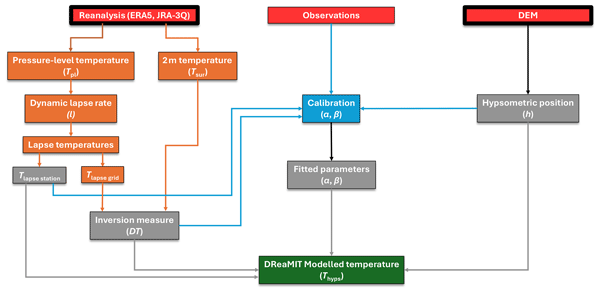
Surface-based temperature inversions occur when cold air becomes trapped near the ground beneath a layer of warmer air. This study combines field data, analysis, and modelling to develop DReaMIT, a model that captures the timing and strength of inversions across northern mountain terrain. The model’s transferability beyond the valleys where it was developed makes it valuable globally to cold-region researchers for mapping and modelling permafrost and assessing climate change impacts.
Alexandre R. Bevington, Brian Menounos, and Mark Ednie
The Cryosphere, 20, 811–833, https://doi.org/10.5194/tc-20-811-2026, https://doi.org/10.5194/tc-20-811-2026, 2026
Short summary
Short summary
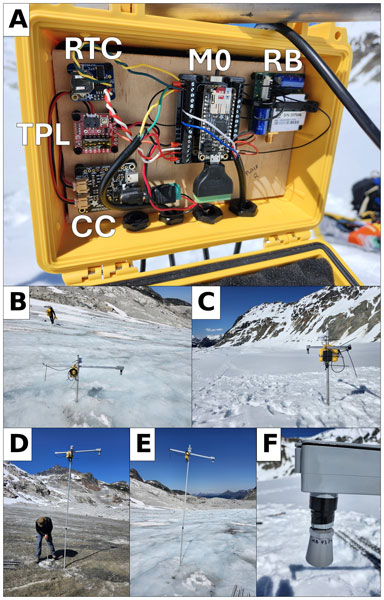
We developed automated "smart stakes" to study how quickly glaciers melt during hot weather. The low-cost devices were installed on Place Glacier in British Columbia and sent data by satellite in 2024. We show that just three heat periods caused more than half of the glacier's total summer melt, even though these events lasted only one-third of the melt season. This system provided measurements that would be impossible with traditional methods and we show that the data can improved melt models.
Anna C. Talucci, Michael M. Loranty, Jean E. Holloway, Brendan M. Rogers, Heather D. Alexander, Natalie Baillargeon, Jennifer L. Baltzer, Logan T. Berner, Amy Breen, Leya Brodt, Brian Buma, Jacqueline Dean, Clement J. F. Delcourt, Lucas R. Diaz, Catherine M. Dieleman, Thomas A. Douglas, Gerald V. Frost, Benjamin V. Gaglioti, Rebecca E. Hewitt, Teresa Hollingsworth, M. Torre Jorgenson, Mark J. Lara, Rachel A. Loehman, Michelle C. Mack, Kristen L. Manies, Christina Minions, Susan M. Natali, Jonathan A. O'Donnell, David Olefeldt, Alison K. Paulson, Adrian V. Rocha, Lisa B. Saperstein, Tatiana A. Shestakova, Seeta Sistla, Oleg Sizov, Andrey Soromotin, Merritt R. Turetsky, Sander Veraverbeke, and Michelle A. Walvoord
Earth Syst. Sci. Data, 17, 2887–2909, https://doi.org/10.5194/essd-17-2887-2025, https://doi.org/10.5194/essd-17-2887-2025, 2025
Short summary
Short summary
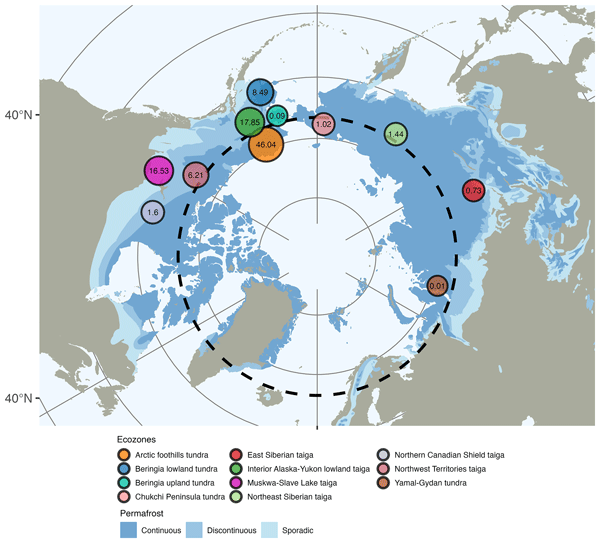
Wildfires have the potential to accelerate permafrost thaw and the associated feedbacks to climate change. We assembled a dataset of permafrost thaw depth measurements from burned and unburned sites contributed by researchers from across the northern high-latitude region. We estimated maximum thaw depth for each measurement, which addresses a key challenge: the ability to assess impacts of wildfire on maximum thaw depth when measurement timing varies.
Yifeng Wang, Robert G. Way, Jordan Beer, Anika Forget, Rosamond Tutton, and Meredith C. Purcell
The Cryosphere, 17, 63–78, https://doi.org/10.5194/tc-17-63-2023, https://doi.org/10.5194/tc-17-63-2023, 2023
Short summary
Short summary
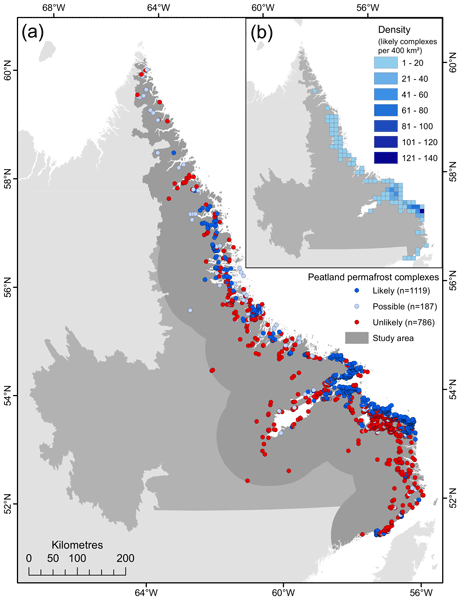
Peatland permafrost in northeastern Canada has been misrepresented by models, leading to significant underestimates of peatland permafrost and permafrost distribution along the Labrador Sea coastline. Our multi-stage, multi-mapper, consensus-based inventorying process, supported by field- and imagery-based validation efforts, identifies peatland permafrost complexes all along the coast. The highest density of complexes is found to the south of the current sporadic discontinuous permafrost limit.
Cited articles
Ackerman, H.: Spatial modelling of monthly climate across mountainous terrain in southern Yukon and northern British Columbia, MSc thesis, University of Ottawa, https://doi.org/10.20381/ruor-28468, 2022.
Aylsworth, J. and Kettles, I.: The Physical Environment of the Mackenzie Valley, Northwest Territories: A Base Line for the Assessment of Environmental Change, Bull. Geol. Surv. Canada, 547, 49–55, 2000.
Behnia, P. and Blais-Stevens, A.: Landslide susceptibility modelling using the quantitative random forest method along the northern portion of the Yukon Alaska Highway Corridor, Canada, Nat. Hazards, 90, 1407–1426, 2018.
Bevington, A. and Lewkowicz, A. G.: Assessment of a land cover driven TTOP model for mountain and lowland permafrost using field data, southern Yukon and northern British Columbia, Canada, Proceedings of GEOQuébec: 68th Canadian Geotechnical Conference and 7th Canadian Permafrost Conference, Quebec City, Canada, Paper 724, https://members.cgs.ca/documents/conference2015/GeoQuebec/prof348.html (last access: July 2019), 2015.
Biau, G. and Scornet, E.: A random forest guided tour, TEST, 25, 197–227, https://doi.org/10.1007/s11749-016-0481-7, 2016.
Bormann, K. J., Westra, S., Evans, J. P., and McCabe, M. F.: Spatial and temporal variability in seasonal snow density, J. Hydrol., 484, 63–73, https://doi.org/10.1016/j.jhydrol.2013.01.032, 2013.
Boulesteix, A.-L., Janitza, S., Kruppa, J., and König, I. R.: Overview of random forest methodology and practical guidance with emphasis on computational biology and bioinformatics, WIREs Data Min. Knowl. Discov., 2, 493–507, https://doi.org/10.1002/widm.1072, 2012.
Breiman, L.: Random Forests, Mach. Learn. 45, 5–32, https://doi.org/10.1023/A:1010933404324, 2001.
Brown, J., Ferrians, O., Heginbottom, J. A., and Melnikov, E.: Circum-Arctic Map of Permafrost and Ground-Ice Conditions (GGD318, Version 2), [data set], National Snow and Ice Data Center, Boulder, Colorado, USA, https://doi.org/10.7265/skbg-kf16, 2002.
Brown, N. and Gruber, S.: Beyond MAGT: learning more from permafrost thermal monitoring data with additional metrics, EGUsphere [preprint], https://doi.org/10.5194/egusphere-2025-2658, 2025.
Colyn, V., Way, R., Wang, Y., Beer, J., Trant, A., Hermanutz, L., Forget, A., Tutton, R., Barone, K., Power, M., Fedder, L., Rendell, E., Gaul, N., and Le, N.: Investigating spatial variability of ground temperatures across coastal and continental highlands in Labrador, northeastern Canada, Arct. Sci., 11, 1–26, https://doi.org/10.1139/as-2024-0079, 2025.
Daly, S. V., Bonnaventure, P. P., and Kochtitzky, W.: Influence of ecosystem and disturbance on near-surface permafrost distribution, Whati, Northwest Territories, Canada, Permafr. Periglac. Process., 33, 339–352, https://doi.org/10.1002/ppp.2160, 2022.
Díaz-Uriarte, R. and Alvarez de Andrés, S.: Gene selection and classification of microarray data using random forest, BMC Bioinform., 7, 3, https://doi.org/10.1186/1471-2105-7-3, 2006.
Duchesne, C., Smith, S. L., Ednie, M., and Bonnaventure, P. P.: Active layer variability and change in the Mackenzie Valley, Northwest Territories, Proceedings of GEOQuébec: 68th Canadian Geotechnical Conference and 7th Canadian Permafrost Conference, Quebec City, Canada, Paper 67, https://members.cgs.ca/documents/conference2015/GeoQuebec/index.html (last access: January 2019), 2015.
Environment and Climate Change Canada: Environment Canada, Historical Data – Climate, Environment and Climate Change Canada [data set], https://climate.weather.gc.ca/historical_data/search_historic_data_e.html (last access: September 2024), 2021.
Forget, A., Way, R., Wang, Y., Beer, J., Colyn, V., Tutton, R., Trant, A., and Hermanutz, L.: Evaluating local drivers of ground surface temperature variability in coastal Labrador, Proceedings of the 12th International Conference on Permafrost, Canadian Permafrost Association, Whitehorse, Yukon, Canada, 94–102, https://doi.org/10.52381/ICOP2024.209.1, 2024.
Garibaldi, M. C., Bonnaventure, P. P., and Lamoureux, S. F.: Utilizing the TTOP model to understand spatial permafrost temperature variability in a High Arctic landscape, Cape Bounty, Nunavut, Canada, Permafr. Periglac. Process., 32, 19–34, https://doi.org/10.1002/ppp.2086, 2021.
Garibaldi, M. C., Bonnaventure, P. P., Noad, N. C., and Kochtitzky, W.: Modelling air, ground surface, and permafrost temperature variability across four dissimilar valleys, Yukon, Canada, Arct. Sci., 10, 611–629, https://doi.org/10.1139/as-2023-0067, 2024a.
Garibaldi, M. C., Bonnaventure, P. P., Noad, N. C., and Kochtitzky, W.: Exploring the impact of surface lapse rate change scenarios on mountain permafrost distribution in four dissimilar valleys in Yukon, Canada, Arctic Science, 10, 749–763, https://doi.org/10.1139/as-2023-0066, 2024b.
Genuer, R., Poggi, J.-M., and Tuleau-Malot, C.: Variable selection using random forests, Pattern Recognit. Lett., 31, 2225–2236, https://doi.org/10.1016/j.patrec.2010.03.014, 2010.
Gisnås, K., Etzelmüller, B., Farbrot, H., Schuler, T. V., and Westermann, S.: CryoGRID 1.0: Permafrost Distribution in Norway estimated by a Spatial Numerical Model, Permafr. Periglac. Process., 24, 2–19, https://doi.org/10.1002/ppp.1765, 2013.
Gisnås, K., Westermann, S., Schuler, T. V., Litherland, T., Isaksen, K., Boike, J., and Etzelmüller, B.: A statistical approach to represent small-scale variability of permafrost temperatures due to snow cover, The Cryosphere, 8, 2063–2074, https://doi.org/10.5194/tc-8-2063-2014, 2014.
Government of Canada: Provinces/Territories, Cartographic Boundary File – 2016 Census, Statistics Canada [data set], https://open.canada.ca/data/en/dataset/a883eb14-0c0e-45c4-b8c4-b54c4a819edb (last access: May 2019), 2016.
Government of Canada: Lakes, Rivers, and Glaciers in Canada – CanVec Series – Hydrographic Features, Natural Resources Canada [data set], https://open.canada.ca/data/en/dataset/9d96e8c9-22fe-4ad2-b5e8-94a6991b7446 (last access: May 2019), 2017.
Gregorutti, B., Michel, B., and Saint-Pierre, P.: Correlation and variable importance in random forests, Stat. Comput., 27, 659–678, https://doi.org/10.1007/s11222-016-9646-1, 2017.
Gregory, F. M.: Biophysical Remote Sensing and Terrestrial CO2 Exchange at Cape Bounty, Melville Island, MSc thesis, Department of Geography, Queen's University, http://hdl.handle.net/1974/6953 (last access: September 2017), 2011.
Grömping, U.: Variable Importance Assessment in Regression: Linear Regression versus Random Forest, Am. Stat., 63, 308–319, https://doi.org/10.1198/tast.2009.08199, 2009.
Guo, L., Ran, Y., Li, X., Jin, H. and Cheng, G.: Sensitivity of Permafrost Degradation to Geological and Climatic Conditions, Permafr. Periglac. Process., 35, 450–460, https://doi.org/10.1002/ppp.2245, 2024.
Heginbottom, J. A., Dubreuil, M. A., and Harker, P. A.: Canada, permafrost: National Atlas of Canada, MCR 4177 Canada Map Office, Contains information licensed under the Open Government Licence – Canada, 1995.
Henry, K. and Smith, M.: A model-based map of ground temperatures for the permafrost regions of Canada, Permafr. Periglac. Process., 12, 389–398, https://doi.org/10.1002/ppp.399, 2001.
Holloway, J.: Impacts of forest fire on permafrost in the discontinuous zones of northwestern Canada, PhD thesis, Université d'Ottawa/University of Ottawa, https://doi.org/10.20381/ruor-25410, 2020.
James, M., Lewkowicz, A. G., Smith, S. L., and Miceli, C. M.: Multi-decadal degradation and persistence of permafrost in the Alaska Highway corridor, northwest Canada, Environ. Res. Lett., 8, 045013, https://doi.org/10.1088/1748-9326/8/4/045013, 2013.
Juliussen, H. and Humlum, O.: Towards a TTOP ground temperature model for mountainous terrain in central-eastern Norway, Permafr. Periglac. Process., 18, 161–184, https://doi.org/10.1002/ppp.586, 2007.
Kääb, A.: Remote sensing of permafrost‐related problems and hazards. Permafrost Periglac., 19, 107–136, https://doi.org/10.1002/ppp.619, 2008.
Karjalainen, O., Luoto, M., Aalto, J., and Hjort, J.: New insights into the environmental factors controlling the ground thermal regime across the Northern Hemisphere: a comparison between permafrost and non-permafrost areas, The Cryosphere, 13, 693–707, https://doi.org/10.5194/tc-13-693-2019, 2019.
Kersten, M. S.: Laboratory research for the determination of the thermal properties of soils, Technical Report 23, Research Laboratory Investigations, Eng. Experiment Station, University of Minnesota, Minneapolis, https://hdl.handle.net/11681/6576 (last access: March 2018), 1949.
Lafrenière, M. J. and Lamoureux, S. F.: Effects of changing permafrost conditions on hydrological processes and fluvial fluxes, Earth-Sci. Rev., 191, 212–223, https://doi.org/10.1016/j.earscirev.2019.02.018, 2019.
Lewkowicz, A. G.: Archiving University of Ottawa northern climate data, Report to Department of Environment and Natural Resources, Government of the Northwest Territories, 2021.
Lewkowicz, A. G., Bonnaventure, P. P., Smith, S. L., and Kuntz, Z.: Spatial and thermal characteristics of mountain permafrost, northwest Canada, Geogr. Ann. A, 94, 195–213, https://doi.org/10.1111/j.1468-0459.2012.00462.x, 2012.
Lin, Z., Burn, C. R., Niu, F., Luo, J., Liu, M., and Yin, G.: The Thermal Regime, including a Reversed Thermal Offset, of Arid Permafrost Sites with Variations in Vegetation Cover Density, Wudaoliang Basin, Qinghai-Tibet Plateau, Permafr. Periglac. Process., 26, 142–159, https://doi.org/10.1002/ppp.1840, 2015.
Luo, D., Jin, H., Wu, Q., Bense, V. F., He, R., Ma, Q., Gao., S., Jin, X., and Lü, L.: Thermal regime of warm-dry permafrost in relation to ground surface temperature in the Source Areas of the Yangtze and Yellow rivers on the Qinghai-Tibet Plateau, SW China, Sci. Total Environ., 618, 1033–1045, https://doi.org/10.1016/j.scitotenv.2017.09.083, 2018.
Luo, D., Jin, H., and Bense, V. F.: Ground surface temperature and the detection of permafrost in the rugged topography on NE Qinghai-Tibet Plateau, Geoderma, 333, 57–68, https://doi.org/10.1016/j.geoderma.2018.07.011, 2019.
L'Hérault, E., Boisson, A., Allard, M., Aubé-Maurice, S., Sarrazin, D., Roger, J., and Barrette, C.: Détermination et analyse des vulnérabilités du Nunavik en fonction des composantes environnementales et des processus physique naturels liés au climate: Phase 1, Rapport produit pour le compte du Ministère des Forêts, de la Faune et des Parcs. Université Laval, Québec City, Canada, 2017.
Medeiros, A. S., Friel, C. E., Finkelstein, S. A., and Quinlan, R.: A high resolution multi-proxy record of pronounced recent environmental change at Baker Lake, Nunavut, J. Paleolimnol., 47, 661–676, https://doi.org/10.1007/s10933-012-9589-2, 2012.
Meloche, J., Langlois, A., Rutter, N., McLennan, D., Royer, A., Billecocq, P., and Ponomarenko, S.: High-resolution snow depth prediction using Random Forest algorithm with topographic parameters: A case study in the Greiner watershed, Nunavut, Hydrol. Process., 36, e14546, https://doi.org/10.1002/hyp.14546, 2022.
Miner, K. R., Turetsky, M. R., Malina, E., Bartsch, A., Tamminen, J., McGuire, A. D., Fix, A., Sweeney, C., Elder, C. D., and Miller, C. E.: Permafrost carbon emissions in a changing Arctic, Nat. Rev. Earth Environ., 3, 55–67, https://doi.org/10.1038/s43017-021-00230-3, 2022.
Nicholson, F. H. and Granberg, H. B: Permafrost and snow cover relationships near Schefferville, Proceedings of the Second International Conference on Permafrost, North American Contribution, National Academy of Sciences, Washington, DC, 151–158, 1973.
Nicodemus, K. K., Malley, J. D., Strobl, C., and Ziegler, A.: The behaviour of random forest permutation-based variable importance measures under predictor correlation, BMC Bioinform., 11, 110, https://doi.org/10.1186/1471-2105-11-110, 2010.
Obu, J., Westermann, S., Bartsch, A., Berdnikov, N., Christiansen, H. H., Dashtseren, A., Delaloye, R., Elberling, B., Etzelmüller, B., Kholodov, A., Khomutov, A., Kääb, A., Leibman, M. O., Lewkowicz, A. G., Panda, S. K., Romanovsky, V., Way, R. G., Westergaard-Nielsen, A., Wu, T., Yamkhin, J., and Zou, D.: Northern Hemisphere permafrost map based on TTOP modelling for 2000–2016 at 1-km2 scale, Earth-Sci. Rev., 193, 299–316, https://doi.org/10.1016/j.earscirev.2019.04.023, 2019.
O'Neill, H. B., Smith, S. L., Burn, C. R., Duchesne, C., and Zhang, Y.: Widespread permafrost degradation and thaw subsidence in northwest Canada, J. Geophys. Res. Earth Surf., 128, e2023JF007262, https://doi.org/10.1029/2023JF007262, 2023.
Riseborough, D.: The effect of transient conditions on an equilibrium permafrost-climate model, Permafr. Periglac. Process., 18, 21–32, https://doi.org/10.1002/ppp.579, 2007.
Riseborough, D. W.: Exploring the parameters of a simple model of the permafrost-climate relationship, PhD thesis, Carleton University, 2004.
Riseborough, D. and Smith, M.: Exploring the limits of permafrost, Proceedings Permafrost: 7th International Conference, Yellowknife, Canada, edited by: Lewkowicz, A. G., and Allard, M., Nordicana, 54, 935–941, 1998.
Riseborough, D., Shiklomanov, N., Etzelmüller, B., Gruber, S., and Marchenko, S.: Recent advances in permafrost modelling, Permafr. Periglac. Process., 19, 137–156, https://doi.org/10.1002/ppp.615, 2008.
Roberts, K. E., Lamoureux, S. F., Kyser, T. K., Muir, D. C. G., Lafrenière, M. J., Iqaluk, D., Pieńkowski, A. J., and Normandeau, A.: Climate and permafrost effects on the chemistry and ecosystems of High Arctic Lakes, Sci. Rep., 7, 13292, https://doi.org/10.1038/s41598-017-13658-9, 2017.
Romanovsky, V., Isaksen, K., Drozdov, D., Anisimov, O., Instanes, A., Leibman, M., McGuire, A. D., Shiklomanov, N., Smith, S., and Walker, D.: Changing permafrost and its impacts, in: Snow, Water, Ice and Permafrost in the Arctic (SWIPA) 2017, Arctic Monitoring and Assessment Program (AMAP) Oslo, Norway, 65–102, ISBN 978-82-7971-101-8, https://www.amap.no/documents/doc/snow-water-ice-and-permafrost-in-the-arctic-swipa-2017/1610 (last access: May 2019), 2017.
Shur, Y. L. and Jorgenson, M. T.: Patterns of permafrost formation and degradation in relation to climate and ecosystems, Permafr. Periglac. Process., 18, 7–19, https://doi.org/10.1002/ppp.582, 2007.
Simpson, I. R., Lawrence, D. M., Swenson, S. C., Hannay, C., McKinnon, K. A., and Truesdale, J. E.: Improvements in wintertime surface temperature variability in the Community Earth System Model version 2 (CESM2) related to the representation of snow density, J. Adv. Model. Earth Syst., 14, https://doi.org/10.1029/2021MS002880, 2022.
Smith, M. W. and Riseborough, D. W.: Permafrost monitoring and detection of climate change, Permafr. Periglac. Process., 7, 301–309, https://doi.org/10.1002/(SICI)1099-1530(199610)7:4<301::AID-PPP231>3.0.CO;2-R, 1996.
Smith, M. W. and Riseborough, D. W.: Climate and the limits of permafrost: a zonal analysis, Permafr. Periglac. Process., 13, 1–15, https://doi.org/10.1002/ppp.410, 2002.
Smith, S. L., Wolfe, S. A., Riseborough, D. W., and Nixon, F. M.: Active-layer characteristics and summer climatic indices, Mackenzie Valley, Northwest Territories, Canada, Permafr. Periglac. Process., 20, 201–220, https://doi.org/10.1002/ppp.651, 2009.
Smith, S. L., O'Neill, H. B., Isaksen, K., Noetzli, J., and Romanovsky, V. E.: The changing thermal state of permafrost, Nat. Rev. Earth Environ., 3, 10–23, https://doi.org/10.1038/s43017-021-00240-1, 2022.
Stanek, W., Alexander, K., and Simmons, C. S.: Reconnaissance of vegetation and soils along the Dempster Highway, Yukon Territory: 1. Vegetation types, Report Pacific Forest Research Centre (Canada), no. BC-X-217, 1980.
Strobl, C. and Zeileis, A.: Danger: High power! – exploring the statistical properties of a test for random forest variable importance, COMPSTAT 2008: Proc. Comput. Stat., II, 59–66, 2008.
Strobl, C., Boulesteix, A.-L., Kneib, T., Augustin, T., and Zeileis, A.: Conditional variable importance for random forests, BMC Bioinform., 9, 307, https://doi.org/10.1186/1471-2105-9-307, 2008.
Throop, J., Lewkowicz, A. G., and Smith, S. L.: Climate and ground temperature relations at sites across the continuous and discontinuous permafrost zones, northern Canada, Can. J. Earth Sci., 49, 865–876, https://doi.org/10.1139/e11-075, 2012.
Tolosi, L. and Lengauer, T.: Classification with correlated features: unreliability of feature ranking and solutions, Bioinformatics, 27, 1986–1994, https://doi.org/10.1093/bioinformatics/btr300, 2011.
Tutton, R. J., Way, R. G., Beddoe, R., Zhang, Y., and Trant, A. J.: Soil temperature sensitivity to variable snow and vegetation conditions in low-relief coastal mountains, Nunatsiavut and NunatuKavut, Labrador, in: Proceedings of the 2021 Regional Conference on Permafrost and 19th International Conference on Cold Regions Engineering, American Society of Civil Engineers, Boulder, Colorado, USA, 71–81, https://doi.org/10.1061/9780784483589.007, 2021.
Vegter, S., Bonnaventure, P. P., Daly, S., and Kochtitzky, W.: Modelling Permafrost Distribution using the Temperature at Top of Permafrost Model in the Boreal Forest Environment of Whatì, NT, Arct. Sci., 10, 455–475, https://doi.org/10.1139/as-2023-0010, 2024.
von Oppen, J., Assman, J. J., Bjorkman, A. D., Treier, U. A., Elberling, B., Nabe-Nielsen, J., and Normand, S.: Cross-scale regulation of seasonal microclimate by vegetation and snow in the Arctic tundra, Glob. Change Biol., 28, 7296–7312, https://doi.org/10.1111/gcb.16426, 2022.
Way, R. G. and Lapalme, C. M.: Does tall vegetation warm or cool the ground surface? Constraining the ground thermal impacts of upright vegetation in northern environments, Environ. Res. Lett., 16, 054077, https://doi.org/10.1088/1748-9326/abef31, 2021.
Way, R. G. and Lewkowicz, A. G.: Modelling the spatial distribution of permafrost in Labrador–Ungava using the temperature at the top of permafrost, Can. J. Earth Sci., 53, 1010–1028, https://doi.org/10.1139/cjes-2016-0034, 2016.
Way, R. G. and Lewkowicz, A. G.: Environmental controls on ground temperature and permafrost in Labrador, northeast Canada, Permafr. Periglac. Process., 29, 73–85, https://doi.org/10.1002/ppp.1972, 2018.
Zhang, T.: Influence of the seasonal snow cover on the ground thermal regime: An overview, Rev. Geophys., 43, https://doi.org/10.1029/2004RG000157, 2005.
Zou, D., Zhao, L., Sheng, Y., Chen, J., Hu, G., Wu, T., Wu, J., Xie, C., Wu, X., Pang, Q., Wang, W., Du, E., Li, W., Liu, G., Li, J., Qin, Y., Qiao, Y., Wang, Z., Shi, J., and Cheng, G.: A new map of permafrost distribution on the Tibetan Plateau, The Cryosphere, 11, 2527–2542, https://doi.org/10.5194/tc-11-2527-2017, 2017.
Short summary
We assessed the sensitivity of a simple permafrost model to changes in parameter values using measured data across northern Canada. We altered the value of one parameter at a time to assess the changes in the resulting temperature. The model was most sensitive to changes in the freezing season parameters and least sensitive to changes in the thawing parameters. However, the importance of specific parameters varied across Canada. The findings of this study can aid in development of future models.
We assessed the sensitivity of a simple permafrost model to changes in parameter values using...