
Articles | Volume 20, issue 3
https://doi.org/10.5194/tc-20-1797-2026
© Author(s) 2026. This work is distributed under
the Creative Commons Attribution 4.0 License.
the Creative Commons Attribution 4.0 License.
https://doi.org/10.5194/tc-20-1797-2026
© Author(s) 2026. This work is distributed under
the Creative Commons Attribution 4.0 License.
the Creative Commons Attribution 4.0 License.
Research article
| Highlight paper
| 
25 Mar 2026
Research article | Highlight paper |
| 25 Mar 2026
| 25 Mar 2026
The terrestrial ice margin morphology in Kalaallit Nunaat (Greenland)

Institute of Geography and Regional Science, University of Graz, Graz, Austria
Jakob Abermann
Institute of Geography and Regional Science, University of Graz, Graz, Austria
Rainer Prinz
Department of Atmospheric and Cryospheric Sciences, University of Innsbruck, Innsbruck, Austria
Related authors
Marie Schroeder, Ivana Stiperski, Michael Winkler, Georg Kaser, Jakob Steiner, Jakob Abermann, Georg Wohlfahrt, and Rainer Prinz
EGUsphere, https://doi.org/10.5194/egusphere-2026-5112, https://doi.org/10.5194/egusphere-2026-5112, 2026
This preprint is open for discussion and under review for The Cryosphere (TC).
Short summary
Short summary
Steep ice cliffs can lose ice much faster than flat glacier surfaces, yet little is known about how they interact with the air around them. Measurements at a 25-metre-high ice cliff on Kilimanjaro revealed distinct day–night air flows and major differences in how heat is transported. Higher up, heat is transported in an organised way, while near the cliff base this exchange was more complex. The cliff shape and its surroundings can strongly influence how heat reaches the ice and how it is lost.
Aris Kwadijk, Philip D. A. Kraaijenbrink, Faezeh M. Nick, Joseph M. Shea, Jakob F. Steiner, René R. Wijngaard, and Walter W. Immerzeel
EGUsphere, https://doi.org/10.5194/egusphere-2026-5005, https://doi.org/10.5194/egusphere-2026-5005, 2026
This preprint is open for discussion and under review for Hydrology and Earth System Sciences (HESS).
Short summary
Short summary
The Himalayas supply water to millions of people downstream, yet high-altitude rainfall remains poorly understood. Using thirteen years of data from weather stations across Nepal's Langtang Valley, we found that during the monsoon the moist atmosphere causes rainfall to be highly sensitive to topography. We show how precipitation-elevation gradients shift during the day. This shift is captured in a numerical relation, that can serve to validate weather models.
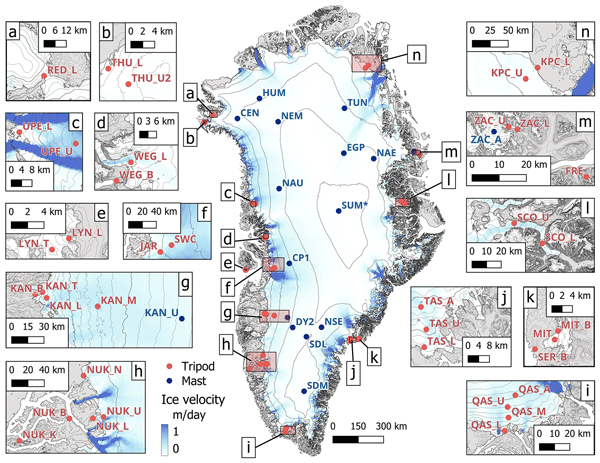
Robert S. Fausto, Penelope How, Baptiste Vandecrux, Mads C. Lund, Jason E. Box, Kenneth D. Mankoff, Signe B. Andersen, Dirk van As, Rasmus Bahbah, Michele Citterio, William Colgan, Henrik T. Jakobsgaard, Nanna B. Karlsson, Kristian K. Kjeldsen, Signe H. Larsen, Charlotte Olsen, Falk M. Oraschewski, Anja Rutishauser, Christopher L. Shields, Anne M. Solgaard, Ian T. Stevens, Synne H. Svendsen, Kirsty Langley, Alexandra Messerli, Anders A. Bjørk, Jonas K. Andersen, Jakob Abermann, Jakob Steiner, Rainer Prinz, Berhard Hynek, James M. Lea, Stephen Brough, and Andreas P. Ahlstrøm
Earth Syst. Sci. Data, 18, 2829–2873, https://doi.org/10.5194/essd-18-2829-2026, https://doi.org/10.5194/essd-18-2829-2026, 2026
Short summary
Short summary
In summary, the PROMICE (Programme for Monitoring of the Greenland Ice Sheet ) | GC-NET AWS (Greenland Climate Network automatic weather station) data product update represents a significant advancement in Arctic climate monitoring. Through enhanced station designs, state-of-the-art instrumentation, and a transparent, automated data processing workflow, the dataset offers an essential resource for studying the Greenland Ice Sheet and its periphery, validating climate models, and supporting global assessments of cryospheric change.
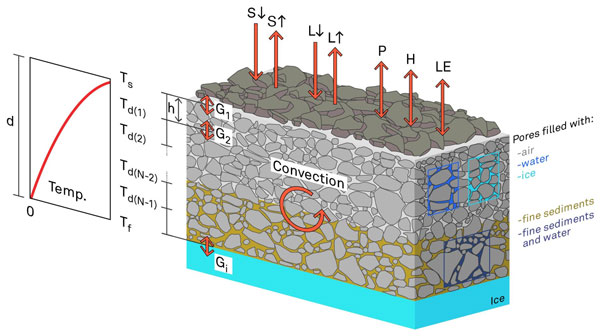
Francesca Pellicciotti, Adrià Fontrodona-Bach, David R. Rounce, Catriona L. Fyffe, Leif S. Anderson, Álvaro Ayala, Ben W. Brock, Pascal Buri, Stefan Fugger, Koji Fujita, Prateek Gantayat, Alexander R. Groos, Walter Immerzeel, Marin Kneib, Christoph Mayer, Shelley MacDonell, Michael McCarthy, James McPhee, Evan Miles, Heather Purdie, Ekaterina Rets, Akiko Sakai, Thomas E. Shaw, Jakob Steiner, Patrick Wagnon, and Alex Winter-Billington
The Cryosphere, 20, 1895–1928, https://doi.org/10.5194/tc-20-1895-2026, https://doi.org/10.5194/tc-20-1895-2026, 2026
Short summary
Short summary
Rock debris covers many of the world glaciers, modifying the transfer of atmospheric energy to the debris and into the ice. Models of different complexity simulate this process, and we compare 15 models at 9 sites to show that the most complex models at the debris-atmosphere interface have the highest performance. However, we lack debris properties and their derivation from measurements is ambiguous, hindering global modelling and calling for both model development and data collection.
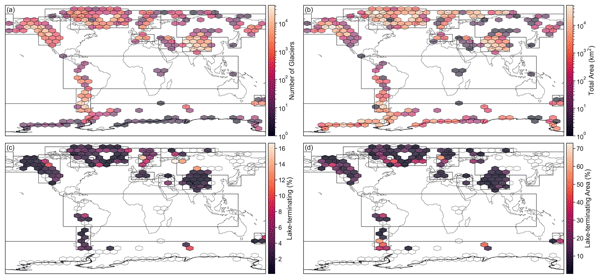
Jakob Steiner, William Armstrong, Will Kochtitzky, Robert McNabb, Rodrigo Aguayo, Tobias Bolch, Fabien Maussion, Vibhor Agarwal, Iestyn Barr, Nathaniel R. Baurley, Mike Cloutier, Katelyn DeWater, Frank Donachie, Yoann Drocourt, Siddhi Garg, Gunjan Joshi, Byron Guzman, Stanislav Kutuzov, Thomas Loriaux, Caleb Mathias, Brian Menounos, Evan Miles, Aleksandra Osika, Kaleigh Potter, Adina Racoviteanu, Brianna Rick, Miles Sterner, Guy D. Tallentire, Levan Tielidze, Rebecca White, Kunpeng Wu, and Whyjay Zheng
Earth Syst. Sci. Data, 18, 1665–1681, https://doi.org/10.5194/essd-18-1665-2026, https://doi.org/10.5194/essd-18-1665-2026, 2026
Short summary
Short summary
Many mountain glaciers around the world flow into lakes – exactly how many however, has never been mapped. Across a large team of experts we have now identified all glaciers that end in lakes. Only about 1% do so, but they are generally larger than those which end on land. This is important to understand, as lakes can influence the behaviour of glacier ice, including how fast it disappears. This new dataset allows us to better model glaciers at a global scale, accounting for the effect of lakes.
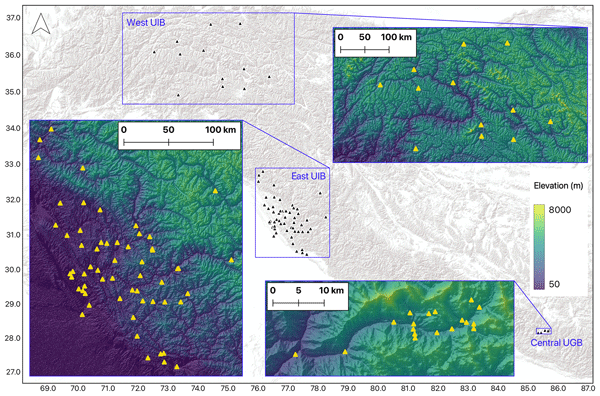
Marc Girona-Mata, Andrew Orr, Martin Widmann, Daniel Bannister, Ghulam Hussain Dars, Scott Hosking, Jesse Norris, David Ocio, Tony Phillips, Jakob Steiner, and Richard E. Turner
Hydrol. Earth Syst. Sci., 29, 3073–3100, https://doi.org/10.5194/hess-29-3073-2025, https://doi.org/10.5194/hess-29-3073-2025, 2025
Short summary
Short summary
We introduce a novel method for improving daily precipitation maps in mountain regions and pilot it across three basins in the Hindu Kush Himalaya (HKH). The approach leverages climate model and weather station data, along with statistical or machine learning techniques. Our results show that this approach outperforms traditional methods, especially in remote ungauged areas, suggesting that it could be used to improve precipitation maps across much of the HKH, as well as other mountain regions.
Finu Shrestha, Jakob F. Steiner, Reeju Shrestha, Yathartha Dhungel, Sharad P. Joshi, Sam Inglis, Arshad Ashraf, Sher Wali, Khwaja M. Walizada, and Taigang Zhang
Earth Syst. Sci. Data, 15, 3941–3961, https://doi.org/10.5194/essd-15-3941-2023, https://doi.org/10.5194/essd-15-3941-2023, 2023
Short summary
Short summary
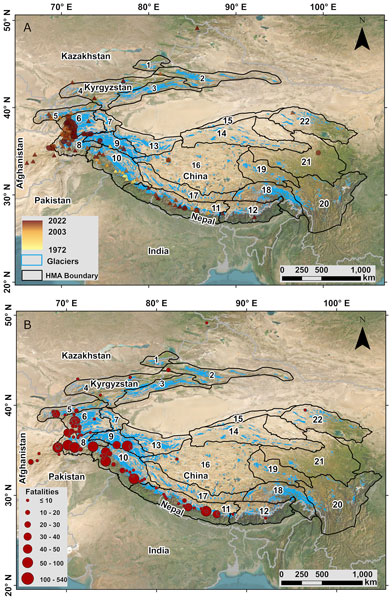
A new inventory of glacial lake outburst floods (GLOFs) in High Mountain Asia found 697 events, causing 906 deaths, 3 times more than previously reported. This study provides insights into the contributing factors behind GLOFs on a regional scale and highlights the need for interdisciplinary approaches, including scientific communities and local knowledge, to understand GLOF risks in Asia. This study allows integration with other datasets, enabling future local and regional risk assessments.
Anushilan Acharya, Jakob F. Steiner, Khwaja Momin Walizada, Salar Ali, Zakir Hussain Zakir, Arnaud Caiserman, and Teiji Watanabe
Nat. Hazards Earth Syst. Sci., 23, 2569–2592, https://doi.org/10.5194/nhess-23-2569-2023, https://doi.org/10.5194/nhess-23-2569-2023, 2023
Short summary
Short summary
All accessible snow and ice avalanches together with previous scientific research, local knowledge, and existing or previously active adaptation and mitigation solutions were investigated in the high mountain Asia (HMA) region to have a detailed overview of the state of knowledge and identify gaps. A comprehensive avalanche database from 1972–2022 is generated, including 681 individual events. The database provides a basis for the forecasting of avalanche hazards in different parts of HMA.
Adam Emmer, Simon K. Allen, Mark Carey, Holger Frey, Christian Huggel, Oliver Korup, Martin Mergili, Ashim Sattar, Georg Veh, Thomas Y. Chen, Simon J. Cook, Mariana Correas-Gonzalez, Soumik Das, Alejandro Diaz Moreno, Fabian Drenkhan, Melanie Fischer, Walter W. Immerzeel, Eñaut Izagirre, Ramesh Chandra Joshi, Ioannis Kougkoulos, Riamsara Kuyakanon Knapp, Dongfeng Li, Ulfat Majeed, Stephanie Matti, Holly Moulton, Faezeh Nick, Valentine Piroton, Irfan Rashid, Masoom Reza, Anderson Ribeiro de Figueiredo, Christian Riveros, Finu Shrestha, Milan Shrestha, Jakob Steiner, Noah Walker-Crawford, Joanne L. Wood, and Jacob C. Yde
Nat. Hazards Earth Syst. Sci., 22, 3041–3061, https://doi.org/10.5194/nhess-22-3041-2022, https://doi.org/10.5194/nhess-22-3041-2022, 2022
Short summary
Short summary
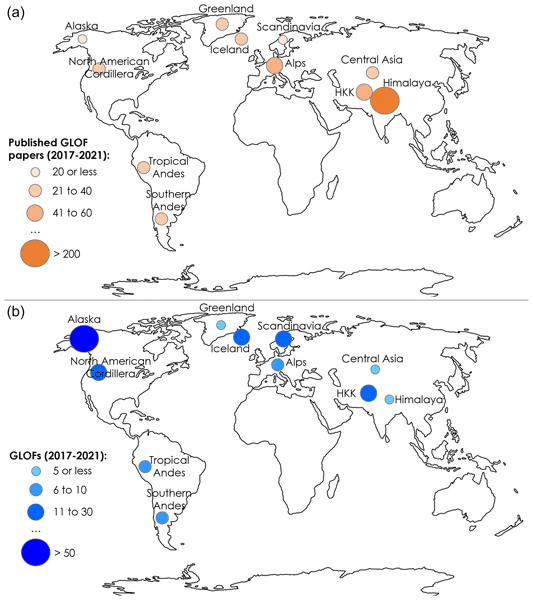
Glacial lake outburst floods (GLOFs) have attracted increased research attention recently. In this work, we review GLOF research papers published between 2017 and 2021 and complement the analysis with research community insights gained from the 2021 GLOF conference we organized. The transdisciplinary character of the conference together with broad geographical coverage allowed us to identify progress, trends and challenges in GLOF research and outline future research needs and directions.
Marie Schroeder, Ivana Stiperski, Michael Winkler, Georg Kaser, Jakob Steiner, Jakob Abermann, Georg Wohlfahrt, and Rainer Prinz
EGUsphere, https://doi.org/10.5194/egusphere-2026-5112, https://doi.org/10.5194/egusphere-2026-5112, 2026
This preprint is open for discussion and under review for The Cryosphere (TC).
Short summary
Short summary
Steep ice cliffs can lose ice much faster than flat glacier surfaces, yet little is known about how they interact with the air around them. Measurements at a 25-metre-high ice cliff on Kilimanjaro revealed distinct day–night air flows and major differences in how heat is transported. Higher up, heat is transported in an organised way, while near the cliff base this exchange was more complex. The cliff shape and its surroundings can strongly influence how heat reaches the ice and how it is lost.
Lea Hartl, Jakob Abermann, Ayla Akgün, Giulia Bertolotti, Tobias Bolch, Svenja Conzelmann, Codrut-Andrei Diaconu, Iris Hansche, Anne Hartig, Anna Haut, Kay Helfricht, Bernhard Hynek, Marie Sophie Kaucher, Andreas Kellerer-Pirklbauer, Ann Christin Kogel, Julie Krippes, Marcela Violeta Lauria, Christoph Mayer, Jan-Christoph Otto, Rainer Prinz, Sina Prölß, Lorenzo Rieg, Lea Schönleber, Gabriele Schwaizer, Bernd Seiser, Martin Stocker-Waldhuber, Markus Strudl, Martin Verhounik, and Harald Zandler
The Cryosphere, 20, 5157–5180, https://doi.org/10.5194/tc-20-5157-2026, https://doi.org/10.5194/tc-20-5157-2026, 2026
Short summary
Short summary
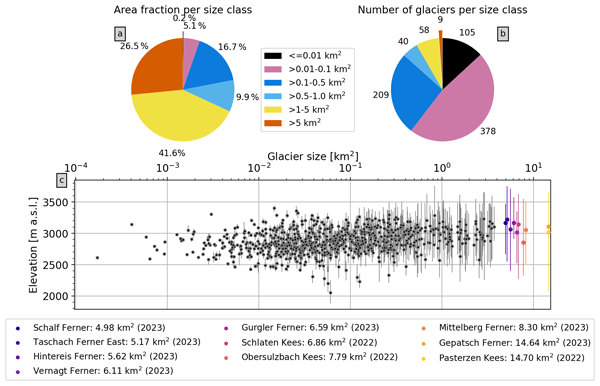
We mapped glacier outlines in Austria using recent, high resolution imagery. The resulting glacier inventory provides an update on glacier area in Austria in 2021-2023. More than 30% of glacier area was lost and 95 glaciers have disappeared since the mid-2000s. Glacier recession is accelerating and regular updates to glacier inventories are needed to understand downstream changes to the hydrological system, quantify glacier mass loss, and support planning and adaptation measures.
Aris Kwadijk, Philip D. A. Kraaijenbrink, Faezeh M. Nick, Joseph M. Shea, Jakob F. Steiner, René R. Wijngaard, and Walter W. Immerzeel
EGUsphere, https://doi.org/10.5194/egusphere-2026-5005, https://doi.org/10.5194/egusphere-2026-5005, 2026
This preprint is open for discussion and under review for Hydrology and Earth System Sciences (HESS).
Short summary
Short summary
The Himalayas supply water to millions of people downstream, yet high-altitude rainfall remains poorly understood. Using thirteen years of data from weather stations across Nepal's Langtang Valley, we found that during the monsoon the moist atmosphere causes rainfall to be highly sensitive to topography. We show how precipitation-elevation gradients shift during the day. This shift is captured in a numerical relation, that can serve to validate weather models.
Tiago Silva, Kristine Flacké Haualand, Jacob Clement Yde, Johan Hassing Scheller, Jakob Abermann, Andreas Trügler, and Wolfgang Schöner
EGUsphere, https://doi.org/10.5194/egusphere-2026-3687, https://doi.org/10.5194/egusphere-2026-3687, 2026
Short summary
Short summary
Severe downslope windstorms (locally known as piteraq) impact southeast Greenland communities and global ocean currents. Using high-resolution weather reanalysis, we show how piteraq events are driven by massive cold weather systems colliding with Greenland. As the dense air plunges down the steep coastal slopes, it accelerates into concentrated low-level jets. Recognizing the associated large-scale preconditioning will improve early warning systems and future climate predictions.
Kristine Flacké Haualand, Tiago Silva, Kerstin Rasmussen, Caroline Drost Jensen, Johan Hassing Scheller, Jakob Abermann, Simon de Villiers, Andreas Trügler, Wolfgang Schöner, and Jacob Clement Yde
EGUsphere, https://doi.org/10.5194/egusphere-2026-3684, https://doi.org/10.5194/egusphere-2026-3684, 2026
Short summary
Short summary
Southeast Greenland is often affected by damaging windstorms from the Greenland ice sheet. Using weather observations, we find that these windstorms have footprints covering several 100 km in the horizontal and several km in the vertical. The largest seasonal differences are warming instead of cooling and larger reductions in humidity in summer compared to winter. Our findings improve our understanding of spatial and temporal characteristics of these windstorms in the present and future climate.
Robert S. Fausto, Penelope How, Baptiste Vandecrux, Mads C. Lund, Jason E. Box, Kenneth D. Mankoff, Signe B. Andersen, Dirk van As, Rasmus Bahbah, Michele Citterio, William Colgan, Henrik T. Jakobsgaard, Nanna B. Karlsson, Kristian K. Kjeldsen, Signe H. Larsen, Charlotte Olsen, Falk M. Oraschewski, Anja Rutishauser, Christopher L. Shields, Anne M. Solgaard, Ian T. Stevens, Synne H. Svendsen, Kirsty Langley, Alexandra Messerli, Anders A. Bjørk, Jonas K. Andersen, Jakob Abermann, Jakob Steiner, Rainer Prinz, Berhard Hynek, James M. Lea, Stephen Brough, and Andreas P. Ahlstrøm
Earth Syst. Sci. Data, 18, 2829–2873, https://doi.org/10.5194/essd-18-2829-2026, https://doi.org/10.5194/essd-18-2829-2026, 2026
Short summary
Short summary
In summary, the PROMICE (Programme for Monitoring of the Greenland Ice Sheet ) | GC-NET AWS (Greenland Climate Network automatic weather station) data product update represents a significant advancement in Arctic climate monitoring. Through enhanced station designs, state-of-the-art instrumentation, and a transparent, automated data processing workflow, the dataset offers an essential resource for studying the Greenland Ice Sheet and its periphery, validating climate models, and supporting global assessments of cryospheric change.
Francesca Pellicciotti, Adrià Fontrodona-Bach, David R. Rounce, Catriona L. Fyffe, Leif S. Anderson, Álvaro Ayala, Ben W. Brock, Pascal Buri, Stefan Fugger, Koji Fujita, Prateek Gantayat, Alexander R. Groos, Walter Immerzeel, Marin Kneib, Christoph Mayer, Shelley MacDonell, Michael McCarthy, James McPhee, Evan Miles, Heather Purdie, Ekaterina Rets, Akiko Sakai, Thomas E. Shaw, Jakob Steiner, Patrick Wagnon, and Alex Winter-Billington
The Cryosphere, 20, 1895–1928, https://doi.org/10.5194/tc-20-1895-2026, https://doi.org/10.5194/tc-20-1895-2026, 2026
Short summary
Short summary
Rock debris covers many of the world glaciers, modifying the transfer of atmospheric energy to the debris and into the ice. Models of different complexity simulate this process, and we compare 15 models at 9 sites to show that the most complex models at the debris-atmosphere interface have the highest performance. However, we lack debris properties and their derivation from measurements is ambiguous, hindering global modelling and calling for both model development and data collection.
Matthew Switanek, Jakob Abermann, Wolfgang Schöner, and Michael L. Anderson
Hydrol. Earth Syst. Sci., 30, 1719–1734, https://doi.org/10.5194/hess-30-1719-2026, https://doi.org/10.5194/hess-30-1719-2026, 2026
Short summary
Short summary
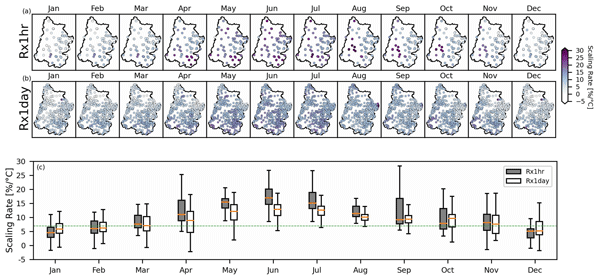
Extreme precipitation is expected to increase in a warming climate. Station-based measurements of precipitation and dew point temperature are often used to estimate observed precipitation-temperature scaling rates. In this study, we use three different approaches which rely on either raw or normalized data to estimate scaling rates and produce predictions of extreme precipitation. We find that normalizing the data first can improve our estimates of precipitation-temperature scaling rates.
Jakob Steiner, William Armstrong, Will Kochtitzky, Robert McNabb, Rodrigo Aguayo, Tobias Bolch, Fabien Maussion, Vibhor Agarwal, Iestyn Barr, Nathaniel R. Baurley, Mike Cloutier, Katelyn DeWater, Frank Donachie, Yoann Drocourt, Siddhi Garg, Gunjan Joshi, Byron Guzman, Stanislav Kutuzov, Thomas Loriaux, Caleb Mathias, Brian Menounos, Evan Miles, Aleksandra Osika, Kaleigh Potter, Adina Racoviteanu, Brianna Rick, Miles Sterner, Guy D. Tallentire, Levan Tielidze, Rebecca White, Kunpeng Wu, and Whyjay Zheng
Earth Syst. Sci. Data, 18, 1665–1681, https://doi.org/10.5194/essd-18-1665-2026, https://doi.org/10.5194/essd-18-1665-2026, 2026
Short summary
Short summary
Many mountain glaciers around the world flow into lakes – exactly how many however, has never been mapped. Across a large team of experts we have now identified all glaciers that end in lakes. Only about 1% do so, but they are generally larger than those which end on land. This is important to understand, as lakes can influence the behaviour of glacier ice, including how fast it disappears. This new dataset allows us to better model glaciers at a global scale, accounting for the effect of lakes.
Jonathan Fipper, Jakob Abermann, Ingo Sasgen, Henrik Skov, Lise Lotte Sørensen, and Wolfgang Schöner
The Cryosphere, 20, 683–698, https://doi.org/10.5194/tc-20-683-2026, https://doi.org/10.5194/tc-20-683-2026, 2026
Short summary
Short summary
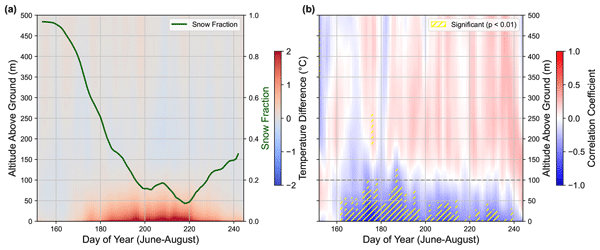
We use measurements conducted with uncrewed aerial vehicles (UAVs) and reanalysis data to study the drivers of vertical air temperature structures and their link to the surface mass balance of Flade Isblink, a large ice cap in Northeast Greenland. Surface properties control temperature structures up to 100 m above ground, while large-scale circulation dominates above. Mass loss has increased since 2015, with record loss in 2023 associated with frequent synoptic conditions favouring melt.
Jan Niklas Richter, Anselm Arndt, Nikolina Ban, Nicolas Gampierakis, Fabien Maussion, Rainer Prinz, Matthias Scheiter, Nikolaus Umlauf, and Lindsey Nicholson
EGUsphere, https://doi.org/10.5194/egusphere-2025-6249, https://doi.org/10.5194/egusphere-2025-6249, 2026
Short summary
Short summary
We developed a multi-objective Bayesian framework to calibrate a surface energy balance (SEB) model using only publicly available satellite data and climate simulations. The framework constrains model parameters well but also reveals biases in the forcing, affecting the SEB and the simulated mass balance and snowlines. The results indicate that an uncertainty-aware model chain can help identify model errors and provides a first step towards physical glacier modelling without in-situ data.
Florina Roana Schalamon, Sebastian Scher, Andreas Trügler, Lea Hartl, Wolfgang Schöner, and Jakob Abermann
Weather Clim. Dynam., 6, 1075–1088, https://doi.org/10.5194/wcd-6-1075-2025, https://doi.org/10.5194/wcd-6-1075-2025, 2025
Short summary
Short summary
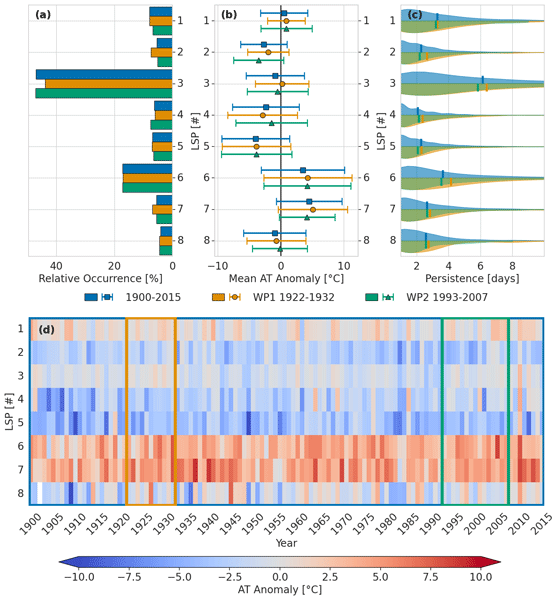
Atmospheric patterns influence the air temperature in Greenland. We investigate two warming periods, from 1922–1932 and 1993–2007, both showing similar temperature increases. Using a neural network-based clustering method, we defined predominant atmospheric patterns for further analysis. Our findings reveal that while the connection between these patterns and local air temperature remains stable, the distribution of patterns changes between the warming periods and the full period (1900–2015).
Tiago Silva, Brandon Samuel Whitley, Elisabeth Machteld Biersma, Jakob Abermann, Katrine Raundrup, Natasha de Vere, Toke Thomas Høye, Verena Haring, and Wolfgang Schöner
Biogeosciences, 22, 4601–4626, https://doi.org/10.5194/bg-22-4601-2025, https://doi.org/10.5194/bg-22-4601-2025, 2025
Short summary
Short summary
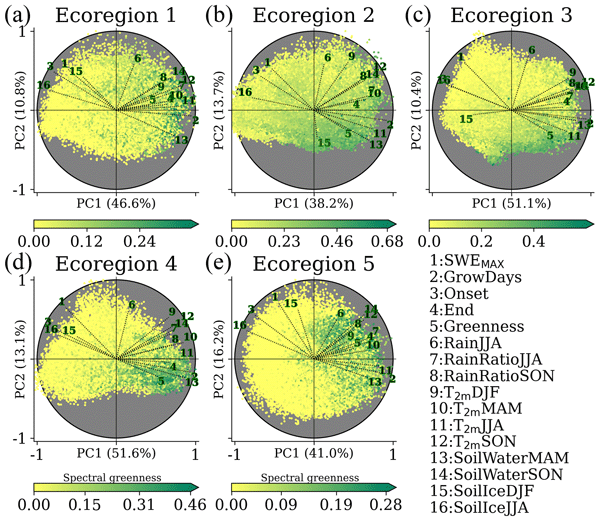
Ecosystems in Greenland have experienced significant changes over recent decades. We show the consistency of a high-resolution polar-adapted reanalysis product to represent bio-climatic factors influencing ecological processes. Our results describe the relevance/interaction between snowmelt and soil water content before the growing season onset, infer how the thermal growing season relates to changes in spectral greenness, and describe regions of ongoing changes in vegetation distribution.
Marc Girona-Mata, Andrew Orr, Martin Widmann, Daniel Bannister, Ghulam Hussain Dars, Scott Hosking, Jesse Norris, David Ocio, Tony Phillips, Jakob Steiner, and Richard E. Turner
Hydrol. Earth Syst. Sci., 29, 3073–3100, https://doi.org/10.5194/hess-29-3073-2025, https://doi.org/10.5194/hess-29-3073-2025, 2025
Short summary
Short summary
We introduce a novel method for improving daily precipitation maps in mountain regions and pilot it across three basins in the Hindu Kush Himalaya (HKH). The approach leverages climate model and weather station data, along with statistical or machine learning techniques. Our results show that this approach outperforms traditional methods, especially in remote ungauged areas, suggesting that it could be used to improve precipitation maps across much of the HKH, as well as other mountain regions.
Lea Hartl, Patrick Schmitt, Lilian Schuster, Kay Helfricht, Jakob Abermann, and Fabien Maussion
The Cryosphere, 19, 1431–1452, https://doi.org/10.5194/tc-19-1431-2025, https://doi.org/10.5194/tc-19-1431-2025, 2025
Short summary
Short summary
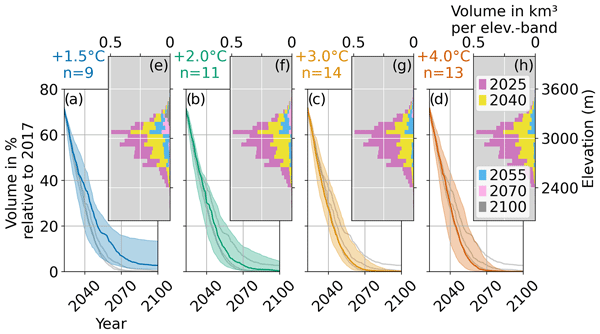
We use regional observations of glacier area and volume change to inform glacier evolution modeling in the Ötztal and Stubai range (Austrian Alps) until 2100 in different climate scenarios. Glaciers in the region lost 23 % of their volume between 2006 and 2017. Under current warming trajectories, glacier loss in the region is expected to be near-total by 2075. We show that integrating regional calibration and validation data in glacier models is important to improve confidence in projections.
Jorrit van der Schot, Jakob Abermann, Tiago Silva, Kerstin Rasmussen, Michael Winkler, Kirsty Langley, and Wolfgang Schöner
The Cryosphere, 18, 5803–5823, https://doi.org/10.5194/tc-18-5803-2024, https://doi.org/10.5194/tc-18-5803-2024, 2024
Short summary
Short summary
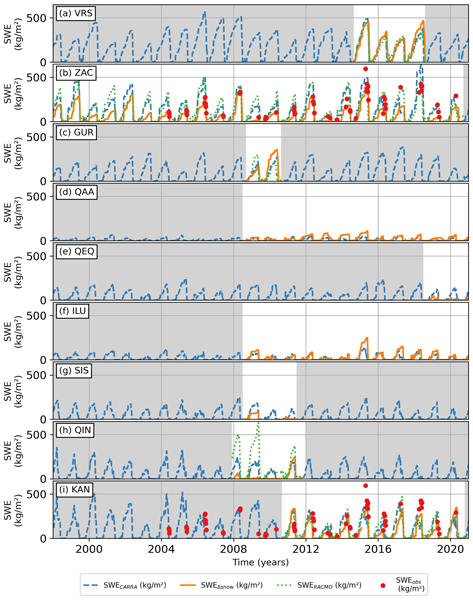
We present snow data from nine locations in coastal Greenland. We show that a reanalysis product (CARRA) simulates seasonal snow characteristics better than a regional climate model (RACMO). CARRA output matches particularly well with our reference dataset when we look at the maximum snow water equivalent and the snow cover end date. We show that seasonal snow in coastal Greenland has large spatial and temporal variability and find little evidence of trends in snow cover characteristics.
Bernhard Hynek, Daniel Binder, Michele Citterio, Signe Hillerup Larsen, Jakob Abermann, Geert Verhoeven, Elke Ludewig, and Wolfgang Schöner
The Cryosphere, 18, 5481–5494, https://doi.org/10.5194/tc-18-5481-2024, https://doi.org/10.5194/tc-18-5481-2024, 2024
Short summary
Short summary
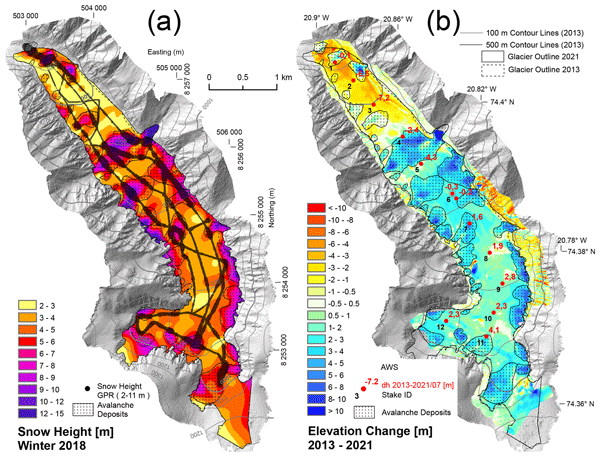
An avalanche event in February 2018 caused thick snow deposits on Freya Glacier, a peripheral mountain glacier in northeastern Greenland. The avalanche deposits contributed significantly to the mass balance, leaving a strong imprint in the elevation changes in 2013–2021. The 8-year geodetic mass balance (2013–2021) of the glacier is positive, whereas previous estimates by direct measurements were negative and now turned out to have a negative bias.
Livia Piermattei, Michael Zemp, Christian Sommer, Fanny Brun, Matthias H. Braun, Liss M. Andreassen, Joaquín M. C. Belart, Etienne Berthier, Atanu Bhattacharya, Laura Boehm Vock, Tobias Bolch, Amaury Dehecq, Inés Dussaillant, Daniel Falaschi, Caitlyn Florentine, Dana Floricioiu, Christian Ginzler, Gregoire Guillet, Romain Hugonnet, Matthias Huss, Andreas Kääb, Owen King, Christoph Klug, Friedrich Knuth, Lukas Krieger, Jeff La Frenierre, Robert McNabb, Christopher McNeil, Rainer Prinz, Louis Sass, Thorsten Seehaus, David Shean, Désirée Treichler, Anja Wendt, and Ruitang Yang
The Cryosphere, 18, 3195–3230, https://doi.org/10.5194/tc-18-3195-2024, https://doi.org/10.5194/tc-18-3195-2024, 2024
Short summary
Short summary
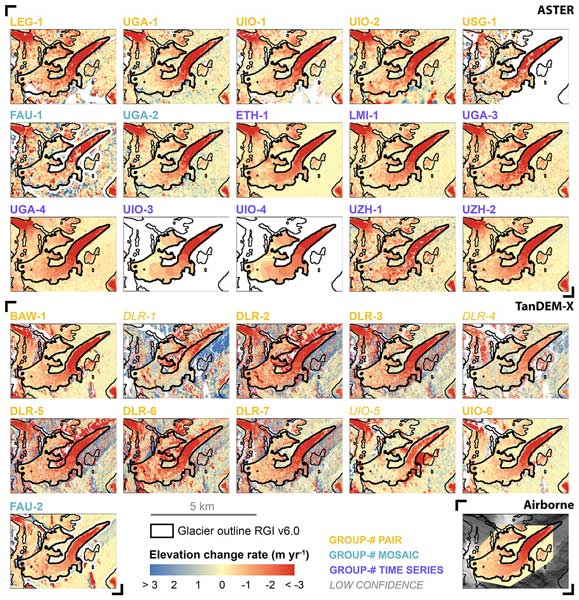
Satellites have made it possible to observe glacier elevation changes from all around the world. In the present study, we compared the results produced from two different types of satellite data between different research groups and against validation measurements from aeroplanes. We found a large spread between individual results but showed that the group ensemble can be used to reliably estimate glacier elevation changes and related errors from satellite data.
Christoph Posch, Jakob Abermann, and Tiago Silva
The Cryosphere, 18, 2035–2059, https://doi.org/10.5194/tc-18-2035-2024, https://doi.org/10.5194/tc-18-2035-2024, 2024
Short summary
Short summary
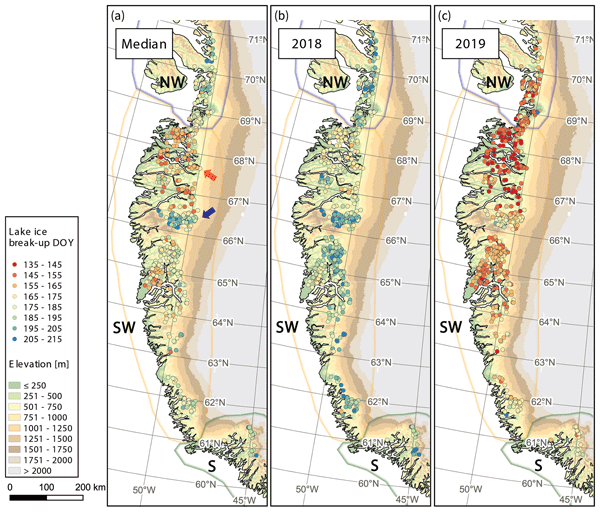
Radar beams from satellites exhibit reflection differences between water and ice. This condition, as well as the comprehensive coverage and high temporal resolution of the Sentinel-1 satellites, allows automatically detecting the timing of when ice cover of lakes in Greenland disappear. We found that lake ice breaks up 3 d later per 100 m elevation gain and that the average break-up timing varies by ±8 d in 2017–2021, which has major implications for the energy budget of the lakes.
Florian Lippl, Alexander Maringer, Margit Kurka, Jakob Abermann, Wolfgang Schöner, and Manuela Hirschmugl
Earth Syst. Sci. Data Discuss., https://doi.org/10.5194/essd-2024-12, https://doi.org/10.5194/essd-2024-12, 2024
Preprint withdrawn
Short summary
Short summary
The aim of our work was to give an overview of data currently available for the National Park Gesäuse and Johnsbachtal relevant to the European long-term ecosystem monitoring. This data, further was made available on respective data repositories, where all data is downloadable free of charge. Data presented in our paper is from all compartments, the atmosphere, social & economic sphere, biosphere and geosphere. We consider our approach as an opportunity to function as a showcase for other sites.
Annelies Voordendag, Brigitta Goger, Rainer Prinz, Tobias Sauter, Thomas Mölg, Manuel Saigger, and Georg Kaser
The Cryosphere, 18, 849–868, https://doi.org/10.5194/tc-18-849-2024, https://doi.org/10.5194/tc-18-849-2024, 2024
Short summary
Short summary
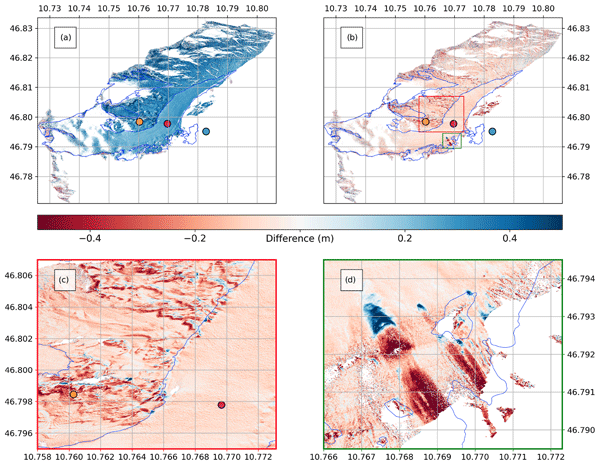
Wind-driven snow redistribution affects glacier mass balance. A case study of Hintereisferner glacier in Austria used high-resolution observations and simulations to model snow redistribution. Simulations matched observations, showing the potential of the model for studying snow redistribution on other mountain glaciers.
Baptiste Vandecrux, Robert S. Fausto, Jason E. Box, Federico Covi, Regine Hock, Åsa K. Rennermalm, Achim Heilig, Jakob Abermann, Dirk van As, Elisa Bjerre, Xavier Fettweis, Paul C. J. P. Smeets, Peter Kuipers Munneke, Michiel R. van den Broeke, Max Brils, Peter L. Langen, Ruth Mottram, and Andreas P. Ahlstrøm
The Cryosphere, 18, 609–631, https://doi.org/10.5194/tc-18-609-2024, https://doi.org/10.5194/tc-18-609-2024, 2024
Short summary
Short summary
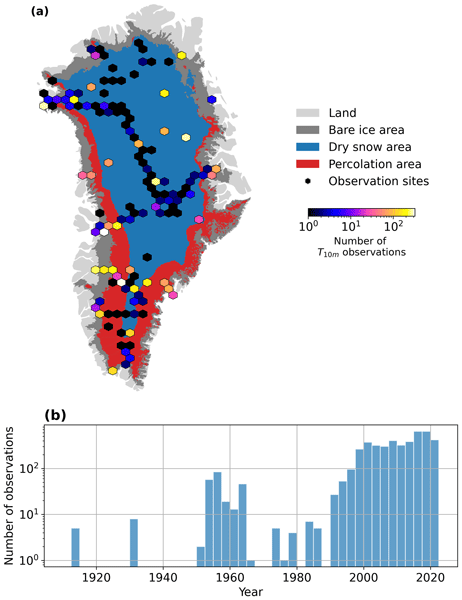
How fast is the Greenland ice sheet warming? In this study, we compiled 4500+ temperature measurements at 10 m below the ice sheet surface (T10m) from 1912 to 2022. We trained a machine learning model on these data and reconstructed T10m for the ice sheet during 1950–2022. After a slight cooling during 1950–1985, the ice sheet warmed at a rate of 0.7 °C per decade until 2022. Climate models showed mixed results compared to our observations and underestimated the warming in key regions.
Finu Shrestha, Jakob F. Steiner, Reeju Shrestha, Yathartha Dhungel, Sharad P. Joshi, Sam Inglis, Arshad Ashraf, Sher Wali, Khwaja M. Walizada, and Taigang Zhang
Earth Syst. Sci. Data, 15, 3941–3961, https://doi.org/10.5194/essd-15-3941-2023, https://doi.org/10.5194/essd-15-3941-2023, 2023
Short summary
Short summary
A new inventory of glacial lake outburst floods (GLOFs) in High Mountain Asia found 697 events, causing 906 deaths, 3 times more than previously reported. This study provides insights into the contributing factors behind GLOFs on a regional scale and highlights the need for interdisciplinary approaches, including scientific communities and local knowledge, to understand GLOF risks in Asia. This study allows integration with other datasets, enabling future local and regional risk assessments.
Sonika Shahi, Jakob Abermann, Tiago Silva, Kirsty Langley, Signe Hillerup Larsen, Mikhail Mastepanov, and Wolfgang Schöner
Weather Clim. Dynam., 4, 747–771, https://doi.org/10.5194/wcd-4-747-2023, https://doi.org/10.5194/wcd-4-747-2023, 2023
Short summary
Short summary
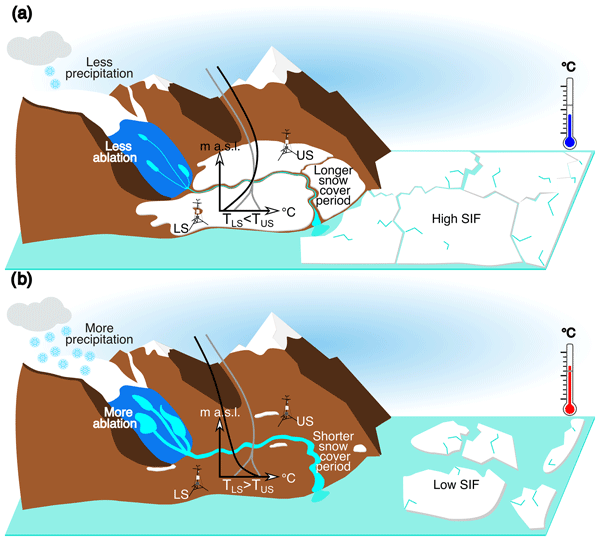
This study highlights how the sea ice variability in the Greenland Sea affects the terrestrial climate and the surface mass changes of peripheral glaciers of the Zackenberg region (ZR), Northeast Greenland, combining model output and observations. Our results show that the temporal evolution of sea ice influences the climate anomaly magnitude in the ZR. We also found that the changing temperature and precipitation patterns due to sea ice variability can affect the surface mass of the ice cap.
Annelies Voordendag, Rainer Prinz, Lilian Schuster, and Georg Kaser
The Cryosphere, 17, 3661–3665, https://doi.org/10.5194/tc-17-3661-2023, https://doi.org/10.5194/tc-17-3661-2023, 2023
Short summary
Short summary
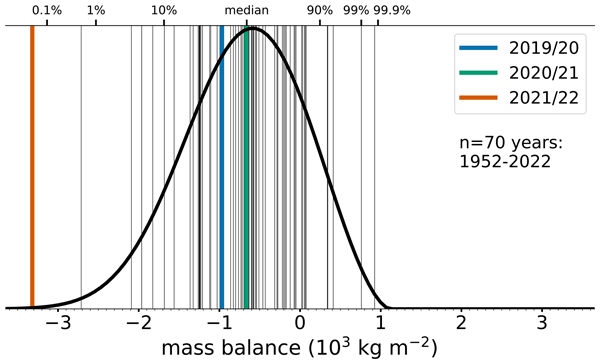
The Glacier Loss Day (GLD) is the day on which all mass gained from the accumulation period is lost, and the glacier loses mass irrecoverably for the rest of the mass balance year. In 2022, the GLD was already reached on 23 June at Hintereisferner (Austria), and this led to a record-breaking mass loss. We introduce the GLD as a gross yet expressive indicator of the glacier’s imbalance with a persistently warming climate.
Klaus Haslinger, Wolfgang Schöner, Jakob Abermann, Gregor Laaha, Konrad Andre, Marc Olefs, and Roland Koch
Nat. Hazards Earth Syst. Sci., 23, 2749–2768, https://doi.org/10.5194/nhess-23-2749-2023, https://doi.org/10.5194/nhess-23-2749-2023, 2023
Short summary
Short summary
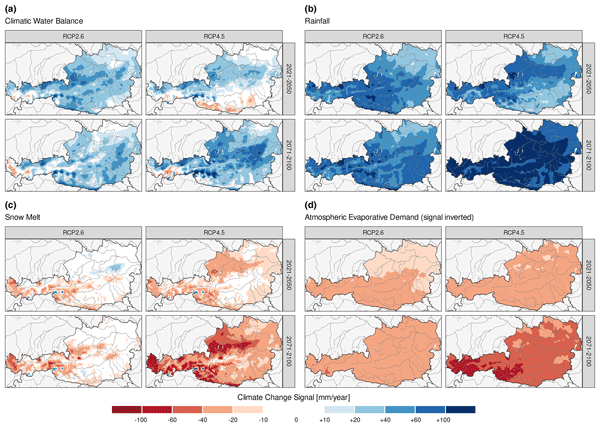
Future changes of surface water availability in Austria are investigated. Alterations of the climatic water balance and its components are analysed along different levels of elevation. Results indicate in general wetter conditions with particular shifts in timing of the snow melt season. On the contrary, an increasing risk for summer droughts is apparent due to increasing year-to-year variability and decreasing snow melt under future climate conditions.
Anushilan Acharya, Jakob F. Steiner, Khwaja Momin Walizada, Salar Ali, Zakir Hussain Zakir, Arnaud Caiserman, and Teiji Watanabe
Nat. Hazards Earth Syst. Sci., 23, 2569–2592, https://doi.org/10.5194/nhess-23-2569-2023, https://doi.org/10.5194/nhess-23-2569-2023, 2023
Short summary
Short summary
All accessible snow and ice avalanches together with previous scientific research, local knowledge, and existing or previously active adaptation and mitigation solutions were investigated in the high mountain Asia (HMA) region to have a detailed overview of the state of knowledge and identify gaps. A comprehensive avalanche database from 1972–2022 is generated, including 681 individual events. The database provides a basis for the forecasting of avalanche hazards in different parts of HMA.
Adam Emmer, Simon K. Allen, Mark Carey, Holger Frey, Christian Huggel, Oliver Korup, Martin Mergili, Ashim Sattar, Georg Veh, Thomas Y. Chen, Simon J. Cook, Mariana Correas-Gonzalez, Soumik Das, Alejandro Diaz Moreno, Fabian Drenkhan, Melanie Fischer, Walter W. Immerzeel, Eñaut Izagirre, Ramesh Chandra Joshi, Ioannis Kougkoulos, Riamsara Kuyakanon Knapp, Dongfeng Li, Ulfat Majeed, Stephanie Matti, Holly Moulton, Faezeh Nick, Valentine Piroton, Irfan Rashid, Masoom Reza, Anderson Ribeiro de Figueiredo, Christian Riveros, Finu Shrestha, Milan Shrestha, Jakob Steiner, Noah Walker-Crawford, Joanne L. Wood, and Jacob C. Yde
Nat. Hazards Earth Syst. Sci., 22, 3041–3061, https://doi.org/10.5194/nhess-22-3041-2022, https://doi.org/10.5194/nhess-22-3041-2022, 2022
Short summary
Short summary
Glacial lake outburst floods (GLOFs) have attracted increased research attention recently. In this work, we review GLOF research papers published between 2017 and 2021 and complement the analysis with research community insights gained from the 2021 GLOF conference we organized. The transdisciplinary character of the conference together with broad geographical coverage allowed us to identify progress, trends and challenges in GLOF research and outline future research needs and directions.

Tiago Silva, Jakob Abermann, Brice Noël, Sonika Shahi, Willem Jan van de Berg, and Wolfgang Schöner
The Cryosphere, 16, 3375–3391, https://doi.org/10.5194/tc-16-3375-2022, https://doi.org/10.5194/tc-16-3375-2022, 2022
Short summary
Short summary
To overcome internal climate variability, this study uses k-means clustering to combine NAO, GBI and IWV over the Greenland Ice Sheet (GrIS) and names the approach as the North Atlantic influence on Greenland (NAG). With the support of a polar-adapted RCM, spatio-temporal changes on SEB components within NAG phases are investigated. We report atmospheric warming and moistening across all NAG phases as well as large-scale and regional-scale contributions to GrIS mass loss and their interactions.
Jonathan P. Conway, Jakob Abermann, Liss M. Andreassen, Mohd Farooq Azam, Nicolas J. Cullen, Noel Fitzpatrick, Rianne H. Giesen, Kirsty Langley, Shelley MacDonell, Thomas Mölg, Valentina Radić, Carleen H. Reijmer, and Jean-Emmanuel Sicart
The Cryosphere, 16, 3331–3356, https://doi.org/10.5194/tc-16-3331-2022, https://doi.org/10.5194/tc-16-3331-2022, 2022
Short summary
Short summary
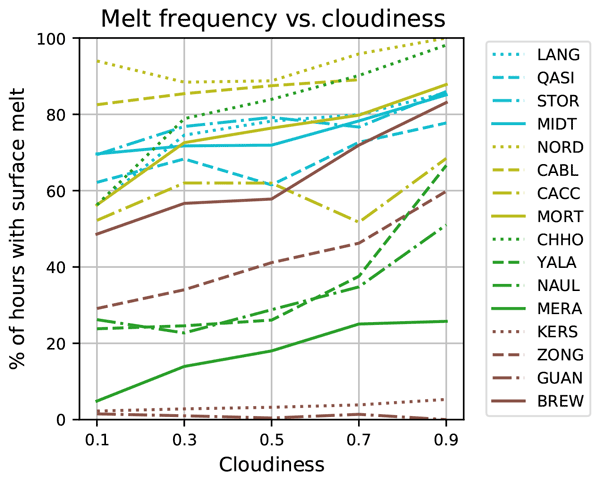
We used data from automatic weather stations on 16 glaciers to show how clouds influence glacier melt in different climates around the world. We found surface melt was always more frequent when it was cloudy but was not universally faster or slower than under clear-sky conditions. Also, air temperature was related to clouds in opposite ways in different climates – warmer with clouds in cold climates and vice versa. These results will help us improve how we model past and future glacier melt.

Thomas Goelles, Tobias Hammer, Stefan Muckenhuber, Birgit Schlager, Jakob Abermann, Christian Bauer, Víctor J. Expósito Jiménez, Wolfgang Schöner, Markus Schratter, Benjamin Schrei, and Kim Senger
Geosci. Instrum. Method. Data Syst., 11, 247–261, https://doi.org/10.5194/gi-11-247-2022, https://doi.org/10.5194/gi-11-247-2022, 2022
Short summary
Short summary
We propose a newly developed modular MObile LIdar SENsor System (MOLISENS) to enable new applications for small industrial light detection and ranging (lidar) sensors. MOLISENS supports both monitoring of dynamic processes and mobile mapping applications. The mobile mapping application of MOLISENS has been tested under various conditions, and results are shown from two surveys in the Lurgrotte cave system in Austria and a glacier cave in Longyearbreen on Svalbard.
A. B. Voordendag, B. Goger, C. Klug, R. Prinz, M. Rutzinger, and G. Kaser
Int. Arch. Photogramm. Remote Sens. Spatial Inf. Sci., XLIII-B2-2022, 1093–1099, https://doi.org/10.5194/isprs-archives-XLIII-B2-2022-1093-2022, https://doi.org/10.5194/isprs-archives-XLIII-B2-2022-1093-2022, 2022
Cited articles
Abermann, J., Vandecrux, B., Scher, S., Löffler, K., Schalamon, F., Trügler, A., Fausto, R., and Schöner, W.: Learning from Alfred Wegener’s pioneering field observations in West Greenland after a century of climate change, Sci. Rep., 13, 7583, https://doi.org/10.1038/s41598-023-33225-9, 2023. a, b
Berthier, E., Lebreton, J., Fontannaz, D., Hosford, S., Belart, J. M.-C., Brun, F., Andreassen, L. M., Menounos, B., and Blondel, C.: The Pléiades Glacier Observatory: high-resolution digital elevation models and ortho-imagery to monitor glacier change, The Cryosphere, 18, 5551–5571, https://doi.org/10.5194/tc-18-5551-2024, 2024. a
Bishop, B. C.: Shear moraines in the Thule area, northwest Greenland, Research Report 17, U.S. Army Snow, Ice, and Permafrost Research Establishment. Engineer Research and Development Center (U.S.), Wilmette, Illinois, https://erdc-library.erdc.dren.mil/items/81b728f7-5e7b-4ef8-e053-411ac80adeb3 (last access: 6 March 2026), 1957. a
Carrivick, J. L., Yde, J. C., Knudsen, N. T., and Kronborg, C.: Ice-dammed lake and ice-margin evolution during the Holocene in the Kangerlussuaq area of west Greenland, Arct. Antarct. Alp. Res., 50, S100005, https://doi.org/10.1080/15230430.2017.1420854, 2018. a, b
Carrivick, J. L., How, P., Lea, J. M., Sutherland, J. L., Grimes, M., Tweed, F. S., Cornford, S., Quincey, D. J., and Mallalieu, J.: Ice-Marginal Proglacial Lakes Across Greenland: Present Status and a Possible Future, Geophys. Res. Lett., 49, e2022GL099276, https://doi.org/10.1029/2022GL099276, 2022. a, b, c, d, e
Chamberlin, T. C.: Glacial Studies in Greenland. VIII, J. Geo., http://archive.org/details/jstor-30055074 (last access: 6 March 2026), 1895. a
Chudley, T. R., Christoffersen, P., Doyle, S. H., Dowling, T. P. F., Law, R., Schoonman, C. M., Bougamont, M., and Hubbard, B.: Controls on Water Storage and Drainage in Crevasses on the Greenland Ice Sheet, J. Geophys. Res.-Earth, 126, e2021JF006287, https://doi.org/10.1029/2021JF006287, 2021. a
Citterio, M. and Ahlstrøm, A. P.: Brief communication ”The aerophotogrammetric map of Greenland ice masses”, The Cryosphere, 7, 445–449, https://doi.org/10.5194/tc-7-445-2013, 2013. a, b
Davies, W. and Krinsley, A.: The recent regimen of the ice cap margin in North Greenland, Int. Assoc. Sci. Hydrol. Publ., 58, 119–130, 1962. a
Davison, B. J., Sole, A. J., Livingstone, S. J., Cowton, T. R., and Nienow, P. W.: The Influence of Hydrology on the Dynamics of Land-Terminating Sectors of the Greenland Ice Sheet, Front. Earth Sci., 7, https://doi.org/10.3389/feart.2019.00010, 2019. a, b
Dawes, P. R. and van As, D.: An advancing glacier in a recessive ice regime: Berlingske bræ, North-West Greenland, Geol. Surv. Den. Greenl., 20, https://doi.org/10.34194/geusb.v20.4986, 2010. a, b
Dowd, C.: A New ECDF Two-Sample Test Statistic, arXiv [preprint], https://doi.org/10.48550/arXiv.2007.01360, 2020. a
Esenther, S. E., Smith, L. C., LeWinter, A., Pitcher, L. H., Overstreet, B. T., Kehl, A., Onclin, C., Goldstein, S., and Ryan, J. C.: New proglacial meteorology and river stage observations from Inglefield Land and Pituffik, NW Greenland, Geosci. Instrum. Method. Data Syst., 12, 215–230, https://doi.org/10.5194/gi-12-215-2023, 2023. a
Farnsworth, L. B., Kelly, M. A., Bromley, G. R. M., Axford, Y., Osterberg, E. C., Howley, J. A., Jackson, M. S., and Zimmerman, S. R.: Holocene history of the Greenland Ice-Sheet margin in Northern Nunatarssuaq, Northwest Greenland, arktos, 4, 10, https://doi.org/10.1007/s41063-018-0044-0, 2018. a, b
Fountain, A. G., Neumann, T. A., Glenn, P. L., and Chinn, T.: Can climate warming induce glacier advance in Taylor Valley, Antarctica?, J. Glaciol., 50, 556–564, https://doi.org/10.3189/172756504781829701, 2004. a
Fountain, A. G., Nylen, T. H., MacClune, K. L., and Dana, G. L.: Glacier mass balances (1993–2001), Taylor Valley, McMurdo Dry Valleys, Antarctica, J. Glaciol., 52, 451–462, https://doi.org/10.3189/172756506781828511, 2006. a
Goldthwait, R.: Restudy of Red Rock Ice Cliff Nunatarssuaq, Greenland, Corps of Engineers, U.S. Army Cold Regions Research and Engineering Laboratory, https://apps.dtic.mil/sti/html/tr/AD0732411/index.html (last access: 6 March 2026), 1971. a
Goliber, S., Black, T., Catania, G., Lea, J. M., Olsen, H., Cheng, D., Bevan, S., Bjørk, A., Bunce, C., Brough, S., Carr, J. R., Cowton, T., Gardner, A., Fahrner, D., Hill, E., Joughin, I., Korsgaard, N. J., Luckman, A., Moon, T., Murray, T., Sole, A., Wood, M., and Zhang, E.: TermPicks: a century of Greenland glacier terminus data for use in scientific and machine learning applications, The Cryosphere, 16, 3215–3233, https://doi.org/10.5194/tc-16-3215-2022, 2022. a
Greene, C. A., Gardner, A. S., Wood, M., and Cuzzone, J. K.: Ubiquitous acceleration in Greenland Ice Sheet calving from 1985 to 2022, Nature, 625, 523–528, https://doi.org/10.1038/s41586-023-06863-2, 2024. a
Hanna, E., Pattyn, F., Navarro, F., Favier, V., Goelzer, H., van den Broeke, M. R., Vizcaino, M., Whitehouse, P. L., Ritz, C., Bulthuis, K., and Smith, B.: Mass balance of the ice sheets and glaciers – Progress since AR5 and challenges, Earth-Sci. Rev., 201, 102976, https://doi.org/10.1016/j.earscirev.2019.102976, 2020. a
Hijmans, R.: terra: Spatial Data Analysis, GitHub [code], https://github.com/rspatial/terra, 2025. a
How, P., Messerli, A., Mätzler, E., Santoro, M., Wiesmann, A., Caduff, R., Langley, K., Bojesen, M. H., Paul, F., Kääb, A., and Carrivick, J. L.: Greenland-wide inventory of ice marginal lakes using a multi-method approach, Sci. Rep., 11, 4481, https://doi.org/10.1038/s41598-021-83509-1, 2021. a, b
Howat, I. M. and Eddy, A.: Multi-decadal retreat of Greenland’s marine-terminating glaciers, J. Glaciol., 57, 389–396, https://doi.org/10.3189/002214311796905631, 2011. a
Hynek, B., Binder, D., Citterio, M., Larsen, S. H., Abermann, J., Verhoeven, G., Ludewig, E., and Schöner, W.: Accumulation by avalanches as a significant contributor to the mass balance of a peripheral glacier of Greenland, The Cryosphere, 18, 5481–5494, https://doi.org/10.5194/tc-18-5481-2024, 2024. a
Kjeldsen, K. K., Korsgaard, N. J., Bjørk, A. A., Khan, S. A., Box, J. E., Funder, S., Larsen, N. K., Bamber, J. L., Colgan, W., van den Broeke, M., Siggaard-Andersen, M.-L., Nuth, C., Schomacker, A., Andresen, C. S., Willerslev, E., and Kjær, K. H.: Spatial and temporal distribution of mass loss from the Greenland Ice Sheet since AD 1900, Nature, 528, 396–400, https://doi.org/10.1038/nature16183, 2015. a
Kjær, K. H., Larsen, N. K., Binder, T., Bjørk, A. A., Eisen, O., Fahnestock, M. A., Funder, S., Garde, A. A., Haack, H., Helm, V., Houmark-Nielsen, M., Kjeldsen, K. K., Khan, S. A., Machguth, H., McDonald, I., Morlighem, M., Mouginot, J., Paden, J. D., Waight, T. E., Weikusat, C., Willerslev, E., and MacGregor, J. A.: A large impact crater beneath Hiawatha Glacier in northwest Greenland, Sci. Adv., 4, eaar8173, https://doi.org/10.1126/sciadv.aar8173, 2018. a, b, c
Knight, P. G., Waller, R. I., Patterson, C. J., Jones, A. P., and Robinson, Z. P.: Glacier advance, ice-marginal lakes and routing of meltwater and sediment: Russell Glacier, Greenland, J. Glaciol., 46, 423–426, https://doi.org/10.3189/172756500781833160, 2000. a, b
Kochtitzky, W. and Copland, L.: Retreat of Northern Hemisphere Marine-Terminating Glaciers, 2000–2020, Geophys. Res. Lett., 49, e2021GL096501, https://doi.org/10.1029/2021GL096501, 2022. a, b, c
Koziol, C. P. and Arnold, N.: Modelling seasonal meltwater forcing of the velocity of land-terminating margins of the Greenland Ice Sheet, The Cryosphere, 12, 971–991, https://doi.org/10.5194/tc-12-971-2018, 2018. a, b
Larocca, L. J., Twining-Ward, M., Axford, Y., Schweinsberg, A. D., Larsen, S. H., Westergaard-Nielsen, A., Luetzenburg, G., Briner, J. P., Kjeldsen, K. K., and Bjørk, A. A.: Greenland-wide accelerated retreat of peripheral glaciers in the twenty-first century, Nat. Clim. Change, 13, 1324–1328, https://doi.org/10.1038/s41558-023-01855-6, 2023. a, b
Lesnek, A. J. and Briner, J. P.: Response of a land-terminating sector of the western Greenland Ice Sheet to early Holocene climate change: Evidence from 10Be dating in the Søndre Isortoq region, Quaternary Sci. Rev., 180, 145–156, https://doi.org/10.1016/j.quascirev.2017.11.028, 2018. a, b
Levy, J. S., Fountain, A. G., Dickson, J. L., Head, J. W., Okal, M., Marchant, D. R., and Watters, J.: Accelerated thermokarst formation in the McMurdo Dry Valleys, Antarctica, Sci. Rep., 3, 2269, https://doi.org/10.1038/srep02269, 2013. a, b
Lewis, K. J., Fountain, A. G., and Dana, G. L.: How important is terminus cliff melt?: a study of the Canada Glacier terminus, Taylor Valley, Antarctica, Global Planet. Change, 22, 105–115, https://doi.org/10.1016/S0921-8181(99)00029-6, 1999. a
Lewis, S. M. and Smith, L. C.: Hydrologic drainage of the Greenland Ice Sheet, Hydrol. Process., 23, 2004–2011, https://doi.org/10.1002/hyp.7343, 2009. a, b
Leysinger Vieli, G. J.-M. C. and Gudmundsson, G. H.: A numerical study of glacier advance over deforming till, The Cryosphere, 4, 359–372, https://doi.org/10.5194/tc-4-359-2010, 2010. a
Luetzenburg, G., Korsgaard, N. J., Deichmann, A. K., Socher, T., Gleie, K., Scharffenberger, T., Fahrner, D., Nielsen, E. B., How, P., Bjørk, A. A., Kjeldsen, K. K., Ahlstrøm, A. P., and Fausto, R. S.: PROMICE-2022 ice mask: a high-resolution outline of the Greenland Ice Sheet from August 2022, Earth Syst. Sci. Data, 18, 411–427, https://doi.org/10.5194/essd-18-411-2026, 2026. a, b
Løkkegaard, A., Mankoff, K. D., Zdanowicz, C., Clow, G. D., Lüthi, M. P., Doyle, S. H., Thomsen, H. H., Fisher, D., Harper, J., Aschwanden, A., Vinther, B. M., Dahl-Jensen, D., Zekollari, H., Meierbachtol, T., McDowell, I., Humphrey, N., Solgaard, A., Karlsson, N. B., Khan, S. A., Hills, B., Law, R., Hubbard, B., Christoffersen, P., Jacquemart, M., Seguinot, J., Fausto, R. S., and Colgan, W. T.: Greenland and Canadian Arctic ice temperature profiles database, The Cryosphere, 17, 3829–3845, https://doi.org/10.5194/tc-17-3829-2023, 2023. a
MacGregor, J. A., Fahnestock, M. A., Colgan, W. T., Larsen, N. K., Kjeldsen, K. K., and Welker, J. M.: The age of surface-exposed ice along the northern margin of the Greenland Ice Sheet, J. Glaciol., 66, 667–684, https://doi.org/10.1017/jog.2020.62, 2020. a
Mankoff, K. D., Fettweis, X., Langen, P. L., Stendel, M., Kjeldsen, K. K., Karlsson, N. B., Noël, B., van den Broeke, M. R., Solgaard, A., Colgan, W., Box, J. E., Simonsen, S. B., King, M. D., Ahlstrøm, A. P., Andersen, S. B., and Fausto, R. S.: Greenland ice sheet mass balance from 1840 through next week, Earth Syst. Sci. Data, 13, 5001–5025, https://doi.org/10.5194/essd-13-5001-2021, 2021. a, b, c
Mernild, S. H., Malmros, J. K., Yde, J. C., and Knudsen, N. T.: Multi-decadal marine- and land-terminating glacier recession in the Ammassalik region, southeast Greenland, The Cryosphere, 6, 625–639, https://doi.org/10.5194/tc-6-625-2012, 2012. a
Morlighem, M., Williams, C. N., Rignot, E., An, L., Arndt, J. E., Bamber, J. L., Catania, G., Chauché, N., Dowdeswell, J. A., Dorschel, B., Fenty, I., Hogan, K., Howat, I., Hubbard, A., Jakobsson, M., Jordan, T. M., Kjeldsen, K. K., Millan, R., Mayer, L., Mouginot, J., Noël, B. P. Y., O'Cofaigh, C., Palmer, S., Rysgaard, S., Seroussi, H., Siegert, M. J., Slabon, P., Straneo, F., van den Broeke, M. R., Weinrebe, W., Wood, M., and Zinglersen, K. B.: BedMachine v3: Complete Bed Topography and Ocean Bathymetry Mapping of Greenland From Multibeam Echo Sounding Combined With Mass Conservation, Geophys. Res. Lett., 44, 11051–11061, https://doi.org/10.1002/2017GL074954, 2017. a, b, c, d
Mouginot, J., Rignot, E., Bjørk, A. A., Broeke, M. v. d., Millan, R., Morlighem, M., Noël, B., Scheuchl, B., and Wood, M.: Forty-six years of Greenland Ice Sheet mass balance from 1972 to 2018, P. Natl. Acad. Sci. USA, 116, 9239–9244, https://doi.org/10.1073/pnas.1904242116, 2019. a, b, c, d
Noël, B., van de Berg, W. J., van Wessem, J. M., van Meijgaard, E., van As, D., Lenaerts, J. T. M., Lhermitte, S., Kuipers Munneke, P., Smeets, C. J. P. P., van Ulft, L. H., van de Wal, R. S. W., and van den Broeke, M. R.: Modelling the climate and surface mass balance of polar ice sheets using RACMO2 – Part 1: Greenland (1958–2016), The Cryosphere, 12, 811–831, https://doi.org/10.5194/tc-12-811-2018, 2018. a
Osterberg, E. C., Hawley, R. L., Wong, G., Kopec, B., Ferris, D., and Howley, J.: Coastal ice-core record of recent northwest Greenland temperature and sea-ice concentration, J. Glaciol., 61, 1137–1146, https://doi.org/10.3189/2015JoG15J054, 2015. a
Porter, C., Howat, I., Noh, M.-J., Husby, E., Khuvis, S., Danish, E., Tomko, K., Gardiner, J., Negrete, A., Yadav, B., Klassen, J., Kelleher, C., Cloutier, M., Bakker, J., Enos, J., Arnold, G., Bauer, G., and Morin, P.: ArcticDEM – Mosaics, Harvard Dataverse [data set], https://doi.org/10.7910/DVN/3VDC4W, 2023. a, b
Rastner, P., Bolch, T., Mölg, N., Machguth, H., Le Bris, R., and Paul, F.: The first complete inventory of the local glaciers and ice caps on Greenland, The Cryosphere, 6, 1483–1495, https://doi.org/10.5194/tc-6-1483-2012, 2012. a, b, c
Rausch, D. O.: Ice Tunnel, Tuto Area, Greenland, 1956, Technical Report 44, U.S. Army Snow Ice and Permafrost Research Establishment, Wilmette, Illinois, 1958. a
Reeh, N., Thomsen, H. H., and Clausen, H. B.: The Greenland ice-sheet margin – A mine of ice for paleo-environmental studies, Palaeogeogr. Palaeocl., 58, 229–234, https://doi.org/10.1016/0031-0182(87)90062-9, 1987. a
Reeh, N., Oerter, H., and Thomsen, H. H.: Comparison between Greenland ice-margin and ice-core oxygen-18 records, Ann. Glaciol., 35, 136–144, https://doi.org/10.3189/172756402781817365, 2002. a
Shepherd, A., Ivins, E., Rignot, E., Smith, B., van den Broeke, M., Velicogna, I., Whitehouse, P., Briggs, K., Joughin, I., Krinner, G., Nowicki, S., Payne, T., Scambos, T., Schlegel, N., A, G., Agosta, C., Ahlstrøm, A., Babonis, G., Barletta, V. R., Bjørk, A. A., Blazquez, A., Bonin, J., Colgan, W., Csatho, B., Cullather, R., Engdahl, M. E., Felikson, D., Fettweis, X., Forsberg, R., Hogg, A. E., Gallee, H., Gardner, A., Gilbert, L., Gourmelen, N., Groh, A., Gunter, B., Hanna, E., Harig, C., Helm, V., Horvath, A., Horwath, M., Khan, S., Kjeldsen, K. K., Konrad, H., Langen, P. L., Lecavalier, B., Loomis, B., Luthcke, S., McMillan, M., Melini, D., Mernild, S., Mohajerani, Y., Moore, P., Mottram, R., Mouginot, J., Moyano, G., Muir, A., Nagler, T., Nield, G., Nilsson, J., Noël, B., Otosaka, I., Pattle, M. E., Peltier, W. R., Pie, N., Rietbroek, R., Rott, H., Sandberg Sørensen, L., Sasgen, I., Save, H., Scheuchl, B., Schrama, E., Schröder, L., Seo, K.-W., Simonsen, S. B., Slater, T., Spada, G., Sutterley, T., Talpe, M., Tarasov, L., van de Berg, W. J., van der Wal, W., van Wessem, M., Vishwakarma, B. D., Wiese, D., Wilton, D., Wagner, T., Wouters, B., Wuite, J., and The IMBIE Team: Mass balance of the Greenland Ice Sheet from 1992 to 2018, Nature, 579, 233–239, https://doi.org/10.1038/s41586-019-1855-2, 2020. a, b, c
Sole, A., Payne, T., Bamber, J., Nienow, P., and Krabill, W.: Testing hypotheses of the cause of peripheral thinning of the Greenland Ice Sheet: is land-terminating ice thinning at anomalously high rates?, The Cryosphere, 2, 205–218, https://doi.org/10.5194/tc-2-205-2008, 2008. a, b
Solgaard, A., Kusk, A., Merryman Boncori, J. P., Dall, J., Mankoff, K. D., Ahlstrøm, A. P., Andersen, S. B., Citterio, M., Karlsson, N. B., Kjeldsen, K. K., Korsgaard, N. J., Larsen, S. H., and Fausto, R. S.: Greenland ice velocity maps from the PROMICE project, Earth Syst. Sci. Data, 13, 3491–3512, https://doi.org/10.5194/essd-13-3491-2021, 2021. a
Steiner, J., Abermann, J., and Prinz, R.: tIM – terrestrial ice margin in Greenland, Zenodo [code/data set], https://doi.org/10.5281/zenodo.15491607, 2025. a, b
Steiner, J. F., Buri, P., Abermann, J., Prinz, R., and Nicholson, L.: Steep ice – progress and future challenges in research on ice cliffs, Ann. Glaciol., 63, 132–136, https://doi.org/10.1017/aog.2023.41, 2022. a, b, c
Swanger, K. M., Lamp, J. L., Winckler, G., Schaefer, J. M., and Marchant, D. R.: Glacier advance during Marine Isotope Stage 11 in the McMurdo Dry Valleys of Antarctica, Sci. Rep., 7, 41433, https://doi.org/10.1038/srep41433, 2017. a
Tatenhove, F. G. M. V., Roelfsema, C. M., Blommers, G., and Voorden, A. V.: Change in position and altitude of a small outlet glacier during the period 1943–92: Leverett Glacier, West Greenland, Ann. Glaciol., 21, 251–258, https://doi.org/10.3189/S0260305500015901, 1995. a
Tedstone, A. J., Nienow, P. W., Gourmelen, N., Dehecq, A., Goldberg, D., and Hanna, E.: Decadal slowdown of a land-terminating sector of the Greenland Ice Sheet despite warming, Nature, 526, 692–695, https://doi.org/10.1038/nature15722, 2015. a, b
van den Broeke, M. R., Enderlin, E. M., Howat, I. M., Kuipers Munneke, P., Noël, B. P. Y., van de Berg, W. J., van Meijgaard, E., and Wouters, B.: On the recent contribution of the Greenland ice sheet to sea level change, The Cryosphere, 10, 1933–1946, https://doi.org/10.5194/tc-10-1933-2016, 2016. a
Weidick, A.: Observations on some Holocene glacier fluctuations in West Greenland, vol. 165 of Meddelelser om Gronland, C.A. Reitzels Forlag, https://doi.org/10.34194/bullggu.v73.6611, 1968. a, b
Winstrup, M., Ranndal, H., Hillerup Larsen, S., Simonsen, S. B., Mankoff, K. D., Fausto, R. S., and Sandberg Sørensen, L.: PRODEM: an annual series of summer DEMs (2019 through 2022) of the marginal areas of the Greenland Ice Sheet, Earth Syst. Sci. Data, 16, 5405–5428, https://doi.org/10.5194/essd-16-5405-2024, 2024. a
Wirbel, A. and Jarosch, A. H.: Inequality-constrained free-surface evolution in a full Stokes ice flow model (evolve_glacier v1.1), Geosci. Model Dev., 13, 6425–6445, https://doi.org/10.5194/gmd-13-6425-2020, 2020. a
Zekollari, H., Huybrechts, P., Noël, B., van de Berg, W. J., and van den Broeke, M. R.: Sensitivity, stability and future evolution of the world's northernmost ice cap, Hans Tausen Iskappe (Greenland), The Cryosphere, 11, 805–825, https://doi.org/10.5194/tc-11-805-2017, 2017. a
Editorial statement
This paper provides a novel insight into the nature of glacier termini across Greenland, both in terms of margin morphology and whether margins are land-, lake-, or marine-terminating. It is therefore a valuable contribution to future work on the changing peripheries of Greenland's ice. Furthermore, it demonstrates the value of open source approaches and data, such as the ArcticDEM, for the ongoing development of knowledge of the polar regions.
This paper provides a novel insight into the nature of glacier termini across Greenland, both in...
Short summary
Nearly 95% of the Greenland ice margin ends on land, where meltwater leaves the ice to supply surrounding ecosystems. Here we show that nearly 30% of this land-terminating margin ends in extremely steep, often vertical sections, previously only described in individual locations. Less than 20% are shallow ramps. Knowledge of these margin shapes and their locations allows us to further investigate what they can potentially tell us about the current ice sheet health and its future evolution.
Nearly 95% of the Greenland ice margin ends on land, where meltwater leaves the ice to supply...


