
Articles | Volume 20, issue 3
https://doi.org/10.5194/tc-20-1725-2026
© Author(s) 2026. This work is distributed under
the Creative Commons Attribution 4.0 License.
the Creative Commons Attribution 4.0 License.
https://doi.org/10.5194/tc-20-1725-2026
© Author(s) 2026. This work is distributed under
the Creative Commons Attribution 4.0 License.
the Creative Commons Attribution 4.0 License.
Research article
| 
24 Mar 2026
Research article |
| 24 Mar 2026
| 24 Mar 2026
Outlet glacier seasonal terminus prediction using interpretable machine learning
Kevin Shionalyn
CORRESPONDING AUTHOR

Department of Earth and Planetary Science, University of Texas at Austin, Austin, TX, USA
Institute for Geophysics, University of Texas, Austin, TX, USA
Ginny Catania
Department of Earth and Planetary Science, University of Texas at Austin, Austin, TX, USA
Institute for Geophysics, University of Texas, Austin, TX, USA
Daniel T. Trugman
Nevada Seismological Laboratory, University of Nevada, Reno, NV, USA
Michael G. Shahin
Department of Earth and Environmental Science, University of Pennsylvania, Philadelphia, PN, USA
Leigh A. Stearns
Department of Earth and Environmental Science, University of Pennsylvania, Philadelphia, PN, USA
Denis Felikson
Cryospheric Sciences Laboratory, NASA Goddard Space Flight Center, Greenbelt, MD, USA
Related authors
No articles found.
Ana Carolina Moraes Luzardi, Sophie Nowicki, Beata Csatho, Jason Briner, Mohammad Salmani, Hui Gao, Denis Felikson, Josh Cuzzone, and Kristin Poinar
EGUsphere, https://doi.org/10.5194/egusphere-2026-5841, https://doi.org/10.5194/egusphere-2026-5841, 2026
This preprint is open for discussion and under review for The Cryosphere (TC).
Short summary
Short summary
Before the satellite era, observations of Greenland ice sheet elevation were sparse in space and time. We reconstruct ice sheet-wide surface elevation for 1850 and 1980 using a 127-member ensemble. The reconstructions agree with observations and historical evidence, reveal patterns of thinning since the preindustrial era, and provide a resource for evaluating and initializing ice sheet simulations.
Michela Savignano, Alison F. Banwell, Waleed Abdalati, Robin E. Bell, Alexandra Boghosian, W. Roger Buck, Sarah E. Esenther, Emily Glazer, Adam L. LeWinter, Laurence C. Smith, and Leigh A. Stearns
The Cryosphere, 20, 5247–5263, https://doi.org/10.5194/tc-20-5247-2026, https://doi.org/10.5194/tc-20-5247-2026, 2026
Short summary
Short summary
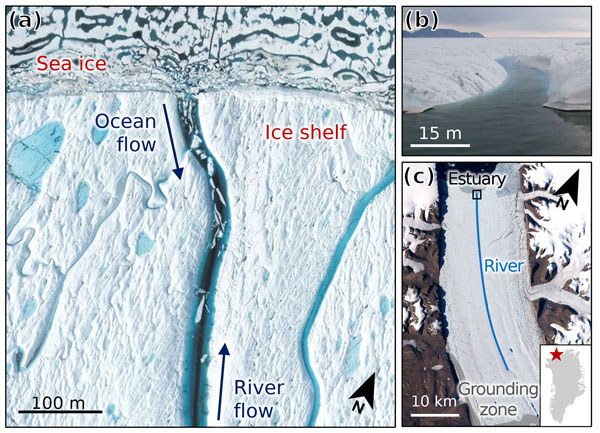
Surface rivers can transport meltwater from floating ice-shelves into the ocean, limiting ponding. However, if a river channel deepens to sea level, seawater can flow up into it and form an ice-shelf estuary. This adds load to the ice shelf and increases stresses that weaken the ice. Using high-resolution satellite imagery, we develop a new way to measure how quickly these rivers deepen, which we use to constrain the timing of Petermann Ice Shelf’s estuary formation over multiple melt seasons.
Andrew O. Hoffman, Paul T. Summers, Jenny Suckale, Knut Christianson, Ginny Catania, and Howard Conway
The Cryosphere, 20, 3977–4003, https://doi.org/10.5194/tc-20-3977-2026, https://doi.org/10.5194/tc-20-3977-2026, 2026
Short summary
Short summary
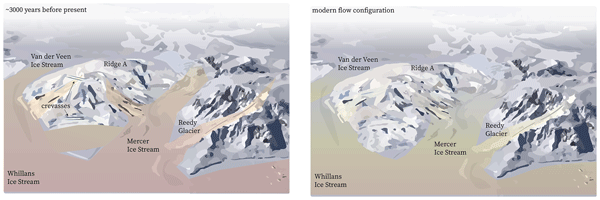
In Antarctica, fast-flowing ice streams drive most ice loss. Radar data from Conway Ice Ridge reveal that the van der Veen and Mercer Ice Streams were wider ~3000 years ago and narrowed progressively. Numerical modeling demonstrates that small thickness changes can rapidly alter shear-margin locations. These findings offer crucial insights into Late Holocene Ice Sheet readvance.

Enze Zhang, Ginny Catania, Ben Smith, Denis Felikson, Beata Csatho, and Daniel T. Trugman
The Cryosphere, 20, 3875–3891, https://doi.org/10.5194/tc-20-3875-2026, https://doi.org/10.5194/tc-20-3875-2026, 2026
Short summary
Short summary
Understanding seasonal changes in Greenland glaciers is vital for studying long-term trends. We use a simple model and high-resolution observation to reveal how multiple processes influence seasonal glacier velocity either alternately or simultaneously each year. Additional tests suggest a steepening glacier surface increases sensitivity of the surface velocity to terminus changes. Our approach can be applied to other glaciers decompose seasonal changes of glacier velocity.

Derek J. Pickell, Robert L. Hawley, Denis Felikson, and Jamie C. Good
The Cryosphere, 20, 483–494, https://doi.org/10.5194/tc-20-483-2026, https://doi.org/10.5194/tc-20-483-2026, 2026
Short summary
Short summary
We compared ICESat-2 ice surface height measurements in interior Greenland with ground-based Global Positioning System (GPS) observations, finding sub-centimeter biases and centimeter-scale precision with no detectable long-term drift. We also apply an autonomous validation method using Global Navigation Satellite System (GNSS) interferometric reflectometry (GNSS-IR) to measure surface elevation, producing comparable results and enabling more frequent, spatially distributed comparisons.
Youngmin Choi, Alek Petty, Denis Felikson, and Jonathan Poterjoy
The Cryosphere, 19, 5423–5444, https://doi.org/10.5194/tc-19-5423-2025, https://doi.org/10.5194/tc-19-5423-2025, 2025
Short summary
Short summary
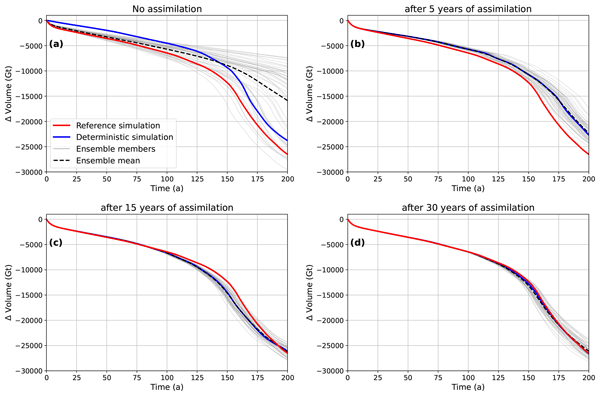
We combined numerical models with satellite observations using the ensemble Kalman filter to improve predictions of glacier states and their basal conditions. Our simulations show that incorporating more data generally improves prediction accuracy. We also tested different types of data and found that the high-resolution observations provide the greatest improvements. This method can help guide the design of future observing systems and improve long-term projections of ice sheet change.

Nicole Abib, David A. Sutherland, Rachel Peterson, Ginny Catania, Jonathan D. Nash, Emily L. Shroyer, Leigh A. Stearns, and Timothy C. Bartholomaus
The Cryosphere, 18, 4817–4829, https://doi.org/10.5194/tc-18-4817-2024, https://doi.org/10.5194/tc-18-4817-2024, 2024
Short summary
Short summary
The melting of ice mélange, or dense packs of icebergs and sea ice in glacial fjords, can influence the water column by releasing cold fresh water deep under the ocean surface. However, direct observations of this process have remained elusive. We use measurements of ocean temperature, salinity, and velocity bookending an episodic ice mélange event to show that this meltwater input changes the density profile of a glacial fjord and has implications for understanding tidewater glacier change.
Denis Felikson, Sophie Nowicki, Isabel Nias, Beata Csatho, Anton Schenk, Michael J. Croteau, and Bryant Loomis
The Cryosphere, 17, 4661–4673, https://doi.org/10.5194/tc-17-4661-2023, https://doi.org/10.5194/tc-17-4661-2023, 2023
Short summary
Short summary
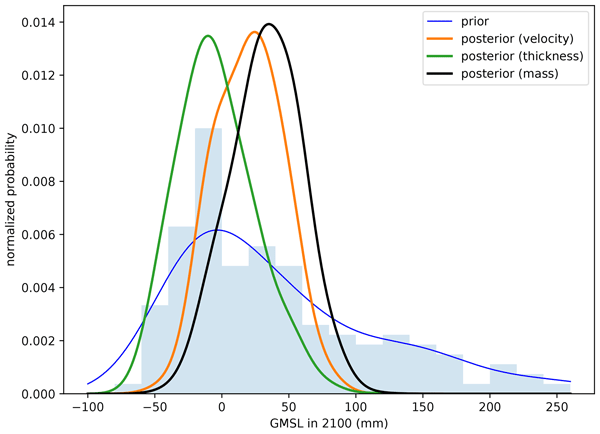
We narrow the spread in model simulations of the Greenland Ice Sheet using velocity change, dynamic thickness change, and mass change observations. We find that the type of observation chosen can lead to significantly different calibrated probability distributions. Further work is required to understand how to best calibrate ensembles of ice sheet simulations because this will improve probability distributions of projected sea-level rise, which is crucial for coastal planning and adaptation.
Enze Zhang, Ginny Catania, and Daniel T. Trugman
The Cryosphere, 17, 3485–3503, https://doi.org/10.5194/tc-17-3485-2023, https://doi.org/10.5194/tc-17-3485-2023, 2023
Short summary
Short summary
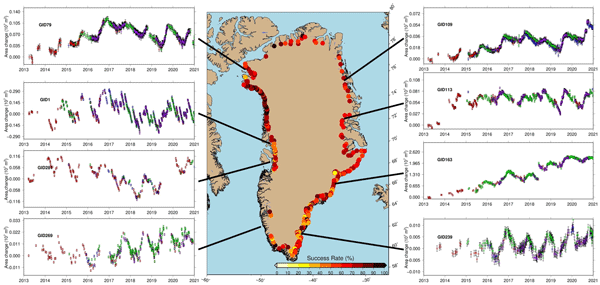
Glacier termini are essential for studying why glaciers retreat, but they need to be mapped automatically due to the volume of satellite images. Existing automated mapping methods have been limited due to limited automation, lack of quality control, and inadequacy in highly diverse terminus environments. We design a fully automated, deep-learning-based method to produce termini with quality control. We produced 278 239 termini in Greenland and provided a way to deliver new termini regularly.
Evan Carnahan, Ginny Catania, and Timothy C. Bartholomaus
The Cryosphere, 16, 4305–4317, https://doi.org/10.5194/tc-16-4305-2022, https://doi.org/10.5194/tc-16-4305-2022, 2022
Short summary
Short summary
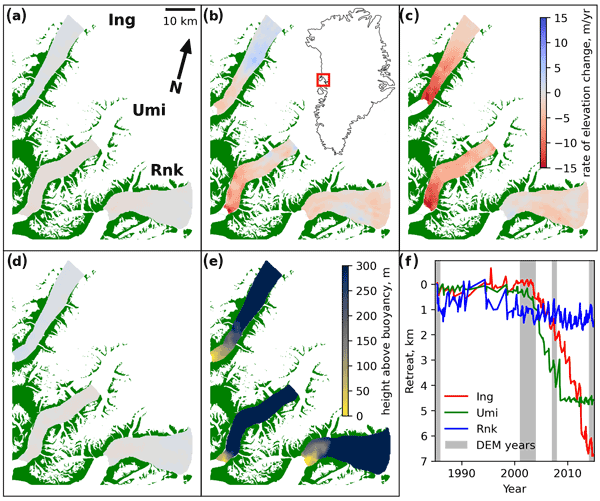
The Greenland Ice Sheet primarily loses mass through increased ice discharge. We find changes in discharge from outlet glaciers are initiated by ocean warming, which causes a change in the balance of forces resisting gravity and leads to acceleration. Vulnerable conditions for sustained retreat and acceleration are predetermined by the glacier-fjord geometry and exist around Greenland, suggesting increases in ice discharge may be sustained into the future despite a pause in ocean warming.
Sophie Goliber, Taryn Black, Ginny Catania, James M. Lea, Helene Olsen, Daniel Cheng, Suzanne Bevan, Anders Bjørk, Charlie Bunce, Stephen Brough, J. Rachel Carr, Tom Cowton, Alex Gardner, Dominik Fahrner, Emily Hill, Ian Joughin, Niels J. Korsgaard, Adrian Luckman, Twila Moon, Tavi Murray, Andrew Sole, Michael Wood, and Enze Zhang
The Cryosphere, 16, 3215–3233, https://doi.org/10.5194/tc-16-3215-2022, https://doi.org/10.5194/tc-16-3215-2022, 2022
Short summary
Short summary
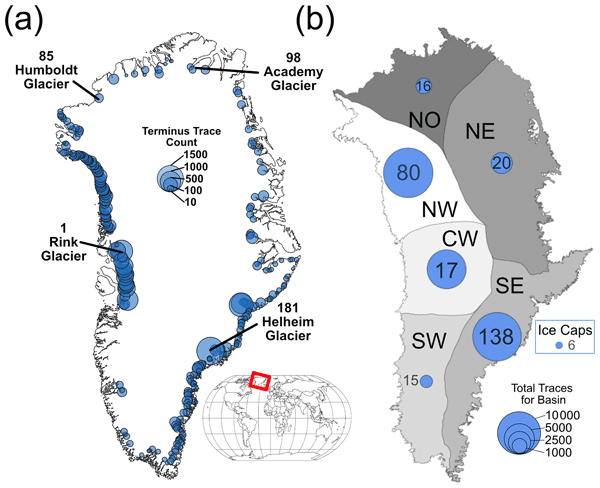
Terminus traces have been used to understand how Greenland's glaciers have changed over time; however, manual digitization is time-intensive, and a lack of coordination leads to duplication of efforts. We have compiled a dataset of over 39 000 terminus traces for 278 glaciers for scientific and machine learning applications. We also provide an overview of an updated version of the Google Earth Engine Digitization Tool (GEEDiT), which has been developed specifically for the Greenland Ice Sheet.

Joseph A. MacGregor, Winnie Chu, William T. Colgan, Mark A. Fahnestock, Denis Felikson, Nanna B. Karlsson, Sophie M. J. Nowicki, and Michael Studinger
The Cryosphere, 16, 3033–3049, https://doi.org/10.5194/tc-16-3033-2022, https://doi.org/10.5194/tc-16-3033-2022, 2022
Short summary
Short summary
Where the bottom of the Greenland Ice Sheet is frozen and where it is thawed is not well known, yet knowing this state is increasingly important to interpret modern changes in ice flow there. We produced a second synthesis of knowledge of the basal thermal state of the ice sheet using airborne and satellite observations and numerical models. About one-third of the ice sheet’s bed is likely thawed; two-fifths is likely frozen; and the remainder is too uncertain to specify.
John Erich Christian, Alexander A. Robel, and Ginny Catania
The Cryosphere, 16, 2725–2743, https://doi.org/10.5194/tc-16-2725-2022, https://doi.org/10.5194/tc-16-2725-2022, 2022
Short summary
Short summary
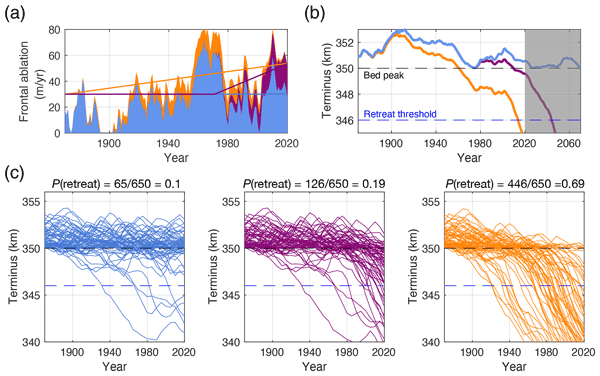
Marine-terminating glaciers have recently retreated dramatically, but the role of anthropogenic forcing remains uncertain. We use idealized model simulations to develop a framework for assessing the probability of rapid retreat in the context of natural climate variability. Our analyses show that century-scale anthropogenic trends can substantially increase the probability of retreats. This provides a roadmap for future work to formally assess the role of human activity in recent glacier change.
Christian J. Taubenberger, Denis Felikson, and Thomas Neumann
The Cryosphere, 16, 1341–1348, https://doi.org/10.5194/tc-16-1341-2022, https://doi.org/10.5194/tc-16-1341-2022, 2022
Short summary
Short summary
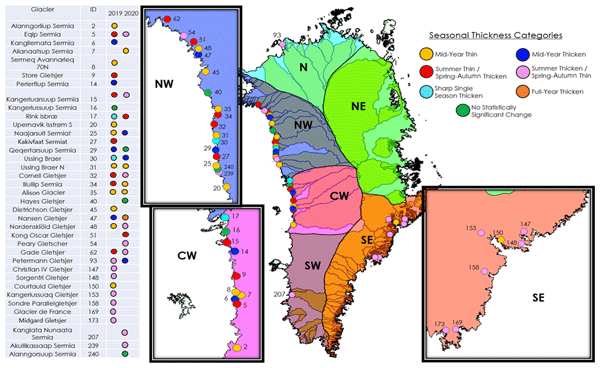
Outlet glaciers are projected to account for half of the total ice loss from the Greenland Ice Sheet over the 21st century. We classify patterns of seasonal dynamic thickness changes of outlet glaciers using new observations from the Ice, Cloud and land Elevation Satellite-2 (ICESat-2). Our results reveal seven distinct patterns that differ across glaciers even within the same region. Future work can use our results to improve our understanding of processes that drive seasonal ice sheet changes.
Cited articles
Alley, R., Cuffey, K., Bassis, J., Alley, K., Wang, S., Parizek, B., Anandakrishnan, S., Christianson, K., and DeConto, R.: Iceberg calving: regimes and transitions, Annu. Rev. Earth Pl. Sc., 51, 189–215, https://doi.org/10.1146/annurev-earth-032320-110916, 2023. a
Amaral, T., Bartholomaus, T. C., and Enderlin, E. M.: Evaluation of Iceberg Calving Models Against Observations From Greenland Outlet Glaciers, J. Geophys. Res.-Earth, 125, https://doi.org/10.1029/2019jf005444, 2019. a
Amundson, J. M., Fahnestock, M. A., Truffer, M., Brown, J., Brown, J., Lüthi, M. P., and Motyka, R. J.: Ice mélange dynamics and implications for terminus stability, Jakobshavn Isbræ, Greenland, J. Geophys. Res., 115, F01005, https://doi.org/10.1029/2009jf001405, 2010. a, b
Aydin, Z. E. and Ozturk, Z. K.: Performance analysis of XGBoost classifier with missing data, Manchester Journal of Artificial Intelligence and Applied Sciences (MJAIAS), 2, 2021 pp., 2021. a
Bassis, J. N. and Jacobs, S.: Diverse calving patterns linked to glacier geometry, Nat. Geosci., 6, 833–836, https://doi.org/10.1038/ngeo1887, 2013. a, b
Benn, D. I., Warren, C. R., and Mottram, R. H.: Calving processes and the dynamics of calving glaciers, Earth-Sci. Rev., 82, 143–179, https://doi.org/10.1016/j.earscirev.2007.02.002, 2007. a
Bergen, K. J., Johnson, P. A., de Hoop, M. V., and Beroza, G. C.: Machine learning for data-driven discovery in solid Earth geoscience, Science, 363, eaau0323, https://doi.org/10.1126/science.aau0323, 2019. a
Bergstra, J., Yamins, D., and Cox, D.: Making a science of model search: Hyperparameter optimization in hundreds of dimensions for vision architectures, in: Proceedings of the 30th International Conference on Machine Learning, 17–19 June 2013, Atlanta, GA, USA, 115–123, https://proceedings.mlr.press/v28/bergstra13.html (last access: 15 June 2025), 2013. a
Bevan, S. L., Luckman, A. J., Benn, D. I., Cowton, T., and Todd, J.: Impact of warming shelf waters on ice mélange and terminus retreat at a large SE Greenland glacier, The Cryosphere, 13, 2303–2315, https://doi.org/10.5194/tc-13-2303-2019, 2019. a
Bézu, C. and Bartholomaus, T. C.: Greenland Ice Sheet's distinct calving styles are identified in terminus change timeseries, Geophys. Res. Lett., 51, e2024GL110224, https://doi.org/10.1029/2024GL110224, 2024. a, b, c
Breiman, L., Friedman, J., Olshen, R. A., and Stone, C. J.: Classification and regression trees, Routledge, Chapman and Hall/CRC, New York, NY, USA, 368 pp., ISBN 9781315139470, https://doi.org/10.1201/9781315139470, 2017. a
Brinkerhoff, D., Truffer, M., and Aschwanden, A.: Sediment transport drives tidewater glacier periodicity, Nat. Commun., 8, 90, https://doi.org/10.1038/s41467-017-00095-5, 2017. a, b
Carnahan, E., Catania, G., and Bartholomaus, T. C.: Observed mechanism for sustained glacier retreat and acceleration in response to ocean warming around Greenland, The Cryosphere, 16, 4305–4317, https://doi.org/10.5194/tc-16-4305-2022, 2022. a
Carroll, D., Sutherland, D. A., Shroyer, E. L., Nash, J. D., Catania, G. A., and Stearns, L. A.: Modeling Turbulent Subglacial Meltwater Plumes: Implications for Fjord-Scale Buoyancy-Driven Circulation, J. Phys. Oceanogr., 45, 2169–2185, https://doi.org/10.1175/jpo-d-15-0033.1, 2015. a
Carroll, D., Sutherland, D. A., Curry, B., Nash, J. D., Shroyer, E. L., Catania, G. A., Stearns, L. A., Grist, J. P., Lee, C. M., and Steur, L.: Subannual and Seasonal Variability of Atlantic‐Origin Waters in Two Adjacent West Greenland Fjords, J. Geophys. Res.-Ocean., 123, 6670–6687, https://doi.org/10.1029/2018jc014278, 2018. a
Chen, T. and Guestrin, C.: Xgboost: A scalable tree boosting system, in: Proceedings of the 22nd International Conference on Knowledge Discovery and Data Mining, 785–794, https://doi.org/10.1145/2939672.2939785, 2016. a
Choi, Y., Morlighem, M., Rignot, E., and Wood, M.: Ice dynamics will remain a primary driver of Greenland ice sheet mass loss over the next century, Commun. Earth Environ., 2, 26, https://doi.org/10.1038/s43247-021-00092-z, 2021. a, b
Crisosto, L. and Tassara, A.: Relating Megathrust Seismogenic Behavior and Subduction Parameters via Machine Learning at Global Scale, Geophys. Res. Lett., 51, e2024GL110984, https://doi.org/10.1029/2024GL110984, 2024. a
Elsner, J. B. and Tsonis, A. A.: Singular spectrum analysis: a new tool in time series analysis, Springer Science & Business Media, 164 pp., ISBN 1475725140, https://doi.org/10.1007/978-1-4757-2514-8, 2013. a
Enderlin, E. M., Howat, I. M., and Vieli, A.: High sensitivity of tidewater outlet glacier dynamics to shape, The Cryosphere, 7, 1007–1015, https://doi.org/10.5194/tc-7-1007-2013, 2013. a
Enderlin, E. M., Howat, I. M., Jeong, S., Noh, M.-J., Angelen, J. H. v., and Broeke, M. R. v. d.: An improved mass budget for the Greenland ice sheet, Geophys. Res. Lett., 41, 866–872, https://doi.org/10.1002/2013gl059010, 2014. a
Enderlin, E. M., Hamilton, G. S., O'Neel, S., Bartholomaus, T. C., Morlighem, M., and Holt, J. W.: An Empirical Approach for Estimating Stress-Coupling Lengths for Marine-Terminating Glaciers, Front. Earth Sci., 4, 104, https://doi.org/10.3389/feart.2016.00104, 2016. a
Felikson, D., Bartholomaus, T. C., Catania, G. A., Korsgaard, N. J., Kjær, K. H., Morlighem, M., Noël, B. P. Y., Broeke, M. R. v. d., Stearns, L. A., Shroyer, E. L., Sutherland, D. A., and Nash, J. D.: Inland thinning on the Greenland ice sheet controlled by outlet glacier geometry, Nat. Geosci., 10, 366–369, https://doi.org/10.1038/ngeo2934, 2017. a
Felikson, D., Nowicki, S., Nias, I., Morlighem, M., and Seroussi, H.: Seasonal Tidewater Glacier Terminus Oscillations Bias Multi‐Decadal Projections of Ice Mass Change, J. Geophys. Res.-Earth, 127, https://doi.org/10.1029/2021jf006249, 2022. a, b
Fischer, E. and Aschwanden, A.: Assessing the effects of fjord geometry on Greenland tidewater glacier stability, J. Glaciol., 70, e53, https://doi.org/10.1017/jog.2024.55, 2024. a
Fischer, R. A.: Statistical Methods for Research Workers, 1st edn., Biological Monographs and Manuals, Vol. 5, Oliver and Boyd, Edinburgh, UK, 239 pp., https://doi.org/10.2134/agronj1928.00021962002000080010x, 1925. a
Frank, T., Åkesson, H., Fleurian, B. d., Morlighem, M., and Nisancioglu, K. H.: Geometric controls of tidewater glacier dynamics, The Cryosphere, 16, 581–601, https://doi.org/10.5194/tc-16-581-2022, 2022. a
Fried, M. J., Catania, G. A., Stearns, L. A., Sutherland, D. A., Bartholomaus, T. C., Shroyer, E., and Nash, J.: Reconciling Drivers of Seasonal Terminus Advance and Retreat at 13 Central West Greenland Tidewater Glaciers, J. Geophys. Res.-Earth, 123, 1590–1607, https://doi.org/10.1029/2018jf004628, 2018. a, b, c, d, e, f, g
Gardner, A. S., Fahnestock, M. A., and Scambos, T. A.: ITS_LIVE Regional Glacier and Ice Sheet Surface Velocities (Version 1), https://doi.org/10.5067/6II6VW8LLWJ7, 2022. a, b, c
Goliber, S. and Catania, G.: Glacier terminus morphology informs calving style, Geophys. Res. Lett., 51, e2024GL108530, https://doi.org/10.1029/2024GL108530, 2024. a, b, c
Goliber, S., Black, T., Catania, G., Lea, J. M., Olsen, H., Cheng, D., Bevan, S., Bjørk, A., Bunce, C., Brough, S., Carr, J. R., Cowton, T., Gardner, A., Fahrner, D., Hill, E., Joughin, I., Korsgaard, N. J., Luckman, A., Moon, T., Murray, T., Sole, A., Wood, M., and Zhang, E.: TermPicks: a century of Greenland glacier terminus data for use in scientific and machine learning applications, The Cryosphere, 16, 3215–3233, https://doi.org/10.5194/tc-16-3215-2022, 2022. a, b, c, d
Good, S. A., Martin, M. J., and Rayner, N. A.: EN4: Quality controlled ocean temperature and salinity profiles and monthly objective analyses with uncertainty estimates, J. Geophys. Res.-Ocean., 118, 6704–6716, https://doi.org/10.1002/2013JC009067, 2013. a
Greene, C. A., Gardner, A. S., Wood, M., and Cuzzone, J. K.: Ubiquitous acceleration in Greenland Ice Sheet calving from 1985 to 2022, Nature, 625, 523–528, https://doi.org/10.1038/s41586-023-06863-2, 2024. a, b, c
Howat, I. M., Box, J. E., Ahn, Y., Herrington, A., and McFadden, E. M.: Seasonal variability in the dynamics of marine-terminating outlet glaciers in Greenland, J. Glaciol., 56, 601–613, https://doi.org/10.3189/002214310793146232, 2010. a, b
Hutson, M.: Artificial intelligence faces reproducibility crisis, Science, 359, 725–726, https://doi.org/10.1126/science.359.6377.725, 2018. a
James, G., Witten, D., Hastie, T., and Tibshirani, R.: An introduction to statistical learning, Vol. 112, Springer, https://doi.org/10.1007/978-1-4614-7138-7, 2013. a
James, T. D., Murray, T., Selmes, N., Scharrer, K., and O’Leary, M.: Buoyant flexure and basal crevassing in dynamic mass loss at Helheim Glacier, Nat. Geosci., 7, 593–596, https://doi.org/10.1038/ngeo2204, 2014. a
Jensen, C., Jørgensen, B., Kern-Hansen, C., Laursen, E., Scheller, J., Cappelen, J., Boas, L., Carstensen, L., and Wang, P.: Weather Observations from Greenland 1958-2022: Observational Data with Description, Tech. Rep. 23-08, Danish Meteorological Institute (DMI), ISSN 2445-9127, https://www.dmi.dk/publikationer/ (last access: 11 November 2024), 2023. a, b
Karlsson, N. B., Mankoff, K. D., Solgaard, A. M., Larsen, S. H., How, P. R., Fausto, R. S., and Sørensen, L. S.: A data set of monthly freshwater fluxes from the Greenland ice sheet’s marine-terminating glaciers on a glacier–basin scale 2010–2020, GEUS Bull., 53, 8338, https://doi.org/10.34194/geusb.v53.8338, 2023. a
Kehrl, L. M., Joughin, I., Shean, D. E., Floricioiu, D., and Krieger, L.: Seasonal and interannual variabilities in terminus position, glacier velocity, and surface elevation at Helheim and Kangerlussuaq Glaciers from 2008 to 2016, J. Geophys. Res.-Earth, 122, 1635–1652, https://doi.org/10.1002/2016jf004133, 2017. a, b, c
Khan, S. A., Seroussi, H., Morlighem, M., Colgan, W., Helm, V., Cheng, G., Berg, D., Barletta, V. R., Larsen, N. K., Kochtitzky, W., van den Broeke, M., Kjær, K. H., Aschwanden, A., Noël, B., Box, J. E., MacGregor, J. A., Fausto, R. S., Mankoff, K. D., Howat, I. M., Oniszk, K., Fahrner, D., Løkkegaard, A., Lippert, E. Y. H., Bråtner, A., and Hassan, J.: Smoothed monthly Greenland ice sheet elevation changes during 2003–2023, Earth Syst. Sci. Data, 17, 3047–3071, https://doi.org/10.5194/essd-17-3047-2025, 2025. a, b
King, M. D., Howat, I. M., Jeong, S., Noh, M. J., Wouters, B., Noël, B., and van den Broeke, M. R.: Seasonal to decadal variability in ice discharge from the Greenland Ice Sheet, The Cryosphere, 12, 3813–3825, https://doi.org/10.5194/tc-12-3813-2018, 2018. a
Kong, Q., Trugman, D. T., Ross, Z. E., Bianco, M. J., Meade, B. J., and Gerstoft, P.: Machine learning in seismology: Turning data into insights, Seismol. Res. Lett., 90, 3–14, https://doi.org/10.1785/0220180259, 2019. a
Korsgaard, N. J., Nuth, C., Khan, S. A., Kjeldsen, K. K., Bjørk, A. A., Schomacker, A., and Kjær, K. H.: Digital elevation model and orthophotographs of Greenland based on aerial photographs from 1978–1987, Sci. Data, 3, 1–15, https://doi.org/10.1038/sdata.2016.32, 2016. a, b
Lea, J. M., Mair, D. W., and Rea, B. R.: Evaluation of existing and new methods of tracking glacier terminus change, J. Glaciol., 60, 323–332, https://doi.org/10.3189/2014JoG13J061, 2014. a
Leinonen, J., Hamann, U., Sideris, I. V., and Germann, U.: Thunderstorm Nowcasting With Deep Learning: A Multi-Hazard Data Fusion Model, Geophys. Res. Lett., 50, e2022GL101626, https://doi.org/10.1029/2022GL101626, 2023. a
Lundberg, S. M. and Lee, S.-I.: A unified approach to interpreting model predictions, Advances in neural information processing systems, arXiv, 30, 7062, https://doi.org/10.48550/arXiv.1705.07874, 2017. a, b
Lundberg, S. M., Erion, G. G., and Lee, S.-I.: Consistent individualized feature attribution for tree ensembles, arXiv preprint, arXiv:1802.03888, https://doi.org/10.48550/arXiv.1802.03888, 2018. a
Mankoff, K. D., Noël, B. P. Y., Fettweis, X., Ahlstrøm, A. P., Colgan, W., Kondo, K., Langley, K., Sugiyama, S., As, D. V., and Fausto, R. S.: Greenland liquid water discharge from 1958 through 2019, Earth Syst. Sci. Data, 12, 2811–2841, https://doi.org/10.5194/essd-12-2811-2020, 2020. a, b, c, d
Meier, M. F. and Post, A.: Fast Tidewater Glaciers, J. Geophys. Res., 92, 9051–9058, https://doi.org/10.1029/JB092iB09p09051, 1987. a
Molnar, C.: Interpretable Machine Learning: A Guide for Making Black Box Models Explainable, Lulu.com, 320 pp., ISBN 9780244768522, 2020. a
Moon, T., Joughin, I., Smith, B., Van Den Broeke, M. R., Van De Berg, W. J., Noël, B., and Usher, M.: Distinct patterns of seasonal Greenland glacier velocity, Geophys. Res. Lett., 41, 7209–7216, https://doi.org/10.1002/2014GL061836, 2014. a, b
Moon, T., Joughin, I., and Smith, B.: Seasonal to multiyear variability of glacier surface velocity, terminus position, and sea ice/ice mélange in northwest Greenland, J. Geophys. Res.-Earth, 120, 818–833, https://doi.org/10.1002/2015jf003494, 2015. a
Moon, T. A., Fisher, M., Stafford, T., and Thurber, A.: QGreenland (v3), Zenodo [data set] , https://doi.org/10.5281/zenodo.12823307, 2023. a
Morlighem, M., Wood, M., Seroussi, H., Choi, Y., and Rignot, E.: Modeling the response of northwest Greenland to enhanced ocean thermal forcing and subglacial discharge, The Cryosphere, 13, 723–734, https://doi.org/10.5194/tc-13-723-2019, 2019. a
Morlighem, M., Williams, C., Rignot, E., An, L., Arndt, J. E., Bamber, J., Catania, G., Chauché, N., Dowdeswell, J. A., Dorschel, B., Fenty, I., Hogan, K., Howat, I., Hubbard, A., Jakobsson, M., Jordan, T. M., Kjeldsen, K. K., Millan, R., Mayer, L., Mouginot, J., Noël, B., O'Cofaigh, C., Palmer, S. J., Rysgaard, S., Seroussi, H., Siegert, M. J., Slabon, P., Straneo, F., van den Broeke, M. R., Weinrebe, W., Wood, M., and Zinglersen, K.: IceBridge BedMachine Greenland (IDBMG4, Version 5), Boulder, Colorado, USA, NASA National Snow and Ice Data Center Distributed Active Archive Center [data set], https://doi.org/10.5067/GMEVBWFLWA7X, 2022. a, b, c, d
Motyka, R. J., Dryer, W. P., Amundson, J., Truffer, M., and Fahnestock, M.: Rapid submarine melting driven by subglacial discharge, LeConte Glacier, Alaska, Geophys. Res. Lett., 40, 5153–5158, https://doi.org/10.1002/grl.51011, 2013. a
Mouginot, J., Rignot, E. J., Bjørk, A. A., Broeke, M. R. v. d., Millan, R., Morlighem, M., Noël, B. P. Y., Scheuchl, B., and Wood, M. H.: Forty-six years of Greenland Ice Sheet mass balance from 1972 to 2018, P. Natl. Acad. Sci. USA, 116, 9239–9244, https://doi.org/10.7280/d1mm37, 2019. a, b
Murray, T., Scharrer, K., James, T., Dye, S., Hanna, E., Booth, A. D., Selmes, N., Luckman, A., Hughes, A., Cook, S., and Huybrechts, P.: Ocean regulation hypothesis for glacier dynamics in southeast Greenland and implications for ice sheet mass changes, J. Geophys. Res.-Earth, 115, https://doi.org/10.1029/2009JF001522, 2010. a, b
NASA/JPL: MODIS Terra Level 3 SST Thermal IR Monthly 4km Daytime V2019.0, NASA Physical Oceanography Distributed Active Archive Center, https://doi.org/10.5067/MODST-MO4D9, 2020. a, b
Nick, F. M. and Oerlemans, J.: Dynamics of tidewater glaciers: comparison of three models, J. Glaciol., 52, 183–190, https://doi.org/10.3189/172756506781828755, 2006. a
Otosaka, I. N., Horwath, M., Mottram, R., and Nowicki, S.: Mass balances of the Antarctic and Greenland ice sheets monitored from space, Surv. Geophys., 44, 1615–1652, https://doi.org/10.1007/s10712-023-09795-8, 2023. a
Pfeffer, W. T.: A simple mechanism for irreversible tidewater glacier retreat, J. Geophys. Res., 112, 119, https://doi.org/10.1029/2006jf000590, 2007. a
Ren, C. X., Dorostkar, O., Rouet-Leduc, B., Hulbert, C., Strebel, D., Guyer, R. A., Johnson, P. A., and Carmeliet, J.: Machine Learning Reveals the State of Intermittent Frictional Dynamics in a Sheared Granular Fault, Geophys. Res. Lett., 46, 7395–7403, https://doi.org/10.1029/2019GL082706, 2019. a
Ren, C. X., Peltier, A., Ferrazzini, V., Rouet-Leduc, B., Johnson, P. A., and Brenguier, F.: Machine Learning Reveals the Seismic Signature of Eruptive Behavior at Piton de La Fournaise Volcano, Geophys. Res. Lett., 47, e2019GL085523, https://doi.org/10.1029/2019GL085523, 2020. a
Ritchie, J. B., Lingle, C. S., Motyka, R. J., and Truffer, M.: Seasonal fluctuations in the advance of a tidewater glacier and potential causes: Hubbard Glacier, Alaska, USA, J. Glaciol., 54, 401–411, https://doi.org/10.3189/002214308785836977, 2008. a
Robel, A. A.: Thinning sea ice weakens buttressing force of iceberg mélange and promotes calving, Nat. Commun., 8, 14596, https://doi.org/10.1038/ncomms14596, 2017. a
Robel, A. A., Roe, G. H., and Haseloff, M.: Response of Marine-Terminating Glaciers to Forcing: Time Scales, Sensitivities, Instabilities and Stochastic Dynamics, J. Geophys. Res.-Earth, 123, 1–62, https://doi.org/10.1029/2018jf004709, 2018. a
Rückamp, M., Neckel, N., Berger, S., Humbert, A., and Helm, V.: Calving induced speedup of Petermann Glacier, J. Geophys. Res.-Earth, 124, 216–228, https://doi.org/10.1029/2018JF004775, 2019. a
Salih, A. M., Raisi-Estabragh, Z., Galazzo, I. B., Radeva, P., Petersen, S. E., Lekadir, K., and Menegaz, G.: A perspective on explainable artificial intelligence methods: SHAP and LIME, Adv. Intell. Syst., 7, 2400304, https://doi.org/10.1002/aisy.202400304, 2025. a
Schild, K. M. and Hamilton, G. S.: Seasonal variations of outlet glacier terminus position in Greenland, J. Glaciol., 59, 759–770, https://doi.org/10.3189/2013jog12j238, 2013. a, b, c
Schoof, C. G.: Ice sheet grounding line dynamics: Steady states, stability, and hysteresis, J. Geophys. Res., 112, 1720, https://doi.org/10.1029/2006jf000664, 2007. a
Shannon, C.: Communication in the Presence of Noise, Proc. IRE, 37, 10–21, https://doi.org/10.1109/jrproc.1949.232969, 1949. a
Shapley, L. S.: A Value for n-Person Games, in: Contributions to the Theory of Games II, edited by: Kuhn, H. W. and Tucker, A. W., 307–317, Princeton University Press, Princeton, ISBN 9781400829156, 1953. a
Shekhar, P., Csatho, B., Schenk, T., Roberts, C., and Patra, A. K.: Alps: a unified framework for modeling time series of land ice changes, IEEE Trans. Geosci. Remote Sens., 59, 6466–6481, https://doi.org/10.1109/TGRS.2020.3027190, 2020. a, b
Slater, D. and Straneo, F.: Submarine melting of glaciers in Greenland amplified by atmospheric warming, Nat. Geosci., 15, 794–799, https://doi.org/10.1038/s41561-022-01035-9, 2022. a, b, c, d
Slater, D., Nienow, P., Cowton, T., Goldberg, D., and Sole, A.: Effect of near-terminus subglacial hydrology on tidewater glacier submarine melt rates, Geophys. Res. Lett., 42, 2861–2868, https://doi.org/10.1002/2014GL062494, 2015. a
Stevens, R., Taylor, V., Nichols, J., Maccabe, A. B., Yelick, K., and Brown, D.: AI for Science: Report on the Department of Dnergy (DOE) Town Halls on Artificial Intelligence (AI) for Science, Tech. rep., Argonne National Lab (ANL), Argonne, IL (United States), https://doi.org/10.2172/1604756, 2020. a
Straneo, F. and Heimbach, P.: North Atlantic warming and the retreat of Greenland's outlet glaciers, Nature, 504, 36–43, https://doi.org/10.1038/nature12854, 2013. a, b
Tan, Y. S., Agarwal, A., and Yu, B.: A cautionary tale on fitting decision trees to data from additive models: generalization lower bounds, in: International Conference on Artificial Intelligence and Statistics, 9663–9685, arXiv, https://doi.org/10.48550/arXiv.2110.09626, 2022. a
Todd, J. and Christoffersen, P.: Are seasonal calving dynamics forced by buttressing from ice mélange or undercutting by melting? Outcomes from full-Stokes simulations of Store Glacier, West Greenland, The Cryosphere, 8, 2353–2365, https://doi.org/10.5194/tc-8-2353-2014, 2014. a
Trugman, D. T. and Ben-Zion, Y.: Coherent Spatial Variations in the Productivity of Earthquake Sequences in California and Nevada, The Seismic Record, 3, 322–331, https://doi.org/10.1785/0320230039, 2023. a
Ultee, L., Felikson, D., Minchew, B., Stearns, L. A., and Riel, B.: Helheim Glacier ice velocity variability responds to runoff and terminus position change at different timescales, Nat. Commun., 13, 6022, https://doi.org/10.1038/s41467-022-33292-y, 2022. a, b, c, d
Van Der Ploeg, T., Austin, P. C., and Steyerberg, E. W.: Modern modelling techniques are data hungry: a simulation study for predicting dichotomous endpoints, BMC Med. Res. Methodol., 14, 1–13, https://doi.org/10.1186/1471-2288-14-137, 2014. a
Van der Veen, C.: Tidewater calving, J. Glaciol., 42, 375–385, https://doi.org/10.3189/S0022143000004226, 1996. a, b
Vieli, A. and Nick, F. M.: Understanding and Modelling Rapid Dynamic Changes of Tidewater Outlet Glaciers: Issues and Implications, Surv. Geophys., 32, 437–458, https://doi.org/10.1007/s10712-011-9132-4, 2011. a
Walter, J. I., Box, J. E., Tulaczyk, S., Brodsky, E. E., Howat, I. M., Ahn, Y., and Brown, A.: Oceanic mechanical forcing of a marine-terminating Greenland glacier, Ann. Glaciol., 53, 181–192, https://doi.org/10.3189/2012AoG60A083, 2012. a, b
Wang, B., Kao, H., Dokht, R. M. H., Visser, R., and Yu, H.: Delineating the Controlling Factors of Hydraulic Fracturing-Induced Seismicity in the Northern Montney Play, Northeastern British Columbia, Canada, With Machine Learning, Seismol. Res. Lett., 93, 2439–2450, https://doi.org/10.1785/0220220075, 2022. a
Wood, M., Rignot, E., Fenty, I., Menemenlis, D., Millan, R., Morlighem, M., Mouginot, J., and Seroussi, H.: Ocean-induced melt triggers glacier retreat in Northwest Greenland, Geophys. Res. Lett., 45, 8334–8342, https://doi.org/10.1029/2018GL078024, 2018. a
Wood, M. H., Rignot, E. J., Fenty, I. G., An, L., Bjørk, A., Broeke, M. R. v. d., Cai, C., Kane, E., Menemenlis, D., Millan, R., Morlighem, M., Mouginot, J., Noël, B. P. Y., Scheuchl, B., Velicogna, I., Willis, J. K., and Zhang, H.: Ocean forcing drives glacier retreat in Greenland., Sci. Adv., 7, https://doi.org/10.1126/sciadv.aba7282, 2021. a, b, c, d
Wuite, J., Rott, H., Hetzenecker, M., Floricioiu, D., De Rydt, J., Gudmundsson, G., Nagler, T., and Kern, M.: Evolution of surface velocities and ice discharge of Larsen B outlet glaciers from 1995 to 2013, The Cryosphere, 9, 957–969, https://doi.org/10.5194/tc-9-957-2015, 2015. a
Short summary
The ocean-facing front of a glacier changes with the seasons. We know this cycle is controlled by the shape and speed of the glacier as well as by the climate, but we do not have a full understanding of these processes. Our study uses 20 years of data and a machine learning model to predict this pattern and identifies which factors matter most. We find that while several factors influence the seasonal cycle, the shape of the glacier plays a key role in how much a glacier changes annually.
The ocean-facing front of a glacier changes with the seasons. We know this cycle is controlled...


