
Articles | Volume 20, issue 3
https://doi.org/10.5194/tc-20-1589-2026
© Author(s) 2026. This work is distributed under
the Creative Commons Attribution 4.0 License.
the Creative Commons Attribution 4.0 License.
https://doi.org/10.5194/tc-20-1589-2026
© Author(s) 2026. This work is distributed under
the Creative Commons Attribution 4.0 License.
the Creative Commons Attribution 4.0 License.
Brief communication
| 
16 Mar 2026
Brief communication |
| 16 Mar 2026
| 16 Mar 2026
Brief communication: Updated grounding line mapping in the Amundsen Sea Embayment, Antarctica, from one day repeat Sentinel-1 SAR data
Jonas K. Andersen
CORRESPONDING AUTHOR

Department of Geosciences and Natural Resource Management, University of Copenhagen, 1350 Copenhagen, Denmark
Romain Millan
Univ. Grenoble Alpes, CNRS, IRD, INRAE, Grenoble-INP, IGE (UMR 5001), 38000 Grenoble, France
Eric Rignot
Department of Earth System Science, University of California, Irvine, CA 92697, USA
Radar Science and Engineering Section, Jet Propulsion Laboratory, California Institute of Technology, Pasadena, CA 91109, USA
Lucille Gimenes
Univ. Grenoble Alpes, CNRS, IRD, INRAE, Grenoble-INP, IGE (UMR 5001), 38000 Grenoble, France
Bernd Scheuchl
Department of Earth System Science, University of California, Irvine, CA 92697, USA
Jean Baptiste Barré
Department of Earth System Science, University of California, Irvine, CA 92697, USA
Anders A. Bjørk
Department of Geosciences and Natural Resource Management, University of Copenhagen, 1350 Copenhagen, Denmark
Related authors
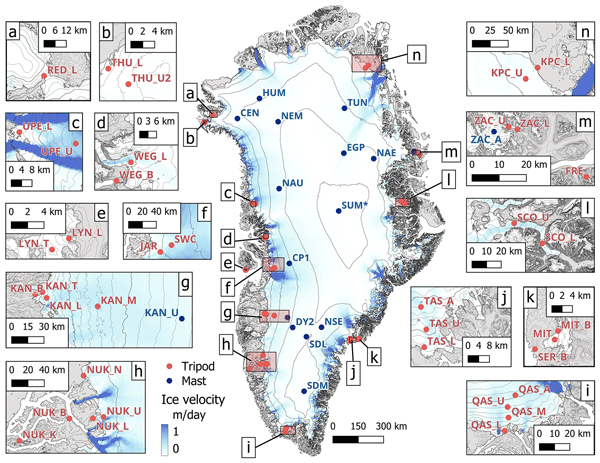
Robert S. Fausto, Penelope How, Baptiste Vandecrux, Mads C. Lund, Jason E. Box, Kenneth D. Mankoff, Signe B. Andersen, Dirk van As, Rasmus Bahbah, Michele Citterio, William Colgan, Henrik T. Jakobsgaard, Nanna B. Karlsson, Kristian K. Kjeldsen, Signe H. Larsen, Charlotte Olsen, Falk M. Oraschewski, Anja Rutishauser, Christopher L. Shields, Anne M. Solgaard, Ian T. Stevens, Synne H. Svendsen, Kirsty Langley, Alexandra Messerli, Anders A. Bjørk, Jonas K. Andersen, Jakob Abermann, Jakob Steiner, Rainer Prinz, Berhard Hynek, James M. Lea, Stephen Brough, and Andreas P. Ahlstrøm
Earth Syst. Sci. Data, 18, 2829–2873, https://doi.org/10.5194/essd-18-2829-2026, https://doi.org/10.5194/essd-18-2829-2026, 2026
Short summary
Short summary
In summary, the PROMICE (Programme for Monitoring of the Greenland Ice Sheet ) | GC-NET AWS (Greenland Climate Network automatic weather station) data product update represents a significant advancement in Arctic climate monitoring. Through enhanced station designs, state-of-the-art instrumentation, and a transparent, automated data processing workflow, the dataset offers an essential resource for studying the Greenland Ice Sheet and its periphery, validating climate models, and supporting global assessments of cryospheric change.
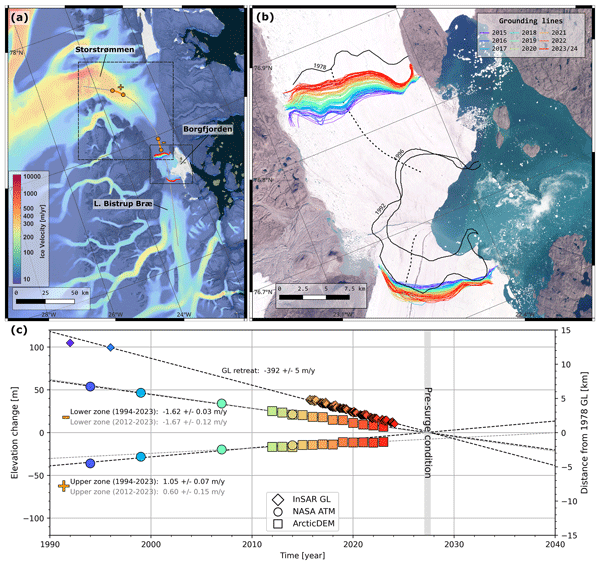
Jonas K. Andersen, Rasmus P. Meyer, Flora S. Huiban, Mads L. Dømgaard, Romain Millan, and Anders A. Bjørk
The Cryosphere, 19, 1717–1724, https://doi.org/10.5194/tc-19-1717-2025, https://doi.org/10.5194/tc-19-1717-2025, 2025
Short summary
Short summary
Storstrømmen Glacier in northeastern Greenland goes through cycles of sudden flow speed-ups (known as surges) followed by long quiet phases. It is currently in its quiet phase, but recent measurements suggest it may be nearing conditions for a new surge, possibly between 2027 and 2040. We also observed several lake drainages that caused brief increases in glacier flow but did not trigger a surge. Continued monitoring is essential to understand how these processes influence glacier behavior.
Etienne Ducasse, Romain Millan, Jonas Kvist Andersen, and Antoine Rabatel
The Cryosphere, 19, 911–917, https://doi.org/10.5194/tc-19-911-2025, https://doi.org/10.5194/tc-19-911-2025, 2025
Short summary
Short summary
Our study examines glacier movement in the tropical Andes from 2013 to 2022 using satellite data. Despite challenges like small glacier size and frequent cloud cover, we tracked annual speeds and seasonal changes. We found stable annual speeds but significant shifts between wet and dry seasons, likely due to changes in meltwater production and glacier–bedrock conditions. This research enhances understanding of how tropical glaciers react to climate change.
Rasmus Meyer, Mathias Preisler Schødt, Mikkel Lydholm Rasmussen, Jonas Kvist Andersen, Mads Dømgaard, and Anders Anker Bjørk
EGUsphere, https://doi.org/10.5194/egusphere-2024-3850, https://doi.org/10.5194/egusphere-2024-3850, 2025
Preprint archived
Short summary
Short summary
Understanding snow accumulation is important for water resource management, but measurements of snow depth in mountainous regions are sparse. We introduce a novel satellite-based approach to estimate snow depth for deep snow in mountainous regions by combining two types of satellite data: radar images and laser surface height measurements. Results suggest that our method more accurately estimate the magnitude of snowfall compared to modelled data over the Southern Norwegian Mountains.
Kaian Shahateet, Colin Prieur, Romain Millan, Lucille Gimenes, Andrea Sofie Haastrup-Vang, Jaime Roas, Maaike Izeboud, Raphaelle Charrassin, Emil Giraldi, and Romain Santiard
EGUsphere, https://doi.org/10.5194/egusphere-2026-5765, https://doi.org/10.5194/egusphere-2026-5765, 2026
This preprint is open for discussion and under review for Earth Observation (EO).
Short summary
Short summary
We developed a deep-learning tool that uses satellite observations to map fractures across Antarctica’s floating ice shelves over nearly four decades. Applied to images collected since the 1980s, it detects both visible surface cracks and subtle signatures of fractures beneath the ice. The method works across several satellite sensors, paving the way for long-term records of ice-shelf damage across Antarctica.
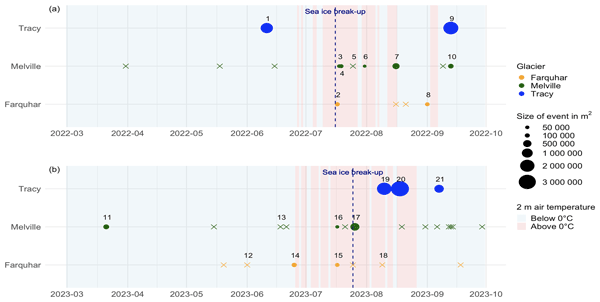
Sofie Hedetoft, Olivia Bang Brinck, Ruth Mottram, Andrea M. U. Gierisch, Steffen Malskær Olsen, Martin Olesen, Nicolaj Hansen, Anders Anker Bjørk, Erik Loebel, Anne Solgaard, and Peter Thejll
The Cryosphere, 20, 5071–5098, https://doi.org/10.5194/tc-20-5071-2026, https://doi.org/10.5194/tc-20-5071-2026, 2026
Short summary
Short summary
Iceberg mélange is the jumble of icebergs in front of some glaciers that calve into the sea. Some studies suggest mélange might help to control the retreat of glaciers. We studied 3 glaciers in NW Greenland where we used GPS sensors and satellites to track ice movement. We found that glaciers push forward and calve all year, including when mélange and landfast sea ice are present, suggesting mélange is not important in supporting glaciers, but may influence the seasonal calving cycle.
Robert S. Fausto, Penelope How, Baptiste Vandecrux, Mads C. Lund, Jason E. Box, Kenneth D. Mankoff, Signe B. Andersen, Dirk van As, Rasmus Bahbah, Michele Citterio, William Colgan, Henrik T. Jakobsgaard, Nanna B. Karlsson, Kristian K. Kjeldsen, Signe H. Larsen, Charlotte Olsen, Falk M. Oraschewski, Anja Rutishauser, Christopher L. Shields, Anne M. Solgaard, Ian T. Stevens, Synne H. Svendsen, Kirsty Langley, Alexandra Messerli, Anders A. Bjørk, Jonas K. Andersen, Jakob Abermann, Jakob Steiner, Rainer Prinz, Berhard Hynek, James M. Lea, Stephen Brough, and Andreas P. Ahlstrøm
Earth Syst. Sci. Data, 18, 2829–2873, https://doi.org/10.5194/essd-18-2829-2026, https://doi.org/10.5194/essd-18-2829-2026, 2026
Short summary
Short summary
In summary, the PROMICE (Programme for Monitoring of the Greenland Ice Sheet ) | GC-NET AWS (Greenland Climate Network automatic weather station) data product update represents a significant advancement in Arctic climate monitoring. Through enhanced station designs, state-of-the-art instrumentation, and a transparent, automated data processing workflow, the dataset offers an essential resource for studying the Greenland Ice Sheet and its periphery, validating climate models, and supporting global assessments of cryospheric change.
Anna Bang Kvorning, Marie-Alexandrine Sicre, Gregor Luetzenburg, Sabine Schmidt, Thorbjørn Joest Andersen, Vincent Klein, Eleanor Georgiadis, Audrey Limoges, Jacques Giraudeau, Anders Anker Bjørk, Nicolaj Krog Larsen, and Sofia Ribeiro
Clim. Past, 22, 605–624, https://doi.org/10.5194/cp-22-605-2026, https://doi.org/10.5194/cp-22-605-2026, 2026
Short summary
Short summary
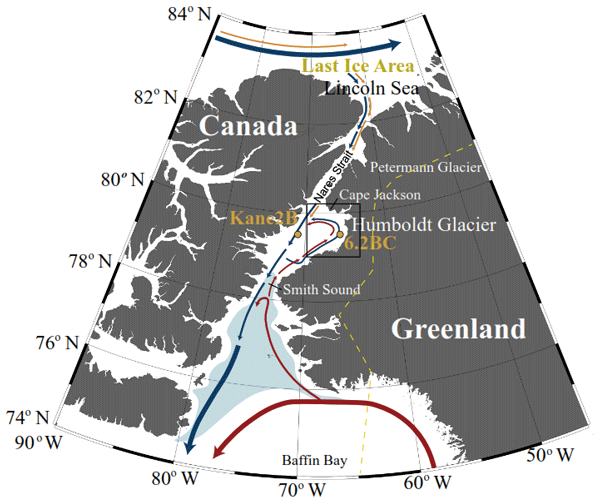
We compare two marine sediment cores collected from contrasting locations in Kane Basin, northwest Greenland. The two sites differ in terms of how much sediment they receive, the level of primary production, and the source and composition of organic matter. Despite these spatial differences, both records reveal a similar long-term environmental trend, a shift from cold, heavy sea-ice conditions between ca. 1750–1900 CE, towards more open, fresher, and biologically productive waters by 1950 CE.
Laurane Charrier, Nathan Lioret, Fanny Brun, Amaury Dehecq, Romain Millan, Anuar Togaibekov, Andrea Walpersdorf, Diego Cusicanqui, and Antoine Rabatel
EGUsphere, https://doi.org/10.5194/egusphere-2026-946, https://doi.org/10.5194/egusphere-2026-946, 2026
Short summary
Short summary
Sub-annual glacier surface velocity derived from remote sensing images are receiving increasing attention. In the meantime, systematic seasonal errors (i.e. biases) have been reported in time series derived from optical images on various landforms, such as landslides or dunes. The extent to which such biases affect glacier velocity maps remains poorly investigated. Here, we propose characterizing the amplitude and spatial distribution of these seasonal biases.
Gregor Luetzenburg, Niels Jakup Korsgaard, Anna Kirk Deichmann, Tobias Socher, Karin Gleie, Thomas Scharffenberger, Dominik Fahrner, Eva Bendix Nielsen, Penelope How, Anders Anker Bjørk, Kristian Kjellerup Kjeldsen, Andreas Peter Ahlstrøm, and Robert Schjøtt Fausto
Earth Syst. Sci. Data, 18, 411–427, https://doi.org/10.5194/essd-18-411-2026, https://doi.org/10.5194/essd-18-411-2026, 2026
Short summary
Short summary
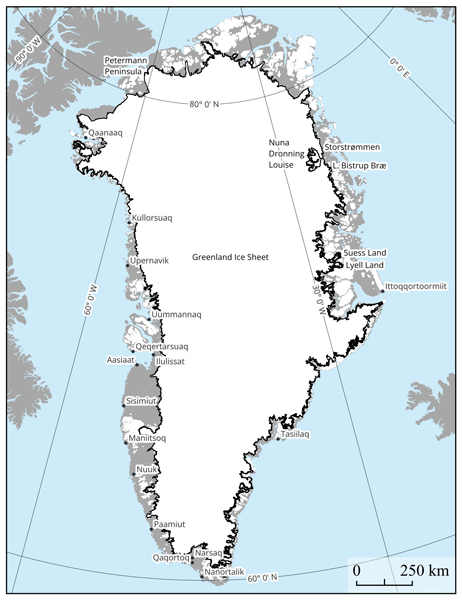
We mapped the edge of the Greenland Ice Sheet using recent satellite images to create a detailed outline of its extent in 2022. This helps track how the ice sheet is changing as the climate warms. By carefully combining satellite data and checking results by hand, we created one of the most accurate maps of the ice sheet to date. This map supports research on ice loss and improves predictions of future changes in Greenland’s ice and its effect on the planet.
Lucille Gimenes, Romain Millan, Nicolas Champollion, and Jordi Bolibar
The Cryosphere, 20, 171–182, https://doi.org/10.5194/tc-20-171-2026, https://doi.org/10.5194/tc-20-171-2026, 2026
Short summary
Short summary
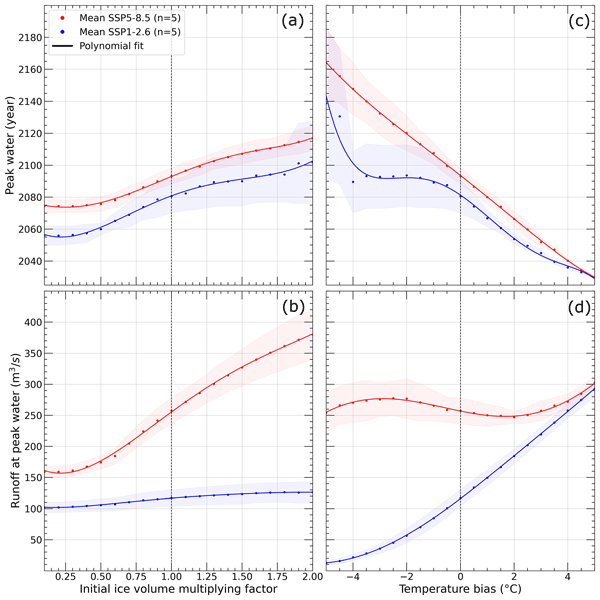
This study looks how changes in glacier thickness estimates and temperature will affect the timing when meltwater from glaciers in the western Kunlun Mountains will reach its peak. Using a global glacier model and two different datasets, we found that thinner glaciers and warmer temperatures cause peak meltwater to happen sooner. This is of interests since it affects future water supplies for people relying on glacier runoff, highlighting the need for accurate ice volume estimates.
Laurane Charrier, Amaury Dehecq, Lei Guo, Fanny Brun, Romain Millan, Nathan Lioret, Luke Copland, Nathan Maier, Christine Dow, and Paul Halas
The Cryosphere, 19, 4555–4583, https://doi.org/10.5194/tc-19-4555-2025, https://doi.org/10.5194/tc-19-4555-2025, 2025
Short summary
Short summary
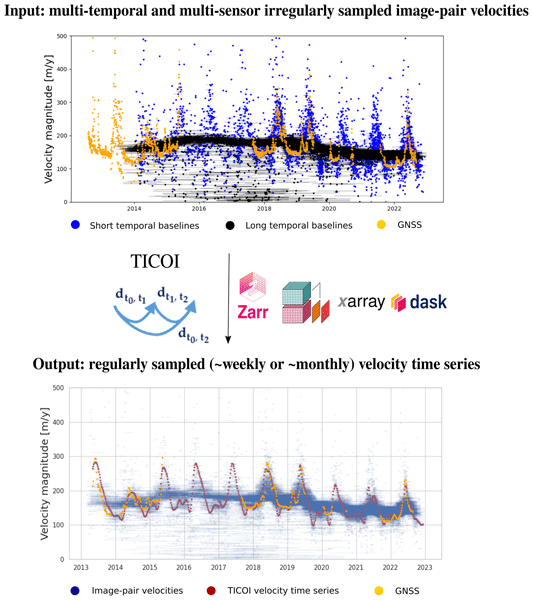
While global annual glacier velocities are openly accessible, sub-annual velocity time series are still lacking. This hinders our ability to understand flow processes and the integration of these observations in numerical models. We introduce an open source Python package called TICOI (Temporal Inversion using linear Combinations of Observations, and Interpolation) to fuse multi-temporal and multi-sensor image-pair velocities produced by different processing chains to produce standardized sub-annual velocity products.
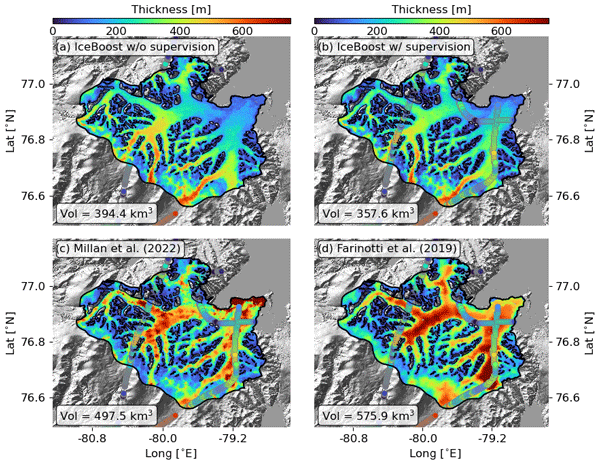
Niccolò Maffezzoli, Eric Rignot, Carlo Barbante, Troels Petersen, and Sebastiano Vascon
Geosci. Model Dev., 18, 2545–2568, https://doi.org/10.5194/gmd-18-2545-2025, https://doi.org/10.5194/gmd-18-2545-2025, 2025
Short summary
Short summary
In this work we introduce IceBoost, a machine learning framework to model the ice thickness distribution of all the world's glaciers with greater accuracy than state-of-the-art methods. The model is trained on 3.7 million measurements globally available and provides skilful estimates across all regions. This advancement will help in better assessing future sea level changes and freshwater resources, with significance for both the scientific community and society at large.
Jonas K. Andersen, Rasmus P. Meyer, Flora S. Huiban, Mads L. Dømgaard, Romain Millan, and Anders A. Bjørk
The Cryosphere, 19, 1717–1724, https://doi.org/10.5194/tc-19-1717-2025, https://doi.org/10.5194/tc-19-1717-2025, 2025
Short summary
Short summary
Storstrømmen Glacier in northeastern Greenland goes through cycles of sudden flow speed-ups (known as surges) followed by long quiet phases. It is currently in its quiet phase, but recent measurements suggest it may be nearing conditions for a new surge, possibly between 2027 and 2040. We also observed several lake drainages that caused brief increases in glacier flow but did not trigger a surge. Continued monitoring is essential to understand how these processes influence glacier behavior.
Etienne Ducasse, Romain Millan, Jonas Kvist Andersen, and Antoine Rabatel
The Cryosphere, 19, 911–917, https://doi.org/10.5194/tc-19-911-2025, https://doi.org/10.5194/tc-19-911-2025, 2025
Short summary
Short summary
Our study examines glacier movement in the tropical Andes from 2013 to 2022 using satellite data. Despite challenges like small glacier size and frequent cloud cover, we tracked annual speeds and seasonal changes. We found stable annual speeds but significant shifts between wet and dry seasons, likely due to changes in meltwater production and glacier–bedrock conditions. This research enhances understanding of how tropical glaciers react to climate change.
Rasmus Meyer, Mathias Preisler Schødt, Mikkel Lydholm Rasmussen, Jonas Kvist Andersen, Mads Dømgaard, and Anders Anker Bjørk
EGUsphere, https://doi.org/10.5194/egusphere-2024-3850, https://doi.org/10.5194/egusphere-2024-3850, 2025
Preprint archived
Short summary
Short summary
Understanding snow accumulation is important for water resource management, but measurements of snow depth in mountainous regions are sparse. We introduce a novel satellite-based approach to estimate snow depth for deep snow in mountainous regions by combining two types of satellite data: radar images and laser surface height measurements. Results suggest that our method more accurately estimate the magnitude of snowfall compared to modelled data over the Southern Norwegian Mountains.
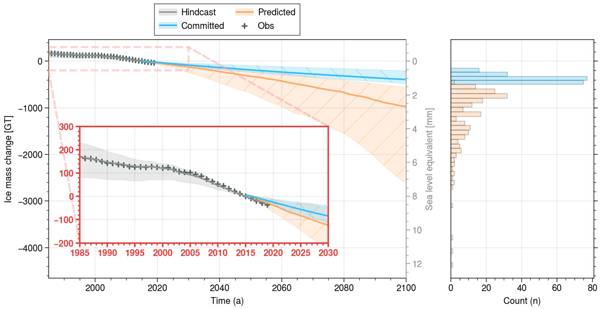
Eliot Jager, Fabien Gillet-Chaulet, Nicolas Champollion, Romain Millan, Heiko Goelzer, and Jérémie Mouginot
The Cryosphere, 18, 5519–5550, https://doi.org/10.5194/tc-18-5519-2024, https://doi.org/10.5194/tc-18-5519-2024, 2024
Short summary
Short summary
Inspired by a previous intercomparison framework, our study better constrains uncertainties in glacier evolution using an innovative method to validate Bayesian calibration. Upernavik Isstrøm, one of Greenland's largest glaciers, has lost significant mass since 1985. By integrating observational data, climate models, human emissions, and internal model parameters, we project its evolution until 2100. We show that future human emissions are the main source of uncertainty in 2100, making up half.
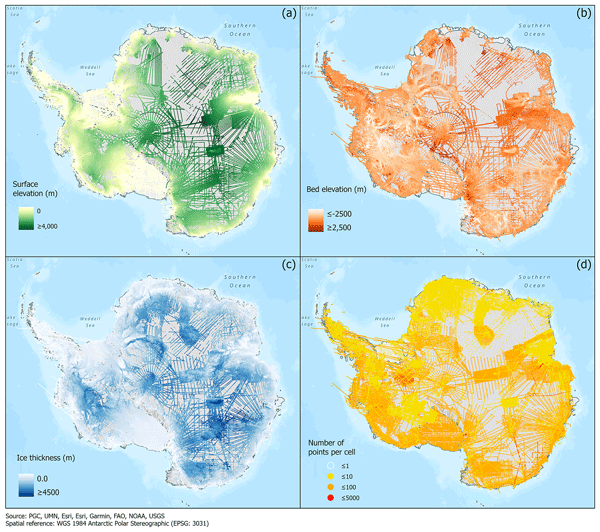
Alice C. Frémand, Peter Fretwell, Julien A. Bodart, Hamish D. Pritchard, Alan Aitken, Jonathan L. Bamber, Robin Bell, Cesidio Bianchi, Robert G. Bingham, Donald D. Blankenship, Gino Casassa, Ginny Catania, Knut Christianson, Howard Conway, Hugh F. J. Corr, Xiangbin Cui, Detlef Damaske, Volkmar Damm, Reinhard Drews, Graeme Eagles, Olaf Eisen, Hannes Eisermann, Fausto Ferraccioli, Elena Field, René Forsberg, Steven Franke, Shuji Fujita, Yonggyu Gim, Vikram Goel, Siva Prasad Gogineni, Jamin Greenbaum, Benjamin Hills, Richard C. A. Hindmarsh, Andrew O. Hoffman, Per Holmlund, Nicholas Holschuh, John W. Holt, Annika N. Horlings, Angelika Humbert, Robert W. Jacobel, Daniela Jansen, Adrian Jenkins, Wilfried Jokat, Tom Jordan, Edward King, Jack Kohler, William Krabill, Mette Kusk Gillespie, Kirsty Langley, Joohan Lee, German Leitchenkov, Carlton Leuschen, Bruce Luyendyk, Joseph MacGregor, Emma MacKie, Kenichi Matsuoka, Mathieu Morlighem, Jérémie Mouginot, Frank O. Nitsche, Yoshifumi Nogi, Ole A. Nost, John Paden, Frank Pattyn, Sergey V. Popov, Eric Rignot, David M. Rippin, Andrés Rivera, Jason Roberts, Neil Ross, Anotonia Ruppel, Dustin M. Schroeder, Martin J. Siegert, Andrew M. Smith, Daniel Steinhage, Michael Studinger, Bo Sun, Ignazio Tabacco, Kirsty Tinto, Stefano Urbini, David Vaughan, Brian C. Welch, Douglas S. Wilson, Duncan A. Young, and Achille Zirizzotti
Earth Syst. Sci. Data, 15, 2695–2710, https://doi.org/10.5194/essd-15-2695-2023, https://doi.org/10.5194/essd-15-2695-2023, 2023
Short summary
Short summary
This paper presents the release of over 60 years of ice thickness, bed elevation, and surface elevation data acquired over Antarctica by the international community. These data are a crucial component of the Antarctic Bedmap initiative which aims to produce a new map and datasets of Antarctic ice thickness and bed topography for the international glaciology and geophysical community.
B. Osmanoglu, S. A. Huang, C. A. Jones, B. Scheuchl, A. Khazendar, J. Sauber, K. Tymofyeyeva, and M. J. Jo
Int. Arch. Photogramm. Remote Sens. Spatial Inf. Sci., XLVIII-M-1-2023, 225–232, https://doi.org/10.5194/isprs-archives-XLVIII-M-1-2023-225-2023, https://doi.org/10.5194/isprs-archives-XLVIII-M-1-2023-225-2023, 2023
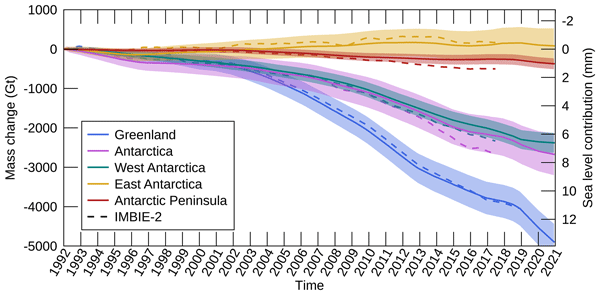
Inès N. Otosaka, Andrew Shepherd, Erik R. Ivins, Nicole-Jeanne Schlegel, Charles Amory, Michiel R. van den Broeke, Martin Horwath, Ian Joughin, Michalea D. King, Gerhard Krinner, Sophie Nowicki, Anthony J. Payne, Eric Rignot, Ted Scambos, Karen M. Simon, Benjamin E. Smith, Louise S. Sørensen, Isabella Velicogna, Pippa L. Whitehouse, Geruo A, Cécile Agosta, Andreas P. Ahlstrøm, Alejandro Blazquez, William Colgan, Marcus E. Engdahl, Xavier Fettweis, Rene Forsberg, Hubert Gallée, Alex Gardner, Lin Gilbert, Noel Gourmelen, Andreas Groh, Brian C. Gunter, Christopher Harig, Veit Helm, Shfaqat Abbas Khan, Christoph Kittel, Hannes Konrad, Peter L. Langen, Benoit S. Lecavalier, Chia-Chun Liang, Bryant D. Loomis, Malcolm McMillan, Daniele Melini, Sebastian H. Mernild, Ruth Mottram, Jeremie Mouginot, Johan Nilsson, Brice Noël, Mark E. Pattle, William R. Peltier, Nadege Pie, Mònica Roca, Ingo Sasgen, Himanshu V. Save, Ki-Weon Seo, Bernd Scheuchl, Ernst J. O. Schrama, Ludwig Schröder, Sebastian B. Simonsen, Thomas Slater, Giorgio Spada, Tyler C. Sutterley, Bramha Dutt Vishwakarma, Jan Melchior van Wessem, David Wiese, Wouter van der Wal, and Bert Wouters
Earth Syst. Sci. Data, 15, 1597–1616, https://doi.org/10.5194/essd-15-1597-2023, https://doi.org/10.5194/essd-15-1597-2023, 2023
Short summary
Short summary
By measuring changes in the volume, gravitational attraction, and ice flow of Greenland and Antarctica from space, we can monitor their mass gain and loss over time. Here, we present a new record of the Earth’s polar ice sheet mass balance produced by aggregating 50 satellite-based estimates of ice sheet mass change. This new assessment shows that the ice sheets have lost (7.5 x 10¹²) t of ice between 1992 and 2020, contributing 21 mm to sea level rise.
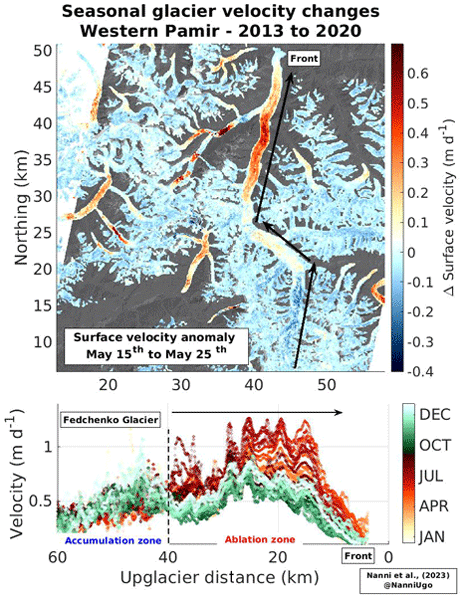
Ugo Nanni, Dirk Scherler, Francois Ayoub, Romain Millan, Frederic Herman, and Jean-Philippe Avouac
The Cryosphere, 17, 1567–1583, https://doi.org/10.5194/tc-17-1567-2023, https://doi.org/10.5194/tc-17-1567-2023, 2023
Short summary
Short summary
Surface melt is a major factor driving glacier movement. Using satellite images, we have tracked the movements of 38 glaciers in the Pamirs over 7 years, capturing their responses to rapid meteorological changes with unprecedented resolution. We show that in spring, glacier accelerations propagate upglacier, while in autumn, they propagate downglacier – all resulting from changes in meltwater input. This provides critical insights into the interplay between surface melt and glacier movement.

Mads Dømgaard, Kristian K. Kjeldsen, Flora Huiban, Jonathan L. Carrivick, Shfaqat A. Khan, and Anders A. Bjørk
The Cryosphere, 17, 1373–1387, https://doi.org/10.5194/tc-17-1373-2023, https://doi.org/10.5194/tc-17-1373-2023, 2023
Short summary
Short summary
Sudden releases of meltwater from glacier-dammed lakes can influence ice flow, cause flooding hazards and landscape changes. This study presents a record of 14 drainages from 2007–2021 from a lake in west Greenland. The time series reveals how the lake fluctuates between releasing large and small amounts of drainage water which is caused by a weakening of the damming glacier following the large events. We also find a shift in the water drainage route which increases the risk of flooding hazards.
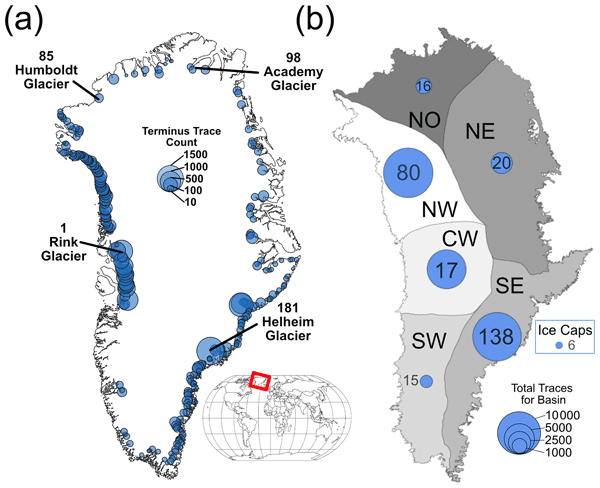
Sophie Goliber, Taryn Black, Ginny Catania, James M. Lea, Helene Olsen, Daniel Cheng, Suzanne Bevan, Anders Bjørk, Charlie Bunce, Stephen Brough, J. Rachel Carr, Tom Cowton, Alex Gardner, Dominik Fahrner, Emily Hill, Ian Joughin, Niels J. Korsgaard, Adrian Luckman, Twila Moon, Tavi Murray, Andrew Sole, Michael Wood, and Enze Zhang
The Cryosphere, 16, 3215–3233, https://doi.org/10.5194/tc-16-3215-2022, https://doi.org/10.5194/tc-16-3215-2022, 2022
Short summary
Short summary
Terminus traces have been used to understand how Greenland's glaciers have changed over time; however, manual digitization is time-intensive, and a lack of coordination leads to duplication of efforts. We have compiled a dataset of over 39 000 terminus traces for 278 glaciers for scientific and machine learning applications. We also provide an overview of an updated version of the Google Earth Engine Digitization Tool (GEEDiT), which has been developed specifically for the Greenland Ice Sheet.
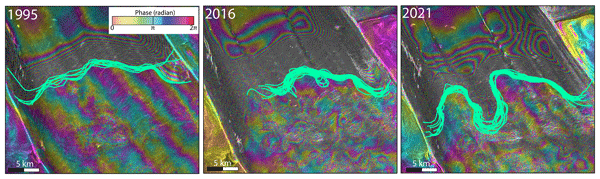
Romain Millan, Jeremie Mouginot, Anna Derkacheva, Eric Rignot, Pietro Milillo, Enrico Ciraci, Luigi Dini, and Anders Bjørk
The Cryosphere, 16, 3021–3031, https://doi.org/10.5194/tc-16-3021-2022, https://doi.org/10.5194/tc-16-3021-2022, 2022
Short summary
Short summary
We detect for the first time a dramatic retreat of the grounding line of Petermann Glacier, a major glacier of the Greenland Ice Sheet. Using satellite data, we also observe a speedup of the glacier and a fracturing of the ice shelf. This sequence of events is coherent with ocean warming in this region and suggests that Petermann Glacier has initiated a phase of destabilization, which is of prime importance for the stability and future contribution of the Greenland Ice Sheet to sea level rise.
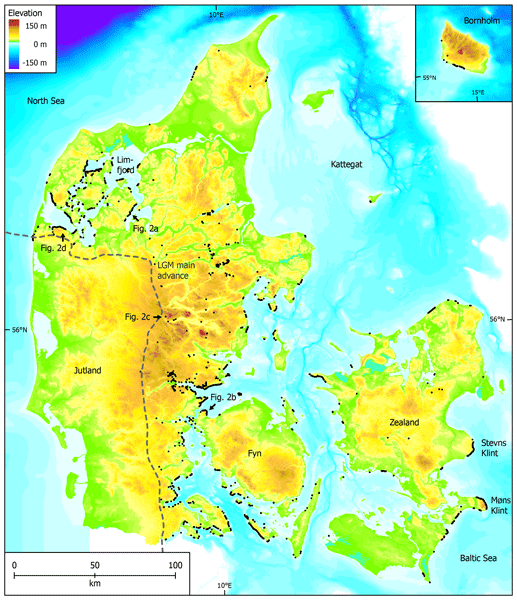
Gregor Luetzenburg, Kristian Svennevig, Anders A. Bjørk, Marie Keiding, and Aart Kroon
Earth Syst. Sci. Data, 14, 3157–3165, https://doi.org/10.5194/essd-14-3157-2022, https://doi.org/10.5194/essd-14-3157-2022, 2022
Short summary
Short summary
We produced the first landslide inventory for Denmark. Over 3200 landslides were mapped using a high-resolution elevation model and orthophotos. We implemented an independent validation into our mapping and found an overall level of completeness of 87 %. The national inventory represents a range of landslide sizes covering all regions that were covered by glacial ice during the last glacial period. This inventory will be used for investigating landslide causes and for natural hazard mitigation.
L. Charrier, Y. Yan, E. Colin Koeniguer, J. Mouginot, R. Millan, and E. Trouvé
ISPRS Ann. Photogramm. Remote Sens. Spatial Inf. Sci., V-3-2022, 311–318, https://doi.org/10.5194/isprs-annals-V-3-2022-311-2022, https://doi.org/10.5194/isprs-annals-V-3-2022-311-2022, 2022
William Colgan, Agnes Wansing, Kenneth Mankoff, Mareen Lösing, John Hopper, Keith Louden, Jörg Ebbing, Flemming G. Christiansen, Thomas Ingeman-Nielsen, Lillemor Claesson Liljedahl, Joseph A. MacGregor, Árni Hjartarson, Stefan Bernstein, Nanna B. Karlsson, Sven Fuchs, Juha Hartikainen, Johan Liakka, Robert S. Fausto, Dorthe Dahl-Jensen, Anders Bjørk, Jens-Ove Naslund, Finn Mørk, Yasmina Martos, Niels Balling, Thomas Funck, Kristian K. Kjeldsen, Dorthe Petersen, Ulrik Gregersen, Gregers Dam, Tove Nielsen, Shfaqat A. Khan, and Anja Løkkegaard
Earth Syst. Sci. Data, 14, 2209–2238, https://doi.org/10.5194/essd-14-2209-2022, https://doi.org/10.5194/essd-14-2209-2022, 2022
Short summary
Short summary
We assemble all available geothermal heat flow measurements collected in and around Greenland into a new database. We use this database of point measurements, in combination with other geophysical datasets, to model geothermal heat flow in and around Greenland. Our geothermal heat flow model is generally cooler than previous models of Greenland, especially in southern Greenland. It does not suggest any high geothermal heat flows resulting from Icelandic plume activity over 50 million years ago.
Cited articles
Andersen, J. K., Kusk, A., Boncori, J. P. M., Hvidberg, C. S., and Grinsted, A.: Improved Ice Velocity Measurements with Sentinel-1 TOPS Interferometry, Remote Sens.-Basel, 12, 2014, https://doi.org/10.3390/rs12122014, 2020. a
Andersen, J. K., Millan, R., Rignot, E., Gimenes, L., Scheuchl, B., Barré, J. B., and Bjørk, A. A.: Updated grounding line mapping in the Amundsen Sea Embayment, Antarctica, from 1 d repeat Sentinel-1 SAR data, https://doi.org/10.5281/ZENODO.18503724, 2025. a
Brancato, V., Rignot, E., Milillo, P., Morlighem, M., Mouginot, J., An, L., Scheuchl, B., Jeong, S., Rizzoli, P., Bueso Bello, J. L., and Prats-Iraola, P.: Grounding Line Retreat of Denman Glacier, East Antarctica, Measured With COSMO-SkyMed Radar Interferometry Data, Geophys. Res. Lett., 47, e2019GL086291, https://doi.org/10.1029/2019GL086291, 2020. a
Chartrand, A. M., Howat, I. M., Joughin, I. R., and Smith, B. E.: Thwaites Glacier thins and retreats fastest where ice-shelf channels intersect its grounding zone, The Cryosphere, 18, 4971–4992, https://doi.org/10.5194/tc-18-4971-2024, 2024. a
Christie, F. D. W., Bingham, R. G., Gourmelen, N., Tett, S. F. B., and Muto, A.: Four-decade record of pervasive grounding line retreat along the Bellingshausen margin of West Antarctica, Geophys. Res. Lett., 43, 5741–5749, https://doi.org/10.1002/2016GL068972, 2016. a, b
Chuter, S. J., Martín-Español, A., Wouters, B., and Bamber, J. L.: Mass balance reassessment of glaciers draining into the Abbot and Getz Ice Shelves of West Antarctica, Geophys. Res. Lett., 44, 7328–7337, https://doi.org/10.1002/2017GL073087, 2017. a
Freer, B. I. D., Marsh, O. J., Hogg, A. E., Fricker, H. A., and Padman, L.: Modes of Antarctic tidal grounding line migration revealed by Ice, Cloud, and land Elevation Satellite-2 (ICESat-2) laser altimetry, The Cryosphere, 17, 4079–4101, https://doi.org/10.5194/tc-17-4079-2023, 2023. a
Fricker, H. A. and Padman, L.: Ice shelf grounding zone structure from ICESat laser altimetry, Geophys. Res. Lett., 33, 2006GL026907, https://doi.org/10.1029/2006GL026907, 2006. a, b
Gourmelen, N., Jakob, L., Holland, P. R., Dutrieux, P., Goldberg, D., Bevan, S., Luckman, A., and Malczyk, G.: The influence of subglacial lake discharge on Thwaites Glacier ice-shelf melting and grounding-line retreat, Nat. Commun., 16, 2272, https://doi.org/10.1038/s41467-025-57417-1, 2025. a
Holland, P. R., Bevan, S. L., and Luckman, A. J.: Strong Ocean Melting Feedback During the Recent Retreat of Thwaites Glacier, Geophys. Res. Lett., 50, e2023GL103088, https://doi.org/10.1029/2023GL103088, 2023. a, b
Howat, I., Porter, C., Noh, M.-J., Husby, E., Khuvis, S., Danish, E., Tomko, K., Gardiner, J., Negrete, A., Yadav, B., Klassen, J., Kelleher, C., Cloutier, M., Bakker, J., Enos, J., Arnold, G., Bauer, G., Morin, P., and Polar Geospatial Center: The Reference Elevation Model of Antarctica – Mosaics, Version 2, https://doi.org/10.7910/DVN/EBW8UC, 2022. a, b
Joughin, I., Smith, B. E., and Holland, D. M.: Sensitivity of 21st century sea level to ocean-induced thinning of Pine Island Glacier, Antarctica, Geophys. Res. Lett., 37, 2010GL044819, https://doi.org/10.1029/2010GL044819, 2010. a
Joughin, I., Smith, B. E., and Medley, B.: Marine Ice Sheet Collapse Potentially Under Way for the Thwaites Glacier Basin, West Antarctica, Science, 344, 735–738, https://doi.org/10.1126/science.1249055, 2014. a
Konrad, H., Shepherd, A., Gilbert, L., Hogg, A. E., McMillan, M., Muir, A., and Slater, T.: Net retreat of Antarctic glacier grounding lines, Nat. Geosci., 11, 258–262, https://doi.org/10.1038/s41561-018-0082-z, 2018. a
Le Meur, E., Sacchettini, M., Garambois, S., Berthier, E., Drouet, A. S., Durand, G., Young, D., Greenbaum, J. S., Holt, J. W., Blankenship, D. D., Rignot, E., Mouginot, J., Gim, Y., Kirchner, D., de Fleurian, B., Gagliardini, O., and Gillet-Chaulet, F.: Two independent methods for mapping the grounding line of an outlet glacier – an example from the Astrolabe Glacier, Terre Adélie, Antarctica, The Cryosphere, 8, 1331–1346, https://doi.org/10.5194/tc-8-1331-2014, 2014. a
Li, T., Dawson, G. J., Chuter, S. J., and Bamber, J. L.: Grounding line retreat and tide-modulated ocean channels at Moscow University and Totten Glacier ice shelves, East Antarctica, The Cryosphere, 17, 1003–1022, https://doi.org/10.5194/tc-17-1003-2023, 2023. a
Massonnet, D., Rossi, M., Carmona, C., Adragna, F., Peltzer, G., Feigl, K., and Rabaute, T.: The displacement field of the Landers earthquake mapped by radar interferometry, Nature, 364, 138–142, https://doi.org/10.1038/364138a0, 1993. a
Milillo, P., Rignot, E., Rizzoli, P., Scheuchl, B., Mouginot, J., Bueso-Bello, J., and Prats-Iraola, P.: Heterogeneous retreat and ice melt of Thwaites Glacier, West Antarctica, Science Advances, 5, eaau3433, https://doi.org/10.1126/sciadv.aau3433, 2019. a, b, c
Millan, R., Mouginot, J., Derkacheva, A., Rignot, E., Milillo, P., Ciraci, E., Dini, L., and Bjørk, A.: Ongoing grounding line retreat and fracturing initiated at the Petermann Glacier ice shelf, Greenland, after 2016, The Cryosphere, 16, 3021–3031, https://doi.org/10.5194/tc-16-3021-2022, 2022. a
Mohajerani, Y., Jeong, S., Scheuchl, B., Velicogna, I., Rignot, E., and Milillo, P.: Automatic delineation of glacier grounding lines in differential interferometric synthetic-aperture radar data using deep learning, Sci. Rep.-UK, 11, 4992, https://doi.org/10.1038/s41598-021-84309-3, 2021. a, b, c, d, e, f, g, h, i, j
Morlighem, M.: MEaSUREs BedMachine Antarctica, Version 3, https://doi.org/10.5067/FPSU0V1MWUB6, 2022. a, b, c
Morlighem, M., Rignot, E., Binder, T., Blankenship, D., Drews, R., Eagles, G., Eisen, O., Ferraccioli, F., Forsberg, R., Fretwell, P., Goel, V., Greenbaum, J. S., Gudmundsson, H., Guo, J., Helm, V., Hofstede, C., Howat, I., Humbert, A., Jokat, W., Karlsson, N. B., Lee, W. S., Matsuoka, K., Millan, R., Mouginot, J., Paden, J., Pattyn, F., Roberts, J., Rosier, S., Ruppel, A., Seroussi, H., Smith, E. C., Steinhage, D., Sun, B., Broeke, M. R. V. D., Ommen, T. D. V., Wessem, M. V., and Young, D. A.: Deep glacial troughs and stabilizing ridges unveiled beneath the margins of the Antarctic ice sheet, Nat. Geosci., 13, 132–137, https://doi.org/10.1038/s41561-019-0510-8, 2020. a
Mouginot, J., Rignot, E., and Scheuchl, B.: Sustained increase in ice discharge from the Amundsen Sea Embayment, West Antarctica, from 1973 to 2013, Geophys. Res. Lett., 41, 1576–1584, https://doi.org/10.1002/2013GL059069, 2014. a
Otosaka, I. N., Shepherd, A., Ivins, E. R., Schlegel, N.-J., Amory, C., van den Broeke, M. R., Horwath, M., Joughin, I., King, M. D., Krinner, G., Nowicki, S., Payne, A. J., Rignot, E., Scambos, T., Simon, K. M., Smith, B. E., Sørensen, L. S., Velicogna, I., Whitehouse, P. L., A, G., Agosta, C., Ahlstrøm, A. P., Blazquez, A., Colgan, W., Engdahl, M. E., Fettweis, X., Forsberg, R., Gallée, H., Gardner, A., Gilbert, L., Gourmelen, N., Groh, A., Gunter, B. C., Harig, C., Helm, V., Khan, S. A., Kittel, C., Konrad, H., Langen, P. L., Lecavalier, B. S., Liang, C.-C., Loomis, B. D., McMillan, M., Melini, D., Mernild, S. H., Mottram, R., Mouginot, J., Nilsson, J., Noël, B., Pattle, M. E., Peltier, W. R., Pie, N., Roca, M., Sasgen, I., Save, H. V., Seo, K.-W., Scheuchl, B., Schrama, E. J. O., Schröder, L., Simonsen, S. B., Slater, T., Spada, G., Sutterley, T. C., Vishwakarma, B. D., van Wessem, J. M., Wiese, D., van der Wal, W., and Wouters, B.: Mass balance of the Greenland and Antarctic ice sheets from 1992 to 2020, Earth Syst. Sci. Data, 15, 1597–1616, https://doi.org/10.5194/essd-15-1597-2023, 2023. a, b
Park, J. W., Gourmelen, N., Shepherd, A., Kim, S. W., Vaughan, D. G., and Wingham, D. J.: Sustained retreat of the Pine Island Glacier, Geophys. Res. Lett., 40, 2137–2142, https://doi.org/10.1002/grl.50379, 2013. a
Qian, Y., Zhou, C., Sun, S., Chen, Y., Wang, T., and Zhang, B.: Ephemeral grounding on the Pine Island Ice Shelf, West Antarctica, from 2014 to 2023, EGUsphere [preprint], https://doi.org/10.5194/egusphere-2025-603, 2025. a
Rignot, E.: Tidal motion, ice velocity and melt rate of Petermann Gletscher, Greenland, measured from radar interferometry, J. Glaciol., 42, 476–485, https://doi.org/10.3189/S0022143000003464, 1996. a, b
Rignot, E.: Observations of grounding zones are the missing key to understand ice melt in Antarctica, Nat. Clim. Change, 13, 1010–1013, https://doi.org/10.1038/s41558-023-01819-w, 2023. a
Rignot, E., Mouginot, J., Morlighem, M., Seroussi, H., and Scheuchl, B.: Widespread, rapid grounding line retreat of Pine Island, Thwaites, Smith, and Kohler glaciers, West Antarctica, from 1992 to 2011, Geophys. Res. Lett., 41, 3502–3509, https://doi.org/10.1002/2014GL060140, 2014. a, b, c, d
Rignot, E., Mouginot, J., and Scheuchl, B.: MEaSUREs InSAR-Based Antarctica Ice Velocity Map, Version 2, https://doi.org/10.5067/D7GK8F5J8M8R, 2017. a, b, c
Scheuchl, B., Mouginot, J., Rignot, E., Morlighem, M., and Khazendar, A.: Grounding line retreat of Pope, Smith, and Kohler Glaciers, West Antarctica, measured with Sentinel-1a radar interferometry data, Geophys. Res. Lett., 43, 8572–8579, https://doi.org/10.1002/2016GL069287, 2016. a, b, c
Schmidtko, S., Heywood, K. J., Thompson, A. F., and Aoki, S.: Multidecadal warming of Antarctic waters, Science, 346, 1227–1231, https://doi.org/10.1126/science.1256117, 2014. a
Selley, H. L., Hogg, A. E., Davison, B. J., Dutrieux, P., and Slater, T.: Speed-up, slowdown, and redirection of ice flow on neighbouring ice streams in the Pope, Smith, and Kohler region of West Antarctica, The Cryosphere, 19, 1725–1738, https://doi.org/10.5194/tc-19-1725-2025, 2025. a
Short summary
We used new satellite radar data from 2025 to map the border where Antarctic glaciers lose contact with the ground and begin to float. This updated map shows recent changes to many glaciers in the Amundsen Sea region, some of which have retreated by several kilometers. Our results help track how Antarctica is responding to climate change and highlight the value of future satellite missions for monitoring ice sheet stability.
We used new satellite radar data from 2025 to map the border where Antarctic glaciers lose...


