
Articles | Volume 20, issue 2
https://doi.org/10.5194/tc-20-1339-2026
© Author(s) 2026. This work is distributed under
the Creative Commons Attribution 4.0 License.
the Creative Commons Attribution 4.0 License.
https://doi.org/10.5194/tc-20-1339-2026
© Author(s) 2026. This work is distributed under
the Creative Commons Attribution 4.0 License.
the Creative Commons Attribution 4.0 License.
Research article
| 
25 Feb 2026
Research article |
| 25 Feb 2026
| 25 Feb 2026
CMIP6 climate model spread outweighs glacier model spread in 21st-century drought buffering projections

Cryospheric Sciences Lab, NASA Goddard Space Flight Center, Greenbelt, MD, USA
GESTAR-II Cooperative Agreement, Morgan State University, Baltimore, MD, USA
Finn Wimberly
Woods Hole Oceanographic Institution, Woods Hole, MA, USA
Sloan Coats
Department of Earth Sciences, University of Hawaii at Manoa, Honolulu, HI, USA
Jonathan Mackay
Environmental Science Centre, British Geological Survey, Keyworth, UK
Erik Holmgren
Department of Space, Earth and Environment, Chalmers University of Technology, Gothenburg, Sweden
Related authors
Ruitang Yang, Lizz Ultee, Kristoffer Aalstad, Matvey V. Debolskiy, Regine Hock, Patrick Schmitt, David Rounce, and Tian Li
EGUsphere, https://doi.org/10.5194/egusphere-2026-1081, https://doi.org/10.5194/egusphere-2026-1081, 2026
Short summary
Short summary
We present a new framework to model frontal ablation of marine-terminating glaciers by linking two global glacier models with a simple physics-based calving scheme and Bayesian calibration. Applied to 71 Svalbard glaciers (2000–2019) and projected to 2100, it reproduces seasonal front changes but overestimates ablation due to uncertain geometry and velocity. This efficient approach can improve regional to global simulations.
Vincent Verjans, Alexander A. Robel, Lizz Ultee, Helene Seroussi, Andrew F. Thompson, Lars Ackermann, Youngmin Choi, and Uta Krebs-Kanzow
The Cryosphere, 19, 3749–3783, https://doi.org/10.5194/tc-19-3749-2025, https://doi.org/10.5194/tc-19-3749-2025, 2025
Short summary
Short summary
This study examines how random variations in climate may influence future ice loss from the Greenland ice sheet. We find that random climate variations are important for predicting future ice loss from the entire Greenland ice sheet over the next 20–30 years but relatively unimportant after that period. Thus, uncertainty in sea level projections from the effect of climate variability on Greenland may play a role in coastal decision-making about sea level rise over the next few decades.
Finn Wimberly, Lizz Ultee, Lilian Schuster, Matthias Huss, David R. Rounce, Fabien Maussion, Sloan Coats, Jonathan Mackay, and Erik Holmgren
The Cryosphere, 19, 1491–1511, https://doi.org/10.5194/tc-19-1491-2025, https://doi.org/10.5194/tc-19-1491-2025, 2025
Short summary
Short summary
Glacier models have historically been used to understand glacier melt’s contribution to sea level rise. The capacity to project seasonal glacier runoff is a relatively recent development for these models. In this study we provide the first model intercomparison of runoff projections for the glacier evolution models capable of simulating future runoff globally. We compare model projections from 2000 to 2100 for all major river basins larger than 3000 km2 with over 30 km2 of initial glacier cover.
Rodrigo Aguayo, Fabien Maussion, Lilian Schuster, Marius Schaefer, Alexis Caro, Patrick Schmitt, Jonathan Mackay, Lizz Ultee, Jorge Leon-Muñoz, and Mauricio Aguayo
The Cryosphere, 18, 5383–5406, https://doi.org/10.5194/tc-18-5383-2024, https://doi.org/10.5194/tc-18-5383-2024, 2024
Short summary
Short summary
Predicting how much water will come from glaciers in the future is a complex task, and there are many factors that make it uncertain. Using a glacier model, we explored 1920 scenarios for each glacier in the Patagonian Andes. We found that the choice of the historical climate data was the most important factor, while other factors such as different data sources, climate models and emission scenarios played a smaller role.
Lizz Ultee, Alexander A. Robel, and Stefano Castruccio
Geosci. Model Dev., 17, 1041–1057, https://doi.org/10.5194/gmd-17-1041-2024, https://doi.org/10.5194/gmd-17-1041-2024, 2024
Short summary
Short summary
The surface mass balance (SMB) of an ice sheet describes the net gain or loss of mass from ice sheets (such as those in Greenland and Antarctica) through interaction with the atmosphere. We developed a statistical method to generate a wide range of SMB fields that reflect the best understanding of SMB processes. Efficiently sampling the variability of SMB will help us understand sources of uncertainty in ice sheet model projections.
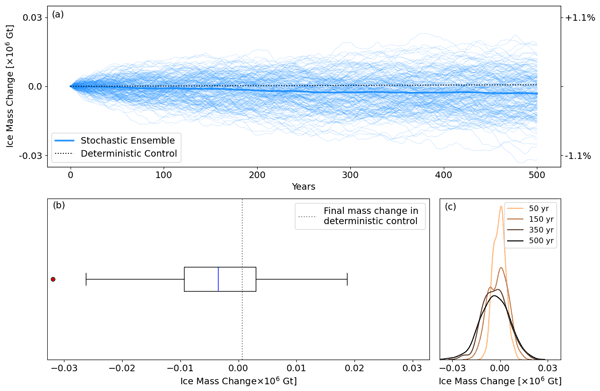
Vincent Verjans, Alexander A. Robel, Helene Seroussi, Lizz Ultee, and Andrew F. Thompson
Geosci. Model Dev., 15, 8269–8293, https://doi.org/10.5194/gmd-15-8269-2022, https://doi.org/10.5194/gmd-15-8269-2022, 2022
Short summary
Short summary
We describe the development of the first large-scale ice sheet model that accounts for stochasticity in a range of processes. Stochasticity allows the impacts of inherently uncertain processes on ice sheets to be represented. This includes climatic uncertainty, as the climate is inherently chaotic. Furthermore, stochastic capabilities also encompass poorly constrained glaciological processes that display strong variability at fine spatiotemporal scales. We present the model and test experiments.
Lizz Ultee, Sloan Coats, and Jonathan Mackay
Earth Syst. Dynam., 13, 935–959, https://doi.org/10.5194/esd-13-935-2022, https://doi.org/10.5194/esd-13-935-2022, 2022
Short summary
Short summary
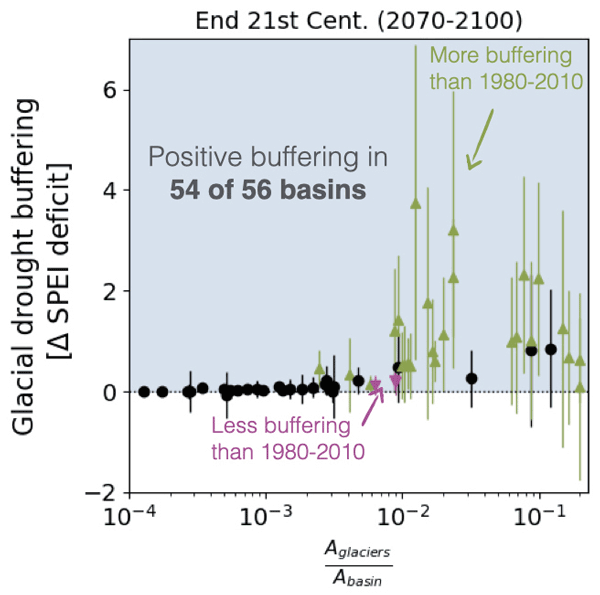
Global climate models suggest that droughts could worsen over the coming century. In mountain basins with glaciers, glacial runoff can ease droughts, but glaciers are retreating worldwide. We analyzed how one measure of drought conditions changes when accounting for glacial runoff that changes over time. Surprisingly, we found that glacial runoff can continue to buffer drought throughout the 21st century in most cases, even as the total amount of runoff declines.
Andrew A. Flaim, Bronwen L. Konecky, and Sloan Coats
Clim. Past, 22, 1423–1439, https://doi.org/10.5194/cp-22-1423-2026, https://doi.org/10.5194/cp-22-1423-2026, 2026
Short summary
Short summary
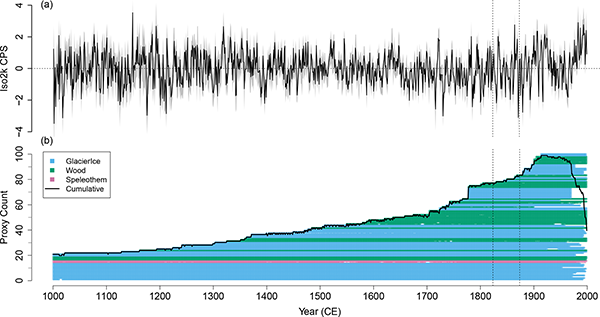
The North Atlantic Oscillation (NAO) is an important driver of year-to-year weather variability in Europe and North America, but its behavior on longer timescales is disputed. We present a new reconstruction of the NAO over the last millennium using water isotope proxy data from ice cores, speleothems, trees, and other archives. We find pronounced but irregular multidecadal to centennial variability. Better accounting for such variability in climate models is crucial to better project future climate.
Ruitang Yang, Lizz Ultee, Kristoffer Aalstad, Matvey V. Debolskiy, Regine Hock, Patrick Schmitt, David Rounce, and Tian Li
EGUsphere, https://doi.org/10.5194/egusphere-2026-1081, https://doi.org/10.5194/egusphere-2026-1081, 2026
Short summary
Short summary
We present a new framework to model frontal ablation of marine-terminating glaciers by linking two global glacier models with a simple physics-based calving scheme and Bayesian calibration. Applied to 71 Svalbard glaciers (2000–2019) and projected to 2100, it reproduces seasonal front changes but overestimates ablation due to uncertain geometry and velocity. This efficient approach can improve regional to global simulations.
Erik Holmgren and Hans W. Chen
Weather Clim. Dynam., 6, 1831–1856, https://doi.org/10.5194/wcd-6-1831-2025, https://doi.org/10.5194/wcd-6-1831-2025, 2025
Short summary
Short summary
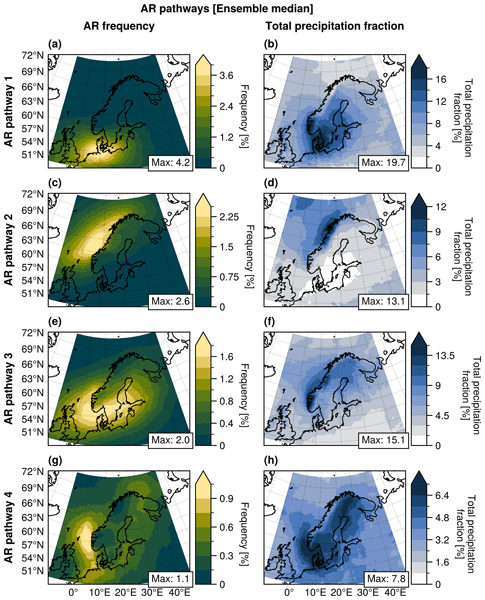
In this paper, we present a new study on atmospheric rivers (ARs) over Scandinavia and how they influence the regional precipitation. Although ARs are fairly well studied in other parts of the world, their influence on the Scandinavian climate remains less explored. Our results show that although ARs occur relatively infrequently over Scandinavia, they exert a large influence on the regional precipitation, contributing up to 40 % of the annual precipitation.
Vincent Verjans, Alexander A. Robel, Lizz Ultee, Helene Seroussi, Andrew F. Thompson, Lars Ackermann, Youngmin Choi, and Uta Krebs-Kanzow
The Cryosphere, 19, 3749–3783, https://doi.org/10.5194/tc-19-3749-2025, https://doi.org/10.5194/tc-19-3749-2025, 2025
Short summary
Short summary
This study examines how random variations in climate may influence future ice loss from the Greenland ice sheet. We find that random climate variations are important for predicting future ice loss from the entire Greenland ice sheet over the next 20–30 years but relatively unimportant after that period. Thus, uncertainty in sea level projections from the effect of climate variability on Greenland may play a role in coastal decision-making about sea level rise over the next few decades.
Finn Wimberly, Lizz Ultee, Lilian Schuster, Matthias Huss, David R. Rounce, Fabien Maussion, Sloan Coats, Jonathan Mackay, and Erik Holmgren
The Cryosphere, 19, 1491–1511, https://doi.org/10.5194/tc-19-1491-2025, https://doi.org/10.5194/tc-19-1491-2025, 2025
Short summary
Short summary
Glacier models have historically been used to understand glacier melt’s contribution to sea level rise. The capacity to project seasonal glacier runoff is a relatively recent development for these models. In this study we provide the first model intercomparison of runoff projections for the glacier evolution models capable of simulating future runoff globally. We compare model projections from 2000 to 2100 for all major river basins larger than 3000 km2 with over 30 km2 of initial glacier cover.
Jonathan D. Mackay, Nicholas E. Barrand, David M. Hannah, Emily Potter, Nilton Montoya, and Wouter Buytaert
The Cryosphere, 19, 685–712, https://doi.org/10.5194/tc-19-685-2025, https://doi.org/10.5194/tc-19-685-2025, 2025
Short summary
Short summary
We combine two globally capable glacier evolution models to include processes that are typically neglected but thought to control tropical glacier retreat (e.g. sublimation). We apply the model to Peru's Vilcanota-Urubamba Basin. The model captures observed glacier mass changes,but struggles with surface albedo dynamics. Projections show glacier mass shrinking to 17 % or 6 % of 2000 levels by 2100 under moderate- and high-emission scenarios, respectively.
Rodrigo Aguayo, Fabien Maussion, Lilian Schuster, Marius Schaefer, Alexis Caro, Patrick Schmitt, Jonathan Mackay, Lizz Ultee, Jorge Leon-Muñoz, and Mauricio Aguayo
The Cryosphere, 18, 5383–5406, https://doi.org/10.5194/tc-18-5383-2024, https://doi.org/10.5194/tc-18-5383-2024, 2024
Short summary
Short summary
Predicting how much water will come from glaciers in the future is a complex task, and there are many factors that make it uncertain. Using a glacier model, we explored 1920 scenarios for each glacier in the Patagonian Andes. We found that the choice of the historical climate data was the most important factor, while other factors such as different data sources, climate models and emission scenarios played a smaller role.
Erik Holmgren and Erik Kjellström
Nat. Hazards Earth Syst. Sci., 24, 2875–2893, https://doi.org/10.5194/nhess-24-2875-2024, https://doi.org/10.5194/nhess-24-2875-2024, 2024
Short summary
Short summary
Associating extreme weather events with changes in the climate remains difficult. We have explored two ways these relationships can be investigated: one using a more common method and one relying solely on long-running records of meteorological observations.
Our results show that while both methods lead to similar conclusions for two recent weather events in Sweden, the commonly used method risks underestimating the strength of the connection between the event and changes to the climate.
Lizz Ultee, Alexander A. Robel, and Stefano Castruccio
Geosci. Model Dev., 17, 1041–1057, https://doi.org/10.5194/gmd-17-1041-2024, https://doi.org/10.5194/gmd-17-1041-2024, 2024
Short summary
Short summary
The surface mass balance (SMB) of an ice sheet describes the net gain or loss of mass from ice sheets (such as those in Greenland and Antarctica) through interaction with the atmosphere. We developed a statistical method to generate a wide range of SMB fields that reflect the best understanding of SMB processes. Efficiently sampling the variability of SMB will help us understand sources of uncertainty in ice sheet model projections.
Simon Parry, Jonathan D. Mackay, Thomas Chitson, Jamie Hannaford, Eugene Magee, Maliko Tanguy, Victoria A. Bell, Katie Facer-Childs, Alison Kay, Rosanna Lane, Robert J. Moore, Stephen Turner, and John Wallbank
Hydrol. Earth Syst. Sci., 28, 417–440, https://doi.org/10.5194/hess-28-417-2024, https://doi.org/10.5194/hess-28-417-2024, 2024
Short summary
Short summary
We studied drought in a dataset of possible future river flows and groundwater levels in the UK and found different outcomes for these two sources of water. Throughout the UK, river flows are likely to be lower in future, with droughts more prolonged and severe. However, whilst these changes are also found in some boreholes, in others, higher levels and less severe drought are indicated for the future. This has implications for the future balance between surface water and groundwater below.
Jamie Hannaford, Jonathan D. Mackay, Matthew Ascott, Victoria A. Bell, Thomas Chitson, Steven Cole, Christian Counsell, Mason Durant, Christopher R. Jackson, Alison L. Kay, Rosanna A. Lane, Majdi Mansour, Robert Moore, Simon Parry, Alison C. Rudd, Michael Simpson, Katie Facer-Childs, Stephen Turner, John R. Wallbank, Steven Wells, and Amy Wilcox
Earth Syst. Sci. Data, 15, 2391–2415, https://doi.org/10.5194/essd-15-2391-2023, https://doi.org/10.5194/essd-15-2391-2023, 2023
Short summary
Short summary
The eFLaG dataset is a nationally consistent set of projections of future climate change impacts on hydrology. eFLaG uses the latest available UK climate projections (UKCP18) run through a series of computer simulation models which enable us to produce future projections of river flows, groundwater levels and groundwater recharge. These simulations are designed for use by water resource planners and managers but could also be used for a wide range of other purposes.
Vincent Verjans, Alexander A. Robel, Helene Seroussi, Lizz Ultee, and Andrew F. Thompson
Geosci. Model Dev., 15, 8269–8293, https://doi.org/10.5194/gmd-15-8269-2022, https://doi.org/10.5194/gmd-15-8269-2022, 2022
Short summary
Short summary
We describe the development of the first large-scale ice sheet model that accounts for stochasticity in a range of processes. Stochasticity allows the impacts of inherently uncertain processes on ice sheets to be represented. This includes climatic uncertainty, as the climate is inherently chaotic. Furthermore, stochastic capabilities also encompass poorly constrained glaciological processes that display strong variability at fine spatiotemporal scales. We present the model and test experiments.
Lizz Ultee, Sloan Coats, and Jonathan Mackay
Earth Syst. Dynam., 13, 935–959, https://doi.org/10.5194/esd-13-935-2022, https://doi.org/10.5194/esd-13-935-2022, 2022
Short summary
Short summary
Global climate models suggest that droughts could worsen over the coming century. In mountain basins with glaciers, glacial runoff can ease droughts, but glaciers are retreating worldwide. We analyzed how one measure of drought conditions changes when accounting for glacial runoff that changes over time. Surprisingly, we found that glacial runoff can continue to buffer drought throughout the 21st century in most cases, even as the total amount of runoff declines.
Cited articles
Adhikari, R. K., Yilmaz, A. G., Mainali, B., and Dyson, P.: Performance evaluation of CMIP6 models for application to hydrological modelling studies – A case study of Australia, Science of The Total Environment, 945, 174 015, https://doi.org/10.1016/j.scitotenv.2024.174015, 2024. a
Aguayo, R., Maussion, F., Schuster, L., Schaefer, M., Caro, A., Schmitt, P., Mackay, J., Ultee, L., Leon-Muñoz, J., and Aguayo, M.: Unravelling the sources of uncertainty in glacier runoff projections in the Patagonian Andes (40–56° S), The Cryosphere, 18, 5383–5406, https://doi.org/10.5194/tc-18-5383-2024, 2024. a, b, c, d, e, f
Ault, T. R.: On the essentials of drought in a changing climate, Science, 368, 256–260, https://doi.org/10.1126/science.aaz5492, 2020. a, b
Azad, N. and Ahmadi, A.: Assessment of CMIP6 models and multi-model averaging for temperature and precipitation over Iran, Scientific Reports, 14, 24165, https://doi.org/10.1038/s41598-024-74789-4, 2024. a
Caretta, M. A., Mukherji, A., Arfanuzzaman, M., Betts, R. A., Gelfan, A., Hirabayashi, Y., Lissner, T. K., Liu, J., Gunn, E. L., Morgan, R., Mwanga, S., and Supratid, S.: Water, in: Climate Change 2022: Impacts, Adaptation and Vulnerability. Contribution of Working Group II to the Sixth Assessment Report of the Intergovernmental Panel on Climate Change, edited by: Pörtner, H.-O., Roberts, D., Tignor, M., Poloczanska, E., Mintenbeck, K., Alegría, A., Craig, M., Langsdorf, S., Löschke, S., Möller, V., Okem, A., and Rama, B., 551–712, Cambridge University Press, Cambridge, UK and New York, NY, USA, https://doi.org/10.1017/9781009325844.006, 2022. a, b
Compagno, L., Huss, M., Miles, E. S., McCarthy, M. J., Zekollari, H., Dehecq, A., Pellicciotti, F., and Farinotti, D.: Modelling supraglacial debris-cover evolution from the single-glacier to the regional scale: an application to High Mountain Asia, The Cryosphere, 16, 1697–1718, https://doi.org/10.5194/tc-16-1697-2022, 2022. a, b
Cook, B. I., Smerdon, J. E., Seager, R., and Coats, S.: Global warming and 21st century drying, Climate Dynamics, 43, 2607–2627, https://doi.org/10.1007/s00382-014-2075-y, 2014. a, b
Cook, B. I., Mankin, J. S., Marvel, K., Williams, A. P., Smerdon, J. E., and Anchukaitis, K. J.: Twenty-first century drought projections in the CMIP6 forcing scenarios, Earth's Future, e2019EF001461, https://doi.org/10.1029/2019EF001461, 2020. a
Danandeh Mehr, A. and Vaheddoost, B.: Identification of the trends associated with the SPI and SPEI indices across Ankara, Turkey, Theoretical and Applied Climatology, 139, 1531–1542, https://doi.org/10.1007/s00704-019-03071-9, 2020. a
Decharme, B., Delire, C., Minvielle, M., Colin, J., Vergnes, J.-P., Alias, A., Saint-Martin, D., Séférian, R., Sénési, S., and Voldoire, A.: Recent changes in the ISBA-CTRIP land surface system for use in the CNRM-CM6 climate model and in global off-line hydrological applications, Journal of Advances in Modeling Earth Systems, 11, 1207–1252, https://doi.org/10.1029/2018MS001545, 2019. a
Deser, C., Lehner, F., Rodgers, K. B., Ault, T., Delworth, T. L., DiNezio, P. N., Fiore, A., Frankignoul, C., Fyfe, J. C., Horton, D. E., Kay, J. E., Knutti, R., Lovenduski, N. S., Marotzke, J., McKinnon, K. A., Minobe, S., Randerson, J., Screen, J. A., Simpson, I. R., and Ting, M.: Insights from Earth system model initial-condition large ensembles and future prospects, Nature Climate Change, 10, 277–286, https://doi.org/10.1038/s41558-020-0731-2, 2020. a
Douville, H., Raghavan, K., Renwick, J., Allan, R. P., Arias, P. A., Barlow, M., Cerezo-Mota, R., Cherchi, A., Gan, T. Y., Gergis, J., Jiang, D., Khan, A., Mba, W. P., Rosenfeld, D., Tierney, J., and Zolina, O.: Water cycle changes, in: Climate Change 2021: The Physical Science Basis, Contribution of Working Group I to the Sixth Assessment Report of the Intergovernmental Panel on Climate Change, edited by: Masson-Delmotte, V. P., Zhai, P., Pirani, A., Connors, S. L., Péan, C., Berger, S., Caud, N., Chen, Y., Goldfarb, L., Gomis, M. I., Huang, M., Leitzell, K., Lonno, E., Matthews, J. B. R., Maycock, T. K., Waterfield, T., Yelekçi, O., Yu, R., and Zhou, B., 1055–1210, Cambridge University Press, Cambridge, UK, https://doi.org/10.1017/9781009157896.010, 2021. a
Eyring, V., Bony, S., Meehl, G. A., Senior, C. A., Stevens, B., Stouffer, R. J., and Taylor, K. E.: Overview of the Coupled Model Intercomparison Project Phase 6 (CMIP6) experimental design and organization, Geoscientific Model Development, 9, 1937–1958, https://doi.org/10.5194/gmd-9-1937-2016, 2016. a, b, c
Farahmand, A. and AghaKouchak, A.: A generalized framework for deriving nonparametric standardized drought indicators, Advances in Water Resources, 76, 140–145, https://doi.org/10.1016/j.advwatres.2014.11.012, 2015. a, b, c
Fleming, S. W. and Clarke, G. K.: Attenuation of High-Frequency Interannual Streamflow Variability by Watershed Glacial Cover, Journal of Hydraulic Engineering, 131, 615–618, https://doi.org/10.1061/(ASCE)0733-9429(2005)131:7(615), 2005. a
Global Runoff Data Centre: GRDC Major River Basins, https://grdc.bafg.de/products/basin_layers/major_rivers/ (last access: 23 February 2026), 2020. a
Goosse, H., Barriat, P.-Y., Dalaiden, Q., Klein, F., Marzeion, B., Maussion, F., Pelucchi, P., and Vlug, A.: Testing the consistency between changes in simulated climate and Alpine glacier length over the past millennium, Climate of the Past, 14, 1119–1133, https://doi.org/10.5194/cp-14-1119-2018, 2018. a
Hanus, S., Schuster, L., Burek, P., Maussion, F., Wada, Y., and Viviroli, D.: Coupling a large-scale glacier and hydrological model (OGGM v1.5.3 and CWatM V1.08) – towards an improved representation of mountain water resources in global assessments, Geoscientific Model Development, 17, 5123–5144, https://doi.org/10.5194/gmd-17-5123-2024, 2024. a, b, c
Hausfather, Z., Marvel, K., Schmidt, G. A., Nielsen-Gammon, J., and Zelinka, M.: Climate simulations: recognize the “hot model” problem, Nature, 605, 26–29, https://doi.org/10.1038/d41586-022-01192-2, 2022. a, b, c
Hersbach, H., Bell, B., Berrisford, P., Hirahara, S., Horányi, A., Muñoz-Sabater, J., Nicolas, J., Peubey, C., Radu, R., Schepers, D., Simmons, A., Soci, C., Abdalla, S., Abellan, X., Balsamo, G., Bechtold, P., Biavati, G., Bidlot, J., Bonavita, M., De Chiara, G., Dahlgren, P., Dee, D., Diamantakis, M., Dragani, R., Flemming, J., Forbes, R., Fuentes, M., Geer, A., Haimberger, L., Healy, S., Hogan, R. J., Hólm, E., Janisková, M., Keeley, S., Laloyaux, P., Lopez, P., Lupu, C., Radnoti, G., de Rosnay, P., Rozum, I., Vamborg, F., Villaume, S., and Thépaut, J.-N.: The ERA5 global reanalysis, Quarterly Journal of the Royal Meteorological Society, 146, 1999–2049, https://doi.org/10.1002/qj.3803, 2020. a
Hock, R., Bliss, A., Marzeion, B., Giesen, R. H., Hirabayashi, Y., Huss, M., Radić, V., and Slangen, A. B.: GlacierMIP – A model intercomparison of global-scale glacier mass-balance models and projections, Journal of Glaciology, 65, 453–467, https://doi.org/10.1017/jog.2019.22, 2019. a
Holmgren, E.: 21st century glacier runoff and how it buffers drought in 75 21st centry glacier runoff and how it buffers drought in 75 large-scale basins, Master's thesis, University of Innsbruck, urn:nbn:at:at-ubi:1-107739, 2022. a
Hugonnet, R., McNabb, R., Berthier, E., Menounos, B., Nuth, C., Girod, L., Farinotti, D., Huss, M., Dussaillant, I., Brun, F., and Kääb, A.: Accelerated global glacier mass loss in the early twenty-first century, Nature, 592, 726–731, https://doi.org/10.1038/s41586-021-03436-z, 2021. a, b, c, d
Huong, N. T., Kim, Y.-T., and Kwon, H.-H.: Evaluation and selection of CMIP6 GCMs for long-term hydrological projections based on spatial performance assessment metrics across South Korea, Journal of Water and Climate Change, 14, 2663–2679, https://doi.org/10.2166/wcc.2023.021, 2023. a
Huss, M. and Hock, R.: A new model for global glacier change and sea-level rise, Frontiers in Earth Science, 3, https://doi.org/10.3389/feart.2015.00054, 2015. a, b, c, d
Huss, M. and Hock, R.: Global-scale hydrological response to future glacier mass loss, Nature Climate Change, 8, 135–140, https://doi.org/10.1038/s41558-017-0049-x, 2018. a, b, c, d
Immerzeel, W. W., Lutz, A. F., Andrade, M., Bahl, A., Biemans, H., Bolch, T., Hyde, S., Brumby, S., Davies, B. J., Elmore, A. C., Emmer, A., Feng, M., Fernández, A., Haritashya, U., Kargel, J. S., Koppes, M., Kraaijenbrink, P. D. A., Kulkarni, A. V., Mayewski, P. A., Nepal, S., Pacheco, P., Painter, T. H., Pellicciotti, F., Rajaram, H., Rupper, S., Sinisalo, A., Shrestha, A. B., Viviroli, D., Wada, Y., Xiao, C., Yao, T., and Baillie, J. E. M.: Importance and vulnerability of the world's water towers, Nature, 577, 364–369, https://doi.org/10.1038/s41586-019-1822-y, 2020. a
Kumar, A., Gosling, S. N., Johnson, M. F., Jones, M. D., Zaherpour, J., Kumar, R., Leng, G., Schmied, H. M., Kupzig, J., Breuer, L., Hanasaki, N., Tang, Q., Ostberg, S., Stacke, T., Pokhrel, Y., Wada, Y., and Masaki, Y.: Multi-model evaluation of catchment- and global-scale hydrological model simulations of drought characteristics across eight large river catchments, Advances in Water Resources, 165, 104212, https://doi.org/10.1016/j.advwatres.2022.104212, 2022. a
Lange, S., Menz, C., Gleixner, S., Cucchi, M., Weedon, G. P., Amici, A., Bellouin, N., Müller Schmied, H., Hersbach, H., Buontempo, C., and Cagnazzo, C.: WFDE5 over land merged with ERA5 over the ocean (W5E5 v2.0), ISIMIP Repository, https://doi.org/10.48364/ISIMIP.342217, 2021. a
Lawrence, D. M., Fisher, R. A., Koven, C. D., Oleson, K. W., Swenson, S. C., Bonan, G., Collier, N., Ghimire, B., van Kampenhout, L., Kennedy, D., Kluzek, E., Lawrence, P. J., Li, F., Li, H., Lombardozzi, D., Riley, W. J., Sacks, W. J., Shi, M., Vertenstein, M., Wieder, W. R., Xu, C., Ali, A. A., Badger, A. M., Bisht, G., van den Broeke, M., Brunke, M. A., Burns, S. P., Buzan, J., Clark, M., Craig, A., Dahlin, K., Drewniak, B., Fisher, J. B., Flanner, M., Fox, A. M., Gentine, P., Hoffman, F., Keppel-Aleks, G., Knox, R., Kumar, S., Lenaerts, J., Leung, L. R., Lipscomb, W. H., Lu, Y., Pandey, A., Pelletier, J. D., Perket, J., Randerson, J. T., Ricciuto, D. M., Sanderson, B. M., Slater, A., Subin, Z. M., Tang, J., Thomas, R. Q., Val Martin, M., and Zeng, X.: The Community Land Model Version 5: Description of New Features, Benchmarking, and Impact of Forcing Uncertainty, Journal of Advances in Modeling Earth Systems, 11, 4245–4287, https://doi.org/10.1029/2018MS001583, 2019. a
López-Moreno, J., Vicente-Serrano, S., Zabalza, J., Beguería, S., Lorenzo-Lacruz, J., Azorin-Molina, C., and Morán-Tejeda, E.: Hydrological response to climate variability at different time scales: A study in the Ebro basin, Journal of Hydrology, 477, 175–188, https://doi.org/10.1016/j.jhydrol.2012.11.028, 2013. a
Mackay, J. D., Barrand, N. E., Hannah, D. M., Krause, S., Jackson, C. R., Everest, J., and Aðalgeirsdóttir, G.: Glacio-hydrological melt and run-off modelling: application of a limits of acceptability framework for model comparison and selection, The Cryosphere, 12, 2175–2210, https://doi.org/10.5194/tc-12-2175-2018, 2018. a
Mackay, J. D., Barrand, N. E., Hannah, D. M., Krause, S., Jackson, C. R., Everest, J., Aðalgeirsdóttir, G., and Black, A. R.: Future evolution and uncertainty of river flow regime change in a deglaciating river basin, Hydrology and Earth System Sciences, 23, 1833–1865, https://doi.org/10.5194/hess-23-1833-2019, 2019. a
Marzeion, B., Hock, R., Anderson, B., Bliss, A., Champollion, N., Fujita, K., Huss, M., Immerzeel, W., Kraaijenbrink, P., Malles, J.-H., Maussion, F., Radić, V., Rounce, D. R., Sakai, A., Shannon, S., van de Wal, R., and Zekollari, H.: Partitioning the Uncertainty of Ensemble Projections of Global Glacier Mass Change, Earth's Future, e2019EF001470, https://doi.org/10.1029/2019EF001470, 2020. a
Maussion, F., Butenko, A., Champollion, N., Dusch, M., Eis, J., Fourteau, K., Gregor, P., Jarosch, A. H., Landmann, J., Oesterle, F., Recinos, B., Rothenpieler, T., Vlug, A., Wild, C. T., and Marzeion, B.: The Open Global Glacier Model (OGGM) v1.1, Geoscientific Model Development, 12, 909–931, https://doi.org/10.5194/gmd-12-909-2019, 2019. a, b, c
Maussion, F., Rothenpieler, T., Dusch, M., Schmitt, P., Vlug, A., Schuster, L., Champollion, N., Li, F., Marzeion, B., Oberrauch, M., Eis, J., Fischer, A., Landmann, J., Jarosch, A., luzpaz, Hanus, S., Rounce, D., Castellani, M., Bartholomew, S. L., Minallah, S., bowenbelongstonature, Merrill, C., Otto, D., Loibl, D., Rosa, G., Ultee, L., Thompson, S., Anton, U. B., and Gregor, P.: OGGM/oggm: v1.6.1, Zenodo, https://doi.org/10.5281/zenodo.8287580, 2023. a
Naz, B. S., Frans, C. D., Clarke, G. K. C., Burns, P., and Lettenmaier, D. P.: Modeling the effect of glacier recession on streamflow response using a coupled glacio-hydrological model, Hydrology and Earth System Sciences, 18, 787–802, https://doi.org/10.5194/hess-18-787-2014, 2014. a
Oerlemans, J.: Holocene glacier fluctuations: is the current rate of retreat exceptional?, Annals of Glaciology, 31, 39–44, https://doi.org/10.3189/172756400781820246, 2000. a
O'Loughlin, R.: Why we need lower-performance climate models, Climatic Change, 177, https://doi.org/10.1007/s10584-023-03661-7, 2024. a
Pesci, M. H., Schulte Overberg, P., Bosshard, T., and Förster, K.: From global glacier modeling to catchment hydrology: bridging the gap with the WaSiM-OGGM coupling scheme, Frontiers in Water, 5, https://doi.org/10.3389/frwa.2023.1296344, 2023. a
Prudhomme, C., Giuntoli, I., Robinson, E. L., Clark, D. B., Arnell, N. W., Dankers, R., Fekete, B. M., Franssen, W., Gerten, D., Gosling, S. N., Hagemann, S., Hannah, D. M., Kim, H., Masaki, Y., Satoh, Y., Stacke, T., Wada, Y., and Wisser, D.: Hydrological droughts in the 21st century, hotspots and uncertainties from a global multimodel ensemble experiment, Proceedings of the National Academy of Sciences, 111, 3262–3267, https://doi.org/10.1073/pnas.1222473110, 2014. a
RGI Consortium: Randolph Glacier Inventory – A Dataset of Global Glacier Outlines. (NSIDC-0770, Version 6), Boulder, Colorado USA, National Snow and Ice Data [data set], https://doi.org/10.7265/4m1f-gd79, 2017. a, b, c
Rivera, J. A. and Arnould, G.: Evaluation of the ability of CMIP6 models to simulate precipitation over Southwestern South America: Climatic features and long-term trends (1901–2014), Atmospheric Research, 241, 104953, https://doi.org/10.1016/j.atmosres.2020.104953, 2020. a
Robel, A. A., Verjans, V., and Ambelorun, A. A.: Biases in ice sheet models from missing noise-induced drift, The Cryosphere, 18, 2613–2623, https://doi.org/10.5194/tc-18-2613-2024, 2024. a
Roe, G. H. and O'Neal, M. A.: The response of glaciers to intrinsic climate variability: observations and models of late-Holocene variations in the Pacific Northwest, Journal of Glaciology, 55, 839–854, https://doi.org/10.3189/002214309790152438, 2009. a
Rounce, D. R., Hock, R., and Shean, D. E.: Glacier Mass Change in High Mountain Asia Through 2100 Using the Open-Source Python Glacier Evolution Model (PyGEM), Frontiers in Earth Science, 7, 331, https://doi.org/10.3389/feart.2019.00331, 2020. a, b, c, d
Rounce, D. R., Hock, R., and Maussion, F.: Global PyGEM-OGGM Glacier Projections with RCP and SSP Scenarios, Version 1, https://doi.org/10.5067/P8BN9VO9N5C7, 2022. a
Rounce, D. R., Hock, R., Maussion, F., Hugonnet, R., Kochtitzky, W., Huss, M., Berthier, E., Brinkerhoff, D., Compagno, L., Copland, L., Farinotti, D., Menounos, B., and McNabb, R. W.: Global glacier change in the 21st century: Every increase in temperature matters, Science, 379, 78–83, https://doi.org/10.1126/science.abo1324, 2023. a, b
Salzmann, N., Huggel, C., Rohrer, M., and Stoffel, M.: Data and knowledge gaps in glacier, snow and related runoff research – A climate change adaptation perspective, Journal of Hydrology, 518, 225–234, https://doi.org/10.1016/j.jhydrol.2014.05.058, 2014. a
Satoh, Y., Shiogama, H., Hanasaki, N., Pokhrel, Y., Boulange, J. E. S., Burek, P., Gosling, S. N., Grillakis, M., Koutroulis, A., Schmied, H. M., Thiery, W., and Yokohata, T.: A quantitative evaluation of the issue of drought definition: a source of disagreement in future drought assessments, Environmental Research Letters, 16, 104001, https://doi.org/10.1088/1748-9326/ac2348, 2021. a
Scheff, J., Coats, S., and Laguë, M. M.: Why do the Global Warming Responses of Land-Surface Models and Climatic Dryness Metrics Disagree?, Earth's Future, 10, e2022EF002814, https://doi.org/10.1029/2022EF002814, 2022. a
Schuster, L., Rounce, D. R., and Maussion, F.: Glacier projections sensitivity to temperature-index model choices and calibration strategies, Annals of Glaciology, 1–16, https://doi.org/10.1017/aog.2023.57, 2023a. a, b
Schuster, L., Schmitt, P., Vlug, A., and Maussion, F.: OGGM/oggm-standard-projections-csv-files: v1.0 (v1.0), Zenodo, https://doi.org/10.5281/zenodo.8286065, 2023b. a, b, c, d
Schuster, L., Maussion, F., Rounce, D. R., Ultee, L., Schmitt, P., Lacroix, F., Frölicher, T. L., and Schleussner, C.-F.: Irreversible glacier change and trough water for centuries after overshooting 1.5 °C, Nature Climate Change, 15, 634–641, https://doi.org/10.1038/s41558-025-02318-w, 2025. a, b
Snyder, A., Prime, N., Tebaldi, C., and Dorheim, K.: Uncertainty-informed selection of CMIP6 Earth system model subsets for use in multisectoral and impact models, Earth System Dynamics, 15, 1301–1318, https://doi.org/10.5194/esd-15-1301-2024, 2024. a
Somers, L. D. and McKenzie, J. M.: A review of groundwater in high mountain environments, WIREs Water, 7, e1475, https://doi.org/10.1002/wat2.1475, 2020. a
Stein, L., Mukkavilli, S. K., Pfitzmann, B. M., Staar, P. W. J., Ozturk, U., Berrospi, C., Brunschwiler, T., and Wagener, T.: Wealth Over Woe: Global Biases in Hydro-Hazard Research, Earth's Future, 12, e2024EF004590, https://doi.org/10.1029/2024EF004590, 2024. a
Ultee, L., Coats, S., and Mackay, J.: ehultee/glacial-SPEI: Publication releast (v1.1.0), Zenodo [code], https://doi.org/10.5281/zenodo.6510185, 2022b. a
Van Loon, A. F., Stahl, K., Di Baldassarre, G., Clark, J., Rangecroft, S., Wanders, N., Gleeson, T., Van Dijk, A. I. J. M., Tallaksen, L. M., Hannaford, J., Uijlenhoet, R., Teuling, A. J., Hannah, D. M., Sheffield, J., Svoboda, M., Verbeiren, B., Wagener, T., and Van Lanen, H. A. J.: Drought in a human-modified world: reframing drought definitions, understanding, and analysis approaches, Hydrology and Earth System Sciences, 20, 3631–3650, https://doi.org/10.5194/hess-20-3631-2016, 2016. a
van Tiel, M., Kohn, I., Van Loon, A. F., and Stahl, K.: The compensating effect of glaciers: Characterizing the relation between interannual streamflow variability and glacier cover, Hydrological Processes, 34, 553–568, https://doi.org/10.1002/hyp.13603, 2020a. a, b
van Tiel, M., Stahl, K., Freudiger, D., and Seibert, J.: Glacio-hydrological model calibration and evaluation, WIREs Water, 7, e1483, https://doi.org/10.1002/wat2.1483, 2020b. a
Vicente-Serrano, S. M., Beguería, S., and López-Moreno, J. I.: A Multiscalar Drought Index Sensitive to Global Warming: The Standardized Precipitation Evapotranspiration Index, Journal of Climate, 23, 1696–1718, https://doi.org/10.1175/2009JCLI2909.1, 2009. a, b
Vlug, A.: The influence of climate variability on the mass balance of Canadian Arctic land-terminating glaciers, in simulations of the last millennium, Ph.D. thesis, Universität Bremen, https://doi.org/10.26092/elib/1501, 2021. a
Vlug, A., Schuster, L., and Maussion, F.: Impact models and averages of forcing data: A recommendation, OGGM Blog, https://oggm.org/2021/08/05/mean-forcing/ (last access: 20 February 2026), 2021. a
Wanders, N., Wada, Y., and Van Lanen, H. A. J.: Global hydrological droughts in the 21st century under a changing hydrological regime, Earth System Dynamics, 6, 1–15, https://doi.org/10.5194/esd-6-1-2015, 2015. a
Wiersma, P., Aerts, J., Zekollari, H., Hrachowitz, M., Drost, N., Huss, M., Sutanudjaja, E. H., and Hut, R.: Coupling a global glacier model to a global hydrological model prevents underestimation of glacier runoff, Hydrology and Earth System Sciences, 26, 5971–5986, https://doi.org/10.5194/hess-26-5971-2022, 2022. a, b
Wimberly, F.: Processed Runoff Files, Data Dryad, 2024. a
Wimberly, F., Ultee, L., Schuster, L., Huss, M., Rounce, D. R., Maussion, F., Coats, S., Mackay, J., and Holmgren, E.: Inter-model differences in 21st century glacier runoff for the world's major river basins, The Cryosphere, 19, 1491–1511, https://doi.org/10.5194/tc-19-1491-2025, 2025. a, b, c, d, e, f, g, h, i, j, k, l, m, n
Yang, Y., Roderick, M. L., Zhang, S., McVicar, T. R., and Donohue, R. J.: Hydrologic implications of vegetation response to elevated CO2 in climate projections, Nature Climate Change, 9, 44, https://doi.org/10.1038/s41558-018-0361-0, 2019. a, b
Zekollari, H., Huss, M., Farinotti, D., and Lhermitte, S.: Ice-Dynamical Glacier Evolution Modeling – A Review, Reviews of Geophysics, 60, e2021RG000754, https://doi.org/10.1029/2021RG000754, 2022. a
Zekollari, H., Huss, M., Schuster, L., Maussion, F., Rounce, D. R., Aguayo, R., Champollion, N., Compagno, L., Hugonnet, R., Marzeion, B., Mojtabavi, S., and Farinotti, D.: Twenty-first century global glacier evolution under CMIP6 scenarios and the role of glacier-specific observations, The Cryosphere, 18, 5045–5066, https://doi.org/10.5194/tc-18-5045-2024, 2024. a, b
Zekollari, H., Schuster, L., Maussion, F., Hock, R., Marzeion, B., Rounce, D. R., Compagno, L., Fujita, K., Huss, M., James, M., Kraaijenbrink, P. D. A., Lipscomb, W. H., Minallah, S., Oberrauch, M., Van Tricht, L., Champollion, N., Edwards, T., Farinotti, D., Immerzeel, W., Leguy, G., and Sakai, A.: Glacier preservation doubled by limiting warming to 1.5 °C versus 2.7 °C, Science, 388, 979–983, https://doi.org/10.1126/science.adu4675, 2025. a, b
Zelinka, M. D., Myers, T. A., McCoy, D. T., Po-Chedley, S., Caldwell, P. M., Ceppi, P., Klein, S. A., and Taylor, K. E.: Causes of Higher Climate Sensitivity in CMIP6 Models, Geophysical Research Letters, 47, e2019GL085782, https://doi.org/10.1029/2019GL085782, 2020. a, b
Short summary
Runoff from glaciers can be an important water source in mountain regions. Global climate models used to understand future changes in the water cycle do not include glacier changes. We simulated glacier change in all available glacier models using information from global climate models as input. We found that for analysis of future drought, it is more important to understand the climate input than to use all available glacier models together.
Runoff from glaciers can be an important water source in mountain regions. Global climate models...


