
Articles | Volume 20, issue 1
https://doi.org/10.5194/tc-20-113-2026
© Author(s) 2026. This work is distributed under
the Creative Commons Attribution 4.0 License.
the Creative Commons Attribution 4.0 License.
https://doi.org/10.5194/tc-20-113-2026
© Author(s) 2026. This work is distributed under
the Creative Commons Attribution 4.0 License.
the Creative Commons Attribution 4.0 License.
Research article
| 
08 Jan 2026
Research article |
| 08 Jan 2026
| 08 Jan 2026
Distribution of landfast, drift and glacier ice in Hornsund, Svalbard
Institute of Geophysics, Polish Academy of Sciences, Warsaw, Poland
A. Malin Johansson
CORRESPONDING AUTHOR
Department of Physics and Technology, UiT The Arctic University of Norway, Tromsø, Norway
Eirik Malnes
NORCE Research AS, Oslo, Norway
Related authors
Vincent Papin, Zuzanna M. Swirad, A. Malin Johansson, and Eirik Malnes
The Cryosphere, 20, 4767–4786, https://doi.org/10.5194/tc-20-4767-2026, https://doi.org/10.5194/tc-20-4767-2026, 2026
Short summary
Short summary
We used satellite images at 50 m resolution to create near-daily maps of ice and open water for Hornsund fjord, Svalbard over 23 seasons from 2002–2025. We observed a gradual shortening of the sea ice season as well as a decrease in the average ice coverage over the years. Air temperature in autumn and winter controlled ice conditions in the fjord.
Zuzanna M. Swirad, A. Malin Johansson, and Eirik Malnes
The Cryosphere, 18, 895–910, https://doi.org/10.5194/tc-18-895-2024, https://doi.org/10.5194/tc-18-895-2024, 2024
Short summary
Short summary
We used satellite images to create sea ice maps of Hornsund fjord, Svalbard, for nine seasons and calculated the percentage of the fjord that was covered by ice. On average, sea ice was present in Hornsund for 158 d per year, but it varied from year to year. April was the "iciest'" month and 2019/2020, 2021/22 and 2014/15 were the "iciest'" seasons. Our data can be used to understand sea ice conditions compared with other fjords of Svalbard and in studies of wave modelling and coastal erosion.
Zuzanna M. Swirad, Mateusz Moskalik, and Agnieszka Herman
Earth Syst. Sci. Data, 15, 2623–2633, https://doi.org/10.5194/essd-15-2623-2023, https://doi.org/10.5194/essd-15-2623-2023, 2023
Short summary
Short summary
Monitoring ocean waves is important for understanding wave climate and seasonal to longer-term (years to decades) changes. In the Arctic, there is limited freely available observational wave information. We placed sensors at the sea bottom of six bays in Hornsund fjord, Svalbard, and calculated wave energy, wave height and wave period for full hours between July 2013 and February 2021. In this paper, we present the procedure of deriving wave properties from raw pressure measurements.

Zuzanna M. Swirad and Adam P. Young
Geosci. Model Dev., 15, 1499–1512, https://doi.org/10.5194/gmd-15-1499-2022, https://doi.org/10.5194/gmd-15-1499-2022, 2022
Short summary
Short summary
Cliff base and top lines that delimit coastal cliff faces are usually manually digitized based on maps, aerial photographs, terrain models, etc. However, manual mapping is time consuming and depends on the mapper's decisions and skills. To increase the objectivity and efficiency of cliff mapping, we developed CliffDelineaTool, an algorithm that identifies cliff base and top positions along cross-shore transects using elevation and slope characteristics.
Vincent Papin, Zuzanna M. Swirad, A. Malin Johansson, and Eirik Malnes
The Cryosphere, 20, 4767–4786, https://doi.org/10.5194/tc-20-4767-2026, https://doi.org/10.5194/tc-20-4767-2026, 2026
Short summary
Short summary
We used satellite images at 50 m resolution to create near-daily maps of ice and open water for Hornsund fjord, Svalbard over 23 seasons from 2002–2025. We observed a gradual shortening of the sea ice season as well as a decrease in the average ice coverage over the years. Air temperature in autumn and winter controlled ice conditions in the fjord.
Truls Thorsen Karlsen, Johannes Lohse, Randall Scharien, Malin Johansson, and Anthony Paul Doulgeris
EGUsphere, https://doi.org/10.5194/egusphere-2026-4775, https://doi.org/10.5194/egusphere-2026-4775, 2026
This preprint is open for discussion and under review for Earth Observation (EO).
Short summary
Short summary
We developed a method to separate sea ice from open water in satellite radar images, which is used for estimating sea ice concentration. By including wind speed, our method better accounts for variable water conditions that can resemble sea ice. The method is highly accurate during the melt season, a period when existing approaches for estimating sea ice concentration often struggle.
Lanqing Huang, Julienne Stroeve, Thomas Newman, Robbie Mallett, Rosemary Willatt, Lu Zhou, Malin Johansson, Carmen Nab, and Alicia Fallows
The Cryosphere, 20, 2825–2849, https://doi.org/10.5194/tc-20-2825-2026, https://doi.org/10.5194/tc-20-2825-2026, 2026
Short summary
Short summary
Understanding snow depth on sea ice is key for measuring ice thickness, studying ecosystems, and modelling climate. Using snow and ice thickness measurements from Arctic and Antarctic campaigns, this study examines sub-kilometre-scale (<1 km²) snow depth variations and identifies the most suitable statistical models for different ice ages, thicknesses, and weather conditions. These results can improve sub-grid snow parameterisations in snow models and remote sensing algorithms.
Siqi Liu, Shiming Xu, Wenkai Guo, Yanfei Fan, Lu Zhou, Jack Landy, Malin Johansson, Weixin Zhu, and Alek Petty
The Cryosphere, 19, 5175–5199, https://doi.org/10.5194/tc-19-5175-2025, https://doi.org/10.5194/tc-19-5175-2025, 2025
Short summary
Short summary
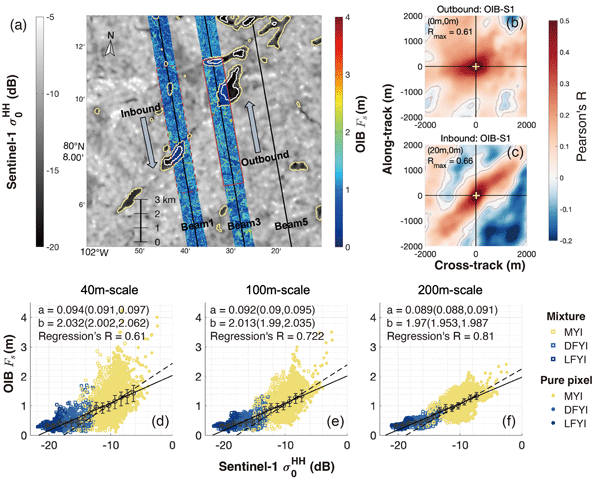
In this study, we explore the potential of using synthetic aperture radars (SAR) to predict the sea ice height measurements by the airborne campaign of Operation IceBridge. In particular, we predict the meter-scale sea ice height with the statistical relationship between the two, overcoming the resolution limitation of SAR images from Sentinel-1 satellites. The prediction and ice drift correction algorithms can be applied to the extrapolation of ICESat-2 measurements in the Arctic region.
Zuzanna M. Swirad, A. Malin Johansson, and Eirik Malnes
The Cryosphere, 18, 895–910, https://doi.org/10.5194/tc-18-895-2024, https://doi.org/10.5194/tc-18-895-2024, 2024
Short summary
Short summary
We used satellite images to create sea ice maps of Hornsund fjord, Svalbard, for nine seasons and calculated the percentage of the fjord that was covered by ice. On average, sea ice was present in Hornsund for 158 d per year, but it varied from year to year. April was the "iciest'" month and 2019/2020, 2021/22 and 2014/15 were the "iciest'" seasons. Our data can be used to understand sea ice conditions compared with other fjords of Svalbard and in studies of wave modelling and coastal erosion.
Zuzanna M. Swirad, Mateusz Moskalik, and Agnieszka Herman
Earth Syst. Sci. Data, 15, 2623–2633, https://doi.org/10.5194/essd-15-2623-2023, https://doi.org/10.5194/essd-15-2623-2023, 2023
Short summary
Short summary
Monitoring ocean waves is important for understanding wave climate and seasonal to longer-term (years to decades) changes. In the Arctic, there is limited freely available observational wave information. We placed sensors at the sea bottom of six bays in Hornsund fjord, Svalbard, and calculated wave energy, wave height and wave period for full hours between July 2013 and February 2021. In this paper, we present the procedure of deriving wave properties from raw pressure measurements.
Wenkai Guo, Polona Itkin, Suman Singha, Anthony P. Doulgeris, Malin Johansson, and Gunnar Spreen
The Cryosphere, 17, 1279–1297, https://doi.org/10.5194/tc-17-1279-2023, https://doi.org/10.5194/tc-17-1279-2023, 2023
Short summary
Short summary
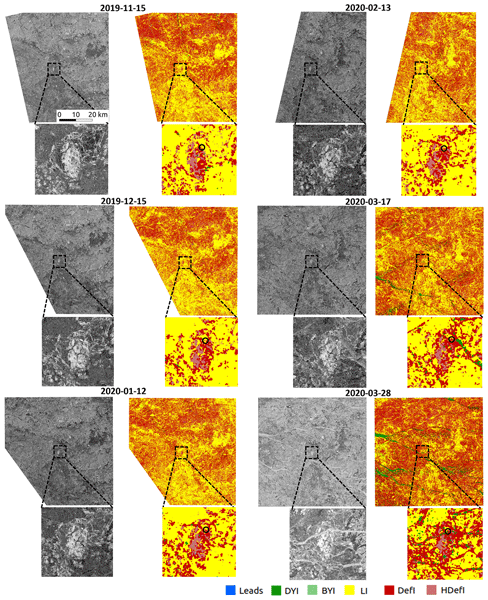
Sea ice maps are produced to cover the MOSAiC Arctic expedition (2019–2020) and divide sea ice into scientifically meaningful classes. We use a high-resolution X-band synthetic aperture radar dataset and show how image brightness and texture systematically vary across the images. We use an algorithm that reliably corrects this effect and achieve good results, as evaluated by comparisons to ground observations and other studies. The sea ice maps are useful as a basis for future MOSAiC studies.
Hannah Ming Siu Vickers, Priscilla Mooney, Eirik Malnes, and Hanna Lee
The Cryosphere Discuss., https://doi.org/10.5194/tc-2022-57, https://doi.org/10.5194/tc-2022-57, 2022
Manuscript not accepted for further review
Short summary
Short summary
Rain-on-snow (ROS) events are becoming more frequent as a result of a warming climate, and can have significant impacts on nature and society. Accurate representation of ROS events is need to identify where impacts are greatest both now and in the future. We compare rain-on-snow climatologies from a climate model, ground and satellite radar observations and show how different methods can lead to contrasting conclusions and interpretation of the results should take into account their limitations.
Zuzanna M. Swirad and Adam P. Young
Geosci. Model Dev., 15, 1499–1512, https://doi.org/10.5194/gmd-15-1499-2022, https://doi.org/10.5194/gmd-15-1499-2022, 2022
Short summary
Short summary
Cliff base and top lines that delimit coastal cliff faces are usually manually digitized based on maps, aerial photographs, terrain models, etc. However, manual mapping is time consuming and depends on the mapper's decisions and skills. To increase the objectivity and efficiency of cliff mapping, we developed CliffDelineaTool, an algorithm that identifies cliff base and top positions along cross-shore transects using elevation and slope characteristics.
Wenkai Guo, Polona Itkin, Johannes Lohse, Malin Johansson, and Anthony Paul Doulgeris
The Cryosphere, 16, 237–257, https://doi.org/10.5194/tc-16-237-2022, https://doi.org/10.5194/tc-16-237-2022, 2022
Short summary
Short summary
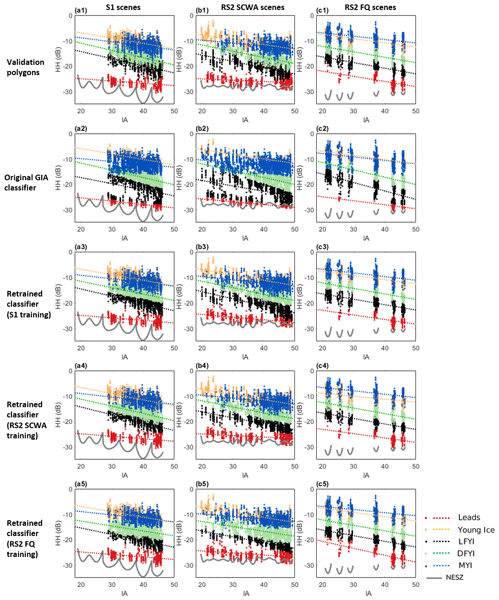
This study uses radar satellite data categorized into different sea ice types to detect ice deformation, which is significant for climate science and ship navigation. For this, we examine radar signal differences of sea ice between two similar satellite sensors and show an optimal way to apply categorization methods across sensors, so more data can be used for this purpose. This study provides a basis for future reliable and constant detection of ice deformation remotely through satellite data.
Cited articles
Arntsen, M., Sundfjord, A., Skogseth,R., Błaszczyk, M., and Promińska, A.: Inflow of warm water to theinner Hornsund fjord, Svalbard: Exchange mechanisms and influenceon local sea ice cover and glacier frontmelting, Journal of Geophysical Research: Oceans, 124, 1915–1931, https://doi.org/10.1029/2018JC014315, 2019.
Błaszczyk, M., Jania, J. A., and Kolondra, L.: Fluctuations of tidewater glaciers in Hornsund fjord (southern Svalbard) since the beginning of the 20th century, Polar Research, 34, 327–352, https://journals.pan.pl/dlibra/publication/114504/edition/99557/content (last access: 27 January 2025), 2013.
Casas-Prat, M. and Wang, X. L.: Projections of extreme ocean waves in the Arctic and potential implications for coastal inundation and erosion, J. Geophys. Res. Oceans, 125, e2019JC015745, https://doi.org/10.1029/2019JC015745, 2020.
Cristea, A., van Houtte, J., and Doulgeris, A. P.: Integrating Incidence Angle Dependencies Into the Clustering-Based Segmentation of SAR Images, IEEE J. Sel. Top. Appl., 13, 2925–2939, https://doi.org/10.1109/JSTARS.2020.2993067, 2020.
de Steur, L., Sumata, H., Divine, D. V., Granskog, M. A., and Pavlova O.: Upper ocean warming and sea ice reduction in the East Greenland Current from 2003 to 2019, Commun. Earth Environ., 4, 261, https://doi.org/10.1038/s43247-023-00913-3, 2023.
Dierking, W., Lang, O., and Busche, T.: Sea ice local surface topography from single-pass satellite InSAR measurements: a feasibility study, The Cryosphere, 11, 1967–1985, https://doi.org/10.5194/tc-11-1967-2017, 2017.
Gao, T., Lan, C., Zhou, C., Zhang, Y., Huang, W., Wang, Y., and Wang, L.: Arctic sea ice motion retrieval from multisource SAR images using a keypoint-free feature tracking algorithm, ISPRS Journal of Photogrammetry and Remote Sensing 230, 258–274, https://doi.org/10.1016/j.isprsjprs.2025.09.013, 2025.
Grabiec, M., Ignatiuk, D., Jania, J. A., Moskalik, M., Głowacki, P., Błaszczyk, M., Budzik, T., and Walczowski, W.: Coast formation in an Arctic area due to glacier surge and retreat: The Hornbreen–Hambergbreen case from Spistbergen, Earth Surf. Process. Land., 43, 387–400, https://doi.org/10.1002/esp.4251, 2018.
Guo, W., Landy, J., Lohse, J., Doulgeris, A. P., Johansson, M., Eltoft, T., Itkin, P., and Xu, S.: Toward a Multidecadal SAR Analysis of Sea Ice Types in the Atlantic Sector of the Arctic Ocean, IEEE Journal of Selected Topics in Applied Earth Observations and Remote Sensing, 18, 10486–10502, https://doi.org/10.1109/JSTARS.2025.3555864, 2025.
Herman, A., Wojtysiak, K., and Moskalik, M.: Wind wave variability in Hornsund fjord, west Spitsbergen, Estuar. Coast. Shelf S., 217, 96–109, https://doi.org/10.1016/j.ecss.2018.11.001, 2019.
Herman, A., Swirad, Z. M., and Moskalik, M.: Increased exposure of the shores of Hornsund (Svalbard) to wave action due to a rapid shift in sea ice conditions, Elementa: Science of the Anthropocene, 13, 00067, https://doi.org/10.1525/elementa.2024.00067, 2025.
Johansson, A. M., Malnes, E., Gerland, S., Cristea, A., Doulgeris, A. P., Divine, D. V., Pavlova, O., and Lauknes, T. R.: Consistent ice and open water classification combining historical synthetic aperture radar satellite images from ERS-1/2, Envisat ASAR, RADARSAT-2 and Sentinel-1A/B, Ann. Glaciol., 61, 40–50, https://doi.org/10.1017/aog.2019.52, 2020.
Kendall, M. G.: Rank correlation methods, 4th edn., Charles Griffin, London, UK, ISBN 9780852641996, 1970.
Kim, M., Kim, H.-C., Im, J., Lee, S., and Han, H.: Object-based landfast sea ice detection over West Antarctica using time series ALOS PALSAR data, Remote Sens. Environ., 242, 111782, https://doi.org/10.1016/j.rse.2020.111782, 2020.
Korosov, A. A. and Rampal, P. A.: Combination of Feature Tracking and Pattern Matching with Optimal Parametrization for Sea Ice Drift Retrieval from SAR Data, Remote Sensing, 9, 258, https://doi.org/10.3390/rs9030258, 2017.
Larsen, Y., Engen, G., Lauknes, T., Malnes, E., and Høgda, K.: A generic differential interferometric SAR processing system, with applications to land subsidence and snow-water equivalent retrieval, Fringe 2005 Workshop, 610, ISBN 92-9092-921-9, 2006.
Liu, S., Xu, S., Guo, W., Fan, Y., Zhou, L., Landy, J., Johansson, M., Zhu, W., and Petty, A.: On the statistical relationship between sea ice freeboard and C-band microwave backscatter – a case study with Sentinel-1 and Operation IceBridge, The Cryosphere, 19, 5175–5199, https://doi.org/10.5194/tc-19-5175-2025, 2025.
Lohse, J., Doulgeris, A., and Dierking, W.: An optimal decision-tree design strategy and its application to sea ice classification from SAR imagery, Remote Sensing, 11, 1574, https://doi.org/10.3390/rs11131574, 2019.
Loose, B., Fer, I., Ulfsbo, A., Chierici, M., Droste E. S., Nomura, D., Fransson, A., Hoppema, M., and Torres-Valdes, S.: An analysis of air-sea gas exchange for the entire MOSAiC Arctic drift, Elementa: Science of the Anthropocene, 12, 1, https://doi.org/10.1525/elementa.2023.00128, 2024.
Lubin, D. and Massom, R.: Polar Remote Sensing, Volume I: Atmosphere and Oceans, Springer-Verlag, Berlin Heidelberg New York, Praxis Publishing Ltd., Chichester, ISBN 9783662499762, 2006.
Luckman, A., Benn, D. I., Cottier, F., Bevan, S., Nilsen, F., and Inall, M.: Calving rates at tidewater glaciers vary strongly with ocean temperature, Nat. Commun., 6, 8566, https://doi.org/10.1038/ncomms9566, 2015.
Makhotina, E., Rees, G., Swirad, Z., and Tutubalina, O.: Mapping of sea and glacier ice distribution in 2018-2023 in the Hornsund fjord, Svalbard with PlanetScope imagery, EGU General Assembly 2025, Vienna, Austria, 27 Apr–2 May 2025, EGU25-7127, https://doi.org/10.5194/egusphere-egu25-7127, 2025.
Mann, H. B.: Nonparametric tests against trend, Econometrical, 13, 245–259, 1945.
Mezzina, B., Goosse, H., Klein, F., Barthélemy, A., and Massonnet, F.: The role of atmospheric conditions in the Antarctic sea ice extent summer minima, The Cryosphere, 18, 3825–3839, https://doi.org/10.5194/tc-18-3825-2024, 2024.
Muckenhuber, S. and Sandven, S.: Open-source sea ice drift algorithm for Sentinel-1 SAR imagery using a combination of feature tracking and pattern matching, The Cryosphere, 11, 1835–1850, https://doi.org/10.5194/tc-11-1835-2017, 2017.
Muckenhuber, S., Nilsen, F., Korosov, A., and Sandven, S.: Sea ice cover in Isfjorden and Hornsund, Svalbard (2000–2014) from remote sensing data, The Cryosphere, 10, 149–158, https://doi.org/10.5194/tc-10-149-2016, 2016.
Muilwijk, M., Hattermann, T., Martin, T., and Granskog, M. A.: Future sea ice weakening amplifies wind-driven trends in surface stress and Arctic Ocean spin-up, Nature Communications, 15, 6889, https://doi.org/10.1038/s41467-024-50874-0, 2024.
Nomura, D., Granskog, M. A., Fransson, A., Chierici, M., Silyakova, A., Ohshima, K. I., Cohen, L., Delille, B., Hudson, S. R., and Dieckmann, G. S.: CO2 flux over young and snow-covered Arctic pack ice in winter and spring, Biogeosciences, 15, 3331–3343, https://doi.org/10.5194/bg-15-3331-2018, 2018.
NPI: Kartdata Svalbard 1:100 000 (S100 Kartdata)/Map Data, Norwegian Polar Institute [data set], https://doi.org/10.21334/npolar.2014.645336c7, 2014.
Park, J.-W., Korosov, A. A., Babiker, M., Won, J.-S., Hansen, M. W., and Kim, H.-C.: Classification of sea ice types in Sentinel-1 synthetic aperture radar images, The Cryosphere, 14, 2629–2645, https://doi.org/10.5194/tc-14-2629-2020, 2020.
Pętlicki, M., Ciepły, M., Jania, J. A., Promińska, A., and Kinnard, C.: Calving of tidewater glacier driven by melting at the waterline, J. Glaciol., 61, 851–863, https://doi.org/10.3189/2015JoG15J062, 2015.
Promińska, A., Falck, E., and Walczowski, W.: Interannual variability in hydrography and water mass distribution in Hornsund, an Arctic fjord in Svalbard, Polar Res., 37, 1495546, https://doi.org/10.1080/17518369.2018.1495546, 2018.
Ricker, R., Kauker, F., Schweiger, A., Hendricks, S., Zhang, J., and Paul, S.: Evidence for an Increasing role of ocean heat in Arctic winter sea ice growth, J. Climate, 34, 5215–5227, https://doi.org/10.1175/JCLI-D-20-0848.1, 2021.
Rodzik, J. and Zagórski, P.: Shore ice and its influence on development of shores of the southwestern Spitsbergen, Oceanol. Hydrobiol. S., 38, 163–180, 2009.
Roquet, F., Ferreira, D., Caneill, R., Schlesinger, D., and Madec, G.: Unique thermal expansion properties of water key to the formation of sea ice on Earth, Science Advances, 8, https://doi.org/10.1126/sciadv.abq0793, 2022.
Saloranta, T. M. and Svendsen, H.: Across the Arctic front west of Spitsbergen: high-resolution CTD sections from 1998–2000, Polar Res., 20, 177–184, https://doi.org/10.3402/polar.v20i2.6515, 2001.
Spreen, G., de Steur, L., Divine, D., Gerland, S., Hansen, E., and Kwok, R.: Arctic sea ice volume export through Fram Straight from 1992 to 2014, Journal of Geophysical Research: Oceans, 125, e2019JC016039, https://doi.org/10.1029/2019JC016039, 2020.
Styszyńska, A. and Rozwadowska, A.: Ice conditions in Hornsund and its foreshore (south-west Spitsbergen) during winter season 2006/07, Problemy Klimatologii Polarnej, 18, 141–160, 2008 (in Polish).
Swirad, Z. M.: Ice type maps for Hornsund, Svalbard, 1.2012-6.2023 (v1.0), Zenodo [data set], https://doi.org/10.5281/zenodo.15647080, 2025.
Swirad, Z. M., Johansson, A. M., and Malnes, E.: Ice distribution in Hornsund fjord, Svalbard from Sentinel-1A/B (2014–2023), PANGAEA [data set], https://doi.org/10.1594/PANGAEA.963167, 2023a.
Swirad, Z. M., Moskalik, M., and Herman, A.: Wind wave and water level dataset for Hornsund, Svalbard (2013–2021), Earth Syst. Sci. Data, 15, 2623–2633, https://doi.org/10.5194/essd-15-2623-2023, 2023b.
Swirad, Z. M., Johansson, A. M., and Malnes, E.: Extent, duration and timing of the sea ice cover in Hornsund, Svalbard, from 2014–2023, The Cryosphere, 18, 895–910, https://doi.org/10.5194/tc-18-895-2024, 2024a.
Swirad, Z. M., Johansson, A. M., and Malnes, E.: Ice distribution in Hornsund fjord, Svalbard from RADARSAT-2 (2012–2016), PANGAEA [data set], https://doi.org/10.1594/PANGAEA.969031, 2024b.
van Pelt, W., Pohjola, V., Pettersson, R., Marchenko, S., Kohler, J., Luks, B., Hagen, J. O., Schuler, T. V., Dunse, T., Noël, B., and Reijmer, C.: A long-term dataset of climatic mass balance, snow conditions, and runoff in Svalbard (1957–2018), The Cryosphere, 13, 2259–2280, https://doi.org/10.5194/tc-13-2259-2019, 2019.
Wang, Q., Lohse, J. P., Doulgeris, A. P., and Eltoft, T.: Data augmentation for SAR sea ice and water classification based on per-class backscatter variation with incidence angle, IEEE Trans. Geosci. Remote Sens., 61, 4205915, https://doi.org/10.1109/TGRS.2023.3291927, 2023.
Wang, X., Zhang, Z., Wang, X., Vihma, T., Zhou, M., Yu, L., Uotila, P., and Sein, D. V.: Impacts of strong wind events on sea ice and water mass properties in Antarctic coastal polynyas, Climate Dynamics, 57, 3505–3528, https://doi.org/10.1007/s00382-021-05878-7, 2021.
Wawrzyniak, T. and Osuch, M.: A 40-year High Arctic climatological dataset of the Polish Polar Station Hornsund (SW Spitsbergen, Svalbard), Earth Syst. Sci. Data, 12, 805–815, https://doi.org/10.5194/essd-12-805-2020, 2020.
Wojtysiak, K., Herman, A., and Moskalik, M.: Wind wave climate of west Spitsbergen: Seasonal variability and extreme events, Oceanologia, 60, 331–343, https://doi.org/10.1016/j.oceano.2018.01.002, 2018.
Zagórski, P., Rodzik, J., Moskalik, M., Strzelecki, M. C., Lim, M., Błaszczyk, M., Promińska, A., Kruszewski, G., Styszyńska, A., and Malczewski, A.: Multidecadal (1960–2011) shoreline changes in Isbjørnhamna (Hornsund, Svalbard), Pol. Polar Res., 36, 369–390, https://journals.pan.pl/Content/99617/PDF/10183_Volume36_Issue4_05_paper.pdf (last access: 8 July 2025), 2015.
Zhu, T., Cui, X., and Zhang, Y.: A High-Resolution Sea Ice Concentration Retrieval from Ice-WaterNet Using Sentinel-1 SAR Imagery in Fram Strait, Arctic, Remote Sensing, 17, 3475, https://doi.org/10.3390/rs17203475, 2025.
Short summary
Drift, landfast and glacier ice are present in fjords and it is important to map them separately. We developed a method to split fjord ice into different types based on ice location, persistence in time and size. We used this method for Hornsund fjord, home to the Polish Polar Station, for an 11.5-year period. We observed that most of the ice is drift ice. The maps produced by this study can be used to look at water circulation, coastal erosion and habitat conditions.
Drift, landfast and glacier ice are present in fjords and it is important to map them...


