
Articles | Volume 20, issue 2
https://doi.org/10.5194/tc-20-1047-2026
© Author(s) 2026. This work is distributed under
the Creative Commons Attribution 4.0 License.
the Creative Commons Attribution 4.0 License.
https://doi.org/10.5194/tc-20-1047-2026
© Author(s) 2026. This work is distributed under
the Creative Commons Attribution 4.0 License.
the Creative Commons Attribution 4.0 License.
Research article
| 
11 Feb 2026
Research article |
| 11 Feb 2026
| 11 Feb 2026
Stabilizing feedbacks allow for multiple states of the Greenland Ice Sheet in a fully coupled Earth System – Ice Sheet Model
Malena Andernach
CORRESPONDING AUTHOR

Max Planck Institute for Meteorology, Hamburg, Germany
International Max Planck Research School for Earth System Modelling (IMPRS), Hamburg, Germany
Marie-Luise Kapsch
Max Planck Institute for Meteorology, Hamburg, Germany
Uwe Mikolajewicz
Max Planck Institute for Meteorology, Hamburg, Germany
Related authors
Malena Andernach, Marie-Luise Kapsch, and Uwe Mikolajewicz
EGUsphere, https://doi.org/10.5194/egusphere-2026-6194, https://doi.org/10.5194/egusphere-2026-6194, 2026
This preprint is open for discussion and under review for Earth System Dynamics (ESD).
Short summary
Short summary
We simulate the transient quasi-equilibrium response of the Greenland Ice Sheet to a range of atmospheric CO2 forcings, using a comprehensive Earth System Model with dynamic ice sheets. We show that the present-day Greenland Ice Sheet disintegrates at a long-term global warming of 2.55 ± 0.15 °C above pre-industrial temperatures. Climate feedbacks cause hysteresis and a stepwise regrowth. Full recovery of the ice sheet requires temperatures of 1.3 ± 0.1 °C below pre-industrial.
Malena Andernach, Marie-Luise Kapsch, and Uwe Mikolajewicz
Earth Syst. Dynam., 16, 451–474, https://doi.org/10.5194/esd-16-451-2025, https://doi.org/10.5194/esd-16-451-2025, 2025
Short summary
Short summary
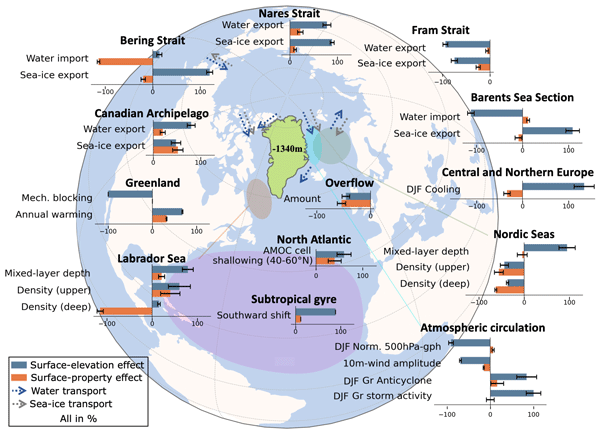
Using a comprehensive set of simulations with the Max Planck Institute for Meteorology Earth System Model, we disentangle and quantify the impacts of a disintegrated Greenland Ice Sheet (GrIS) on the global climate, including the deep ocean. We find most of the climate response is driven by Greenland’s lower elevation and enhanced by changed surface properties, although regional differences exist. Despite the confinement of most responses to the Arctic, the GrIS also influences remote climates.
Malena Andernach, Marie-Luise Kapsch, and Uwe Mikolajewicz
EGUsphere, https://doi.org/10.5194/egusphere-2026-6194, https://doi.org/10.5194/egusphere-2026-6194, 2026
This preprint is open for discussion and under review for Earth System Dynamics (ESD).
Short summary
Short summary
We simulate the transient quasi-equilibrium response of the Greenland Ice Sheet to a range of atmospheric CO2 forcings, using a comprehensive Earth System Model with dynamic ice sheets. We show that the present-day Greenland Ice Sheet disintegrates at a long-term global warming of 2.55 ± 0.15 °C above pre-industrial temperatures. Climate feedbacks cause hysteresis and a stepwise regrowth. Full recovery of the ice sheet requires temperatures of 1.3 ± 0.1 °C below pre-industrial.
Clemens Schannwell, Marie-Luise Kapsch, Matteo Willeit, Lars Ackermann, Gregor Knorr, Uta Krebs-Kanzow, Gerrit Lohmann, Katharina D. Six, Christian Stepanek, and Uwe Mikolajewicz
EGUsphere, https://doi.org/10.5194/egusphere-2026-3384, https://doi.org/10.5194/egusphere-2026-3384, 2026
Short summary
Short summary
We present long-term future projections of the Greenland ice sheet based on three numerical models which all explicitly account for feedbacks between the climate and the Greenland ice sheet. We find that projections vary considerably across the models, particularly beyond 2100. The main reasons for this is the different modelled climate as well as how the modelled climate is translated into snowfall and melt in each of the models.
Chetankumar Jalihal and Uwe Mikolajewicz
Earth Syst. Dynam., 17, 319–331, https://doi.org/10.5194/esd-17-319-2026, https://doi.org/10.5194/esd-17-319-2026, 2026
Short summary
Short summary
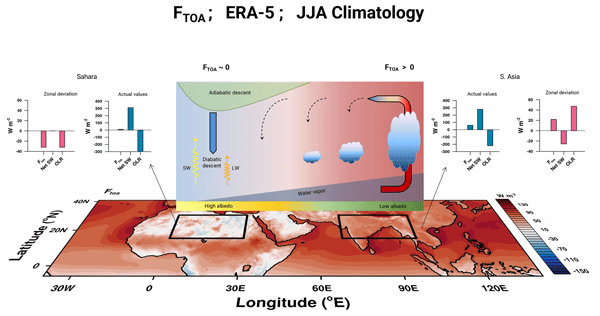
Differences in surface albedo and large-scale circulation are often considered to drive the contrasts between monsoons and deserts. However, using a radiation-circulation framework, we find that large-scale circulation serves primarily as a trigger for this contrast. It is the radiative feedbacks from water vapor and clouds, rather than surface albedo, that amplify the contrast between these climates.
Takashi Obase, Laurie Menviel, Ayako Abe-Ouchi, Tristan Vadsaria, Ruza Ivanovic, Brooke Snoll, Sam Sherriff-Tadano, Paul J. Valdes, Lauren Gregoire, Marie-Luise Kapsch, Uwe Mikolajewicz, Nathaelle Bouttes, Didier Roche, Fanny Lhardy, Chengfei He, Bette Otto-Bliesner, Zhengyu Liu, and Wing-Le Chan
Clim. Past, 21, 1443–1463, https://doi.org/10.5194/cp-21-1443-2025, https://doi.org/10.5194/cp-21-1443-2025, 2025
Short summary
Short summary
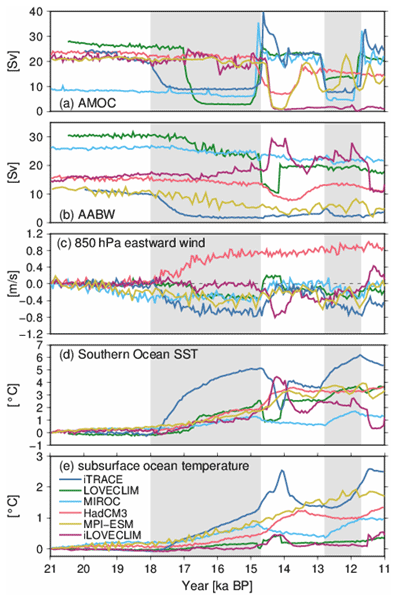
This study analyses transient simulations of the last deglaciation performed by six climate models to understand the processes driving high-southern-latitude temperature changes. We find that atmospheric CO2 and AMOC (Atlantic Meridional Overturning Circulation) changes are the primary drivers of the warming and cooling during the middle stage of the deglaciation. The analysis highlights the model's sensitivity of CO2 and AMOC to meltwater and the meltwater history of temperature changes at high southern latitudes.
Uwe Mikolajewicz, Marie-Luise Kapsch, Clemens Schannwell, Katharina D. Six, Florian A. Ziemen, Meike Bagge, Jean-Philippe Baudouin, Olga Erokhina, Veronika Gayler, Volker Klemann, Virna L. Meccia, Anne Mouchet, and Thomas Riddick
Clim. Past, 21, 719–751, https://doi.org/10.5194/cp-21-719-2025, https://doi.org/10.5194/cp-21-719-2025, 2025
Short summary
Short summary
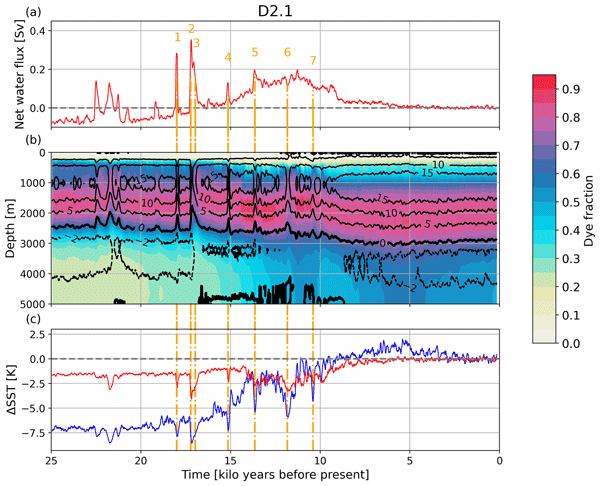
A fully coupled atmosphere–ocean–ice-sheet–solid-earth model was applied to simulate the time from the Last Glacial Maximum (about 25 000 years before the present) to the pre-industrial period. The model simulations are compared to observational estimates. During this climate transition, the model simulates several abrupt changes in the North Atlantic region, which are initiated by different processes. The underlying mechanisms are analysed and described.
Malena Andernach, Marie-Luise Kapsch, and Uwe Mikolajewicz
Earth Syst. Dynam., 16, 451–474, https://doi.org/10.5194/esd-16-451-2025, https://doi.org/10.5194/esd-16-451-2025, 2025
Short summary
Short summary
Using a comprehensive set of simulations with the Max Planck Institute for Meteorology Earth System Model, we disentangle and quantify the impacts of a disintegrated Greenland Ice Sheet (GrIS) on the global climate, including the deep ocean. We find most of the climate response is driven by Greenland’s lower elevation and enhanced by changed surface properties, although regional differences exist. Despite the confinement of most responses to the Arctic, the GrIS also influences remote climates.
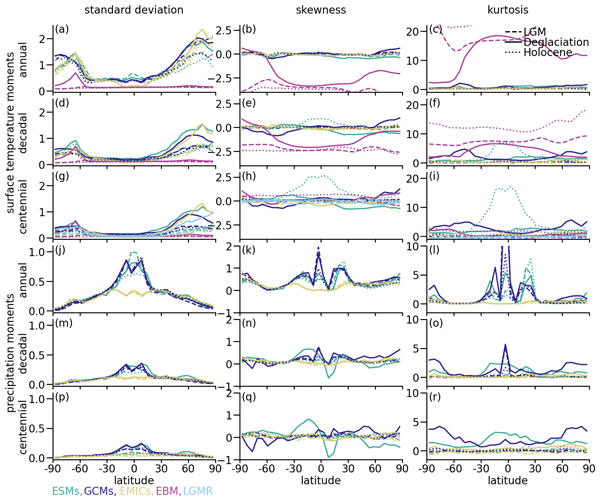
Elisa Ziegler, Nils Weitzel, Jean-Philippe Baudouin, Marie-Luise Kapsch, Uwe Mikolajewicz, Lauren Gregoire, Ruza Ivanovic, Paul J. Valdes, Christian Wirths, and Kira Rehfeld
Clim. Past, 21, 627–659, https://doi.org/10.5194/cp-21-627-2025, https://doi.org/10.5194/cp-21-627-2025, 2025
Short summary
Short summary
During the Last Deglaciation, global surface temperature rose by about 4–7 °C over several millennia. We show that changes in year-to-year up to century-to-century fluctuations of temperature and precipitation during the Deglaciation were mostly larger than during either the preceding or succeeding more stable periods in 15 climate model simulations. The analysis demonstrates how ice sheets, meltwater, and volcanism influence simulated variability to inform future simulation protocols.
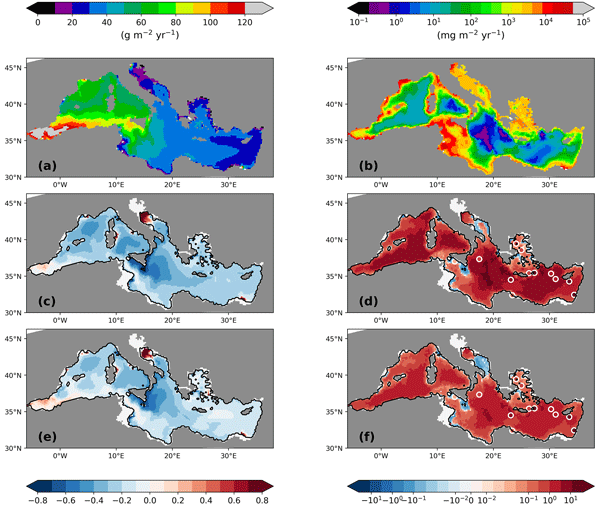
Katharina D. Six, Uwe Mikolajewicz, and Gerhard Schmiedl
Clim. Past, 20, 1785–1816, https://doi.org/10.5194/cp-20-1785-2024, https://doi.org/10.5194/cp-20-1785-2024, 2024
Short summary
Short summary
We use a physical and biogeochemical ocean model of the Mediterranean Sea to obtain a picture of the Last Glacial Maximum. The shallowing of the Strait of Gibraltar leads to a shallower pycnocline and more efficient nutrient export. Consistent with the sediment data, an increase in organic matter deposition is simulated, although this is based on lower biological production. This unexpected but plausible result resolves the apparent contradiction between planktonic and benthic proxy data.
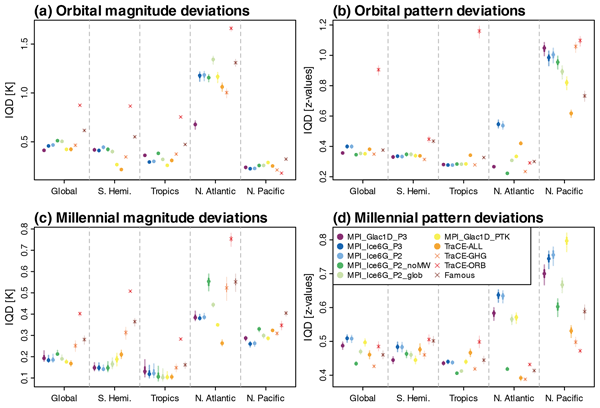
Nils Weitzel, Heather Andres, Jean-Philippe Baudouin, Marie-Luise Kapsch, Uwe Mikolajewicz, Lukas Jonkers, Oliver Bothe, Elisa Ziegler, Thomas Kleinen, André Paul, and Kira Rehfeld
Clim. Past, 20, 865–890, https://doi.org/10.5194/cp-20-865-2024, https://doi.org/10.5194/cp-20-865-2024, 2024
Short summary
Short summary
The ability of climate models to faithfully reproduce past warming episodes is a valuable test considering potentially large future warming. We develop a new method to compare simulations of the last deglaciation with temperature reconstructions. We find that reconstructions differ more between regions than simulations, potentially due to deficiencies in the simulation design, models, or reconstructions. Our work is a promising step towards benchmarking simulations of past climate transitions.
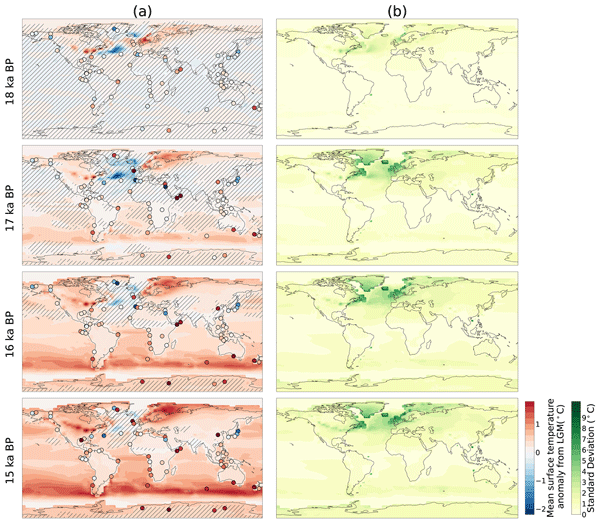
Brooke Snoll, Ruza Ivanovic, Lauren Gregoire, Sam Sherriff-Tadano, Laurie Menviel, Takashi Obase, Ayako Abe-Ouchi, Nathaelle Bouttes, Chengfei He, Feng He, Marie Kapsch, Uwe Mikolajewicz, Juan Muglia, and Paul Valdes
Clim. Past, 20, 789–815, https://doi.org/10.5194/cp-20-789-2024, https://doi.org/10.5194/cp-20-789-2024, 2024
Short summary
Short summary
Geological records show rapid climate change throughout the recent deglaciation. The drivers of these changes are still misunderstood but are often attributed to shifts in the Atlantic Ocean circulation from meltwater input. A cumulative effort to understand these processes prompted numerous simulations of this period. We use these to explain the chain of events and our collective ability to simulate them. The results demonstrate the importance of the meltwater amount used in the simulation.
Clemens Schannwell, Uwe Mikolajewicz, Florian Ziemen, and Marie-Luise Kapsch
Clim. Past, 19, 179–198, https://doi.org/10.5194/cp-19-179-2023, https://doi.org/10.5194/cp-19-179-2023, 2023
Short summary
Short summary
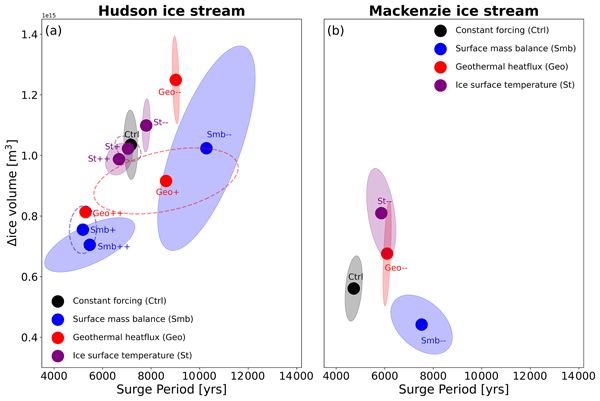
Heinrich-type ice-sheet surges are recurring events over the course of the last glacial cycle during which large numbers of icebergs are discharged from the Laurentide ice sheet into the ocean. These events alter the evolution of the global climate. Here, we use model simulations of the Laurentide ice sheet to identify and quantify the importance of various climate and ice-sheet parameters for the simulated surge cycle.
Katharina Dorothea Six and Uwe Mikolajewicz
Biogeosciences Discuss., https://doi.org/10.5194/bg-2022-27, https://doi.org/10.5194/bg-2022-27, 2022
Preprint withdrawn
Short summary
Short summary
We developed a global ocean biogeochemical model with a zoom on the Benguela upwelling system. We show that the high spatial resolution is necessary to capture long-term trends of oxygen of the recent past. The regional anthropogenic carbon uptake over the last century is lower than compared to a coarser resolution ocean model as used in Earth system models. This suggests that, at least for some regions, the changes projected by these Earth system models are associated with high uncertainty.
Cited articles
Andernach, M.: Data and plots for the paper “Stabilizing feedbacks allow for multiple states of the Greenland Ice Sheet in a fully coupled Earth System – Ice Sheet Model”, Version 1.0, Edmond [data set], https://doi.org/10.17617/3.URUHJ7, 2026. a
Aschwanden, A., Fahnestock, M. A., Truffer, M., Brinkerhoff, D. J., Hock, R., Khroulev, C., Mottram, R., and Khan, S. A.: Contribution of the Greenland Ice Sheet to sea level over the next millennium, Science Advances, 5, eaav9396, https://doi.org/10.1126/sciadv.aav9396, 2019. a
Berger, A. and Loutre, M. F.: Insolation values for the climate of the last 10 million years, Quaternary Science Reviews, 10, 297–317, 1991. a
Boers, N. and Rypdal, M.: Critical slowing down suggests that the western Greenland Ice Sheet is close to a tipping point, Proceedings of the National Academy of Sciences, 118, e2024192118, https://doi.org/10.1073/pnas.202419211, 2021. a
Böning, C. W., Behrens, E., Biastoch, A., Getzlaff, K., and Bamber, J. L.: Emerging impact of Greenland meltwater on deepwater formation in the North Atlantic Ocean, Nature Geoscience, 9, 523–527, 2016. a
Bügelmayer, M., Roche, D. M., and Renssen, H.: How do icebergs affect the Greenland ice sheet under pre-industrial conditions? – a model study with a fully coupled ice-sheet–climate model, The Cryosphere, 9, 821–835, https://doi.org/10.5194/tc-9-821-2015, 2015. a
Caesar, L., Rahmstorf, S., Robinson, A., Feulner, G., and Saba, V.: Observed fingerprint of a weakening Atlantic Ocean overturning circulation, Nature, 556, 191–196, 2018. a
Cuffey, K. M. and Paterson, W. S. B.: The physics of glaciers, 4th edn., Butterworth-Heinemann/Elsevier, Burlington, MA, ISBN: 978-0123694614, 2010. a
Davini, P., von Hardenberg, J., Filippi, L., and Provenzale, A.: Impact of Greenland orography on the Atlantic Meridional Overturning Circulation, Geophysical Research Letters, 42, 871–879, 2015. a
Dethloff, K., Dorn, W., Rinke, A., Fraedrich, K., Junge, M., Roeckner, E., Gayler, V., Cubasch, U., and Christensen, J. H.: The impact of Greenland's deglaciation on the Arctic circulation, Geophysical Research Letters, 31, L19201, https://doi.org/10.1029/2004GL020714, 2004. a, b
Erokhina, O. and Mikolajewicz, U.: A New Eulerian Iceberg Module for Climate Studies, Journal of Advances in Modeling Earth Systems, 16, e2023MS003807, https://doi.org/10.1029/2023MS003807, 2024. a
Ferster, B. S., Fedorov, A. V., Mignot, J., and Guilyardi, E.: AMOC Variability in Climate Models and Its Dependence on the Mean State, Geophysical Research Letters, 52, e2024GL110356, https://doi.org/10.1029/2024GL110356, 2025. a, b
Fyke, J., Sergienko, O., Löfverström, M., Price, S., and Lenaerts, J. T. M.: An Overview of Interactions and Feedbacks Between Ice Sheets and the Earth System, Reviews of Geophysics, 56, 361–408, 2018. a
Goelzer, H., Nowicki, S., Payne, A., Larour, E., Seroussi, H., Lipscomb, W. H., Gregory, J., Abe-Ouchi, A., Shepherd, A., Simon, E., Agosta, C., Alexander, P., Aschwanden, A., Barthel, A., Calov, R., Chambers, C., Choi, Y., Cuzzone, J., Dumas, C., Edwards, T., Felikson, D., Fettweis, X., Golledge, N. R., Greve, R., Humbert, A., Huybrechts, P., Le clec'h, S., Lee, V., Leguy, G., Little, C., Lowry, D. P., Morlighem, M., Nias, I., Quiquet, A., Rückamp, M., Schlegel, N.-J., Slater, D. A., Smith, R. S., Straneo, F., Tarasov, L., van de Wal, R., and van den Broeke, M.: The future sea-level contribution of the Greenland ice sheet: a multi-model ensemble study of ISMIP6, The Cryosphere, 14, 3071–3096, https://doi.org/10.5194/tc-14-3071-2020, 2020. a
He, F. and Clark, P. U.: Freshwater forcing of the Atlantic Meridional Overturning Circulation revisited, Nature Climate Change, 12, 449–454, 2022. a
Hörhold, M., Münch, T., Weißbach, S., Kipfstuhl, S., Freitag, J., Sasgen, I., Lohmann, G., Vinther, B., and Laepple, T.: Modern temperatures in central–north Greenland warmest in past millennium, Nature, 613, 503–507, 2023. a
Jiang, S., Ye, A., and Xiao, C.: The temperature increase in Greenland has accelerated in the past five years, Global and Planetary Change, 194, 103297, https://doi.org/10.1016/j.gloplacha.2020.103297, 2020. a
Joughin, I. and Alley, R. B.: Stability of the West Antarctic ice sheet in a warming world, Nature Geoscience, 4, 506–513, 2011. a
Jungclaus, J. H., Fischer, N., Haak, H., Lohmann, K., Marotzke, J., Matei, D., Mikolajewicz, U., Notz, D., and von Storch, J. S.: Characteristics of the ocean simulations in the Max Planck Institute Ocean Model (MPIOM) the ocean component of the MPI-Earth system model, Journal of Advances in Modeling Earth Systems, 5, 422–446, 2013. a
Kapsch, M. L., Mikolajewicz, U., Ziemen, F. A., Rodehacke, C. B., and Schannwell, C.: Analysis of the surface mass balance for deglacial climate simulations, The Cryosphere, 15, 1131–1156, https://doi.org/10.5194/tc-15-1131-2021, 2021. a
Köhler, P., Nehrbass-Ahles, C., Schmitt, J., Stocker, T. F., and Fischer, H.: A 156 kyr smoothed history of the atmospheric greenhouse gases CO2, CH4, and N2O and their radiative forcing, Earth Syst. Sci. Data, 9, 363–387, https://doi.org/10.5194/essd-9-363-2017, 2017. a
Li, Q., Marshall, J., Rye, C. D., Romanou, A., Rind, D., and Kelley, M.: Global Climate Impacts of Greenland and Antarctic Meltwater: A Comparative Study, Journal of Climate, 36, 3571–3590, 2023. a
Marsland, S. J., Haak, H., Jungclaus, J. H., Latif, M., and Röske, F.: The Max-Planck-Institute global ocean/sea ice model with orthogonal curvilinear coordinates, Ocean Modelling, 5, 91–127, 2003. a
Martinec, Z., Klemann, V., van der Wal, W., Riva, R. E. M., Spada, G., Sun, Y., Melini, D., Kachuck, S. B., Barletta, V., Simon, K., A, G., and James, T. S.: A benchmark study of numerical implementations of the sea level equation in GIA modelling, Geophysical Journal International, 215, 389–414, 2018. a
Mauritsen, T., Bader, J., Becker, T., Behrens, J., Bittner, M., Brokopf, R., Brovkin, V., Claussen, M., Crueger, T., Esch, M., Fast, I., Fiedler, S., Fläschner, D., Gayler, V., Giorgetta, M., Goll, D. S., Haak, H., Hagemann, S., Hedemann, C., Hohenegger, C., Ilyina, T., Jahns, T., Jimenéz-de-la Cuesta, D., Jungclaus, J., Kleinen, T., Kloster, S., Kracher, D., Kinne, S., Kleberg, D., Lasslop, G., Kornblueh, L., Marotzke, J., Matei, D., Meraner, K., Mikolajewicz, U., Modali, K., Möbis, B., Müller, W. A., Nabel, J. E. M. S., Nam, C. C. W., Notz, D., Nyawira, S.-S., Paulsen, H., Peters, K., Pincus, R., Pohlmann, H., Pongratz, J., Popp, M., Raddatz, T. J., Rast, S., Redler, R., Reick, C. H., Rohrschneider, T., Schemann, V., Schmidt, H., Schnur, R., Schulzweida, U., Six, K. D., Stein, L., Stemmler, I., Stevens, B., von Storch, J.-S., Tian, F., Voigt, A., Vrese, P., Wieners, K.-H., Wilkenskjeld, S., Winkler, A., and Roeckner, E.: Developments in the MPI-M Earth System Model version 1.2 (MPI-ESM1.2) and Its Response to Increasing CO2, Journal of Advances in Modeling Earth Systems, 11, 998–1038, 2019. a
McGrath, D., Colgan, W., Bayou, N., Muto, A., and Steffen, K.: Recent warming at Summit, Greenland: Global context and implications, Geophysical Research Letters, 40, 2091–2096, 2013. a
Meccia, V. L. and Mikolajewicz, U.: Interactive ocean bathymetry and coastlines for simulating the last deglaciation with the Max Planck Institute Earth System Model (MPI-ESM-v1.2), Geosci. Model Dev., 11, 4677–4692, https://doi.org/10.5194/gmd-11-4677-2018, 2018. a
Mikolajewicz, U.: Effect of meltwater input from the Antarctic ice sheet on the thermohaline circulation, Annals of Glaciology, 27, 311–315, 1998. a
Mikolajewicz, U., Vizcaíno, M., Jungclaus, J., and Schurgers, G.: Effect of ice sheet interactions in anthropogenic climate change simulations, Geophysical Research Letters, 34, L18706, https://doi.org/10.1029/2007GL031173, 2007. a
Mikolajewicz, U., Ziemen, F., Cioni, G., Claussen, M., Fraedrich, K., Heidkamp, M., Hohenegger, C., Jimenez de la Cuesta, D., Kapsch, M.-L., Lemburg, A., Mauritsen, T., Meraner, K., Röber, N., Schmidt, H., Six, K. D., Stemmler, I., Tamarin-Brodsky, T., Winkler, A., Zhu, X., and Stevens, B.: The climate of a retrograde rotating Earth, Earth Syst. Dynam., 9, 1191–1215, https://doi.org/10.5194/esd-9-1191-2018, 2018. a
Mikolajewicz, U., Kapsch, M.-L., Schannwell, C., Six, K. D., Ziemen, F. A., Bagge, M., Baudouin, J.-P., Erokhina, O., Gayler, V., Klemann, V., Meccia, V. L., Mouchet, A., and Riddick, T.: Deglaciation and abrupt events in a coupled comprehensive atmosphere–ocean–ice-sheet–solid-earth model, Clim. Past, 21, 719–751, https://doi.org/10.5194/cp-21-719-2025, 2025. a, b, c, d, e, f, g
Morlighem, M., Williams, C. N., Rignot, E., An, L., Arndt, J. E., Bamber, J. L., Catania, G., Chauché, N., Dowdeswell, J. A., Dorschel, B., Fenty, I., Hogan, K., Howat, I., Hubbard, A., Jakobsson, M., Jordan, T. M., Kjeldsen, K. K., Millan, R., Mayer, L., Mouginot, J., Noël, B. P. Y., O'Cofaigh, C., Palmer, S., Rysgaard, S., Seroussi, H., Siegert, M. J., Slabon, P., Straneo, F., van den Broeke, M. R., Weinrebe, W., Wood, M., and Zinglersen, K. B.: BedMachine v3: Complete Bed Topography and Ocean Bathymetry Mapping of Greenland From Multibeam Echo Sounding Combined With Mass Conservation, Geophysical Research Letters, 44, 11051–11061, 2017. a
Morlighem, M., Williams, C., Rignot, E., An, L., Arndt, J. E., Bamber, J., Catania, G., Chauché, N., Dowdeswell, J. A., Dorschel, B., Fenty, I., Hogan, K., Howat, I., Hubbard, A., Jakobsson, M., Jordan, T. M., Kjeldsen, K. K., Millan, R., Mayer, L., Mouginot, J., Noël, B., O'Cofaigh, C., Palmer, S. J., Rysgaard, S., Seroussi, H., Siegert, M. J., Slabon, P., Straneo, F., van den Broeke, M. R., Weinrebe, W., Wood, M., and Zinglersen, K.: IceBridge BedMachine Greenland (IDBMG4, Version 5), NASA National Snow and Ice Data Center Distributed Active Archive Center [data set], Boulder, Colorado, USA, https://doi.org/10.5067/GMEVBWFLWA7X, 2022. a
Ohmura, A. and Reeh, N.: New precipitation and accumulation maps for Greenland, Journal of Glaciology, 37, 140–148, 1991. a
Pattyn, F., Ritz, C., Hanna, E., Asay-Davis, X., DeConto, R., Durand, G., Favier, L., Fettweis, X., Goelzer, H., Golledge, N. R., Kuipers Munneke, P., Lenaerts, J. T. M., Nowicki, S., Payne, A. J., Robinson, A., Seroussi, H., Trusel, L. D., and van den Broeke, M.: The Greenland and Antarctic ice sheets under 1.5 °C global warming, Nature Climate Change, 8, 1053–1061, 2018. a, b
Petersen, G. N., Kristjánsson, J. E., and Ólafsson, H.: Numerical simulations of Greenland's impact on the Northern Hemisphere winter circulation, Tellus A, 56, 102–111, 2004. a
Petrini, M., Scherrenberg, M. D. W., Muntjewerf, L., Vizcaino, M., Sellevold, R., Leguy, G. R., Lipscomb, W. H., and Goelzer, H.: A topographically controlled tipping point for complete Greenland ice sheet melt, The Cryosphere, 19, 63–81, https://doi.org/10.5194/tc-19-63-2025, 2025. a, b, c
Raddatz, T. J., Reick, C. H., Knorr, W., Kattge, J., Roeckner, E., Schnur, R., Schnitzler, K. G., Wetzel, P., and Jungclaus, J.: Will the tropical land biosphere dominate the climate–carbon cycle feedback during the twenty-first century?, Climate Dynamics, 29, 565–574, 2007. a
Riddick, T., Brovkin, V., Hagemann, S., and Mikolajewicz, U.: Dynamic hydrological discharge modelling for coupled climate model simulations of the last glacial cycle: the MPI-DynamicHD model version 3.0, Geosci. Model Dev., 11, 4291–4316, https://doi.org/10.5194/gmd-11-4291-2018, 2018. a
Schoof, C.: Ice sheet grounding line dynamics: Steady states, stability, and hysteresis, Journal of Geophysical Research: Earth Surface, 112, F03S28, https://doi.org/10.1029/2006JF000664, 2007. a, b
Sinet, S., von der Heydt, A. S., and Dijkstra, H. A.: AMOC Stabilization Under the Interaction With Tipping Polar Ice Sheets, Geophysical Research Letters, 50, e2022GL100305, https://doi.org/10.1029/2022GL100305, 2023. a
Stevens, B., Giorgetta, M., Esch, M., Mauritsen, T., Crueger, T., Rast, S., Salzmann, M., Schmidt, H., Bader, J., Block, K., Brokopf, R., Fast, I., Kinne, S., Kornblueh, L., Lohmann, U., Pincus, R., Reichler, T., and Roeckner, E.: Atmospheric component of the MPI-M Earth System Model: ECHAM6, Journal of Advances in Modeling Earth Systems, 5, 146–172, 2013. a
Stone, E. J. and Lunt, D. J.: The role of vegetation feedbacks on Greenland glaciation, Climate Dynamics, 40, 2671–2686, 2013. a
Stouffer, R. J., Yin, J., Gregory, J. M., Dixon, K. W., Spelman, M. J., Hurlin, W., Weaver, A. J., Eby, M., Flato, G. M., Hasumi, H., Hu, A., Jungclaus, J. H., Kamenkovich, I. V., Levermann, A., Montoya, M., Murakami, S., Nawrath, S., Oka, A., Peltier, W. R., Robitaille, D. Y., Sokolov, A., Vettoretti, G., and Weber, S. L.: Investigating the Causes of the Response of the Thermohaline Circulation to Past and Future Climate Changes, Journal of Climate, 19, 1365–1387, 2006. a
Weijer, W., Maltrud, M. E., Hecht, M. W., Dijkstra, H. A., and Kliphuis, M. A.: Response of the Atlantic Ocean circulation to Greenland Ice Sheet melting in a strongly-eddying ocean model, Geophysical Research Letters, 39, L09606, https://doi.org/10.1029/2012GL051611, 2012. a
Wunderling, N., Donges, J. F., Kurths, J., and Winkelmann, R.: Interacting tipping elements increase risk of climate domino effects under global warming, Earth Syst. Dynam., 12, 601–619, https://doi.org/10.5194/esd-12-601-2021, 2021. a
Wunderling, N., von der Heydt, A. S., Aksenov, Y., Barker, S., Bastiaansen, R., Brovkin, V., Brunetti, M., Couplet, V., Kleinen, T., Lear, C. H., Lohmann, J., Roman-Cuesta, R. M., Sinet, S., Swingedouw, D., Winkelmann, R., Anand, P., Barichivich, J., Bathiany, S., Baudena, M., Bruun, J. T., Chiessi, C. M., Coxall, H. K., Docquier, D., Donges, J. F., Falkena, S. K. J., Klose, A. K., Obura, D., Rocha, J., Rynders, S., Steinert, N. J., and Willeit, M.: Climate tipping point interactions and cascades: a review, Earth Syst. Dynam., 15, 41–74, https://doi.org/10.5194/esd-15-41-2024, 2024a. a
Wunderling, N., von der Heydt, A. S., Aksenov, Y., Barker, S., Bastiaansen, R., Brovkin, V., Brunetti, M., Couplet, V., Kleinen, T., Lear, C. H., Lohmann, J., Roman-Cuesta, R. M., Sinet, S., Swingedouw, D., Winkelmann, R., Anand, P., Barichivich, J., Bathiany, S., Baudena, M., Bruun, J. T., Chiessi, C. M., Coxall, H. K., Docquier, D., Donges, J. F., Falkena, S. K. J., Klose, A. K., Obura, D., Rocha, J., Rynders, S., Steinert, N. J., and Willeit, M.: Climate tipping point interactions and cascades: a review, Earth Syst. Dynam., 15, 41–74, https://doi.org/10.5194/esd-15-41-2024, 2024b. a
Zeitz, M., Reese, R., Beckmann, J., Krebs-Kanzow, U., and Winkelmann, R.: Impact of the melt–albedo feedback on the future evolution of the Greenland Ice Sheet with PISM-dEBM-simple, The Cryosphere, 15, 5739–5764, https://doi.org/10.5194/tc-15-5739-2021, 2021. a, b, c
Zeitz, M., Haacker, J. M., Donges, J. F., Albrecht, T., and Winkelmann, R.: Dynamic regimes of the Greenland Ice Sheet emerging from interacting melt–elevation and glacial isostatic adjustment feedbacks, Earth Syst. Dynam., 13, 1077–1096, https://doi.org/10.5194/esd-13-1077-2022, 2022. a, b
Ziemen, F. A., Kapsch, M.-L., Klockmann, M., and Mikolajewicz, U.: Heinrich events show two-stage climate response in transient glacial simulations, Clim. Past, 15, 153–168, https://doi.org/10.5194/cp-15-153-2019, 2019. a
Short summary
Using a fully-coupled climate-ice sheet model, we find that the Greenland Ice Sheet has at least four steady states under pre-industrial CO2 concentrations, which are stabilized by several climate-ice sheet feedbacks. We also show that interactions with the Antarctic Ice Sheet impact the timing of some state transitions. The multistability implies that once a certain volume threshold is passed, the mass loss of the Greenland Ice Sheet would be irreversible under subsequently reduced CO2 levels.
Using a fully-coupled climate-ice sheet model, we find that the Greenland Ice Sheet has at least...


