
Articles | Volume 19, issue 12
https://doi.org/10.5194/tc-19-6927-2025
© Author(s) 2025. This work is distributed under
the Creative Commons Attribution 4.0 License.
the Creative Commons Attribution 4.0 License.
https://doi.org/10.5194/tc-19-6927-2025
© Author(s) 2025. This work is distributed under
the Creative Commons Attribution 4.0 License.
the Creative Commons Attribution 4.0 License.
Research article
| 
19 Dec 2025
Research article |
| 19 Dec 2025
| 19 Dec 2025
An integrated multi-instrument methodology for studying marginal ice zone dynamics and wave-ice interactions
Sébastien Kuchly
PMMH-ESPCI, Paris, France
Baptiste Auvity
PMMH-ESPCI, Paris, France
Nicolas Mokus
Institut des Sciences de la Terre, Université Grenoble Alpes, Grenoble, France
Matilde Bureau
PMMH-ESPCI, Paris, France
Paul Nicot
Institut des sciences de la mer, Université du Québec à Rimouski, Québec G5L 3A1, Canada
Amaury Fourgeaud
PMMH-ESPCI, Paris, France
Véronique Dansereau
Institut des Sciences de la Terre, Université Grenoble Alpes, Grenoble, France
Antonin Eddi
PMMH-ESPCI, Paris, France
Stéphane Perrard
PMMH-ESPCI, Paris, France
Dany Dumont
Institut des sciences de la mer, Université du Québec à Rimouski, Québec G5L 3A1, Canada
Ludovic Moreau
CORRESPONDING AUTHOR

Institut des Sciences de la Terre, Université Grenoble Alpes, Grenoble, France
Related authors
Hooshmand Zandi, Ludovic Métivier, Romain Brossier, Sebastien Kuchly, Vasco Zanchi, Nicolas Mokus, Véronique Dansereau, Antonin Eddi, Stéphane Perrard, Dany Dumont, and Ludovic Moreau
EGUsphere, https://doi.org/10.5194/egusphere-2026-2519, https://doi.org/10.5194/egusphere-2026-2519, 2026
This preprint is open for discussion and under review for The Cryosphere (TC).
Short summary
Short summary
Sea ice is declining quickly, yet its thickness varies over short distances and is hard to measure with satellites. We developed a way to map thickness in detail from vibrations that travel through the ice. Using data from two field sites, we estimated thickness along many paths and combined them into continuous maps. Our results show that this approach captures fine-scale changes, offering a practical tool to better track ice conditions for climate studies, ecosystems, and safe human activities
Jérémy Baudry, Dany Dumont, David Didier, Pascal Bernatchez, and Sébastien Dugas
Nat. Hazards Earth Syst. Sci., 26, 4231–4255, https://doi.org/10.5194/nhess-26-4231-2026, https://doi.org/10.5194/nhess-26-4231-2026, 2026
Short summary
Short summary
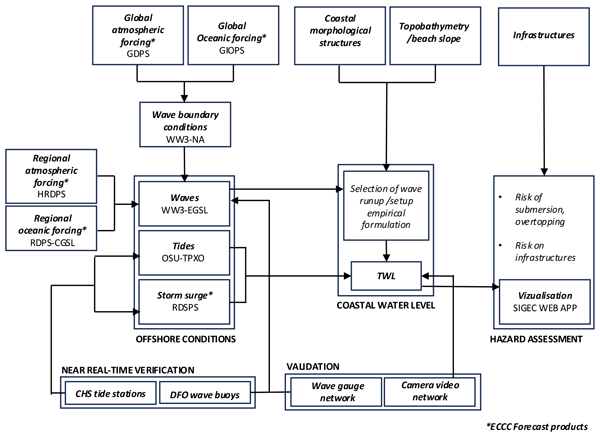
This two-part study explores the development of a short-term (up to 48 hours) coastal flood forecasting system along the Quebec coastline. The first part of the study focuses on wave prediction, a main contributor to coastal hazards. The key results of the study show that wave conditions can be accurately predicted during summer, however, the performances of the model in winter are considerably reduced, primarily because predicting sea ice conditions at fine spatial scales remains challenging.
Lexi Arlen, Earle Wilson, Véronique Dansereau, Ching-Yao Lai, and Yue Meng
EGUsphere, https://doi.org/10.5194/egusphere-2026-3166, https://doi.org/10.5194/egusphere-2026-3166, 2026
This preprint is open for discussion and under review for The Cryosphere (TC).
Short summary
Short summary
Sea ice deforms discretely, through fracturing and collisions, yet it is often modeled as a continuous fluid. To capture discrete processes missed by continuum models, we built a simple model representing the ice pack as disks connected by breakable bonds. With fewer parameters and computational resources, our simple model reproduced some key dynamics simulated in higher-complexity models. This tool can be used by the community as a complement to higher-complexity modeling efforts.
Hooshmand Zandi, Ludovic Métivier, Romain Brossier, Sebastien Kuchly, Vasco Zanchi, Nicolas Mokus, Véronique Dansereau, Antonin Eddi, Stéphane Perrard, Dany Dumont, and Ludovic Moreau
EGUsphere, https://doi.org/10.5194/egusphere-2026-2519, https://doi.org/10.5194/egusphere-2026-2519, 2026
This preprint is open for discussion and under review for The Cryosphere (TC).
Short summary
Short summary
Sea ice is declining quickly, yet its thickness varies over short distances and is hard to measure with satellites. We developed a way to map thickness in detail from vibrations that travel through the ice. Using data from two field sites, we estimated thickness along many paths and combined them into continuous maps. Our results show that this approach captures fine-scale changes, offering a practical tool to better track ice conditions for climate studies, ecosystems, and safe human activities
Felix Strobel, Gregor Hillers, Tom Jilbert, John Loehr, Christian Stranne, Tahvo Oksanen, Jonathan Vänskä, Roméo Courbis, Annukka Rintamäki, Amir Sadeghi-Bagherabadi, Lasse Weißgräber, Yinshuai Ding, Marc de Langenhagen, Eduardo Valero Cano, Kwabena Atobra, Vicent Doñate Felip, Valtteri Hopiavuori, Max Kankainen, Mohammad Alem Khodadadi, Kauri Kolehmainen, Emma Makkonen, Liisa Nygrén, Eero Purhonen, Niklas Rolleberg, Jasmiina Tuomiranta, Tommi Vuorinen, Aurélien Mordret, Cédric Schmelzbach, Ludovic Moreau, Olivier Coutant, and Céline Hadziioannou
EGUsphere, https://doi.org/10.5194/egusphere-2026-2106, https://doi.org/10.5194/egusphere-2026-2106, 2026
Short summary
Short summary
We describe an experiment to investigate variations of lake ice properties. We put a large number of seismic instruments on a frozen lake to record the ambient ice vibrations and make a range of supporting measurements. The initial results show that environmental effects can be resolved from the vibrations. This includes meteorological changes but also the trapping of methane or other gas bubbles during ice formation, which can help quantify the release of greenhouse gases from lakes.
Nicolas Guillaume Alexandre Mokus, Véronique Dansereau, Guillaume Boutin, Jean-Pierre Auclair, and Alexandre Tlili
Geosci. Model Dev., 19, 261–288, https://doi.org/10.5194/gmd-19-261-2026, https://doi.org/10.5194/gmd-19-261-2026, 2026
Short summary
Short summary
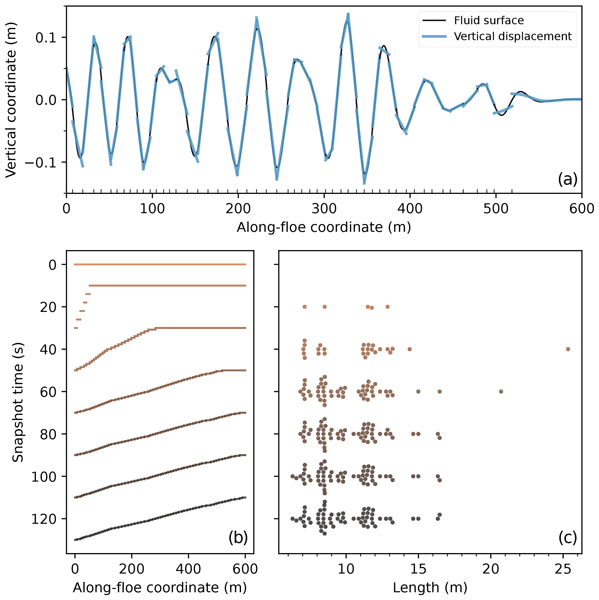
Arctic sea ice recedes, and is thus more exposed to waves, which can fracture continuous pack ice into smaller floes. These are more mobile and easier to melt. Ice fracture itself is not well understood, because of harsh field conditions. We propose a novel criterion parametrising this process, and incorporate it into a numerical model that simulates wave propagation. This criterion can be compared to existing ones. We relate our results to lab experiments, and find qualitative agreement.
Laurent Brodeau, Pierre Rampal, Einar Ólason, and Véronique Dansereau
Geosci. Model Dev., 17, 6051–6082, https://doi.org/10.5194/gmd-17-6051-2024, https://doi.org/10.5194/gmd-17-6051-2024, 2024
Short summary
Short summary
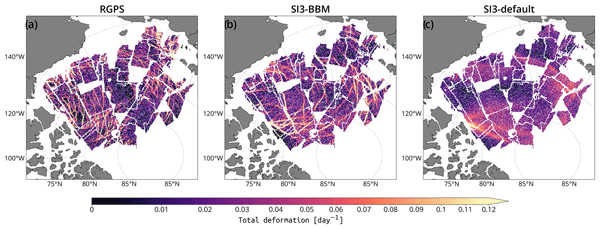
A new brittle sea ice rheology, BBM, has been implemented into the sea ice component of NEMO. We describe how a new spatial discretization framework was introduced to achieve this. A set of idealized and realistic ocean and sea ice simulations of the Arctic have been performed using BBM and the standard viscous–plastic rheology of NEMO. When compared to satellite data, our simulations show that our implementation of BBM leads to a fairly good representation of sea ice deformations.
Yumeng Chen, Polly Smith, Alberto Carrassi, Ivo Pasmans, Laurent Bertino, Marc Bocquet, Tobias Sebastian Finn, Pierre Rampal, and Véronique Dansereau
The Cryosphere, 18, 2381–2406, https://doi.org/10.5194/tc-18-2381-2024, https://doi.org/10.5194/tc-18-2381-2024, 2024
Short summary
Short summary
We explore multivariate state and parameter estimation using a data assimilation approach through idealised simulations in a dynamics-only sea-ice model based on novel rheology. We identify various potential issues that can arise in complex operational sea-ice models when model parameters are estimated. Even though further investigation will be needed for such complex sea-ice models, we show possibilities of improving the observed and the unobserved model state forecast and parameter accuracy.
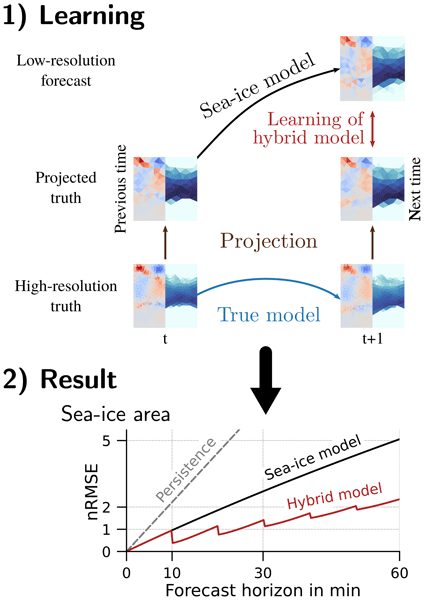
Tobias Sebastian Finn, Charlotte Durand, Alban Farchi, Marc Bocquet, Yumeng Chen, Alberto Carrassi, and Véronique Dansereau
The Cryosphere, 17, 2965–2991, https://doi.org/10.5194/tc-17-2965-2023, https://doi.org/10.5194/tc-17-2965-2023, 2023
Short summary
Short summary
We combine deep learning with a regional sea-ice model to correct model errors in the sea-ice dynamics of low-resolution forecasts towards high-resolution simulations. The combined model improves the forecast by up to 75 % and thereby surpasses the performance of persistence. As the error connection can additionally be used to analyse the shortcomings of the forecasts, this study highlights the potential of combined modelling for short-term sea-ice forecasting.
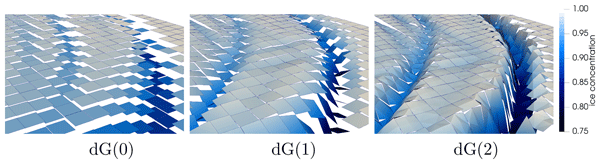
Thomas Richter, Véronique Dansereau, Christian Lessig, and Piotr Minakowski
Geosci. Model Dev., 16, 3907–3926, https://doi.org/10.5194/gmd-16-3907-2023, https://doi.org/10.5194/gmd-16-3907-2023, 2023
Short summary
Short summary
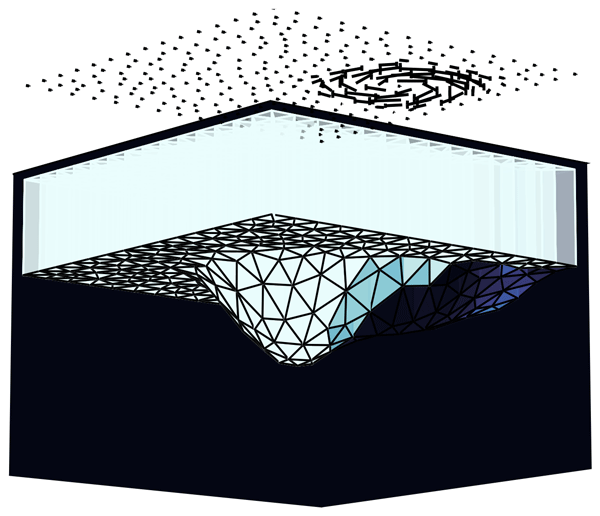
Sea ice covers not only the pole regions but affects the weather and climate globally. For example, its white surface reflects more sunlight than land. The oceans around the poles are therefore kept cool, which affects the circulation in the oceans worldwide. Simulating the behavior and changes in sea ice on a computer is, however, very difficult. We propose a new computer simulation that better models how cracks in the ice change over time and show this by comparing to other simulations.
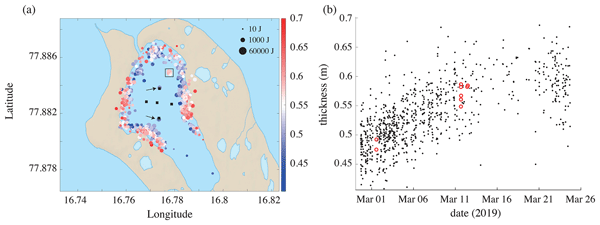
Ludovic Moreau, Léonard Seydoux, Jérôme Weiss, and Michel Campillo
The Cryosphere, 17, 1327–1341, https://doi.org/10.5194/tc-17-1327-2023, https://doi.org/10.5194/tc-17-1327-2023, 2023
Short summary
Short summary
In the perspective of an upcoming seasonally ice-free Arctic, understanding the dynamics of sea ice in the changing climate is a major challenge in oceanography and climatology. It is therefore essential to monitor sea ice properties with fine temporal and spatial resolution. In this paper, we show that icequakes recorded on sea ice can be processed with artificial intelligence to produce accurate maps of sea ice thickness with high temporal and spatial resolutions.
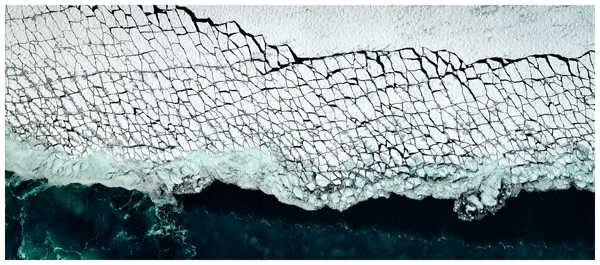
Elie Dumas-Lefebvre and Dany Dumont
The Cryosphere, 17, 827–842, https://doi.org/10.5194/tc-17-827-2023, https://doi.org/10.5194/tc-17-827-2023, 2023
Short summary
Short summary
By changing the shape of ice floes, wave-induced sea ice breakup dramatically affects the large-scale dynamics of sea ice. As this process is also the trigger of multiple others, it was deemed relevant to study how breakup itself affects the ice floe size distribution. To do so, a ship sailed close to ice floes, and the breakup that it generated was recorded with a drone. The obtained data shed light on the underlying physics of wave-induced sea ice breakup.
Nicolas Guillaume Alexandre Mokus and Fabien Montiel
The Cryosphere, 16, 4447–4472, https://doi.org/10.5194/tc-16-4447-2022, https://doi.org/10.5194/tc-16-4447-2022, 2022
Short summary
Short summary
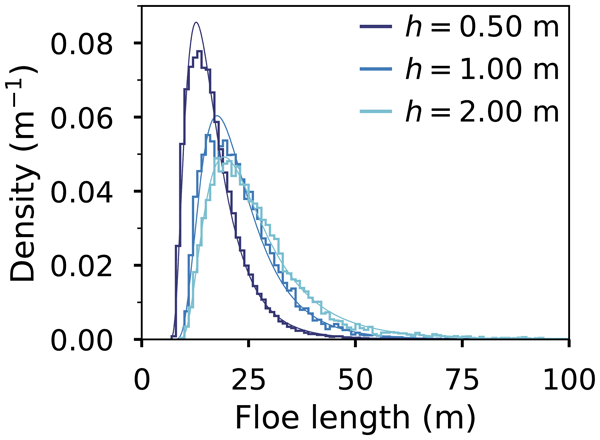
On the fringes of polar oceans, sea ice is easily broken by waves. As small pieces of ice, or floes, are more easily melted by the warming waters than a continuous ice cover, it is important to incorporate these floe sizes in climate models. These models simulate climate evolution at the century scale and are built by combining specialised modules. We study the statistical distribution of floe sizes under the impact of waves to better understand how to connect sea ice modules to wave modules.
Flavienne Bruyant, Rémi Amiraux, Marie-Pier Amyot, Philippe Archambault, Lise Artigue, Lucas Barbedo de Freitas, Guislain Bécu, Simon Bélanger, Pascaline Bourgain, Annick Bricaud, Etienne Brouard, Camille Brunet, Tonya Burgers, Danielle Caleb, Katrine Chalut, Hervé Claustre, Véronique Cornet-Barthaux, Pierre Coupel, Marine Cusa, Fanny Cusset, Laeticia Dadaglio, Marty Davelaar, Gabrièle Deslongchamps, Céline Dimier, Julie Dinasquet, Dany Dumont, Brent Else, Igor Eulaers, Joannie Ferland, Gabrielle Filteau, Marie-Hélène Forget, Jérome Fort, Louis Fortier, Martí Galí, Morgane Gallinari, Svend-Erik Garbus, Nicole Garcia, Catherine Gérikas Ribeiro, Colline Gombault, Priscilla Gourvil, Clémence Goyens, Cindy Grant, Pierre-Luc Grondin, Pascal Guillot, Sandrine Hillion, Rachel Hussherr, Fabien Joux, Hannah Joy-Warren, Gabriel Joyal, David Kieber, Augustin Lafond, José Lagunas, Patrick Lajeunesse, Catherine Lalande, Jade Larivière, Florence Le Gall, Karine Leblanc, Mathieu Leblanc, Justine Legras, Keith Lévesque, Kate-M. Lewis, Edouard Leymarie, Aude Leynaert, Thomas Linkowski, Martine Lizotte, Adriana Lopes dos Santos, Claudie Marec, Dominique Marie, Guillaume Massé, Philippe Massicotte, Atsushi Matsuoka, Lisa A. Miller, Sharif Mirshak, Nathalie Morata, Brivaela Moriceau, Philippe-Israël Morin, Simon Morisset, Anders Mosbech, Alfonso Mucci, Gabrielle Nadaï, Christian Nozais, Ingrid Obernosterer, Thimoté Paire, Christos Panagiotopoulos, Marie Parenteau, Noémie Pelletier, Marc Picheral, Bernard Quéguiner, Patrick Raimbault, Joséphine Ras, Eric Rehm, Llúcia Ribot Lacosta, Jean-François Rontani, Blanche Saint-Béat, Julie Sansoulet, Noé Sardet, Catherine Schmechtig, Antoine Sciandra, Richard Sempéré, Caroline Sévigny, Jordan Toullec, Margot Tragin, Jean-Éric Tremblay, Annie-Pier Trottier, Daniel Vaulot, Anda Vladoiu, Lei Xue, Gustavo Yunda-Guarin, and Marcel Babin
Earth Syst. Sci. Data, 14, 4607–4642, https://doi.org/10.5194/essd-14-4607-2022, https://doi.org/10.5194/essd-14-4607-2022, 2022
Short summary
Short summary
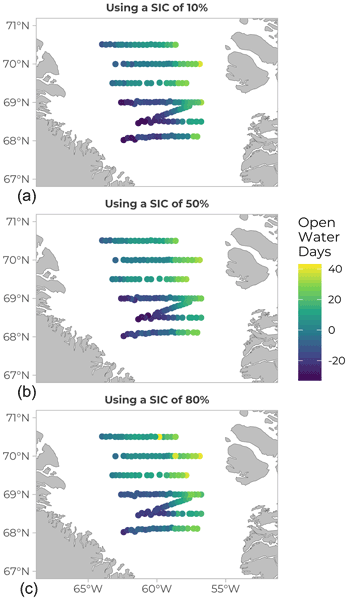
This paper presents a dataset acquired during a research cruise held in Baffin Bay in 2016. We observed that the disappearance of sea ice in the Arctic Ocean increases both the length and spatial extent of the phytoplankton growth season. In the future, this will impact the food webs on which the local populations depend for their food supply and fisheries. This dataset will provide insight into quantifying these impacts and help the decision-making process for policymakers.
Agathe Serripierri, Ludovic Moreau, Pierre Boue, Jérôme Weiss, and Philippe Roux
The Cryosphere, 16, 2527–2543, https://doi.org/10.5194/tc-16-2527-2022, https://doi.org/10.5194/tc-16-2527-2022, 2022
Short summary
Short summary
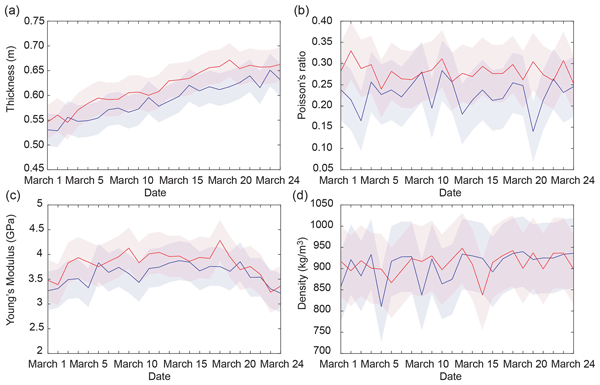
As a result of global warming, the sea ice is disappearing at a much faster rate than predicted by climate models. To better understand and predict its ongoing decline, we deployed 247 geophones on the fast ice in Van Mijen Fjord in Svalbard, Norway, in March 2019. The analysis of these data provided a precise daily evolution of the sea-ice parameters at this location with high spatial and temporal resolution and accuracy. The results obtained are consistent with the observations made in situ.
Frédéric Dupont, Dany Dumont, Jean-François Lemieux, Elie Dumas-Lefebvre, and Alain Caya
The Cryosphere, 16, 1963–1977, https://doi.org/10.5194/tc-16-1963-2022, https://doi.org/10.5194/tc-16-1963-2022, 2022
Short summary
Short summary
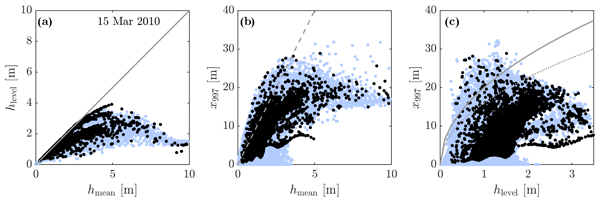
In some shallow seas, grounded ice ridges contribute to stabilizing and maintaining a landfast ice cover. A scheme has already proposed where the keel thickness varies linearly with the mean thickness. Here, we extend the approach by taking into account the ice thickness and bathymetry distributions. The probabilistic approach shows a reasonably good agreement with observations and previous grounding scheme while potentially offering more physical insights into the formation of landfast ice.
Cited articles
Aksenov, Y., Popova, E. E., Yool, A., Nurser, A. G., Williams, T. D., Bertino, L., and Bergh, J.: On the future navigability of Arctic sea routes: High-resolution projections of the Arctic Ocean and sea ice, Marine Policy, 75, 300–317, https://doi.org/10.1016/j.marpol.2015.12.027, 2017. a
Anderson, D.: Preliminary results and review of sea ice elasticity and related studies, Transactions of the Engineering Institute of Canada, 2, 2–8, 1958. a
Ardhuin, F., Collard, F., Chapron, B., Girard‐Ardhuin, F., Guitton, G., Mouche, A., and Stopa, J. E.: Estimates of ocean wave heights and attenuation in sea ice using the SAR wave mode on Sentinel‐1A, Geophysical Research Letters, 42, 2317–2325, https://doi.org/10.1002/2014GL062940, 2015. a
Ardyna, M., Babin, M., Gosselin, M., Devred, E., Rainville, L., and Tremblay, J.-É.: Recent Arctic Ocean sea ice loss triggers novel fall phytoplankton blooms, Geophysical Research Letters, 41, 6207–6212, https://doi.org/10.1002/2014GL061047, 2014. a
Bouguet, J.-Y.: Camera Calibration Toolbox for Matlab, https://doi.org/10.22002/D1.20164, 2022. a
Comiso, J. C., Parkinson, C. L., Gersten, R., and Stock, L.: Accelerated decline in the Arctic sea ice cover, Geophysical Research Letters, 35, https://doi.org/10.1029/2007GL031972, 2008. a
Dawson‐Howe, K. M. and Vernon, D.: Simple pinhole camera calibration, Int. J. Imaging Syst. Tech., 5, 1–6, https://doi.org/10.1002/ima.1850050102, 1994. a
Dumas-Lefebvre, E. and Dumont, D.: Aerial observations of sea ice breakup by ship waves, The Cryosphere, 17, 827–842, https://doi.org/10.5194/tc-17-827-2023, 2023a. a
Dumas-Lefebvre, E. and Dumont, D.: Aerial observations of sea ice breakup by ship waves, The Cryosphere, 17, 827–842, https://doi.org/10.5194/tc-17-827-2023, 2023b. a
Dumont, D.: Marginal ice zone dynamics: history, definitions and research perspectives, Philosophical Transactions of the Royal Society A: Mathematical, Physical and Engineering Sciences, 380, 20210253, https://doi.org/10.1098/rsta.2021.0253, 2022. a
Gaffey, C. and Bhardwaj, A.: Applications of Unmanned Aerial Vehicles in Cryosphere: Latest Advances and Prospects, Remote Sensing, 12, 948, https://doi.org/10.3390/rs12060948, 2020. a
Gupta, M., Gürcan, E., and Thompson, A. F.: Eddy-Induced Dispersion of Sea Ice Floes at the Marginal Ice Zone, Geophysical Research Letters, 51, e2023GL105656, https://doi.org/10.1029/2023GL105656, 2024. a
Horvat, C.: Floes, the marginal ice zone and coupled wave-sea-ice feedbacks, Philosophical Transactions of the Royal Society A: Mathematical, Physical and Engineering Sciences, 380, https://doi.org/10.1098/rsta.2021.0252, 2022. a
Horvat, C., Tziperman, E., and Campin, J.-M.: Interaction of sea ice floe size, ocean eddies, and sea ice melting, Geophysical Research Letters, 43, 8083–8090, https://doi.org/10.1002/2016GL069742, 2016. a
Hunkins, K.: Seismic studies of sea ice, Journal of Geophysical Research, 65, 3459–3472, 1960. a
Kern, S., Khvorostovsky, K., and Skourup, H.: D4.1 Product Validation and Intercomparison Report (PVIR-SIT) – SICCI-PVIR-SIT, Tech. rep., Tech. rep., European Space Agency Sea Ice Climate Change Initiative, 2018. a
Kim, Y.-H., Min, S.-K., Gillett, N. P., Notz, D., and Malinina, E.: Observationally-constrained projections of an ice-free Arctic even under a low emission scenario, Nature Communications, 14, 3139, https://doi.org/10.1038/s41467-023-38511-8, 2023. a
Martin, S. and Kauffman, P.: A Field and Laboratory Study of Wave Damping by Grease Ice, J. Glaciol., 27, 283–313, https://doi.org/10.3189/S0022143000015392, 1981. a
Minonzio, J.-G., Talmant, M., and Laugier, P.: Guided wave phase velocity measurement using multi-emitter and multi-receiver arrays in the axial transmission configuration, The Journal of the Acoustical Society of America, 127, 2913–2919, 2010. a
Moreau, L., Minonzio, J.-G., Foiret, J., Bossy, E., Talmant, M., and Laugier, P.: Accurate measurement of guided modes in a plate using a bidirectional approach, The Journal of the Acoustical Society of America, 135, EL15–EL21, 2014. a
Moreau, L., Boué, P., Serripierri, A., Weiss, J., Hollis, D., Pondaven, I., Vial, B., Garambois, S., Larose, É., Helmstetter, A., Stehly, L., Hillers, G., and Gilbert, O.: Sea ice thickness and elastic properties from the analysis of multimodal guided wave propagation measured with a passive seismic array, Journal of Geophysical Research: Oceans, 125, e2019JC015709, https://doi.org/10.1029/2019JC015709, 2020. a, b
Nziengui-Bâ, D., Coutant, O., Moreau, L., and Boué, P.: Measuring the thickness and Young's modulus of the ice pack with DAS, a test case on a frozen mountain lake, Geophysical Journal International, 233, 1166–1177, https://doi.org/10.1093/gji/ggac504, 2022. a
Pan, B., Qian, K., Xie, H., and Asundi, A.: Two-dimensional digital image correlation for in-plane displacement and strain measurement: a review, Measurement Science and Technology, 20, 062001, https://doi.org/10.1088/0957-0233/20/6/062001, 2009. a
Parry, M., Canziani, O., Palutikof, J., van der Linden, P., and Hanson, C.: IPCC, 2007: Climate Change 2007: Impacts, Adaptation and Vulnerability. Contribution of Working Group II to the Fourth Assessment Report of the Intergovernmental Panel on Climate Change, Tech. rep., Intergovernmental Panel on Climate Change, 2007. a
Perrard, S., Auvity, B., Kuchly, S., Mokus, N., Nicot, P., Fourgeaud, A., Bureau, M., Dansereau, V., Dumont, D., Eddi, A., And Moreau, L.: Dataset for “An integrated multi-instrument methodology for studying marginal ice zone dynamics and wave-ice interactions”, Recherche Data Gouv, V3 [data set and code], https://doi.org/10.57745/OUWL0Z, 2025. a, b
Rabault, J., Taelman, C., Idžanović, M., Hope, G., Nose, T., Kristoffersen, Y., Jensen, A., Breivik, Ø., Bryhni, H. T., Hoppmann, M., Demchev, D., Korosov, A., Johansson, M., Eltoft, T., Dagestad, K.-F., Röhrs, J., Eriksson, L., Moro, M. D., Rikardsen, E. S. U., Waseda, T., Kodaira, T., Lohse, J., Desjonquères, T., Olsen, S., Gundersen, O., de Aguiar, V. C. M., Karlsen, T., Babanin, A., Voermans, J., Park, J.-W., and Müller, M.: A position and wave spectra dataset of Marginal Ice Zone dynamics collected around Svalbard in 2022 and 2023, Scientific Data, 11, 1417, https://doi.org/10.1038/s41597-024-04281-1, 2024. a
Rolph, R. J., Feltham, D. L., and Schröder, D.: Changes of the Arctic marginal ice zone during the satellite era, The Cryosphere, 14, 1971–1984, https://doi.org/10.5194/tc-14-1971-2020, 2020. a
Romeyn, R., Hanssen, A., Ruud, B. O., and Johansen, T. A.: Sea ice thickness from air-coupled flexural waves, The Cryosphere, 15, 2939–2955, https://doi.org/10.5194/tc-15-2939-2021, 2021. a
Rost, S. and Thomas, C.: Array seismology: Methods and applications, Reviews of geophysics, 40, 2–1, https://doi.org/10.1029/2000RG000100, 2002. a
Serripierri, A., Moreau, L., Boue, P., Weiss, J., and Roux, P.: Recovering and monitoring the thickness, density, and elastic properties of sea ice from seismic noise recorded in Svalbard, The Cryosphere, 16, 2527–2543, https://doi.org/10.5194/tc-16-2527-2022, 2022. a, b, c
Song, L., Zhao, X., Wu, Y., Gong, J., and Li, B.: Assessing Arctic marginal ice zone dynamics from 1979 to 2023: insights into long-term variability and morphological changes, Environmental Research Letters, 20, 034032, https://doi.org/10.1088/1748-9326/adb508, 2025. a
Squire, V. A., Hosking, R. J., Kerr, A. J., and Langhorne, P. J.: Moving Loads on Ice Plates, vol. Solid Mechanics and its Applications Vol. 45, Kluwer Academic Press, Dordrecht, the Netherlands, https://doi.org/10.1007/978-94-009-1649-4, 1996. a
Staacks, S., Hütz, S., Heinke, H., and Stampfer, C.: Advanced tools for smartphone-based experiments: phyphox, Physics Education, 53, https://doi.org/10.1088/1361-6552/aac05e, 2018. a
Stroeve, J. and Notz, D.: Changing state of Arctic sea ice across all seasons, Environmental Research Letters, 13, 103001, https://doi.org/10.1088/1748-9326/aade56, 2018. a
Stroeve, J. C., Serreze, M. C., Holland, M. M., Kay, J. E., Malanik, J., and Barrett, A. P.: The Arctic's rapidly shrinking sea ice cover: a research synthesis, Climatic Change, 110, 1005–1027, https://doi.org/10.1007/s10584-011-0101-1, 2012. a
Sutherland, P. and Gascard, J.: Airborne remote sensing of ocean wave directional wavenumber spectra in the marginal ice zone, Geophysical Research Letters, 43, 5151–5159, https://doi.org/10.1002/2016GL067713, 2016. a
Taylor, M. H., Losch, M., and Bracher, A.: On the drivers of phytoplankton blooms in the Antarctic marginal ice zone: A modeling approach, Journal of Geophysical Research: Oceans, 118, 63–75, https://doi.org/10.1029/2012JC008418, 2013. a
Thielicke, W. and Stamhuis, E. J.: PIVlab – Towards User-friendly, Affordable and Accurate Digital Particle Image Velocimetry in MATLAB, Journal of Open Research Software, 2, https://doi.org/10.5334/jors.bl, 2014. a
Thomson, J.: Wave propagation in the marginal ice zone: connections and feedback mechanisms within the air–ice–ocean system, Philosophical Transactions of the Royal Society A: Mathematical, Physical and Engineering Sciences, 380, 20210251, https://doi.org/10.1098/rsta.2021.0251, 2022. a
Toyota, T., Takatsuji, S., and Nakayama, M.: Characteristics of sea ice floe size distribution in the seasonal ice zone, Geophysical Research Letters, 33, https://doi.org/10.1029/2005GL024556, 2006. a
Veras Guimarães, P., Ardhuin, F., Sutherland, P., Accensi, M., Hamon, M., Pérignon, Y., Thomson, J., Benetazzo, A., and Ferrant, P.: A surface kinematics buoy (SKIB) for wave–current interaction studies, Ocean Science, 14, 1449–1460, https://doi.org/10.5194/os-14-1449-2018, 2018. a, b
Voermans, J. J., Rabault, J., Marchenko, A., Nose, T., Waseda, T., and Babanin, A. V.: Estimating the elastic modulus of landfast ice from wave observations, Journal of Glaciology, 69, 1823–1833, https://doi.org/10.1017/jog.2023.63, 2023. a
Wadhams, P.: Airborne laser profiling of swell in an open ice field, J. Geophys. Res., 80, 4520–4528, https://doi.org/10.1029/JC080i033p04520, 1975. a
Zhang, J., Mokus, N., Casoli, J., Eddi, A., and Perrard, S.: Distributed network of smartphone sensors: a new tool for scientific field measurements, arXiv [preprint], https://doi.org/10.48550/arXiv.2501.04886, 2025. a
Zhang, Q. and Skjetne, R.: Image Processing for Identification of Sea-Ice Floes and the Floe Size Distributions, IEEE Trans. Geosci. Remote Sensing, 53, 2913–2924, https://doi.org/10.1109/TGRS.2014.2366640, 2015. a
Short summary
During February and March 2024, we realized a multi-instrument field campaign in the St. Lawrence Estuary, to capture swell-driven sea ice fragmentation. The dataset combines geophones, wave buoys, smartphones, and video recordings with drones, to study wave-ice interactions under natural conditions. It enables analysis of ice thickness, wave properties, and ice motion. Preliminary results show strong consistency across instruments, offering a valuable resource to improve sea ice models.
During February and March 2024, we realized a multi-instrument field campaign in the St....


