
Articles | Volume 19, issue 12
https://doi.org/10.5194/tc-19-6907-2025
© Author(s) 2025. This work is distributed under
the Creative Commons Attribution 4.0 License.
the Creative Commons Attribution 4.0 License.
https://doi.org/10.5194/tc-19-6907-2025
© Author(s) 2025. This work is distributed under
the Creative Commons Attribution 4.0 License.
the Creative Commons Attribution 4.0 License.
Research article
| 
19 Dec 2025
Research article |
| 19 Dec 2025
| 19 Dec 2025
Recent and projected changes in rain-on-snow event characteristics across Svalbard
Hannah Vickers
CORRESPONDING AUTHOR

NORCE Norwegian Research Centre, Bergen, Norway
Priscilla Mooney
NORCE Norwegian Research Centre, Bergen, Norway
Oskar Landgren
Norwegian Meteorological Institute, Oslo, Norway
Related authors
Hannah Ming Siu Vickers, Priscilla Mooney, Eirik Malnes, and Hanna Lee
The Cryosphere Discuss., https://doi.org/10.5194/tc-2022-57, https://doi.org/10.5194/tc-2022-57, 2022
Manuscript not accepted for further review
Short summary
Short summary
Rain-on-snow (ROS) events are becoming more frequent as a result of a warming climate, and can have significant impacts on nature and society. Accurate representation of ROS events is need to identify where impacts are greatest both now and in the future. We compare rain-on-snow climatologies from a climate model, ground and satellite radar observations and show how different methods can lead to contrasting conclusions and interpretation of the results should take into account their limitations.
Ella Gilbert, José Abraham Torres-Alavez, Marte G. Hofsteenge, Willem Jan van de Berg, Fredrik Boberg, Ole Bøssing Christensen, Christiaan Timo van Dalum, Xavier Fettweis, Siddharth Gumber, Nicolaj Hansen, Christoph Kittel, Clara Lambin, Damien Maure, Ruth Mottram, Martin Olesen, Andrew Orr, Tony Phillips, Maurice van Tiggelen, Kristiina Verro, and Priscilla A. Mooney
The Cryosphere, 20, 2629–2658, https://doi.org/10.5194/tc-20-2629-2026, https://doi.org/10.5194/tc-20-2629-2026, 2026
Short summary
Short summary
Here we present a new dataset – the PolarRES ensemble – of four state-of-the-art regional climate models, which capture the full complexity of Antarctica's climate. The ensemble out-performs other available tools, advancing our ability to explore Antarctic climate. While it still has limitations, the PolarRES ensemble offers a novel and exciting way of evaluating climate processes and features, and we encourage researchers to use the data, which are freely available.
Johannes Max Müller, Oskar Andreas Landgren, and Dörthe Handorf
Weather Clim. Dynam., 6, 1895–1921, https://doi.org/10.5194/wcd-6-1895-2025, https://doi.org/10.5194/wcd-6-1895-2025, 2025
Short summary
Short summary
Weather and climate is determined by large-scale air pressure patterns, which can be grouped into a small number of representative patterns. We use two different statistical methods and data from 20 climate models to detect significant changes in a future scenario of strong warming. We focus on the summer season as this is important for both human activities and natural ecosystems. We find an increase in high pressure above Europe and low pressure above the Arctic ocean.
Xavier J. Levine, Ryan S. Williams, Gareth Marshall, Andrew Orr, Lise Seland Graff, Dörthe Handorf, Alexey Karpechko, Raphael Köhler, René R. Wijngaard, Nadine Johnston, Hanna Lee, Lars Nieradzik, and Priscilla A. Mooney
Earth Syst. Dynam., 15, 1161–1177, https://doi.org/10.5194/esd-15-1161-2024, https://doi.org/10.5194/esd-15-1161-2024, 2024
Short summary
Short summary
While the most recent climate projections agree that the Arctic is warming, differences remain in how much and in other climate variables such as precipitation. This presents a challenge for stakeholders who need to develop mitigation and adaptation strategies. We tackle this problem by using the storyline approach to generate four plausible and actionable realisations of end-of-century climate change for the Arctic, spanning its most likely range of variability.
Alok K. Samantaray, Priscilla A. Mooney, and Carla A. Vivacqua
Geosci. Model Dev., 17, 3321–3339, https://doi.org/10.5194/gmd-17-3321-2024, https://doi.org/10.5194/gmd-17-3321-2024, 2024
Short summary
Short summary
Any interpretation of climate model data requires a comprehensive evaluation of the model performance. Numerous error metrics exist for this purpose, and each focuses on a specific aspect of the relationship between reference and model data. Thus, a comprehensive evaluation demands the use of multiple error metrics. However, this can lead to confusion. We propose a clustering technique to reduce the number of error metrics needed and a composite error metric to simplify the interpretation.
Rasmus E. Benestad, Abdelkader Mezghani, Julia Lutz, Andreas Dobler, Kajsa M. Parding, and Oskar A. Landgren
Geosci. Model Dev., 16, 2899–2913, https://doi.org/10.5194/gmd-16-2899-2023, https://doi.org/10.5194/gmd-16-2899-2023, 2023
Short summary
Short summary
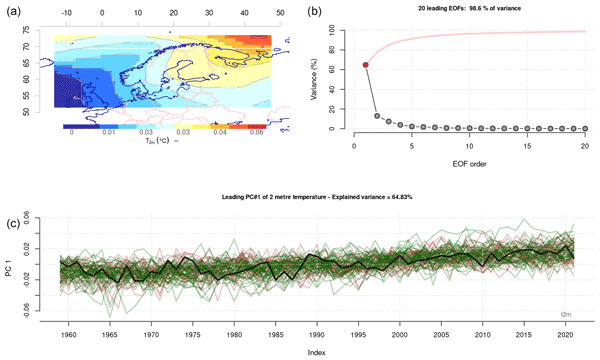
A mathematical method known as common EOFs is not widely used within the climate research community, but it offers innovative ways of evaluating climate models. We show how common EOFs can be used to evaluate large ensembles of global climate model simulations and distill information about their ability to reproduce salient features of the regional climate. We can say that they represent a kind of machine learning (ML) for dealing with big data.
Anne Sophie Daloz, Clemens Schwingshackl, Priscilla Mooney, Susanna Strada, Diana Rechid, Edouard L. Davin, Eleni Katragkou, Nathalie de Noblet-Ducoudré, Michal Belda, Tomas Halenka, Marcus Breil, Rita M. Cardoso, Peter Hoffmann, Daniela C. A. Lima, Ronny Meier, Pedro M. M. Soares, Giannis Sofiadis, Gustav Strandberg, Merja H. Toelle, and Marianne T. Lund
The Cryosphere, 16, 2403–2419, https://doi.org/10.5194/tc-16-2403-2022, https://doi.org/10.5194/tc-16-2403-2022, 2022
Short summary
Short summary
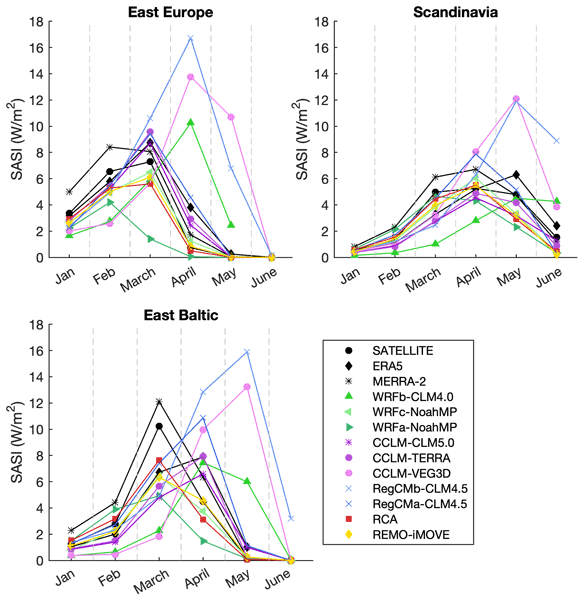
Snow plays a major role in the regulation of the Earth's surface temperature. Together with climate change, rising temperatures are already altering snow in many ways. In this context, it is crucial to better understand the ability of climate models to represent snow and snow processes. This work focuses on Europe and shows that the melting season in spring still represents a challenge for climate models and that more work is needed to accurately simulate snow–atmosphere interactions.
Priscilla A. Mooney, Diana Rechid, Edouard L. Davin, Eleni Katragkou, Natalie de Noblet-Ducoudré, Marcus Breil, Rita M. Cardoso, Anne Sophie Daloz, Peter Hoffmann, Daniela C. A. Lima, Ronny Meier, Pedro M. M. Soares, Giannis Sofiadis, Susanna Strada, Gustav Strandberg, Merja H. Toelle, and Marianne T. Lund
The Cryosphere, 16, 1383–1397, https://doi.org/10.5194/tc-16-1383-2022, https://doi.org/10.5194/tc-16-1383-2022, 2022
Short summary
Short summary
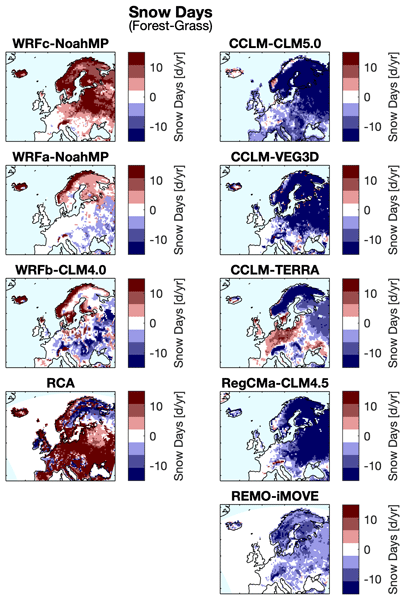
We use multiple regional climate models to show that afforestation in sub-polar and alpine regions reduces the radiative impact of snow albedo on the atmosphere, reduces snow cover, and delays the start of the snowmelt season. This is important for local communities that are highly reliant on snowpack for water resources and winter tourism. However, models disagree on the amount of change particularly when snow is melting. This shows that more research is needed on snow–vegetation interactions.
Hannah Ming Siu Vickers, Priscilla Mooney, Eirik Malnes, and Hanna Lee
The Cryosphere Discuss., https://doi.org/10.5194/tc-2022-57, https://doi.org/10.5194/tc-2022-57, 2022
Manuscript not accepted for further review
Short summary
Short summary
Rain-on-snow (ROS) events are becoming more frequent as a result of a warming climate, and can have significant impacts on nature and society. Accurate representation of ROS events is need to identify where impacts are greatest both now and in the future. We compare rain-on-snow climatologies from a climate model, ground and satellite radar observations and show how different methods can lead to contrasting conclusions and interpretation of the results should take into account their limitations.
Giannis Sofiadis, Eleni Katragkou, Edouard L. Davin, Diana Rechid, Nathalie de Noblet-Ducoudre, Marcus Breil, Rita M. Cardoso, Peter Hoffmann, Lisa Jach, Ronny Meier, Priscilla A. Mooney, Pedro M. M. Soares, Susanna Strada, Merja H. Tölle, and Kirsten Warrach Sagi
Geosci. Model Dev., 15, 595–616, https://doi.org/10.5194/gmd-15-595-2022, https://doi.org/10.5194/gmd-15-595-2022, 2022
Short summary
Short summary
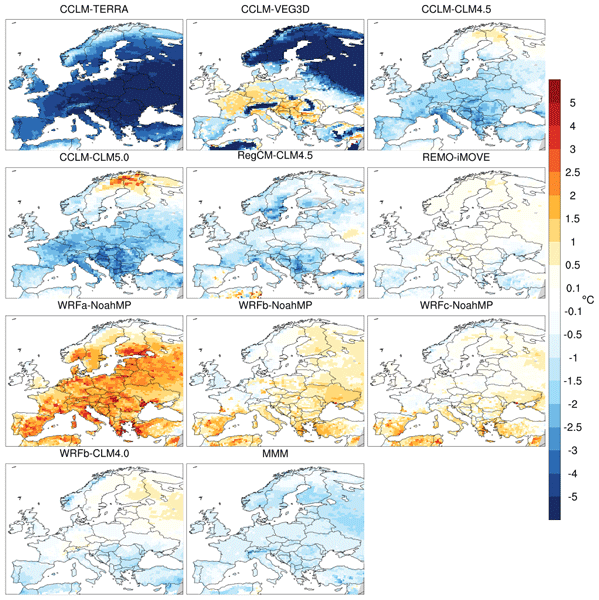
Afforestation is currently promoted as a greenhouse gas mitigation strategy. In our study, we examine the differences in soil temperature and moisture between grounds covered either by forests or grass. The main conclusion emerged is that forest-covered grounds are cooler but drier than open lands in summer. Therefore, afforestation disrupts the seasonal cycle of soil temperature, which in turn could trigger changes in crucial chemical processes such as soil carbon sequestration.
Cited articles
Bartsch, A., Bergstedt, H., Pointner, G., Muri, X., Rautiainen, K., Leppänen, L., Joly, K., Sokolov, A., Orekhov, P., Ehrich, D., and Soininen, E. M.: Towards long-term records of rain-on-snow events across the Arctic from satellite data, The Cryosphere, 17, 889–915, https://doi.org/10.5194/tc-17-889-2023, 2023.
Belušić, D., de Vries, H., Dobler, A., Landgren, O., Lind, P., Lindstedt, D., Pedersen, R. A., Sánchez-Perrino, J. C., Toivonen, E., van Ulft, B., Wang, F., Andrae, U., Batrak, Y., Kjellström, E., Lenderink, G., Nikulin, G., Pietikäinen, J.-P., Rodríguez-Camino, E., Samuelsson, P., van Meijgaard, E., and Wu, M.: HCLIM38: a flexible regional climate model applicable for different climate zones from coarse to convection-permitting scales, Geosci. Model Dev., 13, 1311–1333, https://doi.org/10.5194/gmd-13-1311-2020, 2020.
Day, J. J., Bamber, J. L., Valdes, P. J., and Kohler, J.: The impact of a seasonally ice free Arctic Ocean on the temperature, precipitation and surface mass balance of Svalbard, The Cryosphere, 6, 35–50, https://doi.org/10.5194/tc-6-35-2012, 2012.
Dobler, A., Lutz, J., Landgren, O., and Haugen, J. E.: Circulation Specific Precipitation Patterns over Svalbard and Projected Future Changes, Atmosphere, 11, 1378, https://doi.org/10.3390/atmos11121378, 2020.
Forbes, B. C., Kumpula, T., Meschtyb, N., Laptander, R., Macias-Fauria, M., Zetterberg, P., Verdonen, M., Skarin, A., Kim, K. Y., Boisvert, L. N., Stroeve, J. C., and Bartsch, A.: Sea ice, rain-on-snow and tundra reindeer nomadism in Arctic Russia, Biology Letters, 12, 20160466, https://doi.org/10.1098/rsbl.2016.0466, 2016.
Førland, E. J., Benestad, R. E., Hanssen-Bauer, I., Haugen, J. E., and Skaugen, T. E.: Temperature and Precipitation Development at Svalbard 1900–2100, Adv. Meteor., 2011, 1–14, https://doi.org/10.1155/2011/893790, 2011.
Gutjahr, O., Putrasahan, D., Lohmann, K., Jungclaus, J. H., von Storch, J.-S., Brüggemann, N., Haak, H., and Stössel, A.: Max Planck Institute Earth System Model (MPI-ESM1.2) for the High-Resolution Model Intercomparison Project (HighResMIP), Geosci. Model Dev., 12, 3241–3281, https://doi.org/10.5194/gmd-12-3241-2019, 2019.
Hansen, B. B., Isaksen, K., Benestad, R. E., Kohler, J., Pedersen, Å. Ø., Loe, L. E., Coulson, S. J., Larsen, J. O., and Varpe, Ø.: Warmer and wetter winters: Characteristics and implications of an extreme weather event in the High Arctic, Environmental Research Letters, 9, 114021, https://doi.org/10.1088/1748-9326/9/11/114021, 2014.
Hanssen-Bauer, I., Førland, E. J., Hisdal, H., Mayer, S., Sandø, A. B., and Sorteberg, A.: Climate in Svalbard 2100, NCCS Rep. 1/2019, 205 pp., https://www.miljodirektoratet.no/globalassets/publikasjoner/M1242/M1242.pdf (last access: 17 December 2025), 2019.
Hersbach, H., Bell, B., Berrisford, P., Hirahara, S., Horányi, A., Muñoz-Sabater, J., Nicolas, J., Peubey, C., Radu, R., Schepers, D., Simmons, A., Soci, C., Abdalla, S., Abellan, X., Balsamo, G., Bechtold, P., Biavati, G., Bidlot, J., Bonavita, M., De Chiara, G., Dahlgren, P., Dee, D., Diamantakis, M., Dragani, R., Flemming, J., Forbes, R., Fuentes, M., Geer, A., Haimberger, L., Healy, S., Hogan, R. J., Hólm, E., Janisková, M., Keeley, S., Laloyaux, P., Lopez, P., Lupu, C., Radnoti, G., de Rosnay, P., Rozum, I., Vamborg, F., Villaume, S., and Thépaut, J. N.: The ERA5 global reanalysis, Quarterly Journal of the Royal Meteorological Society, 146, 1999–2049, https://doi.org/10.1002/qj.3803, 2020.
Innanen, S., Hock, R., Schmidt, L. S., Schuler, T. V., Covi, F., and Moholdt, G.: Witnessing the transition from cold to temperate firn on Austfonna ice cap, Svalbard through observations and model simulations, J. Glaciology, 71, e101, https://doi.org/10.1017/jog.2025.10072, 2025.
Isaksen, K., Nordli, Ø., Førland, E. J., Łupikasza, E., Eastwood, S., and Niedźwiedź, T.: Recent warming on Spitsbergen – Influence of atmospheric circulation and sea ice cover, J. Geophys. Res. Atmos., 121, 11913–11931, https://doi.org/10.1002/2016JD025606, 2016.
Isaksen, K., Førland, E. J., Dobler, A., Benestad, R., Haugen, J. E., and Mezghani, A.: Klimascenarioer for Longyearbyen-området, Svalbard, MET Norway Report 15/2017, https://www.met.no/publikasjoner/met-report/met-report-2017/ (last access: 17 December 2025), 2017.
Isaksen, K., Nordli, Ø., Ivanov, B., Køltzow, M. A. Ø., Aaboe, S., Gjelten, H. M., Mezghani, A., Eastwood, S., Førland, E., Benestad, R.E., Hanssen-Bauer, I., Brækkan, R., Sviashchennikov, P., Demin, V., Revina, A., and Karandasheva, T.: Exceptional warming over the Barents area, Sci. Rep., 12, 9371, https://doi.org/10.1038/s41598-022-13568-5, 2022.
Køltzow, M., Casati, B., Bazile, E., Haiden, T., and Valkonen, T.: An NWP model intercomparison of surface weather parameters in the European Arctic during the year of polar prediction special observing period Northern Hemisphere 1, Weather Forecast., 34, 959–983, https://doi.org/10.1175/WAF-D-19-0003.1, 2019.
Køltzow, M., Schyberg, H., Støylen, E., and Yang, X.: Value of the Copernicus Arctic Regional Reanalysis (CARRA) in representing near-surface temperature and wind speed in the north-east European Arctic, Polar Res., 41, 8002, https://doi.org/10.33265/polar.v41.8002, 2022.
Landgren, O., Lutz, J., and Isaksen, K.: 2.5 km future climate projections for Svalbard under the high emission scenario SSP5-8.5, MET Report 1/2025, https://doi.org/10.5281/zenodo.17099386, 2025.
Levine, X. J., Williams, R. S., Marshall, G., Orr, A., Seland Graff, L., Handorf, D., Karpechko, A., Köhler, R., Wijngaard, R. R., Johnston, N., Lee, H., Nieradzik, L., and Mooney, P. A.: Storylines of summer Arctic climate change constrained by Barents–Kara seas and Arctic tropospheric warming for climate risk assessment, Earth Syst. Dynam., 15, 1161–1177, https://doi.org/10.5194/esd-15-1161-2024, 2024.
Łupikasza, E. B., Ignatiuk. D., Grabiec, M., Cielecka-Nowak, K., Laska, M., Jania, J., Luks, B., Uszczyk, A., and Budzik, T.: The Role of Winter Rain in the Glacial System on Svalbard, Water, 11, 334, https://doi.org/10.3390/w11020334, 2019.
Mooney, P. A. and Li, L.: Near future changes to rain-on-snow events in Norway, Environ. Res. Lett., 16, 064039, https://doi.org/10.1088/1748-9326/abfdeb, 2021.
Mooney, P. A., Sobolowski, S., and Lee, H.: Designing and evaluating regional climate simulations for high latitude land use land cover change studies, Tellus Dyn. Meteorol. Oceanogr., 72, 1–17, 2020.
Onarheim, I. H., Smedsrud, L. H., Ingvaldsen, R. B., and Nilsen, F.: Loss of sea ice during winter north of Svalbard, Tellus A: Dynamic Meteorology and Oceanography, 66, https://doi.org/10.3402/tellusa.v66.23933, 2014.
Pedersen Å. Ø., Beumer, L. T., Aanes, R., and Hansen, B. B.: Sea or summit? Wild reindeer spatial responses to changing hgh-arctic winters, Ecosphere, 12, e03883, https://doi.org/10.1002/ecs2.3883, 2021.
Peeters, B., Pedersen, Å. Ø., Loe, L. E., Isaksen, K., Veiberg, V., Stien, A., Kohler, J., Gallet, J. C., Aanes, R., and Hansen, B. B.: Spatiotemporal patterns of rain-on-snow and basal ice in high Arctic Svalbard: Detection of a climate-cryosphere regime shift, Environmental Research Letters, 14, 015002, https://doi.org/10.1088/1748-9326/aaefb3, 2019.
Prein, A. F., Langhans, W., Fosser, G., Ferrone, A., Ban, N., Goergen, K., Keller, M., Tölle, M., Gutjahr, O., Feser, F., Brisson, E., Kollet, S., Schmidli, J., van Lipzig, N. P .M., and Leung, R.: A review on regional convection-permitting climate modeling: demonstrations, prospects, and challenges, Rev. Geophys., 53, 323–361, https://doi.org/10.1002/2014RG000475, 2015.
Rantanen, M., Karpechko, A.Y., Lipponen, A., Nordling, K., Hyvärinen, O., Ruosteenoja, K., Vihma, T., and Laaksonen, A.: The Arctic has warmed nearly four times faster than the globe since 1979, Commun Earth Environ 3, 168, https://doi.org/10.1038/s43247-022-00498-3, 2022.
Schyberg, H., Yang, X., Køltzow, M. A. Ø., Amstrup, B., Bakketun, Å., Bazile, E., Bojarova, J., Box, J. E., Dahlgren, P., Hagelin, S., Homleid, M., Horányi, A., Høyer, J., Johansson, Å., Killie, M. A., Körnich, H., Le Moigne, P., Lindskog, M., Manninen, T., Nielsen Englyst, P., Nielsen K. P., Olsson, E., Palmason, B., Peralta Aros, C., Randriamampianina, R., Samuelsson, P., Stappers, R., Støylen, E., Thorsteinsson, S., Valkonen, T., and Wang, Z. Q.: Arctic regional reanalysis on single levels from 1991 to present, Copernicus Climate Change Service, https://doi.org/10.24381/cds.713858f6, 2020.
Screen, J. A. and Simmonds, I.: Increasing fall-winter energy loss from the Arctic Ocean and its role in Arctic temperature amplification, Geophys. Res. Lett., 37, L16707, https://doi.org/10.1029/2010GL044136, 2010.
Serreze, M., Gustafson, J., Barrett, A. P., Druckenmiller, M. L., Fox, S., Voveris, J., Stroeve, J., Sheffield, B., Forbes, B. C., Rasmus, S., Laptander, R., Brook, M., Brubaker, M., Temte, J., McCrystall, M. R., and Bartsch, A.: Arctic rain on snow events: bridging observations to understand environmental and livelihood impacts, Environmental Research Letters, 16, https://doi.org/10.1088/1748-9326/ac269b, 2021.
Sobota, I., Weckwerth, P., and Grajewski, T.: Rain-On-Snow (ROS) events and their relations to snowpack and ice layer changes on small glaciers in Svalbard, the high Arctic, Journal of Hydrology, 590, 125279, https://doi.org/10.1016/j.jhydrol.2020.125279, 2020.
Spolaor, A., Salzano, R., Scoto, F., Barbaro, E., Luks, B., Laska, M., Sobota, I., Maetze, R., Malnes, E., Vickers, H., Larose, C., Dahlke, S., and Maturilli, M.: Understanding and analysing recurrent warm events in Svalbard: a comprehensive review on land cryosphere (AWARE), SESS report 2024 – The State of Environmental Science in Svalbard – an annual report, 212–226, Svalbard Integrated Arctic Earth Observing System, https://doi.org/10.5281/zenodo.14425903, 2025.
Van Pelt, W. J. J., Kohler, J., Liston, G. E., Hagen, J. O., Luks, B., Reijmer, C. H., and Pohjola, V. A.: Multidecadal climate and seasonal snow conditions in Svalbard, J. Geophys. Res. Earth Surf., 121, 2100–2117, https://doi.org/10.1002/2016JF003999, 2016.
Vickers, H., Malnes, E., and Eckerstorfer, M.: A Synthetic Aperture Radar Based Method for Long Term Monitoring of Seasonal Snowmelt and Wintertime Rain-On-Snow Events in Svalbard, Front. Earth Sci., 10, 868945, https://doi.org/10.3389/feart.2022.868945, 2022.
Vickers, H., Saloranta, T., Køltzow, M., van Pelt Ward, J. J., and Malnes, E.: An analysis of winter rain-on-snow climatology in Svalbard, Front. Earth Sci., 12, https://doi.org/10.3389/feart.2024.1342731, 2024.
Vonnahme, T. R., Nowak, A., Hopwood, M. J., Meire, L., Søgaard, D. H., Krawczyk, D., Kalhagen, K., and Juul-Pedersen, T.: Impact of winter freshwater from tidewater glaciers on fjords in Svalbard and Greenland; A review, Progress in Oceanography, 219, 103144, https://doi.org/10.1016/j.pocean.2023.103144, 2023.
Wang, F.: An introduction to the HARMONIE-Climate (HCLIM) regional climate modeling system, Zenodo, https://doi.org/10.5281/zenodo.11424181, 2024.
Wickström, S., Jonassen, M. O., Cassano, J. J., and Vihma, T.: Present temperature, precipitation, and rain-on-snow climate in Svalbard, Journal of Geophysical Research: Atmospheres, 125, https://doi.org/10.1029/2019JD032155, 2020.
Würzer, S., Jonas, T., Wever, N., and Lehning, M.: Influence of initial snowpack properties on runoff formation during rain-on-snow events, J. Hydrometeor., 17, 1801–1815, https://doi.org/10.1175/JHM-D-15-0181.1, 2016.
Zhang, R., Wang, H., Fu, Q., Rasch, P. J., Wu, M., and Maslowski, W.: Understanding the cold season Arctic surface warming trend in recent decades, Geophysical Research Letters, 48, https://doi.org/10.1029/2021GL094878, 2021
Short summary
Rain-on-snow (ROS) events are becoming a common feature in winter in Svalbard due to climate warming. Understanding how ROS events are changing and how they will change in the coming decades is crucial to minimise their impacts. Using atmospheric reanalyses and climate projections we found contrasting trends between coastal and inland areas, and that the most dramatic future changes in ROS will occur in glaciated areas which will have considerable consequences for Svalbard's hydrology.
Rain-on-snow (ROS) events are becoming a common feature in winter in Svalbard due to climate...


