Articles | Volume 19, issue 12
https://doi.org/10.5194/tc-19-6865-2025
© Author(s) 2025. This work is distributed under
the Creative Commons Attribution 4.0 License.
https://doi.org/10.5194/tc-19-6865-2025
© Author(s) 2025. This work is distributed under
the Creative Commons Attribution 4.0 License.
Modelling ocean melt of ice mélange at Greenland's marine-terminating glaciers

School of GeoSciences, University of Edinburgh, Edinburgh, UK
Donald A. Slater
School of GeoSciences, University of Edinburgh, Edinburgh, UK
Peter Nienow
School of GeoSciences, University of Edinburgh, Edinburgh, UK
Related authors
No articles found.
Donald A. Slater, Eleanor Johnstone, Martim Mas e Braga, Neil J. Fraser, Tom Cowton, and Mark Inall
Geosci. Model Dev., 18, 7475–7500, https://doi.org/10.5194/gmd-18-7475-2025, https://doi.org/10.5194/gmd-18-7475-2025, 2025
Short summary
Short summary
Glacial fjords connect ice sheets to the ocean, controlling heat delivery to glaciers, which impacts ice sheet melt, and freshwater discharge to the ocean, affecting ocean circulation. However, their dynamics are not captured in large-scale climate models. We designed a simplified, computationally efficient model – FjordRPM – that accurately captures key fjord processes. It has direct applications for improving projections of ice melt, ocean circulation, and sea level rise.
Donald A. Slater and Till J. W. Wagner
The Cryosphere, 19, 2475–2493, https://doi.org/10.5194/tc-19-2475-2025, https://doi.org/10.5194/tc-19-2475-2025, 2025
Short summary
Short summary
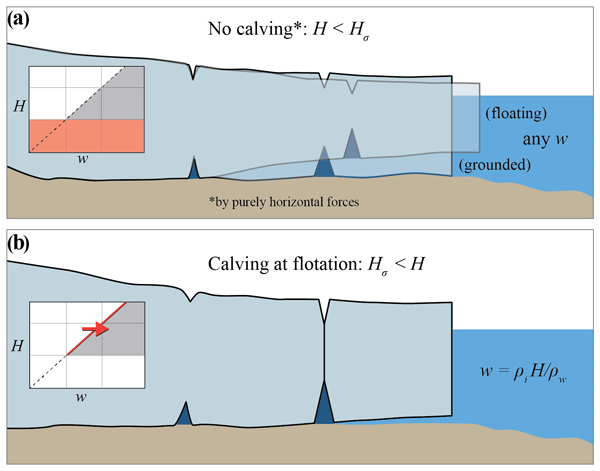
Calving is when icebergs break off glaciers and fall into the ocean. It is an important process determining how ice sheets will respond to changes in climate, but it is currently poorly understood and hard to include in numerical models that are used for sea-level projections. We adapted and extended an existing theory for how this process works, better explaining observations showing that calving style depends on how thick the ice is.
Alexander O. Hager, David A. Sutherland, and Donald A. Slater
The Cryosphere, 18, 911–932, https://doi.org/10.5194/tc-18-911-2024, https://doi.org/10.5194/tc-18-911-2024, 2024
Short summary
Short summary
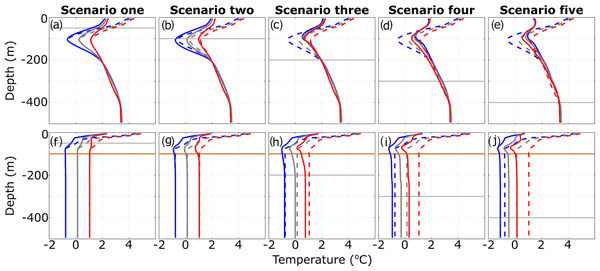
Warming ocean temperatures cause considerable ice loss from the Greenland Ice Sheet; however climate models are unable to resolve the complex ocean processes within fjords that influence near-glacier ocean temperatures. Here, we use a computer model to test the accuracy of assumptions that allow climate and ice sheet models to project near-glacier ocean temperatures, and thus glacier melt, into the future. We then develop new methods that improve accuracy by accounting for local ocean processes.
Dominik Fahrner, Donald Slater, Aman KC, Claudia Cenedese, David A. Sutherland, Ellyn Enderlin, Femke de Jong, Kristian K. Kjeldsen, Michael Wood, Peter Nienow, Sophie Nowicki, and Till Wagner
Earth Syst. Sci. Data Discuss., https://doi.org/10.5194/essd-2023-411, https://doi.org/10.5194/essd-2023-411, 2023
Preprint withdrawn
Short summary
Short summary
Marine-terminating glaciers can lose mass through frontal ablation, which comprises submarine and surface melting, and iceberg calving. We estimate frontal ablation for 49 marine-terminating glaciers in Greenland by combining existing, satellite derived data and calculating volume change near the glacier front over time. The dataset offers exciting opportunities to study the influence of climate forcings on marine-terminating glaciers in Greenland over multi-decadal timescales.
Karina von Schuckmann, Audrey Minière, Flora Gues, Francisco José Cuesta-Valero, Gottfried Kirchengast, Susheel Adusumilli, Fiammetta Straneo, Michaël Ablain, Richard P. Allan, Paul M. Barker, Hugo Beltrami, Alejandro Blazquez, Tim Boyer, Lijing Cheng, John Church, Damien Desbruyeres, Han Dolman, Catia M. Domingues, Almudena García-García, Donata Giglio, John E. Gilson, Maximilian Gorfer, Leopold Haimberger, Maria Z. Hakuba, Stefan Hendricks, Shigeki Hosoda, Gregory C. Johnson, Rachel Killick, Brian King, Nicolas Kolodziejczyk, Anton Korosov, Gerhard Krinner, Mikael Kuusela, Felix W. Landerer, Moritz Langer, Thomas Lavergne, Isobel Lawrence, Yuehua Li, John Lyman, Florence Marti, Ben Marzeion, Michael Mayer, Andrew H. MacDougall, Trevor McDougall, Didier Paolo Monselesan, Jan Nitzbon, Inès Otosaka, Jian Peng, Sarah Purkey, Dean Roemmich, Kanako Sato, Katsunari Sato, Abhishek Savita, Axel Schweiger, Andrew Shepherd, Sonia I. Seneviratne, Leon Simons, Donald A. Slater, Thomas Slater, Andrea K. Steiner, Toshio Suga, Tanguy Szekely, Wim Thiery, Mary-Louise Timmermans, Inne Vanderkelen, Susan E. Wjiffels, Tonghua Wu, and Michael Zemp
Earth Syst. Sci. Data, 15, 1675–1709, https://doi.org/10.5194/essd-15-1675-2023, https://doi.org/10.5194/essd-15-1675-2023, 2023
Short summary
Short summary
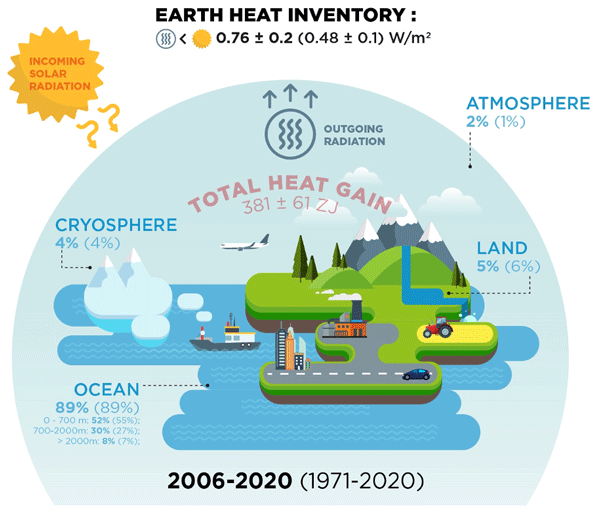
Earth's climate is out of energy balance, and this study quantifies how much heat has consequently accumulated over the past decades (ocean: 89 %, land: 6 %, cryosphere: 4 %, atmosphere: 1 %). Since 1971, this accumulated heat reached record values at an increasing pace. The Earth heat inventory provides a comprehensive view on the status and expectation of global warming, and we call for an implementation of this global climate indicator into the Paris Agreement’s Global Stocktake.
Benjamin Joseph Davison, Tom Cowton, Andrew Sole, Finlo Cottier, and Pete Nienow
The Cryosphere, 16, 1181–1196, https://doi.org/10.5194/tc-16-1181-2022, https://doi.org/10.5194/tc-16-1181-2022, 2022
Short summary
Short summary
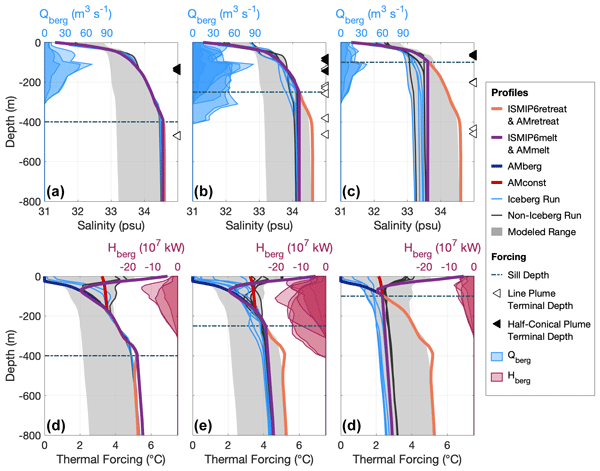
The ocean is an important driver of Greenland glacier retreat. Icebergs influence ocean temperature in the vicinity of glaciers, which will affect glacier retreat rates, but the effect of icebergs on water temperature is poorly understood. In this study, we use a model to show that icebergs cause large changes to water properties next to Greenland's glaciers, which could influence ocean-driven glacier retreat around Greenland.
Thomas Slater, Isobel R. Lawrence, Inès N. Otosaka, Andrew Shepherd, Noel Gourmelen, Livia Jakob, Paul Tepes, Lin Gilbert, and Peter Nienow
The Cryosphere, 15, 233–246, https://doi.org/10.5194/tc-15-233-2021, https://doi.org/10.5194/tc-15-233-2021, 2021
Short summary
Short summary
Satellite observations are the best method for tracking ice loss, because the cryosphere is vast and remote. Using these, and some numerical models, we show that Earth has lost 28 trillion tonnes (Tt) of ice since 1994 from Arctic sea ice (7.6 Tt), ice shelves (6.5 Tt), mountain glaciers (6.1 Tt), the Greenland (3.8 Tt) and Antarctic ice sheets (2.5 Tt), and Antarctic sea ice (0.9 Tt). It has taken just 3.2 % of the excess energy Earth has absorbed due to climate warming to cause this ice loss.
Cited articles
Amundson, J. M., Fahnestock, M., Truffer, M., Brown, J., Lüthi, M. P., and Motyka, R. J.: Ice mélange dynamics and implications for terminus stability, Jakobshavn Isbræ, Greenland, Journal of Geophysical Research: Earth Surface, 115, https://doi.org/10.1029/2009JF001405, 2010. a, b
Amundson, J. M., Robel, A. A., Burton, J. C., and Nissanka, K.: A quasi-one-dimensional ice mélange flow model based on continuum descriptions of granular materials, The Cryosphere, 19, 19–35, https://doi.org/10.5194/tc-19-19-2025, 2025. a, b, c
Åström, J., Cook, S., Enderlin, E. M., Sutherland, D. A., Mazur, A., and Glasser, N.: Fragmentation theory reveals processes controlling iceberg size distributions, Journal of Glaciology, 67, 603–612, https://doi.org/10.1017/jog.2021.14, 2021. a
Bevan, S. L., Luckman, A. J., Benn, D. I., Cowton, T., and Todd, J.: Impact of warming shelf waters on ice mélange and terminus retreat at a large SE Greenland glacier, The Cryosphere, 13, 2303–2315, https://doi.org/10.5194/tc-13-2303-2019, 2019. a
Burton, J. C., Amundson, J. M., Cassotto, R., Kuo, C.-C., and Dennin, M.: Quantifying flow and stress in ice mélange, the world's largest granular material, Proceedings of the National Academy of Sciences, 115, 5105–5110, https://doi.org/10.1073/pnas.1715136115, 2018. a, b, c, d
Carroll, D., Sutherland, D. A., Shroyer, E. L., Nash, J. D., Catania, G. A., and Stearns, L. A.: Modeling Turbulent Subglacial Meltwater Plumes: Implications for Fjord-Scale Buoyancy-Driven Circulation, Journal of Physical Oceanography, 45, 2169–2185, https://doi.org/10.1175/JPO-D-15-0033.1, 2015. a
Catania, G. A., Stearns, L. A., Sutherland, D. A., Fried, M. J., Bartholomaus, T. C., Morlighem, M., Shroyer, E., and Nash, J.: Geometric Controls on Tidewater Glacier Retreat in Central Western Greenland, Journal of Geophysical Research: Earth Surface, 123, 2024–2038, https://doi.org/10.1029/2017JF004499, 2018. a
Cenedese, C. and Straneo, F.: Icebergs Melting, Annual Review of Fluid Mechanics, 55, 377–402, https://doi.org/10.1146/annurev-fluid-032522-100734, 2023. a, b
Cowton, T., Slater, D., Sole, A., Goldberg, D., and Nienow, P.: Modeling the impact of glacial runoff on fjord circulation and submarine melt rate using a new subgrid-scale parameterization for glacial plumes, Journal of Geophysical Research: Oceans, 120, 796–812, https://doi.org/10.1002/2014JC010324, 2015. a
Cowton, T., Sole, A., Nienow, P., Slater, D., Wilton, D., and Hanna, E.: Controls on the transport of oceanic heat to Kangerdlugssuaq Glacier, East Greenland, Journal of Glaciology, 62, https://doi.org/10.1017/jog.2016.117, 2016. a
Davison, B. J., Cowton, T., Sole, A., Cottier, F., and Nienow, P.: Modelling the effect of submarine iceberg melting on glacier-adjacent water properties, The Cryosphere, 16, 1181–1196, https://doi.org/10.5194/tc-16-1181-2022, 2022. a, b
Enderlin, E. M., Hamilton, G. S., Straneo, F., and Sutherland, D. A.: Iceberg meltwater fluxes dominate the freshwater budget in Greenland's iceberg-congested glacial fjords, Geophysical Research Letters, 43, 11287–11294, https://doi.org/10.1002/2016GL070718, 2016. a, b, c, d, e, f, g, h, i, j, k, l, m
FitzMaurice, A., Cenedese, C., and Straneo, F.: Nonlinear response of iceberg side melting to ocean currents, Geophysical Research Letters, 44, 5637–5644, https://doi.org/10.1002/2017GL073585, 2017. a
Foga, S., Stearns, L. A., and van der Veen, C.: Application of Satellite Remote Sensing Techniques to Quantify Terminus and Ice Mélange Behavior at Helheim Glacier, East Greenland, Marine Technology Society Journal, 48, 81–91, https://doi.org/10.4031/MTSJ.48.5.3, 2014. a, b
Gilpin, R. R., Hirata, T., and Cheng, K. C.: Wave formation and heat transfer at an ice-water interface in the presence of a turbulent flow, Journal of Fluid Mechanics, 99, 619–640, https://doi.org/10.1017/S0022112080000791, 1980. a
Hester, E. W., McConnochie, C. D., Cenedese, C., Couston, L.-A., and Vasil, G.: Aspect ratio affects iceberg melting, Physical Review Fluids, 6, 023802, https://doi.org/10.1103/PhysRevFluids.6.023802, 2021. a
Holland, D. M. and Jenkins, A.: Modeling Thermodynamic Ice–Ocean Interactions at the Base of an Ice Shelf, Journal of Physical Oceanography, 29, 1787–1800, https://doi.org/10.1175/1520-0485(1999)029<1787:MTIOIA>2.0.CO;2, 1999. a, b, c, d
Howat, I. M., Joughin, I., Tulaczyk, S., and Gogineni, S.: Rapid retreat and acceleration of Helheim Glacier, east Greenland, Geophysical Research Letters, 32, https://doi.org/10.1029/2005GL024737, 2005. a
Howat, I. M., Box, J. E., Ahn, Y., Herrington, A., and McFadden, E. M.: Seasonal variability in the dynamics of marine-terminating outlet glaciers in Greenland, Journal of Glaciology, 56, 601–613, https://doi.org/10.3189/002214310793146232, 2010. a
Hughes, K. G.: Fjord circulation induced by melting icebergs, The Cryosphere, 18, 1315–1332, https://doi.org/10.5194/tc-18-1315-2024, 2024. a
Jackson, R. H., Nash, J. D., Kienholz, C., Sutherland, D. A., Amundson, J. M., Motyka, R. J., Winters, D., Skyllingstad, E., and Pettit, E. C.: Meltwater Intrusions Reveal Mechanisms for Rapid Submarine Melt at a Tidewater Glacier, Geophysical Research Letters, 47, e2019GL085335, https://doi.org/10.1029/2019GL085335, 2020. a, b
Jain, L.: Modelling ocean melt of ice mélange at Greenland's marine-terminating glaciers: datasets and code, Zenodo [code], https://doi.org/10.5281/zenodo.15577774, 2025. a
Jenkins, A., Dutrieux, P., Jacobs, S. S., McPhail, S. D., Perrett, J. R., Webb, A. T., and White, D.: Observations beneath Pine Island Glacier in West Antarctica and implications for its retreat, Nature Geoscience, 3, 468–472, https://doi.org/10.1038/ngeo890, 2010. a
Joughin, I., Smith, B. E., Howat, I. M., Floricioiu, D., Alley, R. B., Truffer, M., and Fahnestock, M.: Seasonal to decadal scale variations in the surface velocity of Jakobshavn Isbrae, Greenland: Observation and model-based analysis, Journal of Geophysical Research: Earth Surface, 117, https://doi.org/10.1029/2011JF002110, 2012. a
Joughin, I., Shean, D. E., Smith, B. E., and Floricioiu, D.: A decade of variability on Jakobshavn Isbræ: ocean temperatures pace speed through influence on mélange rigidity , The Cryosphere, 14, 211–227, https://doi.org/10.5194/tc-14-211-2020, 2020. a, b
Kajanto, K., Straneo, F., and Nisancioglu, K.: Impact of icebergs on the seasonal submarine melt of Sermeq Kujalleq, The Cryosphere, 17, 371–390, https://doi.org/10.5194/tc-17-371-2023, 2023. a, b
Karlsson, N. B., Mankoff, K. D., Solgaard, A. M., Larsen, S. H., How, P. R., Fausto, R. S., and Sørensen, L. S.: A data set of monthly freshwater fluxes from the Greenland ice sheet's marine-terminating glaciers on a glacier–basin scale 2010–2020, GEUS Bulletin, 53, https://doi.org/10.34194/geusb.v53.8338, 2023. a
King, M. D., Howat, I. M., Candela, S. G., Noh, M. J., Jeong, S., Noël, B. P. Y., van den Broeke, M. R., Wouters, B., and Negrete, A.: Dynamic ice loss from the Greenland Ice Sheet driven by sustained glacier retreat, Communications Earth & Environment, 1, 1–7, https://doi.org/10.1038/s43247-020-0001-2, 2020. a
Krug, J., Durand, G., Gagliardini, O., and Weiss, J.: Modelling the impact of submarine frontal melting and ice mélange on glacier dynamics, The Cryosphere, 9, 989–1003, https://doi.org/10.5194/tc-9-989-2015, 2015. a
Losch, M.: Modeling ice shelf cavities in a z coordinate ocean general circulation model, Journal of Geophysical Research: Oceans, 113, https://doi.org/10.1029/2007JC004368, 2008. a, b
Mankoff, K. D., Noël, B., Fettweis, X., Ahlstrøm, A. P., Colgan, W., Kondo, K., Langley, K., Sugiyama, S., van As, D., and Fausto, R. S.: Greenland liquid water discharge from 1958 through 2019, Earth Syst. Sci. Data, 12, 2811–2841, https://doi.org/10.5194/essd-12-2811-2020, 2020. a
Marshall, J., Adcroft, A., Hill, C., Perelman, L., and Heisey, C.: A finite-volume, incompressible Navier Stokes model for studies of the ocean on parallel computers, Journal of Geophysical Research: Oceans, 102, 5753–5766, https://doi.org/10.1029/96JC02775, 1997a. a
Marshall, J., Hill, C., Perelman, L., and Adcroft, A.: Hydrostatic, quasi-hydrostatic, and nonhydrostatic ocean modeling, Journal of Geophysical Research: Oceans, 102, 5733–5752, https://doi.org/10.1029/96JC02776, 1997b. a
Meng, Y., Lai, C. Y., Culberg, R., Shahin, M. G., Stearns, L. A., Burton, J. C., and Nissanka, K.: Seasonal changes of mélange thickness coincide with Greenland calving dynamics. Nat Commun 16, 573, https://doi.org/10.1038/s41467-024-55241-7, 2025. a, b
Moon, T., Sutherland, D. A., Carroll, D., Felikson, D., Kehrl, L., and Straneo, F.: Subsurface iceberg melt key to Greenland fjord freshwater budget, Nature Geoscience, 11, 49–54, https://doi.org/10.1038/s41561-017-0018-z, 2018. a, b, c
Moyer, A. N., Nienow, P. W., Gourmelen, N., Sole, A. J., and Slater, D. A.: Estimating Spring Terminus Submarine Melt Rates at a Greenlandic Tidewater Glacier Using Satellite Imagery, Frontiers in Earth Science, 5, https://doi.org/10.3389/feart.2017.00107, 2017. a
Moyer, A. N., Nienow, P. W., Gourmelen, N., Sole, A. J., Slater, D. A., Truffer, M., and Fahnestock, M.: Spatio-temporal variations in seasonal ice tongue submarine melt rate at a tidewater glacier in southwest Greenland, Journal of Glaciology, 65, 523–530, https://doi.org/10.1017/jog.2019.27, 2019a. a
Moyer, A. N., Sutherland, D. A., Nienow, P. W., and Sole, A. J.: Seasonal Variations in Iceberg Freshwater Flux in Sermilik Fjord, Southeast Greenland From Sentinel-2 Imagery, Geophysical Research Letters, 46, 8903–8912, https://doi.org/10.1029/2019GL082309, 2019b. a, b
O'Leary, M. and Christoffersen, P.: Calving on tidewater glaciers amplified by submarine frontal melting, The Cryosphere, 7, 119–128, https://doi.org/10.5194/tc-7-119-2013, 2013. a
Rignot, E., Xu, Y., Menemenlis, D., Mouginot, J., Scheuchl, B., Li, X., Morlighem, M., Seroussi, H., den Broeke, M. v., Fenty, I., Cai, C., An, L., and Fleurian, B. d.: Modeling of ocean-induced ice melt rates of five west Greenland glaciers over the past two decades, Geophysical Research Letters, 43, 6374–6382, https://doi.org/10.1002/2016GL068784, 2016. a, b
Robel, A. A.: Thinning sea ice weakens buttressing force of iceberg mélange and promotes calving, Nature Communications, 8, 14596, https://doi.org/10.1038/ncomms14596, 2017. a, b, c
Shiggins, C. J., Lea, J. M., and Brough, S.: Automated ArcticDEM iceberg detection tool: insights into area and volume distributions, and their potential application to satellite imagery and modelling of glacier–iceberg–ocean systems, The Cryosphere, 17, 15–32, https://doi.org/10.5194/tc-17-15-2023, 2023. a, b
Slater, D. A. and Straneo, F.: Submarine melting of glaciers in Greenland amplified by atmospheric warming, Nature Geoscience, 15, 794–799, https://doi.org/10.1038/s41561-022-01035-9, 2022. a
Straneo, F.: Profiles of temperature and salinity from Sermilik Fjord during March 2010, Arctic Data Center [data set], https://doi.org/10.18739/A2M03XZ2K, 2021. a
Straneo, F. and Heimbach, P.: North Atlantic warming and the retreat of Greenland's outlet glaciers, Nature, 504, 36–43, https://doi.org/10.1038/nature12854, 2013. a
Straneo, F., Curry, R. G., Sutherland, D. A., Hamilton, G. S., Cenedese, C., Våge, K., and Stearns, L. A.: Impact of fjord dynamics and glacial runoff on the circulation near Helheim Glacier, Nature Geoscience, 4, 322–327, https://doi.org/10.1038/ngeo1109, 2011. a, b
Straneo, F., Hamilton, G. S., Stearns, L. A., and Sutherland, D. A.: Connecting the Greenland Ice Sheet and the Ocean: A Case Study of Helheim Glacier and Sermilik Fjord, Oceanography, 29, 34–45, 2016. a
Sutherland, D. A., Jackson, R. H., Kienholz, C., Amundson, J. M., Dryer, W. P., Duncan, D., Eidam, E. F., Motyka, R. J., and Nash, J. D.: Direct observations of submarine melt and subsurface geometry at a tidewater glacier, Science, 365, 369–374, https://doi.org/10.1126/science.aax3528, 2019. a, b
The IMBIE Team: Mass balance of the Greenland Ice Sheet from 1992 to 2018, Nature, 579, 233–239, https://doi.org/10.1038/s41586-019-1855-2, 2020. a
Wehrlé, A., Lüthi, M. P., and Vieli, A.: The control of short-term ice mélange weakening episodes on calving activity at major Greenland outlet glaciers, The Cryosphere, 17, 309–326, https://doi.org/10.5194/tc-17-309-2023, 2023. a
Wood, M., Rignot, E., Fenty, I., An, L., Bjørk, A., van den Broeke, M., Cai, C., Kane, E., Menemenlis, D., Millan, R., Morlighem, M., Mouginot, J., Noël, B., Scheuchl, B., Velicogna, I., Willis, J. K., and Zhang, H.: Ocean forcing drives glacier retreat in Greenland, Science Advances, 7, eaba7282, https://doi.org/10.1126/sciadv.aba7282, 2021. a
Xu, Y., Rignot, E., Menemenlis, D., and Koppes, M.: Numerical experiments on subaqueous melting of Greenland tidewater glaciers in response to ocean warming and enhanced subglacial discharge, Annals of Glaciology, 53, 229–234, https://doi.org/10.3189/2012AoG60A139, 2012. a
Short summary
Ice mélange is a mixture of icebergs and sea ice which floats in front of Greenland’s largest glaciers. The presence of ice mélange can have a significant impact on a glacier and its fjord, but the melting of an ice mélange by the ocean is currently poorly understood. Here, we use computer simulations to develop an equation which describes how ice mélange melts under different environmental conditions. This work improves our understanding of the effect of ice mélange on glaciers and the ocean.
Ice mélange is a mixture of icebergs and sea ice which floats in front of Greenland’s largest...