
Articles | Volume 19, issue 12
https://doi.org/10.5194/tc-19-6673-2025
© Author(s) 2025. This work is distributed under
the Creative Commons Attribution 4.0 License.
the Creative Commons Attribution 4.0 License.
https://doi.org/10.5194/tc-19-6673-2025
© Author(s) 2025. This work is distributed under
the Creative Commons Attribution 4.0 License.
the Creative Commons Attribution 4.0 License.
Research article
| 
09 Dec 2025
Research article |
| 09 Dec 2025
| 09 Dec 2025
A history-matching analysis of the Antarctic Ice Sheet since the last interglacial – Part 2: Glacial isostatic adjustment
Benoit S. Lecavalier
CORRESPONDING AUTHOR

Department of Physics and Physical Oceanography, Memorial University of Newfoundland, St. John's, Canada
Lev Tarasov
Department of Physics and Physical Oceanography, Memorial University of Newfoundland, St. John's, Canada
Related authors
Lev Tarasov, Benoit S. Lecavalier, Kevin Hank, and David Pollard
Geosci. Model Dev., 18, 9565–9603, https://doi.org/10.5194/gmd-18-9565-2025, https://doi.org/10.5194/gmd-18-9565-2025, 2025
Short summary
Short summary
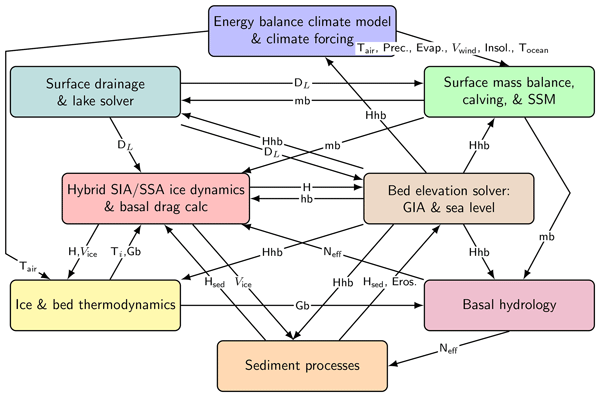
We document the glacial system model (GSM), a 3D glaciological ice sheet systems model specifically designed for large ensemble modelling in glacial cycle contexts. The model is distinguished by the breadth of relevant processes represented for this context. This ranges from meltwater surface drainage with proglacial lake formation to state-of-the-art subglacial sediment production/transport/deposition. The other key distinguishing design feature is attention to addressing process uncertainties.
Benoit S. Lecavalier and Lev Tarasov
The Cryosphere, 19, 919–953, https://doi.org/10.5194/tc-19-919-2025, https://doi.org/10.5194/tc-19-919-2025, 2025
Short summary
Short summary
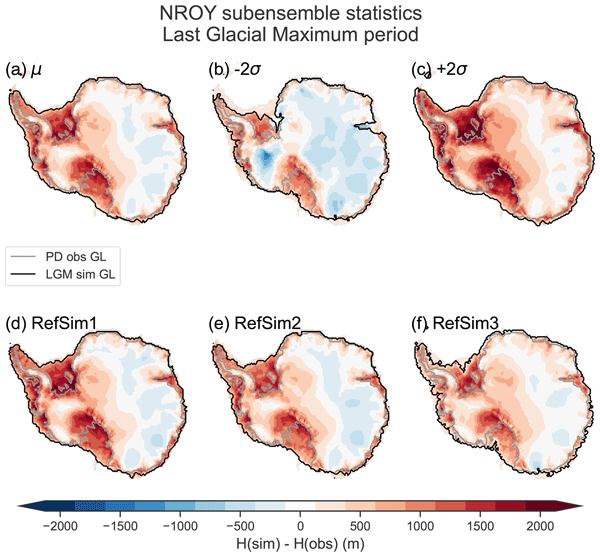
We present the evolution of the Antarctic Ice Sheet (AIS) over the last 200 kyr by means of a history-matching analysis where an updated observational database constrained ~ 10 000 model simulations. During peak glaciation at the Last Glacial Maximum (LGM), the best-fitting sub-ensemble of AIS simulations reached an excess grounded ice volume relative to the present of 9.2 to 26.5 m equivalent sea level relative to the present. The LGM AIS volume can help resolve the LGM missing-ice problem.
Benoit S. Lecavalier, Lev Tarasov, Greg Balco, Perry Spector, Claus-Dieter Hillenbrand, Christo Buizert, Catherine Ritz, Marion Leduc-Leballeur, Robert Mulvaney, Pippa L. Whitehouse, Michael J. Bentley, and Jonathan Bamber
Earth Syst. Sci. Data, 15, 3573–3596, https://doi.org/10.5194/essd-15-3573-2023, https://doi.org/10.5194/essd-15-3573-2023, 2023
Short summary
Short summary
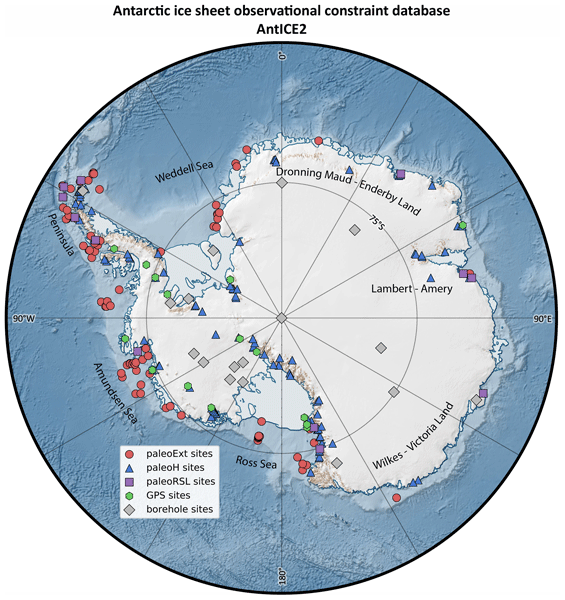
The Antarctic Ice Sheet Evolution constraint database version 2 (AntICE2) consists of a large variety of observations that constrain the evolution of the Antarctic Ice Sheet over the last glacial cycle. This includes observations of past ice sheet extent, past ice thickness, past relative sea level, borehole temperature profiles, and present-day bedrock displacement rates. The database is intended to improve our understanding of past Antarctic changes and for ice sheet model calibrations.
Inès N. Otosaka, Andrew Shepherd, Erik R. Ivins, Nicole-Jeanne Schlegel, Charles Amory, Michiel R. van den Broeke, Martin Horwath, Ian Joughin, Michalea D. King, Gerhard Krinner, Sophie Nowicki, Anthony J. Payne, Eric Rignot, Ted Scambos, Karen M. Simon, Benjamin E. Smith, Louise S. Sørensen, Isabella Velicogna, Pippa L. Whitehouse, Geruo A, Cécile Agosta, Andreas P. Ahlstrøm, Alejandro Blazquez, William Colgan, Marcus E. Engdahl, Xavier Fettweis, Rene Forsberg, Hubert Gallée, Alex Gardner, Lin Gilbert, Noel Gourmelen, Andreas Groh, Brian C. Gunter, Christopher Harig, Veit Helm, Shfaqat Abbas Khan, Christoph Kittel, Hannes Konrad, Peter L. Langen, Benoit S. Lecavalier, Chia-Chun Liang, Bryant D. Loomis, Malcolm McMillan, Daniele Melini, Sebastian H. Mernild, Ruth Mottram, Jeremie Mouginot, Johan Nilsson, Brice Noël, Mark E. Pattle, William R. Peltier, Nadege Pie, Mònica Roca, Ingo Sasgen, Himanshu V. Save, Ki-Weon Seo, Bernd Scheuchl, Ernst J. O. Schrama, Ludwig Schröder, Sebastian B. Simonsen, Thomas Slater, Giorgio Spada, Tyler C. Sutterley, Bramha Dutt Vishwakarma, Jan Melchior van Wessem, David Wiese, Wouter van der Wal, and Bert Wouters
Earth Syst. Sci. Data, 15, 1597–1616, https://doi.org/10.5194/essd-15-1597-2023, https://doi.org/10.5194/essd-15-1597-2023, 2023
Short summary
Short summary
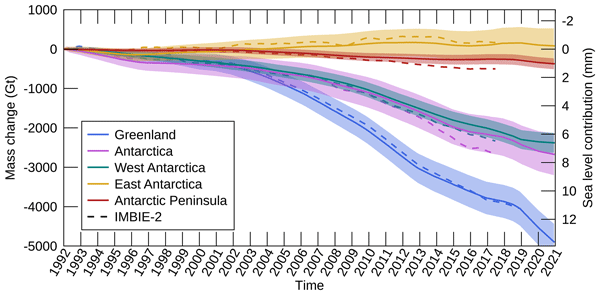
By measuring changes in the volume, gravitational attraction, and ice flow of Greenland and Antarctica from space, we can monitor their mass gain and loss over time. Here, we present a new record of the Earth’s polar ice sheet mass balance produced by aggregating 50 satellite-based estimates of ice sheet mass change. This new assessment shows that the ice sheets have lost (7.5 x 10¹²) t of ice between 1992 and 2020, contributing 21 mm to sea level rise.
Alexis Arturo Goffin, Lev Tarasov, Ívar Örn Benediktsson, and Joseph M. Licciardi
Clim. Past, 22, 825–843, https://doi.org/10.5194/cp-22-825-2026, https://doi.org/10.5194/cp-22-825-2026, 2026
Short summary
Short summary
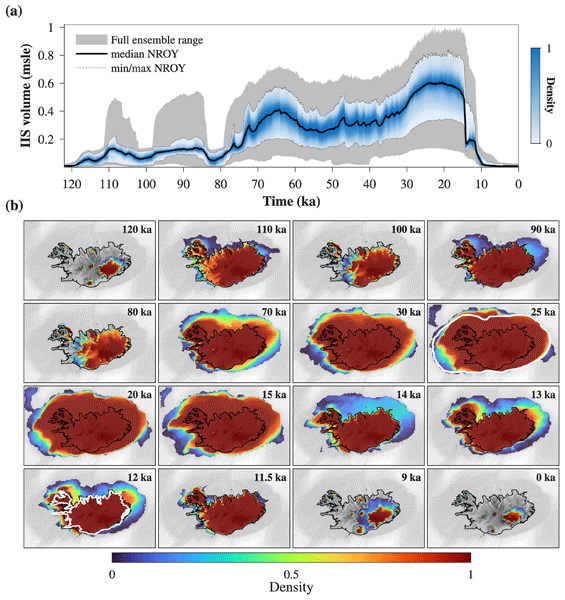
We simulated the Icelandic Ice Sheet over the last 120 kyr using an ice sheet model constrained by geological data with robust uncertainty assessment. At the Last Glacial Maximum, ice reached the continental shelf break, with a potential ice bridge connecting to the Greenland Ice Sheet. Model consistency with geological constraints during deglaciation is only possible with meltwater-driven ice fracture at the ice sheet margin, destabilizing the marine ice sheet and accelerating its collapse.
Lev Tarasov, Benoit S. Lecavalier, Kevin Hank, and David Pollard
Geosci. Model Dev., 18, 9565–9603, https://doi.org/10.5194/gmd-18-9565-2025, https://doi.org/10.5194/gmd-18-9565-2025, 2025
Short summary
Short summary
We document the glacial system model (GSM), a 3D glaciological ice sheet systems model specifically designed for large ensemble modelling in glacial cycle contexts. The model is distinguished by the breadth of relevant processes represented for this context. This ranges from meltwater surface drainage with proglacial lake formation to state-of-the-art subglacial sediment production/transport/deposition. The other key distinguishing design feature is attention to addressing process uncertainties.
Benoit S. Lecavalier and Lev Tarasov
The Cryosphere, 19, 919–953, https://doi.org/10.5194/tc-19-919-2025, https://doi.org/10.5194/tc-19-919-2025, 2025
Short summary
Short summary
We present the evolution of the Antarctic Ice Sheet (AIS) over the last 200 kyr by means of a history-matching analysis where an updated observational database constrained ~ 10 000 model simulations. During peak glaciation at the Last Glacial Maximum (LGM), the best-fitting sub-ensemble of AIS simulations reached an excess grounded ice volume relative to the present of 9.2 to 26.5 m equivalent sea level relative to the present. The LGM AIS volume can help resolve the LGM missing-ice problem.
Marilena Sophie Geng, Lev Tarasov, and April Sue Dalton
EGUsphere, https://doi.org/10.5194/egusphere-2025-495, https://doi.org/10.5194/egusphere-2025-495, 2025
Preprint archived
Short summary
Short summary
We used a fully coupled ice-climate model to simulate the last two glacial inceptions, and compare the ensemble simulated ice sheet evolution to limited geological data. Our results show that Northern Hemisphere ice sheets grew rapidly, sometimes merging in ways not previously assumed and that capturing one glacial inception does not guarantee capturing another. These findings improve our understanding of ice-age dynamics and highlight challenges in predicting past and future climate evolution.
Ryan Love, Glenn A. Milne, Parviz Ajourlou, Soran Parang, Lev Tarasov, and Konstantin Latychev
Geosci. Model Dev., 17, 8535–8551, https://doi.org/10.5194/gmd-17-8535-2024, https://doi.org/10.5194/gmd-17-8535-2024, 2024
Short summary
Short summary
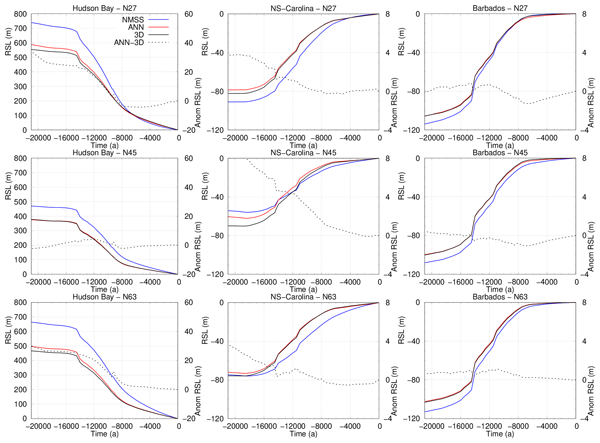
A relatively recent advance in glacial isostatic adjustment modeling has been the development of models that include 3D Earth structure, as opposed to 1D structure. However, a major limitation is the computational expense. We have developed a method using artificial neural networks to emulate the influence of 3D Earth models to affordably constrain the viscosity parameter space. Our results indicate that the misfits are of a scale such that useful predictions of relative sea level can be made.
Kevin Hank and Lev Tarasov
Clim. Past, 20, 2499–2524, https://doi.org/10.5194/cp-20-2499-2024, https://doi.org/10.5194/cp-20-2499-2024, 2024
Short summary
Short summary
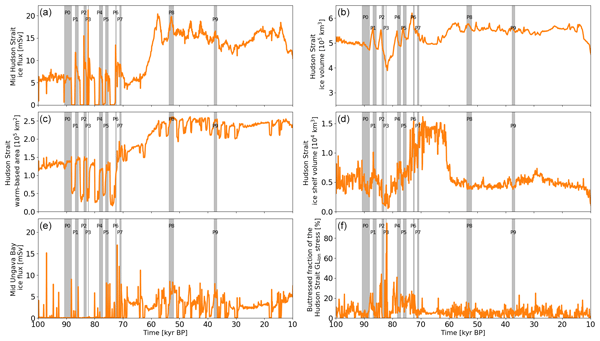
The ice-rafted debris signature of Heinrich events in marine sedimentary cores is usually attributed to massive ice discharge from the Laurentide Ice Sheet. However, the driving mechanism of this pulsed discharge remains unclear. We compare three previously proposed hypotheses and examine the role of relevant system processes. We find ice stream surge cycling is the most likely mechanism, but its character is sensitive to both the geothermal heat flux and the form of the basal drag law.
Matthew Drew and Lev Tarasov
EGUsphere, https://doi.org/10.5194/egusphere-2024-620, https://doi.org/10.5194/egusphere-2024-620, 2024
Preprint withdrawn
Short summary
Short summary
We model the sediment-ice-climate system over North America for the last 2.58 Myr showing that ice sheets are capable of excavating features the size of the Hudson bay. This work provides a basis for reconstructing past landscapes important to climate modelling efforts, helping us to understand past earth system change.
Brian R. Crow, Lev Tarasov, Michael Schulz, and Matthias Prange
Clim. Past, 20, 281–296, https://doi.org/10.5194/cp-20-281-2024, https://doi.org/10.5194/cp-20-281-2024, 2024
Short summary
Short summary
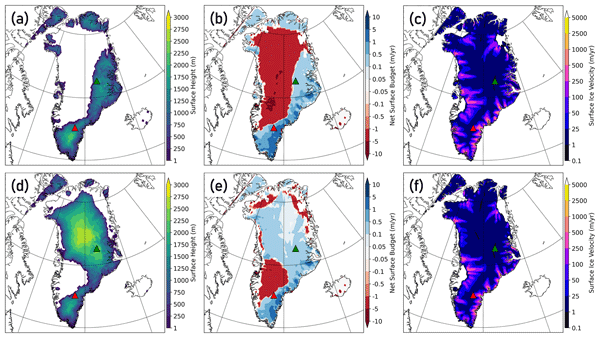
An abnormally warm period around 400,000 years ago is thought to have resulted in a large melt event for the Greenland Ice Sheet. Using a sequence of climate model simulations connected to an ice model, we estimate a 50 % melt of Greenland compared to today. Importantly, we explore how the exact methodology of connecting the temperatures and precipitation from the climate model to the ice sheet model can influence these results and show that common methods could introduce errors.
Matthew Drew and Lev Tarasov
The Cryosphere, 17, 5391–5415, https://doi.org/10.5194/tc-17-5391-2023, https://doi.org/10.5194/tc-17-5391-2023, 2023
Short summary
Short summary
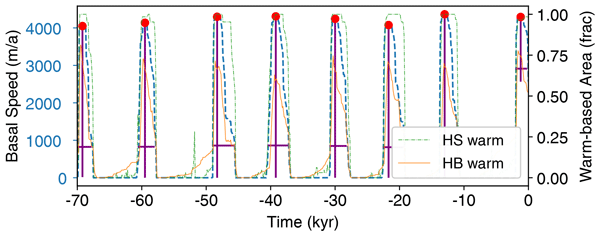
The interaction of fast-flowing regions of continental ice sheets with their beds governs how quickly they slide and therefore flow. The coupling of fast ice to its bed is controlled by the pressure of meltwater at its base. It is currently poorly understood how the physical details of these hydrologic systems affect ice speedup. Using numerical models we find, surprisingly, that they largely do not, except for the duration of the surge. This suggests that cheap models are sufficient.
Ryan Love, Lev Tarasov, Heather Andres, Alan Condron, Xu Zhang, and Gerrit Lohmann
EGUsphere, https://doi.org/10.5194/egusphere-2023-2225, https://doi.org/10.5194/egusphere-2023-2225, 2023
Preprint archived
Short summary
Short summary
Freshwater injection into bands across the North Atlantic are a mainstay of climate modelling when investigating topics such as climate change or the role of glacial runoff in the glacial climate system. However, this approach is unrealistic and results in a systematic bias in the climate response to a given flux of freshwater. We evaluate the magnitude of this bias by comparison to two other approaches for introducing freshwater into a coupled climate model setup for glacial conditions.
Kevin Hank, Lev Tarasov, and Elisa Mantelli
Geosci. Model Dev., 16, 5627–5652, https://doi.org/10.5194/gmd-16-5627-2023, https://doi.org/10.5194/gmd-16-5627-2023, 2023
Short summary
Short summary
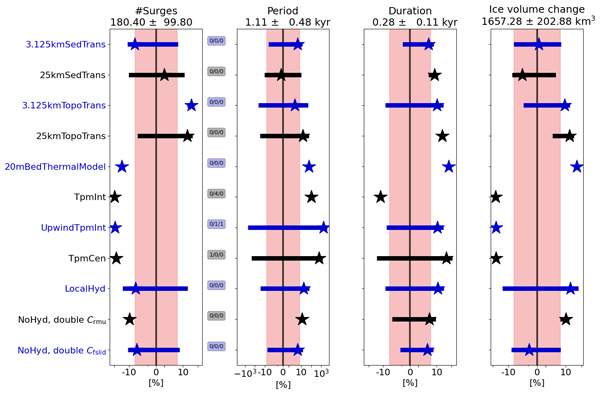
Physically meaningful modeling of geophysical system instabilities is numerically challenging, given the potential effects of purely numerical artifacts. Here we explore the sensitivity of ice stream surge activation to numerical and physical model aspects. We find that surge characteristics exhibit a resolution dependency but converge at higher horizontal grid resolutions and are significantly affected by the incorporation of bed thermal and sub-glacial hydrology models.
Benoit S. Lecavalier, Lev Tarasov, Greg Balco, Perry Spector, Claus-Dieter Hillenbrand, Christo Buizert, Catherine Ritz, Marion Leduc-Leballeur, Robert Mulvaney, Pippa L. Whitehouse, Michael J. Bentley, and Jonathan Bamber
Earth Syst. Sci. Data, 15, 3573–3596, https://doi.org/10.5194/essd-15-3573-2023, https://doi.org/10.5194/essd-15-3573-2023, 2023
Short summary
Short summary
The Antarctic Ice Sheet Evolution constraint database version 2 (AntICE2) consists of a large variety of observations that constrain the evolution of the Antarctic Ice Sheet over the last glacial cycle. This includes observations of past ice sheet extent, past ice thickness, past relative sea level, borehole temperature profiles, and present-day bedrock displacement rates. The database is intended to improve our understanding of past Antarctic changes and for ice sheet model calibrations.
Inès N. Otosaka, Andrew Shepherd, Erik R. Ivins, Nicole-Jeanne Schlegel, Charles Amory, Michiel R. van den Broeke, Martin Horwath, Ian Joughin, Michalea D. King, Gerhard Krinner, Sophie Nowicki, Anthony J. Payne, Eric Rignot, Ted Scambos, Karen M. Simon, Benjamin E. Smith, Louise S. Sørensen, Isabella Velicogna, Pippa L. Whitehouse, Geruo A, Cécile Agosta, Andreas P. Ahlstrøm, Alejandro Blazquez, William Colgan, Marcus E. Engdahl, Xavier Fettweis, Rene Forsberg, Hubert Gallée, Alex Gardner, Lin Gilbert, Noel Gourmelen, Andreas Groh, Brian C. Gunter, Christopher Harig, Veit Helm, Shfaqat Abbas Khan, Christoph Kittel, Hannes Konrad, Peter L. Langen, Benoit S. Lecavalier, Chia-Chun Liang, Bryant D. Loomis, Malcolm McMillan, Daniele Melini, Sebastian H. Mernild, Ruth Mottram, Jeremie Mouginot, Johan Nilsson, Brice Noël, Mark E. Pattle, William R. Peltier, Nadege Pie, Mònica Roca, Ingo Sasgen, Himanshu V. Save, Ki-Weon Seo, Bernd Scheuchl, Ernst J. O. Schrama, Ludwig Schröder, Sebastian B. Simonsen, Thomas Slater, Giorgio Spada, Tyler C. Sutterley, Bramha Dutt Vishwakarma, Jan Melchior van Wessem, David Wiese, Wouter van der Wal, and Bert Wouters
Earth Syst. Sci. Data, 15, 1597–1616, https://doi.org/10.5194/essd-15-1597-2023, https://doi.org/10.5194/essd-15-1597-2023, 2023
Short summary
Short summary
By measuring changes in the volume, gravitational attraction, and ice flow of Greenland and Antarctica from space, we can monitor their mass gain and loss over time. Here, we present a new record of the Earth’s polar ice sheet mass balance produced by aggregating 50 satellite-based estimates of ice sheet mass change. This new assessment shows that the ice sheets have lost (7.5 x 10¹²) t of ice between 1992 and 2020, contributing 21 mm to sea level rise.
Lev Tarasov and Michael Goldstein
EGUsphere, https://doi.org/10.5194/egusphere-2022-1410, https://doi.org/10.5194/egusphere-2022-1410, 2023
Preprint archived
Short summary
Short summary
This overview: 1. Illustrates how current climate and/or ice sheet model-based inferences about the past tend to have little interpretable value about the real world given inadequate accounting of uncertainties. 2. Explains Bayesian inference to a non-statistical community. 3. Sketches out some tractable inferential steps for computationally expensive models in a way that meaningfully accounts for uncertainties. 4. Lays out some steps for the community to move forward.
Lev Tarasov and Michael Goldstein
Clim. Past Discuss., https://doi.org/10.5194/cp-2021-145, https://doi.org/10.5194/cp-2021-145, 2021
Revised manuscript not accepted
Short summary
Short summary
This review: 1. Illustrates how current climate and/or ice sheet model-based inferences about the past tend to have limited interpretable value about the real world given inadequate accounting of uncertainties. 2. Explains Bayesian inference to a non-statistical community. 3. Sketches out tractable Bayesian inference for computationally expensive models in a way that meaningfully accounts for uncertainties. 4. Lays out some steps for the community to move forward.
Ryan Love, Heather J. Andres, Alan Condron, and Lev Tarasov
Clim. Past, 17, 2327–2341, https://doi.org/10.5194/cp-17-2327-2021, https://doi.org/10.5194/cp-17-2327-2021, 2021
Short summary
Short summary
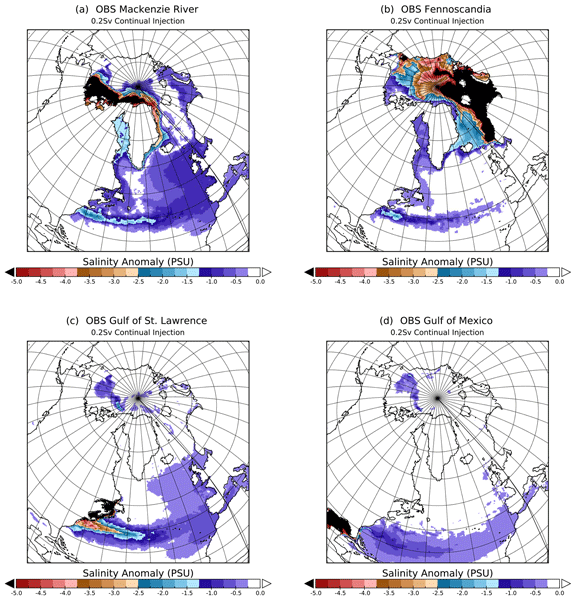
Freshwater, in the form of glacial runoff, is hypothesized to play a critical role in centennial- to millennial-scale climate variability and climate transitions. We track the routing of glaciologically constrained freshwater volumes in glacial ocean simulations. Our simulations capture important generally not well-represented small-scale features (boundary currents, eddies). We show that the dilution of freshwater as it is transported to key climate regions reduces the freshening to 20 %–60 %.
Cited articles
Barletta, V. R., Bevis, M., Smith, B. E., Wilson, T., Brown, A., Bordoni, A., Willis, M., Khan, S. A., Rovira-Navarro, M., Dalziel, I. and Smalley Jr, R., Kendrick, E., Konfal, S., Caccamise II, D. J., Aster, R. C., Nyblade, A., and Wiens, D. A.: Observed rapid bedrock uplift in Amundsen Sea Embayment promotes ice-sheet stability, Science, 360, 1335–1339, https://doi.org/10.1126/science.aao1447, 2018.
Blank, B., Barletta, V., Hu, H., Pappa, F. and van der Wal, W.: Effect of lateral and stress-dependent viscosity variations on GIA induced uplift rates in the Amundsen Sea Embayment, Geochemistry, Geophysics, Geosystems, 22, e2021GC009807, https://doi.org/10.1029/2021GC009807, 2021.
Braddock, S., Hall, B. L., Johnson, J. S., Balco, G., Spoth, M., Whitehouse, P. L., Campbell, S., Goehring, B. M., Rood, D. H., and Woodward, J.: Relative sea-level data preclude major late Holocene ice-mass change in Pine Island Bay, Nature Geoscience, 15, 568–572, https://doi.org/10.1038/s41561-022-00961-y, 2022.
Briggs, R., Pollard, D., and Tarasov, L.: A glacial systems model configured for large ensemble analysis of Antarctic deglaciation, The Cryosphere, 7, 1949–1970, https://doi.org/10.5194/tc-7-1949-2013, 2013.
Briggs, R. D., Pollard, D., and Tarasov, L.: A data-constrained large ensemble analysis of Antarctic evolution since the Eemian, Quaternary Science Reviews, 103, 91–115, https://doi.org/10.1016/j.quascirev.2014.09.003, 2014.
de Boer, B., Stocchi, P., Whitehouse, P. L., and van de Wal, R. S. W.: Current state and future perspectives on coupled ice-sheet – sea-level modelling, Quaternary Science Reviews, 169, 13–28, https://doi.org/10.1016/j.quascirev.2017.05.013, 2017.
DeConto, R. M. and Pollard, D.: Contribution of Antarctica to past and future sea-level rise, Nature, 531, 591–597, https://doi.org/10.1038/nature17145, 2016.
Dziewonski, A. M. and Anderson, D. L.: Preliminary reference Earth model, Physics of the Earth and Planetary Interiors, 25, 297–356, https://doi.org/10.1016/0031-9201(81)90046-7, 1981.
Fukumori, I., Heimbach, P., Ponte, R. M., and Wunsch, C.: A dynamically consistent, multivariable ocean climatology. Bulletin of the American Meteorological Society, 99, 2107–2128, https://doi.org/10.1175/BAMS-D-17-0213.1, 2018.
Gardner, A. S., Moholdt, G., Scambos, T., Fahnstock, M., Ligtenberg, S., van den Broeke, M., and Nilsson, J.: Increased West Antarctic and unchanged East Antarctic ice discharge over the last 7 years, The Cryosphere, 12, 521–547, https://doi.org/10.5194/tc-12-521-2018, 2018.
Gomez, N., Mitrovica, J. X., Huybers, P., and Clark, P. U.: Sea level as a stabilizing factor for marine-ice-sheet grounding lines, Nature Geoscience, 3, 850–853, https://doi.org/10.1038/ngeo1012, 2010.
Gomez, N., Pollard, D., Mitrovica, J. X., Huybers, P., and Clark, P. U.: Evolution of a coupled marine ice sheet-sea level model, J. Geophys. Res. Earth Surf., 117, https://doi.org/10.1029/2011JF002128, 2012.
Gomez, N., Pollard, D., and Mitrovica, J. X.: A 3-D coupled ice sheet – sea level model applied to Antarctica through the last 40 kyr, Earth Planet. Sc. Lett., 384, 88–99, https://doi.org/10.1016/j.epsl.2013.09.042, 2013.
Gomez, N., Latychev, K., and Pollard, D.: A Coupled Ice Sheet-Sea Level Model Incorporating 3D Earth Structure: Variations in Antarctica during the Last Deglacial Retreat, J. Climate, 31, 4041–4054, https://doi.org/10.1175/JCLI-D-17-0352.1, 2018.
Han, H. K., Gomez, N., and Wan, J. X. W.: Capturing the interactions between ice sheets, sea level and the solid Earth on a range of timescales: a new “time window” algorithm, Geosci. Model Dev., 15, 1355–1373, https://doi.org/10.5194/gmd-15-1355-2022, 2022.
He, F.: Simulating Transient Climate Evolution of the Last Deglaciation with CCSM3, PhD Thesis, University of Wisconsin Madison, Madison, WC, USA, 171 pp., https://www.aos.wisc.edu/aosjournal/Volume15/He_PhD_Thesis.pdf (last access: 14 November 2025), 2011.
Heeszel, D. S., Wiens, D. A., Anandakrishnan, S., Aster, R. C., Dalziel, I. W. D., Huerta, A. D., Nyblade, A. A., Wilson, T. J., and Winberry, J. P.: Upper mantle structure of central and West Antarctica from array analysis of Rayleigh wave phase velocities, J. Geophys. Res. Solid Earth, 121, 1758–1775, https://doi.org/10.1002/2015JB012616, 2016.
Huybrechts, P.: Sea-level changes at the LGM from ice-dynamic reconstructions of the Greenland and Antarctic ice sheets during the glacial cycles, Quaternary Science Reviews, 21, 203–231, https://doi.org/10.1016/S0277-3791(01)00082-8, 2002.
Ivins, E. R. and James, T. S.: Antarctic glacial isostatic adjustment: A new assessment, Antarctic Science, 17, 541–553, https://doi.org/10.1017/S0954102005002968, 2005.
Kageyama, M., Albani, S., Braconnot, P., Harrison, S. P., Hopcroft, P. O., Ivanovic, R. F., Lambert, F., Marti, O., Peltier, W. R., Peterschmitt, J.-Y., Roche, D. M., Tarasov, L., Zhang, X., Brady, E. C., Haywood, A. M., LeGrande, A. N., Lunt, D. J., Mahowald, N. M., Mikolajewicz, U., Nisancioglu, K. H., Otto-Bliesner, B. L., Renssen, H., Tomas, R. A., Zhang, Q., Abe-Ouchi, A., Bartlein, P. J., Cao, J., Li, Q., Lohmann, G., Ohgaito, R., Shi, X., Volodin, E., Yoshida, K., Zhang, X., and Zheng, W.: The PMIP4 contribution to CMIP6 – Part 4: Scientific objectives and experimental design of the PMIP4-CMIP6 Last Glacial Maximum experiments and PMIP4 sensitivity experiments, Geosci. Model Dev., 10, 4035–4055, https://doi.org/10.5194/gmd-10-4035-2017, 2017.
Kierulf, H. P., Steffen, H., Barletta, V. R., Lidberg, M., Johansson, J., Kristiansen, O., and Tarasov, L.: A GNSS velocity field for geophysical applications in Fennoscandia, Journal of Geodynamics, 146, 101845, https://doi.org/10.1016/j.jog.2021.101845, 2021.
Konrad, H., Sasgen, I., Pollard, D., and Klemann, V.: Potential of the solid-Earth response for limiting long-term West Antarctic Ice Sheet retreat in a warming climate, Earth Planet. Sc. Lett., 432, 254–264, https://doi.org/10.1016/j.epsl.2015.10.008, 2015.
Lambeck, K., Rouby, H., Purcell, A., Sun, Y., and Sambridge, M.: Sea level and global ice volumes from the Last Glacial Maximum to the Holocene, P. Natl. Acad. Sci. USA, 111, 15296–15303, https://doi.org/10.1073/pnas.1411762111, 2014.
Lecavalier, B. S., Milne, G. A., Simpson, M. J. R., Wake, L., Huybrechts, P., Tarasov, L., Kjeldsen, K. K., Funder, S., Long, A. J., Woodroffe, S., Dyke, A. S., and Larsen, N. K.: A model of Greenland ice sheet deglaciation constrained by observations of relative sea level and ice extent, Quaternary Sci. Rev., 102, 54–84, https://doi.org/10.1016/j.quascirev.2014.07.018, 2014.
Lecavalier, B. S. and Tarasov, L.: A history-matching analysis of the Antarctic Ice Sheet since the Last Interglacial – Part 1: Ice sheet evolution, The Cryosphere, 19, 919–953, https://doi.org/10.5194/tc-19-919-2025, 2025.
Lecavalier, B. S., Tarasov, L., Balco, G., Spector, P., Hillenbrand, C.-D., Buizert, C., Ritz, C., Leduc-Leballeur, M., Mulvaney, R., Whitehouse, P. L., Bentley, M. J., and Bamber, J.: Antarctic Ice Sheet paleo-constraint database, Earth Syst. Sci. Data [data set], 15, 3573–3596, https://doi.org/10.5194/essd-15-3573-2023, 2023.
Lisiecki, L. E. and Raymo, M. E.: A Pliocene-Pleistocene stack of 57 globally distributed benthic δ18O records. Paleoceanography, 20, https://doi.org/10.1029/2004PA001071, 2005.
Lloyd, A. J., Wiens, D. A., Zhu, H., Tromp, J., Nyblade, A. A., Aster, R. C., Hansen, S. E., Dalziel, I. W. D., Wilson, T. J., Ivins, E. R., and O'Donnell, J. P.: Seismic Structure of the Antarctic Upper Mantle Imaged with Adjoint Tomography, J. Geophys. Res. Solid Earth, 125, https://doi.org/10.1029/2019JB017823, 2020.
Love, R., Milne, G. A., Ajourlou, P., Parang, S., Tarasov, L., and Latychev, K.: A fast surrogate model for 3D Earth glacial isostatic adjustment using Tensorflow (v2.8.0) artificial neural networks, Geosci. Model Dev., 17, 8535–8551, https://doi.org/10.5194/gmd-17-8535-2024, 2024.
Martín-Español, A., Zammit-Mangion, A., Clarke, P. J., Flament, T., Helm, V., King, M. A., Luthcke, S. B., Petrie, E., Rémy, F., Schön, N., Wouters, B., and Bamber, J. L.: Spatial and temporal Antarctic Ice Sheet mass trends, glacio-isostatic adjustment, and surface processes from a joint inversion of satellite altimeter, gravity, and GPS data, J. Geophys. Res. Earth Surf., 121, 182–200, https://doi.org/10.1002/2015JF003550, 2016.
Masson-Delmotte, V., Zhai, P., Chen, Y., Goldfarb, L., Gomis, M. I., Matthews, J. B. R., Berger, S., Huang, M., Yelekçi, O., Yu, R., Zhou, B., Lonnoy, E., Maycock, T. K., Waterfield, T., Leitzell, K., and Caud, N.: Working Group I Contribution to the Sixth Assessment Report of the Intergovernmental Panel on Climate Change, https://doi.org/10.1017/9781009157896, 2021.
Matsuoka, K., Skoglund, A., Roth, G., De Pomereu, J., Griffiths, H., Headland, R., Herried, B., Katsumata, K., Le Brocq, A., Licht, K., Morgan, F., Neff, P. D., Ritz, C., Scheinert, M., Tamura, T., Van De Putte, A., Van Den Broeke, M., Von Deschwanden, A., Deschamps-Berger, C., Liefferinge, B. Van, Tronstad, S., and Melvaer, Y.: Quantarctica, an integrated mapping environment for Antarctica, the Southern Ocean, and sub-Antarctic islands, Environmental Modelling & Software, 140, 105015, https://doi.org/10.21334/npolar.2018.8516e961, 2021.
McKay, D. I. A., Staal, A., Abrams, J. F., Winkelmann, R., Sakschewski, B., Loriani, S., Fetzer, I., Cornell, S. E., Rockström, J., and Lenton, T. M.: Exceeding 1.5 °C global warming could trigger multiple climate tipping points, Science, 377, https://doi.org/10.1126/science.abn7950, 2022.
Mitrovica, J. X. and Peltier, W. R.: A complete formalism for the inversion of post-glacial rebound data: resolving power analysis, Geophysical Journal International, 104, https://doi.org/10.1111/j.1365-246X.1991.tb02511.x, 1991.
Morlighem, M., Rignot, E., Binder, T., Blankenship, D., Drews, R., Eagles, G., Eisen, O., Ferraccioli, F., Forsberg, R., Fretwell, P., Goel, V., Greenbaum, J. S., Gudmundsson, H., Guo, J., Helm, V., Hofstede, C., Howat, I., Humbert, A., Jokat, W., Karlsson, N. B., Lee, W. S., Matsuoka, K., Millan, R., Mouginot, J., Paden, J., Pattyn, F., Roberts, J., Rosier, S., Ruppel, A., Seroussi, H., Smith, E. C., Steinhage, D., Sun, B., van den Broeke, M. R., van Ommen, T. D., van Wessem, M., and Young, D. A.: Deep glacial troughs and stabilizing ridges unveiled beneath the margins of the Antarctic ice sheet, Nat. Geosci., 13, 132–137, https://doi.org/10.1038/s41561-019-0510-8, 2020.
Mouginot, J., Rignot, E., Scheuchl, B., and Millan, R.: Comprehensive annual ice sheet velocity mapping using Landsat-8, Sentinel-1, and RADARSAT-2 data, Remote Sens., 9, 364, https://doi.org/10.3390/rs9040364, 2017.
Mouginot, J., Rignot, E., and Scheuchl, B.: Continent-Wide, Interferometric SAR Phase, Mapping of Antarctic Ice Velocity, Geophys. Res. Lett., 46, 9710–9718, https://doi.org/10.1029/2019GL083826, 2019.
Neal, R. M.: Bayesian learning for neural networks, Vol. 118, Springer Science & Business Media, ISBN 978-1-4612-0745-0, 2012.
Nield, G. A., Barletta, V. R., Bordoni, A., King, M. A., Whitehouse, P. L., Clarke, P. J., Domack, E., Scambos, T. A., and Berthier, E.: Rapid bedrock uplift in the Antarctic Peninsula explained by viscoelastic response to recent ice unloading, Earth Planet. Sc. Lett., 397, 32–41, https://doi.org/10.1016/j.epsl.2014.04.019, 2014.
Nield, G. A., Whitehouse, P. L., van der Wal, W., Blank, B., O'Donnell, J. P., and Stuart, G. W.: The impact of lateral variations in lithospheric thickness on glacial isostatic adjustment in West Antarctica, Geophysical Journal International, 214, 811–824, https://doi.org/10.1093/gji/ggy158, 2018.
Otosaka, I. N., Shepherd, A., Ivins, E. R., Schlegel, N.-J., Amory, C., van den Broeke, M. R., Horwath, M., Joughin, I., King, M. D., Krinner, G., Nowicki, S., Payne, A. J., Rignot, E., Scambos, T., Simon, K. M., Smith, B. E., Sørensen, L. S., Velicogna, I., Whitehouse, P. L., A, G., Agosta, C., Ahlstrøm, A. P., Blazquez, A., Colgan, W., Engdahl, M. E., Fettweis, X., Forsberg, R., Gallée, H., Gardner, A., Gilbert, L., Gourmelen, N., Groh, A., Gunter, B. C., Harig, C., Helm, V., Khan, S. A., Kittel, C., Konrad, H., Langen, P. L., Lecavalier, B. S., Liang, C.-C., Loomis, B. D., McMillan, M., Melini, D., Mernild, S. H., Mottram, R., Mouginot, J., Nilsson, J., Noël, B., Pattle, M. E., Peltier, W. R., Pie, N., Roca, M., Sasgen, I., Save, H. V., Seo, K.-W., Scheuchl, B., Schrama, E. J. O., Schröder, L., Simonsen, S. B., Slater, T., Spada, G., Sutterley, T. C., Vishwakarma, B. D., van Wessem, J. M., Wiese, D., van der Wal, W., and Wouters, B.: Mass balance of the Greenland and Antarctic ice sheets from 1992 to 2020, Earth Syst. Sci. Data, 15, 1597–1616, https://doi.org/10.5194/essd-15-1597-2023, 2023.
Pattyn, F.: Sea-level response to melting of Antarctic ice shelves on multi-centennial timescales with the fast Elementary Thermomechanical Ice Sheet model (f.ETISh v1.0), The Cryosphere, 11, 1851–1878, https://doi.org/10.5194/tc-11-1851-2017, 2017.
Pattyn, F. and Morlighem, M.: The uncertain future of the Antarctic Ice Sheet, Science, 367, 1331–1335, https://doi.org/10.1126/science.aaz5487, 2020.
Peltier, W. R., Argus, D. F., and Drummond, R.: Space geodesy constrains ice age terminal deglaciation: The global ICE-6G-C (VM5a) model, J. Geophys. Res. Solid Earth, 120, 450–487, https://doi.org/10.1002/2014JB011176, 2015.
Pollard, D., Gomez, N., and Deconto, R. M.: Variations of the Antarctic Ice Sheet in a Coupled Ice Sheet-Earth-Sea Level Model: Sensitivity to Viscoelastic Earth Properties, J. Geophys. Res. Earth Surf., 122, 2124–2138, https://doi.org/10.1002/2017JF004371, 2017.
Powell, E. M., Pan, L., Hoggard, M. J., Latychev, K., Gomez, N., Austermann, J., and Mitrovica, J. X.: The impact of 3-D Earth structure on far-field sea level following interglacial West Antarctic Ice Sheet collapse, Quaternary Science Reviews, 273, p.107256, https://doi.org/10.1016/j.quascirev.2021.107256, 2021.
Ritzwoller, M. H., Shapiro, N. M., Levshin, A. L., and Leahy, G. M.: Crustal and upper mantle structure beneath Antarctica and surrounding oceans, J. Geophys. Res. Solid Earth, 106, 30645–30670, https://doi.org/10.1029/2001jb000179, 2001.
Sasgen, I., Martín-Español, A., Horvath, A., Klemann, V., Petrie, E. J., Wouters, B., Horwath, M., Pail, R., Bamber, J. L., Clarke, P. J., Konrad, H., and Drinkwater, M. R.: Joint inversion estimate of regional glacial isostatic adjustment in Antarctica considering a lateral varying Earth structure (ESA STSE Project REGINA), Geophys. J. Int., 211, 1534–1553, https://doi.org/10.1093/gji/ggx368, 2017.
Sasgen, I., Wouters, B., Gardner, A. S., King, M. D., Tedesco, M., Landerer, F. W., Dahle, C., Save, H., and Fettweis, X.: Return to rapid ice loss in Greenland and record loss in 2019 detected by the GRACE-FO satellites, Commun. Earth Environ., 1, 8, https://doi.org/10.1038/s43247-020-0010-1, 2020.
Schaeffer, A. J. and Lebedev, S.: Global shear speed structure of the upper mantle and transition zone, Geophys. J. Int., 194, 417–449, https://doi.org/10.1093/gji/ggt095, 2013.
Seroussi, H., Nowicki, S., Payne, A. J., Goelzer, H., Lipscomb, W. H., Abe-Ouchi, A., Agosta, C., Albrecht, T., Asay-Davis, X., Barthel, A., Calov, R., Cullather, R., Dumas, C., Galton-Fenzi, B. K., Gladstone, R., Golledge, N. R., Gregory, J. M., Greve, R., Hattermann, T., Hoffman, M. J., Humbert, A., Huybrechts, P., Jourdain, N. C., Kleiner, T., Larour, E., Leguy, G. R., Lowry, D. P., Little, C. M., Morlighem, M., Pattyn, F., Pelle, T., Price, S. F., Quiquet, A., Reese, R., Schlegel, N.-J., Shepherd, A., Simon, E., Smith, R. S., Straneo, F., Sun, S., Trusel, L. D., Van Breedam, J., van de Wal, R. S. W., Winkelmann, R., Zhao, C., Zhang, T., and Zwinger, T.: ISMIP6 Antarctica: a multi-model ensemble of the Antarctic ice sheet evolution over the 21st century, The Cryosphere, 14, 3033–3070, https://doi.org/10.5194/tc-14-3033-2020, 2020.
Shackleton, S., Baggenstos, D., Menking, J. A., Dyonisius, M. N., Bereiter, B., Bauska, T. K., Rhodes, R. H., Brook, E. J., Petrenko, V. V., McConnell, J. R., and Kellerhals, T.: Global ocean heat content in the Last Interglacial, Nature Geoscience, 13, 77–81, https://doi.org/10.1038/s41561-020-0543-z, 2020.
Shen, W., Wiens, D. A., Anandakrishnan, S., Aster, R. C., Gerstoft, P., Bromirski, P. D., Hansen, S. E., Dalziel, I. W. D., Heeszel, D. S., Huerta, A. D., Nyblade, A. A., Stephen, R., Wilson, T. J., and Winberry, J. P.: The Crust and Upper Mantle Structure of Central and West Antarctica From Bayesian Inversion of Rayleigh Wave and Receiver Functions, J. Geophys. Res. Solid Earth, 123, 7824–7849, https://doi.org/10.1029/2017JB015346, 2018.
Shepherd, A., Ivins, E. R., Geruo, A., Barletta, V. R., Bentley, M. J., Bettadpur, S., Briggs, K. H., Bromwich, D. H., Forsberg, R., Galin, N., Horwath, M., Jacobs, S., Joughin, I., King, M. A., Lenaerts, J. T. M., Li, J., Ligtenberg, S. R. M., Luckman, A., Luthcke, S. B., McMillan, M., Meister, R., Milne, G., Mouginot, J., Muir, A., Nicolas, J. P., Paden, J., Payne, A. J., Pritchard, H., Rignot, E., Rott, H., Sørensen, L. S., Scambos, T. A., Scheuchl, B., Schrama, E. J. O., Smith, B., Sundal, A. V., Van Angelen, J. H., Van De Berg, W. J., Van Den Broeke, M. R., Vaughan, D. G., Velicogna, I., Wahr, J., Whitehouse, P. L., Wingham, D. J., Yi, D., Young, D., and Zwally, H. J.: A reconciled estimate of ice-sheet mass balance, Science, 338, 1183–1189, https://doi.org/10.1126/science.1228102, 2012.
Shepherd, A., Ivins, E., Rignot, E., Smith, B., van den Broeke, M., Velicogna, I., Whitehouse, P., Briggs, K., Joughin, I., Krinner, G., Nowicki, S., Payne, T., Scambos, T., Schlegel, N. A., Geruo, A., Agosta, C., Ahlstrøm, A., Babonis, G., Barletta, V., Blazquez, A., Bonin, J., Csatho, B., Cullather, R., Felikson, D., Fettweis, X., Forsberg, R., Gallee, H., Gardner, A., Gilbert, L., Groh, A., Gunter, B., Hanna, E., Harig, C., Helm, V., Horvath, A., Horwath, M., Khan, S., Kjeldsen, K. K., Konrad, H., Langen, P., Lecavalier, B., Loomis, B., Luthcke, S., McMillan, M., Melini, D., Mernild, S., Mohajerani, Y., Moore, P., Mouginot, J., Moyano, G., Muir, A., Nagler, T., Nield, G., Nilsson, J., Noel, B., Otosaka, I., Pattle, M. E., Peltier, W. R., Pie, N., Rietbroek, R., Rott, H., Sandberg-Sørensen, L., Sasgen, I., Save, H., Scheuchl, B., Schrama, E., Schröder, L., Seo, K., Simonsen, S., Slater, T., Spada, G., Sutterley, T., Talpe, M., Tarasov, L., van de Berg, W. J., van der Wal, W., van Wessem, M., Vishwakarma, B. D., Wiese, D., and Wouters, B.: Mass balance of the Antarctic Ice Sheet from 1992 to 2017, Nature, 558, 219–222, https://doi.org/10.1038/s41586-018-0179-y, 2018.
Smith, B., Fricker, H. A., Gardner, A. S., Medley, B., Nilsson, J., Paolo, F. S., Holschuh, N., Adusumilli, S., Brunt, K., Csatho, B., Harbeck, K., Markus, T., Neumann, T., Siegfried, M. R., and Zwally, H. J.: Pervasive ice sheet mass loss reflects competing ocean and atmosphere processes, Science, 368, 1239–1242, https://doi.org/10.1126/science.aaz5845, 2020.
Tapley, B. D., Watkins, M. M., Flechtner, F., Reigber, C., Bettadpur, S., Rodell, M., Sasgen, I., Famiglietti, J. S., Landerer, F. W., Chambers, D. P., Reager, J. T., Gardner, A. S., Save, H., Ivins, E. R., Swenson, S. C., Boening, C., Dahle, C., Wiese, D. N., Dobslaw, H., Tamisiea, M. E., and Velicogna, I.: Contributions of GRACE to understanding climate change, Nature Climate Change, https://doi.org/10.1038/s41558-019-0456-2, 2019.
Tarasov, L. and Goldstein, M.: Assessing uncertainty in past ice and climate evolution: overview, stepping-stones, and challenges, Clim. Past Discuss. [preprint], https://doi.org/10.5194/cp-2021-145, 2021.
Tarasov, L. and Peltier, W. R.: Terminating the 100 kyr ice age cycle, Journal of Geophysical Research: Atmospheres, 102, 21665–21693, https://doi.org/10.1029/97JD01766, 1997.
Tarasov, L., Dyke, A. S., Neal, R. M., and Peltier, W. R.: A data-calibrated distribution of deglacial chronologies for the North American ice complex from glaciological modeling, Earth Planet. Sc. Lett., 315–316, 30–40, https://doi.org/10.1016/j.epsl.2011.09.010, 2012.
Tarasov, L., Lecavalier, B. S., Hank, K., and Pollard, D.: The glacial systems model (GSM) Version 24G, Geosci. Model Dev. Discuss. [preprint], https://doi.org/10.5194/gmd-2024-175, in review, 2025.
van Calcar, C. J., van de Wal, R. S. W., Blank, B., de Boer, B., and van der Wal, W.: Simulation of a fully coupled 3D glacial isostatic adjustment – ice sheet model for the Antarctic ice sheet over a glacial cycle, Geosci. Model Dev., 16, 5473–5492, https://doi.org/10.5194/gmd-16-5473-2023, 2023.
van der Wal, W., Whitehouse, P. L., and Schrama, E. J.: Effect of GIA models with 3D composite mantle viscosity on GRACE mass balance estimates for Antarctica, Earth and Planetary Science Letters, 414, 134–143, https://doi.org/10.1016/j.epsl.2015.01.001, 2015.
Velicogna, I., Mohajerani, Y., Geruo, A., Landerer, F., Mouginot, J., Noel, B., Rignot, E., Sutterley, T., van den Broeke, M., van Wessem, M., and Wiese, D.: Continuity of Ice Sheet Mass Loss in Greenland and Antarctica From the GRACE and GRACE Follow-On Missions, Geophys. Res. Lett., 47, https://doi.org/10.1029/2020GL087291, 2020.
Whitehouse, P.: Glacial isostatic adjustment and sea-level change, State of the Art report, https://skb.com/publication/1925608/TR-09-11.pdf (last access: 19 October 2025), 2009.
Whitehouse, P., Latychev, K., Milne, G. A., Mitrovica, J. X., and Kendall, R.: Impact of 3-D Earth structure on Fennoscandian glacial isostatic adjustment: Implications for space-geodetic estimates of present-day crustal deformations, Geophysical Research Letters, 33, https://doi.org/10.1029/2006GL026568, 2006.
Whitehouse, P. L.: Glacial isostatic adjustment modelling: historical perspectives, recent advances, and future directions, Earth Surf. Dynam., 6, 401–429, https://doi.org/10.5194/esurf-6-401-2018, 2018.
Whitehouse, P. L., Bentley, M. J., and Le Brocq, A. M.: A deglacial model for Antarctica: geological constraints and glaciological modelling as a basis for a new model of Antarctic glacial isostatic adjustment, Quaternary Science Reviews, 32, 1–24, https://doi.org/10.1016/j.quascirev.2011.11.016, 2012a.
Whitehouse, P. L., Bentley, M. J., Milne, G. A., King, M. A., and Thomas, I. D.: A new glacial isostatic adjustment model for Antarctica: Calibrated and tested using observations of relative sea-level change and present-day uplift rates, Geophys. J. Int., 190, 1464–1482, https://doi.org/10.1111/j.1365-246X.2012.05557.x, 2012b.
Whitehouse, P. L., Gomez, N., King, M. A., and Wiens, D. A.: Solid Earth change and the evolution of the Antarctic Ice Sheet, Nature Communications, 10, 503, https://doi.org/10.1038/s41467-018-08068-y, 2019.
Wolstencroft, M., King, M. A., Whitehouse, P. L., Bentley, M. J., Nield, G. A., King, E. C., McMillan, M., Shepherd, A., Barletta, V., Bordoni, A., and Riva, R. E.: Uplift rates from a new high-density GPS network in Palmer Land indicate significant late Holocene ice loss in the southwestern Weddell Sea, Geophysical Journal International, 203, 737–754, https://doi.org/10.1093/gji/ggv327, 2015.
Zhao, C., King, M. A., Watson, C. S., Barletta, V. R., Bordoni, A., Dell, M., and Whitehouse, P. L.: Rapid ice unloading in the Fleming Glacier region, southern Antarctic Peninsula, and its effect on bedrock uplift rates, Earth and Planetary Science Letters, 473, 164–176, https://doi.org/10.1016/j.epsl.2017.06.002, 2017.
Short summary
To simulate the past evolution of the Antarctic ice sheet (AIS) during past warm and cold periods, a modelling analysis was performed that compared thousands of AIS simulations to a large collection of field observations. As the AIS changes, so does the surface load which leads to crustal deformation, gravitational and sea-level change. The present-day rate of bedrock deformation due to past AIS changes is used with satellite observations to infer AIS changes due to contemporary climate change.
To simulate the past evolution of the Antarctic ice sheet (AIS) during past warm and cold...


