
Articles | Volume 20, issue 2
https://doi.org/10.5194/tc-20-963-2026
© Author(s) 2026. This work is distributed under
the Creative Commons Attribution 4.0 License.
the Creative Commons Attribution 4.0 License.
https://doi.org/10.5194/tc-20-963-2026
© Author(s) 2026. This work is distributed under
the Creative Commons Attribution 4.0 License.
the Creative Commons Attribution 4.0 License.
Research article
| 
04 Feb 2026
Research article |
| 04 Feb 2026
| 04 Feb 2026
Influence of snowpack properties and local incidence angle on SAR signal depolarization: a mathematical model for high-resolution snow depth estimation

Alpsolut S.r.l., Via Saroch 1098/a, 23041 Livigno, Italy
Department of Science and High Technology, University of Insubria, Via Valleggio 11, 22100 Como, Italy
Jacopo Borsotti
Department of Mathematical, Physical and Computer Sciences, University of Parma, Parco Area delle Scienze 53/A, 43124 Parma, Italy
Franz Livio
Department of Science and High Technology, University of Insubria, Via Valleggio 11, 22100 Como, Italy
Giacomo Villa
Alpsolut S.r.l., Via Saroch 1098/a, 23041 Livigno, Italy
Martin Metzger
Alpsolut S.r.l., Via Saroch 1098/a, 23041 Livigno, Italy
Fabiano Monti
Alpsolut S.r.l., Via Saroch 1098/a, 23041 Livigno, Italy
Related authors
Alberto Mariani, Jacopo Borsotti, Mattia Gatti, Gianna Giovanoli, Paula Spannring, Martin Metzger, Luca Dellarole, Franz Livio, Ignazio Gallo, and Fabiano Monti
EGUsphere, https://doi.org/10.5194/egusphere-2026-3551, https://doi.org/10.5194/egusphere-2026-3551, 2026
This preprint is open for discussion and under review for The Cryosphere (TC).
Short summary
Short summary
Snow avalanches are difficult to document in mountain regions, limiting risk assessment and forecasting. We used satellite SAR images and a deep learning model to detect avalanche deposits over ten years, assessing capabilities and main cause of failure under variable snow conditions. We firstly USE a SAR-based avalanche dataset to probabilistic runout distance modelling.
Alberto Mariani, Jacopo Borsotti, Mattia Gatti, Gianna Giovanoli, Paula Spannring, Martin Metzger, Luca Dellarole, Franz Livio, Ignazio Gallo, and Fabiano Monti
EGUsphere, https://doi.org/10.5194/egusphere-2026-3551, https://doi.org/10.5194/egusphere-2026-3551, 2026
This preprint is open for discussion and under review for The Cryosphere (TC).
Short summary
Short summary
Snow avalanches are difficult to document in mountain regions, limiting risk assessment and forecasting. We used satellite SAR images and a deep learning model to detect avalanche deposits over ten years, assessing capabilities and main cause of failure under variable snow conditions. We firstly USE a SAR-based avalanche dataset to probabilistic runout distance modelling.
Jürg Schweizer, Benjamin Reuter, Christoph Mitterer, Fabiano Monti, and Stephanie Mayer
EGUsphere, https://doi.org/10.5194/egusphere-2026-3913, https://doi.org/10.5194/egusphere-2026-3913, 2026
Short summary
Short summary
Avalanche forecasting increasingly relies on numerical predictions of snow stability. We present the first comparison of traditional as well as AI-based stability metrics and validate them against avalanche observations. The metrics show a similar level of performance. Combining both process-based and data-driven metrics provides the most reliable forecasts.
Franz A. Livio, Anna M. Blumetti, Valerio Comerci, Maria F. Ferrario, Gilberto Binda, Marco Caciagli, Michela Colombo, Pio Di Manna, Fernando Ferri, Fiorenzo Fumanti, Roberto Gambillara, Maurizio Guerra, Luca Guerrieri, Paolo Lorenzoni, Valerio Materni, Francesco Miscione, Rosa Nappi, Rosella Nave, Kathleen Nicoll, Alba Peiro, Marco Pizza, Roberto Pompili, Luca M. Puzzilli, Mauro Roma, Aurora Rossi, Valerio Ruscito, Vincenzo Sapia, Argelia Silva Fragoso, Emanuele Scaramuzzo, Frank Thomas, Giorgio Tringali, Stefano Urbini, Andrea Zerboni, and Alessandro M. Michetti
Nat. Hazards Earth Syst. Sci., 26, 131–162, https://doi.org/10.5194/nhess-26-131-2026, https://doi.org/10.5194/nhess-26-131-2026, 2026
Short summary
Short summary
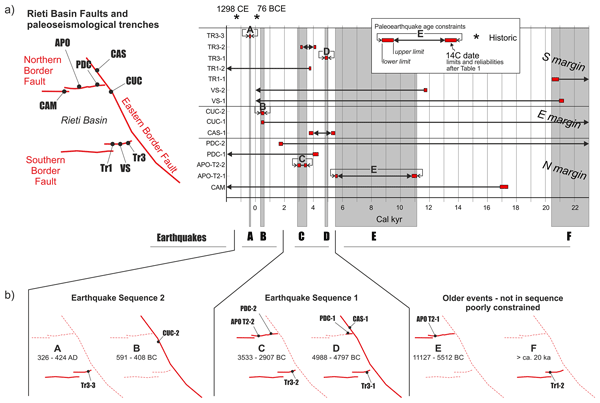
The Rieti Basin in Central Italy, though surrounded by active faults, has been largely overlooked in earthquake studies. To better understand its seismic past, we dug 17 trenches and discovered evidence of 15 ancient earthquakes over the past ca. 20 000 years. The findings show that earthquakes in this area tend to cluster in time, likely due to stress shifting between nearby faults, and can reach a magnitude of 6.5.
Giorgio Tringali, Domenico Bella, Franz A. Livio, Anna Maria Blumetti, Gianluca Groppelli, Luca Guerrieri, Marco Neri, Vincenzo Adorno, Rosario Pettinato, Sara Trotta, and Alessandro M. Michetti
Solid Earth, 16, 1473–1491, https://doi.org/10.5194/se-16-1473-2025, https://doi.org/10.5194/se-16-1473-2025, 2025
Short summary
Short summary
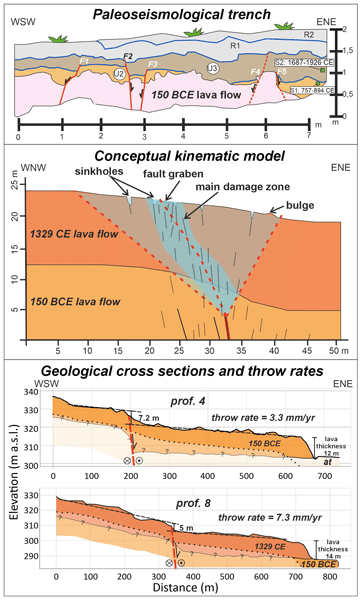
Trenches were excavated along the Fiandaca Fault providing data for relocating buildings damaged by the 2018 Mt. Etna earthquake. The paleoseismological results revealed 3 surface faulting events occurred in: 2018, 1894 and an unknown one in the Early Middle Ages. To verify a possible increase in seismicity, fault scarps were analysed conceptualizing a kinematic model and obtaining throw rate growth in the last 2 kyrs.
Emanuele Scaramuzzo, Franz A. Livio, Maria Giuditta Fellin, and Colin Maden
Solid Earth, 16, 619–640, https://doi.org/10.5194/se-16-619-2025, https://doi.org/10.5194/se-16-619-2025, 2025
Short summary
Short summary
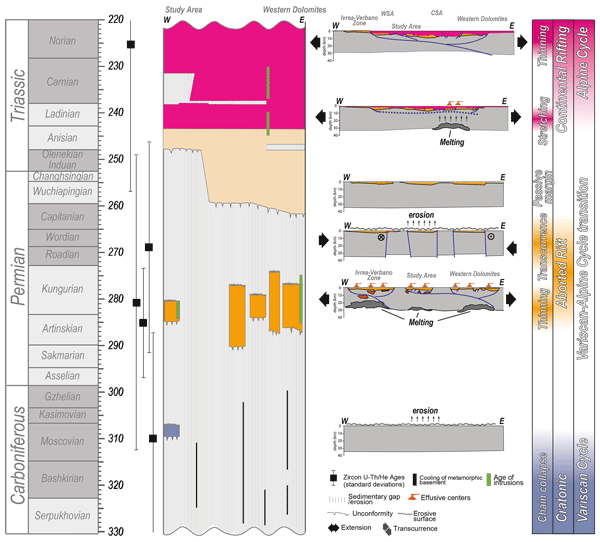
We address the transition between the Paleozoic Variscan and Alpine Mesozoic–Cenozoic cycles using tectono-stratigraphy and thermochronology. This transition unfolds through a multi-phase rifting history. An initial rifting stage occurred in the early Permian, followed in the early–middle Permian by a phase of transcurrent tectonics. This was succeeded by a period of erosion/non-deposition in the middle Permian. Crustal stretching in the Middle Triassic marked the onset of the Alpine cycle.
Franz Livio, Maria Francesca Ferrario, Elisa Martinelli, Sahra Talamo, Silvia Cercatillo, and Alessandro Maria Michetti
Nat. Hazards Earth Syst. Sci., 23, 3407–3424, https://doi.org/10.5194/nhess-23-3407-2023, https://doi.org/10.5194/nhess-23-3407-2023, 2023
Short summary
Short summary
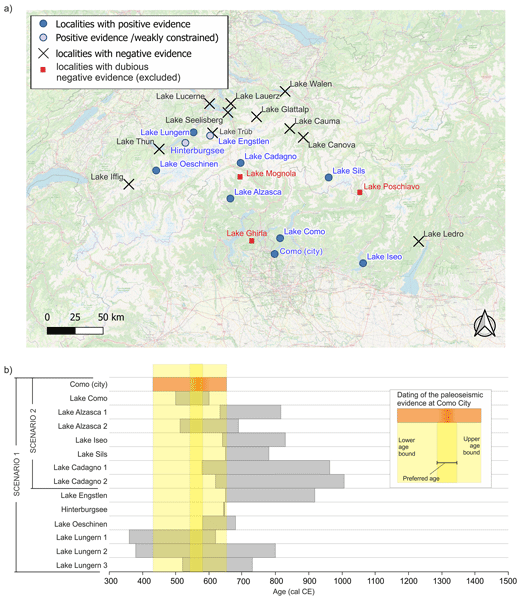
Here we document the occurrence of an historical earthquake that occurred in the European western Southern Alps in the sixth century CE. Analysis of the effects due to earthquake shaking in the city of Como (N Italy) and a comparison with dated offshore landslides in the Alpine lakes allowed us to make an inference about the possible magnitude and the location of the seismic source for this event.
Cited articles
ARPA Lombardia: Vall dataset, ARPA Lombardia [data set], https://www.arpalombardia.it/temi-ambientali/meteo-e-clima/form-richiesta-dati/, last access: 13 January 2025. a
Awasthi, S. and Varade, D.: Recent advances in the remote sensing of alpine snow: a review, GISci. Remote Sens., 58, 852—888, https://doi.org/10.1080/15481603.2021.1946938, 2021. a, b
Barnett, T. P., Adam, J. C., and Lettenmaier, D. P.: Potential impacts of a warming climate on water availability in snow-dominated regions, Nature, 438, 303–309, https://doi.org/10.1038/nature04141, 2005. a
Bartelt, P. and Lehning, M.: A physical SNOWPACK model for the Swiss avalanche warning: Part I: Numerical model, Cold Reg. Sci. Technol., 35, 123–145, https://doi.org/10.1016/S0165-232X(02)00074-5, 2002. a
Baumgartner, F., Jezek, K., Forster, R. R., Gogineni, S. P., and Zabel, I. H. H.: Spectral and angular ground-based radar backscatter measurement of Greenland snow facies, IEEE Int. Geosci. Remote Sens. Symposium, 2, 1053–1055, https://doi.org/10.1109/igarss.1999.774530, 1999. a
Besic, N., Vasile, G., Chanussot, J., Stankovic, S., Dedieu, J.-P., d'Urso, G., Boldo, D., and Ovarlez, J.-P.: Dry snow backscattering sensitivity on density change for SWE estimation, IEEE Int. Geosci. Remote Sens. Symposium, 4418–4421, https://doi.org/10.1109/IGARSS.2012.6350393, 2012. a, b
Brangers, I., Marshall, H.-P., De Lannoy, G., Dunmire, D., Mätzler, C., and Lievens, H.: Tower-based C-band radar measurements of an alpine snowpack, The Cryosphere, 18, 3177–3193, https://doi.org/10.5194/tc-18-3177-2024, 2024. a, b, c, d
Breiman, L.: Random Forests, Mach. Learn., 45, 5–32, https://doi.org/10.1023/A:1010933404324, 2001. a
Bühler, Y., Stoffel, A., and Salzmann, C. M.: Photogrammetric Drone Data Dorfberg, EnviDat [data set], https://doi.org/10.16904/envidat.376, 2022. a, b
Chang, W., Tan, S., Lemmetyinen, J., Tsang, L., Xu, X., and Yueh, S. H.: Dense media radiative transfer applied to SnowScat and SnowSAR, IEEE J. Sel. Top. Appl. Earth Obs., 7, 3811–3825, https://doi.org/10.1109/JSTARS.2014.2343519, 2014. a
Colbeck, S. C.: An overview of seasonal snow metamorphism, Rev. Geophys., 20, 45–61, https://doi.org/10.1029/RG020i001p00045, 1982. a
Copernicus Browser: Copernicus [data set], https://browser.dataspace.copernicus.eu/?zoom=5&lat=50.16282&lng=20.78613&themeId=DEFAULT-THEME&visualizationUrl=U2FsdGVkX1%2FUoSuL6eKzKziKrUW9wityFi8H7G%2BVZd6v4xK%2Bv4bFpx%2Fn4NoTSqx8d%2BvEQK%2FwZFyd93iNrEO1qFZh%2BikB1Pxd12Nbefbz32zhK1kvVuQSktnA1yDFstfz&datasetId=S2_L2A_CDAS&demSource3D=%22MAPZEN%22&cloudCoverage=30&dateMode=SINGLE, last access: 13 January 2025. a, b
Das, D. and Pandey, A.: Soil moisture retrieval from dual-polarized Sentinel-1 SAR data over agricultural regions using a water cloud model, Environ. Monit. Assess., 197, 52, https://doi.org/10.1007/s10661-024-13510-4, 2024. a
Dramis, F. and Guglielmin, M.: Permafrost Investigations in the Italian Mountains: The State of the Art, Springer, NATO Sci. S., 76, https://doi.org/10.1007/978-94-010-0684-2_17, 2001. a
EAWS, European Avalanche Warning Service: https://www.avalanches.org/fatalities/, last access: 13 January 2025. a
Engeset, R. V., Ekker, R., Humstad, T., and Landrø, M.: Varsom:regobs – a common real-time picture of the hazard situation shared by mobile information technology, Proceedings of the International Snow Science Workshop, Innsbruck, Austria, 1573–1577, https://arc.lib.montana.edu/snow-science/item/2822 (last access: 28 January 2026), 2018. a
European Union, Copernicus Global Digital Elevation Model (GLO-30): https://dataspace.copernicus.eu/explore-data/data-collections/copernicus-contributing-missions/collections-description/COP-DEM, last access: 13 January 2025. a
Hauke, J. and Kossowski, T.: Comparison of values of Pearson's and Spearman's correlation coefficients on the same sets of data, Quest. Geographicae, 30, 87–93, https://doi.org/10.2478/v10117-011-0021-1, 2011. a
Jans, J. F., Beernaert, E., De Breuck, M., Brangers, I., Dunmire, D., De Lannoy, G., and Lievens, H.: Sensitivity of Sentinel-1 C-band SAR backscatter, polarimetry and interferometry to snow accumulation in the Alps, Remote Sens. Environ., 316, 114477, https://doi.org/10.1016/j.rse.2024.114477, 2025. a, b, c, d, e, f, g
Kaplan, G., Fine, L., Lukyanov, V., Manivasagam, V.S., Tanny, J., and Rozenstein, O.: Normalizing the local incidence angle in sentinel-1 imagery to improve leaf area index, vegetation height, and crop coefficient estimations, Land, 10, 680, https://doi.org/10.3390/land10070680, 2021. a
Kapper, K. L., Goelles, T., Muckenhuber, S., Trügler, A., Abermann, J., Schlager, B., Gaisberger, C., Eckerstorfer, M., Grahn, J., Malnes, E., Prokop, A., and Schöner, W.: Automated snow avalanche monitoring for Austria: State of the art and roadmap for future work, Front. Remote Sens., 4, https://doi.org/10.3389/frsen.2023.1156519, 2023. a
Kendra, J. R., Sarabandi, K., and Ulaby, F. T.: Radar measurements of snow: experiment and analysis, IEEE T. Geosci. Remote, 36, 864–879, https://doi.org/10.1109/36.673679, 1998. a, b
Lemos, A. and Riihelä, A.: Snow depth derived from Sentinel-1 compared to in situ observations in northern Finland, The Cryosphere, 19, 3939–3947, https://doi.org/10.5194/tc-19-3939-2025, 2025. a
Li, H. and Wang, Z., and He, G., and Man, W.: Estimating Snow Depth and Snow Water Equivalence Using Repeat-Pass Interferometric SAR in the Northern Piedmont Region of the Tianshan Mountains, J. Sens., 2017, 8739598, https://doi.org/10.1155/2017/8739598, 2017. a
Lievens, H., Demuzere, M., Marshall, H. P., Reichle, R. H., Brucker, L., Brangers, I., de Rosnay, P., Dumont, M., Girotto, M., Immerzeel, W. W., Jonas, T., Kim, E. J., Koch, I., Marty, C., Saloranta, T., Schöber, J., and De Lannoy, G. J. M.: Snow depth variability in the Northern Hemisphere mountains observed from space, Nat. Commun., 10, 4629, https://doi.org/10.1038/s41467-019-12566-y, 2019. a, b, c, d
Lievens, H., Brangers, I., Marshall, H.-P., Jonas, T., Olefs, M., and De Lannoy, G.: Sentinel-1 snow depth retrieval at sub-kilometer resolution over the European Alps, The Cryosphere, 16, 159–177, https://doi.org/10.5194/tc-16-159-2022, 2022. a, b
Mandal, D., Kumar, V., Ratha, D., Dey, S., Bhattacharya, A., Lopez-Sanchez, J. M., McNairn, H., and Rao, Y. S.: Dual polarimetric radar vegetation index for crop growth monitoring using sentinel-1 SAR data, Remote Sens. Environ., 247, 111954, https://doi.org/10.1016/j.rse.2020.111954, 2020. a, b
Mariani, A., Abrahamsen, A. B., Bridle, D., Ingeman-Nielsen, T., Cicoira, A., Monti, F., and Marcer, M.: Snowpack and avalanche characterization over the 2021–2022 winter season in Sisimiut, West Greenland, Front. Earth. Sci., 11, 1134728, https://doi.org/10.3389/feart.2023.1134728, 2023. a
Mariani, A., Dellarole, L., Borsotti, J., Villa, G., and Monti, F.: A new operational approach for the daily assessment of potential avalanche danger, Proceedings of the International Snow Science Workshop, Tromsø, Norway, 23–29 September 2024, 116–123, https://arc.lib.montana.edu/snow-science/item.php?id=3122 (last access: 28 January 2026), 2024. a
Mätzler, C.: Applications of the interaction of microwaves with the natural snow cover, Remote Sens. Rev., 2, 259–387, https://doi.org/10.1080/02757258709532086, 1987. a
Mitterer, C., Techel, F., Fierz, C., and Schweizer, J.: An operational supporting tool for assessing wet-snow avalanche danger, Proceedings of the International Snow Science Workshop, Grenoble, Chamonix Mont-Blanc, 334–338, https://arc.lib.montana.edu/snow-science/item.php?id=1860 (last access: 28 January 2026), 2013. a
Monti, F., Steinkogler, W., and Mitterer, C.: Livigno (Italy) Freeride project, Proceedings of the International Snow Science Workshop, Banff, Canada, 1066–1070, https://arc.lib.montana.edu/snow-science/item.php?id=2201 (last access: 28 January 2026), 2014. a
Monti, F., Mitterer, C., Steinkogler, W., Bavay, M., and Pozzi, A.: Combining snowpack models and observations for better avalanche danger assessments, Proceedings of the International Snow Science Workshop, Breckenridge, CO, USA, 343–348, https://arc.lib.montana.edu/snow-science/item.php?id=2290 (last access: 28 January 2026), 2016. a
Nagler, T. and Rott, H.: Retrieval of Wet Snow by Means of Multitemporal SAR Data, IEEE T. Geosci. Remote, 38, 754–765, https://doi.org/10.1109/36.842004, 2000. a, b
Nagler, T., Rott, H., Ripper, E., Bippus, G., and Hetzenecker, M.: Advancements for snowmelt monitoring by means of Sentinel-1 SAR, Remote Sens., 8, 348, https://doi.org/10.3390/rs8040348, 2016. a, b, c
Oveisgharan, S., Zinke, R., Hoppinen, Z., and Marshall, H. P.: Snow water equivalent retrieval over Idaho – Part 1: Using Sentinel-1 repeat-pass interferometry, The Cryosphere, 18, 559–574, https://doi.org/10.5194/tc-18-559-2024, 2024. a
Paloscia, S., Pettinato, S., Santi, E., and Valt, M.: Cosmo-skymed image investigation of snow features in alpine environment, Sensors, 17, 84, https://doi.org/10.3390/s17010084, 2017. a
Patil, A., Singh, G., and Rüdiger, C.: Retrieval of snow depth and snow water equivalent using dual polarization SAR data, Remote Sens., 12, 1183, https://doi.org/10.3390/rs12071183, 2020. a
Pettinato, S., Santi, E., Brogioni, M., Paloscia, S., Palchetti, E., and Xiong, C.: The potential of COSMO-SkyMed SAR images in monitoring snow cover characteristics, IEEE Geosci. Remote Sens., 10, 9–13, https://doi.org/10.1109/LGRS.2012.2189752, 2013. a, b
Picard, G., Leduc-Leballeur, M., Banwell, A. F., Brucker, L., and Macelloni, G.: The sensitivity of satellite microwave observations to liquid water in the Antarctic snowpack, The Cryosphere, 16, 5061–5083, https://doi.org/10.5194/tc-16-5061-2022, 2022. a
Plattner, C. H., Braun, L. N., and Brenning, A.: Spatial variability of snow accumulation on Vernagtferner, Austrian Alps, in winter 2003/2004, Z. Gletscherkunde Glazialgeologie, 39, 43–57, 2004. a
Reppucci, A., Banque, X., Zhan, Y., Alonso, A., and López-Martinez, C.: Estimation of snow pack characteristics by means of polarimetric SAR data, Remote Sens. Agr. Ecosyst. Hydrol., XIV, 85310Z, https://doi.org/10.1117/12.974598, 2012. a
Rott, H., Nagler, T., and Scheiber, R.: Snow mass retrieval by means of SAR interferometry, Proc. of FRINGE Workshop, Frascati, Italy, 1–5, https://www.researchgate.net/publication/228990055_Snow_mass_retrieval_by_means_of_SAR_interferometry (last access: 28 January 2026), 2003. a
Rott, H., Cline, D. W., Duguay, C., Essery, R., Etchevers, P., Hajnsek, I., Kern, M., MacElloni, G., Malnes, E., Pulliainen, J., and Yueh, S. H.: CoReH2O, a dual frequency radar mission for snow and ice observations, IEEE Int. Geosci. Remote, 5550–5553, https://doi.org/10.1109/IGARSS.2012.6352348, 2012. a
Rott, H., Scheiblauer, S., Wuite, J., Krieger, L., Floricioiu, D., Rizzoli, P., Libert, L., and Nagler, T.: Penetration of interferometric radar signals in Antarctic snow, The Cryosphere, 15, 4399–4419, https://doi.org/10.5194/tc-15-4399-2021, 2021. a
Small, D.: Flattening gamma: Radiometric terrain correction for SAR imagery, IEEE T. Geosci. Remote, 49, 3081–3093, https://doi.org/10.1109/TGRS.2011.2120616, 2011. a
Snehmani, Singh, M. K., Gupta, R. D., Bhardwaj, A., and Joshi, P. K.: Remote sensing of mountain snow using active microwave sensors: a review, Geocarto Int., 30, 1–27, https://doi.org/10.1080/10106049.2014.883434, 2015. a
Soncini, A. and Bocchiola, D.: Assessment of future snowfall regimes within the Italian Alps using general circulation models, Cold Reg. Sci. Technol., 68, 113–123, https://doi.org/10.1016/J.COLDREGIONS.2011.06.011, 2011. a
Strozzi, T., Wiesmann, A., and Mätzler, C.: Active microwave signatures of snow covers at 5.3 and 35 GHz, Radio Sci., 32, 479–495, https://doi.org/10.1029/96RS03777, 1997. a, b
Tiuri, M., Sihvola, A., Nyfors, E., and Hallikaiken, M.: The complex dielectric constant of snow at microwave frequencies, IEEE J. Oceanic Eng., 9, 377–382, https://doi.org/10.1109/JOE.1984.1145645, 1984. a, b, c
Tsai, Y. L. S., Dietz, A., Oppelt, N., and Kuenzer, C.: Remote sensing of snow cover using spaceborne SAR: A review, Remote Sens., 11, 1456, https://doi.org/10.3390/rs11121456, 2019. a
Tsang, L., Durand, M., Derksen, C., Barros, A. P., Kang, D.-H., Lievens, H., Marshall, H.-P., Zhu, J., Johnson, J., King, J., Lemmetyinen, J., Sandells, M., Rutter, N., Siqueira, P., Nolin, A., Osmanoglu, B., Vuyovich, C., Kim, E., Taylor, D., Merkouriadi, I., Brucker, L., Navari, M., Dumont, M., Kelly, R., Kim, R. S., Liao, T.-H., Borah, F., and Xu, X.: Review article: Global monitoring of snow water equivalent using high-frequency radar remote sensing, The Cryosphere, 16, 3531–3573, https://doi.org/10.5194/tc-16-3531-2022, 2022. a
Ulaby, F. T. and Herschel Stiles, W.: Microwave response of snow, Adv. Space Res., 1, 131–149, https://doi.org/10.1016/0273-1177(81)90389-6, 1981. a
Varsom Regobs: Snow observations, Varsom Regobs [data set], https://regobs.no/?SelectedNumberOfDays=3&&NWLat=72.47527631092942&NWLon=-21.621093750000004&SELat=55.178867663282006&SELon=89.384765625, last access: 13 January 2025. a
Velsand, P.: Comparison and classification of an Arctic Transitional snow climate in Tromsø, Norway, The Artic University of Norway, Tromsø, Norway, https://api.semanticscholar.org/CorpusID:134889729 (last access: 28 January 2026), 2017. a
Wiesmann, A., Strozzi, T., Werner, C., Wegmuller, U., and Santoro, M.: Microwave remote sensing of alpine snow, IEEE International Geoscience and Remote Sensing Symposium, 1223–1227, https://doi.org/10.1109/IGARSS.2007.4423026, 2007. a
Yommy, A. S., Liu, R., and Wu, A. S.: SAR image despeckling using refined Lee filter, 7th Int. C. Intel. Hum. Mach., Hangzhou, China, 260–265, https://doi.org/10.1109/IHMSC.2015.236, 2015. a
Short summary
We developed a new model to estimate snow depth using radar satellite data. By correcting for how the viewing angle affects signal reflection, we reduced errors by nearly 40 %. Tested in the Alps and Norway, the method improves fine-scale snow monitoring, supporting avalanche forecasting and water management.
We developed a new model to estimate snow depth using radar satellite data. By correcting for...


