
Articles | Volume 20, issue 11
https://doi.org/10.5194/tc-20-7013-2026
© Author(s) 2026. This work is distributed under
the Creative Commons Attribution 4.0 License.
https://doi.org/10.5194/tc-20-7013-2026
© Author(s) 2026. This work is distributed under
the Creative Commons Attribution 4.0 License.
Brief communication
| 
27 Nov 2026
Brief communication |
| 27 Nov 2026
Brief communication: The Interdecadal Pacific Oscillation is not a reliable indicator of the timing of an ice-free Arctic
Christopher Wyburn-Powell
CORRESPONDING AUTHOR

Department of Atmospheric and Oceanic Science and Institute of Arctic and Alpine Research, University of Colorado Boulder, Boulder, Colorado.
Alexandra Jahn
Department of Atmospheric and Oceanic Science and Institute of Arctic and Alpine Research, University of Colorado Boulder, Boulder, Colorado.
Related authors
Annelies Sticker, François Massonnet, Thierry Fichefet, Patricia DeRepentigny, Alexandra Jahn, David Docquier, Christopher Wyburn-Powell, Daphne Quint, Erica Shivers, and Makayla Ortiz
The Cryosphere, 19, 3259–3277, https://doi.org/10.5194/tc-19-3259-2025, https://doi.org/10.5194/tc-19-3259-2025, 2025
Short summary
Short summary
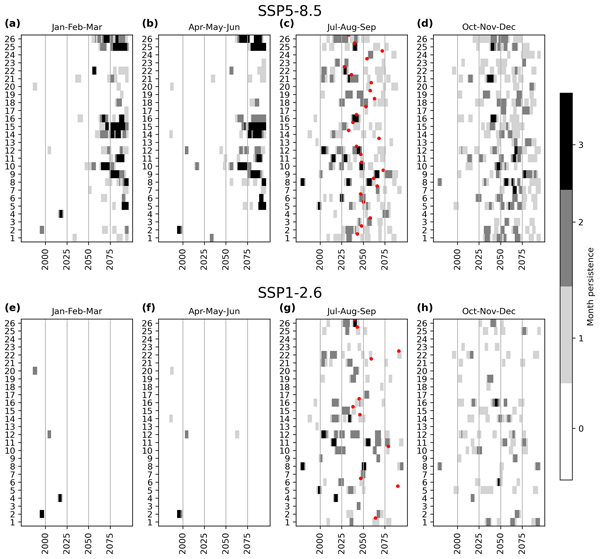
Our study analyzes rapid ice loss events (RILEs) in the Arctic, which are significant reductions in sea ice extent. RILEs are expected throughout the year, varying in frequency and duration with the seasons. Our research gives a year-round analysis of their characteristics in climate models and suggests that summer RILEs could begin before the middle of the century. Understanding these events is crucial as they can have profound impacts on the Arctic environment.
Annelies Sticker, Francois Massonnet, Thierry Fichefet, Alexandra Jahn, David A. Bailey, and Benjamin Richaud
EGUsphere, https://doi.org/10.5194/egusphere-2026-4173, https://doi.org/10.5194/egusphere-2026-4173, 2026
Short summary
Short summary
Arctic sea ice has been shrinking for decades, and climate projections suggest this decline will continue, punctuated by episodes of rapid and abrupt sea ice loss. Using a climate model ensemble, our results show that thermodynamic processes, particularly melting at the base of the ice, are the dominant driver of these events. Dynamic processes contribute only a minor fraction. These findings lay the groundwork for developing early warning indicators of rapid Arctic sea ice loss.
Annelies Sticker, François Massonnet, Thierry Fichefet, Patricia DeRepentigny, Alexandra Jahn, David Docquier, Christopher Wyburn-Powell, Daphne Quint, Erica Shivers, and Makayla Ortiz
The Cryosphere, 19, 3259–3277, https://doi.org/10.5194/tc-19-3259-2025, https://doi.org/10.5194/tc-19-3259-2025, 2025
Short summary
Short summary
Our study analyzes rapid ice loss events (RILEs) in the Arctic, which are significant reductions in sea ice extent. RILEs are expected throughout the year, varying in frequency and duration with the seasons. Our research gives a year-round analysis of their characteristics in climate models and suggests that summer RILEs could begin before the middle of the century. Understanding these events is crucial as they can have profound impacts on the Arctic environment.
Bjorn Stevens, Stefan Adami, Tariq Ali, Hartwig Anzt, Zafer Aslan, Sabine Attinger, Jaana Bäck, Johanna Baehr, Peter Bauer, Natacha Bernier, Bob Bishop, Hendryk Bockelmann, Sandrine Bony, Guy Brasseur, David N. Bresch, Sean Breyer, Gilbert Brunet, Pier Luigi Buttigieg, Junji Cao, Christelle Castet, Yafang Cheng, Ayantika Dey Choudhury, Deborah Coen, Susanne Crewell, Atish Dabholkar, Qing Dai, Francisco Doblas-Reyes, Dale Durran, Ayoub El Gaidi, Charlie Ewen, Eleftheria Exarchou, Veronika Eyring, Florencia Falkinhoff, David Farrell, Piers M. Forster, Ariane Frassoni, Claudia Frauen, Oliver Fuhrer, Shahzad Gani, Edwin Gerber, Debra Goldfarb, Jens Grieger, Nicolas Gruber, Wilco Hazeleger, Rolf Herken, Chris Hewitt, Torsten Hoefler, Huang-Hsiung Hsu, Daniela Jacob, Alexandra Jahn, Christian Jakob, Thomas Jung, Christopher Kadow, In-Sik Kang, Sarah Kang, Karthik Kashinath, Katharina Kleinen-von Königslöw, Daniel Klocke, Uta Kloenne, Milan Klöwer, Chihiro Kodama, Stefan Kollet, Tobias Kölling, Jenni Kontkanen, Steve Kopp, Michal Koran, Markku Kulmala, Hanna Lappalainen, Fakhria Latifi, Bryan Lawrence, June Yi Lee, Quentin Lejeun, Christian Lessig, Chao Li, Thomas Lippert, Jürg Luterbacher, Pekka Manninen, Jochem Marotzke, Satoshi Matsouoka, Charlotte Merchant, Peter Messmer, Gero Michel, Kristel Michielsen, Tomoki Miyakawa, Jens Müller, Ramsha Munir, Sandeep Narayanasetti, Ousmane Ndiaye, Carlos Nobre, Achim Oberg, Riko Oki, Tuba Özkan-Haller, Tim Palmer, Stan Posey, Andreas Prein, Odessa Primus, Mike Pritchard, Julie Pullen, Dian Putrasahan, Johannes Quaas, Krishnan Raghavan, Venkatachalam Ramaswamy, Markus Rapp, Florian Rauser, Markus Reichstein, Aromar Revi, Sonakshi Saluja, Masaki Satoh, Vera Schemann, Sebastian Schemm, Christina Schnadt Poberaj, Thomas Schulthess, Cath Senior, Jagadish Shukla, Manmeet Singh, Julia Slingo, Adam Sobel, Silvina Solman, Jenna Spitzer, Philip Stier, Thomas Stocker, Sarah Strock, Hang Su, Petteri Taalas, John Taylor, Susann Tegtmeier, Georg Teutsch, Adrian Tompkins, Uwe Ulbrich, Pier-Luigi Vidale, Chien-Ming Wu, Hao Xu, Najibullah Zaki, Laure Zanna, Tianjun Zhou, and Florian Ziemen
Earth Syst. Sci. Data, 16, 2113–2122, https://doi.org/10.5194/essd-16-2113-2024, https://doi.org/10.5194/essd-16-2113-2024, 2024
Short summary
Short summary
To manage Earth in the Anthropocene, new tools, new institutions, and new forms of international cooperation will be required. Earth Virtualization Engines is proposed as an international federation of centers of excellence to empower all people to respond to the immense and urgent challenges posed by climate change.
Marika M. Holland, Cecile Hannay, John Fasullo, Alexandra Jahn, Jennifer E. Kay, Michael Mills, Isla R. Simpson, William Wieder, Peter Lawrence, Erik Kluzek, and David Bailey
Geosci. Model Dev., 17, 1585–1602, https://doi.org/10.5194/gmd-17-1585-2024, https://doi.org/10.5194/gmd-17-1585-2024, 2024
Short summary
Short summary
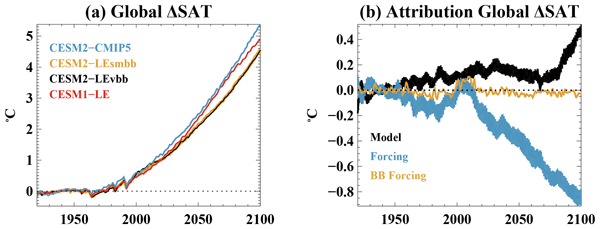
Climate evolves in response to changing forcings, as prescribed in simulations. Models and forcings are updated over time to reflect new understanding. This makes it difficult to attribute simulation differences to either model or forcing changes. Here we present new simulations which enable the separation of model structure and forcing influence between two widely used simulation sets. Results indicate a strong influence of aerosol emission uncertainty on historical climate.
Gifford H. Miller, Simon L. Pendleton, Alexandra Jahn, Yafang Zhong, John T. Andrews, Scott J. Lehman, Jason P. Briner, Jonathan H. Raberg, Helga Bueltmann, Martha Raynolds, Áslaug Geirsdóttir, and John R. Southon
Clim. Past, 19, 2341–2360, https://doi.org/10.5194/cp-19-2341-2023, https://doi.org/10.5194/cp-19-2341-2023, 2023
Short summary
Short summary
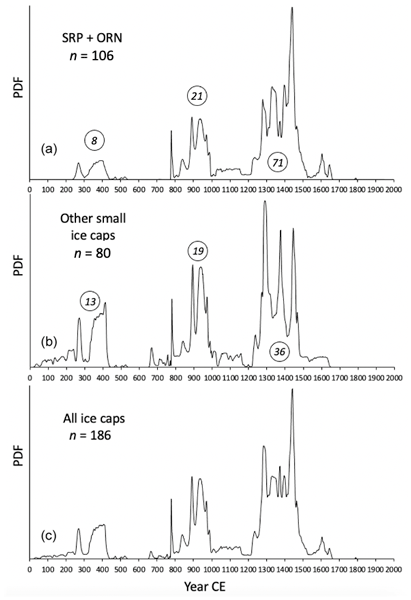
Receding Arctic ice caps reveal moss killed by earlier ice expansions; 186 moss kill dates from 71 ice caps cluster at 250–450, 850–1000 and 1240–1500 CE and continued expanding 1500–1880 CE, as recorded by regions of sparse vegetation cover, when ice caps covered > 11 000 km2 but < 100 km2 at present. The 1880 CE state approached conditions expected during the start of an ice age; climate models suggest this was only reversed by anthropogenic alterations to the planetary energy balance.
Abigail Smith, Alexandra Jahn, Clara Burgard, and Dirk Notz
The Cryosphere, 16, 3235–3248, https://doi.org/10.5194/tc-16-3235-2022, https://doi.org/10.5194/tc-16-3235-2022, 2022
Short summary
Short summary
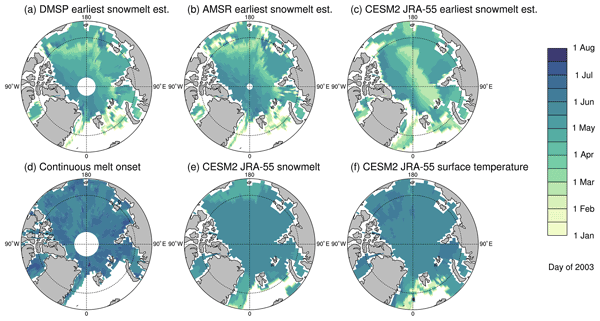
The timing of Arctic sea ice melt each year is an important metric for assessing how sea ice in climate models compares to satellite observations. Here, we utilize a new tool for creating more direct comparisons between climate model projections and satellite observations of Arctic sea ice, such that the melt onset dates are defined the same way. This tool allows us to identify climate model biases more clearly and gain more information about what the satellites are observing.
Cited articles
Årthun, M., Onarheim, I. H., Dörr, J., and Eldevik, T.: The Seasonal and Regional Transition to an Ice‐Free Arctic, Geophys. Res. Lett., 48, https://doi.org/10.1029/2020GL090825, 2021. a
Baxter, I., Ding, Q., Schweiger, A., L'Heureux, M., Baxter, S., Wang, T., Zhang, Q., Harnos, K., Markle, B., Topal, D., and Lu, J.: How tropical Pacific surface cooling contributed to accelerated sea ice melt from 2007 to 2012 as ice is thinned by anthropogenic forcing, J. Climate, 32, 8583–8602, https://doi.org/10.1175/JCLI-D-18-0783.1, 2019. a
Benjamini, Y. and Hochberg, Y.: Controlling the False Discovery Rate: a Practical and Powerful Approach to Multiple Testing, J. R. Stat. Soc., 57, 289–300, 1995. a
Bonan, D. B. and Blanchard-Wrigglesworth, E.: Nonstationary Teleconnection Between the Pacific Ocean and Arctic Sea Ice, Geophys. Res. Lett., 47, https://doi.org/10.1029/2019GL085666, 2020. a
Bonan, D. B., Lehner, F., and Holland, M. M.: Partitioning uncertainty in projections of Arctic sea ice, Environ. Res. Lett., 16, https://doi.org/10.1088/1748-9326/abe0ec, 2021. a
Danabasoglu, G., Lamarque, J. F., Bacmeister, J., Bailey, D. A., DuVivier, A. K., Edwards, J., Emmons, L. K., Fasullo, J., Garcia, R., Gettelman, A., Hannay, C., Holland, M. M., Large, W. G., Lauritzen, P. H., Lawrence, D. M., Lenaerts, J. T., Lindsay, K., Lipscomb, W. H., Mills, M. J., Neale, R., Oleson, K. W., Otto-Bliesner, B., Phillips, A. S., Sacks, W., Tilmes, S., van Kampenhout, L., Vertenstein, M., Bertini, A., Dennis, J., Deser, C., Fischer, C., Fox-Kemper, B., Kay, J. E., Kinnison, D., Kushner, P. J., Larson, V. E., Long, M. C., Mickelson, S., Moore, J. K., Nienhouse, E., Polvani, L., Rasch, P. J., and Strand, W. G.: The Community Earth System Model Version 2 (CESM2), J. Adv. Model. Earth Sys., 12, https://doi.org/10.1029/2019MS001916, 2020. a
DeRepentigny, P., Jahn, A., Holland, M. M., Kay, J. E., Fasullo, J., Lamarque, J.-F., Tilmes, S., Hannay, C., Mills, M. J., Bailey, D. A., and Barrett, A. P.: Enhanced simulated early 21st century Arctic sea ice loss due to CMIP6 biomass burning emissions, Sci. Adv., 8, 2405, https://doi.org/10.1126/sciadv.abo2405, 2022. a
Ding, Q., Wallace, J. M., Battisti, D. S., Steig, E. J., Gallant, A. J., Kim, H. J., and Geng, L.: Tropical forcing of the recent rapid Arctic warming in northeastern Canada and Greenland, Nature, 509, 209–212, https://doi.org/10.1038/nature13260, 2014. a
Fasullo, J. T., Phillips, A. S., and Deser, C.: Evaluation of Leading Modes of Climate Variability in the CMIP Archives, J. Climate, 33, 5527–5545, https://doi.org/10.1175/jcli-d-19-1024.1, 2020. a
Fetterer, F., Knowles, K., Meier, W. N., Savoie, M., and Windnagel, A. K.: Sea Ice Index (G02135, Version 3), National Snow and Ice Data Center Boulder [data set], https://doi.org/10.7265/N5K072F8, 2017. a, b, c
Hadley Centre for Climate Prediction and Research, Met Office, Ministry of Defence, United Kingdom: Hadley Centre Global Sea Ice and Sea Surface Temperature (HadISST), NSF National Center for Atmospheric Research [data set], https://doi.org/10.5065/XMYE-AN84, 2000. a
Henley, B. J., Gergis, J., Karoly, D. J., Power, S., Kennedy, J., and Folland, C. K.: A Tripole Index for the Interdecadal Pacific Oscillation, Clim. Dynam., 45, 3077–3090, https://doi.org/10.1007/s00382-015-2525-1, 2015. a, b
Holland, B. M. M. and Hunke, E. C.: A Review of Arctic Sea Ice Climate Predictability in Large-Scale Earth System Models, Oceanography, 35, 20–27, https://doi.org/10.5670/oceanog.2022.113, 2022. a
Jahn, A., Kay, J. E., Holland, M. M., and Hall, D. M.: How predictable is the timing of a summer ice-free Arctic?, Geophys. Res. Lett., 43, 9113–9120, https://doi.org/10.1002/2016GL070067, 2016. a
Jahn, A., Holland, M., and Kay, J.: Projections of an ice-free Arctic Ocean, Nat. Rev. Earth Environ., 5, 164–176, https://doi.org/10.1038/s43017-023-00515-9, 2024. a, b, c
Kay, J. E., Holland, M. M., and Jahn, A.: Inter-annual to multi-decadal Arctic sea ice extent trends in a warming world, Geophys. Res. Lett., 38, 2–7, https://doi.org/10.1029/2011GL048008, 2011. a
Kay, J. E., Deser, C., Phillips, A., Mai, A., Hannay, C., Strand, G., Arblaster, J. M., Bates, S. C., Danabasoglu, G., Edwards, J., Holland, M., Kushner, P., Lamarque, J. F., Lawrence, D., Lindsay, K., Middleton, A., Munoz, E., Neale, R., Oleson, K., Polvani, L., and Vertenstein, M.: The community earth system model (CESM) large ensemble project: A community resource for studying climate change in the presence of internal climate variability, B. Am. Meteorol. Soc., 96, 1333–1349, https://doi.org/10.1175/BAMS-D-13-00255.1, 2015. a
Kim, H., Yeh, S. W., An, S. I., and Song, S. Y.: Changes in the role of Pacific decadal oscillation on sea ice extent variability across the mid-1990s, Sci. Rep., 10, https://doi.org/10.1038/s41598-020-74260-0, 2020. a
Kirchmeier-Young, M. C., Zwiers, F. W., and Gillett, N. P.: Attribution of extreme events in Arctic Sea ice extent, J. Climate, 30, 553–571, https://doi.org/10.1175/JCLI-D-16-0412.1, 2017. a
Mauritsen, T., Bader, J., Becker, T., Behrens, J., Bittner, M., Brokopf, R., Brovkin, V., Claussen, M., Crueger, T., Esch, M., Fast, I., Fiedler, S., Fläschner, D., Gayler, V., Giorgetta, M., Goll, D. S., Haak, H., Hagemann, S., Hedemann, C., Hohenegger, C., Ilyina, T., Jahns, T., de-la Cuesta, D. J., Jungclaus, J., Kleinen, T., Kloster, S., Kracher, D., Kinne, S., Kleberg, D., Lasslop, G., Kornblueh, L., Marotzke, J., Matei, D., Meraner, K., Mikolajewicz, U., Modali, K., Möbis, B., Müller, W. A., Nabel, J. E., Nam, C. C., Notz, D., Nyawira, S. S., Paulsen, H., Peters, K., Pincus, R., Pohlmann, H., Pongratz, J., Popp, M., Raddatz, T. J., Rast, S., Redler, R., Reick, C. H., Rohrschneider, T., Schemann, V., Schmidt, H., Schnur, R., Schulzweida, U., Six, K. D., Stein, L., Stemmler, I., Stevens, B., von Storch, J. S., Tian, F., Voigt, A., Vrese, P., Wieners, K. H., Wilkenskjeld, S., Winkler, A., and Roeckner, E.: Developments in the MPI-M Earth System Model version 1.2 (MPI-ESM1.2) and Its Response to Increasing CO2, J. Adv. Model. Earth Sy., 11, 998–1038, https://doi.org/10.1029/2018MS001400, 2019. a
Notz, D.: How well must climate models agree with observations?, Philos. T. R. Soc. A, 373, https://doi.org/10.1098/rsta.2014.0164, 2015. a
Notz, D. and SIMIP-Community: Arctic Sea Ice in CMIP6, Geophys. Res. Lett., 47, https://doi.org/10.1029/2019GL086749, 2020. a, b, c, d
Phillips, A., Deser, C., and Fasullo, J.: A New Tool for Evaluating Modes of Variability in Climate Models, Eos, 95, 453–455, https://doi.org/10.1002/2014EO490002, 2014. a
Rayner, N. A., Parker, D. E., Horton, E. B., Folland, C. K., Alexander, L. V., Rowell, D. P., Kent, E. C., and Kaplan, A.: Global analyses of sea surface temperature, sea ice, and night marine air temperature since the late nineteenth century, J. Geophys. Res.-Atmos., 108, 4407, https://doi.org/10.1029/2002jd002670, 2003. a
Shiogama, H., Tatebe, H., Hayashi, M., Abe, M., Arai, M., Koyama, H., Imada, Y., Kosaka, Y., Ogura, T., and Watanabe, M.: MIROC6 Large Ensemble (MIROC6-LE): experimental design and initial analyses, Earth Syst. Dynam., 14, 1107–1124, https://doi.org/10.5194/esd-14-1107-2023, 2023. a
Simon, A., Gastineau, G., Frankignoul, C., Lapin, V., and Ortega, P.: Pacific Decadal Oscillation modulates the Arctic sea-ice loss influence on the midlatitude atmospheric circulation in winter, Weather Clim. Dynam., 3, 845–861, https://doi.org/10.5194/wcd-3-845-2022, 2022. a
Swart, N. C., Fyfe, J. C., Hawkins, E., Kay, J. E., and Jahn, A.: Influence of internal variability on Arctic sea-ice trends, Nat. Clim. Chang., 5, 86–89, https://doi.org/10.1038/nclimate2483, 2015. a
Swart, N. C., Cole, J. N. S., Kharin, V. V., Lazare, M., Scinocca, J. F., Gillett, N. P., Anstey, J., Arora, V., Christian, J. R., Hanna, S., Jiao, Y., Lee, W. G., Majaess, F., Saenko, O. A., Seiler, C., Seinen, C., Shao, A., Sigmond, M., Solheim, L., von Salzen, K., Yang, D., and Winter, B.: The Canadian Earth System Model version 5 (CanESM5.0.3), Geosci. Model Dev., 12, 4823–4873, https://doi.org/10.5194/gmd-12-4823-2019, 2019. a
Topál, D., Ding, Q., Mitchell, J., Baxter, I., Herein, M., Haszpra, T., Luo, R., and Li, Q.: An internal atmospheric process determining summertime Arctic sea ice melting in the next three decades: Lessons learned from five large ensembles and multiple CMIP5 climate simulations, J. Climate, 33, 7431–7454, https://doi.org/10.1175/JCLI-D-19-0803.1, 2020. a
Vance, T. R., Kiem, A. S., Jong, L. M., Roberts, J. L., Plummer, C. T., Moy, A. D., Curran, M. A., and van Ommen, T. D.: Pacific decadal variability over the last 2000 years and implications for climatic risk, Commun. Earth Environ., 3, https://doi.org/10.1038/s43247-022-00359-z, 2022. a
Wettstein, J. J. and Deser, C.: Internal variability in projections of twenty-first-century Arctic sea ice loss: Role of the large-scale atmospheric circulation, J. Climate, 27, 527–550, https://doi.org/10.1175/JCLI-D-12-00839.1, 2014. a
Wyburn-Powell, C.: chrisrwp/ice-free: v1.0.0 (Version v1.0.0), Zenodo [code], https://doi.org/10.5281/zenodo.24328523, 2026a. a
Wyburn-Powell, C.: Interdecadal Pacific Oscillation and Arctic sea ice concentration and extent data for large ensemble global climate models, Arctic Data Center [data set], https://doi.org/10.18739/A2CN6Z23B, 2026b. a
Wyburn-Powell, C. and Jahn, A.: Large-Scale Climate Modes Drive Low-Frequency Regional Arctic Sea Ice Variability, J. Climate, 37, 4313–4333, https://doi.org/10.1175/JCLI-D-23, 2024. a
Wyser, K., Koenigk, T., Fladrich, U., Fuentes-Franco, R., Karami, M. P., and Kruschke, T.: The SMHI Large Ensemble (SMHI-LENS) with EC-Earth3.3.1, Geosci. Model Dev., 14, 4781–4796, https://doi.org/10.5194/gmd-14-4781-2021, 2021. a
Ziehn, T., Chamberlain, M. A., Law, R. M., Lenton, A., Bodman, R. W., Dix, M., Stevens, L., Wang, Y. P., and Srbinovsky, J.: The Australian Earth System Model: ACCESS-ESM1.5, Journal of Southern Hemisphere Earth Systems Science, 70, 193–214, https://doi.org/10.1071/ES19035, 2020. a
Short summary
The Arctic Ocean is expected to become seasonally ice-free within a few decades. Previous research using one climate model showed that a major climate pattern called the Interdecadal Pacific Oscillation (IPO) could narrow predictions of when this will happen. Using a broader selection of the latest climate models, we show the IPO is not a reliable predictor of ice-free timing. However, the IPO may still influence the rate and location of Arctic sea ice reduction over the next two decades.
The Arctic Ocean is expected to become seasonally ice-free within a few decades. Previous...


Altmetrics
Final-revised paper
Preprint