
the Creative Commons Attribution 4.0 License.
the Creative Commons Attribution 4.0 License.
 | 25 Nov 2026
West Antarctic ice retreat temporarily halted with transient rheology in future climate projections

B. Parazin
Harriet C. P. Lau
Natalya Gomez
Projections of sea-level change and Antarctic Ice Sheet (AIS) stability under anthropogenic climate change hinge upon accurately describing physical feedbacks that link ice dynamics (marine and terrestrial) with the gravitational, rotational and deformational response of the solid Earth to ice and ocean loading changes. The marine West Antarctic Ice Sheet (WAIS) is vulnerable to runaway grounding line retreat. However, the rapid viscoelastic rebound of the bedrock in response to ice retreat has been shown to stabilize its grounding line, aided by the low-viscosity mantle beneath the WAIS. Such bedrock deformation is typically modelled using idealised Maxwell viscoelasticity. However, rock deformation experiments show that additional “transient” creep mechanisms, which are not captured by the Maxwell model, occur over societally relevant (∼ decadal-centennial) timescales. Here, we simulate future AIS evolution, coupled with self-consistent solid Earth deformation and sea level change, for various emissions scenarios (RCP 2.6, 4.5, 8.5), incorporating transient deformation. This more complete treatment of solid Earth deformation delays grounding line retreat as compared to Maxwell projections, with differences of tens of kilometres persisting for decades at Pine Island and Thwaites Glaciers. Though transient deformation slows glacier retreat, it is unable to prevent the bulk of ice loss and sea-level rise on longer, centennial timescales. Even still, deviations in AIS meltwater flux with transient deformation could impact climate model predictions.
- Article
(10408 KB) - Full-text XML
-
Supplement
(18438 KB) - BibTeX
- EndNote


Predictions of ice sheet and sea-level change in response to various trajectories of atmospheric carbon emissions have demonstrated the potential for dramatic ice retreat in West Antarctica (Kopp et al., 2017; Robel et al., 2019). This vulnerability to extreme ice loss is in large part because the bedrock underneath the marine-based West Antarctic Ice Sheet (WAIS) deepens from the margins toward the ice sheet interior, which predisposes the WAIS to runaway retreat via the Marine Ice Sheet Instability (Schoof, 2007; Thomas, 1979; Weertman, 1974). The flux through the grounding line, the location at which the ice sheet begins to float because it is too thin to displace the entire weight of the water column, has strong sensitivity to the thickness of ice at the grounding line (with outflow proportional to ice thickness to the power ∼ 5, Schoof, 2007.) Therefore, on such retrograde bed slopes, even a small perturbation can trigger unstable collapse as the grounding line retreats to a location with deeper bedrock and greater ice thickness. This greater grounding line ice thickness heightens ice loss through the grounding line, promoting continued retreat. Bedrock topography is one of many factors that can trigger ice sheet retreat; grounding line migration is a complex process modulated by time-evolving boundary conditions relating to ocean forcing, downstream ice shelf stability, variable ice mass accumulation, ice rheology, and basal friction and heat flow, which are spatially heterogenous (Caillet et al., 2023; Hudson et al., 2023; Sergienko et al., 2026). These unsteady phenomena enable irregular oscillations between advance and retreat and allow for unstable conditions to exist on prograde as well as retrograde slopes (Sergienko and Wingham, 2024).
By nature of this dependence on bedrock topography and slope, marine ice sheet retreat is a critical avenue for dynamical feedback between ice sheet evolution and solid Earth deformation and sea level (e.g., Gomez et al., 2010). The redistribution of ice and ocean over Earth's surface in response to an evolving climate will induce gravitational, rotational, and deformational effects on the solid Earth, collectively termed Glacial Isostatic Adjustment (GIA), which modify the timing and pattern of sea level and bedrock elevation change (Mitrovica et al., 2001). Sea-level rise at a marine grounding line (e.g. from far-field ice loss) promotes further grounding-line retreat. On the other hand, local ice loss drives local sea level fall due to solid Earth uplift and gravitational drawdown of the sea surface, which slows ice loss and stabilizes the grounding line (Barletta et al., 2018; Gomez et al., 2015; Larour et al., 2019). Changes in bedrock elevation from GIA can also impact ice sheet mass balance through modulation of ice surface temperature, with the potential to reduce surface melting and/or increase the amount of precipitation that falls as snow, aiding in mass accumulation (Zeitz et al., 2022). Studies investigating such feedbacks between solid Earth deformation, sea level, and ice sheet evolution have suggested that the coupling acts to reduce changes in ice volume over timescales of full glacial cycles (Abe-Ouchi et al., 2013; Gomez et al., 2013; Han et al., 2021).
The calculation of gravitationally self-consistent sea-level change due to the redistribution of ice and ocean mass at Earth's surface and consequently, its potential to influence ice sheet evolution, is contingent on the deformational response of the solid Earth. Typically, GIA models assume an idealized linear viscoelastic Maxwell rheology, which deforms by an instantaneous and fully recoverable elastic response and a delayed, irrecoverable viscous response, characterized by the mantle's elastic modulus and viscosity. The viscous response of a mantle with higher viscosity will be delayed longer. For such deformation, the characteristic timescale of viscoelastic deformation is known as the so-called Maxwell time, τM (defined simply by the ratio between a material's viscosity to its elastic modulus). Intuitively, any surface loading changes will induce viscoelastic deformation over timescales ≈τM. For rapid changes where loading timescales are ≪τM, elastic deformation dominates and oftentimes deformation is modelled with an entirely elastic mantle. For ice mass changes associated with modern climate change, this is often the case since τM for the mantle on average ranges between approximately 500 to 10 000 years (Hansen et al., 2021a; Spada et al., 2012; Whitehouse et al., 2012). In contrast, the full viscoelastic response is modelled in the case of GIA over ice age cycles (with timescales of 1000s to 10 000s of years). In locations like West Antarctica, however, the underlying mantle is characterized by relatively low mantle viscosity with τM≈ 10 to 100 years (Barletta et al., 2018; Lloyd et al., 2020; Lucas et al., 2025), and such an assumption of mantle elasticity cannot be made. And thus, even for some modern ice loading calculations, the viscoelastic deformation must be considered. To account for both Maxwell viscoelasticity and the large geographical variations in mantle viscosity, recent studies developed coupled models of future Antarctic ice sheet and sea level evolution that incorporate lateral variations in Earth's viscosity structure (Gomez et al., 2024a; van Calcar et al., 2025). Assuming a Maxwell viscoelastic Earth rheology, Gomez et al. (2024a) demonstrated that the consideration of 3D Earth structure could reduce the Antarctic global mean sea level (GMSL) contribution by 2500 relative to that predicted with radially symmetric Earth structure by up to 40 %.
In this paper, we argue that Maxwell viscoelasticity is insufficient to characterize solid Earth deformation, especially on modern (decadal to centennial) timescales. Evidence for this largely stems from the rock physics community, where experiments confirm that non-elastic deformation mechanisms are activated even across these timescales (decadal to centennial) and beyond (e.g., Faul et al., 2011; Gribb and Cooper, 1998; McCarthy et al., 2011; Yamauchi and Takei, 2016). The associated strains of such models are non-instantaneous, but recoverable, and we will collectively term such models as transient models (Havlin et al., 2021; Lau et al., 2021). Indeed, by incorporating a variety of transient models, a growing body of literature has demonstrated the importance of moving away from Maxwell viscoelasticity on decadal-centennial ice mass changes in several contexts (e.g. Adhikari et al., 2021; Coonin et al., 2025; Ivins et al., 2023; Lau, 2024).
Where the Maxwell viscoelastic model is characterized by a single relaxation time, τM, any transient viscoelastic model is one that includes additional relaxation times, or a continuous spectrum of relaxation times, which results in non-elastic behavior at time scales even shorter than the Maxwell time. In these models, the elastic, transient viscous, and Maxwell steady state components of strain add together to describe the total deformation response. Hence, if the Earth is weaker over shorter timescales, regardless of the assumed viscosity structure of the mantle, the magnitude and timing the solid Earth response to ice and ocean load changes and consequently, sea level and topography will differ by as much as meters (Coonin et al., 2025; Lau, 2023). In particular, decadal to centennial timescales of modern ice loss and potentially even more rapid projections of ice loss into the future will activate these transient deformation mechanisms. Lau et al. (2026) model the GIA response to Antarctic ice loss under future projections, accounting for lateral variations in both steady state mantle viscosity and transient rheology without consideration of dynamic ice sheet-sea level feedbacks. They find that deviations in near field sea level from transient solid Earth deformation are on the order of or larger than the effects of 3D Earth structure, suggesting that transient Earth rheology is an important consideration in modelling modern and future marine grounding line dynamics. However, the effect of transient viscous deformation in coupled simulations of future Antarctic ice evolution is not well understood.
Here, we modify the coupled framework of Gomez et al. (2024a) approach by incorporating transient viscoelastic deformation. While Gomez et al. (2024a) showed that laterally varying properties clearly play an important role in coupled global sea level–Antarctic ice sheet evolution, such models with 3D earth structure require significantly greater computational power. We do not take this route, instead opting for 1D (i.e., depth dependent only) mantle viscoelastic structure. Not only is this computationally more feasible, but it also allows us to isolate the effect that transient deformation alone has in modulating the solid Earth's response to modern timescales of ice loss. In this study, we explore the consequences of incorporating more realistic solid Earth rheology, namely transient rheology, in coupled ice sheet-sea level dynamics. We examine the effect of transient solid Earth rheology on the evolution of the Antarctic ice sheet for various emissions scenarios (RCPs 2.6, 4.5, and 8.5; IPCC, 2014).
2.1 Coupled ice sheet-sea level modelling
We run forward simulations of Antarctic Ice Sheet evolution using the PSU 3D ice sheet shelf model (Pollard and DeConto, 2012; Pollard et al., 2015) coupled with the gravitationally self-consistent sea-level algorithm outlined in Kendall et al. (2005) and expanded upon in Gomez et al. (2010) for use in projections. The sea level component of the model accounts for the gravitational, deformational and rotational effects from glacial isostatic adjustment, assuming a radially-varying Earth. Within this algorithm, the calculation of deformation routinely adopts Maxwell viscoelastic Earth rheology (Gomez et al., 2015; Han et al., 2022; Pollard et al., 2017) but has more recently been adapted to consider the effects of transient viscoelastic solid Earth rheology (Lau, 2024). To the authors' best knowledge, transient rheology has only recently been considered in coupled ice sheet–sea level modelling where Caron et al. (2026) modify the coupled Ice Sheet–Sea-Level System Model (ISSM) to incorporate the Extended Burgers viscoelastic model (Faul and Jackson, 2015) for solid Earth deformation, which is utilized in Houriez et al. (2025) to investigate the sensitivity of the viscoelastic stabilization effect on Thwaites Glacier in the WAIS to spatiotemporal resolution. Houriez et al. (2025) compare their viscoelastic coupled simulations to elastic-only and uncoupled GIA models. However, it remains unclear how coupled ice sheet-sea level projections that incorporate transient deformation differ from coupled models with idealized Maxwell Earth. rheology. Here, we take this further and isolate the effects of transient deformation in the coupled ice-sheet sea level evolution under a realistic climate scenarios which we describe below.
Required inputs for the ice sheet model are the bedrock topography, basal sliding coefficients, geothermal heat flux, sea-level, and air temperature and precipitation outputs from a climate model of the RCP climate projections (IPCC, 2014) as in Gomez et al. (2024a) and DeConto et al. (2021). Required inputs for the sea level model include the initial bedrock topography, the ice mass distribution changes (here, generated by the PSU 3D ice model), and the Love numbers corresponding to the chosen radially varying viscoelastic Earth model (see Fig. S2 in the Supplement; Kendall et al., 2005). Love number theory is a Green function approach to determining the viscoelastic deformation of the solid Earth and the Earth's gravity field, given a surface load history. The ice sheet and sea-level models communicate via offline coupling with a timestep of 10 years. That is, under the prescribed climate forcing, the ice sheet model runs with the specified internal time-stepping (here set to ∼ 18 d as in DeConto et al., 2021; Fig. S4) until the coupling time is reached. At this point, the associated ice volume changes are then fed into the sea-level model to calculate changes in sea-level and bedrock topography. These fields are sent back to the ice model, thereby impacting ongoing ice sheet evolution. The coupling time step of 10 years was chosen to balance resolution with computation time, since sensitivity tests for the coupling time step showed minimal differences for the choice of 25-, 10-, or 2-year coupling time steps (see Fig. S3). Forward calculations of global sea-level change are performed to spherical harmonic degree 512 (∼ 80 km resolution), and a spatial resolution of 10 km is used within the ice sheet model. Unfortunately, finer spatial resolutions are computationally infeasible for continental-scale calculations (Gomez et al., 2024a). To isolate the effects of the choice of solid Earth rheology on Antarctic Ice Sheet evolution, we hold ice volume and extent constant over the remainder of the globe, hence any changes in GMSL are the result of Antarctic Ice Sheet changes only.
2.2 Ice sheet dynamics
The dynamic ice component is a hybrid ice sheet-shelf model employing the shallow ice and shallow shelf approximations for ice flow (which account for vertical shearing and longitudinal stretching respectively), ensuring computational feasibility for continental-scale simulations (Pollard and DeConto, 2012). The ice sheet model setup is identical to that of DeConto et al. (2021) and Gomez et al. (2024a), with a 100 000-year spin-up of the ice sheet model using observed climate forcing and Antarctic bathymetry from Bedmap2 (Fretwell et al., 2013). A modified version of the Schoof (2007) parametrization for ice flux through the grounding line is adopted, allowing for evolving grounding line position and self-consistency with the basal shear stress condition at the grounding line (Pollard and DeConto, 2012, 2020; Schoof, 2007). Surface mass balance is calculated by a positive-degree day scheme using RCP temperature and precipitation forcings. The parametrization for basal melting accounts for frictional heating due to shear, and sub-ice oceanic melting closely follows the parametrization of Martin et al. (2011) and is described in Pollard and DeConto (2012).
Calving of floating ice, though still poorly understood, is also an important mass balance consideration for tidewater glaciers and ice shelves because floating ice can stabilize grounded ice upstream by means of buttressing at the grounding line (Gudmundsson, 2013; Sergienko, 2025). We consider two endmembers to describe ice loss through calving – a parametrization based on the large–scale stress field of the ice sheet where calving is related to the thickness of the ice shelf and is proportional to the positive divergence of floating ice velocity for thicker ice shelves (Nick et al., 2010) and the highly debated Marine Ice Cliff Instability (MICI), with the parametrization of Pollard et al. (2015), which accounts for hydrofracturing due to surface melt and failure of vertical cliff faces (Bassis et al., 2021; Golledge and Lowry, 2021; Pollard et al., 2015). The main results presented in this paper reflect the former, though we explore a possible scenario of accelerated retreat due to the MICI (see Sect. 4.3). Reese et al. (2018) demonstrate that cumulative grounding line fluxes for heavily buttressed ice shelves (e.g., at modern-day Pine Island and Thwaites glaciers) are underestimated using the Schoof (2007) grounding line flux parametrization, as compared to fluxes estimated using a finite element ice flow model. However, such heavily buttressed conditions are not expected to be prevalent beyond modern ice extent in simulations of future West Antarctic ice sheet retreat with the PSU 3D ice model because grounding zones readily retreat into wide interior basins, which are less sensitive to buttressing than are narrower embayments (Pollard and DeConto, 2020). As such, the simulations presented in this paper may underestimate ice flux through the grounding line near Pine Island and Thwaites Glaciers, especially earlier on in the simulations when ice shelf buttressing is strongest. For the purposes of this study, that is the effect that different viscoelastic models of rheology have on the ice-GIA coupling, both versions of viscoelastic Earth models inherit this underestimation. If the PSU 3D ice model systematically underestimates grounding line flux at Pine Island and Thwaites glaciers, and in reality, more grounded ice mass loss would be expected than simulated here, there should be even more deviation between Maxwell and transient Earth model responses, even for the less extreme climate forcing scenarios, since more rapid ice loss would trigger a stronger solid Earth deformation response with a transient Earth rheology model than the Maxwell Earth rheology model. Hence, the deviations in coupled ice sheet-sea level evolution presented here can be considered a conservative estimate of the sensitivity to transient solid Earth deformation.
2.3 Solid Earth Structure and Rheology
While we focus on West Antarctica here, we considered two distinct 1D Earth models to represent the geological dichotomy of the Antarctic continent, where East Antarctica is characterized by cold cratonic structure and West Antarctica is characterized by thin lithosphere underlain by relatively warm mantle (Lloyd et al., 2020; Lucas et al., 2025). For both models, however, we assume the elastic and density properties based on the Preliminary Reference Earth Model (Dziewonski and Anderson, 1981). The elastic properties of the mantle are much less sensitive to temperature differences than the viscous properties, where the steady state, or Maxwell, viscosities differ by orders of magnitude. In accordance with East Antarctic structure, we assume a steady state viscosity profile (hereafter referred to as ηH, as in higher steady state viscosity model), which is comprised of a 96 km-thick lithosphere, an upper mantle viscosity of 1020 Pa s, and a lower mantle viscosity of 5 × 10²¹ Pa s (> 670 km depth). To reflect West Antarctic mantle structure, we assume a reduced steady state viscosity model (hereafter referred to as ηL) with a 50 km-thick lithosphere overlying a zone with reduced viscosity down to 400 km depth with a viscosity of 1019 Pa s, a viscosity of 2 × 10²⁰ Pa s for the remainder of the upper mantle, and a lower mantle viscosity (> 670 km depth) of 3 × 10²¹ Pa s. As in Gomez et al. (2024a), the sea level model begins in equilibrium at the start of the simulations in 1950 and we do not consider the ongoing effects of loading prior to the year 1950, which will be relatively small compared to the GIA driven by ongoing ice mass changes during the simulation. In order to model the entire continent self-consistently in a way that captures the East-West dichotomy, we would require a 3D model of GIA (as in Gomez et al., 2024a). As mentioned, such 3D GIA model simulations are computationally expensive and we emphasize that our approach (i.e., to run full simulations with two distinct 1D Earth models) is a reasonable approximation to model the impact of transient deformation on each side of the continent, since our focus, as we shall see, will be on deformation in the direct vicinity of each region.
With these mantle properties, we calculate the viscoelastic Love numbers using the methodology outlined in Lau (2024). We do this for both a Maxwell viscoelastic rheology – which we will treat as our reference calculation – and for a transient viscoelastic rheology, adopting the empirical law of Yamauchi and Takei (2016) for both 1D Earth models. The Yamauchi and Takei (2016) transient rheology model accounts for the observed weakening across timescales spanning the elastic to steady state and can conveniently be scaled to a particular reference Maxwell model (see Sect. S1 in the Supplement for more details on these models). We compare the coupled ice sheet-sea level modelling results for simulations with the same steady state Earth structure but with Maxwell versus transient viscoelastic solid Earth rheology to assess the impact of including transient viscoelastic deformation on sea level and ice sheet evolution for the prescribed climate forcing between 1950 to 2500 (RCP 2.5, RCP 4.5, RCP 8.5; IPCC, 2014). An Earth with transient solid Earth rheology will be more sensitive to the pace of ice melting over timescales smaller than typical Maxwell relaxation times. Given that our planet's actual trajectory of radiative forcing is unknown, we explore multiple climate change scenarios and further modify the rate of ice loss in each climate scenario further by invoking the rapid ice loss via MICI.
2.4 Calculating Antarctic Global Mean Sea Level Contribution
Mass balance can be used to estimate the GMSL contribution associated with the simulated co-evolution of ice sheet and sea-level change. In consideration of the effects of transient Earth deformation on predictions of the Antarctic contribution to GMSL, we neglect steric changes and adopt the modified volume above floatation (VAF) method described in Eq. (1) of Gomez et al. (2024a), which is applicable for cases where there are minimal changes in ice sheets and/or shorelines outside of Antarctica. This formulation accounts for water expulsion from regions of Antarctica below sea level to the remainder of the ocean. While globally, the ice mass lost will be equal to the mass gained by the ocean, in this paper we consider the Antarctic GMSL contribution to be the global average sea level rise in the rest of the world due to Antarctic ice loss and the gravitational, rotational, and deformational feedbacks from GIA. We present the deviations in GMSL predictions, uplift, ice volume, and marine grounding line dynamics in West Antarctica due to the inclusion of transient Earth deformation in the following section.
Figure 1 shows the initial ice configuration for all simulations (1950 CE; Fig. 1a) and the change in ice thickness between 1950 and 2500 CE across West Antarctica with the ηL steady state viscosity with Maxwell solid Earth rheology, our reference case (Fig. 1b.i RCP 2.6; Fig. 1b.ii RCP 4.5; Fig. 1b.iii RCP 8.5). We note that in all map figures, the unshaded region is that in which the background viscoelastic structure is appropriate (e.g., for an unshaded Western Antarctic region, the simulation adopted the ηL steady state profile). Projected ice loss under RCP 8.5 in West Antarctica is drastic, with ice thickness losses as large as 2 km and near-complete collapse of the Filchner-Ronne and Ross ice shelves (grey fill in Fig. 1a to reduced extent in Fig. 1b.iii). While floating ice does not impact GMSL, loss of ice shelves can reduce buttressing of upstream grounded ice, leading to reductions in grounded ice volume and consequently, GMSL rise. In addition to loss of floating ice, grounded ice margins of the WAIS undergo notable retreat (Fig. 1b; compare grey contour of initial grounded ice margins and solid black contour outlining final grounded ice margins in the Maxwell model). Grounded ice loss is particularly severe in the Amundsen Sea Embayment (ASE), which encompasses the swiftly deglaciating Pine Island (transect A-A'; Fig. 1a) and Thwaites Glacier (transect B-B'; Fig. 1a). The near-complete collapse of the ASE in RCP 8.5 disconnects the grounded ice of the Antarctic Peninsula from the remainder of the continent. The starting point of the glacier transects (circle markers A, B) are located along the initial grounded ice margins. Small yellow areas along the Maxwell model in the ASE region indicate places where the final grounded ice margins in the transient model extend further outward than those within the Maxwell model. There is noticeably less grounding line retreat in the ASE under the more moderate emissions scenarios, RCPs 2.6 and 4.5. However, if the parametrization of MICI is applied within the coupled model, the ice loss exceeds that of RCP 8.5 without MICI for both RCP 2.6 and 4.5, resulting in near-total collapse of the ASE and the interior of the WAIS (see Sect. S6).

Figure 1Maxwell Model Ice Thickness Change: (a) initial ice sheet configuration and ice shelf extent at 1950 CE. (b) total change in ice thickness from 1950 to 2500 CE in West Antarctica with the ηL Maxwell Earth model for RCP 2.6 (b.i), RCP 4.5 (b.ii), and RCP 8.5 (b.iii). Solid contours outline initial (dark grey) and final (black) grounded ice extent in the Maxwell model. The final grounded ice extent in the transient model is contoured in yellow, which extends further from the solid black line, indicating areas of additional grounded ice extent in the transient model, compared to the maxwell model (b.iii). Pink line indicates division between East Antarctica and West Antarctica used in this study. Transects A-A' (cyan markers) and B-B' (orange markers) cut through Pine Island and Thwaites glaciers, respectively. Solid grey fill in (b) indicates final ice shelf extent.
Once more, the Maxwell model results presented in Fig. 1 serve as a reference for solid Earth–ice sheet feedbacks without accounting for transient Earth deformation. We compare the effect of including transient Earth deformation on bedrock elevation and ice thickness relative to the reference Maxwell model at 2500 CE in Fig. 2. Regardless of the choice of solid Earth rheology, the largescale patterns of solid Earth deformation consist of uplift across West Antarctica and subtle subsidence with pockets of uplift around marine outlet glaciers in East Antarctica (see Figs. S12 and S13). However, the magnitudes of vertical displacement are greater in the transient models for nearly the entirety of the continent, compared to that of the Maxwell model. Under RCP 8.5, the ASE is uplifted by an additional ∼ 25 m when accounting for transient Earth deformation (∼ 10 m for RCPs 4.5 and 2.6; Fig. 2c, e ).

Figure 2Bedrock and Ice Thickness Deviation (Transient minus Maxwell) (a, c, e) Difference between bedrock elevation of transient and Maxwell Earth rheology simulations at 2500 CE in West Antarctica for (a) RCP 2.6 and (c) RCP 4.5, and (e) RCP 8.5 respectively. Note that the scale bar for panel (e) is distinct from that of panels (a) and (c), to illustrate that there is a larger magnitude of uplift deviation under the RCP 8.5 projection than under RCP 2.6 or 4.5. (b, d, f) Difference between final ice thickness of transient and Maxwell Earth rheology simulations at 2500 CE in West Antarctica for (b) RCP 2.6 and (d) RCP 4.5, and (f) RCP 8.5 respectively.
3.1 Slowdown of grounding line retreat
Figure 3 compares the relative deviation of grounding line position through time in Maxwell versus transient models under RCP 8.5 (IPCC, 2014) at Pine Island (vertical lines, Fig. 3a, c) and Thwaites Glaciers (Fig. 3b, d). Along both glacier transects, the transient and Maxwell models are similar until around 2300 CE, after which, there is observable deviation in the relative pace of grounding line retreat. Though, regardless of the rheology, the grounding line tends to become pinned along bumps in the bedrock or locations where the slope changes from retrograde to prograde, grounding line retreat at both glaciers in the transient model is delayed by decades or more relative to the Maxwell model. For every time slice in Fig. 3, the grounding line in the Maxwell model has retreated further upstream than in the transient model, with deviations in grounding line position greater than 30 km (RCP 8.5).

Figure 3RCP 8.5 Grounding Line Retreat at Pine Island and Thwaites Glacier (a, c) Evolution of bedrock surface (dark grey to light grey) and ice sheet surface (dark blue to light blue) elevation across Pine Island Glacier (Transect A-A', Fig. 1a) considering Maxwell (a) vs. transient (c) viscoelastic solid Earth deformation. (b, d) as in (a) and (c) but for Thwaites Glacier (Transect B-B', Fig. 1a). Connecting lines plotted in distinct colours indicate grounding line position at the indicated times within the simulation. At each illustrated time slice in the figure, the transient Earth simulation has undergone less retreat than the reference simulation considering only Maxwell viscoelastic deformation. All results shown adopt ηL steady state profile.
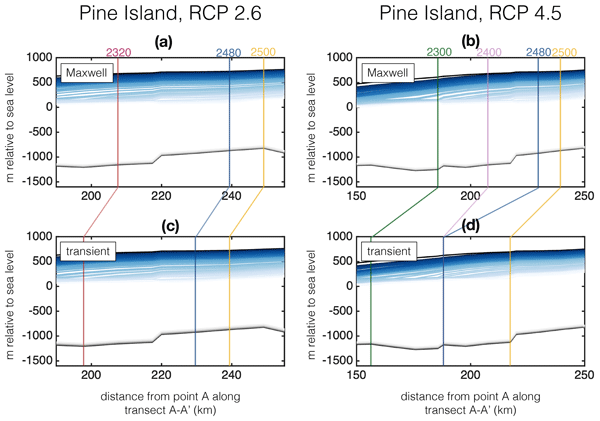
Figure 4 demonstrates a similar progression at Pine Island glacier for RCPs 2.6 and 4.5, with more grounding line retreat at a given time within the Maxwell simulation than the transient simulation. In fact, the total distance of grounding line retreat by the year 2500 along the Pine Island glacier transect in the transient model is less than that of the Maxwell model (by ∼ 10 and 20 km for RCPs 2.6 and 4.5, respectively). This is distinct from the RCP 8.5 simulations, where the total grounding line retreat by the year 2050 is identical for both rheology models. In the last ∼ 150 years of the coupled ice sheet-sea level evolution, grounding line retreat is significantly delayed in the transient model compared to the Maxwell model at Pine Island Glacier in all RCPs (Movies S2–S4 in the Supplement). The same is true at Thwaites Glacier in RCP 8.5, though in the more moderate emissions scenarios there is little to no deviation in Thwaites Glacier grounding line retreat with transient rheology, compared to the Maxwell rheology simulation (Movie S1). We emphasize that the marine outlet glaciers of the WAIS are broad spatial features, and we only show the grounding line migration through time along the transects described in Fig. 1 in the cross-sections (Figs. 3 and 4). The deviations in the spatial pattern of retreat of marine outlet glaciers are more complex, as illustrated by the areas where the grounded ice margins vary between the transient and Maxwell models off-transect in Figs. 1 and 2 (yellow fill) and S17–S22. The vertical lines in Figs. 3 and 4 highlight instances of time with the largest differences in the grounding line position between the Maxwell and the transient model. Figure S15 plots the timeseries of grounding line position along the glacier transects from Figs. 3 and 4 for the Maxwell versus transient models.

Figure 4Grounding Line Retreat at Pine Island Glacier in RCP 2.6 and RCP 4.5 (a, c) Evolution of bedrock surface (dark grey to light grey) and ice sheet surface (dark blue to light blue) elevation across Pine Island Glacier (Transect A-A', Fig. 1a) under RCP 2.6 considering Maxwell (a) vs. transient (c) viscoelastic solid Earth deformation. (b, d) as in (a) and (c) but for RCP 4.5 climate forcing. At each time slice for either glacier transect, the transient Earth simulation has undergone less retreat than the reference Maxwell Earth rheology simulation. All results shown adopt the ηL steady state profile, to mirror West Antarctic Earth structure.
Moving to a continent-scale view of the predicted deformation and sea-level change, Fig. 5 displays maps of the absolute value of bedrock uplift rate in the Maxwell model (left panels) and the deviation in uplift rate between the transient and Maxwell models (right panels) in West Antarctica at 2300 CE (here, uplift rate is defined as the radial displacement of the solid Earth surface over a change in time step.)

Figure 5Vertical Bedrock Displacement Rate Deviation (Transient–Maxwell) (a, c, e) Uplift rate in mm yr−1 in the reference Maxwell simulation with low steady state viscosity profile for RCP 2.6, 4.5, and 8.5, respectively. (b, d, f) Difference in uplift rate (transient minus Maxwell) with the low steady state viscosity profile for RCP 2.6, 4.5, and 8.5, respectively. Pine Island and Thwaites transects marked as in Fig. 1a (bounded by cyan and orange markers, respectively).
Across all RCP scenarios, the rate of bedrock uplift at the Thwaites and Pine Island grounding lines in the Maxwell model (proximate to the orange- and cyan-filled circles, respectively in Fig. 5), are on the order of magnitude of observed bedrock uplift rates in the ASE (Lucas et al., 2025; Sect. S4 in the Supplement). When transient deformation is included, the modelled rates of bedrock uplift exceed that of the Maxwell model by an additional 10 to 40 mm yr−1 (Fig. 5b, d, f).
3.2 Deviation in global mean sea level contribution
The spatial pattern of global sea-level change is largely unaffected by transient solid Earth rheology outside of Antarctica. The total amount of GMSL rise from the Antarctic Ice Sheet (AIS) as a whole is dominated by the contribution from the WAIS, since majority of the ice loss occurs in marine-grounded areas. Fig. 6 shows the transient–Maxwell deviation in GMSL rise contributed by the WAIS over the course of the simulation, for all emissions scenarios. Examining the deviation in the total WAIS GMSL contribution throughout the simulation (Fig. 6, right vertical axis), we see that transient deformation causes the cumulative GMSL rise from the WAIS by the year 2500 to be smaller than that of the Maxwell model by centimetres (∼ 2 cm in RCP 2.6, ∼ 3 cm in RCP 4.5, and ∼ 5 cm in RCP 8.5), compared with a total contribution of approximately 0.6–2.5 m. This is despite that the incremental WAIS GMSL contribution over a given model time step is sometimes larger in the transient model (red fill, Fig. 6). The WAIS GMSL contribution is reduced on the order of centimetres in the transient model relative to the Maxwell model, regardless of which steady state viscosity profile is used (compare solid vs. dashed continuous lines in Fig. 6). Even so, the WAIS and AIS GMSL contributions are reduced with transient deformation by only a few percent, with a maximum value of ∼ 5 % (see Sect. S5 in the Supplement for absolute and percent deviations in WAIS GMSL contribution.) Interestingly, the largest percent reductions in GMSL contribution are associated with the lower-emissions scenarios, RCP 2.6 and 4.5. This reflects how the timescale of uplift in the transient Earth model can more readily compete with the timescale of the climate forcing in RCP 2.6 and 4.5 than RCP 8.5. as the climate forcing becomes increasingly rapid, eventually the climate forcing will dominate the response because even the accelerated solid Earth uplift from transient deformation will struggle to keep pace.
We note that between the high and low viscosity deviations (i.e., comparing solid and dashed lines) between different RCP scenarios does not show a clear pattern. That is, in RCP 4.5, the ηH simulation deviates less than ηL, whereas in RCP 8.5 they both track each other very well and in RCP 2.6, the ηL deviation is greater than ηH before switching around 2400. This reflects the different ways the time scale of forcing interacts with the deformational properties of the planet at the time of load, but also the inherited load from viscous relaxation. The two RCP 8.5 traces align because the loading is so rapid that both ηL and ηH behave near-elastically. However, the other two models show more complicated interactions.

Figure 6Deviation in WAIS GMSL Contribution (a, c, e) Blue and red infilled lines indicate the associated Transient–Maxwell deviation in incremental GMSL contribution in millimetres from the WAIS over each time step in the simulations for RCP 2.6 (a), 4.5 (c) and 8.5 (e) forcings with steady state profile ηL. (b, d, f) Continuous lines indicate Transient–Maxwell deviation cumulative WAIS GMSL contribution in centimetres throughout the simulations using the ηL steady state profile (solid lines) and the ηH steady state viscosity (dashed lines) for RCP 2.6 (b), 4.5 (d) and 8.5 (f) forcings. For all RCP scenarios, the cumulative transient-Maxwell GMSL deviation is negative (reduction of total WAIS contribution to GMSL.)
We simulate coupled Antarctic ice sheet–sea level dynamics with a 1D, radially varying GIA model (Gomez et al., 2010; Han et al., 2022; Kendall et al., 2005) and 3D ice sheet-shelf model (Pollard and DeConto, 2012; Pollard et al., 2015) subject to the RCP 2.6, 4.5, and 8.5 emissions trajectories (IPCC, 2014). Our results show that transient rheology has a stabilizing effect on the WAIS by providing an additional (and earlier) strain contribution to solid Earth rebound in response to ice loss, thereby slowing and/or reducing the absolute extent of grounding line retreat. For a given climate forcing, the offset in the grounding line position with transient rheology relative to Maxwell rheology is sustained for a larger portion of the simulation at Pine Island Glacier than at Thwaites Glacier (e.g., compare Movies S1 and S2 or S5 and S6). In other words, grounding-line retreat in the transient model more readily catches up with the Maxwell model at Thwaites Glacier than Pine Island glacier under the same RCP scenario. This reflects the distinct bathymetry profiles along each selected glacier transect; there are a greater number of pinning points in the Pine Island transect than the Thwaites transect that the grounding line can get stuck on due to the small deviation in bedrock uplift with transient deformation, exacerbating the lag from the Maxwell model. Overall, the local effects of transient rheology are stabilizing to the WAIS by counteracting grounding-line retreat. We note that the stabilizing effects of transient deformation are only temporary across WAIS grounding zones; over a timescale of centuries, both Maxwell and transient simulations converge to similar magnitudes of grounding line retreat. That is, drastic ice loss still occurs regardless of the assumed solid Earth rheology, but the pathway there varies. This becomes the case for all RCP scenarios when rapid ice loss via the Marine Ice Cliff Instability (MICI) is accounted for in the coupled ice sheet-sea level simulations (see Sect. 4.3). Although transient deformation cannot counteract the magnitude of projected global sea level rise, any reduction in the predicted rate of sea-level rise from transient rheology compared to Maxwell predictions has implications on coastal adaptation planning for concerns such as amplified storm surge flooding and saltwater intrusion of aquifers (Panthi et al., 2022; Tahvildari and Castrucci, 2021). Moreover, predicted AIS discharge rates will play a role in understanding the global climate feedbacks associated with the delivery of freshwater to the Southern Ocean (Gorte et al., 2023; Sadai et al., 2025).
4.1 Local feedback mechanisms and impact on global mean sea level
As the WAIS shrinks throughout the simulation, water mass is added to the ocean and sea level is lowered in the near field, due to both solid Earth uplift and reduced gravitational attraction of the remaining ice load to the ocean. The counterpart of this local sea-level fall is increased sea-level rise in the far field (Mitrovica et al., 2001). While ultimately, the contribution of transient deformation to bedrock uplift prolongs retreat and therefore integrated GMSL rise (Gomez et al., 2015, 2024a), earlier in the simulations, the opposite is true, i.e., our transient simulations show more incremental GMSL in the first few time steps. This early opposing trend reflects enhanced far field sea level rise due to increased water expulsion in the transient simulations relative to the Maxwell, since there are negligible transient–Maxwell deviations in ice loss so early in the simulation (Fig. 6; red fill). Despite this water expulsion effect, there is a net reduction in GMSL rise from Antarctica. The ability for solid Earth uplift to counteract grounding-line retreat in West Antarctica builds with time as the simulation progresses, owing to the time delay between the loading change and the associated strain contribution from non-elastic deformation (see how the continuous lines for cumulative GMSL deviation begin to depart from zero around 2150, Fig. 6). We note that the magnitude of GMSL reduction from transient deformation is small and likely within the uncertainty in dynamic ice sheet model projections due to factors like basal conditions and implementation of ice sheet-shelf physics (Bamber et al., 2022).
4.2 Sensitivity to steady state viscosity
As aforementioned, transient deformation affects the magnitude and timing of the solid Earth response to loading changes, causing an apparent softening of Earth's mechanical properties over relevant loading timescales and an effective reduction in time delay for viscous deformation. Our transient rheology model (Yamauchi and Takei, 2016) is based on taking a Maxwell viscoelastic model and adding a continuous spectrum transient dissipation in proportion to the Maxwell steady state viscosity. If a given transient rheological model has a Maxwell time of 1000 years, the transient dissipation will be activated on timescales faster than the Maxwell time. If instead, the Maxwell time is 10 000 years, the transient dissipation will be proportionally stretched over a broader bandwidth at timescales faster than 10 000 years. As such, different steady state viscosity profiles will have a distinct transient viscoelastic behavior and will therefore have a different sensitivity to the timescale of the forcing than another transient Earth model scaled to a different steady state viscosity profile. While we have chosen to focus our discussion on results based on Earth structure characterized by the low (ηL) steady state viscosity profile, thought to be representative of the hot structure beneath West Antarctica (Lloyd et al., 2020), there remains substantial uncertainty in the absolute viscosity structure. Indeed, a lower Maxwell viscosity mantle beneath West Antarctica is also consistent with GPS measurements of uplift rates (Barletta et al., 2018). It is unclear, however, whether these inferred low viscosities are representative of the long-term viscosity as opposed to a transient deviation from a higher, steady state viscosity activated by modern loading changes (Lau et al., 2021; Nield et al., 2025), or even some combination (see Sect. S4, Fig. S5).
Given the uncertainty in steady state mantle viscosity, we also considered the coupled ice sheet-sea level evolution of the WAIS with the high steady state viscosity profile for RCP 2.6, RCP 4.5, and RCP 8.5 in West Antarctica. We find similar delayed trajectories of grounding line retreat and magnitudes of the reduction in WAIS GMSL contribution with transient deformation for both the low- and high steady state viscosity simulations (compare solid vs. dashed lines in Fig. 6). For the low steady state viscosity profile, the WAIS GMSL contribution at 2500 is reduced by 1.9 % under RCP 8.5 (2.1 % with high steady state viscosity profile), 4.1 % under RCP 4.5 (1.7 % with high steady state viscosity profile), and 3.1 % under RCP 2.6 (5 % with high steady state viscosity profile). These results suggest that the stabilizing effect of transient deformation on grounding line retreat need not be unique to West Antarctica, given the subglacial topography of some East Antarctic glaciers (Pritchard et al., 2025). There are several marine-terminating outlet glaciers through which East Antarctica loses considerable ice mass, and they have been suggested to exhibit considerable grounding line retreat (Favier et al., 2016; Jones et al., 2015; Picton et al., 2023; Stokes et al., 2022). In our simulations, the East Antarctic deviations in behaviour between transient and Maxwell models are most notable when MICI is invoked because it expedites the early ice loss timescales in East Antarctica before the ice shelves are completely collapsed, regardless of the RCP scenario. We discuss these East Antarctic deviations in the following section.
4.3 Impact of the Marine Ice Cliff Instability
Though there is no consensus in physical treatment of calving, the Marine Ice Cliff Instability (MICI) has been suggested to exacerbate both East and West Antarctic ice loss through rapid cliff failure and the subsequent reduction in buttressing of upstream grounded ice (Bassis et al., 2021; Bassis and Walker, 2012; DeConto et al., 2021; Golledge and Lowry, 2021; Pollard et al., 2015). The transient Earth deformation response will be sensitive to such rapid loading changes, and viscoelastic behaviour will occur on timescales that can better compete with that of ice loss, thereby affecting the ice dynamics. We explore the potential effects of MICI on ice sheet-sea level projections with transient Earth deformation (see Sect. S7; Movies S5–S6). We find exacerbated deviations in grounding line position at a given time due to transient Earth deformation in MICI simulations of RCP 2.6 and RCP 4.5. This reflects the expedited rate of ice loss becoming sufficient to activate a larger transient deformation response. Under RCP 8.5, however, when rapid ice loss via calving is invoked, there is minimal deviation in the grounding line position between the transient and Maxwell models, precisely because the background climate forcing is already sufficiently rapid to trigger the transient deformation response; regardless of rheology, the solid earth uplift cannot keep pace with the ice sheet retreat, unlike in the more moderate climate scenarios.
Figure 7 is analogous to Fig. 2, illustrating grounding line retreat at Pine Island and Thwaites Glaciers for Maxwell versus transient Earth models, but with RCP 4.5 climate forcing and the additional consideration of MICI (implemented in the model via the algorithm described in Pollard et al., 2015 and DeConto et al., 2021). Fig. 7b, d demonstrates deviations in the Maxwell and transient model grounding line positions of between ∼ 50–70 km at a given time in the simulation at Thwaites Glacier. While eventually the transient model catches up with the grounding line retreat in the Maxwell model by ∼ 2130 CE, the trajectory is delayed. In the Maxwell model under RCP 4.5 with MICI included, Pine Island Glacier has nearly fully collapsed by 2380 CE (Fig. 7a). It takes another ∼ 30 years for the glacier to fully retreat in the transient model. Given that understanding and modelling of calving processes is currently under active development in the literature, these results should be viewed as a preliminary sensitivity test of the role of transient deformation in modulating ice retreat through calving processes. Though we focus on West Antarctica, subglacial basins of East Antarctica are also prone to rapid retreat with MICI (DeConto et al., 2021). We see greater ice retention by upwards of 50 m within the Wilkes, Aurora, and Recovery subglacial basins in the transient Earth rheology simulations as early as 2050 CE for all RCP simulations including MICI (see Sect. S6, Fig. S14). Ultimately, the transient models with MICI catch up to the ice levels in the Maxwell simulations with MICI after 2300 CE in East Antarctica (apart from a small region in the Wilkes Subglacial Basin under RCP 8.5; Fig. S14). Given that Greenland, like East Antarctica, is predominantly grounded above sea level and has cratonic mantle structure, we should also expect a delay in ice retreat with transient Earth deformation.

Figure 7Deviation in Grounding line retreat with MICI Timeline of grounding line retreat across Pine Island and Thwaites Glaciers. Analogous to Fig. 2, instead using the coupled ice sheet-sea level simulations of RCP 4.5 with the inclusion of rapid ice calving via the MICI. Ice sheet (dark blue to light blue) and bedrock surface (dark grey to light grey) evolution at Pine Island Glacier (a, c) and Thwaites Glacier (b, d) for Maxwell and transient Earth models, respectively.
4.4 Moving to more realistic Earth rheology
Although there is strong consensus in the rock physics community that transient viscous deformation occurs over a range of timescales from the elastic end-member to the steady state viscous regime, the exact nature of empirically-derived parametrizations of transient rheology varies between laboratories (Faul and Jackson, 2015; Havlin et al., 2021; Lau and Holtzman, 2019; Yamauchi and Takei, 2016). These transient models have differing sensitivities across the full spectrum of loading timescales, and therefore predictions of sea level and ice sheet coevolution with transient deformation will bear the uncertainty in the choice of transient model (as well as the assumed trajectory of climate forcing).
As noted earlier, the Lau et al. (2026) GIA model accounts for lateral variations in both steady state mantle viscosity and transient rheology (using the Yamauchi and Takei, 2016 model, as applied here though only to 1D Earth models). Though the two distinct 1D steady state viscosity profiles used here are consistent in terms of the magnitude of GMSL reduction in the transient Earth model relative to that of the reference Maxwell model, future coupled ice sheet-sea level modelling studies should incorporate laterally varying Earth structure (as in Gomez et al., 2024a) in conjunction with transient deformation behaviour, since East Antarctica and West Antarctica evolve simultaneously and there is potential for covariance across the regions within the context of solid Earth-ice sheet feedbacks (Gomez et al., 2018, 2024a; Lucas et al., 2025; van Calcar et al., 2025). Moreover, this study considers the effects of complex time-dependent deformation in the linear viscoelastic regime. There is also evidence for transient dislocation creep mechanisms at these intermediate timescales (Hansen et al., 2021b). Accordingly, stress-dependence and transient deformation behaviour could also be considered together in regions of high background stress (e.g., Lau et al., 2021).
Transient solid Earth deformation is unable to thwart the inevitable Antarctic ice loss and sea level rise predisposed by the climate forcing in this coupled model of ice sheet-sea level-solid Earth interactions. However, transient deformation has the potential to slow the pace of ice retreat and influence the rate at which freshwater discharge from the Antarctic Ice Sheet is delivered to the ocean. Some studies from the atmospheric and oceanic modelling community (e.g. Sadai et al., 2020) have shown that freshwater outflux from the AIS can delay global temperature rise, concurrently with increasing sea level rise, by driving the expansion of sea ice. Earth's albedo, or reflectivity of the surface against solar radiation, is highly sensitive to sea ice extent and this feedback has been shown to reduce predictions of global mean temperature between 0.3 and 1 °C by 2100 CE (Sadai et al., 2025). At the same time, Antarctic freshwater input may also enhance local ice mass loss by inducing subsurface warming (Bronselaer et al., 2018). As the atmosphere warms over time, the uppermost portion of the coastal water column becomes trapped due to meltwater-induced changes in ocean stratification, enabling heat to accumulate beneath the ice shelf, though a recent study suggests that this positive meltwater stratification feedback may become saturated under amplified climate forcing (Kreuzer et al., 2026). If we predict AIS evolution and contribution to sea-level rise within the framework of transient solid Earth rheology, it remains unclear how the deviations in meltwater flux from Maxwell model predictions will impact competing ocean and atmospheric feedbacks. Regardless, transient viscoelastic deformation is a more realistic description of viscoelastic rock deformation behaviour. We demonstrate that transient earth deformation delays AIS retreat, which controls the rate of freshwater discharge, thus it should be a consideration in predicting and interpreting the response of the entire climate system.
All codes used in this study are publicly available from previously published studies. The sea level model component of the coupled Ice Sheet-Sea Level model can be accessed at https://doi.org/10.5281/zenodo.5775235 (hollyhan, 2021). The dynamic ice sheet model component can be accessed at https://doi.org/10.20383/103.01006 (Gomez et al., 2024b).
The model outputs for ice sheet and sea level change, as well as the driver scripts for the simulations are available in the following Zenodo repository https://doi.org/10.5281/zenodo.24070700 (Coonin, 2026).
The supplement related to this article is available online at https://doi.org/10.5194/tc-20-6919-2026-supplement.
A.N.C. developed the project. A.N.C. conducted the modelling with guidance from B.P. and N.G. Results were analyzed by A.N.C. with guidance from B.P., N.G., H.C.P.L. The paper was written by A.N.C. with feedback by B.P., H.C.P.L., N.G.
The contact author has declared that none of the authors has any competing interests.
Publisher's note: Copernicus Publications remains neutral with regard to jurisdictional claims made in the text, published maps, institutional affiliations, or any other geographical representation in this paper. The authors bear the ultimate responsibility for providing appropriate place names. Views expressed in the text are those of the authors and do not necessarily reflect the views of the publisher.
We thank Dr. Sainan Sun, Dr. Maria Zeitz, and an anonymous reviewer for constructive feedback which greatly improved the manuscript. We also thank PALSEA and the POLENET GIA Summer Training Schools for fostering helpful conversations.
A. N. C. and H. C. P. L were supported by the David and Lucile Packard Foundation and the National Science Foundation (grant no. EAR 2311897). B. P. was supported by Fonds de recherche du Québec (Bourses de doctorate en recherche grant no. 2003862; https://doi.org/10.69777/2003862). N. G. was supported by Natural Sciences and Engineering Research Council of Canada (grant no. RGPIN-2016-05159).
This paper was edited by Sainan Sun and reviewed by Maria Zeitz and one anonymous referee.
Abe-Ouchi, A., Saito, F., Kawamura, K., Raymo, M. E., Okuno, J. I., Takahashi, K., and Blatter, H.: Insolation-driven 100 000-year glacial cycles and hysteresis of ice-sheet volume, Nature, 500, 190–193, https://doi.org/10.1038/nature12374, 2013.
Adhikari, S., Milne, G. A., Caron, L., Khan, S. A., Kjeldsen, K. K., Nilsson, J., Larour, E., and Ivins, E. R.: Decadal to Centennial Timescale Mantle Viscosity Inferred From Modern Crustal Uplift Rates in Greenland, Geophys. Res. Lett., 48, https://doi.org/10.1029/2021gl094040, 2021.
Bamber, J. L., Oppenheimer, M., Kopp, R. E., Aspinall, W. P., and Cooke, R. M.: Ice Sheet and Climate Processes Driving the Uncertainty in Projections of Future Sea Level Rise: Findings From a Structured Expert Judgement Approach, Earth's Future, 10, https://doi.org/10.1029/2022ef002772, 2022.
Barletta, V. R., Bevis, M., Smith, B. E., Wilson, T., Brown, A., Bordoni, A., Willis, M., Khan, S. A., Rovira-Navarro, M., Dalziel, I., Smalley, R., Kendrick, E., Konfal, S., Caccamise, D. J., Aster, R. C., Nyblade, A., and Wiens, D. A.: Observed rapid bedrock uplift in Amundsen Sea Embayment promotes ice-sheet stability, Science, 360, 1335–1339, https://doi.org/10.1126/science.aao1447, 2018.
Bassis, J. N. and Walker, C. C.: Upper and lower limits on the stability of calving glaciers from the yield strength envelope of ice, P. R. Soc. A, 468, 913–931, https://doi.org/10.1098/rspa.2011.0422, 2012.
Bassis, J. N., Berg, B., Crawford, A. J., and Benn, D. I.: Transition to marine ice cliff instability controlled by ice thickness gradients and velocity, Science, 372, 1342–1344, https://doi.org/10.1126/science.abf6271, 2021.
Bronselaer, B., Winton, M., Griffies, S. M., Hurlin, W. J., Rodgers, K. B., Sergienko, O. V., Stouffer, R. J., and Russell, J. L.: Change in future climate due to Antarctic meltwater, Nature, 564, 53–58, https://doi.org/10.1038/s41586-018-0712-z, 2018.
Caillet, J., Jourdain, N. C., Mathiot, P., Hellmer, H. H., and Mouginot, J.: Drivers and reversibility of abrupt ocean state transitions in the Amundsen Sea, Antarctica, J. Geophys. Res.-Oceans, 128, https://doi.org/10.1029/2022JC018929, 2023.
Caron, L., Ivins, E., Larour, E., Adhikari, S., and Métivier, L.: Love number computation within the Ice-sheet and Sea-level System Model (ISSM v4.24), Geosci. Model Dev., 19, 4031–4054, https://doi.org/10.5194/gmd-19-4031-2026, 2026.
Coonin, A.: Data Repository for “West Antarctic Ice Retreat Temporarily Halted with Transient Rheology in Future Climate Projections” by Allie N. Coonin, B. Parazin, Harriet C. P. Lau, Natalya Gomez, Zenodo [data set], https://doi.org/10.5281/zenodo.24070700, 2026.
Coonin, A. N., Lau, H. C. P., and Coulson, S.: Meltwater Pulse 1A sea-level-rise patterns explained by global cascade of ice loss, Nat. Geosci., 18, 254–259, https://doi.org/10.1038/s41561-025-01648-w, 2025.
DeConto, R. M., Pollard, D., Alley, R. B., Velicogna, I., Gasson, E., Gomez, N., Sadai, S., Condron, A., Gilford, D. M., Ashe, E. L., Kopp, R. E., Li, D., and Dutton, A.: The Paris Climate Agreement and future sea-level rise from Antarctica, Nature, 593, 83–89, https://doi.org/10.1038/s41586-021-03427-0, 2021.
Dziewonski, A. M. and Anderson, D. L.: Preliminary reference Earth model, Phys. Earth Planet. In., 25, 297–356, https://doi.org/10.1016/0031-9201(81)90046-7, 1981.
Faul, U. and Jackson, I.: Transient Creep and Strain Energy Dissipation: An Experimental Perspective, Annu. Rev. Earth Pl. Sc., 43, 541–569, https://doi.org/10.1146/annurev-earth-060313-054732, 2015.
Faul, U. H., Fitz Gerald, J. D., Farla, R. J. M., Ahlefeldt, R., and Jackson, I.: Dislocation creep of fine-grained olivine, J. Geophys. Res., 116, https://doi.org/10.1029/2009jb007174, 2011.
Favier, L., Pattyn, F., Berger, S., and Drews, R.: Dynamic influence of pinning points on marine ice-sheet stability: a numerical study in Dronning Maud Land, East Antarctica, The Cryosphere, 10, 2623–2635, https://doi.org/10.5194/tc-10-2623-2016, 2016.
Fretwell, P., Pritchard, H. D., Vaughan, D. G., Bamber, J. L., Barrand, N. E., Bell, R., Bianchi, C., Bingham, R. G., Blankenship, D. D., Casassa, G., Catania, G., Callens, D., Conway, H., Cook, A. J., Corr, H. F. J., Damaske, D., Damm, V., Ferraccioli, F., Forsberg, R., Fujita, S., Gim, Y., Gogineni, P., Griggs, J. A., Hindmarsh, R. C. A., Holmlund, P., Holt, J. W., Jacobel, R. W., Jenkins, A., Jokat, W., Jordan, T., King, E. C., Kohler, J., Krabill, W., Riger-Kusk, M., Langley, K. A., Leitchenkov, G., Leuschen, C., Luyendyk, B. P., Matsuoka, K., Mouginot, J., Nitsche, F. O., Nogi, Y., Nost, O. A., Popov, S. V., Rignot, E., Rippin, D. M., Rivera, A., Roberts, J., Ross, N., Siegert, M. J., Smith, A. M., Steinhage, D., Studinger, M., Sun, B., Tinto, B. K., Welch, B. C., Wilson, D., Young, D. A., Xiangbin, C., and Zirizzotti, A.: Bedmap2: improved ice bed, surface and thickness datasets for Antarctica, The Cryosphere, 7, 375–393, https://doi.org/10.5194/tc-7-375-2013, 2013.
Golledge, N. R. and Lowry, D. P.: Is the marine ice cliff hypothesis collapsing? Science, 372, 1266–1267, https://doi.org/10.1126/science.abj3266, 2021.
Gomez, N., Mitrovica, J., Huybers, P., Clark, P. U.: Sea level as a stabilizing factor for marine-ice-sheet grounding lines, Nat. Geosci. 3, 850–853, https://doi.org/10.1038/ngeo1012, 2010.
Gomez, N., Pollard, D., and Mitrovica, J. X.: A 3-D coupled ice sheet – sea level model applied to Antarctica through the last 40 ky, Earth Planet. Sci. Lett., 384, 88–99, https://doi.org/10.1016/j.epsl.2013.09.042, 2013.
Gomez, N., Pollard, D., and Holland, D.: Sea-level feedback lowers projections of future Antarctic Ice-Sheet mass loss, Nat. Commun., 6, 8798, https://doi.org/10.1038/ncomms9798, 2015.
Gomez, N., Latychev, K., and Pollard, D.: A Coupled Ice Sheet–Sea Level Model Incorporating 3D Earth Structure: Variations in Antarctica during the Last Deglacial Retreat, J. Climate, 31, 4041–4054, https://doi.org/10.1175/jcli-d-17-0352.1, 2018.
Gomez, N., Yousefi, M., Pollard, D., DeConto, R. M., Sadai, S., Lloyd, A., Nyblade, A., Wiens, D. A., Aster, R. C., and Wilson, T.: The influence of realistic 3D mantle viscosity on Antarctica's contribution to future global sea levels, Sci. Adv., 10, https://doi.org/10.1126/sciadv.adn1470, 2024a
Gomez, N., Yousefi, M., Pollard, D., DeConto, R., Sadai, S., Lloyd, A., Nyblade, A., Wiens, D., Aster, R., Wilson, T.: Materials from Gomez et al. (2024) “The influence of realistic 3D mantle viscosity on Antarctica’s contribution to future global sea levels”, Federated Research Data Repository [data set], https://doi.org/10.20383/103.01006, 2024b.
Gorte, T., Lovenduski, N. S., Nissen, C., and Lenaerts, J. T. M.: Antarctic Ice Sheet freshwater discharge drives substantial Southern Ocean changes over the 21st century, Geophys. Res. Lett., 50, https://doi.org/10.1029/2023GL104949, 2023.
Gribb, T. T. and Cooper, R. F.: Low-frequency shear attenuation in polycrystalline olivine: Grain boundary diffusion and the physical significance of the Andrade model for viscoelastic rheology, J. Geophys. Res.-Sol. Ea., 103(B11), 27267–27279, https://doi.org/10.1029/98jb02786, 1998.
Gudmundsson, G. H.: Ice-shelf buttressing and the stability of marine ice sheets, The Cryosphere, 7, 647–655, https://doi.org/10.5194/tc-7-647-2013, 2013.
Han, H. K., Gomez, N., Pollard, D., and DeConto, R.: Modeling Northern Hemispheric Ice Sheet Dynamics, Sea Level Change, and Solid Earth Deformation Through the Last Glacial Cycle, J. Geophys. Res.-Earth, 126, https://doi.org/10.1029/2020jf006040, 2021.
Han, H. K., Gomez, N., and Wan, J. X. W.: Capturing the interactions between ice sheets, sea level and the solid Earth on a range of timescales: a new “time window” algorithm, Geosci. Model Dev., 15, 1355–1373, https://doi.org/10.5194/gmd-15-1355-2022, 2022.
Hansen, K., Truffer, M., Aschwanden, A., Mankoff, K., Bevis, M., Humbert, A., Van Den Broeke, M. R., Noël, B., Bjørk, A., Colgan, W., Kjær, K. H., Adhikari, S., Barletta, V., and Khan, S. A.: Estimating Ice Discharge at Greenland's Three Largest Outlet Glaciers Using Local Bedrock Uplift, Geophys. Res. Lett., 48, https://doi.org/10.1029/2021gl094252, 2021a.
Hansen, L. N., Wallis, D., Breithaupt, T., Thom, C. A., and Kempton, I.: Dislocation Creep of Olivine: Backstress Evolution Controls Transient Creep at High Temperatures, J. Geophys. Res.-Sol. Ea., 126, https://doi.org/10.1029/2020jb021325, 2021b.
Havlin, C., Holtzman, B. K., and Hopper, E.: Inference of thermodynamic state in the asthenosphere from anelastic properties, with applications to North American upper mantle, Phys. Earth Planet. In., 314, 106639, https://doi.org/10.1016/j.pepi.2020.106639, 2021.
hollyhan: hollyhan/1DSeaLevelModel_FWTW: Sea Level Model with Forward Time Window algorithm (Version v1.0.0), Zenodo [code], https://doi.org/10.5281/zenodo.5775235, 2021.
Houriez, L., Larour, E., Caron, L., Schlegel, N.-J., Adhikari, S., Ivins, E., Pelle, T., Seroussi, H., Darve, E., and Fischer, M.: Reinforced ridges in Thwaites Glacier yield insights into resolution requirements for coupled ice sheet and solid Earth models, The Cryosphere, 19, 4355–4372, https://doi.org/10.5194/tc-19-4355-2025, 2025.
Hudson, T.S., Kufner, S.K., Brisbourne, A.M., Kendall, J. M., Smith, A. M., Alley, R. B., Arthern, R. J., and Murray, T.: Highly variable friction and slip observed at Antarctic ice stream bed, Nat. Geosci. 16, 612–618, https://doi.org/10.1038/s41561-023-01204-4, 2023.
IPCC: Climate Change 2014: Synthesis Report, Contribution of Working Groups I, II and III to the Fifth Assessment Report of the Intergovernmental Panel on Climate Change, edited by: Core Writing Team, Pachauri, R. K. and Meyer, L. A., ISBN 978-92-9169-143-2, 2014.
Ivins, E. R., Caron, L., and Adhikari, S.: Anthropocene isostatic adjustment on an anelastic mantle, J. Geod., 97, 92, https://doi.org/10.1007/s00190-023-01781-7, 2023.
Jones, R. S., Mackintosh, A. N., Norton, K. P., Golledge, N. R., Fogwill, C. J., Kubik, P. W., Christl, M., and Greenwood, S. L.: Rapid Holocene thinning of an East Antarctic outlet glacier driven by marine ice sheet instability, Nat. Commun., 6, 8910, https://doi.org/10.1038/ncomms9910, 2015.
Kendall, R. A., Mitrovica, J. X., and Milne, G. A.: On post-glacial sea level – II, Numerical formulation and comparative results on spherically symmetric models, Geophys. J. Int., 161, 679–706, https://doi.org/10.1111/j.1365-246x.2005.02553.x, 2005.
Kopp, R. E., DeConto, R. M., Bader, D. A., Hay, C. C., Horton, R. M., Kulp, S., Oppenheimer, M., Pollard, D., and Strauss, B. H.: Evolving Understanding of Antarctic Ice-Sheet Physics and Ambiguity in Probabilistic Sea-Level Projections, Earth's Future, 5, 1217–1233, https://doi.org/10.1002/2017ef000663, 2017.
Kreuzer, M., Albrecht, T., Huiskamp, W., Petri, S., Feldmann, J., Feulner, G., and Winkelmann, R.: Antarctic meltwater-stratification feedback is less pronounced under high climate forcing, Geophys. Res. Lett., 53, https://doi.org/10.1029/2025GL118643, 2026.
Larour, E., Seroussi, H., Adhikari, S., Ivins, E., Caron, L., Morlighem, M., and Schlegel, N.: Slowdown in Antarctic mass loss from solid Earth and sea-level feedbacks, Science, 364, https://doi.org/10.1126/science.aav7908, 2019.
Lau, H. C. P.: Transient rheology in sea level change: Implications for Meltwater Pulse 1A, Earth Planet. Sci. Lett., 609, 118106, https://doi.org/10.1016/j.epsl.2023.118106, 2023.
Lau, H. C. P.: Surface loading on a self-gravitating, linear viscoelastic Earth: moving beyond Maxwell, Geophys. J. Int., 237, 1842–1857, https://doi.org/10.1093/gji/ggae149, 2024.
Lau, H. C. P. and Holtzman, B. K.: “Measures of Dissipation in Viscoelastic Media” Extended: Toward Continuous Characterization Across Very Broad Geophysical Time Scales, Geophys. Res. Lett., 46, 9544–9553, https://doi.org/10.1029/2019gl083529, 2019.
Lau, H. C. P., Austermann, J., Holtzman, B. K., Havlin, C., Lloyd, A. J., Book, C., and Hopper, E.: Frequency Dependent Mantle Viscoelasticity via the Complex Viscosity: Cases From Antarctica, J. Geophys. Res.-Sol. Ea., 126, https://doi.org/10.1029/2021jb022622, 2021.
Lau, H. C. P., Coonin, A. N., Richards, F. D., and Latychev, K.: The Overprint of Transient Rheology on Laterally Heterogeneous Viscosity: Influences on Sea‐Level Change Driven by Antarctic Ice Sheet Loss, J. Geophys. Res.-Sol. Ea., 131, https://doi.org/10.1029/2026jb033961, 2026.
Lloyd, A. J., Wiens, D. A., Zhu, H., Tromp, J., Nyblade, A. A., Aster, R. C., Hansen, S. E., Dalziel, I. W. D., Wilson, T. J., Ivins, E. R., and O'Donnell, J. P.: Seismic Structure of the Antarctic Upper Mantle Imaged with Adjoint Tomography, J. Geophys. Res.-Sol. Ea., 125, https://doi.org/10.1029/2019jb017823, 2020.
Lucas, E. M., Gomez, N., and Wilson, T.: The impact of regional-scale upper-mantle heterogeneity on glacial isostatic adjustment in West Antarctica, The Cryosphere, 19, 2387–2405, https://doi.org/10.5194/tc-19-2387-2025, 2025.
Martin, M. A., Winkelmann, R., Haseloff, M., Albrecht, T., Bueler, E., Khroulev, C., and Levermann, A.: The Potsdam Parallel Ice Sheet Model (PISM-PIK) – Part 2: Dynamic equilibrium simulation of the Antarctic ice sheet, The Cryosphere, 5, 727–740, https://doi.org/10.5194/tc-5-727-2011, 2011.
McCarthy, C., Takei, Y., and Hiraga, T.: Experimental study of attenuation and dispersion over a broad frequency range: 2. The universal scaling of polycrystalline materials, J. Geophys. Res., 116, https://doi.org/10.1029/2011jb008384, 2011.
Mitrovica, J. X., Tamisiea, M. E., Davis, J. L., and Milne, G. A.: Recent mass balance of polar ice sheets inferred from patterns of global sea-level change, Nature, 409, 1026–1029, https://doi.org/10.1038/35059054, 2001.
Nick, F. M., Van Der Veen, C. J., Vieli, A., and Benn, D. I.: A physically based calving model applied to marine outlet glaciers and implications for the glacier dynamics, J. Glaciol., 56, 781–794, https://doi.org/10.3189/002214310794457344, 2010.
Nield, G. A., Bentley, M. J., Koulali, A., Clarke, P. J., King, M. A., Wilson, T., and Whitehouse, P. L.: Surface Mass Balance Variability Causes Viscoelastic Solid Earth Deformation in the Antarctic Peninsula, Geophys. Res. Lett., 52, https://doi.org/10.1029/2025gl114595, 2025.
Panthi, J., Pradhanang S. M., Notle, A., and Boving, T. B.: Saltwater intrusion into coastal aquifers in the contiguous United States – A systematic review of investigation approaches and monitoring networks, Sci. Total Environ., 836, 155641, https://doi.org/10.1016/j.scitotenv.2022.155641, 2022.
Picton, H. J., Stokes, C. R., Jamieson, S. S. R., Floricioiu, D., and Krieger, L.: Extensive and anomalous grounding line retreat at Vanderford Glacier, Vincennes Bay, Wilkes Land, East Antarctica, The Cryosphere, 17, 3593–3616, https://doi.org/10.5194/tc-17-3593-2023, 2023.
Pollard, D. and DeConto, R. M.: Description of a hybrid ice sheet-shelf model, and application to Antarctica, Geosci. Model Dev., 5, 1273–1295, https://doi.org/10.5194/gmd-5-1273-2012, 2012.
Pollard, D. and DeConto, R. M.: Improvements in one-dimensional grounding-line parameterizations in an ice-sheet model with lateral variations (PSUICE3D v2.1), Geosci. Model Dev., 13, 6481–6500, https://doi.org/10.5194/gmd-13-6481-2020, 2020.
Pollard, D., DeConto, R. M., and Alley, R. B.: Potential Antarctic Ice Sheet retreat driven by hydrofracturing and ice cliff failure, Earth Planet. Sci. Lett., 412, 112–121, https://doi.org/10.1016/j.epsl.2014.12.035, 2015.
Pollard, D., Gomez, N., and DeConto, R. M.: Variations of the Antarctic Ice Sheet in a Coupled Ice Sheet-Earth-Sea Level Model: Sensitivity to Viscoelastic Earth Properties, J. Geophys. Res.-Earth , 122, 2124–2138, https://doi.org/10.1002/2017jf004371, 2017.
Pritchard, H. D., Fretwell, P. T., Fremand, A. C., Bodart, J. A., Kirkham, J. D., Aitken, A., Bamber, J., Bell, R., Bianchi, C., Bingham, R. G., Blankenship, D. D., Casassa, G., Christianson, K., Conway, H., Corr, H. F. J., Cui, X., Damaske, D., Damm, V., Dorschel, B., Drews, R., Eagles, G., Eisen, O., Eisermann, H., Ferraccioli, F., Field, E., Forsberg, R., Franke, S., Goel, V., Prasad Gogineni, S. Greenbaum, J., Hills, B., Hindmarsh, R. C. A., Hoffman, A. O., Holschuh, N., Holt, J. W., Humbert, A., Jacobel, R. W., Jansen, D., Jenkins, A., Jokat, W., Jong, L. Jordan, T. A., King, E. C., Kohler, J. Krabill, W., Matron, J., Kusk Gillespie, M., Langly, K., Lee, J., Leitchenkov, G., Leuschen, C., Luyendyk, B., MacGregor, J. A., MacKie, E., Moholdt, G., Matsuoka, K., Morlighem, M., Mouginot, J., Nitsche, F. O., Nost, O. A., Paden, J., Pattyn, F., Popov, S., Rignot, E., Rippin, D. M., Rivera, A., Roberts, J. L., Ross, N., Ruppel, A., Schroeder, D. M., Siegert, M. J., Smith, A. M., Steinhage, D., Studinger, M. Sun, B., Tabacco, I., Tinto, K. J., Urbini, S., Vaughan, D. G., Wilson D. S., Young, D. A., and Zirizzotti, A.: Bedmap3 updated ice bed, surface and thickness gridded datasets for Antarctica, Sci. Data, 12, https://doi.org/10.1038/s41597-025-04672-y, 2025.
Reese, R., Winkelmann, R., and Gudmundsson, G. H.: Grounding-line flux formula applied as a flux condition in numerical simulations fails for buttressed Antarctic ice streams, The Cryosphere, 12, 3229–3242, https://doi.org/10.5194/tc-12-3229-2018, 2018.
Robel, A. A., Seroussi, H., and Roe, G. H.: Marine ice sheet instability amplifies and skews uncertainty in projections of future sea-level rise, Proc. Natl. Acad. Sci. USA, 116, 14887–14892, https://doi.org/10.1073/pnas.1904822116, 2019.
Sadai, S., Condron, A., DeConto, R., and Pollard, D.: Future climate response to Antarctic Ice Sheet melt caused by anthropogenic warming, Sci. Adv., 6, https://doi.org/10.1126/sciadv.aaz1169, 2020.
Sadai, S., Karmalkar, A. V., Pollard, D., Dong, Y., Lucas, E., Gomez, N., DeConto, R., and Condron, A.: Antarctic meltwater alters future projections of climate and sea level, Nat. Commun., 16, https://doi.org/10.1038/s41467-025-64438-3, 2025.
Schoof, C.: Ice sheet grounding line dynamics: Steady states, stability, and hysteresis, J. Geophys. Res.-Earth, 112, https://doi.org/10.1029/2006jf000664, 2007.
Sergienko, O.: Treatment of the ice-shelf backpressure and buttressing in two horizontal dimensions, J. Glaciol., 71, 1–40, https://doi.org/10.1017/jog.2024.83, 2025.
Sergienko, O. and Wingham, D. J.: Diverse behaviors of marine ice sheets in response to temporal variability of the atmospheric and basal conditions, J. Glaciol., 70, 1–12, https://doi.org/10.1017/jog.2024.43, 2024.
Sergienko, O., Haseloff, M., Robel, A., Wingham, D.: A new paradigm for understanding Earth's marine ice sheets, Nat. Geosci. 19, 374–383, https://doi.org/10.1038/s41561-026-01941-2, 2026.
Spada, G., Ruggieri, G., Sørensen, L. S., Nielsen, K., Melini, D., and Colleoni, F.: Greenland uplift and regional sea level changes from ICESat observations and GIA modelling, Geophys. J. Int., 189, 1457–1474, https://doi.org/10.1111/j.1365-246x.2012.05443.x, 2012.
Stokes, C. R., Abram, N.J., Bentley, M.J., Edwards, T. L, England, M. H., Foppert, A., Jamieson S. S. R., Jones, R. S., King, M. A., Lenaerts, J. T. M., Medley, B., Miles, W. J. M., Paxman, G. J. G., Ritz, C. van de Flierdt, T., and Whitehouse, P. L.: Response of the East Antarctic Ice Sheet to past and future climate change, Nature, 608, 275–286, https://doi.org/10.1038/s41586-022-04946-0, 2022.
Tahvildari, N. and Castrucci, L.: Relative sea level rise impacts on storm surge flooding of transportation infrastructure, Nat. Hazards Rev., 22, https://doi.org/10.1061/(ASCE)NH.1527-6996.0000412, 2021.
Thomas, R. H.: The Dynamics of Marine Ice Sheets, J. Glaciol., 24, 167–177, https://doi.org/10.3189/s0022143000014726, 1979.
van Calcar, C. J., Bernales, J., Berends, C. J., van der Wal, W., and van de Wal, R. S. W.: Bedrock uplift reduces Antarctic sea-level contribution over next centuries, Nat. Commun., 16, 10512, https://doi.org/10.1038/s41467-025-66435-y, 2025.
Weertman, J.: Stability of the Junction of an Ice Sheet and an Ice Shelf, J. Glaciol., 13, 3–11, https://doi.org/10.3189/s0022143000023327, 1974.
Whitehouse, P. L., Bentley, M. J., Milne, G. A., King, M. A., and Thomas, I. D.: A new glacial isostatic adjustment model for Antarctica: calibrated and tested using observations of relative sea-level change and present-day uplift rates, Geophys. J. Int., 190, 1464–1482, https://doi.org/10.1111/j.1365-246x.2012.05557.x, 2012.
Yamauchi, H. and Takei, Y.: Polycrystal anelasticity at near-solidus temperatures, J. Geophys. Res.-Sol. Ea., 121, 7790–7820, https://doi.org/10.1002/2016jb013316, 2016.
Zeitz, M., Haacker, J. M., Donges, J. F., Albrecht, T., and Winkelmann, R.: Dynamic regimes of the Greenland Ice Sheet emerging from interacting melt–elevation and glacial isostatic adjustment feedbacks, Earth Syst. Dynam., 13, 1077–1096, https://doi.org/10.5194/esd-13-1077-2022, 2022.