
the Creative Commons Attribution 4.0 License.
the Creative Commons Attribution 4.0 License.
 | 18 Nov 2026
Proglacial lakes substantially modulate the surface mass balance of deglacial ice sheets
Lianne Sijbrandij

Paul Gierz
Gregor Knorr
Shan Xu
Gerrit Lohmann
During the last deglaciation, large proglacial lakes formed along the margins of retreating continental ice sheets. While proglacial lakes are commonly regarded as promoting ice-sheet retreat through dynamic interactions with the ice margin, their influence on the climate may instead have acted to stabilize retreat. Sustained by meltwater inflow and iceberg calving, these lakes likely remained cold throughout summer and may have modified the regional climate, potentially reducing ice-sheet melt. Here, we quantify this atmospheric feedback for the Laurentide and Fennoscandian ice sheets using an atmospheric model in combination with an ice-sheet surface mass balance scheme in simulations representative of the Allerød (∼ 13 000 years before present), which was a period during which large proglacial lakes formed at the margins of both the North American and European ice sheets. We show that cold proglacial lakes reduce summer air temperatures over a broad surrounding region, while decreasing precipitation and increasing the snow-to-rain ratio. These effects are enhanced when lake temperatures are constrained below 4 °C to represent continued cooling by meltwater inflow and iceberg calving. In our simulation, total melt decreases by 18 % and 27 % for the Laurentide and Fennoscandian ice sheets, respectively, and by 23 % and 35 % with additional lake cooling. These sensitivity experiments demonstrate that cold proglacial lakes can partially offset the positive dynamic feedbacks associated with deglacial lake formation, highlighting an important stabilizing climate feedback during ice-sheet retreat.
- Article
(4870 KB) - Full-text XML
-
Supplement
(973 KB) - BibTeX
- EndNote


Towards the end of the last glacial period, large proglacial lakes (PLs) have evolved along the margins of the retreating northern hemisphere ice sheets which covered areas comparable to today's Baltic Sea. Prominent examples are the Baltic Ice Lake south of the Fennoscandian Ice Sheet (FIS) covering about 300 000 km2 (Patton et al., 2017), and Lake Agassiz south of the Laurentide Ice Sheet (LIS) possibly covering more than 150 000 km2 (Teller et al., 2002). The diversity of drainage and runoff routing histories from the North American ice sheets and the Great Lakes into the Arctic, subpolar Atlantic, and the Gulf of Mexico may have played a pivotal role in the complex northern hemispheric climate evolution (Fisher, 2020). In recent years several studies (Quiquet et al., 2021; Hinck et al., 2022; Austermann et al., 2022; Scherrenberg et al., 2024; Hu and Haseloff, 2025) have highlighted the dynamic response of the Laurentide Ice Sheets to proglacial lakes as a positive feedback for deglacial ice mass loss. Ice-contact proglacial lakes affect the dynamics of the neighbouring ice sheet through various mechanisms which have an overall negative effect on the mass balance. In particular, PLs may influence location and velocity of ice streams (e.g. Stokes and Clark, 2004; Demidov et al., 2006) and trigger dramatic mass loss similar to the marine ice sheet instability (MISI; Weertman, 1974; Schoof, 2007). For the deglaciation of the Laurentide Ice Sheet, the coupled simulations with an Earth system model of intermediate complexity from Quiquet et al. (2021) suggest that proglacial lakes cause additional mass loss of 3000 Gt per year, which however likely overestimates the dynamic effect.
In comparison to marine terminating glaciers, lake terminating glaciers are more prone to form floating ice shelves and mass changes will be primarily controlled by the balance between dynamical response and surface mass balance (SMB = snowfall − melt + refreezing), as basal melt is reduced due to lower water temperatures, lower density contrasts and weaker density driven circulation (Truffer and Motyka, 2016). While the positive SMB-elevation feedback seems to play a great role in accelerating the deglaciation (see the Supplement of Scherrenberg et al., 2024), the climate response and corresponding SMB change due to the existence of proglacial lakes has not been represented or discussed in any of the above studies. Sensitivity studies have shown that proglacial lakes can lead to colder summer temperatures over adjacent ice sheets (Hostetler et al., 2000; Krinner et al., 2004; Mangerud et al., 2004; Carrivick and Tweed, 2013), potentially resulting in a substantial increase in surface mass balance (SMB). However, to our knowledge, no studies have quantified the resulting negative SMB feedback for the Laurentide Ice Sheet. More generally, a comparison of the opposing feedbacks of accelerated dynamic mass loss and increased SMB is difficult. For Eurasian Ice Sheets some studies provide a comparison of SMB estimates with and without proglacial lakes (Peyaud et al., 2007; Colleoni et al., 2009; Krinner et al., 2004). These studies indicate that proglacial lakes may reduce surface melt by approximately 25 % and thus increase SMB substantially. None of these studies consider the SMB response during a deglaciation (i.e. in a period of elevated ablation) and all SMB estimates were either obtained by empirical downscaling schemes (temperature-index methods, not capturing regional difference due to radiation or albedo) or diagnosed by climate models of insufficient resolution (absolute values are not reliable). Furthermore Hostetler et al. (2000) pointed out that ice-contact proglacial lakes enhance regional cooling more than other lakes because melting ice in the lakes consumes additional heat: the melting of 1000 Gt of calving icebergs and floating ice shelves would be sufficient to adiabatically cool 8100 km3 of water by 10 K – an aspect which might shape the chronology of a deglaciation that is not represented in any of the existent SMB estimates.
Therefore we here aim to separately quantify the SMB response to the presence of proglacial lakes for both the Laurentide and Fennoscandian Ice Sheets in three equilibrated simulations with (i) no proglacial lakes, (ii) with proglacial lakes at the margins of both ice sheets and (iii) with the proglacial lakes being additionally cooled to remain below 4 °C in order to mimic the effect of heat loss due to the presence of melting ice in the lakes. We conduct these sensitivity experiments under otherwise identical deglacial boundary conditions representative of the Allerød, the second part of the Bølling- Allerød interstadial (13.9–12.9 ka, thousand years before present), a warm excursion from the last deglaciation associated with a strengthening of the Atlantic Meridional Overturning Circulation and increasing Northern Hemisphere summer insolation. During this interval, rapid retreat of the Laurentide and Fennoscandian ice sheets led to the widespread development of large proglacial lakes. We use an atmospheric general circulation model with a novel modification for the cold proglacial lakes, in combination with a physics based energy balance model as a downscaling interface to resolve the narrow ablation zone of the ice sheets (Sect. 2.) and investigate climate and SMB response to prescribed proglacial lakes (Sect. 3.1. and 3.2). This approach also allows us to investigate regional differences in the air temperature-melt relation, to identify limitations of empirical temperature-index methods (Sect. 3.3).
We use the global atmosphere model ECHAM6 (Stevens et al., 2013; Giorgetta et al., 2013) at a horizontal resolution of approximately 1.85° × 1.85° (T63) with 47 vertical levels coupled with the land surface model JSBACH3.2 (Reick et al., 2013) for dynamic vegetation. A thermodynamic lake scheme is part of ECHAM6 where lakes are represented as a single 10 m deep, homogenous layer with the capability to form lake ice but without dynamics. The three experiments apply prescribed boundary conditions and forcings representative of the Allerød interstadial at 13 ka. These conditions include 13 ka orography and land ice cover according to the GLAC1D reconstruction (Tarasov et al., 2012) (Fig. S1 in the Supplement), constant 13 ka orbital parameters (Berger, 1978) and atmospheric greenhouse gas concentration (Köhler et al., 2017). However, ocean surface conditions and land sea mask, not available for 13 ka, were taken from a 15 ka simulation with the global coupled climate model AWI-ESM2 (Sidorenko et al., 2019) that has been integrated for 1000 years under constant 15 ka boundary conditions, orbital parameters and atmospheric greenhouse gas concentration. Monthly means of sea surface temperature and sea ice concentration averaged over the last 100 model years have been used to drive the model. This somewhat hybrid setup appears to be appropriate for a first sensitivity study which primarily considers response to changes in the land surface, but would not be suitable for a realistic simulation of the deglaciation. In any event, the drivers of the Allerød interstadial are poorly understood and the millennial-scale variations during a fundamental climate transition are almost impossible to reproduce in coupled climate simulations- a more consistent model set-up would not necessarily be more realistic. Our atmosphere model experiments only differ in the representation of lakes.
Experiment REF13ka: Experiment REF13ka is considered the reference simulation. Here, lakes are removed in ice covered regions but otherwise are identical with the present day land surface as in Sidorenko et al. (2019).
Experiment PL13ka: This scenario has implemented a more realistic lake configuration as it includes additional lakes along the margins of the Fennoscandian and Laurentide Ice Sheets (FIS-PL and LIS-PL hereafter). The location of these lakes was identified by the LakeCC tool (Hinck et al., 2020) for the 13 ka land surface from the GLAC1D reconstruction. Apart from these additional lakes this experiment is identical with experiment REF13ka. In this experiment all lakes are treated identically with lake temperatures evolving freely according to a mixed layer scheme (Giorgetta et al., 2013).
Experiment PL13kacold: During a deglaciation with dramatic mass loss at the lake-ice interface, proglacial lakes can be assumed to have a cold surface (Hostetler et al., 2000), to be well mixed and to have rarely exceeded 4 °C, due to melting of icebergs calving from the adjacent ice sheets and glacial meltwater runoff (Andersen and Borns, 1994; Vincent et al., 2010). The PL13kacold scenario uses the same lake configuration as experiment PL13ka, but uses the novel subroutine added to the ECHAM6 source code (Sijbrandij, 2022), which implements that PLs are commonly cold even in summer due to the influence of meltwater from the neighboring ice sheets. The proglacial lakes are distinguished from lakes in REF13ka by an additional mask, which activates a modified lake surface temperature calculation, to the effect that surface temperatures cannot exceed 4 °C. Surface temperatures of all other lakes evolve freely.
All experiments have run for 350 years. We consider the first 250 years as spin-up after which atmosphere and land surface exhibit no noticeable drift in near surface climate and appear to be sufficiently equilibrated. We use the last 100 years to analyze the climate. Finally, we interpolate monthly means of precipitation, near surface temperature, surface downward shortwave and longwave radiation and cloud cover of the analysis period to 5 km resolution and force the surface mass balance model, dEBM (Krebs-Kanzow et al., 2021), to obtain surface mass balance, run-off and accumulation (i.e. snow fall and refreezing). The dEBM is an energy and mass balance scheme, which downscales the monthly forcing from the coarse resolution atmosphere model and implicitly accounts for the diurnal cycle of insolation (Krebs-Kanzow et al., 2018). In a model intercomparison the dEBM demonstrated good agreement with the observed surface mass balance of the present-day Greenland Ice sheet (GrSMBMIP, Fettweis et al., 2020). In the following we focus on differences between REF13ka and PL13kacold, additional analysis of experiment PL13ka can be found in the Supplement.
3.1 Climate response
General climate response
Introducing lakes in experiment PL13ka adds substantial heat storage capacity that regionally dampens the seasonal cycle relative to experiment REF13ka, yielding cooler, later-onset summers (Fig. 1) but elevated autumn temperatures (not shown). The cooler lake surfaces increase surface air pressure, which suppresses advection of humid air and cloud formation. Consequently we observe a drier climate around the lakes with reduced spring and summer precipitation, while autumn precipitation is enhanced in some locations. Because summer precipitation dominates the seasonal cycle over North America and Europe (Fig. S6 in the Supplement), this reduction translates into lower annual-mean precipitation along the ice-sheet margins (Fig. 2). The additional cooling of the lake surface in experiment PL13kacold further amplifies the effect on summer temperatures and precipitation (Figs. 1 and 2), while suppressing the autumn warming and wetting.
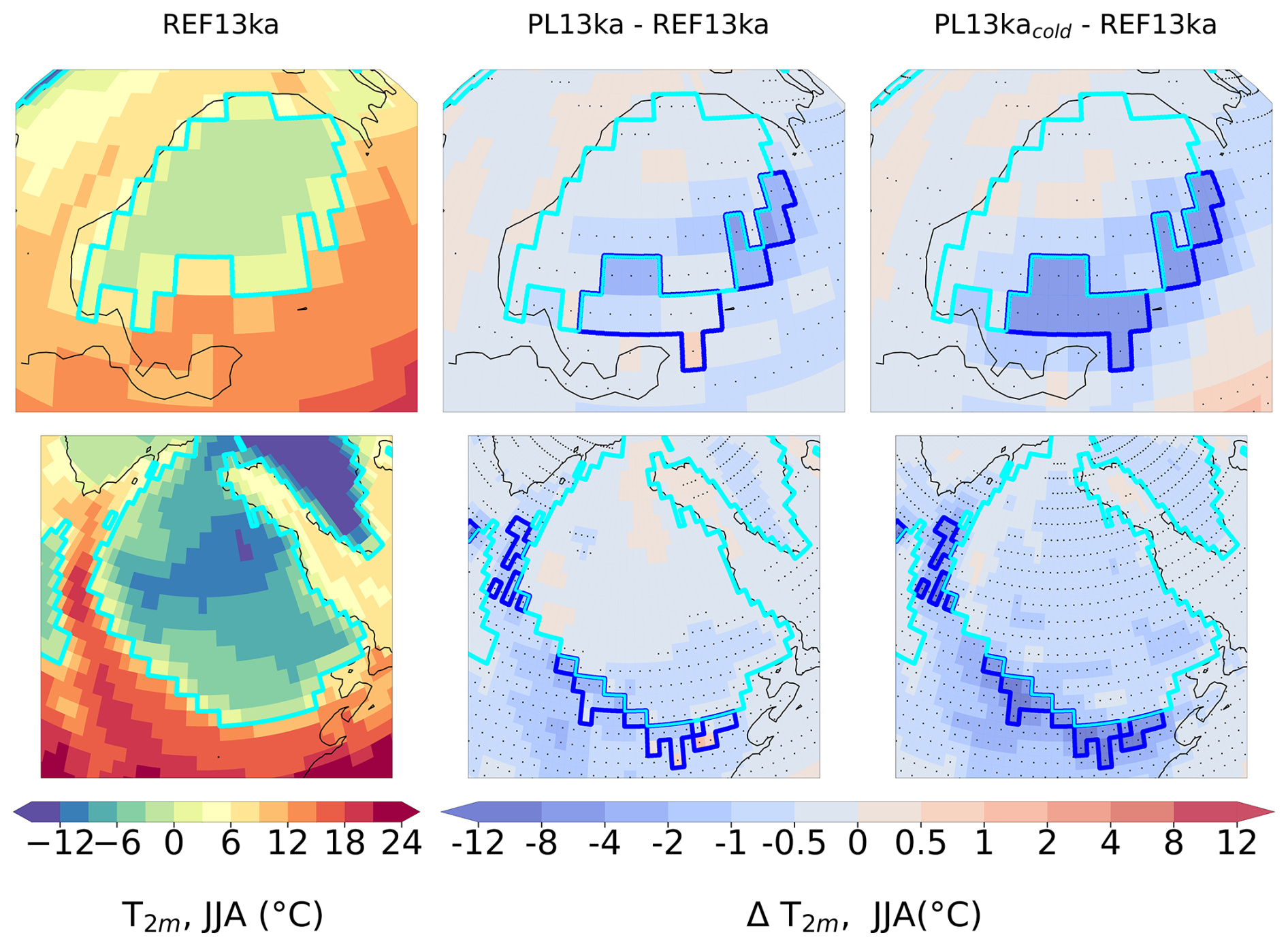
Figure 12m summer temperature for REF13ka (left), PL13ka–REF13ka anomalies (center) and PL13ka–REF13kacold anomalies (right). Light blue contours indicate ice sheet margins and dark blue lines indicate proglacial lakes. Anomalies which are significant according to a t-test with 95 % confidence level are highlighted by black dots.
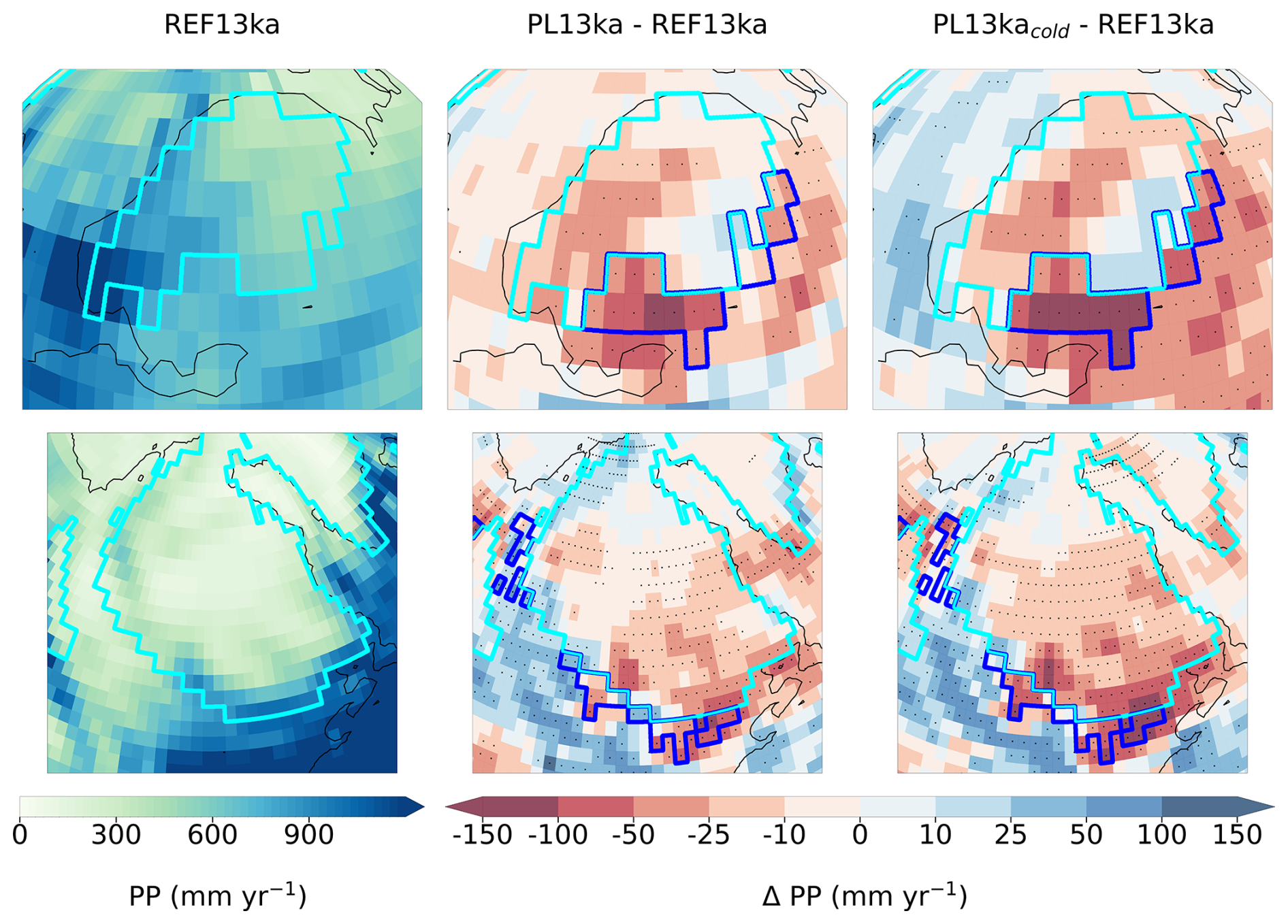
Figure 2Annual precipitation for REF13ka (left), PL13ka–REF13ka anomalies (center) and PL13ka–REF13kacold anomalies (right). Light blue contours indicate ice sheet margins and dark blue lines indicate proglacial lakes. Anomalies which are significant according to a t-test with 95 % confidence level are highlighted by black dots.
Experiment PL13kacold is intended to represent the additional heat loss from melting ice shelves and icebergs within the lakes. To quantify this effect, we use a simple one-dimensional lake model – described in the Supplemental Material – to estimate the ice melt required to produce comparable cooling. Lake model experiments indicate that 200–400 Gt of ice melt per year are sufficient to keep a 100 000 km2 lake surface below 4 °C year-round for lakes at the southern margins of the Fennoscandian and Laurentide Ice Sheets, respectively. Experiment PL13kacold therefore can serve as a lower bound, consistent with peak periods of deglaciation, when proglacial lake–ice sheet instability (PLISI; Quiquet et al., 2021) drives rapid ice loss at the lake interface. In the following we consider summer 2 m temperatures (June, July, August; JJA) and yearly mean precipitation as the key drivers of surface mass balance and focus on regions around the FIS and LIS. Figure 1 shows for both regions the distributions of summer near surface temperatures and annual mean precipitation in experiment REF13ka together with respective anomalies for experiments PL13ka and PL13kacold relative to REF13ka. Above the lake centers summer temperatures are reduced by up to 5 and 10 °C in PL13ka and PL13kacold respectively. In experiment PL13ka parts of the lakes also exhibit positive temperature anomalies, which likely reflects the delayed but longer warm season due to the unconstrained heat uptake and storage of the lakes. On a larger scale temperature gradients in summer between ice sheets and ice free land surface are weakened and shifted away from the ice sheets due to the lakes. Associated with this shift is a displacement in precipitation patterns and reduced precipitation over the lakeward slopes of the ice sheets. These general characteristics are in good agreement with sensitivities found in Colleoni et al. (2009) for the penultimate glaciation. A similar difference in seasonality between experiments with unconstrained and with limited surface warming of PLs is also found in Hostetler et al. (2000). Mean precipitation (summer and winter) and temperature anomalies (summer and winter) on a larger scale are also given in the Supplement (Figs. S2, S3, S4, S5).
Effect of the proglacial lakes on the Fennoscandian Ice Sheet (FIS-PL)
The existence of the FIS-PLs in experiment PL13kacold reduces summer temperatures significantly over the largest parts of the ice sheet with anomalies lower than −1 °C over the grid cells adjacent to the lakes (Fig. 1).
Interpolated to the 5 km grid and averaged over the Fennoscandian ice sheet JJA 2m temperature exhibits a reduction of 1.21 °C (0.9 °C) for PL13kacold (PL13ka).
The annual mean precipitation over the FIS is reduced by less than 3 % in experiments PL13ka and PL13kacold but local changes are only significant over the interior (Fig. 2).
Effect of the proglacial lakes on the Laurentide Ice Sheet (LIS-PL)
Around the LIS-PLs large scale (> 500 km) cooling is visible and 2 m temperature anomalies are lower than −1°C over most parts of the eastern Laurentide Ice Sheet in experiment PL13kacold (Fig. 1). Similar, yet weaker patterns are found in experiment PL13ka. During the winter months lake surface temperatures are colder than 4 °C in all experiments and lakes are mostly ice covered. In consequence differences in albedo and heat fluxes are small between experiments (not shown) and temperature anomalies are weak and mostly insignificant on a larger scale. Averaged over the entire ice sheet at 5 km resolution summer 2 m temperature anomalies are of the order of −0.9 °C (−0.8 °C) in the PL13kacold (PL13ka) experiment. In experiment REF13ka the southeastern margins of the ice sheet are zones of high precipitation with intensified precipitation towards the East (Fig. 2). In experiment PL13kacold the center of the high precipitation region has moved away from the ice sheet and annual precipitation averaged over the ice sheet is reduced by approximately 5 % (2 %) in PL13kacold (PL13ka). Significantly drier climates are found in the direct vicinity of the LIS-PLs and over most parts of the ice sheet, while regions south of the lakes experience enhanced precipitation.
3.2 Surface mass balance
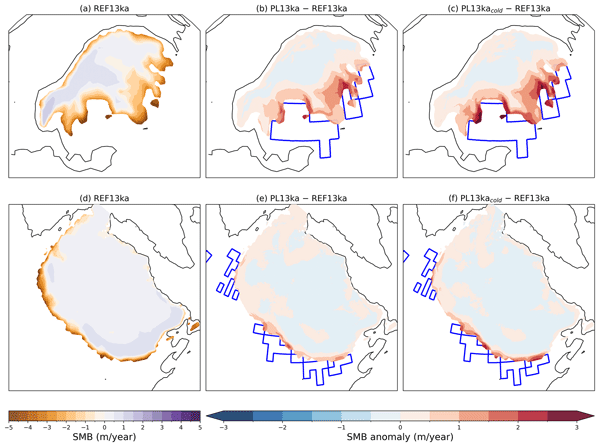
At 13 ka the northern hemisphere ice sheets were already strongly reduced with the LIS and FIS covering respectively 8.2×10⁶ km2 and 1.2×10⁶ km2 according to the GLAC1D reconstruction. During this period both ice sheets were losing mass at fast rates, which implies that the SMB of the ice sheets must have been too low, possibly even negative to balance the dynamic mass loss through calving. In the following surface mass balance is considered as:
and runoff as
Table 1 shows our modeled SMB and the components, which define SMB and runoff calculated separately for both considered ice sheets as multi-year means of the annual mean mass changes.
Table 1SMB and subcomponents of SMB and runoff from dEBM for both ice sheets in [Gt per year].

The prescribed geometry of the FIS and LIS indicates that the deglaciation of the two ice sheets is at different stages. The FIS is characterized by a gentle slope and low elevation towards its continental margins, indicating advanced mass loss, while the LIS has steeper slopes at its margins and the interior is still mostly at heights of more than 1000 m (Fig. S1). In consequence the LIS surface mass balance is positive but small (286 Gt) relative to the spatial dimension of the ice sheet (today’s Greenland ice sheet needs to have a SMB of approximately 400 Gt to balance mass loss from calving (Mankoff et al., 2019)) and the total SMB of the FIS is strongly negative due to an extensive ablation zone. Including PLs in experiment PL13kacold increases the SMB of the FIS and LIS by 550 and 601 Gt respectively and consequently stabilizes both ice sheets (Fig. 3). Primarily the PLs reduce surface melt due to the cooler summer temperatures, by approximately 23 % (18 %) for the LIS and by 36 % (27 %) for the FIS in experiment PL13kacold (PL13ka). Seasonal analysis (Tables S1 and S2) reveals that in both experiments the onset of the melt season is delayed and weakened, while there is no effect detected in winter. Only in experiment PL13ka does the melt season last well into the autumn due to the capacity of the warm lakes to store and later release heat. The slightly drier climate over the ice sheets is not fully reflected in accordingly reduced snow fall. Snow fall over the FIS is even enhanced, which can be explained with a shift in the snow rain ratio at lower altitudes caused by the colder climate (Fig. S6 in the Supplement). We would like to note that surface melt in dEBM is also sensitive to changes in precipitation during the melt season due to the albedo feedback (Niu et al., 2024): decrease in snow fall may result in lower albedo and higher surface melt, while a decrease in rain will act in the opposite direction. Seasonality in snow, rain and total precipitation are also shown in Fig. S6 in the Supplement for both ice sheets.

Figure 3Annual SMB for REF13ka (left) as well as the anomaly between PL13ka and REF13ka (center), and between PL13kacold and REF13ka (right). The upper row shows the FIS; the lower row shows LIS. Blue lines indicate proglacial lakes.
3.3 Sensitivity of the temperature-melt relation to local climate
Ice-sheet surface mass balance exhibits strong spatial gradients at scales of a few kilometers, so atmospheric fields from global climate models at typical grid scales of the order 100 km are too coarse to resolve key processes in the narrow ablation zones with steep topographic gradients, introducing substantial biases in both regional and integrated SMB estimates (van den Broeke et al., 2017). Consequently available SMB estimates for paleo-ice sheets often draw on statistically downscaled atmospheric forcing (<20 km) in combination with temperature-index methods to estimate melt (e.g. Yang et al., 2022). These empirical methods are grounded in the observation that surface melt rates generally increase linearly with positive-degree days, PDDs, where PDD refers to the temporal integral of near-surface temperatures exceeding the melting point (Calov and Greve, 2005). For the present-day climate the PDD approach has demonstrated good skill in deducing surface melt of the Greenland Ice Sheet from near surface air temperatures (Fettweis et al., 2020). However, the surface mass balance does not only depend on temperature and precipitation but radiation considerably influences the temperature–melt relation. It remains unclear whether the same empirical parameters are globally applicable or suitable in different climate periods. To investigate this we assess the sensitivity of the temperature–melt relationship as simulated by the physics-based dEBM to identify potential limitations of empirical methods. The LIS and FIS in our experiments differ in shape, latitudinal position and the influence of adjacent continents and oceans, offering a broader range of climate conditions than the modern Greenland Ice Sheet. Considering both ice sheets we find that for any given PDD value melt rates may vary by a factor of two or more due to variations in incoming shortwave radiation (Fig. 4, left). Experiments PL13kacold and REF13ka generally exhibit a similar temperature–melt relation (Fig. 4, center). However, when compared with dEBM surface melt rates over Greenland from the last 30 years of a historical simulation (Verjans et al., 2025), we find that here melt appears less efficient (similar temperatures will produce less melt) and the parameter space is narrowed as shortwave radiation is generally less intense. Furthermore, the temperature-melt relation differs between the FIS and LIS (Fig. 4, right). Melt is most efficient over parts of the LIS, particularly away from the coast at the southern and western margin of the Laurentide Ice Sheet where diurnal insolation maxima are intensified due to the lower latitude and less cloud cover. These findings underscore that empirical temperature-index methods would require region-specific parameters, and those derived from present-day Greenland observations are unlikely to be accurate for paleo-ice sheets.
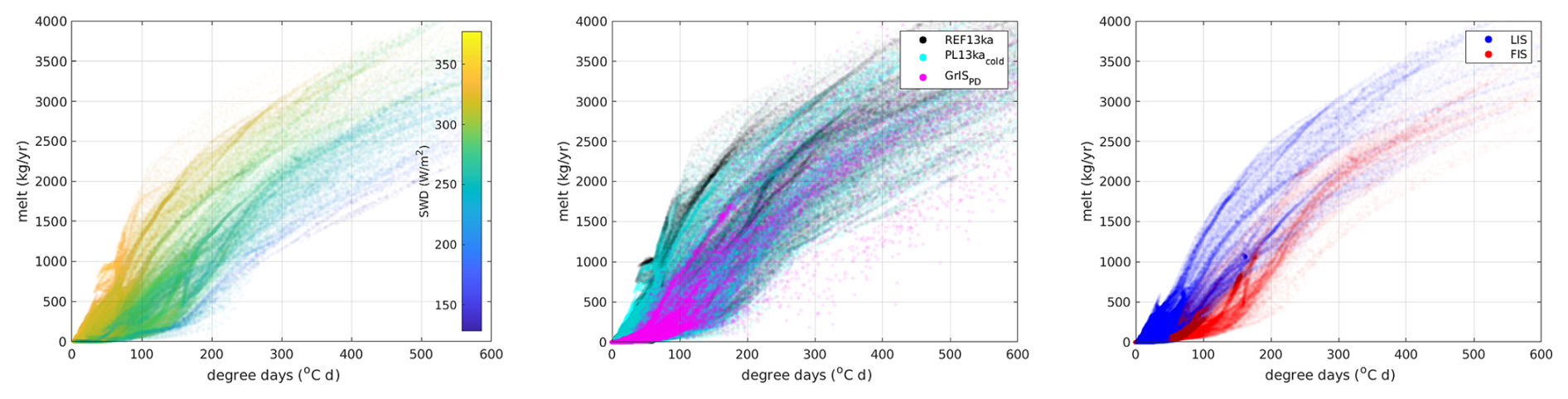
Figure 4Annual melt versus annual positive degree days. Each circle represents the multi-year mean for an individual ice covered gridpoint. Left: experiment PL13kacold, including LIS, FIS, Cordilleran and Greenland Ice Sheet, colors represent the mean downward shortwave radiation weighted by melt rates. Center: Colors identify experiment REF13ka (black), experiment PL13kacold (cyan) and the last 30 years of the 20th century in a historical simulation downscaled with dEBM for the present-day Greenland Ice Sheet (magenta, Verjans et al., 2025). Right: experiment PL13kacold, colors identify the Laurentide (blue) and Fennoscandian Ice Sheet (red).
4.1 Surface mass balance response to proglacial lakes under deglacial conditions
Using a physics-based surface energy-mass balance model, this sensitivity study demonstrates that large proglacial lakes can substantially reduce surface ablation of adjacent ice sheets during deglaciation. For both the Laurentide and Fennoscandian ice sheets, total surface melt is reduced by more than 20 %–35 % when proglacial lakes are present, with approximately one quarter of this reduction attributable to the maintenance of a perennially cold lake surface. In agreement with earlier studies (Hostetler et al., 2000; Krinner et al., 2004), we find that proglacial lakes induce regional summer cooling over adjacent ice sheets, while accumulation over the Laurentide Ice Sheet is slightly reduced (<2 %). This reduction in accumulation weakens the surface mass balance response only marginally, as the decrease in melt dominates. The relative sensitivity of surface melt to the presence of proglacial lakes under deglacial conditions is comparable to that reported for peak glacial conditions (Colleoni et al., 2009) and also ice-dammed lakes developing during the early inception of the Eurasian Ice Sheet Complex are found to exert a similar effect (Krinner et al., 2004; Peyaud et al., 2007). However, the resulting impact on total surface mass balance differs markedly during deglaciation, because the ratio of ablation to accumulation is substantially higher. In the present experiments, the lowered ice-surface and reduced slope of the southward facing part of the Fennoscandian Ice Sheet (FIS) leads to a widening of the ablation zone while the Laurentide Ice Sheet (LIS) is less advanced and does not yet show advanced downwasting. As a result, total ablation exceeds accumulation by more than a factor of two for the FIS and is likely to become more dominant as deglaciation progresses. This contrasts with conditions during the peak of the penultimate glacial period (around 140 ka), when accumulation was the dominant component of the surface mass balance (Colleoni et al., 2009).
4.2 Balance between dynamical ice loss and climatic SMB feedbacks
Proglacial lakes exert a dual influence on ice-sheet evolution through opposing climatic and dynamic feedbacks, potentially decoupling deglacial ice-sheet behavior from global climate forcing. We find that explicitly coupling proglacial lakes to the climate system increases the surface mass balance of neighbouring ice sheets by suppressing summer melt and reducing mass loss by roughly 20 %–30 %. The simulated absolute increase in surface mass balance of both ice sheets combined corresponds to a sea-level equivalent of more than 30 cm per 100 years, opposing deglacial sea level rise which by comparison was in the order of 1 m per 100 years over the main deglaciation (Lambeck et al., 2014). For the Laurentide Ice Sheet proglacial lakes increase surface mass balance and reduce mass loss by ∼ 600 Gt per year for the geometry considered here. In a simulation with a fast retreating interactive ice sheet, this negative feedback would become even larger through the melt–elevation feedback under progressive downwasting of the ice sheet. Complementary to this negative feedback, recent modeling studies have studied the positive dynamic feedback, while neglecting the climate response. Proglacial lake-induced ice-sheet instabilities (PLISI) may increase Laurentide Ice Sheet mass loss by more than 3000 Gt per year (Quiquet et al., 2021). Our results suggest that the deglaciation of Northern Hemisphere ice sheets may have been modulated by the balance between opposing dynamical and climatic effects. A conceptual picture emerges in which lake-induced instabilities initially promote rapid mass loss and margin retreat, followed by a phase in which sufficiently large proglacial lakes exert a stabilizing climatic influence by cooling the regional atmosphere and reducing ablation. Indeed Austermann et al. (2022) find that between 14.2 and 11.5 ka, retreat rates inferred from geological reconstructions were significantly higher at lake-terminating than at land-terminating margins, whereas this contrast was less pronounced before and after this interval. However, sensitivity studies also reveal that the strength of the dynamic feedback strongly depends on complex processes and poorly constrained basal boundary conditions, including basal friction, ice–lake interactions, glacial isostatic adjustment, and changing lake levels or drainage events (Scherrenberg et al., 2024; Austermann et al., 2022; Hu and Haseloff, 2025). These factors may explain why both ice sheets exhibit a more heterogeneous retreat history in geological reconstructions than in the above simulations with ice-only models or models of intermediate complexity: The southern Laurentide Ice Sheet exhibits highly variable ice-stream configurations and periods of stagnation and readvance (e.g. Dyke, 2004; Margold et al., 2018; Dalton et al., 2020; Norris et al., 2024) and contrasting retreat patterns of the Fennoscandian Ice Sheet between Bølling–Allerød and Younger Dryas despite a continuous presence of the Baltic Ice Lake (Stroeven et al., 2016).
4.3 Limitations and implications for surface mass balance parameterizations
Several limitations of the present experiments should be noted. The prescribed ice-sheet geometry does not allow for elevation-surface mass balance feedbacks, which may alter the magnitude of the surface mass balance response during ongoing retreat. Furthermore, the hybrid boundary conditions employed here are not intended to reproduce a realistic deglacial trajectory, but rather to isolate the sensitivity of climate and surface mass balance to proglacial lakes under deglacial conditions. Our results further indicate that variations in incoming shortwave radiation substantially modify the relationship between near-surface temperature and melt. This finding highlights limitations of empirical temperature-index approaches when applied across different regions or climate states. Nevertheless, temperature-index methods may yield reliable surface mass balance estimates if temperatures are downscaled to sufficiently high spatial resolution and model parameters are adjusted to account for regional and climatic differences, as e.g. in Colleoni et al. (2009). These considerations are particularly relevant for large-scale ice-sheet modeling studies that rely on simplified surface mass balance parameterizations.
4.4 Toward fully coupled lake-ice-atmosphere modeling
Fully assessing the complex interplay between proglacial lakes, ice sheets, and the atmosphere during deglaciation ultimately requires transient, fully coupled Earth system simulations that explicitly represent lake-ice, lake-atmosphere, and atmosphere-ice interactions. In recent years, important developments have emerged for all three interfaces, providing a pathway toward such comprehensive modeling frameworks. These include LakeCC for efficiently representing lake basins and lake-ice interactions (Hinck et al., 2020), ECHAM6 with a proglacial lake extension for representing lake-atmosphere coupling (this study, ECHAM6-PL), and coupled atmosphere-ice approaches that resolve energy and mass exchange at the ice surface (Vizcaíno et al., 2010; Krebs-Kanzow et al., 2021; Born et al., 2019).
Integrating these developments into transient simulations offers the potential to quantify the evolving balance between dynamical ice loss and climatically driven surface mass balance feedbacks during glacial terminations.
Using a physics-based surface energy-mass balance approach, we show that large proglacial lakes can substantially reduce surface ablation of adjacent ice sheets during deglaciation, decreasing total melt by more than 20 %–35 % for the Laurentide and Fennoscandian ice sheets under Allerød-like conditions. Approximately one quarter of this reduction arises from the maintenance of a perennially cold lake surface, highlighting the importance of ice-lake thermal interactions. Although proglacial lakes slightly reduce accumulation, this effect is small compared to the reduction in melt, resulting in a net increase in surface mass balance. Because ablation dominates surface mass balance during deglaciation, the climatic impact of proglacial lakes is amplified relative to glacial conditions. Our results indicate that proglacial lakes can partially counteract dynamically driven ice loss and thereby modulate the pace of ice-sheet retreat. Accounting for the influence of proglacial lakes during glacial terminations may therefore improve ice-sheet model projections.
The data used in this study are available at https://doi.org/10.5281/zenodo.18545093 (Gierz et al., 2026). The analysis scripts, Jupyter notebooks and the lake model used to produce the figures and results of this study are archived at https://doi.org/10.5281/zenodo.23981978 (Krebs-Kanzow et al., 2026).
The supplement related to this article is available online at https://doi.org/10.5194/tc-20-6685-2026-supplement.
UKK, LS and GL conceptualized the original ideas presented in this manuscript. LS and PG implemented the lake extension in ECHAM6, GK provided ocean boundary conditions, LN and LS defined the lake configuration with LakeCC. LS carried out atmosphere model experiments and LS and UKK conducted SMB simulations. LS and UKK conducted the analysis of the model results and wrote the initial draft of the manuscript. All authors contributed to the interpretation of results and manuscript preparation.
The contact author has declared that none of the authors has any competing interests.
Publisher's note: Copernicus Publications remains neutral with regard to jurisdictional claims made in the text, published maps, institutional affiliations, or any other geographical representation in this paper. The authors bear the ultimate responsibility for providing appropriate place names. Views expressed in the text are those of the authors and do not necessarily reflect the views of the publisher.
UKK acknowledges funding from the Deutsche Forschungsgemeinschaft (DFG, German Research Foundation) under Germany’s Excellence Strategy – Cluster of Excellence “The Ocean Floor – Earth’s Uncharted Interface” (EXC 2077, Project 390741603), and from the European Union’s Horizon Europe programme through the LiquidIce project (Grant Agreement No. 101184962). This project was also supported by the German Federal Ministry of Education and Research (BMBF) through the PalMod project (grant numbers 01LP1915A and 01LP2303A to G.K., and 01LP1916B and 01LP2313A to G.L.). G.L. acknowledges funding from the European Union through the European Research Council (ERC) grant “i2B” (Grant Agreement No. 101118519). We thank the Max Planck Institute for Meteorology in Hamburg and our colleagues at the Alfred Wegener Institute (AWI) for making the ECHAM6-JSBACH and FESOM2 models available. We are grateful to Kai Himstedt and Sebastian Hinck (Deutsches Klimarechenzentrum, DKRZ) for their support with ECHAM6 and LakeCC. We gratefully acknowledge the computational resources and technical support provided by the AWI computing center in Bremerhaven and the DKRZ in Hamburg, Germany. This work contributes to the Helmholtz research program “Changing Earth – Sustaining our Future” and the Helmholtz Climate Initiative “REKLIM”. We thank Benjamin Stoker, Niall Gandy and one anonymous reviewer for their thorough reviews and constructive feedback, which helped improve the quality of this manuscript.
The article processing charges for this open-access publication were covered by the Alfred-Wegener-Institut Helmholtz-Zentrum für Polar- und Meeresforschung.
This paper was edited by Ian Delaney and reviewed by Benjamin Stoker, Niall Gandy, and one anonymous referee.
Andersen, B. G. and Borns Jr., H. W.: The Ice Age World: An Introduction to Quaternary History and Research with Emphasis on North America and Northern Europe During the Last 2.5 Million Years, Scandinavian University Press, Oslo, ISBN 9788200376835, 1994. a
Austermann, J., Wickert, A. D., Pico, T., Kingslake, J., Callaghan, K. L., and Creel, R. C.: Glacial Isostatic Adjustment Shapes Proglacial Lakes Over Glacial Cycles, Geophys. Res. Lett., 49, e2022GL101191, https://doi.org/10.1029/2022GL101191, 2022. a, b, c
Berger, A. L.: Long-term variations of daily insolation and Quaternary climatic changes, J. Atmos. Sci., 35, 2362–2367, https://doi.org/10.1175/1520-0469(1978)035<2362:LTVODI>2.0.CO;2, 1978. a
Born, A., Imhof, M. A., and Stocker, T. F.: An efficient surface energy–mass balance model for snow and ice, The Cryosphere, 13, 1529–1546, https://doi.org/10.5194/tc-13-1529-2019, 2019. a
Calov, R. and Greve, R.: A semi-analytical solution for the positive degree-day model with stochastic temperature variations, J. Glaciol., 51, 173–175, https://doi.org/10.3189/172756505781829601, 2005. a
Carrivick, J. L. and Tweed, F. S.: Proglacial lakes: character, behaviour and geological importance, Quat. Sci. Rev., 78, 34–52, https://doi.org/10.1016/j.quascirev.2013.07.028, 2013. a
Colleoni, F., Krinner, G., Jakobsson, M., Peyaud, V., and Ritz, C.: Influence of regional parameters on the surface mass balance of the Eurasian ice sheet during the peak Saalian (140 kya), Glob. Planet. Change, 68, 132–148, https://doi.org/10.1016/j.gloplacha.2009.03.021, 2009. a, b, c, d, e
Dalton, A. S., Margold, M., Stokes, C. R., Tarasov, L., Dyke, A. S., Adams, R. S., Allard, S., Arends, H. E., Atkinson, N., Attig, J. W., Barnett, P. J., Barnett, R. L., Batterson, M., Bernatchez, P., Borns Jr., H. W., Breckenridge, A., Briner, J. P., Brouard, E., Campbell, J. E., Carlson, A. E., Clague, J. J., Curry, B. B., Daigneault, R.-A., Dubé-Loubert, H., Easterbrook, D. J., Franzi, D. A., Friedrich, H. G., Funder, S., Gauthier, M. S., Gowan, A. S., Harris, K. L., Hétu, B., Hooyer, T. S., Jennings, C. E., Johnson, M. D., Kehew, A. E., Kelley, S. E., Kerr, D., King, E. L., Kjeldsen, K. K., Knaeble, A. R., Lajeunesse, P., Lakeman, T. R., Lamothe, M., Larson, P., Lavoie, M., Loope, H. M., Lowell, T. V., Lusardi, B. A., Manz, L., McMartin, I., Nixon, F. C., Occhietti, S., Parkhill, M. A., Piper, D. J. W., Pronk, A. G., Richard, P. J. H., Ridge, J. C., Ross, M., Roy, M., Seaman, A., Shaw, J., Stea, R. R., Teller, J. T., Thompson, W. B., Thorleifson, L. H., Utting, D. J., Veillette, J. J., Ward, B. C., Weddle, T. K., and Wright Jr., H. E.: An updated radiocarbon-based ice margin chronology for the last deglaciation of the North American Ice Sheet Complex, Quat. Sci. Rev., 234, 106223, https://doi.org/10.1016/j.quascirev.2020.106223, 2020. a
Demidov, I. N., Houmark-Nielsen, M., Kjær, K. H., and Larsen, E.: The last Scandinavian Ice Sheet in northwestern Russia: ice flow patterns and decay dynamics, Boreas, 35, 425–443, https://doi.org/10.1080/03009480600781883, 2006. a
Dyke, A. S.: An outline of North American deglaciation with emphasis on central and northern Canada, in: Quaternary Glaciations – Extent and Chronology, Part II: North America, edited by: Ehlers, J. and Gibbard, P. L., pp. 373–424, Elsevier, Amsterdam, https://doi.org/10.1016/S1571-0866(04)80209-4, 2004. a
Fettweis, X., Hofer, S., Krebs-Kanzow, U., Amory, C., Aoki, T., Berends, C. J., Born, A., Box, J. E., Delhasse, A., Fujita, K., Gierz, P., Goelzer, H., Hanna, E., Hashimoto, A., Huybrechts, P., Kapsch, M.-L., King, M. D., Kittel, C., Lang, C., Langen, P. L., Lenaerts, J. T. M., Liston, G. E., Lohmann, G., Mernild, S. H., Mikolajewicz, U., Modali, K., Mottram, R. H., Niwano, M., Noël, B., Ryan, J. C., Smith, A., Streffing, J., Tedesco, M., van de Berg, W. J., van den Broeke, M., van de Wal, R. S. W., van Kampenhout, L., Wilton, D., Wouters, B., Ziemen, F., and Zolles, T.: GrSMBMIP: intercomparison of the modelled 1980–2012 surface mass balance over the Greenland Ice Sheet, The Cryosphere, 14, 3935–3958, https://doi.org/10.5194/tc-14-3935-2020, 2020. a, b
Fisher, T. G.: Megaflooding associated with glacial Lake Agassiz, Earth Sci. Rev., 201, 102974, https://doi.org/10.1016/j.earscirev.2019.102974, 2020. a
Gierz, P., Sijbrandij, L., and Krebs-Kanzow, U.: Proglacial lakes substantially modulate the surface mass balance of retreating ice sheets: Data, Zenodo [data set], https://doi.org/10.5281/zenodo.18545093, 2026. a
Giorgetta, M. A., Roeckner, E., Mauritsen, T., Bader, J., Crueger, T., Esch, M., Rast, S., Kornblueh, L., Schmidt, H., Kinne, S., Hohenegger, C., Möbis, B., Krismer, T., Wieners, K.-H., and Stevens, B.: The atmospheric general circulation model ECHAM6 – Model description, Reports on Earth System Science 135, Max-Planck-Institut für Meteorologie, Hamburg, https://doi.org/10.17617/2.1810480, 2013. a, b
Hinck, S., Gowan, E. J., and Lohmann, G.: LakeCC: a tool for efficiently identifying lake basins with application to palaeogeographic reconstructions of North America, J. Quat. Sci., 35, 422–432, https://doi.org/10.1002/jqs.3182, 2020. a, b
Hinck, S., Gowan, E. J., Zhang, X., and Lohmann, G.: PISM-LakeCC: Implementing an adaptive proglacial lake boundary in an ice sheet model, The Cryosphere, 16, 941–965, https://doi.org/10.5194/tc-16-941-2022, 2022. a
Hostetler, S. W., Bartlein, P. J., Clark, P. U., Small, E. E., and Solomon, A. M.: Simulated influences of Lake Agassiz on the climate of central North America 11 000 years ago, Nature, 405, 334–337, https://doi.org/10.1038/35012581, 2000. a, b, c, d, e
Hu, K. and Haseloff, M.: Proglacial Lake Drainage Events Drive Fast Grounding Line Advance in a Warming Climate, Geophys. Res. Lett., 52, e2025GL115184, https://doi.org/10.1029/2025GL115184, 2025. a, b
Köhler, P., Nehrbass-Ahles, C., Schmitt, J., Stocker, T. F., and Fischer, H.: A 156 kyr smoothed history of the atmospheric greenhouse gases CO2, CH4, and N2O and their radiative forcing, Earth Syst. Sci. Data, 9, 363–387, https://doi.org/10.5194/essd-9-363-2017, 2017. a
Krebs-Kanzow, U., Gierz, P., and Lohmann, G.: Brief communication: An ice surface melt scheme including the diurnal cycle of solar radiation, The Cryosphere, 12, 3923–3930, https://doi.org/10.5194/tc-12-3923-2018, 2018. a
Krebs-Kanzow, U., Gierz, P., Rodehacke, C. B., Xu, S., Yang, H., and Lohmann, G.: The diurnal Energy Balance Model (dEBM): a convenient surface mass balance solution for ice sheets in Earth system modeling, The Cryosphere, 15, 2295–2313, https://doi.org/10.5194/tc-15-2295-2021, 2021. a, b
Krebs-Kanzow, U., Gierz, P., and Sijbrandij, L.: Analysis scripts for: Proglacial lakes substantially modulate the surface mass balance of deglacial ice sheets, Zenodo [code], https://doi.org/10.5281/zenodo.23981978, 2026. a
Krinner, G., Mangerud, J., Jakobsson, M., Crucifix, M., Ritz, C., and Svendsen, J. I.: Enhanced ice sheet growth in Eurasia owing to adjacent ice-dammed lakes, Nature, 427, 429–432, https://doi.org/10.1038/nature02233, 2004. a, b, c, d
Lambeck, K., Rouby, H., Purcell, A., Sun, Y., and Sambridge, M.: Sea level and global ice volumes from the Last Glacial Maximum to the Holocene, Proc. Natl. Acad. Sci. USA, 111, 15296–15303, https://doi.org/10.1073/pnas.1411762111, 2014. a
Mangerud, J., Jakobsson, M., Alexanderson, H., Astakhov, V., Clarke, G. K. C., Henriksen, M., Hjort, C., Krinner, G., Lunkka, J.-P., Möller, P., Murray, A., Nikolskaya, O., Saarnisto, M., and Svendsen, J. I.: Ice-dammed lakes and rerouting of the drainage of northern Eurasia during the Last Glaciation, Quat. Sci. Rev., 23, 1313–1332, https://doi.org/10.1016/j.quascirev.2003.12.009, 2004. a
Mankoff, K. D., Colgan, W., Solgaard, A., Karlsson, N. B., Ahlstrøm, A. P., van As, D., Box, J. E., Khan, S. A., Kjeldsen, K. K., Mouginot, J., and Fausto, R. S.: Greenland Ice Sheet solid ice discharge from 1986 through 2017, Earth Syst. Sci. Data, 11, 769–786, https://doi.org/10.5194/essd-11-769-2019, 2019. a
Margold, M., Stokes, C. R., and Clark, C. D.: Reconciling records of ice streaming and ice margin retreat to produce a palaeogeographic reconstruction of the deglaciation of the Laurentide Ice Sheet, Quat. Sci. Rev., 189, 1–30, https://doi.org/10.1016/j.quascirev.2018.03.013, 2018. a
Niu, L., Knorr, G., Krebs-Kanzow, U., Gierz, P., and Lohmann, G.: Rapid Laurentide Ice Sheet growth preceding the Last Glacial Maximum due to summer snowfall, Nat. Geosci., 17, 440–449, https://doi.org/10.1038/s41561-024-01419-z, 2024. a
Norris, S. L., Margold, M., Evans, D. J. A., Atkinson, N., and Froese, D. G.: Dynamical response of the southwestern Laurentide Ice Sheet to rapid Bølling–Allerød warming, The Cryosphere, 18, 1533–1559, https://doi.org/10.5194/tc-18-1533-2024, 2024. a
Patton, H., Hubbard, A., Andreassen, K., Auriac, A., Whitehouse, P. L., Stroeven, A. P., Shackleton, C., Winsborrow, M., Heyman, J., and Hall, A. M.: Deglaciation of the Eurasian ice sheet complex, Quat. Sci. Rev., 169, 148–172, https://doi.org/10.1016/j.quascirev.2017.05.019, 2017. a
Peyaud, V., Ritz, C., and Krinner, G.: Modelling the Early Weichselian Eurasian Ice Sheets: role of ice shelves and influence of ice-dammed lakes, Clim. Past, 3, 375–386, https://doi.org/10.5194/cp-3-375-2007, 2007. a, b
Quiquet, A., Dumas, C., Paillard, D., Ramstein, G., Ritz, C., and Roche, D. M.: Deglacial Ice Sheet Instabilities Induced by Proglacial Lakes, Geophys. Res. Lett., 48, e2020GL092141, https://doi.org/10.1029/2020GL092141, 2021. a, b, c, d
Reick, C. H., Raddatz, T., Brovkin, V., and Gayler, V.: Representation of natural and anthropogenic land cover change in MPI-ESM, J. Adv. Model. Earth Syst., 5, 459–482, https://doi.org/10.1002/jame.20022, 2013. a
Scherrenberg, M. D. W., Berends, C. J., and van de Wal, R. S. W.: Late Pleistocene glacial terminations accelerated by proglacial lakes, Clim. Past, 20, 1761–1784, https://doi.org/10.5194/cp-20-1761-2024, 2024. a, b, c
Schoof, C.: Ice sheet grounding line dynamics: Steady states, stability, and hysteresis, J. Geophys. Res.: Earth Surf., 112, F03S28, https://doi.org/10.1029/2006JF000664, 2007. a
Sidorenko, D., Goessling, H. F., Koldunov, N. V., Scholz, P., Danilov, S., Barbi, D., Cabos, W., Gurses, O., Harig, S., Hinrichs, C., Juricke, S., Lohmann, G., Losch, M., Mu, L., Rackow, T., Rakowsky, N., Sein, D., Semmler, T., Shi, X., Stepanek, C., Streffing, J., Wang, Q., Wekerle, C., Yang, H., and Jung, T.: Evaluation of FESOM2.0 Coupled to ECHAM6.3: Preindustrial and HighResMIP Simulations, J. Adv. Model. Earth Syst., 11, 3794–3815, https://doi.org/10.1029/2019MS001696, 2019. a, b
Sijbrandij, L.: The influence of proglacial lakes on climate and surface mass balance of retreating ice sheets: A study of the North American and Scandinavian ice sheets at 13 ka BP, Master's thesis, University of Augsburg, https://hdl.handle.net/10013/epic.23a21860-81d6-4d22-bea7-d115bfcdcb8a (last access: 16 November 2026), 2022. a
Stevens, B., Giorgetta, M., Esch, M., Mauritsen, T., Crueger, T., Rast, S., Salzmann, M., Schmidt, H., Bader, J., Block, K., Brokopf, R., Fast, I., Kinne, S., Kornblueh, L., Lohmann, U., Pincus, R., Reichler, T., and Roeckner, E.: Atmospheric component of the MPI-M Earth System Model: ECHAM6, J. Adv. Model. Earth Syst., 5, 146–172, https://doi.org/10.1002/jame.20015, 2013. a
Stokes, C. R. and Clark, C. D.: Evolution of late glacial ice-marginal lakes on the northwestern Canadian Shield and their influence on the location of the Dubawnt Lake palaeo-ice stream, Palaeogeogr. Palaeoclimatol. Palaeoecol., 215, 155–171, https://doi.org/10.1016/j.palaeo.2004.09.006, 2004. a
Stroeven, A. P., Hättestrand, C., Kleman, J., Heyman, J., Fabel, D., Fredin, O., Goodfellow, B. W., Harbor, J. M., Jansen, J. D., Olsen, L., Caffee, M. W., Fink, D., Lundqvist, J., Rosqvist, G. C., Strömberg, B., and Jansson, K. N.: Deglaciation of Fennoscandia, Quat. Sci. Rev., 147, 91–121, https://doi.org/10.1016/j.quascirev.2015.09.016, 2016. a
Tarasov, L., Dyke, A. S., Neal, R. M., and Peltier, W. R.: A data-calibrated distribution of deglacial chronologies for the North American ice complex from glaciological modeling, Earth Planet. Sci. Lett., 315–316, 30–40, https://doi.org/10.1016/j.epsl.2011.09.010, 2012. a
Teller, J. T., Leverington, D. W., and Mann, J. D.: Freshwater outbursts to the oceans from glacial Lake Agassiz and their role in climate change during the last deglaciation, Quat. Sci. Rev., 21, 879–887, https://doi.org/10.1016/S0277-3791(01)00145-7, 2002. a
Truffer, M. and Motyka, R. J.: Where glaciers meet water: Subaqueous melt and its relevance to glaciers in various settings, Rev. Geophys., 54, 220–239, https://doi.org/10.1002/2015RG000494, 2016. a
van den Broeke, M., Box, J., Fettweis, X., Hanna, E., Noël, B., Tedesco, M., van As, D., van de Berg, W. J., and van Kampenhout, L.: Greenland Ice Sheet Surface Mass Loss: Recent Developments in Observation and Modeling, Curr. Clim. Change Rep., 3, 345–356, https://doi.org/10.1007/s40641-017-0084-8, 2017. a
Verjans, V., Robel, A. A., Ultee, L., Seroussi, H., Thompson, A. F., Ackermann, L., Choi, Y., and Krebs-Kanzow, U.: The Greenland Ice Sheet Large Ensemble (GrISLENS): simulating the future of Greenland under climate variability, The Cryosphere, 19, 3749–3783, https://doi.org/10.5194/tc-19-3749-2025, 2025. a, b
Vincent, C., Auclair, S., and Le Meur, E.: Outburst flood hazard for glacier-dammed Lac de Rochemelon, France, J. Glaciol., 56, 91–100, https://doi.org/10.3189/002214310791190857, 2010. a
Vizcaíno, M., Mikolajewicz, U., Jungclaus, J., and Schurgers, G.: Climate modification by future ice sheet changes and consequences for ice sheet mass balance, Clim. Dyn., 34, 301–324, https://doi.org/10.1007/s00382-009-0591-y, 2010. a
Weertman, J.: Stability of the Junction of an Ice Sheet and an Ice Shelf, J. Glaciol., 13, 3–11, https://doi.org/10.3189/S0022143000023327, 1974. a
Yang, H., Krebs-Kanzow, U., Kleiner, T., Sidorenko, D., Rodehacke, C. B., Shi, X., Gierz, P., Niu, L., Gowan, E. J., Hinck, S., Liu, X., Stap, L. B., and Lohmann, G.: Impact of paleoclimate on present and future evolution of the Greenland Ice Sheet, PLoS ONE, 17, e0259816, https://doi.org/10.1371/journal.pone.0259816, 2022. a