
Articles | Volume 20, issue 11
https://doi.org/10.5194/tc-20-6535-2026
© Author(s) 2026. This work is distributed under
the Creative Commons Attribution 4.0 License.
the Creative Commons Attribution 4.0 License.
https://doi.org/10.5194/tc-20-6535-2026
© Author(s) 2026. This work is distributed under
the Creative Commons Attribution 4.0 License.
the Creative Commons Attribution 4.0 License.
Research article
| 
13 Nov 2026
Research article |
| 13 Nov 2026
| 13 Nov 2026
Intra-annual grounding-line migration and retreat: insights from high-resolution satellite and in situ observations over Milne Glacier in the Canadian High Arctic
Yulia K. Antropova
CORRESPONDING AUTHOR

Department of Geography and Environmental Studies, Carleton University, Ottawa, K1S 5B6, Canada
Derek Mueller
Department of Geography and Environmental Studies, Carleton University, Ottawa, K1S 5B6, Canada
Sergey V. Samsonov
Canadian Centre for Mapping and Earth Observations, Natural Resources Canada, Ottawa, K1A 0E4, Canada
Alexander S. Komarov
Earth System Research and Integration Division, Environment and Climate Change Canada, Ottawa, K1A 0H3, Canada
Jérémie Bonneau
Department of Civil Engineering, The University of British Columbia, Vancouver, V6T 1Z2, Canada
Département de Génie Civil et Génie des Eaux, Université Laval, Québec, G1V 0A6, Canada
Related authors
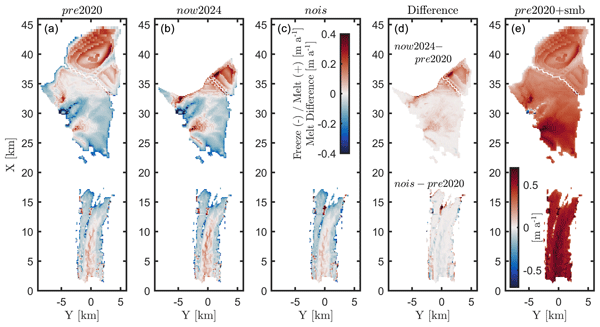
Jérémie Bonneau, Bernard E. Laval, Derek Mueller, Yulia Antropova, and Andrew K. Hamilton
The Cryosphere, 19, 2615–2633, https://doi.org/10.5194/tc-19-2615-2025, https://doi.org/10.5194/tc-19-2615-2025, 2025
Short summary
Short summary
Arctic glaciers and ice shelves are retreating due to warmer oceans, but the link between ocean warming and ice loss is complex. We used a numerical model to study these processes in Milne Fiord, a unique site with an ice shelf and a tidewater glacier. Our results show that submarine melting is an important thinning mechanism and that glacier retreat will continue for decades. This research highlights the ongoing and future changes in Arctic ice structures.
Ada Loewen, Derek Mueller, Gregory Crocker, Katherine Wilson, Adrianne Mike-Qaunaq, and Andrew R. Mahoney
EGUsphere, https://doi.org/10.5194/egusphere-2026-3739, https://doi.org/10.5194/egusphere-2026-3739, 2026
Short summary
Short summary
By looking at landfast sea ice fracture patterns in Admiralty Inlet, Nunavut using satellite imagery and Inuit Knowledge, we learned that seasonal changes in ice properties and certain geographic features (e.g. points of land) were important for fracture formation. By integrating remote sensing, environmental datasets, and Inuit knowledge, we improved understanding of landfast ice stability and predictive capabilities relevant for community travel safety and Arctic climate modelling.
Jérémie Bonneau, Bernard E. Laval, Derek Mueller, Yulia Antropova, and Andrew K. Hamilton
The Cryosphere, 19, 2615–2633, https://doi.org/10.5194/tc-19-2615-2025, https://doi.org/10.5194/tc-19-2615-2025, 2025
Short summary
Short summary
Arctic glaciers and ice shelves are retreating due to warmer oceans, but the link between ocean warming and ice loss is complex. We used a numerical model to study these processes in Milne Fiord, a unique site with an ice shelf and a tidewater glacier. Our results show that submarine melting is an important thinning mechanism and that glacier retreat will continue for decades. This research highlights the ongoing and future changes in Arctic ice structures.
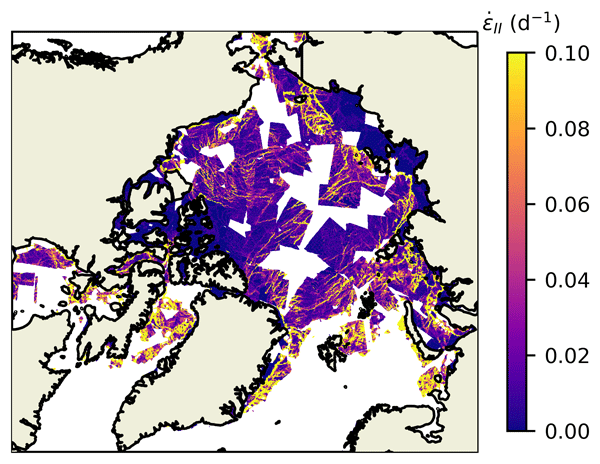
Mathieu Plante, Jean-François Lemieux, L. Bruno Tremblay, Amélie Bouchat, Damien Ringeisen, Philippe Blain, Stephen Howell, Mike Brady, Alexander S. Komarov, Béatrice Duval, Lekima Yakuden, and Frédérique Labelle
Earth Syst. Sci. Data, 17, 423–434, https://doi.org/10.5194/essd-17-423-2025, https://doi.org/10.5194/essd-17-423-2025, 2025
Short summary
Short summary
Sea ice forms a thin boundary between the ocean and the atmosphere, with complex, crust-like dynamics and ever-changing networks of sea ice leads and ridges. Statistics of these dynamical features are often used to evaluate sea ice models. Here, we present a new pan-Arctic dataset of sea ice deformations derived from satellite imagery, from 1 September 2017 to 31 August 2023. We discuss the dataset coverage and some limitations associated with uncertainties in the computed values.
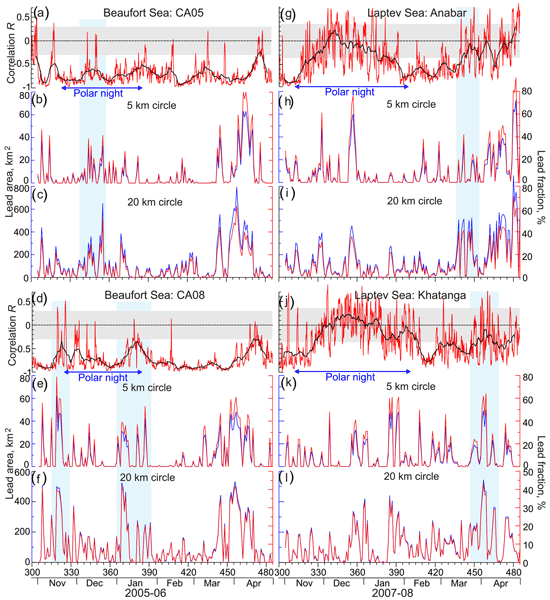
Igor A. Dmitrenko, Vladislav Petrusevich, Andreas Preußer, Ksenia Kosobokova, Caroline Bouchard, Maxime Geoffroy, Alexander S. Komarov, David G. Babb, Sergei A. Kirillov, and David G. Barber
Ocean Sci., 20, 1677–1705, https://doi.org/10.5194/os-20-1677-2024, https://doi.org/10.5194/os-20-1677-2024, 2024
Short summary
Short summary
The diel vertical migration (DVM) of zooplankton is one of the largest species migrations to occur globally and is a key driver of regional ecosystems. Here, time series of acoustic data collected at the circumpolar Arctic polynya system were used to examine the annual cycle of DVM. We revealed that the formation of polynya open water disrupts DVM. This disruption is attributed to a predator avoidance behavior of zooplankton in response to higher polar cod abundance attracted by the polynya.
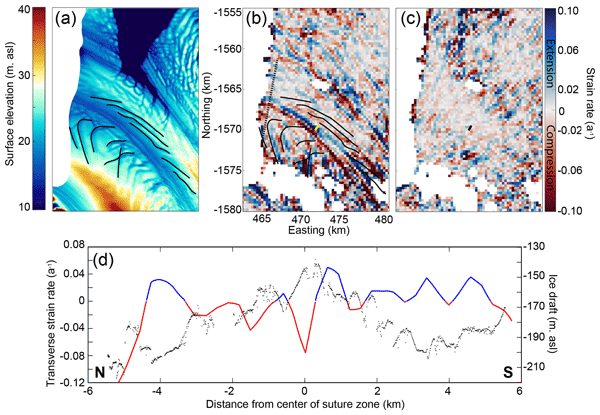
Christine F. Dow, Derek Mueller, Peter Wray, Drew Friedrichs, Alexander L. Forrest, Jasmin B. McInerney, Jamin Greenbaum, Donald D. Blankenship, Choon Ki Lee, and Won Sang Lee
The Cryosphere, 18, 1105–1123, https://doi.org/10.5194/tc-18-1105-2024, https://doi.org/10.5194/tc-18-1105-2024, 2024
Short summary
Short summary
Ice shelves are a key control on Antarctic contribution to sea level rise. We examine the Nansen Ice Shelf in East Antarctica using a combination of field-based and satellite data. We find the basal topography of the ice shelf is highly variable, only partially visible in satellite datasets. We also find that the thinnest region of the ice shelf is altered over time by ice flow rates and ocean melting. These processes can cause fractures to form that eventually result in large calving events.
Stephen E. L. Howell, Mike Brady, and Alexander S. Komarov
The Cryosphere, 16, 1125–1139, https://doi.org/10.5194/tc-16-1125-2022, https://doi.org/10.5194/tc-16-1125-2022, 2022
Short summary
Short summary
We describe, apply, and validate the Environment and Climate Change Canada automated sea ice tracking system (ECCC-ASITS) that routinely generates large-scale sea ice motion (SIM) over the pan-Arctic domain using synthetic aperture radar (SAR) images. The ECCC-ASITS was applied to the incoming image streams of Sentinel-1AB and the RADARSAT Constellation Mission from March 2020 to October 2021 using a total of 135 471 SAR images and generated new SIM datasets (i.e., 7 d 25 km and 3 d 6.25 km).

Reza Zeinali-Torbati, Ian D. Turnbull, Rocky S. Taylor, and Derek Mueller
The Cryosphere, 15, 5601–5621, https://doi.org/10.5194/tc-15-5601-2021, https://doi.org/10.5194/tc-15-5601-2021, 2021
Short summary
Short summary
Using the reanalysis datasets and the Canadian Ice Island Drift, Deterioration and Detection database, a probabilistic model was developed to quantify ice island fracture probability under various atmospheric and oceanic conditions. The model identified water temperature as the most dominant variable behind ice island fracture events, while ocean currents played a minor role. The developed model offers a predictive capability and could be of particular interest to offshore and marine activities.
Cited articles
Andersen, J. K., Millan, R., Rignot, E., Gimenes, L., Scheuchl, B., Barré, J. B., and Bjørk, A. A.: Brief communication: Updated grounding line mapping in the Amundsen Sea Embayment, Antarctica, from one day repeat Sentinel-1 SAR data, The Cryosphere, 20, 1589–1598, https://doi.org/10.5194/tc-20-1589-2026, 2026.
Antropova, Y. K., Mueller, D., Samsonov, S. V., Komarov, A. S., Bonneau, J., and Crawford, A. J.: Grounding-line retreat of Milne Glacier, Ellesmere Island, Canada over 1966–2023 from satellite, airborne, and ground radar data, Remote Sens. Environ., 315, 114478, https://doi.org/10.1016/j.rse.2024.114478, 2024.
Black, T. E. and Joughin, I.: Multi-decadal retreat of marine-terminating outlet glaciers in northwest and central-west Greenland, The Cryosphere, 16, 807–824, https://doi.org/10.5194/tc-16-807-2022, 2022.
Bonneau, J., Laval, B. E., Mueller, D., Hamilton, A. K., and Crawford, A. J.: Heat fluxes in a glacial fjord: the role of buoyancy-driven circulation and offshore forcing, Geophys. Res. Lett., 51, e2024GL111242, https://doi.org/10.1029/2024GL111242, 2024a.
Bonneau, J., Laval, B. E., Mueller, D., Hamilton, A. K., and Forrest, A. L.: Unsteady circulation in a glacial fjord: a multiyear modeling study of Milne Fiord, J. Geophys. Res.-Oceans, 129, e2023JC020140, https://doi.org/10.1029/2023JC020140, 2024b.
Buehner, M., McTaggart-Cowan, R., Beaulne, A., Charette, C., Garand, L., Heilliette, S., Lapalme, E., Laroche, S., Macpherson, S. R., Morneau, J., and Zadra, A.: Implementation of deterministic weather forecasting systems based on ensemble–variational data assimilation at Environment Canada. Part I: The global system, Mon. Weather Rev., 143, 2532–2559, https://doi.org/10.1175/MWR-D-14-00354.1, 2015.
Carnahan, E., Catania, G., and Bartholomaus, T. C.: Observed mechanism for sustained glacier retreat and acceleration in response to ocean warming around Greenland, The Cryosphere, 16, 4305–4317, https://doi.org/10.5194/tc-16-4305-2022, 2022.
Chartrand, A. M., Howat, I. M., Joughin, I. R., and Smith, B. E.: Thwaites Glacier thins and retreats fastest where ice-shelf channels intersect its grounding zone, The Cryosphere, 18, 4971–4992, https://doi.org/10.5194/tc-18-4971-2024, 2024.
Chen, H., Rignot, E., Scheuchl, B., and Ehrenfeucht, S.: Grounding zone of Amery Ice Shelf, Antarctica, from differential synthetic-aperture radar interferometry, Geophys. Res. Lett., 50, e2022GL102430, https://doi.org/10.1029/2022GL102430, 2023.
Ciracì, E., Rignot, E., Scheuchl, B., Tolpekin, V., Wollersheim, M., An, L., Milillo, P., Bueso-Bello, J.-L., Rizzoli, P., and Dini, L.: Melt rates in the kilometer-size grounding zone of Petermann Glacier, Greenland, before and during a retreat, P. Natl. Acad. Sci. USA, 120, e2220924120, https://doi.org/10.1073/pnas.2220924120, 2023.
Costantini, M.: A novel phase unwrapping method based on network programming, IEEE T. Geosci. Remote, 36, 813–821, https://doi.org/10.1109/36.673674, 1998.
CReSIS: 2014 Greenland P3: 20140401_03_029 track, Data, Lawrence, Kansas, USA. Digital Media, http://data.cresis.ku.edu (last access: 18 January 2025), 2024.
Forster, R. R., Rignot, E., Isacks, B. L., and Jezek, K. C.: Interferometric radar observations of Glaciares Europa and Penguin, Hielo Patagónico Sur, Chile, J. Glaciol., 45, 325–337, https://doi.org/10.3189/S0022143000001829, 1999.
Freer, B. I. D., Marsh, O. J., Hogg, A. E., Fricker, H. A., and Padman, L.: Modes of Antarctic tidal grounding line migration revealed by Ice, Cloud, and land Elevation Satellite-2 (ICESat-2) laser altimetry, The Cryosphere, 17, 4079–4101, https://doi.org/10.5194/tc-17-4079-2023, 2023.
Fricker, H. A., Coleman, R., Padman, L., Scambos, T. A., Bohlander, J., and Brunt, K. M.: Mapping the grounding zone of the Amery Ice Shelf, East Antarctica using InSAR, MODIS and ICESat, Antarct. Sci., 21, 515–532, https://doi.org/10.1017/S095410200999023X, 2009.
Gadi, R., Rignot, E., Menemenlis, D., and Scheuchl, B.: Contrasting melt regime in the ice grounding zone of Thwaites Glacier, West Antarctica, P. Natl. Acad. Sci. USA, 122, e2512626122, https://doi.org/10.1073/pnas.2512626122, 2025.
GAMMA Remote Sensing: GAMMA Software Information, GAMMA Remote Sensing AG, Gümligen, Switzerland, https://www.gamma-rs.ch/uploads/media/GAMMA_Software_information.pdf (last access: 20 June 2025), 2025.
Garbo, A.: Cryologger glacier velocity tracker (v2.3.1), GitHub [software], https://github.com/cryologger/glacier-velocity-tracker (last access: 16 July 2024), 2024.
Hamilton, A. K., Mueller, D., and Laval, B. E.: Ocean modification and seasonality in a northern Ellesmere Island glacial fjord prior to ice shelf breakup: Milne Fiord, J. Geophys. Res.-Oceans, 126, e2020JC016975, https://doi.org/10.1029/2020JC016975, 2021.
Han, H. and Lee, H.: Tide deflection of Campbell Glacier Tongue, Antarctica, analyzed by double-differential SAR interferometry and finite element method, Remote Sens. Environ., 141, 201–213, https://doi.org/10.1016/j.rse.2013.11.002, 2014.
Hansen, P. C.: Analysis of discrete ill-posed problems by means of the L-curve, SIAM Rev., 34, 561–580, https://doi.org/10.1137/1034115, 1992.
Holmes, F. A., Barnett, J., Åkesson, H., Morlighem, M., Nilsson, J., Kirchner, N., and Jakobsson, M.: Sea level rise contribution from Ryder Glacier in northern Greenland varies by an order of magnitude by 2300 depending on future emissions, The Cryosphere, 19, 2695–2714, https://doi.org/10.5194/tc-19-2695-2025, 2025.
Howard, S. L. and Padman, L.: Gr1kmTM: Greenland 1 kilometer tide model, Arctic Data Center [data set], https://doi.org/10.18739/A2251FM3S, 2021.
Hu, J., Li, Z. W., Ding, X. L., Zhu, J. J., Zhang, L., and Sun, Q.: Resolving three-dimensional surface displacements from InSAR measurements: a review, Earth-Sci. Rev., 133, 1–17, https://doi.org/10.1016/j.earscirev.2014.02.005, 2014.
Jeffries, M. O.: Milne Glacier, Northern Ellesmere Island, N.W.T., Canada: a Surging Glacier?, J. Glaciol., 30, 251–253, https://doi.org/10.3189/S0022143000006043, 1984.
Kim, J. H., Rignot, E., Holland, D., and Holland, D. M.: Seawater intrusion at the grounding line of Jakobshavn Isbræ, Greenland, from terrestrial radar interferometry, Geophys. Res. Lett., 51, e2023GL106181, https://doi.org/10.1029/2023GL106181, 2024.
Kochtitzky, W. and Copland, L.: Retreat of Northern Hemisphere marine-terminating glaciers, 2000–2020, Geophys. Res. Lett., 49, e2021GL096501, https://doi.org/10.1029/2021GL096501, 2022.
Mannerfelt, E. S., Schellenberger, T., and Kääb, A. M.: Tracking glacier surge evolution using interferometric SAR coherence – examples from Svalbard, J. Glaciol., 71, e43, https://doi.org/10.1017/jog.2025.27, 2025.
MDA Space: RADARSAT Constellation Mission product specification, https://download-telecharger.services.geo.ca/pub/csa_asc/Space-technology_Technologie-spatiale/radarsat_constellation_mission _plan/RCM-SP-52-9092_Product_Spec_1-15_Public.pdf (last access: 25 September 2026), 2021.
Milillo, P., Rignot, E., Mouginot, J., Scheuchl, B., Morlighem, M., Li, X., and Salzer, J. T.: Short-term grounding zone dynamics of Pine Island Glacier, Geophys. Res. Lett., 44, 10436–10444, https://doi.org/10.1002/2017GL074320, 2017.
Milillo, P., Rignot, E., Rizzoli, P., Scheuchl, B., Mouginot, J., Bueso-Bello, J. L., Prats-Iraola, P., and Dini, L.: Rapid glacier retreat rates observed in West Antarctica, Nat. Geosci., 15, 48–53, https://doi.org/10.1038/s41561-021-00877-z, 2022.
Millan, R., Mouginot, J., and Rignot, E.: Mass budget of the glaciers and ice caps of the Queen Elizabeth Islands, Canada, from 1991 to 2015, Environ. Res. Lett., 12, 024016, https://doi.org/10.1088/1748-9326/aa5b04, 2017.
Millan, R., Jager, E., Mouginot, J., Wood, M. H., Larsen, S. H., Mathiot, P., Jourdain, N. C., and Bjørk, A.: Rapid disintegration and weakening of ice shelves in North Greenland, Nat. Commun., 14, 6914, https://doi.org/10.1038/s41467-023-42198-2, 2023.
Mohajerani, Y., Jeong, S., Scheuchl, B., Velicogna, I., Rignot, E., and Milillo, P.: Automatic delineation of glacier grounding lines using deep learning, Sci. Rep., 11, 1–13, https://doi.org/10.1038/s41598-021-84309-3, 2021.
Morlighem, M., Wood, M., Seroussi, H., Choi, Y., and Rignot, E.: Modeling the response of northwest Greenland to enhanced ocean thermal forcing and subglacial discharge, The Cryosphere, 13, 723–734, https://doi.org/10.5194/tc-13-723-2019, 2019.
Mortimer, C. A., Copland, L., and Mueller, D. R.: Volume and area changes of the Milne Ice Shelf, Ellesmere Island, Nunavut, Canada, since 1950, J. Geophys. Res.-Earth Surf., 117, https://doi.org/10.1029/2011JF002074, 2012.
Mueller, D., Copland, L., and Jeffries, M. O.: Changes in Canadian Arctic ice shelf extent since 1906, in: Arctic Ice Shelves and Ice Islands, Springer, 109–148, https://doi.org/10.1007/978-94-024-1101-0_5, 2017.
Natural Resources Canada (NRCan): Canadian Spatial Reference System precise point positioning (CSRS-PPP) service, Government of Canada, https://webapp.csrs-scrs.nrcan-rncan.gc.ca/geod/tools-outils/ppp.php (last access: 20 February 2025), 2024.
Paden, J., Li, J., Leuschen, C., Rodriguez-Morales, F., and Hale, R.: IceBridge MCoRDS L2 Ice Thickness. (IRMCR2, Version 1), Boulder, Colorado USA, NASA National Snow and Ice Data Center Distributed Active Archive Center [data set], https://doi.org/10.5067/GDQ0CUCVTE2Q, 2010.
Padman, L., King, M., Goring, D., Corr, H., and Coleman, R.: Ice-shelf elevation changes due to atmospheric pressure variations, J. Glaciol., 49, 521–526, https://doi.org/10.3189/172756503781830386, 2003.
Padman, L., Siegfried, M. R., and Fricker, H. A.: Ocean Tide Influences on the Antarctic and Greenland Ice Sheets, Rev. Geophys., 56, 142–184, https://doi.org/10.1002/2016RG000546, 2018.
Pawlowicz, R., Beardsley, B., and Lentz, S.: Classical tidal harmonic analysis including error estimates in MATLAB using T_TIDE, Comput. Geosci., 28, 929–937, https://doi.org/10.1016/S0098-3004(02)00013-4, 2002.
Planet Labs PBC: Planet Application Program Interface: In Space for Life on Earth, Planet, https://api.planet.com/ (last access: 12 August 2024), 2024.
Poinelli, M., Nakayama, Y., Larour, E., Vizcaino, M., and Riva, R.: Ice-front retreat controls on ocean dynamics under Larsen C Ice Shelf, Antarctica, Geophys. Res. Lett., 50, e2023GL104588, https://doi.org/10.1029/2023GL104588, 2023.
Porter, C., Howat, I., Noh, M.-J., Husby, E. Khuvis, S., Danish, E., Tomko, K., Gardiner, J., Negrete, A., Yadav, B., Klassen, J., Kelleher, C., Cloutier, M., Bakker, J., Enos, J., Arnold, G., Bauer, G., and Morin, P.: ArcticDEM – Mosaics, Version 4.1, Harvard Dataverse, V1 [data set], https://doi.org/10.7910/DVN/3VDC4W, 2023.
Rack, W., King, M. A., Marsh, O. J., Wild, C. T., and Floricioiu, D.: Analysis of ice shelf flexure and its InSAR representation in the grounding zone of the southern McMurdo Ice Shelf, The Cryosphere, 11, 2481–2490, https://doi.org/10.5194/tc-11-2481-2017, 2017.
Ramanath, S., Krieger, L., Floricioiu, D., Diaconu, C.-A., and Heidler, K.: Automatic grounding line delineation of DInSAR interferograms using deep learning, The Cryosphere, 19, 2431–2455, https://doi.org/10.5194/tc-19-2431-2025, 2025.
Rantanen, M., Karpechko, A. Y., Lipponen, A., Nordling, K., Hyvärinen, O., Ruosteenoja, K., Vihma, T., and Laaksonen, A.: The Arctic has warmed nearly four times faster than the globe since 1979, Commun. Earth Environ., 3, 168, https://doi.org/10.1038/s43247-022-00498-3, 2022.
Rignot, E.: Tidal motion, ice velocity and melt rate of Petermann Gletscher, Greenland, measured from radar interferometry, J. Glaciol., 42, 476–485, https://doi.org/10.3189/S0022143000003464, 1996.
Rignot, E., Mouginot, J., and Scheuchl, B.: Antarctic grounding line mapping from differential satellite radar interferometry, Geophys. Res. Lett., 38, L10504, https://doi.org/10.1029/2011GL047109, 2011.
Rignot, E., Mouginot, J., Morlighem, M., Seroussi, H., and Scheuchl, B.: Widespread, rapid grounding line retreat of Pine Island, Thwaites, Smith, and Kohler glaciers, West Antarctica, from 1992 to 2011, Geophys. Res. Lett., 41, 3502–3509, https://doi.org/10.1002/2014GL060140, 2014.
Rignot, E., Ciracì, E., Scheuchl, B., Tolpekin, V., Wollersheim, M., and Dow, C.: Widespread seawater intrusions beneath the grounded ice of Thwaites Glacier, West Antarctica, P. Natl. Acad. Sci. USA, 121, e2404766121, https://doi.org/10.1073/pnas.2404766121, 2024.
Robel, A. A., Tsai, V. C., Minchew, B., and Simons, M.: Tidal modulation of ice shelf buttressing stresses, Ann. Glaciol., 58, 12–20, https://doi.org/10.1017/aog.2017.22, 2017.
Robel, A. A., Wilson, E., and Seroussi, H.: Layered seawater intrusion and melt under grounded ice, The Cryosphere, 16, 451–469, https://doi.org/10.5194/tc-16-451-2022, 2022.
Rocca, F., Prati, C., and Ferretti, A.: Space-borne SARs: impact of wavelengths and scan modes on ground motion studies, Ann. GIS, 16, 69–79, https://doi.org/10.1080/19475683.2010.492124, 2010.
Samsonov, S.: Multidimensional small baseline subset (MSBAS) software for constrained and unconstrained deformation analysis, Can. J. Remote Sens., 50, 2424753, https://doi.org/10.1080/07038992.2024.2424753, 2024.
Samsonov, S., Tiampo, K., and Cassotto, R.: Measuring the state and temporal evolution of glaciers in Alaska and Yukon using synthetic-aperture-radar-derived (SAR-derived) 3D time series of glacier surface flow, The Cryosphere, 15, 4221–4239, https://doi.org/10.5194/tc-15-4221-2021, 2021.
Schoof, C.: Ice sheet grounding line dynamics: steady states, stability, and hysteresis, J. Geophys. Res.-Earth Surf., 112, https://doi.org/10.1029/2006JF000664, 2007.
Sergienko, O. V.: Marine outlet glacier dynamics, steady states and steady-state stability, J. Glaciol., 68, 946–960, https://doi.org/10.1017/jog.2022.13, 2022.
Sergienko, O. and Wingham, D. J.: Diverse behaviors of marine ice sheets in response to temporal variability of the atmospheric and basal conditions, J. Glaciol., 70, e52, 1–12, https://doi.org/10.1017/jog.2024.43, 2024.
Still, H. and Hulbe, C.: Mechanics and dynamics of pinning points on the Shirase Coast, West Antarctica, The Cryosphere, 15, 2647–2665, https://doi.org/10.5194/tc-15-2647-2021, 2021.
Tsai, V. C. and Gudmundsson, G. H.: An improved model for tidally modulated grounding-line migration, J. Glaciol., 61, 216–222, https://doi.org/10.3189/2015JoG14J152, 2015.
Vaňková, I., Nicholls, K. W., Corr, H. F. J., Makinson, K., and Brennan, P. V.: Observations of tidal melt and vertical strain at the Filchner-Ronne Ice Shelf, Antarctica, J. Geophys. Res.-Earth Surf., 125, e2019JF005280, https://doi.org/10.1029/2019JF005280, 2020.
Van Wychen, W. V., Burgess, D., Kochtitzky, W., Nikolic, N., Copland, L., and Gray, L.: RADARSAT-2-derived glacier velocities and dynamic discharge estimates for the Canadian High Arctic, Can. J. Remote Sens., 46, 695–714, https://doi.org/10.1080/07038992.2020.1859359, 2020.
Weertman, J.: Stability of the junction of an ice sheet and an ice shelf, J. Glaciol., 13, 3–11, https://doi.org/10.3189/S0022143000023327, 1974.
Wild, C. T., Marsh, O. J., and Rack, W.: Viscosity and elasticity: a model intercomparison of ice-shelf bending in an Antarctic grounding zone, J. Glaciol., 63, 573–580, https://doi.org/10.1017/jog.2017.15, 2017.
Wild, C. T., Marsh, O. J., and Rack, W.: Unraveling InSAR-observed Antarctic ice-shelf flexure using 2-D elastic and viscoelastic modeling, Front. Earth Sci., 6, https://doi.org/10.3389/feart.2018.00028, 2018.
Wild, C. T., Marsh, O. J., and Rack, W.: Differential interferometric synthetic aperture radar for tide modelling in Antarctic ice-shelf grounding zones, The Cryosphere, 13, 3171–3191, https://doi.org/10.5194/tc-13-3171-2019, 2019.
Wild, C. T., Drews, R., Neckel, N., Lee, J., Kim, S., Han, H., Lee, W. S., Helm, V., Rosier, S. H. R., Marsh, O. J., and Rack, W.: Monitoring shear-zone weakening in East Antarctic outlet glaciers through differential InSAR measurements, The Cryosphere, 19, 4533–4554, https://doi.org/10.5194/tc-19-4533-2025, 2025.
Wood, M., Rignot, E., Fenty, I., An, L., Bjørk, A., van den Broeke, M., Cai, C., Kane, E., Menemenlis, D., Millan, R., Morlighem, M., Mouginot, J., Noël, B., Scheuchl, B., Velicogna, I., Willis, J. K., and Zhang, H.: Ocean forcing drives glacier retreat in Greenland, Sci. Adv., 7, eaba7282, https://doi.org/10.1126/sciadv.aba7282, 2021.
Wunsch, C. and Stammer, D.: Atmospheric loading and the oceanic “inverted barometer” effect, Rev. Geophys., 35, 79–107, https://doi.org/10.1029/96RG03037, 1997.
Short summary
Arctic glaciers that flow into the ocean are changing rapidly due to climate warming. The grounding line, where these glaciers transition from land to ocean, is critical to their stability. We examined Milne Glacier in the Canadian High Arctic using satellite, field, and modelled data. Our study shows how changes in ice flow and ice bending near the grounding line affect satellite-based mapping of this area and documents a newly discovered grounding-line retreat associated with subglacial ridges.
Arctic glaciers that flow into the ocean are changing rapidly due to climate warming. The...


Altmetrics
Final-revised paper
Preprint