
Articles | Volume 20, issue 11
https://doi.org/10.5194/tc-20-6501-2026
© Author(s) 2026. This work is distributed under
the Creative Commons Attribution 4.0 License.
the Creative Commons Attribution 4.0 License.
https://doi.org/10.5194/tc-20-6501-2026
© Author(s) 2026. This work is distributed under
the Creative Commons Attribution 4.0 License.
the Creative Commons Attribution 4.0 License.
Research article
| 
12 Nov 2026
Research article |
| 12 Nov 2026
| 12 Nov 2026
Multi-sensor satellite analysis reveals latitudinal and morphometric controls on ice phenology across 31 000 lakes on the Alaska North Slope
Alexander L. Nguyen
Department of Earth, Environmental, and Planetary Sciences, Washington University in St. Louis, Saint Louis, MO, 63130, USA
Cesar G. Lopez
Department of Earth, Environmental, and Planetary Sciences, Washington University in St. Louis, Saint Louis, MO, 63130, USA
Jennifer Melara-Valle
Department of Earth, Environmental, and Planetary Sciences, Washington University in St. Louis, Saint Louis, MO, 63130, USA
Eliza Ross
Department of Earth, Environmental, and Planetary Sciences, Washington University in St. Louis, Saint Louis, MO, 63130, USA
Alexander S. Bradley
Department of Earth, Environmental, and Planetary Sciences, Washington University in St. Louis, Saint Louis, MO, 63130, USA
Maggie R. Limbeck
Department of Earth, Environmental, and Planetary Sciences, Washington University in St. Louis, Saint Louis, MO, 63130, USA
Claire C. Masteller
Department of Earth, Environmental, and Planetary Sciences, Washington University in St. Louis, Saint Louis, MO, 63130, USA
Roger J. Michaelides
CORRESPONDING AUTHOR

Department of Earth, Environmental, and Planetary Sciences, Washington University in St. Louis, Saint Louis, MO, 63130, USA
Related authors
No articles found.
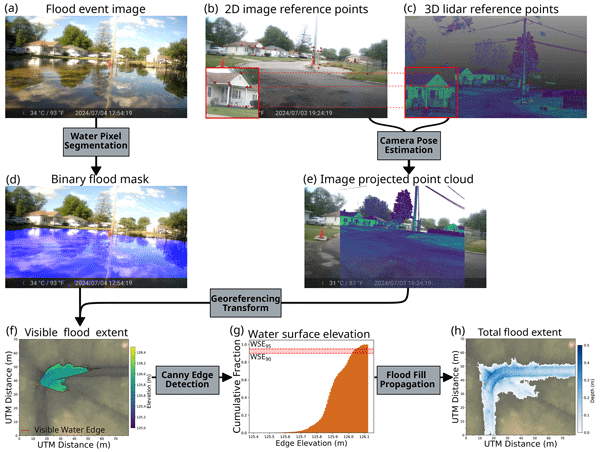
Jedidiah E. Dale, Sophie Dorosin, José A. Constantine, and Claire C. Masteller
Hydrol. Earth Syst. Sci., 30, 2183–2206, https://doi.org/10.5194/hess-30-2183-2026, https://doi.org/10.5194/hess-30-2183-2026, 2026
Short summary
Short summary
Frequent, low-intensity urban pluvial flooding is notoriously difficult to detect and monitor. This study introduces a novel, low-cost approach using computer vision to integrate time-lapse photos with lidar data to estimate water levels and flood extents. Applied to two case study flood events and validated against a two-dimensional flood model, this method shows how community-centered, adaptable monitoring systems can capture spatiotemporal flood dynamics often missed by traditional methods.
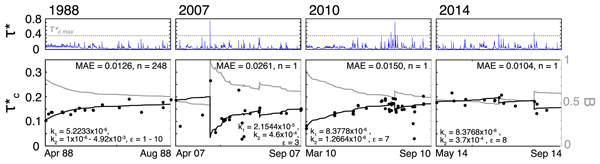
Claire C. Masteller, Joel P. L. Johnson, Dieter Rickenmann, and Jens M. Turowski
Earth Surf. Dynam., 13, 593–605, https://doi.org/10.5194/esurf-13-593-2025, https://doi.org/10.5194/esurf-13-593-2025, 2025
Short summary
Short summary
This paper presents a novel model that predicts how gravel riverbeds may evolve in response to differences in the frequency and severity of flood events. We test our model using a 23-year-long record of river flow and gravel transport from the Swiss Prealps. We find that our model reliably captures yearly patterns in gravel transport in this setting. Our new model is a major advance towards better predictions of river erosion that account for the flood history of a gravel-bed river.
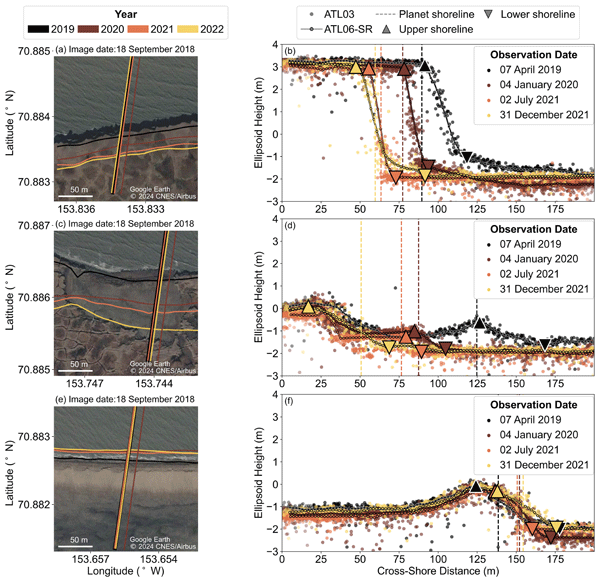
Marnie B. Bryant, Adrian A. Borsa, Eric J. Anderson, Claire C. Masteller, Roger J. Michaelides, Matthew R. Siegfried, and Adam P. Young
The Cryosphere, 19, 1825–1847, https://doi.org/10.5194/tc-19-1825-2025, https://doi.org/10.5194/tc-19-1825-2025, 2025
Short summary
Short summary
We measure shoreline change across a 7 km stretch of coastline on the Alaskan Beaufort Sea coast between 2019 and 2022 using multispectral imagery from Planet and satellite altimetry from ICESat-2. We find that shoreline change rates are high and variable and that different shoreline types show distinct patterns of change in shoreline position and topography. We discuss how the observed changes may be driven by both time-varying ocean and air conditions and spatial variations in morphology.
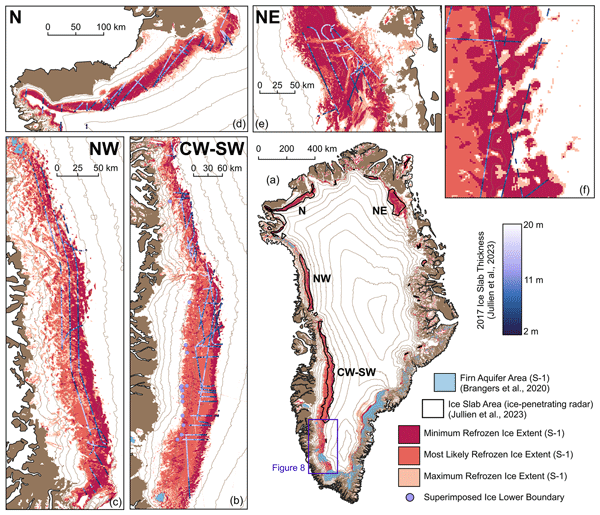
Riley Culberg, Roger J. Michaelides, and Julie Z. Miller
The Cryosphere, 18, 2531–2555, https://doi.org/10.5194/tc-18-2531-2024, https://doi.org/10.5194/tc-18-2531-2024, 2024
Short summary
Short summary
Ice slabs enhance meltwater runoff from the Greenland Ice Sheet. Therefore, it is important to understand their extent and change in extent over time. We present a new method for detecting ice slabs in satellite radar data, which we use to map ice slabs at 500 m resolution across the entire ice sheet in winter 2016–2017. Our results provide better spatial coverage and resolution than previous maps from airborne radar and lay the groundwork for long-term monitoring of ice slabs from space.
Hossein Hosseiny, Claire C. Masteller, Jedidiah E. Dale, and Colin B. Phillips
Earth Surf. Dynam., 11, 681–693, https://doi.org/10.5194/esurf-11-681-2023, https://doi.org/10.5194/esurf-11-681-2023, 2023
Short summary
Short summary
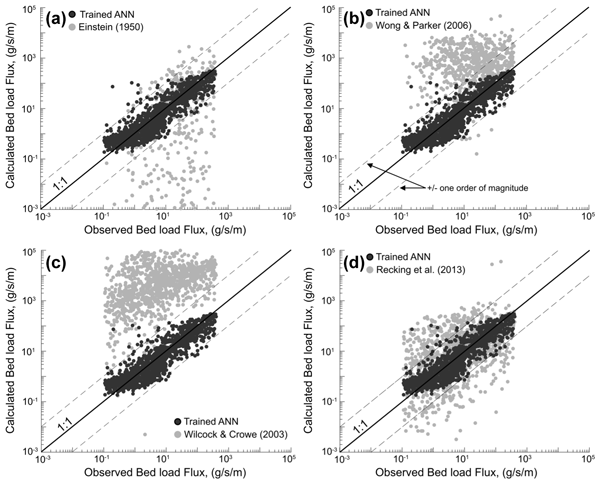
It is of great importance to engineers and geomorphologists to predict the rate of bed load in rivers. In this contribution, we used a large dataset of measured data and developed an artificial neural network (ANN), a machine learning algorithm, for bed load prediction. The ANN model predicted the bed load flux close to measured values and better than the ones obtained from four standard bed load models with varying degrees of complexity.
Cited articles
Arp, C. D., Jones, B. M., Urban, F. E., and Grosse, G.: Hydrogeomorphic processes of thermokarst lakes with grounded-ice and floating-ice regimes on the Arctic coastal plain, Alaska, Hydrol. Process., 25, 2422–2438, https://doi.org/10.1002/hyp.8019, 2011.
Arp, C. D., Jones, B. M., Liljedahl, A. K., Hinkel, K. M., and Welker, J. A.: Depth, ice thickness, and ice-out timing cause divergent hydrologic responses among Arctic lakes, Water Resour. Res., 51, 9379–9401, https://doi.org/10.1002/2015WR017362, 2015.
Ashton, G. D.: River and Lake Ice Engineering, Water Resources Publications, Littleton, CO, ISBN 9780918334596, 1986.
Bartsch, A., Pointner, G., Leibman, M. O., Dvornikov, Y. A., Khomutov, A. V., and Trofaier, A. M.: Circumpolar mapping of ground-fast lake ice, Front. Earth Sci., 5, 12, https://doi.org/10.3389/feart.2017.00012, 2017.
Bartsch, A., Strozzi, T., and Nitze, I.: Permafrost Monitoring from Space, Surv. Geophysics, 44, 1579–1613 https://doi.org/10.1007/s10712-023-09770-3, 2023.
Basu, A., Culpepper, J., Blagrave, K., and Sharma, S.: Phenological shifts in lake ice cover across the Northern Hemisphere: A glimpse into the past, present, and the future of lake ice phenology, Water Resour. Res., 60, https://doi.org/10.1029/2023WR036392, 2024.
Beaven, S. G.: Sea Ice Radar Backscatter Modeling, Measurements, and the Fusion of Active and Passive Microwave Data, Radar Remote Sensing Laboratory, The University of Kansas Center for Research, Inc., 1995.
Bergstedt, H. and Jones, B.: Integrated Field and Synthetic Aperture Radar-Based Dataset for Arctic Lake Ice and Under-Ice Water Salinity Classification, Northern Alaska, Arctic Data Center, https://doi.org/10.18739/A25M6288G, 2025.
Bozeman, J. R. and Pilling, M.: The Convexity Ratio and Applications, Scientiae Mathematicae Japonicae, 76, 47–53, https://doi.org/10.32219/isms.76.1_47, 2013.
Breiman, L.: Random Forests, Mach. Learn., 45, 5–32, https://doi.org/10.1023/A:1010933404324, 2001.
Brown, L. C. and Duguay, C. R.: The response and role of ice cover in lake-climate interactions, Prog. Phys. Geog.-Earth and Environment, 34, 671–704, https://doi.org/10.1177/0309133310375653, 2010.
Bryant, M. B., Borsa, A. A., Anderson, E. J., Masteller, C. C., Michaelides, R. J., Siegfried, M. R., and Young, A. P.: Multiple modes of shoreline change along the Alaskan Beaufort Sea observed using ICESat-2 altimetry and satellite imagery, The Cryosphere, 19, 1825–1847, https://doi.org/10.5194/tc-19-1825-2025, 2025.
Cael, B. B. and Seekell, D.: A theory for the relationship between lake surface area and maximum depth, Limnol. Oceanogr.-Lett., 7, 527–533, https://doi.org/10.1002/lol2.10269, 2022.
Carson C. E., and Hussey K. M.: The oriented lakes of Arctic Alaska, J. Geol., 70, 417–439, 1962.
Carver, R. W. and Merose, A.: ARCO-ERA5: An Analysis-Ready Cloud-Optimized Reanalysis Dataset, in: 22nd Conference on AI for Environmental Science, American Meterological Society, 4A.1, 2023AMS_10315842C, 2023.
Clelland, A. A., Marshall, G. J., and Baxter, R.: Evaluating the performance of key ERA-Interim, ERA5 and ERA5-Land climate variables across Siberia, Int. J. Climatol., 1-25, https://doi.org/10.1002/joc.8456, 2024.
Detterman, R. L., Bowsher, A. L., and Dutro, J. T.: Glaciation on the Arctic Slope of the Brooks Range, Northern Alaska, Arctic, 11, 43–61, https://doi.org/10.14430/arctic3732, 1958.
Duguay, C. R., Flato, G. M., Jeffries, M. O., Ménard, P., Morris, K., and Rouse, W. R.: Ice-cover variability on shallow lakes at high latitudes: model simulations and observations, Hydrol. Process., 17, 3465–3483, https://doi.org/10.1002/hyp.1394, 2003.
Elder, C. D., Thompson, D. R., Thrope, A. K., Hanke, P., Walter Anthony, K. M., Miller, C. E.: Airborne Mapping Reveals Emergent Power Law of Arctic Methane Emissions, Geophys. Res. Lett., 47, 3, https://doi.org/10.1029/2019GL085707, 2020.
Engram, M.: Floating and bedfast lake ice regimes across Arctic Alaska using space-borne SAR imagery from 1992-2016, Arctic Data Center, https://doi.org/10.18739/A2CJ87K8Hdoi:10.18739/A2CJ87K8H, 2018.
Engram, M. and Walter Anthony, K.: Synthetic aperture radar (SAR) detects large gas seeps in Alaska lakes, Environ. Res. Lett., 19, https://doi.org/10.1088/1748-9326/ad2b2a, 2024.
Farquharson, L. M., Mann, D. H., Grosse, G., Jones, B. M., Romanovsky, V. E.: Spatial distribution of thermokarst terrain in Arctic Alaska, Geomorphology, 273, 116–133, https://doi.org/10.1016/j.geomorph.2016.08.007, 2016.
Gorelick, N., Hancher, M., Dixon, M., Ilyushchenko, S., Thau, D., and Moore, D.: Google Earth Engine: Planetary-scale geospatial analysis for everyone, emote Sens. Environ., 202, https://doi.org/10.1016/j.rse.2017.06.031, 2017.
Grunblatt, J. and Atwood, D.: Mapping lakes for winter liquid water availability using SAR on the North Slope of Alaska, Int. J. Appl. Earth Obs., 27, 63–69, https://doi.org/10.1016/j.jag.2013.05.006, 2014 .
Guo, M., Zhuang, W., Tan, Z., Shurpali, N., Juutinen, S., Kortelainen, P., and Martikainen, P. J.: Rising methane emissions from boreal lakes due to increasing ice-free days , Environ. Res. Lett., 15, 6, https://doi.org/10.1088/1748-9326/ab8254, 2020.
Hall, D. K., Fagre, D. B., Klasner, F., Linebaugh, G., and Liston, G. E.: Analysis of ERS 1 synthetic aperture radar data of frozen lakes in northern Montana and implications for climate studies, J. Geophys. Res.-Oceans, 99, C11, 22473–22482, https://doi.org/10.1029/94JC01391, 1994.
Hall, D., Riggs, G. A., and Salomonson, V. V.: Development of methods for mapping global snow cover using moderate resolution imaging spectroradiometer data, Remote Sens. Environ., 54, 2, 127–40, https://doi.org/10.1016/0034-4257(95)00137-P, 1995.
Hersbach, H., Bell, B., Berrisford, P., Hirahara, S., Horányi, A., Muñoz-Sabater, J., Nicolas, J., Peubey, C., Radu, R., Schepers, D., Simmons, A., Soci, C., Abdalla, S., Abellan, X., Balsamo, G., Bechtold, P., Biavati, G., Bidlot, J., Bonavita, M., De Chiara, G., Dahlgren, P., Dee, D., Diamantakis, M., Dragani, R., Flemming, J., Forbes, R., Fuentes, M., Geer, A., Haimberger, L., Healy, S., Hogan, R. J., Hólm, E., Janisková, M., Keeley, S., Laloyaux, P., Lopez, P., Lupu, C., Radnoti, G., de Rosnay, P., Rozum, I., Vamborg, F.,Villaume, S., Thépaut, J-N.: Complete ERA5: Fifth generation of ECMWF atmospheric reanalyses of the global climate, Copernicus Climate Change Service (C3S) Data Store (CDS), 2017.
Hersbach, H., Bell, B., Berrisford, P., Hirahara, S., Horányi, A., Muñoz-Sabater, J., Nicolas, J., Peubey, C., Radu, R., Schepers, D., Simmons, A., Soci, C., Abdalla, S., Abellan, X., Balsamo, G., Bechtold, P., Biavati, G., Bidlot, J., Bonavita, M., De Chiara, G., Dahlgren, P., Dee, D., Diamantakis, M., Dragani, R., Flemming, J., Forbes, R., Fuentes, M., Geer, A., Haimberger, L., Healy, S., Hogan, R. J., Hólm, E., Janisková, M., Keeley, S., Laloyaux, P., Lopez, P., Lupu, C., Radnoti, G., de Rosnay, P., Rozum, I., Vamborg, F., Villaume, S., and Jean-Noël Thépaut: The ERA5 global reanalysis, Q. J. Roy. Meteor. Soc., 146, 1999–2049, https://doi.org/10.1002/qj.380, 2020.
Heslop, J. K., Walter Anthony, K. M., Winkel, M., Sepulveda-Jauregui, A., Martinez-Cruz, K., Bondurant, A., Gross, G., and Liebner, S.: A synthesis of methane dynamics in thermokarst lake environments, Earth-Sci. Rev., 210, https://doi.org/10.1016/j.earscirev.2020.103365, 2020.
Higgins, S. N., Desjardins, C. M., Drouin, H., Hrenchuk, L. E., and van der Sanden, J. J.: The role of climate and lake size in regulating the ice phenology of boreal lakes, J. Geophys. Res.-Biogeo., 126, https://doi.org/10.1029/2020JG005898, 2021.
Hinkel, K. M., Sheng, Y., Lenters, J. D., Lyons, E. A., Beck, R. A., Eisner, W. R., and Wang, J.: Thermokarst Lakes on the Arctic Coastal Plain of Alaska: Geomorphic Controls on Bathymetry, Permafrost Periglac., 23, 3, 218–230, https://doi.org/10.1002/ppp.1744, 2012.
Hoekstra, M., Jiang, M., Clausi, D. A., and Duguay, C.: Lake ice-water classification of RADARSAT-2 images by integrating IRGS segmentation with pixel-based random forest labeling, Remote Sens. (Basel), 12, 1425, https://doi.org/10.3390/rs12091425, 2020.
Hutchinson, G. E.: A Treatise on Limnology, Vol. 1: Geography, Physics, and Chemistry, John Wiley & Sons, New York, NY, ISBN 9780471542940, 1957.
Ibebuchi, C. C., Lee, C. C., Silva, A., and Sheridan, S. C.: Evaluating apparent temperature in the contiguous United States from four reanalysis products using Artificial Neural Networks, J. Geophys. Res.-Machine Learning and Computation, 1, https://doi.org/10.1029/2023JH000102, 2024.
in 't Zandt, M. H., Liebner, S., and Welte, C. U.: Roles of Thermokarst Lakes in a Warming World, Trends Microbiol., 28, 9, https://doi.org/10.1016/j.tim.2020.04.002, 2020.
Jeffries, M. O., Morris, K., Weeks, W. F., and Wakabayashi, H.: Structural and stratigraphie features and ERS 1 synthetic aperture radar backscatter characteristics of ice growing on shallow lakes in NW Alaska, winter 1991–1992, J. Geophys. Res.-Oceans, 99, C11, 22459–22471, https://doi.org/10.1029/94JC01479, 1994.
Jones, B. M., Grosse, G., Farquharson, L. M., Roy-Léveillée, P., Veremeeva, A., Kanevskiy, M. Z., Gaglioti, B. V., Breen, A. L., Parsekian, A. D., Ulrich, M., Hinkel, K. M.: Lake and drained lake basin systems in lowland permafrost regions, Nat. Rev. Earth Environ., 3, 85–98, https://doi.org/10.1038/s43017-021-00238-9, 2022.
Kirillin, G., Leppäranta, M., Terzhevik, A., Granin, N., Bernhardt, J., Engelhardt, C., Efremova, T., Golosov, S., Palshin, N., Sherstyankin, P., Zdorovennova, G., Zdorovennov, R.: Physics of seasonally ice-covered lakes: a review, Aquat. Sci., 74, 659–682, https://doi.org/10.1007/s00027-012-0279-y, 2012.
Kyzivat, E. D. and Smith, L. C.: A Closer Look at the Effects of Lake Area, Aquatic Vegetation, and Double-Counted Wetlands on Pan-Arctic Lake Methane Emissions Estimates, Geophys. Res. Lett., 50, https://doi.org/10.1029/2023GL104825, 2023.
Latifovic, R. and Pouliot, D.: Analysis of climate change impacts on lake ice phenology in Canada using the historical satellite data record, Remote Sens. Environ., 106, 4, https://doi.org/10.1016/j.rse.2006.09.015, 2007.
Lafrenière, M. J. and Lamoureux, S. F.: Effects of changing permafrost conditions on hydrological processes and fluvial fluxes, Earth-Sci. Rev., 191, 212–223, https://doi.org/10.1016/j.earscirev.2019.02.018, 2019.
Levenson, E., Cooley, S. W., and Mullen, A.: ABoVE: Alaska Lake and Pond Occurrence, ORNL Distributed Active Archive Center [data set], https://doi.org/10.3334/ORNLDAAC/2399, 2025.
Lund, J., Forster, R. R., Deeb, E. J., Liston, G. E., Skiles, S. M., and Marshall, H.: Interpreting Sentinel-1 SAR Backscatter Signals of Snowpack Surface Melt/Freeze, Warming, and Ripening, through Field Measurements and Physically-Based SnowModel, Remote Sens., 14, 4002, https://doi.org/10.3390/rs14164002, 2022.
Manasypov, R., Fan, L., Lim, A. G., Krickov, I. V., Pokrovsky, O. S., Kuzyakov, Y., and Dorodnikov, M.: Size matters: Aerobic methane oxidation in sediments of shallow thermokarst lakes, Glob. Change Biol., 30, https://doi.org/10.1111/gcb.17120, 2023.
Matthews, E., Johnson, M. S., Genovese, V., Du, J., and Bastviken, D.: Methane emission from high latitude lakes: Methane-centric lake classification and satellite-driven annual cycle of emissions, Sci. Rep., 10, 1, https://doi.org/10.1038/s41598-020-68246-1, 2020.
Marin, C., Bertoldi, G., Premier, V., Callegari, M., Brida, C., Hürkamp, K., Tschiersch, J., Zebisch, M., and Notarnicola, C.: Use of Sentinel-1 radar observations to evaluate snowmelt dynamics in alpine regions, The Cryosphere, 14, 935–956, https://doi.org/10.5194/tc-14-935-2020, 2020.
McLinden, C. A., Griffin, D., Davis, Z., Hempel, C., Smith, J., Sioris, C., Nassar, R., Moeini, O., Legault-Ouellet, E., and Malo, A.: An Independent Evaluation of GHGSat Methane Emissions: Performance Assessment, J. Geophys. Res.-Atmos., 129, e2023JD039906, https://doi.org/10.1029/2023JD039906, 2024.
Mu, C., Lei, P., Mu, M., Zhang, C., Zhou, Z., Song, J., Jia, Y., Fan, C., Peng, X., Zhang, G., Yang, Y., Wang, L., Li, D., Song, C., Wang, G., and Zhang, Z.: Methane emissions from thermokarst lakes must emphasize the ice-melting impact on the Tibetan Plateau, Nat. Commun., 16, 1, https://doi.org/10.1038/s41467-025-57745-2, 2025.
Mullen, A. L., Watts, J. D., Rogers, B. M., Carroll, M. L., Elder, C. D., Noomah, J., Williams, Z., Caraballo-Vega, J. A., Bredder, A., Rickenbaugh, E., Levenson, E., Cooley, S. W., Hung, J. K. Y., Fiske, G., Potter, S., Yang, Y., Miller, C. E., Natali, S. M., Douglas, T. A., and Kyzivat, E. D.: Using high-resolution satellite imagery and deep learning to track dynamic seasonality in small water bodies, Geophys. Res. Lett., 50, 7, https://doi.org/10.1029/2022GL102327, 2023.
Mullissa, A., Vollrath, A., Odongo-Braun, C., Slagter, B., Balling, J., Gou, Y., Gorelick, N., and Reiche, J.: Sentinel-1 SAR Backscatter Analysis Ready Data Preparation in Google Earth Engine, Remote Sens., 13, 10, https://doi.org/10.3390/rs13101954, 2021.
Murfitt, J. and Duguay, C.: Assessing the Performance of Methods for Monitoring Ice Phenology of the World's Largest High Arctic Lake Using High-Density Time Series Analysis of Sentinel-1 Data, Remote Sens., 12, 382, https://doi.org/10.3390/rs12030382, 2020.
Muster, S., Roth, K., Langer, M., Lange, S., Cresto Aleina, F., Bartsch, A., Morgenstern, A., Grosse, G., Jones, B., Sannel, A. B. K., Sjöberg, Y., Günther, F., Andresen, C., Veremeeva, A., Lindgren, P. R., Bouchard, F., Lara, M. J., Fortier, D., Charbonneau, S., Virtanen, T. A., Hugelius, G., Palmtag, J., Siewert, M. B., Riley, W. J., Koven, C. D., and Boike, J.: PeRL: a circum-Arctic Permafrost Region Pond and Lake database, Earth Syst. Sci. Data, 9, 317–348, https://doi.org/10.5194/essd-9-317-2017, 2017.
Nguyen, A. L., Lopez, C. G., Melara-Valle, J., Ross, E., Bradley, A. S., Limbeck, M. R., Masteller, C. C., and Michaelides, R.: Multi-sensor satellite analysis reveals latitudinal and morphometric controls on ice phenology across 31,000 lakes on the Alaska North Slope (Version v1.0.4), Zenodo [code], https://doi.org/10.5281/zenodo.21329400, 2026.
Ohara, N,. Jones, B. M., Parsekian, A. D., Hinkel, K. M., Yamatani, K., Kanevskiy, M., Rangel, R. C., Breen, A. L., and Bergstedt, H.: A new Stefan equation to characterize the evolution of thermokarst lake and talik geometry, The Cryosphere, 16, 1247–1264, https://doi.org/10.5194/tc-16-1247-2022, 2022.
Paul, S., Willmes, S., Hoppmann, M., Hunkeler, P. A., Wesche, C., Nicolaus, M., Heinemann, G., and Timmermann, R.: The impact of early-summer snow properties on Antarctic landfast sea-ice X-band backscatter, Ann. Glaciol., 56, 263–273, https://doi.org/10.3189/2015AoG69A715, 2015.
Pedregosa, F., Varoquaux, G., Gramfort, A., Michel, V., Thirion, B., Grisel, O., Blondel, M., Prettenhofer, P., Weiss, R., Dubourg, V., Vanderplas, J., Passos, A., Cournapeau, D., Brucher, M., Perrot, M., and Duchesnay, E.: Scikit-learn: Machine learning in Python, J. Mach. Learn. Res., 12, 2825–2830, https://doi.org/10.48550/arXiv.1201.0490, 2011.
Pernov, J. B., Hjorth, J. L., Sørensen, L. L., and Skov, H.: On the dynamics of ozone depletion events at Villum Research Station in the High Arctic, Atmos. Chem. Phys., 24, 13603–13631, https://doi.org/10.5194/acp-24-13603-2024, 2024.
Posch, C., Abermann, J., and Silva, T.: Lake ice break-up in Greenland: timing and spatiotemporal variability, The Cryosphere, 18, 2035–2059, https://doi.org/10.5194/tc-18-2035-2024, 2024.
Pouw, A. F., Kheyrollah Pour, H., and MacLean, A.: Mapping snow depth on Canadian sub-arctic lakes using ground-penetrating radar, The Cryosphere, 17, 2367–2385, https://doi.org/10.5194/tc-17-2367-2023, 2023.
Rantanen, M., Karpechko, A. Y., Lipponen, A., Nordling, K., Hyvärinen, O., Ruosteenoja, K., Vihma, T., and Laaksonen, A.: The Arctic has warmed nearly four times faster than the globe since 1979, Commun. Earth Environ., 3, 168, https://doi.org/10.1038/s43247-022-00498-3, 2022.
Riggs, G. A., Hall, D. K., and Román, M. O.: Overview of NASA's MODIS and Visible Infrared Imaging Radiometer Suite (VIIRS) snow-cover Earth System Data Records, Earth Syst. Sci. Data, 9, 765–777, https://doi.org/10.5194/essd-9-765-2017, 2017.
Schuur, E. A. G., McGuire, A. D., Schädel, C., Grosse, G., Harden, J. W., Hayes, D. J., Hugelius, G., Koven, C. D., Kuhry, P., Lawrence, D. M., Natali, S. M., Olefeldt, D., Romanovsky, V. E., Schaefer, K., Turetsky, M. R., Treat, C. C., and Vonk, J. E.: Climate change and the permafrost carbon feedback, Nature, 520, 7546, https://doi.org/10.1038/nature14338, 2015.
Seekell, D., Cael, B. B., Byström, P.: Problems With the Shoreline Development Index—A Widely Used Metric of Lake Shape, Geophys. Res. Lett., 49, 10, https://doi.org/10.1029/2022GL098499, 2022.
Sellmann, P. V., Weeks, W. F., and Campbell, W.: Use of side–looking airborne radar to determine lake depth on the Alaskan North Slope, Special Report 230, U. S. Cold Regions Research and Engineering Laboratory, 1975.
Sentinel-Hub: Sentinel-2 cloud detector, Sinergise Solutions and Planet Labs, https://github.com/sentinel-hub/sentinel2-cloud-detector (last access: 24 February 2026), 2025.
Serreze, M. C. and Barry, R. G.: Processes and impacts of Arctic Amplification: A research synthesis, Global Planet. Change, 77, 1–2, https://doi.org/10.1016/j.gloplacha.2011.03.004, 2011.
Skakun, S., Wevers, J., Brockmann, C., Doxani, G., Aleksandrov, M., Batič, M., Frantz, D., Gascon, F., Gómez-Chova, L., Hagolle, O., López-Puigdollers, D., Louis, J., Lubej, M., Mateo-García, G., Osman, J., Peressutti, D., Pflug, B., Puc, J., Richter, R., Roger, J.-C., Scaramuzza, P., Vermote, E., Vesel, N., Zupanc, A., and Žust, L.: Cloud Mask Intercomparison eXercise (CMIX): An evaluation of cloud masking algorithms for 8 and Sentinel-2, Remote Sens. Environ., 274, 112990, https://doi.org/10.1016/j.rse.2022.112990, 2022.
Smits, A. P., Gomez, N. W., Dozier, J., and Sadro, S.: Winter climate and lake morphology control ice phenology and under-ice temperature and oxygen regimes in mountain lakes, J. Geophys. Res.-Biogeo., 126, https://doi.org/10.1029/2021JG006277, 2021.
Stefan, J.: On the theory of ice formation, with particular regard to ice formation in the polar sea, Sitz. Ber. Kais. Akad. Wiss. Wien, 98, 965–983, 1890.
Streletskiy, D. A., Maslakov, A., Grosse, G., Shiklomanov, N. I., Farquharson, L., Zwieback, S., Iwahana, G., Bartsch, A., Liu, L., Strozzi, T., Lee, H., and Debolskiy, M. V.: Thawing permafrost is subsiding in the Northern Hemisphere-Reivew and perspectives, Environ. Res. Lett., 20, 1, https://doi.org/10.1088/1748-9326/ada2ff, 2025.
Stuefer, S. L., Hale, K., May, L. D., Mason, M., Vuyovich, C., Marshall, H., Vas, D., and Elder, K.: Snow depth measurements from Arctic tundra and boreal forest collected during NASA SnowEx Aalaska campaign, Sci. Data, 12, 919, https://doi.org/10.1038/s41597-025-05170-x, 2025.
Surdu, C. M., Duguay, C. R., Brown, L. C., and Fernández Prieto, D.: Response of ice cover on shallow lakes of the North Slope of Alaska to contemporary climate conditions (1950–2011): radar remote-sensing and numerical modeling data analysis, The Cryosphere, 8, 167–180, https://doi.org/10.5194/tc-8-167-2014, 2014.
Surdu, C. M., Duguay, C. R., Pour, H. K., and Brown, L. C.: Ice Freeze-up and Break-up Detection of Shallow Lakes in Northern Alaska with Spaceborne SAR, Remote Sens., 7, 6133–6159, https://doi.org/10.3390/rs70506133, 2015.
Surdu, C. M., Duguay, C. R., and Fernández Prieto, D.: Evidence of recent changes in the ice regime of lakes in the Canadian High Arctic from spaceborne satellite observations, The Cryosphere, 10, 941–960, https://doi.org/10.5194/tc-10-941-2016, 2016.
Tarek, M., Brissette, F. P., and Arsenault, R.,: Evaluation of the ERA5 reanalysis as a potential reference dataset for hydrological modelling over North America, Hydrol. Earth Syst. Sci., 24, 2527–2544, https://doi.org/10.5194/hess-24-2527-2020, 2020.
Tom, M., Aguilar, R., Imhof, P., Leinss, S., Baltsavias, E., and Schindler, K.: Lake ice detection from Sentinel-1 Sar with deep learning, ISPRS Ann. Photogramm. Remote Sens. Spat. Inf. Sci., V-3–2020, 409–416, https://doi.org/10.5194/isprs-annals-V-3-2020-409-2020, 2020.
Unterschultz, K. D., Van der Sanden, J. J., Hicks, F.: Potential of RADARSAT-1 for the monitoring of river ice: Results of a case study on the Athabasca River at Fort McMurray, Canada, Cold Reg. Sc. Technol., 55, 238–248, https://doi.org/10.1016/j.coldregions.2008.02.003, 2009.
USACE: Method to Estimate River Ice Thickness Based on Meteorological Cold Regions Research and Engineering Laboratory Data Report, 6 pp., U.S. Army Corps of Eng., Hanover, NH, 2004.
Veijola, K., Cohen, J., Mäkynen, M., Lemmetyinen, J., Praks, J., and Cheng, B.: X- and Ku-Band SAR Backscattering Signatures of Snow-Covered Lake Ice and Sea Ice, Remote Sens., 16, 369, https://doi.org/10.3390/rs16020369, 2024.
Walter Anthony, K., Schneider von Deimling, T., Nitze, I., Frolking, S., Emond, A., Daanen, R., Anthony, P., Lindgren, P., Jones, B., and Grosse, G.: 21st-century modeled permafrost carbon emissions accelerated by abrupt thaw beneath lakes, Nat. Commun., 9, 3262, https://doi.org/10.1038/s41467-018-05738-9, 2018.
West, W. E., Creamer, K. P., and Jones, S. E.: Productivity and depth regulate lake contributions to atmospheric methane, Limnol. Oceanogr., 61, S1, https://doi.org/10.1002/lno.10247, 2016.
Wik, M., Varner, R. K., Anthony, K. W., MacIntyre, S., and Bastviken, D.: Climate-sensitive northern lakes and ponds are critical components of methane release, Nat. Geosci., 9, 99–105, https://doi.org/10.1038/ngeo2578, 2016.
Zhan, P., Song, C., Liu, K., Chen, T., Ke, L., Luo, S., and Fan, C.: Can we estimate the lake mean depth and volume from the deepest record and auxiliary geospatial parameters?, J. Hydrol., 617, https://doi.org/10.1016/j.jhydrol.2022.128958, 2023.
Zhuang, Q., Guo, M., Melack, J. M., Lan, X., Tan, Z., Oh, Y., and Leung, L. R.: Current and Future Global Lake Methane Emissions: A Process-Based Modeling Analysis, J. Geophys. Res.-Biogeo., 128, 3, https://doi.org/10.1029/2022JG007137, 2023.
Short summary
Arctic lakes undergo freezing and thawing, but the timing and duration of these events across large areas is not well known. Using a machine learning model applied to satellite imagery, we successfully identify lake ice conditions on over 30 000 lakes in Alaska with high accuracy. Our results indicate that latitude is an important control on lake ice conditions, with secondary effects from lake size and shape. These findings have implications for future greenhouse gas emissions in the Arctic.
Arctic lakes undergo freezing and thawing, but the timing and duration of these events across...


Altmetrics
Final-revised paper
Preprint