
Articles | Volume 20, issue 10
https://doi.org/10.5194/tc-20-5883-2026
© Author(s) 2026. This work is distributed under
the Creative Commons Attribution 4.0 License.
the Creative Commons Attribution 4.0 License.
https://doi.org/10.5194/tc-20-5883-2026
© Author(s) 2026. This work is distributed under
the Creative Commons Attribution 4.0 License.
the Creative Commons Attribution 4.0 License.
Research article
| 
13 Oct 2026
Research article |
| 13 Oct 2026
| 13 Oct 2026
Glacier response to the transition from lake- to land-terminating following a glacial lake outburst flood at Jinwu Glacier, southeastern Tibet
Yunyi Luo
Key Laboratory of Mountain Hazards and Engineering Resilience, Institute of Mountain Hazards and Environment, Chinese Academy of Sciences, Chengdu 610213, China
College of Resources and Environment, University of Chinese Academy of Sciences, Beijing 100049, China

Key Laboratory of Mountain Hazards and Engineering Resilience, Institute of Mountain Hazards and Environment, Chinese Academy of Sciences, Chengdu 610213, China
Yin Fu
Key Laboratory of Mountain Hazards and Engineering Resilience, Institute of Mountain Hazards and Environment, Chinese Academy of Sciences, Chengdu 610213, China
Xueyuan Lu
Key Laboratory of Mountain Hazards and Engineering Resilience, Institute of Mountain Hazards and Environment, Chinese Academy of Sciences, Chengdu 610213, China
College of Resources and Environment, University of Chinese Academy of Sciences, Beijing 100049, China
Yongsheng Yin
Key Laboratory of Mountain Hazards and Engineering Resilience, Institute of Mountain Hazards and Environment, Chinese Academy of Sciences, Chengdu 610213, China
College of Resources and Environment, University of Chinese Academy of Sciences, Beijing 100049, China
Jiawei Yang
Key Laboratory of Mountain Hazards and Engineering Resilience, Institute of Mountain Hazards and Environment, Chinese Academy of Sciences, Chengdu 610213, China
College of Resources and Environment, University of Chinese Academy of Sciences, Beijing 100049, China
Guoxiong Zheng
School of Earth and Environmental Sciences, Lanzhou University, Lanzhou 730000, China
Xuyang Lu
Key Laboratory of Mountain Hazards and Engineering Resilience, Institute of Mountain Hazards and Environment, Chinese Academy of Sciences, Chengdu 610213, China
Related authors
Qiao Liu, Yongsheng Yin, Jiawei Yang, Yunyi Luo, Xueyuan Lu, Hao Wang, Yin Fu, Bo Zhang, Qianqian Zheng, Dongyu Lei, Xin Wang, Shiyin Liu, Yong Nie, and Shichang Kang
EGUsphere, https://doi.org/10.5194/egusphere-2026-2674, https://doi.org/10.5194/egusphere-2026-2674, 2026
Short summary
Short summary
On 16 Dec 2024, a frozen Himalayan glacial lake burst following rockfalls, triggering an "ice tsunami" and flash flood—the first well-documented winter glacial lake outburst flood (GLOF). As warming destabilizes slopes and weakens ice, such winter floods may increase. We urge heightened public awareness and call for future GLOF risk assessments and early-warning systems to include lake-ice condition as a key monitoring parameter under safety protocols.
Yunyi Luo, Qiao Liu, Xueyuan Lu, Yongsheng Yin, Jiawei Yang, and Xuyang Lu
Earth Syst. Sci. Data, 18, 1503–1518, https://doi.org/10.5194/essd-18-1503-2026, https://doi.org/10.5194/essd-18-1503-2026, 2026
Short summary
Short summary
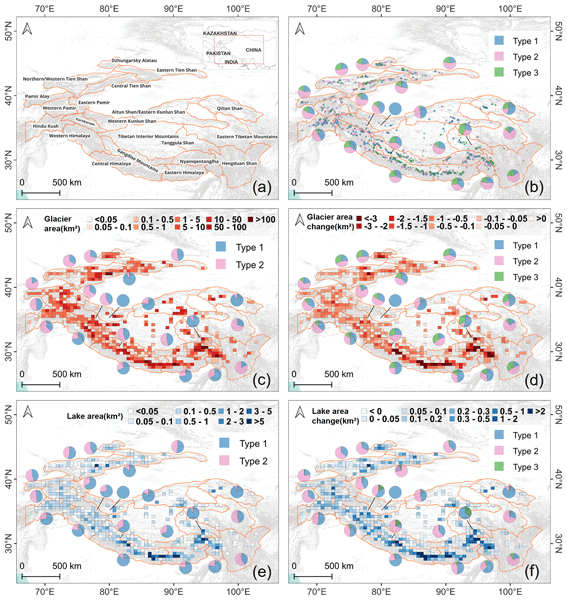
Glaciers that end in lakes are changing rapidly in the mountains of Asia. We created the first long-term record of these glaciers and their lakes from 1990 to 2022 by analyzing satellite images. Our results show that many glaciers are shrinking while their lakes are growing. These changes matter because they affect water supply, flood risks, and mountain landscapes. This dataset offers new knowledge to support research and planning for climate change impacts.
Nitesh Khadka, Vishnu Prasad Pandey, C. Scott Watson, Guoxiong Zheng, Tianpei Wu, Keshab Sharma, Lauren D. Rawlins, Simon Allen, Manish Raj Gouli, and Dibas Shrestha
Nat. Hazards Earth Syst. Sci., 26, 4131–4152, https://doi.org/10.5194/nhess-26-4131-2026, https://doi.org/10.5194/nhess-26-4131-2026, 2026
Short summary
Short summary
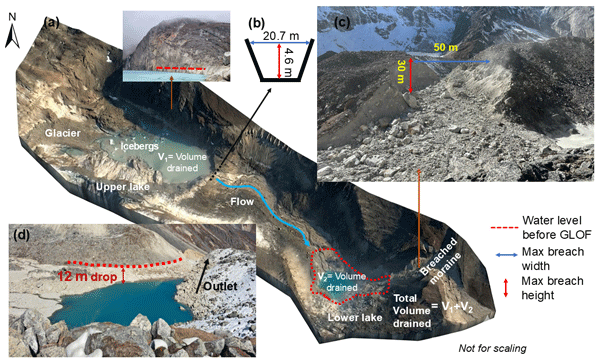
On 16 August 2024, a cascading glacial lake outburst flood destroyed Thame Village, Nepal. An upstream glacial lake formed in the late 2000s overtopped triggering a downstream lake breach. Combined release of ~770,000 m³ with peak discharge >800 m³/s reached the village within 22–25 min. Losses exceeded 6.18 million USD. Small, rapidly evolving lakes pose often overlooked GLOF risks in a warming climate.
Xin Yang, Shiyin Liu, Fuming Xie, Jinyue Wei, Jun Zhou, Yunpeng Duan, Yiyuan Shen, Yu Zhu, Qiao Liu, Muhammad Mannan Afzal, and Muhammad Saifullah
EGUsphere, https://doi.org/10.5194/egusphere-2026-2836, https://doi.org/10.5194/egusphere-2026-2836, 2026
Short summary
Short summary
Glaciers in the Karakoram are changing but older maps often miss small ice bodies and blur the edges where ice is covered by rock. We made a clearer map by combining detailed satellite images, height information, surface temperature, computer-assisted mapping, and careful human checking. The new map shows about 13,900 glaciers and reveals that much rock-covered ice is concentrated on a small number of very large glaciers. This work helps people better understand water, risk, and mountain change.
Qiao Liu, Yongsheng Yin, Jiawei Yang, Yunyi Luo, Xueyuan Lu, Hao Wang, Yin Fu, Bo Zhang, Qianqian Zheng, Dongyu Lei, Xin Wang, Shiyin Liu, Yong Nie, and Shichang Kang
EGUsphere, https://doi.org/10.5194/egusphere-2026-2674, https://doi.org/10.5194/egusphere-2026-2674, 2026
Short summary
Short summary
On 16 Dec 2024, a frozen Himalayan glacial lake burst following rockfalls, triggering an "ice tsunami" and flash flood—the first well-documented winter glacial lake outburst flood (GLOF). As warming destabilizes slopes and weakens ice, such winter floods may increase. We urge heightened public awareness and call for future GLOF risk assessments and early-warning systems to include lake-ice condition as a key monitoring parameter under safety protocols.
Yunyi Luo, Qiao Liu, Xueyuan Lu, Yongsheng Yin, Jiawei Yang, and Xuyang Lu
Earth Syst. Sci. Data, 18, 1503–1518, https://doi.org/10.5194/essd-18-1503-2026, https://doi.org/10.5194/essd-18-1503-2026, 2026
Short summary
Short summary
Glaciers that end in lakes are changing rapidly in the mountains of Asia. We created the first long-term record of these glaciers and their lakes from 1990 to 2022 by analyzing satellite images. Our results show that many glaciers are shrinking while their lakes are growing. These changes matter because they affect water supply, flood risks, and mountain landscapes. This dataset offers new knowledge to support research and planning for climate change impacts.
Fuming Xie, Shiyin Liu, Yongpeng Gao, Yu Zhu, Tobias Bolch, Andreas Kääb, Shimei Duan, Wenfei Miao, Jianfang Kang, Yaonan Zhang, Xiran Pan, Caixia Qin, Kunpeng Wu, Miaomiao Qi, Xianhe Zhang, Ying Yi, Fengze Han, Xiaojun Yao, Qiao Liu, Xin Wang, Zongli Jiang, Donghui Shangguan, Yong Zhang, Richard Grünwald, Muhammad Adnan, Jyoti Karki, and Muhammad Saifullah
Earth Syst. Sci. Data, 15, 847–867, https://doi.org/10.5194/essd-15-847-2023, https://doi.org/10.5194/essd-15-847-2023, 2023
Short summary
Short summary
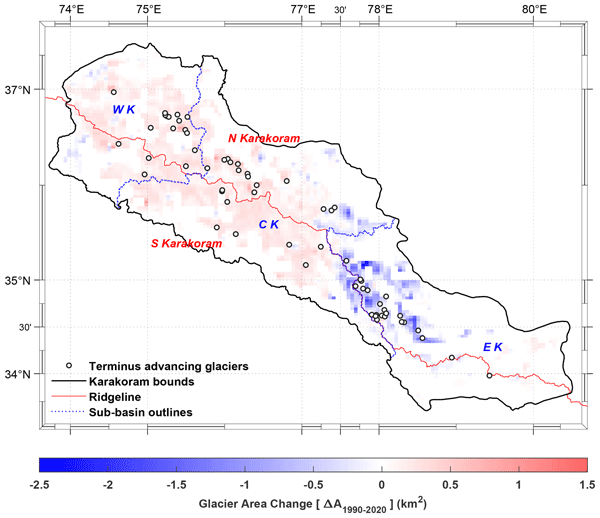
In this study, first we generated inventories which allowed us to systematically detect glacier change patterns in the Karakoram range. We found that, by the 2020s, there were approximately 10 500 glaciers in the Karakoram mountains covering an area of 22 510.73 km2, of which ~ 10.2 % is covered by debris. During the past 30 years (from 1990 to 2020), the total glacier cover area in Karakoram remained relatively stable, with a slight increase in area of 23.5 km2.
Stefan Fugger, Catriona L. Fyffe, Simone Fatichi, Evan Miles, Michael McCarthy, Thomas E. Shaw, Baohong Ding, Wei Yang, Patrick Wagnon, Walter Immerzeel, Qiao Liu, and Francesca Pellicciotti
The Cryosphere, 16, 1631–1652, https://doi.org/10.5194/tc-16-1631-2022, https://doi.org/10.5194/tc-16-1631-2022, 2022
Short summary
Short summary
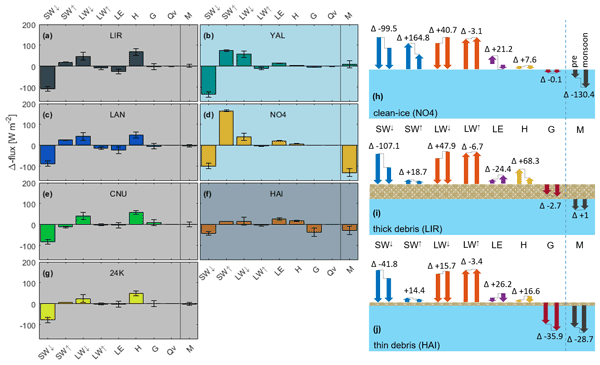
The monsoon is important for the shrinking and growing of glaciers in the Himalaya during summer. We calculate the melt of seven glaciers in the region using a complex glacier melt model and weather data. We find that monsoonal weather affects glaciers that are covered with a layer of rocky debris and glaciers without such a layer in different ways. It is important to take so-called turbulent fluxes into account. This knowledge is vital for predicting the future of the Himalayan glaciers.
Yan Zhong, Qiao Liu, Matthew Westoby, Yong Nie, Francesca Pellicciotti, Bo Zhang, Jialun Cai, Guoxiang Liu, Haijun Liao, and Xuyang Lu
Earth Surf. Dynam., 10, 23–42, https://doi.org/10.5194/esurf-10-23-2022, https://doi.org/10.5194/esurf-10-23-2022, 2022
Short summary
Short summary
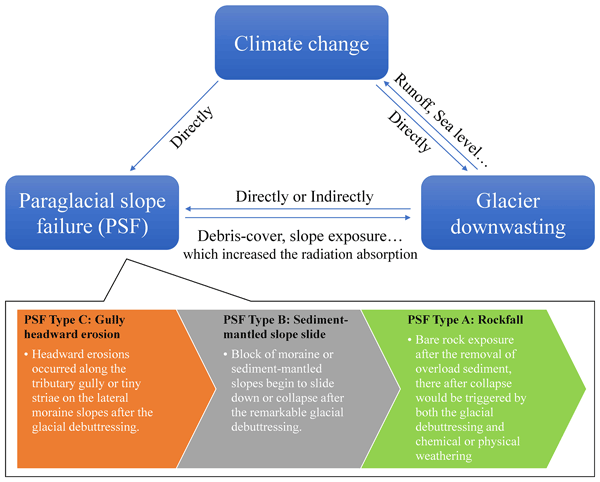
Slope failures exist in many paraglacial regions and are the main manifestation of the interaction between debris-covered glaciers and slopes. We mapped paraglacial slope failures (PSFs) along the Hailuogou Glacier (HLG), Mt. Gongga, southeastern Tibetan Plateau. We argue that the formation, evolution, and current status of these typical PSFs are generally related to glacier history and paraglacial geomorphological adjustments, and influenced by the fluctuation of climate conditions.
Cited articles
Ahmed, R.: Glacial Lake Outburst Flood (GLOF) Hazard and Risk Management Strategies: A Global Overview, Water Resour. Manag., 39, 1–16, https://doi.org/10.1007/s11269-024-03958-x, 2025.
Armstrong, W. H., Anderson, R. S., and Fahnestock, M. A.: Spatial Patterns of Summer Speedup on South Central Alaska Glaciers, Geophys. Res. Lett., 44, 9379–9388, https://doi.org/10.1002/2017gl074370, 2017.
Benn, D. I., Hulton, N. R. J., and Mottram, R. H.: “Calving laws”, “sliding laws” and the stability of tidewater glaciers, Ann. Glaciol., 46, 123–130, https://doi.org/10.3189/172756407782871161, 2007.
Berthier, E., Vincent, C., Magnússon, E., Gunnlaugsson, Á. Þ., Pitte, P., Le Meur, E., Masiokas, M., Ruiz, L., Pálsson, F., Belart, J. M. C., and Wagnon, P.: Glacier topography and elevation changes derived from Pléiades sub-meter stereo images, The Cryosphere, 8, 2275–2291, https://doi.org/10.5194/tc-8-2275-2014, 2014.
Beyer, R. A., Alexandrov, O., and McMichael, S.: The Ames Stereo Pipeline: NASA's Open Source Software for Deriving and Processing Terrain Data, Earth and Space Science, 5, 537–548, https://doi.org/10.1029/2018EA000409, 2018.
Bhattacharya, A., Bolch, T., Mukherjee, K., King, O., Menounos, B., Kapitsa, V., Neckel, N., Yang, W., and Yao, T.: High Mountain Asian glacier response to climate revealed by multi-temporal satellite observations since the 1960s, Nat. Commun., 12, 4133, https://doi.org/10.1038/s41467-021-24180-y, 2021.
Brun, F., Berthier, E., Wagnon, P., Kaab, A., and Treichler, D.: A spatially resolved estimate of High Mountain Asia glacier mass balances, 2000–2016, Nat. Geosci., 10, 668–673, https://doi.org/10.1038/NGEO2999, 2017a.
Brun, F., Berthier, E., Wagnon, P., Kääb, A., and Treichler, D.: Elevation changes of High Mountain Asia from 2000 to 2016, PANGAEA [data set], https://doi.org/10.1594/PANGAEA.876545, 2017b.
Carrivick, J. L. and Tweed, F. S.: Proglacial lakes: character, behaviour and geological importance, Quaternary Sci. Rev., 78, 34–52, https://doi.org/10.1016/j.quascirev.2013.07.028, 2013.
Durkin, W. J., Bartholomaus, T. C., Willis, M. J., and Pritchard, M. E.: Dynamic Changes at Yahtse Glacier, the Most Rapidly Advancing Tidewater Glacier in Alaska, Front. Earth Sci., 5, https://doi.org/10.3389/feart.2017.00021, 2017.
Gao, Y., Wang, J., Liu, S., Qi, M., Liang, P., and Mu, J.: Mechanisms of glacier surges in the Central Himalayas uncovered using remote sensing and glacier modelling, Geomorphology, 482, 109816, https://doi.org/10.1016/j.geomorph.2025.109816, 2025.
Gardner, A. S., Greene, C. A., Kennedy, J. H., Fahnestock, M. A., Liukis, M., López, L. A., Lei, Y., Scambos, T. A., and Dehecq, A.: ITS_LIVE global glacier velocity data in near-real time, The Cryosphere, 19, 3517–3533, https://doi.org/10.5194/tc-19-3517-2025, 2025.
Hanshaw, M. N. and Bookhagen, B.: Glacial areas, lake areas, and snow lines from 1975 to 2012: status of the Cordillera Vilcanota, including the Quelccaya Ice Cap, northern central Andes, Peru, The Cryosphere, 8, 359–376, https://doi.org/10.5194/tc-8-359-2014, 2014.
Hugonnet, R., McNabb, R., Berthier, E., Menounos, B., Nuth, C., Girod, L., Farinotti, D., Huss, M., Dussaillant, I., Brun, F., and Kaab, A.: Accelerated global glacier mass loss in the early twenty-first century, Nature, 592, 726–731, https://doi.org/10.1038/s41586-021-03436-z, 2021.
Hugonnet, R., Brun, F., Berthier, E., Dehecq, A., Mannerfelt, E. S., Eckert, N., and Farinotti, D.: Uncertainty Analysis of Digital Elevation Models by Spatial Inference From Stable Terrain, IEEE J-Stars, 15, 6456–6472, https://doi.org/10.1109/JSTARS.2022.3188922, 2022.
Hyde, A., Carr, R., Dunning, S. A., and Van Wyk de Vries, M.: Quantifying heterogeneous glacier dynamics in Lunana, Bhutan, using spatiotemporally high-resolution satellite imagery, J. Glaciol., 71, e126, https://doi.org/10.1017/jog.2025.10103, 2025.
Ke, L., Song, C., Yong, B., Lei, Y., and Ding, X.: Which heterogeneous glacier melting patterns can be robustly observed from space? A multi-scale assessment in southeastern Tibetan Plateau, Remote Sens. Environ., 242, https://doi.org/10.1016/j.rse.2020.111777, 2020.
King, O., Dehecq, A., Quincey, D., and Carrivick, J.: Contrasting geometric and dynamic evolution of lake and land-terminating glaciers in the central Himalaya, Global Planet. Change, 167, 46–60, https://doi.org/10.1016/j.gloplacha.2018.05.006, 2018.
Kitoh, A.: The Asian Monsoon and its Future Change in Climate Models: A Review, J. Meteorol. Soc. Jpn. Ser. II, 95, 7–33, https://doi.org/10.2151/jmsj.2017-002, 2017.
Lehner, B. and Grill, G.: Global river hydrography and network routing: baseline data and new approaches to study the world's large river systems, Hydrol. Process., 27, 2171–2186, https://doi.org/10.1002/hyp.9740, 2013.
Leprince, S., Barbot, S., Ayoub, F., and Avouac, J. P.: Automatic and precise orthorectification, coregistration, and subpixel correlation of satellite images, application to ground deformation measurements, IEEE T. Geosci. Remote, 45, 1529–1558, https://doi.org/10.1109/Tgrs.2006.888937, 2007.
Li, G., Lv, M., Quincey, D. J., Taylor, L. S., Li, X., Yan, S., Sun, Y., and Guo, H.: Characterizing the surge behaviour and associated ice-dammed lake evolution of the Kyagar Glacier in the Karakoram, The Cryosphere, 17, 2891–2907, https://doi.org/10.5194/tc-17-2891-2023, 2023.
Li, S. and Hajnsek, I.: Geodetic glacier mass balance in the Karakoram (2011–2019) from TanDEM-X: An InSAR DEM differencing framework, Remote Sens. Environ., 331, 115023, https://doi.org/10.1016/j.rse.2025.115023, 2025.
Liu, Q., Mayer, C., Wang, X., Nie, Y., Wu, K., Wei, J., and Liu, S.: Interannual flow dynamics driven by frontal retreat of a lake-terminating glacier in the Chinese Central Himalaya, Earth Planet. Sc. Lett., 546, https://doi.org/10.1016/j.epsl.2020.116450, 2020.
Luo, Y.: Dataset for “Glacier response to the transition from lake- to land-terminating following a glacial lake outburst flood at Jinwu Glacier, southeastern Tibet”, Zenodo [data set], https://doi.org/10.5281/zenodo.23190897, 2026.
Luo, Y., Yin, Y., Zhong, Y., Lu, X., Yang, J., Sapkota, L., Lu, X., and Liu, Q.: Dynamics of lake–terminating glaciers in the Himalaya and Southeastern Tibet between 1990 and 2020, J. Glaciol., 1–20, https://doi.org/10.1017/jog.2025.10088, 2025.
Lützow, N., Veh, G., and Korup, O.: A global database of historic glacier lake outburst floods, Earth Syst. Sci. Data, 15, 2983–3000, https://doi.org/10.5194/essd-15-2983-2023, 2023.
Mattea, E., Berthier, E., Dehecq, A., Bolch, T., Bhattacharya, A., Ghuffar, S., Barandun, M., and Hoelzle, M.: Five decades of Abramov glacier dynamics reconstructed with multi-sensor optical remote sensing, The Cryosphere, 19, 219–247, https://doi.org/10.5194/tc-19-219-2025, 2025.
Maurer, J. M., Schaefer, J. M., Rupper, S., and Corley, A.: Acceleration of ice loss across the Himalayas over the past 40 years, Science Advances, 5, eaav7266, https://doi.org/10.1126/sciadv.aav7266, 2019.
McNabb, R. W., Hock, R., O'Neel, S., Rasmussen, L. A., Ahn, Y., Braun, M., Conway, H., Herreid, S., Joughin, I., Pfeffer, W. T., Smith, B. E., and Truffer, M.: Using surface velocities to calculate ice thickness and bed topography: a case study at Columbia Glacier, Alaska, USA, J. Glaciol., 58, 1151–1164, https://doi.org/10.3189/2012JoG11J249, 2012.
Nuth, C. and Kääb, A.: Co-registration and bias corrections of satellite elevation data sets for quantifying glacier thickness change, The Cryosphere, 5, 271–290, https://doi.org/10.5194/tc-5-271-2011, 2011.
Paul, F., Bolch, T., Kääb, A., Nagler, T., Nuth, C., Scharrer, K., Shepherd, A., Strozzi, T., Ticconi, F., Bhambri, R., Berthier, E., Bevan, S., Gourmelen, N., Heid, T., Jeong, S., Kunz, M., Lauknes, T. R., Luckman, A., Merryman Boncori, J. P., Moholdt, G., Muir, A., Neelmeijer, J., Rankl, M., VanLooy, J., and Van Niel, T.: The glaciers climate change initiative: Methods for creating glacier area, elevation change and velocity products, Remote Sens. Environ., 162, 408–426, https://doi.org/10.1016/j.rse.2013.07.043, 2015.
Paul, F., Piermattei, L., Treichler, D., Gilbert, L., Girod, L., Kääb, A., Libert, L., Nagler, T., Strozzi, T., and Wuite, J.: Three different glacier surges at a spot: what satellites observe and what not, The Cryosphere, 16, 2505–2526, https://doi.org/10.5194/tc-16-2505-2022, 2022.
Peng, M., Wang, X., Zhang, G., Veh, G., Sattar, A., Chen, W., and Allen, S.: Cascading hazards from two recent glacial lake outburst floods in the Nyainqêntanglha range, Tibetan Plateau, J. Hydrol., 626, https://doi.org/10.1016/j.jhydrol.2023.130155, 2023.
Pronk, J. B., Bolch, T., King, O., Wouters, B., and Benn, D. I.: Contrasting surface velocities between lake- and land-terminating glaciers in the Himalayan region, The Cryosphere, 15, 5577–5599, https://doi.org/10.5194/tc-15-5577-2021, 2021.
Rabus, B., Eineder, M., Roth, A., and Bamler, R.: The shuttle radar topography mission – a new class of digital elevation models acquired by spaceborne radar, ISPRS J Photogramm., 57, 241–262, https://doi.org/10.1016/s0924-2716(02)00124-7, 2003.
RGI Consortium: Randolph Glacier Inventory – A Dataset of Global Glacier Outlines, Version 7.0, National Snow and Ice Data Center [data set], https://doi.org/10.5067/F6JMOVY5NAVZ, 2023.
Richardson, S. D. and Reynolds, J. M.: An overview of glacial hazards in the Himalayas, Quatern. Int., 65–66, 31–47, https://doi.org/10.1016/S1040-6182(99)00035-X, 2000.
Salerno, F., Thakuri, S., D'Agata, C., Smiraglia, C., Manfredi, E. C., Viviano, G., and Tartari, G.: Glacial lake distribution in the Mount Everest region: Uncertainty of measurement and conditions of formation, Global Planet. Change, 92–93, 30–39, https://doi.org/10.1016/j.gloplacha.2012.04.001, 2012.
Sanjay, J., Krishnan, R., Shrestha, A. B., Rajbhandari, R., and Ren, G.-Y.: Downscaled climate change projections for the Hindu Kush Himalayan region using CORDEX South Asia regional climate models, Advances in Climate Change Research, 8, 185–198, https://doi.org/10.1016/j.accre.2017.08.003, 2017.
Sato, Y., Fujita, K., Inoue, H., Sakai, A., and Karma: Land- to lake-terminating transition triggers dynamic thinning of a Bhutanese glacier, The Cryosphere, 16, 2643–2654, https://doi.org/10.5194/tc-16-2643-2022, 2022.
Schomacker, A.: Expansion of ice-marginal lakes at the Vatnajökull ice cap, Iceland, from 1999 to 2009, Geomorphology, 119, 232–236, https://doi.org/10.1016/j.geomorph.2010.03.022, 2010.
Shugar, D. H., Burr, A., Haritashya, U. K., Kargel, J. S., Watson, C. S., Kennedy, M. C., Bevington, A. R., Betts, R. A., Harrison, S., and Strattman, K.: Rapid worldwide growth of glacial lakes since 1990, Nat. Clim. Change, 10, 939–945, https://doi.org/10.1038/s41558-020-0855-4, 2020.
Singh Jasrotia, A., Ahmad, S., Ridwan, Q., Ahmad Wani, Z., Siddiqui, S., Siddiqua, A., and Ali Morfeine aika, E.: Estimation of Surface Ice Velocity of Durung Drung Glacier, Western Himalaya using COSI-Corr from Landsat images, The Egyptian Journal of Remote Sensing and Space Sciences, 27, 369–381, https://doi.org/10.1016/j.ejrs.2024.04.006, 2024.
Sutherland, J. L., Carrivick, J. L., Gandy, N., Shulmeister, J., Quincey, D. J., and Cornford, S. L.: Proglacial Lakes Control Glacier Geometry and Behavior During Recession, Geophys. Res. Lett., 47, https://doi.org/10.1029/2020gl088865, 2020.
Truffer, M. and Motyka, R. J.: Where glaciers meet water: Subaqueous melt and its relevance to glaciers in various settings, Rev. Geophys., 54, 220–239, https://doi.org/10.1002/2015rg000494, 2016.
Tsutaki, S., Fujita, K., Nuimura, T., Sakai, A., Sugiyama, S., Komori, J., and Tshering, P.: Contrasting thinning patterns between lake- and land-terminating glaciers in the Bhutanese Himalaya, The Cryosphere, 13, 2733–2750, https://doi.org/10.5194/tc-13-2733-2019, 2019.
Wang, X., Guo, X., Yang, C., Liu, Q., Wei, J., Zhang, Y., Liu, S., Zhang, Y., Jiang, Z., and Tang, Z.: Glacial lake inventory of high-mountain Asia in 1990 and 2018 derived from Landsat images, Earth Syst. Sci. Data, 12, 2169–2182, https://doi.org/10.5194/essd-12-2169-2020, 2020.
Watson, C. S., Kargel, J. S., Shugar, D. H., Haritashya, U. K., Schiassi, E., and Furfaro, R.: Mass Loss From Calving in Himalayan Proglacial Lakes, Front. Earth Sci., 7, https://doi.org/10.3389/feart.2019.00342, 2020.
Yao, T., Thompson, L., Yang, W., Yu, W., Gao, Y., Guo, X., Yang, X., Duan, K., Zhao, H., Xu, B., Pu, J., Lu, A., Xiang, Y., Kattel, D. B., and Joswiak, D.: Different glacier status with atmospheric circulations in Tibetan Plateau and surroundings, Nat. Clim. Change, 2, 663–667, https://doi.org/10.1038/nclimate1580, 2012.
Zemp, M., Jakob, L., Dussaillant, I., Nussbaumer, S. U., Gourmelen, N., Dubber, S., A, G., Abdullahi, S., Andreassen, L. M., Berthier, E., Bhattacharya, A., Blazquez, A., Boehm Vock, L. F., Bolch, T., Box, J., Braun, M. H., Brun, F., Cicero, E., Colgan, W., Eckert, N., Farinotti, D., Florentine, C., Floricioiu, D., Gardner, A., Harig, C., Hassan, J., Hugonnet, R., Huss, M., Jóhannesson, T., Liang, C.-C. A., Ke, C.-Q., Khan, S. A., King, O., Kneib, M., Krieger, L., Maussion, F., Mattea, E., McNabb, R., Menounos, B., Miles, E., Moholdt, G., Nilsson, J., Pálsson, F., Pfeffer, J., Piermattei, L., Plummer, S., Richter, A., Sasgen, I., Schuster, L., Seehaus, T., Shen, X., Sommer, C., Sutterley, T., Treichler, D., Velicogna, I., Wouters, B., Zekollari, H., Zheng, W., and The GlaMBIE Team: Community estimate of global glacier mass changes from 2000 to 2023, Nature, 639, 382–388, https://doi.org/10.1038/s41586-024-08545-z, 2025.
Zhang, G., Bolch, T., Yao, T., Rounce, D. R., Chen, W., Veh, G., King, O., Allen, S. K., Wang, M., and Wang, W.: Underestimated mass loss from lake-terminating glaciers in the greater Himalaya, Nat. Geosci., 16, 333–338, https://doi.org/10.1038/s41561-023-01150-1, 2023a.
Zhang, T., Wang, W., An, B., and Wei, L.: Enhanced glacial lake activity threatens numerous communities and infrastructure in the Third Pole, Nat. Commun., 14, 8250, https://doi.org/10.1038/s41467-023-44123-z, 2023b.
Zhang, T., Wang, W., and An, B.: Heterogeneous changes in global glacial lakes under coupled climate warming and glacier thinning, Communications Earth & Environment, 5, 374, https://doi.org/10.1038/s43247-024-01544-y, 2024.
Zhang, T., Wang, W., Kougkoulos, I., Cook, S. J., Li, S., Iribarren-Anacona, P., Watson, C. S., An, B., and Yao, T.: High frequency of moraine-dammed lake outburst floods driven by global warming, Nat. Commun., 16, 11173, https://doi.org/10.1038/s41467-025-67650-3, 2025.
Zheng, G., Bao, A., Allen, S., Antonio Ballesteros-Cánovas, J., Yuan, Y., Jiapaer, G., and Stoffel, M.: Numerous unreported glacial lake outburst floods in the Third Pole revealed by high-resolution satellite data and geomorphological evidence, Sci. Bull., 66, 1270–1273, https://doi.org/10.1016/j.scib.2021.01.014, 2021a.
Zheng, G., Mergili, M., Emmer, A., Allen, S., Bao, A., Guo, H., and Stoffel, M.: The 2020 glacial lake outburst flood at Jinwuco, Tibet: causes, impacts, and implications for hazard and risk assessment, The Cryosphere, 15, 3159–3180, https://doi.org/10.5194/tc-15-3159-2021, 2021b.
Zheng, G., Allen, S. K., Bao, A., Ballesteros-Cánovas, J. A., Huss, M., Zhang, G., Li, J., Yuan, Y., Jiang, L., Yu, T., Chen, W., and Stoffel, M.: Increasing risk of glacial lake outburst floods from future Third Pole deglaciation, Nat. Clim. Change, 11, 411–417, https://doi.org/10.1038/s41558-021-01028-3, 2021c.
Short summary
After a glacial lake outburst flood in 2020, Jinwu Glacier in southeastern Tibet lost contact with its lake. Using satellite images, we found that the glacier front slowed by about 44% and showed ice-cliff collapse and a short-lived advance. The study shows that sudden lake drainage can rapidly change glacier behaviour, with implications for how lake-terminating glaciers evolve after outburst floods.
After a glacial lake outburst flood in 2020, Jinwu Glacier in southeastern Tibet lost contact...


