Articles | Volume 20, issue 1
https://doi.org/10.5194/tc-20-527-2026
© Author(s) 2026. This work is distributed under
the Creative Commons Attribution 4.0 License.
https://doi.org/10.5194/tc-20-527-2026
© Author(s) 2026. This work is distributed under
the Creative Commons Attribution 4.0 License.
Brief communication: Evaluation of the ESA CCI+ ESMR v1.1 sea-ice concentration product

Integrated Climate Data Center, Center for Earth System Research and Sustainability, University of Hamburg, Hamburg, 20144, Germany
Related authors
Remon Sadikni and Stefan Kern
Earth Syst. Sci. Data Discuss., https://doi.org/10.5194/essd-2025-757, https://doi.org/10.5194/essd-2025-757, 2026
Preprint under review for ESSD
Short summary
Short summary
Melt ponds form during summer on Arctic sea ice. They impact the amount of solar energy entering the sea ice-ocean system. We describe the retrieval method of a new data set of the daily melt-pond coverage on Arctic sea ice north of 60 degrees latitude North for June to August of years 2000 to 2024 based on satellite remote sensing. The results of the quality assessment against independent observations demonstrate the data set’s credibility and usefulness for Arctic climate system studies.
Andreas Wernecke, Thomas Lavergne, Stefan Kern, and Dirk Notz
EGUsphere, https://doi.org/10.5194/egusphere-2025-6234, https://doi.org/10.5194/egusphere-2025-6234, 2026
This preprint is open for discussion and under review for The Cryosphere (TC).
Short summary
Short summary
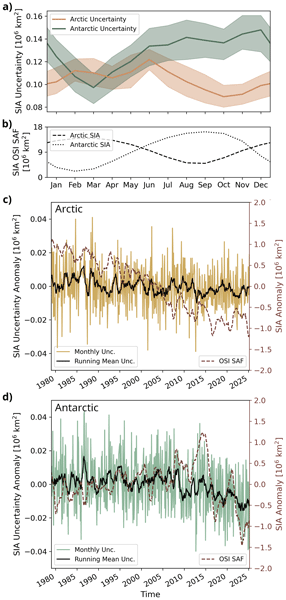
We analyse the types and size of uncertainties in satellite measurements of the global sea ice cover. These measurements give insights into the state of the climate system and quality of climate models. We derive uncertainties for one satellite product and compare it with other products. We find that offsets do play a role for measurements of the total sea ice cover, but also for estimates of its change. This calls for further investigations into the product development.
Ida Birgitte Lundtorp Olsen, Henriette Skourup, Heidi Sallila, Stefan Hendricks, Renée Mie Fredensborg Hansen, Stefan Kern, Stephan Paul, Marion Bocquet, Sara Fleury, Dmitry Divine, and Eero Rinne
Earth Syst. Sci. Data Discuss., https://doi.org/10.5194/essd-2024-234, https://doi.org/10.5194/essd-2024-234, 2024
Revised manuscript accepted for ESSD
Short summary
Short summary
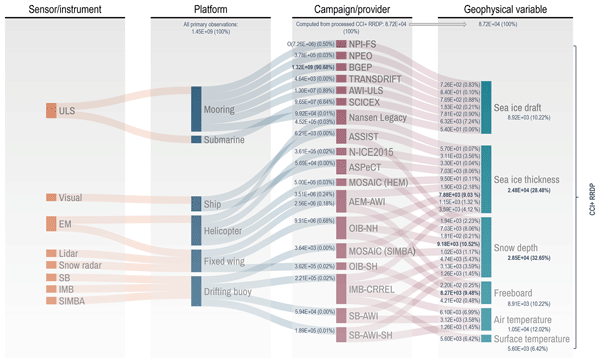
Discover the latest advancements in sea ice research with our comprehensive Climate Change Initiative (CCI) sea ice thickness (SIT) Round Robin Data Package (RRDP). This pioneering collection contains reference measurements from 1960 to 2022 from airborne sensors, buoys, visual observations and sonar and covers the polar regions from 1993 to 2021, providing crucial reference measurements for validating satellite-derived sea ice thickness.
Andreas Wernecke, Dirk Notz, Stefan Kern, and Thomas Lavergne
The Cryosphere, 18, 2473–2486, https://doi.org/10.5194/tc-18-2473-2024, https://doi.org/10.5194/tc-18-2473-2024, 2024
Short summary
Short summary
The total Arctic sea-ice area (SIA), which is an important climate indicator, is routinely monitored with the help of satellite measurements. Uncertainties in observations of sea-ice concentration (SIC) partly cancel out when summed up to the total SIA, but the degree to which this is happening has been unclear. Here we find that the uncertainty daily SIA estimates, based on uncertainties in SIC, are about 300 000 km2. The 2002 to 2017 September decline in SIA is approx. 105 000 ± 9000 km2 a−1.
Stefan Kern, Thomas Lavergne, Leif Toudal Pedersen, Rasmus Tage Tonboe, Louisa Bell, Maybritt Meyer, and Luise Zeigermann
The Cryosphere, 16, 349–378, https://doi.org/10.5194/tc-16-349-2022, https://doi.org/10.5194/tc-16-349-2022, 2022
Short summary
Short summary
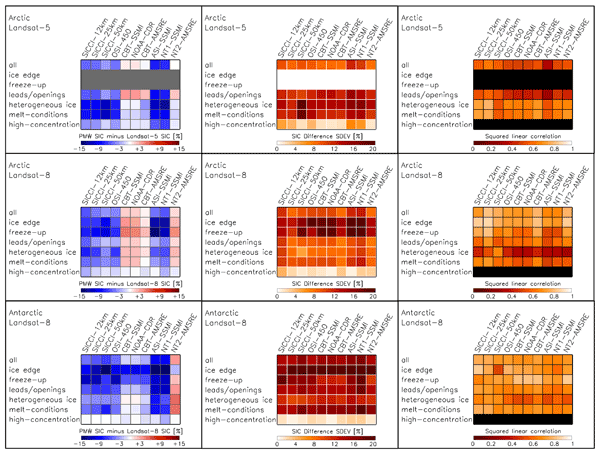
High-resolution clear-sky optical satellite imagery has rarely been used to evaluate satellite passive microwave sea-ice concentration products beyond case-study level. By comparing 10 such products with sea-ice concentration estimated from > 350 such optical images in both hemispheres, we expand results of earlier evaluation studies for these products. Results stress the need to look beyond precision and accuracy and to discuss the evaluation data’s quality and filters applied in the products.
Rasmus T. Tonboe, Vishnu Nandan, John Yackel, Stefan Kern, Leif Toudal Pedersen, and Julienne Stroeve
The Cryosphere, 15, 1811–1822, https://doi.org/10.5194/tc-15-1811-2021, https://doi.org/10.5194/tc-15-1811-2021, 2021
Short summary
Short summary
A relationship between the Ku-band radar scattering horizon and snow depth is found using a radar scattering model. This relationship has implications for (1) the use of snow climatology in the conversion of satellite radar freeboard into sea ice thickness and (2) the impact of variability in measured snow depth on the derived ice thickness. For both 1 and 2, the impact of using a snow climatology versus the actual snow depth is relatively small.
Remon Sadikni and Stefan Kern
Earth Syst. Sci. Data Discuss., https://doi.org/10.5194/essd-2025-757, https://doi.org/10.5194/essd-2025-757, 2026
Preprint under review for ESSD
Short summary
Short summary
Melt ponds form during summer on Arctic sea ice. They impact the amount of solar energy entering the sea ice-ocean system. We describe the retrieval method of a new data set of the daily melt-pond coverage on Arctic sea ice north of 60 degrees latitude North for June to August of years 2000 to 2024 based on satellite remote sensing. The results of the quality assessment against independent observations demonstrate the data set’s credibility and usefulness for Arctic climate system studies.
Andreas Wernecke, Thomas Lavergne, Stefan Kern, and Dirk Notz
EGUsphere, https://doi.org/10.5194/egusphere-2025-6234, https://doi.org/10.5194/egusphere-2025-6234, 2026
This preprint is open for discussion and under review for The Cryosphere (TC).
Short summary
Short summary
We analyse the types and size of uncertainties in satellite measurements of the global sea ice cover. These measurements give insights into the state of the climate system and quality of climate models. We derive uncertainties for one satellite product and compare it with other products. We find that offsets do play a role for measurements of the total sea ice cover, but also for estimates of its change. This calls for further investigations into the product development.
Ida Birgitte Lundtorp Olsen, Henriette Skourup, Heidi Sallila, Stefan Hendricks, Renée Mie Fredensborg Hansen, Stefan Kern, Stephan Paul, Marion Bocquet, Sara Fleury, Dmitry Divine, and Eero Rinne
Earth Syst. Sci. Data Discuss., https://doi.org/10.5194/essd-2024-234, https://doi.org/10.5194/essd-2024-234, 2024
Revised manuscript accepted for ESSD
Short summary
Short summary
Discover the latest advancements in sea ice research with our comprehensive Climate Change Initiative (CCI) sea ice thickness (SIT) Round Robin Data Package (RRDP). This pioneering collection contains reference measurements from 1960 to 2022 from airborne sensors, buoys, visual observations and sonar and covers the polar regions from 1993 to 2021, providing crucial reference measurements for validating satellite-derived sea ice thickness.
Andreas Wernecke, Dirk Notz, Stefan Kern, and Thomas Lavergne
The Cryosphere, 18, 2473–2486, https://doi.org/10.5194/tc-18-2473-2024, https://doi.org/10.5194/tc-18-2473-2024, 2024
Short summary
Short summary
The total Arctic sea-ice area (SIA), which is an important climate indicator, is routinely monitored with the help of satellite measurements. Uncertainties in observations of sea-ice concentration (SIC) partly cancel out when summed up to the total SIA, but the degree to which this is happening has been unclear. Here we find that the uncertainty daily SIA estimates, based on uncertainties in SIC, are about 300 000 km2. The 2002 to 2017 September decline in SIA is approx. 105 000 ± 9000 km2 a−1.
Stefan Kern, Thomas Lavergne, Leif Toudal Pedersen, Rasmus Tage Tonboe, Louisa Bell, Maybritt Meyer, and Luise Zeigermann
The Cryosphere, 16, 349–378, https://doi.org/10.5194/tc-16-349-2022, https://doi.org/10.5194/tc-16-349-2022, 2022
Short summary
Short summary
High-resolution clear-sky optical satellite imagery has rarely been used to evaluate satellite passive microwave sea-ice concentration products beyond case-study level. By comparing 10 such products with sea-ice concentration estimated from > 350 such optical images in both hemispheres, we expand results of earlier evaluation studies for these products. Results stress the need to look beyond precision and accuracy and to discuss the evaluation data’s quality and filters applied in the products.
Rasmus T. Tonboe, Vishnu Nandan, John Yackel, Stefan Kern, Leif Toudal Pedersen, and Julienne Stroeve
The Cryosphere, 15, 1811–1822, https://doi.org/10.5194/tc-15-1811-2021, https://doi.org/10.5194/tc-15-1811-2021, 2021
Short summary
Short summary
A relationship between the Ku-band radar scattering horizon and snow depth is found using a radar scattering model. This relationship has implications for (1) the use of snow climatology in the conversion of satellite radar freeboard into sea ice thickness and (2) the impact of variability in measured snow depth on the derived ice thickness. For both 1 and 2, the impact of using a snow climatology versus the actual snow depth is relatively small.
Cited articles
Cavalieri, D. J., Markus, T., Hall, D. K., Gasiewski, A. J., Klein, M., and Ivanoff, A.: Assessment of EOS Aqua AMSR-E Arctic sea ice concentrations using Landsat-7 and airborne microwave imagery, IEEE Transactions on Geoscience and Remote Sensing, 44, 3057–3069, https://doi.org/10.1109/TGRS.2006.878445, 2006.
Chander, G., Markham, B. L., and Helder, D. L.: Summary of current radiometric calibration coefficients for Landsat MSS, TM, ETM+, and EO-1 ALI sensors, Rem. Sens. Environ., 113, 893–903, https://doi.org/10.1016/j.rse.2009.01.007, 2009.
Engebretson, C.: Landsat Multispectral Scanner (MSS) Collection 2 (C2) Level 1 (L1) Data Format Control Book (DFCB), Version 3.0, September 2020, U. S. Geological Survey (USGS), Earth Resources Observation and Science (EROS) Center, LSDS-1416, 2020.
Kern, S.: Landsat-1 Multispectral Scanner surface type over water from supervised classification of surface broadband albedo estimates, Zentrum für Nachhaltiges Forschungsdatenmanagement (ZFDM), University of Hamburg [data set], https://doi.org/10.25592/uhhfdm.17915, 2025.
Kern, S., Lavergne, T., Notz, D., Pedersen, L. T., Tonboe, R. T., Saldo, R., and Sørensen, A. M.: Satellite passive microwave sea-ice concentration data set intercomparison: closed ice and ship-based observations, The Cryosphere, 13, 3261–3307, https://doi.org/10.5194/tc-13-3261-2019, 2019.
Kern, S., Lavergne, T., Pedersen, L. T., Tonboe, R. T., Bell, L., Meyer, M., and Zeigermann, L.: Satellite passive microwave sea-ice concentration data set intercomparison using Landsat data, The Cryosphere, 16, 349–378, https://doi.org/10.5194/tc-16-349-2022, 2022.
Koepke, P.: Removal of Atmospheric Effects from AVHRR albedos, J. Appl. Meteorol., 28, 1341–1348, 1989.
Kolbe, W. M., Tonboe, R. T., and Stroeve, J.: Mapping of sea ice concentration using the NASA NIMBUS 5 Electrically Scanning Microwave Radiometer data from 1972–1977, Earth Syst. Sci. Data, 16, 1247–1264, https://doi.org/10.5194/essd-16-1247-2024, 2024.
Lavergne, T., Sørensen, A. M., Kern, S., Tonboe, R., Notz, D., Aaboe, S., Bell, L., Dybkjær, G., Eastwood, S., Gabarro, C., Heygster, G., Killie, M. A., Brandt Kreiner, M., Lavelle, J., Saldo, R., Sandven, S., and Pedersen, L. T.: Version 2 of the EUMETSAT OSI SAF and ESA CCI sea-ice concentration climate data records, The Cryosphere, 13, 49–78, https://doi.org/10.5194/tc-13-49-2019, 2019.
Lu, J., Heygster, G., and Spreen, G.: Atmospheric correction of sea-ice concentration retrieval for 89 GHz AMSRE observations, IEEE J. Sel. Top. Appl., 11, 1442–1457, https://doi.org/10.1109/JSTARS.2018.2805193, 2018.
Meier, W. N., Fetterer, F., Windnagel, A. K., Stewart, J. S., and Stafford, T.: NOAA/NSIDC Climate Data Record of Passive Microwave Sea Ice Concentration (G02202, Version 5), National Snow and Ice Data Center, Boulder, Colorado, USA [data set], https://doi.org/10.7265/rjzb-pf78, 2024.
Parkinson, C. L., Comiso, J. C., and Zwally, H. J.: Nimbus-5 ESMR Polar Gridded Sea Ice Concentrations, edited by: Meier, W. N. and Stroeve, J., Version 1, NASA National Snow and Ice Data Center Distributed Active Archive Center, Boulder, Colorado, USA [data set], https://doi.org/10.5067/W2PKTWMTY0TP, 2004.
Purich, A. and Doddridge, E. W.: Record low Antarctic sea ice coverage indicates a new sea ice state, Commun. Earth Environ., 4, 314, https://doi.org/10.1038/s43247-023-00961-9, 2023.
Tonboe, R. T., Eastwood, S., Lavergne, T., Sørensen, A. M., Rathmann, N., Dybkjær, G., Pedersen, L. T., Høyer, J. L., and Kern, S.: The EUMETSAT sea ice concentration climate data record, The Cryosphere, 10, 2275–2290, https://doi.org/10.5194/tc-10-2275-2016, 2016.
Tonboe, R. T., Kolbe, W. M., Toudal Pedersen, L., Lavergne, T., Sørensen, A., and Saldo, R.: ESA Sea Ice Climate Change Initiative (Sea_Ice_cci): Nimbus-5 ESMR Sea Ice Concentration, version 1.0, NERC EDS Centre for Environmental Data Analysis [data set], https://doi.org/10.5285/34a15b96f1134d9e95b9e486d74e49cf, 2023.
Tonboe, R. T., Tellefsen, E., Kolbe, W. M., Toudal Pedersen, L., Lavergne, T., Sørensen, A., and Saldo, R.: ESA Sea Ice Climate Change Initiative (Sea_Ice_cci): Nimbus-5 ESMR Sea Ice Concentration, version 1.1, NERC EDS Centre for Environmental Data Analysis [data set], 25 March 2025, https://doi.org/10.5285/8978580336864f6d8282656d58771b32, 2025.
Wang, M., Smith, S. L., Box, J. E., Gerland, S., Isaksen, K., Meier, W. N., Mudryk, L., Natali, S. M., Romanovsky, V. E., Shu, Q., and Sigmond, M.: Cryosphere, in: AMAP Arctic Climate Change Update 2024: Key Trends and Impacts, Arctic Monitoring and Assessment Programme (AMAP), Tromsø, Norway, 31–56, https://doi.org/10.21352/g8qd-6h14, 2024.
Wiebe, H., Heygster, G., and Markus, T.: Comparison of the ASI ice concentration algorithm with Landsat-7 ETM+ and SAR imagery, IEEE Transactions on Geoscience and Remote Sensing, 47, 3008–3015, https://doi.org/10.1109/TGRS.2009.2026367, 2009.
Zhao, X., Chen, Y., Kern, S., Qu, M., Ji, Q., Fan, P., and Liu, Y.: Sea ice concentration derived from FY-3D MWRI and its accuracy assessment, IEEE Transactions on Geoscience and Remote Sensing, 60, 4300418, https://doi.org/10.1109/TGRS.2021.3063272, 2022.
Short summary
I evaluated a novel sea-ice concentration data product based on satellite microwave observations during December 1972 to May 1977. I used Landsat-1 satellite images obtained in 1974 in the Arctic, classified into water and ice. My evaluation provides results very similar to evaluations carried out for sea-ice concentration data products based on more recent satellite observations. I suggest that the novel sea-ice concentration data product is a useful extension back in time.
I evaluated a novel sea-ice concentration data product based on satellite microwave observations...