
Articles | Volume 20, issue 5
https://doi.org/10.5194/tc-20-2723-2026
© Author(s) 2026. This work is distributed under
the Creative Commons Attribution 4.0 License.
the Creative Commons Attribution 4.0 License.
https://doi.org/10.5194/tc-20-2723-2026
© Author(s) 2026. This work is distributed under
the Creative Commons Attribution 4.0 License.
the Creative Commons Attribution 4.0 License.
Research article
| 
12 May 2026
Research article |
| 12 May 2026
| 12 May 2026
Impact of surface melt and brine infiltration on fracture toughness of ice shelves

British Antarctic Survey, Cambridge, United Kingdom
Oliver J. Marsh
British Antarctic Survey, Cambridge, United Kingdom
Thomas M. Mitchell
Rock and Ice Physics Laboratory, University College London, London, United Kingdom
Jukka Tuhkuri
Aalto University, Espoo, Finland
Elizabeth R. Thomas
British Antarctic Survey, Cambridge, United Kingdom
Siobhan Johnson
Yusuf Hamied Department of Chemistry, University of Cambridge, Cambridge, United Kingdom
British Antarctic Survey, Cambridge, United Kingdom
Related authors
Emma Pearce, Dimitri Zigone, Coen Hofstede, Andreas Fichtner, and Olaf Eisen
EGUsphere, https://doi.org/10.5194/egusphere-2026-3762, https://doi.org/10.5194/egusphere-2026-3762, 2026
Short summary
Short summary
When ice cores are drilled, they are broken before being brought back to the surface, generating small seismic signals. We tested whether these signals could be used to study the inside of the North East Greenland Ice Stream. Most possible signals were too weak or noisy, but a few clear examples produced realistic estimates of ice speed. The results show that this method is promising, but future experiments need better timing, quieter conditions, and sensors placed specifically for this purpose.
Emma Pearce, Dimitri Zigone, Coen Hofstede, Andreas Fichtner, Joachim Rimpot, Sune Olander Rasmussen, Johannes Freitag, and Olaf Eisen
The Cryosphere, 18, 4917–4932, https://doi.org/10.5194/tc-18-4917-2024, https://doi.org/10.5194/tc-18-4917-2024, 2024
Short summary
Short summary
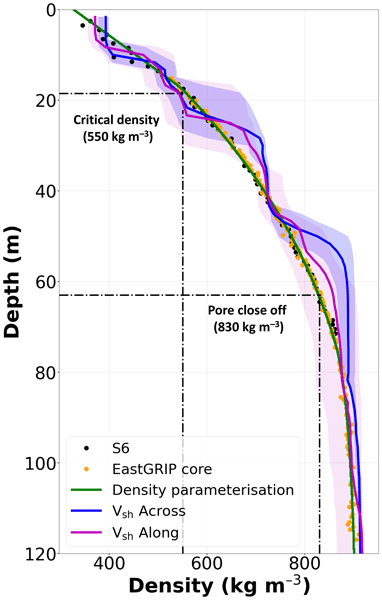
Our study near EastGRIP camp in Greenland shows varying firn properties by direction (crucial for studying ice stream stability, structure, surface mass balance, and past climate conditions). We used dispersion curve analysis of Love and Rayleigh waves to show firn is nonuniform along and across the flow of an ice stream due to wind patterns, seasonal variability, and the proximity to the edge of the ice stream. This method better informs firn structure, advancing ice stream understanding.
Daniel H. Richards, Robert J. Arthern, and Oliver J. Marsh
EGUsphere, https://doi.org/10.5194/egusphere-2026-5569, https://doi.org/10.5194/egusphere-2026-5569, 2026
This preprint is open for discussion and under review for The Cryosphere (TC).
Short summary
Short summary
Iceberg calving is a major source of ice loss from Antarctica, yet predicting when and how this happens remains difficult. We develop a mathematical model that simulates how ice deforms over years, but also how it suddenly fractures. Our model can represent cracks on the surface and base of the ice. Our results show the rate of ice loss depends strongly on thickness. The model can reproduce different ways in which icebergs calve, allowing better predictions of future ice loss and sea-level rise.
Dorothea Elisabeth Baur, Andrea Spolaor, Federico Scoto, and Elizabeth R. Thomas
The Cryosphere, 20, 5533–5558, https://doi.org/10.5194/tc-20-5533-2026, https://doi.org/10.5194/tc-20-5533-2026, 2026
Short summary
Short summary
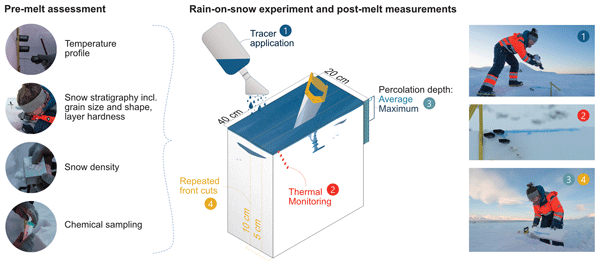
The Arctic is warming rapidly, and winter rain-on-snow events are becoming more common. These events can alter snow layers and disturb climate information stored in glaciers. We studied how small rain-on-snow events affect snow structure and water isotopes near Ny-Ålesund, Svalbard. Field experiments show that meltwater flow creates complex features, but isotope changes remain confined to them, meaning seasonal climate signals can still be preserved where enough snow accumulates.
Yikai Zhu, Anna E. Hogg, Benjamin J. Wallis, Ross A. W. Slater, and Oliver J. Marsh
EGUsphere, https://doi.org/10.5194/egusphere-2026-3795, https://doi.org/10.5194/egusphere-2026-3795, 2026
This preprint is open for discussion and under review for The Cryosphere (TC).
Short summary
Short summary
Satellite measurements are widely used to monitor how fast Antarctic ice is flowing, but the rise and fall of ocean tides can make the ice appear to move faster or slower than it really does. We developed a new way to remove this effect using satellite observations alone and applied it across all Antarctic ice shelves. The corrected measurements provide a more reliable picture of ice movement, improving studies of ice-sheet change and future sea-level rise.
Emma Pearce, Dimitri Zigone, Coen Hofstede, Andreas Fichtner, and Olaf Eisen
EGUsphere, https://doi.org/10.5194/egusphere-2026-3762, https://doi.org/10.5194/egusphere-2026-3762, 2026
Short summary
Short summary
When ice cores are drilled, they are broken before being brought back to the surface, generating small seismic signals. We tested whether these signals could be used to study the inside of the North East Greenland Ice Stream. Most possible signals were too weak or noisy, but a few clear examples produced realistic estimates of ice speed. The results show that this method is promising, but future experiments need better timing, quieter conditions, and sensors placed specifically for this purpose.
Harry J. Davis, Robert G. Bingham, Carlos Martín, Elizabeth R. Thomas, Andrew S. Hein, and Anna E. Hogg
The Cryosphere, 20, 2735–2756, https://doi.org/10.5194/tc-20-2735-2026, https://doi.org/10.5194/tc-20-2735-2026, 2026
Short summary
Short summary
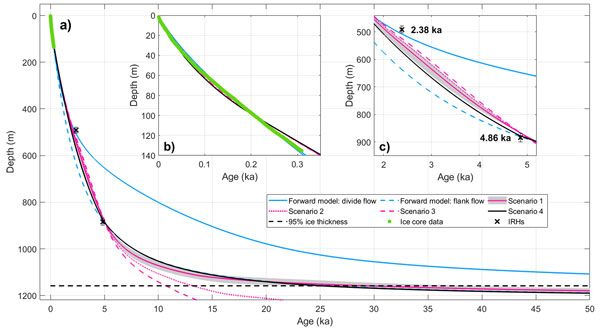
Ice in the southern Antarctic Peninsula is experiencing major ice changes today and predicting the rate at which this may continue is important. One way to address this knowledge gap would be to retrieve a past climate record from an ice core. We identify a suitable site using a model constrained by radar and shallow ice core data. We find a climate record spanning the Holocene can certainly be extracted here, but a potential continuous climate record here could extend back ~ 30 000 years.
Christian T. Wild, Reinhard Drews, Niklas Neckel, Joohan Lee, Sihyung Kim, Hyangsun Han, Won Sang Lee, Veit Helm, Sebastian Harry Reid Rosier, Oliver J. Marsh, and Wolfgang Rack
The Cryosphere, 19, 4533–4554, https://doi.org/10.5194/tc-19-4533-2025, https://doi.org/10.5194/tc-19-4533-2025, 2025
Short summary
Short summary
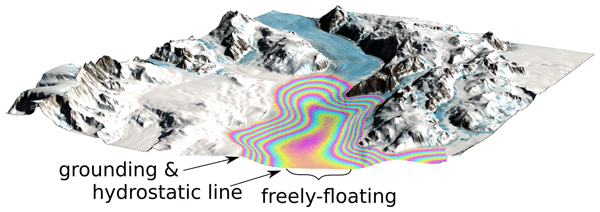
The stability of the Antarctic Ice Sheet depends on how resistance along the sides of large glaciers slows down the flow of ice into the ocean. We present a method to map ice strength using the effect of ocean tides on floating ice shelves. Incorporating weaker ice in shear zones improves the accuracy of model predictions, compared with satellite observations. This demonstrates the untapped potential of radar satellites to map ice stiffness in the most critical areas for ice sheet stability.
Ashley Morris, Bradley P. Lipovsky, Catherine C. Walker, and Oliver J. Marsh
The Cryosphere, 19, 4303–4325, https://doi.org/10.5194/tc-19-4303-2025, https://doi.org/10.5194/tc-19-4303-2025, 2025
Short summary
Short summary
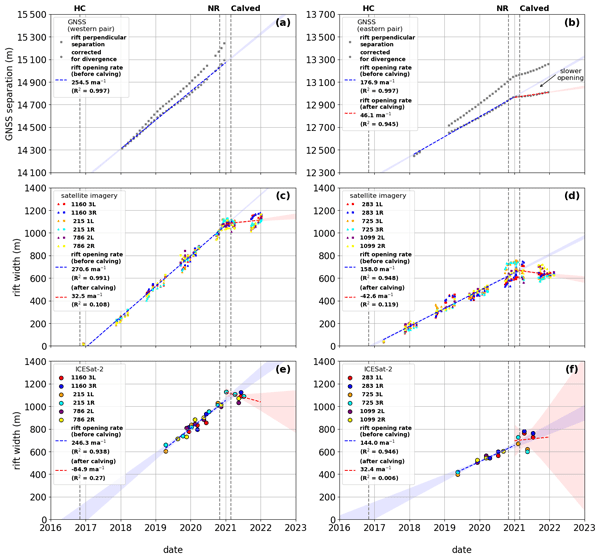
Floating ice shelves hold back Antarctic ice flow, but they are thinning and retreating. To help predict future mass loss we need a better understanding of the behavior of the rifts from which icebergs detach. We automate rift width measurement using ICESat-2 laser altimetry over the "Halloween Crack" on Brunt Ice Shelf. We find that rift opening stagnated following calving from an adjacent rift, which we investigate using an ice flow model.
Elizabeth R. Thomas, Dieter Tetzner, Bradley Markle, Joel Pedro, Guisella Gacitúa, Dorothea Elisabeth Moser, and Sarah Jackson
Clim. Past, 20, 2525–2538, https://doi.org/10.5194/cp-20-2525-2024, https://doi.org/10.5194/cp-20-2525-2024, 2024
Short summary
Short summary
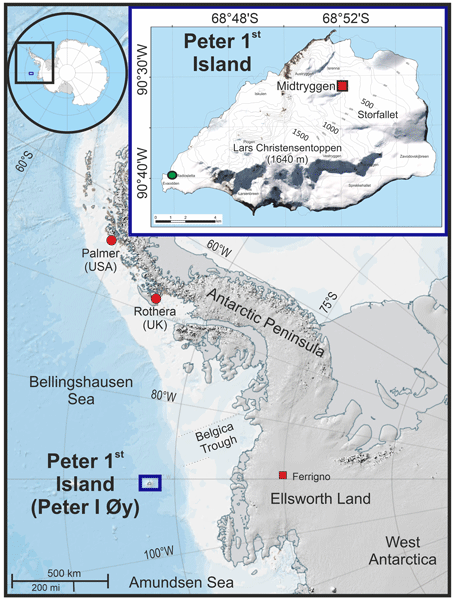
The chemical records contained in a 12 m firn (ice) core from Peter I Island, a remote sub-Antarctic island situated in the Pacific sector of the Southern Ocean (the Bellingshausen Sea), capture changes in snowfall and temperature (2002–2017 CE). This data-sparse region has experienced dramatic climate change in recent decades, including sea ice decline and ice loss from adjacent West Antarctic glaciers.
Emma Pearce, Dimitri Zigone, Coen Hofstede, Andreas Fichtner, Joachim Rimpot, Sune Olander Rasmussen, Johannes Freitag, and Olaf Eisen
The Cryosphere, 18, 4917–4932, https://doi.org/10.5194/tc-18-4917-2024, https://doi.org/10.5194/tc-18-4917-2024, 2024
Short summary
Short summary
Our study near EastGRIP camp in Greenland shows varying firn properties by direction (crucial for studying ice stream stability, structure, surface mass balance, and past climate conditions). We used dispersion curve analysis of Love and Rayleigh waves to show firn is nonuniform along and across the flow of an ice stream due to wind patterns, seasonal variability, and the proximity to the edge of the ice stream. This method better informs firn structure, advancing ice stream understanding.
Dorothea Elisabeth Moser, Elizabeth R. Thomas, Christoph Nehrbass-Ahles, Anja Eichler, and Eric Wolff
The Cryosphere, 18, 2691–2718, https://doi.org/10.5194/tc-18-2691-2024, https://doi.org/10.5194/tc-18-2691-2024, 2024
Short summary
Short summary
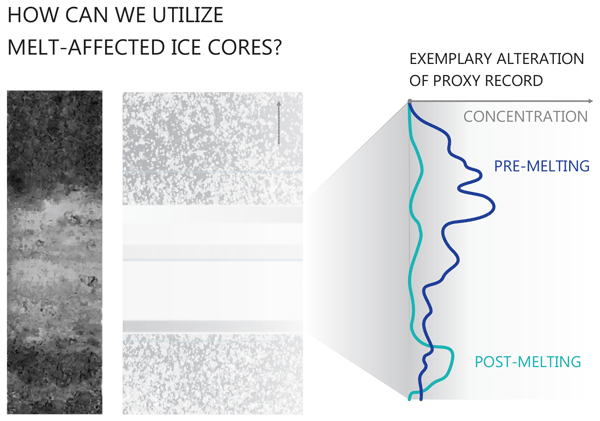
Increasing temperatures worldwide lead to more melting of glaciers and ice caps, even in the polar regions. This is why ice-core scientists need to prepare to analyse records affected by melting and refreezing. In this paper, we present a summary of how near-surface melt forms, what structural imprints it leaves in snow, how various signatures used for ice-core climate reconstruction are altered, and how we can still extract valuable insights from melt-affected ice cores.
Oliver J. Marsh, Adrian J. Luckman, and Dominic A. Hodgson
The Cryosphere, 18, 705–710, https://doi.org/10.5194/tc-18-705-2024, https://doi.org/10.5194/tc-18-705-2024, 2024
Short summary
Short summary
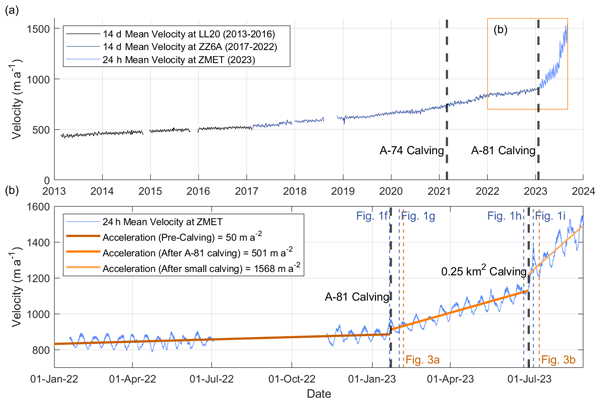
The Brunt Ice Shelf has accelerated rapidly after calving an iceberg in January 2023. A decade of GPS data show that the rate of acceleration in August 2023 was 30 times higher than before calving, and velocity has doubled in 6 months. Satellite velocity maps show the extent of the change. The acceleration is due to loss of contact between the ice shelf and a pinning point known as the McDonald Ice Rumples. The observations highlight how iceberg calving can directly impact ice shelves.
Bryony I. D. Freer, Oliver J. Marsh, Anna E. Hogg, Helen Amanda Fricker, and Laurie Padman
The Cryosphere, 17, 4079–4101, https://doi.org/10.5194/tc-17-4079-2023, https://doi.org/10.5194/tc-17-4079-2023, 2023
Short summary
Short summary
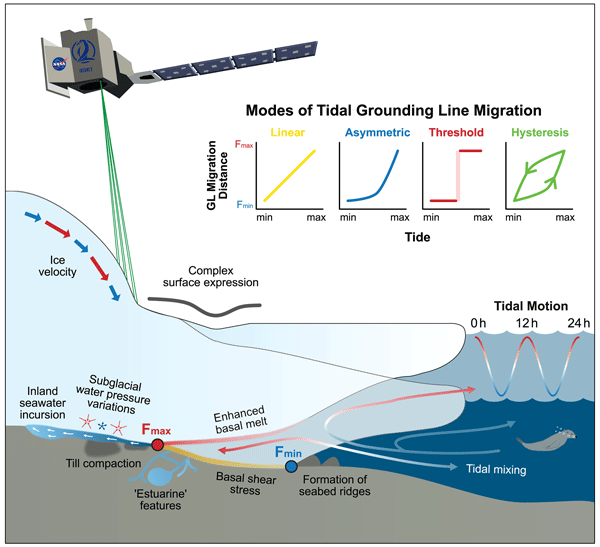
We develop a method using ICESat-2 data to measure how Antarctic grounding lines (GLs) migrate across the tide cycle. At an ice plain on the Ronne Ice Shelf we observe 15 km of tidal GL migration, the largest reported distance in Antarctica, dominating any signal of long-term migration. We identify four distinct migration modes, which provide both observational support for models of tidal ice flexure and GL migration and insights into ice shelf–ocean–subglacial interactions in grounding zones.
Elizabeth R. Thomas, Diana O. Vladimirova, Dieter R. Tetzner, B. Daniel Emanuelsson, Nathan Chellman, Daniel A. Dixon, Hugues Goosse, Mackenzie M. Grieman, Amy C. F. King, Michael Sigl, Danielle G. Udy, Tessa R. Vance, Dominic A. Winski, V. Holly L. Winton, Nancy A. N. Bertler, Akira Hori, Chavarukonam M. Laluraj, Joseph R. McConnell, Yuko Motizuki, Kazuya Takahashi, Hideaki Motoyama, Yoichi Nakai, Franciéle Schwanck, Jefferson Cardia Simões, Filipe Gaudie Ley Lindau, Mirko Severi, Rita Traversi, Sarah Wauthy, Cunde Xiao, Jiao Yang, Ellen Mosely-Thompson, Tamara V. Khodzher, Ludmila P. Golobokova, and Alexey A. Ekaykin
Earth Syst. Sci. Data, 15, 2517–2532, https://doi.org/10.5194/essd-15-2517-2023, https://doi.org/10.5194/essd-15-2517-2023, 2023
Short summary
Short summary
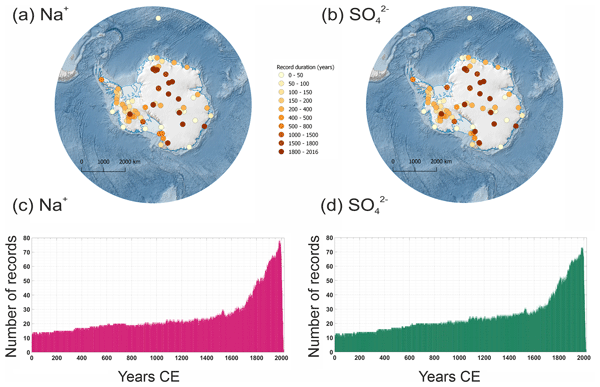
The concentration of sodium and sulfate measured in Antarctic ice cores is related to changes in both sea ice and winds. Here we have compiled a database of sodium and sulfate records from 105 ice core sites in Antarctica. The records span all, or part, of the past 2000 years. The records will improve our understanding of how winds and sea ice have changed in the past and how they have influenced the climate of Antarctica over the past 2000 years.
Yetang Wang, Xueying Zhang, Wentao Ning, Matthew A. Lazzara, Minghu Ding, Carleen H. Reijmer, Paul C. J. P. Smeets, Paolo Grigioni, Petra Heil, Elizabeth R. Thomas, David Mikolajczyk, Lee J. Welhouse, Linda M. Keller, Zhaosheng Zhai, Yuqi Sun, and Shugui Hou
Earth Syst. Sci. Data, 15, 411–429, https://doi.org/10.5194/essd-15-411-2023, https://doi.org/10.5194/essd-15-411-2023, 2023
Short summary
Short summary
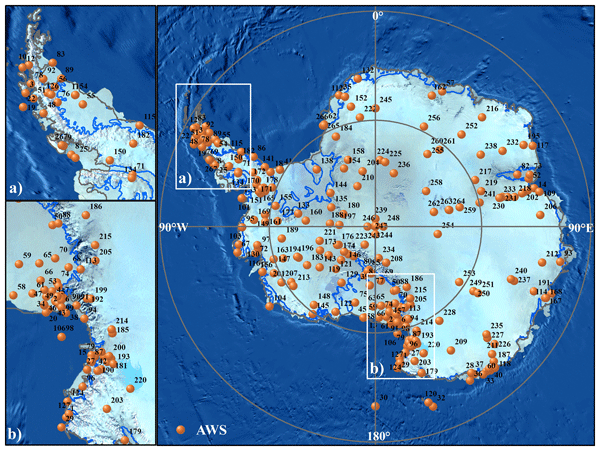
Here we construct a new database of Antarctic automatic weather station (AWS) meteorological records, which is quality-controlled by restrictive criteria. This dataset compiled all available Antarctic AWS observations, and its resolutions are 3-hourly, daily and monthly, which is very useful for quantifying spatiotemporal variability in weather conditions. Furthermore, this compilation will be used to estimate the performance of the regional climate models or meteorological reanalysis products.
Helene M. Hoffmann, Mackenzie M. Grieman, Amy C. F. King, Jenna A. Epifanio, Kaden Martin, Diana Vladimirova, Helena V. Pryer, Emily Doyle, Axel Schmidt, Jack D. Humby, Isobel F. Rowell, Christoph Nehrbass-Ahles, Elizabeth R. Thomas, Robert Mulvaney, and Eric W. Wolff
Clim. Past, 18, 1831–1847, https://doi.org/10.5194/cp-18-1831-2022, https://doi.org/10.5194/cp-18-1831-2022, 2022
Short summary
Short summary
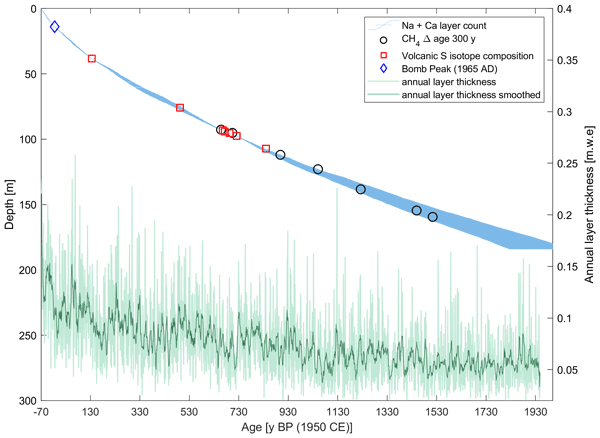
The WACSWAIN project (WArm Climate Stability of the West Antarctic ice sheet in the last INterglacial) investigates the fate of the West Antarctic Ice Sheet during the last warm period on Earth (115 000–130 000 years before present). Within this framework an ice core was recently drilled at Skytrain Ice Rise. In this study we present a stratigraphic chronology of that ice core based on absolute age markers and annual layer counting for the last 2000 years.
Dieter R. Tetzner, Elizabeth R. Thomas, Claire S. Allen, and Mackenzie M. Grieman
Clim. Past, 18, 1709–1727, https://doi.org/10.5194/cp-18-1709-2022, https://doi.org/10.5194/cp-18-1709-2022, 2022
Short summary
Short summary
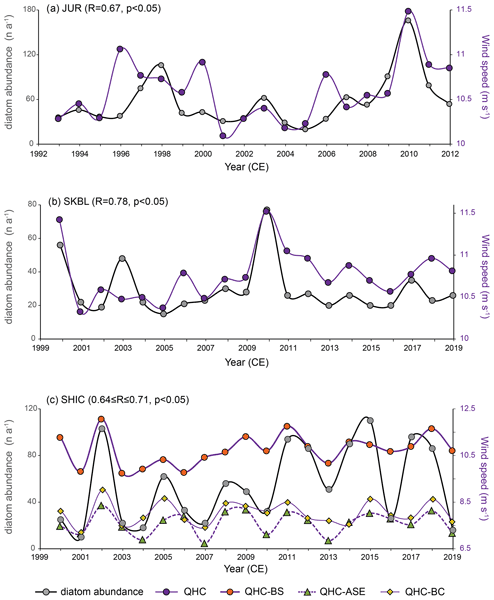
Changes in the Southern Hemisphere westerly winds are drivers of recent environmental changes in West Antarctica. However, our understanding of this relationship is limited by short and sparse observational records. Here we present the first regional wind study based on the novel use of diatoms preserved in Antarctic ice cores. Our results demonstrate that diatom abundance is the optimal record for reconstructing wind strength variability over the Southern Hemisphere westerly wind belt.

Joanne S. Johnson, Ryan A. Venturelli, Greg Balco, Claire S. Allen, Scott Braddock, Seth Campbell, Brent M. Goehring, Brenda L. Hall, Peter D. Neff, Keir A. Nichols, Dylan H. Rood, Elizabeth R. Thomas, and John Woodward
The Cryosphere, 16, 1543–1562, https://doi.org/10.5194/tc-16-1543-2022, https://doi.org/10.5194/tc-16-1543-2022, 2022
Short summary
Short summary
Recent studies have suggested that some portions of the Antarctic Ice Sheet were less extensive than present in the last few thousand years. We discuss how past ice loss and regrowth during this time would leave its mark on geological and glaciological records and suggest ways in which future studies could detect such changes. Determining timing of ice loss and gain around Antarctica and conditions under which they occurred is critical for preparing for future climate-warming-induced changes.
Tobias Erhardt, Matthias Bigler, Urs Federer, Gideon Gfeller, Daiana Leuenberger, Olivia Stowasser, Regine Röthlisberger, Simon Schüpbach, Urs Ruth, Birthe Twarloh, Anna Wegner, Kumiko Goto-Azuma, Takayuki Kuramoto, Helle A. Kjær, Paul T. Vallelonga, Marie-Louise Siggaard-Andersen, Margareta E. Hansson, Ailsa K. Benton, Louise G. Fleet, Rob Mulvaney, Elizabeth R. Thomas, Nerilie Abram, Thomas F. Stocker, and Hubertus Fischer
Earth Syst. Sci. Data, 14, 1215–1231, https://doi.org/10.5194/essd-14-1215-2022, https://doi.org/10.5194/essd-14-1215-2022, 2022
Short summary
Short summary
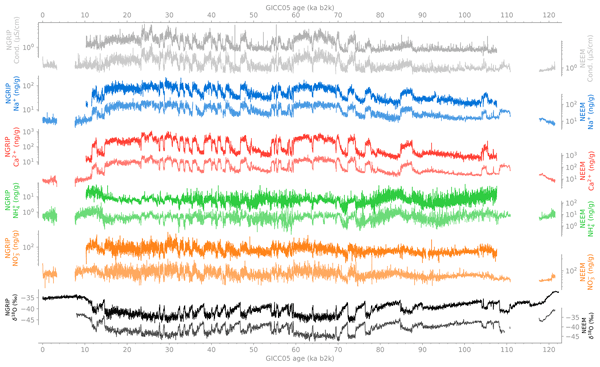
The datasets presented alongside this manuscript contain high-resolution concentration measurements of chemical impurities in deep ice cores, NGRIP and NEEM, from the Greenland ice sheet. The impurities originate from the deposition of aerosols to the surface of the ice sheet and are influenced by source, transport and deposition processes. Together, these records contain detailed, multi-parameter records of past climate variability over the last glacial period.
Dieter R. Tetzner, Claire S. Allen, and Elizabeth R. Thomas
The Cryosphere, 16, 779–798, https://doi.org/10.5194/tc-16-779-2022, https://doi.org/10.5194/tc-16-779-2022, 2022
Short summary
Short summary
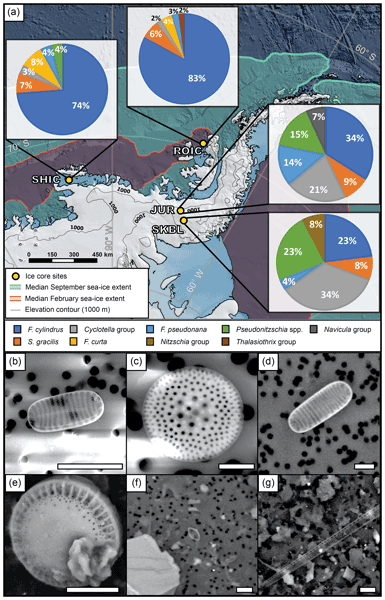
The presence of diatoms in Antarctic ice cores has been scarcely documented and poorly understood. Here we present a detailed analysis of the spatial and temporal distribution of the diatom record preserved in a set of Antarctic ice cores. Our results reveal that the timing and amount of diatoms deposited present a strong geographical division. This study highlights the potential of the diatom record preserved in Antarctic ice cores to provide useful information about past environmental changes.
Cited articles
Albrecht, T. and Levermann, A.: Fracture field for large-scale ice dynamics, J. Glaciol., 58, 165–176, 2012. a
Alley, R. B. and Bentley, C. R.: Ice-core analysis on the Siple Coast of West Antarctica, Ann. Glaciol., 11, 1–7, 1988. a
Bassis, J., Coleman, R., Fricker, H., and Minster, J.: Episodic propagation of a rift on the Amery Ice Shelf, East Antarctica, Geophys. Res. Lett., 32, L06502, https://doi.org/10.1029/2004GL022048, 2005. a
Borstad, C., Khazendar, A., Larour, E., Morlighem, M., Rignot, E., Schodlok, M., and Seroussi, H.: A damage mechanics assessment of the Larsen B ice shelf prior to collapse: Toward a physically-based calving law, Geophys. Res. Lett., 39, L18502, https://doi.org/10.1029/2012GL053317, 2012. a, b
Christmann, J., Müller, R., Webber, K. G., Isaia, D., Schader, F. H., Kipfstuhl, S., Freitag, J., and Humbert, A.: Measurement of the fracture toughness of polycrystalline bubbly ice from an Antarctic ice core, Earth Syst. Sci. Data, 7, 87–92, https://doi.org/10.5194/essd-7-87-2015, 2015. a
Clayton, T., Duddu, R., Hageman, T., and Martínez-Pañeda, E.: The influence of firn layer material properties on surface crevasse propagation in glaciers and ice shelves, The Cryosphere, 18, 5573–5593, https://doi.org/10.5194/tc-18-5573-2024, 2024. a, b
Cook, S., Galton-Fenzi, B. K., Ligtenberg, S. R. M., and Coleman, R.: Brief communication: widespread potential for seawater infiltration on Antarctic ice shelves, The Cryosphere, 12, 3853–3859, https://doi.org/10.5194/tc-12-3853-2018, 2018. a, b
Craw, L., McCormack, F. S., Cook, S., Roberts, J., and Treverrow, A.: Modelling the influence of marine ice on the dynamics of an idealised ice shelf, J. Glaciol., 69, 342–352, 2023. a
Cruz, C. and Lipovsky, B. P.: Fracturing during freezing in salty ice: preliminary analysis using a low-cost model system, Earth ArXiv [preprint], https://doi.org/10.31223/X5P994, 2025. a
Cullen, D. and Baker, I.: Observation of impurities in ice, Microsc. Res. Techniq., 55, 198–207, 2001. a
De Rydt, J., Gudmundsson, G. H., Nagler, T., and Wuite, J.: Calving cycle of the Brunt Ice Shelf, Antarctica, driven by changes in ice shelf geometry, The Cryosphere, 13, 2771–2787, https://doi.org/10.5194/tc-13-2771-2019, 2019. a
Dempsey, J. P.: The fracture toughness of ice, in: Ice-Structure Interaction: IUTAM/IAHR Symposium St. John's, Newfoundland Canada 1989, 109–145, Springer, 109–145, https://doi.org/10.1007/978-3-642-84100-2, ISBN 978-3-642-84100-2, 1991. a
Foster, T. D. and Carmack, E. C.: Temperature and salinity structure in the Weddell Sea, J. Phys. Oceanogr., 6, 36–44, 1976. a
Fricker, H., Bassis, J., Minster, B., and MacAyeal, D.: ICESat's new perspective on ice shelf rifts: The vertical dimension, Geophys. Res. Lett., 32, L23S08, https://doi.org/10.1029/2005GL025070, 2005a. a, b
Fricker, H., Young, N., Coleman, R., Bassis, J., and Minster, J.-B.: Multi-year monitoring of rift propagation on the Amery Ice Shelf, East Antarctica, Geophys. Res. Lett., 32, L02502, https://doi.org/10.1029/2004GL021036, 2005b. a
Glasser, N. and Scambos, T. A.: A structural glaciological analysis of the 2002 Larsen B ice-shelf collapse, J. Glaciol., 54, 3–16, 2008. a
Gudmundsson, G. H., Paolo, F. S., Adusumilli, S., and Fricker, H. A.: Instantaneous Antarctic ice sheet mass loss driven by thinning ice shelves, Geophys. Res. Lett., 46, 13903–13909, 2019. a
Hubbard, B., Luckman, A., Bevan, S., Ashmore, D. W., Kulessa, B., Kuipers Munneke, P., Philippe, M., Jansen, D., Booth, A., Sevestre, H., Tison, J.-L., O'Leary, M., and Rutt, I.: Massive subsurface ice formed by refreezing of ice-shelf melt ponds, Nat. Commun., 7, 11897, https://doi.org/10.1038/ncomms11897, 2016. a, b
Hulbe, C. L., LeDOUX, C., and Cruikshank, K.: Propagation of long fractures in the Ronne Ice Shelf, Antarctica, investigated using a numerical model of fracture propagation, J. Glaciol., 56, 459–472, 2010. a
Huth, A., Duddu, R., Smith, B., and Sergienko, O.: Simulating the processes controlling ice-shelf rift paths using damage mechanics, J. Glaciol., 69, 1915–1928, 2023. a
Jacobs, S. S., Helmer, H., Doake, C. S., Jenkins, A., and Frolich, R. M.: Melting of ice shelves and the mass balance of Antarctica, J. Glaciol., 38, 375–387, 1992. a
Killingbeck, S. F., Kulessa, B., Miles, K. E., Hubbard, B., Luckman, A., Thompson, S. S., Jones, G., and Galton-Fenzi, B. K.: Imaging brine infiltration and basal marine ice in Larsen C Ice Shelf, Antarctic Peninsula, from borehole measurements and transient electromagnetics, Geophys. Res. Lett., 52, e2025GL115908, https://doi.org/10.1029/2025GL115908, 2025. a, b
King, E. C., De Rydt, J., and Gudmundsson, G. H.: The internal structure of the Brunt Ice Shelf from ice-penetrating radar analysis and implications for ice shelf fracture, The Cryosphere, 12, 3361–3372, https://doi.org/10.5194/tc-12-3361-2018, 2018. a, b, c, d
Kittel, C., Amory, C., Agosta, C., Jourdain, N. C., Hofer, S., Delhasse, A., Doutreloup, S., Huot, P.-V., Lang, C., Fichefet, T., and Fettweis, X.: Diverging future surface mass balance between the Antarctic ice shelves and grounded ice sheet, The Cryosphere, 15, 1215–1236, https://doi.org/10.5194/tc-15-1215-2021, 2021. a
Krug, J., Weiss, J., Gagliardini, O., and Durand, G.: Combining damage and fracture mechanics to model calving, The Cryosphere, 8, 2101–2117, https://doi.org/10.5194/tc-8-2101-2014, 2014. a, b
Kulessa, B., Booth, A. D., O'Leary, M., McGrath, D., King, E. C., Luckman, A. J., Holland, P. R., Jansen, D., Bevan, S. L., Thompson, S. S., and Hubbard, B.: Seawater softening of suture zones inhibits fracture propagation in Antarctic ice shelves, Nat. Commun., 10, 5491, https://doi.org/10.1038/s41467-019-13539-x, 2019. a, b
Larour, E., Rignot, E., and Aubry, D.: Modelling of rift propagation on Ronne Ice Shelf, Antarctica, and sensitivity to climate change, Geophys. Res. Lett., 31, L16404, https://doi.org/10.1029/2004GL020077, 2004. a, b
Lewis, E.: The practical salinity scale 1978 and its antecedents, IEEE J. Oceanic Eng., 5, 3–8, 1980. a
Lipovsky, B. P.: Ice shelf rift propagation and the mechanics of wave-induced fracture, J. Geophys. Res.-Oceans, 123, 4014–4033, 2018. a
Lipovsky, B. P.: Ice shelf rift propagation: stability, three-dimensional effects, and the role of marginal weakening, The Cryosphere, 14, 1673–1683, https://doi.org/10.5194/tc-14-1673-2020, 2020. a, b
Marsh, O., Arthern, R., and De Rydt, J.: Ocean tides trigger ice shelf rift growth and calving, Nat. Commun., 16, 6697, https://doi.org/10.1038/s41467-025-61796-w, 2025. a
Marsh, O. J., Luckman, A. J., and Hodgson, D. A.: Brief communication: Rapid acceleration of the Brunt Ice Shelf after calving of iceberg A-81, The Cryosphere, 18, 705–710, https://doi.org/10.5194/tc-18-705-2024, 2024. a, b
Miles, B., Stokes, C., Jenkins, A., Jordan, J., Jamieson, S., and Gudmundsson, G.: Intermittent structural weakening and acceleration of the Thwaites Glacier Tongue between 2000 and 2018, J. Glaciol., 66, 485–495, 2020. a
Mulvaney, R., Bremner, S., Tait, A., and Audley, N.: A medium-depth ice core drill, Memoirs of National Institute of Polar Research, 56, 82–90, 2002. a
Nicola, L., Notz, D., and Winkelmann, R.: Revisiting temperature sensitivity: how does Antarctic precipitation change with temperature?, The Cryosphere, 17, 2563–2583, https://doi.org/10.5194/tc-17-2563-2023, 2023. a
Nixon, W. and Schulson, E.: A micromechanical view of the fracture toughness of ice, Le Journal de Physique Colloques, 48, C1-313–C1-319, https://doi.org/10.1051/jphyscol:1987144, 1987. a, b
Noël, B., Van Wessem, J. M., Wouters, B., Trusel, L., Lhermitte, S., and Van Den Broeke, M. R.: Higher Antarctic ice sheet accumulation and surface melt rates revealed at 2 km resolution, Nat. Commun., 14, 7949, https://doi.org/10.1038/s41467-023-43584-6, 2023. a
Orr, A., Deb, P., Clem, K. R., Gilbert, E., Bromwich, D. H., Boberg, F., Colwell, S., Hansen, N., Lazzara, M. A., Mooney, P. A., Mottram, R. H., Niwano, M., Phillips, T., Pishniak, D., Reijmer, C. H., van de Berg, W. J., Webster, S., and Zou, X.: Characteristics of surface “melt potential” over Antarctic ice shelves based on regional atmospheric model simulations of summer air temperature extremes from 1979/80 to 2018/19, J. Climate, 36, 3357–3383, 2023. a, b
Pearce, E., Marsh, O., and Thomas, E.: Ice core physical property data from Brunt Ice Shelf close to the site of Halley VI Research Station from 2023/2024 and 2024/2025 (Version 1.0), NERC EDS UK Polar Data Centre [data set], https://doi.org/10.5285/c059bb26-276d-4be6-ae8c-778aee12a3b4, 2026. a
Pralong, A. and Funk, M.: Dynamic damage model of crevasse opening and application to glacier calving, J. Geophys. Res.-Sol. Ea., 110, B01309, https://doi.org/10.1029/2004JB003104, 2005. a
Reed, B., Green, J. A. M., Jenkins, A., and Gudmundsson, G. H.: Melt sensitivity of irreversible retreat of Pine Island Glacier, The Cryosphere, 18, 4567–4587, https://doi.org/10.5194/tc-18-4567-2024, 2024. a, b
Scambos, T., Fricker, H. A., Liu, C.-C., Bohlander, J., Fastook, J., Sargent, A., Massom, R., and Wu, A.-M.: Ice shelf disintegration by plate bending and hydro-fracture: Satellite observations and model results of the 2008 Wilkins ice shelf break-ups, Earth Planet. Sc. Lett., 280, 51–60, 2009. a
Scambos, T. A., Bohlander, J., Shuman, C. A., and Skvarca, P.: Glacier acceleration and thinning after ice shelf collapse in the Larsen B embayment, Antarctica, Geophys. Res. Lett., 31, L18402, https://doi.org/10.1029/2004GL020670, 2004. a, b, c
Schulson, E. M. and Duval, P.: Creep and fracture of ice, Cambridge University Press, ISBN 978-0521806206, 2009. a
Scott, J. B., Smith, A. M., Bingham, R. G., and Vaughan, D. G.: Crevasses triggered on Pine Island Glacier, West Antarctica, by drilling through an exceptional melt layer, Ann. Glaciol., 51, 65–70, 2010. a
Timco, G. W. and Frederking, R. M. W.: Flexural strength and fracture toughness of sea ice, Cold Reg. Sci. Technol., 8, 35–41, 1983. a
Van der Veen, C.: Fracture mechanics approach to penetration of surface crevasses on glaciers, Cold Reg. Sci. Technol., 27, 31–47, 1998. a
van der Veen, C. J.: Fracture mechanics approach to penetration of bottom crevasses on glaciers, Cold Reg. Sci. Technol., 27, 213–223, https://doi.org/10.1016/S0165-232X(98)00006-8, 1998. a
Weeks, W.: On sea ice, University of Alaska Press, ISBN 978-1-60223-079-8, 2010. a
Weiss, J.: Subcritical crack propagation as a mechanism of crevasse formation and iceberg calving, J. Glaciol., 50, 109–115, 2004. a
Wille, J. D., Favier, V., Jourdain, N. C., Kittel, C., Turton, J. V., Agosta, C., Gorodetskaya, I. V., Picard, G., Codron, F., Leroy-Dos Santos, C., Amory, C., Fettweis, X., Blanchet, J., and Berchet, A.: Intense atmospheric rivers can weaken ice shelf stability at the Antarctic Peninsula, Communications Earth and Environment, 3, 90, https://doi.org/10.1038/s43247-022-00422-9, 2022. a
Short summary
Ice shelves slow the flow of Antarctic glaciers into the sea and help limit their contribution to sea level rise. Their stability depends on how different types of ice respond to stress. We collected a 37 m ice core from the Brunt Ice Shelf and carried out fracture experiments to measure ice strength. We found that refrozen surface melt strengthens the ice, while salty seawater weakens it, affecting how cracks grow and how ice-shelf break-up should be modelled.
Ice shelves slow the flow of Antarctic glaciers into the sea and help limit their contribution...


