
Articles | Volume 20, issue 4
https://doi.org/10.5194/tc-20-2351-2026
© Author(s) 2026. This work is distributed under
the Creative Commons Attribution 4.0 License.
the Creative Commons Attribution 4.0 License.
https://doi.org/10.5194/tc-20-2351-2026
© Author(s) 2026. This work is distributed under
the Creative Commons Attribution 4.0 License.
the Creative Commons Attribution 4.0 License.
Research article
| 
23 Apr 2026
Research article |
| 23 Apr 2026
| 23 Apr 2026
Assessment of snow model uncertainty in relation to the effect of a 1 °C warming using the snow modelling framework openAMUNDSEN

Department of Geography, University of Innsbruck, Innsbruck, Austria
Brage Storebakken
Department of Geography, University of Innsbruck, Innsbruck, Austria
Michael Warscher
lumiosys GmbH, Innsbruck, Austria
Florian Hanzer
lumiosys GmbH, Innsbruck, Austria
Elena Bertazza
Department of Geography, University of Innsbruck, Innsbruck, Austria
Ulrich Strasser
Department of Geography, University of Innsbruck, Innsbruck, Austria
Related authors
Franz Wagner, Erwin Rottler, and Ulrich Strasser
EGUsphere, https://doi.org/10.5194/egusphere-2026-4575, https://doi.org/10.5194/egusphere-2026-4575, 2026
This preprint is open for discussion and under review for Geoscientific Model Development (GMD).
Short summary
Short summary
We developed openAMUNDSEN-DA, an open source framework for ensemble based snow data assimilation coupled to the fully distributed snow hydrological model openAMUNDSEN. It represents uncertainty by perturbing meteorological forcing and assimilates in situ and satellite snow observations using a sequential particle filter. The framework provides a reproducible workflow for observation preprocessing, ensemble simulation, assimilation, diagnostics, plots, maps and reporting in mountain regions.

Ulrich Strasser, Michael Warscher, Erwin Rottler, and Florian Hanzer
Geosci. Model Dev., 17, 6775–6797, https://doi.org/10.5194/gmd-17-6775-2024, https://doi.org/10.5194/gmd-17-6775-2024, 2024
Short summary
Short summary
openAMUNDSEN is a fully distributed open-source snow-hydrological model for mountain catchments. It includes process representations of an empirical, semi-empirical, and physical nature. It uses temperature, precipitation, humidity, radiation, and wind speed as forcing data and is computationally efficient, of a modular nature, and easily extendible. The Python code is available on GitHub (https://github.com/openamundsen/openamundsen), including documentation (https://doc.openamundsen.org).
Michael Warscher, Thomas Marke, Erwin Rottler, and Ulrich Strasser
Earth Syst. Sci. Data, 16, 3579–3599, https://doi.org/10.5194/essd-16-3579-2024, https://doi.org/10.5194/essd-16-3579-2024, 2024
Short summary
Short summary
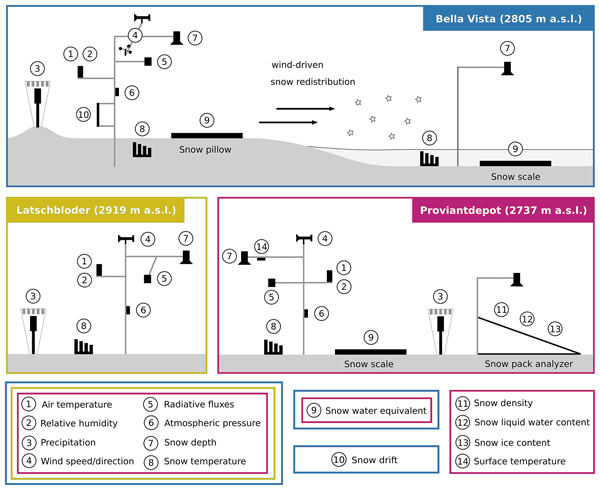
Continuous observations of snow and climate at high altitudes are still sparse. We present a unique collection of weather and snow cover data from three automatic weather stations at remote locations in the Ötztal Alps (Austria) that include continuous recordings of snow cover properties. The data are available over multiple winter seasons and enable new insights for snow hydrological research. The data are also used in operational applications, i.e., for avalanche warning and flood forecasting.
Lena Katharina Schmidt, Till Francke, Erwin Rottler, Theresa Blume, Johannes Schöber, and Axel Bronstert
Earth Surf. Dynam., 10, 653–669, https://doi.org/10.5194/esurf-10-653-2022, https://doi.org/10.5194/esurf-10-653-2022, 2022
Short summary
Short summary
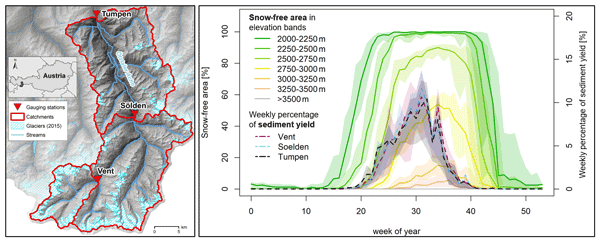
Climate change fundamentally alters glaciated high-alpine areas, but it is unclear how this affects riverine sediment transport. As a first step, we aimed to identify the most important processes and source areas in three nested catchments in the Ötztal, Austria, in the past 15 years. We found that areas above 2500 m were crucial and that summer rainstorms were less influential than glacier melt. These findings provide a baseline for studies on future changes in high-alpine sediment dynamics.
Franz Wagner, Erwin Rottler, and Ulrich Strasser
EGUsphere, https://doi.org/10.5194/egusphere-2026-4575, https://doi.org/10.5194/egusphere-2026-4575, 2026
This preprint is open for discussion and under review for Geoscientific Model Development (GMD).
Short summary
Short summary
We developed openAMUNDSEN-DA, an open source framework for ensemble based snow data assimilation coupled to the fully distributed snow hydrological model openAMUNDSEN. It represents uncertainty by perturbing meteorological forcing and assimilates in situ and satellite snow observations using a sequential particle filter. The framework provides a reproducible workflow for observation preprocessing, ensemble simulation, assimilation, diagnostics, plots, maps and reporting in mountain regions.
Ulrich Strasser, Michael Warscher, Erwin Rottler, and Florian Hanzer
Geosci. Model Dev., 17, 6775–6797, https://doi.org/10.5194/gmd-17-6775-2024, https://doi.org/10.5194/gmd-17-6775-2024, 2024
Short summary
Short summary
openAMUNDSEN is a fully distributed open-source snow-hydrological model for mountain catchments. It includes process representations of an empirical, semi-empirical, and physical nature. It uses temperature, precipitation, humidity, radiation, and wind speed as forcing data and is computationally efficient, of a modular nature, and easily extendible. The Python code is available on GitHub (https://github.com/openamundsen/openamundsen), including documentation (https://doc.openamundsen.org).
Michael Warscher, Thomas Marke, Erwin Rottler, and Ulrich Strasser
Earth Syst. Sci. Data, 16, 3579–3599, https://doi.org/10.5194/essd-16-3579-2024, https://doi.org/10.5194/essd-16-3579-2024, 2024
Short summary
Short summary
Continuous observations of snow and climate at high altitudes are still sparse. We present a unique collection of weather and snow cover data from three automatic weather stations at remote locations in the Ötztal Alps (Austria) that include continuous recordings of snow cover properties. The data are available over multiple winter seasons and enable new insights for snow hydrological research. The data are also used in operational applications, i.e., for avalanche warning and flood forecasting.
Lena Katharina Schmidt, Till Francke, Erwin Rottler, Theresa Blume, Johannes Schöber, and Axel Bronstert
Earth Surf. Dynam., 10, 653–669, https://doi.org/10.5194/esurf-10-653-2022, https://doi.org/10.5194/esurf-10-653-2022, 2022
Short summary
Short summary
Climate change fundamentally alters glaciated high-alpine areas, but it is unclear how this affects riverine sediment transport. As a first step, we aimed to identify the most important processes and source areas in three nested catchments in the Ötztal, Austria, in the past 15 years. We found that areas above 2500 m were crucial and that summer rainstorms were less influential than glacier melt. These findings provide a baseline for studies on future changes in high-alpine sediment dynamics.
Cited articles
Adhikari, T. R., Talchabhadel, R., Shrestha, S., Sharma, S., Aryal, D., and Pradhanang, S. M.: The evaluation of climate change impact on hydrologic processes of a mountain river basin, Theor. Appl. Climatol., 150, 749–762, https://doi.org/10.1007/s00704-022-04204-3, 2022. a
Albrich, K., Seidl, R., Rammer, W., and Thom, D.: From sink to source: changing climate and disturbance regimes could tip the 21st century carbon balance of an unmanaged mountain forest landscape, Forestry, 96, 399–409, https://doi.org/10.1093/forestry/cpac022, 2022. a
Alonso-González, E., Gutmann, E., Aalstad, K., Fayad, A., Bouchet, M., and Gascoin, S.: Snowpack dynamics in the Lebanese mountains from quasi-dynamically downscaled ERA5 reanalysis updated by assimilating remotely sensed fractional snow-covered area, Hydrol. Earth Syst. Sci., 25, 4455–4471, https://doi.org/10.5194/hess-25-4455-2021, 2021. a
Bair, E. H., Stillinger, T., and Dozier, J.: Snow Property Inversion From Remote Sensing (SPIReS): A Generalized Multispectral Unmixing Approach With Examples From MODIS and Landsat 8 OLI, IEEE T. Geosci. Remote, 59, 7270–7284, https://doi.org/10.1109/TGRS.2020.3040328, 2021. a
Ban, N., Caillaud, C., Coppola, E., et al.: The first multi-model ensemble of regional climate simulations at kilometer-scale resolution, part I: evaluation of precipitation, Clim. Dynam., 57, 275–302, https://doi.org/10.1007/s00382-021-05708-w, 2021. a, b
Beniston, M., Farinotti, D., Stoffel, M., Andreassen, L. M., Coppola, E., Eckert, N., Fantini, A., Giacona, F., Hauck, C., Huss, M., Huwald, H., Lehning, M., López-Moreno, J.-I., Magnusson, J., Marty, C., Morán-Tejéda, E., Morin, S., Naaim, M., Provenzale, A., Rabatel, A., Six, D., Stötter, J., Strasser, U., Terzago, S., and Vincent, C.: The European mountain cryosphere: a review of its current state, trends, and future challenges, The Cryosphere, 12, 759–794, https://doi.org/10.5194/tc-12-759-2018, 2018. a
Bergström, S.: The HBV model, in: Computer models of watershed hydrology, edited by: Singh, V. P., Highlands Ranch, CO, Water Resources Publications, 443–476, 1995. a
Bernhardt, M., Schulz, K., Liston, G., and Zängl, G.: The influence of lateral snow redistribution processes on snow melt and sublimation in alpine regions, J. Hydrol., 424–425, 196–206, https://doi.org/10.1016/j.jhydrol.2012.01.001, 2012. a
Braziunas, K. H., Geres, L., Richter, T., Glasmann, F., Senf, C., Thom, D., Seibold, S., and Seidl, R.: Projected climate and canopy change lead to thermophilization and homogenization of forest floor vegetation in a hotspot of plant species richness, Glob. Change Biol., 30, e17121, https://doi.org/10.1111/gcb.17121, 2024. a
Brun, É., Vionnet, V., Morin, S., Boone, A., Martin, É., Faroux, S., Le Moigne, P., and Willemet, J.-M.: Le modèle de manteau neigeux Crocus et ses applications, La Météorologie, 44–54, https://doi.org/10.4267/2042/47245, 2012. a
Bürger, G., Schulla, J., and Werner, A. T.: Estimates of future flow, including extremes, of the Columbia River headwaters, Water Resour. Res., 47, https://doi.org/10.1029/2010WR009716, 2011. a
Collier, E. and Mölg, T.: BAYWRF: a high-resolution present-day climatological atmospheric dataset for Bavaria, Earth Syst. Sci. Data, 12, 3097–3112, https://doi.org/10.5194/essd-12-3097-2020, 2020. a
Collier, E., Ban, N., Richter, N., Ahrens, B., Chen, D., Chen, X., Lai, H.-W., Leung, R., Li, L., Medvedova, A., Ou, T., Pothapakula, P. K., Potter, E., Prein, A. F., Sakaguchi, K., Schroeder, M., Singh, P., Sobolowski, S., Sugimoto, S., Tang, J., Yu, H., and Ziska, C.: The first ensemble of kilometer-scale simulations of a hydrological year over the third pole, Clim. Dynam., 62, 7501–7518, https://doi.org/10.1007/s00382-024-07291-2, 2024. a, b
Coron, L., Thirel, G., Delaigue, O., Perrin, C., and Andréassian, V.: The suite of lumped GR hydrological models in an R package, Environ. Modell. Softw., 94, 166–171, https://doi.org/10.1016/j.envsoft.2017.05.002, 2017. a
Corripio, J. G. and López-Moreno, J. I.: Analysis and Predictability of the Hydrological Response of Mountain Catchments to Heavy Rain on Snow Events: A Case Study in the Spanish Pyrenees, Hydrology, 4, https://doi.org/10.3390/hydrology4020020, 2017. a
Dakhlaoui, H., Hakala, K., and Seibert, J.: Hydrological Impacts of Projected Climate Change on Northern Tunisian Headwater Catchments – An Ensemble Approach Addressing Uncertainties, Springer International Publishing, 499–519, https://doi.org/10.1007/978-3-030-78566-6_24, 2022. a
Dietz, A. J., Wohner, C., and Kuenzer, C.: European Snow Cover Characteristics between 2000 and 2011 Derived from Improved MODIS Daily Snow Cover Products, Remote Sens.-Basel, 4, 2432–2454, https://doi.org/10.3390/rs4082432, 2012. a
Dietz, A. J., Kuenzer, C., and Conrad, C.: Snow-cover variability in central Asia between 2000 and 2011 derived from improved MODIS daily snow-cover products, Int. J. Remote Sens., 34, 3879–3902, https://doi.org/10.1080/01431161.2013.767480, 2013. a
Dietz, A. J., Conrad, C., Kuenzer, C., Gesell, G., and Dech, S.: Identifying Changing Snow Cover Characteristics in Central Asia between 1986 and 2014 from Remote Sensing Data, Remote Sens.-Basel, 6, 12752–12775, https://doi.org/10.3390/rs61212752, 2014. a
Dietz, A. J., Kuenzer, C., and Dech, S.: Global SnowPack: a new set of snow cover parameters for studying status and dynamics of the planetary snow cover extent, Remote Sens. Lett., 6, 844–853, https://doi.org/10.1080/2150704X.2015.1084551, 2015. a
Dollinger, C., Rammer, W., and Seidl, R.: Climate change accelerates ecosystem restoration in the mountain forests of Central Europe, J. Appl. Ecol., 60, 2665–2675, https://doi.org/10.1111/1365-2664.14520, 2023. a
Essery, R.: A factorial snowpack model (FSM 1.0), Geosci. Model Dev., 8, 3867–3876, https://doi.org/10.5194/gmd-8-3867-2015, 2015. a
Essery, R. and Etchevers, P.: Parameter sensitivity in simulations of snowmelt, J. Geophys. Res.-Atmos., 109, https://doi.org/10.1029/2004JD005036, 2004. a
Essery, R., Rutter, N., Pomeroy, J., Baxter, R., Stähli, M., Gustafsson, D., Barr, A., Bartlett, P., and Elder, K.: SNOWMIP2: An Evaluation of Forest Snow Process Simulations, B. Am. Meteorol. Soc., 90, 1120–1136, https://doi.org/10.1175/2009BAMS2629.1, 2009. a
Essery, R., Morin, S., Lejeune, Y., and B Ménard, C.: A comparison of 1701 snow models using observations from an alpine site, Adv. Water Resour., 55, 131–148, https://doi.org/10.1016/j.advwatres.2012.07.013, 2013. a
Essery, R., Mazzotti, G., Barr, S., Jonas, T., Quaife, T., and Rutter, N.: A Flexible Snow Model (FSM 2.1.1) including a forest canopy, Geosci. Model Dev., 18, 3583–3605, https://doi.org/10.5194/gmd-18-3583-2025, 2025. a
Freudiger, D., Kohn, I., Seibert, J., Stahl, K., and Weiler, M.: Snow redistribution for the hydrological modeling of alpine catchments, WIREs Water, 4, e1232, https://doi.org/10.1002/wat2.1232, 2017. a, b
Girons Lopez, M., Vis, M. J. P., Jenicek, M., Griessinger, N., and Seibert, J.: Assessing the degree of detail of temperature-based snow routines for runoff modelling in mountainous areas in central Europe, Hydrol. Earth Syst. Sci., 24, 4441–4461, https://doi.org/10.5194/hess-24-4441-2020, 2020. a
Gobiet, A., Kotlarski, S., Beniston, M., Heinrich, G., Rajczak, J., and Stoffel, M.: 21st century climate change in the European Alps – A review, Sci. Total Environ., 493, 1138–1151, https://doi.org/10.1016/j.scitotenv.2013.07.050, 2014. a
Günther, D., Marke, T., Essery, R., and Strasser, U.: Uncertainties in Snowpack Simulations – Assessing the Impact of Model Structure, Parameter Choice, and Forcing Data Error on Point-Scale Energy Balance Snow Model Performance, Water Resour. Res., 55, 2779–2800, https://doi.org/10.1029/2018WR023403, 2019. a
Günther, D., Hanzer, F., Warscher, M., Essery, R., and Strasser, U.: Including Parameter Uncertainty in an Intercomparison of Physically-Based Snow Models, Front. Earth Sci., 8, https://doi.org/10.3389/feart.2020.542599, 2020. a
Hanus, S., Hrachowitz, M., Zekollari, H., Schoups, G., Vizcaino, M., and Kaitna, R.: Future changes in annual, seasonal and monthly runoff signatures in contrasting Alpine catchments in Austria, Hydrol. Earth Syst. Sci., 25, 3429–3453, https://doi.org/10.5194/hess-25-3429-2021, 2021. a
Hanzer, F., Helfricht, K., Marke, T., and Strasser, U.: Multilevel spatiotemporal validation of snow/ice mass balance and runoff modeling in glacierized catchments, The Cryosphere, 10, 1859–1881, https://doi.org/10.5194/tc-10-1859-2016, 2016. a, b
Hanzer, F., Förster, K., Nemec, J., and Strasser, U.: Projected cryospheric and hydrological impacts of 21st century climate change in the Ötztal Alps (Austria) simulated using a physically based approach, Hydrol. Earth Syst. Sci., 22, 1593–1614, https://doi.org/10.5194/hess-22-1593-2018, 2018. a
Hanzer, F., Kollert, A., and Warscher, M.: openamundsen/openamundsen: v1.2.1 (v1.2.1), Zenodo [data set], https://doi.org/10.5281/zenodo.19108928, 2026a. a
Hanzer, F., Kollert, A., and Warscher, M.: openAMUNDSEN climate generator v0.2.0 (v0.2.0), Zenodo [data set], https://doi.org/10.5281/zenodo.19662555, 2026b. a
Hao, S., Jiang, L., Shi, J., Wang, G., and Liu, X.: Assessment of MODIS-Based Fractional Snow Cover Products Over the Tibetan Plateau, IEEE J. Sel. Top. Appl., 12, 533–548, https://doi.org/10.1109/JSTARS.2018.2879666, 2019. a
Hock, R.: Temperature index melt modelling in mountain areas, J. Hydrol., 282, 104–115, https://doi.org/10.1016/S0022-1694(03)00257-9, 2003. a
Hofmeister, F., Arias-Rodriguez, L. F., Premier, V., Marin, C., Notarnicola, C., Disse, M., and Chiogna, G.: Intercomparison of Sentinel-2 and modelled snow cover maps in a high-elevation Alpine catchment, J. Hydrol. X, 15, 100123, https://doi.org/j.hydroa.2022.100123, 2022. a
Ismail, M. F., Bogacki, W., Disse, M., Schäfer, M., and Kirschbauer, L.: Estimating degree-day factors of snow based on energy flux components, The Cryosphere, 17, 211–231, https://doi.org/10.5194/tc-17-211-2023, 2023. a
Keuris, L., Hetzenecker, M., Nagler, T., Mölg, N., and Schwaizer, G.: An Adaptive Method for the Estimation of Snow-Covered Fraction with Error Propagation for Applications from Local to Global Scales, Remote Sens.-Basel, 15, https://doi.org/10.3390/rs15051231, 2023. a
Kochendorfer, J., Rasmussen, R., Wolff, M., Baker, B., Hall, M. E., Meyers, T., Landolt, S., Jachcik, A., Isaksen, K., Brækkan, R., and Leeper, R.: The quantification and correction of wind-induced precipitation measurement errors, Hydrol. Earth Syst. Sci., 21, 1973–1989, https://doi.org/10.5194/hess-21-1973-2017, 2017. a
Kotlarski, S., Gobiet, A., Morin, S., Olefs, M., Rajczak, J., and Samacoïts, R.: 21st Century alpine climate change, Clim. Dynam., 60, 65–86, https://doi.org/10.1007/s00382-022-06303-3, 2023. a, b, c
Kraller, G., Warscher, M., Kunstmann, H., Vogl, S., Marke, T., and Strasser, U.: Water balance estimation in high Alpine terrain by combining distributed modeling and a neural network approach (Berchtesgaden Alps, Germany), Hydrol. Earth Syst. Sci., 16, 1969–1990, https://doi.org/10.5194/hess-16-1969-2012, 2012. a
Lafaysse, M., Cluzet, B., Dumont, M., Lejeune, Y., Vionnet, V., and Morin, S.: A multiphysical ensemble system of numerical snow modelling, The Cryosphere, 11, 1173–1198, https://doi.org/10.5194/tc-11-1173-2017, 2017. a
Liu, L., Ma, Y., Menenti, M., Zhang, X., and Ma, W.: Evaluation of WRF Modeling in Relation to Different Land Surface Schemes and Initial and Boundary Conditions: A Snow Event Simulation Over the Tibetan Plateau, J. Geophys. Res.-Atmos., 124, 209–226, https://doi.org/10.1029/2018JD029208, 2019. a
Lucas-Picher, P., Argüeso, D., Brisson, E., Tramblay, Y., Berg, P., Lemonsu, A., Kotlarski, S., and Caillaud, C.: Convection-permitting modeling with regional climate models: Latest developments and next steps, WIREs Clim. Change, 12, e731, https://doi.org/10.1002/wcc.731, 2021. a
Luo, L., Zhang, J., Hock, R., and Yao, Y.: Case Study of Blowing Snow Impacts on the Antarctic Peninsula Lower Atmosphere and Surface Simulated With a Snow/Ice Enhanced WRF Model, J. Geophys. Res.-Atmos., 126, e2020JD033936, https://doi.org/10.1029/2020JD033936, 2021. a
Magnusson, J., Wever, N., Essery, R., Helbig, N., Winstral, A., and Jonas, T.: Evaluating snow models with varying process representations for hydrological applications, Water Resour. Res., 51, 2707–2723, https://doi.org/10.1002/2014WR016498, 2015. a
Marke, T., Strasser, U., Hanzer, F., Stötter, J., Wilcke, R. A. I., and Gobiet, A.: Scenarios of Future Snow Conditions in Styria (Austrian Alps), J. Hydrometeorol., 16, 261–277, https://doi.org/10.1175/JHM-D-14-0035.1, 2015. a
Marsoner, T., Simion, H., Giombini, V., Egarter Vigl, L., and Candiago, S.: A detailed land use/land cover map for the European Alps macro region, Sci. Data, 10, 468, https://doi.org/10.1038/s41597-023-02344-3, 2023. a, b, c
Marty, C., Schlögl, S., Bavay, M., and Lehning, M.: How much can we save? Impact of different emission scenarios on future snow cover in the Alps, The Cryosphere, 11, 517–529, https://doi.org/10.5194/tc-11-517-2017, 2017. a
Marx, A., Kumar, R., Thober, S., Rakovec, O., Wanders, N., Zink, M., Wood, E. F., Pan, M., Sheffield, J., and Samaniego, L.: Climate change alters low flows in Europe under global warming of 1.5, 2, and 3 °C, Hydrol. Earth Syst. Sci., 22, 1017–1032, https://doi.org/10.5194/hess-22-1017-2018, 2018. a
Matiu, M., Crespi, A., Bertoldi, G., Carmagnola, C. M., Marty, C., Morin, S., Schöner, W., Cat Berro, D., Chiogna, G., De Gregorio, L., Kotlarski, S., Majone, B., Resch, G., Terzago, S., Valt, M., Beozzo, W., Cianfarra, P., Gouttevin, I., Marcolini, G., Notarnicola, C., Petitta, M., Scherrer, S. C., Strasser, U., Winkler, M., Zebisch, M., Cicogna, A., Cremonini, R., Debernardi, A., Faletto, M., Gaddo, M., Giovannini, L., Mercalli, L., Soubeyroux, J.-M., Sušnik, A., Trenti, A., Urbani, S., and Weilguni, V.: Observed snow depth trends in the European Alps: 1971 to 2019, The Cryosphere, 15, 1343–1382, https://doi.org/10.5194/tc-15-1343-2021, 2021. a
Menard, C. B., Essery, R., Krinner, G., Arduini, G., Bartlett, P., Boone, A., Brutel-Vuilmet, C., Burke, E., Cuntz, M., Dai, Y., Decharme, B., Dutra, E., Fang, X., Fierz, C., Gusev, Y., Hagemann, S., Haverd, V., Kim, H., Lafaysse, M., Marke, T., Nasonova, O., Nitta, T., Niwano, M., Pomeroy, J., Schädler, G., Semenov, V. A., Smirnova, T., Strasser, U., Swenson, S., Turkov, D., Wever, N., and Yuan, H.: Scientific and Human Errors in a Snow Model Intercomparison, B. Am. Meteorol. Soc., 102, E61–E79, https://doi.org/10.1175/BAMS-D-19-0329.1, 2021. a
Mott, R., Vionnet, V., and Grünewald, T.: The Seasonal Snow Cover Dynamics: Review on Wind-Driven Coupling Processes, Front. Earth Sci., 6, https://doi.org/10.3389/feart.2018.00197, 2018. a
Muelchi, R., Rössler, O., Schwanbeck, J., Weingartner, R., and Martius, O.: River runoff in Switzerland in a changing climate – changes in moderate extremes and their seasonality, Hydrol. Earth Syst. Sci., 25, 3577–3594, https://doi.org/10.5194/hess-25-3577-2021, 2021. a
Olefs, M., Koch, R., Schöner, W., and Marke, T.: Changes in Snow Depth, Snow Cover Duration, and Potential Snowmaking Conditions in Austria, 1961–2020 – A Model Based Approach, Atmosphere-Basel, 11, https://doi.org/10.3390/atmos11121330, 2020. a
Padgham, M., Rudis, B., Lovelace, R., and Salmon, M.: osmdata, Journal of Open Source Software, 2, 305, https://doi.org/10.21105/joss.00305, 2017. a
Pellicciotti, F., Brock, B., Strasser, U., Burlando, P., Funk, M., and Corripio, J.: An enhanced temperature-index glacier melt model including the shortwave radiation balance: development and testing for Haut Glacier d'Arolla, Switzerland, J. Glaciol., 51, 573–587, https://doi.org/10.3189/172756505781829124, 2005. a
Pichelli, E., Coppola, E., Sobolowski, S., et al.: The first multi-model ensemble of regional climate simulations at kilometer-scale resolution part 2: historical and future simulations of precipitation, Clim. Dynam., 56, 3581–3602, https://doi.org/10.1007/s00382-021-05657-4, 2021. a, b
Pomeroy, J., Fang, X., and Ellis, C.: Sensitivity of snowmelt hydrology in Marmot Creek, Alberta, to forest cover disturbance, Hydrol. Process., 26, 1891–1904, https://doi.org/10.1002/hyp.9248, 2012. a
Prein, A. F., Ban, N., Ou, T., Tang, J., Sakaguchi, K., Collier, E., Jayanarayanan, S., Li, L., Sobolowski, S., Chen, X., Zhou, X., Lai, H.-W., Sugimoto, S., Zou, L., ul Hasson, S., Ekstrom, M., Pothapakula, P. K., Ahrens, B., Stuart, R., Steen-Larsen, H. C., Leung, R., Belusic, D., Kukulies, J., Curio, J., and Chen, D.: Towards ensemble-based kilometer-scale climate simulations over the third pole region, Clim. Dynam., 60, 4055–4081, https://doi.org/10.1007/s00382-022-06543-3, 2023. a
Quéno, L., Mott, R., Morin, P., Cluzet, B., Mazzotti, G., and Jonas, T.: Snow redistribution in an intermediate-complexity snow hydrology modelling framework, The Cryosphere, 18, 3533–3557, https://doi.org/10.5194/tc-18-3533-2024, 2024. a, b
Raparelli, E., Tuccella, P., Colaiuda, V., and Marzano, F. S.: Snow cover prediction in the Italian central Apennines using weather forecast and land surface numerical models, The Cryosphere, 17, 519–538, https://doi.org/10.5194/tc-17-519-2023, 2023. a
Roessler, S. and Dietz, A. J.: Development of Global Snow Cover – Trends from 23 Years of Global SnowPack, Earth, 4, 1–22, https://doi.org/10.3390/earth4010001, 2023. a
Rottler, E., Bronstert, A., Bürger, G., and Rakovec, O.: Projected changes in Rhine River flood seasonality under global warming, Hydrol. Earth Syst. Sci., 25, 2353–2371, https://doi.org/10.5194/hess-25-2353-2021, 2021. a
Rottler, E., Warscher, M., Hanzer, F., and Strasser, U.: Spatio-temporal wet snow dynamics from model simulations and remote sensing: A case study from the Rofental, Austria, Hydrol. Process., 38, e15279, https://doi.org/10.1002/hyp.15279, 2024. a, b
Rottler, E., Storebakken, B., Warscher, M., Hanzer, F., Bertazza, E., and Strasser, U.: Assessment of snow model uncertainty in relation to the effect of a 1 °C warming using the snow modelling framework openAMUNDSEN, B2SHARE v2 [data set], https://doi.org/10.23728/b2share.530a7560a73647459969f5c21639e8cb, 2025. a
Rumpf, S. B., Gravey, M., Brönnimann, O., Luoto, M., Cianfrani, C., Mariethoz, G., and Guisan, A.: From white to green: Snow cover loss and increased vegetation productivity in the European Alps, Science, 376, 1119–1122, https://doi.org/10.1126/science.abn6697, 2022. a
Rößler, S., Witt, M. S., Ikonen, J., Brown, I. A., and Dietz, A. J.: Remote Sensing of Snow Cover Variability and Its Influence on the Runoff of Sápmi's Rivers, Geosciences, 11, https://doi.org/10.3390/geosciences11030130, 2021. a
Saigger, M., Sauter, T., Schmid, C., Collier, E., Goger, B., Kaser, G., Prinz, R., Voordendag, A., and Mölg, T.: A Drifting and Blowing Snow Scheme in the Weather Research and Forecasting Model, J. Adv. Model. Earth Sy., 16, e2023MS004007, https://doi.org/10.1029/2023MS004007, 2024. a
Samaniego, L., Kumar, R., and Attinger, S.: Multiscale parameter regionalization of a grid-based hydrologic model at the mesoscale, Water Resour. Res., 46, https://doi.org/10.1029/2008WR007327, 2010. a
Sanmiguel-Vallelado, A., McPhee, J., Carreño, P. E. O., Morán-Tejeda, E., Camarero, J. J., and López-Moreno, J. I.: Sensitivity of forest–snow interactions to climate forcing: Local variability in a Pyrenean valley, J. Hydrol., 605, 127311, https://doi.org/10.1016/j.jhydrol.2021.127311, 2022. a
Seibert, J. and Bergström, S.: A retrospective on hydrological catchment modelling based on half a century with the HBV model, Hydrol. Earth Syst. Sci., 26, 1371–1388, https://doi.org/10.5194/hess-26-1371-2022, 2022. a
Senf, C., Pflugmacher, D., Hostert, P., and Seidl, R.: Using Landsat time series for characterizing forest disturbance dynamics in the coupled human and natural systems of Central Europe, ISPRS J. Photogramm., 130, 453–463, https://doi.org/10.1016/j.isprsjprs.2017.07.004, 2017. a
Storebakken, B., Rottler, E., Warscher, M., and Strasser, U.: Modelling of the Seasonal Snow Cover Dynamics for Open and Forested Areas in the Berchtesgaden National Park (Germany) Using the openAMUNDSEN Mountain Snow Cover Model, Hydrol. Process., 39, e70197, https://doi.org/10.1002/hyp.70197, 2025. a, b, c, d, e
Strasser, U., Warscher, M., and Liston, G. E.: Modeling snow–canopy processes on an idealized mountain, J. Hydrometeorol., 12, 663–677, https://doi.org/10.1175/2011JHM1344.1, 2011. a
Sun, N., Yan, H., Wigmosta, M. S., Lundquist, J., Dickerson-Lange, S., and Zhou, T.: Forest Canopy Density Effects on Snowpack Across the Climate Gradients of the Western United States Mountain Ranges, Water Resour. Res., 58, e2020WR029194, https://doi.org/10.1029/2020WR029194, 2022. a
Ten Berge, A. A., Booij, M. J., and Rientjes, T. H.: Robustness of hydrological models for simulating impacts of climate change on high and low streamflow, J. Hydrol., 133734, https://doi.org/10.1016/j.jhydrol.2025.133734, 2025. a
Thober, S., Kumar, R., Wanders, N., Marx, A., Pan, M., Rakovec, O., Samaniego, L., Sheffield, J., Wood, E. F., and Zink, M.: Multi-model ensemble projections of European river floods and high flows at 1.5, 2, and 3 degrees global warming, Environ. Res. Lett., 13, 014003, https://doi.org/10.1088/1748-9326/aa9e35, 2018. a
Thom, D., Rammer, W., Laux, P., Smiatek, G., Kunstmann, H., Seibold, S., and Seidl, R.: Will forest dynamics continue to accelerate throughout the 21st century in the Northern Alps?, Glob. Change Biol., 28, 3260–3274, https://doi.org/10.1111/gcb.16133, 2022. a
Verfaillie, D., Lafaysse, M., Déqué, M., Eckert, N., Lejeune, Y., and Morin, S.: Multi-component ensembles of future meteorological and natural snow conditions for 1500 m altitude in the Chartreuse mountain range, Northern French Alps, The Cryosphere, 12, 1249–1271, https://doi.org/10.5194/tc-12-1249-2018, 2018. a
Vernay, M., Lafaysse, M., Monteiro, D., Hagenmuller, P., Nheili, R., Samacoïts, R., Verfaillie, D., and Morin, S.: The S2M meteorological and snow cover reanalysis over the French mountainous areas: description and evaluation (1958–2021), Earth Syst. Sci. Data, 14, 1707–1733, https://doi.org/10.5194/essd-14-1707-2022, 2022. a
Vionnet, V., Brun, E., Morin, S., Boone, A., Faroux, S., Le Moigne, P., Martin, E., and Willemet, J.-M.: The detailed snowpack scheme Crocus and its implementation in SURFEX v7.2, Geosci. Model Dev., 5, 773–791, https://doi.org/10.5194/gmd-5-773-2012, 2012. a
Vormoor, K., Lawrence, D., Heistermann, M., and Bronstert, A.: Climate change impacts on the seasonality and generation processes of floods – projections and uncertainties for catchments with mixed snowmelt/rainfall regimes, Hydrol. Earth Syst. Sci., 19, 913–931, https://doi.org/10.5194/hess-19-913-2015, 2015. a, b
Vormoor, K., Herzog, A., Francke, T., and Bronstert, A.: Patterns and Processes of Diel Streamflow Cycles Along the Longitudinal Profile of an Alpine Headwater Stream, Hydrol. Process., 39, e70189, https://doi.org/10.1002/hyp.70189, 2025. a
Warscher, M., Strasser, U., Kraller, G., Marke, T., Franz, H., and Kunstmann, H.: Performance of complex snow cover descriptions in a distributed hydrological model system: A case study for the high Alpine terrain of the Berchtesgaden Alps, Water Resour. Res., 49, 2619–2637, https://doi.org/10.1002/wrcr.20219, 2013. a, b, c, d
Warscher, M., Wagner, S., Marke, T., Laux, P., Smiatek, G., Strasser, U., and Kunstmann, H.: A 5 km Resolution Regional Climate Simulation for Central Europe: Performance in High Mountain Areas and Seasonal, Regional and Elevation-Dependent Variations, Atmosphere, 10, https://doi.org/10.3390/atmos10110682, 2019. a
Weigand, M., Staab, J., Wurm, M., and Taubenböck, H.: Spatial and semantic effects of LUCAS samples on fully automated land use/land cover classification in high-resolution Sentinel-2 data, Int. J. Appl. Earth Obs., 88, 102065, https://doi.org/10.1016/j.jag.2020.102065, 2020. a
Xin, Q., Woodcock, C. E., Liu, J., Tan, B., Melloh, R. A., and Davis, R. E.: View angle effects on MODIS snow mapping in forests, Remote Sens. Environ., 118, 50–59, https://doi.org/10.1016/j.rse.2011.10.029, 2012. a
Yokoyama, R.: Visualizing topography by openness: A new application of image processing to digital elevation models, Photogramm. Eng. Remote Sens., 68, 257–265, 2002. a
Zanaga, D., Van De Kerchove, R., Daems, D., De Keersmaecker, W., Brockmann, C., Kirches, G., Wevers, J., Cartus, O., Santoro, M., Fritz, S., Lesiv, M., Herold, M., Tsendbazar, N.-E., Xu, P., Ramoino, F., and Arino, O.: ESA WorldCover 10 m 2021 v200, https://doi.org/10.5281/zenodo.7254221, 2022. a
Zhou, G., Cui, M., Wan, J., and Zhang, S.: A Review on Snowmelt Models: Progress and Prospect, Sustainability, 13, https://doi.org/10.3390/su132011485, 2021. a
Zhou, X., Ding, B., Yang, K., Pan, J., Ma, X., Zhao, L., Li, X., and Shi, J.: Reducing the Cold Bias of the WRF Model Over the Tibetan Plateau by Implementing a Snow Coverage-Topography Relationship and a Fresh Snow Albedo Scheme, J. Adv. Model. Earth Sy., 15, e2023MS003626, https://doi.org/10.1029/2023MS003626, 2023. a
Short summary
In this study, we simulate the snow cover in a complex mountain area under historical conditions and for a time period characterized by a 1 °C warming using a large number of different snow models. Our objective is the assessment of differences in the modelling results induced by different snow model configurations. We find that differences stemming from the choice of snowmelt method, land cover map and spatial resolution can be comparable in magnitude to the effect of a 1°C warming.
In this study, we simulate the snow cover in a complex mountain area under historical conditions...


