Articles | Volume 20, issue 3
https://doi.org/10.5194/tc-20-1523-2026
© Author(s) 2026. This work is distributed under
the Creative Commons Attribution 4.0 License.
https://doi.org/10.5194/tc-20-1523-2026
© Author(s) 2026. This work is distributed under
the Creative Commons Attribution 4.0 License.
Sea ice albedo bounded data assimilation and its impact on modeling: a regional approach

Department of Atmospheric and Climate Science, University of Washington, Seattle, 98195, Washington, United States
Molly M. Wieringa
Department of Atmospheric and Climate Science, University of Washington, Seattle, 98195, Washington, United States
Advanced Study Program, National Science Foundation National Center for Atmospheric Research, Boulder, 80309, Colorado, United States
Cecilia M. Bitz
Department of Atmospheric and Climate Science, University of Washington, Seattle, 98195, Washington, United States
Robin P. Clancy
School of Meteorology, University of Oklahoma, Norman, 73019, Oklahoma, United States
Steven M. Cavallo
School of Meteorology, University of Oklahoma, Norman, 73019, Oklahoma, United States
Related authors
No articles found.
Nils Hutter and Cecilia M. Bitz
EGUsphere, https://doi.org/10.5194/egusphere-2026-461, https://doi.org/10.5194/egusphere-2026-461, 2026
This preprint is open for discussion and under review for The Cryosphere (TC).
Short summary
Short summary
Polar oceans are covered by many pieces of floating ice, called floes, that vary in size, shape and thickness. This study focuses on how fracturing caused by stresses from wind and ocean currents changes floe sizes. Using satellite images, we track ice motion and floe sizes, and study floe shapes and how deformation alters the distribution of floe sizes. We find that stronger deformation creates more small floes and present a formula to include this effect in sea-ice models.
Molly M. Wieringa and Cecilia M. Bitz
The Cryosphere, 19, 6207–6227, https://doi.org/10.5194/tc-19-6207-2025, https://doi.org/10.5194/tc-19-6207-2025, 2025
Short summary
Short summary
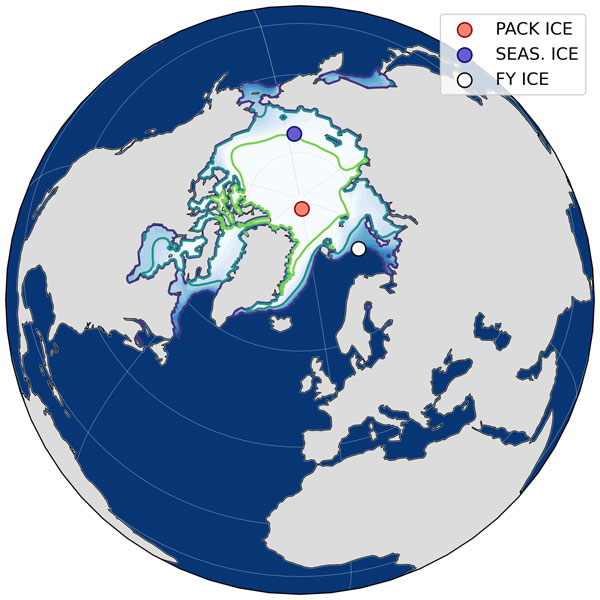
Integrating observations into complex sea ice models improves model estimates, but the impact of specific kinds of observations may vary in space and time. By modeling sea ice at single locations, this work quantifies the impact of four different observation kinds on sea ice at three characteristic locations in the Arctic. The results indicate that this simplified experimental framework is a useful tool for developing methods to meld new and existing observations with modern sea ice models.
Molly M. Wieringa, Christopher Riedel, Jeffrey L. Anderson, and Cecilia M. Bitz
The Cryosphere, 18, 5365–5382, https://doi.org/10.5194/tc-18-5365-2024, https://doi.org/10.5194/tc-18-5365-2024, 2024
Short summary
Short summary
Statistically combining models and observations with data assimilation (DA) can improve sea ice forecasts but must address several challenges, including irregularity in ice thickness and coverage over the ocean. Using a sea ice column model, we show that novel, bounds-aware DA methods outperform traditional methods for sea ice. Additionally, thickness observations at sub-grid scales improve modeled ice estimates of both thick and thin ice, a finding relevant for forecasting applications.
Matthew T. Bray and Steven M. Cavallo
Weather Clim. Dynam., 3, 251–278, https://doi.org/10.5194/wcd-3-251-2022, https://doi.org/10.5194/wcd-3-251-2022, 2022
Short summary
Short summary
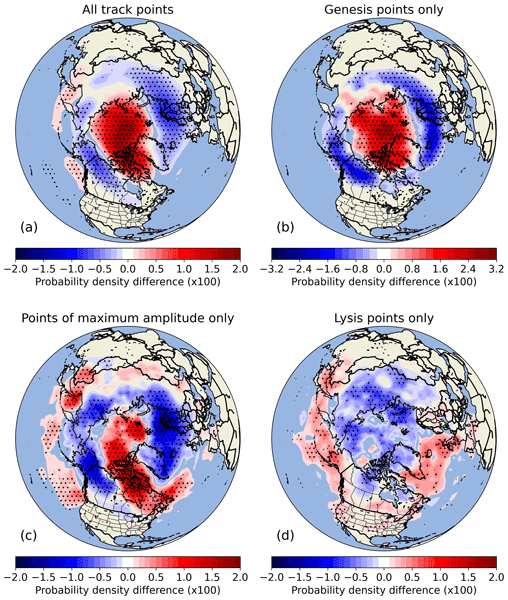
Tropopause polar vortices (TPVs) are a high-latitude atmospheric phenomenon that impact weather inside and outside of polar regions. Using a set of long-lived TPVs to gain insight into the conditions that are most supportive of TPV survival, we describe patterns of vortex formation and movement. In addition, we analyze the characteristics of these TPVs and how they vary by season. These results help us to better understand TPVs which, in turn, may improve forecasts of related weather events.
Yong-Fei Zhang, Cecilia M. Bitz, Jeffrey L. Anderson, Nancy S. Collins, Timothy J. Hoar, Kevin D. Raeder, and Edward Blanchard-Wrigglesworth
The Cryosphere, 15, 1277–1284, https://doi.org/10.5194/tc-15-1277-2021, https://doi.org/10.5194/tc-15-1277-2021, 2021
Short summary
Short summary
Sea ice models suffer from large uncertainties arising from multiple sources, among which parametric uncertainty is highly under-investigated. We select a key ice albedo parameter and update it by assimilating either sea ice concentration or thickness observations. We found that the sea ice albedo parameter is improved by data assimilation, especially by assimilating sea ice thickness observations. The improved parameter can further benefit the forecast of sea ice after data assimilation stops.
Cited articles
Agarwal, S., Moon, W., and Wettlaufer, J. S.: Decadal to seasonal variability of Arctic sea ice albedo, Geophys. Res. Lett., 38, L20504, https://doi.org/10.1029/2011GL049109, 2011. a
Anderson, J. L., Hoar, T. J., Raeder, K., Liu, H., Collins, N., Torn, R., and Avellano, A.: The Data Assimilation Research Testbed: A Community Facility, B. Am. Meteorol. Soc., 90, 1283–1296, https://doi.org/10.1175/2009BAMS2618.1, 2009. a
Anderson, J., Riedel, C., Wieringa, M., Ishraque, F., Smith, M., and Kershaw, H.: A Quantile-Conserving Ensemble Filter Framework. Part III: Data Assimilation for Mixed Distributions with Application to a Low-Order Tracer Advection Model, Mon. Weather Rev., 152, 2111–2127, https://doi.org/10.1175/MWR-D-23-0255.1, 2024. a, b, c, d
Anderson, J. L.: A Quantile-Conserving Ensemble Filter Framework. Part I: Updating an Observed Variable, Mon. Weather Rev., 150, 1061–1074, https://doi.org/10.1175/MWR-D-21-0229.1, 2022. a
Arndt, S. and Nicolaus, M.: Seasonal cycle and long-term trend of solar energy fluxes through Arctic sea ice, The Cryosphere, 8, 2219–2233, https://doi.org/10.5194/tc-8-2219-2014, 2014. a
Barry, R. G.: The parameterization of surface albedo for sea ice and its snow cover, Prog. Phys. Geog., 20, 63–79, https://doi.org/10.1177/030913339602000104, 1996. a
Becker, S., Ehrlich, A., Schäfer, M., and Wendisch, M.: Airborne observations of the surface cloud radiative effect during different seasons over sea ice and open ocean in the Fram Strait, Atmos. Chem. Phys., 23, 7015–7031, https://doi.org/10.5194/acp-23-7015-2023, 2023. a
Brucker, L., Cavalieri, D. J., Markus, T., and Ivanoff, A.: NASA Team 2 Sea Ice Concentration Algorithm Retrieval Uncertainty, IEEE T. Geosci. Remote, 52, 7336–7352, https://doi.org/10.1109/TGRS.2014.2311376, 2014. a
Calmer, R., de Boer, G., Hamilton, J., Lawrence, D., Webster, M. A., Wright, N., Shupe, M. D., Cox, C. J., and Cassano, J. J.: Relationships between summertime surface albedo and melt pond fraction in the central Arctic Ocean: The aggregate scale of albedo obtained on the MOSAiC floe, Elem. Sci. Anth., 11, 00001, https://doi.org/10.1525/elementa.2023.00001, 2023. a
Cavallo, S. M., Frank, M. C., and Bitz, C. M.: Sea ice loss in association with Arctic cyclones, Commun. Earth Environ., 6, 1–9, https://doi.org/10.1038/s43247-025-02022-9, 2025. a
Chapman-Dutton, H. R. and Webster, M. A.: The Effects of Summer Snowfall on Arctic Sea Ice Radiative Forcing, J. Geophys. Res.-Atmos., 129, e2023JD040667, https://doi.org/10.1029/2023JD040667, 2024. a
Chen, F., Wang, D., Zhang, Y., Zhou, Y., and Chen, C.: Intercomparisons and Evaluations of Satellite-Derived Arctic Sea Ice Thickness Products, Remote Sens., 16, 508, https://doi.org/10.3390/rs16030508, 2024. a
Donohoe, A., Blanchard-Wrigglesworth, E., Schweiger, A., and Rasch, P. J.: The Effect of Atmospheric Transmissivity on Model and Observational Estimates of the Sea Ice Albedo Feedback, J. Climate, 33, 5743–5765, https://doi.org/10.1175/JCLI-D-19-0674.1, 2020. a
Edel, L., Xie, J., Korosov, A., Brajard, J., and Bertino, L.: Reconstruction of Arctic sea ice thickness (1992–2010) based on a hybrid machine learning and data assimilation approach, The Cryosphere, 19, 731–752, https://doi.org/10.5194/tc-19-731-2025, 2025. a
Grenfell, T. C. and Perovich, D. K.: Seasonal and spatial evolution of albedo in a snow-ice-land-ocean environment, J. Geophys. Res.-Oceans, 109, https://doi.org/10.1029/2003JC001866, 2004. a, b
Han, H., Lee, S., Kim, H.-C., and Kim, M.: Retrieval of Summer Sea Ice Concentration in the Pacific Arctic Ocean from AMSR2 Observations and Numerical Weather Data Using Random Forest Regression, Remote Sens., 13, 2283, https://doi.org/10.3390/rs13122283, 2021. a
Hunke, E., Allard, R., Bailey, D. A., Blain, P., Craig, A., Dupont, F., DuVivier, A., Grumbine, R., Hebert, D., Holland, M., Jeffery, N., Lemieux, J.-F., Osinski, R., Rasmussen, T., Ribergaard, M., Roach, L., Roberts, A., Turner, M., and Winton, M.: CICE-Consortium/Icepack: Icepack 1.4.0, Zenodo [code], https://doi.org/10.5281/zenodo.10056496, 2023. a
Hunke, E. C., Lipscomb, W. H., and Turner, A. K.: Sea-ice models for climate study: retrospective and new directions, J. Glaciol., 56, 1162–1172, https://doi.org/10.3189/002214311796406095, 2010. a
Hunke, E. C., Hebert, D. A., and Lecomte, O.: Level‐ice melt ponds in the Los Alamos sea ice model, CICE, Ocean Model., 71, 26–42, https://doi.org/10.1016/j.ocemod.2012.11.008, 2013. a
Karlsson, K.-G., Stengel, M., Meirink, J. F., Riihelä, A., Trentmann, J., Akkermans, T., Stein, D., Devasthale, A., Eliasson, S., Johansson, E., Håkansson, N., Solodovnik, I., Benas, N., Clerbaux, N., Selbach, N., Schröder, M., and Hollmann, R.: CLARA-A3: The third edition of the AVHRR-based CM SAF climate data record on clouds, radiation and surface albedo covering the period 1979 to 2023, Earth Syst. Sci. Data, 15, 4901–4926, https://doi.org/10.5194/essd-15-4901-2023, 2023. a, b, c
Keen, A., Blockley, E., Bailey, D. A., Boldingh Debernard, J., Bushuk, M., Delhaye, S., Docquier, D., Feltham, D., Massonnet, F., O'Farrell, S., Ponsoni, L., Rodriguez, J. M., Schroeder, D., Swart, N., Toyoda, T., Tsujino, H., Vancoppenolle, M., and Wyser, K.: An inter-comparison of the mass budget of the Arctic sea ice in CMIP6 models, The Cryosphere, 15, 951–982, https://doi.org/10.5194/tc-15-951-2021, 2021. a
Kern, S., Rösel, A., Pedersen, L. T., Ivanova, N., Saldo, R., and Tonboe, R. T.: The impact of melt ponds on summertime microwave brightness temperatures and sea-ice concentrations, The Cryosphere, 10, 2217–2239, https://doi.org/10.5194/tc-10-2217-2016, 2016. a
Lindsay, R. W.: Arctic sea-ice albedo derived from RGPS-based ice-thickness estimates, Ann. Glaciol., 33, 225–229, https://doi.org/10.3189/172756401781818103, 2001. a
Lindsay, R. W.: Ice deformation near SHEBA, J. Geophys. Res.-Oceans, 107, SHE 20-1–SHE 20-13, https://doi.org/10.1029/2000JC000445, 2002. a
McCrystall, M. R., Stroeve, J., Serreze, M., Forbes, B. C., and Screen, J. A.: New climate models reveal faster and larger increases in Arctic precipitation than previously projected, Nat. Commun., 12, 6765, https://doi.org/10.1038/s41467-021-27031-y, 2021. a
Meier, W., Fetterer, F., Windnagel, A., Stewart, J. S., and Stafford, T.: NOAA/NSIDC Climate Data Record of Passive Microwave Sea Ice Concentration, Version 5, National Snow and Ice Data Center, https://doi.org/10.7265/RJZB-PF78, 2024. a
Meier, W. N., Petty, A., Hendricks, S., Kaleschke, L., Divine, D., Farrell, S., Gerland, S., Perovich, D., Ricker, R., Tian-Kunze, X., and Webster, M.: NOAA Arctic Report Card 2023: Sea Ice, NOAA, https://repository.library.noaa.gov/view/noaa/56616 (last access: 8 June 2025), 2023. a
Nicolaus, M., Katlein, C., Maslanik, J., and Hendricks, S.: Changes in Arctic sea ice result in increasing light transmittance and absorption, Geophys. Res. Lett., 39, https://doi.org/10.1029/2012GL053738, 2012. a
Ono, J., Komuro, Y., and Tatebe, H.: Impact of sea-ice thickness initialized in April on Arctic sea-ice extent predictability with the MIROC climate model, Ann. Glaciol., 61, 97–105, https://doi.org/10.1017/aog.2020.13, 2020. a
Peng, G., Meier, W. N., Scott, D. J., and Savoie, M. H.: A long-term and reproducible passive microwave sea ice concentration data record for climate studies and monitoring, Earth Syst. Sci. Data, 5, 311–318, https://doi.org/10.5194/essd-5-311-2013, 2013. a
Perovich, D., Polashenski, C., Arntsen, A., and Stwertka, C.: Anatomy of a late spring snowfall on sea ice, Geophys. Res. Lett., 44, 2802–2809, https://doi.org/10.1002/2016GL071470, 2017. a
Perovich, D. K.: The Optical Properties of Sea Ice, Tech. Rep. Monograph 96-1, Cold Regions Research and Engineering Laboratory, U.S. Army Corps of Engineers, https://apps.dtic.mil/sti/tr/pdf/ADA310586.pdf (last access: 29 May 2025), 1996. a
Perovich, D. K. and Polashenski, C.: Albedo evolution of seasonal Arctic sea ice, Geophys. Res. Lett., 39, https://doi.org/10.1029/2012GL051432, 2012. a
Perovich, D. K., Tucker III, W. B., and Ligett, K. A.: Aerial observations of the evolution of ice surface conditions during summer, J. Geophys. Res.-Oceans, 107, SHE 24-1–SHE 24-14, https://doi.org/10.1029/2000JC000449, 2002. a
Perovich, D. K., Richter-Menge, J. A., Jones, K. F., and Light, B.: Sunlight, water, and ice: Extreme Arctic sea ice melt during the summer of 2007, Geophys. Res. Lett., 35, https://doi.org/10.1029/2008GL034007, 2008. a
Petty, A. A., Keeney, N., Cabaj, A., Kushner, P., and Bagnardi, M.: Winter Arctic sea ice thickness from ICESat-2: upgrades to freeboard and snow loading estimates and an assessment of the first three winters of data collection, The Cryosphere, 17, 127–156, https://doi.org/10.5194/tc-17-127-2023, 2023. a
Pistone, K., Eisenman, I., and Ramanathan, V.: Observational determination of albedo decrease caused by vanishing Arctic sea ice, P. Natl. Acad. Sci. USA, 111, 3322–3326, https://doi.org/10.1073/pnas.1318201111, 2014. a
Pithan, F. and Mauritsen, T.: Arctic amplification dominated by temperature feedbacks in contemporary climate models, Nat. Geosci., 7, 181–184, https://doi.org/10.1038/ngeo2071, 2014. a
Plante, M., Lemieux, J.-F., Tremblay, L. B., Tivy, A., Angnatok, J., Roy, F., Smith, G., Dupont, F., and Turner, A. K.: Using Icepack to reproduce ice mass balance buoy observations in landfast ice: improvements from the mushy-layer thermodynamics, The Cryosphere, 18, 1685–1708, https://doi.org/10.5194/tc-18-1685-2024, 2024. a
Rantanen, M., Karpechko, A. Y., Lipponen, A., Nordling, K., Hyvärinen, O., Ruosteenoja, K., Vihma, T., and Laaksonen, A.: The Arctic has warmed nearly four times faster than the globe since 1979, Commun. Earth Environ., 3, 1–10, https://doi.org/10.1038/s43247-022-00498-3, 2022. a
Riedel, C. P., Wieringa, M. M., and Anderson, J. L.: Exploring Bounded Nonparametric Ensemble Filter Impacts on Sea Ice Data Assimilation, Mon. Weather Rev., 153, 637–654, https://doi.org/10.1175/MWR-D-24-0096.1, 2025. a, b
Riihelä, A., Laine, V., Manninen, T., Palo, T., and Vihma, T.: Validation of the Climate-SAF surface broadband albedo product: Comparisons with in situ observations over Greenland and the ice-covered Arctic Ocean, Remote Sens. Environ., 114, 2779–2790, https://doi.org/10.1016/j.rse.2010.06.014, 2010. a
Riihelä, A., Jääskeläinen, E., and Kallio-Myers, V.: Four decades of global surface albedo estimates in the third edition of the CM SAF cLoud, Albedo and surface Radiation (CLARA) climate data record, Earth Syst. Sci. Data, 16, 1007–1028, https://doi.org/10.5194/essd-16-1007-2024, 2024. a, b, c
Rösel, A., Itkin, P., King, J., Divine, D., Wang, C., Granskog, M. A., Krumpen, T., and Gerland, S.: Thin Sea Ice, Thick Snow, and Widespread Negative Freeboard Observed During N-ICE2015 North of Svalbard, J. Geophys. Res.-Oceans, 123, 1156–1176, https://doi.org/10.1002/2017JC012865, 2018. a
Rotondo, J.: SIAL Icepack Perfect Model Synthetic Experiment Results (1.0.0), Zenodo [data set], https://doi.org/10.5281/zenodo.15571204, 2025. a
Rotondo, J.: jrotondo-uw/cice-scm-albedo-da: release for public access (code_download), Zenodo [code], https://doi.org/10.5281/zenodo.18859988, 2026. a
Schröder, D., Feltham, D. L., Flocco, D., and Tsamados, M.: September Arctic sea-ice minimum predicted by spring melt-pond fraction, Nat. Clim. Change, 4, 353–357, https://doi.org/10.1038/nclimate2203, 2014. a, b
Schweiger, A., Lindsay, R., Zhang, J., Steele, M., Stern, H., and Kwok, R.: Uncertainty in modeled Arctic sea ice volume, J. Geophys. Res.-Oceans, 116, https://doi.org/10.1029/2011JC007084, 2011. a
Seong, N.-H., Kim, H.-C., Choi, S., Jin, D., Jung, D., Sim, S., Woo, J., Kim, N., Seo, M., Lee, K.-S., and Han, K.-S.: Evaluation of Sea Ice Radiative Forcing according to Surface Albedo and Skin Temperature over the Arctic from 1982–2015, Remote Sens., 14, 2512, https://doi.org/10.3390/rs14112512, 2022. a
Serreze, M. C. and Barry, R. G.: Processes and impacts of Arctic amplification: A research synthesis, Global Planet. Change, 77, 85–96, https://doi.org/10.1016/j.gloplacha.2011.03.004, 2011. a, b
Song, R., Mu, L., Loza, S. N., Kauker, F., and Chen, X.: Assimilating Summer Sea-Ice Thickness Observations Improves Arctic Sea-Ice Forecast, Geophys. Res. Lett., 51, e2024GL110405, https://doi.org/10.1029/2024GL110405, 2024. a, b
Stonebridge, G., Scott, K. A., and Buehner, M.: Impacts on sea ice analyses from the assumption of uncorrelated ice thickness observation errors: Experiments using a 1D toy model, Tellus A, 70, https://doi.org/10.1080/16000870.2018.1445379, 2018. a
Sumata, H., de Steur, L., Divine, D. V., Granskog, M. A., and Gerland, S.: Regime shift in Arctic Ocean sea ice thickness, Nature, 615, 443–449, https://doi.org/10.1038/s41586-022-05686-x, 2023. a, b
Tschudi, M., Meier, W., Stewart, J., Fowler, C., and Maslanik, J.: Polar Pathfinder Daily 25 km EASE-Grid Sea Ice Motion Vectors, Version 4, National Snow and Ice Data Center, https://doi.org/10.5067/INAWUWO7QH7B, 2019. a
Tschudi, M. A., Meier, W. N., and Stewart, J. S.: An enhancement to sea ice motion and age products at the National Snow and Ice Data Center (NSIDC), The Cryosphere, 14, 1519–1536, https://doi.org/10.5194/tc-14-1519-2020, 2020. a
Tsujino, H., Urakawa, S., Nakano, H., Small, R. J., Kim, W. M., Yeager, S. G., Danabasoglu, G., Suzuki, T., Bamber, J. L., Bentsen, M., Böning, C. W., Bozec, A., Chassignet, E. P., Curchitser, E., Boeira Dias, F., Durack, P. J., Griffies, S. M., Harada, Y., Ilicak, M., Josey, S. A., Kobayashi, C., Kobayashi, S., Komuro, Y., Large, W. G., Le Sommer, J., Marsland, S. J., Masina, S., Scheinert, M., Tomita, H., Valdivieso, M., and Yamazaki, D.: JRA-55 based surface dataset for driving ocean–sea-ice models (JRA55-do), Ocean Model., 130, 79–139, https://doi.org/10.1016/j.ocemod.2018.07.002, 2018. a
Vérin, G., Domine, F., Babin, M., Picard, G., and Arnaud, L.: Metamorphism of snow on Arctic sea ice during the melt season: impact on spectral albedo and radiative fluxes through snow, The Cryosphere, 16, 3431–3449, https://doi.org/10.5194/tc-16-3431-2022, 2022. a
Wernecke, A., Notz, D., Kern, S., and Lavergne, T.: Estimating the uncertainty of sea-ice area and sea-ice extent from satellite retrievals, The Cryosphere, 18, 2473–2486, https://doi.org/10.5194/tc-18-2473-2024, 2024. a
Wieringa, M. M. and Bitz, C. M.: Regime-dependence when constraining a sea ice model with observations: lessons from a single-column perspective, The Cryosphere, 19, 6207–6227, https://doi.org/10.5194/tc-19-6207-2025, 2025. a, b
Wieringa, M. M., Riedel, C., Anderson, J. L., and Bitz, C. M.: Bounded and categorized: targeting data assimilation for sea ice fractional coverage and nonnegative quantities in a single-column multi-category sea ice model, The Cryosphere, 18, 5365–5382, https://doi.org/10.5194/tc-18-5365-2024, 2024. a, b
Williams, N., Byrne, N., Feltham, D., Van Leeuwen, P. J., Bannister, R., Schroeder, D., Ridout, A., and Nerger, L.: The effects of assimilating a sub-grid-scale sea ice thickness distribution in a new Arctic sea ice data assimilation system, The Cryosphere, 17, 2509–2532, https://doi.org/10.5194/tc-17-2509-2023, 2023. a, b
Xiong, X., Stamnes, K., and Lubin, D.: Surface Albedo over the Arctic Ocean Derived from AVHRR and Its Validation with SHEBA Data, J. Appl. Meteorol. Clim., 41, 413–425, https://doi.org/10.1175/1520-0450(2002)041<0413:SAOTAO>2.0.CO;2, 2002. a, b, c
Zhang, Y.-F., Bitz, C. M., Anderson, J. L., Collins, N., Hendricks, J., Hoar, T., Raeder, K., and Massonnet, F.: Insights on Sea Ice Data Assimilation from Perfect Model Observing System Simulation Experiments, J. Climate, 31, 5911–5926, https://doi.org/10.1175/JCLI-D-17-0904.1, 2018. a
Zhang, Y.-F., Bushuk, M., Winton, M., Hurlin, B., Yang, X., Delworth, T., and Jia, L.: Assimilation of Satellite-Retrieved Sea Ice Concentration and Prospects for September Predictions of Arctic Sea Ice, J. Climate, 34, 2107–2126, https://doi.org/10.1175/JCLI-D-20-0469.1, 2021. a, b
Zhang, Y.-F., Bushuk, M., Winton, M., Hurlin, B., Gregory, W., Landy, J., and Jia, L.: Improvements in September Arctic Sea Ice Predictions Via Assimilation of Summer CryoSat-2 Sea Ice Thickness Observations, Geophys. Res. Lett., 50, e2023GL105672, https://doi.org/10.1029/2023GL105672, 2023. a
Short summary
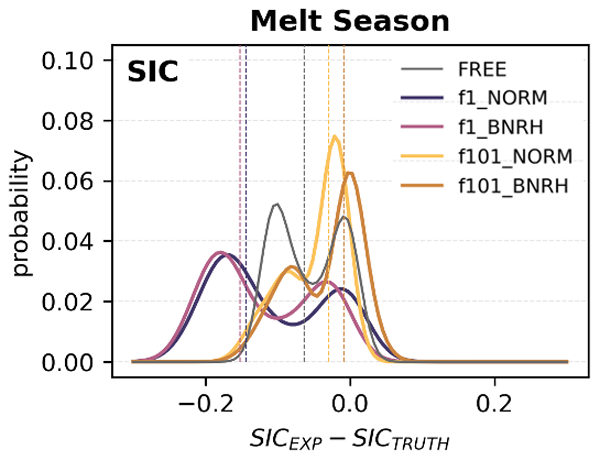
We tested a new way to improve Arctic sea ice forecasts by adding satellite-based surface brightness, or albedo, into a sea ice model. This approach captures key surface changes like melting and snowfall that affect ice loss. We found it often gives better results when combined with standard data like ice coverage or thickness, especially during the melt season. This method offers a powerful tool for tracking Arctic sea ice in a changing climate.
We tested a new way to improve Arctic sea ice forecasts by adding satellite-based surface...