Colombero, C., Comina, C., De Toma, E., Franco, D., and Godio, A.: Ice Thickness Estimation from Geophysical Investigations on the Terminal Lobes of Belvedere Glacier (NW Italian Alps), Remote Sensing, 11, 805,
https://doi.org/10.3390/rs11070805, 2019.
a
Colucci, R. R., Forte, E., Boccali, C., Dossi, M., Lanza, L., Pipan, M., and Guglielmin, M.: Evaluation of Internal Structure, Volume and Mass of Glacial Bodies by Integrated LiDAR and Ground Penetrating Radar Surveys: The Case Study of Canin Eastern Glacieret (Julian Alps, Italy), Surveys in Geophysics, 36, 231–252,
https://doi.org/10.1007/s10712-014-9311-1, 2015.
a
Comiti, F., Mao, L., Penna, D., Dell'Agnese, A., Engel, M., Rathburn, S., and Cavalli, M.: Glacier melt runoff controls bedload transport in Alpine catchments, Earth and Planetary Science Letters, 520, 77–86,
https://doi.org/10.1016/j.epsl.2019.05.031, 2019.
a
Cook, S. J., Swift, D. A., Kirkbride, M. P., Knight, P. G., and Waller, R. I.: The empirical basis for modelling glacial erosion rates, Nature Communications, 11, 759,
https://doi.org/10.1038/s41467-020-14583-8, 2020.
a
Corte, E., Ajmar, A., Camporeale, C., Cina, A., Coviello, V., Giulio Tonolo, F., Godio, A., Macelloni, M. M., Tamea, S., and Vergnano, A.: Orthophoto and DSM Rutor Glacier, Zenodo [data set],
https://doi.org/10.5281/zenodo.7713299, 2023.
a
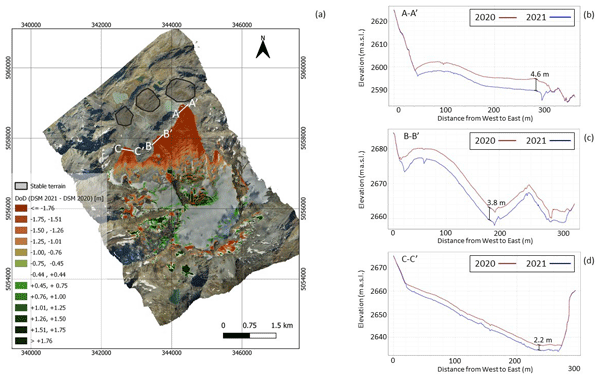
Corte, E., Ajmar, A., Camporeale, C., Cina, A., Coviello, V., Giulio Tonolo, F., Godio, A., Macelloni, M. M., Tamea, S., and Vergnano, A.: Multitemporal characterization of a proglacial system: a multidisciplinary approach, Earth Syst. Sci. Data, 16, 3283–3306,
https://doi.org/10.5194/essd-16-3283-2024, 2024.
a,
b,
c
Cuffey, K. M. and Paterson, W. S. B.: The physics of glaciers, Elsevier, San Diego, 4th edn., ISBN 978-0-12-369461-4, 978-0-08-091912-6, 2010.
a,
b
Farinotti, D., Huss, M., Bauder, A., Funk, M., and Truffer, M.: A method to estimate the ice volume and ice-thickness distribution of alpine glaciers, Journal of Glaciology, 55, 422–430,
https://doi.org/10.3189/002214309788816759, 2009.
a
Farinotti, D., Brinkerhoff, D. J., Clarke, G. K. C., Fürst, J. J., Frey, H., Gantayat, P., Gillet-Chaulet, F., Girard, C., Huss, M., Leclercq, P. W., Linsbauer, A., Machguth, H., Martin, C., Maussion, F., Morlighem, M., Mosbeux, C., Pandit, A., Portmann, A., Rabatel, A., Ramsankaran, R., Reerink, T. J., Sanchez, O., Stentoft, P. A., Singh Kumari, S., van Pelt, W. J. J., Anderson, B., Benham, T., Binder, D., Dowdeswell, J. A., Fischer, A., Helfricht, K., Kutuzov, S., Lavrentiev, I., McNabb, R., Gudmundsson, G. H., Li, H., and Andreassen, L. M.: How accurate are estimates of glacier ice thickness? Results from ITMIX, the Ice Thickness Models Intercomparison eXperiment, The Cryosphere, 11, 949–970,
https://doi.org/10.5194/tc-11-949-2017, 2017.
a,
b,
c,
d
Farinotti, D., Huss, M., Fürst, J. J., Landmann, J., Machguth, H., Maussion, F., and Pandit, A.: A consensus estimate for the ice thickness distribution of all glaciers on Earth, Nature Geoscience, 12, 168–173,
https://doi.org/10.1038/s41561-019-0300-3, 2019.
a,
b,
c,
d
Forte, E., Pipan, M., Francese, R., and Godio, A.: An overview of GPR investigation in the Italian Alps, First Break, 33,
https://doi.org/10.3997/1365-2397.33.8.82011, 2015.
a
Forte, E., Santin, I., Ponti, S., Colucci, R. R., Gutgesell, P., and Guglielmin, M.: New insights in glaciers characterization by differential diagnosis integrating GPR and remote sensing techniques: A case study for the Eastern Gran Zebrù glacier (Central Alps), Remote Sensing of Environment, 267, 112715,
https://doi.org/10.1016/j.rse.2021.112715, 2021.
a,
b,
c,
d
Frey, H., Machguth, H., Huss, M., Huggel, C., Bajracharya, S., Bolch, T., Kulkarni, A., Linsbauer, A., Salzmann, N., and Stoffel, M.: Estimating the volume of glaciers in the Himalayan–Karakoram region using different methods, The Cryosphere, 8, 2313–2333,
https://doi.org/10.5194/tc-8-2313-2014, 2014.
a,
b,
c,
d,
e
Gizzi, M., Mondani, M., Taddia, G., Suozzi, E., and Lo Russo, S.: Aosta Valley Mountain Springs: A Preliminary Analysis for Understanding Variations in Water Resource Availability under Climate Change, Water, 14, 1004,
https://doi.org/10.3390/w14071004, 2022.
a
Grab, M., Mattea, E., Bauder, A., Huss, M., Rabenstein, L., Hodel, E., Linsbauer, A., Langhammer, L., Schmid, L., Church, G., Hellmann, S., Délèze, K., Schaer, P., Lathion, P., Farinotti, D., and Maurer, H.: Ice thickness distribution of all Swiss glaciers based on extended ground-penetrating radar data and glaciological modeling, Journal of Glaciology, 67, 1074–1092,
https://doi.org/10.1017/jog.2021.55, 2021.
a,
b,
c,
d
Haeberli, W. and Hoelzle, M.: Application of inventory data for estimating characteristics of and regional climate-change effects on mountain glaciers: a pilot study with the European Alps, Annals of Glaciology, 21, 206–212,
https://doi.org/10.3189/S0260305500015834, 1995.
a
Haeberli, W., Oerlemans, J., and Zemp, M.: The Future of Alpine Glaciers and Beyond, in: Oxford Research Encyclopedia of Climate Science, Oxford University Press, ISBN 978-0-19-022862-0,
https://doi.org/10.1093/acrefore/9780190228620.013.769, 2019.
a
Helfricht, K., Huss, M., Fischer, A., and Otto, J.-C.: Calibrated Ice Thickness Estimate for All Glaciers in Austria, Frontiers in Earth Science, 7, 68,
https://doi.org/10.3389/feart.2019.00068, 2019.
a
Huber, E. and Hans, G.: RGPR – An open-source package to process and visualize GPR data, in: 2018 17th International Conference on Ground Penetrating Radar (GPR), pp. 1–4, IEEE, Rapperswil, ISBN 978-1-5386-5777-5,
https://doi.org/10.1109/ICGPR.2018.8441658, 2018.
a,
b
Hugonnet, R., McNabb, R., Berthier, E., Menounos, B., Nuth, C., Girod, L., Farinotti, D., Huss, M., Dussaillant, I., Brun, F., and Kääb, A.: Accelerated global glacier mass loss in the early twenty-first century, Nature, 592, 726–731,
https://doi.org/10.1038/s41586-021-03436-z, 2021.
a
Jol, H. M.: Ground penetrating radar theory and applications, Elsevier Science, Amsterdam, Netherlands, 1st edn., ISBN 978-0-08-095184-3, oCLC: 1078275154, 2009. a
Karušs, J., Lamsters, K., Ješkins, J., Sobota, I., and Džeriņš, P.: UAV and GPR Data Integration in Glacier Geometry Reconstruction: A Case Study from Irenebreen, Svalbard, Remote Sensing, 14, 456,
https://doi.org/10.3390/rs14030456, 2022.
a
Langhammer, L., Grab, M., Bauder, A., and Maurer, H.: Glacier thickness estimations of alpine glaciers using data and modeling constraints, The Cryosphere, 13, 2189–2202,
https://doi.org/10.5194/tc-13-2189-2019, 2019a.
a,
b,
c
Langhammer, L., Rabenstein, L., Schmid, L., Bauder, A., Grab, M., Schaer, P., and Maurer, H.: Glacier bed surveying with helicopter-borne dual-polarization ground-penetrating radar, Journal of Glaciology, 65, 123–135,
https://doi.org/10.1017/jog.2018.99, 2019b.
a
Langley, K., Lacroix, P., Hamran, S.-E., and Brandt, O.: Sources of backscatter at 5.3 GHz from a superimposed ice and firn area revealed by multi-frequency GPR and cores, Journal of Glaciology, 55, 373–383,
https://doi.org/10.3189/002214309788608660, 2009.
a
Linsbauer, A., Paul, F., and Haeberli, W.: Modeling glacier thickness distribution and bed topography over entire mountain ranges with GlabTop: Application of a fast and robust approach: REGIONAL-SCALE MODELING OF GLACIER BEDS, Journal of Geophysical Research: Earth Surface, 117,
https://doi.org/10.1029/2011JF002313, 2012.
a
Macelloni, M. M., Corte, E., Ajmar, A., Cina, A., Giulio Tonolo, F., Maschio, P. F., and Pisoni, I. N.: Multi-platform, Multi-scale and Multi-temporal 4D Glacier Monitoring. The Rutor Glacier Case Study, in: Geomatics for Green and Digital Transition, series Title: Communications in Computer and Information Science, edited by: Borgogno-Mondino, E. and Zamperlin, P., 1651, 392–404, Springer International Publishing, Cham, ISBN 978-3-031-17438-4 978-3-031-17439-1,
https://doi.org/10.1007/978-3-031-17439-1_29, 2022.
a,
b,
c
MacGregor, J. A., Studinger, M., Arnold, E., Leuschen, C. J., Rodríguez-Morales, F., and Paden, J. D.: Brief communication: An empirical relation between center frequency and measured thickness for radar sounding of temperate glaciers, The Cryosphere, 15, 2569–2574,
https://doi.org/10.5194/tc-15-2569-2021, 2021.
a
Maurer, H.: GlaTE – Glacier thickness modeling algorithm, GitLab [code],
https://gitlab.com/hmaurer/glate (last access: 9 December 2025), 2022.
a,
b
Maussion, F.: OGGM – Open Global Glacier Model, GitHub [code],
https://github.com/OGGM/oggm (last access: 9 December 2025), 2024. a
Maussion, F., Butenko, A., Champollion, N., Dusch, M., Eis, J., Fourteau, K., Gregor, P., Jarosch, A. H., Landmann, J., Oesterle, F., Recinos, B., Rothenpieler, T., Vlug, A., Wild, C. T., and Marzeion, B.: The Open Global Glacier Model (OGGM) v1.1, Geosci. Model Dev., 12, 909–931,
https://doi.org/10.5194/gmd-12-909-2019, 2019.
a,
b,
c
Millan, R., Mouginot, J., Rabatel, A., and Morlighem, M.: Ice velocity and thickness of the world’s glaciers, Nature Geoscience, 15, 124–129,
https://doi.org/10.1038/s41561-021-00885-z, 2022.
a,
b,
c
Milner, A. M., Khamis, K., Battin, T. J., Brittain, J. E., Barrand, N. E., Füreder, L., Cauvy-Fraunié, S., Gíslason, G. M., Jacobsen, D., Hannah, D. M., Hodson, A. J., Hood, E., Lencioni, V., Ólafsson, J. S., Robinson, C. T., Tranter, M., and Brown, L. E.: Glacier shrinkage driving global changes in downstream systems, Proceedings of the National Academy of Sciences, 114, 9770–9778,
https://doi.org/10.1073/pnas.1619807114, 2017.
a
QGIS Development Team: QGIS Geographic Information System,
http://qgis.osgeo.org (last access: 9 December 2025), 2021. a
Reinardy, B. T. I., Booth, A. D., Hughes, A. L. C., Boston, C. M., Åkesson, H., Bakke, J., Nesje, A., Giesen, R. H., and Pearce, D. M.: Pervasive cold ice within a temperate glacier – implications for glacier thermal regimes, sediment transport and foreland geomorphology, The Cryosphere, 13, 827–843,
https://doi.org/10.5194/tc-13-827-2019, 2019.
a,
b,
c
RGI Consortium, R. G. I.: Randolph Glacier Inventory 6.0, Boulder, Colorado USA, NSIDC: National Snow and Ice Data Center [data set],
https://doi.org/10.7265/N5-RGI-60, 2017.
a,
b,
c
Rutishauser, A., Maurer, H., and Bauder, A.: Helicopter-borne ground-penetrating radar investigations on temperate alpine glaciers: A comparison of different systems and their abilities for bedrock mapping, Geophysics, 81, WA119–WA129,
https://doi.org/10.1190/geo2015-0144.1, 2016.
a,
b,
c
Sandmeier, K.: REFLEXW Version 7.0-program for the Processing of Seismic, Acoustic or Electromagnetic Reflection, Refraction and Transmission Data, User's Manual, 578,
https://www.sandmeier-geo.de/guides-and-videos.html (last access: 9 December 2025), 2012.
a,
b
Santin, I., Forte, E., Nicora, M., Ponti, S., and Guglielmin, M.: Where does a glacier end? Integrated geophysical, geomorphological and photogrammetric measurements to image geometry and ice facies distribution, Catena, 225, 107016,
https://doi.org/10.1016/j.catena.2023.107016, 2023.
a
Scanlan, K. M., Rutishauser, A., Young, D. A., and Blankenship, D. D.: Interferometric discrimination of cross-track bed clutter in ice-penetrating radar sounding data, Annals of Glaciology, 61, 68–73,
https://doi.org/10.1017/aog.2020.20, 2020.
a
Schwanghart, W. and Scherler, D.: Short Communication: TopoToolbox 2 – MATLAB-based software for topographic analysis and modeling in Earth surface sciences, Earth Surf. Dynam., 2, 1–7,
https://doi.org/10.5194/esurf-2-1-2014, 2014.
a
Shahateet, K., J. Fürst, J., Navarro, F., Seehaus, T., Farinotti, D., and Braun, M.: A reconstruction of the ice thickness of the Antarctic Peninsula Ice Sheet north of 70° S, The Cryosphere, 19, 1577–1597,
https://doi.org/10.5194/tc-19-1577-2025, 2025.
a
Suter, S., Laternser, M., Haeberli, W., Frauenfelder, R., and Hoelzle, M.: Cold firn and ice of high-altitude glaciers in the Alps: measurements and distribution modelling, Journal of Glaciology, 47, 85–96,
https://doi.org/10.3189/172756501781832566, 2001.
a
Terink, W.: GlabTop2-py, GitHub [code],
https://github.com/WilcoTerink/GlabTop2-py (last access: 9 December 2025), 2018. a
Urbini, S., Bianchi-Fasani, G., Mazzanti, P., Rocca, A., Vittuari, L., Zanutta, A., Girelli, V. A., Serafini, M., Zirizzotti, A., and Frezzotti, M.: Multi-Temporal Investigation of the Boulder Clay Glacier and Northern Foothills (Victoria Land, Antarctica) by Integrated Surveying Techniques, Remote Sensing, 11, 1501,
https://doi.org/10.3390/rs11121501, 2019.
a
Val d'Aosta Region: Servizi Cartografici SCT – GeoDownload,
https://mappe.regione.vda.it/pub/geonavitg/geodownload.asp?carta=DTM99 (last access: 9 December 2025), 2008.
a,
b
Vergnano, A.: Supplementary materials for the publication “Integrating GPR and ice-thickness models for improved bedrock detection: the case study of Rutor temperate glacier”, Zenodo [data set],
https://doi.org/10.5281/zenodo.17379126, 2024.
a
Vergnano, A., Oggeri, C., and Godio, A.: Geophysical–geotechnical methodology for assessing the spatial distribution of glacio‐lacustrine sediments: The case history of Lake Seracchi, Earth Surface Processes and Landforms, 48, 1374–1397,
https://doi.org/10.1002/esp.5555, 2023.
a
Viani, C., Machguth, H., Huggel, C., Perotti, L., and Giardino, M.: Detecting glacier-bed overdeepenings for glaciers in the Western Italian Alps using the GlabTop2 model: the test site of the Rutor Glacier, Aosta Valley, in: EGU General Assembly Conference Abstracts, EPSC2016–13607,
https://meetingorganizer.copernicus.org/EGU2016/EGU2016-13607.pdf (last access: 9 December 2025), 2016. a
Viani, C., Machguth, H., Huggel, C., Godio, A., Franco, D., Perotti, L., and Giardino, M.: Potential future lakes from continued glacier shrinkage in the Aosta Valley Region (Western Alps, Italy), Geomorphology, 355, 107068,
https://doi.org/10.1016/j.geomorph.2020.107068, 2020.
a,
b
Villa, F., De Amicis, M., and Maggi, V.: GIS analysis of Rutor Glacier (Aosta Valley, Italy) volume and terminus variations, Geografia Fisica e Dinamica Quaternaria, 30, 87–95, 2007. a
Villa, F., Tamburini, A., Deamicis, M., Sironi, S., Maggi, V., and Rossi, G.: Volume decrease of Rutor Glacier (Western Italian Alps) since little ice age: A quantitative approach combining GPR, GPS and cartography, Geografia Fisica e Dinamica Quaternaria, 31, 63–70, 2008.
a,
b,
c,
d,
e,
f,
g,
h,
i
Zekollari, H., Huss, M., Farinotti, D., and Lhermitte, S.: Ice‐Dynamical Glacier Evolution Modeling – A Review, Reviews of Geophysics, 60, e2021RG000754,
https://doi.org/10.1029/2021RG000754, 2022.
a