
Articles | Volume 19, issue 12
https://doi.org/10.5194/tc-19-6639-2025
© Author(s) 2025. This work is distributed under
the Creative Commons Attribution 4.0 License.
the Creative Commons Attribution 4.0 License.
https://doi.org/10.5194/tc-19-6639-2025
© Author(s) 2025. This work is distributed under
the Creative Commons Attribution 4.0 License.
the Creative Commons Attribution 4.0 License.
Research article
| 
08 Dec 2025
Research article |
| 08 Dec 2025
| 08 Dec 2025
Arctic regional changes revealed by clustering of sea-ice observations

IMT Atlantique, Lab-STICC, UMR CNRS 6285, 29238, Brest, France
Univ Brest CNRS Ifremer IRD, Laboratoire d'Océanographie Physique et Spatiale (LOPS), Brest, France
Pierre Tandeo
IMT Atlantique, Lab-STICC, UMR CNRS 6285, 29238, Brest, France
ODYSSEY Team-Project, INRIA CNRS, Brest, France
Florian Sévellec
Univ Brest CNRS Ifremer IRD, Laboratoire d'Océanographie Physique et Spatiale (LOPS), Brest, France
ODYSSEY Team-Project, INRIA CNRS, Brest, France
Camille Lique
Univ Brest CNRS Ifremer IRD, Laboratoire d'Océanographie Physique et Spatiale (LOPS), Brest, France
Related authors
David Docquier, Giorgia Di Capua, Reik V. Donner, Carlos A. L. Pires, Amélie Simon, and Stéphane Vannitsem
Nonlin. Processes Geophys., 31, 115–136, https://doi.org/10.5194/npg-31-115-2024, https://doi.org/10.5194/npg-31-115-2024, 2024
Short summary
Short summary
Identifying causes of specific processes is crucial in order to better understand our climate system. Traditionally, correlation analyses have been used to identify cause–effect relationships in climate studies. However, correlation does not imply causation, which justifies the need to use causal methods. We compare two independent causal methods and show that these are superior to classical correlation analyses. We also find some interesting differences between the two methods.
Amélie Simon, Coline Poppeschi, Sandra Plecha, Guillaume Charria, and Ana Russo
Ocean Sci., 19, 1339–1355, https://doi.org/10.5194/os-19-1339-2023, https://doi.org/10.5194/os-19-1339-2023, 2023
Short summary
Short summary
In the coastal northeastern Atlantic and for three subregions (the English Channel, Bay of Brest and Bay of Biscay) over the period 1982–2022, marine heatwaves are more frequent and longer and extend over larger areas, while the opposite is seen for marine cold spells. This result is obtained with both in situ and satellite datasets, although the satellite dataset underestimates the amplitude of these extremes.
Amélie Simon, Guillaume Gastineau, Claude Frankignoul, Vladimir Lapin, and Pablo Ortega
Weather Clim. Dynam., 3, 845–861, https://doi.org/10.5194/wcd-3-845-2022, https://doi.org/10.5194/wcd-3-845-2022, 2022
Short summary
Short summary
The influence of the Arctic sea-ice loss on atmospheric circulation in midlatitudes depends on persistent sea surface temperatures in the North Pacific. In winter, Arctic sea-ice loss and a warm North Pacific Ocean both induce depressions over the North Pacific and North Atlantic, an anticyclone over Greenland, and a stratospheric anticyclone over the Arctic. However, the effects are not additive as the interaction between both signals is slightly destructive.
Erwan Le Roux, Pierre Tandeo, Carlos Granero Belinchon, Melika Baklouti, Julien Le Sommer, Florence Sevault, Samuel Somot, Antoine Doury, and Mahmoud Al Najar
EGUsphere, https://doi.org/10.5194/egusphere-2026-1991, https://doi.org/10.5194/egusphere-2026-1991, 2026
Short summary
Short summary
Projected impacts of climate change are assessed with impact models driven by climate projections. However, impact models can have a high computational cost. Here, we design statistical emulators of impact models based on automatic equation discovery. To our knowledge, this approach is a promising innovation that could pave the way to develop simple and interpretable emulators for various climate impact studies, but also to validate existing knowledge and to understand novel links.
Arthur Coquereau, Florian Sévellec, Thierry Huck, Joël J.-M. Hirschi, and Quentin Jamet
Earth Syst. Dynam., 17, 209–233, https://doi.org/10.5194/esd-17-209-2026, https://doi.org/10.5194/esd-17-209-2026, 2026
Short summary
Short summary
Using statistical methods and a set of ensemble climate models, we decompose the sources of Atlantic Meridional Overturning Circulation (AMOC) variance. Three distinct phases of physical variability are identified: from 1850 to 1990, internal variability dominates; from 1990 to 2050, dynamical adjustment related to AMOC decline takes over; after 2050, differences between forcing scenarios become dominant. Beyond these physical factors, model variability remains a major source of uncertainty.
Noémie Planat, Carolina Olivia Dufour, Camille Lique, Jan Klaus Rieck, Claude Talandier, and Louis Bruno Tremblay
Ocean Sci., 22, 653–678, https://doi.org/10.5194/os-22-653-2026, https://doi.org/10.5194/os-22-653-2026, 2026
Short summary
Short summary
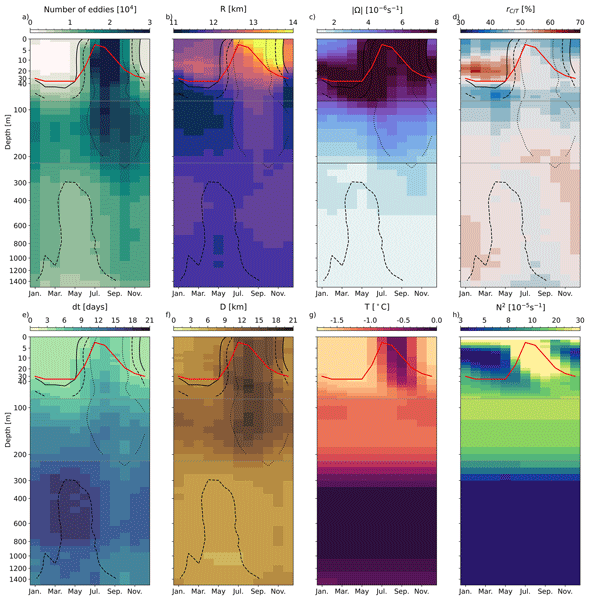
We detect and track mesoscale eddies in the Canadian Basin of the Arctic Ocean and describe their spatio-temporal characteristics in a high resolution pan-Arctic model. Results show eddies of typical size 12 km, lasting 10 d and travelling 11 km, with roughly an equal number of cyclones and anticyclones detected. Seasonal, decadal and interannual changes of the number of eddies detected show strong correlations with the ice cover, and with the mean circulation of the basin.
Solène Dealbera, Stéphane Raynaud, Carlos Granero Belinchon, Brahim Boussidi, Clément Le Goff, and Pierre Tandeo
EGUsphere, https://doi.org/10.5194/egusphere-2025-5907, https://doi.org/10.5194/egusphere-2025-5907, 2025
Short summary
Short summary
The goal of data assimilation in geoscience is to merge information from models and observations. In the presence of structures such as ocean eddies, classic assimilation schemes fail to merge those two sources, resulting in position and shape errors. Here, we propose a new scheme which assimilates only the parameters describing a simplified eddy structure. Comparison with classic schemes shows that our approach preserves the eddy parameters and reduces the computational cost.
Sofia Allende, Anne Marie Treguier, Camille Lique, Clément de Boyer Montégut, François Massonnet, Thierry Fichefet, and Antoine Barthélemy
Geosci. Model Dev., 17, 7445–7466, https://doi.org/10.5194/gmd-17-7445-2024, https://doi.org/10.5194/gmd-17-7445-2024, 2024
Short summary
Short summary
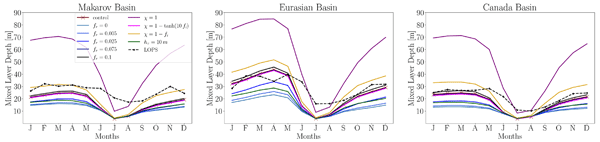
We study the parameters of the turbulent-kinetic-energy mixed-layer-penetration scheme in the NEMO model with regard to sea-ice-covered regions of the Arctic Ocean. This evaluation reveals the impact of these parameters on mixed-layer depth, sea surface temperature and salinity, and ocean stratification. Our findings demonstrate significant impacts on sea ice thickness and sea ice concentration, emphasizing the need for accurately representing ocean mixing to understand Arctic climate dynamics.
Paul Platzer, Pierre Ailliot, Bertrand Chapron, and Pierre Tandeo
Clim. Past, 20, 2267–2286, https://doi.org/10.5194/cp-20-2267-2024, https://doi.org/10.5194/cp-20-2267-2024, 2024
Short summary
Short summary
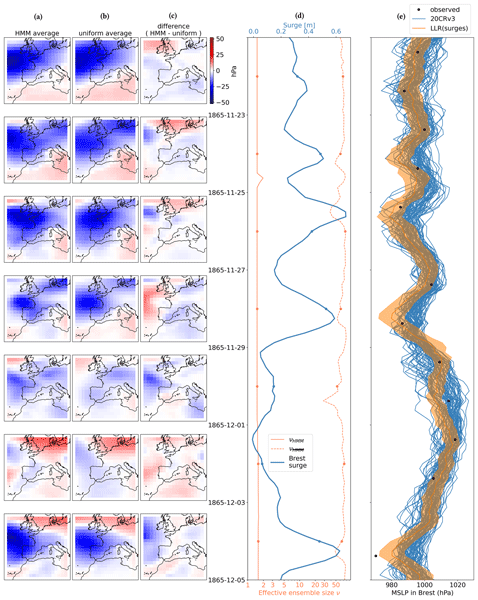
Old observations are necessary to understand the atmosphere. When direct observations are not available, one can use indirect observations, such as tide gauges, which measure the sea level in port cities. The sea level rises when local air pressure decreases and when wind pushes water towards the coast. Several centuries-long tide gauge records are available. We show that these can be complementary to direct pressure observations for studying storms and anticyclones in the 19th century.
Pierre Le Bras, Florian Sévellec, Pierre Tandeo, Juan Ruiz, and Pierre Ailliot
Nonlin. Processes Geophys., 31, 303–317, https://doi.org/10.5194/npg-31-303-2024, https://doi.org/10.5194/npg-31-303-2024, 2024
Short summary
Short summary
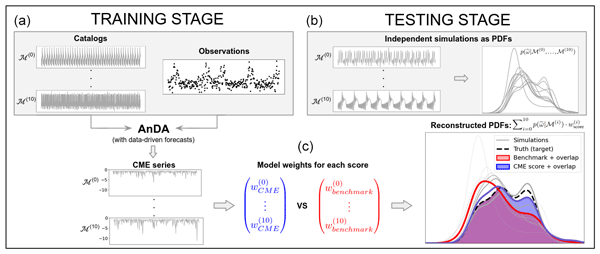
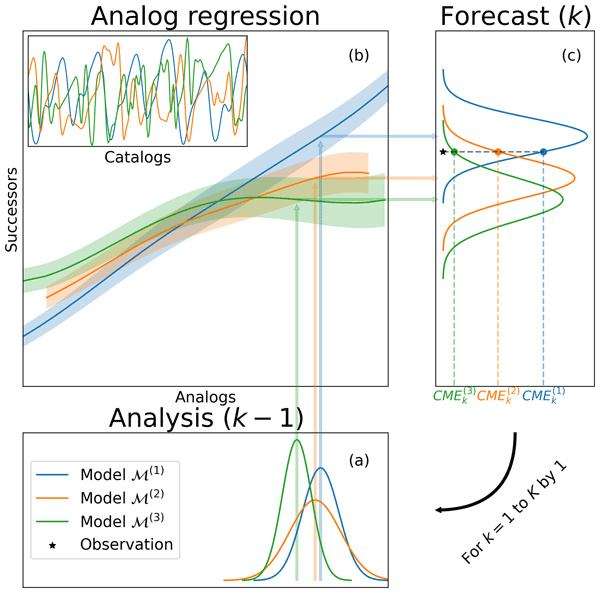
The goal of this paper is to weight several dynamic models in order to improve the representativeness of a system. It is illustrated using a set of versions of an idealized model describing the Atlantic Meridional Overturning Circulation. The low-cost method is based on data-driven forecasts. It enables model performance to be evaluated on their dynamics. Taking into account both model performance and codependency, the derived weights outperform benchmarks in reconstructing a model distribution.
David Docquier, Giorgia Di Capua, Reik V. Donner, Carlos A. L. Pires, Amélie Simon, and Stéphane Vannitsem
Nonlin. Processes Geophys., 31, 115–136, https://doi.org/10.5194/npg-31-115-2024, https://doi.org/10.5194/npg-31-115-2024, 2024
Short summary
Short summary
Identifying causes of specific processes is crucial in order to better understand our climate system. Traditionally, correlation analyses have been used to identify cause–effect relationships in climate studies. However, correlation does not imply causation, which justifies the need to use causal methods. We compare two independent causal methods and show that these are superior to classical correlation analyses. We also find some interesting differences between the two methods.
Amélie Simon, Coline Poppeschi, Sandra Plecha, Guillaume Charria, and Ana Russo
Ocean Sci., 19, 1339–1355, https://doi.org/10.5194/os-19-1339-2023, https://doi.org/10.5194/os-19-1339-2023, 2023
Short summary
Short summary
In the coastal northeastern Atlantic and for three subregions (the English Channel, Bay of Brest and Bay of Biscay) over the period 1982–2022, marine heatwaves are more frequent and longer and extend over larger areas, while the opposite is seen for marine cold spells. This result is obtained with both in situ and satellite datasets, although the satellite dataset underestimates the amplitude of these extremes.
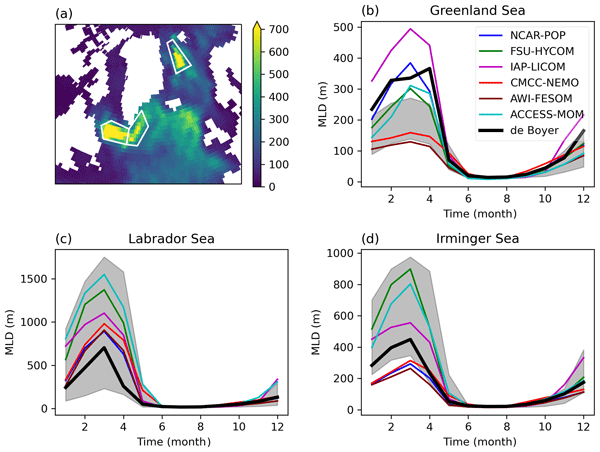
Anne Marie Treguier, Clement de Boyer Montégut, Alexandra Bozec, Eric P. Chassignet, Baylor Fox-Kemper, Andy McC. Hogg, Doroteaciro Iovino, Andrew E. Kiss, Julien Le Sommer, Yiwen Li, Pengfei Lin, Camille Lique, Hailong Liu, Guillaume Serazin, Dmitry Sidorenko, Qiang Wang, Xiaobio Xu, and Steve Yeager
Geosci. Model Dev., 16, 3849–3872, https://doi.org/10.5194/gmd-16-3849-2023, https://doi.org/10.5194/gmd-16-3849-2023, 2023
Short summary
Short summary
The ocean mixed layer is the interface between the ocean interior and the atmosphere and plays a key role in climate variability. We evaluate the performance of the new generation of ocean models for climate studies, designed to resolve
ocean eddies, which are the largest source of ocean variability and modulate the mixed-layer properties. We find that the mixed-layer depth is better represented in eddy-rich models but, unfortunately, not uniformly across the globe and not in all models.
Pierre Tandeo, Pierre Ailliot, and Florian Sévellec
Nonlin. Processes Geophys., 30, 129–137, https://doi.org/10.5194/npg-30-129-2023, https://doi.org/10.5194/npg-30-129-2023, 2023
Short summary
Short summary
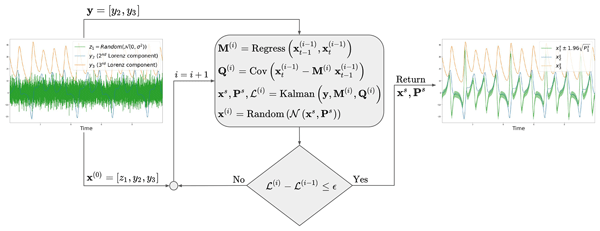
The goal of this paper is to obtain probabilistic predictions of a partially observed dynamical system without knowing the model equations. It is illustrated using the three-dimensional Lorenz system, where only two components are observed. The proposed data-driven procedure is low-cost, is easy to implement, uses linear and Gaussian assumptions and requires only a small amount of data. It is based on an iterative linear Kalman smoother with a state augmentation.
Robin Marcille, Maxime Thiébaut, Pierre Tandeo, and Jean-François Filipot
Wind Energ. Sci., 8, 771–786, https://doi.org/10.5194/wes-8-771-2023, https://doi.org/10.5194/wes-8-771-2023, 2023
Short summary
Short summary
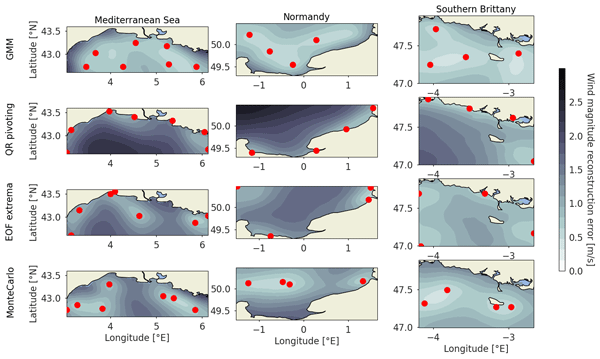
A novel data-driven method is proposed to design an optimal sensor network for the reconstruction of offshore wind resources. Based on unsupervised learning of numerical weather prediction wind data, it provides a simple yet efficient method for the siting of sensors, outperforming state-of-the-art methods for this application. It is applied in the main French offshore wind energy development areas to provide guidelines for the deployment of floating lidars for wind resource assessment.
Guillaume Boutin, Einar Ólason, Pierre Rampal, Heather Regan, Camille Lique, Claude Talandier, Laurent Brodeau, and Robert Ricker
The Cryosphere, 17, 617–638, https://doi.org/10.5194/tc-17-617-2023, https://doi.org/10.5194/tc-17-617-2023, 2023
Short summary
Short summary
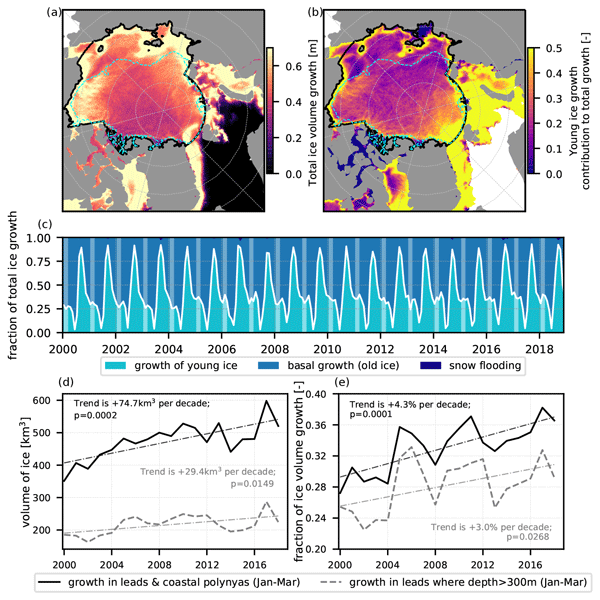
Sea ice cover in the Arctic is full of cracks, which we call leads. We suspect that these leads play a role for atmosphere–ocean interactions in polar regions, but their importance remains challenging to estimate. We use a new ocean–sea ice model with an original way of representing sea ice dynamics to estimate their impact on winter sea ice production. This model successfully represents sea ice evolution from 2000 to 2018, and we find that about 30 % of ice production takes place in leads.
Juan Ruiz, Pierre Ailliot, Thi Tuyet Trang Chau, Pierre Le Bras, Valérie Monbet, Florian Sévellec, and Pierre Tandeo
Geosci. Model Dev., 15, 7203–7220, https://doi.org/10.5194/gmd-15-7203-2022, https://doi.org/10.5194/gmd-15-7203-2022, 2022
Short summary
Short summary
We present a new approach to validate numerical simulations of the current climate. The method can take advantage of existing climate simulations produced by different centers combining an analog forecasting approach with data assimilation to quantify how well a particular model reproduces a sequence of observed values. The method can be applied with different observations types and is implemented locally in space and time significantly reducing the associated computational cost.
Etienne Pauthenet, Loïc Bachelot, Kevin Balem, Guillaume Maze, Anne-Marie Tréguier, Fabien Roquet, Ronan Fablet, and Pierre Tandeo
Ocean Sci., 18, 1221–1244, https://doi.org/10.5194/os-18-1221-2022, https://doi.org/10.5194/os-18-1221-2022, 2022
Short summary
Short summary
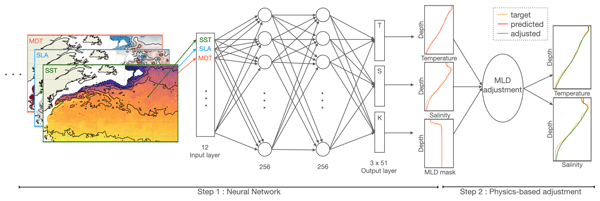
Temperature and salinity profiles are essential for studying the ocean’s stratification, but there are not enough of these data. Satellites are able to measure daily maps of the surface ocean. We train a machine to learn the link between the satellite data and the profiles in the Gulf Stream region. We can then use this link to predict profiles at the high resolution of the satellite maps. Our prediction is fast to compute and allows us to get profiles at any locations only from surface data.
Amélie Simon, Guillaume Gastineau, Claude Frankignoul, Vladimir Lapin, and Pablo Ortega
Weather Clim. Dynam., 3, 845–861, https://doi.org/10.5194/wcd-3-845-2022, https://doi.org/10.5194/wcd-3-845-2022, 2022
Short summary
Short summary
The influence of the Arctic sea-ice loss on atmospheric circulation in midlatitudes depends on persistent sea surface temperatures in the North Pacific. In winter, Arctic sea-ice loss and a warm North Pacific Ocean both induce depressions over the North Pacific and North Atlantic, an anticyclone over Greenland, and a stratospheric anticyclone over the Arctic. However, the effects are not additive as the interaction between both signals is slightly destructive.
Cited articles
Aksenov, Y., Popova, E. E., Yool, A., Nurser, A. G., Williams, T. D., Bertino, L., and Bergh, J.: On the future navigability of Arctic sea routes: High-resolution projections of the Arctic Ocean and sea ice, Marine Policy, 75, 300–317, 2017.
Ardyna, M. and Arrigo, K. R.: Phytoplankton dynamics in a changing Arctic Ocean, Nature Climate Change, 10, 892–903, 2020.
Bushuk, M., Ali, S., Bailey, D. A., Bao, Q., Batté, L., Bhatt, U. S., Blanchard-Wrigglesworth, E., Blockley, E., Cawley, G., Chi, J., Counillon, F., Coulombe, P. G., Cullather, R. I., Diebold, F. X., Dirkson, A., Exarchou, E., Göbel, M., Gregory, W., Guemas, V., Hamilton, L., He, B., Horvath, S., Ionita, M., Kay, J. E., Kim, E., Kimura, N., Kondrashov, D., Labe, Z. M., Lee, W., Lee, Y. J., Li, C., Li, X., Lin, Y., Liu, Y., Maslowski, W., Massonnet, F., Meier, W. N., Merryfield, W. J., Myint, H., Acosta Navarro, J. C., Petty, A., Qiao, F., Schröder, D., Schweiger, A., Shu, Q., Sigmond, M., Steele, M., Stroeve, J., Sun, N., Tietsche, S., Tsamados, M., Wang, K., Wang, J., Wang, W., Wang, Y., Wang, Y., Williams, J., Yang, Q., Yuan, X., Zhang, J., and Zhang, Y. Predicting September Arctic Sea Ice: A Multi-Model Seasonal Skill Comparison, Bulletin of the American Meteorological Society, E1170–E1203, https://doi.org/10.1175/BAMS-D-23-0163.1, 2024.
Cavalieri, D. J., Gloersen, P., Campbell, W. J.: Determination of sea ice parameters with the NIMBUS 7 SMMR, J. Geophys. Res., 89, 5355–5369, https://doi.org/10.1029/JD089iD04p05355, 1984.
Chripko, S., Msadek, R., Sanchez-Gomez, E., Terray, L., Bessières, L., and Moine, M. P.: Impact of reduced arctic sea ice on northern hemisphere climate and weather in autumn and winter, Journal of Climate, 34, 5847–5867, 2021.
Cocetta, F., Zampieri, L., Selivanova, J., and Iovino, D.: Assessing the representation of Arctic sea ice and the marginal ice zone in ocean–sea ice reanalyses, The Cryosphere, 18, 4687–4702, https://doi.org/10.5194/tc-18-4687-2024, 2024.
Cohen, J., Zhang, X., Francis, J., Jung, T., Kwok, R., Overland, J., Ballinger, T. J., Bhatt, U. S., Chen, H. W., Coumou, D., Feldstein, S., Gu, H., Handorf, D., Henderson, G., Ionita, M., Kretschmer, M., Laliberte, F., Lee, S., Linderholm, H. W., and Yoon, J.: Divergent consensus on Arctic amplification influence on mid-latitude severe winter weather, Nat. Clim. Change, 10, 20–29, https://doi.org/10.1038/s41558-019-0662-y, 2020.
Comiso, J. C.: Characteristics of Arctic winter sea ice from satellite multispectral microwave observations, Journal of Geophysical Research: Oceans, 91, 975–994, 1986.
Cvijanovic, I., Simon, A., Levine, X., White, R., Ortega, P., Donat, M., Lucas, D. D., Chiang, J. C. H. , Seidenglanz, A., Bojovic, D., Amaral, A. R., Lapin, V., Doblas-Reyes, F., and and Petrova, D. : Arctic sea-ice loss drives a strong regional atmospheric response over the North Pacific and North Atlantic on decadal scales, Communications Earth and Environment, 6, 154, https://doi.org/10.1038/s43247-025-02059-w, 2025.
Delhaye, S., Massonnet, F., Fichefet, T., Msadek, R., Terray, L., and Screen, J.: Dominant role of early winter Barents–Kara sea ice extent anomalies in subsequent atmospheric circulation changes in CMIP6 models, Climate Dynamics, 62, 2755–2778, 2024.
Deser, C., Tomas, R. A., and Sun, L.: The role of ocean–atmosphere coupling in the zonal-mean atmospheric response to Arctic sea-ice loss, J. Climate, 28, 2168–2186, 2015.
D'Ortenzio, F. and Ribera d'Alcalà, M.: On the trophic regimes of the Mediterranean Sea: a satellite analysis, Biogeosciences, 6, 139–148, https://doi.org/10.5194/bg-6-139-2009, 2009.
Eisenman, I.: Geographic muting of changes in the Arctic sea ice cover, Geophysical Research Letters, 37, https://doi.org/10.1029/2010GL043741, 2010.
Eyring, V., Gillett, N. P., Achuta Rao, K. M., Barimalala, R., Barreiro Parrillo, M., Bellouin, N., Cassou, C., Durack, P. J., Kosaka, Y., McGregor, S., Min, S., Morgenstern, O., and Sun, Y.: Human Influence on the Climate System, in: Climate Change 2021: The Physical Science Basis, Contribution of Working Group I to the Sixth Assessment Report of the Intergovernmental Panel on Climate Change, edited by: Masson-Delmotte, V., Zhai, P., Pirani, A., Connors, S. L., Péan, C., Berger, S., Caud, N., Chen, Y., Goldfarb, L., Gomis, M. I., Huang, M., Leitzell, K., Lonnoy, E., Matthews, J. B. R., Maycock, T. K., Waterfield, T., Yelekçi, O., Yu, R., and Zhou, B., Cambridge University Press, Cambridge, United Kingdom and New York, NY, USA, 423–552, https://doi.org/10.1017/9781009157896.005, 2021.
Forster, P., Storelvmo, T., Armour, K., Collins, W., Dufresne, J.-L., Frame, D., Lunt, D. J., Mauritsen, T., Palmer, M. D., Watanabe, M., Wild, M., and Zhang, H.: The Earth's Energy Budget, Climate Feedbacks, and Climate Sensitivity, in: Climate Change 2021: The Physical Science Basis, Contribution of Working Group I to the Sixth Assessment Report of the Intergovernmental Panel on Climate Change, edited by: Masson-Delmotte, V., Zhai, P., Pirani, A., Connors, S. L., Péan, C., Berger, S., Caud, N., Chen, Y., Goldfarb, L., Gomis, M. I., Huang, M., Leitzell, K., Lonnoy, E., Matthews, J. B. R., Maycock, T. K., Waterfield, T., Yelekçi, O., Yu, R., and Zhou, B., Cambridge University Press, Cambridge, United Kingdom and New York, NY, USA, 923–1054, https://doi.org/10.1017/9781009157896.009, 2021.
Fox-Kemper, B., Hewitt, H. T., Xiao, C., Aðalgeirsdóttir, G., Drijfhout, S. S., Edwards, T. L., Golledge, N. R., Hemer, M., Kopp, R. E., Krinner, G., Mix, A., Notz, D., Nowicki, S., Nurhati, I. S., Ruiz, L., Sallée, J.-B., Slangen, A. B. A., and Yu, Y.: Ocean, Cryosphere and Sea Level Change, in: Climate Change 2021: The Physical Science Basis. Contribution of Working Group I to the Sixth Assessment Report of the Intergovernmental Panel on Climate Change, edited by: Masson-Delmotte, V., Zhai, P., Pirani, A., Connors, S. L., Péan, C., Berger, S., Caud, N., Chen, Y., Goldfarb, L., Gomis, M. I., Huang, M., Leitzell, K., Lonnoy, E., Matthews, J. B. R., Maycock, T. K., Waterfield, T., Yelekçi, O., Yu, R., and Zhou, B., Cambridge University Press, Cambridge, United Kingdom and New York, NY, USA, 1211–1362, https://doi.org/10.1017/9781009157896.011, 2021.
Fučkar, N. S., Guemas, V., Johnson, N. C., Massonnet, F., and Doblas-Reyes, F. J.: Clusters of interannual sea ice variability in the northern hemisphere, Climate Dynamics, 47, 1527–1543, https://doi.org/10.1007/s00382-015-2917-2, 2016.
Galley, R. J., Else, B. G. T., Prinsenberg, S. J., Babb, D., and Barber, D. G.: Summer sea ice concentration, motion, and thickness near areas of proposed offshore oil and gas development in the Canadian Beaufort Sea—2009, Arctic, 105–116, 2013.
GEBCO Compilation Group: GEBCO 2024 Grid, NERC EDS British Oceanographic Data Centre NOC [data set], https://doi.org/10.5285/1c44ce99-0a0d-5f4f-e063-7086abc0ea0f (last access: 6 February 2025), 2024.
Goosse, H., Kay, J. E., Armour, K. C., Bodas-Salcedo, A., Chepfer, H., Docquier, D., Jonko, A., Kushner, P. J., Lecomte, O., Massonnet, F., Park, H.-S., Pithan, F., Svensson, G., and Vancoppenolle, M.: Quantifying climate feedbacks in polar regions, Nature communications, 9, https://doi.org/10.1038/s41467-018-04173-0, 2018.
Gregory, W., Tsamados, M., Stroeve, J., and Sollich, P.: Regional September sea ice forecasting with complex networks and Gaussian processes, Weather and Forecasting, 35, 793–806, 2020.
Gregory, W., Stroeve, J., and Tsamados, M.: Network connectivity between the winter Arctic Oscillation and summer sea ice in CMIP6 models and observations, The Cryosphere, 16, 1653–1673, https://doi.org/10.5194/tc-16-1653-2022, 2022.
Gulev, S. K., Thorne, P. W., Ahn, J., Dentener, F. J., Domingues, C. M., Gerland, S., Gong, D., Kaufman, D. S., Nnamchi, H. C., Quaas, J., Rivera, J. A., Sathyendranath, S., Smith, S. L., Trewin, B., von Schuckmann, K., and Vose, R. S.: Changing State of the Climate System, in: Climate Change 2021: The Physical Science Basis. Contribution of Working Group I to the Sixth Assessment Report of the Intergovernmental Panel on Climate Change, edited by: Masson-Delmotte, V., Zhai, P., Pirani, A., Connors, S. L., Péan, C., Berger, S., Caud, N., Chen, Y., Goldfarb, L., Gomis, M. I., Huang, M., Leitzell, K., Lonnoy, E., Matthews, J. B. R., Maycock, T. K., Waterfield, T., Yelekçi, O., Yu, R., and Zhou, B., Cambridge University Press, Cambridge, United Kingdom and New York, NY, USA, 287–422, https://doi.org/10.1017/9781009157896.004, 2021.
Himmich, K., Vancoppenolle, M., Madec, G., Sallée, J. B., Holland, P. R., and Lebrun, M.: Drivers of Antarctic sea ice advance, Nature Communications, 14, 6219, https://doi.org/10.1038/s41467-023-41962-8, 2023.
Himmich, K., Vancoppenolle, M., Stammerjohn, S., Bocquet, M., Madec, G., and Fleury, S.: Local drivers of Antarctic spring sea ice retreat, Geophysical Research Letters, 52, e2025GL114764, https://doi.org/10.1029/2025GL114764, 2025.
Houghton, I. A. and Wilson, J. D.: El Niño detection via unsupervised clustering of Argo temperature profiles, Journal ofGeophysical Research: Oceans, 125, e2019JC015947, https://doi.org/10.1029/2019JC015947, 2020.
Huntington, H. P., Quakenbush, L. T., and Nelson, M.: Evaluating the effects of climate change on indigenous marine mammal hunting in northern and western alaska using traditional knowledge, Front. Mar. Sci., 4, 319, https://doi.org/10.3389/fmars.2017.00319, 2017.
Huntington, H. P., Danielson, S. L., Wiese, F. K., Baker, M., Boveng, P., Citta, J. J., De Robertis, A., Dickson, D. M. S., Farley, E., George J. C., Iken, K., Kimmel, D. G., Kuletz, K., Ladd, C., Levine, R., Quakenbush, L., Stabeno, P., Stafford, K. M., Stockwell, D., and Wilson, C.: Evidence suggests potential transformation of the Pacific Arctic ecosystem is underway, Nature Climate Change, 10, 342–348, https://doi.org/10.1038/s41558-020-0695-2, 2020.
IPCC: Summary for Policymakers, in: IPCC Special Report on the Ocean and Cryosphere in a Changing Climate, edited by: Pörtner, H.-O., Roberts, D. C., Masson-Delmotte, V., Zhai, P., Tignor, M., Poloczanska, E., Mintenbeck, K., Alegría, A., Nicolai, M., Okem, A., Petzold, J., Rama, B., Weyer, N. M., Cambridge University Press, Cambridge, UK and New York, NY, USA, 3–35, https://doi.org/10.1017/9781009157964.001, 2019.
IPCC: Summary for Policymakers, in: Climate Change 2021: The Physical Science Basis. Contribution of Working Group I to the Sixth Assessment Report of the Intergovernmental Panel on Climate Change, edited by: Masson-Delmotte, V., Zhai, P., Pirani, A., Connors, S. L., Péan, C., Berger, S., Caud, N., Chen, Y., Goldfarb, L., Gomis, M. I., Huang, M., Leitzell, K., Lonnoy, E., Matthews, J. B. R., Maycock, T. K., Waterfield, T., Yelekçi, O., Yu, R., and Zhou, B., Cambridge University Press, Cambridge, United Kingdom and New York, NY, USA, 3–32, https://doi.org/10.1017/9781009157896.001, 2021.
Jain, A. K.: Data clustering: 50 years beyond K-means, Pattern recognition letters, 31, 651–666, 2010.
Jambudi, T. and Gandhi, S.: An Effective Initialization Method Based on Quartiles for the K-means Algorithm, Indian Journal of Science and Technology, 15, 1712–1721, https://doi.org/10.17485/IJST/v15i35.714, 2022.
Johannessen, O. M., Kuzmina, S. I., Bobylev, L. P., and Miles, M. W.: Surface air temperature variability and trends in the Arctic: new amplification assessment and regionalisation, Tellus A, 68, 28234, https://doi.org/10.3402/tellusa.v68.28234, 2016.
Johnson, M. and Eicken, H.: Estimating Arctic sea-ice freeze-up and break-up from the satellite record: A comparison of different approaches in the Chukchi and Beaufort Seas, Elementa, 4, 000124, https://doi.org/10.12952/journal.elementa.000124, 2016.
Kwok, R.: Near zero replenishment of the Arctic multiyear sea ice cover at the end of 2005 summer, Geophysical Research Letters, 34, L05501, https://doi.org/10.1029/2006GL028737, 2007.
Lebrun, M., Vancoppenolle, M., Madec, G., and Massonnet, F.: Arctic sea-ice-free season projected to extend into autumn, The Cryosphere, 13, 79–96, https://doi.org/10.5194/tc-13-79-2019, 2019.
Levine, X. J., Cvijanovic, I., Ortega, P., Donat, M. G., and Tourigny, E.: Atmospheric feedback explains disparate climate response to regional Arctic sea-ice loss, npj Climate and Atmospheric Science, 4, 28, https://doi.org/10.1038/s41612-021-00183-w, 2021.
Lukovich, J. V. and Barber, D. G.: On the spatiotemporal behavior of sea ice concentration anomalies in the Northern Hemisphere, Journal of Geophysical Research: Atmospheres, 112, https://doi.org/10.1029/2006JD007836, 2007.
Markus, T., Stroeve, J. C., and Miller, J.: Recent changes in Arctic sea ice melt onset, freezeup, and melt season length, J. Geophys. Res., 114, C12024, https://doi.org/10.1029/2009JC005436, 2009.
Maze, G., Mercier, H., Fablet, R., Tandeo, P., Radcenco, M. L., Lenca, P., Feucher, C., and Le Goff, C.: Coherent heat patterns revealed by unsupervised classification of Argo temperature profiles in the North Atlantic Ocean, Progress in Oceanography, 151, 275–292, https://doi.org/10.1016/j.pocean.2016.12.008, 2017.
Maslanik, J., Stroeve, J., Fowler, C., and Emery, W.: Distribution and trends in Arctic sea ice age through spring 2011, Geophys. Res. Lett., 38, L13502, https://doi.org/10.1029/2011GL047735, 2011.
Meier, W. N. and Stewart, J. S.: NSIDC Land, Ocean, Coast, Ice, and Sea Ice Region Masks. NSIDC Special Report 25. Boulder CO, USA, National Snow and Ice Data Center, https://nsidc.org/sites/default/files/documents/technical-reference/nsidc-special-report-25.pdf (last access: 15 July 2024), 2023.
Meier, W. N. and Stroeve, J.: An updated assessment of the changing Arctic sea ice cover. Oceanography, 35, 10–19, 2022.
Meier, W. N., Stroeve, J., and Fetterer, F.: Whither Arctic sea ice? A clear signal of decline regionally, seasonally and extending beyond the satellite record, Annals of Glaciology, 46, 428–434, 2007.
Meier, W. N., Fetterer, F., Windnagel, A. K., and Stewart, J. S.: NOAA/NSIDC Climate Data Record of Passive Microwave Sea Ice Concentration (G02202, Version 4), Boulder, Colorado USA, National Snow and Ice Data Center [data set], https://doi.org/10.7265/efmz-2t65 (last access: 15 July 2024), 2021.
Meier, W. N., Stewart, J. S., Windnagel, A., and Fetterer, F. M.: Comparison of hemispheric and regional sea ice extent and area trends from NOAA and NASA passive microwave-derived climate records, Remote Sensing, 14, 619, https://doi.org/10.3390/rs14030619, 2022.
Parkinson, C. L.: Spatially mapped reductions in the length of the Arctic sea ice season, Geophys. Res. Lett., 41, 4316–4322, https://doi.org/10.1002/2014GL060434, 2014.
Parkinson, C. L. and Cavalieri, D. J.: Arctic sea ice variability and trends, 1979–2006, Journal of Geophysical Research: Oceans, 113, https://doi.org/10.1029/2007JC004558, 2008.
Parkinson, C. L. and Comiso, J. C.: On the 2012 record low Arctic sea ice cover: Combined impact of preconditioning and an August storm, Geophys. Res. Lett., 40, 1356–1361, https://doi.org/10.1002/grl.50349, 2013.
Parkinson, C. L., Cavalieri, D. J., Gloersen, P., Zwally, H. J., and Comiso, J. C.: Arctic sea ice extents, areas, and trends, 1978–1996, J. Geophys. Res., 104, 20837–20856, https://doi.org/10.1029/1999JC900082, 1999.
Parkinson, C. L.: Arctic sea ice, 1973-1976: Satellite passive-microwave observations (Vol. 490), Scientific and Technical Information Branch, National Aeronautics and Space Administration, Washington, DC, USA, 1987.
Pedregosa, F., Varoquaux, G., Gramfort, A., Michel, V., Thirion, B., Grisel, O., Blondel, M., Prettenhofer, P., Weiss, R., Dubourg, V., Vanderplas, J., Passos, A., Cournapeau, D., Brucher, M., Perrot, M. and Duchesnay, É.: Scikit-learn: Machine learning in Python, Journal of Machine Learning Research, 12, 2825–2830, https://www.jmlr.org/papers/volume12/pedregosa11a/pedregosa11a.pdf (last access: 5 December 2025), 2011.
Peng, G. and Meier, W. N.: Temporal and regional variability of Arctic sea-ice coverage from satellite data, Annals of Glaciology, 59, 191–200, 2018.
Petty, A. A., Stroeve, J. C., Holland, P. R., Boisvert, L. N., Bliss, A. C., Kimura, N., and Meier, W. N.: The Arctic sea ice cover of 2016: a year of record-low highs and higher-than-expected lows, The Cryosphere, 12, 433–452, https://doi.org/10.5194/tc-12-433-2018, 2018.
Pithan, F. and Mauritsen, T.: Arctic amplification dominated by temperature feedbacks in contemporary climate models, Nature geoscience, 7, 181–184, https://doi.org/10.1038/ngeo2071, 2014.
Przybylak, R.: Variability of Air Temperature, in: Variability of Air Temperature and Atmospheric Precipitation in the Arctic, Atmospheric and Oceanographic Sciences Library, Springer, Dordrecht, 47–167, https://doi.org/10.1007/0-306-48222-3_5, 2003.
Przybylak, R.: Recent air-temperature changes in the Arctic, Annals of Glaciology, 46, 316–324, 2007.
Raphael, M. N. and Hobbs, W.:. The influence of the large-scale atmospheric circulation on Antarctic sea ice during ice advance and retreat seasons, Geophys. Res. Lett., 41, 5037–5045, https://doi.org/10.1002/2014GL060365, 2014.
Regan, H., Rampal, P., Ólason, E., Boutin, G., and Korosov, A.: Modelling the evolution of Arctic multiyear sea ice over 2000–2018, The Cryosphere, 17, 1873–1893, https://doi.org/10.5194/tc-17-1873-2023, 2023.
Ricker, R., Hendricks, S., Kaleschke, L., Tian-Kunze, X., King, J., and Haas, C.: A weekly Arctic sea-ice thickness data record from merged CryoSat-2 and SMOS satellite data, The Cryosphere, 11, 1607–1623, https://doi.org/10.5194/tc-11-1607-2017, 2017.
Rolph, R. J., Feltham, D. L., and Schröder, D.: Changes of the Arctic marginal ice zone during the satellite era, The Cryosphere, 14, 1971–1984, https://doi.org/10.5194/tc-14-1971-2020, 2020.
Rousseeuw, P. J.: Silhouettes: a graphical aid to the interpretation and validation of cluster analysis, Journal of computational and applied mathematics, 20, 53–65, 1987.
Shu, Q., Wang, Q., Årthun, M., Wang, S., Song, Z., Zhang, M., and Qiao, F.: Arctic Ocean Amplification in a warming climate in CMIP6 models, Science advances, 8, eabn9755, https://doi.org/10.1126/sciadv.abn9755, 2022.
Siddon, E. C., Zador, S. G., and Hunt Jr., G. L.: Ecological responses to climate perturbations and minimal sea ice in the northern Bering Sea, Deep-Sea Research Part II, 181, 104914, https://doi.org/10.1016/j.dsr2.2020.104914, 2020.
Simon, A., Gastineau, G., Frankignoul, C., Rousset, C., and Codron, F.: Transient climate response to Arctic sea-ice loss with two ice-constraining methods, J. Climate, 34, 3295–3310, https://doi.org/10.1175/JCLI-D-20-0288.1, 2021.
Simon, A., Tandeo, P., Sévellec, F., and Lique, C.: amelie-simon-pro/SIC_Clustering: Zenodo, Zenodo [data set], https://doi.org/10.5281/zenodo.17827248, 2025.
Smith, L. C. and Stephenson, S. R.: New Trans-Arctic shipping routes navigable by midcentury, Proceedings of the National Academy of Sciences, 110, E1191–E1195, https://doi.org/10.1073/pnas.1214212110, 2013.
Smith, D. M., Eade, R., Andrews, M. B., Ayres, H., Clark, A., Chripko, S., and Walsh, A.: Robust but weak winter atmospheric circulation response to future Arctic sea-ice loss, Nat. Commun., 13, 1–15, 2022.
Song, L., Zhao, X., Wu, Y., Gong, J., and Li, B.: Assessing Arctic marginal ice zone dynamics from 1979 to 2023: insights into long-term variability and morphological changes, Environmental Research Letters, 20, 034032, https://doi.org/10.1088/1748-9326/adb508, 2025.
Stammerjohn, S., Massom, R., Rind, D., and Martinson, D.: Regions of rapid sea ice change: An inter-hemispheric seasonal comparison, Geophys. Res. Lett., 39, L06501, https://doi.org/10.1029/2012GL050874, 2012.
Stock, C. A., John, J. G., Rykaczewski, R. R., Asch, R. G., Cheung, W. W., Dunne, J. P., Friedland, K. D., Lam, V. W. Y., Sarmiento, J. L., and Watson, R. A.: Reconciling fisheries catch and ocean productivity, Proceedings of the National Academy of Sciences, 114, E1441–E1449, https://doi.org/10.1073/pnas.1610238114, 2017.
Stroeve, J. C., Markus, T., Boisvert, L., Miller, J., and Barrett, A.: Changes in Arctic melt season and implications for sea ice loss, Geophys. Res. Lett., 41, 1216–1225, https://doi.org/10.1002/2013GL058951, 2014.
Stroeve, J. C., Crawford, A. D., and Stammerjohn, S.: Using timing of ice retreat to predict timing of fall freeze-up in the Arctic, Geophys. Res. Lett., 43, GL069314, https://doi.org/10.1002/2016GL069314, 2016.
Sutherland, P. and Dumont, D.: Marginal ice zone thickness and extent due to wave radiation stress, Journal of Physical Oceanography, 48, 1885–1901, 2018.
Valko, I.: Differentiating Arctic Provinces: A Cluster Analysis of Geographic and Geopolitical Indicators, Central European Journal of International & Security Studies, 8, https://www.proquest.com/scholarly-journals/differentiating-arctic-provinces-cluster-analysis/docview/2138314295/se-2 (last access: 5 December 2025), 2014.
Vancoppenolle, M., Bopp, L., Madec, G., Dunne, J., Ilyina, T., Halloran, P. R., and Steiner, N.: Future Arctic Ocean primary productivity from CMIP5 simulations: Uncertain outcome, but consistent mechanisms, Global Biogeochem. Cycles, 27, 605–619, https://doi.org/10.1002/gbc.20055, 2013.
Wachter, P., Reiser, F., Friedl, P., and Jacobeit, J.: A new approach to classification of 40 years of Antarctic sea ice concentration data, International Journal of Climatology, 41, E2683–E2699, https://doi.org/10.1002/joc.6874, 2021.
Short summary
Through a machine learning technique based on seasonal cycles of sea-ice concentration from satellite data over the last 4 decades, our research shows that four regions are sufficient to best regionalize the Arctic. These regions are mainly organized into latitudinal bands and evolve in time and space. The descriptor proposed to monitor Arctic sea-ice changes is the probability to belong to each region. The probability to belong to the permanent sea-ice regions has decreased by 3.1 % per decade.
Through a machine learning technique based on seasonal cycles of sea-ice concentration from...


