Articles | Volume 16, issue 10
https://doi.org/10.5194/tc-16-4273-2022
© Author(s) 2022. This work is distributed under
the Creative Commons Attribution 4.0 License.
https://doi.org/10.5194/tc-16-4273-2022
© Author(s) 2022. This work is distributed under
the Creative Commons Attribution 4.0 License.
Glacier extraction based on high-spatial-resolution remote-sensing images using a deep-learning approach with attention mechanism
Xinde Chu
College of Geography and Environmental Science, Northwest Normal
University, Lanzhou, 730070, China
Xiaojun Yao
CORRESPONDING AUTHOR
College of Geography and Environmental Science, Northwest Normal
University, Lanzhou, 730070, China
Hongyu Duan
College of Geography and Environmental Science, Northwest Normal
University, Lanzhou, 730070, China
Cong Chen
Key Laboratory of Western China's Environmental Systems (Ministry of Education), College of Earth and Environmental Sciences, Lanzhou University, Lanzhou, 730000, China
Jing Li
College of Geography and Environmental Science, Northwest Normal
University, Lanzhou, 730070, China
Wenlong Pang
Xining Center of Natural Resources Comprehensive Survey, China
Geological Survey, Xining, 810000, China
Related authors
No articles found.
Yu Zhu, Shiyin Liu, Junfeng Wei, Kunpeng Wu, Tobias Bolch, Junli Xu, Wanqin Guo, Zongli Jiang, Fuming Xie, Ying Yi, Donghui Shangguan, Xiaojun Yao, and Zhen Zhang
Earth Syst. Sci. Data, 17, 1851–1871, https://doi.org/10.5194/essd-17-1851-2025, https://doi.org/10.5194/essd-17-1851-2025, 2025
Short summary
Short summary
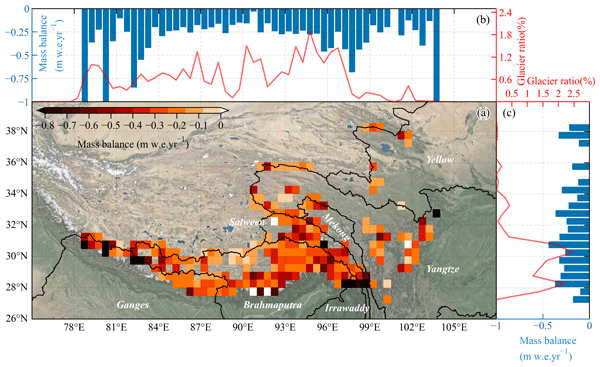
This study compiled a near-complete inventory of glacier mass changes across the eastern Tibetan Plateau using topographical maps. These data enhance our understanding of glacier change variability before 2000. When combined with existing research, our dataset provides a nearly 5-decade record of mass balance, aiding hydrological simulations and assessments of mountain glacier contributions to sea-level rise.
Fuming Xie, Shiyin Liu, Yongpeng Gao, Yu Zhu, Tobias Bolch, Andreas Kääb, Shimei Duan, Wenfei Miao, Jianfang Kang, Yaonan Zhang, Xiran Pan, Caixia Qin, Kunpeng Wu, Miaomiao Qi, Xianhe Zhang, Ying Yi, Fengze Han, Xiaojun Yao, Qiao Liu, Xin Wang, Zongli Jiang, Donghui Shangguan, Yong Zhang, Richard Grünwald, Muhammad Adnan, Jyoti Karki, and Muhammad Saifullah
Earth Syst. Sci. Data, 15, 847–867, https://doi.org/10.5194/essd-15-847-2023, https://doi.org/10.5194/essd-15-847-2023, 2023
Short summary
Short summary
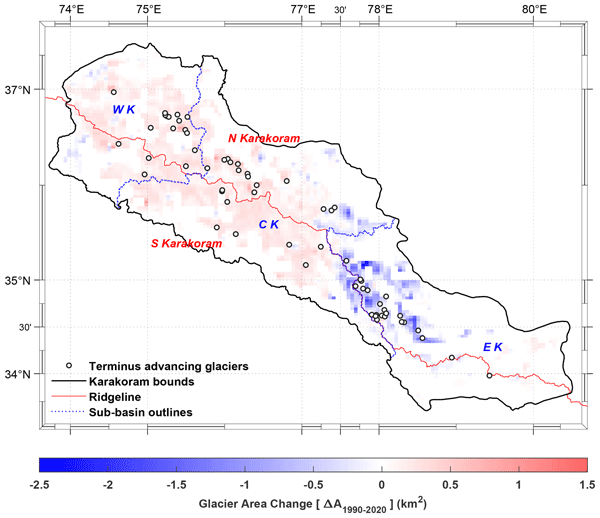
In this study, first we generated inventories which allowed us to systematically detect glacier change patterns in the Karakoram range. We found that, by the 2020s, there were approximately 10 500 glaciers in the Karakoram mountains covering an area of 22 510.73 km2, of which ~ 10.2 % is covered by debris. During the past 30 years (from 1990 to 2020), the total glacier cover area in Karakoram remained relatively stable, with a slight increase in area of 23.5 km2.
Hongyu Duan, Xiaojun Yao, Yuan Zhang, Huian Jin, Qi Wang, Zhishui Du, Jiayu Hu, Bin Wang, and Qianxun Wang
The Cryosphere, 17, 591–616, https://doi.org/10.5194/tc-17-591-2023, https://doi.org/10.5194/tc-17-591-2023, 2023
Short summary
Short summary
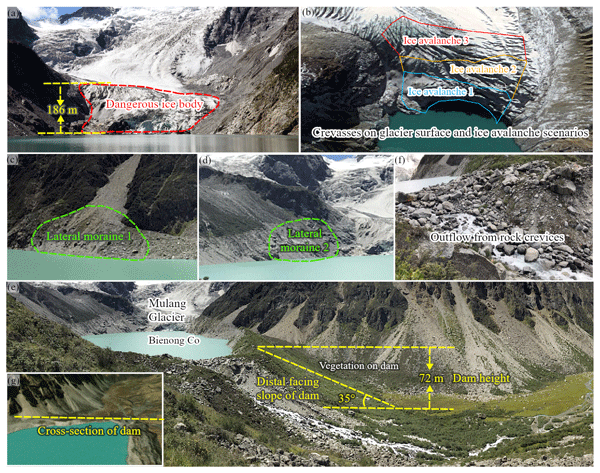
We conducted a comprehensive investigation of Bienong Co, a moraine-dammed glacial lake on the southeastern Tibetan Plateau (SETP), to assess its potential hazards. The maximum lake depth is ~181 m, and the lake volume is ~102.3 × 10⁶ m3. Bienong Co is the deepest known glacial lake with the same surface area on the Tibetan Plateau. Ice avalanches may produce glacial lake outburst floods that threaten the downstream area. This study could provide new insight into glacial lakes on the SETP.
Yu Zhu, Shiyin Liu, Junfeng Wei, Kunpeng Wu, Tobias Bolch, Junli Xu, Wanqin Guo, Zongli Jiang, Fuming Xie, Ying Yi, Donghui Shangguan, Xiaojun Yao, and Zhen Zhang
Earth Syst. Sci. Data Discuss., https://doi.org/10.5194/essd-2022-473, https://doi.org/10.5194/essd-2022-473, 2023
Preprint withdrawn
Short summary
Short summary
In this study, we presented a nearly complete inventory of glacier mass change dataset across the eastern Tibetan Plateau by using topographical maps, which will enhance the knowledge on the heterogeneity of glacier change before 2000. Our dataset, in combination with the published results, provide a nearly five decades mass balance to support hydrological simulation, and to evaluate the contribution of mountain glacier loss to sea level.
Meiping Sun, Sugang Zhou, Xiaojun Yao, Hongyu Duan, and Yuan Zhang
EGUsphere, https://doi.org/10.5194/egusphere-2022-765, https://doi.org/10.5194/egusphere-2022-765, 2022
Preprint withdrawn
Short summary
Short summary
For understanding the occurrence mechanism of surging glaciers in High Mountain Asia, it is essential to ascertain their amounts, distribution and periodicity. Based on images from Landsat satellite from 1986–2021, we identified 244 surging glaciers with high confidence and 2802 events of glacier surge. We also analyzed the periodicity of 36 glaciers which experienced two or more surges. The findings will benefit to enrich dataset and provide basic information of surging glaciers in HMA.
Dahong Zhang, Gang Zhou, Wen Li, Shiqiang Zhang, Xiaojun Yao, and Shimei Wei
Earth Syst. Sci. Data, 14, 3889–3913, https://doi.org/10.5194/essd-14-3889-2022, https://doi.org/10.5194/essd-14-3889-2022, 2022
Short summary
Short summary
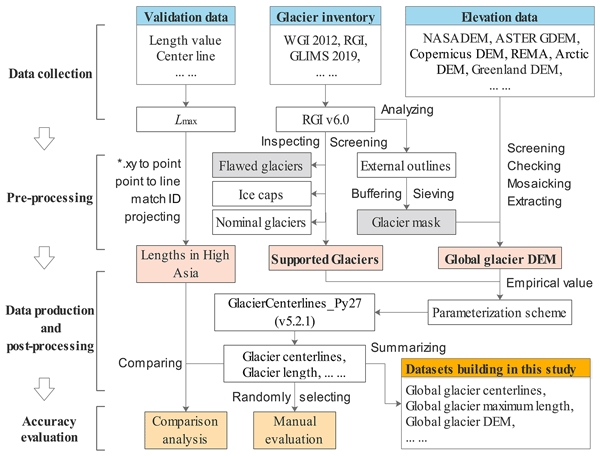
The length of a glacier is a key determinant of its geometry; glacier centerlines are crucial inputs for many glaciological applications. Based on the European allocation theory, we present a new global dataset that includes the centerlines and lengths of 198 137 mountain glaciers. The accuracy of the glacier centerlines was 89.68 %. The constructed dataset comprises 17 sub-datasets which contain the centerlines and lengths of glacier tributaries.
Cited articles
Azam, M. F., Wagnon, P., Berthier, E., Vincent, C., Fujita, K., and Kargel,
J. S.: Review of the status and mass changes of Himalayan-Karakoram
glaciers, J. Glaciol., 64, 61–74, https://doi.org/10.1017/jog.2017.86, 2018.
Badrinarayanan, V., Kendall, A., and Cipolla, R.: SegNet: A Deep
Convolutional Encoder-Decoder Architecture for Image Segmentation, IEEE T.
Pattern Anal., 39, 2481–2495, https://doi.org/10.1109/TPAMI.2016.2644615,
2017.
Baumhoer, C. A., Dietz, A. J., Kneisel, C., and Kuenzer, C.: Automated
Extraction of Antarctic Glacier and Ice Shelf Fronts from Sentinel-1 Imagery
Using Deep Learning, Remote Sens.-Basel, 11, 2529,
https://doi.org/10.3390/rs11212529, 2019.
Bishop, M. P., Olsenholler, J. A., Shroder, J. F., Barry, R. G., Raup, B.
H., Bush, A. B. G., Copland, L., Dwyer, J. L., Fountain, A. G., Haeberli,
W., Kääb, A., Paul, F., Hall, D. K., Kargel, J. S., Molnia, B. F.,
Trabant, D. C., and Wessels, R.: Global Land Ice Measurements from Space
(GLIMS): Remote Sensing and GIS Investigations of the Earth's Cryosphere,
Geocarto Int., 19, 57–84, https://doi.org/10.1080/10106040408542307, 2004.
Bolch, T., Kulkarni, A., Kaab, A., Huggel, C., Paul, F., Cogley, J. G.,
Frey, H., Kargel, J. S., Fujita, K., Scheel, M., Bajracharya, S., and
Stoffel, M.: The state and fate of Himalayan glaciers, Science, 336,
310–314, https://doi.org/10.1126/science.1215828, 2012.
Braithwaite, R. J. and Raper, S. C. B.: Estimating equilibrium-line altitude
(ELA) from glacier inventory data, Ann. Glaciol., 50, 127–132,
https://doi.org/10.3189/172756410790595930, 2009.
Chen, L. C., Zhu, Y. K., Papandreou, G., Schroff, F., and Adam, H.:
Encoder-Decoder with Atrous Separable Convolution for Semantic Image
Segmentation, Proceedings of the European Conference on Computer Vision,
Munich, Germany, 8–14 September 2018, 801–818,
https://doi.org/10.1007/978-3-030-01234-2_49, 2018.
Cheng, D., Hayes, W., Larour, E., Mohajerani, Y., Wood, M., Velicogna, I., and Rignot, E.: Calving Front Machine (CALFIN): glacial termini dataset and automated deep learning extraction method for Greenland, 1972–2019, The Cryosphere, 15, 1663–1675, https://doi.org/10.5194/tc-15-1663-2021, 2021.
China High-resolution Earth Observation System: Homepage, https://www.cheosgrid.org.cn/, last access: 16 May 2022.
Chollet, F.: Xception: Deep Learning with Depthwise Separable Convolutions,
Proceedings of the IEEE Conference on Computer Vision and Pattern
Recognition, Honolulu, Hawaii, 22–25 July 2017, 1251–1258,
https://doi.org/10.1109/CVPR.2017.195, 2017.
Chu, X.: yiyou101/Attention-DeepLab-V3plus: A deep learning approach to extract the glacier outlines (v2.1), Zenodo [code and software], https://doi.org/10.5281/zenodo.7132888, 2022.
Girshick, R.: Fast R-CNN, Proceedings of the IEEE International Conference
on Computer Vision, Santiago, Chile, 13–16 December 2015, 1440–1448,
https://doi.org/10.1109/ICCV.2015.169, 2015.
Grinsted, A.: An estimate of global glacier volume, The Cryosphere, 7, 141–151, https://doi.org/10.5194/tc-7-141-2013, 2013.
Guo, W. Q., Liu, S. Y., Xu, J. L., Wu, L. Z., Shangguan, D. H., Yao, X. J.,
Wei, J. F., Bao, W. J., Yu, P. C., Liu, Q., and Jiang, Z. L.: The second
Chinese glacier inventory: data, methods and results, J. Glaciol., 61,
357–372, https://doi.org/10.3189/2015JoG14J209, 2017.
He, K. M., Zhang, X. Y., Ren, S. Q., and Sun, J.: Deep residual learning for
image recognition, in: Proceedings of the IEEE Conference on Computer Vision and
Pattern Recognition, Las Vegas, USA, 27–30 June 2016, 770–778, https://doi.org/10.1109/CVPR.2016.90, 2016.
He, Y., Yao, S., Yang, W., Yan, H. W., Zhang, L. F., Wen, Z. Q., Zhang, Y.
L., and Liu, T.: An Extraction Method for Glacial Lakes Based on Landsat-8
Imagery Using an Improved U-Net Network, IEEE J-STARS, 14, 6544–6558,
https://doi.org/10.1109/jstars.2021.3085397, 2021.
Heimann, T., van Ginneken, B., Styner, M. A., Arzhaeva, Y., Aurich, V.,
Bauer, C., Beck, A., Becker, C., Beichel, R., Bekes, G., Bello, F., Binnig,
G., Bischof, H., Bornik, A., Cashman, P. M., Chi, Y., Cordova, A., Dawant,
B. M., Fidrich, M., Furst, J. D., Furukawa, D., Grenacher, L., Hornegger,
J., Kainmuller, D., Kitney, R. I., Kobatake, H., Lamecker, H., Lange, T.,
Lee, J., Lennon, B., Li, R., Li, S., Meinzer, H. P., Nemeth, G., Raicu, D.
S., Rau, A. M., van Rikxoort, E. M., Rousson, M., Rusko, L., Saddi, K. A.,
Schmidt, G., Seghers, D., Shimizu, A., Slagmolen, P., Sorantin, E., Soza,
G., Susomboon, R., Waite, J. M., Wimmer, A., and Wolf, I.: Comparison and
evaluation of methods for liver segmentation from CT datasets, IEEE T. Med.
Imaging, 28, 1251–1265, https://doi.org/10.1109/TMI.2009.2013851, 2009.
Howard, A. G., Zhu, M., Chen, B., Kalenichenko, D., Wang, W., Weyand, T.,
Andreetto, M., and Adam, H.: Mobilenets: Efficient convolutional neural
networks for mobile vision applications, arXiv [preprint], https://doi.org/10.48550/arXiv.1704.04861,
17 April 2017.
Huang, B., Zhao, B., and Song, Y. M.: Urban land-use mapping using a deep
convolutional neural network with high spatial resolution multispectral
remote sensing imagery, Remote Sens. Environ., 214, 73–86,
https://doi.org/10.1016/j.rse.2018.04.050, 2018.
Immerzeel, W. W., van Beek, L. P., and Bierkens, M. F.: Climate change will
affect the Asian water towers, Science, 328, 1382–1385,
https://doi.org/10.1126/science.1183188, 2010.
Ji, Q., Dong, J., Liu, R., Xiao, Z. L., and Yang, T. B.: Glacier Changes in
Response to Climate Change in the Himalayas in 1990–2015, Scientia
Geographica Sinica, 40, 486–496,
https://doi.org/10.13249/j.cnki.sgs.2020.03.017, 2020.
King, M. A., Bingham, R. J., Moore, P., Whitehouse, P. L., Bentley, M. J.,
and Milne, G. A.: Lower satellite-gravimetry estimates of Antarctic
sea-level contribution, Nature, 491, 586–589,
https://doi.org/10.1038/nature11621, 2012.
Li, X., Cheng, G. D., Jin, H. J., Kang, E., Che, T., Jin, R., Wu, L. Z.,
Nan, Z. T., Wang, J., and Shen, Y. P.: Cryospheric change in China, Global
Planet. Change, 62, 210–218,
https://doi.org/10.1016/j.gloplacha.2008.02.001, 2008.
Liu, J., Yao, X. J., Liu, S. Y., Guo, W. Q., and Xu, J. L.: Glacial changes
in the Gangdisê Mountains from 1970 to 2016, J. Geogr. Sci., 30,
131–144, https://doi.org/10.1007/s11442-020-1719-6, 2020.
Long, J., Shelhamer, E., and Darrell, T.: Fully Convolutional Networks for
Semantic Segmentation, Proceedings of the IEEE Conference on Computer Vision
and Pattern Recognition, Boston, US, 8–10 June 2015, 3431–3440,
https://doi.org/10.1109/CVPR.2015.7298965, 2015.
Marochov, M., Stokes, C. R., and Carbonneau, P. E.: Image classification of marine-terminating outlet glaciers in Greenland using deep learning methods, The Cryosphere, 15, 5041–5059, https://doi.org/10.5194/tc-15-5041-2021, 2021.
Milletari, F., Navab, N., and Ahmadi, S.: V-Net: Fully Convolutional Neural
Networks for Volumetric Medical Image Segmentation, in: 2016 Fourth
International Conference on 3D Vision, Stanford, US, 25–28 October 2016,
565–571, https://doi.org/10.1109/3DV.2016.79, 2016.
Nie, Y., Zhang, Y. L., Liu, L. S., and Zhang, J. P.: Monitoring Glacier
Change Based on Remote Sensing in the Mt. Qomolangma National Nature
Preserve, 1976–2006, Acta Geographica Sinica, 65, 13–28,
https://doi.org/10.11821/xb201001003, 2010.
Nuimura, T., Sakai, A., Taniguchi, K., Nagai, H., Lamsal, D., Tsutaki, S., Kozawa, A., Hoshina, Y., Takenaka, S., Omiya, S., Tsunematsu, K., Tshering, P., and Fujita, K.: The GAMDAM glacier inventory: a quality-controlled inventory of Asian glaciers, The Cryosphere, 9, 849–864, https://doi.org/10.5194/tc-9-849-2015, 2015.
Oerlemans, J.: Quantifying global warming from the retreat of glaciers,
Science, 264, 243–245, https://doi.org/10.1126/science.264.5156.243, 1994.
Olofsson, P., Foody, G. M., Herold, M., Stehman, S. V., Woodcock, C. E., and
Wulder, M. A.: Good practices for estimating area and assessing accuracy of
land change, Remote Sens. Environ., 148, 42–57,
https://doi.org/10.1016/j.rse.2014.02.015, 2014.
Pfeffer, W. T., Harper, J. T., and O'Neel, S.: Kinematic Constraints on
Glacier Contributions to 21st-Century Sea-Level Rise, Science, 321,
1340–1343, https://doi.org/10.1126/science.1159099, 2008.
Racoviteanu, A. E., Arnaud, Y., Williams, M. W., and Manley, W. F.: Spatial patterns in glacier characteristics and area changes from 1962 to 2006 in the Kanchenjunga–Sikkim area, eastern Himalaya, The Cryosphere, 9, 505–523, https://doi.org/10.5194/tc-9-505-2015, 2015.
Redmon, J., Divvala, S., Girshick, R., and Farhadi, A.: You Only Look Once:
Unified, Real-Time Object Detection, Proceedings of the IEEE Conference on
Computer Vision and Pattern Recognition, Las Vegas, US, 26 June–1 July 2016, 779–788, https://doi.org/10.1109/CVPR.2016.91, 2016.
Robson, B. A., Nuth, C., Dahl, S. O., Hölbling, D., Strozzi, T., and
Nielsen, P. R.: Automated classification of debris-covered glaciers
combining optical, SAR and topographic data in an object-based environment,
Remote Sens. Environ., 170, 372–387,
https://doi.org/10.1016/j.rse.2015.10.001, 2015.
Robson, B. A., Bolch, T., MacDonell, S., Hölbling, D., Rastner, P., and
Schaffer, N.: Automated detection of rock glaciers using deep learning and
object-based image analysis, Remote Sens. Environ., 250, 112033,
https://doi.org/10.1016/j.rse.2020.112033, 2020.
Ronneberger, O., Fischer, P., and Brox, T.: U-Net: Convolutional Networks
for Biomedical Image Segmentation, arXiv [preprint], https://doi.org/10.48550/arXiv.1505.04597, 18
May 2015.
Schrama, E. J. O., Wouters, B., and Rietbroek, R.: A mascon approach to
assess ice sheet and glacier mass balances and their uncertainties from
GRACE data, J. Geophys. Res.-Sol. Ea., 119, 60480–6066,
https://doi.org/10.1002/2013jb010923, 2014.
Sun, M. P., Liu, S. Y., Yao, X. J., Guo, W. Q., and Xu, J. L.: Glacier
changes in the Qilian Mountains in the past half-century: Based on the
revised First and Second Chinese Glacier Inventory, J. Geogr. Sci., 28,
206–220, https://doi.org/10.1007/s11442-018-1468-y, 2018.
Telgarsky, M.: Benefits of depth in neural networks, in: Proceedings of
Machine Learning Research, 29th Annual Conference on Learning Theory, New
York, US, 23–26 June 2016, 1517–1539, http://proceedings.mlr.press/v49/telgarsky16.html (last access: 4 October 2022), 2016.
Tong, X. Y., Xia, G. S., Lu, Q. K., Shen, H. F., Li, S. Y., You, S. C., and
Zhang, L. P.: Land-cover classification with high-resolution remote sensing
images using transferable deep models, Remote Sens. Environ., 237, 111322,
https://doi.org/10.1016/j.rse.2019.111322, 2020.
Wang, Y. L., Du, W. B., and Wang, S. T.: Extracting glacier information from
remote sensing imageries by automatic threshold method of Gaussian mixture
model, National Remote Sensing Bulletin, 25, 1434–1444,
https://doi.org/10.11834/jrs.20219153, 2021.
Wang, Z. Q., Zhou, Y., Wang, F. T., Wang, S. X., and Xu, Z. Y.: SDGH-Net:
Ship Detection in Optical Remote Sensing Images Based on Gaussian Heatmap
Regression, Remote Sens.-Basel, 13, 499, https://doi.org/10.3390/rs13030499,
2021.
Woo, S., Park, J., Lee, J.-Y., and Kweon, I. S.: CBAM: Convolutional Block
Attention Module, in: Proceedings of the European Conference on Computer Vision,
Munich, Germany, 8–14 September 2018, 3–19,
https://doi.org/10.1007/978-3-030-01234-2_1, 2018.
Xie, Z. Y., Haritashya, U. K., Asari, V. K., Young, B. W., Bishop, M. P.,
and Kargel, J. S.: GlacierNet: A Deep-Learning Approach for Debris-Covered
Glacier Mapping, IEEE Access, 8, 83495–83510,
https://doi.org/10.1109/access.2020.2991187, 2020.
Yan, L. L. and Wang, J.: Study of Extracting Glacier lnformation from Remote
Sensing, Journal of Glaciology and Geocryology, 35, 110–118,
10.7522/j.issn.1000-0240.2013.0013, 2013.
Yao, T. D., Thompson, L., Yang, W., Yu, W. S., Gao, Y., Guo, X. J., Yang, X.
X., Duan, K. Q., Zhao, H. B., Xu, B. Q., Pu, J. C., Lu, A. X., Xiang, Y.,
Kattel, D. B., and Joswiak, D.: Different glacier status with atmospheric
circulations in Tibetan Plateau and surroundings, Nat. Clim. Change, 2,
663–667, https://doi.org/10.1038/nclimate1580, 2012.
Ye, Q. H.: Glacier coverage data on the Tibetan Plateau in 2017 (TPG2017,
Version1.0), National Tibetan Plateau Data Center [data set],
https://doi.org/10.11888/Glacio.tpdc.270924, 2019.
Ye, Q. H., Zong, J. B., Tian, L. D., Cogley, J. G., Song, C. Q., and Guo, W.
Q.: Glacier changes on the Tibetan Plateau derived from Landsat imagery:
mid-1970s – 2000–13, J. Glaciol., 63, 273–287,
https://doi.org/10.1017/jog.2016.137, 2017.
Yu, F. and Koltun, V.: Multi-scale context aggregation by dilated
convolutions, arXiv [preprint], https://doi.org/10.48550/arXiv.1511.07122, 23 November 2015.
Zhang, E., Liu, L., and Huang, L.: Automatically delineating the calving front of Jakobshavn Isbræ from multitemporal TerraSAR-X images: a deep learning approach, The Cryosphere, 13, 1729–1741, https://doi.org/10.5194/tc-13-1729-2019, 2019.
Zhang, E., Liu, L., Huang, L., and Ng, K. S.: An automated, generalized,
deep-learning-based method for delineating the calving fronts of Greenland
glaciers from multi-sensor remote sensing imagery, Remote Sens. Environ.,
254, 112265, https://doi.org/10.1016/j.rse.2020.112265, 2021.
Zhao, X. R., Wang, X., Wei, J. F., Jiang, Z. L., Zhang, Y., and Liu, S. Y.:
Spatiotemporal variability of glacier changes and their controlling factors
in the Kanchenjunga region, Himalaya based on multi-source remote sensing
data from 1975 to 2015, Sci. Total Environ., 745, 140995,
https://doi.org/10.1016/j.scitotenv.2020.140995, 2020.
Short summary
The available remote-sensing data are increasingly abundant, and the efficient and rapid acquisition of glacier boundaries based on these data is currently a frontier issue in glacier research. In this study, we designed a complete solution to automatically extract glacier outlines from the high-resolution images. Compared with other methods, our method achieves the best performance for glacier boundary extraction in parts of the Tanggula Mountains, Kunlun Mountains and Qilian Mountains.
The available remote-sensing data are increasingly abundant, and the efficient and rapid...