
the Creative Commons Attribution 4.0 License.
the Creative Commons Attribution 4.0 License.
 | 06 Feb 2026
Observations of creep of polar firn at different temperatures
Kaitlin Keegan
Ian Baker
To improve our understanding of firn compaction and deformation processes, constant-load compressive creep tests were performed on specimens from a Summit, Greenland (72°35′ N, 38°25′ W) firn core that was extracted in June 2017. Cylindrical specimens were tested at temperatures of −5, −18 and −30 °C from depths of 20, 40 and 60 m at stresses of 0.21, 0.32 and 0.43 MPa, respectively. The microstructures were characterized before and after creep using both X-ray micro-computed tomography (micro-CT) and thin sections viewed between optical crossed polarizers. The results of these experiments comprise a novel data set on the creep of firn at three depths of a firn column at three different temperatures, providing useful calibration data for firn model development. Examining the resulting strain vs. time and strain vs. strain rate curves from the creep tests revealed the following notable features. First, the time exponent k was found to be 0.34–0.69 during transient creep, which is greater than the 0.33 usually observed in fully-dense ice. Second, the strain rate minimum (SRmin) in secondary creep occurred at a greater strain from specimens with lower density and at higher temperatures. Third, tertiary creep occurred more easily for the lower-density specimens at greater effective stresses and higher temperatures, where strain softening is primarily due to recrystallization. Fourth, the SRmin is a function of the temperature for a given firn density. Lastly, we developed empirical equations for inferring the SRmin, as it is difficult to measure during creep at low temperatures. The creep behaviors of polar firn, being essentially different from full-density ice, imply that firn densification is an indispensable process within the snow-to-ice transition, particularly firn deformation at different temperatures connected to a changing climate.
- Article
(11193 KB) - Full-text XML
- BibTeX
- EndNote


Understanding firn compaction and densification experimentally is critical for developing physics-based firn models that are necessary for many glaciological applications. For example, such models are essential for reconstructing ice-core paleoclimate records by simulating the lock-in depth of gases and the smoothing of climate signals (Schwander et al., 1997; Goujon et al., 2003). They are also crucial for interpreting ice-mass changes from satellite altimetry data, as they allow for the accurate correction of firn air content and surface elevation changes not related to underlying ice dynamics (Ligtenberg et al., 2011; Simonsen et al., 2013). However, the firn models used for these applications are empirical and are known to perform poorly outside of their calibration range (Lundin et al., 2017). Thus, a better understanding of firn compaction is necessary to refine firn models for these important glaciological applications. Laboratory compressive experiments on firn and ice improve our understanding of their respective flow laws and advance the development of firn models under a range of conditions. The rheology of polycrystalline ice, particularly its temperature-dependent creep deformation, is a cornerstone of glaciological modeling. Numerous studies have established a robust framework for understanding ice deformation, primarily through laboratory creep experiments (e.g. Glen, 1955; Weertman, 1983; Budd and Jacka, 1989; Durham and Stern, 2001; Goldsby and Kohlstedt, 2001; Petrenko and Whitworth, 1999). This body of work has confirmed that ice creep is strongly governed by temperature, typically described by an Arrhenius relationship with a well-constrained activation energy for grain-scale processes like dislocation glide and climb (e.g. Jacka, 1984; Hooke, 2005). In contrast, the mechanical behavior of firn, the intermediate porous material between snow and glacial ice, remains comparatively poorly characterized, especially with respect to temperature. The experimental observations are interpreted by drawing parallels between firn deformation and the mechanical properties of its constituent material, polycrystalline ice. This connection is formalized through a poromechanics approach, where the behavior of the porous firn is derived from that of the ice skeleton using continuum mechanics and homogenization principles (Scapozza and Bartelt, 2003; Gagliardini and Meyssonnier, 2000; Coussy, 2004; Hutter and Johnk, 2004; Srivastava et al., 2010; Theile et al., 2011). While numerous studies have investigated ice deformation (e.g. Steinemann, 1954; Maeno and Ebinuma, 1983; Li et al., 1996; Jacka and Li, 2000; Song et al., 2006a, 2006b, 2008; Treverrow et al., 2012; Hammonds and Baker, 2016, 2018) and firn deformation (e.g. Landauer, 1958; Mellor, 1975; Salm, 1982; Ambach and Eisner, 1985; Meussen et al., 1999; Bartelt and von Moos, 2000; Theile et al., 2011; Li and Baker, 2021, 2022a), existing firn data are sparse and fragmented. A critical knowledge gap persists in the systematic experimental quantification of firn's mechanical response across a broad range of temperatures. Temperature is a first-order control on firn densification and deformation rates, yet most laboratory studies have been conducted at a limited number of isothermal conditions, often focused on a single density or at temperatures near the melting point (e.g. Mellor, 1975; Maeno and Ebinuma, 1983). Consequently, there is a pronounced lack of experimental data necessary to derive the systematic activation energy for the creep of firn over its full density spectrum. This parameter is not merely a scalar but is likely a function of density, microstructure, and the dominant deformation mechanism (compaction versus shear), transitioning from grain-boundary sliding in low-density firn to dislocation creep in high-density firn and ice (Hammonds and Baker, 2018; Li, 2022; Li and Baker, 2022a). The absence of comprehensive, temperature-variable creep data for firn across its density range renders it insufficient for constraining the temperature-dependence terms in modern, physics-based firn models. Our work fills this gap via X-ray micro-computed tomography-analyzed mechanical examinations, e.g. a systematic series of constant-stress creep experiments on firn cores of varying density, conducted across a thermally controlled range from −30 to −5 °C. This allows for the direct determination whether the apparent activation energy is a function of density, thereby providing the essential experimental foundation needed to improve predictions of firn densification in ice-sheet and glacier models. Notably, the mechanical behavior of two-phase flow coupling the airflow with the ice matrix deformation has not yet been performed experimentally hitherto, even though the role of the microstructures of firn on airflow has been studied (Albert et al., 2000; Courville et al., 2010; Adolph and Albert, 2014). This difficulty is largely due to the limitations of the observation techniques of nondestructive visualization of the microstructures during snow and firn deformation. Thus, caution should be taken when extending the conclusions to ice sheet and glacier scales from sample laboratory experiments. Macroscopically, the creep of firn obeys a power-law dependence of the strain rate on the stress at constant stresses and temperature, similar to that of full-density ice (Li and Baker, 2022a). Note that both the diffusivity and permeability of the air in the pores (Albert et al., 2000; Courville et al., 2010; Adolph and Albert, 2014) impact heat conduction of the ice matrix, and hence the grain growth. This is tightly tied to the micro-mechanisms, e.g. grain-boundary and lattice diffusion of the ice crystals (Li and Baker, 2021), superplastic deformation and inter-particle sliding from dislocation motion in the ice necks (Bartelt and Von Moos, 2000), and likely rearrangement of the ice particles (Perutz and Seligman, 1939; Anderson and Benson, 1963; Ebinuma and Maeno, 1987).
Through experiments on isotropic ice samples subjected to uni-axial compaction at octahedral stresses of 0.1–0.8 MPa and temperatures from −45 to −5 °C, Jacka and Li (2000) determined the mechanisms involved in the empirical power-law flow, which was derived by Glen (1955) for stresses ranging from 0.1–1 MPa at temperatures spanning from −13 °C to the melting-point. They found that dynamic recrystallization predominated at higher temperatures and stresses, whereas crystal rotation governed at lower temperatures and stresses. Later, Goldsby and Kohlstedt (2001) found that ice could exhibit superplastic flow, which depends inversely on the grain size, particularly for fine-grained ice, while both dislocation creep and basal slip-limited creep were unrelated to the grain size at stresses of 0.1 MPa or less over a wide range of temperatures. Moreover, Baker and Gerberich (1979) reported that the apparent activation energy for creep for polycrystalline ice, which was derived from tests at constant stress and temperatures ranging from −40 to −5 °C, increased with increasing volume fraction of inclusions (bubbles, impurities, dust, and air clathrate hydrates). Such inclusions governed the evolution of grain size related to thermal activations. The activation energies for the creep of snow and ice have been determined by a number of authors, and values ranging from 58.6–113 kJ mol−1 were obtained under both uniaxial and hydrostatic experiments for snow with a density of ∼ 400 kg m−3 at −13.6 to −3.6 °C (Landauer, 1958); 44.8–74.5 kJ mol−1 from snow with densities of 440–830 kg m−3 at −34.5 to −0.5 °C (Mellor and Smith, 1966); ∼ 72.9 kJ mol−1 for firn with a density of 320–650 kg m−3 at the South Pole (Gow, 1969); 69 ± 5 kJ mol−1 for a mean snow density of 423 ± 8 kg m−3 at −19 to −11 °C (Scapozza and Bartelt, 2003); the 78 kJ mol−1 from polycrystalline ice compression deformation at a temperature of −10 °C (Duval et al., 1983); ∼ 60 kJ mol−1 for artificial and natural ice at the South Pole (Pimienta and Duval, 1987); and 78 ± 4 kJ mol−1 for monocrystal ice at −20 to −4.5 °C and 75 ± 2 kJ mol−1 for bicrystal ice at −15 to −4.5 °C (Homer and Glen, 1978). In summary, the flow law of polycrystalline ice and firn depends on the effects of recrystallization, grain size, inclusions (Mellor and Testa, 1969; Vickers and Greenfield, 1968; Barnes et al., 1971; Baker and Gerberich, 1979; Goodman et al., 1981), and the temperature.
With advanced observation techniques, the relevant microstructural parameters of snow and firn have been characterized by a number of scientists (Arnaud et al., 1998; Coleou et al., 2001; Flin et al., 2004; Wang and Baker, 2013; Wiese and Schneebeli, 2017; Li, 2022). Using X-ray micro-computed tomography (micro-CT), Li and Baker (2022b) characterized metamorphism from snow to depth hoar under opposing temperature gradients. Only rarely has work been performed on the co-effects of temperature and stress on the densification of firn while simultaneously visualizing the microstructural changes using a micro-CT. For example, Schleef et al. (2014) reported that densification under varying conditions of overburden stress and temperature from natural and laboratory-grown new snow showed a linear relationship between density and the specific surface area (SSA). To this end, the aim of our present work is to investigate the temperature dependence of the creep of polar firn and relate this to the change of microstructure determined using micro-CT studies on firn obtained from Summit, Greenland in 2017. As is well known, temperature is a key parameter affecting the flow of firn and ice, and plays a determined role in their deformation, especially for polythermal and temperate glaciers. Due to the great difficulty of analyzing firn and ice deformation with the presence of liquid water, this work focuses on the firn creep from the dry snow zone, i.e., areas without meltwater, at different temperatures.
2.1 Samples
Three cylindrical samples (22 ± 0.5 mm diameter; 50 ± 0.5 mm high) were produced at each of three depths of 20, 40 and 60 m from the same 2017 Summit, Greenland firn core that was studied in Li and Baker (2022a). Both the densities and porosities of these above samples are typical of values in the snow-to-ice transition zone as introduced in Section 1. It is important to note that the reduction in effective stress with increasing depth is evident in samples taken from these three specified depths (Appendix A). Before creep testing, one cylindrical firn samples from each depth was stored at a temperature of −5 ± 0.5, −18 ± 0.5, and −30 ± 0.5 °C for two days to achieve thermal equilibrium (Li and Baker, 2022a). It's also important to note that firn is a heterogeneous material that can have variations in layering, fabric, grain size, and impurity concentration across short distances. Thus, care was taken to extract the three replicate samples from the core at each depth as closely as possible to reduce the variability in their initial conditions.
2.2 Creep measurements
Three home-built creep jigs were placed in individual Styrofoam boxes in three different cold rooms that were held at temperatures of −5 ± 0.5, −18 ± 0.5 and −30 ± 0.5 °C. Each creep jig consists of an aluminum base plate and three polished aluminum-guide rails passing through linear bearings that hold the upper aluminum loading plate (Fig. 1). A linear voltage differential transducer (LVDT-Omega LD-320: resolution of 0.025 %; linearity error of ±0.15 % of full-scale output), parallel to the three aluminum-guide rails, was located adjacent to the center of the upper plate, and fixed firmly using a screw through the plate (Fig. 1) for measuring the displacement during a test. The displacement was logged every 5 s using a Grant SQ2010 datalogger (accuracy of 0.1 %). Temperatures were logged at 300 s time intervals over the entire test period, using a k-type thermocouple (Omega RDXL4SD thermistor: resolution of 0.1 °C) that was mounted inside each box. In this work, specimens were tested at temperatures of −5 ± 0.2, −18 ± 0.2 and −30 ± 0.2 °C from depths of 20 m (applied stress 0.21 MPa), 40 m (0.32 MPa) and 60 m (0.43 MPa). There are smaller error bars for the temperature of the specimens than the room temperature because the creep jigs were in insulated Styrofoam boxes. The stresses were chosen based on experience from previous tests (Li and Baker, 2022a) in order to give measurable creep rates in a reasonable time.

Figure 1Schematic illustrating the home-built compressive creep jigs. More details can be found in (Li and Baker, 2022a).
2.3 X-ray micro-computed tomography (micro-CT)
Each specimen at each depth and temperature combination was scanned using a Skyscan 1172 micro-CT, before and after creep testing. Each micro-CT scan lasted ∼ 2 h. The cubic Volume of Interest (VOI, a side length of 8 mm) was taken from near the center of the firn specimen as conducted in Li and Baker (2022a). The microstructural parameters obtained from the micro-CT data are the SSA, the mean structure thickness of the ice matrix (S.Th), the area-equivalent circle diameter of the pores (ECDa), the total porosity (TP), the closed porosity (CP), and the structure model index (SMI). The SSA (mm−1) is the ratio of the ice surface area to total firn volume (ice plus air) in a VOI analytical element, and is calculated using the hexahedral marching cubes algorithm via CTAn software (Wang and Baker, 2013). It characterizes the thickness and complexity of the firn microstructure. Changes in SSA indicate a change in free energy of the ice surfaces, the decrease of which represents the occurrence of sintering-pressure. The S.Th (mm) is the mean structure thickness of an ice matrix (Hildebrand and Ruegsegger, 1997), which represents the characteristic size of an ice particle in the firn, where the ice particle consists of one or many crystals or grains. It is measured based on the largest sphere diameter that encloses a point in the ice matrix and is completely bounded within solid surfaces. The ECDa (mm) is the diameter of a circle having the same area as the average for all pores in the VOI from the 2-D binary images, indicative of the characteristic size for the void space (Adolph and Albert, 2014). The TP (%) is the ratio of the pore volume, including both open and closed pores, to the total VOI. The CP (%) is the ratio of the volume of the closed pores to the total volume of solid plus closed pores volume in a VOI, while the open porosity (%) is the ratio of the volume of the open pores to the total VOI. The SMI is calculated based on the dilation of a 3-D voxel model (Hildebrand and Ruegsegger, 1997) , where S′ is the change in the surface area due to dilation, and V and S are the object volume and surface area, respectively. It indicates the prevalent ice curvature, negative values of which represent a concave surface, e.g. the hollow air structure surrounded by an ice matrix. The more negative the SMI value, the more spherical the pore. Notably, the micro-CT-derived density of each specimen agrees well with the bulk density measured using the mass-volume approach (Li and Baker, 2021).
2.4 Thin section preparation and imaging
Thin sections for optical photographs before and after creep testing were cut from bulk specimens, one side of which was first smoothed with a microtome. This side was then frozen onto a glass plate (100 × 60 × 2 mm) by dropping supercooled gas-free water along its edges. Its thickness was reduced to ∼ 2 mm by a band saw, and finally thinned further to a uniform thickness of ∼ 0.5 mm using a microtome. Images were captured using a digital camera after each thin section was placed on a light table between a pair of crossed polarizing sheets.
3.1 Microstructures before creep
Increasing firn density with increasing depth from either of the −5, −18, and −30 °C specimens can be readily recognized by visual inspection of the micro-CT 3-D reconstructions of the firn microstructure (Fig. 2). Correspondingly, the microstructural parameters, with the exception of the CP, changed monotonically with increasing depth at each temperature, e.g. the −30 °C samples increased in density from 591 ± 1.4, to 683 ± 4.2, to 782 ± 1.5 kg m−3, decreased in SSA from 4.64 ± 0.04, to 3.3 ± 0.06, to 2.39 ± 0.01 mm−1, and decreased in TP from 35.6 ± 0.05 %, 25.6 ± 0.4 %, to 14.8 ± 0.2 % at 20, 40, and 60 m, respectively (Table 1). These above changes are similar to those previously observed in this firn core (Li and Baker, 2022a), implying that the sintering-pressure mechanism plays a crucial role in the densification of polar firn due to the increasing overburden of snow and firn with increasing depth. However, the microstructures of the samples from the three temperatures at each depth show little variability and do not monotonically change with temperature, e.g. at 20 m depth the −5, −18, and −30 °C samples having densities of 589 ± 1.3, 615 ± 2.5, and 591 ± 1.4 kg m−3, and SSAs of 4.74 ± 0.03, 4.51 ± 0.04, and 4.64 ± 0.04 mm−1, respectively (Figs. 2–3; Table 1). Here, despite the −18 °C specimen having a higher density than the two others at −5 and −30 °C, is not possible to conclude that the sintering of firn is not directly related to the temperature. This is likely because a thermal equilibration period of two days in the absence of compression is too short to sufficiently exert the influence of temperature on firn sintering. The microstructural differences seen in these specimens more likely arose from the initial samples themselves, which were anisotropic and heterogeneous even if taken from the same depth, attributed to firn pre-deformation and partial annealing before experiments (Li and Baker, 2022a).

Figure 2Micro-CT 3-D reconstructions (the side length of each cubic volume of interest is 8 mm) of specimens before and after creep testing at the depths and temperatures shown. Grey voxels represent ice in the firn structure.
Table 1Microstructural parameters derived from Micro-CT for samples at −5, −18, and −30 °C from depths of 20, 40, and 60 m before creep.

Note: SSA is the specific surface area, S.Th is the structure thickness, TP is the total porosity, CP is the closed porosity, SMI is the structure model index, and ECDa is the area-equivalent circle diameter.
3.2 Microstructures after creep
The microstructural evolution is characterized by the microstructural parameters shown in Fig. 3. The largest changes occurred in the −5 °C specimens due to the higher temperature, i.e., the density, S.Th, and CP increased, while the ECDa, TP, SSA, and SMI decreased, indicative of consolidation of the firn after creep. It is important to note that for the 60 m sample tested at −5 °C, there was no change in density, i.e., 790.2 ± 1 kg m−3 before creep vs. 790.7 ± 0.9 kg m−3 after creep, or TP, i.e., 14.0 ± 0.1 % before creep vs. 13.9 ± 0.1 % after creep. This lack of microstructural change is due to the high initial density, which was close to the firn pore close-off density of ∼ 830 kg m−3. Thus, the creep of this sample may involve a transition from firn to bubbly ice, as is also indicated by the increase in CP, which would have made it difficult to compress further. Intriguingly, some of the changes in microstructure observed in the micro-CT 3-D reconstructions from the specimens before and after creep, e.g. the distribution of ice-space, are indistinguishable in Fig. 2. This is presumably due to the relatively large initial particle size, or from radial dilation exceeding the axial compression because of the small strains that occurred at relatively low temperatures.

Figure 3Density, structure thickness (S.Th), area-equivalent circle diameter (ECDa), specific surface area (SSA), total porosity (TP), closed porosity (CP), and structure model index (SMI) of the firn samples before and after creep at three temperatures (orange, magenta, and blue lines) from depths of 20, 40 and 60 m. Error bars indicate the variation of each microstructural parameter as derived from three different VOIs of the same sample.
One exception to the expected microstructural change after creep was the decrease of CP, which was likely due to the measurement uncertainty of the micro-CT (Burr et al., 2018), or radial expansion of the specimen during creep. Another exception was the decrease in density after creep for the −18 °C specimen at 20 m and the −30 °C specimen at 60 m, which arose due to a de-densification effect produced by temperature gradient metamorphism, as confirmed by the increase of both TP and S.Th (Li and Baker, 2022b). The thermal gradient appears to be associated with a fluctuation of 0.2 °C around the test temperature, similar to temperature cycling occurred within firn (Mellor and Testa, 1969; Weertman, 1985), which stems from the thermometer's inherent accuracy as noted in Sect. 2.2 (−5 ± 0.2, −18 ± 0.2 and −30 ± 0.2 °C). In the relatively simple deformation found at ice-sheet dome sites, such as Summit, there is no mechanism to decrease density during compression. At sites closer to the ice sheet margins, cracking due to extension of the ice may cause a localized decrease in density. The rate of firn densification should decrease with increasing depth at a given temperature, due to the decrease of effective stress with increasing depth (Appendix A). As a matter of fact, the density of the –5 °C samples after creep increased by 32, 44, and 0.5 kg m−3 for the 20, 40, and 60 m samples, respectively. The 44 kg m−3 unexpectedly outnumbers the 32 kg m−3, implying that the densification of firn is also affected by other undetermined factors, e.g. the effect of inclusions, in addition to the stress and temperature.
Another way to investigate microstructure changes before and after creep tests is to compare their grain sizes using thin sections. As an example, Fig. 4 shows optical micrographs of thin sections made from the −5 °C sample at 40 m before and after creep to a strain of 19.3 %, where the significant reduction in grain size from 0.8 ± 0.67 to 0.5 ± 0.32 mm implies the occurrence of recrystallization during testing. However, it is also unclear at what strain recrystallization was initiated in each test, as noted in Li and Baker (2022a). Recrystallization occurs frequently at a temperature higher than the homologous temperatures of 0.9 Tm. However, no evidence was found for recrystallization after testing at the relatively cold −18 and −30 °C conditions, probably due to the small creep strains at these relatively low temperatures. The creep mechanisms for these samples, and whether the mechanisms were different at different temperatures, could not be determined from the micro-CT-derived microstructural observations alone, because the micro-CT can only capture the microstructure before and after creep. Instead, plots of both strain vs. time and strain rate vs. strain can be used to elucidate the onset of recrystallization during creep (Sect. 3.3 and 3.4; Ogunmolasuyi et al., 2023).

Figure 4Optical micrographs of thin sections, and the distribution of grain sizes for the 40 m sample at −5 °C (a) before and (b) after creep (19.3 % strain).
3.3 Relationship between strain and time
Figure 5 shows the strain vs. time creep curves. The specimens at −5 °C at 20 m and −18 °C at 20, 40, and 60 m, show decelerating transient creep and quasi-viscous steady-state creep, while the specimens at −5 °C at 40 and 60 m show transient, secondary, and accelerating tertiary creep. Note that the curves from the −30 °C specimens are not easily interpreted due to a large amount of noise arising from both the insufficient resolution of a linear voltage differential transducer (Li and Baker, 2022a) and the very small strains. The transient creep stage may be caused by strain hardening that occurs from the yield point to the ultimate strength (Glen, 1955; Jacka, 1984). The plastic deformation is accommodated by an increase in dislocation density through dislocation multiplication or the formation of new dislocations (Frost and Ashby, 1982; Duval et al., 1983; Ashby and Duval, 1985), which leads to an increase of the firn strength as the dislocations become pinned or tangled, and thus more difficult to move. The initial decrease of creep rate may also be related to the rearrangement of dislocations into a more stable pattern through a dragging mechanism (Weertman, 1983) for the −5 °C specimens. The tertiary creep stage may be associated with strain softening deriving either from the thermally-activated processes at the high homologous temperature approaching the melting point of ice, or from recrystallization (Li and Baker, 2022a). Clearly, the creep rate of firn is sensitive to temperature under constant stress at a given depth, viz., the creep rate increases with increasing temperature (Fig. 5). Incidentally, there is no evidence of the onset of recrystallization in the creep curves themselves despite the thin-section observation that −5 °C specimens clearly underwent recrystallization during creep (Sect. 3.2).

Figure 5Strain vs. time for firn specimens at −5 °C (yellow lines), −18 °C (blue lines), and −30 °C (brown lines), from depths of 20 m (applied stress 0.21 MPa), 40 m (0.32 MPa) and 60 m (0.43 MPa). The black dashed curves represent fits to a modified Andrade-like equation with the time exponents indicated on the curves, if any. Note: The y-axis limits vary across the subfigures.
A modified Andrade-like equation in Li and Baker (2022a) was used to describe the transient creep behavior of the firn, in which the primary creep was well represented in black dashed lines on the creep curves in Fig. 5. The time exponent k, derived from the above equation, ranges from 0.34–0.69: the data for the −30 °C specimens are excluded since the noise in the results makes them uninterpretable. These k values are also smaller than those from monocrystalline and bicrystalline ice: 1.9 ± 0.5, 1.5 ± 0.2, and 1.3 ± 0.4 (Li and Baker, 2022a and references therein). We also note that the k values from the specimens at −5 °C from 20–60 m (0.68, 0.61, and 0.69), and at −18 °C from 40 m (0.49) are greater than 0.33, while the k value from the −18 °C specimens at 20 m (0.34) and 60 m (0.34) are close to 0.33 that is usually obtained for full-density polycrystal ice. Interestingly, an evident relationship between the density of firn and the k values, regardless of the effect of stress (Li and Baker, 2022a) and temperature, remains unknown. A greater k value signifies faster deformation. The k values derived for firn are generally higher than those for polycrystalline ice, implying that the higher firn deformation rates compared to those of ice (k= ∼ 0.33; Cuffey and Paterson, 2010, and references therein) are likely related to the fewer grain-boundary constraints with more void space in firn (Li and Baker, 2022a; Li et al., 2023). Clearly, the above k values, which increased with increasing temperature (Fig. 5), indicate that deformation is easier because of the lower viscosity at the higher temperature. Thus, k seems to be a state variable with respect to temperature. In addition, k values greater than 0.33 may be related to the decrease of viscosity of the firn specimens (Freitag et al., 2002; Fujita et al., 2014). k values lower than 0.33 observed under constant load and temperature occurred at relatively low effective stresses (Li and Baker, 2022a). The identified trend of steadily declining k values across the temperature range of −5 to −18 °C, however, represents a significant gap in our current understanding, necessitating a dedicated investigation into the microstructural or metamorphic causes. Alternatively, the enhanced cohesion strength in the firn, which resulted from both the ice matrix with higher purity and the stronger bond connection of inter-grains, increases the viscosity of test samples and lowers the k value to less than 0.33.
3.4 Relationship of strain rate to strain
Figure 6 shows log strain rate vs. strain plots from all the −5 and −18 °C specimens; the −30 °C samples are excluded due to noise. The evolution of the strain rate is characterized more clearly in Fig. 6 than in Fig. 5. Clearly, the strain rate is also a state variable of temperature, where the strain rate increases with increasing temperature for a given strain at a given depth (Fig. 6; Table 2).
Table 2Observed and inferred strain rate minima and strains observed at the strain rate minima. In the table, the experimentally observed SRmin for the 20 m sample (in bold italic) is used to calculate the corresponding SRmin values for the 40 and 60 m samples in the PC1-SRmin column (in italic). Following the same methodology: the observed SRmin from the 40 m sample is used for calculations in the PC2-SRmin column, and the observed SRmin from the 60 m sample is used for the PC3-SRmin column.

The SRmin without the prefix is the observed values during creep, while the SRmin with a prefix is the inferred values. Note that PC-SRmin is the abbreviation of the post-calibration SRmin, and that −30 °C(U) and −30 °C(L) indicate the upper and lower bound from the −30 °C samples from 44.8 and 113 kJ mol−1, respectively. PC1-SRmin, PC2-SRmin, and PC3-SRmin are described in Appendix B. The symbol – indicates the unavailable values of SRmin and the strain value at the SRmin observed during creep.

Figure 6Log strain rate vs. strain from the firn specimens at temperatures of −5 and −18 °C from depths of 20 m (applied stress 0.21 MPa), 40 m (0.32 MPa) and 60 m (0.43 MPa). Samples from −30 °C are not shown due to the very large noise. The blue lines represent discrete strain rates, which are calculated by extracting the strain data hourly, while the orange lines represent a moving average of 15 moving windows with respect to the strain.
The strain rate minimum at the secondary creep stage (SRmin) and the strain at the SRmin for all the −5 and −18 °C specimens are shown in Fig. 6 and Table 2. The SRmin was reached at a strain of 11.8 %, 7.5 % and 2.7 % for the −5 °C specimens from depths of 20, 40, and 60 m, respectively, consistent with strains at the SRmin decreasing with increasing depth at a given temperature in Fig. 9 and Table 4 in Li and Baker (2022a). For the –18 °C specimens, the SRmin occurred over a range of strains from 1.81 %–2.9 % at 20 m, at a fixed strain of 4.1 % at 40 m, and at a strain oscillating between 1.1 % and 1.8 % at 60 m. These values of strain at different SRmin values are different from those usually observed at strains of 0.5 %–3 % for fully-dense ice (Cuffey and Paterson, 2010, and references therein), implying different mechanical behavior between firn and pure ice (Duval, 1981; Mellor and Smith, 1966; Jacka, 1984; Li et al., 1996; Jacka and Li, 2000; Song et al., 2005, 2008; Cuffey and Paterson, 2010). Overall, the strain at the SRmin is greater with lower density and higher temperature, e.g. 11.8 % strain from the −5 °C specimens at 20 m, and 4.1 % strain from the −18 °C specimens at 40 m. This is likely due to the effect of strain hardening on density and temperature (Li, 2023). Additionally, tertiary creep is observed during both quasi-steady state deformation, particularly in the −5 °C specimens at depths of 40 and 60 m, and in the ascending stage, as seen in the −5 and −18 °C specimens at 20 m, along with the −18 °C specimen at 40 m. This mechanical behavior is facilitated by lower firn density, increased effective stress, and elevated creep temperatures. For instance, in the −5 °C specimens at 20 m, strain softening primarily results from recrystallization (Duval, 1981; Jacka, 1984; Jacka and Li, 2000; Song et al., 2005; Faria et al., 2014). Also, the activation of easy slip systems contributes to this process (Jonas and Muller, 1969; Duval and Montagnat, 2002; Alley et al., 2005; Horhold et al., 2012; Fujita et al., 2014; Eichler et al., 2017; Vedrine et al., 2025). It is noteworthy that Jacka and Li (1994) observed that steady-state tertiary ice creep, which is marked by stable grain size, is influenced more by applied stresses than by temperature. This finding suggests that there exists a balance between the activation energies required for grain growth and subdivision at a specific temperature.
3.5 Apparent activation energy for creep
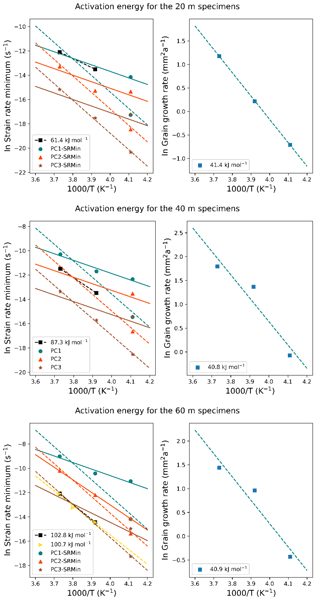
Experimental observations of the SRmin are limited, as they only occurred for the −5 and at −18 °C specimens at each depth (Table 2). It is hard to achieve the SRmin for all firn specimens in laboratory environments (Landauer, 1958), especially under low temperatures and stresses such as those from the −30 °C specimens in this work. To this end, we offer the various possibilities of the SRmin using the evidence we have. The value of the apparent activation energy of creep, Qc (kJ mol−1), is equal to the slope of a line fitted versus as did in Goldsby and Kohlstedt (1997, 2001), using the Arrhenius relation , where (s−1) is the strain rate, B (s−1 Pa−n) is the material parameter, σ (MPa) is the applied stress, n is the creep (stress) exponent, R (8.314 J mol−1 K−1) is the gas constant, and T (K) is Kelvin temperature. It is noted that under constant-stress conditions, the value of the stress exponent n influences the pre-exponential factor B but does not affect the slope of the Arrhenius plot and therefore the derived activation energy Qc. First, the estimation of Qc is based on only two SRmin values from the −5 and −18 °C samples at each depth (Table 2). Glen-King's model treats the pre-factor A, material parameter B, and stress exponent n as constants (Glen, 1955; Goldsby and Kohlstedt, 2001). This simplification is valid by using the unifying concept of normalized effective stress. The effective stress captures the complex multi-physical behavior of the two-phase ice-air system, accounting for: (1) The incompressibility of individual ice grains versus the compressibility of the porous ice skeleton, (2) The coupled flow of ice and air; and (3) The interplay between different strain components (axial, radial, volumetric, and true). This framework is grounded in the principles of poromechanics, originally developed for soils and later applied to snow and ice (Gubler, 1978; Hansen and Brown, 1988; Mahajan and Brown, 1993; Chen and Chen, 1997; Lade and De Boer, 1997; Ehlers, 2002; Khalili et al., 2004; Gray and Schrefler, 2007; da Silva et al., 2008; Nuth and Laloui, 2008). The variability in density for the samples from 20 m depth on the mechanical behavior are negligible due to a small difference (up to ∼ 4 %), between samples, which falls within an acceptable error range in previous studies. This is likely related to multiple factors, including the intrinsic properties of the samples, e.g. inclusions (impurities, dust, bubbles, clathrate hydrates), the effects of deformation and partial annealing of firn due to stress distribution and temperature changes during drilling, extraction, transportation, or storage, and the fact that the samples are taken from adjacent parts of the core, and might capture heterogeneous density layers, as well as potential measurement errors associated with the equipment used. The Qc values from the 20, 40, and 60 m specimens were calculated to be 61.4, 87.3, and 102.8 kJ mol−1, respectively (Fig. 7). Based on the three SRmin from the −5 and −18 °C samples at 60 m in this work, and from −10 °C samples at 60 m in Li and Baker (2022a), a Qc value for the 60 m specimen was calculated to be 100.7 kJ mol−1. To see whether or not these above Qc values are reliable, we estimated the activation energy of grain-boundary diffusion/viscosity, Qgbd (kJ mol−1), using the relation , in an alternative form of , where K is the observed rate of grain growth (mm2 a−1), and are the measured mean grain area (mm2) in a firn sample at the onset of the creep (t= 0), and at the end time of the creep (t-year), andk is a constant grain growth factor. The grain growth rates are plotted on a logarithmic scale against the reciprocal of T (Fig. 7). For changes in grain size from the related specimens before and after creep see Table 3. Correspondingly, the Qgbd values calculated were 41.4, 40.8, and 40.9 kJ mol−1 for the specimens at 20, 40, and 60 m, respectively. These Qgbd values are comparable to the values of 40.6 kJ mol−1 obtained in laboratory experiments on polycrystalline ice (Jumawan, 1972), and 42.4 kJ mol−1 from 13 polar firn cores (Cuffey and Paterson, 2010) for grain-boundary self-diffusion of polycrystalline ice. Further, the ratio of is 0.67, 0.47, and 0.4 for the 20, 40, and 60 m specimens, respectively. We noted that the ratio of 0.67 for was recommended by Hobbs (1974) and Cuffey and Paterson (2010). The Qc values calculated using the Arrhenius relation for the 40 and 60 m specimens are likely greater than the actual values, and hence are seemingly less reliable. There is little difference between the two-SRmin-derived Qc value (102.8 kJ mol−1) and the three-SRmin-derived Qc value (100.7 kJ mol−1), implying that these two avenues for calculating Qchave equal utility. Moreover, the above Qgbd values are lower than the 48.6 kJ mol−1 that was inferred by the grain growth rate for firn samples with densities ranging from 320–650 kg m−3 from cores drilled at the South Pole, Antarctic (Gow, 1969), which makes a ratio of 0.67 for an unreliable sole-criterion. In short, it is difficult to assess the reliability of both Qc and Qgbd, as discussed above due to their scatter and debates in the current literature. Thus, these Qc values estimated in this work, ranging from 61.4–102.8 kJ mol−1, are reasonable, aligning with the literature range of 44.8–113 kJ mol−1 (Table 4).
Table 3Grain area (mm2) measured from optical thin sections for samples at −5, −18, and −30 °C from depths of 20, 40, and 60 m before and after creep.


Figure 7Arrhenius plots to estimate the apparent activation energy of creep (Qc; left panel) and the apparent activation energy of grain-boundary diffusion (Qgbd; right panel) from the firn specimens noted. The teal, orange, and brown solid lines are the upper bound (44.8 kJ mol−1) of PC1-SRmin, PC2-SRmin, and PC3-SRmin, respectively, while the teal, orange, and brown dashed lines are the lower bound (113 kJ mol−1) of PC1-SRmin, PC2-SRmin, and PC3-SRmin, respectively (Table 2). The teal circles, the orange triangles, and the brown stars are the data in Table 2. The black dashed lines are from only two SRmins at −5 and −18 °C (the black squares are the data measured), whose Qc is indicated in each subfigure. The yellow dashed line is from the three SRmins at −5, −18 in this work, and −10 °C from Li and Baker (2022a) (the yellow triangles are the measured data), whose Qc is 110.7 kJ mol−1. The blue dashed lines (right panel) are from grain growth rate at three temperatures (the blue squares are the observed data), whose Qgbd is indicated in each subfigure.
A great challenge is the estimation of the Qc using the SRmin including the −30 °C specimens, whose SRmin shows high variability due to the extraordinarily slow strain rate at low temperatures. This difficulty cannot be resolved by extrapolating experimental data (Sinha, 1978; Hooke et al., 1980), e.g. the use of Andrade's law (Glen, 1955). Instead, we turned our focus to studying the relationship between the SRmin and temperature by constraining our data in a wide range of Qc values reported in existing literature presented in Table 4. Clearly, there is a larger scatter of Qc values for firn than for ice. The increase of Qc from mono-crystalline and bi-crystalline to polycrystalline ice implies that the greater the reduction in the constraint from grain boundaries, the greater is Qc. Alternatively, firn creep is easier than that of polycrystalline ice due to either the easier sliding of grains in firn along more directions in the more porous and heterogeneous structure (Sect. 3.3), or the decrease of viscosity associated with inclusions (e.g. Baker and Gerberich, 1979; Goodman et al., 1981) that facilitate the intra- and inter-grain sliding (Salamatin et al., 2009). In principle, Qc of firn should exceed that for polycrystalline ice. Intriguingly, some reported Qc values from firn are less than that for ice, meaning the degree of spatial freedom in the ice-matrix is limited by the topological structure of the firn (Liu et al., 2022). Incidentally, the effective stress of porous materials is determined by not only its porosity, but also other factors, e.g. the microstructural topology (Liu et al., 2022) and the impurity types and concentrations in the firn. However, this issue is beyond the scope of this work. In seeking a conclusion, we evaluated the dependence of creep activation energy on firn density. The data indicate no discernible relationship between these two parameters (Fig. 8). In summary, a Qc for firn, which ranges from 44.8–113 kJ mol−1, is plausible due to the intrinsic nature of natural firn that has a far more complicated and changeable microstructure than ice.
Table 4Apparent activation energy for the creep of firn and ice, Qc, reported in literature.


Figure 8Plots of the creep activation energy vs. firn densities. For each density, three values are shown: the lower bound (minimum activation energy, teal), the upper bound (maximum activation energy, orange), and the mean value (magenta). Error bars represent the standard deviation of the mean. Data are sourced from Table 4 and the present study.
The value of the stress exponent n is determined by plotting the line fit the logarithm relation of the steady-state strain rate, , versus the effective stress, σ, and is, thus, the slope of this line from the measured SRmins (Table 2). We determined stress exponent (n) values of approximately 0.1 and −1.2 for the −5 and −18° C samples based on observed data, respectively. This result directly contradicts the value of n≈ 4.3 reported from the same Greenland firn core by Li and Baker (2022a). Further, these values fall entirely outside the established range of ∼ 1 to ∼ 7.5 (mean ∼ 4.25 ± 3.25) documented across decades of ice mechanics literature (Glen, 1955; Hansen and Landauer, 1958; Butkovich and Landauer, 1960; Kamb, 1961; Paterson and Savage, 1963; Higashi et al., 1965; Mellor and Testa, 1969; Raymond, 1973; Hooke, 1981; Thomas et al., 1980; Duval et al., 1983; Weertman, 1983,1985; Azuma and Higashi, 1984; Pimienta and Duval, 1987; Budd and Jacka, 1989; Jacka and Li, 1994; Goldsby and Kohlstedt, 2001; Bindschadler et al., 2003; Cuffey, 2006; Chandler et al., 2008; Cuffey and Kavanaugh, 2011; McCarthy et al., 2017; Millstein et al., 2022; Colgan et al., 2023; Li, 2025). The wide range of reported n-values is governed by a complex interplay of deformation mechanisms – including grain boundary sliding, diffusion (lattice and grain boundary), and dislocation processes, e.g. hard-slip-dominated, dislocation-accommodated grain boundary sliding, and grain boundary sliding-limited basal dislocation – across varying stresses, temperatures, crystalographic fabrics, impurity contents, and grain-size-to-sample-size ratios. We attribute the significant discrepancy in these findings to the experimental conditions. The lower temperatures used (down to −30 °C) induce slower strain rates, which prevented the tests from reaching a critical strain rate minimum (SRMin). Therefore, to accurately estimate the activation energy for deformation, it is necessary first to calibrate the SRMin value for all noised samples. A constant stress exponent value of n≈ 4.3 (Li and Baker, 2022a) was used to compute the activation energy. This necessary simplification – an acknowledgement of current methodological limitations rather than a dismissal of the underlying physics – introduces a key uncertainty that highlights the need for future advancements in observational methodology within firn research. To proceed, the post-calibration SRmins for the −5 and −18 °C samples are highlighted in Table 2 (see Appendix B in detail). It is important to note that the stress exponent does not depend on the density of the tested samples, thereby negating any basis for discussing a relationship between the stress exponent and sample density. Instead, variations in stress corresponding to density variations are manifested in the strain rate, ensuring that the derivation of the stress exponent and activation energy remains consistent. From here on we only discuss the applied stress since there is little difference between the effective stress and applied stress for calculating the stress exponent (Li and Baker, 2022a). Based on both the reported range of Qc and the two observed SRmins at −5 and −18 °C, the SRmins for the −30 °C samples are inferred (Table 2), using the Arrhenius relation. Also, based on both the observed and inferred SRmins with the upper and lower bounds (Table 2), a series of fitted functions are then found between the SRmin and the reciprocal of the temperature (°C), :
20 m samples:
40 m samples:
60 m samples:
where PC1(L20) and PC1(U20) indicate the lower and upper bound values of the post-calibration SRmins from the 20 m samples (Table 1), and other symbols are similarly formatted, e.g. PC1(L40), PC1(U40), PC1(L60), PC1(U60), and so on. These relationships are plotted in Fig. 9, where the SRmin vs. plots from the three depths are almost the same shape, implying that the SRmin is dependent on the temperature at a constant stress. It is important to note that the average (minimum) strain rate for the secondary creep stage for a given temperature increases with increasing depth/density of the samples (Fig. 9; Table 2). This is opposite to a decrease of the SRmin at a fixed stress and temperature in Fig. 9 and Table 4 in Li and Baker (2022a). These changes in SRmin are irrespective of the stress (Appendix A). The temperature plays a predominant role during firn creep for a given density of sample at a constant stress. An interesting question on firn creep at a specific temperature is whether the SRmin slows down or speeds up with decreasing density of firn. Certainly, natural firn samples raise the complexity in interpreting the firn creep due to the influences both from inclusions (Li and Baker, 2022a and references therein; Li, 2022), and from the topology of the microstructures (Liu et al., 2022). In addition, there is a broad spread of the SRmin at each depth, in which the SRmin varies by several times, even one order of magnitude or more between the different possibilities of post-calibration SRmins (Fig. 9), implying that the microstructure of the sample significantly influences the process of the creep of firn. Moreover, it is hard to generalize a universal formula for predicting the SRmin at temperatures below −30 °C, where the SRmins becomes negative (Fig. 9). Thus, there is a need for an in-depth understanding of the polar firn creep behavior in secondary creep stage.

Figure 9Plots of the strain rate minimum versus the reciprocal of temperature. PC1(L20) and PC1(U20) indicates the lower and upper bound, respectively, from the 20 m samples via PC1 as noted in Table 2, and so on. The circles indicate the upper bound data measured and inferred, while the squares indicate the lower bound data. The dashed line is the fit from the lower bound, while the solid line is the fit from the upper bound.
To illustrate the differences between the Qc values calculated from PC1-SRmin, PC2-SRmin, and PC3-SRmin, we have plotted them in Fig. 7. Interestingly, the Arrhenius plots of the natural logarithm of strain rate with (Fig. 7) are similar to those observed by Glen (1955) and Homer and Glen (1978), implying that there is no significant difference in the creep mechanism for a temperature range of −30 to −5 °C (Glen, 1955; Homer and Glen, 1978), where both diffusion via grain-boundary, vacancy or interstitial defects (Barnes et al., 1971; Brown and George, 1996; Nasello et al., 2005; Li and Baker, 2022b), and dislocations contribute to the creep of polar firn.
Constant-load creep tests were performed on three cylindrical specimens tested from depths of 20 m (applied stress 0.21 MPa), 40 m (0.32 MPa) and 60 m (0.43 MPa) at temperatures of −5 ± 0.2, −18 ± 0.2, and −30 ± 0.2 °C from a firn core extracted at Summit, Greenland in June 2017. The microstructures were characterized before and after creep testing using the micro-CT and thin sections viewed between optical crossed polarizers. It was found that:
-
Microstructural parameters measured using the micro-CT show that the polar firn densified during the creep compression (e.g. from 685 to 729 kg m−3 for the 40 m specimen at −5 °C), viz., the TP (from 25.5 % to 20.7 %), the ECDa (from 0.86 to 0.69 mm), the SSA (from 3.26 to 3.02 mm−1), and the SMI (from −1.85 to −2.8) decreased, while the S.Th (from 0.95 to 0.99 mm) and the CP (from 0.01 % to 0.02 %) increased. Anomalies in the microstructures, especially at low temperatures of −18 and −30 °C, are likely due to metamorphism under temperature gradients, the radial dilation effect during firn deformation, the measurement uncertainty of the micro-CT, or the anisotropy and the heterogeneity of natural firn.
-
The transient creep behavior of firn at constant stress and different temperatures obeys an Andrade-like law, but, the time exponent k of 0.34–0.69 is greater than the 0.33 found for ice. This is due to fewer grain-boundary constraints in porous firn than in ice.
-
The secondary creep behavior of firn at constant stress and different temperatures presented here shows that the strain at the SRmin increases with decreasing firn density and increasing creep temperature. In particular, low-density firn during creep at high temperatures shows that the strain at the SRmin, e.g. 11.8 % and 7.5 % respectively from the 20 and 40 m specimens at −5 °C, is greater than the strain of 3 %, which is the maximum found at the SRMin of ice.
-
The tertiary creep behavior of firn at constant stress and different temperatures is more easily observed from lower-density specimens at greater effective stresses and higher creep temperatures. The strain softening in tertiary creep is primarily due to recrystallization.
-
The apparent activation energy for the firn creep has a wide range of 61.4–102.8 kJ mol−1 because the grains in firn slide more easily along more directions in the more porous and heterogeneous structure, the enhanced fluidity from inclusions, and the topological structure of the firn. In addition, the SRmin is a function of the temperature, depending on the microstructure of firn and the inclusion content. The predicted SRmin increases with increasing firn density at a given temperature and is independent of the effective stress. Lastly, there is no significant difference in the creep mechanism at temperatures ranging from −30 to −5 °C.
The creep of polar firn behaves differently from full-density ice, implying that firn densification is an indispensable process in fully understanding the transformation of snowfall to ice in the polar regions. Observed firn deformation indicates that temperature plays a determined role in firn densification. Thereby, it will be helpful to bridge a gap between the firn temperature and the climate of the past for reconstructing paleoclimate. Also, it will be helpful to apply a confining load to investigate the microstructure of the creep of polar firn with smaller initial particle sizes at low temperatures using the micro-CT. Further studies of interest are to investigate the quantitative relationship between the microstructural parameters and the mechanical behavior of polar firn, and when the onset of recrystallization occurs during creep, as well as verify the SRmin predicted by the relationship of SRmin vs. temperature from the firn specimens at more extensive ranges of stresses and temperatures.
The hydrostatic pressure, p, which varies with temperature, along with the cohesion of the ice and the friction angle between snow particles, plays a significant role in determining the apparent activation energy and, consequently, the strength of the ice (Fish, 1991). It was calculated from the overburden pressure of snow, i.e. , where is the average firn density above the depth of interest, h, and g is the acceleration of gravity. At Summit, p at the depths of 20, 40, and 60 m was estimated to be ∼ 0.1, ∼ 0.22, and ∼ 0.38 MPa, respectively. Note that the slope of the surface of ice sheets and glaciers at Summit is idealized to be zero, i.e., their surfaces are horizontal. The applied stress, σ, is the applied load divided by the cross-sectional area of a sample. The σ at the depths of 20, 40, and 60 m were 0.21, 0.32, and 0.43 MPa, respectively. The effective stress, , is defined as σ divided by the fraction of ice matrix in firn, see in detail from Li and Baker (2022a). Thereby, is 0.32 MPa (the mean porosity of 34.9 %), 0.43 MPa (24.8 %), and 0.5 MPa (14.4 %) from the 20–60 m samples, respectively. Note that the stresses were vertically loaded on the sample (parallel to the direction of core axis of the sample) in laboratory tests. Ideally, in order to be analogous to the densification of firn in nature, for laboratory samples from a given depth should be equal to the p of firn in situ at an equivalently same depth at Summit, namely 1. However, in consideration of the laboratory timeframe for experiments (Pimienta and Duval, 1987), the stresses applied in laboratory tests are usually higher with a resulting higher rate of deformation than those in situ. Thus, to observe the effect of the stress on the creep of firn with different densities at different depths, we designed the following configuration of the with depth, viz., 0.32 MPa/∼ 0.1 MPa = ∼ 3.2, 0.43 MPa/∼ 0.22 MPa = ∼ 1.95, and 0.5 MPa/∼ 0.38 MPa = ∼ 1.32 for the samples from the depths of 20, 40, and 60 m, respectively. In this manner, the decrement of with increasing depth represents the decrease of the effective stress with increasing depth. Also, it's important to note that the strain rates achieved during creep experiments in laboratory settings are 6 to 7 times faster than on ice sheets due to the constraints of conducting experiment in reasonable times, which requires higher loads.
To improve the reliability of inferred SRmins, two kinds of constraints were applied. First, the SRmins from the −5 and −18 °C samples are calibrated using Glen's law with n= 4.3 (Li and Baker, 2022a). PC1-SRmin, PC2-SRmin, and PC3-SRmin indicate three possibilities of the SRmins that are calculated from the 20, 40, and 60 m samples via the only SRmin observed at a given temperature (Table 2). As an example, for the −5 °C samples, there exist three possibilities from three depths. (1) The SRmin observed from the 20 m sample in bold italic font is used to calculate two other SRmins for the 40 and 60 m samples in the italic font in the column of PC1-SRmin. (2) In the same manner as in scenario 1), the SRmin observed from the 40 m sample is calculated in the column of PC2-SRmin in the bold italic font, and the SRmin observed from the 60 m sample is calculated in the column of PC3-SRmin in the bold italic font. (3) In the same manner as in scenarios (1) and (2), the SRmin is calculated for the −18 °C samples in turn from three depths. Second, the SRMin of the −30 °C samples is inferred on the basis of the range of Qc, i.e., from 44.8 kJ mol−1 (upper bound) to 113 kJ mol−1 (lower bound), using the Arrhenius relation.
The data supporting the conclusions in this study are available at https://arcticdata.io/catalog (last access: 15 July 2025).
Y.L. and I.B. designed the experiments and Y.L. carried them out. Y.L. analyzed the data and visualized the relevant results. Y.L. prepared the manuscript with contributions from all co-authors (K.K. and I.B.).
At least one of the (co-)authors is a member of the editorial board of The Cryosphere. The peer-review process was guided by an independent editor, and the authors also have no other competing interests to declare.
Publisher's note: Copernicus Publications remains neutral with regard to jurisdictional claims made in the text, published maps, institutional affiliations, or any other geographical representation in this paper. The authors bear the ultimate responsibility for providing appropriate place names. Views expressed in the text are those of the authors and do not necessarily reflect the views of the publisher.
This work was sponsored by the National Science Foundation under Arctic Natural Science grant no. 1743106. Y.L. gratefully acknowledges Ciao Fu for her great support and help during the COVID-19 pandemic. The authors wish to thank Chris Polashenski, Zoe Courville and Lauren B. Farnsworth at USA-CRREL for their assistance with the storage of the firn cores. We also acknowledge the use of facilities of the Ice Research Laboratory (Director-Erland Schulson) at Dartmouth College.
This research has been supported by the National Science Foundation (grant no. 1743106).
This paper was edited by Nanna Bjørnholt Karlsson and reviewed by Louis Védrine and one anonymous referee.
Adolph, A. C. and Albert, M. R.: Gas diffusivity and permeability through the firn column at Summit, Greenland: measurements and comparison to microstructural properties, The Cryosphere, 8, 319–328, https://https://doi.org/10.5194/tc-8-319-2014, 2014.
Albert, M. R., Shultz, E. F., and Perron, F. E.: Snow and firn permeability at Siple Dome, Antarctica, Ann. Glaciol., 31, 353–356, 2000.
Alley, R. B., Clark, P. U., Huybrechts, P., and Joughin, I.: Ice-sheet and sea-level changes, Sci., 310, 456–460, https://doi.org/10.1126/science.1114613. 2005.
Ambach, W. and Eisner, H.: Rheological properties of temperate firn. Polarforschung, Bremerhaven, Alfred Wegener Institute for Polar and Marine Research & German Society of Polar Research, 55, 71–77, 1985.
Anderson, D. L. and Benson, C. S.: The densification and diagenesis of snow, in: Ice and Snow, edited by: Kingery, W. D., Press, Cambridge, Massachusetts, M.I.T, 391–411, ISBN 0-262-61007-5, 1963.
Arnaud, L., Gay, M., Barnola, J. M., and Duval, P.: Imaging of firn and bubbly ice in coaxial reflected light: a new technique for the characterization of these porous media, J. Glaciol., 44, 326–332, 1998.
Ashby, M. F. and Duval, P.: The creep of polycrystalline ice, Cold Reg. Sci. Technol., 11, 285–300, https://doi.org/10.1016/0165-232X(85)90052-7, 1985.
Azuma, N. and Higashi, A.: Mechanical properties of Dye 3 Greenland deep ice cores, Ann. Glaciol., https://doi.org/10.3189/1984AoG5-1-1-8, 1984.
Baker, R. W. and Gerberich, W. W.: The effect of crystal size and dispersed-solid inclusions on the activation energy for creep of ice, J. Glaciol., 24, 179–194, 1979.
Barnes, P., Tabor, D., and Walker, J. C. F.: The friction and creep of polycrystalline ice, Proc. Roy. Soc. Lond. A, 324, 127–155, 1971.
Bartelt, P. and von Moos, M.: Triaxial tests to determine a microstructure-based snow viscosity law, Ann. Glaciol., 31, 457–462, 2000.
Bindschadler, R., King, M., Alley, R., Anandakrishnan, S., and Padman, L.: Tidally controlled stick-slip discharge of a West Antarctic ice stream, Ann. Glaciol., 36, 157–162, 2003.
Brown, D. E. and George, S. M.: Surface and bulk diffusion of HO on single-crystal HO ice multilayers, J. Phys. Chem., 100, 15460–15469, 1996.
Budd, W. F. and Jacka, T. H.: A review of ice rheology for ice sheet modelling, Cold Reg. Sci. Technol., 16, 107–144, https://doi.org/10.1016/0165-232X(89)90014-1, 1989.
Burr, A., Ballot, C., Lhuissier, P., Martinerie, P., Martin, C. L., and Philip, A.: Pore morphology of polar firn around closure revealed by X-ray tomography, The Cryosphere, 12, 2481–2500, https://https://doi.org/10.5194/tc-12-2481-2018, 2018.
Butkovich, T. R. and Landauer, J. K.: Creep of ice at low stresses, U.S. Snow, Ice and Permafrost Research Establishment, Research Report, 72, https://doi.org/10.1038/232222b0, 1960.
Chandler, D., Hubbard, B., Hubbard, A., Murray, T., and Rippin, D.: Optimising ice flow law parameters using borehole deformation measurements and numerical modelling, Geophys. Res. Lett., 35, L12502, https://doi.org/10.1029/2008GL033801, 2008.
Chen, M. and Chen, Z. D.: Effective stress laws for multi-porosity media, Appl. Math. Mech., 20, 1207–1213, 1997.
Coleou, C., Lesaffre, B., Brzoska, J.B., Ludwig, W., and Boller, E. Three-dimensional snow images by X-ray microtomography, Ann. Glaciol., 32, 75–81, 2001.
Colgan, W., Jakobsen, J., Solgaard, A., Løkkegaard, A., Abermann, J., Khan, S. A., Csatho, B., MacGregor, J. A., Fausto, R. S., Karlsson, N., Pedersen, A., Andersen, S. B., Sonntag, J., Hvidberg, C. S., and Ahlstrøm, A. P.: Sixty years of ice form and flow at Camp Century, Greenland, J. Glaciol., 69, 919–929, 2023.
Courville, Z., Horhold, M., Hopkins, M., and Albert, M.: Lattice-Boltzmann modeling of the air permeability of polar firn, J. Geophys. Res. Earth Surface, 115, https://doi.org/10.1029/2009JF001549, 2010.
Coussy, O.: Poromechanics, John Wiley & Sons, https://doi.org/10.1002/0470092718, 2004.
Cuffey, K. M.: Manifestations of ice microphysical processes at the scale of whole ice sheets, in: Glacier Science and Environmental Change, edited by: Knight, P., Blackwell Publishing, 290–300, https://doi.org/10.1002/9780470750636.ch57, 2006.
Cuffey, K. M. and Kavanaugh, J. L.: How nonlinear is the creep deformation of polar ice? A new field assessment, Geol., 39, 1027–1030, 2011.
Cuffey, K. M. and Paterson, W. S. B.: The Physics of Glaciers, 4th edn., Elsevier Inc, ISBN 9780080919126, 2010.
da Silva, M. R., Schroeder, C., and Verbrugge, J. C.: Unsaturated rock mechanics applied to a low-porosity shale, Eng. Geol., 97, 42–52, 2008.
Durham, W. B. and Stern, L. A.: Rheological properties of water ice applications to satellites of the outer planets, Annu. Rev. Earth Planet. Sci., 29, 295–330, 2001.
Duval, P.: Creep and fabrics of polycrystalline ice under shear and compression, J. Glaciol., 27, 129–140, 1981.
Duval, P. and Montagnat, M.: Comment on Superplastic deformation of ice: experimental observations by D. L. Goldsby and D. L. Kohlstedt, J. Geophys. Res. Solid Earth. 107, ECV 4-1–ECV 4-2, https://doi.org/10.1029/2001JB000946, 2002.
Duval, P., Ashby, M. F., and Anderman, I.: Rate-controlling processes in the creep of polycrystalline ice, J. Phys. Chem., 87, 4066–4074, 1983.
Ebinuma, T. and Maeno, N.: Particle rearrangement and dislocation creep in a snow densification process, J. Phys. (Paris), 48, 263–269, 1987.
Ehlers, W.: Foundations of multiphasic and porous materials, in: Porous Media–Theory, Experiments and Numerical Applications, edited by: Ehlers, W. and Bluhm, J., Berlin, Springer, 3–86, https://doi.org/10.1007/978-3-662-04999-0_1, 2002.
Eichler, J., Kleitz, I., Bayer-Giraldi, M., Jansen, D., Kipfstuhl, S., Shigeyama, W., Weikusat, C., and Weikusat, I.: Location and distribution of micro-inclusions in the EDML and NEEM ice cores using optical microscopy and in situ Raman spectroscopy, The Cryosphere, 11, 1075–1090, https://https://doi.org/10.5194/tc-11-1075-2017, 2017.
Faria, S. H., Weikusat, I., and Azuma, N.: The microstructure of polar ice. Part II: state of the art, J. Struct. Geol., 61, 21–49, https://doi.org/10.1016/j.jsg.2013.11.003, 2014.
Fish, A. M.: Creep and yield model of ice under combined stress, USA Cold Regions Research and Engineering Laboratory, Special Report, 91–31, https://catalog.hathitrust.org/Record/103076902 (last access: 20 January 2026), 1991.
Flin, F., Brzoska, J. B., Lesaffer, B., Coleou, C., and Pieritz, R. A.: Three-dimensional geometric measurements of snow microstructural evolution under isothermal conditions, Ann. Glaciol., 38, 39–44, 2004.
Freitag, J., Dobrindt, U., and Kipfstuhl, J.: A new method for predicting transport properties of polar firn with respect to gases on the pore-space scale, Ann. Glaciol., 35, 538–544, 2002.
Frost, H. J. and Ashby, M. F.: Deformation-mechanism maps: the plasticity and creep of metals and ceramics, Oxford, Pergamon Press, ISBN 0080293379, 1982.
Fujita, S., Hirabayashi, M., Goto-Azuma, K., Dallmayr, R., Satow, K., Zheng, J., and Dahl-Jensen, D.: Densification of layered firn of the ice sheet at NEEM, J. Glaciol., 60, 905–921, https://doi.org/10.3189/2014JoG14J006, 2014.
Gagliardini, O. and Meyssonnier, J.: Simulation of the creep of ice with a self-consistent anisotropic approach, Comput. Mech., 25, 479–486, 2000.
Glen, J. W.: The creep of polycrystalline ice, Proc. R. Soc. A, 228, 519–538, doi.10.1098/rspa.1955.0066, 1955.
Goldsby, D. L. and Kohlstedt, D. L.: Grain boundary sliding in fine-grained ice I, Scr. Mater., 37, 1399–1406, 1997.
Goldsby, D. L. and Kohlstedt, D. L.: Superplastic deformation of ice: experimental observations, J. Geophys. Res., 106, 11017–11030, 2001.
Goodman, D. J., Frost, H. J., and Ashby, M. F.: The plasticity of polycrystalline ice, Philos. Mag., 43, 665–695, 1981.
Gow, A. J.: On the rates of growth of grains and crystals in South Polar firn, J. Glaciol., 8, 241–252, 1969.
Gray, W. G. and Schrefler, B. A.: Analysis of the solid stress tensor in multiphase porous media, Int. J. Numer. Anal. Methods Geomech., 31, 541–581, 2007.
Goujon, C., Barnola, J.-M., and Ritz, C.: Modeling the densification of polar firn including heat diffusion: Application to close-off characteristics and gas isotopic fractionation for Antarctica and Greenland sites, J. Geophys. Res., 108, 4792, https://doi.org/10.1029/2002JD003319, 2003.
Gubler, H.: Determination of the mean number of bonds per snow grain and of the dependence of the tensile strength of snow on stereological parameters, J. Glaciol., 20, 329–341, 1978.
Hammonds, K. and Baker, I.: The effects of Ca on the strength of polycrystalline ice, J. Glaciol., 62, 1–9, https://doi.org/10.1017/jog.2016.84, 2016.
Hammonds, K. and Baker, I.: The effects of H2SO4 on the mechanical behavior and microstructural evolution of polycrystalline Ice, J. Geophys. Res.: Solid Earth, 123, 1–22, https://doi.org/10.1002/2017JF004335, 2018.
Hansen, B. L. and Landauer, J. K.: Some results of ice cap drill hole measurements, IASH Publ. 47 (Physics of the Movement of the Ice: Symposium at Chamonix 1958), 313–317, 1958.
Hansen, A. C. and Brown, R. L.: An internal state variable approach to constitutive theories for granular materials with snow as an example, Mech. Mater., 7, 109–119, 1988.
Higashi, A., Konimua, S., and Mae, S.: Plastic yielding in ice single crystals, Jpn. J. Appl. Phys., 4, 575–582, 1965.
Hildebrand, T. and Ruegsegger, P.: A new method for the model-independent assessment of thickness in three-dimensional images, J. Microsc., 185, 67–75, 1997.
Hobbs, P. V.: Ice Physics, 1st edn., Oxford University Press Inc., New York, ISBN 9780199587711, 1974.
Homer, D. R. and Glen, J. W.: The creep activation energies of ice, J. Glaciol., 21, 429–444, 1978.
Hooke, R. L.: Flow law for polycrystalline ice in glaciers: comparison of theoretical predictions, laboratory data, and field measurements, Rev. Geophys. Space Phys., 19, 664–672, 1981.
Hooke, R. L.: Principles of Glacier Mechanics, Cambridge, Cambridge University Press, ISBN 9780511614231, 2005.
Hooke, R. L., Mellor, M., Budd, W. F., Glen, J. W., Higashi, A., Jacka, T. H., Jones, S. J., Lile, R. C., Martin, R. T., Meier, M. F., Russell-Head, D. S., and Weertman, J.: Mechanical properties of polycrystalline ice: an assessment of current knowledge and priorities for research, Cold Reg. Sci. Technol., 3, 263–275, 1980.
Horhold, M. W., Laepple, T., Freitag, J., Bigler, M., Fischer, H., and Kipfstuhl, S.: On the impact of impurities on the densification of polar firn, Earth Planet. Sci. Lett., 325–326, 93–99, https://doi.org/10.1016/j.epsl.2011.12.022, 2012.
Hutter, K. and Johnk, K.: Continuum methods of physical modeling: Continuum mechanics, dimensional analysis, turbulence, Springer Science & Business Media, ISBN 9783662064023, 2004.
Jacka, T. H.: The time and strain required for development of minimum strain rates in ice, Cold Reg. Sci. Technol., 8, 261–268, https://doi.org/10.1016/0165-232X(84)90057-0, 1984.
Jacka, T. H. and Li, J.: The steady state crystal size of deforming ice, Ann. Glacial., 20, 13–18, 1994.
Jacka, T. H. and Li, J.: Flow rates and crystal orientation fabrics in compression of polycrystalline ice at low temperatures and stresses, Physics of Ice Core Records International Symposium on Physics of Ice Core Records, Shikotsukohan, Hokkaido, Japan, 83–102, https://eprints.lib.hokudai.ac.jp/dspace/bitstream/2115/32463/1/P83-102.pdf (last access: 20 January 2026), 2000.
Jonas, J. J. and Muller, F.: Deformation of ice under high internal shear stresses, Can. J. Earth Sci., 6, 963–968, https://doi.org/10.1139/e69-100, 1969.
Jumawan, A. B.: An experimental study of self-diffusion in polycrystalline ice, Diss. Abstr. Int. B, 32, 5163–5164, 1972.
Kamb, B.: The thermodynamic theory of nonhydrostatically stressed solids, J. Geophys. Res., 66, 259–271, 1961.
Khalili, N., Geiser, F., and Blight, G. E.: Effective stress in un-saturated soils, a review with new evidence, Int. J. Geomech., 4, 115–126, 2004.
Lade, P. V. and De Boer, R. V.: The concept of effective stress for soil, concrete and rock, Geotech., 47, 61–78, 1997.
Landauer, J. K.: The creep of snow under combined stress, Trans. Soc. Rheol., 2, 175–194, 1958.
Li, J., Jacka, T. H., and Budd, W. F.: Deformation rates in combined compression and shear for ice which is initially isotropic and after the development of strong anisotropy, Ann. Glaciol., 23, 247–252, 1996.
Li, Y.: Critical values of the microstructural parameters at the first critical density of the densification of polar firn, Cold Reg. Sci. Technol., 198, 10355, https://doi.org/10.1016/j.coldregions.2022.103553, 2022.
Li, Y.: Changes in grain size during the relaxation stage of viscoelastic firn, Philos. Mag., 104, 239–259, https://doi.org/10.1080/14786435.2023.2296656, 2023.
Li, Y.: Comments on Linear-viscous flow of temperate ice, ESS Open Archive, https://doi.org/10.22541/essoar.175080283.36935396/v1, 2025.
Li, Y. and Baker, I.: Dynamic observations of the densification of polar firn under compression using a micro-computed tomograph, J. Geophys. Res., Earth Surface, 126, e2021JF006290, https://doi.org/10.1029/2021JF006290, 2021.
Li, Y. and Baker, I.: Observations of the creep of polar firn, J. Glaciol., 68, 269–287, https://doi.org/10.1017/jog.2021.91, 2022a.
Li, Y. and Baker, I.: Metamorphism observation and model of snow from Summit, Greenland under both positive and negative temperature gradients in a Micro CT, Hydrol. Processes, e14696, https://doi.org/10.1002/HYP.14696, 2022b.
Li, Y., Fu, C., Keegan, K., Yang, J., Huang, G., and Baker, I.: Microstructural characterization of depth hoar and ice-crust layers using a micro-CT, and hypothesis of ice-crust formation under a thunderstorm, Hydrol. Processes, 37, e15060, https://doi.org/10.1002/hyp.15060, 2023.
Ligtenberg, S. R. M., Helsen, M. M., and van den Broeke, M. R.: An improved semi-empirical model for the densification of Antarctic firn, The Cryosphere, 5, 809–819, https://doi.org/10.5194/tc-5-809-2011, 2011.
Liu, K., Sun, R., and Daraio, C.: Growth rules for irregular architected materials with programmable properties, Sci., 377, 975–981, 2022.
Lundin, J. M., Stevens, C. M., Arthern, R., Buizert, C., Orsi, A., Ligtenberg, S. R., Simonsen, S. B., Cummins, E., Essery, R., Leahy, W., Harris, P., Helsen, M. M., and Waddington, E. D.: Firn model intercomparison experiment (FirnMICE), J. Glaciol., 63, 401–422, https://https://doi.org/10.1017/jog.2016.114, 2017.
Maeno, N. and Ebinuma, T.: Pressure sintering of ice and its implication to the densification of snow at polar glaciers and ice sheets, J. Phys. Chem., 87, 4103–4110, 1983.
Mahajan, P. and Brown, R. L.: A microstructure-based constitutive law for snow, Ann. Glaciol., 18, 287–294, 1993.
McCarthy, C., Savage, H., and Nettles, M.: Temperature dependence of ice-on-rock friction at realistic glacier conditions, J. Glaciol., 63, 595–606, 2017.
Mellor, M.: A review of basic snow mechanics, Int. Assoc. Hydrol. Sci., 114, 251–291, 1975.
Mellor, M. and Smith, J. H.: Creep of snow and ice, CRREL Res. Rep., 220, International Conference on Low Temperature Science. I. Conference on Physics of Snow and Ice, II. Conference on Cryobiology, Sapporo, Japan, 14–19 August 1966, 1966.
Mellor, M. and Testa, R.: Effect of temperature on the creep of ice, J. Glaciol., 8, 131–145, 1969.
Meussen, B., Mahrenholtz, O., and Oerter, H.: Creep of polar firn, Cold Reg. Sci. Technol., 29, 177–200, https://doi.org/10.1016/S0165-232X(99)00018-X, 1999.
Millstein, J. D., Minchew, B. M., and Pegler, S. S.: Ice viscosity is more sensitive to stress than commonly assumed, Commun. Earth Environ., 3, 57, https://doi.org/10.1038/s43247-022-00385-x, 2022.
Nasello, O. B., Di Prinzio, C. L., and Guzman, P. G.: Temperature dependence of “pure” ice grain boundary mobility, Acta Mater., 53, 4863–4869, https://doi.org/10.1016/j.actamat.2005.06.022, 2005.
Nuth, M. and Laloui, L.: Effective stress concept in unsaturated soils: clarification and validation of a unified framework, Int. J. Numer. Anal. Methods Geomech., 32, 771–801, 2008.
Ogunmolasuyi, A., Murdza, A., and Baker, I.: The onset of recrystallization in polar firn, Geophys. Res. Lett., 50, e2023GL103435, https://doi.org/10.1029/2023GL103435, 2023.
Paterson, W. S. B.: Secondary and tertiary creep of glacier ice as measured by borehole closure rates, Rev. Geophys. Space Phys., 15, 47–55, 1977.
Paterson, W. S. B. and Savage, J. C.: Measurements on Athabasca Glacier relating to the flow law of ice, J. Geophys. Res., 68, 4537–4543, 1963.
Perutz, M. F. and Seligman, G.: A crystallographic investigation of glacier structure and the mechanism of glacier flow, Proc. Roy. Soc. London A, 172, 335–360, 1939.
Petrenko, V. F. and Whitworth, R. W.: Physics of Ice. Oxford, Oxford University Press, https://doi.org/10.3189/S0022143000213579, 1999.
Pimienta, P. and Duval, P.: Rate controlling processes in the creep of polar glacier ice, J. Phys., 48, 243–248, 1987.
Raymond, C. F.: Inversion of flow measurements for stress and rheological parameters inva valley glacier, J. Glaciol., 12, 19–44, 1973.
Salamatin, A. N., Lipenkov, V. Y., Barnola, J. M., Hori, A., Duval, P., and Hondoh, T.: Snow/firn densification in polar ice sheets, edited by: Hondoh, T., in: III. Firn densification, close-off and chronology, Hokkaido University Press, 195–222, https://eprints.lib.hokudai.ac.jp/dspace/bitstream/2115/45449/1/LTS68suppl_016.pdf (last access: 20 January 2026), 2009.
Salm, B.: Mechanical properties of snow, Rev. Geophys. Space Phys., 20, 1–19, 1982.
Scapozza, C. and Bartelt, P. A.: The influence of temperature on the small-strain viscous deformation mechanics of snow: a comparison with polycrystalline ice, Ann. Glaciol., 37, 90–96, 2003.
Schleef, S., Löwe, H., and Schneebeli, M.: Influence of stress, temperature and crystal morphology on isothermal densification and specific surface area decrease of new snow, The Cryosphere, 8, 1825–1838, https://doi.org/10.5194/tc-8-1825-2014, 2014.
Schwander, J., Sowers, T., Barnola, J.-M., Blunier, T., Fuchs, A., and Malaize, B.: Age scale of the air in the summit ice: Implication for glacial-interglacial temperature change, J. Geophys. Res., 102, 19483–19493, https://doi.org/10.1029/97JD01309, 1997.
Simonsen, S. B., Stenseng, L., Adalgeirsdottir, G., Fausto, R. S., Hvidberg, C. S., and Lucas-Picher, P.: Assessing a multilayered dynamic firn-compaction model for Greenland using ASIRAS radar measurements, J. Glaciol., 59, 545–558, https://doi.org/10.3189/2013JoG12J158, 2013.
Sinha, N. K.: Short-term rheology of polycrystalline ice, J. Glaciol., 21, 457–472, 1978.
Steinemann, S.: Flow and recrystallisation of ice, Proc. Int. Assoc. Hydrol. Sci., 39, 449–462, 1954.
Song, M., Baker, I., and Cole, D. M.: The effect of particles on dynamic recrystallization and fabric development of granular ice during creep, J. Glaciol., 51, 377–382, https://doi.org/10.3189/172756505781829287, 2005.
Song, M., Cole, D. M., and Baker, I.: Investigation of Newtonian creep in polycrystalline ice. Philos, Mag. Lett., 86, 763–771, https://doi.org/10.1080/09500830601023787, 2006a.
Song, M., Cole, D. M., and Baker, I.: An investigation of the effects of particles on creep of polycrystalline ice, Scr. Mater., 55, 91–94, https://doi.org/10.1016/j.scriptamat.2006.03.029, 2006b.
Song, M., Baker, I., and Cole, D. M.: The effect of particles on creep rate and microstructures of granular ice, J. Glaciol., 54, 533–537, https://doi.org/10.3189/002214308785836959, 2008.
Srivastava, P. K., Mahajan, P., and Satyawali, P. K.: A constitutive law for the densification of polar firn, Cold Reg. Sci. Technol., 60, 133–138, 2010.
Theile, T., Lowe, H., Theile, T. C., and Schneebeli, M.: Simulating creep of snow based on microstructure and the anisotropic deformation of ice, Acta Mater., 59, 7104–7113, https://doi.org/10.1016/j.actamat.2011.07.065, 2011.
Thomas, R. H., MacAyeal, D. R., Bentley, C. R., and Clapp, J. L.: The creep of ice, geothermal heat flow, and Roosevelt Island, Antarctica, J. Glaciol., 25, 47–60, 1980.
Treverrow, A., Budd, W. F., Jacka, T. H., and Warner, R. C.: The tertiary creep of polycrystalline ice: experimental evidence for stress-dependent levels of strain-rate enhancement, J. Glaciol., 58, 301–314, https://doi.org/10.3189/2012JoG11J149, 2012.
Vedrine, L., Hagenmuller, P., Gelebart, L., Montagnat, M., and Lowe, H.: Sensitivity of the viscoplasticity of polycrystals to porosity and pore-to-crystal size ratio, Acta Mater., 301, 121507, https://doi.org/10.1016/j.actamat.2025.121507, 2025.
Vickers, W. and Greenfield, P.: The high temperature creep properties of compacted magnesium powder, J. Nucl. Mater., 27, 73–79, 1968.
Wang, X. and Baker, I.: Observation of the Microstructural Evolution of Snow under Uniaxial Compression using X-ray Computed Micro-tomography, J. Geophys. Res., 118, 1–12, https://doi.org/10.1002/2013JD020352, 2013.
Weertman, J.: Creep deformation of ice, Annu. Rev. Earth Planet. Sci., 11, 215–240, 1983.
Weertman, J.: Unsolved problems of creep, Nat., 314, 227, 1985.
Wiese, M. and Schneebeli, M.: Snowbreeder 5: a Micro-CT device for measuring the snow-microstructure evolution under the simultaneous influence of a temperature gradient and compaction, J. Glaciol., 63, 355–360, https://doi.org/10.1017/jog.2016.143, 2017.
- Abstract
- Introduction
- Samples and measurements
- Results and discussion
- Conclusions
- Appendix A: Hydrostatic pressure, the applied stress, and the effective stress
- Appendix B: Strain rate minimum inferred via two kinds of constraints
- Data availability
- Author contributions
- Competing interests
- Disclaimer
- Acknowledgements
- Financial support
- Review statement
- References
- Abstract
- Introduction
- Samples and measurements
- Results and discussion
- Conclusions
- Appendix A: Hydrostatic pressure, the applied stress, and the effective stress
- Appendix B: Strain rate minimum inferred via two kinds of constraints
- Data availability
- Author contributions
- Competing interests
- Disclaimer
- Acknowledgements
- Financial support
- Review statement
- References