Articles | Volume 20, issue 1
https://doi.org/10.5194/tc-20-397-2026
© Author(s) 2026. This work is distributed under
the Creative Commons Attribution 4.0 License.
https://doi.org/10.5194/tc-20-397-2026
© Author(s) 2026. This work is distributed under
the Creative Commons Attribution 4.0 License.
First arctic-wide assessment of SWOT swath altimetry with ICESat-2 over sea ice

Felix L. Müller
CORRESPONDING AUTHOR
Technical University of Munich, TUM School of Engineering and Design, Department of Aerospace & Geodesy, Deutsches Geodätisches Forschungsinstitut (DGFI-TUM), Munich, Germany
Denise Dettmering
Technical University of Munich, TUM School of Engineering and Design, Department of Aerospace & Geodesy, Deutsches Geodätisches Forschungsinstitut (DGFI-TUM), Munich, Germany
Florian Seitz
Technical University of Munich, TUM School of Engineering and Design, Department of Aerospace & Geodesy, Deutsches Geodätisches Forschungsinstitut (DGFI-TUM), Munich, Germany
Related authors
Felix L. Müller, Stephan Paul, Stefan Hendricks, and Denise Dettmering
The Cryosphere, 17, 809–825, https://doi.org/10.5194/tc-17-809-2023, https://doi.org/10.5194/tc-17-809-2023, 2023
Short summary
Short summary
Thinning sea ice has significant impacts on the energy exchange between the atmosphere and the ocean. In this study we present visual and quantitative comparisons of thin-ice detections obtained from classified Cryosat-2 radar reflections and thin-ice-thickness estimates derived from MODIS thermal-infrared imagery. In addition to good comparability, the results of the study indicate the potential for a deeper understanding of sea ice in the polar seas and improved processing of altimeter data.
Denise Dettmering, Felix L. Müller, Julius Oelsmann, Marcello Passaro, Christian Schwatke, Marco Restano, Jérôme Benveniste, and Florian Seitz
Earth Syst. Sci. Data, 13, 3733–3753, https://doi.org/10.5194/essd-13-3733-2021, https://doi.org/10.5194/essd-13-3733-2021, 2021
Short summary
Short summary
In this study, a new gridded altimetry-based regional sea level dataset for the North Sea is presented, named North SEAL. It is based on long-term multi-mission cross-calibrated altimetry data consistently preprocessed with coastal dedicated algorithms. On a 6–8 km wide triangular mesh, North SEAL provides time series of monthly sea level anomalies as well as sea level trends and amplitudes of the mean annual sea level cycle for the period 1995–2019 for various applications.
Felix L. Müller, Stephan Paul, Stefan Hendricks, and Denise Dettmering
The Cryosphere, 17, 809–825, https://doi.org/10.5194/tc-17-809-2023, https://doi.org/10.5194/tc-17-809-2023, 2023
Short summary
Short summary
Thinning sea ice has significant impacts on the energy exchange between the atmosphere and the ocean. In this study we present visual and quantitative comparisons of thin-ice detections obtained from classified Cryosat-2 radar reflections and thin-ice-thickness estimates derived from MODIS thermal-infrared imagery. In addition to good comparability, the results of the study indicate the potential for a deeper understanding of sea ice in the polar seas and improved processing of altimeter data.
Michael G. Hart-Davis, Gaia Piccioni, Denise Dettmering, Christian Schwatke, Marcello Passaro, and Florian Seitz
Earth Syst. Sci. Data, 13, 3869–3884, https://doi.org/10.5194/essd-13-3869-2021, https://doi.org/10.5194/essd-13-3869-2021, 2021
Short summary
Short summary
Ocean tides are an extremely important process for a variety of oceanographic applications, particularly in understanding coastal sea-level rise. Tidal signals influence satellite altimetry estimations of the sea surface, which has resulted in the development of ocean tide models to account for such signals. The EOT20 ocean tide model has been developed at DGFI-TUM using residual analysis of satellite altimetry, with the focus on improving the estimation of ocean tides in the coastal region.
Denise Dettmering, Felix L. Müller, Julius Oelsmann, Marcello Passaro, Christian Schwatke, Marco Restano, Jérôme Benveniste, and Florian Seitz
Earth Syst. Sci. Data, 13, 3733–3753, https://doi.org/10.5194/essd-13-3733-2021, https://doi.org/10.5194/essd-13-3733-2021, 2021
Short summary
Short summary
In this study, a new gridded altimetry-based regional sea level dataset for the North Sea is presented, named North SEAL. It is based on long-term multi-mission cross-calibrated altimetry data consistently preprocessed with coastal dedicated algorithms. On a 6–8 km wide triangular mesh, North SEAL provides time series of monthly sea level anomalies as well as sea level trends and amplitudes of the mean annual sea level cycle for the period 1995–2019 for various applications.
Simon Deggim, Annette Eicker, Lennart Schawohl, Helena Gerdener, Kerstin Schulze, Olga Engels, Jürgen Kusche, Anita T. Saraswati, Tonie van Dam, Laura Ellenbeck, Denise Dettmering, Christian Schwatke, Stefan Mayr, Igor Klein, and Laurent Longuevergne
Earth Syst. Sci. Data, 13, 2227–2244, https://doi.org/10.5194/essd-13-2227-2021, https://doi.org/10.5194/essd-13-2227-2021, 2021
Short summary
Short summary
GRACE provides us with global changes of terrestrial water storage. However, the data have a low spatial resolution, and localized storage changes in lakes/reservoirs or mass change due to earthquakes causes leakage effects. The correction product RECOG RL01 presented in this paper accounts for these effects. Its application allows for improving calibration/assimilation of GRACE into hydrological models and better drought detection in earthquake-affected areas.
Cited articles
Andersen, O. B.: DTU21 Mean Sea Surface, Technical University of Denmark [data set], https://doi.org/10.11583/DTU.19383221.v2, 2022. a
Andersen, O. B., Rose, S. K., Abulaitijiang, A., Zhang, S., and Fleury, S.: The DTU21 global mean sea surface and first evaluation, Earth System Science Data , 15, 4065–4075, https://doi.org/10.5194/essd-15-4065-2023, 2023. a, b, c
Armitage, T. W. and Kwok, R.: SWOT and the ice-covered polar oceans: An exploratory analysis, Advances in Space Research, 68, 829–842, https://doi.org/10.1016/j.asr.2019.07.006, 2021. a, b
Dibarboure, G., Ubelmann, C., Flamant, B., Briol, F., Peral, E., Bracher, G., Vergara, O., Faugère, Y., Soulat, F., and Picot, N.: Data-Driven Calibration Algorithm and Pre-Launch Performance Simulations for the SWOT Mission, Remote Sensing, 14, https://doi.org/10.3390/rs14236070, 2022. a, b
Dierking, W.: Sea Ice Monitoring by Synthetic Aperture Radar, Oceanography, 26, https://doi.org/10.5670/oceanog.2013.33, 2013. a
Farrell, S. L., Duncan, K., Buckley, E. M., Richter-Menge, J., and Li, R.: Mapping Sea Ice Surface Topography in High Fidelity With ICESat-2, Geophysical Research Letters, 47, e2020GL090708, https://doi.org/10.1029/2020GL090708, 2020. a
Fayne, J. V., Smith, L. C., Liao, T.-H., Pitcher, L. H., Denbina, M., Chen, A. C., Simard, M., Chen, C. W., and Williams, B. A.: Characterizing Near-Nadir and Low Incidence Ka-Band SAR Backscatter From Wet Surfaces and Diverse Land Covers, IEEE Journal of Selected Topics in Applied Earth Observations and Remote Sensing, 17, 985–1006, https://doi.org/10.1109/JSTARS.2023.3317502, 2024. a
Fredensborg Hansen, R. M., Skourup, H., Rinne, E., Jutila, A., Lawrence, I. R., Shepherd, A., Høyland, K. V., Li, J., Rodriguez-Morales, F., Simonsen, S. B., Wilkinson, J., Veyssiere, G., Yi, D., Forsberg, R., and Casal, T. G. D.: Multi-frequency altimetry snow depth estimates over heterogeneous snow-covered Antarctic summer sea ice – Part 1: C S-, Ku-, and Ka-band airborne observations, The Cryosphere, 19, 4167–4192, https://doi.org/10.5194/tc-19-4167-2025, 2025. a
Grubbs, F. E.: Sample Criteria for Testing Outlying Observations, Annals of Mathematical Statistics, 21, 27–58, https://doi.org/10.1214/aoms/1177729885, 1950. a
Guerreiro, K., Fleury, S., Zakharova, E., Rémy, F., and Kouraev, A.: Potential for estimation of snow depth on Arctic sea ice from CryoSat-2 and SARAL/AltiKa missions, Remote Sensing of Environment, 186, 339–349, https://doi.org/10.1016/j.rse.2016.07.013, 2016. a
Jutila, A. and Haas, C.: C and K band microwave penetration into snow on sea ice studied with off-the-shelf tank radars, Annals of Glaciology, 65, e5, https://doi.org/10.1017/aog.2023.47, 2025. a
Kacimi, S. and Kwok, R.: Arctic Snow Depth, Ice Thickness, and Volume From ICESat‐2 and CryoSat‐2: 2018–2021, Geophysical Research Letters, 49, https://doi.org/10.1029/2021gl097448, 2022. a
Kacimi, S., Jaruwatanadilok, S., and Kwok, R.: SWOT Observations Over Sea Ice: A First Look, Geophysical Research Letters, 52, e2025GL116079, https://doi.org/10.1029/2025GL116079, 2025. a, b, c
Kwok, R., Bagnardi, M., Petty, A., and Kurtz, N.: ICESat-2 sea ice ancillary data – Mean Sea Surface Height Grids (1.0), Zenodo [data set], https://doi.org/10.5281/zenodo.4294048, 2020. a
Kwok, R., Petty, A., Bagnardi, M., Wimert, J. T., Cunningham, G. F., Hancock, D. W., Ivanoff, A., and Kurtz, N.: Ice, Cloud, and Land Elevation Satellite (ICESat-2) Project Algorithm Theoretical Basis Document (ATBD) for Sea Ice Products, Version 6, ICESat-2 Project, https://doi.org/10.5067/9VT7NJWOTV3I, 2022. a
Kwok, R., Petty, A. A., Cunningham, G., Markus, T., Hancock, D., Ivanoff, A., Wimert, J., Bagnardi, M., Kurtz, N., and the ICESat-2 Science Team: ATLAS/ICESat-2 L3A Sea Ice Height, (ATL07, Version 6), Boulder, Colorado USA. NASA National Snow and Ice Data Center Distributed Active Archive Center [data set], https://doi.org/10.5067/ATLAS/ATL07.006, 2023. a, b, c, d, e, f, g
Magruder, L. A., Brunt, K. M., and Alonzo, M.: Early ICESat-2 on-orbit Geolocation Validation Using Ground-Based Corner Cube Retro-Reflectors, Remote Sensing, 12, https://doi.org/10.3390/rs12213653, 2020. a
Morrow, R., Fu, L.-L., Ardhuin, F., Benkiran, M., Chapron, B., Cosme, E., d’Ovidio, F., Farrar, J. T., Gille, S. T., Lapeyre, G., Le Traon, P.-Y., Pascual, A., Ponte, A., Qiu, B., Rascle, N., Ubelmann, C., Wang, J., and Zaron, E. D.: Global Observations of Fine-Scale Ocean Surface Topography With the Surface Water and Ocean Topography (SWOT) Mission, Frontiers in Marine Science, 6, https://doi.org/10.3389/fmars.2019.00232, 2019. a
Müller, F. L., Paul, S., Hendricks, S., and Dettmering, D.: Monitoring Arctic thin ice: a comparison between CryoSat-2 SAR altimetry data and MODIS thermal-infrared imagery, The Cryosphere, 17, 809–825, https://doi.org/10.5194/tc-17-809-2023, 2023. a, b, c
Murashkin, D., Spreen, G., Huntemann, M., and Dierking, W.: Method for detection of leads from Sentinel-1 SAR images, Annals of Glaciology, 59, 124–136, https://doi.org/10.1017/aog.2018.6, 2018. a, b
Neumann, T. A., Martino, A. J., Markus, T., Bae, S., Bock, M. R., Brenner, A. C., Brunt, K. M., Cavanaugh, J., Fernandes, S. T., Hancock, D. W., Harbeck, K., Lee, J., Kurtz, N. T., Luers, P. J., Luthcke, S. B., Magruder, L., Pennington, T. A., Ramos-Izquierdo, L., Rebold, T., Skoog, J., and Thomas, T. C.: The Ice, Cloud, and Land Elevation Satellite – 2 mission: A global geolocated photon product derived from the Advanced Topographic Laser Altimeter System, Remote Sensing of Environment, 233, 111325, https://doi.org/10.1016/j.rse.2019.111325, 2019. a, b
OSI SAF: Global Low Resolution Sea Ice Drift – Multimission, EUMETSAT SAF on Ocean and Sea Ice, https://doi.org/10.15770/EUM_SAF_OSI_NRT_2007, 2010. a
Petty, A. A., Keeney, N., Cabaj, A., Kushner, P., and Bagnardi, M.: Winter Arctic sea ice thickness from ICESat-2: upgrades to freeboard and snow loading estimates and an assessment of the first three winters of data collection, The Cryosphere, 17, 127–156, https://doi.org/10.5194/tc-17-127-2023, 2023. a, b
Ricker, R., Fons, S., Jutila, A., Hutter, N., Duncan, K., Farrell, S. L., Kurtz, N. T., and Fredensborg Hansen, R. M.: Linking scales of sea ice surface topography: evaluation of ICESat-2 measurements with coincident helicopter laser scanning during MOSAiC, The Cryosphere, 17, 1411–1429, https://doi.org/10.5194/tc-17-1411-2023, 2023. a, b
Surface Water Ocean Topography (SWOT): SWOT Level 2 KaRIn Low Rate Sea Surface Height Data Product, Version C. Ver. C. PO.DAAC, CA, USA, https://doi.org/10.5067/SWOT-SSH-2.0, 2024. a, b
von Albedyll, L., Hendricks, S., Hutter, N., Murashkin, D., Kaleschke, L., Willmes, S., Thielke, L., Tian-Kunze, X., Spreen, G., and Haas, C.: Lead fractions from SAR-derived sea ice divergence during MOSAiC, The Cryosphere, 18, 1259–1285, https://doi.org/10.5194/tc-18-1259-2024, 2024. a
Willatt, R., Mallett, R., Stroeve, J., Wilkinson, J., Nandan, V., and Newman, T.: Ku- and Ka-Band Polarimetric Radar Waveforms and Snow Depth Estimation Over Multi-Year Antarctic Sea Ice in the Weddell Sea, Geophysical Research Letters, 52, e2024GL112870, https://doi.org/10.1029/2024GL112870, 2025. a
Short summary
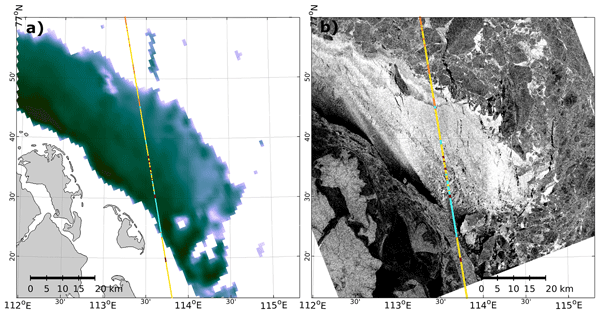
This study evaluates Arctic-wide sea surface height observations by the Surface Water and Ocean Topography (SWOT) mission by comparing them with laser altimetry and radar imagery. Using data from over 550 crossovers, the analysis shows good agreement, with mean absolute water differences of around 5 cm, but also larger discrepancies during winter and early melt. These results illustrate both the potential but also arising problem areas of swath altimetry in the polar regions.
This study evaluates Arctic-wide sea surface height observations by the Surface Water and Ocean...