Articles | Volume 20, issue 1
https://doi.org/10.5194/tc-20-265-2026
© Author(s) 2026. This work is distributed under
the Creative Commons Attribution 4.0 License.
https://doi.org/10.5194/tc-20-265-2026
© Author(s) 2026. This work is distributed under
the Creative Commons Attribution 4.0 License.
Characterizing near-surface permafrost in Utqiaġvik, Alaska, using Electrical Resistivity Tomography and Ground Penetrating Radar

Valentina Ekimova
CORRESPONDING AUTHOR
Department of Environmental Sciences, University of Virginia, Charlottesville, VA 22904-4123, USA
Environmental Institute, University of Virginia, Charlottesville, VA 22902, USA
MacKenzie A. Nelson
Department of Environmental Sciences, University of Virginia, Charlottesville, VA 22904-4123, USA
Taylor Sullivan
U.S. Army Engineer Research and Development Center Cold Regions Research and Engineering Laboratory, Fort Wainwright, AK 99703-0170, USA
Thomas A. Douglas
U.S. Army Engineer Research and Development Center Cold Regions Research and Engineering Laboratory, Fort Wainwright, AK 99703-0170, USA
Howard E. Epstein
Department of Environmental Sciences, University of Virginia, Charlottesville, VA 22904-4123, USA
Matthew G. Jull
Department of Architecture, University of Virginia, Charlottesville, VA 22903, USA
Related authors
No articles found.
David Brodylo, Lauren V. Bosche, Ryan R. Busby, Elias J. Deeb, Thomas A. Douglas, and Juha Lemmetyinen
The Cryosphere, 19, 6127–6148, https://doi.org/10.5194/tc-19-6127-2025, https://doi.org/10.5194/tc-19-6127-2025, 2025
Short summary
Short summary
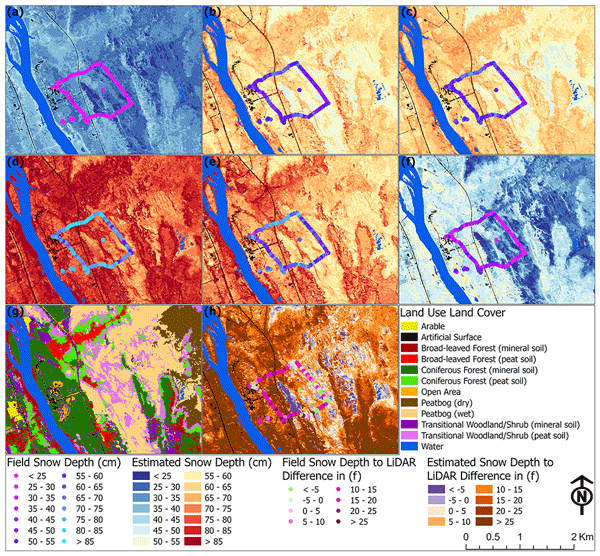
We combined field-based snow depth and snow water equivalent (SWE) measurements, remote sensing data, and machine learning to estimate snow depth and SWE over a 10 km2 local scale area in Sodankylä, Finland. Associations were found for snow depth and SWE with carbon- and mineral-based forest surface soils, alongside dry and wet peatbogs. This approach to upscale field-based snow depth and SWE measurements to a local scale can be used in regions that regularly experience snowfall.
Hailey Webb, Ethan Pierce, Benjamin W. Abbott, William B. Bowden, Yaping Chen, Yating Chen, Thomas A. Douglas, Joel F. Eklof, Eugénie S. Euskirchen, Moritz Langer, Isla H. Myers-Smith, Irina Overeem, Jens Strauss, Katey Walter Anthony, Kang Wang, Matthew A. Whitley, and Merritt R. Turetsky
Earth Syst. Sci. Data Discuss., https://doi.org/10.5194/essd-2025-557, https://doi.org/10.5194/essd-2025-557, 2025
Preprint under review for ESSD
Short summary
Short summary
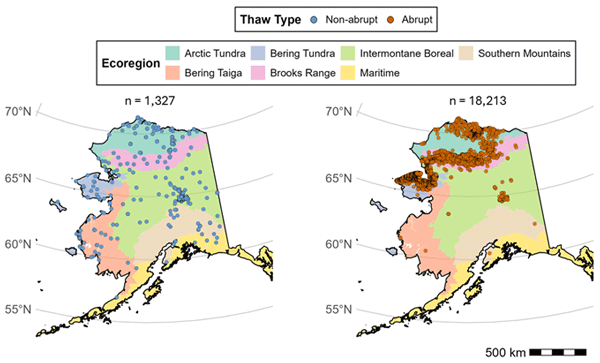
We created a database of 19,540 thawing permafrost sites across Alaska, including both abrupt and non-abrupt thaw features and explored relationships with elevation, slope, and incoming solar radiation. We use the database to show that existing ground ice maps are too coarse to predict abrupt thaw risk. This database can enhance predictions of future thaw, improve greenhouse gas budget calculations, and guide planning and climate adaptation strategies.
Thomas A. Douglas, M. Torre Jorgenson, Taylor Sullivan, and Caiyun Zhang
The Cryosphere, 19, 3991–4009, https://doi.org/10.5194/tc-19-3991-2025, https://doi.org/10.5194/tc-19-3991-2025, 2025
Short summary
Short summary
Permafrost thaw across Earth's high latitudes is leading to dramatic changes in vegetation and hydrology. We undertook a two-decade-long study on the Tanana Flats near Fairbanks, Alaska, to measure permafrost thaw and associated ground surface subsidence via field-based and remote-sensing techniques. The study identified strengths and limitations of the three methods we used to quantify permafrost thaw degradation.
Jinyang Du, K. Arthur Endsley, Kazem Bakian Dogaheh, John Kimball, Mahta Moghaddam, Tom Douglas, Asem Melebari, Sepehr Eskandari, Jinhyuk Kim, Jane Whitcomb, Yuhuan Zhao, and Sophia Henze
EGUsphere, https://doi.org/10.5194/egusphere-2025-3236, https://doi.org/10.5194/egusphere-2025-3236, 2025
Short summary
Short summary
Active layer thickness (ALT) is a sensitive indicator of the thawing Alaskan frozen soil, which may lead to increased greenhouse gas emissions, vegetation changes, and infrastructure damage. This study represents a multi-scale assessment of ALT spatial variations using observations including intensive field sampling, and drone, airborne and satellite remote sensing. Our study allows for improved interpretation of remote sensing and process-based ALT simulations for the changing Arctic.
Anna C. Talucci, Michael M. Loranty, Jean E. Holloway, Brendan M. Rogers, Heather D. Alexander, Natalie Baillargeon, Jennifer L. Baltzer, Logan T. Berner, Amy Breen, Leya Brodt, Brian Buma, Jacqueline Dean, Clement J. F. Delcourt, Lucas R. Diaz, Catherine M. Dieleman, Thomas A. Douglas, Gerald V. Frost, Benjamin V. Gaglioti, Rebecca E. Hewitt, Teresa Hollingsworth, M. Torre Jorgenson, Mark J. Lara, Rachel A. Loehman, Michelle C. Mack, Kristen L. Manies, Christina Minions, Susan M. Natali, Jonathan A. O'Donnell, David Olefeldt, Alison K. Paulson, Adrian V. Rocha, Lisa B. Saperstein, Tatiana A. Shestakova, Seeta Sistla, Oleg Sizov, Andrey Soromotin, Merritt R. Turetsky, Sander Veraverbeke, and Michelle A. Walvoord
Earth Syst. Sci. Data, 17, 2887–2909, https://doi.org/10.5194/essd-17-2887-2025, https://doi.org/10.5194/essd-17-2887-2025, 2025
Short summary
Short summary
Wildfires have the potential to accelerate permafrost thaw and the associated feedbacks to climate change. We assembled a dataset of permafrost thaw depth measurements from burned and unburned sites contributed by researchers from across the northern high-latitude region. We estimated maximum thaw depth for each measurement, which addresses a key challenge: the ability to assess impacts of wildfire on maximum thaw depth when measurement timing varies.
Charles E. Miller, Peter C. Griffith, Elizabeth Hoy, Naiara S. Pinto, Yunling Lou, Scott Hensley, Bruce D. Chapman, Jennifer Baltzer, Kazem Bakian-Dogaheh, W. Robert Bolton, Laura Bourgeau-Chavez, Richard H. Chen, Byung-Hun Choe, Leah K. Clayton, Thomas A. Douglas, Nancy French, Jean E. Holloway, Gang Hong, Lingcao Huang, Go Iwahana, Liza Jenkins, John S. Kimball, Tatiana Loboda, Michelle Mack, Philip Marsh, Roger J. Michaelides, Mahta Moghaddam, Andrew Parsekian, Kevin Schaefer, Paul R. Siqueira, Debjani Singh, Alireza Tabatabaeenejad, Merritt Turetsky, Ridha Touzi, Elizabeth Wig, Cathy J. Wilson, Paul Wilson, Stan D. Wullschleger, Yonghong Yi, Howard A. Zebker, Yu Zhang, Yuhuan Zhao, and Scott J. Goetz
Earth Syst. Sci. Data, 16, 2605–2624, https://doi.org/10.5194/essd-16-2605-2024, https://doi.org/10.5194/essd-16-2605-2024, 2024
Short summary
Short summary
NASA’s Arctic Boreal Vulnerability Experiment (ABoVE) conducted airborne synthetic aperture radar (SAR) surveys of over 120 000 km2 in Alaska and northwestern Canada during 2017, 2018, 2019, and 2022. This paper summarizes those results and provides links to details on ~ 80 individual flight lines. This paper is presented as a guide to enable interested readers to fully explore the ABoVE L- and P-band SAR data.
Kevin R. Barry, Thomas C. J. Hill, Marina Nieto-Caballero, Thomas A. Douglas, Sonia M. Kreidenweis, Paul J. DeMott, and Jessie M. Creamean
Atmos. Chem. Phys., 23, 15783–15793, https://doi.org/10.5194/acp-23-15783-2023, https://doi.org/10.5194/acp-23-15783-2023, 2023
Short summary
Short summary
Ice-nucleating particles (INPs) are important for the climate due to their influence on cloud properties. To understand potential land-based sources of them in the Arctic, we carried out a survey near the northernmost point of Alaska, a landscape connected to the permafrost (thermokarst). Permafrost contained high concentrations of INPs, with the largest values near the coast. The thermokarst lakes were found to emit INPs, and the water contained elevated concentrations.
Thomas A. Douglas, Christopher A. Hiemstra, John E. Anderson, Robyn A. Barbato, Kevin L. Bjella, Elias J. Deeb, Arthur B. Gelvin, Patricia E. Nelsen, Stephen D. Newman, Stephanie P. Saari, and Anna M. Wagner
The Cryosphere, 15, 3555–3575, https://doi.org/10.5194/tc-15-3555-2021, https://doi.org/10.5194/tc-15-3555-2021, 2021
Short summary
Short summary
Permafrost is actively degrading across high latitudes due to climate warming. We combined thousands of end-of-summer active layer measurements, permafrost temperatures, geophysical surveys, deep borehole drilling, and repeat airborne lidar to quantify permafrost warming and thawing at sites across central Alaska. We calculate the mass of permafrost soil carbon potentially exposed to thaw over the past 7 years (0.44 Pg) is similar to the yearly carbon dioxide emissions of Australia.
Cited articles
Annan, A. P., Davis, J. L., and Scott, W. J.: Impulse radar wide angle reflection and refraction sounding in permafrost, Geological Survey of Canada Paper, 75, 335–341, 1975.
Biskaborn, B. K., Smith, S. L., Noetzli, J., Matthes, H., Vieira, G., Streletskiy, D. A., Schoeneich, P., Romanovsky, V. E., Lewkowicz, A. G., Abramov, A., Allard, M., Boike, J., Cable, W. L., Christiansen, H. H., Delaloye, R., Diekmann, B., Drozdov, D., Etzelmüller, B., Grosse, G., Guglielmin, M., Ingeman-Nielsen, T., Isaksen, K., Ishikawa, M., Johansson, M., Johannsson, H., Joo, A., Kaverin, D., Kholodov, A., Konstantinov, P., Kröger, T., Lambiel, C., Lanckman, J.-P., Luo, D., Malkova, G., Meiklejohn, I., Moskalenko, N., Oliva, M., Phillips, M., Ramos, M., Sannel, A. B. K., Sergeev, D., Seybold, C., Skryabin, P., Vasiliev, A., Wu, Q., Yoshikawa, K., Zheleznyak, M., and Lantuit, H.: Permafrost is warming at a global scale, Nat. Commun., 10, 264, https://doi.org/10.1038/s41467-018-08240-4, 2019.
Black, R. F.: Gubik formation of Quaternary age in northern Alaska, in: Exploration of naval petroleum reserve No. 4 and adjacent areas, Northern Alaska, 1944–53. Part 2. Regional studies, US Government Printing Office, Washington, US, 1964.
Blanchy, G., Saneiyan, S., Boyd, J., McLachlan, P., and Binley, A.: ResIPy, an intuitive open source software for complex geoelectrical inversion/modeling, Comput. Geosci., 137, 104423, https://doi.org/10.1016/j.cageo.2020.104423, 2020.
Bobrov, N., Titov, A., and Krekhov, A.: Delineation of underbed talik in the Lena River delta with the use of geophysics – results of GPR, TEM and ERT measurements, in: Theory and Methods of Polar Science: Proceedings of International youth scientific conference on the polar geodesy, glaciology, hydrology and geophysics, edited by: Popov, S. V., Gavrilkina, S. A., and Pryakhina, G. V., St. Petersburg State University, St. Petersburg, Russia, 60–68, ISBN 978-5-9651-1154-1, 2018.
Boike, J., Chadburn, S., Martin, J., Zwieback, S., Althuizen, I. H. J., Anselm, N., Cai, L., Coulombe, S., Lee, H., Liljedahl, A. K., Schneebeli, M., Sjöberg, Y., Smith, N., Smith, S. L., Streletskiy, D. A., Stuenzi, S. M., Westermann, S., and Wilcox, E. J.: Standardized monitoring of permafrost thaw: a user-friendly, multiparameter protocol, Arct. Sci., 8, 153–182, https://doi.org/10.1139/as-2021-0007, 2022.
Brandt, O., Langley, K., Kohler, J., and Hamran, S. E.: Detection of buried ice and sediment layers in permafrost using multi-frequency Ground Penetrating Radar: A case examination on Svalbard, Remote Sens. Environ., 111, 212–227, https://doi.org/10.1016/j.rse.2007.03.025, 2007.
Brown, J.: Ionic concentration gradients in permafrost, Barrow, Alaska, Corps of Engineers, US Army, Cold Regions Research and Engineering Laboratory, Hanover, US, Research Report 272, 25 pp., 1969.
Buddo, I., Misyurkeeva, N., Shelokhov, I., Shein, A., Sankov, V., Rybchenko, A., Dobrynina, A., Nezhdanov, A., Parfeevets, A., Lebedeva, M., Kadetova, A., Smirnov, A., Gutareva, O., Chernikh, A., Shashkeeva, L., and Kraev, G.: Modeling of Explosive Pingo-like Structures and Fluid-Dynamic Processes in the Arctic Permafrost: Workflow Based on Integrated Geophysical, Geocryological, and Analytical Data, Remote Sens. (Basel), 16, 2948, https://doi.org/10.3390/rs16162948, 2024.
Bunnell, F. L., MacLean Jr., S. F., and Brown, J.: Barrow, Alaska, USA, Ecological Bulletins, 73–124, 1975.
Chen, L., Fortier, D., McKenzie, J. M., and Sliger, M.: Impact of heat advection on the thermal regime of roads built on permafrost, Hydrol. Process., 34, 1647–1664, https://doi.org/10.1002/hyp.13688, 2020.
Chuvilin, E., Sokolova, N., and Bukhanov, B.: Changes in Unfrozen Water Contents in Warming Permafrost Soils, Geosciences (Basel), 12, 253, https://doi.org/10.3390/geosciences12060253, 2022.
Dafflon, B., Hubbard, S. S., Ulrich, C., Peterson, J. E., Wainwright, H., and Wu, Y.: Estimating active layer, ice-wedge, and permafrost property distributions in Arctic ecosystem using electrical conductivity imaging, in: SEG Technical Program Expanded Abstracts 2013, 4444–4449, https://doi.org/10.1190/segam2013-0787.1, 2013.
Dafflon, B., Soom, F., Peterson, J., and Hubbard, S.: Frost Table Elevation across a Low-Centered and a High-Centered Polygon, Mapped using Ground Penetrating Radar, Utqiagvik (Barrow), Alaska, 2015, https://doi.org/10.5440/1575055, 2020.
Daniels, D.: Ground Penetrating Radar, 2nd edn., edited by: Daniels, D. J., Institution of Engineering and Technology, London, UK, 752 pp., https://doi.org/10.1049/PBRA015E, 2004.
Douglas, T. A., Torre Jorgenson, M., Brown, D. R. N., Campbell, S. W., Hiemstra, C. A., Saari, S. P., Bjella, K., and Liljedahl, A. K.: Degrading permafrost mapped with electrical resistivity tomography, airborne imagery and LiDAR, and seasonal thaw measurements, Geophysics, 81, WA71–WA85, https://doi.org/10.1190/GEO2015-0149.1, 2016.
Douglas, T. A., Jorgenson, M. T., Sullivan, T., and Zhang, C.: Comparing thaw probing, electrical resistivity tomography, and airborne lidar to quantify lateral and vertical thaw in rapidly degrading boreal permafrost, The Cryosphere, 19, 3991–4009, https://doi.org/10.5194/tc-19-3991-2025, 2025.
Edemsky, D. E., Tumskoy, V. E., and Prokopovich, I. V.: Ground Penetrating Radar Survey of Arctic Polygonal Wedge Structures, Russian Geology and Geophysics, 65, 767–778, https://doi.org/10.2113/RGG20234628, 2024.
Ekimova, V., Sullivan, T., Nelson, M., Epstein, H., Douglas, T., and Jull, M.: Utqiaġvik permafrost geophysics datasets (2021–2023), Zenodo [data set], https://doi.org/10.5281/zenodo.17096203, 2025.
EPA: Climate Change Indicators: Permafrost, https://permafrost.gi.alaska.edu/sites/default/files/TSP_manual.pdf (last access: 29 July 2025), December 2024.
ESRI: Satellite imagery basemap, ArcGIS Online (accessed via QGIS), https://www.arcgis.com/home/item.html?id=30e5fe3149c34df1ba922e6f5bbf808f (last access: 20 December 2024), 2024.
Farquharson, L. M., Mann, D. H., Grosse, G., Jones, B. M., and Romanovsky, V. E.: Spatial distribution of thermokarst terrain in Arctic Alaska, Geomorphology, 273, 116–133, https://doi.org/10.1016/j.geomorph.2016.08.007, 2016.
Fortier, P., Young, N. L., Lemieux, J., Walvoord, M. A., and Fortier, R.: Long-Term, High-Resolution Permafrost Monitoring Reveals Coupled Energy Balance and Hydrogeologic Controls on Talik Dynamics Near Umiujaq (Nunavik, Québec, Canada), Water Resour. Res., 59, https://doi.org/10.1029/2022WR032456, 2023.
Fortier, R., LeBlanc, A.-M., and Yu, W.: Impacts of permafrost degradation on a road embankment at Umiujaq in Nunavik (Quebec), Canada, Canadian Geotechnical Journal, 48, 720–740, https://doi.org/10.1139/t10-101, 2011.
Frolov, V.: Some Problems of Buildings and Structures Service Within Permafrost Area, Procedia Eng., 165, 385–393, https://doi.org/10.1016/j.proeng.2016.11.714, 2016.
Grosse, G., Romanovsky, V., Jorgenson, T., Anthony, K. W., Brown, J., and Overduin, P. P.: Vulnerability and Feedbacks of Permafrost to Climate Change, Eos, Transactions American Geophysical Union, 92, 73–74, https://doi.org/10.1029/2011EO090001, 2011.
Gusmeroli, A., Liu, L., Schaefer, K., Zhang, T., Schaefer, T., and Grosse, G.: Active Layer Stratigraphy and Organic Layer Thickness at a Thermokarst Site in Arctic Alaska Identified Using Ground Penetrating Radar, Arct. Antarct. Alp. Res., 47, 195–202, https://doi.org/10.1657/AAAR00C-13-301, 2015.
Hauck, C. and Kneisel, C.: Applied Geophysics in Periglacial Environments, edited by: Hauck, C. and Kneisel, C., Cambridge University Press, 248 pp., https://doi.org/10.1017/CBO9780511535628, 2008.
Herring, T., Lewkowicz, A. G., Hauck, C., Hilbich, C., Mollaret, C., Oldenborger, G. A., Uhlemann, S., Farzamian, M., Calmels, F., and Scandroglio, R.: Best practices for using electrical resistivity tomography to investigate permafrost, Permafr. Periglac. Process., 34, 494–512, https://doi.org/10.1002/ppp.2207, 2023.
Hinkel, K. and Nelson, F.: Spatial and temporal patterns of active layer thickness at Circumpolar Active Layer Monitoring (CALM) sites in northern Alaska, 1995–2000, J. Geophys. Res.-Atmos., 108, https://doi.org/10.1029/2001JD000927, 2003.
Hinkel, K. M. and Hurd, J. K.: Permafrost Destabilization and Thermokarst Following Snow Fence Installation, Barrow, Alaska, U.S.A., Arct. Antarct. Alp. Res., 38, 530–539, https://doi.org/10.1657/1523-0430(2006)38[530:PDATFS]2.0.CO;2, 2006.
Hinkel, K. M., Doolittle, J. A., Bockheim, J. G., Nelson, F. E., Paetzold, R., Kimble, J. M., and Travis, R.: Detection of subsurface permafrost features with ground-penetrating radar, Barrow, Alaska, Permafr. Periglac. Process., 12, 179–190, https://doi.org/10.1002/ppp.369, 2001.
Hjort, J., Streletskiy, D., Doré, G., Wu, Q., Bjella, K., and Luoto, M.: Impacts of permafrost degradation on infrastructure, Nat. Rev. Earth Environ., 3, 24–38, https://doi.org/10.1038/s43017-021-00247-8, 2022.
Hoekstra, P., Sellmann, P. V., and Delaney, A.: Ground and airborne resistivity surveys of permafrost near Fairbanks, Alaska, Geophysics, 40, 641–656, https://doi.org/10.1190/1.1440555, 1975.
Hopkins, D. M. and Karlstrom, T. N.: Permafrost and ground water in Alaska, U.S. Geological Survey Professional Paper (264-F), US Government Printing Office, Washington, DC, US, 1955.
Ingeman-Nielsen, T., Tomaškovičo vá, S., Larsen, S. H., Aparício, S. F., and Gori, P.: Surface Geophysical Measurements for Locating and Mapping Ice-Wedges, in: Cold Regions Engineering 2012: Sustainable Infrastructure Development in a Changing Cold Environment, American Society of Civil Engineers, Reston, VA, 634–643, https://doi.org/10.1061/9780784412473.063, 2012.
Iwahana, G., Cooper, Z. S., Carpenter, S. D., Deming, J. W., and Eicken, H.: Intra-ice and intra-sediment cryopeg brine occurrence in permafrost near Utqiaġvik (Barrow), Permafr. Periglac. Process., 32, 427–446, https://doi.org/10.1002/ppp.2101, 2021.
Jafarov, E. E., Parsekian, A. D., Schaefer, K., Liu, L., Chen, A. C., Panda, S. K., and Zhang, T.: Estimating active layer thickness and volumetric water content from ground penetrating radar measurements in Barrow, Alaska, Geosci. Data J., 4, 72–79, https://doi.org/10.1002/gdj3.49, 2017.
Jol, H. M.: Ground Penetrating Radar Theory and Applications, edited by: Jol, H. M., Elsevier, Slovenia, 544 pp., ISBN 9780444533487/0444533486, 2008.
Jorgenson, M. T., Racine, C. H., Walters, J. C., and Osterkamp, T. E.: Permafrost degradation and ecological changes associated with a warming climate in central Alaska, Clim. Change, 48, 551–579, https://doi.org/10.1023/A:1005667424292, 2001.
Jorgenson, M. T., Yoshikawa, K., Kanevskiy, M., Shur, Y., Romanovsky, V., Marchenko, S., Jones, B., Brown, J., and Jones, B.: Permafrost characteristics of Alaska, in: Ninth international conference on permafrost, 29 June–3 July 2008, Fairbanks, Alaska, edited by: Kane, D. L. and Hinkel, K. M., vol. 3, 121–122, ISBN 978-0-9800179-2-2, 2008.
Jorgenson, M. T., Kanevskiy, M. Z., Jorgenson, J. C., Liljedahl, A., Shur, Y., Epstein, H., Kent, K., Griffin, C. G., Daanen, R., Boldenow, M., Orndahl, K., Witharana, C., and Jones, B. M.: Rapid transformation of tundra ecosystems from ice-wedge degradation, Glob Planet Change, 216, 103921, https://doi.org/10.1016/j.gloplacha.2022.103921, 2022.
Kanevskiy, M., Shur, Y., Jorgenson, T., Brown, D. R. N., Moskalenko, N., Brown, J., Walker, D. A., Raynolds, M. K., and Buchhorn, M.: Degradation and stabilization of ice wedges: Implications for assessing risk of thermokarst in northern Alaska, Geomorphology, 297, 20–42, https://doi.org/10.1016/j.geomorph.2017.09.001, 2017.
Kim, K., Lee, J., Ju, H., Jung, J. Y., Chae, N., Chi, J., Kwon, M. J., Lee, B. Y., Wagner, J., and Kim, J.-S.: Time-lapse electrical resistivity tomography and ground penetrating radar mapping of the active layer of permafrost across a snow fence in Cambridge Bay, Nunavut Territory, Canada: correlation interpretation using vegetation and meteorological data, Geosciences Journal, 25, 877–890, https://doi.org/10.1007/s12303-021-0021-7, 2021.
Kim, K., Ju, H., Chi, J., Jung, J. Y., Nam, S., Park, S.-J., Dafflon, B., Lee, J., and Kim, W.-K.: Determination of Ground Subsidence Around Snow Fences in the Arctic Region, Lithosphere, 2025, https://doi.org/10.2113/2025/lithosphere_2024_215, 2025.
Kneisel, C., Hauck, C., and Mühll, D. V.: Permafrost below the Timberline Confirmed and Characterized by Geoelectrical Resistivity Measurements, Bever Valley, Eastern Swiss Alps, Permafr. Periglac. Process., 11, 295–304, https://doi.org/10.1002/1099-1530(200012)11:4<295::AID-PPP353>3.0.CO;2-L, 2000.
Kneisel, C., Hauck, C., Fortier, R., and Moorman, B.: Advances in geophysical methods for permafrost investigations, Permafr. Periglac. Process., 19, 157–178, https://doi.org/10.1002/ppp.616, 2008.
Kneisel, C., Emmert, A., and Kästl, J.: Application of 3D electrical resistivity imaging for mapping frozen ground conditions exemplified by three case studies, Geomorphology, 210, 71–82, https://doi.org/10.1016/j.geomorph.2013.12.022, 2014.
Kudryavtsev, V. A.: Obshcheye merzlotovedeniye (geokriologiya) [General permafrost science], 2nd edn., Moscow State University Press, Moscow, Russia, 464 pp., 1978 (in Russian).
Kvon, D. A., Modin, I. N., Shevnin, V. A., Makarov, D. V., and Skobelev, A. D.: Electrical resistivity tomography for identification of frozen and cold saline rocks, Earth`s Cryosphere, XXIII, 3–10, https://doi.org/10.21782/EC2541-9994-2019-3(3-10), 2019.
Leger, E., Dafflon, B., Soom, F., Peterson, J., Ulrich, C., and Hubbard, S.: Quantification of Arctic Soil and Permafrost Properties Using Ground-Penetrating Radar and Electrical Resistivity Tomography Datasets, IEEE J. Sel. Top. Appl. Earth Obs., 10, 4348–4359, https://doi.org/10.1109/JSTARS.2017.2694447, 2017.
Liu, Z.: The Variation Characteristics of Temperature in Barrow Alaska During 1925–2018, IOP Conf. Ser. Earth Environ. Sci., 546, 032056, https://doi.org/10.1088/1755-1315/546/3/032056, 2020.
Loke, M. H., Rucker, D. F., Chambers, J. E., Wilkinson, P. B., and Kuras, O.: Electrical Resistivity Surveys and Data Interpretation, in: Encyclopedia of solid earth geophysics, 344–350, https://doi.org/10.1007/978-3-030-58631-7_46, 2021.
McCarthy, K. A.: Overview of environmental and hydrogeologic conditions at Barrow, Alaska, Open-File Report 94-322, Open-File Report, Anchorage, Alaska, US, 21 pp., https://doi.org/10.3133/ofr94322, 1994.
Moon, T. A., Druckenmiller, M. L., and Thoman, R. L.: Arctic Report Card 2024, 116 pp., https://doi.org/10.25923/b7c7-6431, 2024.
Moorman, B., Robinson, S., and Burgess, M.: Imaging near-surface permafrost structure and characteristics with Ground-Penetrating Radar, CSEG Recorder, 32, 1–8, 2007.
Moorman, B. J., Robinson, S. D., and Burgess, M. M.: Imaging periglacial conditions with ground-penetrating radar, Permafr. Periglac. Process., 14, 319–329, https://doi.org/10.1002/ppp.463, 2003.
Munroe, J. S., Doolittle, J. A., Kanevskiy, M. Z., Hinkel, K. M., Nelson, F. E., Jones, B. M., Shur, Y., and Kimble, J. M.: Application of ground-penetrating radar imagery for three-dimensional visualisation of near-surface structures in ice-rich permafrost, Barrow, Alaska, Permafr. Periglac. Process., 18, 309–321, https://doi.org/10.1002/ppp.594, 2007.
Nyland, K. E., Shiklomanov, N. I., Streletskiy, D. A., Nelson, F. E., Klene, A. E., and Kholodov, A. L.: Long-term Circumpolar Active Layer Monitoring (CALM) program observations in Northern Alaskan tundra, Polar Geography, 44, 167–185, https://doi.org/10.1080/1088937X.2021.1988000, 2021.
Olenchenko, V. V., Gagarin, L. A., Khristoforov, I. I., Kolesnikov, A. B., and Efremov, V. S.: The structure of a site with thermo-suffosion processes within Bestyakh terrace of the Lena River, according to geophysical data, Earth's Cryosphere, XXI, 14–23, https://doi.org/10.21782/EC1560-7496-2017-5(14-23), 2017.
Osterkamp, T. E. and Payne, M. W.: Estimates of permafrost thickness from well logs in northern Alaska, Cold Reg. Sci. Technol., 5, 13–27, https://doi.org/10.1016/0165-232X(81)90037-9, 1981.
Pace, F., Vergnano, A., Godio, A., Romano, G., Capozzoli, L., Baneschi, I., Doveri, M., and Santilano, A.: A new repository of electrical resistivity tomography and ground-penetrating radar data from summer 2022 near Ny-Ålesund, Svalbard, Earth Syst. Sci. Data, 16, 3171–3192, https://doi.org/10.5194/essd-16-3171-2024, 2024.
Plattner, A. M.: GPRPy: Open-source ground-penetrating radar processing and visualization software, The Leading Edge, 39, 332–337, https://doi.org/10.1190/tle39050332.1, 2020.
Popov, A. I.: Merzlotnyye yavleniya v zemnoy kore (kriolitologiya) [Permafrost phenomena in the earth's crust], Moscow State University Publishing House, Moscow, 304 pp., 1967 (in Russian).
QGIS Development Team: QGIS Geographic Information System, Open Source Geospatial Foundation Project, http://qgis.osgeo.org (last access: 29 July 2025), 2024.
Qi, J., Yao, X., Yu, F., and Liu, Y.: Study on thaw consolidation of permafrost under roadway embankment, Cold Reg. Sci. Technol., 81, 48–54, https://doi.org/10.1016/j.coldregions.2012.04.007, 2012.
Romanovsky, V. E., Smith, S. L., and Christiansen, H. H.: Permafrost thermal state in the polar Northern Hemisphere during the international polar year 2007–2009: a synthesis, Permafr. Periglac. Process., 21, 106–116, https://doi.org/10.1002/ppp.689, 2010.
Saintenoy, A., Pessel, M., Grenier, C., Léger, E., Danilov, K., Bazhin, K., Khristoforov, I., Séjourné, A., and Konstantinov, P.: Coupling GPR and ERT data interpretation to study the thermal imprint of a river in Syrdakh (Central Yakutia, Russia), in: 18th International Conference on Ground Penetrating Radar, Golden, Colorado, 14–19 June 2020, 93–96, https://doi.org/10.1190/gpr2020-025.1, 2020.
Schneider von Deimling, T., Lee, H., Ingeman-Nielsen, T., Westermann, S., Romanovsky, V., Lamoureux, S., Walker, D. A., Chadburn, S., Trochim, E., Cai, L., Nitzbon, J., Jacobi, S., and Langer, M.: Consequences of permafrost degradation for Arctic infrastructure – bridging the model gap between regional and engineering scales, The Cryosphere, 15, 2451–2471, https://doi.org/10.5194/tc-15-2451-2021, 2021.
Sellmann, P. V. and Brown, J.: Stratigraphy and diagenesis of perennially frozen sediments in the Barrow, Alaska region, in: The North American Contribution to the Second International Conference on Permafrost, Yakutsk, U.S.S.R., 13–28 July 1973, 171–181, 1973.
Shein, A. N., Kraev, G. N., and Kamnev, Ya. K.: Geophysical research for organization and service of the regional permafrost monitoring network in the Yamalo-Nenets Autonomous District (Published in Russian), Inter Expo Geo-Siberia, 2, 321–327, 2022.
Shiklomanov, N. I., Streletskiy, D. A., Nelson, F. E., Hollister, R. D., Romanovsky, V. E., Tweedie, C. E., Bockheim, J. G., and Brown, J.: Decadal variations of active-layer thickness in moisture-controlled landscapes, Barrow, Alaska, J. Geophys. Res.-Biogeo., 115, https://doi.org/10.1029/2009JG001248, 2010.
Shumsky, P. A.: Podzemnyye l'dy [Ground Ices], in: Osnovy geokriologii (merzlotovedenija). Obshchaya geokriologiya [Fundamentals of geocryology, ðt 1, General geocryology], Academy of Sciences of the USSR, Moscow, Russia, 274–326, 1959 (in Russian).
Sjöberg, Y., Marklund, P., Pettersson, R., and Lyon, S. W.: Geophysical mapping of palsa peatland permafrost, The Cryosphere, 9, 465–478, https://doi.org/10.5194/tc-9-465-2015, 2015.
Spero, T. L., Briggs, N. L., and Boldrick, L.: Environmental Impacts from Projected Permafrost Thaw in Alaska: Defining Knowledge Gaps, Data Needs, and Research Priorities, Weather, Climate, and Society, 17, 325–337, https://doi.org/10.1175/WCAS-D-24-0150.1, 2025.
Streletskiy, D. A., Clemens, S., Lanckman, J.-P., and Shiklomanov, N. I.: The costs of Arctic infrastructure damages due to permafrost degradation, Environ. Res. Lett., 18, 015006, https://doi.org/10.1088/1748-9326/acab18, 2023.
Tourei, A., Ji, X., Rocha dos Santos, G., Czarny, R., Rybakov, S., Wang, Z., Hallissey, M., Martin, E. R., Xiao, M., Zhu, T., Nicolsky, D., and Jensen, A.: Mapping Permafrost Variability and Degradation Using Seismic Surface Waves, Electrical Resistivity, and Temperature Sensing: A Case Study in Arctic Alaska, J. Geophys. Res.-Earth Surf., 129, e2023JF007352, https://doi.org/10.1029/2023JF007352, 2024.
Victor, S.: Detection of increase in air temperature in Barrow, AK, USA, through the use of extreme value indices and its impact on the permafrost active layer thickness, Theor. Appl. Climatol., 148, 79–89, https://doi.org/10.1007/s00704-021-03919-z, 2022.
Walker, D. A., Raynolds, M. K., Kanevskiy, M. Z., Shur, Y. S., Romanovsky, V. E., Jones, B. M., Buchhorn, M., Jorgenson, M. T., Šibík, J., Breen, A. L., Kade, A., Watson-Cook, E., Matyshak, G., Bergstedt, H., Liljedahl, A. K., Daanen, R. P., Connor, B., Nicolsky, D., and Peirce, J. L.: Cumulative impacts of a gravel road and climate change in an ice-wedge-polygon landscape, Prudhoe Bay, Alaska, Arct. Sci., 8, 1040–1066, https://doi.org/10.1139/as-2021-0014, 2022.
Westermann, S., Wollschläger, U., and Boike, J.: Monitoring of active layer dynamics at a permafrost site on Svalbard using multi-channel ground-penetrating radar, The Cryosphere, 4, 475–487, https://doi.org/10.5194/tc-4-475-2010, 2010.
Wollschläger, U., Gerhards, H., Yu, Q., and Roth, K.: Multi-channel ground-penetrating radar to explore spatial variations in thaw depth and moisture content in the active layer of a permafrost site, The Cryosphere, 4, 269–283, https://doi.org/10.5194/tc-4-269-2010, 2010.
Yershov, E. D.: General Geocryology, edited by: Williams, P. J., Cambridge university press, Cambridge, UK, 608 pp., 2004.
Yoshikawa, K., Leuschen, C., Ikeda, A., Harada, K., Gogineni, P., Hoekstra, P., Hinzman, L., Sawada, Y., and Matsuoka, N.: Comparison of geophysical investigations for detection of massive ground ice (pingo ice), J. Geophys. Res.-Planets, 111, https://doi.org/10.1029/2005JE002573, 2006.
Zhang, T., Barry, R. G., Knowles, K., Heginbottom, J. A., and Brown, J.: Statistics and characteristics of permafrost and ground-ice distribution in the Northern Hemisphere, Polar Geography, 23, 132–154, https://doi.org/10.1080/10889379909377670, 1999.
Short summary
Permafrost beneath Arctic communities is highly sensitive to surface heat and moisture. Geophysics at four Utqiaġvik (Alaska) sites shows that infrastructure – buildings, roads, snow fences – reshapes snow and drainage, redirecting heat and water. Thaw deepens near disturbed ground, while undisturbed, vegetated terrain stays shallower or heaves. Local land use and surface conditions can outweigh regional climate signals, guiding design, maintenance, and risk planning for Arctic infrastructure.
Permafrost beneath Arctic communities is highly sensitive to surface heat and moisture....